
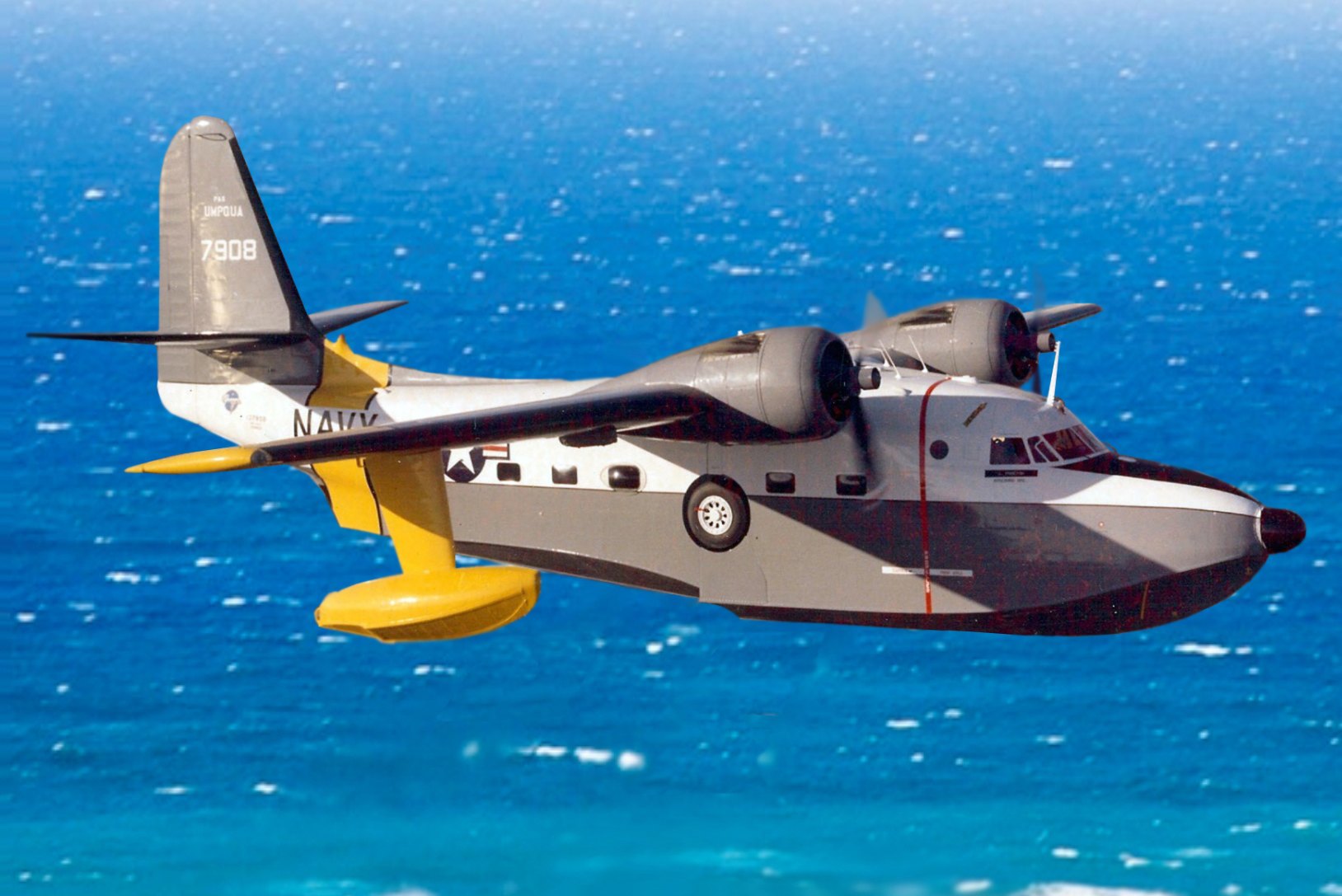
Grumman HU-16 Albatross
The Rescue Amphibian
Grumman’s big amphibian landed on the open sea to pull airmen out of the water in Korea and Vietnam, flew for the US Air Force, Navy and Coast Guard and some twenty other nations, and still flies in private hands.
The HU-16 Albatross: how Grumman built a flying boat that could land where the airmen were
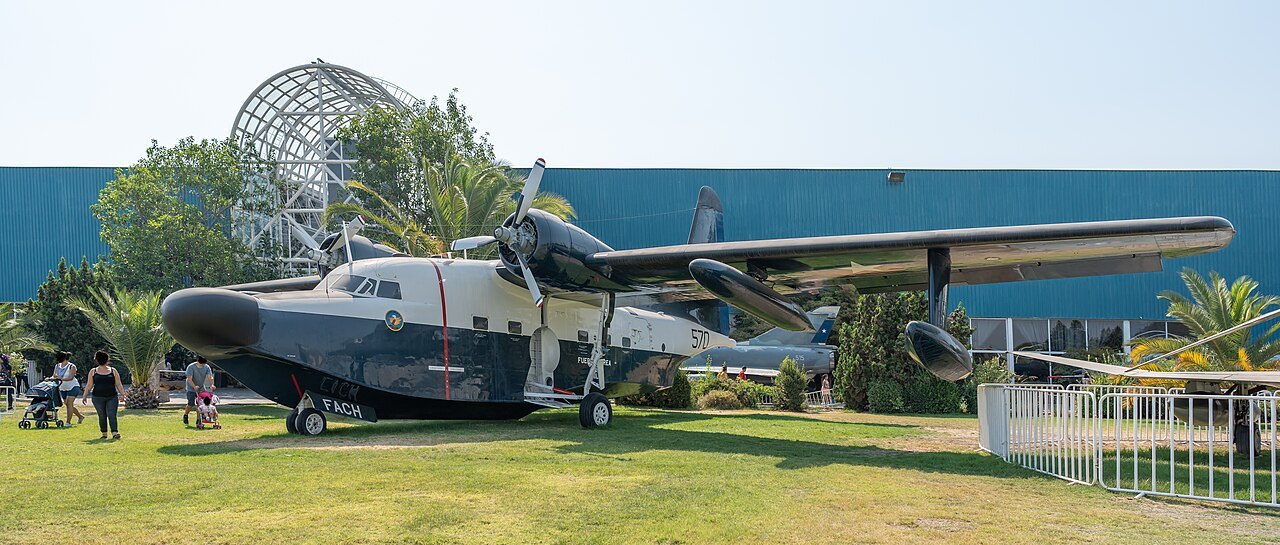
The Albatross began as a US Navy requirement for an amphibious utility aircraft to replace the wartime Grumman JRF Goose, one that could also work from snow and ice on skis. Grumman scaled up the ideas of its smaller Mallard, gave the new design a deep-V hull and a long keel so it could alight on the open ocean, and hung it from a high wing with two Wright R-1820 Cyclone radials. The prototype flew on 24 October 1947. The Navy ordered it, and so did the newly independent US Air Force, which wanted an air-sea rescue machine for its Air Rescue Service. The Coast Guard followed. Each service gave it a different designation, SA-16, UF-1 or JR2F, until a common system made them all HU-16s in 1962.
Its finest hour came quickly. In Korea the Air Force’s SA-16s flew into coastal waters and river estuaries, often in hostile territory, to pick up downed aircrew; the National Museum of the US Air Force credits the type with rescuing nearly 1,000 UN personnel during the war. From 1955 an improved version with a wing 16.5 ft longer, bigger ailerons and a larger tail appeared, and from 1957 many early aircraft were rebuilt to this HU-16B standard. Over Southeast Asia the Albatross went back to work, landing in the Gulf of Tonkin to recover airmen who had ejected, sometimes taxiing for miles across rough water when the sea was too high for a take-off.
Grumman built 466 Albatrosses between 1949 and 1961, and they went to the air forces and navies of some twenty countries, from Argentina, Brazil and Canada to Greece, Indonesia, Italy, Japan, Norway, Pakistan, Spain and Thailand. Helicopters with longer reach and air-refuelling eventually took over the rescue role, and the Coast Guard’s last Albatross left service in 1983. The Hellenic Air Force kept its fleet into the 1990s. Many retired machines found new lives: as island airliners in Micronesia, as 28-seat G-111 airliners for Chalk’s in Florida, and as privately owned amphibians that still land on lakes and bays today. Museums from Dayton and Tucson to Dekelia and Vigna di Valle keep others on display, many in the bright rescue colours they wore when their crews were the last hope of a man in the water.
01The HU-16 in Korea and Vietnam: rescues under fire
The Air Force went to war in Korea with its new SA-16As still being delivered. Grumman built 297 A-models for the USAF, mostly for the Air Rescue Service, and they were spread through rescue squadrons in Japan, Korea and the Philippines. Their job was to be on station when a fighter or bomber went down in the sea, and to land beside the survivors. The work took them into estuaries and along coasts held by the enemy. The National Museum of the US Air Force credits the type with saving nearly 1,000 UN personnel in Korea.
Fifteen years later the long-wing HU-16B was flying combat rescue again, this time with the Aerospace Rescue and Recovery Service over the Gulf of Tonkin. Open-sea landings close to a hostile shore were dangerous: on 14 March 1966 an HU-16B that had landed to pick up the crew of an F-4C was hit by mortar fire from the shore and sank, and two of its crew died. The navigator, Captain Donald Price, received the Air Force Cross. Long-range rescue helicopters steadily took over the mission, and the Air Force retired its last Albatross in July 1973.
02The HU-16 after the military: island airliner and private amphibian
The Albatross was never built for the civil market, but its seaworthiness made it valuable wherever runways were scarce. In the 1950s Transocean Air Lines flew SA-16s under contract to the US Department of the Interior between the islands of the Trust Territory of the Pacific, and Pan Am and then Continental’s Air Micronesia kept them flying to Yap, Palau, Chuuk and Pohnpei until island runways were built around 1970.
In Florida, Grumman St Augustine marketed a civil conversion approved under the US transport category rules, the G-111, with seating for 28 passengers. Thirteen were certificated, and Chalk’s International Airline flew them from Miami, but the type’s operating economics were poor and most ended up in storage. Other ex-military Albatrosses passed to private owners. In 1997 N44RD, flown by Bay Area pilots Andy Macfie and Reid Dennis, became the first Albatross to fly a single mission around the world, as camera and safety aircraft for a flight recreating Amelia Earhart’s last journey.
What makes the HU-16 Albatross special
A hull built for the open sea
Most amphibians are happiest on sheltered water. The Albatross was designed for the ocean. Its deep-V hull and long keel let it alight in waves around 4 ft high as a matter of routine and in worse conditions when lives depended on it. Getting off again was the hard part: in seas of 8 to 10 ft crews relied on jet-assisted take-off bottles strapped to the fuselage to break the hull free of the water. Reversible propellers shortened the landing run and helped the pilot manoeuvre on the surface, where there was no water rudder and steering came from differential engine power.
Land, water, snow and ice
The original Navy requirement asked for an aircraft that could work from snow and ice as well as water and land. The Albatross had retractable wheels that folded into wells in the side of the hull, and Grumman offered a Triphibian conversion with a hydraulic keel skid and small skids on the wingtip floats so it could land directly on ice and snow. Navy ski-equipped versions, designated LU-16C, worked in polar regions, and the Antarctic Development Squadron Six was among its users.
Reach: Alaska to Japan non-stop
Range mattered in a rescue aircraft that might have to wait over a ditching for hours. The Albatross carried most of its fuel in the wings, could take more in the tip floats and could carry two 300 US gal drop tanks under the wings. Fully fuelled it could cover roughly 3,000 miles, enough for non-stop flights between Alaska and Japan. Its radar first sat in a pod on the left wing, where the fuselage blocked its view to the right, and was moved to the nose on later aircraft. In 1973 a USAF crew took one to 32,883 ft, a world record for twin-engined amphibians.
03The HU-16’s cockpit and systems: cables, pulleys and a lot of muscle
The Albatross was a big aircraft with manual flight controls. Its reversible control system used cables, pulleys and pushrods; only the rudder had an optional hydraulic boost, used mainly for take-off and landing and to ease pedal forces with an engine out. Electric trim tabs on the elevators, rudder and left aileron helped the crew on long patrols, and the elevator trims were duplicated for redundancy. The flaps were electrically controlled and hydraulically actuated.
The Hamilton Standard three-bladed propellers were constant-speed, fully feathering and reversible, with an oil cooler in each hub so that propeller control was available immediately after engine start. On the water the main wheel wells flooded and drained again through the rear bulkhead during the take-off run, and a small window let the crew inspect the partly flooded nose-wheel bay. Typical crews numbered four to six, with room for about ten passengers or stretchers.
Grumman HU-16B Albatross specifications
Specifications
- Crew
- 4–6, plus up to about 10 passengers or stretchers
- Length
- 19.15 m (62 ft 10 in)
- Wingspan
- 29.46 m (96 ft 8 in); early short-wing aircraft 24.43 m (80 ft 2 in)
- Height
- 7.87 m (25 ft 10 in)
- Empty weight
- 10,380 kg (22,883 lb)
- Max take-off weight
- about 16,330–17,010 kg (36,000–37,500 lb) depending on source
- Powerplant
- 2 × Wright R-1820-76A Cyclone 9 radials, 1,425 hp each for take-off
- Maximum speed
- 380–400 km/h (236–250 mph) depending on source
- Cruise speed
- about 200 km/h (124 mph)
- Range
- up to about 4,590 km (2,850 mi) with maximum fuel; the USAF quotes 2,655 km (1,650 mi)
- Service ceiling
- 6,550 m (21,500 ft)
- Climb rate
- 7.4 m/s (1,450 ft/min)
- Armament
- None as standard; wing racks for drop tanks or stores, and some export aircraft were armed
Costs & production
- Unit cost
- No reliable contract figure found in the sources used
- Cost per flight hour
- No official figure. A rough estimate for a privately operated Albatross today is several thousand US dollars per hour, based on two large radial engines with high fuel and oil burn and the heavy maintenance of an ageing flying-boat hull; treat this as an order of magnitude, not a quoted rate
- Production
- 466 built by Grumman at Bethpage, New York, 1949–1961; 297 A-models delivered to the USAF
- Programme
- Prototype first flight 24 October 1947; long-wing version from 1955; redesignated HU-16 in 1962; last USAF flight 1973, last US Coast Guard flight 1983
04The HU-16’s variants: SA-16, UF, CSR-110 and G-111
- XJR2F-1: two Navy prototypes, briefly known as the Pelican.
- SA-16A / HU-16A: original short-wing USAF rescue version.
- SA-16B / HU-16B: long-wing version with 16.5 ft more span, larger ailerons and tail; many A-models converted from 1957.
- UF-1 / HU-16C, LU-16C, TU-16C: US Navy utility, ski-equipped and navigation-trainer versions.
- UF-2 / HU-16D: long-wing Navy and export version, including aircraft for West Germany.
- UF-2G / HU-16E: long-wing US Coast Guard search-and-rescue version.
- SHU-16B: anti-submarine export version with nose radar and tail MAD boom, used by Spain, Peru and Chile.
- CSR-110: Royal Canadian Air Force rescue version.
- G-111: 28-seat civil airliner conversion; 13 certificated.
05The HU-16’s operating costs: why the airlines gave up
Even in its civil G-111 form, with rebuilt wings, extra doors, stainless-steel oil tanks and auto-feathering propellers, the Albatross was an expensive way to carry 28 people. It burned avgas in two large piston radials, needed constant corrosion control after every salt-water landing, and carried a hull and floats that made it heavy and slow compared with a landplane. Chalk’s flew its G-111s for only a few years before parking them in Arizona. For private owners today the costs are those of a large vintage twin: fuel, oil, engine overhauls on R-1820 Cyclones and hull work. In the United States its weight means pilots need a type rating.
The HU-16 Albatross from Navy utility amphibian to warbird
Navy requirement
The US Navy asks for an amphibian to replace the JRF Goose that can also work from snow and ice.
First flight
The prototype flies on 24 October 1947 and the US Air Force soon orders it for air-sea rescue as the SA-16A.
Korea
Air Force SA-16s fly combat rescues off Korea’s coasts and rivers, saving nearly 1,000 UN personnel.
Long wing
An improved version with 16.5 ft more wingspan and larger control surfaces appears; conversions of older aircraft start in 1957.
Production ends
Grumman completes the last of 466 Albatrosses.
Becomes the HU-16
The tri-service designation system renames SA-16s and UFs as HU-16s. In May the Air Force sends one to the Aurora 7 splashdown.
Gulf of Tonkin
On 14 March an HU-16B is hit by shore fire while picking up an F-4C crew and sinks.
Greece
The Hellenic Air Force starts receiving 12 ex-USAF Albatrosses for 353 Naval Cooperation Squadron.
Record and retirement
On 4 July a USAF HU-16B climbs to 32,883 ft; two weeks later it is retired to the Air Force Museum.
Coast Guard bows out
The US Coast Guard flies its last Albatross mission at Cape Cod.
Around the world
N44RD becomes the first Albatross to circle the globe on a single mission; Greece retires its last Albatrosses in the late 1990s.
Stories & eyewitnesses: the HU-16 Albatross on rough water
Thirty-two survivors in the Mediterranean
A 1952 rescue that won its pilot the Cheney Award.
Read the full story
The longest taxi
In 1957 an Albatross that could not take off drove towards Africa.
Read the full story
Circling Aurora 7
An Albatross reached Scott Carpenter first, and was told not to land.
Read the full story
Mortar fire in the Gulf of Tonkin
On 14 March 1966 a rescue became a fight for survival.
Read the full story
Five days at sea and a fuel truck on a buoy tender
In 1964 an Albatross ran dry while retrieving a missile nose cone.
Read the full story
32,883 ft: a last record
The Air Force’s last Albatross went out with a world record.
Read the full story
Around the world in N44RD
In 1997 an Albatross shadowed a recreation of Amelia Earhart’s last flight.
Read the full story
Greece’s Albatrosses
Twelve ex-USAF amphibians flew for 353 Squadron for almost three decades.
Read the full story
Pakistan’s war patrols of 1965
Four SA-16As flew coastal patrols in the 17-day war.
Read the full story
Jet skis under the wings
Pima’s HU-16B shows how far private owners took the Albatross.
Read the full story
The HU-16 Albatross in pictures
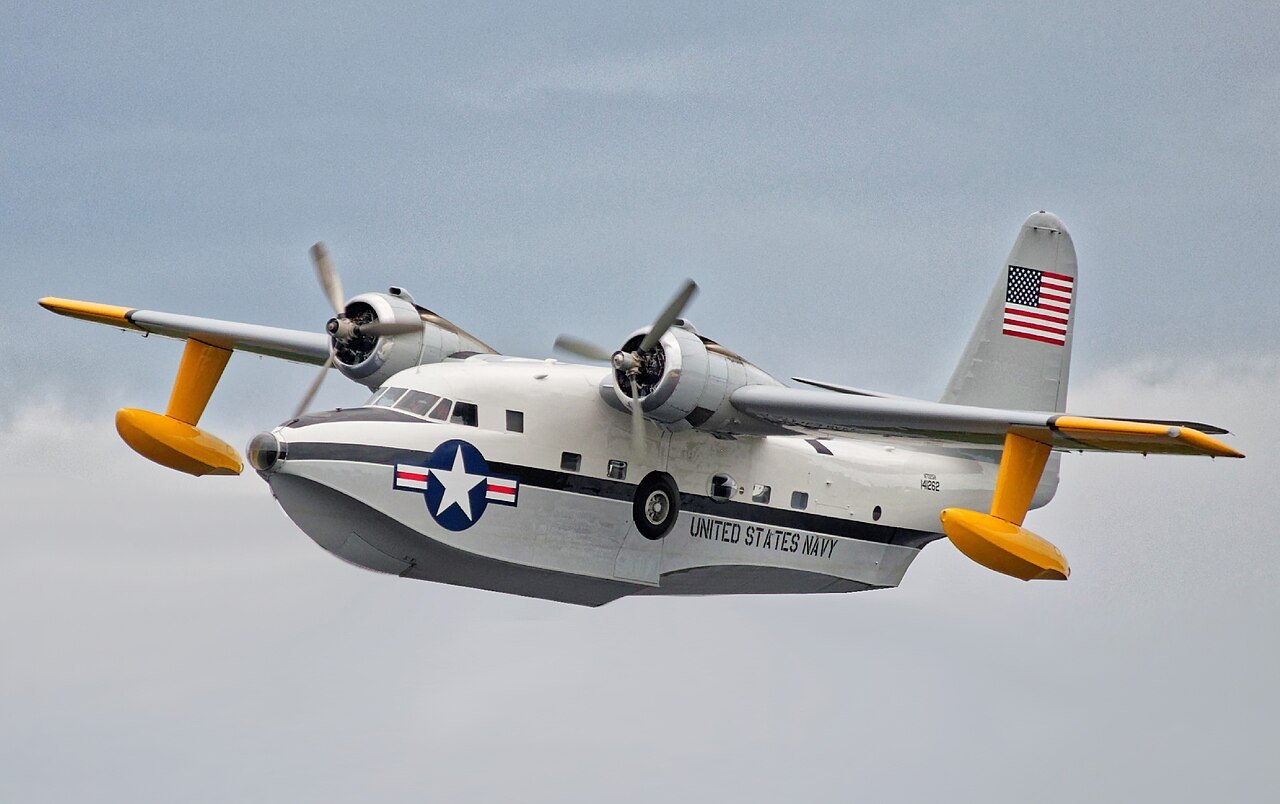
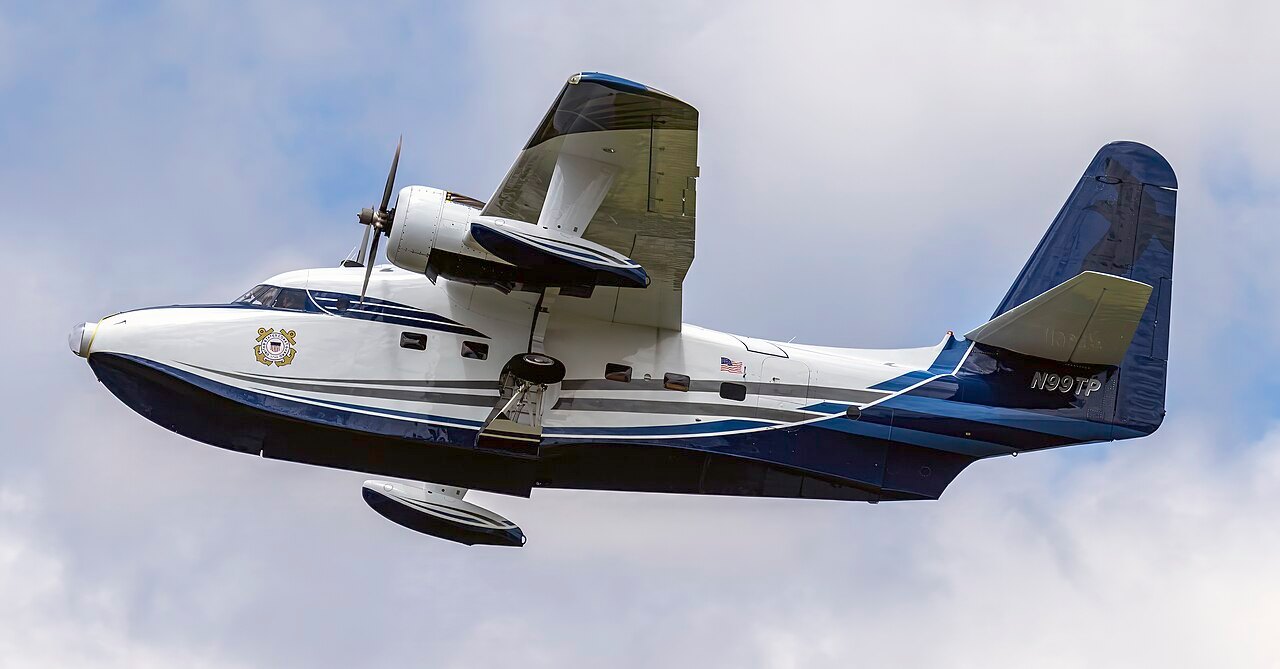
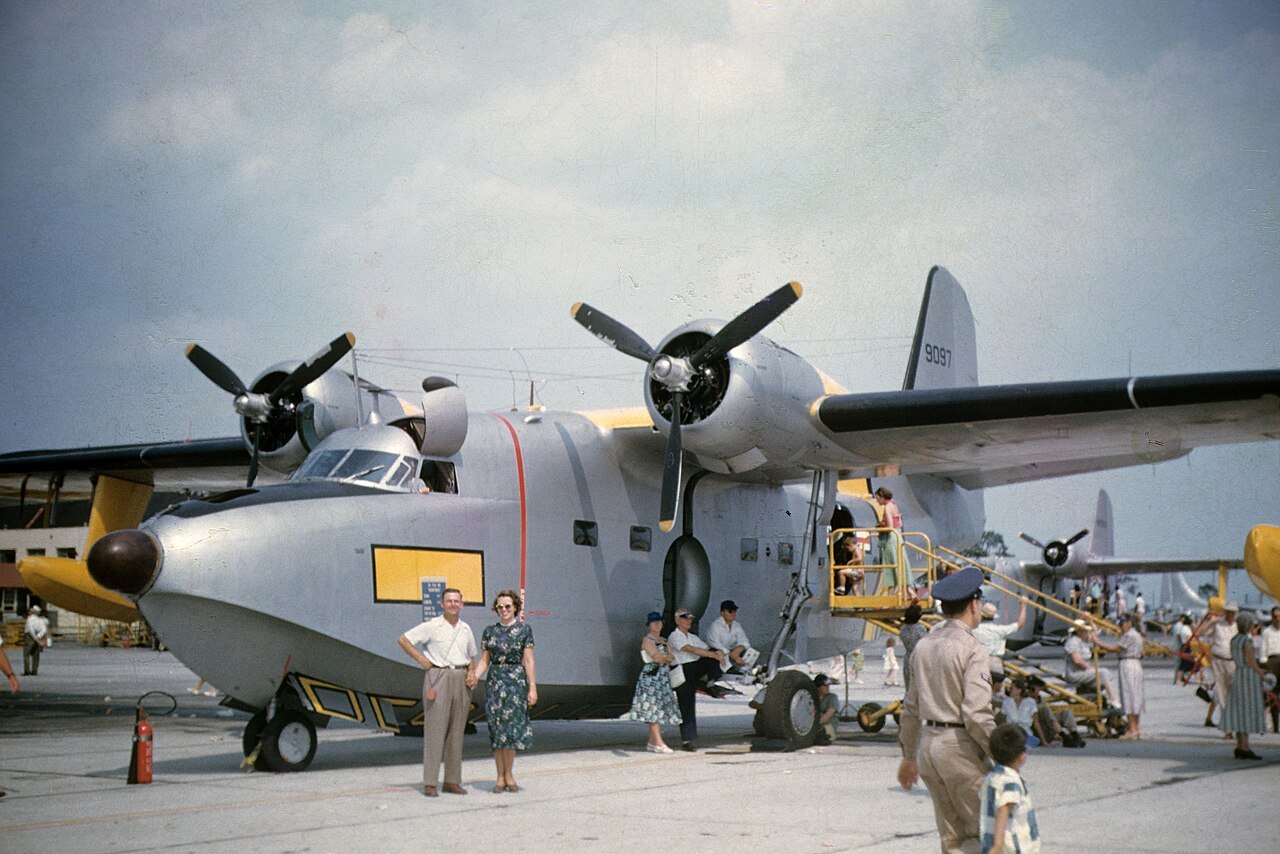
Where the HU-16 Albatross flies and flew
The HU-16 Albatross’s record
The Albatross was a rescue aircraft first and last. It flew combat rescue in Korea and Vietnam, coastal patrol in Pakistan’s 1965 war and Indonesian operations, and decades of peacetime search-and-rescue over the world’s oceans. Losses came mostly from the sea, the weather and mountains rather than from enemy fire.
See how training and combat types compare in the military aircraft statistics database. Figures are approximate.
Everything people ask about the HU-16 Albatross
Can I fly in a Grumman HU-16 Albatross?
What was the HU-16 Albatross used for?
How many HU-16 Albatrosses were built?
Could the Albatross land on the open ocean?
When did the HU-16 retire?
Where can I see an HU-16 Albatross?
Is the HU-16 related to the L-39 Albatros?
You can’t fly the HU-16 Albatross.
These, you can.
Most of this museum you can only look at. These genuine military jets you can fly yourself with MiGFlug — with aerobatics and time on the controls.
 Fly the L-39 AlbatrosThe world’s most-flown jet trainer — aerobatics included
 Fly the F-104 Starfighter“The missile with a man in it”
 Fly the MiG-21The Cold War’s most-produced jet
 Fly the T-33 Shooting StarAmerica’s first jet trainer
 Fly the DH VampireA piece of early jet history
 Fly the S.211Agile Italian jet trainer
 Fly the MB-326The classic Aermacchi jet
 Fly the MiG-15The Soviet legend of the Korean War
Continue the tour
Every fact, checked
- Grumman HU-16B Albatross fact sheetNational Museum of the USAF: first flight, 297 USAF A-models, Korea rescues, 1955 long wing, 1973 altitude record and crew
- Grumman HU-16B AlbatrossPima Air & Space Museum: origins as JRF Goose replacement, specifications, jet-ski modification of 51-5291
- Grumman HU-16A AlbatrossPima Air & Space Museum: short-wing HU-16A specifications and 31st Air Rescue Squadron markings
- Grumman HU-16 Albatross (N44RD)Hiller Aviation Museum: 1997 round-the-world flight by Andy Macfie and Reid Dennis
- HU-16B AlbatrossHellenic Air Force: twelve ex-USAF aircraft with 353 Naval Cooperation Squadron, 1969 to 1997
- Splashdown (Proceedings, January 1989)US Naval Institute: Air Force HU-16 circling Scott Carpenter’s Aurora 7 recovery
- Grumman Albatross civil and production history (Geoff Goodall)Aviation historian’s registry: 466 built at Bethpage 1949–1961, G-111 conversions