
J2M Raiden
The Zero designer’s opposite fighter
The interceptor Jiro Horikoshi built to stop the bombers — fast-climbing, heavily armed and armoured, and almost everything the nimble Zero was not.
The Raiden: when the Zero’s designer built its opposite
The same engineer who gave Japan the featherlight, dancing A6M Zero also gave it the Raiden — and the two could hardly be less alike. Jiro Horikoshi designed the J2M not to turn and twist in a dogfight, but to climb fast, hit hard and knock down bombers. It was a deliberate rejection of the philosophy that had made the Zero famous.
The idea went back to a 1939 Imperial Japanese Navy requirement for a “local-defence interceptor” — a short-ranged fighter whose job was to scramble, climb and destroy high-flying raiders over Japan’s own cities and bases. Where the Zero traded everything for range and agility, the Raiden traded agility for speed, climb and firepower.
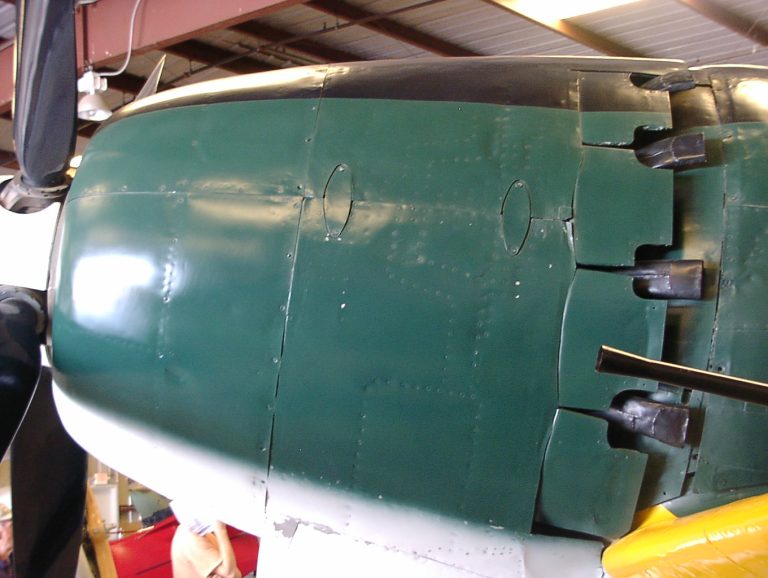
To get there, Horikoshi wrapped the airframe around a big Mitsubishi Kasei radial engine, mounting it well back behind a long, pointed cowling driven through an extension shaft and cooled by a forced-draught fan. The result was a fat, streamlined, purposeful-looking fighter with four 20 mm cannon — heavy armament by Japanese standards — but with a poor view over that long nose.
It was also a troubled aircraft. Engine vibration, cooling problems, a weak undercarriage and unreliable turbochargers dogged the programme for years. The Raiden that should have been ready to meet the American bombers arrived late, in small numbers, and never fully cured of its faults.
When the B-29 Superfortresses began their raids on Japan in 1944, the Raiden was one of the very few Japanese fighters with the climb and the guns to reach them and do real damage. But there were never enough, and even the Raiden struggled at the extreme altitudes the Superfortress preferred.
Only 493 were built before the war ended. The Raiden — codenamed “Jack” by the Allies — was a glimpse of where Japanese fighter design was heading: heavier, faster, built to kill bombers rather than dogfight. The war ended before that direction could bear full fruit.
01Why the Raiden mattered: the Zero’s designer changes his mind
The J2M is fascinating precisely because of who designed it. Jiro Horikoshi had built his reputation on the Zero’s astonishing lightness and agility, but he understood better than anyone that those qualities came at a cost in speed, climb, armour and firepower — exactly the qualities an interceptor needs.
The Raiden was his answer to a different question: not “how do we win a turning fight?” but “how do we stop a high, fast bomber?” That it arrived late and flawed reflects Japan’s wartime industrial strain more than any failure of the concept — the concept itself pointed straight at the future of piston fighter design.
How Horikoshi built a bomber-killer
An interceptor, not a dogfighter
Everything about the Raiden was tuned for one job: reaching a high, fast bomber quickly and destroying it. That meant power, climb, heavy cannon, armour and self-sealing tanks — and a willingness to sacrifice the very agility that had made Horikoshi’s Zero a legend.
The buried engine
To streamline the airframe around a bulky radial, Horikoshi set the Mitsubishi Kasei well back in the fuselage, driving the propeller through an extension shaft behind a long, pointed cowling. A forced-draught cooling fan kept the buried engine alive. The result was fast and clean — but the long nose left the pilot with a poor view forward.
Four heavy cannon
Where many Japanese fighters relied on a mix of light machine guns and one or two cannon, the Raiden carried four 20 mm cannon. Against the aluminium bulk of a B-29, that concentrated firepower was exactly what an interceptor needed.
02Why the Raiden was late: a programme fighting itself
The J2M’s development was plagued by the very features that made it advanced. The extension-shaft-and-fan cooling arrangement was complex and prone to vibration; the undercarriage and turbochargers gave trouble; and each fix took time Japan did not have. The upshot was that the interceptor designed in 1939 to stop bombers was still being sorted out when the bombers finally arrived in force in 1944 — and was never available in the numbers that were needed.
Mitsubishi J2M Raiden — by the numbers
Baseline note: the figures below describe the J2M3 Raiden Model 21 ("Jack 21" to Allied intelligence), the only mark built in real numbers and the aeroplane the home-defence groups actually flew against the B-29. Deltas for the J2M1 prototype, the J2M2 Model 11 and the high-altitude J2M5 Model 33 are in grey. Japanese airframe documents and Western reference tables disagree on several dimensions and weights; where they do, the Japanese figures are given first and the conflict is stated rather than averaged.
Dimensions & weights
- Crew
- 1
- Length
- 9.695 m (31 ft 10 in) from Japanese factory data for the Model 21. Most English-language tables print 9.945 m (32 ft 8 in), which Japanese sources give for the Model 33; the 250 mm difference is a real change of mark, not a measuring convention
- Wingspan
- 10.8 m (35 ft 5 in) — 1.2 m less than an A6M2, and deliberately so
- Height
- 3.81 m (12 ft 6 in); 3.945 m (12 ft 11 in) on the Model 33 with its raised canopy
- Wing area
- 20.05 m² (215.8 sq ft), about 10 per cent smaller than the Zero’s
- Aspect ratio
- 5.82
- Empty weight
- 2,490 kg (5,489 lb); the Model 11 was 2,348 kg (5,176 lb) and the Model 33 2,540 kg (5,600 lb)
- Normal loaded weight
- 3,440 kg (7,584 lb); Model 11 3,210 kg (7,077 lb), Model 33 3,507 kg (7,731 lb). Some widely copied English tables pair an empty weight of 2,839 kg with a gross of 3,211 kg, which leaves 372 kg of useful load for fuel, guns, ammunition and pilot and cannot be right
- Weights as flown by Allied testers
- 3,320 kg (7,320 lb) light and 3,688 kg (8,130 lb) at overload with a drop tank, in the American Technical Air Intelligence Command trials of a captured Model 21
- Wing loading
- 171.5 kg/m² (35.1 lb/sq ft) at normal loaded weight, against roughly 128 kg/m² for an A6M2. This one number explains the landing accidents, the pilot complaints and the whole quarrel about the aeroplane
- Power loading
- 1.89 kg/hp (4.17 lb/hp) on take-off power — the compensation for the wing loading, and the reason the climb was worth having
- Internal fuel
- 570 l (~125 imp gal): 390 l in a self-sealing fuselage tank ahead of the cockpit plus 90 l in each wing. The Model 11 carried 590 l with a 410 l fuselage tank; a further 120 l (26 imp gal) fuselage tank held water-methanol, not fuel
- Structure
- All-metal stressed-skin low-wing monoplane with fabric-covered control surfaces, a laminar-flow aerofoil inboard blending to a conventional section outboard, 2° of washout, and a spindle-shaped fuselage whose widest point lies behind the engine at the cockpit
Performance
- Maximum speed
- 596 km/h (370 mph) at 5,450 m (17,880 ft)
- Maximum speed, Model 33
- 614.5 km/h (382 mph) at 6,585 m (21,600 ft) — the Kasei 26a with its taller supercharger gearing, and the fastest Raiden of all
- Maximum speed, Allied figures
- 671 km/h (417 mph) at 5,060 m (16,600 ft) for the Model 21 and 655 km/h (407 mph) at 5,300 m (17,400 ft) for the Model 11, from American testing on 92-octane fuel with water-methanol. The TAIC manual states plainly that these were calculated from measurements rather than timed over a course, and the aircraft flew light; treat them as an upper bound. Even at overload the same machine gave 616 km/h (383 mph)
- Cruising speed
- 351 km/h (218 mph)
- Landing speed
- 162 km/h (101 mph), against 119 km/h (74 mph) for the A6M — 1.36 times the approach speed the squadrons had trained on, and the direct cause of the Raiden’s reputation as a killer in the circuit
- Time to 6,000 m (19,685 ft)
- 5 min 38 s. The 14-Shi requirement had asked for 5 min 30 s; the Model 11 reached 5,000 m (16,400 ft) in 4 min 30 s, and the Model 33 needed 6 min 20 s to 6,000 m and 9 min 45 s to 8,000 m (26,250 ft)
- Rate of climb
- 17.8 m/s (3,500 ft/min), averaged over the climb to 6,000 m rather than an instantaneous sea-level figure
- Service ceiling
- 11,520 m (37,800 ft); Model 11 11,680 m (38,320 ft), Model 33 11,500 m (37,730 ft)
- Dive speed limit
- 740.8 km/h (460 mph) indicated — genuinely high, and the foundation of the dive-and-zoom attack the type was flown to make
- Range
- 1,056 km (656 miles) normal, 2,520 km (1,566 miles) at overload with a drop tank. The Model 33 was quoted as endurance instead: half an hour at full power plus an hour and a half cruising
- Performance against the B-29
- The Raiden could reach 9,000 m (29,500 ft), which is more than most of its contemporaries managed, but the Kasei had no turbocharger and fell away above full-throttle height. It arrived at the bombers, usually late, usually once, and with little energy to spend
- Handling
- Well harmonised to about 520 km/h (323 mph), above which the ailerons went heavy and the roll rate collapsed. Stall behaviour was excellent, recovery quick and the spin tendency slight. It swung hard left on take-off and nothing at all was visible over the nose until the tailwheel lifted
Propulsion & systems
- Engine, Model 21
- One Mitsubishi MK4R-A Kasei 23a, a 14-cylinder two-row air-cooled radial of 42.1 l (2,569 cu in) and 1,340 mm (52.8 in) diameter — a bomber engine, nearly 200 mm fatter than the Zero’s Sakae, and the origin of every shape problem the aeroplane had
- Power ratings
- 1,357 kW (1,820 hp) for take-off; 1,126 kW (1,510 hp) at 4,150 m (13,615 ft)
- Engine, other marks
- J2M1: MK4C Kasei 13, 1,066 kW (1,430 hp) for take-off. J2M5 and J2M7: MK4U-A Kasei 26a, 1,357 kW (1,820 hp) for take-off and 1,044 kW (1,400 hp) at 7,200 m (23,620 ft), the supercharger geared up to raise full-throttle height
- Induction
- Direct fuel injection and water-methanol injection — the first production application of water-methanol in Japan, and a fresh source of rough running while it was learnt
- Extension shaft and reduction gear
- The propeller is driven through an extension shaft on a deliberately decoupled engine mount. Reduction ratio 0.684 on the Kasei 13, changed to 0.5 on the Kasei 23a to break a beat between engine second-order and propeller fourth-order vibration, and 0.625 on the Kasei 26a
- Cooling fan
- An engine-driven forced-cooling fan ahead of the cylinders, made necessary by the throttled nose intake: 22 blades driven directly on the J2M1, then 14 blades geared to 3.18 times propeller shaft speed. It cost power to turn, and the cowl flaps opened only 15° against 30° on the A6M
- Propeller
- Four-blade constant-speed Sumitomo/VDM unit of 3.3 m (10 ft 10 in); the J2M1 had a three-blade unit of 3.2 m (10 ft 6 in). Pitch control began as a licence-built VDM electric governor, which failed often enough to be replaced from the J2M2 by a hybrid using Hamilton hydraulics. From late 1944 broad-chord blades were fitted for high-altitude work, at some cost in level speed
- Flaps
- Fowler flaps, electrically driven, rather than the simple split flaps of the A6M — the high wing loading demanded them. Usable as manual combat flaps from 0° to 16° through a trigger on the control column with an angle gauge on the panel, 2 to 3 seconds to extend; 50° for landing, 6 to 7 seconds on a 0.6 kW (0.8 hp) 9 V motor, with a buzzer to warn the pilot before the motor cooked itself
- Undercarriage and services
- Inward-retracting main gear and a retractable tailwheel, operated electrically rather than hydraulically to save weight and high-pressure plumbing. The electrics were a chronic defect that was never cured: units reported gear that would not retract or would not come down, and the fatal accident of 16 June 1943 was traced to a bent tailwheel oleo fouling the elevator torque tube as the gear came up
- Protection
- 8 mm armour plate behind the seat from the outset — unusual for a Japanese fighter and written into the original requirement. Automatic fire extinguishers in the wing tanks from the Model 11; armoured glass in the windscreen and a self-sealing fuselage tank from the Model 21, though units sometimes removed the glass for weight and visibility
- Cockpit and view
- Roomy by Japanese standards and praised by American pilots for it. The view was the aeroplane’s worst feature: a very low fastback canopy with curved front glass that distorted the picture, and a fat fuselage that hid everything forward and below. The nose was shortened 205 mm and the canopy raised from the J2M2; the Model 31 and Model 33 raised it a further 50 mm, widened it 80 mm and cut away the decking ahead of it, at a measurable cost in speed and climb
- Starting
- Hand-cranked inertia starter. The Kasei would take an electric starter, but the way it was mounted in the Raiden ruled one out — and once stopped in flight it was very hard to relight, so pilots switched tanks early and lost endurance to do it
03Marks and armament
The Raiden evolved quickly across its short life. The early J2M2 gave way to the most-produced J2M3, which standardised the four-cannon armament, and the high-altitude J2M5 added a revised supercharger to claw back performance against the B-29 at height. Figures vary between marks, so the numbers above are representative of the type rather than any single version.
Armament & payload
The Raiden’s four wing cannon were the entire point of the aeroplane, and two of them were the wrong gun
The 14-Shi requirement was an interception requirement, and interception is an armament problem before it is a flying-qualities problem: the fighter that gets one pass at a bomber formation must do enough in that pass to matter. The Model 21 answered it properly by Japanese standards of 1944 — four 20 mm cannon in the wings, belt-fed, with roughly 200 rounds each, a weight of fire no A6M ever carried — and then undermined the answer by fitting two different guns. Type 99 Mark 2 production could not keep up, so the long-barrelled Mark 2 went inboard and the short-barrelled Mark 1 outboard, giving two muzzle velocities, two trajectories, two incompatible ammunition supplies and one convergence range at which all four actually agreed. Gun fits varied by mark, by batch and by unit; the 30 mm installations in particular were handfuls of aircraft, and Japanese unit histories, Francillon and Allied technical intelligence reports do not agree on which mark carried what.
Gun
- J2M1 and J2M2 Model 11: two 7.7 mm Type 97 machine guns in the upper fuselage decking with 550 rounds each, plus two 20 mm Type 99 Mark 1 Model 3 in the wings with 60-round drums — the Zero’s battery, and by 1943 an inadequate one against four-engined aircraft
- Model 21 onward: the fuselage guns deleted, the wing structure strengthened, and four belt-fed 20 mm Type 99 Model 4 guns installed — Mark 2 inboard (20×101RB, about 750 m/s, roughly 480 rounds per minute, 34 kg) and Mark 1 outboard (20×72RB, about 600 m/s, lighter and faster-cycling). Ammunition is usually given as 190 rounds for one pair and 210 for the other, though sources disagree over which gun got which
- The mixed battery was a supply compromise, not a design choice, and it cost accuracy: two structurally different guns, two non-interchangeable rounds and visible dispersion between the pairs. The J2M3a Model 21A, with four Mark 2 guns throughout, was built only as a prototype or in tiny numbers
- 30 mm, briefly and in single figures: the Type 2 30 mm (a scaled-up Type 99 by Dai-Nippon Heiki, 50.9 kg, 710 m/s, 380 rounds per minute, 42-round drum, only 50 pre-production guns ever made) went into a pair of Raiden delivered to the 302nd Kokutai in November 1944. On 3 December 1944 Petty Officer Sugitaki Takumi used one to break a B-29 apart from a forward-low attack. Japanese sources split over whether these were Model 11 or Model 21 airframes; the drum diameter argument favours the Model 11
- By spring 1945 one or two Model 33s at the same unit carried two Type 5 30 mm instead of the four 20 mm — a much better weapon (70 kg, 750 m/s, 350 rounds per minute, belt fed, about 2,000 built) that arrived far too late and suffered constant feed failures from poor wartime materials
Air-to-air
- No guided air-to-air weapon existed in Japanese service at any point in the Raiden’s life. The guns were the whole battery, and the tactics were built around them
- The cannon were rigged 4° nose-up because the fat fuselage hid the target during an overhead pass — a small adjustment that says everything about the aeroplane’s worst fault
- Type 3 air-to-air bombs, phosphorus weapons dropped into a bomber formation from above, were used by Raiden pilots: the 1001st Kokutai’s ferry crews recorded an attack by Lieutenant Miyata Fusaji over Nagoya. The practice is far better attested for the twin-engined Ki-45 and for Zeros than for the Raiden.
- The J2M4 is reported by Western sources to have carried two oblique 20 mm Type 99 cannon behind the cockpit firing upward at about 70°, in the German Schräge Musik manner, with the four wing guns retained. Japanese variant listings do not describe this fit, and it should be treated as reported rather than settled.
- What actually worked was the diving pass. A Raiden that got above a B-29 formation and came down through it with four 20 mm was one of the few genuinely lethal Japanese answers to the type, and the 302nd Kokutai’s Raiden squadron scored more against B-29s over Tokyo than any other unit
Air-to-surface guided
- None carried, and none existed. Japan fielded no operational air-to-surface guided weapon for single-seat fighters during the war
- The airframe had no provision for one: no guidance set, no second crewman, no electrical capacity to spare on an aircraft whose electrics could not reliably raise the undercarriage
- The card is kept for consistency across this encyclopedia. The honest entry is that the category was empty for every Japanese single-seat fighter of the period
Bombs
- Two 30 kg (66 lb) bombs on wing racks on the 14-Shi prototype; two 30 kg or two 60 kg (132 lb) from the Model 21 onward, using the same racks that took the drop tanks
- Rarely used and never intended. The Raiden had no dive brakes, no bombing sight worth the name, a short radius and a landing speed that punished any load left on the racks
- The only bombing that mattered to the type was air-to-air bombing of formations, and even that was a marginal practice with a low hit rate
- The Navy had better tools for ground attack and knew it; the Raiden existed to climb, not to carry
Rockets
- None fitted. No production Raiden is known to have carried rocket rails, launch tubes or firing circuits
- Japanese Navy air-to-air rocketry of 1944 and 1945 went to types with the payload and crew to aim it, not to a short-endurance single-seater already carrying four cannon and 800 rounds
- Nothing in the wing structure, the racks or the electrical system was ever adapted for it, and no unit is recorded as having asked
Pods & other stores
- Drop tanks of 250 l (55 imp gal) under the fuselage; from airframe 3204 the standardised unified tank of 300 to 400 l (66 to 88 imp gal) could be carried instead, raising total fuel to about 970 l
- The 302nd Kokutai went the other way and fitted an internal auxiliary tank behind the seat. On a scramble with no warning time, a drop tank’s drag cost more climb than the fuel bought endurance, and the tank was going to be jettisoned before contact anyway
- Reflector gunsight, oxygen system and an HF radio set that was frequently unserviceable, as on most Japanese fighters of the period
- No camera, no reconnaissance fit, no electronic equipment of any kind was developed for the type — it was a point-defence interceptor and nothing else
- The one universal "fit" was fuel discipline: because a stopped Kasei was very hard to relight in the air, pilots switched tanks well before a tank ran dry, accepting a real loss of endurance to avoid losing the aeroplane
Three typical loadouts
- B-29 interception, 302nd Kokutai, Atsugi, winter 1944–45
- Model 21 with four 20 mm, full ammunition, guns rigged 4° up, no drop tank and often an internal auxiliary tank behind the seat. Scramble on radar and visual warning, climb to about 9,000 m, one diving pass through the formation and, with luck, a second from below. The limiting factor was never the guns; it was arriving with height and speed still in hand.
- Bomber destroyer, 302nd Kokutai, December 1944
- Model 21 with the wing battery replaced by two Type 2 30 mm and 42 rounds a gun — sixteen seconds of firing at best, and enough to blow a Superfortress apart in one attack on 3 December 1944. Two aircraft only, from a run of fifty pre-production guns; it is the clearest demonstration of what the Raiden could have been with a weapon worth its climb.
- Oilfield defence, 381st Kokutai, Balikpapan, mid-1944
- Model 11 or Model 21 at standing readiness over the Sepinggan refineries with a 250 l drop tank, intercepting Fifth and Thirteenth Air Force B-24s with P-38 and P-47 escort. The unit had one advantage no home-defence group enjoyed: unlimited high-grade fuel straight from the refinery it was defending, and enough of it to train properly.
Sourcing caveat: ammunition capacities, the assignment of round counts between Mark 1 and Mark 2 guns, and the mark designations of the 30 mm aircraft differ between Japanese unit histories, Francillon and Allied Technical Air Intelligence Command reports compiled from captured airframes. Gun data above follow Japanese ordnance sources, flight-test figures follow TAIC where noted, and the disagreements are flagged in grey rather than smoothed away.
Variants
Seven marks, five years of trouble, and only one of them built in numbers
The Navy handed the 14-Shi local fighter requirement to Mitsubishi alone in September 1939, weeks after taking delivery of the first Zero prototype, and issued the formal document in April 1940. It asked for 325 knots at 6,000 m rising to a target of 340, 6,000 m in five and a half minutes, a ceiling above 11,000 m, two 20 mm and two 7.7 mm guns, and armour plate behind the pilot. It said nothing whatever about turning. It was the first Japanese fighter requirement written by people who had watched Chinese bombers hit their airfields and concluded that manoeuvrability was not the answer.
Jiro Horikoshi answered it with the only high-power engine available, the 1,340 mm Kasei, and then spent the programme paying for that decision. To hide the diameter he adopted a spindle fuselage from Naval Air Technical Arsenal wind-tunnel work, pushed the propeller forward on an extension shaft, throttled the nose and added a geared cooling fan to make up the lost airflow. The first aircraft flew on 20 March 1942 and managed 574 km/h against a 602 km/h requirement. Then, on the J2M2 with its Kasei 23a and four-blade propeller, a vibration appeared that had never troubled the J2M1: a low-frequency thumping traced to a beat between engine second-order and propeller fourth-order forcing at the 0.54 reduction ratio, and a high-frequency buzz at high rpm. A Farman gear of 0.5 ratio cured the first and made the second worse. An out-of-balance weight banded to one blade root reduced it but left enough shake to spoil gun aiming, which for an interceptor is not a compromise but a failure.
On 16 June 1943 the test pilot Lieutenant Hoashi took off to evaluate a heavier balance weight, dropped the nose immediately after raising the undercarriage and was killed. The cause was not the vibration at all: a bent tailwheel oleo had fouled the elevator torque tube as the gear retracted. The vibration itself was finally solved by Matsudaira Tadashi of the Naval Air Technical Arsenal, who discovered that the one flight ever reported free of it had been made with a stiffer Shiden propeller fitted by mistake. Refit the stiff propeller and the shaking stopped — at the price of thicker blade sections and lower propeller efficiency. Production began in September 1943 before the type was even accepted; the Raiden was formally adopted as the Model 11 in October 1944, five years after the requirement, by which time Yokosuka Kokutai had already recommended cancelling it in favour of the Shiden-Kai on the grounds that the Raiden could not fight fighters and had to be escorted by Zeros to be useful at all.
It survived that recommendation for two reasons: the Shiden-Kai’s Homare engine was in trouble of its own, and the Raiden’s fat fuselage looked like the best available home for the turbocharger and intercooler everyone agreed would be needed against the B-29. A 1943 plan to end Zero production at Mitsubishi and build nothing but Raiden was quietly abandoned. What remained was a small, difficult, respected aeroplane that arrived just in time to be too few.
- J2M1, 14-Shi Local Fighter (1942, 8 built)
- Kasei 13 of 1,430 hp, three-blade 3.2 m propeller, an extremely low fastback canopy with curved front glass, two wing 20 mm and two fuselage 7.7 mm guns. First flight 20 March 1942; 574 km/h on Navy trials, well short of requirement, and a view over the nose the test pilots disliked from the first flight.
- J2M2, Raiden Model 11 (first aircraft October 1942; production from September 1943)
- Kasei 23a with water-methanol and direct fuel injection, four-blade 3.3 m propeller, ejector exhaust stubs, reduction gearing changed to 0.5, the nose shortened 205 mm and the canopy raised. The first service aircraft went to the 381st Kokutai in December 1943, a year after the first deliveries to development units, and the intervening year was spent on engines and vibration.
- J2M3, Raiden Model 21 (from October 1943; about 280 by Mitsubishi alone)
- The main production version and just over half the whole programme. Fuselage guns deleted, wing structure strengthened for four belt-fed 20 mm, self-sealing 390 l fuselage tank, enlarged engine induction, and provision for the standardised drop tank from airframe 3204. Deliveries to combat units began in February 1944. The J2M3a Model 21A with four Mark 2 guns did not go into real production.
- J2M4, Raiden Model 32 (from August 1944, small numbers)
- The turbocharged high-altitude mark, pursued in three parallel lines: Mitsubishi rebuilt a Model 21 with the Kasei 23c, the engine mount extended 200 mm and the oil cooler moved to the front of the cowling; the Naval Air Technical Arsenal made a minimal conversion of a Model 11 and later a Model 31; and the 21st Naval Air Arsenal produced a simplified version. In all of them the turbocharger sat on the right side of the fuselage directly behind the engine. Aircraft reached the 302nd at Atsugi and the 352nd at Omura, but tail buffeting (cured with strakes on the fuselage sides), poor balance and a higher landing speed ended any thought of mass production. The widely repeated claim that only two were built and none saw use does not survive contact with the Japanese literature; the model number is also often misprinted as 34.
- J2M5, Raiden Model 33 (1944–45, small numbers)
- The high-altitude answer that actually worked, and the best Raiden: the Kasei 26a with taller supercharger gearing, an enlarged supercharger intake duct, a semi-recessed oil cooler intake, and a canopy 50 mm higher and 80 mm wider with the decking ahead of it cut away for a view forward. 614.5 km/h at 6,585 m. Issued in small numbers to the 302nd and 332nd Kokutai in the last months. The J2M5a with four Mark 2 guns and strengthened spars was prototyped.
- J2M6, Raiden Model 31 (1944, chronologically before the Models 32 and 33)
- A Model 21 with the visibility fix and nothing else. The wider, taller canopy and cut-down decking cost speed and climb, which is a fair summary of the whole aeroplane’s dilemma. Most Mitsubishi-built machines from late 1944 were to this standard. J2M6a prototyped with the uniform gun fit.
- J2M7, Raiden Model 23 (1945, very few)
- Model 21 airframe with the Kasei 26a and the semi-recessed oil cooler intake but the old canopy and fuselage lines — the engine improvement without the visibility improvement. Intended for production at the Koza arsenal; only a handful were finished. J2M7a likewise.
- Koza Naval Arsenal production (1944–45; 60 to 130 aircraft depending on which source you believe)
- Model 21s built at Koza in Kanagawa beside the 302nd’s own airfield at Atsugi, with wings subcontracted to Nihon Kentetsu at Funabashi, assembled largely by Taiwanese boy labourers — the shonenko, over 8,400 of them, aged 12 to 14. The work was rushed for quantity and the results were dangerous: wings that stalled 6 to 7 knots earlier than Mitsubishi’s, a twisting tendency that rolled three aircraft in five during a descent from 7,000 to 1,500 m, a left yaw above 300 knots, coarse riveting, instruments in the wrong holes and rudder cables connected the wrong way round. One test aircraft broke up in the air after an uncontrollable left roll; the fin was found to be set at the wrong incidence, and so were others still on the line.
- Ki-65 (Army project, never built)
- For a period the Army’s Ki-65 requirement resolved into little more than a lightly modified Army version of the 14-Shi local fighter. The requirement moved on, and nothing was built — the closest the Raiden came to serving anyone but the Navy.
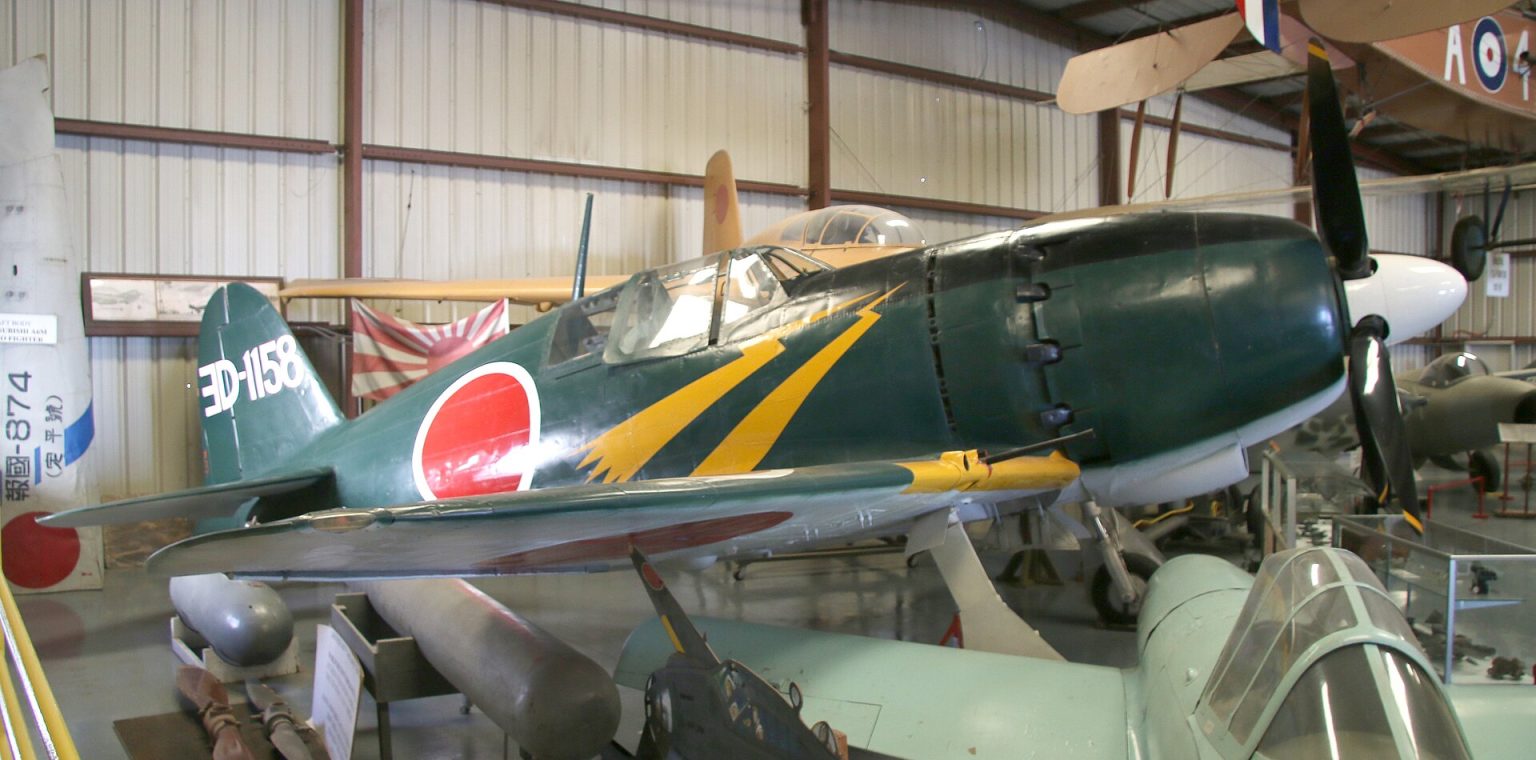
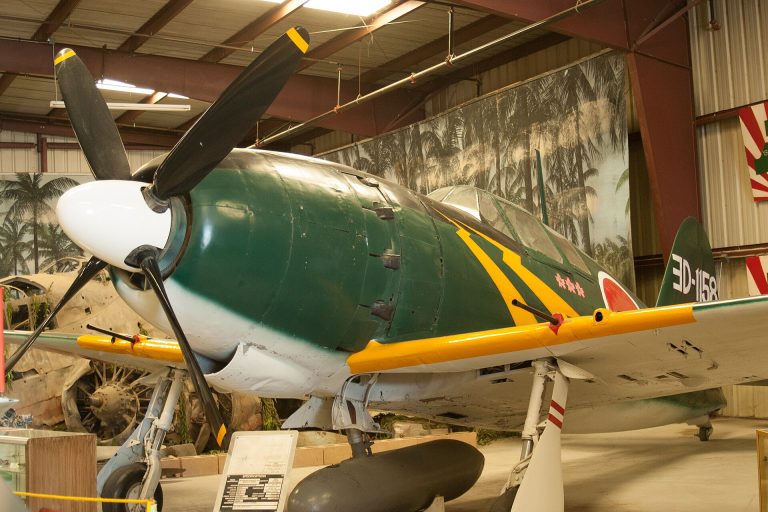
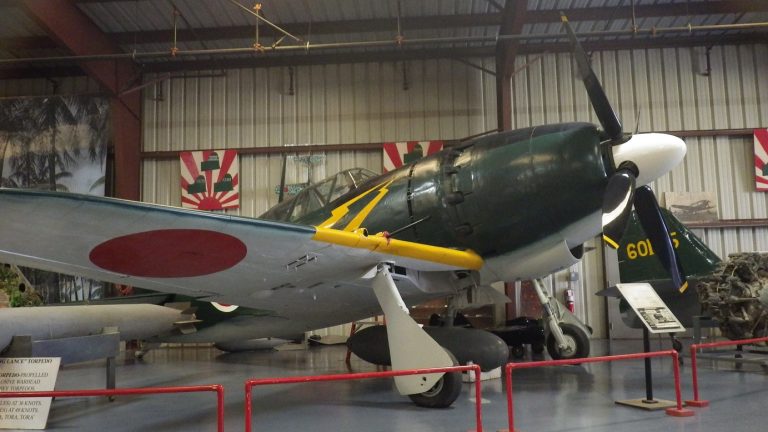
Survivors: exactly one complete original J2M is generally accepted to exist. It is a Model 21, construction number 3014, tail code 81-124 of the 381st Kokutai, taken in the Philippines and shipped to the United States in 1945 for technical evaluation by the US Navy; declared surplus, displayed at the Travel Town Museum in Griffith Park, Los Angeles, and bought in 1958 by Edward T. Maloney. It is at the Planes of Fame Air Museum, Chino, California. Its present finish is entirely postwar and internally inconsistent: a lightning flash copied from a 352nd Kokutai section leader’s aircraft, over the 302nd Kokutai tail code yo-D 1158. No second airframe survives anywhere, no reproduction stands in for one, and none is airworthy. What else remains is fragments: components believed to be of Koza arsenal manufacture, donated to the Zama city offices in January 2020, and an instrument panel carried off by an Allied technical survey team and since returned to Japan. The much-photographed machine the Americans flight-tested as "S12" was a different aeroplane, construction number 3008, originally destined for the 381st and abandoned unserviceable at a field outside Manila; it was tested with a second captured engine fitted and does not survive. Two more left in the Philippines were flown for the British by Japanese pilots in December 1945; the British were unimpressed and did not ship them home. Production totals are equally unsettled. The usual figure of 621 is a sum, not a count: the United States Strategic Bombing Survey tabulated 493 aircraft month by month at Mitsubishi’s Nagoya works, Japanese sources following the Zero pilots’ association give 476 for Mitsubishi at Nagoya and Suzuka, and the Koza figure is variously about 130 (the American survey team), about 90 (Navy and Munitions Ministry documents cross-checked), 60 (the official Japanese naval aviation history) and 50 to 60 (a Koza engineer’s recollection). Roughly 620 is the defensible answer; the arithmetic underneath it is not.
From a 1939 requirement to the last days of the war
A call for an interceptor
The Imperial Japanese Navy issues its “14-Shi” requirement for a fast-climbing, short-range local-defence interceptor — a very different aircraft from the Zero.
First flight, first troubles
The J2M1 prototype flies on 20 March 1942, but engine vibration, cooling and undercarriage problems immediately slow the programme.
Into service, slowly
The J2M2 and improved J2M3 reach navy units, though continuing teething troubles keep numbers low.
Meeting the Superfortress
As B-29 raids on Japan begin, the Raiden becomes one of the few interceptors able to climb to the bombers and hurt them with its four cannon.
Too few, too late
The high-altitude J2M5 appears, but the Raiden is never available in the numbers needed to blunt the American bombing campaign.
The final sorties
Raidens fly to the very end — a handful even tangling with US Navy Hellcats on 15 August 1945, hours before Japan’s surrender.
Eight chapters in the Raiden’s short life
Horikoshi’s other aircraft
The man who created the impossibly agile A6M Zero also designed the heavy, fast-climbing Raiden — a deliberate opposite.
The full story
The interceptor’s single-minded mission
The Raiden existed to do one thing: get off the ground, climb hard, and destroy a high-flying bomber.
The full story
Streamlining a fat radial
To wrap a slim fuselage around a bulky radial engine, Horikoshi buried the engine and drove the propeller through a long extension shaft.
The full story
Years of trouble
The Raiden should have been ready to meet the American bombers. Instead it spent years fighting its own engineering.
The full story
One of the few that could reach them
When the Superfortresses came, the Raiden was among the handful of Japanese fighters that could climb to meet them and do real harm.
The full story
Firepower built for bomber-killing
Where many Japanese fighters mixed light machine guns with a cannon or two, the Raiden carried four 20 mm cannon.
The full story
The Allied codename
To Allied intelligence the Raiden was “Jack” — and after the war, captured examples were flown and studied.
The full story
One Raiden still exists
Of the 493 built, a single complete Raiden survives today — at the Planes of Fame Air Museum in California.
The full story
The Raiden in pictures
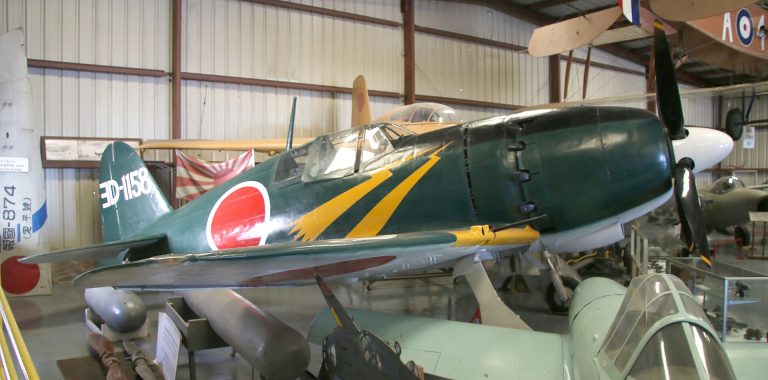
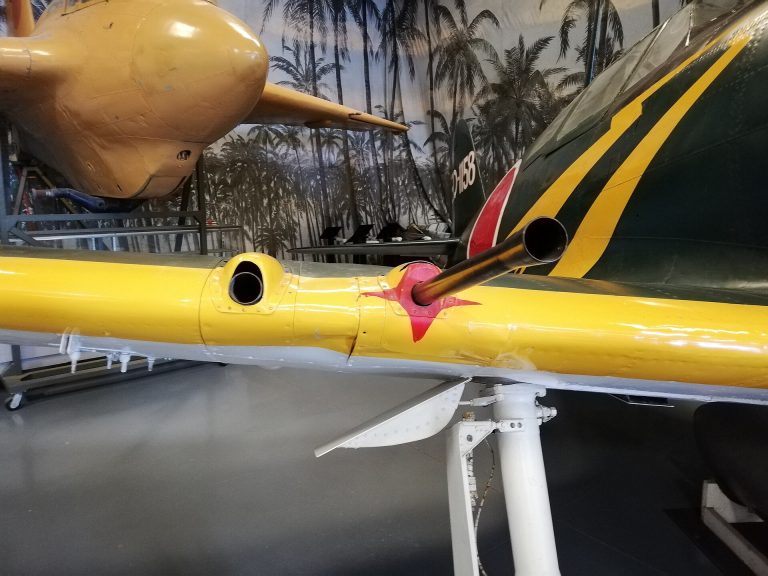
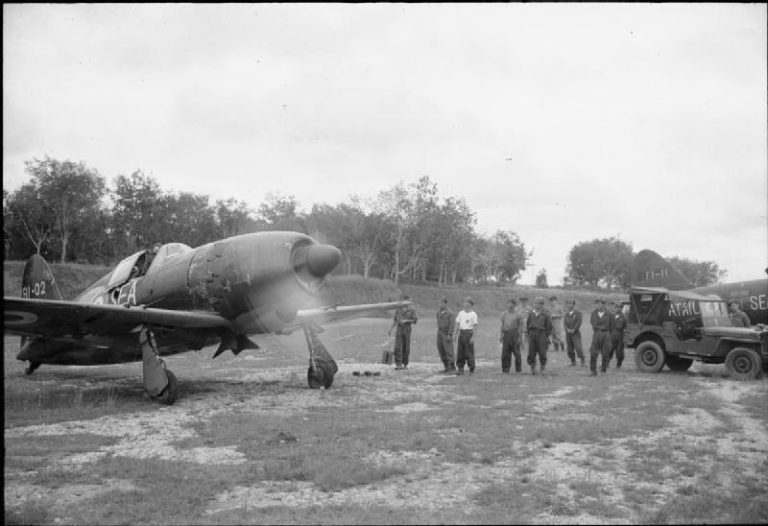
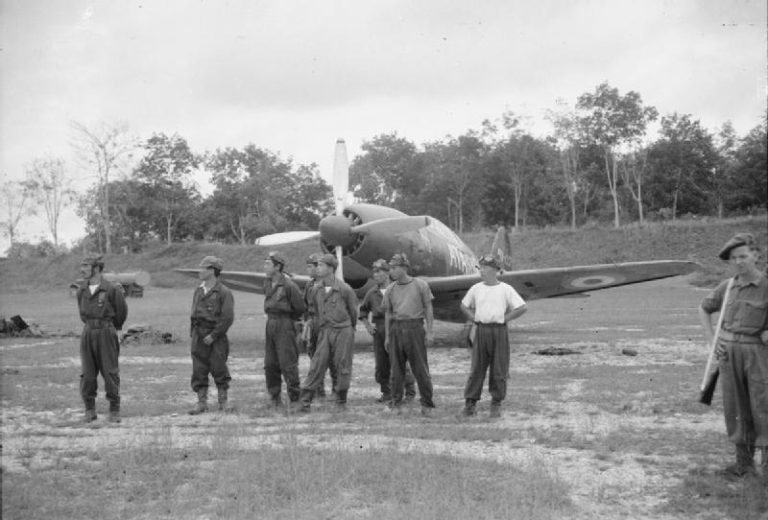
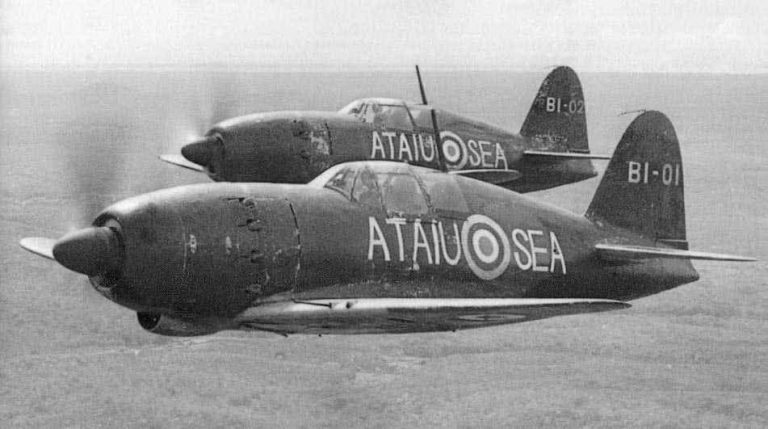
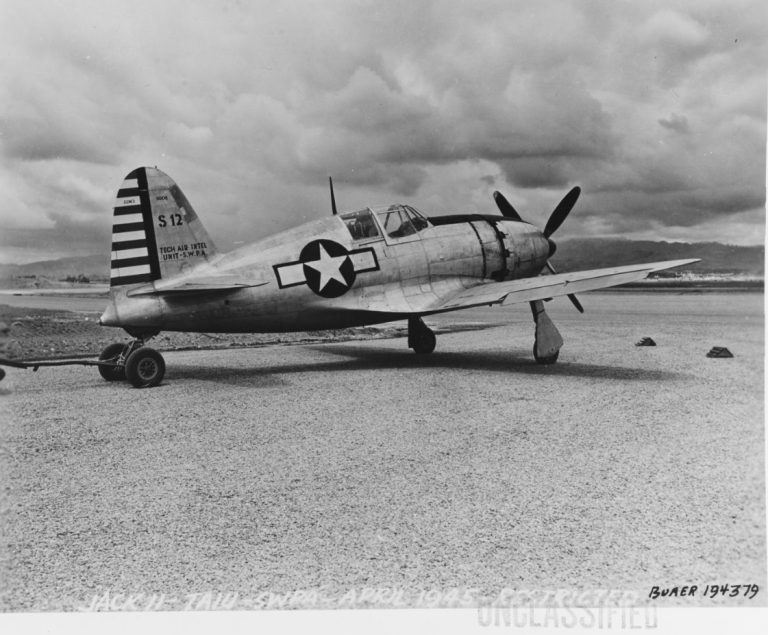
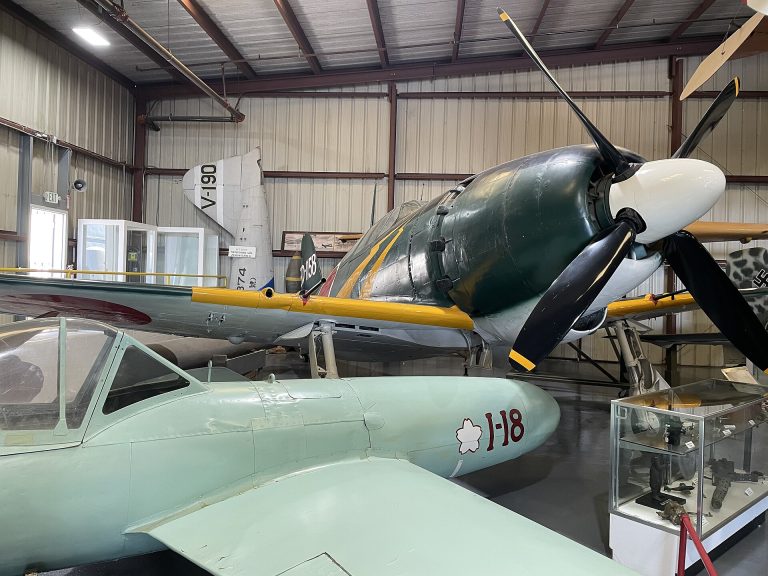
See the Raiden in context
Could a better interceptor have changed Japan’s air war? This history follows the Raiden from Horikoshi’s drawing board through its troubled development to its brief, hard-fought career against the B-29.
Video: “The Plane That (Hypothetically) Could Have Saved Japan: Mitsubishi J2M Raiden” by IHYLS (~122,000 views). Embedded via YouTube.
Where the Raiden fought
The Raiden, by the numbers
The J2M Raiden fought a short, concentrated war: a home-defence interceptor that arrived just as the American bombing campaign against Japan was building to its peak. Its record is defined less by aces than by a race against time — a promising bomber-killer that never reached the front in the numbers its mission demanded.
Wartime Japanese records are fragmentary, and individual Raiden victory tallies are hard to verify; the figures above reflect the type’s production and role rather than a detailed combat account.
Mitsubishi J2M Raiden — questions & answers
Can you fly a Mitsubishi J2M Raiden today?
No. Only one complete Raiden survives — at the Planes of Fame Air Museum in California — and there are no public J2M flights anywhere. If you want to fly a real fighter yourself, MiGFlug offers cockpit experiences in genuine jet fighters you can actually strap into.
Why did the designer of the Zero build such a different fighter?
Because the mission was different. The Zero was built for very long range and dogfighting agility; the Raiden was built as a short-range interceptor to climb quickly and destroy high-flying bombers. Jiro Horikoshi designed each aircraft for the job it had to do.
What was the Raiden’s Allied codename?
“Jack.” The Allies gave short reporting names to Japanese aircraft, and the J2M Raiden became known to American and British crews as “Jack.”
Was the J2M Raiden a good fighter?
For its role, yes — it had a strong climb and heavy cannon armament that made it dangerous to bombers. But chronic engine, cooling and reliability problems delayed it and kept numbers low, so it never had the impact its design promised.
How many Raidens survive?
Just one complete example is known to survive, preserved at the Planes of Fame Air Museum in Chino, California — the last of nearly 500 built.
You can’t fly a Raiden — but you can fly a fighter jet
The Raiden’s war belongs to history, but the thrill of flying a real fighter doesn’t. With MiGFlug you can strap into a genuine jet — from the L-39 Albatros to a MiG-29 at the edge of space — with an experienced fighter pilot beside you.
 Fly the L-39 AlbatrosThe world’s most-flown jet trainer — aerobatics included
 Fly the F-104 Starfighter“The missile with a man in it”
 Fly the MiG-21The Cold War’s most-produced jet
 Fly the T-33 Shooting StarAmerica’s first jet trainer
 Fly the DH VampireA piece of early jet history
 Fly the S.211Agile Italian jet trainer
 Fly the MB-326The classic Aermacchi jet
 Fly the MiG-15The Soviet legend of the Korean War
Related aircraft
Where these facts come from
- Planes of Fame Air Museum — J2M3 RaidenThe world’s only surviving Raiden
- Vintage Aviation News — the last RaidenSurvivor history & restoration
- Plane-Encyclopedia — J2M Raiden “Jack”Development, variants & service
- San Diego Air & Space MuseumArchive photography of Japanese aircraft
Figures are drawn from museum and reference sources and cross-checked; where sources differ, the most commonly cited value is given. Performance and armament varied between the J2M2, J2M3 and J2M5 marks.