
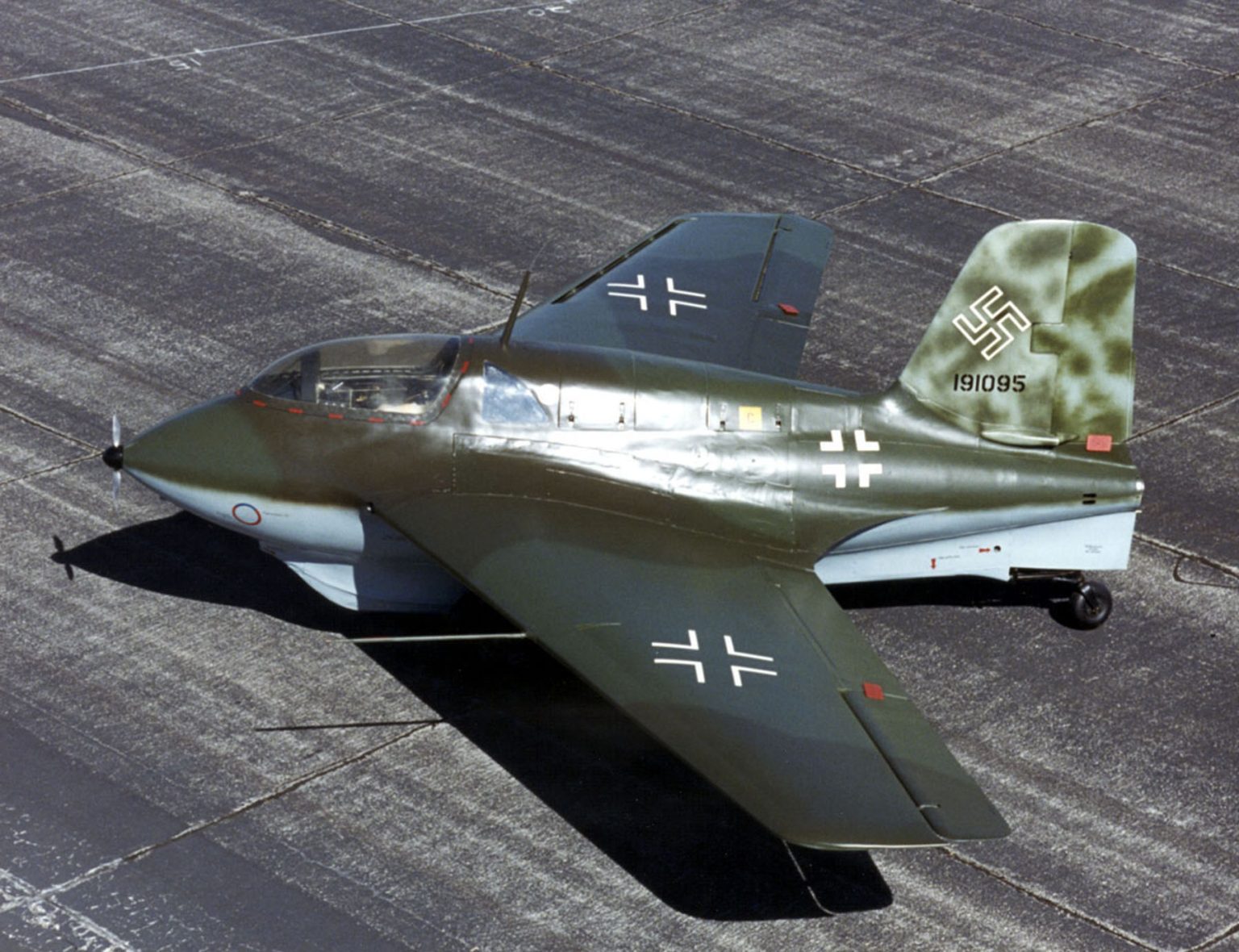
Me 163 Komet
The Luftwaffe’s rocket-powered interceptor
The fastest aircraft of the Second World War — and one of the deadliest to its own pilots. The Komet climbed like nothing before it, then ran out of fuel in eight minutes.
The Me 163 Komet: eight minutes of rocket power
No aircraft of the Second World War flew faster — and few were more dangerous to the men who flew them. The Messerschmitt Me 163 Komet was a rocket-powered interceptor: a tiny, tailless swept-wing dart that climbed to 9,000 metres in about three minutes, faster than anything else in the sky, then glided home dead-stick when its rocket ran dry after seven or eight minutes. It remains the only rocket-powered fighter ever to see combat.
It grew out of the glider research of Alexander Lippisch, who had been building tailless swept-wing designs since the 1920s and moved his team to Messerschmitt in 1939. The power came from Hellmuth Walter’s rocket motor, which burned two hypergolic chemicals: T-Stoff, a concentrated hydrogen peroxide, and C-Stoff, a hydrazine-and-methanol fuel. Mixed, they ignited on contact — and they were monstrous to handle. T-Stoff was corrosive enough to dissolve organic matter, a pilot included; leaks and spontaneous explosions killed men on the ground, and at least one pilot died soaked in the stuff after a crash-landing.
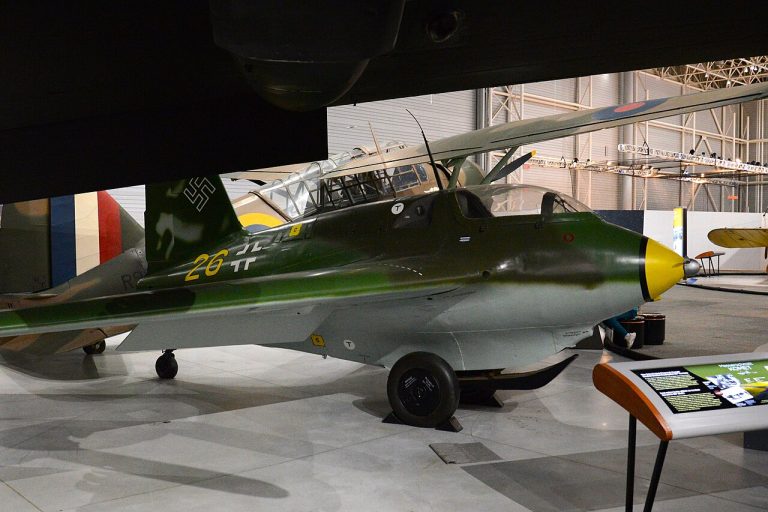
Flying it was a sequence of controlled emergencies. The Komet took off from a jettisonable two-wheeled dolly, which the pilot dropped once airborne; on return it landed on a retractable belly skid — and with the volatile remnants of its propellants still aboard, a heavy landing could detonate. Once down, it lay helpless on its belly until a special tractor came to lift it away.
In the air it was breathtaking. On 2 October 1941 the test pilot Heini Dittmar took an early Komet to 1,004 km/h — the first piloted aircraft ever to exceed 1,000 km/h, a record kept secret for years. In 1944 he pushed a later machine to an unofficial 1,130 km/h. Allied bomber crews who met the type in 1944 could scarcely believe how fast the little tailless speck closed on them.
And yet, as a weapon, it failed. The rocket gave only minutes of powered flight and a combat radius of barely 40 km, so Komets could defend only a small patch of sky — the synthetic-fuel plants around Leipzig that its single operational unit, JG 400, was formed to protect. A pilot got perhaps two firing passes, at a closing speed so high that hitting a bomber with the two slow-firing 30 mm cannon was desperately hard; it often took several hits to bring down a B-17. Across its whole career the type is credited with somewhere between nine and sixteen kills.
It killed more of its own than the enemy’s. Far more Komets were lost to takeoff and landing accidents, fuel fires and explosions than to Allied guns, and Allied pilots soon learned the safest tactic was simply to wait — and attack the Komet once its fuel ran out and it became a defenceless glider. By May 1945 the programme was over, its surviving pilots reassigned to Me 262 jets, and a handful of captured Komets were shipped to Britain and America as objects of fascination and dread.
01Why the Me 163 Komet was a brilliant technological dead end
Every quality that made the Komet astonishing also made it useless as a weapon. The rocket that gave it an unmatched climb also drained in minutes, tying it to the airfield it defended. The light, tailless airframe that let it reach 1,000 km/h left no room for the fuel a longer mission needed. And the hypergolic propellants that made the rocket so powerful made the whole aircraft a bomb on the ground.
The future of high-speed flight belonged not to the rocket but to the jet — the Me 262 could stay up for half an hour and fight on something like equal terms. Rocket research continued after the war, but no rocket-powered fighter ever entered service again. The Komet was a magnificent, terrifying blind alley.
How the Me 163 Komet was built
Tailless and swept
Alexander Lippisch’s design had no tail at all — just a short, fat fuselage and a swept wing, a shape drawn from his 1920s gliders. It was tiny, light and, for its day, radically fast; the same layout would reappear on jets decades later.
A rocket, not a jet
Power came from a Walter HWK 109-509 bi-propellant rocket of about 1,700 kg thrust — enough to climb at 81 m/s, faster than any fighter of the war. The price was endurance: at full thrust the propellants lasted only about seven and a half minutes.
Dolly, skid and cannon
The Komet took off on a jettisonable wheeled dolly and landed on a retractable belly skid. It carried two 30 mm MK 108 cannon; a few were fitted with the SG 500 Jägerfaust, ten upward-firing barrels triggered automatically as the Komet flashed beneath a bomber.
02The Me 163 Komet’s rocket engine: how T-Stoff and C-Stoff worked, and why they were lethal
The Walter motor burned two hypergolic propellants — chemicals that ignite the instant they meet, needing no spark. T-Stoff was concentrated hydrogen peroxide, a violent oxidiser; C-Stoff was a mix of hydrazine hydrate and methanol. Fed together into the combustion chamber they produced a controllable, throttleable thrust of up to about 1,700 kg — extraordinary for 1944.
They were also nightmarish. T-Stoff was corrosive enough to attack skin, cloth and organic tissue; the two fluids had to be trucked and stored entirely separately, because any accidental mixing could explode. Ground crews wore protective suits, aircraft blew up on the tarmac, and pilots died from leaks and fires. The test pilot Josef Pöhs was killed in 1943 in a takeoff accident compounded by T-Stoff exposure. The rocket gave the Komet its magic — and much of its menace.
03The Me 163 Komet’s takeoff and landing: the dolly, the skid and the tractor
With no undercarriage to save weight, the Komet used a two-wheeled dolly for takeoff, accelerating to around 320 km/h before lifting off and dropping the dolly. That was the easy part. Landing meant gliding back, unpowered, and setting down on a sprung belly skid — often with unburned, volatile propellant still sloshing in the tanks, so that a hard arrival could ignite or explode.
Once stopped, the Komet was immobile, lying on its belly in the open, and had to be hauled clear by a purpose-built tractor, the Scheuch-Schlepper. Many pilots were injured in landing accidents; the recovery process left the aircraft — and the pilot — dangerously exposed on the airfield.
Messerschmitt Me 163B Komet specifications
Baseline note: the figures below describe the Me 163B-1a as issued to I./JG 400 at Brandis in the summer of 1944 — the only version built in quantity, with the single-chamber Walter HWK 109-509A-2 and two 30 mm MK 108 cannon. Deltas for the unarmed Me 163A, for the twin-chamber Me 163C and for the Junkers-built Ju 248 / Me 263 are given in grey. Two warnings attach to every number on this page. First, almost all of it comes from Messerschmitt and Walter company documents and from brief Allied handling trials in 1945–46; no Allied test establishment ever flew a Komet under power, because nobody was willing to handle the propellants, so there is no independent performance data of the kind that exists for the Me 262. Second, several much-reprinted figures — powered endurance above all — describe the engine at a throttle setting no operational interception ever used.
Dimensions & weights
- Crew
- 1
- Length
- 5.70 m (18 ft 8 in) — shorter than a Supermarine Spitfire by more than three metres, and shorter than the wing it carried was wide
- Wingspan
- 9.33 m (30 ft 7 in); most sources round this to 9.3 m
- Height
- 2.50 m (8 ft 2 in) sitting on the skid; appreciably more on the take-off dolly, and published heights differ according to which state is meant
- Wing area
- 19.6 m² (211 sq ft) — a large wing for so small an aeroplane, which is what made the Komet such a good glider once the propellant ran out
- Wing sweep
- 23.3° at quarter chord — swept for longitudinal balance on a tailless aeroplane rather than for compressibility, though it helped with both
- Aspect ratio
- 4.44
- Empty weight
- 1,905 kg (4,200 lb)
- Maximum take-off weight
- 4,310 kg (9,500 lb), including the jettisoned dolly
- Propellant load
- ~1,650 litres, roughly 2,000 kg (4,400 lb) — T-Stoff and C-Stoff together made up close to half the all-up weight, so the Komet landed at about 45 per cent of the weight at which it left the ground
- Wing loading
- 220 kg/m² at take-off (45.1 lb/sq ft), falling to about 100 kg/m² (20.5 lb/sq ft) empty — two entirely different aeroplanes inside eight minutes
- Thrust-to-weight ratio
- 0.35 at maximum take-off weight (0.42 is often quoted, using a lighter loaded figure); above 0.7 by the time the tanks were dry
- Undercarriage
- Jettisonable two-wheel take-off dolly, retractable ventral landing skid on an oleo-pneumatic strut, retractable tailwheel — there were no wheels on the aeroplane after unstick, and none for the landing
Performance
- Maximum speed
- 900 km/h (559 mph) from sea level to 12,000 m — a limit set by compressibility and by the airframe, not by the motor, which had thrust to spare all the way up
- Compressibility limit
- About Mach 0.82 — beyond it the tailless aeroplane pitched and the controls went solid. A Mach warning device was fitted because the thrust-to-drag ratio made it very easy to arrive there without noticing.
- Rate of climb
- 81 m/s (15,900 ft/min) initial — roughly five times what a contemporary piston fighter could manage, and the whole point of the aeroplane
- Time to 9,000 m
- 2.6 minutes (29,500 ft)
- Time to 12,000 m
- 3.45 minutes (39,400 ft) from release of the dolly
- Service ceiling
- 12,000 m (39,400 ft) as an operating altitude; zoom climbs went considerably higher, but the cockpit was unpressurised and the pilot on bottled oxygen, which set the practical limit rather than the airframe
- Powered endurance
- 7.5 minutes at the most economical throttle setting; about 4 minutes at full thrust — and a realistic interception, climbing at full power, gave the pilot two to three minutes of powered manoeuvring before the motor cut
- Combat radius
- ~40 km (25 miles) — the Komet could only engage what flew more or less over its own aerodrome, which is why JG 400 sat on top of the Leuna synthetic fuel plant rather than anywhere else
- Range
- No meaningful figure exists — the type had no cruise condition and no diversion capability. Once the propellant was gone it was a one-way glider back to the field it had launched from.
- Glide performance
- Reported at roughly 20:1 clean — sailplane figures, and a real problem: the aeroplane floated on the approach and would climb again on the smallest updraught, so the pilot had one attempt and no engine to correct it
- Touchdown speed
- About 220 km/h (137 mph) on the skid, on grass. Back injuries from a hard arrival were routine; a skid that failed to extend, or extended and locked, broke the pilot as often as the aeroplane.
- For comparison: North American P-51D
- 703 km/h (437 mph) — 200 km/h slower, and quite unable to catch a Komet under power, which is why Mustang and Thunderbolt pilots simply waited above Brandis for the motor to stop
Propulsion & systems
- Engine
- 1 × Walter HWK 109-509A-2 bi-propellant liquid rocket motor — the Me 163A had instead the monopropellant Walter R II-203, which decomposed T-Stoff alone over a catalyst; the step to a true hypergolic bi-propellant came with the B
- Thrust
- 14.71 kN (3,307 lbf, 1,500 kp) maximum, throttleable to about 2 kN (200 kp). The 509B and 509C added a small Marschofen cruise chamber of 300–400 kp so the pilot could hold height economically; that is where the twelve-minute endurance figures come from, and no Me 163B ever had it in service.
- Oxidiser: T-Stoff
- 80 per cent hydrogen peroxide, stabilised with oxyquinoline or phosphate — a violent oxidiser that set fire to cloth, leather and wood on contact and inflicted deep, spreading chemical burns on anything living. Aircrew and armourers worked in acid-resistant Mipolam suits, and the fear of the stuff was entirely rational.
- Fuel: C-Stoff
- 30 per cent hydrazine hydrate, 57 per cent methanol, 13 per cent water, with a potassium-copper-cyanide catalyst — toxic in its own right, and hypergolic with T-Stoff: the two ignited on contact, instantly and without an igniter, which is exactly what happened whenever a line ruptured or a tank split on landing
- Consumption
- Roughly 6.5 kg/s of propellant at full thrust, of which nearly 5 kg/s was T-Stoff alone — twice the pre-war estimate. Two thousand kilogrammes of chemicals lasted about five minutes.
- Propellant feed
- Steam turbopump driven by T-Stoff decomposed over a permanganate catalyst (Z-Stoff), so the pump ran on the same oxidiser it delivered
- Tankage
- Main T-Stoff tank of about 1,040 litres behind the cockpit, plus two 120-litre auxiliary tanks in the cockpit flanks; C-Stoff in wing leading-edge and fuselage tanks — published breakdowns vary, but the essential point does not: the pilot sat wrapped in the oxidiser, with the fuel in the wings he was sitting between
- Ground handling
- Separate bowsers for each propellant, filling through separate dorsal points, with the T-Stoff vehicle withdrawn before the C-Stoff arrived; the aeroplane was recovered by a Scheuch-Schlepper three-wheeled tractor and a lifting trailer — on the skid the Komet could not move an inch under its own power, and a strafing fighter found it stationary
- Structure
- All-metal fuselage with a wooden wing built by furniture manufacturers — metal for the fuselage precisely because T-Stoff attacked organic material. Klemm-built wings suffered from bad glue and, in at least one surviving airframe, from deliberate sabotage by French forced labourers.
- Flight controls
- Elevons on the trailing edge with fixed leading-edge slots ahead of them, twin trim flaps, a single fin and rudder; no tailplane and no separate ailerons — the slots were Lippisch’s answer to tailless stall behaviour and made the Komet notably docile in the glide
- Electrical & equipment
- Nose-mounted ram-air turbine charging a lead-acid battery; Revi 16B reflector gunsight; FuG 16ZY radio and FuG 25a IFF — no engine-driven generator, because there was no engine in the conventional sense
- Protection
- Armoured nose bulkhead and armour glass windscreen, unpressurised cockpit — the armour was against defensive fire from bombers; nothing on the aeroplane protected the pilot from what was in the tanks
04The Me 163 Komet’s numbers: how many were built, and how many it shot down
Around 370 Komets were built, but only one unit — Jagdgeschwader 400 — ever flew them in anger, and only a fraction were airborne at any time thanks to chronic shortages of the exotic propellants. Its confirmed tally is usually given as between nine and sixteen Allied aircraft, mostly heavy bombers, across roughly a year of operations.
Set against that are the Komets lost to accidents — takeoff and landing crashes, fuel fires and explosions — which outnumbered those lost to the enemy. One historian’s verdict was blunt: for all its speed, the Komet “did not warrant the effort put into the project.”
05After the Komet: the Me 263, the Japanese J8M and the end of the rocket fighter
The Komet spawned a short-lived family. The Me 263 (originally the Junkers Ju 248) was a larger, longer-ranged redesign with retractable landing gear; it was completed but never flew under power, and its lineage was continued after the war by the Soviet Mikoyan-Gurevich I-270. Germany also shipped plans and an example to its ally Japan, which developed the Mitsubishi J8M Shūsui — whose prototype crashed on its first powered flight.
None entered service. The rocket fighter, for all its thrilling performance, had reached a dead end — outlived within months by the turbojet.
Armament & payload
The Komet carried two cannon, sixty rounds each, and about five seconds of firing time
Everything about the Me 163’s armament was governed by one number: closing speed. A Komet came up through a bomber stream at 900 km/h against a B-17 formation making 300, which gave the pilot roughly two to three seconds inside effective range on each pass and no possibility of tracking. Into that window Messerschmitt put the heaviest gun available, two 30 mm MK 108 cannon in the wing roots with sixty rounds each — a weapon whose enormous Minengeschoss shell would break a heavy bomber with three or four hits, and whose 505 m/s muzzle velocity and looping trajectory made those hits desperately hard to achieve at any deflection. The result is the central paradox of the aeroplane: the fastest interceptor of the war was, as a gun platform, one of the worst, and the Luftwaffe spent the last year of the conflict trying to invent a weapon that did not require aiming at all. The pre-production Me 163B-0 carried 20 mm MG 151/20 cannon instead, and a handful of late airframes were fitted with the SG 500 Jägerfaust; neither was a service standard, and figures quoted for either should be read as applying to a few aeroplanes rather than to the type.
Gun
- 2 × 30 mm Rheinmetall-Borsig MK 108, one in each wing root, 60 rounds per gun — the Me 163B-1a standard
- About 660 rounds per minute, so roughly 5.5 seconds of continuous fire per gun and no second chance if the pilot emptied them on a poor pass
- Muzzle velocity 505–540 m/s — very low for a fighter gun. The shell dropped visibly over 400 m and the sighting solution against a crossing target was close to guesswork at Komet closing speeds.
- 2 × 20 mm Mauser MG 151/20 with 100 rounds per gun on the Me 163B-0 pre-production machines — flatter shooting and longer firing time, but far too light to break a Fortress in two or three strikes
- Revi 16B reflector sight, with an armour-glass windscreen behind it; some late airframes carried the EZ 42 gyro sight, which was of little use in a two-second firing pass
Air-to-air
- Guns only. No guided air-to-air weapon existed that a 1944 single-seater could carry, and none was proposed for the Komet
- SG 500 Jägerfaust: ten single-shot 50 mm recoilless barrels, five buried vertically in each wing root, fired upward. A photocell in the upper surface sensed the shadow of a bomber passing overhead and triggered them automatically, the recoil cancelled by ejecting the barrel downward as the shell went up
- It is the most interesting weapon on the aeroplane and it worked, once: Leutnant Fritz Kelb is credited with destroying an RAF Lancaster with a Jägerfaust salvo on 10 April 1945. That is the entire combat record of the device
- Tactically the Komet was flown vertically up through the bombers at about 9,000 m, on to 10,700–12,000 m, then dived back through the formation firing on the way down. Pilots reported that four passes on a single straggler were possible; against a defended box, one or two
- The scoreboard is brutal. Roughly nine confirmed victories, with claims ranging as high as sixteen to eighteen, against about ten to fourteen Komets lost — a return on something like 370 aeroplanes, a bespoke rocket industry and a dedicated Geschwader
Air-to-surface guided
- None, and none contemplated. The Me 163 had no ground-attack capability of any kind
- The card is kept because the absence is the aeroplane. With forty kilometres of radius and four minutes of thrust, the Komet had exactly one mission and could not be given a second one
- By comparison the Me 262 and the Ar 234, the other two German jets in service, both carried bombs and both were pressed into strike work. The Komet could not have carried a load if anyone had wanted it to
- Nor could it be used as a Mistel component, an intruder or a reconnaissance machine. It was the most single-purpose combat aeroplane ever put into squadron service
Bombs
- None. No Me 163 was ever fitted with a bomb rack, and no drawing for one was issued
- There was physically nowhere to hang anything. The fuselage underside was occupied along its whole length by the landing skid and its well, and the wing was a wooden structure full of C-Stoff
- External stores would in any case have destroyed the performance that justified the aeroplane. Every kilogramme of drag came directly out of an endurance already measured in single-figure minutes
- The RLM specification that produced the Komet asked for a short-range, high-rate-of-climb point-defence interceptor and nothing else. On that narrow requirement, and only on it, the design delivered
Rockets
- The Komet’s rocket was propulsion, not armament, and it never carried a rocket weapon in service
- The R4M unguided air-to-air rocket, salvo-fired from wooden rails and used to good effect by Me 262s from March 1945, was never fitted — there was no rail, no wiring and no drag margin for it
- The RZ 65 and RZ 73 spin-stabilised rockets were considered for anti-bomber work across the fighter force; nothing reached an operational Komet
- Schräge Musik-style upward-firing cannon, standard on night fighters, were impossible: the space behind the Me 163’s cockpit held the main T-Stoff tank
- The Jägerfaust was often described as a rocket battery and was not one — it was a set of recoilless single-shot barrels, closer to a bank of mortars than to anything with a motor
Pods & other stores
- Nothing was ever carried externally. No pod, no drop tank, no camera fairing, no hardpoint of any description
- A drop tank was out of the question on principle as well as on drag: hypergolic propellants in a jettisonable container hung under a wooden wing was not an engineering problem anyone wanted to solve
- The one thing the Komet routinely dropped was its own undercarriage — the two-wheel take-off dolly, released immediately after unstick. Released too high it bounced off the ground and back into the aeroplane, which is how Oberleutnant Josef Pöhs was fatally injured on 30 December 1943
- The dolly is worth counting as a store because it was expendable, dangerous and part of every sortie. Early sprung dollies were replaced by a simple crossbeam-axled type for exactly this reason
Three typical loadouts
- Bomber interception, Brandis, August 1944
- 2 × MK 108 with 60 rounds per gun; full T-Stoff and C-Stoff; take-off dolly. Scramble on radar warning of a Leuna raid, vertical climb to about 12,000 m, one firing pass down through the formation, a second if the propellant lasted, then a dead-stick glide back to Brandis. Total sortie: eight to twelve minutes.
- Familiarisation glide, EK 16 or a JG 400 training flight
- Guns removed or unloaded, tanks empty or water-ballasted, towed aloft behind a Messerschmitt Bf 110 and released. Every Komet pilot flew the aeroplane as a glider before he ever lit the motor, and the Me 163S two-seater existed for precisely this stage.
- Jägerfaust sortie, Brandis, April 1945
- SG 500 installation of ten 50 mm barrels in the wing roots, photocell trigger armed, MK 108s retained. Fly underneath the bomber, let the sensor do the shooting. Attempted in earnest only in the last weeks, and credited with a single Lancaster on 10 April 1945.
Sourcing caveat: the Komet’s victory and loss tallies are among the least settled in Luftwaffe history. Nine confirmed kills against roughly ten losses is the most conservative and most commonly cited pair; other authorities credit up to sixteen or eighteen Allied aircraft, and JG 400’s own loss returns are incomplete for the final weeks. Ammunition loads and sight fits varied between airframes and between the surviving manuals, and several late modifications exist only in drawings.
Variants
The Komet descends from a Lippisch sailplane and ends in a Japanese copy and a Soviet prototype
The Me 163 was not a Messerschmitt design in origin. It is the last of a line of tailless aeroplanes that Alexander Lippisch had been building since the Storch gliders of 1927 and the Delta series of the early 1930s, refined through the DFS 39 and given a rocket motor as the DFS 194. When the Reich Air Ministry moved Lippisch and his team to Augsburg in January 1939 they brought a half-finished airframe with them; Messerschmitt supplied the factory, the type number and eventually the name, and the friction between Lippisch and Willy Messerschmitt was constant enough that Lippisch left for Vienna in 1943, before the aeroplane ever saw combat.
What followed the Me 163B is a study in diminishing returns. Every attempt to fix the Komet’s two fatal shortcomings — the endurance and the undercarriage — produced a heavier aeroplane that needed more propellant, which is a circle the technology of 1944 could not square. The Me 163C added a cruise chamber and a bubble canopy and flew once, without its intended motor. The Junkers redesign that became the Ju 248 and then the Me 263 finally gave the type a proper tricycle undercarriage and was glide-tested in 1944, but never flew under power. The lineage did not end with the war: the Soviets picked the work up as the Mikoyan-Gurevich I-270, and Japan, working from a manual that survived when the submarines carrying the drawings did not, reverse-engineered the whole thing as the Mitsubishi J8M.
- DFS 194 (1940, 1 built)
- Lippisch’s tailless research aircraft, begun at DFS with a piston engine and completed at Augsburg with a Walter R I-203 rocket. Flew under power at Peenemünde-West in the summer of 1940 at about 550 km/h and settled the configuration.
- Me 163A (1941–43, about 10 including prototypes)
- Unarmed prototypes and service-test machines with the monopropellant Walter R II-203. Heini Dittmar took the V4 to an unofficial 1,004.5 km/h on 2 October 1941 after a towed launch — the first aeroplane past 1,000 km/h, and a record nobody was allowed to publish.
- Me 163B-0 (1942–44, roughly 30 pre-production)
- First airframes to the simplified production standard, with the bi-propellant HWK 109-509 and 20 mm MG 151/20 cannon. Issued to Erprobungskommando 16 at Bad Zwischenahn from January 1944.
- Me 163B-1a (1944–45, the great majority of about 370 completed)
- The service aeroplane: HWK 109-509A, two MK 108 cannon, dolly and skid. Built by Messerschmitt, then by Klemm and Junkers as Augsburg was overloaded. German sources give around 274 series machines; the difference from the 370 total is prototypes, test airframes and aircraft never delivered.
- Me 163S (1944–45, a small number of conversions)
- Two-seat unpowered trainer, converted from B-series airframes by deleting the motor and the T-Stoff tank behind the cockpit and putting an instructor there under a second canopy. Towed aloft and glided down — the only way to teach the approach, which was the part that killed people.
- Me 163C (1944–45, 3 ordered, 1 flown)
- Waldemar Voigt’s redesign: wing root inserts, a longer fuselage with more propellant, a retractable tailwheel, a pressurised cockpit under a bubble canopy and the twin-chamber HWK 109-509C. Claimed 15,850 m and about twelve powered minutes. The single completed C-1a flew without its intended motor.
- Me 163D / Junkers Ju 248 / Me 263 (1944–45, 3 prototypes)
- Junkers took the redesign over under Heinrich Hertel and built it as a three-section fuselage for easier production, with a retractable tricycle undercarriage and the twin-chamber motor from the outset. The V1 was finished in August 1944 and glide-tested behind a Bf 110; it never flew under rocket power.
- Mikoyan-Gurevich I-270 (1946–47, 2 built)
- The Soviet continuation of the Me 263 work after the Junkers plant was overrun, with a conventional straight wing and a T-tail. Both prototypes flew; neither entered service, and the line died with them.
- Mitsubishi J8M1 Shūsui / Ki-200 (1944–45, 7 completed)
- The joint Navy and Army Japanese copy, reverse-engineered from a manual carried by Commander Eiichi Iwaya after the submarines I-29 and RO-501 were sunk with the drawings and the sample airframe aboard. Toko Ro.2 motor, two 30 mm cannon. Lieutenant Commander Toyohiko Inuzuka flew the first powered flight on 7 July 1945; the motor failed at 400 m and he died of his injuries the next day.
- Yokosuka MXY8 Akigusa and MXY9 Shūka (1944–45, about 60 gliders)
- The Japanese equivalent of the Me 163S: unpowered wooden gliders for type conversion, first flown by Inuzuka on 8 December 1944 and judged to handle almost exactly like the German aeroplane. The MXY9 motorjet trainer was never completed.
Survivors: roughly ten original Me 163B airframes exist, all of them non-flying and none with a live motor, which makes the Komet one of the better-represented German rarities. In Britain, Werknummer 191316 is at the Science Museum in London (on display since 1964, its Walter motor exhibited separately), 191614 at the Royal Air Force Museum, and 191659 (RAF Air Ministry number AM215, "Yellow 15", captured at Husum in 1945 and used at Cranfield from 1947) at the National Museum of Flight, East Fortune. In Germany, 191904 "Yellow 25" is at the Luftwaffenmuseum at Berlin-Gatow, returned from RAF St Athan in 1988 and restored with a Walter HWK 109-509, and 120370 "Yellow 6" is at the Deutsches Museum in Munich. In the United States, 191301 (FE-500) is at the Smithsonian National Air and Space Museum’s Udvar-Hazy Center, displayed deliberately unrestored; 191095 is at the National Museum of the United States Air Force at Wright-Patterson, the airframe in which Canadian restorers found stones packed between the propellant tanks and their straps and French writing inside the fuselage, sabotage by forced labourers; and 191660 "Yellow 3" went from the Imperial War Museum to Paul Allen’s Flying Heritage Collection at Everett, Washington in 2005 for a reported £800,000, the export licensed because three Komets remained in British collections. Canada Aviation and Space Museum in Ottawa holds one from JG 400 captured at Husum and shipped over in 1946, and the Australian War Memorial holds 191907, formerly at RAAF Point Cook. Werknummer attributions are not wholly reliable — the Ottawa aeroplane is given variously as 191659 (AM215) or 191914 (AM220), and 191659 cannot be in both Ottawa and East Fortune, so at least one published identity is wrong. The unpowered replica built in 1994–96 by the former Komet pilot Joseph Kurtz is at the Messerschmitt Museum of Flight, and is a replica, not an original. Of the Japanese derivative, one complete J8M survives at the Planes of Fame Museum at Chino, California, and a fuselage recovered from a cave in the 1960s is displayed at the Mitsubishi plant museum at Komaki.
The Me 163 Komet, from record-breaker to last resort
First powered flight
The Me 163 makes its first rocket-powered flight on 1 September.
Past 1,000 km/h
On 2 October Heini Dittmar reaches 1,004 km/h — a secret world first.
A propellant claims a pilot
Test pilot Josef Pöhs is killed in a takeoff accident involving T-Stoff.
JG 400 formed
The only operational Komet unit stands up to defend the synthetic-fuel plants near Leipzig.
Into combat
The first combat sortie flies on 13 May; regular operations begin on 28 July.
Unofficial 1,130 km/h
On 6 July Dittmar pushes a twin-chamber Komet to an unofficial 1,130 km/h.
The upward gun scores
On 10 April an SG 500 Jägerfaust brings down a Lancaster — its only recorded kill.
The end
Operations cease in May; surviving JG 400 pilots move to the Me 262 jet.
The Me 163 Komet in nine stories
Eric Brown flies the Komet
Britain’s greatest test pilot took one up under power.
The full story
T-Stoff, C-Stoff and the men they killed
The propellants were as dangerous as the enemy.
The full story
1,000 km/h — and no one could know
Heini Dittmar broke a barrier the world wasn’t told about.
The full story
A fighter tied to its own airfield
The rocket that gave everything also took it away.
The full story
How the Allies beat the fastest fighter
The counter to the Komet was patience.
The full story
The Jägerfaust and its single Lancaster
A weapon that fired straight up, once.
The full story
The skid, the tractor and the injuries
Getting down was the hardest part.
The full story
More lost to accidents than to the enemy
The Komet killed more of its own than it downed.
The full story
The Me 263, the J8M and the I-270
The rocket fighter’s brief family tree.
The full story
The Me 163 Komet in photographs
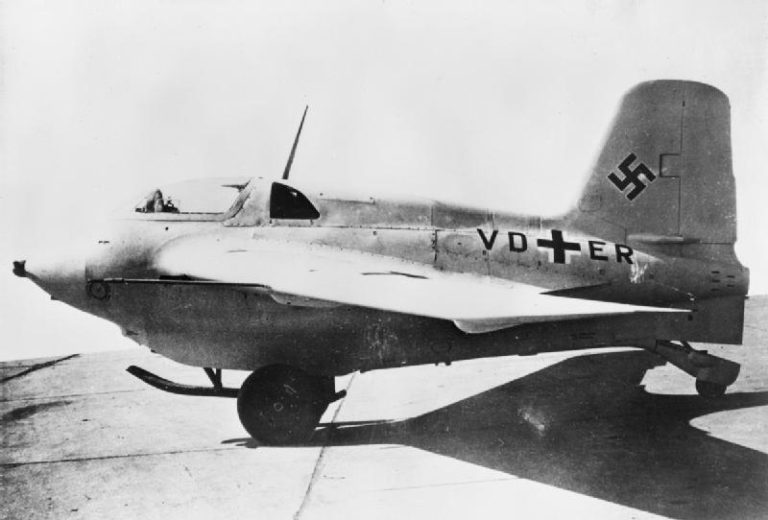
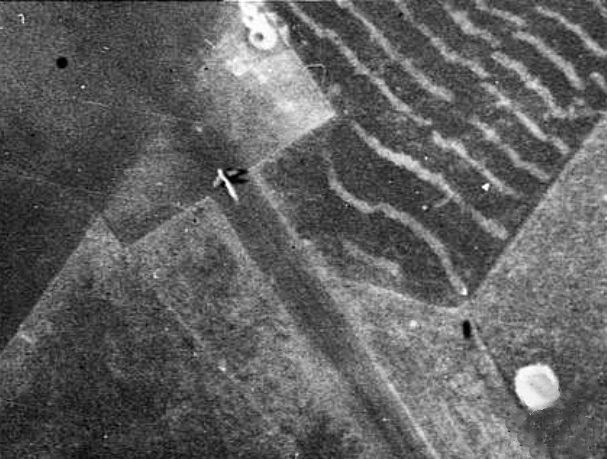
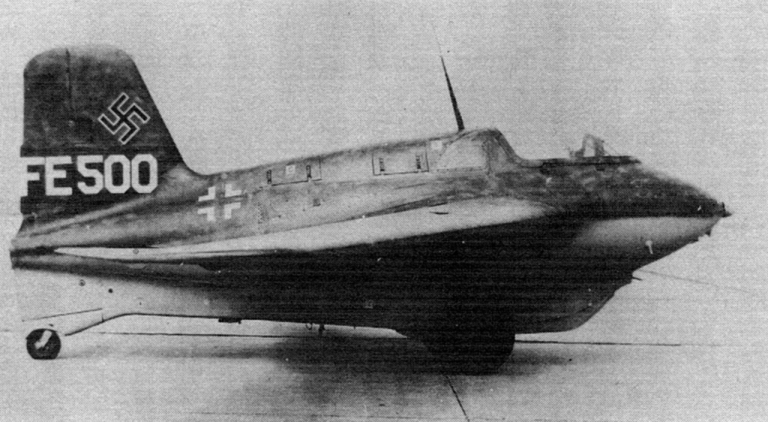
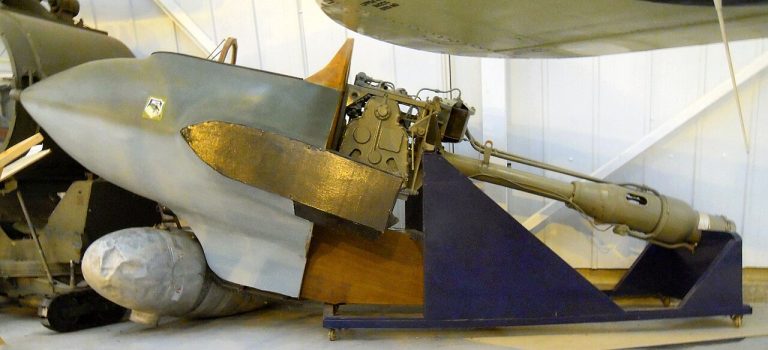
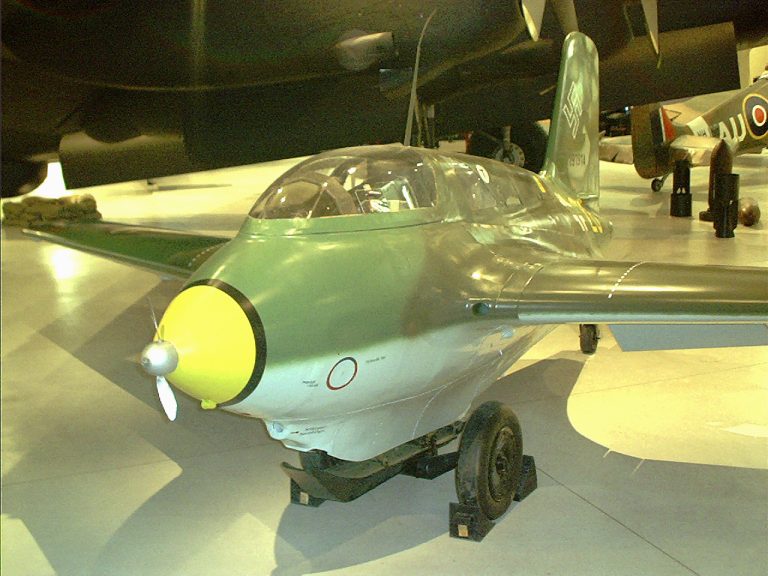
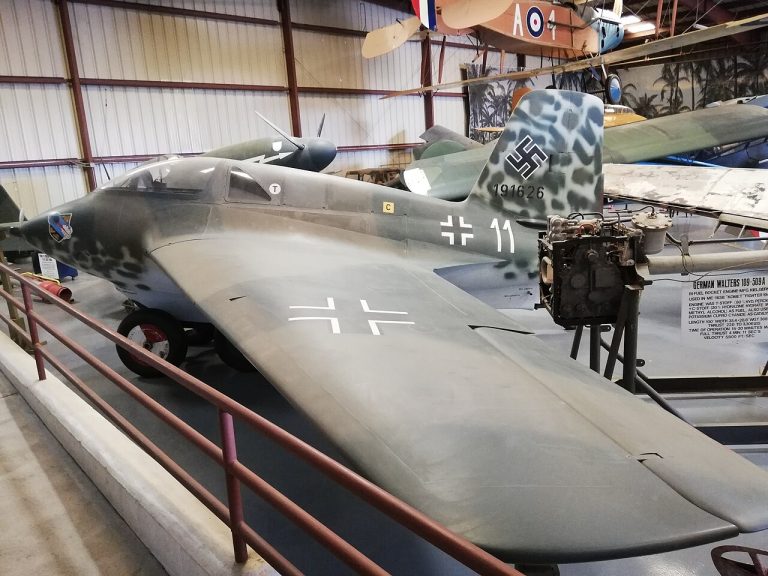
The Komet, filmed in 1944
Rare wartime footage of the Me 163 in service — its rocket launch, its skid landing, and the ground crews who handled its lethal fuel.
A wartime Luftwaffe instructional film on the Me 163 B, c. late 1944 (German WWII Archive).
Where the Me 163 Komet flew — and survives
The score: speed without result
The Komet was the fastest thing in the sky and one of the least effective weapons of the war. In roughly a year of operations it downed a handful of bombers — and lost more of its own to fuel, fire and failed landings than to the enemy.
Faster than anything the Allies flew, the Komet was defeated by its own tiny endurance, its lethal fuel, and the simple tactic of waiting for it to glide. Compare the combat record of every military aircraft.
Me 163 Komet: your questions, answered
Can I fly in a Me 163 Komet?
No — only a handful survive, all in museums, and none are airworthy. But you can fly in a real military jet today: MiGFlug offers flights in genuine fighters and jet trainers such as the L-39 Albatros and the MiG-29. See migflug.com/flights-prices.
Was the Me 163 the fastest aircraft of World War II?
Yes. It reached about 1,000 km/h (620 mph), and in 1941 became the first piloted aircraft ever to exceed 1,000 km/h — a record kept secret at the time.
Why did the Me 163 only fly for a few minutes?
Its rocket burned propellant at an enormous rate. Powered flight lasted only about seven and a half minutes, giving a combat radius of roughly 40 km — after which it glided home unpowered.
Why was the Me 163 so dangerous to its own pilots?
Its hypergolic propellants, T-Stoff and C-Stoff, were corrosive and explosive, and the dolly takeoff and skid landing caused many crashes. More Komets were lost to accidents than to the enemy.
How many aircraft did the Me 163 shoot down?
Between about nine and sixteen Allied aircraft over its whole career — a tiny return for the effort the programme consumed.
How did the Me 163 take off and land?
It took off from a jettisonable two-wheeled dolly and landed on a retractable belly skid, then had to be towed off the airfield by a special tractor.
What happened to the Me 163 after the war?
The programme ended in May 1945. Captured examples went to Britain and the United States, and the design influenced the Me 263, the Japanese J8M and the Soviet I-270 — but no rocket fighter entered service again.
You can’t fly the Me 163 Komet.
These, you can.
The Komet is long gone, and no one will ever fly one again — but you can still strap into a genuine military jet. MiGFlug flies civilians in real fighters and jet trainers around the world.
 Fly the L-39 AlbatrosThe world’s most-flown jet trainer — aerobatics included
 Fly the F-104 Starfighter“The missile with a man in it”
 Fly the MiG-21The Cold War’s most-produced jet
 Fly the T-33 Shooting StarAmerica’s first jet trainer
 Fly the DH VampireA piece of early jet history
 Fly the S.211Agile Italian jet trainer
 Fly the MB-326The classic Aermacchi jet
 Fly the MiG-15The Soviet legend of the Korean War
Related aircraft
Where this chapter comes from
- National Museum of the U.S. Air ForceFact sheets on the Me 163 and its captured, restored examples.
- Smithsonian National Air and Space MuseumThe Me 163 B at the Udvar-Hazy Center, with technical and historical detail.
- Royal Air Force MuseumOn the captured Komets brought to Britain for evaluation in 1945.
- Imperial War MuseumWartime context on the Reich air-defence campaign the Komet was built to fight.
- Deutsches Museum, MunichHolds an original Me 163 and documents the Walter rocket technology.
- MiGFlug — AfterburnerMiGFlug’s aviation magazine, on the wonder-weapons of the Luftwaffe and the dawn of jet and rocket flight.
The Komet’s kill and loss figures are contested; the commonly cited range of nine to sixteen victories is used here, and performance figures are drawn from period records and postwar evaluation.