
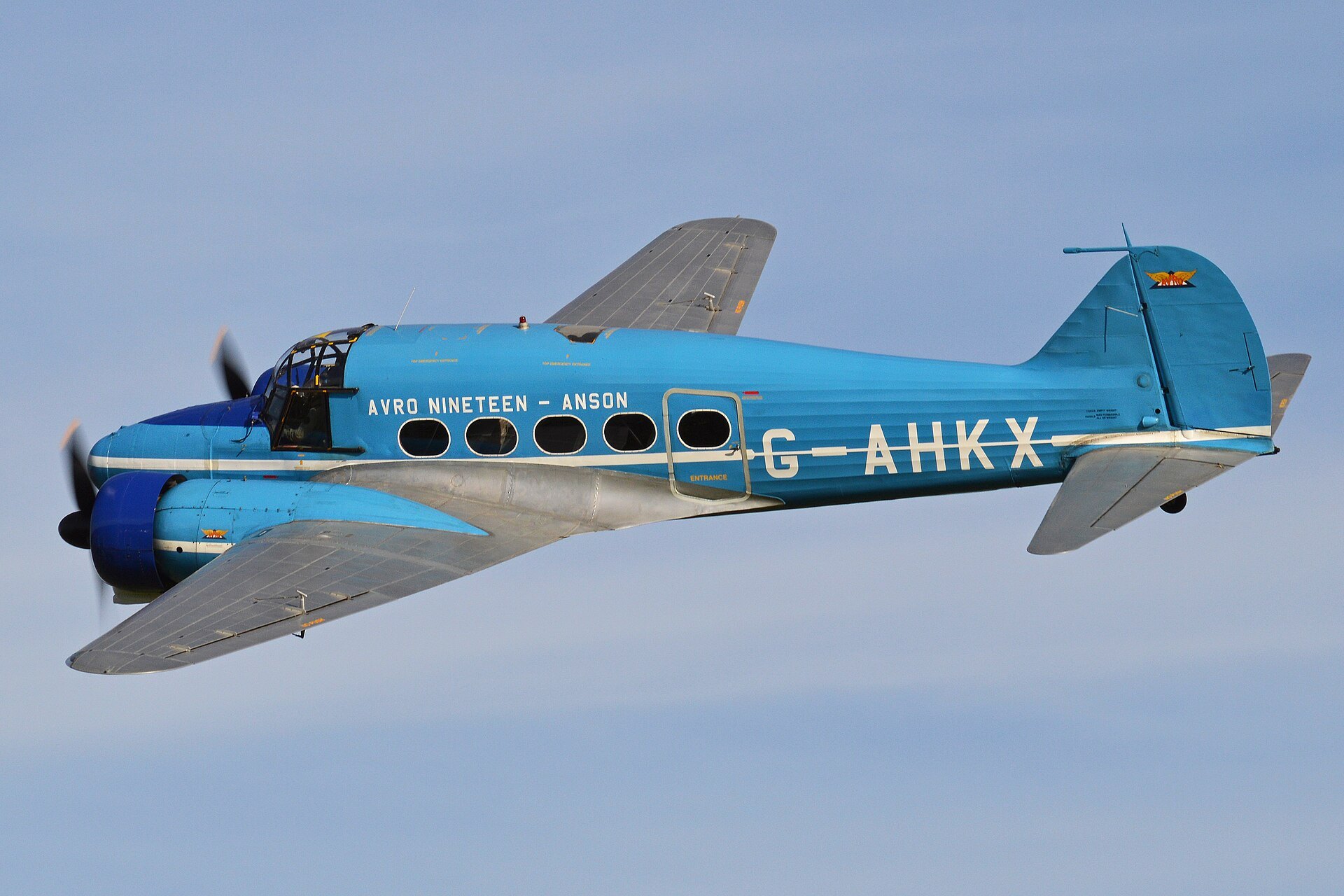
Avro Anson
Faithful Annie
Built as a coastal patrol aircraft and outclassed by 1939, the Anson became the twin-engined classroom of the Commonwealth: more than 11,000 were made and the RAF flew them for 33 years.
The Anson: how a small airliner became the Commonwealth’s flying classroom
The Avro Anson began life as a modest commercial project. In the mid-1930s Roy Chadwick’s design team at Avro had drawn the Avro 652, a small twin-engined transport for Imperial Airways. When the Air Ministry asked for a coastal reconnaissance aircraft for the new Coastal Command, Avro adapted the 652 into the 652A, which first flew on 24 March 1935. It was a low-wing monoplane with a steel-tube fuselage, wooden wings, two Armstrong Siddeley Cheetah radials and, unusually for the RAF of the day, a retractable undercarriage. The catch was that the pilot raised it by hand, with a crank that needed about 144 turns. On 6 March 1936 the type entered service with No. 48 Squadron, and the RAF had its first monoplane with a retractable undercarriage in squadron service.
By September 1939 the Anson was, in the words of the RAF Museum, hopelessly outclassed: slow, short-ranged and armed with a single fixed machine gun and one more in a hand-turned turret. Coastal Command flew it anyway. An Anson made the first RAF attack on a German U-boat within three days of the declaration of war, and over Dunkirk on 1 June 1940 three Ansons of No. 500 Squadron fought nine Messerschmitt Bf 109s and came home claiming two of them. Yet the Anson’s real war was fought in classrooms. The Lockheed Hudson took over its patrol work, and the Anson became the standard twin-engined trainer for pilots, navigators, wireless operators and bomb aimers across Britain, Canada, Australia and South Africa.
Production numbers tell the story. Avro built 8,138 Ansons in Britain between 1935 and March 1952, and Federal Aircraft Ltd of Montreal organised another 2,882 in Canada from 1941, a total of 11,020. The Royal Canadian Air Force alone used 4,413, more than any other type in its wartime inventory. After the war the redesigned Anson C.19, with a taller cabin and later metal wings, served as a communications aircraft until the RAF retired its last Ansons on 28 June 1968. Crews nicknamed it Faithful Annie, and the name stuck because the aircraft deserved it: forgiving, stable and almost impossible to wear out. Today a handful survive in museums, and one Mk I still flies.
01The Anson’s war at sea: Coastal Command’s first patrol aircraft
When war came in September 1939 the Anson equipped most of Coastal Command’s general reconnaissance squadrons. Its job was to watch the North Sea and the approaches to British ports, escort convoys and report anything it found. On paper it could carry two 100 lb bombs inside the fuselage and small bombs, flares or smoke floats under the wings, and it had a fixed forward-firing Vickers gun and a Lewis gun in a manually operated dorsal turret. In practice its patrol radius was short and its weapons were barely adequate against a submarine.
The early months exposed those limits. An Anson made the first RAF attack on a U-boat within three days of the declaration of war. Weeks later, Ansons of No. 233 Squadron dropped anti-submarine bombs that skipped off the water and exploded close to the attacking aircraft. On 3 December 1939 an Anson attacked a surfaced submarine that turned out to be the Royal Navy’s own HMS Snapper; the bomb that hit her broke four light bulbs. These episodes were less about the Anson than about the weapons it was given, but they hastened its replacement by the Lockheed Hudson.
The Anson still had a defiant moment left. During the Dunkirk evacuation No. 500 Squadron flew patrols over the Channel, and on 1 June 1940 the crews of three Ansons held their own against nine Bf 109s, an action examined below. By the end of 1941 the type had largely left front-line patrol work, and its future lay in training.
02The Anson in the Empire Air Training Scheme: a classroom with wings
The Empire Air Training Scheme, known in Canada as the British Commonwealth Air Training Plan, was the largest aircrew training programme the Commonwealth ever attempted. Schools in Canada, Australia, South Africa and Southern Rhodesia trained pilots, navigators, wireless operators, air gunners and bomb aimers away from the risk of German bombing. It needed a twin-engined aircraft with room for an instructor and several students, docile enough for beginners and robust enough to fly all day. The Anson fitted. It was chosen as the standard twin-engined aircrew trainer, and although the RAF expected the Airspeed Oxford to take over, the Anson stayed in training for the whole war.
Britain could not ship enough of them, so Canada built its own. Federal Aircraft Ltd in Montreal coordinated a network of Canadian factories from 1941. The Anson II used American Jacobs engines and hydraulic undercarriage operation, and the Anson V, intended for navigator training, had a moulded plywood fuselage and 450 hp Pratt & Whitney Wasp Junior radials. Canadian production reached 2,882 aircraft. The RCAF used 4,413 Ansons of all marks, and the Royal Australian Air Force received several hundred more.
For a young navigator from Saskatchewan or Queensland, the Anson was the first aircraft in which flying became teamwork: the pilot holding a heading, the navigator plotting, the wireless operator working the set. Many of those crews went on to Bomber Command’s heavies, including Chadwick’s own Lancaster.
What makes the Anson special
The Anson’s undercarriage: 144 turns of the crank
The Anson I was among the first RAF aircraft to enter squadron service with a retractable undercarriage, a sign of how modern it looked in 1936. Avro kept the system simple: there was no hydraulic or electric drive, so the pilot or a second crew member wound the main wheels up with a hand crank, commonly quoted as needing about 144 turns. Many crews simply left the gear down on short training flights. Later Canadian-built marks introduced hydraulic operation and ended the ritual.
The Anson’s airframe: built to be mended
The early Anson combined a welded steel-tube fuselage covered in fabric with wooden wings and tailplane. It was not elegant engineering, but it was cheap, easy to repair at a training station and tolerant of hard landings by tired students. In Canada, where metal was scarce, the Anson V went further with a moulded plywood fuselage. The postwar Anson C.19 and the T.20 to T.22 trainers moved to a deeper cabin and, eventually, metal wings and tailplane.
The Anson’s cabin: room for a whole crew
Because it began as a small airliner, the Anson had a proper cabin rather than a cramped fuselage. That space made it valuable once its front-line career was over. A pilot, navigator, wireless operator and gunner could all train in it at once, and later versions carried passengers on communications duties. Twin Cheetah radials gave it a gentle, predictable character and a stable platform for map reading and astro-navigation, which is exactly what a navigation school needs.
03The Anson’s cockpit and crew stations: how a trainer worked
The Anson I carried a crew of four in its coastal role: pilot, bomb aimer or navigator, wireless operator and gunner. The pilot sat on the left in the nose under a generous glazed canopy, with a fixed .303 Vickers gun firing forward. Behind the cockpit, the cabin held the navigator’s chart table and the wireless station, and further aft a small manually traversed dorsal turret mounted a single Lewis gun.
In the training role these stations became classrooms. Navigation schools fitted extra tables and instruments so that two students could plot simultaneously while the staff pilot flew a set route; gunnery schools used the turret for air-to-air firing practice; and bombing schools used the nose position for bomb-aiming training with practice bombs. The aircraft’s stability and low wing loading made it a calm platform for all of them.
Power came from two Armstrong Siddeley Cheetah seven-cylinder radials of roughly 335 to 350 hp each in the Mk I. Canadian marks used American engines because British engines could not be spared: Jacobs radials in the Mk II and Pratt & Whitney Wasp Juniors in the Mk V.
Avro Anson specifications
Specifications
- Crew
- 3–4 (pilot, navigator / bomb aimer, wireless operator, gunner)
- Length
- 12.88 m (42 ft 3 in)
- Wingspan
- 17.22 m (56 ft 6 in)
- Height
- 3.99 m (13 ft 1 in)
- Empty weight
- 2,438 kg (5,375 lb)
- Max take-off weight
- 3,629 kg (8,000 lb)
- Powerplant
- 2 × Armstrong Siddeley Cheetah IX 7-cylinder radial, about 335–350 hp (250–261 kW) each (Mk I)
- Maximum speed
- 303 km/h (188 mph) at 2,135 m (7,000 ft)
- Cruise speed
- 254 km/h (158 mph)
- Range
- about 1,060 km (660 mi)
- Service ceiling
- 5,790 m (19,000 ft)
- Climb rate
- 4.9 m/s (960 ft/min)
- Armament
- 1 × fixed forward .303 in Vickers machine gun, 1 × .303 in Lewis gun in dorsal turret; up to 163 kg (360 lb) of bombs
Costs & production
- Cost per flight hour
- Estimate only: in the order of £1,500–3,000 per hour for a privately restored twin-radial warbird today, based on two radial engines’ fuel and oil burn, engine overhaul reserves and scarce parts; no official figure is published
- Production
- 11,020 built: 8,138 by Avro in the UK (1935 to March 1952) and 2,882 in Canada (from 1941)
- Programme
- Developed from the Avro 652 airliner to an Air Ministry coastal reconnaissance requirement; service entry 6 March 1936
04The Anson’s variants: from Coastal Command to Canadian plywood
- Anson I: the original coastal reconnaissance and training version with Cheetah engines and a hand-cranked undercarriage; the most numerous mark, with roughly 6,700 built.
- Anson II: Canadian-built with Jacobs radials and hydraulically operated undercarriage; commonly given as about 1,400 built, though some Canadian sources quote higher figures.
- Anson V: Canadian navigation trainer with a moulded plywood fuselage and 450 hp Pratt & Whitney Wasp Junior engines; a little over 1,000 built.
- Avro 19 / Anson C.19: postwar transport with a redesigned, taller fuselage and later metal wings and tailplane; about 250 built for the RAF.
- Anson T.20, T.21 and T.22: postwar navigation and radio trainers, the last Ansons built before production ended in March 1952.
05The Anson’s operating costs: what a Faithful Annie costs to fly today
No meaningful wartime unit cost survives in the sources consulted, and the Anson is far too rare today for a market rate to exist. What can be said is that operating one is a serious undertaking. Two radial engines, a wooden or composite airframe that must be kept dry, and a scarcity of parts put it in the same category as other twin-engined warbirds. A rough estimate for a privately owned airworthy example, covering fuel, oil, engine overhaul reserves, maintenance and insurance, is in the order of £1,500 to £3,000 per flying hour. That is a judgement based on comparable types, not a published figure.
The restoration of Mk I MH120 in New Zealand shows the scale: more than a decade of work and, by its owner’s estimate, contributions from over 100 people.
The Anson from airliner design to the last flying Mk I
First flight of the 652A
The militarised Avro 652A, the prototype Anson, flies on 24 March 1935.
Into service
No. 48 Squadron receives the Anson on 6 March 1936, bringing a retractable undercarriage to RAF squadron service.
First RAF attack on a U-boat
Within three days of the declaration of war, a Coastal Command Anson attacks a German submarine.
The Snapper incident
On 3 December an Anson bombs the Royal Navy submarine HMS Snapper by mistake; the only damage is four broken light bulbs.
Ansons against Messerschmitts
On 1 June three Ansons of No. 500 Squadron are attacked by nine Bf 109s near Dunkirk; Pilot Officer Philip Peters’ crew claims two.
Brocklesby
On 29 September two Ansons from Wagga Wagga collide and lock together; Leonard Fuller lands both in a paddock.
Canadian production
Federal Aircraft Ltd begins building Ansons in Canada; 2,882 follow.
Production ends
The last Ansons leave the line in March 1952, bringing the total to 11,020.
RAF retirement
The RAF retires its last Ansons on 28 June 1968, 32 years after service entry.
A Mk I flies again
Bill Reid’s restored Anson Mk I MH120 makes its first post-restoration flight from Nelson, New Zealand, on 18 July.
Annie comes to Europe
MH120 arrives in Belgium in May 2024 and later flies from Podhořany in Czechia.
Stories & eyewitnesses: the Anson in war, training and survival
Three Ansons, nine Messerschmitts
Over Dunkirk, an obsolete patrol aircraft fought back and won its pilot a DFC.
Read the full story
The wireless operator’s view of Dunkirk
Jack Watchous lived through the same fight in a second Anson, and recorded it decades later.
Read the full story
Brocklesby: the pilot who landed two aircraft at once
Two training Ansons collided over New South Wales and came down locked together.
Read the full story
The first RAF attack on a U-boat
Within three days of war being declared, an Anson went hunting.
Read the full story
HMS Snapper and the four light bulbs
A friendly-fire attack that exposed the weakness of Coastal Command’s weapons.
Read the full story
Canada’s most numerous wartime aircraft
4,413 Ansons served the RCAF, more than any other type.
Read the full story
Winding up the wheels
The Anson I’s retractable undercarriage came with an aching arm.
Read the full story
Bill’s Anson: the last flying Mk I
A decade-long New Zealand restoration returned MH120 to the sky.
Read the full story
W2068 at the RAF Museum
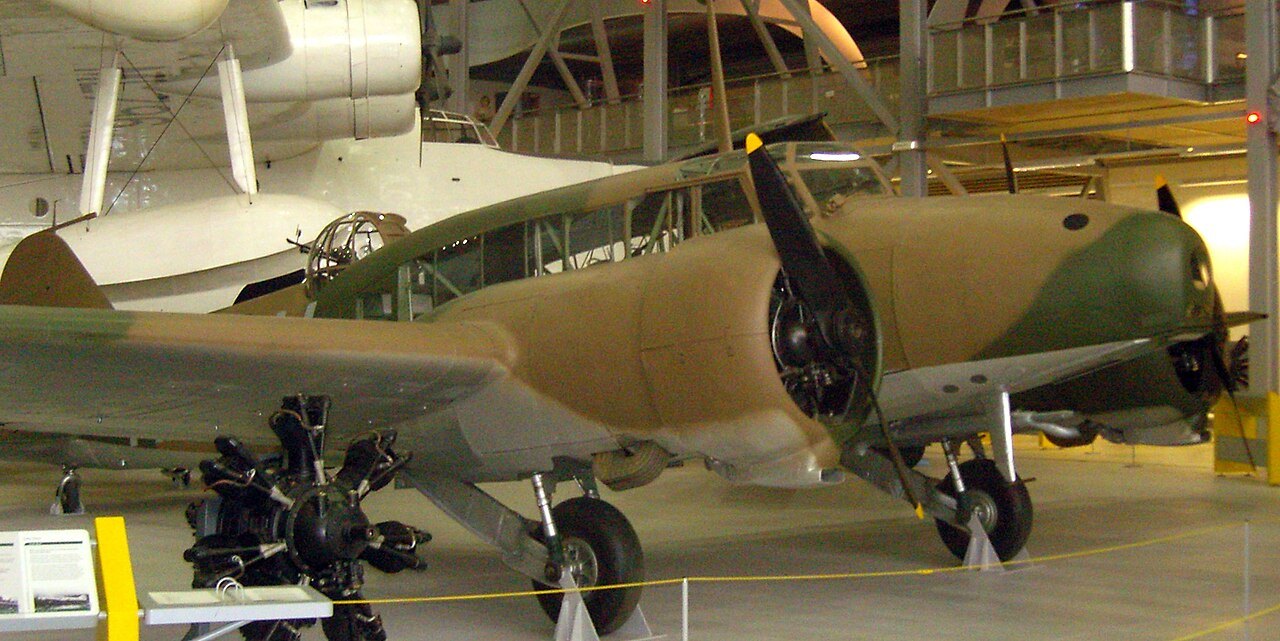
An Anson I in Hendon’s Hangar 5 tells the whole story.
Read the full story
The Yeadon-built C.19 at East Fortune
A postwar Anson that flew executives rather than navigators.
Read the full story
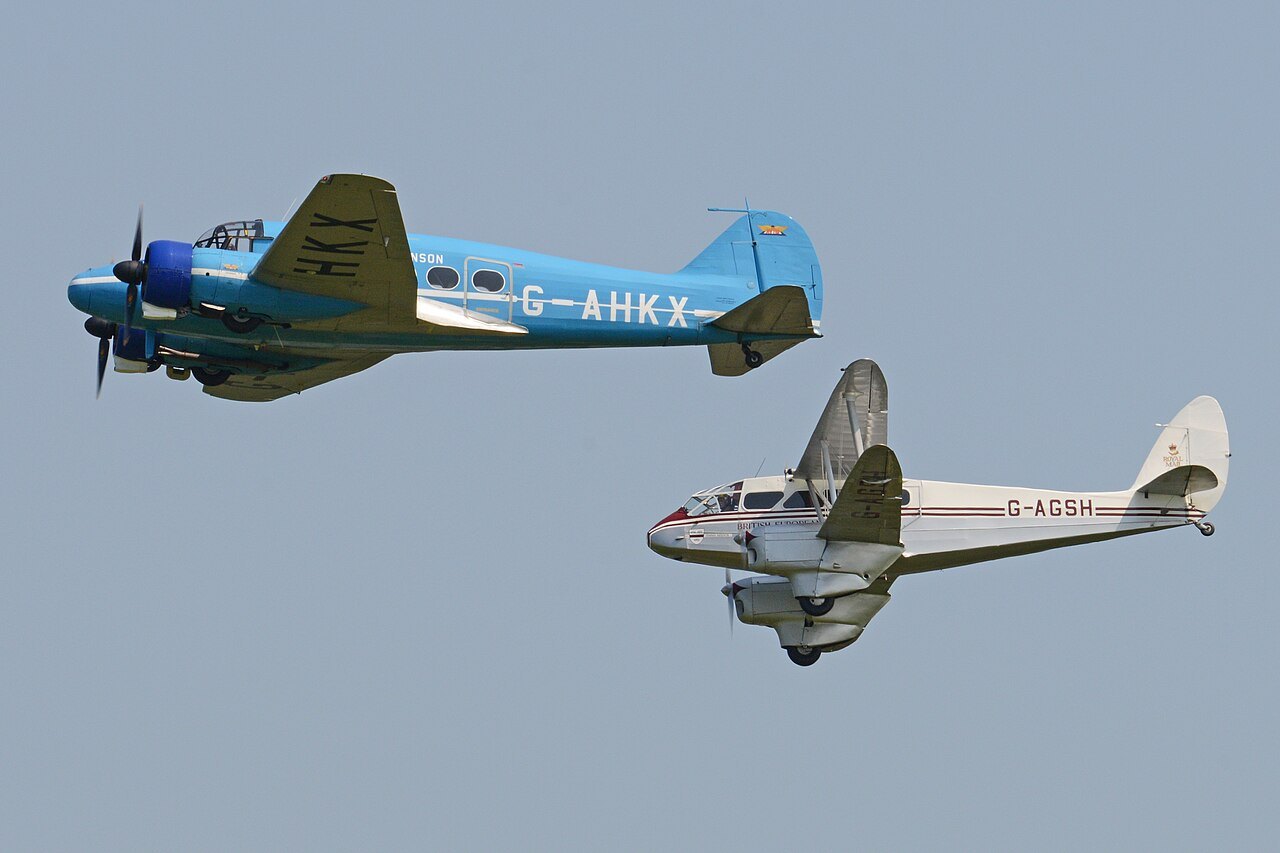
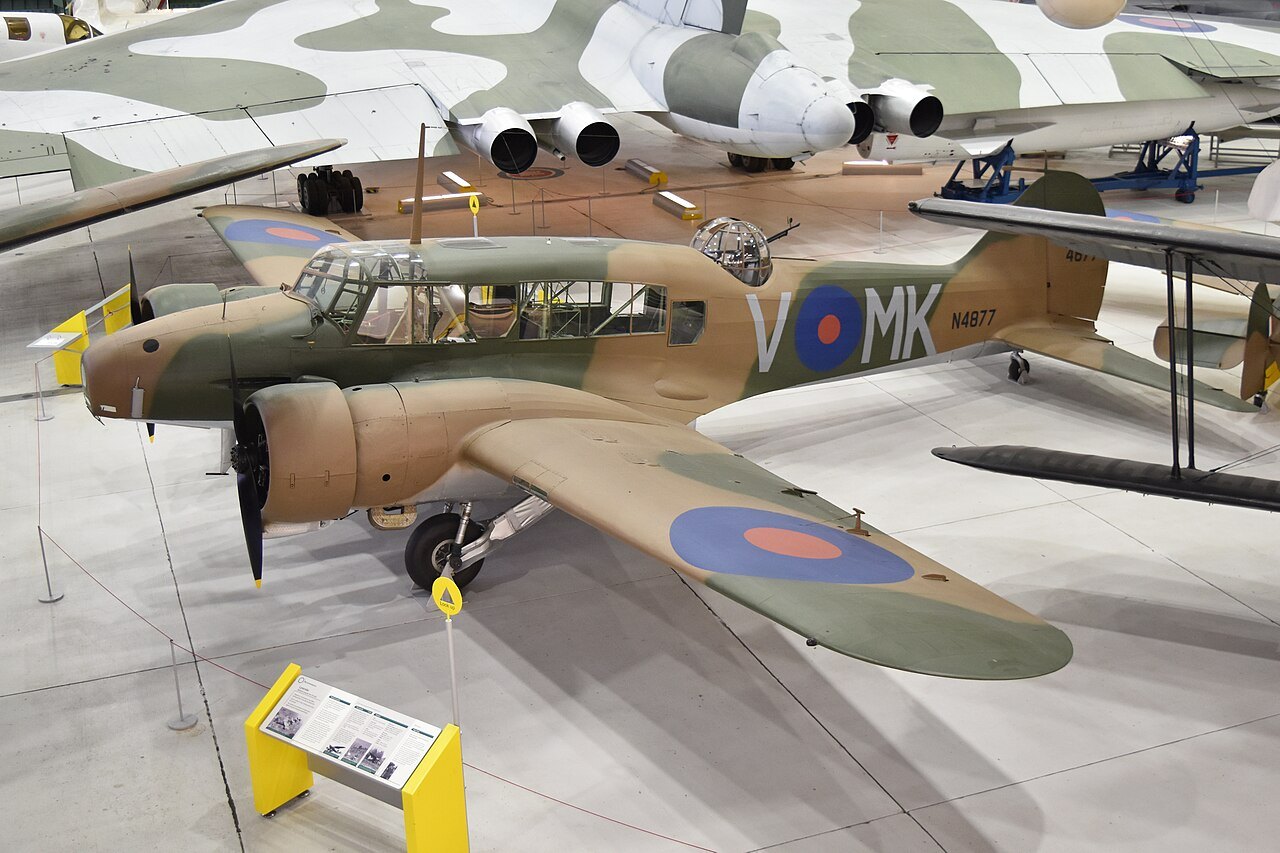
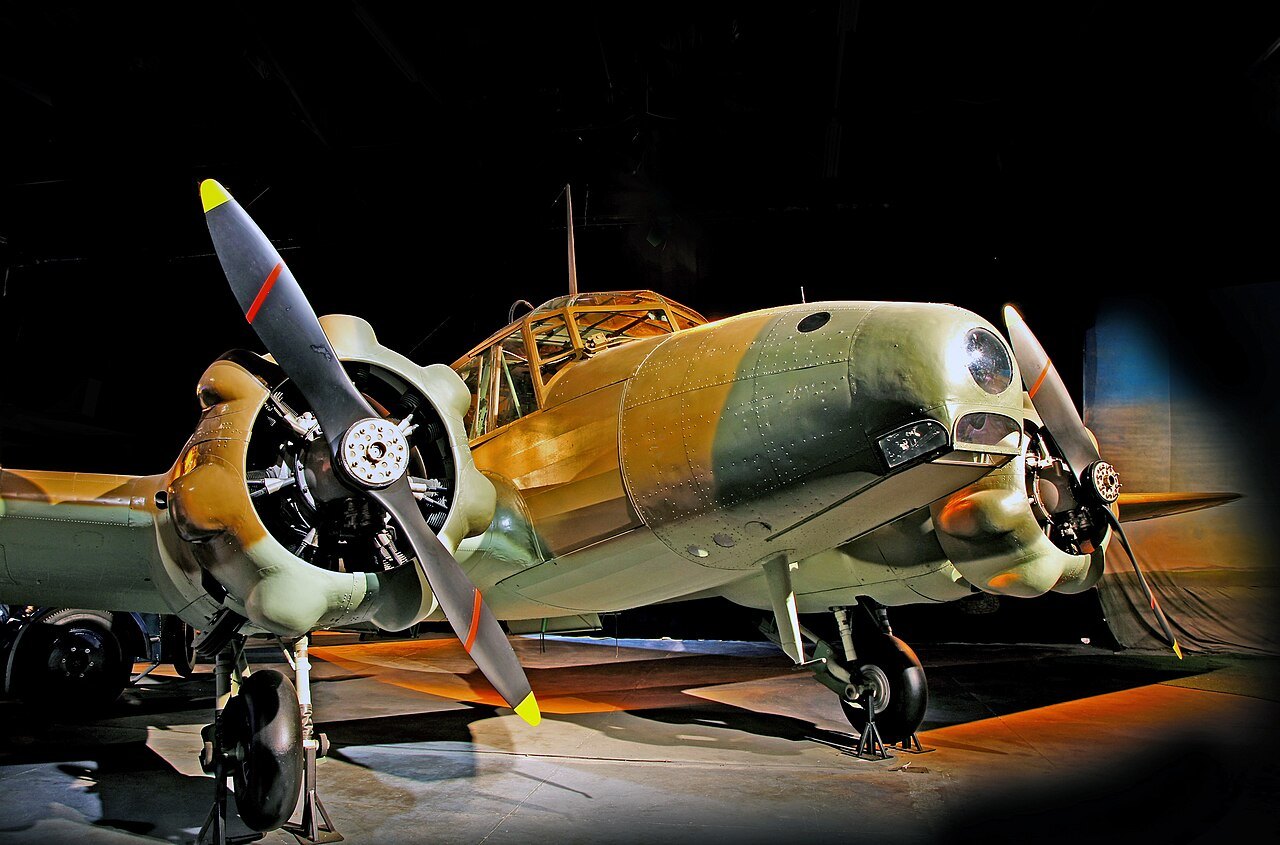
The Anson in pictures
Where the Anson flies and flew
The Anson’s record
The Anson’s combat career was short and modest: early-war maritime patrols, convoy escort and a famous action over Dunkirk. Its lasting contribution was training. Tens of thousands of Commonwealth pilots, navigators, wireless operators and bomb aimers learned crew flying in it before moving on to operational bombers and maritime aircraft.
See how training and combat types compare in the military aircraft statistics database. Figures are approximate.
Everything people ask about the Anson
Can I fly in an Avro Anson?
Why was the Avro Anson called Faithful Annie?
How many Avro Ansons were built?
Did the Avro Anson see combat?
What was the Avro Anson used for in training?
Is any Avro Anson still flying?
Where can I see an Avro Anson?
You can’t fly the Anson.
These, you can.
Most of this museum you can only look at. These genuine military jets you can fly yourself with MiGFlug — with aerobatics and time on the controls.
 Fly the L-39 AlbatrosThe world’s most-flown jet trainer — aerobatics included
 Fly the F-104 Starfighter“The missile with a man in it”
 Fly the MiG-21The Cold War’s most-produced jet
 Fly the T-33 Shooting StarAmerica’s first jet trainer
 Fly the DH VampireA piece of early jet history
 Fly the S.211Agile Italian jet trainer
 Fly the MB-326The classic Aermacchi jet
 Fly the MiG-15The Soviet legend of the Korean War
Continue the tour
Every fact, checked
- Avro Anson 1 (W2068)RAF Museum: coastal role, first RAF U-boat attack, training and C.19 service to 1968
- Avro Ansons vs Messerschmitt 109s, Dunkirk 1940RAF Museum blog by Ewan Burnet on No. 500 Squadron’s action of 1 June 1940
- Brocklesby mid-air collision, 29 September 1940Australian War Memorial: serials, crews and Leonard Fuller’s landing
- Avro 652 Anson Mk. IIThe Hangar Flight Museum, Calgary: Canadian production and BCATP use
- Avro AnsonNational Museums Scotland: Anson C.19 VM360 / G-APHV
- Avro Anson in Coastal Commanduboat.net: maritime patrol role, crew, armament and Mk I figures
- Bill’s Anson: the restoration of Avro Anson Mk I MH120Vintage Aviation News, Grant Newman: restoration and move to Europe
- Exploits of 500 Squadron Avro Ansons over DunkirkKey.Aero feature on the Dunkirk action
- Faithful Annie: the Avro Anson exhibitMontrose Air Station Heritage Centre Anson project