
Nakajima B6N Tenzan
“Jill”
Japan’s fastest carrier torpedo bomber — the powerful successor to the B5N Kate that reached the fleet in 1943, just as the crews and carriers it was built for were slipping away.
The Nakajima B6N Tenzan: Japan’s torpedo bomber that arrived too late
By 1939 the Imperial Japanese Navy’s frontline carrier torpedo bomber was the Nakajima B5N “Kate” — the aircraft that would help sink battleships at Pearl Harbor. Even as the Kate went to war, Nakajima was already designing its replacement. The result was the B6N Tenzan (“Heavenly Mountain”): a bigger, heavier, far more powerful machine meant to carry a torpedo faster and further than any carrier attack aircraft Japan had ever flown.
On paper it was a clean evolution — the same three-man crew, the same folding wings for carrier stowage — but built around a giant new radial engine and a redesigned airframe. In the air it became the fastest carrier torpedo bomber Japan ever fielded. Yet it was born into trouble. The engine chosen for it, Nakajima’s own Mamoru, was powerful but unreliable, and development slipped almost two years behind schedule.
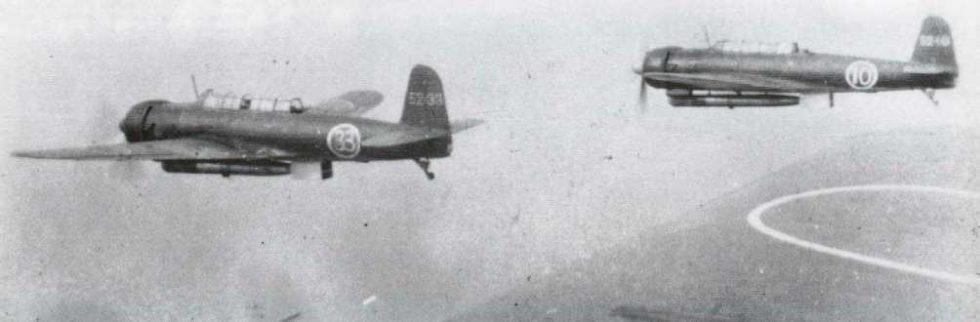
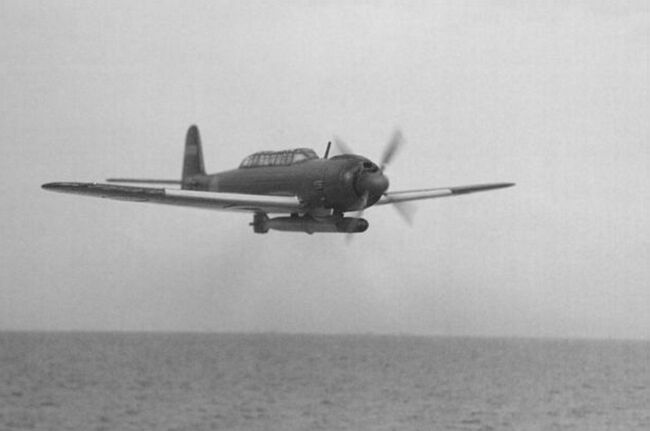
When the Ministry of Munitions ordered Nakajima to abandon the Mamoru and concentrate its factories on other engines, the whole programme had to be re-engined around the Mitsubishi Kasei 25. That produced the definitive B6N2 — but it cost precious time. The engine and its large four-blade propeller generated so much torque that the vertical tail had to be canted slightly to one side just to keep the aircraft flying straight.
By the time the Tenzan finally reached the fleet in 1943, the war had already turned. The superb carrier aircrews that had rampaged across the Pacific in 1941–42 had been gutted at Midway and bled white over the Solomons. The Tenzan was a fine aeroplane flown, increasingly, by half-trained crews against an enemy whose fighters, radar and anti-aircraft fire had all improved dramatically.
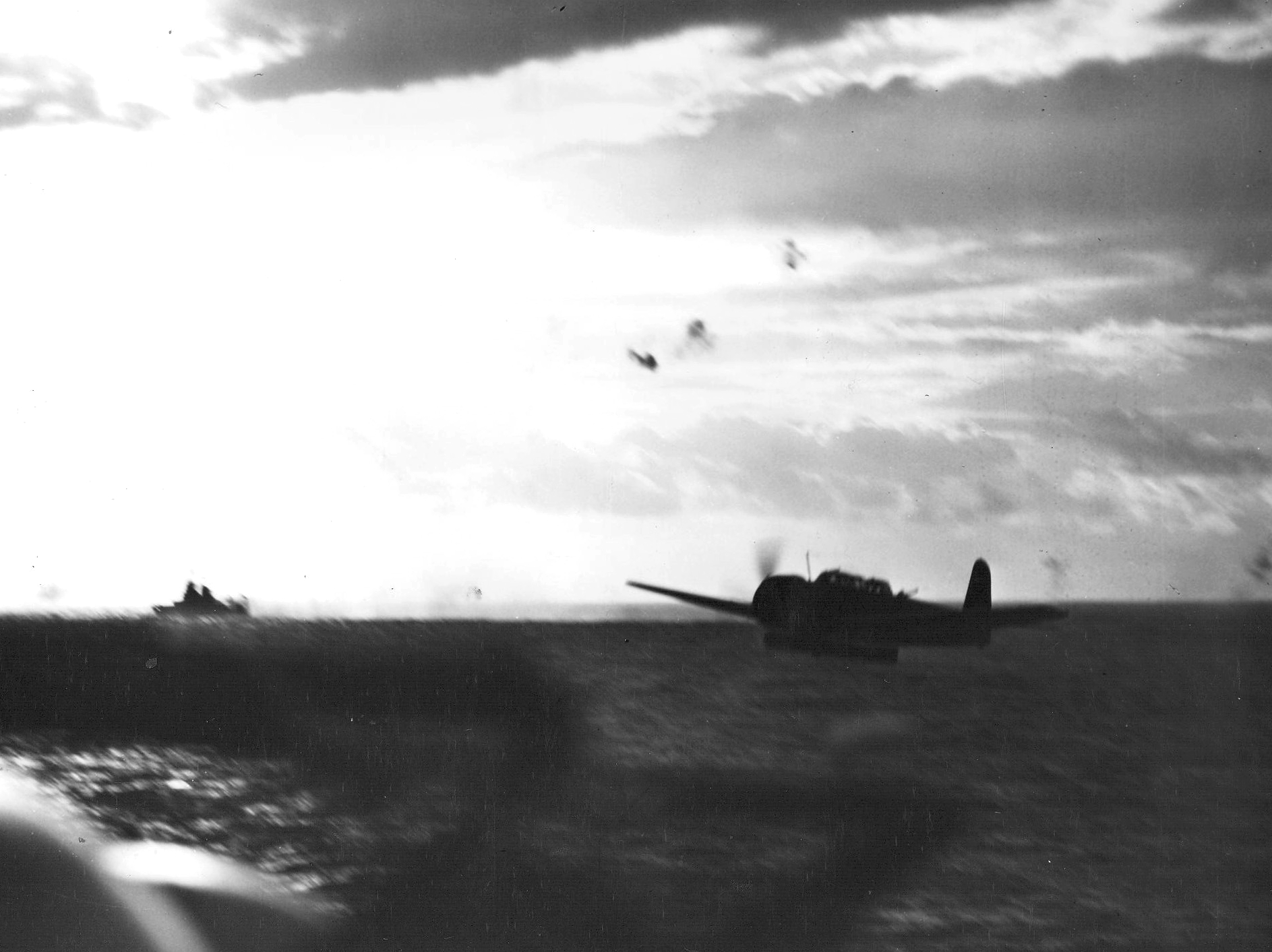
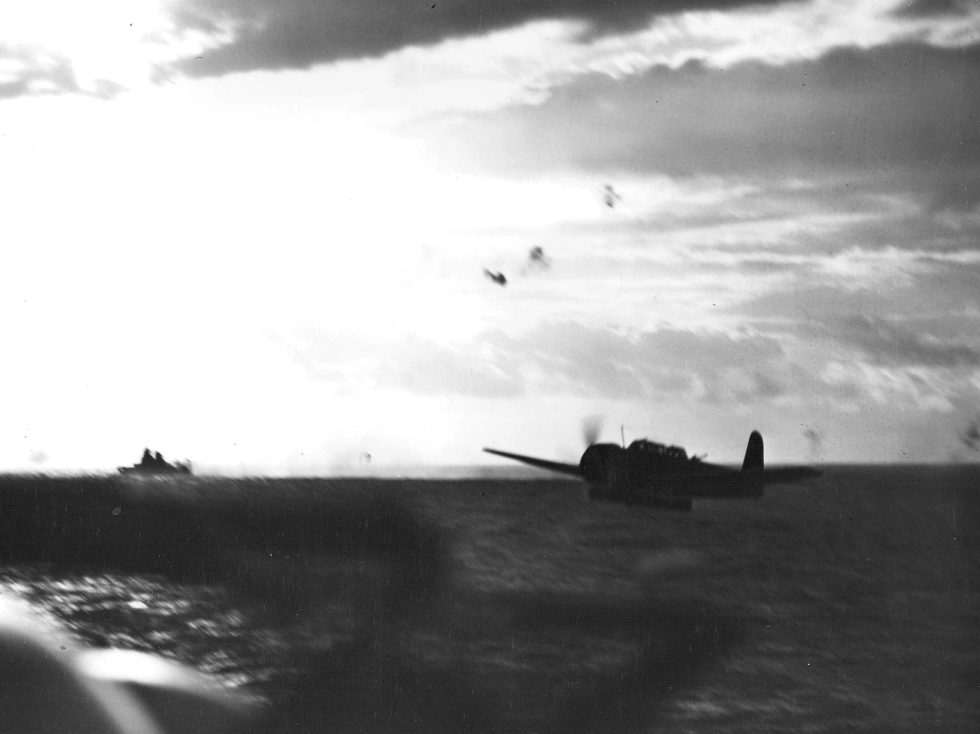
The reckoning came in June 1944 at the Battle of the Philippine Sea — the “Great Marianas Turkey Shoot.” Dozens of Tenzans were launched against the US fleet; most were shot down by Hellcats before they could line up a shot, and not one of their torpedoes struck home. At Leyte Gulf that October the story repeated. Increasingly the type flew from land bases, and in the war’s final months some were expended in kamikaze attacks off Okinawa.
Around 1,268 were built — the exact figure is contested. To the Allies it was simply “Jill.” By most measures it was a good aircraft: fast, long-legged and hard-hitting on paper. Its tragedy was timing — a first-class torpedo bomber delivered to a naval air arm that no longer had the trained crews or the carriers to use it. Today a single B6N2 survives, held by the Smithsonian’s National Air and Space Museum: the last Tenzan in the world.
01The Nakajima B6N Tenzan’s engine crisis: how a troubled radial reshaped the whole aircraft
The Tenzan was designed around Nakajima’s new Mamoru 11, a 14-cylinder radial of about 1,800 hp chosen for its fuel economy and room to grow. But the Mamoru proved troublesome, and Nakajima’s factories were already stretched. When the Ministry of Munitions ordered the company to stop building the Mamoru after only around 130 B6N1s and switch to the Mitsubishi Kasei 25, the airframe had to be adapted to a different engine mid-programme — the change that created the mass-produced B6N2.
The powerful engine brought its own quirk. Torque from the big four-blade propeller pulled the aircraft off-heading so strongly that Nakajima canted the vertical tail a few degrees to port to compensate — a distinctive, slightly lopsided look. Combined with structural fixes forced by carrier landing trials, the engine saga is the main reason a design first flown in early 1941 did not reach the fleet in numbers until 1943.
What makes the B6N Tenzan special
A bigger, faster successor to the Kate
The Tenzan kept the B5N’s three-seat layout and carrier-friendly folding wings but wrapped them around a much larger radial engine and a cleaner, heavier airframe. The payoff was speed and reach: at roughly 482 km/h it was the fastest carrier torpedo bomber Japan ever put to sea, able to carry a full torpedo across long over-water distances.
The engine that forced a redesign
Planned around the unreliable Nakajima Mamoru and then re-engined with the Mitsubishi Kasei 25 of about 1,850 hp, the Tenzan carried the marks of its troubled birth. Engine torque was so strong that the fin was canted to one side, and the delay pushed the aircraft into service two years late.
Built for the torpedo, armed for the fleet
Its reason for being was the Type 91 aerial torpedo — roughly 800 kg slung under the belly — or an equivalent bomb load. A crew of three worked the aircraft: pilot, observer and a radio-operator/gunner defending the tail, with later marks carrying a heavier dorsal gun and, on some aircraft, air-to-surface radar.
02The Nakajima B6N Tenzan’s carrier problem: why it needed Japan’s newest decks
The Tenzan was heavier and faster-landing than the Kate it replaced, and early carrier trials exposed structural and arrestor-hook problems that had to be fixed before it could operate safely. By the time those fixes were made, many of the large fleet carriers it had been designed for had already been sunk at Midway and in the 1942–43 battles. The aircraft increasingly flew from the newer, larger carriers that survived — and, more and more, from land bases — rather than the sea-going striking force it was conceived to equip.
03The Nakajima B6N Tenzan’s defences: three men, a torpedo and a losing fight for the sky
Like most torpedo bombers, the Tenzan was fast for its class but lightly defended — one or two rifle-calibre machine guns, upgraded to a 13 mm dorsal weapon on the B6N2a. Against the disciplined Hellcat combat air patrols and radar-directed anti-aircraft fire of the 1944 US fleet, that was not enough. A torpedo run demanded a long, low, straight approach at the target, exactly the profile that made the aircraft easiest to shoot down. The Tenzan’s combat record is less a story of its own failings than of a good aircraft flown into an impossible tactical situation.
Full B6N Tenzan specifications
Baseline note: the figures below describe the B6N2 Tenzan Model 12, the Kasei-engined carrier attack aircraft that made up the overwhelming majority of production and flew every operation after mid-1944. Deltas for the two prototypes and the Mamoru-engined B6N1 Model 11, the re-armed B6N2a Model 12A and the two B6N3 Model 13 conversions are given in grey. Authorities disagree on the totals: the standard English sources give 1,268 built and 133 Model 11s, the Japanese literature 1,187 and 124. Both are quoted where the difference matters, and neither is a rounding of the other — they count prototypes, conversions and airframes completed in the final fortnight differently.
Dimensions & weights
- Crew
- 3 — pilot, observer who navigated and aimed the bomb, and a radio operator who manned the rear gun (the same crew structure as the B5N it replaced, and a real advantage over the two-seat American and British torpedo aircraft when navigating over empty ocean)
- Length
- 10.865 m (35 ft 8 in) — the Navy capped overall length at 11 m so the aeroplane would fit the lifts of the existing carriers, and that single number shaped the whole aft fuselage
- Wingspan
- 14.894 m (48 ft 10 in); hydraulically folded upward outboard of the dihedral break to roughly 6.3 m (20 ft 8 in) for stowage
- Height
- 3.80 m (12 ft 6 in) in the tail-down attitude
- Wing area
- 37.2 m² (400 sq ft); some tables give 37.25 m²
- Wing layout
- low-set cantilever monoplane with dihedral carried across the full span — the visual test that separates a Tenzan from a Kate, whose centre section was flat and which only picked up dihedral outboard of the fold
- Vertical tail
- trailing edge raked forward, so the rudder hinge line leans over the fin root — not styling, and not aerodynamics. It was the only way to keep enough fin and rudder area inside the 11 m length limit once the tail was measured in the nose-high parked and landing attitude, where a conventional swept-back fin would have overhung the lift
- Fin offset
- canted to port to fight propeller torque — 3° on B6N1 airframes 19 to 29, reduced to 2° 06′ from airframe 30 onward (2.1° in the Japanese tables). The prototype had rolled and swung left alarmingly under the four-blade propeller of the 1,870 hp Mamoru
- Empty weight
- 3,010 kg (6,636 lb); B6N1 3,225 kg (7,110 lb) — the Kasei installation was the lighter of the two, which is not what most accounts of the engine change assume
- Loaded weight
- 5,200 kg (11,464 lb) in normal torpedo-strike trim
- Maximum take-off weight
- 5,650 kg (12,456 lb) — a full 2,640 kg above empty, on a wing no larger than the 1937 Kate’s
- Wing loading
- 139.8 kg/m² (28.6 lb/sq ft) at normal loaded weight — high for a deck aeroplane of the period, and the reason the Tenzan needed Fowler flaps and a very disciplined approach
Performance
- Maximum speed
- 482 km/h (300 mph, 260 kn) at 4,900 m (16,100 ft)
- B6N1 Model 11
- 465 km/h (289 mph, 251 kn) at 4,800 m (15,700 ft) — the Mamoru never delivered its rated output, so the aeroplane that was supposed to be faster was slower
- Cruising speed
- 333 km/h (207 mph, 180 kn) at 5,500 m (18,000 ft) — against the 14-Shi requirement of 200 kn, which the type never met in service trim
- Climb to 5,000 m
- 10 min 24 s (16,400 ft)
- Initial rate of climb
- 455 m/min (1,490 ft/min) — adequate loaded, and utterly inadequate for escaping an F6F that had already seen you
- Service ceiling
- 9,040 m (29,660 ft); B6N1 8,650 m (28,380 ft)
- Range, normal
- 1,746 km (1,085 miles, 943 nautical miles) with the torpedo; B6N1 1,460 km (907 miles)
- Range, maximum
- 3,045 km (1,892 miles, 1,644 nautical miles) clean and in overload; the B6N1 is credited with 3,447 km (2,142 miles). The 14-Shi specification had asked for 1,000 nautical miles with an 800 kg load, and this was the one requirement the Tenzan comfortably beat
- Combat radius, strike
- roughly 550 km (340 miles, 300 nautical miles) with a torpedo and a reserve for a deck landing — derived from the normal range figure rather than quoted directly in the Japanese tables
- Torpedo release envelope
- the Type 91 Kai-3 could be dropped at up to about 378 km/h (235 mph, 204 kn), against roughly 330 km/h for earlier marks — a strengthened torpedo body bought precisely the margin a 1944 attack aircraft needed to survive the run-in
- Take-off run
- the type could leave a carrier deck at normal load without catapult assistance, which is why it was cleared for the smaller flight decks of Hiyo, Junyo and Zuiho as well as Shokaku, Zuikaku and Taiho
- Deck-landing behaviour
- the aeroplane came aboard heavy and fast, and carrier trials aboard Ryuho and Zuikaku at the end of 1942 kept parting arrester wires. The Navy first blamed weight and approach speed; investigation found a defective arrester hook and its fuselage mounting, which had to be redesigned and strengthened — a full extra season of delay, on an aeroplane that was already late
Propulsion & systems
- Engine, B6N2
- 1 × Mitsubishi MK4T Kasei 25, 14-cylinder two-row air-cooled radial, 42 litres, 1,850 hp (1,380 kW) for take-off; 1,680 hp (1,253 kW) at 2,100 m and 1,540 hp (1,148 kW) at 5,500 m. Water-methanol injection. This was the engine the Navy had wanted from the start
- Engine, B6N1
- 1 × Nakajima NK7A Mamoru 11, 14-cylinder radial, 44.9 litres, 155 × 170 mm bore and stroke, four valves per cylinder, 1,870 hp (1,394 kW) at 2,600 rpm on paper — on the bench and in the air it vibrated savagely, overheated in certain speed bands and never made its rating
- Why the engine changed
- Nakajima’s chief engineer Kenichi Matsumura insisted on the in-house Mamoru over the Navy’s Kasei, arguing lower fuel consumption and growth to 2,000 hp; the Navy conceded in March 1941. In July 1943, after 133 Model 11s, the Ministry of Munitions simply ordered Mamoru manufacture stopped — a rationalisation decision taken above Nakajima’s head — and the Tenzan was re-engined with the Kasei 25 after all. Only a few hundred Mamorus were ever built
- Airframe changes for the Kasei
- the nose was lengthened to hold the centre of gravity, the oil cooler moved and the cowling reshaped — but the conversion was genuinely minor, and production continued with barely a pause. That the swap was so easy is the sharpest indictment of the original choice
- Propeller
- four-blade constant-speed unit; 3.4 m (11 ft 2 in) diameter on the B6N2, slightly smaller than the Mamoru installation’s. A four-blade propeller on a Japanese carrier aircraft was itself unusual, and its torque is what forced the offset fin
- Exhaust
- the prototype’s single collector was replaced on production aircraft by individual ejector stubs — less glare to blind the crew on night operations, and a small amount of recovered thrust
- Fuel and tank protection
- semi-integral tanks in the wing upper surfaces, with a carbon-dioxide fire suppression system. Self-sealing tanks were proposed and rejected: they would have cost about 30 per cent of capacity, and the Navy would not give up the range (a protected-tank installation was tried again in October 1944 and did not go into production). Crews paid for that decision at the Philippine Sea
- Flaps
- Fowler type, 20° for take-off and 38° for landing — a sophisticated high-lift system, and necessary at 140 kg/m²
- Undercarriage and arrester gear
- wide-track inward-retracting main gear, strengthened on production aircraft; tailwheel retractable on the B6N1 and locked permanently down on the B6N2 to save weight and complication; V-frame arrester hook under the rear fuselage, redesigned after the 1942 trials
- Radar
- from late 1943 and in quantity from March 1944, roughly one in three aircraft carried the Type 3 Ku Mark 6 air-to-surface search set, with Yagi aerials on the wing leading edges and projecting from the sides of the rear fuselage — crude by Allied standards but genuinely useful, and it made the Tenzan the Navy’s best night anti-shipping aeroplane of 1945
- Production
- 1,268 by August 1945 in Western tables, 1,187 in the Japanese; built at Nakajima’s Koizumi works in Gunma and, from September 1943, at the Handa works in Aichi. Output never exceeded about 90 aircraft a month — roughly 187 were still on strength at the surrender
04The Nakajima B6N Tenzan’s cost: why no reliable price exists
The Tenzan was a wartime product of the Japanese state, built for the Imperial Japanese Navy and never sold on any open market, so a meaningful flyaway unit price simply does not exist in the public record. Period Japanese figures were denominated in wartime yen under a controlled economy and do not convert into a comparable modern dollar cost. There is likewise no credible cost-per-flight-hour figure for the type — the concept was not tracked the way it is for modern aircraft, and no reliable operating-cost accounting survives. Any precise price attached to a B6N should be treated as an estimate, not a sourced fact.
Armament & payload
The Tenzan carried the finest aerial torpedo of the war and almost nothing with which to defend itself
The B6N was built around one weapon: the Type 91 Kai-3, a strengthened aerial torpedo with wooden tail stabilisers that broke away on entry and an angular-acceleration roll damper that was years ahead of anything the Allies fielded. It could be released fast and low, from an aeroplane running in at nearly 380 km/h, and against a ship that hit it did enormous damage. Everything else in the Tenzan’s armament was the 1937 fit of the B5N carried forward unchanged — two rifle-calibre machine guns, one on a ring in the rear cockpit and one poked down a ventral tunnel — and by 1944 those guns were a gesture.
The consequence was a strike aeroplane that could only work behind an escort. At the Philippine Sea the escort was destroyed on the way in, and the Tenzans were shot down before they reached release range. The B6N2a of late 1944 finally substituted a 13 mm gun above and a 7.92 mm below, which helped against a stern chase and not at all against a beam attack by four Hellcats. Fits varied a great deal between marks and units: the fixed wing gun was fitted only to the first seventy Model 11s, the ventral tunnel gun was often left out because it was almost unusable, the radar aircraft carried extra aerials and sometimes less ammunition, and by 1945 many land-based machines had had their bomb gear replaced by a fixed special-attack installation.
Gun
- One 7.7 mm Type 92 flexible machine gun on a ring mount in the rear cockpit — the standard Japanese Navy observer’s gun since the early 1930s, drum-fed and hopelessly outclassed by 1944
- One 7.7 mm Type 92 in a retractable ventral tunnel mounting, intended to protect the belly during high-altitude level bombing; awkward to use and frequently deleted in the field
- One fixed forward-firing 7.7 mm Type 97 in the port wing on B6N1 airframes up to number 70, for suppressing light flak during the torpedo run — dropped from airframe 71 as pointless against modern American anti-aircraft fire
- B6N2a Model 12A: the dorsal gun became a 13 mm Type 2 and the ventral a 7.92 mm Type 1, the first defensive armament on the type with any real prospect of hurting a fighter
- No forward-firing cannon was ever fitted. Unlike the D4Y, the Tenzan was never seriously considered for conversion to a night fighter — it was too big, too slow and too valuable as a torpedo carrier
Air-to-air
- None. The Imperial Japanese Navy had no air-to-air missile of any kind, and the Tenzan carried no air-to-air weapon beyond the defensive machine guns above
- Nor did it carry air-to-air bombs: the Type 3 aerial phosphorus bomb used by some Japanese aircraft against bomber formations was never a Tenzan store
- The card is kept because the aeroplane’s survival depended entirely on somebody else’s air-to-air weapons. A Tenzan strike without a working Zero escort was a casualty list
- At the Philippine Sea on 19 June 1944 the escort was stripped away by radar-directed Hellcats before the strike reached the American task force, and the torpedo aircraft were killed in open sky with no answer available to them
Air-to-surface guided
- None. The Type 91 torpedo ran a straight gyro course; there was no homing torpedo, no glide bomb and no radio-controlled store in Japanese Navy carrier service
- The Type 3 Ku Mark 6 radar was a search set for finding ships at night, not a guidance system — the attack itself was flown and aimed by eye once contact was made
- From October 1944 the Navy supplied the missing guidance by other means. In the special-attack role the aeroplane became the terminal guidance for its own bomb, with a crew of three aboard
- Japan’s one true guided anti-ship weapon programme of 1945, the Ohka rocket aircraft, was carried by the land-based G4M and had no connection to the Tenzan
Bombs
- One Type 91 Kai-3 aerial torpedo on an offset, downward-angled rack under the fuselage, with stabilising plates to steady it in the airflow — the primary weapon and the reason the aeroplane existed
- Torpedo figures differ between sources: the baseline Type 91 is usually given as 835 kg with a 205 kg charge, the Kai-3 as about 848 kg with a 235 kg warhead. Either way the Tenzan’s stated 800 kg external load is the round number, not the weighed one
- As a level or shallow-dive bomber: one 800 kg No. 80 bomb, one 500 kg No. 50, two 250 kg No. 25, or six 60 kg No. 6
- The observer aimed from a station in the fuselage; against a manoeuvring warship from altitude the results were poor, which is why the torpedo remained the weapon of choice whenever there were crews left who could deliver one
- For kamikaze sorties from spring 1945 the usual load was a single 800 kg bomb, sometimes fixed in place with the release gear disconnected
Rockets
- None. The Tenzan carried no air-to-surface rockets in service, and no rocket-assisted take-off gear was adopted for it
- This is a genuine gap rather than an omission. Contemporary Japanese aircraft did use rockets — the D4Y4 had built-in solid boosters designed in, the night-attack units fired the Type 3 No. 1 Mark 28 rocket bomb at shipping — but the Tenzan stayed with the torpedo and the bomb
- The reason is simple: a torpedo that could be released at 378 km/h and would sink a fleet carrier was a better weapon than any rocket Japan had, and the aeroplane had been designed around carrying one
- Nothing in the surviving Japanese production or armament documentation records a rocket installation on any B6N mark, including the two B6N3 conversions
Pods & other stores
- Type 3 Ku Mark 6 air-to-surface radar, fitted to roughly one aircraft in three from March 1944: Yagi aerials on the wing leading edges and side-mounted arrays on the rear fuselage, at a cost in drag and top speed that the crews accepted gladly
- Drop tanks for ferry and overload reconnaissance flights, giving the 3,045 km maximum range figure
- Flares and float lights for night torpedo attack and for marking a target for a following section — the standard technique of the land-based units in 1945
- Full three-man navigation and radio fit, including a long-range wireless set. The Tenzan was a much better ocean navigator than any single-seat aircraft, and was regularly used for search and shadowing rather than attack
- No gun pods, no reconnaissance camera pods and no external fuel beyond the drop tanks — Japanese Navy practice put such equipment inside dedicated types, not on pylons
Three typical loadouts
- Carrier torpedo strike, Philippine Sea, 19 June 1944
- One Type 91 Kai-3 torpedo on the ventral rack, full internal fuel, three crew, dorsal and ventral 7.7 mm guns manned. Flown from Shokaku, Taiho, Zuikaku, Hiyo and Junyo at ranges beyond what the American strike aircraft could match. Of roughly 44 Tenzans committed across the day’s raids, most were lost and none scored a torpedo hit.
- Land-based night anti-shipping sortie, Okinawa, 1945
- One torpedo, Type 3 Ku Mark 6 radar with wing and fuselage Yagi aerials, flares, reduced ammunition, individual ejector exhausts to preserve the crew’s night vision. Small sections of two to four aircraft, approaching low and in darkness where the Hellcats could not follow — the only tactic that still worked, and the one that put a torpedo into Pennsylvania on 12 August 1945.
- Special attack, Kikusui operations, spring 1945
- One 800 kg bomb, minimum fuel for a one-way flight, guns and radio sometimes removed, crew of three or fewer. Flown by pilots with a fraction of the training their predecessors had received, in a heavy aeroplane that could not manoeuvre and could not run — the role the Tenzan finished the war in, and the one it had been least designed for.
Sourcing caveat: Japanese armament records for the Tenzan are incomplete, and the wartime unit-level modifications — deleted ventral guns, field-fitted radar, improvised special-attack racks — are documented mainly through photographs and postwar recollection. Where a figure here is contested, both readings are given. Ordnance designations follow Imperial Japanese Navy practice, in which No. 80 means an 800 kg bomb.
Variants
The Tenzan changed engines once, changed guns once, and never got the mark it needed
For an aircraft built in four figures the B6N had remarkably few variants, and the reason is that it spent its whole career catching up. The prototype flew on 14 March 1941, three months before the Zero met its first serious opposition; production approval came only in early 1943; front-line deliveries began in August 1943; and the type’s carrier combat debut was 19 June 1944, three years and three months after first flight. In that interval Japan lost four fleet carriers at Midway, two more in the Solomons, and — far more damaging — the pool of aircrew who could fly a loaded torpedo aeroplane off a pitching deck at night.
So the Tenzan arrived to find its own reason for existing gone. It was a genuinely good aeroplane: faster than the Kate by a wide margin, longer-legged than the Grumman Avenger, carrying the better torpedo. It was also entirely dependent on things Japan no longer had — decks to fly from, escorts to protect it, and crews trained to the standard of 1941. Most of the 1,268 built operated from land, and most of those never saw a warship worth a torpedo.
The land-based career is the real story of the type, and it is a grim one. Its combat debut had already come ashore: forty B6N1s flew from Truk to Rabaul for Operation RO between 28 October and 1 November 1943, fourteen of them attacked shipping off Bougainville on 5 November for four losses and no hits, and when the survivors of the First Carrier Division returned to Truk on 13 November just six of the forty were left. In the Formosa air battle of 12–16 October 1944 the Tenzan units were fed into Task Force 38 in daylight: seventeen aircraft attacked on 14 October and one came back. The crews reported the American Third Fleet all but destroyed, the claim travelled up the chain to the Emperor, who issued congratulations, and the Combined Fleet then planned Leyte Gulf around a victory that had not happened.
What remained worked only in the dark. Three aircraft put a hit into Saratoga off Iwo Jima on 21 February 1945 as part of an attack that killed 123 of her crew and finished her as a combat carrier. Off Okinawa the type flew both conventional night torpedo strikes and kamikaze sorties in the Kikusui operations, sinking destroyers and helping damage Intrepid. The last recorded attack was made on 12 August 1945 by four Tenzans of the 931st Kokutai from Kushira, which torpedoed the battleship Pennsylvania at anchor in Nakagusuku Bay three days before the surrender — the aeroplane doing at the very end, at night and in tiny numbers, exactly what it had been designed to do in daylight from a carrier deck four years earlier.
- B6N1 prototypes (1941–1942, 2 built)
- Nakajima Mamoru 11, single collector exhaust, retractable tailwheel. First flight 14 March 1941. Rolled and swung left under propeller torque; the fin was thinned and canted to port to cure it.
- B6N1 Model 11 (1942–July 1943, 133 built in Western sources, 124 in Japanese)
- Production Mamoru aircraft. Individual ejector exhaust stubs, angled torpedo rack with stabilising plates, strengthened undercarriage and tailplane, added ventral 7.7 mm gun. Airframes 1–70 also had a fixed 7.7 mm in the port wing. Fin offset 3° on airframes 19–29, 2° 06′ thereafter.
- B6N2 Model 12 (from mid-1943, 256 built)
- Mitsubishi Kasei 25 in place of the cancelled Mamoru: lengthened nose, revised oil cooler and cowling, 3.4 m four-blade propeller, tailwheel fixed down. Faster, lighter when empty and vastly more reliable than the aircraft it replaced.
- B6N2 with Type 3 Ku Mark 6 radar (from March 1944, roughly one aircraft in three)
- Air-to-surface search radar with Yagi aerials on the wing leading edges and rear fuselage sides. Not a separate designation, but operationally the most significant modification the type received — it is what made the 1945 night torpedo attacks possible at all.
- B6N2a Model 12A (late 1944–1945, about 875 built)
- Defensive armament revised: 13 mm Type 2 dorsal in place of the 7.7 mm Type 92, and 7.92 mm Type 1 ventral in place of the second Type 92. The most numerous single mark, and the one most of the kamikaze aircraft came from.
- B6N3 Model 13 (1945, 2 converted, no production)
- Land-based version, converted from B6N2a airframes 751 and 752. Kasei 25c engine, redesigned cowling and windscreen, arrester hook removed and the tailwheel made retractable again. An admission in metal that there were no carriers left to fly from. The war ended before a production order was placed.
- Aichi B7A Ryusei "Grace" (1942–1945, 114 built)
- Not a Tenzan variant but its intended replacement: a single type combining the torpedo and dive-bombing roles, designed for the large armoured carriers that were never completed. It suffered the same fate as the B6N, in a worse form — it never operated from a carrier at all.
- Operating units (1943–1945)
- 531st Kokutai received the first aircraft in July 1943; 582nd Kokutai flew the combat debut in November 1943; 601st and 653rd Kokutai provided the carrier attack squadrons of 1944; 931st Kokutai flew the last recorded torpedo attack of the war on 12 August 1945.
Survivors: essentially one, and it has never been restored. A single B6N2, taken in Japan in 1945 and shipped to the United States for technical evaluation, was displayed outdoors for decades at Naval Air Station Willow Grove in Horsham Township, Pennsylvania, and was transferred to the National Air and Space Museum in 1981. It is now in the Smithsonian’s storage collection at Suitland, Maryland — long identified with the Paul E. Garber Preservation, Restoration and Storage Facility, from which the museum has been consolidating holdings towards the Udvar-Hazy Center — and it remains disassembled, unrestored and not on public display. It is often cited as construction number 5350, though that identification is not firmly documented. Beyond it there are wrecks rather than airframes: a ditched example in Truk lagoon, and fragments recorded at Clark Field and Puerto Princesa in early 1945 that were scrapped where they lay. Of 1,268 built, and of the 187 or so still on strength at the surrender, nothing else survives, and no reproduction exists.
From the Kate’s successor to the war’s last torpedo runs
The requirement
The Navy issues a specification for a faster, longer-ranged carrier attack aircraft to succeed the B5N Kate.
First flight
The prototype flies on 14 March 1941 with the Nakajima Mamoru engine — the start of a long, troubled development.
Enters service
After the switch to the Mitsubishi Kasei engine and carrier-trial fixes, the B6N2 finally reaches the fleet.
Combat debut
Tenzans fly their first strikes over the Solomons and Bougainville against US carrier forces raiding Rabaul.
The Philippine Sea
In the “Marianas Turkey Shoot” most attacking Tenzans are shot down; none of their torpedoes hit.
Leyte & Formosa
Land- and carrier-based Tenzans attack US Task Force 38 at Leyte Gulf and in the Formosa Air Battle, at heavy cost.
Kamikaze
With the fleet gone, surviving Tenzans are thrown into suicide attacks off Okinawa in the war’s final months.
The last survivor
The Smithsonian acquires a B6N2 recovered after the war — today the only complete Tenzan left in the world.
From the hangar deck: twelve B6N Tenzan stories
Built to replace the Kate
The B5N Kate helped sink battleships at Pearl Harbor; the Tenzan was meant to do the same job faster.
Read the full story
Why “Heavenly Mountain”?
Tenzan is named for a mountain range; to the Allies it was just “Jill.”
Read the full story
The engine that changed twice
Designed around the Nakajima Mamoru, the Tenzan had to be re-engined with the Mitsubishi Kasei.
Read the full story
The tail that leans
Engine torque was so strong the vertical fin was canted to one side to fly straight.
Read the full story
Too heavy for the old decks
Structural and arrestor problems meant the Tenzan needed Japan’s newer, larger carriers.
Read the full story
First blood over the Solomons
The Tenzan went to war in November 1943 against US carriers raiding Rabaul.
Read the full story
The Marianas Turkey Shoot
In June 1944 Tenzan squadrons were annihilated before they could line up their torpedoes.
Read the full story
No hits, heavy losses
At Leyte the Tenzan again failed to break through American fighter and radar defences.
Read the full story
Night torpedo runs
Land-based Tenzans attacked Task Force 38 in the Formosa Air Battle of October 1944.
Read the full story
Hunting ships in the dark
Some late Tenzans carried air-to-surface radar for night anti-shipping work.
Read the full story
The last missions
In 1945 surviving Tenzans were expended in suicide attacks off Okinawa.
Read the full story
The last Tenzan on Earth
One B6N2 survives at the Smithsonian — the only complete example left in the world.
Read the full story
The B6N Tenzan in pictures
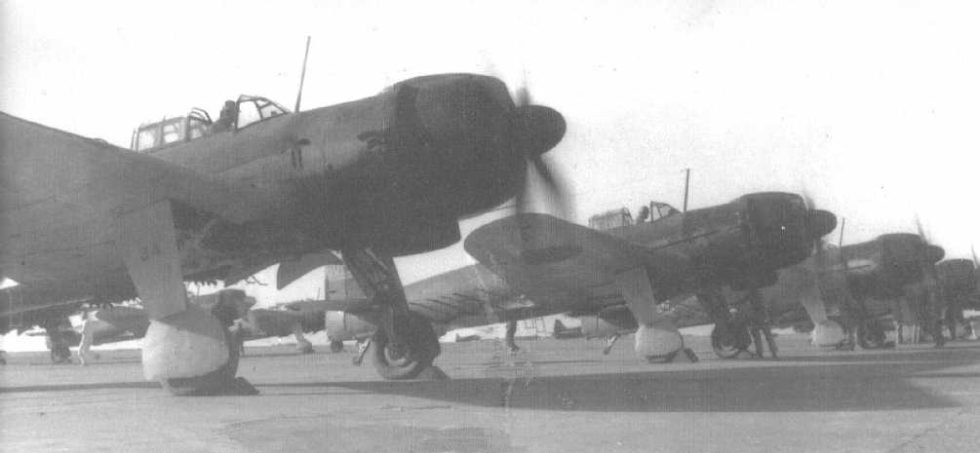
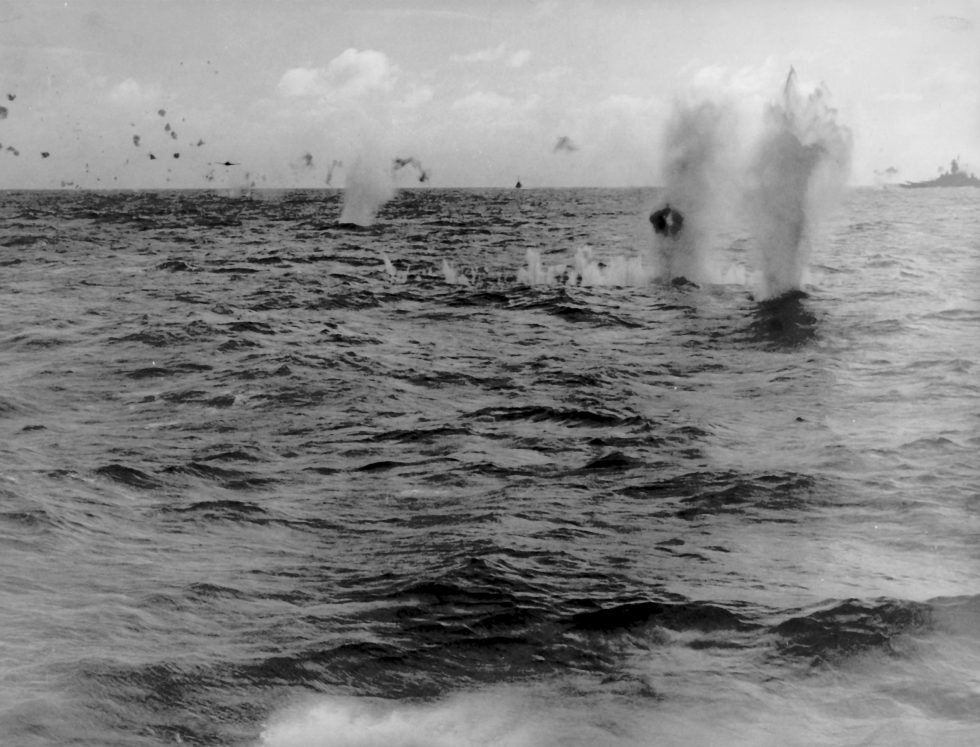
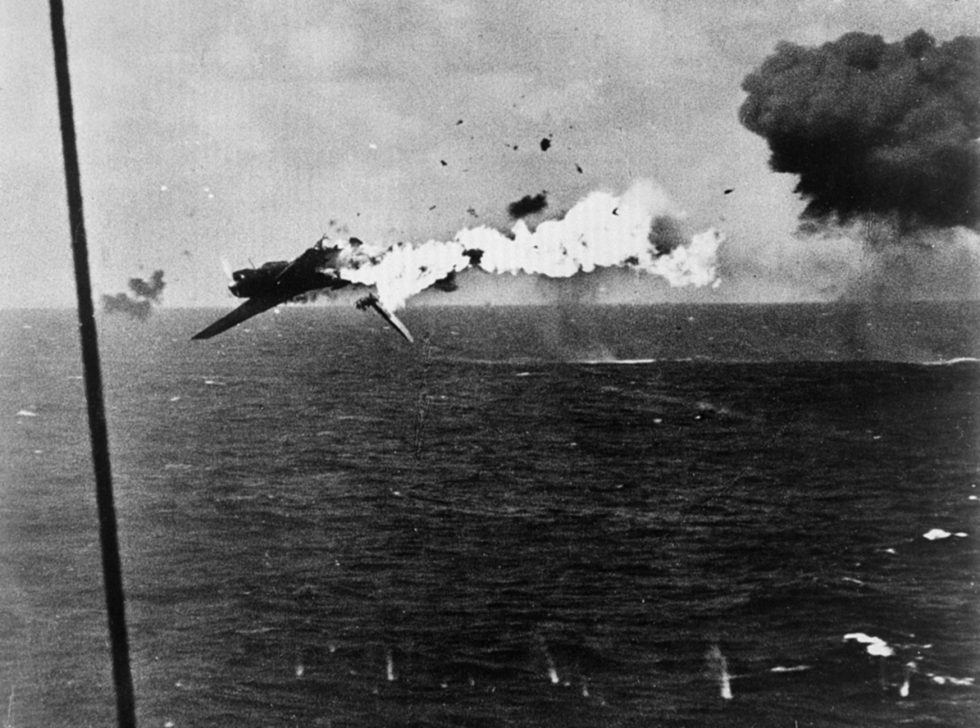
The B6N Tenzan in motion
Rare wartime footage of the Nakajima B6N Tenzan in flight and operating from the deck — one of the few moving-picture records of Japan’s last carrier torpedo bomber. Archival compilation via Aviation Videos Archives.
Where the B6N Tenzan fought
The score that defines the B6N Tenzan
The Tenzan’s combat record is a hard one to read, because its story is less about what it did than about when it arrived. Technically capable and fast for its class, it reached the fleet only after Japan had lost the experienced carrier aircrews and the massed carrier decks it was built to serve. In its two great battles it was cut apart before it could strike.
Compare the combat record of every military aircraft. Figures reflect the most commonly cited accounts and are hedged where sources differ.
Everything people ask about the Nakajima B6N Tenzan
Can I fly in a Nakajima B6N Tenzan?
What does “Tenzan” mean, and why was it called “Jill”?
How fast was the B6N Tenzan?
Why did the B6N need a new engine?
How many B6N Tenzans were built?
Did the B6N Tenzan sink any ships?
Are there any surviving B6N Tenzans?
How was the B6N different from the B5N Kate?
You can’t fly the B6N Tenzan.
These, you can.
Some legends only live in museums — others are fuelled and waiting. MiGFlug has put civilians in real military jet cockpits since 2004.
 Fly the L-39 AlbatrosThe world’s most-flown jet trainer — aerobatics included
 Fly the F-104 Starfighter“The missile with a man in it”
 Fly the MiG-21The Cold War’s most-produced jet
 Fly the T-33 Shooting StarAmerica’s first jet trainer
 Fly the DH VampireA piece of early jet history
 Fly the S.211Agile Italian jet trainer
 Fly the MB-326The classic Aermacchi jet
 Fly the MiG-15The Soviet legend of the Korean War
Continue the tour
Every fact, checked
- Smithsonian National Air and Space Museum — Nakajima B6N2 TenzanThe last surviving Tenzan in the world; museum history and provenance of the airframe.
- HistoryOfWar.org — Nakajima B6N TenzanDevelopment, variants, engine change and production figures.
- Naval Encyclopedia — B6N Tenzan “Jill”Design detail and combat history of the type.
- Military Factory — Nakajima B6N TenzanSpecifications and performance data.
- U.S. Navy / Naval History and Heritage CommandWartime photographs and accounts of the 1944 carrier battles.
- Imperial War MuseumsPacific carrier-war context and the collapse of Japanese naval aviation.
- CombinedFleet.comImperial Japanese Navy operational history and battle narratives.
- Wikimedia Commons — Nakajima B6N (images)Public-domain wartime photographs used in the gallery, with licensing.