
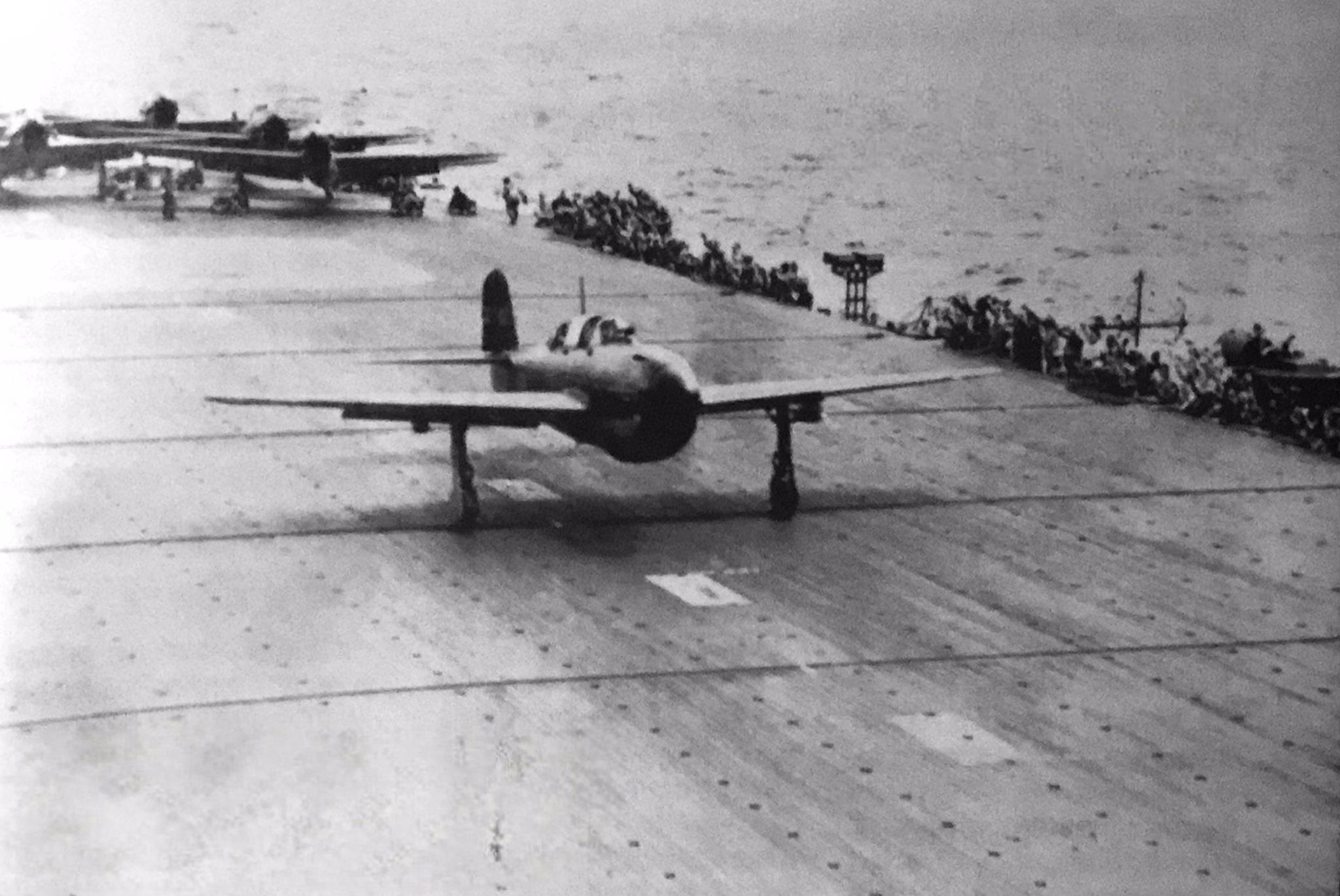
Yokosuka D4Y Suisei
“Judy”
The fastest carrier dive bomber of the Pacific War — a sleek, inline-engined “Comet” built for speed, undone by its temperamental engine, and expended at the end in kamikaze fire.
The Yokosuka D4Y Suisei: built for speed, betrayed by its engine
By the late 1930s the Imperial Japanese Navy wanted a carrier dive bomber that could outrun the fighters sent to stop it. The fixed-gear Aichi D3A “Val” then in service was rugged but slow, and the Navy’s planners looked to Germany for a faster shape. In 1938 Japan bought examples of the Heinkel He 118 dive bomber; the sole imported machine was destroyed in testing, but its clean, liquid-cooled lines pointed the way. The Navy’s own Yokosuka arsenal (the Kugisho) was tasked with a sleek, fast successor, and the result — first flown in December 1940 — was named Suisei, “Comet.” The Allies would call it “Judy.”
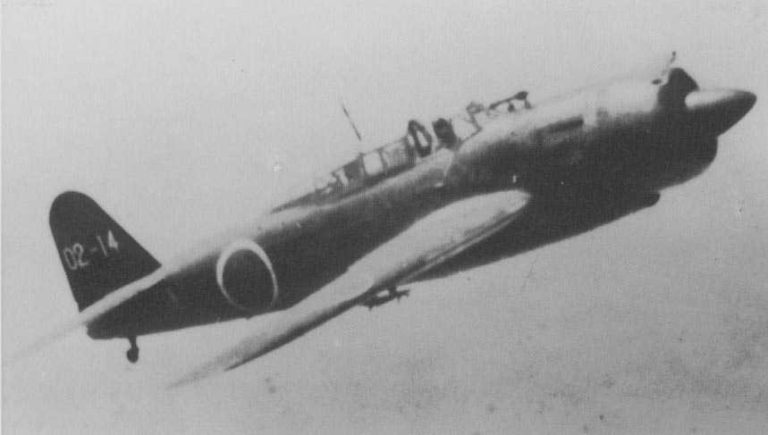
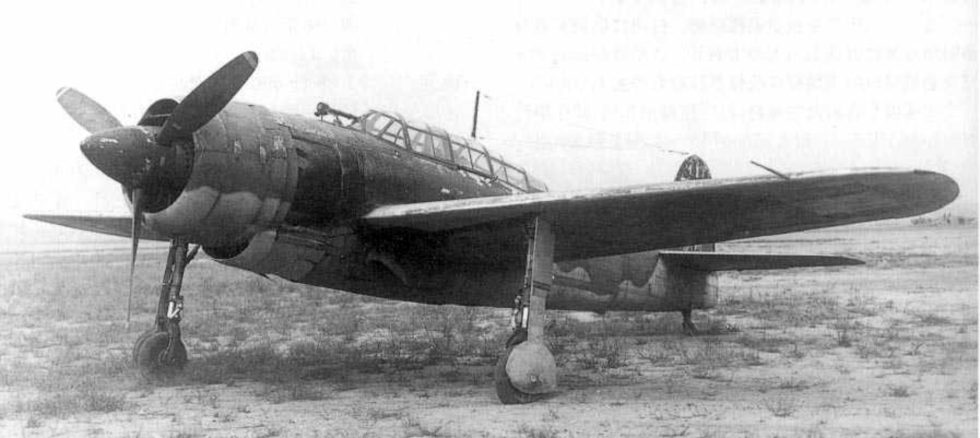
What made the D4Y unusual was its engine. Almost every Japanese naval aircraft used an air-cooled radial; the Suisei instead carried an Aichi Atsuta, a licence-built version of the German Daimler-Benz DB 601 inverted-V12. The narrow inline let designers wrap a slender, low-drag fuselage around it, and the D4Y became the fastest carrier dive bomber of the war, touching around 580 km/h. It was so fast and long-legged that its combat debut was not as a bomber at all: two D4Y1-C reconnaissance machines flew from the carrier Sōryū at Midway in June 1942 — and went down with her when she was sunk.
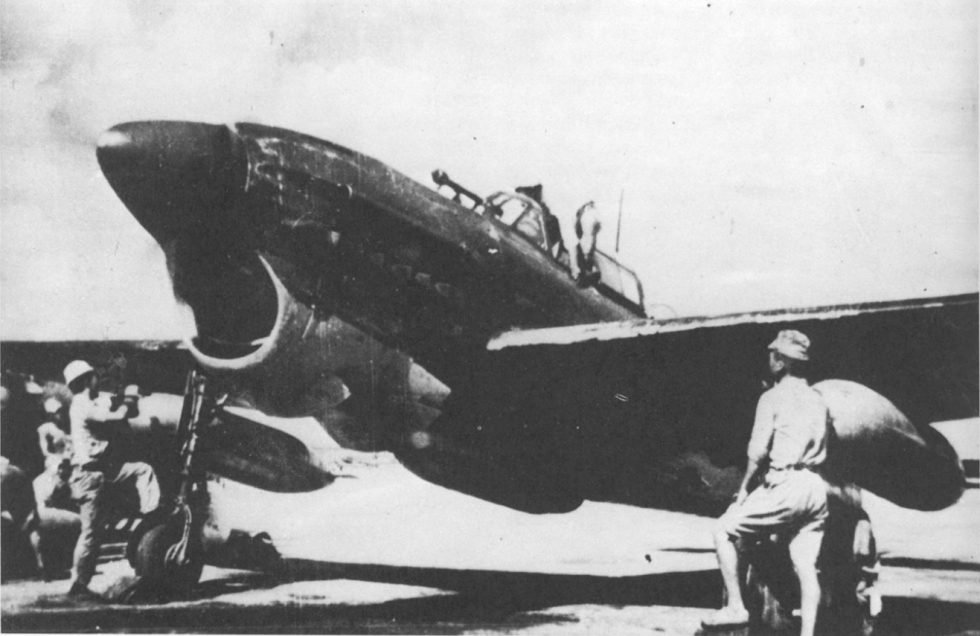
The speed came at a price. The Atsuta was notoriously unreliable: hard to build, hard to maintain, and often unserviceable in the field, where Japan lacked the precision industry the German engine demanded. Early D4Y1s also suffered wing flutter in the dive, delaying the true dive-bomber version until 1943. To escape the engine altogether, the later D4Y3 and D4Y4 abandoned the inline for a conventional Mitsubishi Kinsei radial — less elegant, blunter in the nose, but dependable.
By the time the Suisei was available in numbers, the war had turned. At the Battle of the Philippine Sea in June 1944, scores of D4Ys were thrown against the US fleet and cut down by radar-directed fighters and proximity-fused flak in the rout later nicknamed the “Marianas Turkey Shoot.” Yet the type could still bite: in October 1944 a single D4Y put one bomb through the deck of the light carrier USS Princeton and doomed her. As trained crews and fuel ran out, surviving Suiseis were turned into kamikaze aircraft. The very last Japanese air sortie of the war, on 15 August 1945, was a group of D4Ys led by Vice Admiral Matome Ugaki into the sea off Okinawa.
01The Yokosuka D4Y’s German bloodline: how the Heinkel He 118 shaped Japan’s Comet
In 1938 the Imperial Japanese Navy purchased the Heinkel He 118, a liquid-cooled monoplane dive bomber that had lost Germany’s own competition to the Ju 87 Stuka. The single imported airframe was wrecked in trials, but the Navy had already seen what it wanted: a clean, fast, inverted-V12 layout utterly unlike the fat radials of the D3A. The Yokosuka arsenal used that inspiration — together with a licence for the Daimler-Benz DB 601 engine — to design a slender all-new aircraft. The exact degree of Heinkel influence is debated, but the DB 601 licence and the He 118’s aerodynamic thinking are the reasons the Suisei looked and flew so differently from every other Japanese carrier bomber.
What makes the D4Y Suisei special
A liquid-cooled inline in a sea of radials
Alone among Japan’s carrier bombers, the D4Y was built around an Aichi Atsuta — a licence-built Daimler-Benz DB 601 inverted-V12. The slim inline let designers draw a low-drag fuselage barely wider than the pilot, and an internal bomb bay kept the belly clean. The payoff was speed: roughly 580 km/h, faster than the Allied dive bombers it faced and quick enough to be used as a fleet scout.
The engine that broke the Comet
The Atsuta demanded German-grade precision manufacturing Japan could not sustain in wartime. Engines arrived late, ran rough and were often unserviceable in the field. Whole squadrons sat grounded for want of working powerplants. The fix was radical: the D4Y3 and D4Y4 threw out the inline entirely for a dependable Mitsubishi Kinsei radial — blunter and slightly slower, but reliable.
Fast and long-legged — and unarmored
To stay light and fast the Suisei carried no armor and no self-sealing fuel tanks. Speed was its defence. That worked early on, but by 1944 — against radar-directed Hellcats and proximity-fused flak — an unprotected, lightly armed dive bomber burned easily. The same fragility that made it fast made it desperately vulnerable in a defended sky.
02The Yokosuka D4Y’s engine trouble: why Japan abandoned the inline Atsuta
The Aichi Atsuta was a fine engine on paper — a licensed DB 601 giving 1,200 hp in the D4Y1 and around 1,400 hp in the D4Y2. In practice it was a maintenance nightmare. The DB 601 relied on close machining tolerances and quality alloys that wartime Japanese industry, starved of materials and skilled labour, struggled to reproduce. Serviceability rates were poor and spare engines scarce. Rather than keep fighting the inline, Yokosuka re-engined the aircraft with the air-cooled Mitsubishi Kinsei 62 radial (~1,560 hp) to create the D4Y3. The nose grew fatter and top speed dipped slightly, but the radial could actually be kept running — the difference between an aircraft on the flight deck and one in the hangar.
03The Yokosuka D4Y2-S night fighter: the Comet sent up against the B-29
As American B-29s began night raids on Japan, a handful of Suiseis were converted into improvised night fighters as the D4Y2-S. The bomb bay and rear gun made way for an obliquely mounted 20 mm cannon — a “Schräge Musik”-style upward-firing weapon meant to be walked up into a bomber’s belly from below. Without airborne radar and short on high-altitude performance, the type was never an effective interceptor, but it is a telling snapshot of a Navy improvising with whatever airframes it had left.
Yokosuka D4Y Suisei: full specifications
Baseline note: the figures below describe the D4Y2 Suisei Model 12, the Atsuta-engined dive bomber that equipped the carrier air groups in 1944 and the definitive liquid-cooled mark. Deltas for the D4Y1 Model 11, the D4Y1-C reconnaissance aeroplane, the radial-engined D4Y3 Model 33 and the special-attack D4Y4 Model 43 are given in grey. Metric figures follow the Naval Air Technical Arsenal and Aichi data tables reprinted in the Japanese literature; Western compilations after Rene Francillon round several of them differently and quote a single "D4Y2" column that blends marks, so where the two disagree both are named.
Dimensions & weights
- Crew
- 2 — pilot, and an observer who doubled as radio operator and rear gunner (the D4Y4 deleted the rear seat, radio and guns, and was flown solo as a wingman aircraft behind a two-seat leader that did the navigating)
- Length
- 10.22 m (33 ft 6 in); Aichi’s own drawings give 10.24 m
- Wingspan
- 11.50 m (37 ft 9 in) — chosen deliberately so that no wing-folding mechanism was needed, at the cost of a cramped hangar deck
- Height
- 3.175 m (10 ft 5 in); D4Y1-C 3.295 m (10 ft 10 in), D4Y3 3.069 m (10 ft 1 in) on its fixed tailwheel
- Wing area
- 23.6 m² (254 sq ft)
- Aspect ratio and planform
- 5.60, straight taper 2:1 with rounded tips, incidence 1°, dihedral 3.5°, no washout
- Aerofoil
- NACA 230-series mean camber line throughout; 16 per cent thickness at the root, 6 per cent at the tip — maximum thickness at 40 per cent chord inboard and 20 per cent outboard, so the inner wing behaved almost as a laminar-flow section while the tip kept a stall angle about 4° higher than the root
- Fuselage section
- 1.830 m high × 1.068 m wide (6 ft 0 in × 3 ft 6 in) — so slim that a back-type parachute had to be developed because the usual seat-type pack would not fit
- Undercarriage track
- 4.630 m (15 ft 2 in), electrically retracted forward of the main spar
- Empty weight
- 2,635 kg (5,809 lb); D4Y1 2,510 kg (5,534 lb), D4Y1-C 2,440 kg (5,379 lb), D4Y3 2,501 kg (5,514 lb)
- Overload weight
- 4,353 kg (9,597 lb); D4Y1 3,960 kg (8,730 lb), D4Y3 4,657 kg (10,266 lb). Western sources usually quote a 4,250 kg (9,370 lb) gross instead
- Wing loading
- 184 kg/m² (37.8 lb/sq ft) at overload — high for 1943, and the reason the semi-Fowler flaps had to be so elaborate
Performance
- Maximum speed
- 579.7 km/h (360 mph, 313 kn) at 5,250 m (17,200 ft)
- D4Y1 Model 11
- 546.3 km/h (339 mph) at 4,750 m (15,600 ft)
- D4Y3 Model 33
- 574.1 km/h (357 mph) at 6,050 m (19,850 ft) — the radial cost a little speed low down and bought it back higher up
- Prototype trials, 1941
- 552 km/h (343 mph, 298 kn) at 4,750 m — the fastest aeroplane the Imperial Japanese Navy had flown to that date, and a dive bomber at that
- Cruising speed
- 426 km/h (265 mph, 230 kn) — exactly the 13-Shi requirement
- Climb to 3,000 m
- 4 min 36 s (9,850 ft); D4Y3 4 min 35 s
- Climb to 5,000 m
- 7 min 14 s (16,400 ft); D4Y1 9 min 28 s. The D4Y3 reached 6,000 m (19,700 ft) in 9 min 18 s
- Service ceiling
- 10,700 m (35,100 ft) is the usual quoted figure, but 9,400 m (30,800 ft) is given for the Atsuta marks in service trim; the Kinsei-engined D4Y3 is credited with lifting it back above 10,000 m (32,800 ft)
- Range, normal
- 1,517 km (943 miles) with a 250 kg bomb; D4Y1 1,783 km (1,108 miles), D4Y3 1,519 km (944 miles)
- Range, overload
- 2,389 km (1,485 miles); D4Y1 2,196 km (1,365 miles), D4Y3 2,911 km (1,809 miles). The higher radial figures are overload numbers and should not be read as the D4Y3 being the longer-legged aeroplane at a given fuel state — the Kinsei drank appreciably more
- Reconnaissance radius
- the prototypes recorded 2,100 nautical miles (~3,890 km, ~2,417 miles) in overload reconnaissance trim with drop tanks — the number that kept the type alive when it could not yet be trusted to dive
- Limiting speed in the dive
- 350 kn (650 km/h, 404 mph) indicated — and it was a shallow high-speed dive, not a bombing dive, that destroyed the fifth prototype
Propulsion & systems
- Engine
- 1 × Aichi AE1P Atsuta 32, inverted V-12, liquid-cooled, 1,400 hp (1,044 kW) for take-off
- D4Y1
- Aichi AE1A Atsuta 12, 1,200 hp (895 kW). The first prototype actually flew behind an imported Daimler-Benz DB 600G, whose carburettor proved almost impossible to set up, and was re-engined with the prototype Atsuta to get the test programme moving
- D4Y3 and D4Y4
- Mitsubishi MK8P Kinsei 62, 14-cylinder radial, 1,560 hp (1,163 kW) — more power, far better availability, worse fuel consumption, and a cowling that blanked the pilot’s view forward and down over a carrier’s round-down
- Where the Atsuta came from
- a licence copy of the DB 601A. Aichi could not readily reproduce the Bosch injection pump or the fluid-coupling supercharger drive, and abandoned glycol for a high-temperature, high-pressure plain-water system to get the engine into production at all — the cylinder block, crankcase and long crankshaft made it far dearer than a radial and unsuited to mass production, which is the real reason the D4Y3 exists
- Propeller
- three-blade constant-speed, 3.20 m (10 ft 6 in), pitch range 24–52°; D4Y3 3.00 m (9 ft 10 in), 26–56°
- Fuel
- the whole lower wing skin was a removable semi-integral tank — for the same wing area as an A6M2 Zero it held roughly twice the fuel, and matched a D3A that had half again the wing. Unprotected, and the reason a Suisei so often burned
- Dive brakes
- three-section auxiliary flaps under each wing ahead of the landing flaps, opening 70°, 65° and 60° from the root outboard, with the elevator trim tab interlinked to cancel the pitch change — closed, they sealed the slot ahead of the flap; open, they were the airbrake. Elegant, and the part that took two years to make safe
- Flaps
- semi-Fowler over 60 per cent of the span, 35° maximum and used fully even for take-off, with the ailerons drooping 10° as flaperons at full deflection
- Actuation
- electric throughout — undercarriage, flaps and bomb-bay doors; only the wheel brakes and propeller pitch were hydraulic Weight was saved, but the motors were weak against airloads, the batteries marginal and the ground crews unfamiliar, and the D4Y was harder to keep serviceable for it
- Bombsight
- Type 98 reflector sight inside the windscreen at first; the downward view it allowed was 7–8° against the 12–13° a dive-bombing run needed, so from spring 1943 the telescopic Type 2 No. 1 Model 1 was fitted, with a computer-driven variable-angle prism that set the aiming correction automatically — a genuine help to half-trained pilots, and one of the few late-war Japanese items that did what it promised
- Protection
- none at all until the D4Y4: 75 mm bulletproof glass ahead of the windscreen, 5 mm armour forward of the cockpit and 9 mm behind it, and protected tanks Crews of Attack Hikotai 3 are recorded removing the plate again to claw back performance
- Serviceability
- the Atsuta’s reputation is worse than the record in the one unit that took it seriously: Minobe’s Fuyo Butai, with deep spares and factory-trained fitters, showed 22 of 30 aircraft serviceable on 1 June 1945 (73 per cent) against 41 per cent for the 302nd Kokutai — though on other dates the Fuyo Butai itself managed only 35–58 per cent, and the claim of a sustained 80 per cent does not survive the war diaries
04The Yokosuka D4Y’s cost: why no reliable price exists
The D4Y was a wartime state product of the Imperial Japanese Navy, built by the Yokosuka arsenal and Aichi under a command economy, never sold on any open market. No credible flyaway unit price, and certainly no cost-per-flight-hour figure, survives in the public record — the accounting simply was not kept or published in those terms, and much of Japan’s wartime documentation was destroyed in 1945. Any precise dollar or yen figure attached to a Suisei today should be treated as guesswork. What can be said is qualitative: the inline Atsuta made early Suiseis expensive and labour-intensive to keep flying, which is a large part of why Japan switched later airframes to the cheaper, simpler radial.
Armament & payload
The Suisei carried one heavy bomb well and defended itself hardly at all
The D4Y was built around a single 500 kg bomb in an internal bay, delivered in a true dive behind a three-section airbrake and a telescopic sight with automatic correction, and that part of the design was excellent. Everything else about its armament was an economy. Two rifle-calibre guns in the nose and one on a ring in the back were the same defensive fit the Navy had given the fixed-undercarriage D3A of 1937, and against the Hellcat they were decorative; the 13 mm rear gun that might have mattered arrived only on the kou sub-types of late 1944. Nothing was armoured and nothing was self-sealing, because the specification had asked for range and the design team bought it with the crew’s lives.
The last variant abandoned the pretence entirely. The D4Y4 deleted the guns, the radio, the observer, the arrester hook and the mechanism that swung the bomb clear of the propeller, added armour that the crews sometimes took out again, and hung one 800 kg bomb where the bay had been. Fits varied widely by mark, by sub-type and by unit — late Model 12s, the 13 mm kou conversions, the oblique-cannon night fighters and the locally modified D4Y3s all overlapped in service, and the rocket boosters designed into the Model 43 were almost never carried.
Gun
- Two Type 97 7.7 mm fixed machine guns in the nose, 600 rounds each on the Model 11 and 400 each thereafter — a dive bomber’s strafing and flak-suppression armament, not a fighting one
- One Type 92 7.7 mm flexible gun on a ring in the rear cockpit, six 97-round drums; replaced from late Model 12 production by the faster-firing Type 1 7.92 mm with three 75-round drums
- The kou sub-types — Model 12A and Model 33A — substituted a Type 2 13 mm flexible gun, the first rear gun on the type with any real chance against an F6F
- The D4Y4 carried no guns at all, fixed or flexible; late production after April 1945 had even the nose guns and the bomb displacement gear deleted
- An April 1944 staff proposal to fit two Type 99 20 mm cannon in the wings and use the Suisei as a bomber-destroyer was studied and never acted on
Air-to-air
- No air-to-air missiles existed in Japanese service; this card belongs to the night-fighter conversions instead
- D4Y2-S Model 12E: bombing equipment stripped out and a single Type 99 20 mm cannon installed in the rear cockpit firing upward and forward, 250 rounds — the Japanese Navy’s own Schrage Musik, pioneered on the Nakajima J1N in May 1943
- Some carried two or four 10 cm air-to-air rockets under the wings against B-29 formations
- Two D4Y3 airframes were locally converted to the same oblique-cannon standard at unit level; the designation D4Y3-S appears in Western books but in no Imperial Japanese Navy document
- Without radar, and with a climb that could not get it to a B-29’s altitude in time, the night-fighter Suisei was fast and blind. Little is recorded of its successes because there were few
Air-to-surface guided
- None. The Imperial Japanese Navy never fitted a guided weapon of any kind to the D4Y
- The card is kept because the type ended the war doing the job a guided weapon does, by other means: the D4Y4 Model 43 was a terminal-guidance system with a man in it
- The Navy’s actual guided weapon of 1945, the Yokosuka MXY7 Ohka, was a separate manned rocket aircraft carried by the G4M bomber and had nothing to do with the Suisei
- Nor was the D4Y ever a torpedo carrier — that was the province of the Nakajima B5N and B6N carrier attack aircraft, a separate class in Japanese practice
Bombs
- Internal bomb bay: one 500 kg No. 50 bomb, one 250 kg No. 25, or two 30 kg No. 3. With the 500 kg aboard the bay doors could not be closed — a permanent drag penalty on the heaviest and most useful load
- From mid-Model 12 production, underwing racks for 30 kg and 60 kg bombs were added
- The D4Y3 Model 33 could carry one 250 kg bomb under each wing, in which case the bay was restricted to a single 250 kg — 750 kg total, the type’s heaviest conventional load
- The D4Y4 Model 43 took one 800 kg No. 80 bomb semi-recessed in the bay. The dive-bombing displacement crutch, which swung the bomb clear of the propeller arc, was deleted along with the doors: this aeroplane was never going to release
- A telescopic bombsight with an automatic correcting prism, and a genuine dive brake, made the D4Y an accurate dive bomber when flown by a trained crew. By 1944 there were very few of those left
Rockets
- Five Type 4 solid rocket units were designed into the D4Y4: one beneath each wing root for take-off with the 800 kg bomb, three under the fuselage aft of the bay for the final run-in and, in theory, the escape. All were jettisoned after burning
- They worked. Trials confirmed a large speed increment — and then a tube on a parked aircraft fired of its own accord, the aeroplane careered forward into the ones beside it, the cause was never established and supply and servicing never followed. They were not used again
- The cut-outs for the fuselage rockets were built into production airframes, which is why photographs suggest a fit that operational units almost never carried — a point on which many published accounts are wrong
- The night-attack Fuyo Butai used the Type 3 No. 1 Mk 28 rocket bomb against shipping: about 72 cm long, 14.5 kg all up with an 850 g charge, 230 m/s, two rails under each wing and no drop tanks with it
- The 10 cm air-to-air rockets of the night-fighter conversions are noted above
Pods & other stores
- Drop tanks under the wings — initially A6M tanks pressed into service on the reconnaissance conversions. Reconnaissance crews are on record as flying with them attached throughout the sortie and jettisoning only in extremis
- D4Y1-C reconnaissance fit: a K-8 camera in the rear fuselage and an auxiliary fuel tank in the bomb bay, sights sometimes removed altogether
- Catapult spools and fittings on the D4Y1 Kai Model 21 and D4Y2 Kai Model 22, for operation from the hybrid battleship-carriers Ise and Hyuga and from the smaller, slower carriers the fleet was reduced to after Midway
- Arrester hook: fitted throughout, deleted on later D4Y3 production and absent from the D4Y4 — the clearest documentary evidence that the Model 43 was never meant to come back
- There is no hardpoint count in the modern sense. Bar the tanks and the wing bomb racks, everything the Suisei carried it carried internally
Three typical loadouts
- Carrier strike, D4Y2, Philippine Sea, 19 June 1944
- One 500 kg bomb in the bay with the doors open, full internal fuel, two 7.7 mm nose guns and one 7.92 mm flexible gun aft. A strike radius of roughly 300 nautical miles, launched deliberately outside American reach — and 174 Suisei of all models went out from nine carriers that day, sank nothing, and were massacred short of the target.
- Long-range reconnaissance, D4Y1-C
- K-8 camera aft, auxiliary tank in the bomb bay, two underwing drop tanks carried the whole sortie, bombsight often removed, guns reduced to the pair in the nose. This was the fit that reached about 2,100 nautical miles in trials, found the American carriers at Midway, and gave the type its first three years of usefulness while the airframe was still forbidden to dive.
- Special attack, D4Y4, Kikusui operations, spring 1945
- One 800 kg bomb semi-recessed and fixed, no guns, no radio, no arrester hook, 75 mm glass and 5 mm and 9 mm plate, rocket cut-outs empty. Flown solo, in a three-aircraft element behind a two-seat leader carrying an observer and a 500 kg bomb to do the navigation. At Okinawa 251 Suisei were flown on special attack, second in number only to the Zero, and 140 did not return.
Weapon designations and load tables follow Japanese sources, principally the Kugisho and Aichi data reprinted in Famous Airplanes of the World No. 69 and the surviving First Naval Technical Arsenal handover inventories. Where English-language accounts state that the D4Y4 was routinely fitted with three rocket boosters, they describe a design provision that was tested and then abandoned after an accident; where they give the D4Y4 a movable rear gun, the Japanese production description says the gun was deleted along with the seat.
Variants
Yokosuka designed the Suisei, Aichi built it, and every mark was a compromise forced by something breaking
The D4Y was not a manufacturer’s aeroplane. It was designed inside the Navy’s own research establishment, the Naval Air Technical Arsenal at Yokosuka, by a team under Masao Yamana, and handed to Aichi to produce — the same arsenal that would later give the fleet the P1Y Ginga and the MXY7 Ohka. That origin explains both the ambition and the trouble. Yamana’s team computed the fuselage cross-sections algebraically instead of drawing them with battens, got a wind-tunnel result close to pure skin friction, built the lower wing skin as a removable integral fuel tank, and arranged the tail so the aeroplane could not be made to flat spin. It was the most advanced airframe Japan had flown. It was also the one that cracked its spars.
The variant sequence is therefore a record of repairs. Flutter and spar cracks pushed the type into reconnaissance for a year; the Atsuta’s cost and unreliability produced the radial-engined Model 33; the loss of the carriers produced the catapult-equipped Kai; the loss of the war produced the Model 43. Roughly 2,038 were completed by the usual Western count, though the Japanese production breakdown adds to a little over 2,200 and the two figures have never been reconciled.
- 13-Shi Carrier Bomber, D4Y1 prototypes (1940–42, 5 built)
- First aircraft completed 1 November 1940 and flown at Yokosuka on 15 November — a day early, because Lieutenant Komaki lifted off on what was meant to be a taxi run and reported the machine honest and vice-free. Prototype No. 5 broke up in a high-speed shallow dive on 15 August 1942, killing both crew.
- D4Y1-C Type 2 Carrier Reconnaissance Aircraft Model 11 (adopted July 1942)
- The dodge that saved the programme. With the wing spars cracking and flutter unexplained, the Navy accepted the aeroplane as a fast unarmed scout — camera aft, tank in the bomb bay, no diving — and it went to sea aboard Soryu for Midway before it was ever cleared as a bomber.
- D4Y1 Suisei Model 11 (accepted March 1943)
- The dive bomber at last, after reinforced wing spars and redesigned dive brakes. Aichi AE1A Atsuta 12 of 1,200 hp. Two and a half years between first flight and first bombing sortie, in a war Japan had already begun losing.
- D4Y1 Kai Suisei Model 21 (from 17 March 1944)
- Catapult fittings, for the small slow carriers and for the hybrid battleships Ise and Hyuga. An admission that the fleet the D4Y had been designed for no longer existed.
- D4Y2 Suisei Model 12 and 12A (1944, 281 built at Aichi)
- Atsuta 32 of 1,400 hp, 580 km/h, and the fastest carrier bomber either side flew. The 12A substituted a 13 mm rear gun. The catapult-equipped Model 22 and 22A ran alongside it, and the land-based reconnaissance Model 12 and 12A were the same airframe without bombs.
- D4Y2-S Suisei Model 12E (conversions from 1944, 11th Naval Air Arsenal, Hiro)
- Night fighter: bombing gear out, one 20 mm Type 99 firing obliquely upward and forward, sometimes 10 cm rockets under the wings. No radar, and no ceiling to reach a B-29 with. Flown by Minobe’s Fuyo Butai and the homeland defence groups.
- D4Y3 Suisei Model 33 and 33A (1944–45, 536 built at Aichi)
- The Mitsubishi Kinsei 62 radial in place of the Atsuta — taller fin to restore directional stability behind the fatter nose, better climb and ceiling, worse forward view and worse fuel consumption, and units reported departures in the manoeuvre the liquid-cooled aircraft had been immune to. Early aircraft kept the hook; later ones lost it.
- D4Y4 Suisei Model 43 (first aircraft 12 February 1945, 296 built)
- Purpose-built for special attack: rear seat, radio and guns deleted, one fixed 800 kg bomb, armour and bulletproof glass, no hook, no bomb bay doors, provision for five rocket units that were withdrawn after a ground accident. Photographs of two-seat examples exist because some were flown as leaders or reconverted — the production description is unambiguous that the observer’s station went.
- Suisei Model 54, D4Y5 (designed 1945, none built)
- Nakajima Homare 12 of 1,825 hp, four-blade constant-speed propeller, armour for crew and tanks. Paper, in a country that by then had neither the engines nor the aluminium.
- Hiro production (11th Naval Air Arsenal, about 430 liquid-cooled aircraft)
- Not a variant but the second source. Aichi built 705 Model 11s, 281 Model 12s, 536 Model 33s and 296 Model 43s including the reconnaissance versions; Hiro added roughly 430 Atsuta-engined machines whose breakdown by mark is lost.
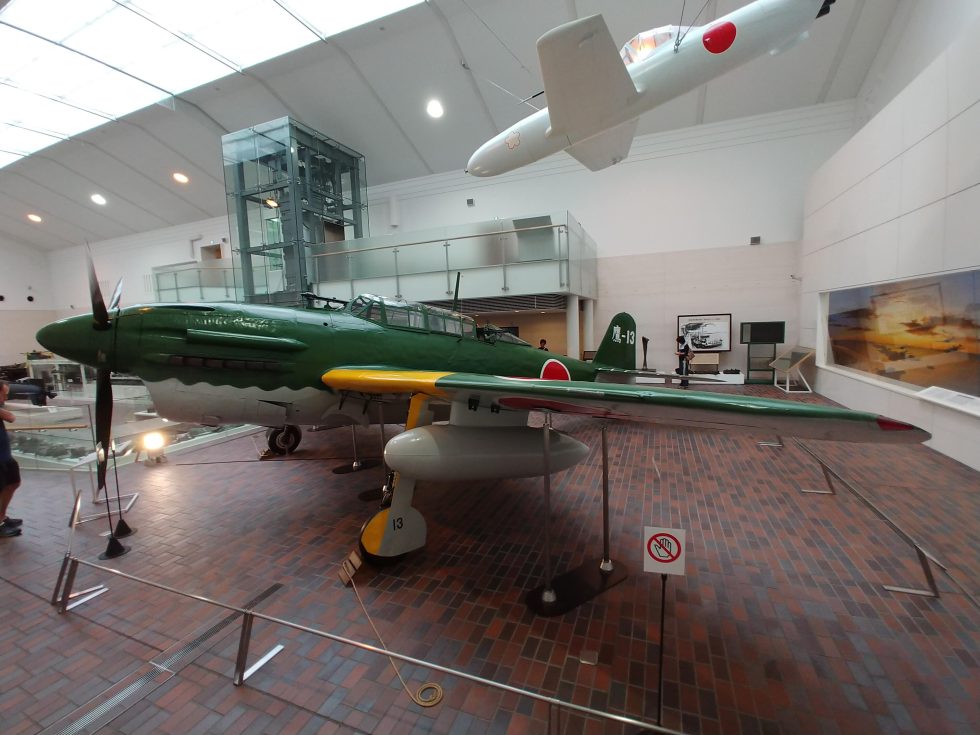
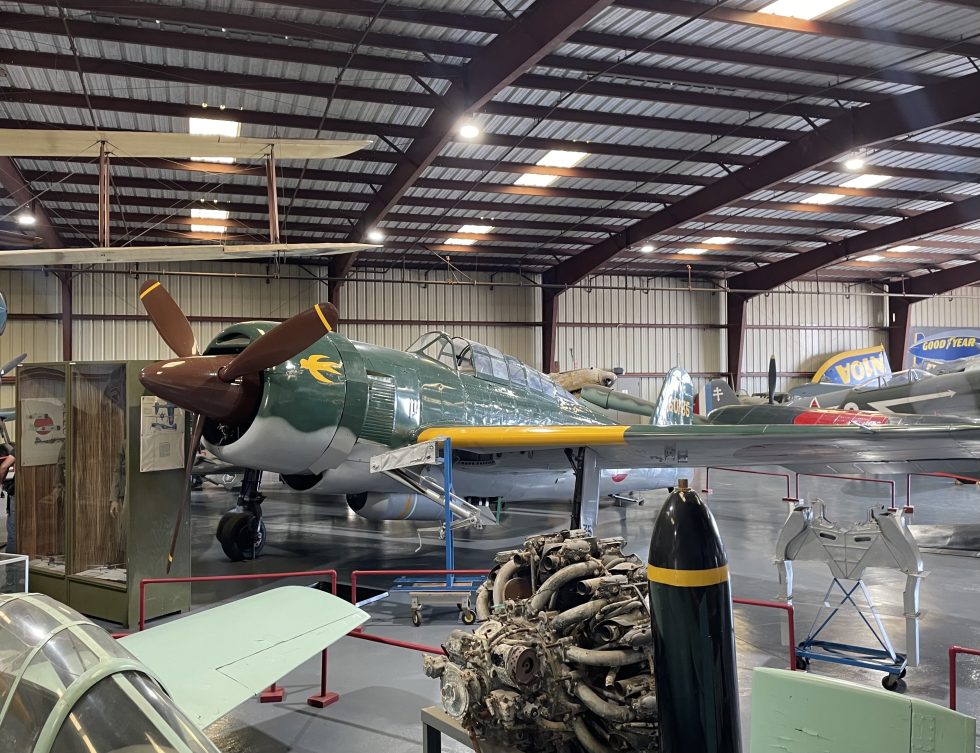
Survivors, precisely. There is one substantially complete original: the D4Y1 Model 11, construction number 4316, tail code Taka-13, at the Yushukan museum at Yasukuni Shrine in Tokyo. It was found beside a jungle airstrip on Yap in 1972, recovered in 1980 with the wings gas-cut at the roots to fit a transport aircraft, rebuilt at Kisarazu by volunteers for a television programme, presented in 1988, and comprehensively re-restored in 2016; its Atsuta 21 is displayed separately because the cut wings could not be restored to strength to carry it. It is the only complete liquid-cooled Suisei anywhere and the only surviving Japanese naval bomber in Japan. The second aircraft, at Planes of Fame in Chino, California, is a wreck recovered from Babo in Indonesia in 1991 and rebuilt to taxiable condition by 2013 with an American Pratt & Whitney R-1830 standing in for the Kinsei, presented as a D4Y3 Model 33 — a substantially recovered and re-engined airframe, not a museum-condition aeroplane. Beyond those there are only relics: rear-fuselage sections of a D4Y4 held unexhibited by the Iwate Prefecture high school teachers’ association, an Atsuta 21 with its propeller weathering unfenced beside the car park at Rota International Airport in the Northern Marianas, and an engine and tailplane outside a derelict pineapple factory on Babeldaob in Palau. No airworthy example exists and no reproduction has been built.
From carrier scout to kamikaze: the D4Y Suisei’s war
A German blueprint
Japan imports the Heinkel He 118 and a Daimler-Benz DB 601 engine licence, seeding the design of a fast, inline-engined dive bomber.
First flight
The prototype Suisei flies in December 1940 — a slender machine unlike any other Japanese carrier bomber.
Debut at Midway — as a scout
Two D4Y1-C reconnaissance aircraft operate from the carrier Sōryū at Midway and are lost when she is sunk in June.
Dive bomber at last
After wing-flutter fixes, the D4Y1 enters service as a full dive bomber; the radial-engined D4Y3 follows to escape the troublesome Atsuta.
The Philippine Sea
Massed D4Ys are flung at the US fleet and slaughtered by radar-directed fighters and proximity flak in the “Marianas Turkey Shoot.”
USS Princeton
A single D4Y plants one bomb through the flight deck of the light carrier USS Princeton, triggering fires that sink her.
USS Franklin crippled
Off Japan, a lone dive bomber — commonly attributed to a D4Y — puts two bombs into USS Franklin, causing one of the US Navy’s worst carrier disasters.
The last sortie
Vice Admiral Matome Ugaki leads a final flight of D4Ys on a kamikaze mission off Okinawa — the last Japanese air attack of the war.
From the cockpit: twelve D4Y Suisei stories
A comet born from a German loser
The Heinkel He 118 lost Germany’s dive-bomber contest — then shaped Japan’s fastest carrier bomber.
Read the full story
Two Comets go down with Sōryū
The D4Y’s first combat use was as a scout — and both machines were lost with their carrier.
Read the full story
Why the bomber flew as a spy
Wing flutter in the dive kept the D4Y out of its intended role for over a year.
Read the full story
The Atsuta that grounded squadrons
A German engine Japan could not reliably build kept the fastest dive bomber in the hangar.
Read the full story
Radial rescue: the D4Y3
Japan gave up on the elegant inline and bolted on a dependable radial instead.
Read the full story
Into the Turkey Shoot
Scores of Suiseis were thrown at the US fleet — and cut down almost to a machine.
Read the full story
One bomb, one carrier
A single D4Y put one bomb through Princeton’s deck — and that was enough.
Read the full story
The carrier that would not die
A lone dive bomber — commonly attributed to a D4Y — nearly destroyed one of America’s biggest carriers.
Read the full story
The D4Y2-S against the B-29
A dive bomber pressed into service as a makeshift night fighter over Japan.
Read the full story
Speed instead of armor
The Suisei carried no protection at all — a gamble that stopped paying off.
Read the full story
The Comet as a weapon
As crews and fuel ran out, surviving Suiseis were turned into guided bombs.
Read the full story
Ugaki’s last flight
The war’s final Japanese air sortie was flown by Suiseis into the sea off Okinawa.
Read the full story
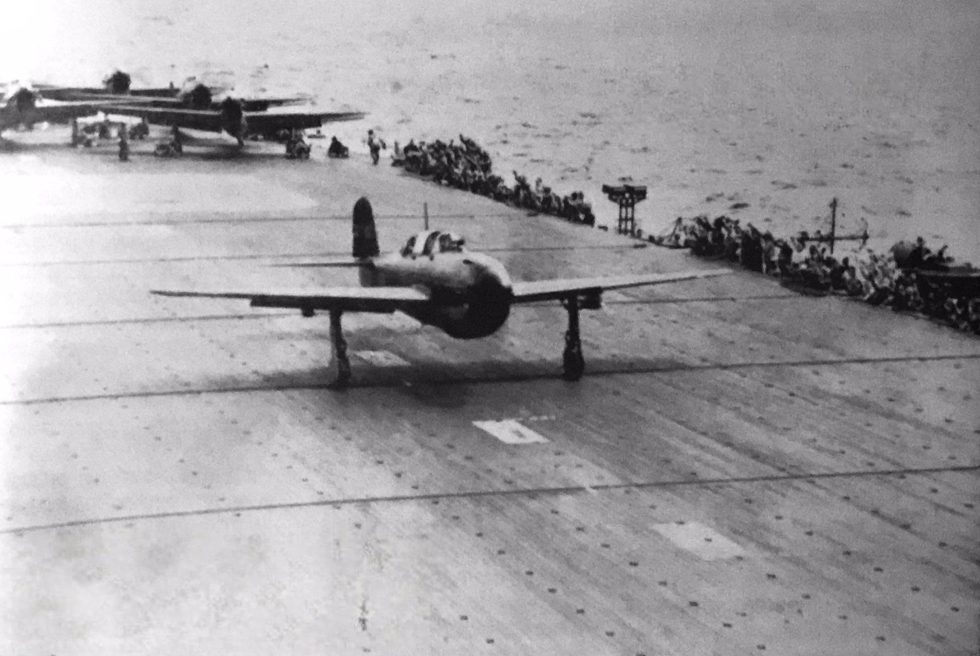
The D4Y Suisei in pictures
The Blackbird in motion
Real Engineering: The Insane Engineering of the SR-71 Blackbird — 10 million views, the definitive technical breakdown.
Where the D4Y Suisei fought
The D4Y Suisei: the record that defines it
The Suisei’s war is a story of speed against overwhelming odds. It was the fastest carrier dive bomber of the conflict, yet it arrived in numbers just as Japanese naval air power collapsed. Its greatest blows were struck not in massed raids but by lone aircraft that slipped through — and, at the very end, by aircraft flown deliberately into their targets.
Compare the combat record of every military aircraft. Figures as of August 2026.
Everything people ask about the D4Y Suisei
Can I fly in a Yokosuka D4Y Suisei?
How fast was the D4Y Suisei?
Why is the D4Y called “Judy”?
What engine did the D4Y use?
Did a D4Y ever sink an American aircraft carrier?
How many D4Y Suisei survive today?
Was the D4Y used for kamikaze attacks?
You can’t fly the D4Y Suisei.
These, you can.
Some legends only live in museums — others are fuelled and waiting. MiGFlug has put civilians in real military jet cockpits since 2004.
 Fly the L-39 AlbatrosThe world’s most-flown jet trainer — aerobatics included
 Fly the F-104 Starfighter“The missile with a man in it”
 Fly the MiG-21The Cold War’s most-produced jet
 Fly the T-33 Shooting StarAmerica’s first jet trainer
 Fly the DH VampireA piece of early jet history
 Fly the S.211Agile Italian jet trainer
 Fly the MB-326The classic Aermacchi jet
 Fly the MiG-15The Soviet legend of the Korean War
Continue the tour
Every fact, checked
- History of War — Yokosuka D4Y Suisei (“Judy”)Variant history, engine details, production totals and combat use.
- Naval Encyclopedia — Yokosuka D4Y SuiseiDesign origins, the Atsuta-to-Kinsei switch and operational record.
- Planes of Fame Air Museum — D4Y3 Model 33 SuiseiThe surviving restored airframe and its history.
- Naval History and Heritage CommandUSS Princeton and USS Franklin damage and loss records.
- Imperial War MuseumsPacific carrier warfare and Japanese naval aviation context.
- Osprey — Yokosuka D4Y “Judy” UnitsUnit-level operational history of the Suisei in the Combat Aircraft series.
- Vintage Aviation NewsThe rebirth of the Planes of Fame Suisei and the type’s rarity.
- Smithsonian National Air and Space MuseumReference for Japanese naval aircraft of the Second World War.