
Beriev Be-6
Madge, the Soviet Navy’s Flying Boat
The Soviet Navy’s big gull-winged flying boat replaced wartime Catalinas, watched NATO fleets from the Barents Sea to the Sea of Japan, opened the era of Soviet anti-submarine aviation and served China into the 1990s.
The Be-6: how Beriev gave the Soviet Navy its own long-range flying boat
The war had shown the Soviet Navy that it needed heavy flying boats, and it had filled the gap with Lend-Lease American Catalinas that would one day have to go back. Georgy Beriev’s design bureau, evacuated to Krasnoyarsk, drew up a twin-engined boat in 1944 and returned to Taganrog at the end of 1945 to build it. The first version, the LL-143, completed its state tests in 1946 with a recommendation to modernise it. The result was the Be-6: a gull-winged, all-metal boat with twin fins, fixed wingtip floats and two big ASh-73 radials, the same engines that powered the Tu-4 bomber but without its turbochargers. Factory tests began at Taganrog in July 1948 with test pilot M. V. Tsepilov at the controls.
The military kept moving the goalposts. A transport and reconnaissance version with radar and cannon followed, then the Be-6M with 23 mm NR-23 cannon in three remotely controlled turrets, a retractable radar under the hull and new navigation equipment. It passed its trials in early 1951 and was formally adopted on 22 August 1951. Production at Plant No. 86 in Taganrog proved difficult; the first series aircraft failed its acceptance tests in 1952, with leaking decks and hundreds of loose rivets. Quality improved, and by 1957 the factory had built 123 Be-6s in 19 series. They equipped long-range reconnaissance units of the Northern, Baltic, Black Sea and Pacific Fleets, and American fighters soon began intercepting them over the Sea of Japan.
From the mid-1950s the Be-6 became the Soviet Navy’s first real anti-submarine aircraft. The Be-6PLO carried the Baku sonobuoy system and a magnetic anomaly detector in place of its tail turret, and in 1961 the reconnaissance regiments were renamed anti-submarine regiments. Crews learned the new trade by trial and error, tracking foreign submarines in the Barents Sea. When nuclear submarines replaced diesel boats there, the Be-6 could no longer keep up, and by 1968–69 the turboprop Be-12 and the Il-38 had replaced it. About twenty went to China in 1959–60, where some were re-engined with turboprops and a few were still flying in 1998.
01The Be-6 in the Cold War: watching fleets and hunting submarines
The Be-6 began its service as a long-range scout. The first aircraft reached the Northern Fleet in 1951, based at Gryaznaya bay near Safonovo, and units of the Baltic, Black Sea and Pacific Fleets followed. Conversion was slow: by September 1953 the naval air arm had only about 20 series aircraft. Over the Sea of Japan, Pacific Fleet crews were soon being intercepted and escorted by American fighters, and NATO gave the type the reporting name Madge.
Anti-submarine work came next. The Be-6PLO, with its Baku system of passive buoys and an APM-56 magnetometer in the tail, entered service in 1955. Soviet accounts record the first successful tracking of a foreign submarine by a Northern Fleet Be-6 in 1958, followed by a 4.5-hour buoy track before contact was passed to ships. Killing a submerged boat was another matter: calculations showed that dozens of aircraft might be needed to be sure of a hit, so the job was usually left to warships. The most celebrated hunt came in March 1963, when Be-6s, helicopters and ships tracked a British diesel submarine for 33 hours until, by the Soviet account, it was forced to surface.
02The Be-6 in China: the boat that outlived its makers
In 1959 and 1960, after preparation by the factory and a working group of Beriev engineers, about twenty Be-6s that had already served in the Soviet Union were handed over to China. Many of the Soviet specialists involved were decorated for the work. Little is known in detail about their Chinese service, but they patrolled China’s long coastline and territorial waters for far longer than their Soviet sisters.
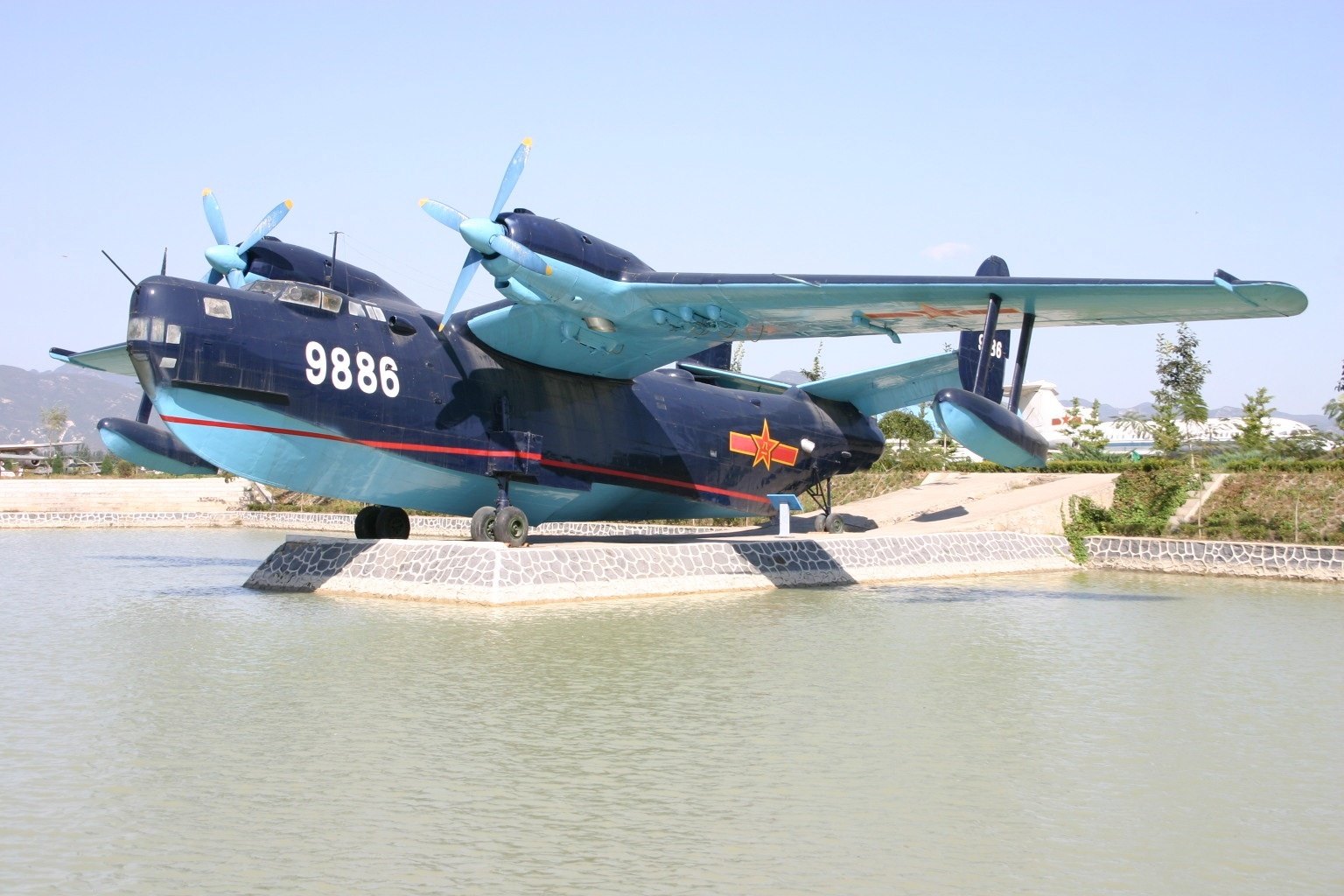
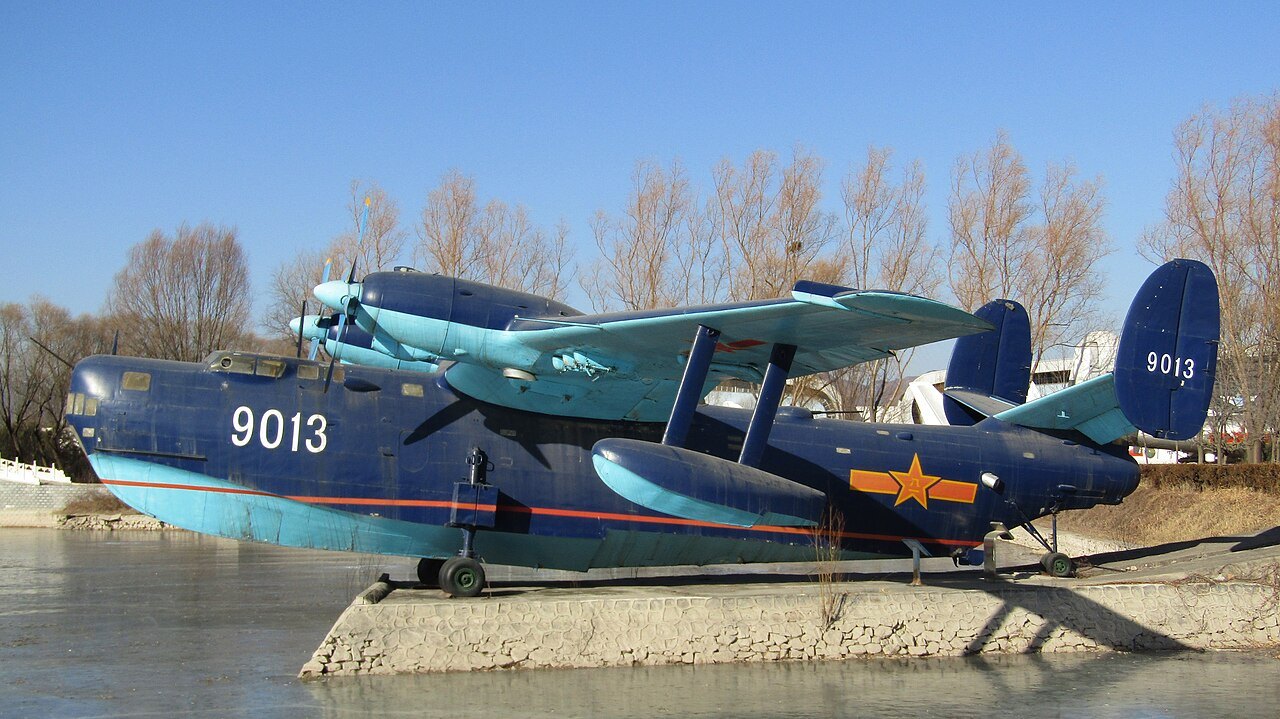
As the original ASh-73 radials wore out with no spares available, the Chinese navy re-engined several aircraft with locally built turboprops in new nacelles, and the Be-6 served in some respects as a starting point for China’s own SH-5 flying boat. Russian sources record four Be-6s still flying with Chinese naval aviation in 1998, with another in a museum. Examples are preserved today at the China Aviation Museum near Beijing and the naval museum at Qingdao.
What makes the Be-6 special
A boat that only lands on water
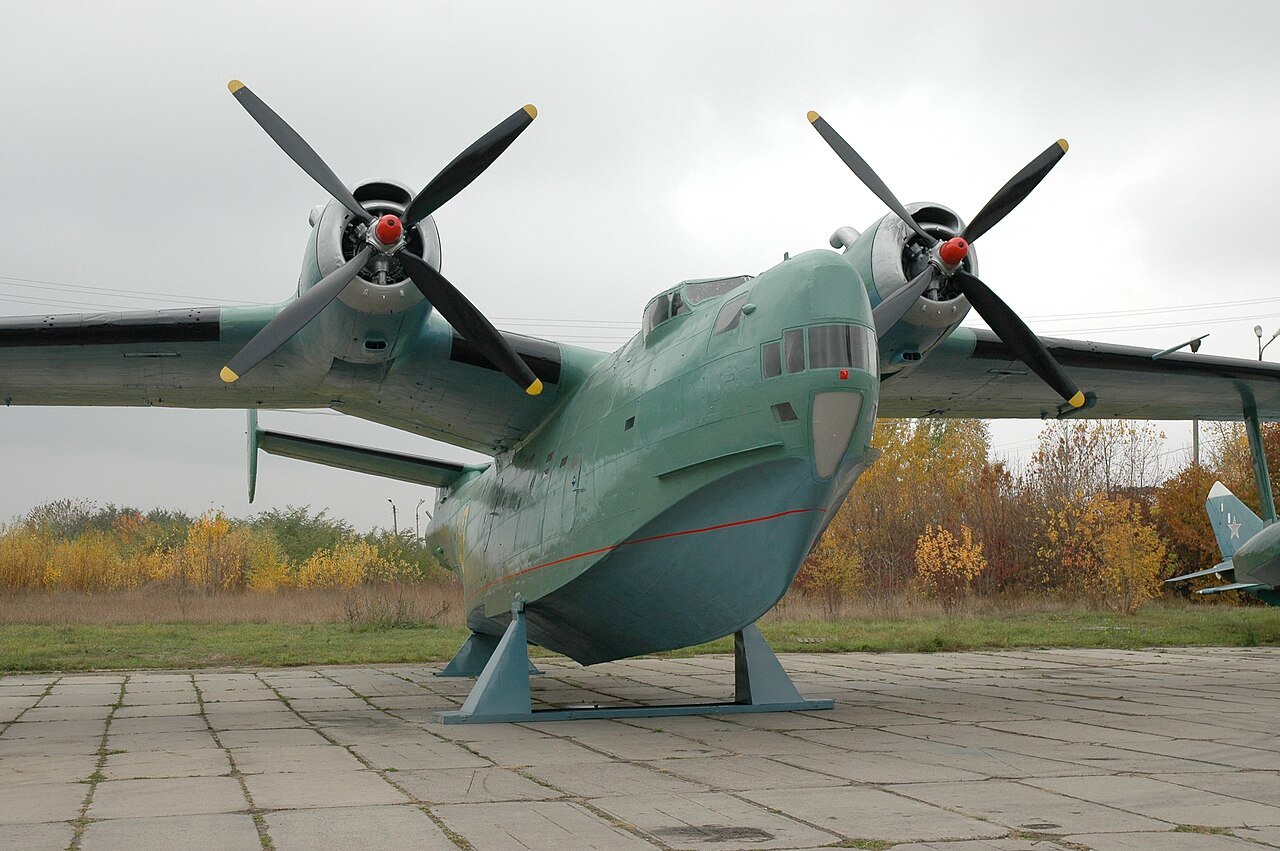
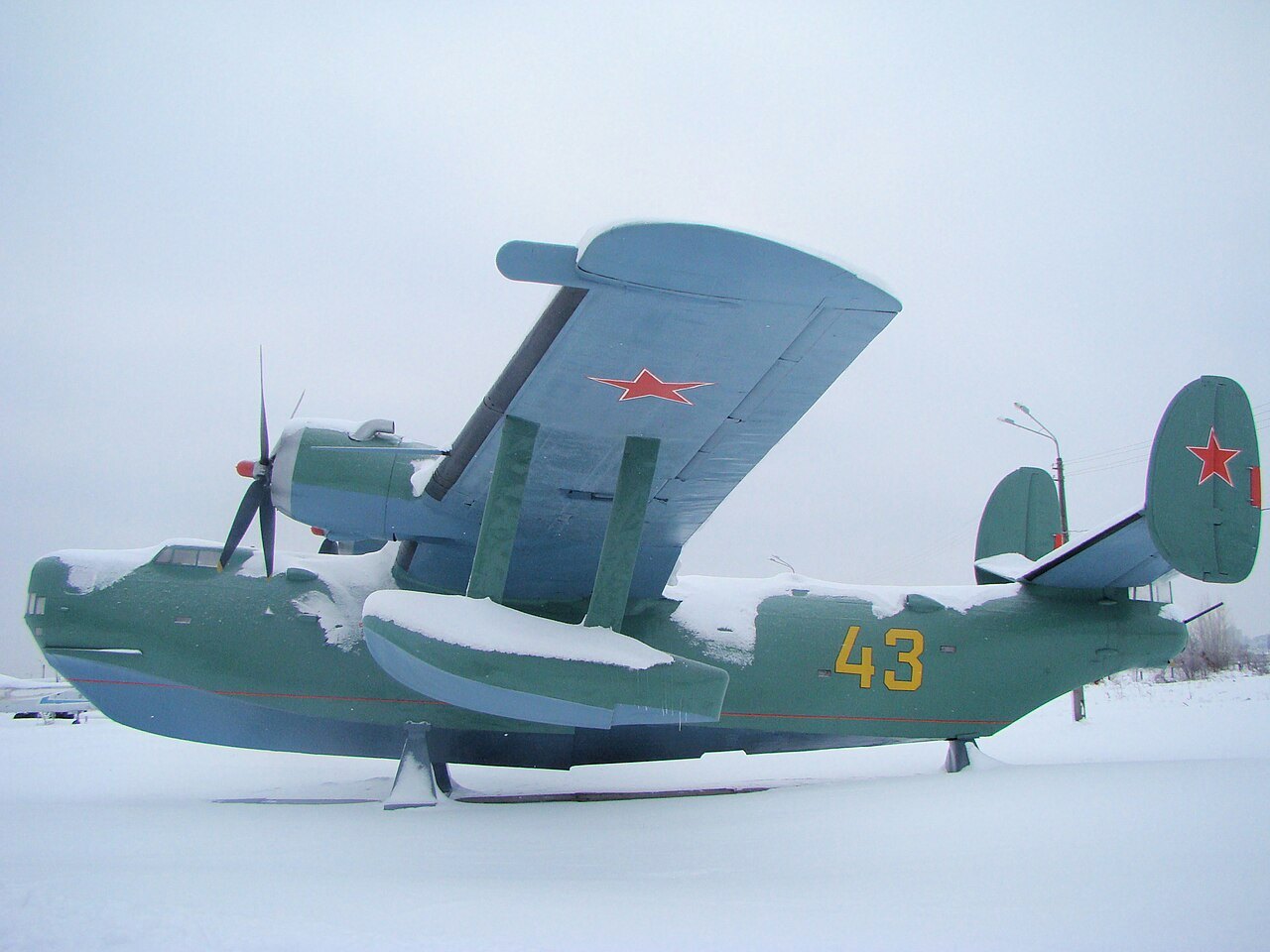
The Be-6 could take off and land only from water. For moving it ashore and into hangars, ground crews bolted on a removable beaching gear with two main units and a steerable tail trolley. The hull, with two steps and a deck on top, was divided by watertight bulkheads into eight compartments, and it would stay afloat with two adjacent compartments flooded. The gull wing lifted the engines and propellers clear of spray, and each fixed wingtip float was itself split into four watertight sections, because losing a float meant losing the aircraft.
Five cannon in three turrets
The production Be-6 carried five 23 mm NR-23 cannon: one in a remotely controlled nose mounting aimed by the navigator, two in a dorsal turret and two in a tail turret shared with the Il-28 bomber, with a total of more than 1,000 rounds. Under the wings it could carry bombs up to the 1,500 kg class, mines or two torpedoes, and in its reconnaissance role a camera looked down through a hatch in the hull. Some 205 kg of armour protected the crew of eight.
Heated, hosed and washed
Russian sources note that the Be-6 was the first Soviet piston-engined flying boat with a heated crew cabin, a real comfort on long Arctic patrols. Endurance could reach about 16 hours, and the boat carried bunks, thermoses for every crew member and a toilet. The price was maintenance. After every flying shift the whole aircraft had to be washed in fresh water in seven stages, inside and out, to remove the salt, and in winter, when the seaplane stations froze, the boats were put into long-term storage until the ice went out.
03The Be-6’s systems and variants
Two Shvetsov ASh-73 18-cylinder radials, developed in Molotov (Perm) with much borrowed from the American Wright Cyclone 18, drove four-bladed feathering V-3BA-5 propellers. Fuel was held in 22 flexible tanks in the wing, some 10,670 litres in all. A small petrol-driven generator set, also taken from the Tu-4, supplied power on the water. The PSBN-M search and bombing radar extended below the hull through a sealed hatch in flight and retracted when not in use.
- LL-143: prototype with ASh-72 engines and machine guns, tested 1945–46.
- Be-6TR: transport and reconnaissance development of 1949–50 with radar and 20 mm cannon.
- Be-6M / Be-6: production standard with NR-23 cannon and PSBN-M radar.
- Be-6SS: unarmed search-and-rescue conversion tested 1958 and 1960, able to take 15 survivors; not produced in series.
- Be-6PLO: anti-submarine version with Baku sonobuoy system and APM-56 magnetometer in place of the tail turret.
- Liner: one aircraft used in 1965–67 for trials of communications with submerged submarines.
Beriev Be-6 specifications
Specifications
- Crew
- 8
- Length
- 23.5 m (77 ft 1 in)
- Wingspan
- 33.0 m (108 ft 3 in)
- Height
- 7.45–7.64 m (24 ft 5 in–25 ft 1 in) depending on source
- Empty weight
- 18,827 kg (41,507 lb)
- Max take-off weight
- 23,456 kg (51,712 lb) normal; up to about 28,850 kg (63,600 lb) overload
- Powerplant
- 2 × Shvetsov ASh-73TK 18-cylinder radials, about 2,300–2,400 hp each
- Maximum speed
- about 415 km/h (258 mph)
- Cruise speed
- about 280 km/h (174 mph)
- Range
- about 4,900 km (3,045 mi)
- Service ceiling
- 6,100 m (20,000 ft)
- Climb rate
- 5.6 m/s (1,100 ft/min)
- Armament
- 5 (later 4) × 23 mm NR-23 cannon; bombs, mines, depth charges or two torpedoes, up to about 4,400 kg
Costs & production
- Unit cost
- No published figure; Soviet production costs were not released
- Cost per flight hour
- No figure exists for a Soviet military type of the 1950s, and none survives in airworthy condition. Any per-hour estimate would be guesswork; Russian accounts instead stress the very high maintenance labour, with seven-stage freshwater washing after every flying shift and scheduled work every 25, 50 and 100 flight hours
- Production
- 123 built in 19 series at Plant No. 86, Taganrog, 1952–1957 (some sources give 129)
- Programme
- Design 1944; LL-143 tests 1945–46; Be-6 factory tests 1948; adopted 22 August 1951; replaced by Be-12 and Il-38 by 1968–69
04The Be-6’s operating costs: a hungry, labour-heavy boat
Russian accounts are blunt: the Be-6 was extremely labour-intensive. Military trials found it considerably more complex to maintain than the Catalina, and unit establishments, technical battalions and spares scales had to be revised. Salt water attacked everything, so the aircraft was washed after each flying shift and protected with special marine grease. Scheduled maintenance came every 25, 50 and 100 flight hours, guns were harmonised every year and the tail turret was removed for overhaul every two years. Aircraft parked for more than a week had to be preserved. The first series machines also burned more fuel than the prototype, cutting range by about 11 per cent until engines were better adjusted and the maximum weight raised.
The Be-6 from Krasnoyarsk to the Chinese coast
Design in exile
Beriev’s bureau, evacuated to Krasnoyarsk, completes the draft design and mock-up of a twin-engined flying boat.
LL-143 tested
The LL-143 prototype completes state tests; the commission asks for a modernised version with ASh-73 engines.
Be-6 flies
Factory tests of the Be-6 run at Taganrog from 2 July to 3 October 1948, with M. V. Tsepilov as lead test pilot.
Adopted
The Be-6M passes its trials at Lake Paleostomi and is adopted on 22 August 1951.
Series production
Production starts at Taganrog; the first series aircraft fails its acceptance tests.
Across Siberia
In July and August, 18 Black Sea Fleet Be-6s fly to the Pacific Fleet by rivers and lakes.
Submarine hunter
The Be-6PLO with the Baku sonobuoy system is accepted for service.
Production ends
The 123rd and last Be-6 is completed.
To China
About twenty ex-Soviet Be-6s are handed over to China.
A 33-hour hunt
Northern Fleet forces track a British submarine for 33 hours, by the Soviet account until it surfaces.
Replaced
The Be-12 and Il-38 take over; one Be-6 becomes a monument at Gryaznaya bay.
Last flyers
Four Be-6s are reported still flying with Chinese naval aviation.
Stories & eyewitnesses: the Be-6 on Soviet waters
Flutter at 5,000 metres
In 1948 Tsepilov saved the prototype when its rudders shook to pieces.
Read the full story
Ducks on Lake Paleostomi
A dusk landing in 1951 ended badly for a flock of birds.
Read the full story
Is it shaking yet?
A stall test in the early 1950s that veterans still told stories about.
Read the full story
From the Black Sea to the Pacific by river
In 1954 eighteen flying boats crossed the Soviet Union on rivers and lakes.
Read the full story
Escorted over the Sea of Japan
Pacific Fleet Be-6s met American fighters almost from the start.
Read the full story
Thirty-three hours
In 1963, by the Soviet account, a British submarine ran out of battery.
Read the full story
Saved by a sister ship
A Northern Fleet boat holed on rocks, and a rescue Be-6 picked up the crew.
Read the full story
Ribs like a thin cow
Two Baltic crashes in the early 1960s revealed how worn the fleet had become.
Read the full story
China’s Be-6s
About twenty flying boats outlived their Soviet sisters by decades.
Read the full story
From a Crimean plinth to Kyiv
The Be-6 in Ukraine’s State Aviation Museum spent 35 years as a monument.
Read the full story
The Be-6 in pictures
Where the Be-6 flies and flew
The Be-6’s record
The Be-6 never fought a war. Its record is a Cold War one: long-range reconnaissance over the Barents, Baltic and Black Seas and the Sea of Japan, the Soviet Navy’s first organised submarine hunting, search and rescue at sea, and a long second career in China.
See how training and combat types compare in the military aircraft statistics database. Figures are approximate.
Everything people ask about the Be-6
Can I fly in a Beriev Be-6?
What was the Beriev Be-6 used for?
What does the NATO name Madge refer to?
How many Be-6s were built?
What replaced the Be-6?
Can I see a Be-6 today?
You can’t fly the Be-6.
These, you can.
Most of this museum you can only look at. These genuine military jets you can fly yourself with MiGFlug — with aerobatics and time on the controls.
 Fly the L-39 AlbatrosThe world’s most-flown jet trainer — aerobatics included
 Fly the F-104 Starfighter“The missile with a man in it”
 Fly the MiG-21The Cold War’s most-produced jet
 Fly the T-33 Shooting StarAmerica’s first jet trainer
 Fly the DH VampireA piece of early jet history
 Fly the S.211Agile Italian jet trainer
 Fly the MB-326The classic Aermacchi jet
 Fly the MiG-15The Soviet legend of the Korean War
Continue the tour
Every fact, checked
- Beriev Be-6 (Ugolok Neba aviation encyclopedia)Detailed Russian history based on Aviatsiya i Vremya, Zablotsky and Salnikov, Yakubovich and Shavrov: tests, production, service, China, 1963 hunt
- Be-6 (TC) anti-submarine seaplaneState Aviation Museum, Kyiv: displayed aircraft, production 1952–1957, 123 built, data
- Beriev Be-6Virtual Aircraft Museum: development from LL-143, MAD version, service into the 1970s, specifications