
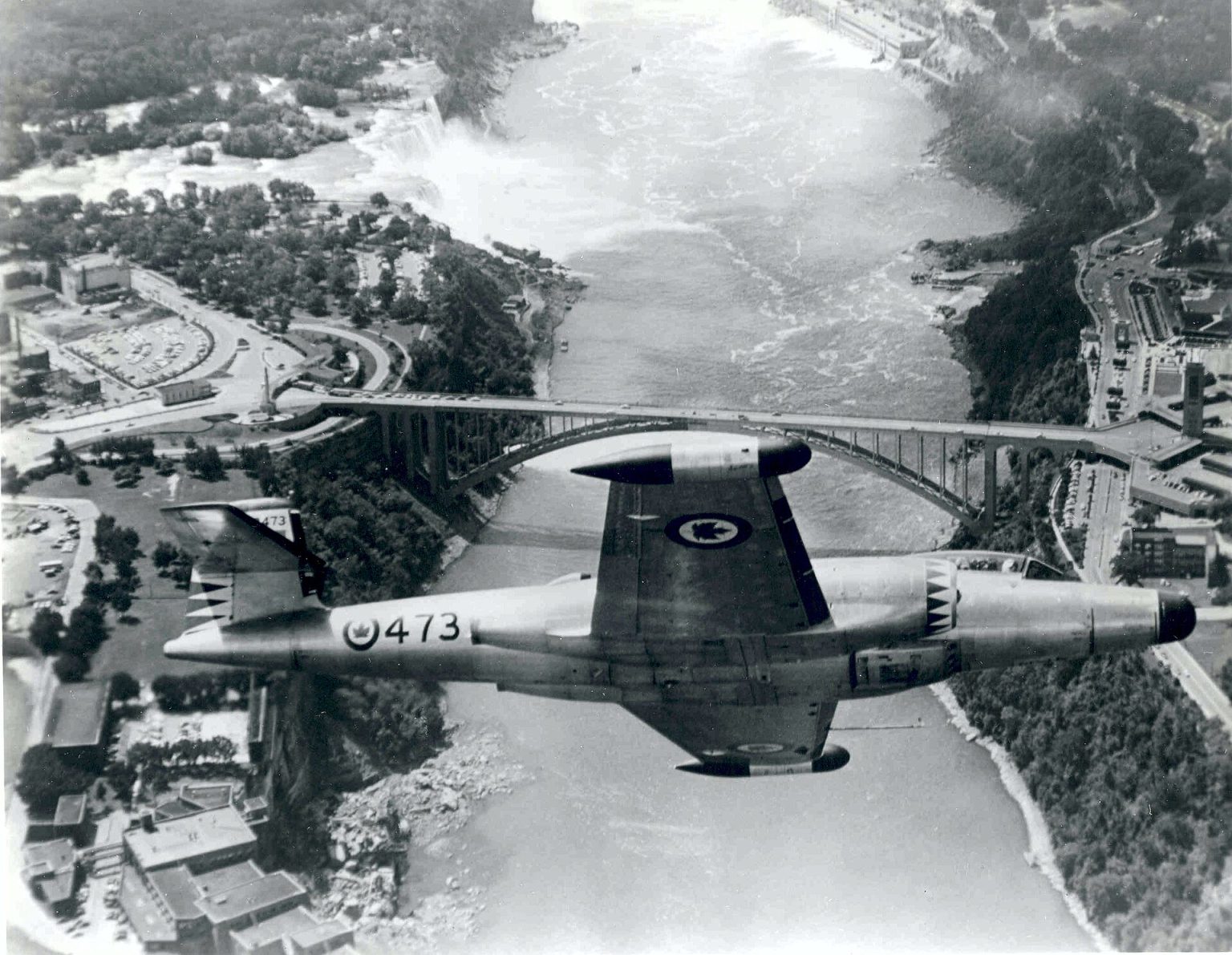
Avro Canada CF-100
“Canuck”
Canada’s big twin-jet all-weather interceptor — the only Canadian-designed combat aircraft ever to reach large-scale production, the first straight-winged jet to go supersonic, and the rugged NORAD guardian the crews affectionately called “the Clunk.”
Canada builds its own interceptor
In 1946 the young Royal Canadian Air Force faced a hard geographic fact: the shortest route for Soviet bombers to reach North America ran straight over the Canadian Arctic, and they would come at night and in weather that grounded lesser aircraft. Rather than simply buy an interceptor abroad, Canada chose to build its own. The task went to Avro Canada, and the result — first flown on 19 January 1950 — was the CF-100 Canuck, the first jet aircraft designed and built in Canada, and the only Canadian-designed combat aircraft ever to reach large-scale production.
The Canuck was a big, honest machine: a two-seat, straight-winged interceptor with the pilot and a radar navigator in tandem, powered by two Canadian Avro Orenda turbojets buried in the fuselage roots. It was never meant to dogfight. Its job was to be scrambled into the dark, vectored by ground control, find a bomber on its own radar and destroy it on a single pass. Crews nicknamed it “the Clunk” — commonly said to be for the heavy noise the nose gear made retracting — and, less kindly, the “Lead Sled.” The names stuck to an aircraft that proved tough, dependable and surprisingly capable.
It also had a genuine claim to fame. On 18 December 1952, Avro test pilot Janusz “Jan” Zurakowski pushed a CF-100 prototype past the speed of sound in a dive — making the straight-winged Canuck, by the most-cited account, the first straight-wing jet aircraft to fly supersonic in controlled flight. The definitive interceptor models, the Mk 4 and Mk 5, carried batteries of unguided “Mighty Mouse” 2.75-inch rockets in wingtip pods, the Mk 5 relying on those rockets alone after its guns were deleted and its wingtips and tail extended for better high-altitude reach.
The Canuck stood alert for NORAD across Canada, and from the mid-1950s equipped RCAF squadrons in Europe under NATO, guarding the continent’s skies from bases in France and West Germany. Belgium liked it enough to buy 53 of them. It flew in the shadow of its glamorous stablemate, the supersonic Avro Arrow — and outlived it: the Arrow was cancelled in 1959, while the humble Canuck soldiered on. Replaced in the interceptor role from about 1961 by the CF-101 Voodoo, it found a long second career as an electronic-warfare and target-towing aircraft, finally retiring in 1981 — more than three decades after its first flight.
01The Avro Canada CF-100 Canuck’s origins: how the Arctic bomber threat gave Canada its own interceptor
The Canuck was born from a 1946 RCAF requirement for a long-range, twin-engined, radar-equipped all-weather interceptor able to defend Canada’s vast, thinly-populated north in any conditions. No foreign type quite fit, and Canada’s wartime aircraft industry was looking for a peacetime future, so the newly-formed Avro Canada was handed the job of designing the country’s first jet fighter from scratch.
The programme was ambitious for a nation that had never designed a jet combat aircraft, and the early flight-test phase was troubled. But the aircraft that emerged was a genuine success on its own terms: rugged, roomy, well-suited to Arctic operations, and built around the radar and fire-control system that were its real weapons. That it was also home-grown — airframe and Orenda engines both Canadian — made it a point of national pride.
What makes it special
A wholly Canadian interceptor — airframe and engines
The CF-100 was designed and built in Canada by Avro Canada, powered by two Canadian Avro Orenda axial-flow turbojets developed by the same industrial group. Very few nations have ever fielded a home-designed jet fighter with home-designed engines; the Canuck made Canada one of them, and remains the only Canadian-designed combat aircraft to reach volume production.
The straight wing that went supersonic
Where its swept-wing contemporaries chased speed, the Canuck kept a thin, straight wing for the steady handling an all-weather radar platform needs. Yet on 18 December 1952 test pilot Jan Zurakowski dove a CF-100 through Mach 1 — by the most-cited account the first straight-winged jet to fly supersonic in controlled flight, a feat few expected of the type.
All-weather radar and a wall of Mighty Mouse rockets
The Canuck’s true weapon was its nose radar and Hughes fire-control system, worked by the back-seat navigator to find a bomber in cloud or darkness. The definitive Mk 5 was armed entirely with unguided 2.75-inch “Mighty Mouse” rockets — some 58 of them in two wingtip pods, ripple-fired in a single saturating salvo.
02The CF-100 Canuck’s supersonic dive: Jan Zurakowski and the straight-wing sound barrier
On 18 December 1952, Avro Canada’s chief development test pilot Janusz Zurakowski — a Polish-born wartime RAF pilot and famed aerobatic display flyer — took a CF-100 into a dive and pushed it past the speed of sound. Because the Canuck had a conventional straight wing rather than the swept wing then thought necessary for supersonic flight, the achievement is widely cited as the first time a straight-winged jet aircraft exceeded Mach 1 in controlled flight.
It was a dive, not level flight — the Canuck was never a supersonic aircraft in service — but it demonstrated the strength of the airframe and the skill of Avro’s test team, and it burnished the reputation of an interceptor that critics had written off as a heavy, plodding “Lead Sled.”
03The CF-100 Mk 5 Canuck’s armament: from cannon to an all-rocket interceptor
Early Canucks mixed guns and rockets: the Mk 4 carried a belly pack of eight 0.50-in machine guns alongside its rocket pods. The final production model, the Mk 5, took the concept to its logical end — it deleted the gun pack entirely and relied solely on unguided 2.75-inch “Mighty Mouse” folding-fin rockets carried in the wingtip pods, roughly 58 in total.
The Mk 5 also gained extended wingtips and tailplane to improve handling and reach at high altitude, where the bombers it hunted flew. The idea was blunt but effective for the era: get the radar onto a target in the dark, then empty a wall of rockets into its path on a single firing pass, trading pinpoint accuracy for sheer volume of fire.
Full specifications
Figures below are for the definitive rocket-armed CF-100 Mk 5. Several period sources differ on top speed and ceiling, so contested values are given as commonly cited figures rather than exact numbers.
Baseline note: the figures below describe the CF-100 Mk 5, the final and by far the most numerous production standard — about 332 of the 692 airframes built at Malton, Ontario — powered by two Avro Canada Orenda 11 turbojets, fitted with the extended wingtips and enlarged tailplane that were the mark’s whole reason for existing, and carrying no guns at all. It is the right baseline because it is what most CF-100s actually were, what Belgium bought, and what survived in Canadian service for another twenty years after the interceptor squadrons had gone. Deltas for the Mk 3 of 1952 (APG-33 radar, eight .50 in Browning M3 machine guns in a ventral pack, no rockets), for the Mk 4A and Mk 4B of 1953–1955 (APG-40 radar in a longer nose, Hughes MG-2 fire control, guns and wingtip rocket pods together) and for the Mk 5D and Mk 5M conversions are in grey. Five warnings before any number below is read. First, the wingspan of the Mk 5 is genuinely disputed and the disagreement is large. The infobox figure reproduced across most English-language reference sites is 17.42 m (57 ft 2 in); Canadian accounts and several museum descriptions give 18.54 m (60 ft 10 in); 58 ft 6 in also appears. The arithmetic favours the larger number, because the same sources describe the Mk 5 as adding roughly 1.06 m (3 ft 6 in) of new tip to each wing of a gun-armed mark that spanned about 16.3 m (53 ft 6 in), which lands at just over 18 m. Both figures are given below and neither should be quoted alone. Second, the quoted top speed and ceiling differ by a wide margin depending on which mark and which engine the writer had in mind: 888 km/h and 13,700 m are the standard Mk 5 numbers, while 650 mph (1,046 km/h) at 40,000 ft and a 16,460 m (54,000 ft) ceiling appear in Canadian service accounts, almost certainly describing a light, late Orenda 14 aircraft. Third, the Mk 5 sub-designations are routinely muddled. Mk 5D is the electronic-warfare conversion; Mk 5M is the Sparrow II missile trials conversion and was never an electronic-warfare aircraft; Mk 5C is used both for the Belgian export batch and, in some sources, for an electronic-warfare training standard. Anyone using the three interchangeably is repeating an error. Fourth, the supersonic claim needs stating exactly. On 18 December 1952 Janusz Żurakowski dived a Mk 4 prototype through Mach 1, making the CF-100 the first straight-winged jet aircraft to exceed the speed of sound in controlled flight. The qualifier matters: the rocket-powered Bell X-1 had straight wings and had been supersonic since October 1947. Sources also disagree on the entry altitude (45,000 ft or 30,000 ft) and the peak (Mach 1.0 or Mach 1.10). Fifth, the mark-by-mark production sub-totals wobble between authorities — 70 or 74 Mk 3, 141 or 144 Mk 4B, 331 or 332 Mk 5 — but the grand total of 692 is firm and is the figure to use.
Dimensions & weights
- Crew
- 2 — pilot and radar operator or navigator in tandem under a long canopy, the back-seater working the APG-40 and the MG-2 fire-control system. This was the decisive design choice and the reason the type outlived faster contemporaries: the CF-100 never asked one man to fly an instrument approach into an Arctic snow squall and run a blind interception at the same time
- Length
- 16.51 m (54 ft 2 in) — the gun-armed Mk 3 was slightly shorter; the nose grew when the APG-33 gave way to the larger APG-40 dish on the Mk 4
- Wingspan, Mk 5
- 18.54 m (60 ft 10 in) is the figure given in Canadian service accounts and by several museums; 17.42 m (57 ft 2 in) is the figure reproduced by most reference sites and 58 ft 6 in also appears. The Mk 5 added roughly 1.06 m (3 ft 6 in) of new tip to each wing, so the larger number is the one the arithmetic supports. Treat the span as disputed
- Wingspan, gun-armed marks
- About 16.3 m (about 53 ft 6 in) for the Mk 3, Mk 4A and Mk 4B; 54 ft 10 in is also quoted. The short-span wing is the quickest way to tell a Mk 4 from a Mk 5 in a photograph, once the ventral gun pack has been checked for
- Height
- 4.42 m (14 ft 6 in)
- Wing area
- 54.9 m² (591 sq ft) — quoted unchanged for the Mk 4B and the Mk 5, which cannot literally be true once seven feet of tip has been added, and is a good illustration of how uncritically these tables get copied. The extensions were narrow in chord, so the real increase was modest, but it was not zero
- Wing planform
- Straight, unswept, mid-mounted, with the engines buried in the wing roots — in 1950 that was already the conservative choice, and Avro Canada knew it. The unswept wing bought docile low-speed handling, a short take-off run and a fine climb; it cost the aircraft any prospect of level supersonic flight, and it is exactly why the CF-100 was obsolescent as an interceptor within a decade
- Empty weight
- 10,478 kg (23,100 lb)
- Gross weight
- 15,173 kg (33,450 lb) — the normal loaded weight, full internal fuel and two rocket pods
- Maximum take-off weight
- 16,329 kg (36,000 lb)
- Wing loading
- 276 kg/m² (56.6 lb/sq ft) at gross weight, 297 kg/m² (60.9 lb/sq ft) at maximum — modest for a jet of its era, which is where the climb and the short field performance came from. The nickname "Lead Sled" was earned by heavy, unboosted-feeling controls at speed, not by wing loading
- Fuel
- All internal, in the wing and fuselage, with provision for wingtip tanks in place of the rocket pods — internal capacity is not consistently published in English-language sources and no figure here is offered as authoritative. What is clear from the range numbers is that the tip tanks roughly doubled the useful reach, and that electronic-warfare Mk 5Ds flew with them as standard because they had no use for rockets
- Airframe life
- Designed for 2,000 flying hours; individual airframes passed 20,000 — an accidental tribute to a structure that was over-engineered because nobody at Avro Canada had built a jet fighter before. It is the single reason a 1950 interceptor was still flying operational sorties in 1981
Performance
- Maximum speed
- 888 km/h (552 mph; 480 kn) — the standard Mk 5 figure. Canadian accounts of late Orenda 14 aircraft give 1,046 km/h (650 mph) at 12,200 m (40,000 ft), which is a different aeroplane on a different day and should not be quoted as the type figure
- Limiting Mach, level flight
- About Mach 0.85 — the straight wing set the ceiling on speed long before thrust did. Above it the aircraft met compressibility, and the pilot met the control forces that earned it the name "Lead Sled"
- Maximum Mach achieved
- Mach 1.0 to 1.10, in a dive, on 18 December 1952 — not a service capability and never treated as one. Sources put the entry altitude at either 45,000 ft or 30,000 ft, and the peak at either Mach 1.0 or Mach 1.10; what is agreed is that the aeroplane came back and that no straight-winged jet had done it before
- Rate of climb
- 44.5 m/s (8,750 ft/min) at sea level — genuinely good, better than several swept-wing contemporaries, and the quality that made the type worth keeping on alert. A big straight wing and two engines climb well whatever they do at the top end
- Time to altitude
- Roughly eight minutes to 15,000 m (50,000 ft) is quoted in Canadian service accounts for a light Mk 5; the figure sits awkwardly beside the 13,700 m service ceiling given elsewhere and is best read as a zoom rather than a sustained climb
- Service ceiling
- 13,700 m (45,000 ft) — the standard figure. 16,460 m (54,000 ft) appears in Canadian sources for Orenda 14 aircraft. The gap matters, because the whole argument for replacing the CF-100 was that it could not reach a high-flying bomber quickly enough
- Range
- 3,200 km (2,000 miles; 1,700 nmi)
- Ferry range
- About 3,700 km (about 2,300 miles; 2,000 nmi) with wingtip fuel tanks fitted in place of the rocket pods — enough for the North Atlantic ferry legs of Operation Nimble Bat in 1956, when the first CF-100s crossed to Europe by air
- Combat radius
- ~1,125 km (~700 miles; ~610 nmi) — the number that made the type useful over Canada. It was bought with wing area and internal volume rather than with efficiency, and it is why the RCAF preferred a heavy two-seater to a light point-defence fighter
- Thrust-to-weight
- 0.44 at gross weight — ordinary for a 1950s all-weather fighter, and adequate because the mission was a controlled interception from ground radar rather than a scramble and a chase
- All-weather capability
- Cleared for operation in zero visibility — for a period in the mid-1950s the CF-100 was the only NATO fighter that genuinely was, which is why four squadrons of a Canadian aeroplane ended up standing night and bad-weather alert over France and West Germany while allied wings flew day fighters
- Handling
- Docile at low speed, short take-off run, heavy in roll and pitch at high indicated airspeed — the service nicknames tell the story better than any number: "Clunk" for the noise of the nosewheel retracting, "Lead Sled" for the controls, and less affectionately "CF-Zero" and "the Beast"
Propulsion & systems
- Engines
- 2 × Avro Canada Orenda 11 axial-flow turbojets — ten-stage compressor, six can-type combustors, no afterburner, buried in the wing roots either side of the fuselage. The Orenda is half the reason this page exists: Canada designed and built not only the fighter but the engine that powered it, and more than 4,000 Orendas were delivered in the 1950s, over a thousand of them for the CF-100
- Thrust
- 32.5 kN (7,300 lbf) each; 65 kN (14,600 lbf) total. Published ratings for the Orenda 11 run from 7,275 to 7,400 lbf depending on the source and the standard-day assumption, a spread small enough to ignore and large enough to explain why no two tables agree
- Engines by mark
- Rolls-Royce Avon RA.3 of 28.9 kN (6,500 lbf) in the two Mk 1 prototypes, because the Orenda was not ready; Orenda 2 of about 27 kN (6,000 lbf) in the Mk 2 and Mk 3A; Orenda 8 of 27 kN (6,000 lbf) in the Mk 3B; Orenda 9 of 29 kN (6,500 lbf) in the Mk 4A; Orenda 11 in the Mk 4B and Mk 5, with the Orenda 14 of 33.4 kN (7,500 lbf) in late Mk 5 aircraft
- Radar
- AN/APG-40 in the nose — the American set that also equipped the Northrop F-89D Scorpion, and the reason the Mk 4 nose is visibly fatter than the Mk 3’s. The Mk 3 carried the earlier and much less capable AN/APG-33, essentially a ranging set behind a gunsight rather than a search and track radar
- Fire control
- Hughes MG-2 — a fire-control system rather than a sight: it took the radar track, computed a lead-collision course, steered the pilot onto it and fired the rocket salvo automatically at the computed point. This is the equipment that made the CF-100 an all-weather interceptor instead of a fast two-seater with a radar in the nose
- Ground environment
- Interceptions were run from the ground — the Pinetree Line from 1954, then the Mid-Canada and DEW lines, feeding NORAD after the command was formalised in 1958, and SAGE data links at North Bay from the 1960s. The CF-100 was one component of a continental system, not an autonomous hunter, and it should be judged as such
- Electronic-warfare fit, Mk 5D
- Jammers, chaff dispensers and signal-emitting equipment carried internally and in wingtip installations, wingtip fuel tanks in place of the rocket pods, and no offensive armament of any kind. These aircraft flew as hostile electronic targets for Canadian and allied air-defence radars, fighters and ships. Detailed fits are not comprehensively published and varied over twenty years of service
- Crew escape
- Martin-Baker ejection seats for both crew — Mk 2E seats are reported. Escape from a low-level failure was marginal by later standards, and the type’s accident record was poor: two Canadian crashes into built-up areas, at Longueuil in August 1953 and at Orléans, Ontario in May 1956, killed twenty civilians between them, thirteen of them at a convent
- Undercarriage
- Tricycle, the nose unit retracting rearwards — and making the distinctive noise that gave the aircraft its permanent RCAF name. Every CF-100 was a "Clunk" from the moment the wheels came up
- Production
- 692 airframes, 1950 to 1958, all built by A. V. Roe Canada at Malton, Ontario — the only Canadian-designed fighter ever to reach mass production, and the largest run of any Canadian-designed military aircraft. Fifty-three of the total went to Belgium
- Cost
- The Belgian contract for 54 aircraft was worth about 42 million US dollars, roughly 790,000 dollars an airframe in 1957 money — of which 75 per cent was American and 25 per cent Canadian. Avro Canada is reported to have spent 150 million dollars and 450,000 man-hours before the prototype flew, against 42,000 man-hours for a P-51 Mustang; the comparison was made at the time and it was not flattering
04The CF-100 Canuck’s cost: what Canada’s home-built interceptor was worth
As a Canadian government procurement of the early 1950s, the Canuck never carried a modern-style flyaway sticker price, and published figures are scarce. Period estimates place the unit cost on the order of CA$1 million in 1950s dollars — a substantial sum reflecting the aircraft’s size and its expensive radar and fire-control electronics. That figure should be read as an order-of-magnitude estimate, not a sourced flyaway price.
No reliable public cost-per-flight-hour number exists for the type. As with most first-generation Cold War interceptors, operating-cost data was never published in a form comparable to modern figures, so any precise dollar-per-hour claim for the CF-100 is effectively a guess.
Armament & payload
The CF-100 began as a gunfighter, ended as a rocket carrier, and never fired a shot in anger
The armament story of the Canuck is a straight line from guns to rockets to nothing at all. The Mk 3 of 1952 carried eight .50 in Browning M3 machine guns in a ventral pack and nothing else. The Mk 4 of 1953 kept the guns and added a pod on each wingtip holding twenty-nine 70 mm folding-fin rockets, so that for two years the CF-100 was that rare thing, an all-weather interceptor with both a battery of guns and a rocket salvo. The Mk 5 of 1955 threw the guns away and kept the rockets, and the electronic-warfare conversions of the 1960s and 1970s threw the rockets away too and carried fuel and jammers on the wingtips instead.
The logic behind the change was sound and it was not Canadian. Against a formation of high-flying jet bombers, a machine-gun pass required closing to a few hundred metres and holding an aim; a salvo of unguided rockets fired from a mile out on a computed lead-collision course, with the fire-control system pulling the trigger, was calculated to be a better proposition. The Americans reached the same conclusion and armed the F-89D and the F-86D the same way. Everybody involved was wrong: unguided rockets against a manoeuvring or even a merely jinking target proved close to useless, as the USAF demonstrated to itself in a series of dismal live-fire trials. The CF-100 was fortunate never to be asked to prove it.
The guided missile that was supposed to fix this never arrived. Canada’s own Velvet Glove, developed by the Canadian Armament Research and Development Establishment from 1951 and test-fired from CF-100s, was cancelled in 1956 as unsuitable for supersonic launch. The Douglas Sparrow II that replaced it in Canadian planning was intended for the CF-105 Arrow, was trial-fitted to a handful of CF-100 Mk 5M conversions, and died with the Canadian missile programme in September 1958, months before the Arrow itself. Fits varied sharply by mark and by operator: a Mk 3 had guns and no rockets, a Mk 4 had both, a standard Mk 5 and every Belgian aircraft had rockets only, and a Mk 5D had neither. No CF-100 of any mark ever carried an operational air-to-air missile.
Gun
- 8 × .50 in (12.7 mm) Browning M3 machine guns with 200 rounds each, 1,600 rounds in total, in a forward-firing pack under the fuselage — the entire armament of the Mk 3 and half the armament of the Mk 4A and Mk 4B.
- The pack was a discrete unit that could be lowered and drawn clear for rearming and servicing, which made turnrounds quick and also made the guns easy to delete altogether. That is exactly what happened on the Mk 5.
- Rate of fire was high and range short: eight M3s put out a heavy stream of fire, but the M3 is a rifle-calibre-lineage weapon scaled up, and against a large pressurised bomber airframe it was already marginal in 1952.
- None on the Mk 5, the most numerous mark, on any Belgian aircraft, or on the electronic-warfare conversions. Roughly half of all CF-100s built had no gun at all.
- No cannon of any calibre was ever fitted or seriously proposed. The RCAF went from rifle-calibre-descended heavy machine guns straight to unguided rockets, skipping the 20 mm and 30 mm generation entirely.
Air-to-air
- No guided air-to-air missile was ever operational on any CF-100. The card is kept because two serious attempts were made and both failed, and because the failures shaped Canadian aviation more than any weapon that succeeded.
- Velvet Glove — the Canadian Armament Research and Development Establishment’s radar-guided missile, developed from 1951 and air-launched from CF-100 trials aircraft. Cancelled in 1956: it was built around a subsonic launch aircraft and could not be made to work from the supersonic fighters Canada intended to buy next.
- Douglas AAM-N-3 Sparrow II — a fully active radar-homing weapon, the first of its kind, selected in 1955 as the armament of the CF-105 Arrow. Douglas abandoned it in 1956; Canadair took the programme over and built two complete rounds from scratch plus five on Douglas airframes before Canada cancelled it on 23 September 1958.
- CF-100 Mk 5M — a small number of Mk 5s converted as Sparrow II trials aircraft, carrying the rounds on the wingtip stations in place of the rocket pods. Trials only; no squadron ever received a missile-armed Canuck.
- The proposed Mk 6 would have combined Sparrow II with afterburning Orenda 11IR engines as an interim fighter pending the Arrow. It was never built, and the interim was filled instead by buying American CF-101 Voodoos.
Air-to-surface guided
- None, on any mark, at any time. No anti-radiation weapon, no command-guided or television-guided missile, no anti-ship round.
- The APG-40 and the MG-2 fire-control system had no air-to-ground modes whatever. There was no mapping function, no ballistics computer for surface targets and no provision for one.
- This was a deliberate and permanent limitation. When the USAF looked at the CF-100 in the early 1950s as a possible all-weather interdiction aircraft, it was rejected for insufficient range and payload, and the English Electric Canberra was licence-built as the Martin B-57 instead.
- The nearest the type came to a ground role was electronic warfare, and that was a training service rendered to friendly forces rather than an attack capability.
Bombs
- None. No bomb bay, no external racks, no bomb-aiming equipment of any kind, on any variant from the Mk 1 prototype to the last Mk 5D.
- The ventral space that on many contemporaries held stores held a gun pack instead, and on the Mk 5 held nothing at all.
- Unlike the American all-weather fighters of the same generation, the CF-100 was never given a nuclear air-to-air weapon. There was no Canadian equivalent of the F-89J and its Genie, and the type therefore never carried a warhead of any description beyond a rocket’s.
- The absence is worth stating plainly because the CF-100 is often loosely described as a fighter-bomber in secondary writing. It was not one, could not have been made into one without a redesign, and never dropped anything.
Rockets
- 2 × wingtip pods, each with 29 × 70 mm (2.75 in) Mk 4 "Mighty Mouse" folding-fin aircraft rockets — 58 rounds in total, and from the Mk 4 prototype of October 1952 onwards the primary weapon of the type.
- Some sources give 30 rounds a pod and a total of 60, and a few give 58 as a per-pod figure. Twenty-nine each, fifty-eight in total, is the best-attested arrangement.
- The rockets were fired in salvo or ripple on a lead-collision course computed by the MG-2 system, which released them automatically at the calculated point. The pilot flew the steering dot; he did not aim.
- The Mighty Mouse was a small, cheap, unguided folding-fin rocket with a high-explosive head, shared with the F-86D and F-89D. Its dispersion at realistic firing ranges was wide enough that the tactic depended on a large salvo intersecting a large, straight-flying target.
- Retained on the Mk 5 when the guns were deleted, carried by every Belgian aircraft, and removed from the electronic-warfare conversions, which used the wingtip stations for fuel instead.
Pods & other stores
- Wingtip fuel tanks, fitted in place of the rocket pods — the only alternative store the wingtip stations ever carried, and the fit that took the type’s reach from roughly 3,200 km to about 3,700 km. Standard for ferry flights and for the electronic-warfare fleet.
- Electronic-warfare equipment on the Mk 5D: jammers, chaff dispensers and emitters carried internally and in wingtip installations, replacing all offensive armament. Detailed fits changed repeatedly across twenty years and are not comprehensively published.
- No external fuel tank on a pylon, no reconnaissance pod, no gun pod, no targeting pod. The wing had no hardpoints. Everything the CF-100 ever carried externally hung on the two wingtip stations.
- No in-flight refuelling of any kind, in an aircraft designed for long patrols over the Canadian north. What it took off with was what it had.
- The Mk 2T, Mk 3CT and Mk 3D conversions carried dual controls in place of the rear cockpit’s radar station and were unarmed; they are the only CF-100s built or converted with no weapon fit at all until the Mk 5D.
Three typical loadouts
- NORAD alert, Mk 5, Canada, late 1950s
- Two wingtip pods, 58 × 70 mm Mighty Mouse rockets, full internal fuel, no guns. Scrambled from Bagotville, Cold Lake, Comox, North Bay or Uplands on a Pinetree Line track, vectored by ground control, closing on a single lead-collision pass computed by the MG-2. One pass, one salvo, and if that failed there was nothing else aboard to try.
- NATO night and bad-weather patrol, Mk 4B, 1 Air Division, 1957
- Eight .50 in Browning M3 with 1,600 rounds in the ventral pack and two wingtip pods of 58 rockets, full internal fuel. Flown from Marville, Grostenquin, Zweibrücken or Baden-Soellingen in the European winter weather that grounded the allied day-fighter wings, which is precisely why Canada sent this aircraft and not more Sabres.
- Electronic-warfare training sortie, Mk 5D, 414 Squadron, CFB North Bay, 1975
- Two wingtip fuel tanks, internal jammers and chaff, no guns and no rockets. Flown as a hostile emitter against Canadian and allied radar sites, interceptors and warships, to give crews something to practise against that fought back electronically. Unarmed, unglamorous, and the reason the type reached its thirty-first year in service.
Sourcing caveat. No CF-100 of any mark ever fired a weapon in combat, in any air force, so none of the above has been tested against an enemy and the effectiveness claims are trials and doctrine, not results. Round counts for the wingtip pods differ between sources (29 or 30 a side); the Sparrow II installation on the Mk 5M is documented as a trials fit and the number of aircraft converted is not consistently reported; and detailed electronic-warfare equipment fits on the Mk 5D remain thinly covered in open sources, so any specific list of jammer types should be treated with caution.
Variants
Five marks in eight years, then twenty more years as somebody else’s training aid
The CF-100 family is compact and its logic is easy to follow: prototypes on borrowed British engines, a pre-production batch on Canadian ones, a gun-armed interceptor, a gun-and-rocket interceptor with a proper fire-control system, and finally a long-winged rocket-armed high-altitude version that outnumbered everything before it. There is no swept-wing derivative, no attack version and no naval version, because every one of those was studied and none was built.
What gives the list its shape is the shadow of the aircraft that never arrived. Avro Canada was designing the CF-105 Arrow while it was building the CF-100, and the Arrow existed specifically to replace it. The proposed Mk 6, with Sparrow II missiles and afterburning Orenda 11IR engines, was explicitly an interim type to bridge the gap until the Arrow was ready; when the Arrow was cancelled on 20 February 1959 the gap was filled instead by leasing and buying American CF-101 Voodoos, and Avro Canada’s fighter business ended with roughly 14,000 people out of work. The Canuck outlived the company that built it by twenty-two years.
The second thing the list shows is how the type survived. Withdrawn from the interceptor role from 1961 and gone from Europe by the end of 1962, the CF-100 should have disappeared in the mid-1960s like every comparable American design. Instead a handful of airframes were converted to fly as electronic aggressors, and because the structure had been built with a margin nobody had asked for, they kept flying until December 1981.
- CF-100 Mk 1 and Mk 2 (1950–1951; 2 prototypes, 5 to 10 pre-production)
- Prototype 18101 first flew from Malton on 19 January 1950 in the hands of Gloster test pilot Bill Waterton, on two Rolls-Royce Avon RA.3 turbojets because the Canadian Orenda was not ready. The second prototype crashed on 5 April 1951, killing test pilot Bruce Warren and putting the whole programme and Avro Canada’s competence in question. The Mk 2 pre-production batch, 18103 onwards, introduced the Orenda 2; sources give the batch as five or as ten. One was completed as the unarmed dual-control Mk 2T.
- CF-100 Mk 3, Mk 3A and Mk 3B (1952–1953; 70 or 74 built)
- The first operational mark, in service from 1953, with AN/APG-33 radar and eight .50 in Browning M3 guns in a ventral pack and no rockets. Mk 3A had the Orenda 2 (21 aircraft), Mk 3B the Orenda 8 (45). Several were converted to unarmed dual-control trainers as the Mk 3CT and Mk 3D, which is what most surviving Mk 3 airframes actually are. An initial RCAF order for 124 Mk 3s in September 1950 was cut back as the improved marks came into view.
- CF-100 Mk 4 prototype (first flight 11–12 October 1952; 1 converted)
- A Mk 3 rebuilt with the larger AN/APG-40 radar in a lengthened nose, the Hughes MG-2 fire-control system and wingtip rocket pods. This is the aircraft that Janusz Żurakowski dived through Mach 1 on 18 December 1952, making the CF-100 the first straight-winged jet aircraft to go supersonic in controlled flight — a distinction that must be stated with the word "jet" in it, since the rocket-powered Bell X-1 had straight wings and had beaten it by five years.
- CF-100 Mk 4A (1953–1954; 137 built)
- The production version of the Mk 4 on Orenda 9 engines, carrying both the eight-gun ventral pack and the two wingtip rocket pods. The mark that equipped the bulk of the RCAF’s all-weather squadrons in the mid-1950s, when nine squadrons flew the type at once.
- CF-100 Mk 4B (1954–1955; 141 or 144 built)
- The Mk 4A re-engined with the considerably more powerful Orenda 11. This is the aircraft that went to Europe: from 1956 four Mk 4B squadrons stood all-weather alert with 1 Air Division while the rest of the division flew day-fighter Sabres, and for a period it was the only NATO fighter that could reliably work in zero visibility.
- CF-100 Mk 5 (1955–1958; 331 or 332 built)
- The definitive mark and half the total production. Extended wingtips and an enlarged tailplane for better high-altitude performance, Orenda 11 and later Orenda 14 engines, the ventral gun pack deleted altogether and the wingtip rocket pods retained. Everything on this page’s specification grid describes this aeroplane.
- CF-100 Mk 5 for Belgium, sometimes Mk 5C (1957–1958; 54 ordered, 53 delivered)
- The only export order, and the CF-100’s only foreign operator. The purchase is credited to Żurakowski’s display at Farnborough in 1955; 75 per cent of the roughly 42 million dollar contract was American money under offshore procurement, so "sold to Belgium" flatters Canada’s salesmanship. Serials AX-01 to AX-53. Fifteen were ferried from Ottawa via Goose Bay and Keflavik in December 1957, and on 17 December 1957 No. 11 Squadron at Beauvechain became the first non-Canadian unit to operate the type, flying alongside Nos. 349 and 350 in the 1st All-Weather Wing. Withdrawn from 1961 and finally in 1964, replaced by F-104G Starfighters.
- CF-100 Mk 5D (conversions from the 1960s; small number)
- The electronic-warfare conversion and the reason the type lasted so long. Jammers, chaff and emitters replaced all armament, wingtip fuel tanks replaced the rocket pods, and the aircraft flew as an electronic aggressor for No. 414 Squadron from CFB North Bay, providing hostile emissions for Canadian and allied radars, interceptors and ships. The last of them flew until 1981.
- CF-100 Mk 5M (1958–1959; small number of conversions)
- Mk 5 airframes converted as trials platforms for the Douglas Sparrow II active-radar missile, part of the weapons work for the CF-105 Arrow. Frequently and wrongly listed as an electronic-warfare variant; it was a missile test aircraft and nothing else, and it never led anywhere because the Canadian Sparrow II programme was cancelled on 23 September 1958.
- CF-100 Mk 6 and Avro Canada CF-103 (projects, 1951–1957, none built)
- The CF-103 of 1951 was a swept-wing transonic development that reached full-scale mock-up and was judged obsolete before it was built, its thinking feeding straight into the Arrow. The Mk 6 of the mid-1950s would have married Sparrow II missiles to afterburning Orenda 11IR engines as a stopgap until the Arrow arrived. Neither was ordered, and after February 1959 there was no Canadian fighter programme left for either to belong to.
Closing note on survivors. Around thirty CF-100s survive, an unusually high proportion for a 1950s jet, and the reason is simple: when the type was withdrawn there were hundreds of airframes in Canada, no scrap value worth the trouble, and a great many air-force bases, armouries, schools and parks that wanted a gate guardian. Roughly twenty-five are in Canada, from CFB Comox on Vancouver Island to Halifax in Nova Scotia, including examples at the Canada Aviation and Space Museum in Ottawa (Mk 5D 100757), the Canadian War Museum (Mk 5 100760, in storage), the Canadian Warplane Heritage Museum at Mount Hope (Mk 5D 100785), the Reynolds-Alberta Museum at Wetaskiwin, the Alberta Aviation Museum in Edmonton (Mk 4B 100476), the Hangar Flight Museum in Calgary (Mk 3D 18126), the Canadian Museum of Flight at Langley (Mk 3B 18138), the Bomber Command Museum of Canada at Nanton (Mk 3 18152), the National Air Force Museum of Canada at Trenton, the Air Defence Museum at CFB Bagotville, the Base Borden Military Museum, the Royal Military College at Kingston and its counterpart at Saint-Jean, and gate guards or park displays at North Bay, Cold Lake, Winnipeg, Moncton, Malton, Campbellford and Haliburton. Five are abroad: the Royal Museum of the Armed Forces in Brussels (Mk 5 18534), the Imperial War Museum at Duxford (Mk 4B 18393), the National Museum of the United States Air Force at Dayton (Mk 4A 18241, in 428 Squadron markings), the Peterson Air and Space Museum in Colorado (100779) and the Castle Air Museum in California (Mk 5 100504). Three precisions are worth making. Every one of these is an original Avro Canada airframe: no replica or reproduction CF-100 has ever been built, and none of the survivors is a composite of a wooden mock-up or a rebuilt hulk. None is airworthy, and none has flown since December 1981; there is no flying CF-100 anywhere and there is unlikely ever to be one. And not one of them is a Belgian aircraft — all 53 Belgian Canucks were either lost in accidents, five of them, or stored at Koksijde and broken up by a scrap merchant at Ghent, so the aeroplane displayed in Brussels is an ex-RCAF machine standing in for the ones Belgium destroyed.
From Cold-War prototype to NORAD workhorse
The requirement
The RCAF calls for a twin-engined, radar-equipped all-weather interceptor to defend the Canadian Arctic; Avro Canada gets the job.
First flight
The prototype CF-100 makes its maiden flight on 19 January — the first jet aircraft designed and built in Canada.
Through the sound barrier
On 18 December, Jan Zurakowski dives a CF-100 past Mach 1 — the first straight-winged jet to fly supersonic in controlled flight.
Enters RCAF service
The Canuck reaches operational squadrons as Canada’s front-line all-weather interceptor, standing NORAD alert.
Guarding NATO’s skies
RCAF CF-100 squadrons deploy to Europe with 1 Air Division, flying air-defence alert from bases in France and West Germany.
Belgium buys in
The Belgian Air Force orders 53 Mk 5 Canucks — the only export customer for the type.
Production ends
The last of 692 Canucks is delivered as the supersonic Avro Arrow flies — the Arrow is cancelled the following year.
Handed the second job
Supersonic CF-101 Voodoos take over interception; the Canuck begins a long career in electronic warfare and target towing.
Retirement
The last CF-100s are withdrawn from RCAF service — more than three decades after the type first flew.
Twelve CF-100 Canuck stories
Why it is “the Clunk”
RCAF crews nicknamed the Canuck for the heavy clunk its nose gear made retracting.
Read the full story
Canada’s own jet fighter
The CF-100 was the first jet aircraft designed and built in Canada — and the only Canadian combat type built in numbers.
Read the full story
First straight-wing jet to go supersonic
On 18 December 1952, Jan Zurakowski dove a CF-100 through the sound barrier.
Read the full story
Guarding the top of the world
The Canuck existed to catch Soviet bombers crossing the Arctic at night, in any weather.
Read the full story
A wall of Mighty Mouse rockets
The Mk 5 dropped its guns entirely for 58 unguided 2.75-inch rockets in wingtip pods.
Read the full story
Made in Canada: the Orenda
The Canuck was powered by two Canadian Avro Orenda turbojets — a national engine for a national fighter.
Read the full story
A Canadian jet over Europe
From the mid-1950s, RCAF CF-100 squadrons stood NATO alert from bases in France and West Germany.
Read the full story
Belgium’s 53 Canucks
Belgium was the CF-100’s only foreign buyer, operating 53 Mk 5s in the all-weather role.
Read the full story
Living in the Arrow’s shadow
The Canuck flew alongside — and outlived — the doomed supersonic Avro Arrow.
Read the full story
From interceptor to electronic warrior
Replaced as an interceptor around 1961, the Canuck became an EW and target-towing aircraft.
Read the full story
Three decades in the air
First flown in 1950, the last CF-100 was not retired until 1981.
Read the full story
The interceptor Canada built itself
Judged on its own terms, the CF-100 did exactly what Canada asked of it.
Read the full story
The Canuck in pictures
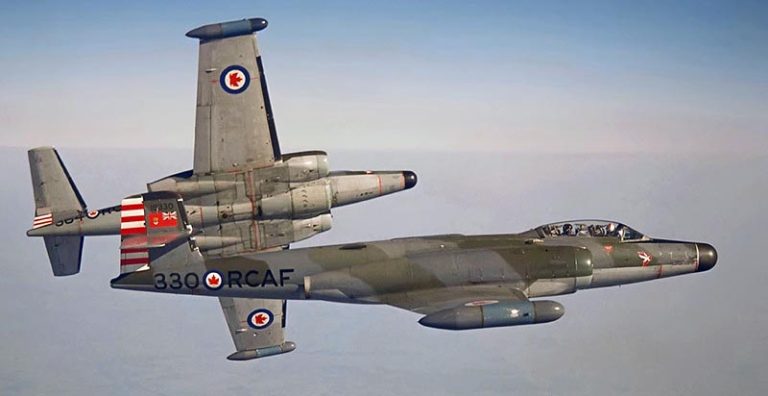
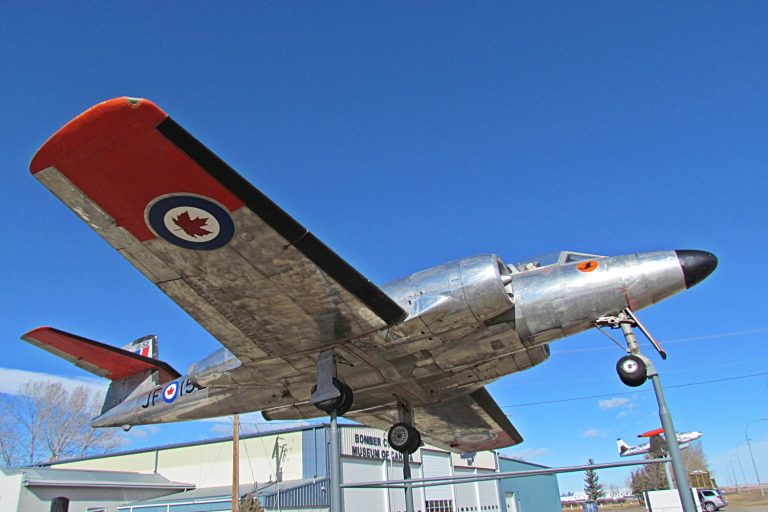
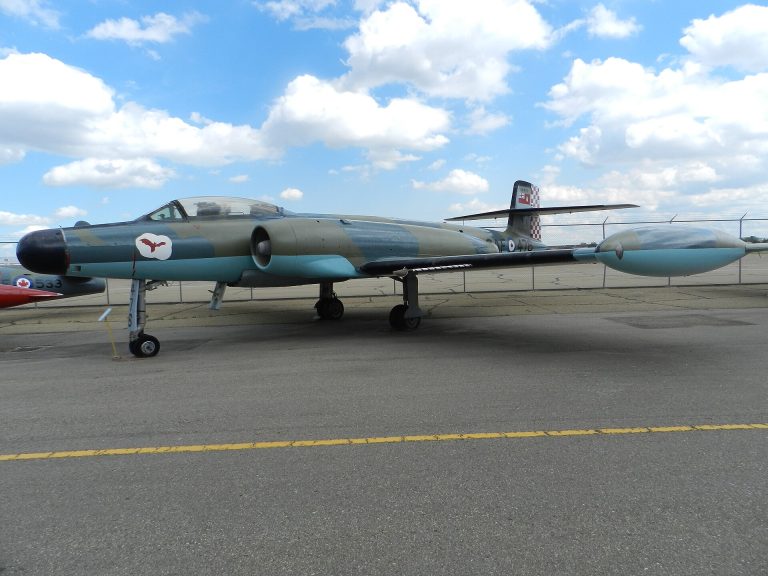
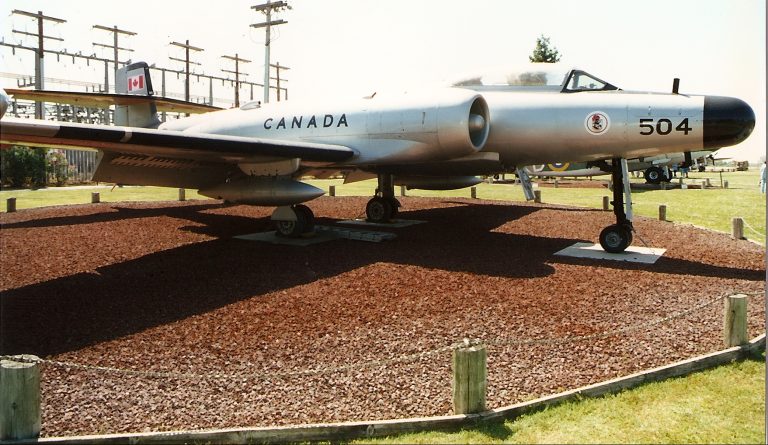
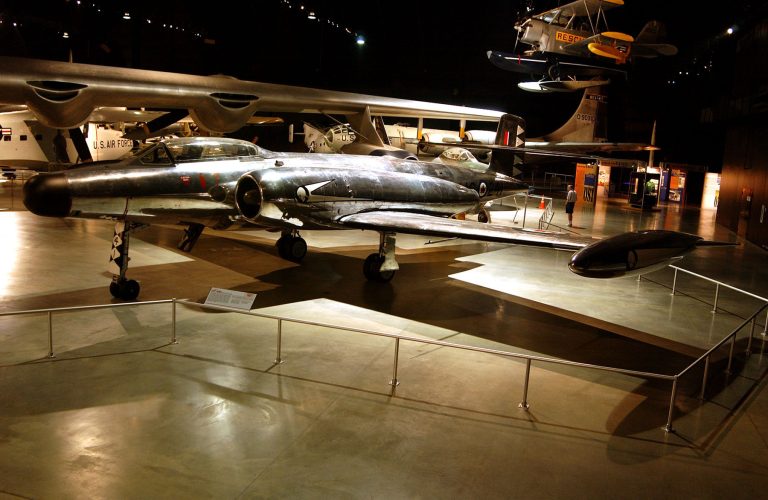
The Canuck in motion
A curated video feature for the Avro Canada CF-100 Canuck is coming soon. In the meantime, explore the photo gallery above and the operator map below.
Where the Canuck served
Where the record stands
The CF-100 never fired a shot in anger at an enemy aircraft — the Soviet bomber raids it was built to stop never came. Its record is instead one of constant alert across the roof of the continent, of a genuine engineering first, and of remarkable longevity. Its true achievement was deterrence: standing guard, ready, over Canada and NATO Europe for the most dangerous years of the Cold War, so that the intercepts it trained for were never needed.
Compare the combat record of every military aircraft. Figures as of July 2026.
Everything people ask about the CF-100 Canuck
Can I fly in a CF-100?
Why is the CF-100 called “the Clunk”?
Was the CF-100 really the first straight-wing jet to go supersonic?
How was the CF-100 armed?
Who operated the CF-100 Canuck?
What was the CF-100’s connection to the Avro Arrow?
You can’t fly the CF-100.
These, you can.
Some legends only live in museums — others are fuelled and waiting. MiGFlug has put civilians in real military jet cockpits since 2004.
 Fly the L-39 AlbatrosThe world’s most-flown jet trainer — aerobatics included
 Fly the F-104 Starfighter“The missile with a man in it”
 Fly the MiG-21The Cold War’s most-produced jet
 Fly the T-33 Shooting StarAmerica’s first jet trainer
 Fly the DH VampireA piece of early jet history
 Fly the S.211Agile Italian jet trainer
 Fly the MB-326The classic Aermacchi jet
 Fly the MiG-15The Soviet legend of the Korean War
Continue the tour
Every fact, checked
- Royal Canadian Air Force — CF-100 CanuckOfficial RCAF history: service dates, roles and the aircraft’s place in Canadian air defence.
- Ingenium — Canada Aviation and Space MuseumAirframe history, Mk 5 details and the type’s national significance.
- Air Vectors — Avro Canada CF-100 Canuck & CF-105 ArrowDeep engineering and variant history, and the Zurakowski supersonic dive.
- Skytamer — CF-100 Mk 5 CanuckMk 5 specifications, armament, production totals and Belgian service.
- GlobalSecurity.org — CF-100 CanuckProgramme background, dimensions, engines and operational history.
- Canadian Warplane Heritage Museum — CF-100 Mk 5Preserved-airframe notes, crew, roles and the “Clunk” nickname.
- flugzeuginfo.net — CF-100 Canuck Mk 5Cross-check of Mk 5 dimensions, weights, speed and ceiling.
- The Hangar Flight Museum — Avro CF-100 CanuckCanadian museum overview of the type’s design, service and legacy.