
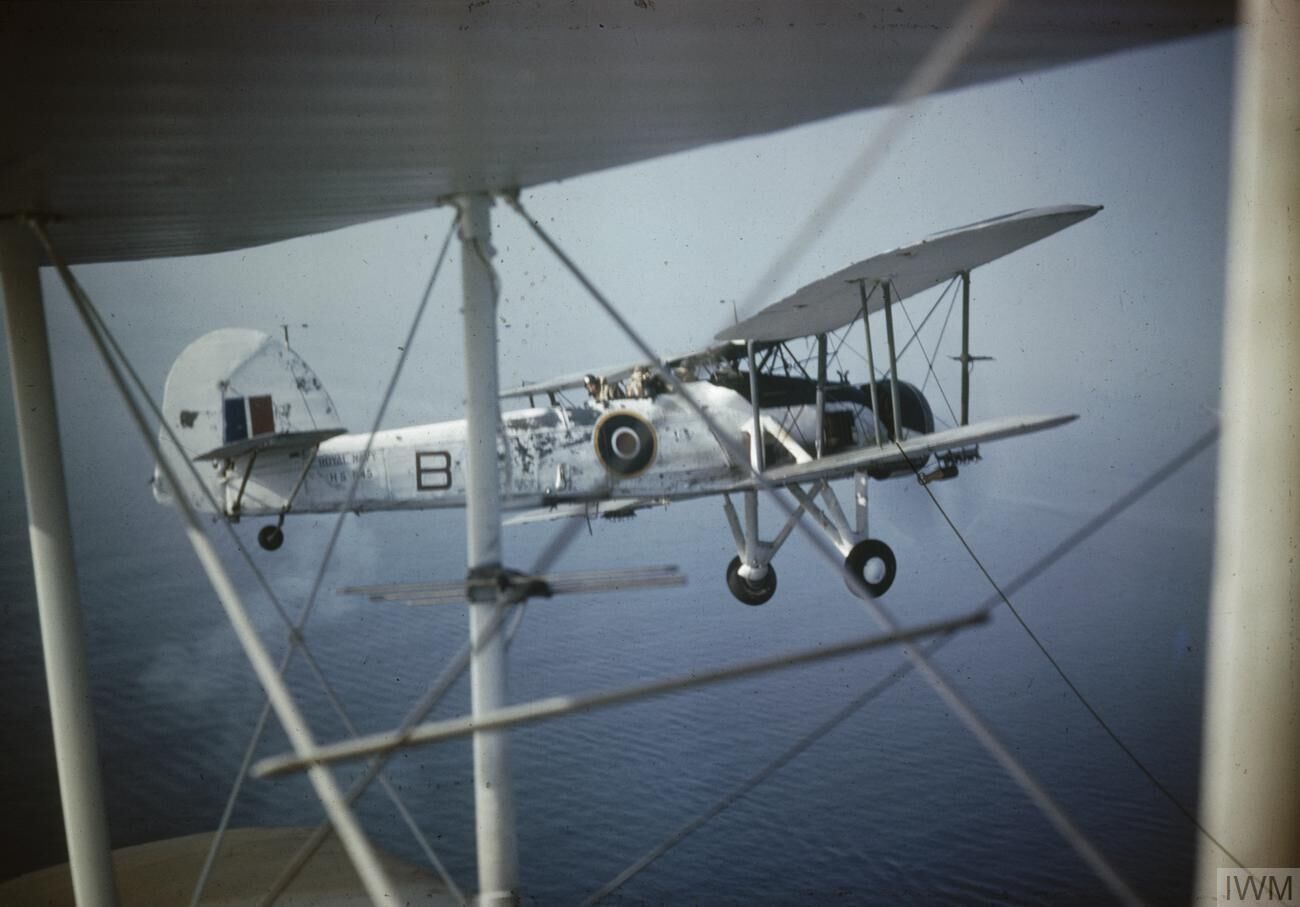
Fairey Swordfish
“Stringbag”
An obsolete-looking fabric-and-metal biplane that went to war in 1939 and became one of the most effective torpedo bombers of all — the aircraft that crippled the Italian fleet at Taranto and jammed the Bismarck’s rudder.
The obsolete biplane that refused to lose
By the time Britain went to war in 1939, the Fairey Swordfish already looked like a museum piece. It was an open-cockpit biplane of metal frame and fabric skin, with a fixed undercarriage and a top speed of barely 220 km/h — slower than some of the airliners of its day and a world away from the sleek monoplane fighters entering service. First flown in 1934 and in Fleet Air Arm service from 1936, it seemed destined for a quiet, brief career. Instead it became one of the most effective and enduring naval aircraft of the entire war.
The Swordfish was designed to a single demanding brief: a carrier aircraft that could deliver a torpedo, spot the fall of naval gunfire, and fly long over-water reconnaissance — the “TSR” role. Crews soon nicknamed it the “Stringbag,” not for its rigging but for the sheer variety of loads it could carry, like a household string shopping bag that always seemed to stretch to fit one more item: a torpedo, bombs, mines, depth charges, flares or rockets. Slow, docile and almost impossible to stall, it could be flung off a pitching deck in filthy North Atlantic weather that grounded faster aircraft.
That combination produced two of the most famous naval air actions in history. On the night of 11–12 November 1940, 21 Swordfish flying from HMS Illustrious attacked the Italian battle fleet in its harbour at Taranto, crippling three battleships at anchor for the loss of two aircraft — a night torpedo raid widely cited as a model the Japanese studied before planning the attack on Pearl Harbor. Six months later, in May 1941, a single torpedo dropped by a Swordfish from HMS Ark Royal jammed the rudder of the battleship Bismarck, leaving Germany’s most powerful warship steaming in circles until the Home Fleet caught and sank her.
For all its dash-and-glory moments, the Swordfish did its most important work in the long, grinding Battle of the Atlantic. Flying from tiny escort carriers with ASV radar, rockets and depth charges, it became a patient U-boat hunter and convoy guardian, where its slow, forgiving handling was an asset rather than a liability. Remarkably, it outlived the very aircraft built to replace it — the Fairey Albacore was retired first — and stayed in front-line service until 1945. Around 2,400 were built. The Stringbag had gone to war looking a decade out of date, and finished it as a legend.
01The Fairey Swordfish’s nickname: why the Fleet Air Arm called it the “Stringbag”
The name had nothing to do with the aircraft’s wire-braced biplane rigging, as is sometimes assumed. Crews called it the Stringbag after the string shopping bags of the era, which could be stuffed with an apparently endless and mismatched assortment of goods. The Swordfish was the same: on any given sortie it might carry a torpedo, or a bomb load, or depth charges, or naval mines, or flares for night spotting, or — later in the war — underwing rockets. Whatever the Admiralty needed carried out over the sea, the Stringbag seemed able to stretch to fit it. The nickname became a badge of affection for an aircraft its crews trusted absolutely.
What makes it special
A rugged, slow biplane built around its load
The Swordfish was fabric over a metal frame, with open cockpits and a fixed undercarriage — deliberately simple and immensely strong. Its low speed and gentle stall made it forgiving to fly and hard to break, and its airframe could be adapted to almost any weapon the Fleet Air Arm needed: a torpedo, bombs, mines, depth charges, flares or rockets. That versatility earned it the “Stringbag” name and kept it useful long after faster designs had come and gone.
A carrier — and escort-carrier — torpedo bomber
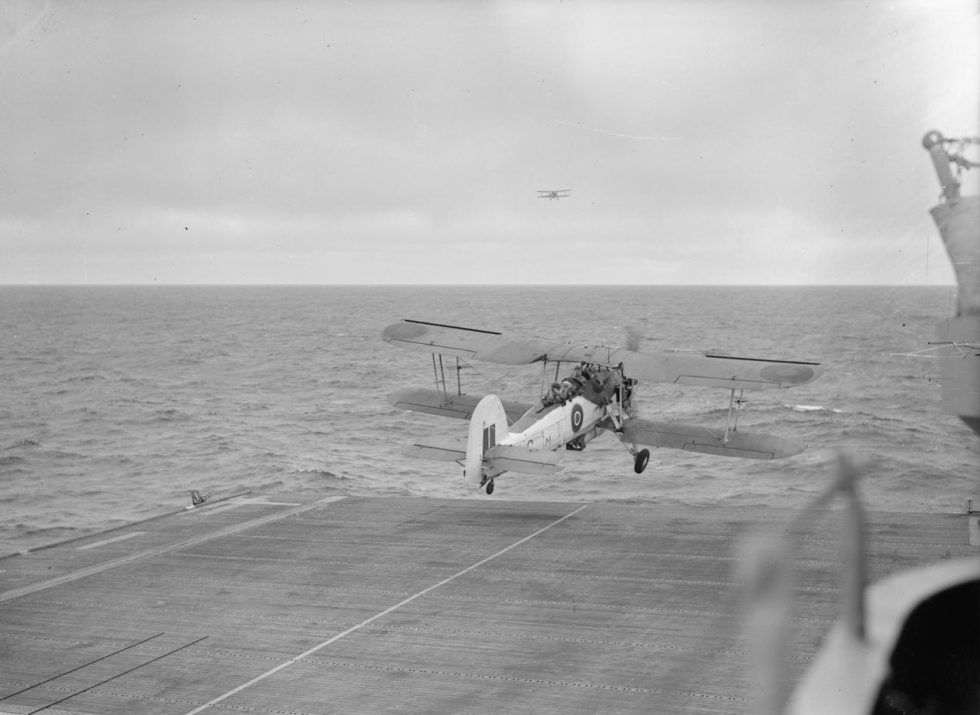
Built for the Royal Navy’s fleet carriers, the Swordfish turned out to be perfectly suited to the small, slow escort carriers that guarded Atlantic convoys. Its docile handling let it operate from short, pitching decks in weather that grounded higher-performance aircraft, launching and recovering in conditions that would have wrecked a monoplane. Slowness, on a carrier deck in a gale, was a virtue.
Longevity: it outlasted its own replacement
The Fairey Albacore was designed specifically to replace the Swordfish — and was withdrawn from service first. The Stringbag simply kept working, taking on ASV radar, rocket rails and depth charges for the anti-submarine war and serving to the very end in 1945. Few combat aircraft have ever outlived their intended successor so completely.
02The Fairey Swordfish’s Bristol Pegasus engine and open cockpit
Power came from a single Bristol Pegasus nine-cylinder radial of roughly 690 horsepower — modest even by the standards of the mid-1930s, and the reason the Swordfish cruised so slowly. The crew of two or three sat in open cockpits, exposed to the full brutality of North Atlantic and Arctic weather; long anti-submarine patrols in an open Swordfish, in winter, were an ordeal of cold and wind that pushed men to the limit of endurance. Yet the same simplicity made the aircraft dependable and easy to maintain aboard ship, far from workshops.
03The Fairey Swordfish as a submarine-hunter: radar, rockets and escort carriers
As the Battle of the Atlantic ground on, the Swordfish found its most important role. Fitted with early ASV (air-to-surface-vessel) radar, it could locate surfaced U-boats at night and in poor visibility, then attack with depth charges or, from 1943, batteries of underwing rocket projectiles. Flying from merchant-hull escort carriers and even catapult-equipped merchant ships, Swordfish crews are credited with sinking or sharing in the destruction of more than twenty U-boats and helping close the mid-Atlantic gap. Its slow, stable flight made it an ideal weapons platform for this patient, unglamorous work.
Full specifications
Baseline note: the figures below describe the Swordfish Mk II, the mark built in the largest numbers by Blackburn at Sherburn-in-Elmet, fitted with the 750 hp Pegasus XXX and the strengthened lower wing that took rocket rails — the aeroplane of the Atlantic convoy war rather than of Taranto. Deltas for the Mk I that flew Taranto and the Bismarck strikes, for the radar-carrying Mk III and the Canadian Mk IV, are given in grey. Two cautions apply to every published Swordfish table. First, most compilations tabulate the Mk I on the 690 hp Pegasus IIIM.3 and then silently attach late-mark equipment to it, so engine, ceiling and weight figures migrate between marks. Second, the Air Ministry quoted this aeroplane’s speed with a torpedo aboard, which is why the Swordfish looks even slower on paper than it was: the tabulated 143 mph is a loaded figure, not a clean one.
Dimensions & weights
- Crew
- 3 — pilot, observer and telegraphist air gunner, in three open cockpits in tandem (on long-range strikes such as Taranto the observer’s cockpit was filled by an overload fuel tank and the gunner was left on deck, so the aircraft flew as a two-seater with no rear gun at all)
- Length
- 10.87 m (35 ft 8 in). Some tables give 36 ft 1 in (11.00 m); the difference is the tailwheel and fairing standard, not a different aeroplane. The floatplane was longer again
- Wingspan
- 13.87 m (45 ft 6 in), upper and lower planes of equal span, the upper slightly swept back to move the centre of pressure aft after the T.S.R. I was lost in a flat spin
- Width, wings folded
- 5.26 m (17 ft 3 in) — folded manually by the deck party about a hinge just outboard of the centre section. This number is the reason the type outlived its replacements: a Swordfish fitted into lifts and hangars that a Barracuda did not
- Height
- 3.76 m (12 ft 4 in), tail down
- Wing area
- 56.4 m² (607 sq ft) across both planes — an enormous area for a 3.4 tonne aeroplane, and the single figure from which most of the type’s virtues and all of its vices follow
- Aspect ratio
- 3.41 for the cellule as a whole (span squared over combined area) — low even by biplane standards, which is why the Swordfish was draggy, slow and almost impossible to stall out of a turn
- Aerofoil
- RAF 28 — a thick, high-lift, entirely conventional section of 1920s pedigree, chosen for docile low-speed behaviour rather than for anything else
- Structure
- Steel-tube and light-alloy framework, fabric covered over wooden formers and stringers; interplane bracing by streamlined wires and struts — cheap to build, trivial to repair with dope and needle in a merchant ship’s hold, and remarkably tolerant of cannon fire, which passed through fabric without detonating
- Empty weight
- 1,903 kg (4,195 lb) as tabulated for a clean Mk I. A Mk II carrying ASV Mk II, its aerial array, rocket rails and full armour-free equipment weighed appreciably more, and published tables almost never separate the two
- Gross weight
- 3,438 kg (7,580 lb) with a torpedo — the weight at which every performance figure in the next column was measured
- Maximum overload weight
- about 4,200 kg (9,250 lb) is commonly quoted for late marks carrying radar, rockets and an overload tank; the figure is not well documented and should be treated as an order of magnitude
- Wing loading
- 61 kg/m² (12.5 lb/sq ft) at gross — roughly a third of a contemporary Fairey Barracuda’s and less than half a Hurricane’s. This one number explains the whole aeroplane: it could be flown off a 130 m merchant deck in a North Atlantic gale, turned inside anything sent to intercept it, and brought aboard at walking pace on a pitching flight deck at night
Performance
- Maximum speed
- 230 km/h (143 mph, 124 kn) at 1,525 m (5,000 ft) at 3,438 kg with a torpedo. The Mk II on the Pegasus XXX is usually credited with 222 km/h (138 mph) at sea level. Either way the Swordfish’s flat-out speed was below the economical cruise of the Bf 109F sent to kill it
- Cruise speed
- about 165 km/h (103 mph) for range. Anti-submarine patrols were flown slower still, near 130 km/h (81 mph), to stretch a sortie past four hours
- Stalling speed
- about 90 km/h (56 mph, 49 kn) at light weight, and the aeroplane gave copious warning before it happened. Deck approaches were flown at 100–110 km/h (55–60 kn), slow enough that a carrier steaming into a 30 kn wind closed on the aircraft at little more than a brisk run
- Rate of climb, sea level
- 4.4 m/s (870 ft/min) at gross weight
- Rate of climb at 1,525 m
- 3.5 m/s (690 ft/min) at 3,438 kg — the climb to the 1,500 m release height for a Taranto-style attack took the best part of ten minutes with a torpedo aboard
- Service ceiling
- 5,030 m (16,500 ft) at gross weight for the Mk I; 5,870 m (19,250 ft) is quoted for the lightly loaded Mk II, and some tables give as little as 3,780 m (12,400 ft) for a torpedo-armed aircraft. The spread is real and is a function of load, not of disagreement about the aeroplane
- Range with torpedo
- 840 km (522 miles, 454 nmi) on normal internal fuel — the number that governed how far a carrier had to steam towards its target
- Range, reconnaissance
- 1,658 km (1,030 miles, 895 nmi) with the overload tank in the observer’s cockpit and no torpedo
- Endurance
- 5 hours 30 minutes on internal fuel; MAC-ship and escort-carrier anti-submarine sorties routinely ran to four hours and more, flown in an open cockpit over the winter North Atlantic in an immersion suit
- Deck run
- the meaningful figure is not a still-air distance but the deck available: MAC-ship flight decks ran 126–140 m (413–460 ft), and a Swordfish left them on wind over the deck alone. Rocket-assisted take-off gear was developed for calm days and heavy loads. No aircraft that replaced the Swordfish could do this at all
- Power loading
- 6.15 kg/kW (10.1 lb/hp) at gross on the Pegasus XXX; 6.69 kg/kW (11.0 lb/hp) on the Mk I’s Pegasus IIIM.3
- Take-off and landing character
- Exceptional. Full-throttle unstick in a few aircraft lengths with a 25 kn wind over the deck, no tendency to swing, and an approach so slow and so well-mannered that Swordfish operated at night, in snow and from decks pitching through 15 m when nothing else in the fleet could be launched
Propulsion & systems
- Engine
- One Bristol Pegasus XXX nine-cylinder single-row air-cooled radial (Mk I: Pegasus IIIM.3; the prototype T.S.R. II flew behind a Pegasus IIIM.3 after the T.S.R. I’s 645 hp Pegasus IIM)
- Rated power
- 559 kW (750 hp) for the Pegasus XXX, fitted to aircraft built from the summer of 1941; 515 kW (690 hp) for the Pegasus IIIM.3 of the Mk I. The extra 60 hp went almost entirely into carrying radar and rockets, not into speed
- Engine detail
- 28.7 litres (1,753 cu in), four poppet valves per cylinder, single-speed supercharger, Townend ring cowl. The Pegasus was Bristol’s most successful sleeve-valve-free radial and also powered the Wellington, Hampden and Short Sunderland; parts and fitters were available in every naval air station and dockyard in the Empire
- Propeller
- Three-blade fixed-pitch metal. The Swordfish never received a constant-speed unit in service — a real performance penalty, and one nobody thought worth the money on an aeroplane already obsolete
- Fuel
- ~700 litres (155 imp gal) internal in the fuselage tank, plus an overload tank of ~273 litres (60 imp gal) fitted in the observer’s cockpit for long-range strikes and for the ferry flights that reinforced Malta
- Radar
- ASV Mk II from late 1941 on the Mk I and Mk II — metric radar with Yagi transmitting aerials on the interplane struts and receiving aerials along the fuselage, giving a ship contact at perhaps 40 km (25 miles). The Mk III carried centimetric ASV Mk XI in a large radome slung between the undercarriage legs, which detected a surfaced U-boat or a schnorkel head at comparable ranges but physically prevented carriage of a torpedo. The Swordfish was the first naval aircraft in the world to use airborne radar operationally
- Wing fold
- Manual, about a hinge outboard of the centre section, wings trailing back alongside the fuselage. No power fold, no hydraulics to fail, and a deck party could do it in a seaway
- Deck equipment
- Arrester hook, catapult spools, flotation bags in the upper wing and a stowed dinghy. Cleared for accelerator (catapult) launch from the outset, which is what made the type usable from escort carriers and small decks
- Alternative undercarriage
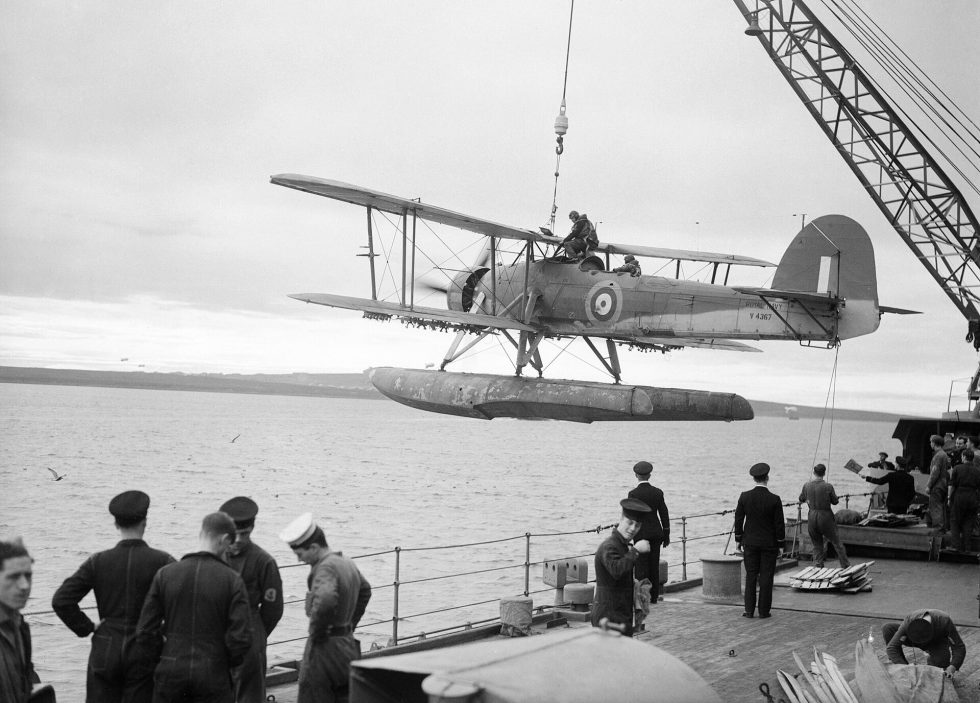
- Interchangeable twin-float gear for catapult operation from battleships and cruisers. A Warspite floatplane spotted and sank U-64 in Herjangsfjord on 13 April 1940 — the Fleet Air Arm’s first U-boat kill of the war
- Crew accommodation
- Three open cockpits, no heating, no de-icing and no blind-flying panel worth the name on early aircraft. Crews flew Atlantic winter patrols in Sidcot suits and long johns; frostbite was an occupational hazard. Only the Canadian Mk IV, built in 1944 for the RCAF, ever had an enclosed cabin
- Navigation and radio
- Bubble sextant, drift sight, chartboard and a competent observer — the Swordfish’s real navigation system, and the reason a strike from a heaving deck 300 km from land could find a harbour in the dark
04The Fairey Swordfish’s cost: why no reliable price exists
The Swordfish was a wartime state product, built for the Royal Navy under government contract rather than sold on any open market, so a clean flyaway unit price simply does not exist in the public record. Production was shared with Blackburn Aircraft (which built the majority of the roughly 2,400 airframes, giving rise to the affectionate variant nickname “Blackfish”), and costs were absorbed into the broader war economy. No credible cost-per-flight-hour figure exists for the type in open sources either. Any precise price attached to a Swordfish today should be read as an estimate, not a sourced figure.
Armament & payload
The Swordfish carried one torpedo and two rifle-calibre guns, and the torpedo is the only part of that sentence which mattered
As a torpedo aircraft the Swordfish was a delivery vehicle for a single 18-inch weapon slung between the undercarriage legs, aimed by pointing the whole aeroplane at the target and released at 90 knots from 50 to 150 feet. That profile was suicidal against an alerted warship in daylight and merely dangerous at night, which is why almost every successful Swordfish torpedo action was fought in darkness or against an enemy who was not looking. Its defensive armament — one fixed Vickers gun for the pilot and one Lewis or Vickers K on a Scarff-type ring for the gunner — was 1918 equipment fitted in 1936 and never seriously improved.
What transformed the type was not the torpedo but everything the airframe could be persuaded to carry once it stopped being a torpedo bomber. From 1943 the strengthened lower wing of the Mk II took eight three-inch rocket projectiles; the fuselage crutch took depth charges or a 1,500 lb magnetic mine; the observer’s cockpit took a fuel tank; the interplane struts took radar aerials. Crews called it the Stringbag not for its bracing wires but because, like a housewife’s string shopping bag, it would accommodate contents of any shape. That flexibility is the whole reason an aeroplane obsolete in 1936 was still killing U-boats in 1945.
The single most consequential fault in the Swordfish’s armoury was not in the aeroplane at all. The Duplex magnetic-influence pistol fitted to the Mark XII torpedo was supposed to detonate under a ship’s keel; on 26 May 1941 fifteen Ark Royal Swordfish attacked HMS Sheffield by mistake and most of their torpedoes exploded on hitting the water. The strike was re-armed with plain contact pistols — and it was that second, cruder load which jammed Bismarck’s rudder. Fits varied sharply by mark, theatre and date: Malta-based aircraft flew with the rear gun removed and a fuel tank in its place, Mk IIIs with ASV Mk XI could not carry a torpedo at all, MAC-ship aircraft often flew unarmed except for depth charges, and RCAF Mk IVs were training machines with no operational fit.
Gun
- One fixed 0.303 in (7.7 mm) Vickers Mk III machine gun in the upper starboard fuselage decking, firing through the propeller arc via Constantinesco hydraulic interrupter gear — the same synchronisation principle used on the Sopwith Camel eighteen years earlier
- One 0.303 in Lewis Mk III, later a Vickers K (Vickers Gas Operated), on a ring mounting in the rear cockpit, fed by 97-round drum or pan magazines
- Total defensive firepower was therefore two rifle-calibre guns against fighters carrying 20 mm cannon. Against a Bf 109 this was ornamental, and everyone involved knew it
- On overloaded sorties — Taranto, the Malta strikes, ferry flights — the gunner and his gun were frequently left behind to make room for petrol, so the aircraft went in with no rear defence whatsoever
- The one genuine advantage: a Swordfish at 90 knots presented so slow and so tight-turning a target that fast fighters overshot it repeatedly, and German pilots on 12 February 1942 complained of exactly that problem while shooting all six down anyway
Air-to-air
- No air-to-air guided weapon existed anywhere in 1934–1945; the Swordfish’s air-to-air capability was the gunner’s single Lewis or Vickers K, and it was negligible
- The type’s air-to-air record is essentially a record of being intercepted. It was never intended to survive contact with fighters and it did not
- Its accidental defence was aerodynamic rather than ballistic: a 90 knot target inside a 100 m turning circle sat below the tracking limits of fighters designed to shoot at 300 knot monoplanes, and cannon shells frequently passed clean through fabric-covered wings without fusing
- The same slowness defeated German and Italian anti-aircraft fuse settings. Off Bismarck on 26 May 1941, Swordfish flew so low that most of the battleship’s flak could not depress far enough to bear, and the ship was reduced to firing her main armament into the sea ahead of them to raise splashes
- None of this saved 825 Squadron in daylight against fifteen Bf 109s, which is the honest limit of the argument
Air-to-surface guided
- None. No guided air-to-surface weapon of any kind was ever carried operationally by a Swordfish, and none existed in Royal Navy service in time to be
- The nearest thing to guidance in the Swordfish’s armoury was the Duplex magnetic-influence pistol on the 18 in Mark XII torpedo, intended to fire under a target’s keel where no armour belt protected it
- It was unreliable in practice. On the first Ark Royal strike of 26 May 1941 a substantial part of the salvo detonated on striking the sea; the strike was recovered, re-armed with contact pistols, and sent again
- At Taranto the shallow harbour forced a different improvisation entirely: a drum under the aircraft nose paid out a wire to the torpedo’s nose to control its entry attitude, and Duplex pistols were used with running depths set for water only 12 m deep
- The genuine guidance breakthrough on this aeroplane was sensing, not weapons — ASV radar, which let a Swordfish find a target in cloud or darkness that it then attacked with entirely unguided ordnance
Bombs
- One 18 in torpedo — the Mark XII, about 760 kg (1,670 lb) all up with a warhead of roughly 176 kg (388 lb) TNT, released at about 90 knots from 50–150 ft. Published run settings differ between sources; figures between 27 and 40 knots and ranges from 1,500 to 3,500 yards are all quoted, depending on setting and mark
- Up to 680 kg (1,500 lb) of bombs under the fuselage and wings in place of the torpedo: typically six 113 kg (250 lb) GP or SAP bombs, or a pair of 227 kg (500 lb) weapons
- One 680 kg (1,500 lb) Mk I–IV magnetic or acoustic sea mine on the fuselage crutch. 812 Squadron under Coastal Command mined the Channel ports and Dutch estuaries through 1940–41, a role for which the type’s slow, steady, low-level release was ideal
- Four 113 kg (250 lb) Mk VII or Mk VIII depth charges for anti-submarine work — the standard MAC-ship and escort-carrier load from 1943, with Torpex fillings and shallow pistol settings for a boat caught on the surface or in the swirl of a crash dive
- Reconnaissance flares: at Taranto four of the twenty-one aircraft were flare-droppers, laying a line of parachute flares to the east of the anchorage so that the torpedo aircraft attacked from the dark against ships silhouetted against the light
Rockets
- Eight RP-3 three-inch rocket projectiles on rails under the strengthened lower wing of the Swordfish Mk II, introduced in 1943 and retrofitted widely thereafter
- Motor: a 3 in steel tube of cordite, 1.40 m long, about 17 kg without warhead, salvoed in pairs or ripple-fired at a shallow dive angle
- Two heads mattered. The 27 kg (60 lb) semi-armour-piercing head was the general-purpose weapon for shipping and shore targets; the 11 kg (25 lb) solid armour-piercing shot was the U-boat killer, because a near miss entering the water short of the target curved upwards and holed the pressure hull below the waterline — damage no depth charge dropped from a biplane could reliably reproduce
- First success: U-752, sunk on 23 May 1943 north-west of Ireland by a rocket-armed Swordfish of 819 Squadron flying from the escort carrier HMS Archer — the first submarine in history destroyed by air-launched rockets. Some references date this action 13 May; 23 May is the better-attested figure
- The penalty was drag. Early steel rails cost speed the Swordfish could not spare; aluminium Mk III rails from late 1944 recovered a little of it, and zero-length launchers arrived only in 1945, too late to matter
Pods & other stores
- ASV Mk II metric radar: Yagi transmitting arrays on the interplane struts and receiving dipoles along the fuselage sides, in service on Swordfish from October 1941. In December 1941 a Gibraltar-based Swordfish found and sank a U-boat at night by radar — the first such kill by any aircraft
- ASV Mk XI centimetric radar in a large radome between the undercarriage legs on the Mk III, able to pick up a surfaced boat or a schnorkel head at some 40 km (25 miles). It occupied the space the torpedo used, which is why the Mk III was purely an anti-submarine aeroplane
- Overload fuel tank in the observer’s cockpit, roughly 273 litres (60 imp gal), which turned a 5 hour 30 minute aeroplane into a Taranto-range one at the cost of the third crewman
- Rocket-assisted take-off gear for heavily loaded launches from MAC ships and escort carriers on days without enough wind over the deck; also flotation bags in the upper wing and a stowed dinghy for the more likely outcome
- Camera installations for photographic reconnaissance and bombardment spotting, smoke floats and sea markers for navigation and for marking a diving contact, and target-towing gear for the second-line squadrons that outlasted the operational ones
Three typical loadouts
- Operation Judgement, Taranto, night of 11–12 November 1940
- One 18 in Mark XII torpedo with Duplex pistol and a nose-wire attitude drum, overload tank in the observer’s cockpit, no rear gunner. Eleven of the twenty-one aircraft launched carried torpedoes; the remainder carried 113 kg bombs and parachute flares. Flown from HMS Illustrious at a range of about 320 km (170 nmi), in two waves, in the dark, with no blind-flying aids and no radar
- North Atlantic convoy patrol from a MAC ship, 1944
- Two or four 113 kg depth charges on the fuselage crutch, ASV Mk II radar, overload fuel, two crew in immersion suits. Four hours over a convoy in winter weather, launched from a 130 m grain-ship deck that also held 8,000 tons of wheat. The aircraft’s job was not to sink anything but to be visible, and it worked
- Anti-submarine strike from an escort carrier, 1943–45
- Eight RP-3 rockets with 11 kg solid armour-piercing heads on the strengthened lower wing, ASV Mk II or Mk XI, one or two depth charges retained. Attack flown as a shallow dive from about 250 m with the rockets salvoed to fall just short of the hull, so that they curved up under the pressure hull. This is the load that killed U-752 and that made a 1934 biplane a genuinely modern anti-submarine weapon
Sourcing caveat: Swordfish weapon fits were improvised in the field to an unusual degree and squadron records are inconsistent. Torpedo performance figures in particular vary widely between references, and the totals for U-boats destroyed by Swordfish range from fourteen in the standard general accounts to over twenty in some squadron histories, depending on whether shared credits with surface escorts are counted.
Variants
Four service marks, two factories and a nickname earned in Yorkshire
The Swordfish changed remarkably little across eight years and nearly 2,400 airframes. There was no re-engining that mattered beyond 60 horsepower, no retractable undercarriage, no enclosed cockpit until a Canadian trainer at the very end, and no monoplane derivative. What changed instead was equipment: a stronger lower wing to take rockets, a radome where the torpedo used to hang, and a great deal of radar.
Production tells its own story. Fairey built 692 aircraft at Hayes before handing the line over entirely to Blackburn at Sherburn-in-Elmet in 1940 so that its own factories could concentrate on the Albacore, Barracuda and Firefly — the aeroplanes meant to replace the Swordfish. Blackburn then built 1,699, more than twice as many as the parent firm, and the aircraft acquired the affectionate insult Blackfish. Standard totals are 2,391 or 2,396 built, the discrepancy resting on how prototypes and rebuilds are counted; production ended on 18 August 1944.
- Fairey T.S.R. I (1933, 1 built)
- Private-venture prototype F1875, first flown 21 March 1933 by Chris Staniland from Great West Aerodrome — the field that is now Heathrow. Lost on 11 September 1933 when it would not recover from a flat spin; the pilot took to his parachute. Its origins lay partly in a Fairey proposal for the Greek Naval Air Service seeking a Fairey IIIF replacement
- Fairey T.S.R. II (1934, 1 built)
- K4190, first flown 17 April 1934, built to Specification S.15/33. Lengthened rear fuselage, enlarged fin and slightly swept-back upper wings to cure the spin; float trials from 10 November 1934, catapult trials from HMS Repulse, service trials at Martlesham Heath
- Swordfish Mk I (1935–1943, ~1,500 including Blackburn’s 834)
- Pegasus IIIM.3 of 690 hp, fixed-pitch propeller, one torpedo or 1,500 lb of bombs or a mine. Entered service with 825 Naval Air Squadron in July 1936, replacing the Fairey Seal and the Blackburn Baffin. This is the Taranto, Matapan and Bismarck aeroplane; from late 1941 many carried ASV Mk II
- Swordfish Mk I floatplane (1936 onward, small numbers converted)
- Twin-float gear for catapult operation from battleships, battlecruisers and cruisers. A Warspite aircraft sank U-64 in Herjangsfjord on 13 April 1940, the Fleet Air Arm’s first U-boat; others spotted for the fleet’s guns at Narvik
- Swordfish Mk II (1943–1944, 545 by Blackburn)
- Metal-skinned, strengthened lower wing cleared for eight RP-3 rocket projectiles; Pegasus XXX of 750 hp standard on aircraft built from summer 1941; ASV Mk II. The Atlantic and Arctic convoy mark, and the one that killed submarines
- Swordfish Mk III (1943–1944, 320 by Blackburn)
- Centimetric ASV Mk XI in a radome between the undercarriage legs. Could not carry a torpedo. Flown by 119 Squadron RAF from Belgian airfields in the final months hunting German Biber and Seehund midget submarines off the Dutch coast at night
- Swordfish Mk IV (1944, small number)
- The last version, with an enclosed cabin, produced for Royal Canadian Air Force use in the Canadian winter. A training and second-line machine that never saw operations — and, by an accident of survival, the mark most heavily represented among preserved airframes today
- Blackburn-built aircraft, the Blackfish (1940–1944, 1,699)
- Not a distinct mark but the majority of all Swordfish. Built at Sherburn-in-Elmet in Yorkshire after Fairey’s capacity went to newer types; 834 Mk I, 545 Mk II and 320 Mk III. Both surviving airworthy aircraft are Blackburn machines
- Foreign and second-line operation (1940–1946)
- No licence production abroad. 860 Naval Air Squadron was Royal Netherlands Navy manned and flew Swordfish from the Dutch MAC ships Gadila and Macoma; the Royal Canadian Navy and RCAF operated the type for training from 1944. Late-war and postwar British use was target-towing, radar calibration and communications until the last training squadron disbanded in mid-1946
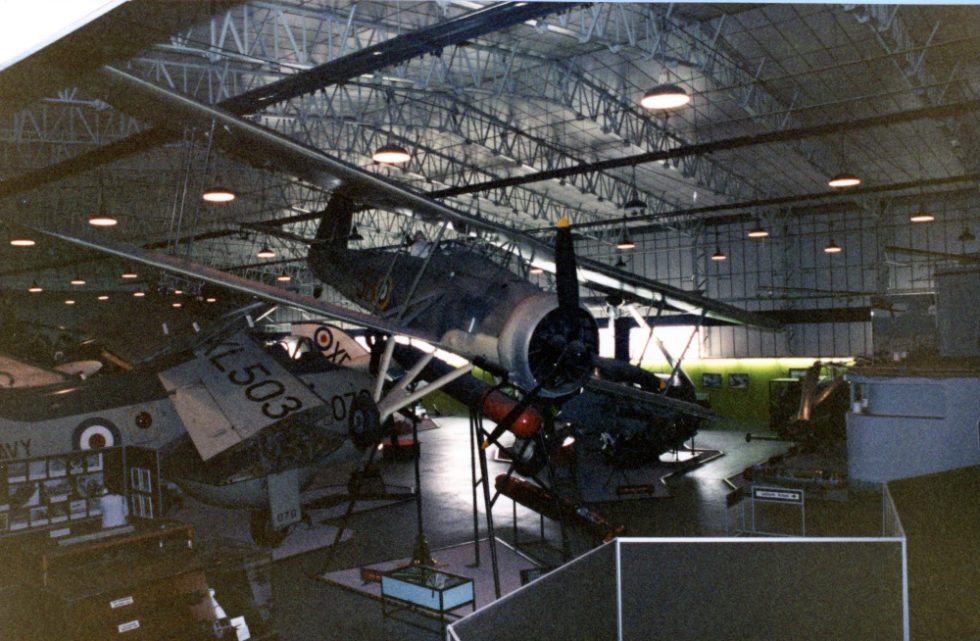
Survivors, precisely. Roughly a dozen Swordfish exist, and all of them are original wartime airframes — no flying reproduction of the type has ever been built, and a large proportion of the survivors come from a single source: the Ontario farm of Ernie Simmons, whose hoard of stored Canadian Mk IVs was auctioned in 1970 and seeded most of today’s collection. Two are airworthy and both belong to Navy Wings, the charity that took over the Royal Navy Historic Flight’s aircraft when the RNHF disbanded in March 2019 and the fleet moved to the civil register: Mk I W5856, a Blackburn aircraft first flown on Trafalgar Day 1941, restored to flight in 1993, grounded in 2003 with spar corrosion, given new wings by BAE Systems in 2012 and returned to display flying in 2015 in the colours of 820 Naval Air Squadron; and Mk II LS326, built 1943, an 836 Squadron MAC-ship veteran, presented to the Royal Navy by Westland in October 1960, flown in the film Sink the Bismarck!, rewinged at Brough between 1999 and 2008 and flying since. Displays by both are intermittent and season-dependent, and it is unusual for both to be on the circuit at once. A third, Mk III HS554, was restored to flight in 2006 and is privately owned at White Waltham. NF370 at IWM Duxford was restored to airworthy standard but carries a non-functional Pegasus and is effectively a static exhibit; HS469 at the Shearwater Aviation Museum in Nova Scotia flew in 1994 and is now displayed. The remainder are museum aircraft: HS618 at the Fleet Air Arm Museum, HS503 at RAF Museum Cosford, NS122 at the Canada Aviation and Space Museum, HS498 in store at the Reynolds-Alberta Museum, HS164 with the Commemorative Air Force in Texas, and HS491 under restoration at the Malta Aviation Museum — the last of these on the island where Swordfish sank an average of 50,000 tons of Axis shipping a month for nine months.
From private venture to Atlantic workhorse
The TSR concept
Fairey develops a torpedo-spotter-reconnaissance biplane for the Fleet Air Arm, refining an earlier private-venture design.
First flight
The definitive TSR II prototype flies on 17 April 1934, establishing the Swordfish layout.
Enters service
The Swordfish joins the Fleet Air Arm as the Royal Navy’s standard carrier torpedo bomber.
The Taranto raid
On 11–12 November, 21 Swordfish from HMS Illustrious cripple three Italian battleships in harbour at night.
The Bismarck strike
In May a Swordfish torpedo from HMS Ark Royal jams the Bismarck’s rudder, sealing the battleship’s fate.
The Channel Dash
Six Swordfish attack German warships in the Channel and are all lost; their leader, Eugene Esmonde, is awarded a posthumous Victoria Cross.
The U-boat war
Flying from escort carriers with ASV radar, rockets and depth charges, the Swordfish becomes a key convoy-escort submarine hunter.
End of the line
The Swordfish serves to the end of the war, outliving its intended replacement. Around 2,400 were built.
From the Stringbag: twelve Swordfish stories
Three jobs in one biplane
The Swordfish was designed to carry a torpedo, spot naval gunfire and fly long reconnaissance — all in one airframe.
Read the full story
Why they called it the Stringbag
The name came from the string shopping bags of the day — endlessly stretchable to fit whatever you piled in.
Read the full story
The night 21 biplanes rewrote naval war
On 11–12 November 1940, Swordfish from HMS Illustrious crippled three Italian battleships at anchor.
Read the full story
The raid Japan studied
Taranto is widely cited as an inspiration for the Japanese planning of the 1941 attack on Pearl Harbor.
Read the full story
The torpedo that doomed a battleship
A single Swordfish hit jammed the Bismarck’s rudder, leaving her unable to steer for home.
Read the full story
Esmonde’s last flight
Six Swordfish attacked German battlecruisers in daylight and were annihilated; their leader won a posthumous VC.
Read the full story
Hunting U-boats from a merchant deck
Flying from tiny escort carriers, Swordfish became patient submarine hunters over the Atlantic convoys.
Read the full story
Slow enough to survive
The Swordfish’s very slowness could confuse anti-aircraft gun predictors built to track faster aircraft.
Read the full story
The plane that outlived its replacement
The Fairey Albacore was built to replace the Swordfish — and was retired first.
Read the full story
An open cockpit over the Atlantic
Long patrols in an open Swordfish, in winter, were an endurance test of cold, wind and spray.
Read the full story
Rockets and depth charges
Late-war Swordfish carried rocket projectiles and depth charges to hunt surfaced submarines.
Read the full story
Still flying today
A handful of Swordfish are kept airworthy in Britain, honouring the type at air shows.
Read the full story
The Swordfish in pictures
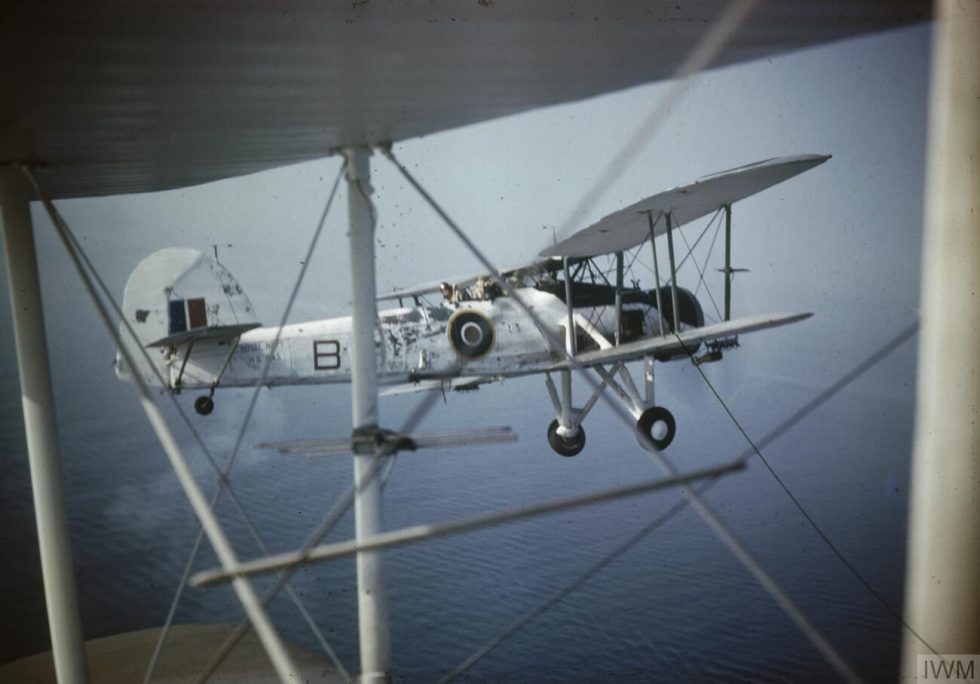
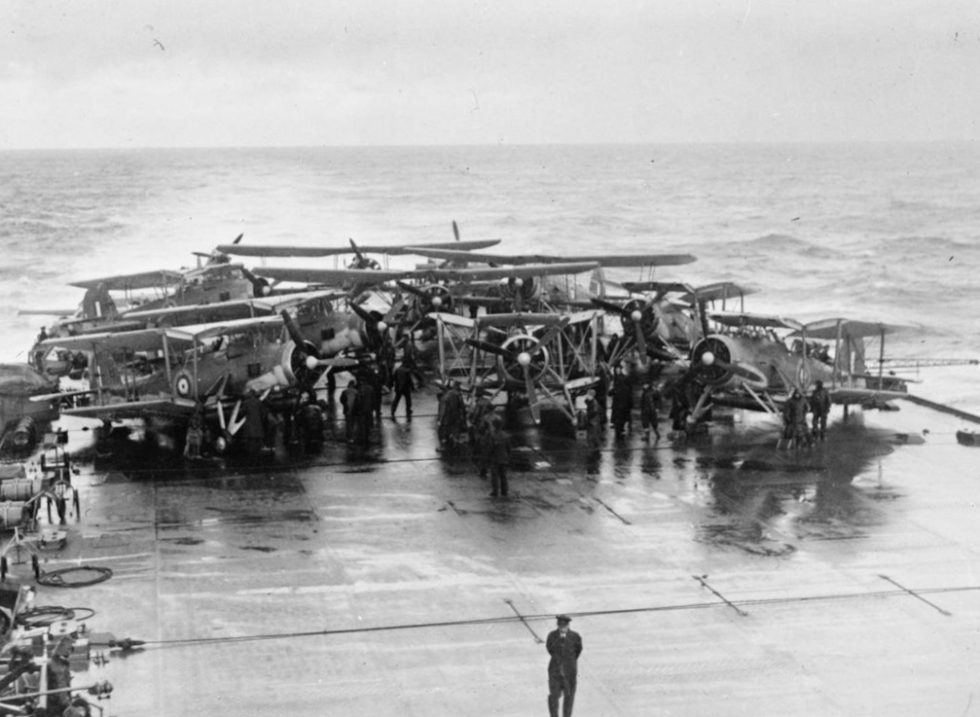
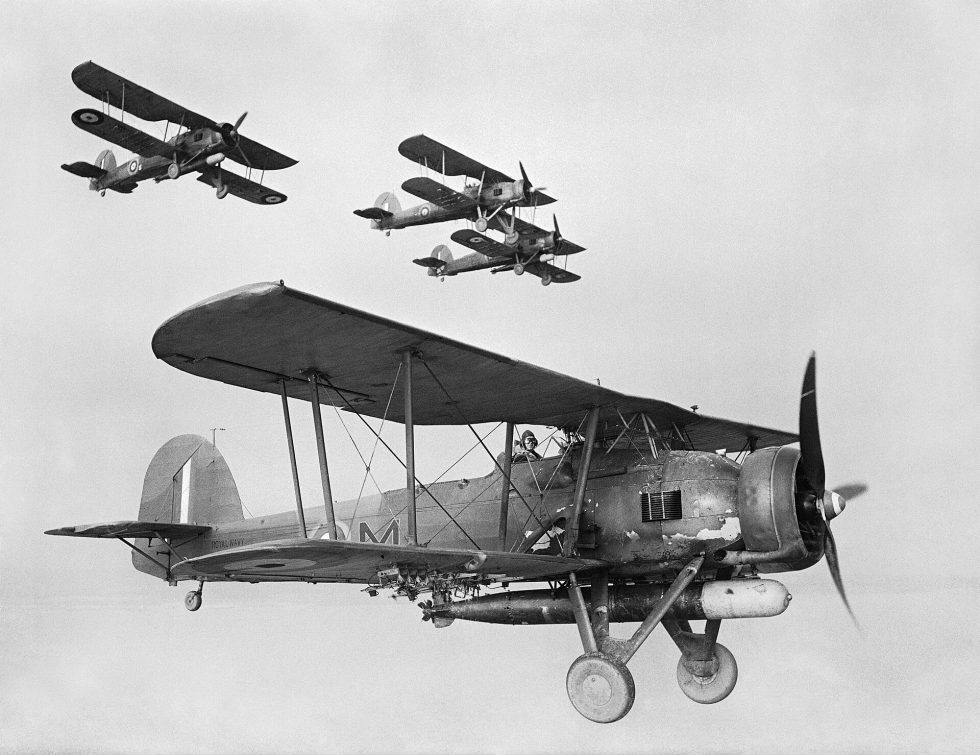
The Swordfish in motion
A verified archive film of the Fairey Swordfish is coming soon. In the meantime, the photo gallery above and the stories below capture the Stringbag at war and in preservation.
Where the Swordfish flew
The score that defines it
The Swordfish’s record is not written in air-to-air kills — it was never a fighter. It is measured in enemy warships crippled and submarines sunk. In a single night at Taranto it changed the balance of naval power in the Mediterranean; six months later it helped doom the Bismarck; and across the Atlantic it became one of the war’s most effective convoy guardians.
Compare the combat record of every military aircraft. Figures as of July 2026.
Everything people ask about the Fairey Swordfish
Can I fly in a Fairey Swordfish?
Why was the Swordfish called the “Stringbag”?
What did the Swordfish do at Taranto?
Did a Swordfish really cripple the Bismarck?
How slow was the Swordfish?
How many Swordfish were built?
Was the Swordfish obsolete?
Are any Swordfish still flying?
You can’t fly the Swordfish.
These, you can.
Some legends only live in museums — others are fuelled and waiting. MiGFlug has put civilians in real military jet cockpits since 2004.
 Fly the L-39 AlbatrosThe world’s most-flown jet trainer — aerobatics included
 Fly the F-104 Starfighter“The missile with a man in it”
 Fly the MiG-21The Cold War’s most-produced jet
 Fly the T-33 Shooting StarAmerica’s first jet trainer
 Fly the DH VampireA piece of early jet history
 Fly the S.211Agile Italian jet trainer
 Fly the MB-326The classic Aermacchi jet
 Fly the MiG-15The Soviet legend of the Korean War
Continue the tour
Every fact, checked
- Imperial War Museums — The Bismarck Action: The Swordfish AttackPrimary museum account of the 26 May 1941 torpedo strike on the Bismarck.
- The National WWII Museum — Strike on Taranto, November 1940The night raid on the Italian fleet and its influence on later naval planning.
- Navy Wings — Fairey Swordfish LS326The naval-aviation charity that keeps airworthy Swordfish flying today.
- HistoryNet — The glorious “Stringbag”Design origins, the nickname and the type’s wartime career.
- Warfare History Network — The Fairey Swordfish Torpedo BomberDetailed operational history of the Stringbag at war.
- War History Online — Fairey SwordfishThe outdated biplane that helped sink the Bismarck.
- Aviation History — Fairey SwordfishReference for specifications, variants and production.
- MiGFlug Afterburner — Taranto 1940MiGFlug’s own long-read on the Swordfish raid that rewrote naval warfare.