
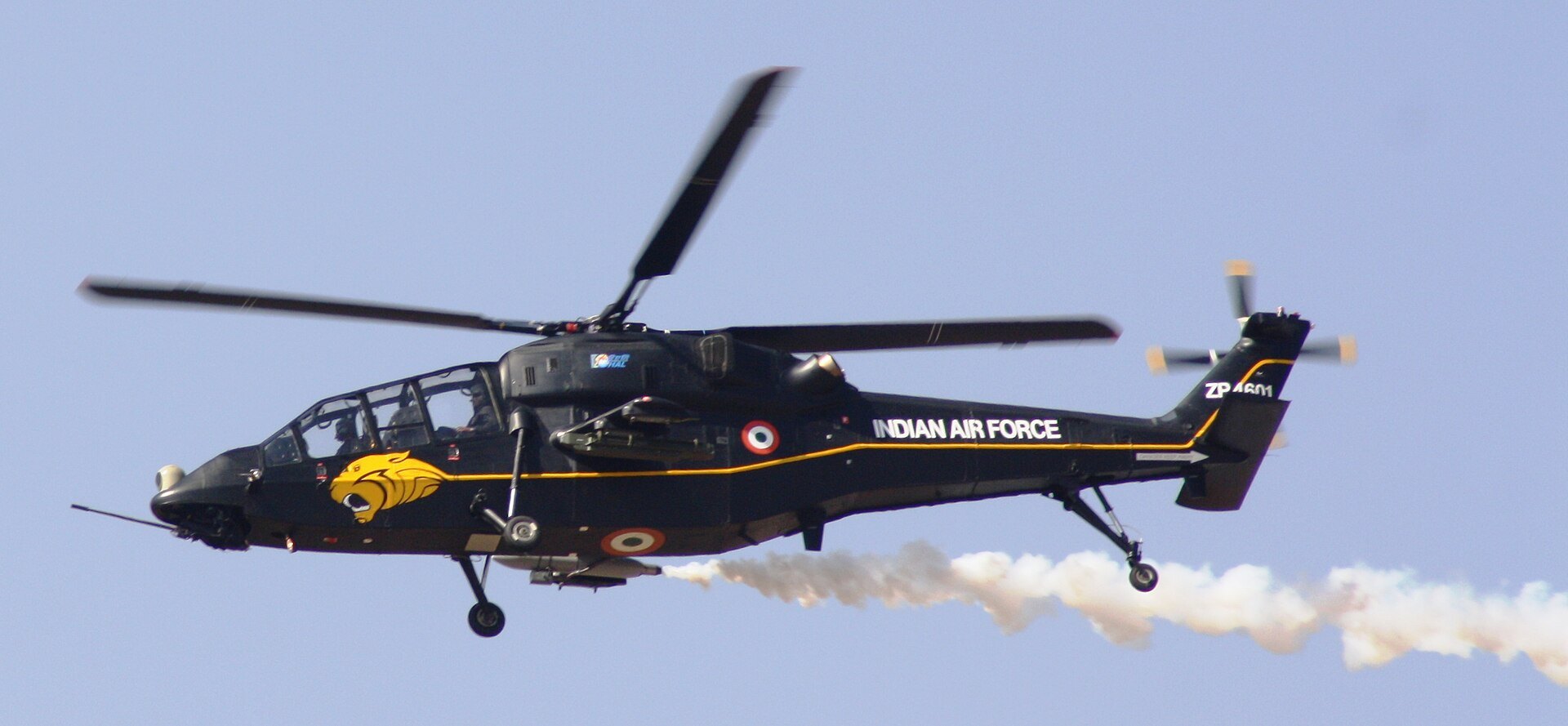
HAL Prachand
Light Combat Helicopter
Born from the lessons of Kargil, the Prachand is the attack helicopter built to fight at Himalayan altitudes, the first to land at Siachen, and now on order in 156 examples for India’s Army and Air Force.
The Prachand: how Kargil gave India a mountain attack helicopter
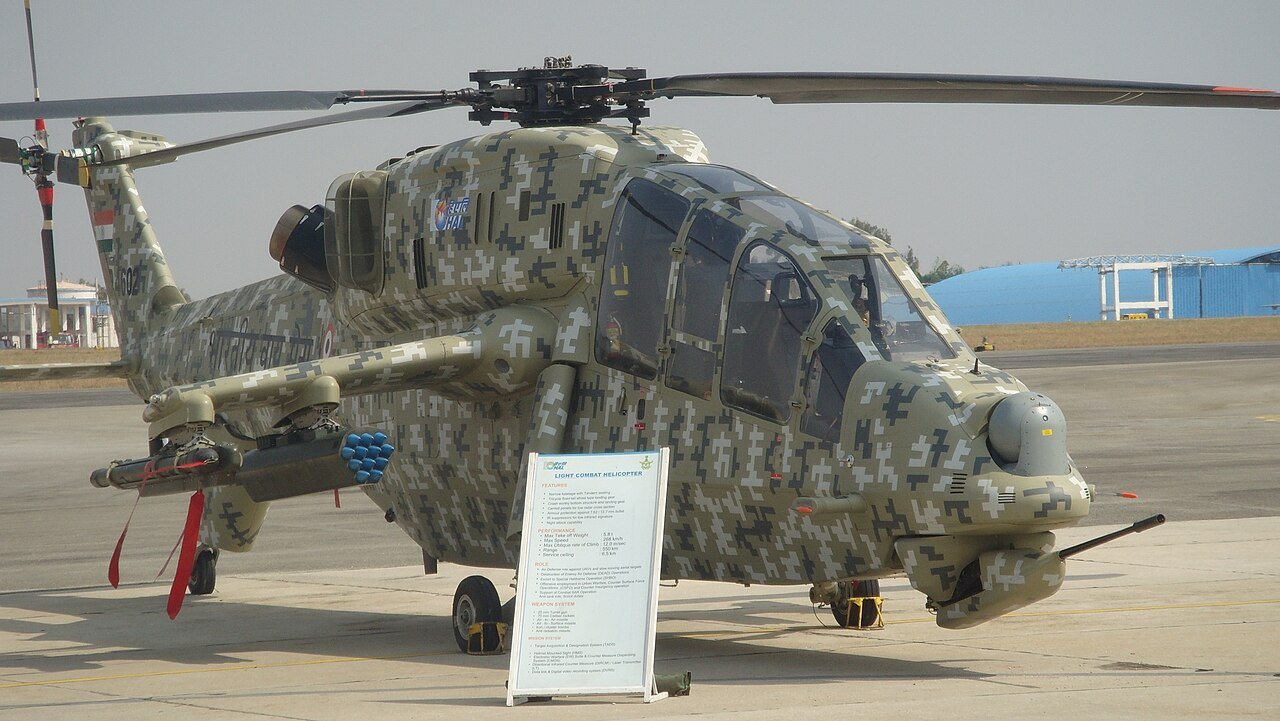
In the summer of 1999 India fought the Kargil war against Pakistani forces dug in on the heights of Ladakh. The fighting on peaks above 15,000 ft showed the Indian Air Force and Army that they needed a combat helicopter able to fight at the altitudes where the war had been decided. Hindustan Aeronautics answered with the Light Combat Helicopter, a narrow tandem two-seater built around the engines and dynamic system of its own Dhruv. The first technology demonstrator, TD-1, flew at Bengaluru on 29 March 2010. Three more followed by December 2015, testing armour, sensors and weapons, the 20 mm turret gun, 70 mm rockets and Mistral air-to-air missiles.
The decisive trials took place in the mountains. In 2015 the LCH became the first attack helicopter to land at Siachen, repeatedly operating from high-altitude helipads between about 13,600 and 15,800 ft. HAL declared initial operational clearance on 26 August 2017, and in 2020, as tension with China grew in Ladakh, two LCHs deployed to the Leh sector, landing and taking off from 15,000 ft helipads with combat loads. In March 2020 the government approved a limited series of 15, ten for the Air Force and five for the Army, for Rs 3,887 crore. The Army raised its first squadron, 351 Army Aviation Squadron, in Bengaluru on 1 June 2022 and inducted the type on 29 September 2022.
On 3 October 2022 at Jodhpur, Defence Minister Rajnath Singh flew in the helicopter and named it Prachand, meaning fierce, as the Air Force’s new No. 143 Helicopter Unit received its first aircraft. The ministry called it India’s first indigenous multi-role combat helicopter, able to operate above 5,000 metres. The full order came on 28 March 2025: two contracts worth Rs 62,700 crore for 156 more, 66 for the Air Force and 90 for the Army, with deliveries due to begin in the third year and continue over five. HAL planned over 65 percent indigenous content, with more than 250 Indian companies in the supply chain. It was the culmination of a 23-year effort.
01The Prachand in the mountains: Siachen and Ladakh
Altitude was the reason the Light Combat Helicopter existed, so it was in the mountains that it had to prove itself. During trials based at Leh in 2015 it became, in HAL’s words, the first attack helicopter to land at Siachen, operating repeatedly from helipads between about 13,600 ft and 15,800 ft. The aim was to show that it could reach the posts and passes of the Himalaya with useful fuel and weapons still aboard, something older Russian-built gunships in Indian service could not do.
The real-world test came in 2020. During the confrontation with China in eastern Ladakh, the Air Force sent two LCHs, still technically development aircraft, to the Leh sector. They landed and took off from 15,000 ft helipads with combat loads, and India’s Vice Chief of Air Staff flew simulated attack missions in one of them. Business Standard reported that the helicopter had shown it could operate at 20,000 ft, an altitude claim no other attack helicopter in service makes. ThePrint later reported that the Prachand can carry about 500 kg of weapons at high altitude, enough for its gun, rockets and air-to-air missiles.
What makes the Prachand special
A Dhruv reshaped for combat
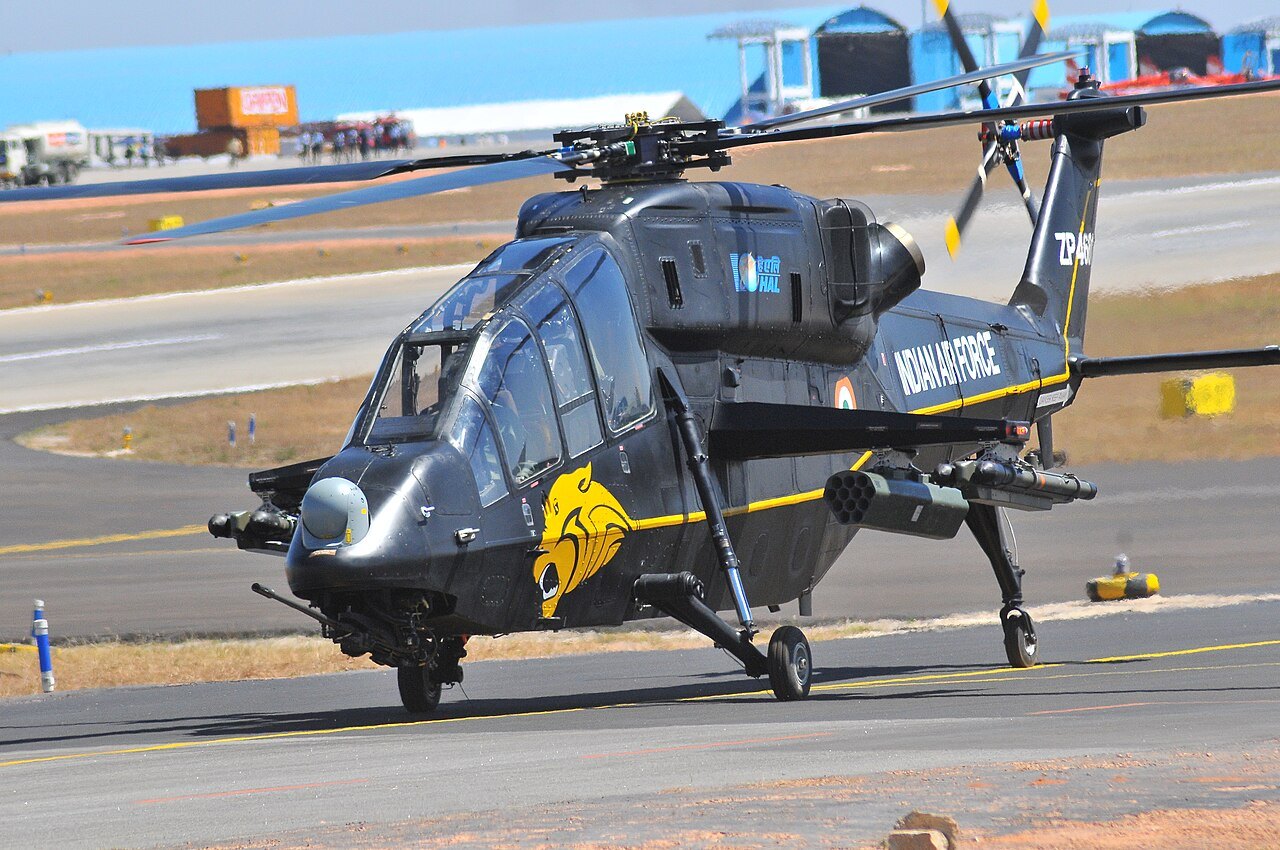
The Prachand shares its rotor system and twin Shakti engines with the Dhruv utility helicopter, but wraps them in a slim tandem fuselage, with the pilots seated one behind the other. That cut weight and frontal area and made the aircraft harder to see and hit. The result is a 5.8-tonne helicopter, much lighter than an Apache, whose power-to-weight ratio is what lets it hover and fight at altitudes where heavier gunships struggle. It is, in effect, a mountain specialist built from parts India already knew how to make and maintain.
Built to survive
HAL designed the Prachand to take hits. It has armour panels, self-sealing fuel tanks, a bulletproof windshield, damage-tolerant main rotor blades and crashworthy landing gear. Infrared suppression and a self-protection suite are intended to defeat heat-seeking missiles and other threats. HAL also claims stealth features in the shaping of the airframe, intended to reduce its radar and infrared signatures. The ministry described its armour protection as robust, and ThePrint listed the self-sealing tanks and bulletproof windshield among its key features.
Gun, rockets and missiles
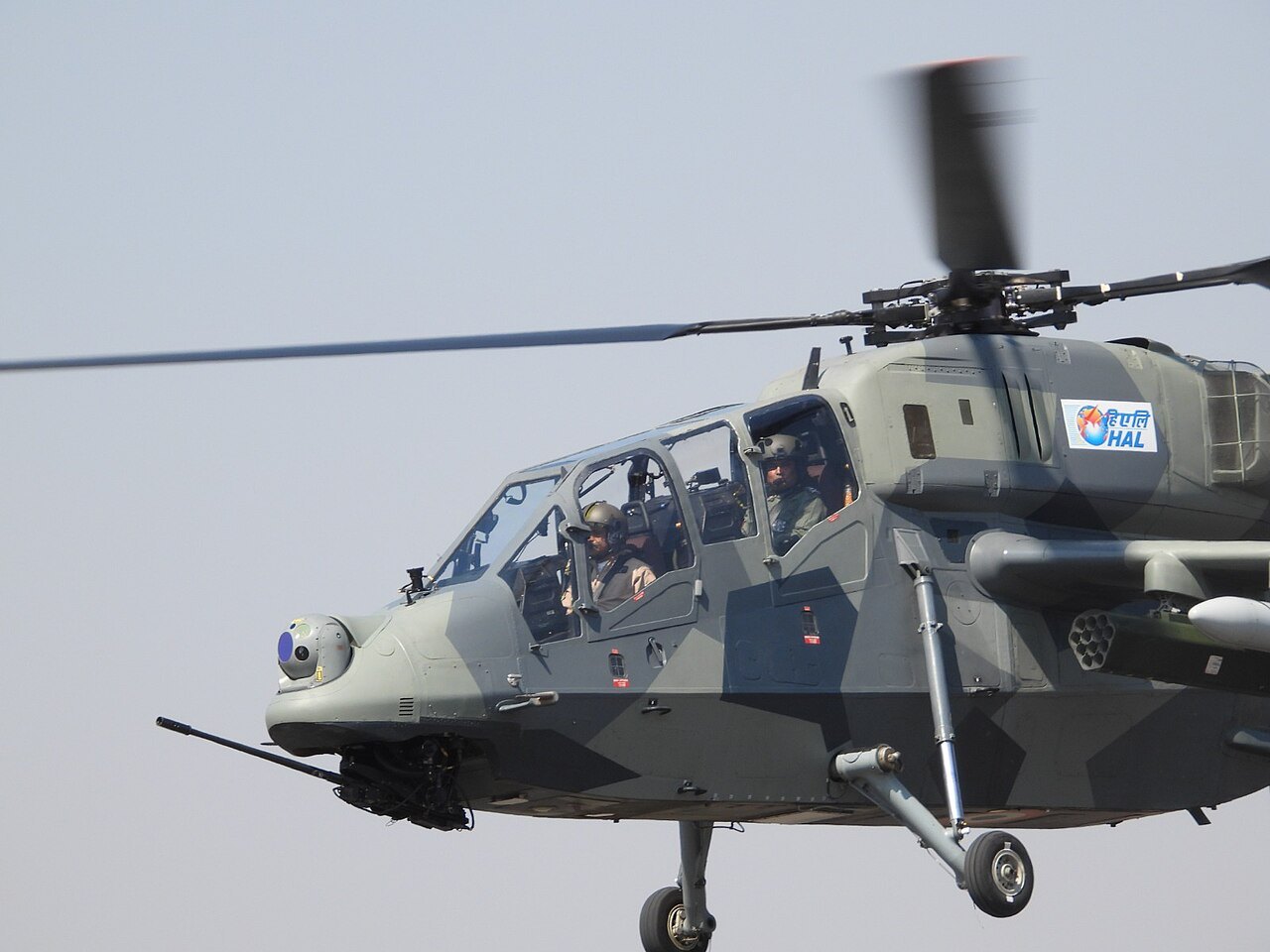
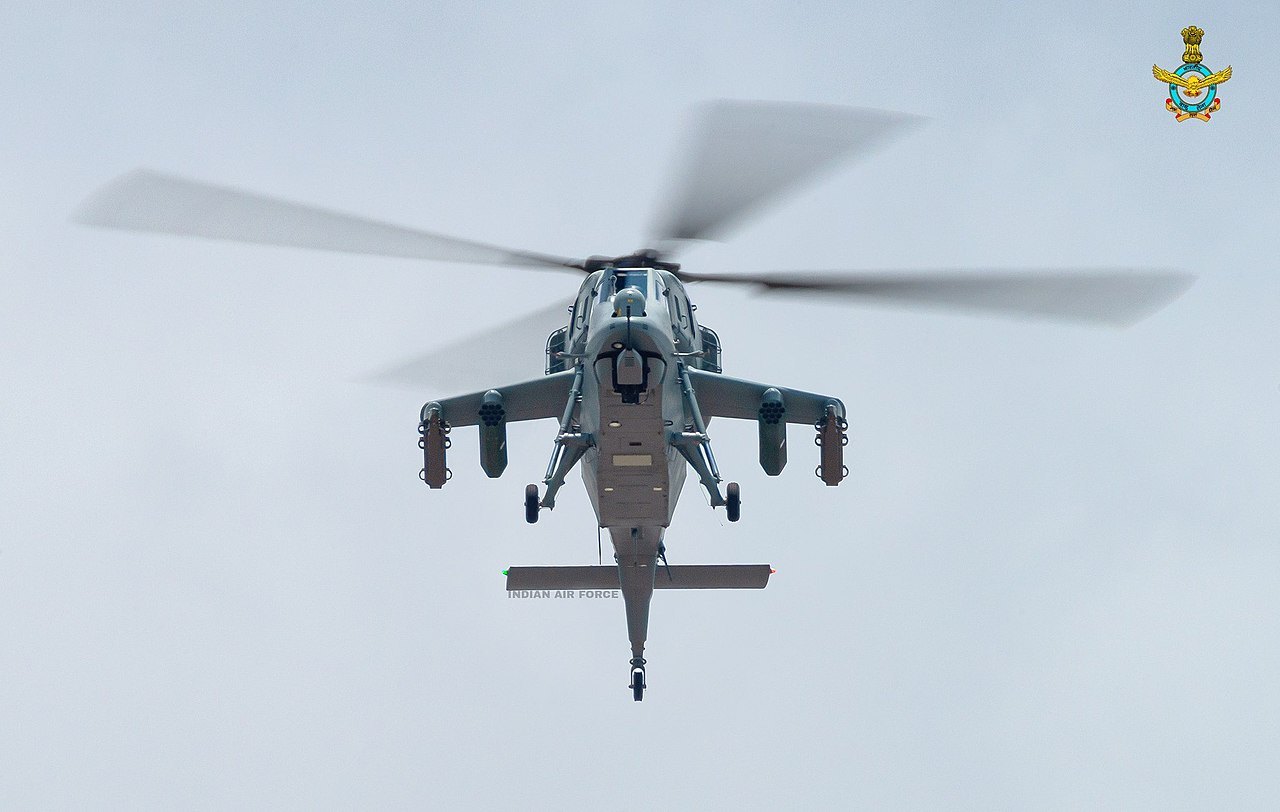
Under the nose is a 20 mm M621 cannon in a Nexter THL-20 turret, slaved to the crew’s helmet-mounted sights. Four hardpoints on the stub wings carry 70 mm rocket pods, Mistral-2 air-to-air missiles for use against other aircraft, bombs, and Indian anti-tank missiles. A sighting system with thermal imaging and a laser rangefinder allows attacks at night, and the glass cockpit is designed to keep two crew working together in tight mountain valleys, often in poor weather and low light.
02The Prachand’s development: four demonstrators and a long road
The first technology demonstrator, TD-1, flew for 20 minutes at Bengaluru on 29 March 2010. TD-2 followed on 28 June 2011, TD-3 on 12 November 2014 and TD-4 on 1 December 2015, each refining weight, systems and weapons. Hot-weather trials in the desert and cold-weather trials in the mountains followed, along with firing trials of the gun, rockets and Mistral missiles.
HAL announced initial operational clearance in August 2017, when it said the helicopter met the services’ requirements. In November 2016 the Ministry of Defence had cleared a limited-series order, and in March 2020 the Cabinet Committee on Security approved 15 for Rs 3,887 crore, ten for the Air Force and five for the Army. The type was finally inducted in 2022, about 23 years after the requirement was first identified. The 2025 contract for 156 more makes the Prachand one of India’s largest helicopter programmes, with deliveries spread over five years.
HAL Prachand specifications
Specifications
- Crew
- 2 (tandem)
- Length
- 15.8 m (51 ft 10 in)
- Main rotor diameter
- 13.2 m (43 ft 4 in)
- Height
- 4.70 m (15 ft 5 in)
- Stub wing span
- 4.60 m (15 ft 1 in)
- Empty weight
- 2,250 kg (4,960 lb)
- Max take-off weight
- 5,800 kg (12,790 lb)
- Powerplant
- 2 × HAL/Safran Shakti-1H1 turboshafts, 1,032 kW (1,384 shp) each
- Maximum speed
- 280 km/h (174 mph)
- Never-exceed speed
- 330 km/h (205 mph)
- Range
- 700 km (435 mi)
- Service ceiling
- 6,500 m (21,300 ft)
- Climb rate
- 12 m/s (2,360 ft/min)
- Armament
- 20 mm M621 cannon in THL-20 turret; 70 mm rockets; Mistral-2 air-to-air missiles; bombs; anti-tank guided missiles
Costs & production
- Unit cost
- About Rs 400 crore per helicopter implied by the 2025 contracts (Rs 62,700 crore for 156, excluding taxes); earlier press estimates put the flyaway price at US$18–20 million
- Cost per flight hour
- No official figure. Hedged estimate: a few thousand US dollars per hour, based on its Dhruv-derived Shakti engines and dynamic system and a 5.8-tonne airframe
- Production
- 15 limited-series aircraft (10 Air Force, 5 Army); 156 ordered in March 2025 (66 Air Force, 90 Army)
- Programme
- Requirement after Kargil 1999; first flight 29 March 2010; initial operational clearance August 2017; inducted September–October 2022
03The Prachand’s versions: demonstrators to series production
- TD-1 to TD-4: four technology demonstrators, first flown between 2010 and 2015.
- Limited series production: 15 aircraft, ten for the Indian Air Force’s No. 143 Helicopter Unit and five for the Army’s 351 Army Aviation Squadron, approved in 2020 and inducted from 2022.
- Series production: 156 aircraft ordered on 28 March 2025, 66 for the Air Force and 90 for the Army, with planned indigenous content above 65 percent.
The Prachand is closely related to the Dhruv and its armed Rudra version: all three use HAL’s Shakti engine and Dhruv-derived rotor and transmission components, which simplifies training and support in the Indian services. Deliveries of the 156 series aircraft are planned to begin in the third year after the 2025 contracts and to run over the following five years.
04The Prachand’s operating costs: the advantage of commonality
Neither HAL nor the Indian services publish a cost per flight hour, so the figure in the table is an estimate. The Prachand’s greatest economic advantage is that its engines and many dynamic components are shared with hundreds of Dhruvs and Rudras already in Indian service, so spares, engine overhaul and technician training are already in place at home.
Acquisition is a different matter. The 2025 contracts worked out at roughly Rs 400 crore per helicopter, a figure that includes more than the airframe alone. Press estimates in 2017 put the price at US$18–20 million each, about 70 percent of the cost of a late-model Apache. The government also stressed the industrial return: more than 250 Indian companies, mostly small and medium firms, and more than 8,500 direct and indirect jobs.
The Prachand from Kargil to series production
Kargil
The war in the Ladakh heights shows India needs a combat helicopter for high altitude.
First flight
Technology demonstrator TD-1 flies at Bengaluru on 29 March.
Siachen landings
The LCH becomes the first attack helicopter to land at Siachen; TD-4 flies on 1 December.
Operational clearance
Initial operational clearance is declared on 26 August.
Ladakh deployment
Two LCHs deploy to Leh during the standoff with China; 15 limited-series aircraft are approved.
Army squadron
351 Army Aviation Squadron is raised on 1 June; the Army inducts the type on 29 September.
Named Prachand
On 3 October the Air Force inducts it at Jodhpur and the Defence Minister names it.
156 ordered
On 28 March contracts worth Rs 62,700 crore are signed for 66 Air Force and 90 Army helicopters.
Stories & eyewitnesses: the Prachand from Kargil to Ladakh
The lesson of Kargil
A mountain war revealed a gap in India’s armoury.
Read the full story
First to land at Siachen
In 2015 the LCH landed where no attack helicopter had before.
Read the full story
Ladakh, 2020
Two development aircraft went to the front line.
Read the full story
A minister in the front seat
Rajnath Singh flew in the helicopter before naming it.
Read the full story
143 Helicopter Unit
The Air Force raised a new unit at Jodhpur for the Prachand.
Read the full story
The Army’s first attack squadron
351 Army Aviation Squadron was raised for the Prachand in 2022.
Read the full story
156 helicopters and 250 companies
The 2025 order was one of India’s largest helicopter contracts.
Read the full story
The shared engine
The Shakti links the Prachand to the Dhruv.
Read the full story
The Prachand in pictures
Where the Prachand flies and flew
The Prachand’s record
The Prachand has not yet fought, but it was deployed to the Ladakh frontier during the 2020 standoff with China while still a development aircraft. Its record so far is one of altitude trials, induction and a large production order.
See how training and combat types compare in the military aircraft statistics database. Figures are approximate.
Everything people ask about the Prachand
Can I fly in a HAL Prachand?
What does Prachand mean?
Why was the Prachand developed?
How many Prachands has India ordered?
Is the Prachand related to the Dhruv?
What weapons does the Prachand carry?
You can’t fly the Prachand.
These, you can.
Most of this museum you can only look at. These genuine military jets you can fly yourself with MiGFlug — with aerobatics and time on the controls.
 Fly the L-39 AlbatrosThe world’s most-flown jet trainer — aerobatics included
 Fly the F-104 Starfighter“The missile with a man in it”
 Fly the MiG-21The Cold War’s most-produced jet
 Fly the T-33 Shooting StarAmerica’s first jet trainer
 Fly the DH VampireA piece of early jet history
 Fly the S.211Agile Italian jet trainer
 Fly the MB-326The classic Aermacchi jet
 Fly the MiG-15The Soviet legend of the Korean War
Continue the tour
Every fact, checked
- Raksha Mantri inducts indigenously-developed Light Combat Helicopter into IAFPress Information Bureau, 3 October 2022: induction at Jodhpur, 143 Helicopter Unit, naming
- MoD inks two contracts worth Rs 62,700 crore with HAL for supply of 156 LCH PrachandPress Information Bureau, 28 March 2025: numbers, schedule and indigenous content
- IAF inducts indigenous light combat helicopters after a 23-year journey which began after KargilThePrint, October 2022: history, limited-series cost and features
- Light Combat Helicopter (LCH)HAL product page: design features and 2017 operational clearance
- Hindustan Aeronautics light combat chopper cutting its teeth in LadakhBusiness Standard, August 2020: Leh deployment
- India kicks off production of Light Combat HelicopterThe Diplomat, 2017: limited-series clearance and cost estimate
- IAF names HAL LCH helicopter as Prachand; Defence Minister Rajnath Singh takes a sortieZee News on the naming and the 2020 approval