
He 162 Volksjäger
Germany’s desperate wooden jet
A jet fighter of wood and desperation, designed in weeks and meant to be flown into battle by teenagers — the last, doomed idea of the Luftwaffe.
The He 162 Volksjäger: a jet built out of desperation
By late 1944 Germany was losing the air war and running out of everything — fuel, aluminium, trained pilots, time. Its answer was one of the strangest aircraft of the entire conflict: the Heinkel He 162 Volksjäger, or “People’s Fighter.” It was a small jet fighter made largely of wood, meant to be built in the thousands by unskilled labour and flown into battle by barely-trained Hitler Youth. It went from a paper requirement to its first flight in roughly ninety days.
That speed came at a terrible price. The design was selected on 25 September 1944; the prototype flew on 6 December. Four days later, in a demonstration before Nazi officials, the acidic wartime glue holding its wooden structure together failed, a wing came apart, and the aircraft broke up in the air, killing test pilot Gotthold Peter. The programme did not slow down.
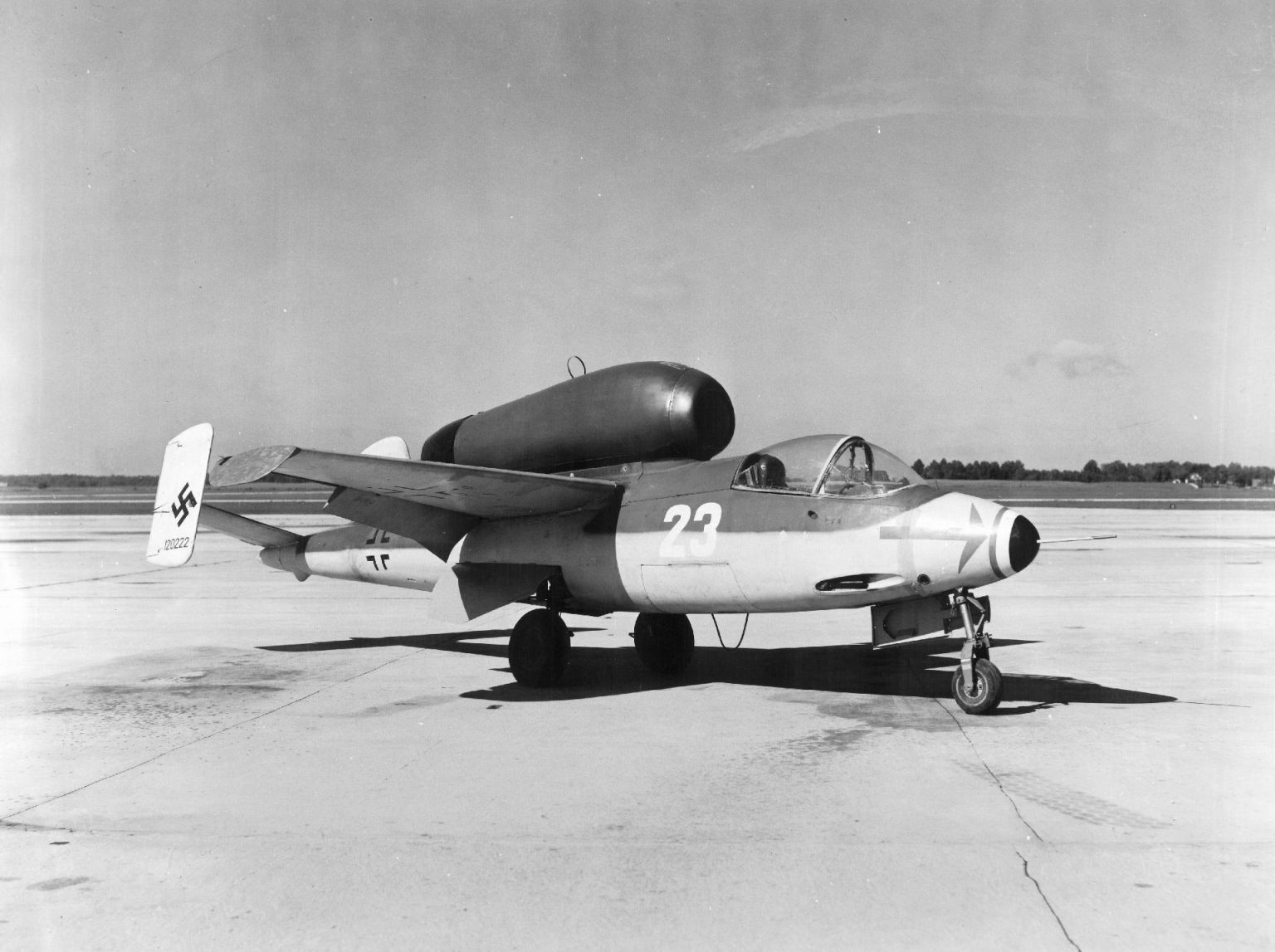
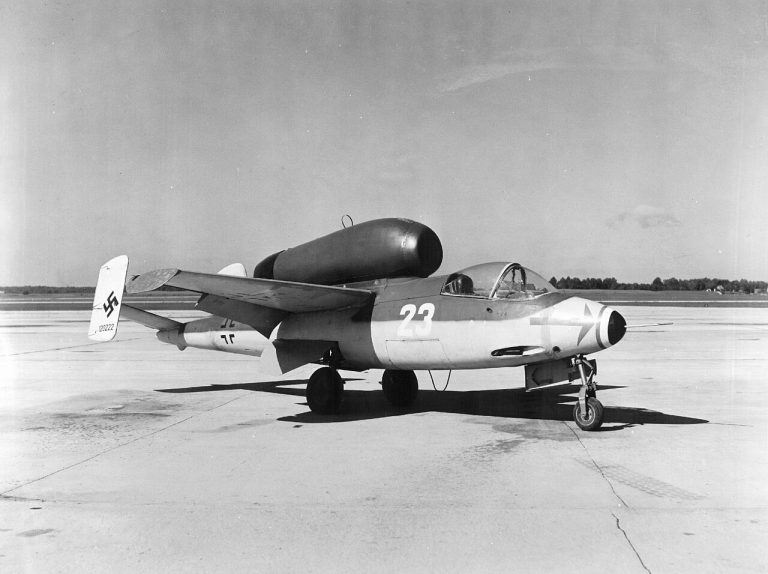
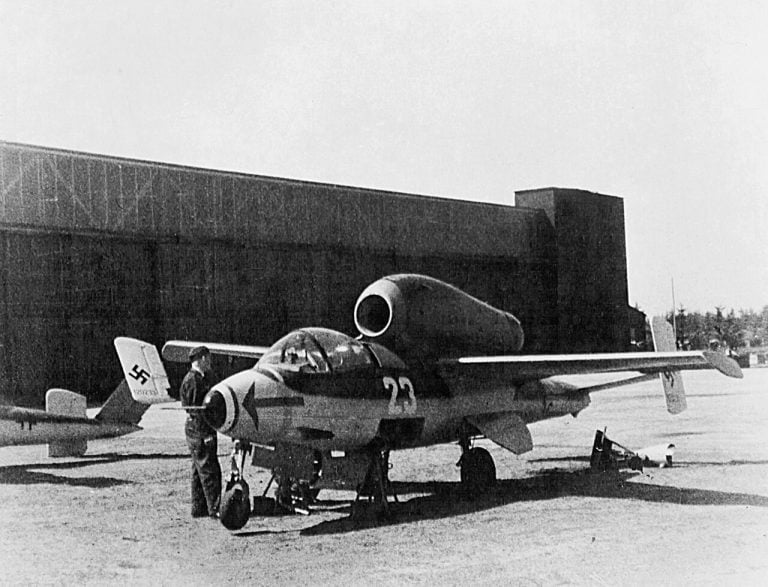
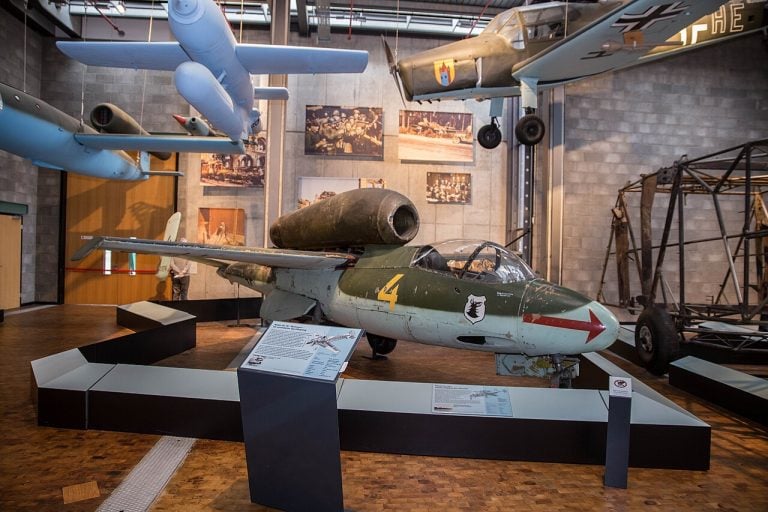
The He 162 was full of clever ideas rushed past the point of safety. Its single BMW 003 turbojet sat in a pod on top of the fuselage, behind the cockpit; it carried one of the first ejection seats fitted to a production fighter; and it was genuinely fast — over 500 mph, faster still with emergency boost. But it was unstable, unforgiving, and had barely thirty minutes of fuel. The plan to have teenagers fly it after a few glider lessons was, in the words of its own maker Ernst Heinkel, an “unrealistic notion” born of “unbalanced fanaticism.”
Only one unit, JG 1, ever took it into combat, in the last weeks of the war. On 19 April 1945 a He 162 pilot shot down an RAF fighter — and was himself killed the same day. In roughly three weeks of operations the unit lost thirteen aircraft and ten pilots; only two were shot down by the enemy. The rest fell to flameouts, structural failures and dead-stick landings after the fuel ran out.
Nearly a thousand He 162s stood on the assembly lines when Germany surrendered, many in underground factories, but only about 120 reached the squadrons and few ever flew. On 6 May 1945 the surviving JG 1 aircraft were handed over to the Allies at Leck, and examples went to Britain, America, France and the Soviet Union for study.
Flown after the war, the He 162 impressed the experts who could handle it — and terrified them at the thought of who was meant to. It was a flash of real engineering brilliance wrapped around an idea so desperate it could only have come from a country that had already lost.
01Why the He 162 Volksjäger was a symptom of defeat
The Volksjäger was never really a weapon; it was a confession. By the autumn of 1944 Germany could no longer out-fly the Allies, so it gambled on quantity: a jet so cheap and simple it could be churned out by the thousand in caves and flown by children. Every design choice — the wood, the single top-mounted engine, the minimal training — served that gamble, and every one of them made the aircraft more dangerous to its own pilots.
As engineering, the He 162 showed flashes of brilliance and even pointed toward the future with its ejection seat and light jet layout. As strategy, it was pure desperation — proof that no amount of clever design can rescue a cause that has already run out of fuel, time and men.
How the He 162 Volksjäger was built
Wood and glue
To save scarce metal and use unskilled labour, much of the He 162 was built from wood and plywood. It was a clever way to mass-produce a jet — until the special adhesive factory was bombed and the replacement glue turned acidic, dissolving the structure and killing the first test pilot.
The jet on its back
The single BMW 003 turbojet sat in a nacelle mounted on top of the fuselage, behind the cockpit — easy to build and service, and clear of debris on rough strips, but a source of aerodynamic trouble. The pilot sat ahead of it on one of the first ejection seats fitted to a production fighter.
Fast but feral
The He 162 was quick — over 800 km/h, more with boost — but it was also unstable, prone to Dutch roll and pitch problems that forced hasty fixes like drooped wingtips and nose ballast. With about thirty minutes of fuel and demanding handling, it was a handful even for experienced pilots.
02The He 162’s top-mounted engine and ejection seat
Perching the BMW 003 on top of the fuselage was a production engineer’s solution, not an aerodynamicist’s: it kept the engine away from the wooden structure, simplified installation and let the jet operate from rough surfaces without ingesting debris. The cost was a high thrust line and airflow interactions that added to the aircraft’s instability.
Ahead of the engine sat the pilot — on a compressed-air ejection seat, among the first fitted to a production fighter. It was used in anger at least four times in the He 162’s brief career, though several of those ejections still ended in the pilot’s death, at low altitude or when the canopy failed to clear.
03The He 162’s construction: wood, glue and the assembly caves
Germany’s aluminium was running short, so the He 162 was designed to be built largely of wood and other non-strategic materials by a workforce that included unskilled and forced labour, in dispersed and underground factories. The idea was to build a thousand a month.
It nearly worked, in volume terms — close to a thousand airframes were on the lines at the surrender. But the same haste that made mass production possible also produced the acidic-glue disaster that killed the first prototype’s pilot, and a stream of quality problems that dogged the type to the end.
Heinkel He 162 A-2 specifications
Baseline note: the figures below describe the He 162 A-2 as delivered to I./JG 1 in the spring of 1945 — the production standard, with a single BMW 003E turbojet on the spine and two 20 mm MG 151/20 cannon in the lower nose. Deltas for the MK 108-armed A-0 and A-1, for the Jumo-engined A-8 and for the projected B-series are given in grey. Two cautions apply to every number on this page. The He 162 flew for five months and never completed a proper acceptance programme, so much of the published performance rests on Heinkel’s own calculations and on the brief Allied test flying of 1945 rather than on service experience. And the RLM design calculations of 12 September 1944 — 8.00 m long, 10.00 m² of wing, 2,525 kg, 850 km/h, 22 minutes in the air — describe an aeroplane that was never built; what reached Leck was longer, heavier and no better endowed with fuel.
Dimensions & weights
- Crew
- 1
- Length
- 9.05 m (29 ft 8 in) — within 30 cm of a Bf 109, on barely three-quarters of its wingspan
- Wingspan
- 7.20 m (23 ft 7 in), including the drooped tips
- Height
- 2.60 m (8 ft 6 in)
- Wing area
- 11.16 m² (120.1 sq ft)
- Wing dihedral
- 3° on the main panels, cancelled outboard by anhedral aluminium tips — the "Lippisch-Ohren" or Lippisch ears, added from the M3 airframe because there was no time to redesign the wing itself
- Tailplane dihedral
- 14° on the horizontal surface slung below the jet efflux, between twin fins
- Wing attachment
- One-piece wooden wing on four bolts — quick to build and quick to fit, but the engine had to come off to reach the bolts
- Empty weight
- 1,660 kg (3,660 lb)
- Maximum take-off weight
- 2,800 kg (6,170 lb)
- Specification weight limit
- 2,000 kg (4,410 lb) — exceeded by 40 per cent once the wing had been strengthened and lead ballast added in the nose
- Wing loading
- 252 kg/m² (51.6 lb/sq ft) — high for 1945, and the reason the approach was fast
- Thrust-to-weight ratio
- 0.35 at normal thrust (0.41 on emergency boost)
- Undercarriage
- Retractable tricycle; the main oleos, wheels, brakes and retraction jacks were taken straight from the Messerschmitt Bf 109K — one of several shortcuts that bought the programme weeks
Performance
- Maximum speed, sea level
- 790 km/h (491 mph) at normal thrust
- Maximum speed at 6,000 m
- 840 km/h (522 mph, 19,700 ft)
- On emergency boost
- 890 km/h at sea level and 905 km/h at 6,000 m (553 and 562 mph) — a short burst only, and hard on an engine already living on borrowed time
- Rate of climb
- 23.4 m/s (4,610 ft/min) at sea level
- Service ceiling
- 12,000 m (39,400 ft); Flug Revue and several German accounts give 11,700 m (38,400 ft)
- Range
- 975 km (606 miles) at economical cruise and height — a paper figure that assumes a climb the pilot rarely had time for
- Endurance
- About 20 minutes at low level, half an hour at best — German sources quoting 45 to 60 minutes describe high-altitude cruise, not interception. The specification had asked for 30 minutes and got it only on paper.
- Landing speed
- 154 km/h (96 mph) by the design calculations; in service approaches were flown nearer 200 km/h (124 mph), which is why so many training sorties ended in a broken aeroplane
- Take-off run
- 570 m (1,870 ft) by calculation, against a specification ceiling of 500 m; the operational aeroplane, 800 kg heavier, needed appreciably more
- Combat radius
- ~50 km (31 miles) in practice — the He 162 was a point-defence fighter in the most literal sense, useful only if the bombers happened to cross its own aerodrome
- For comparison: Me 262 A-1a
- 870 km/h (541 mph) at 6,000 m, with roughly an hour and a half of fuel and four 30 mm cannon — the aircraft Adolf Galland wanted built instead
- For comparison: Hawker Tempest V
- 700 km/h (435 mph) — the type that shot down the first He 162 lost in combat, on 19 April 1945
Propulsion & systems
- Engine
- 1 × BMW 003E-1 or 003E-2 (RLM designation 109-003), axial-flow turbojet, mounted in a nacelle on the fuselage spine directly behind the cockpit
- Thrust
- 7.85 kN (1,760 lbf) at 9,500 rpm at sea level
- Why the BMW
- The specification named the 003 precisely because it was the engine nobody else wanted — the Me 262 and Ar 234 had first call on the Junkers Jumo 004, and the lower-rated BMW was the only turbojet with spare capacity
- Layout
- Seven-stage axial compressor, annular combustor, single-stage axial turbine
- Engine dry weight
- 624 kg (1,375 lb) — more than a third of the airframe’s empty weight sitting above and behind the centre of gravity
- Starting
- Riedel 10 hp flat-twin two-stroke auxiliary engine buried in the intake bullet, hand-cranked or electrically started, to spin the shaft up to light-off
- Engine life
- Nominally about 50 hours between overhauls; in service far less, and flameouts on rapid throttle movement killed more JG 1 pilots than the RAF did
- Fuel
- J2, the synthetic brown-coal-derived kerosene of the German jet programme
- Internal fuel
- 695 litres (153 imp gal, 184 US gal) in a single flexible bladder tank in the fuselage under the engine intake; some A-2s added two impregnated 180 litre wing tanks between the first four ribs, feeding the main tank and carrying no gauge of their own — the pilot learned they were empty when the main gauge began to fall
- Structure
- Light-alloy semi-monocoque fuselage with a moulded plywood nose cap; wooden one-piece wing, wooden tail surfaces. The often-repeated line that the He 162 was "made of wood" is a simplification: the wood was where the shortages were
- Adhesive
- Tego-Film phenolic resin glue film, from the Goldschmidt works at Wuppertal, was the intended bonding for the wooden structure. After the RAF destroyed that plant the substitute was a cold-setting acidic glue that attacked the wood it was meant to hold — the same failure that had already wrecked the Focke-Wulf Ta 154, and the failure that killed Gotthold Peter
- Escape
- Cartridge-fired ejection seat — the first fitted to a single-engine aircraft in operational service, and not a luxury: a pilot going over the side by hand would have gone into the intake or the fin
- Sighting and protection
- Revi 16B reflector sight; light armour plate at the pilot’s head and back only. No pressurisation, no gyro sight, no radar
04The He 162’s numbers: built in weeks, flown for days
The He 162 is a study in the gap between production and reality. Design to first flight took about ninety days; the plan was to build a thousand a month, and close to a thousand airframes were on the assembly lines by May 1945. Yet only around 120 were delivered to units, and only a fraction of those ever flew a mission before the war ended. It was, in effect, mass-produced and barely used.
05The survivors: where the Volksjäger endures
Because so many He 162s were captured intact at the surrender, the type survives unusually well for a late-war rarity. Complete examples are preserved at the Royal Air Force Museum and Imperial War Museum Duxford in Britain, the Smithsonian in the United States, the Canada Aviation and Space Museum, the Deutsches Technikmuseum in Berlin, Planes of Fame in California and the Musée de l’Air near Paris — scattered trophies of a fighter that never really got to fight.
Armament & payload
The He 162 carried two cannon and about ten seconds of ammunition, and nothing else at all
Two guns in the lower nose is the whole of the He 162’s offensive armament: no bomb rack, no rocket rail, no drop tank, no pod, no hardpoint of any kind on the aeroplane as built. The choice of gun was made twice. The pre-production A-0 and the A-1 carried the 30 mm MK 108, the standard German bomber-killer, which is what the type had been conceived to do; firing trials showed that the recoil of that battery was more than a nose structure designed in three weeks could absorb, and the production A-2 went to the 20 mm MG 151/20 instead. The lighter gun was kinder to the airframe and allowed 120 rounds per gun against fifty, but it turned a bomber destroyer into a fighter-versus-fighter aeroplane — which, given that JG 1 spent its brief career being hunted by Tempests and Mustangs rather than intercepting Fortresses, was arguably the more useful weapon anyway. The reinforced-nose A-3 that was supposed to restore the 30 mm battery was never built, so every 30 mm figure quoted here belongs to a handful of prototypes and pre-production machines rather than to a service standard.
Gun
- 2 × 20 mm MG 151/20 in the lower forward fuselage below the cockpit, 120 rounds per gun — the He 162 A-2, the only version built in quantity
- 2 × 30 mm MK 108, 50 rounds per gun — the A-0 and A-1; recoil deformed the light nose structure and the fit was abandoned
- MG 151/20: about 700 rounds per minute, roughly 700 m/s muzzle velocity, and the excellent thin-walled Minengeschoss high-explosive shell
- MK 108: 30 × 90RB at about 500 m/s, a howitzer of a gun — three hits would break a heavy bomber and almost none of them would land at any range or deflection worth the name
- Roughly ten seconds of firing on the A-2, and about five on the A-1. Ammunition boxes sat where the nosewheel bay allowed, which is why there was no room for more
Air-to-air
- Guns only. No guided air-to-air weapon existed in a form a 1945 single-seater could carry, and none was ever proposed for the A-series
- The R4M unguided air-to-air rocket, in use on Me 262s and Fw 190s by March 1945, was never fitted — the wooden wing had no rail, no wiring and no structural margin for it
- The combat record is thin and disputed. Fw. Günther Kirchner is credited on 19 April 1945 with an RAF fighter, the claim originally given to a flak unit and later supported by the British pilot under interrogation; Kirchner was shot down and killed the same day by a Tempest of the RAF over Husum
- German accounts instead date the first sortie to 26 April 1945 and credit Uffz. Rechenbach that day and Lt. Rudolf Schmitt on 4 May, both claims unconfirmed. Nothing about the He 162’s scoreboard is settled beyond "perhaps two"
- Against that: I./JG 1 lost 13 He 162s and 10 pilots. Only two were shot down. Ten were operational losses to flameouts and structural failure, and at least two pilots died attempting dead-stick landings after running the tank dry
Air-to-surface guided
- None, and none planned. The He 162 had no guided weapon capability of any sort
- The card is kept because the absence defines the aeroplane: with twenty minutes of fuel and no external stations, it could do exactly one job and had no secondary role at all
- The single composite-weapon scheme was Mistel 5, an He 162 A-2 riding an Arado E.377A flying bomb with two BMW 003s of its own, launched off a jettisonable trolley. The bomb never left the drawing board
- By contrast the Me 262 and the Ar 234 did carry guided and free-fall ordnance. The Volksjäger specification deliberately asked for none of it
Bombs
- None. No production He 162 was fitted with a bomb rack, and no drawing for one reached the shop floor
- There was nowhere to put one. The wing was a one-piece wooden structure bolted on at four points with no provision for local load, and the fuselage underside was occupied by the nosewheel bay and the gun installation
- The RLM specification of 8 September 1944 asked for a single-seat interceptor with cannon and nothing else — cheapness and speed of manufacture were the requirement, versatility was not
- The only ordnance ever associated with the type was the Arado flying bomb of the Mistel 5 paper project, which the fighter would have released rather than carried
Rockets
- No rocket weapon was carried operationally, and none was cleared. The Werfer-Granate 21 mortar tube and the R4M salvo rack both went to other types
- The one rocket that did reach an He 162 was propulsion, not armament: the He 162E, an A-series airframe with the BMW 003R mixed powerplant — a 003A turbojet with a BMW 109-718 liquid-fuel rocket mounted above its exhaust for boost. At least one prototype was flown briefly
- The projected He 162C would have carried twin 30 mm MK 108s angled upward behind the cockpit as Schräge Musik, to be fired while passing under a bomber. It existed only as drawings
- Every one of these schemes assumed an aeroplane with fuel to spare. The He 162 never had any
Pods & other stores
- None whatsoever. No He 162 ever flew with anything hung beneath it, including a drop tank — which, on a fighter with twenty minutes of endurance, is the single most consequential omission in its design
- Fuel was 695 litres in one fuselage bladder, with two ungauged 180 litre wing tanks on some A-2s; the pilot flown by Eric Brown at Farnborough had the wing tanks and no way of reading them
- The cartridge-fired ejection seat counts here as equipment rather than store, and was fitted because there was no other way out past a turbojet mounted where the pilot’s exit path would be
- It was used at least four times in combat by JG 1 pilots in April 1945. Kirchner ejected too low for his parachute on 19 April; Lt. Rudolf Schmidt got out on 20 April and Fw. Erwin Steeb on 21 April; Hptm. Paul-Heinrich Dähne was killed on 24 April when the canopy failed to jettison
- No pressurisation, no de-icing, no camera gun, no gyro gunsight. The aeroplane was built to be thrown away, and equipped accordingly
Three typical loadouts
- Point-defence scramble, Leck, late April 1945
- 695 litres internal, 240 rounds of 20 mm, nothing external. About twenty minutes airborne, of which the climb consumed a large share — the fighter had to meet its target within sight of its own aerodrome or not at all.
- Anti-bomber sortie as originally intended, A-1 standard
- Two MK 108s with 50 rounds each, roughly five seconds of fire, flown at 6,000 m against a Fortress or Lancaster stream. This is the mission the Volksjäger was specified for, and the mission the He 162 never once flew.
- Conversion flight, Marienehe or Parchim, March 1945
- Guns loaded but not armed, part fuel, a single circuit and landing. I./JG 1 converted from Fw 190As on aircraft collected from the factory airfield; there was no two-seat trainer, no simulator and no handling notes worth the name, so the first flight on type was also the first solo.
Sourcing caveat: armament, ammunition and equipment figures come from captured-equipment reports compiled by British and American teams in 1945 and from Heinkel drawings surrendered by the firm’s own engineers. Marks above the A-2 never existed in metal, so their armament is drawing-office intention rather than fact, and should be read that way.
Variants
Ten designations, four airframes that flew, and one production standard that reached a squadron
The Volksjäger specification went to industry on 8 September 1944 and demanded designs within ten days: a single-seat fighter on one BMW 003, under 2,000 kg, thirty minutes’ endurance, 500 m of runway, cheap enough to abandon, and quantity production to begin on 1 January 1945. Adolf Galland and most of the fighter arm opposed the whole idea and wanted the effort put into Me 262 production; Göring, Speer and Karl-Otto Saur’s armaments staff overrode them. Heinkel had a head start in its P 1073 studies and won in a competition many thought decided in advance, beating among others the Blohm & Voss P 211, which several engineers judged the better aeroplane. Willy Messerschmitt did not bother to enter. To confuse Allied intelligence the RLM reissued the airframe number 8-162, previously a Messerschmitt bomber project; Heinkel had asked for He 500. Salamander was the code name of the wing-construction programme and Spatz, sparrow, was Heinkel’s own name for the aircraft — calling the machine itself "Salamander" is an old error worth not repeating.
The famous part of the story is the part that never happened. The plan was that Hitler Youth glider pupils would step from clipped-wing DFS Habicht sailplanes into a jet fighter after a handful of hours, and Ernst Heinkel wrote after the war that the notion "displayed the unbalanced fanaticism of those days". What actually happened is that the aircraft turned out to demand a good pilot: pitch sensitivity, a fast approach and an engine that would flame out if the throttle were moved briskly. The one Hitler Youth training unit was activated at Sagan in March 1945, was still forming when the war ended, and never began flying. The He 162S two-seat training glider — built by the NSFK and the Organisation Heyn at Olbernhau in the Erzgebirge after the Dresden raids destroyed the original works — produced exactly one finished airframe, flown successfully at Trebbin by Hanna Reitsch among others, with six more awaiting paint when the staff destroyed the lot ahead of the Soviet advance on 8 May 1945. Every He 162 that saw combat was flown by an experienced Luftwaffe pilot, most of them Fw 190 men of JG 1. The Hitler Youth fighter was flown by no Hitler Youth at all.
The production plan was as unreal as the pilot plan, and far more brutal. Assembly was to be spread across Heinkel-Nord at Rostock-Marienehe, Heinkel-Süd at Vienna-Schwechat, Junkers at Bernburg, the Mittelwerk at Nordhausen and lines at Salzburg, rising to 1,000 aircraft a month by April 1945. Two of those sites were underground and both ran on slave labour. At Hinterbrühl near Mödling the galleries of the Seegrotte gypsum mine were seized on 1 May 1944 under the code name Languste, worked by prisoners of a Mauthausen subcamp established in August 1943; He 162 fuselages were built there and trucked out in sections to Schwechat for final assembly. When the plant was evacuated in April 1945 the SS killed 51 prisoners too sick to walk, by petrol injection or strangulation, and marched the rest some 200 km to Mauthausen. At the Mittelwerk, the V-2 tunnels in the Kohnstein worked by the prisoners of Mittelbau-Dora, He 162s were assembled in cross-tunnels 1 to 20 between February and April 1945. Whatever the He 162 was as an aeroplane, this is what it cost to build.
- He 162 V1 and V2 (December 1944, 2)
- V1 flew at Vienna-Schwechat on 6 December 1944, between 69 and 90 days after the go-ahead depending on which contract date is used, and reached over 800 km/h with a glued nosewheel door failing in the process. On 10 December, before assembled officials, the same aircraft shed a badly bonded wing leading edge and then its starboard aileron at about 700 km/h; it broke up and killed Flugkapitän Gotthold Peter. V2 flew on 22 December and showed a marked Dutch roll.
- He 162 M3 to M6 (January–February 1945)
- The fix airframes. Strengthened wing structure, enlarged fin and rudder area, lead ballast in the nose to bring the centre of gravity forward, and the drooped anhedral aluminium tips that cancelled part of the wing’s 3° dihedral to tame the roll-with-sideslip. Heinkel intended to drop the tips altogether once a properly redesigned wing arrived after the 2,000th aircraft — a milestone the programme never approached.
- He 162 A-0 (1945, 10)
- Pre-production batch with two MK 108 cannon, used for trials and for the first deliveries to Erprobungskommando 162 at Rechlin.
- He 162 A-1 (1945, small numbers)
- The anti-bomber version as specified: 2 × 30 mm MK 108 with 50 rounds per gun. Abandoned in production because the recoil was too much for the nose structure.
- He 162 A-2 (1945, the great majority)
- The production standard and effectively the only service version: 2 × 20 mm MG 151/20 with 120 rounds per gun, BMW 003E-1 or E-2, some aircraft with the pair of ungauged wing tanks. Every surviving airframe is an A-2.
- He 162 A-3 and A-8 (1945, projects and two test airframes)
- A-3 was the reinforced nose that would have made the 30 mm battery practical, and was never built. A-8 substituted the 10.3 kN Junkers Jumo 004D-4; test airframes M11 and M12 reportedly reached 885 km/h at sea level and 960 km/h on maximum thrust.
- He 162 B-1 (projected for 1946)
- Heinkel’s own 12 kN HeS 011A turbojet, a stretched fuselage for the fuel the A-series so badly lacked, greater span and reduced dihedral that would have let the drooped tips go. Twin MK 108s. The B airframe also underpinned a pulsejet-powered Miniature Fighter study using Argus As 044s, which could not even produce take-off thrust.
- He 162C and He 162D (projects)
- Both on the B fuselage with the HeS 011A. The C had swept, anhedral outer panels forming a gull wing, a V-tail and twin upward-firing MK 108s as Schräge Musik; the D had a forward-swept wing with dihedral. Neither was begun.
- He 162E (1945, at least 1 flown)
- An A-series airframe with the BMW 003R mixed powerplant, turbojet plus BMW 109-718 liquid-fuel rocket for a short boost. Flight tested briefly.
- He 162S (1945, 1 completed and flown, 6 more nearly finished)
- Two-seat unpowered training glider, built by the NSFK and the Organisation Heyn at Olbernhau. A separate two-seat powered trainer on the standard fuselage with a ventral hatch for the rear cockpit was drawn but got no further. This is the aircraft on which the Hitler Youth were to have learned, and it existed in the singular.
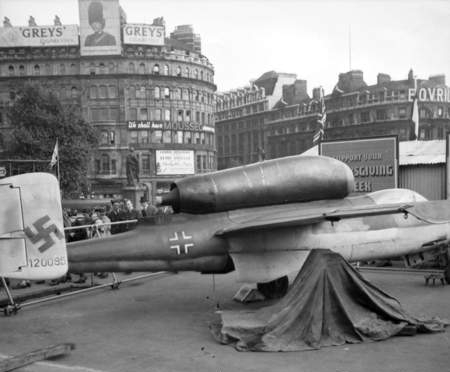
Closing caveat on numbers and survivors: production totals are genuinely unsettled. The Luftwaffe formally accepted 116 aircraft; German sources commonly give about 170 completed; English-language accounts usually say roughly 120 reached airfields with nearly 1,000 more on the lines, and figures as high as 320 completed circulate in the literature. What is not disputed is that British troops walking onto the airfield at Leck in May 1945 found somewhere between 31 and 50 intact machines in one place. Seven original airframes survive, every one of them war booty and every one an A-2: W.Nr. 120015, originally marked 120223 and coded Yellow 21, at the Musée de l’Air et de l’Espace, Le Bourget; W.Nr. 120076, Yellow 4, at the Deutsches Technikmuseum in Berlin, acquired in June 2011 after decades in the Canadian national collection at Rockcliffe; W.Nr. 120077, Red 1 Nervenklau of 2./JG 1, at the Planes of Fame Museum, Chino, California, taken at Leck and shipped to the United States as FE-489 and later T-2-489; W.Nr. 120086 at the Canada Aviation and Space Museum, Ottawa; W.Nr. 120227, Red 2, at the Royal Air Force Museum, London; W.Nr. 120230, wearing White 23 and thought to have been flown by Oberst Herbert Ihlefeld, at the Smithsonian National Air and Space Museum, captured at Leck on 8 May 1945, brought over under Operation Lusty as FE-504 and later T2-504, and fitted at Wright Field with the tail unit of W.Nr. 120222; and W.Nr. 120235, also taken at Leck, at the Imperial War Museum, Duxford. The He 162 displayed at the National Warplane Museum at Geneseo, New York, is a modern reproduction and not an original airframe.
The He 162 Volksjäger, from tender to surrender
The People’s Fighter is ordered
The Volksjäger requirement is issued; Heinkel’s design is chosen on 25 September, with days to spare.
First flight
The He 162 V1 makes its maiden flight — just about ninety days after selection.
Disaster
Days later, a glue failure breaks up the prototype in the air, killing test pilot Gotthold Peter.
To the squadron
Deliveries begin to JG 1 — the only unit ever to fly the type in combat.
One kill, one loss
A He 162 downs an RAF fighter, and its pilot is killed the same day.
A thousand on the lines
Nearly a thousand airframes stand unfinished as Germany surrenders; JG 1’s survivors are handed over at Leck on 6 May.
The trophies remain
Several He 162s survive in museums across Europe and North America.
The He 162 Volksjäger in eight stories
From paper to flight in three months
The He 162 was designed and flying in about ninety days.
The full story
A wing that came apart in the air
The rushed construction claimed the first prototype and its pilot.
The full story
The plan to send teenagers to war in jets
The Volksjäger was meant for barely-trained Hitler Youth.
The full story
An engine mounted where you’d least expect
The He 162’s single jet sat on top of the fuselage.
The full story
The He 162’s single day of victory
Its first confirmed kill and its pilot’s death came together.
The full story
An advanced idea, used in desperation
The He 162 had one of the first ejection seats — and needed it.
The full story
Mass production that never flew
Nearly a thousand He 162s were being built at the surrender.
The full story
What the experts thought
Britain’s greatest test pilot admired it — and feared for its pilots.
The full story
The He 162 Volksjäger in photographs
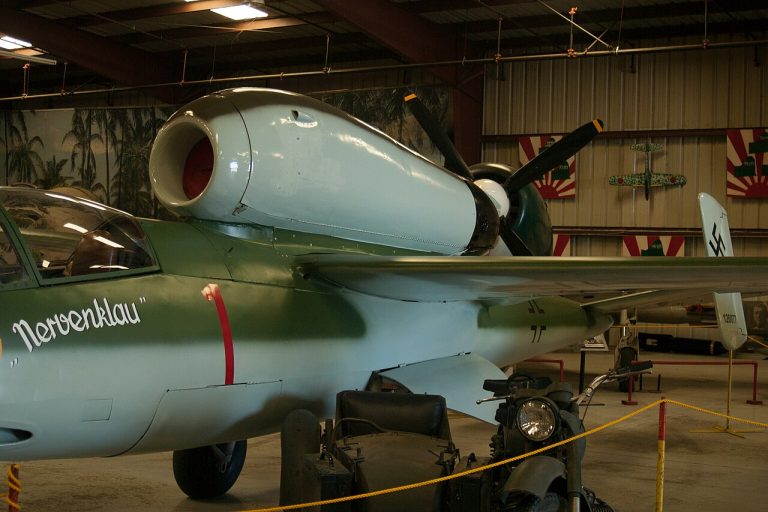
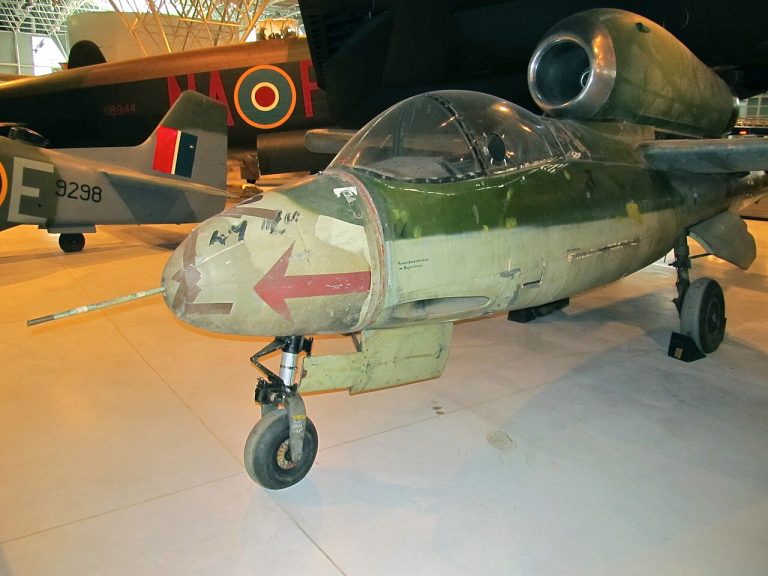
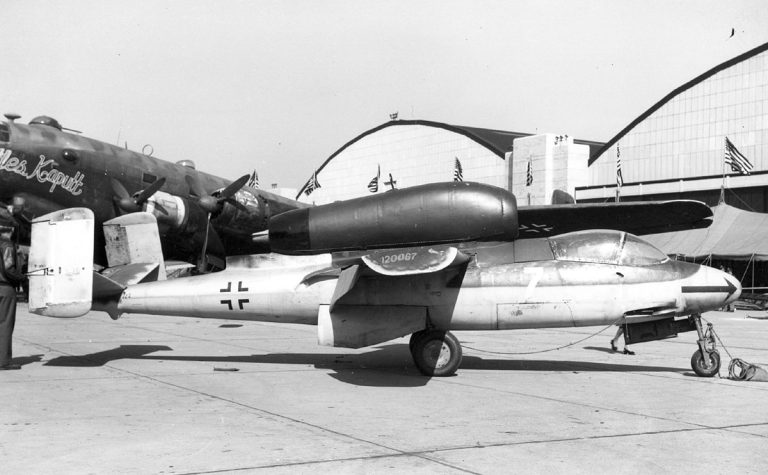
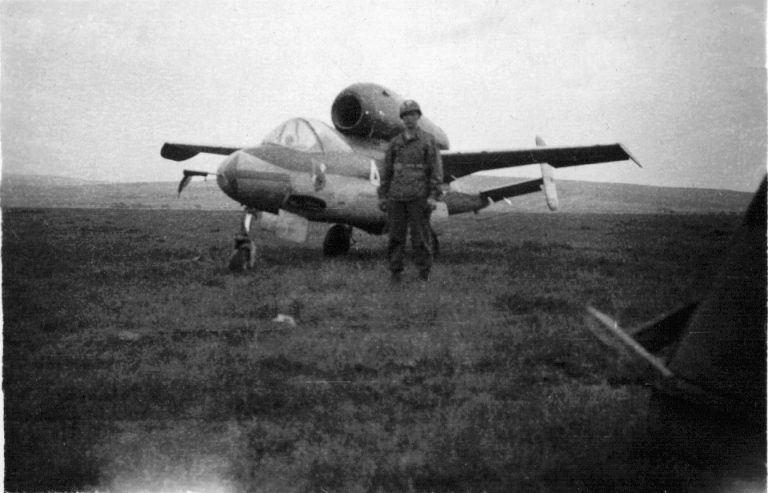
The People’s Fighter in combat
Rare wartime and museum footage of the He 162 — the little wooden jet with its engine on its back.
How the He 162 actually fared in its final weeks of combat (Showtime112).
Where the He 162 Volksjäger flew — and survives
Days of combat, then the end
The He 162 reached combat only in the war’s final weeks, with a single unit, and it killed more of its own pilots than of the enemy. Its record is measured in days.
Rushed from drawing board to squadron in months, the He 162 was undone by its own haste — glue failures, flameouts and fuel starvation. Compare the combat record of every military aircraft.
He 162 Volksjäger: your questions, answered
Can I fly in a Heinkel He 162?
No — every surviving He 162 is a static museum aircraft. But you can fly in a real military jet today: MiGFlug offers flights in genuine fighters and jet trainers such as the L-39 Albatros and the MiG-29. See migflug.com/flights-prices.
What was the Volksjäger?
The “People’s Fighter” — a late-1944 German programme for a cheap, mass-produced jet fighter to be built quickly and flown by minimally trained pilots. The He 162 was the result.
Why was the He 162 made of wood?
To save scarce strategic metals such as aluminium and to allow the aircraft to be built by unskilled and forced labour in dispersed factories.
Why was the engine mounted on top?
Placing the BMW 003 in a pod on top of the fuselage simplified construction and maintenance and kept it clear of debris — at the cost of extra aerodynamic instability.
Was it really meant to be flown by teenagers?
Yes. The plan was to train Hitler Youth glider pilots to fly it after minimal instruction — an idea even Ernst Heinkel condemned as unrealistic fanaticism.
Did the He 162 see combat?
Only just. One unit, JG 1, flew it in the last weeks of the war, scoring one confirmed kill while losing far more aircraft and pilots to accidents than to the enemy.
How many He 162s survive?
Several — preserved in museums in Britain, the United States, Canada, Germany and France, unusually many for such a late-war type, because so many were captured intact.
You can’t fly the He 162 Volksjäger.
These, you can.
The Volksjäger belongs to a desperate, vanished moment — but you can still strap into a genuine military jet. MiGFlug flies civilians in real fighters and jet trainers around the world.
 Fly the L-39 AlbatrosThe world’s most-flown jet trainer — aerobatics included
 Fly the F-104 Starfighter“The missile with a man in it”
 Fly the MiG-21The Cold War’s most-produced jet
 Fly the T-33 Shooting StarAmerica’s first jet trainer
 Fly the DH VampireA piece of early jet history
 Fly the S.211Agile Italian jet trainer
 Fly the MB-326The classic Aermacchi jet
 Fly the MiG-15The Soviet legend of the Korean War
Related aircraft
Where this chapter comes from
- Smithsonian National Air and Space MuseumHolds a He 162 and documents the Volksjäger programme.
- Royal Air Force MuseumOn the captured He 162s brought to Britain and the type’s development.
- Imperial War MuseumContext on the collapsing German air war the He 162 was meant to reverse.
- Deutsches Technikmuseum / Deutsches MuseumGerman technical history of the He 162 and its BMW 003 engine.
- MiGFlug — AfterburnerMiGFlug’s aviation magazine, on the Luftwaffe’s wonder-weapons and the dawn of the jet age.
Figures for the He 162 — production totals, top speed and combat losses — vary between sources; the most widely cited values are used here.