
Ilyushin Il-78 “Midas”
The Soviet Union’s Flying Fuel Station
Built on the Il-76 airlifter, the Il-78 gave Soviet and Russian long-range aviation a modern three-point tanker, and became the standard aerial refueller of India, Pakistan, Algeria and Ukraine.
The Il-78: how the Il-76 airlifter became Russia’s strategic tanker
Through the 1960s and 1970s the Soviet Air Force refuelled its bombers from converted bombers. Myasishchev M-4 and 3M aircraft fitted as tankers supported long-range aviation, and Tu-16 tankers served the medium bombers, but both used a single hose and were growing old. The arrival of new long-range bombers and of probe-equipped tactical aircraft called for something better. Ilyushin’s answer was to adapt its Il-76 four-engined airlifter, which was already in large-scale production at Tashkent in Soviet Uzbekistan. The result, the Il-78, known to NATO as Midas, first flew on 26 June 1983 and entered service in the mid-1980s, giving the Soviet Union a modern jet tanker comparable in role to the American KC-135.
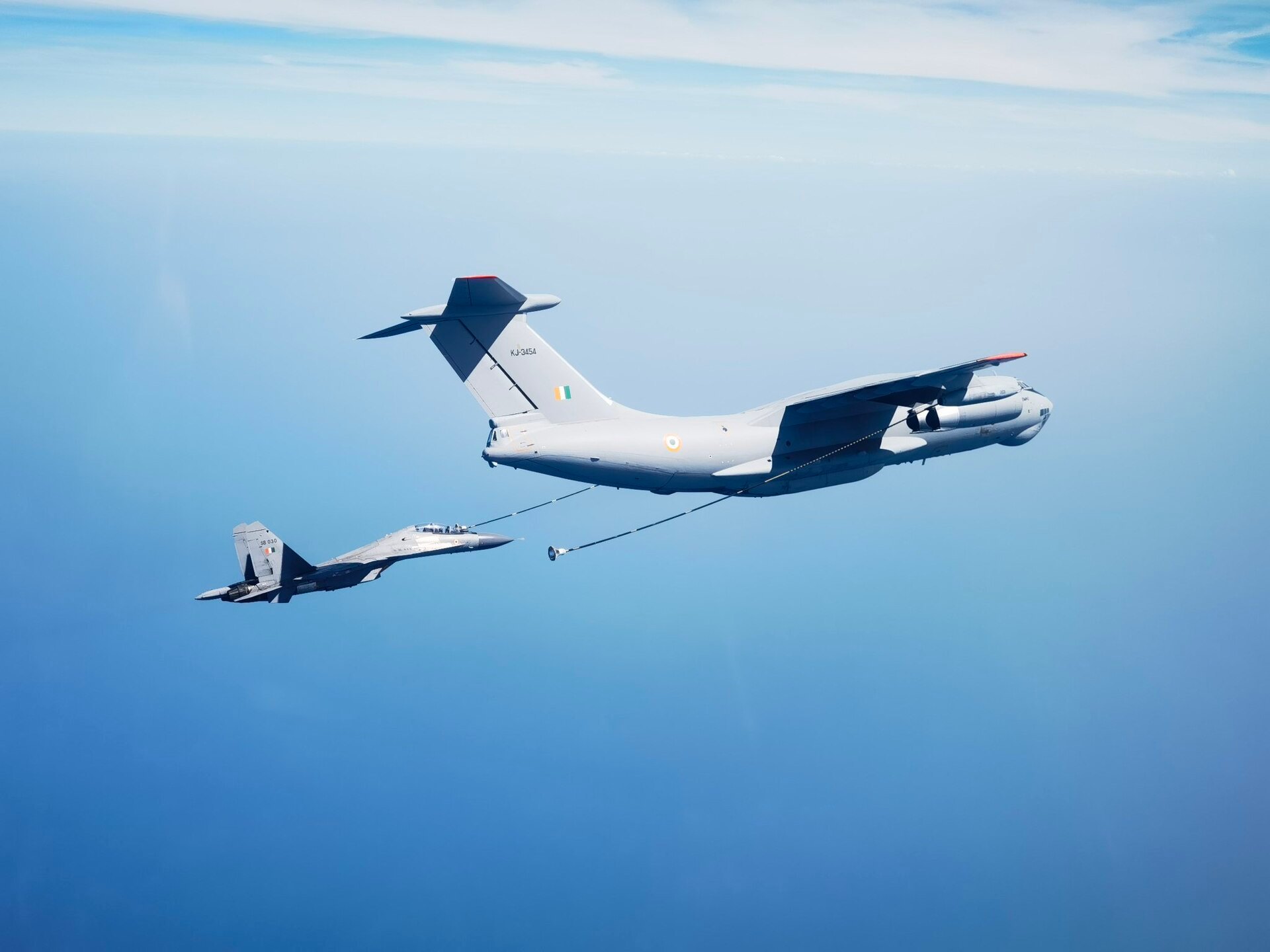
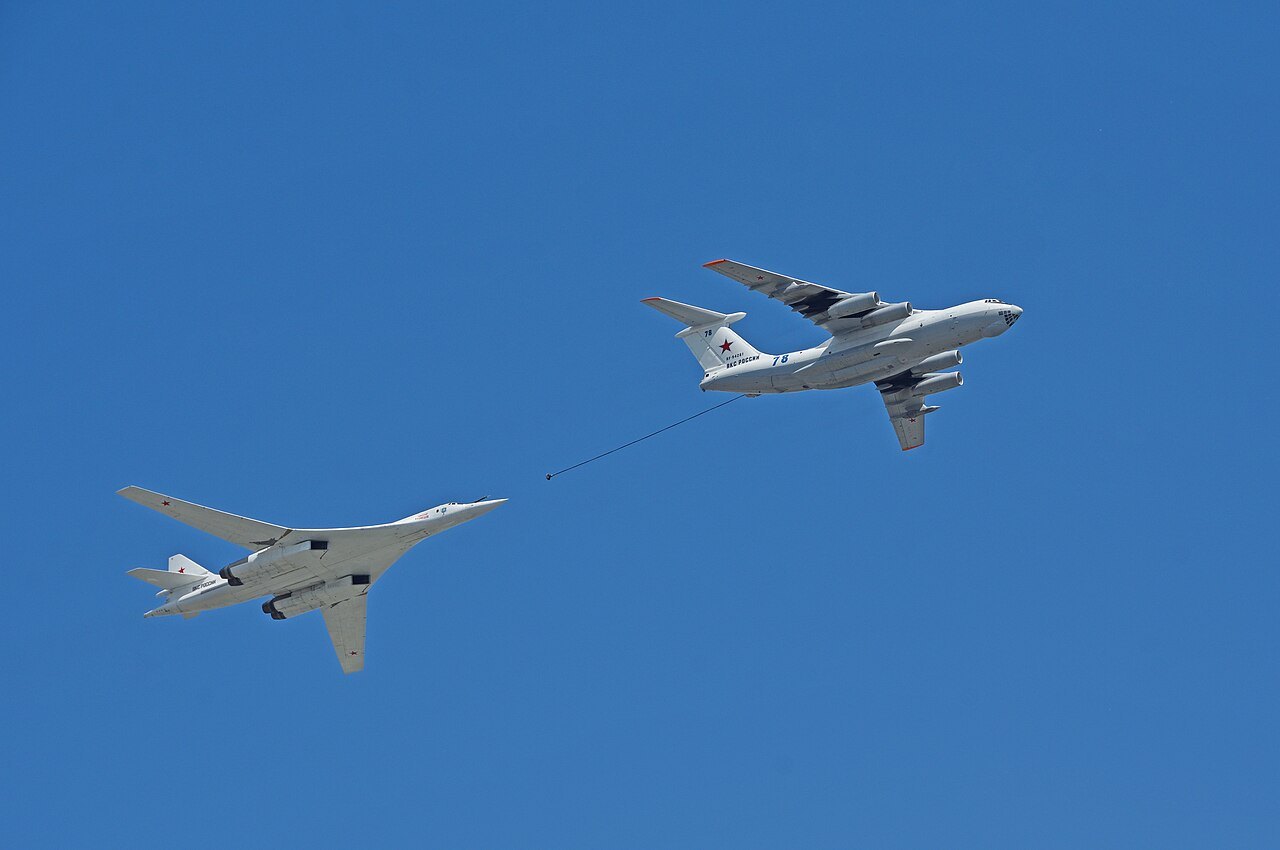
The Il-78 carries its fuel in the Il-76’s wings and in large tanks inside the cargo hold. It passes it through three UPAZ-1 hose-and-drogue pods, one under each outer wing and one on the left side of the rear fuselage, and can refuel up to three aircraft at a time. Fighters use the wing pods; heavy bombers such as the Tu-95 and Tu-160 use the fuselage pod. On the first version the hold tanks could be removed so the aircraft could serve as a transport. The improved Il-78M, which followed in the late 1980s, had fixed tanks and could transfer about 105.7 tonnes of fuel, against 85.7 tonnes on the original.
Only about 45 to 50 Il-78s were built at Tashkent, a small number by Soviet standards. When the Soviet Union broke up, the fleet was split, with Ukraine inheriting a regiment at Uzin. Russia kept the core, about 19 in service by 2019 according to FlightGlobal’s survey, supporting long-range aviation and tactical aircraft. Ukraine sold most of its aircraft abroad, to Algeria and Pakistan, while India bought six new export Il-78MKI tankers in the early 2000s. In January 2018 a modernised Il-78M-90A, built at Ulyanovsk in Russia with new PS-90A engines, made its first flight, meant to give Russia a new generation of tankers without depending on the Uzbek factory.
01The Il-78 abroad: India, Pakistan, Algeria and China
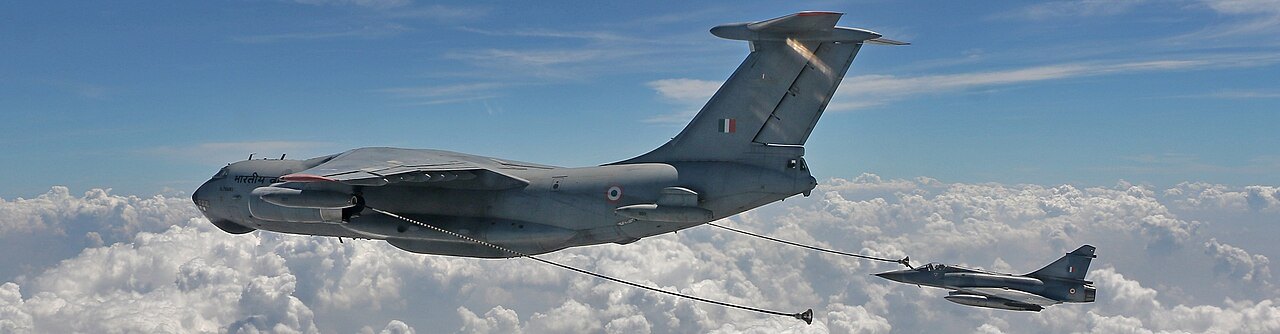
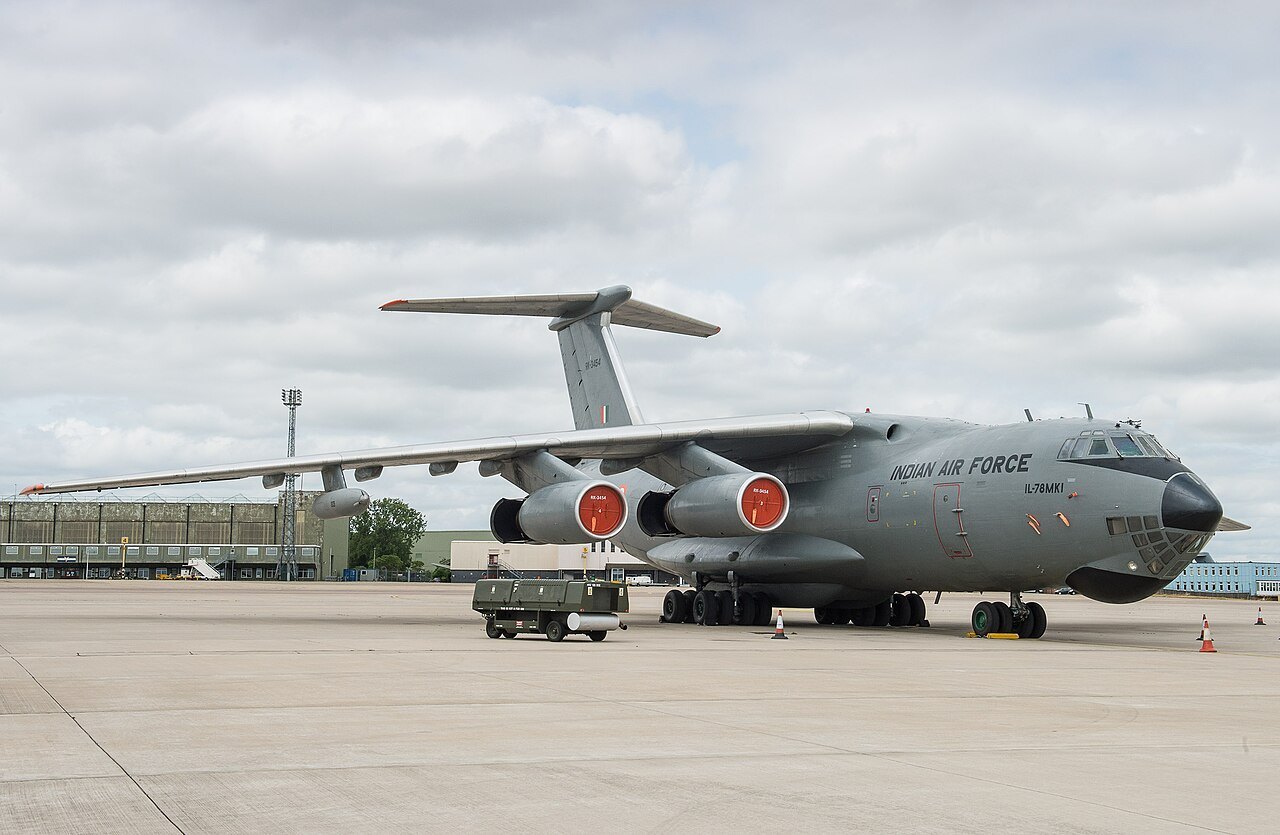
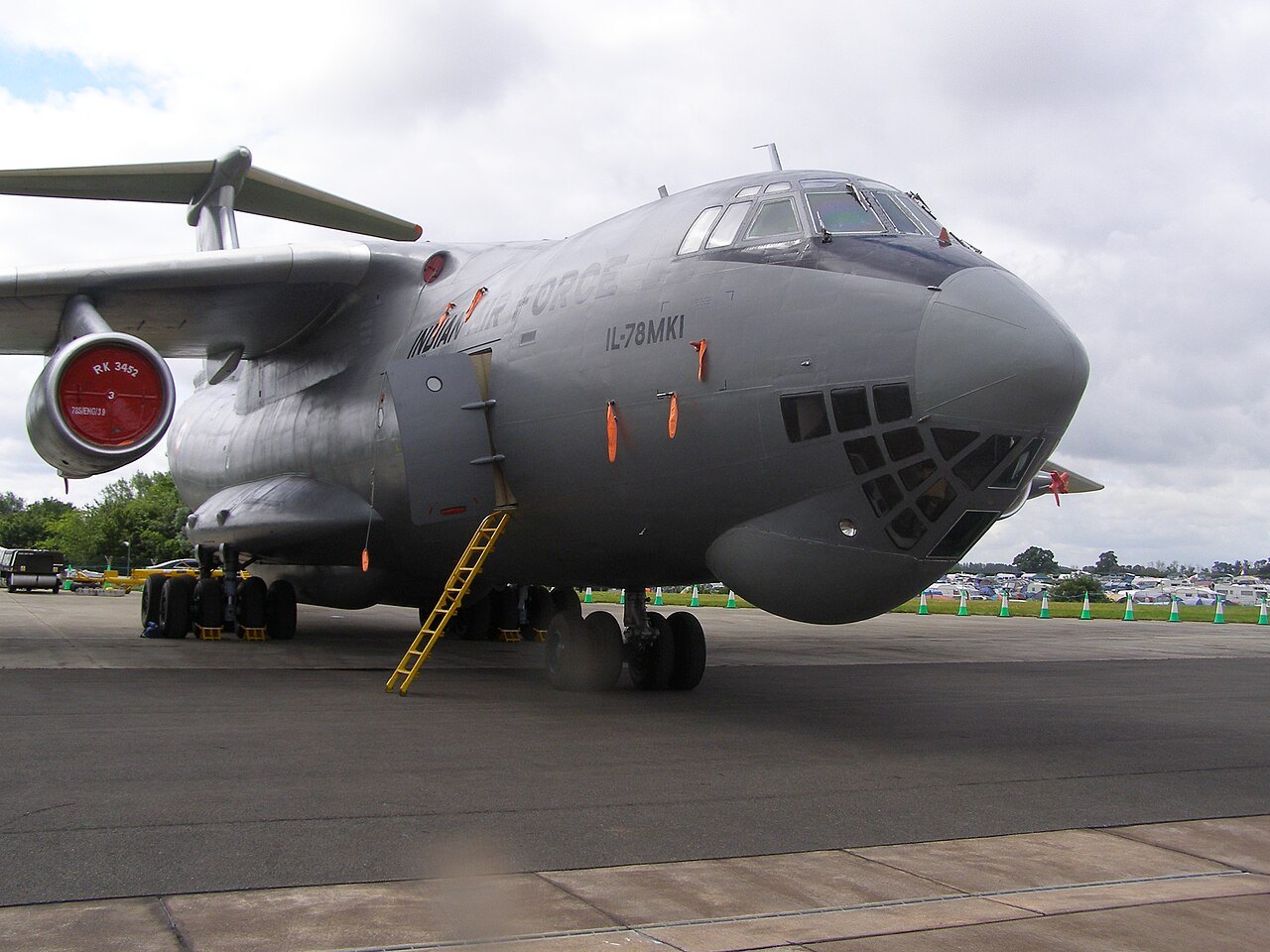
India was the Il-78’s first new-build export customer. It ordered six Il-78MKI tankers, delivered in 2003 and 2004 and based at Agra with No. 78 Squadron. They were specified with refuelling equipment able to serve both Russian-designed fighters such as the Su-30MKI and Western types such as the Mirage 2000 and Jaguar. The fleet has given the Indian Air Force a real long-range capability, but Indian official audits and press reports have repeatedly criticised its availability and support costs, and India has run several competitions for a replacement tanker, while leasing other aircraft for training.
Pakistan bought four Il-78s from Ukraine, delivered between 2009 and 2011. They were refurbished in Ukraine, can also serve as transports, and allow the Pakistan Air Force to refuel its Mirages and JF-17s. Algeria acquired Il-78s from Ukraine at the end of the 1990s to support its Su-24s and later Su-30MKAs. Ukraine retained a small number itself and converted others into freighters. China has been reported to have acquired ex-Ukrainian Il-78s as well, alongside its own tanker developments.
02The Il-78’s new generation: the Il-78M-90A
The break-up of the Soviet Union left Russia with a problem: its heavy transports and tankers were built in Tashkent, now in independent Uzbekistan. Ilyushin moved production of a modernised Il-76, the Il-76MD-90A, to the Aviastar-SP plant at Ulyanovsk, and the Il-78M-90A, also called the Il-478, is its tanker version. It has new PS-90A-76 turbofans of about 35,000 lb of thrust each, a glass cockpit, a strengthened wing and updated refuelling pods.
The first Il-78M-90A flew in January 2018. Russian accounts give it a higher cruise speed and a shorter take-off run than the D-30-powered Il-78, and the new engines are quieter and more efficient. Rosoboronexport also offers an export version, the Il-78MK-90A. Production has been slow, and the older Il-78s and Il-78Ms remain the backbone of Russia’s tanker force. For the Russian Aerospace Forces, the question is less the aircraft itself than numbers: a fleet of a few dozen tankers must support strategic bombers, long-range fighters and transports across eleven time zones.
What makes the Il-78 special
Three UPAZ pods
The Il-78 relies entirely on hose-and-drogue refuelling: there is no flying boom. Three UPAZ-1 pods trail hoses with baskets, two under the wings for tactical aircraft and one on the left rear fuselage, used mainly for heavy aircraft. Fuel flows at about 900 to 2,200 litres a minute depending on the receiver. Because Soviet and Russian aircraft all use probes, one standard serves every receiver, from MiG-31 and Su-34 to Tu-95 and Tu-160 bombers. The trade-off is speed of transfer to large aircraft, which is slower than through a boom.
An airlifter’s strengths
Building on the Il-76 gave the Il-78 the airlifter’s strong high-mounted wing, rugged landing gear for poor runways and four D-30KP turbofans. On the original Il-78 the cargo-hold tanks could be removed, so the same aircraft could carry cargo when not tanking. The Il-78M gave up that flexibility for more fuel. GlobalSecurity notes that the type can also act as a ground refueller, feeding several aircraft at once on an airfield without fuel facilities. The shared airframe also means crews can move between the two types with limited retraining.
Range and offload
The Il-78M can transfer about 105.7 tonnes of fuel in total. The farther it flies, the less it has left to give: published figures for the Il-78M are about 74 tonnes available at 1,000 km from base, 56 tonnes at 2,000 km and 40 tonnes at 3,000 km. That made it well suited to supporting bomber missions far from Russian territory and to refuelling fighters over the vast distances of Russia itself. The figures show why tanker planning is a matter of geometry as much as fuel.
03The Il-78’s variants: from Il-78 to Il-78M-90A
- Il-78: original tanker with removable hold tanks and three UPAZ-1 pods; could double as a transport.
- Il-78M: dedicated tanker with fixed tanks and about 105.7 tonnes of transferable fuel.
- Il-78MKI: export version for India, able to refuel both Russian and Western-designed fighters.
- Il-78MP: Pakistani aircraft supplied from Ukraine, with removable tanks for transport use.
- Il-78M-90A / Il-478: modernised tanker built at Ulyanovsk with PS-90A-76 engines; first flight 2018.
- Il-78MK-90A: export version of the modernised tanker offered by Rosoboronexport.
Ilyushin Il-78M specifications
Specifications
- Crew
- 6
- Length
- 46.59 m (152 ft 10 in)
- Wingspan
- 50.50 m (165 ft 8 in)
- Height
- 14.76 m (48 ft 5 in)
- Max take-off weight
- 210,000 kg (462,971 lb)
- Transferable fuel
- about 105,700 kg (233,000 lb); 85,700 kg (189,000 lb) on the basic Il-78
- Powerplant
- 4 × Aviadvigatel D-30KP-2 turbofans, about 118 kN (26,500 lbf) each
- Maximum speed
- about 850 km/h (530 mph)
- Range
- about 7,300 km (4,500 miles)
- Service ceiling
- about 12,000 m (39,000 ft)
- Refuelling equipment
- 3 × UPAZ-1 hose-and-drogue pods
- Fuel transfer rate
- about 900–2,200 litres per minute
Costs & production
- Unit cost
- Export price reported at about US$25–35 million per aircraft (GlobalSecurity, for the D-30-powered versions)
- Cost per flight hour
- Hedged estimate: roughly US$10,000–20,000 per hour, based on the four D-30KP turbofans’ fuel burn and Il-76-class maintenance; no official figure published
- Production
- Between about 45 and 53 built at Tashkent (sources differ), plus new-generation Il-78M-90A aircraft at Ulyanovsk
- Programme
- First flight 1983; in service from the mid-1980s; modernised Il-78M-90A flew in 2018
04The Il-78’s operating costs: a thirsty workhorse
The Il-78 shares its engines and most of its systems with the Il-76, which keeps parts and training within a large fleet. The D-30KP turbofans, however, are 1970s technology and are thirsty and noisy by modern standards, and the tanker burns a significant share of its own fuel load on long missions. India’s experience shows the other cost: support from the original manufacturer and its suppliers across several post-Soviet countries has been difficult, and availability has suffered.
The Il-78M-90A’s PS-90A engines are designed to reduce fuel burn and maintenance, but few have been delivered. Real hourly costs for any Il-78 operator are not published, so the figure above is an estimate based on comparable aircraft.
The Il-78 from Tashkent to the Il-78M-90A
First flight
The Il-78 tanker, derived from the Il-76MD, flies on 26 June.
Into service
The Il-78 joins Soviet long-range aviation, replacing ageing bomber-based tankers.
Il-78M
The improved Il-78M with fixed tanks and more fuel enters service.
Fleet divided
The Soviet break-up leaves Il-78s in Russia and Ukraine and the factory in Uzbekistan.
Algeria
Algeria acquires Il-78s from Ukraine.
India’s Il-78MKI
Deliveries of six new tankers to the Indian Air Force begin, completed in 2004.
Bomber patrols resume
Russia restarts regular long-range bomber patrols, supported by Il-78 tankers.
Pakistan
The first of four Il-78s from Ukraine is delivered to the Pakistan Air Force; the last arrives in 2011.
Syria
Russian long-range bombers strike Syria from Russian bases, with tanker support reported by the Russian defence ministry.
Il-78M-90A flies
The modernised tanker built at Ulyanovsk makes its first flight in January.
Stories & eyewitnesses: the Il-78 from Engels to Agra
Replacing the Bison tankers
Why the Soviet Union needed a new tanker.
Read the full story
Made in Tashkent
A Russian tanker built in Uzbekistan.
Read the full story
Ukraine’s tankers at Uzin
An inheritance that went abroad.
Read the full story
India’s No. 78 Squadron
The tanker that gave India reach.
Read the full story
Pakistan’s Il-78s
Second-hand tankers for a growing air force.
Read the full story
The return of the bomber patrols
Long flights to the edges of NATO airspace.
Read the full story
Syria, 2015
Bombers strike from Russia.
Read the full story
Over Red Square
A refuelling formation in the Victory Day flypast.
Read the full story
The Il-78M-90A takes off
A tanker for a new century.
Read the full story
The Il-78 in pictures
Where the Il-78 flies and flew
The Il-78’s record
The Il-78 is a support aircraft and its operational record is less documented than that of its Western counterparts. It has supported Russian long-range aviation for four decades, including combat missions over Syria, and has given India, Pakistan and Algeria their aerial refuelling capability.
See how training and combat types compare in the military aircraft statistics database. Figures are approximate.
Everything people ask about the Il-78
Can I fly in an Ilyushin Il-78?
What does Midas mean?
Is the Il-78 based on the Il-76?
Does the Il-78 have a refuelling boom?
Who flies the Il-78?
How much fuel can it give away?
You can’t fly the Il-78.
These, you can.
Most of this museum you can only look at. These genuine military jets you can fly yourself with MiGFlug — with aerobatics and time on the controls.
 Fly the L-39 AlbatrosThe world’s most-flown jet trainer — aerobatics included
 Fly the F-104 Starfighter“The missile with a man in it”
 Fly the MiG-21The Cold War’s most-produced jet
 Fly the T-33 Shooting StarAmerica’s first jet trainer
 Fly the DH VampireA piece of early jet history
 Fly the S.211Agile Italian jet trainer
 Fly the MB-326The classic Aermacchi jet
 Fly the MiG-15The Soviet legend of the Korean War
Continue the tour
Every fact, checked
- Il-78 MIDASDevelopment, pods, fuel transfer, production, export price, exercises
- Il-78 (Ilyushin Aviation Complex)Manufacturer page for the Il-78 family
- Tanker aircraft Il-78MK-90A (Rosoboronexport)Export offer of the modernised tanker
- World Air Forces 2020 (FlightGlobal)Fleet numbers by operator
- Pakistan receiving Il-78 refuelling aircraft (Defense Industry Daily)Pakistani acquisition from Ukraine
- Russia marks maiden flight of Il-78M-90A tanker (Jane’s, 2018)First flight of the new-generation tanker