
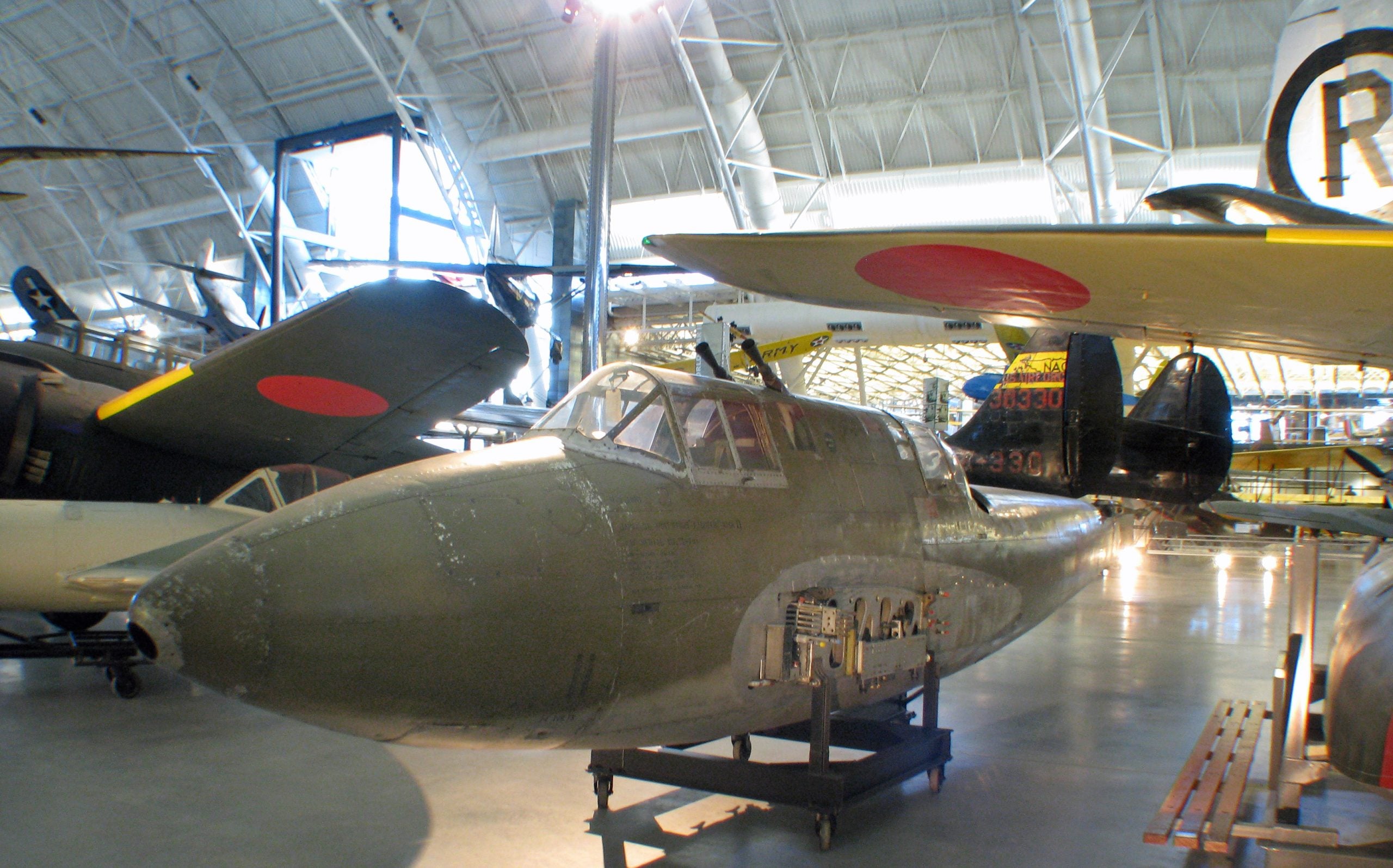
Kawasaki Ki-45 Toryu
“Nick”
Japan’s first operational twin-engine heavy fighter — the “Dragon Slayer” that hunted ships and ground targets across Asia, then became the Army’s last-ditch night hunter of the B-29 over the Home Islands.
Kawasaki Ki-45 Toryu: from heavy fighter to night-time B-29 hunter
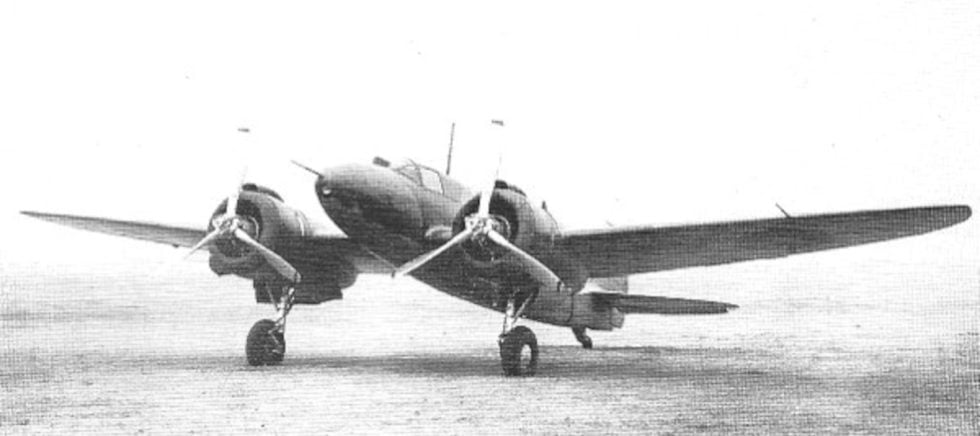
In 1937 the Imperial Japanese Army, watching Europe field twin-engine “destroyers” such as the Messerschmitt Bf 110, issued a requirement for a long-range twin-engine heavy fighter. Kawasaki’s answer, first flown in January 1939, was underpowered and troubled — its Nakajima Ha-20 engines never delivered. Only after a thorough redesign, re-engined with Nakajima Ha-25 and then Mitsubishi Ha-102 radials and reborn as the Ki-45 KAI, did the aircraft come good. It entered service in 1942 and drew its name Toryu — “Dragon Slayer” — and, from the Allies, the reporting name “Nick.”
As a heavy fighter the Toryu proved a flexible workhorse. It escorted bombers and intercepted them, flew anti-shipping strikes, strafed and bombed ground targets, and hunted lumbering B-24 Liberators over China, Burma, New Guinea and the Philippines. Some variants carried a hand-loaded 37 mm cannon; one experimental version mounted a 75 mm gun. Where nimble single-seat fighters struggled to carry heavy weapons and fuel, the two-seat Toryu could.
Its defining chapter came late. When the B-29 Superfortress began raiding Japan in 1944, the Ki-45 became the Army’s principal home-defence night fighter — by most accounts the only Japanese Army night fighter to see significant action. The definitive KAI Hei carried a nose 37 mm cannon and a pair of obliquely-mounted, upward-firing 20 mm cannon, the same idea as the Luftwaffe’s Schräge Musik, letting a Toryu slide beneath a bomber and fire up into its belly.
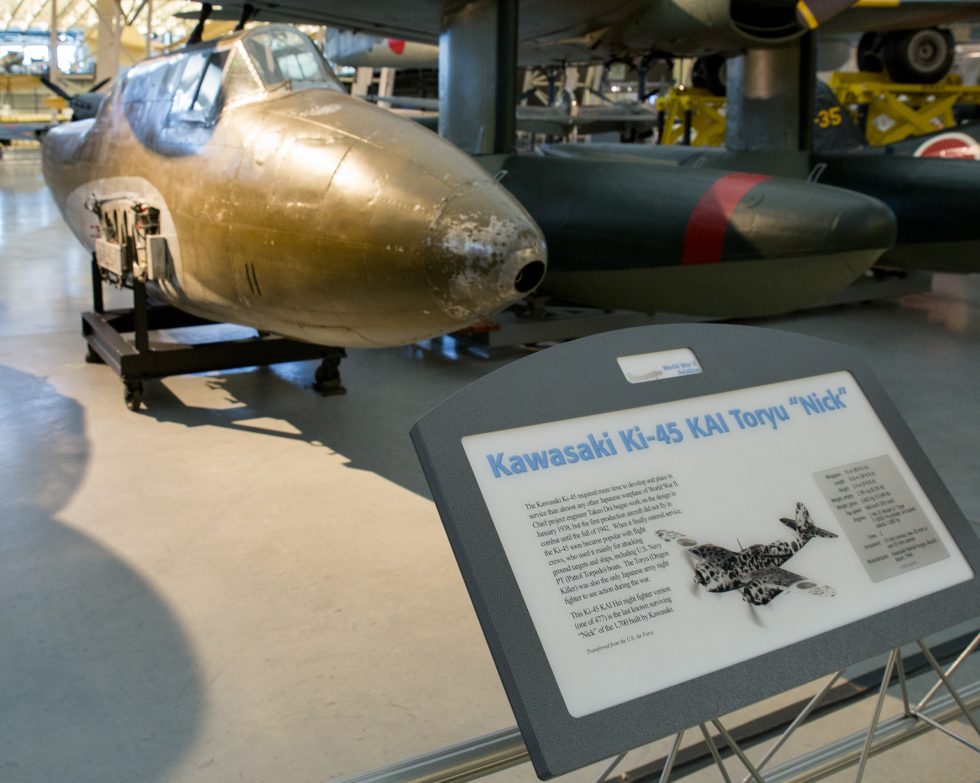
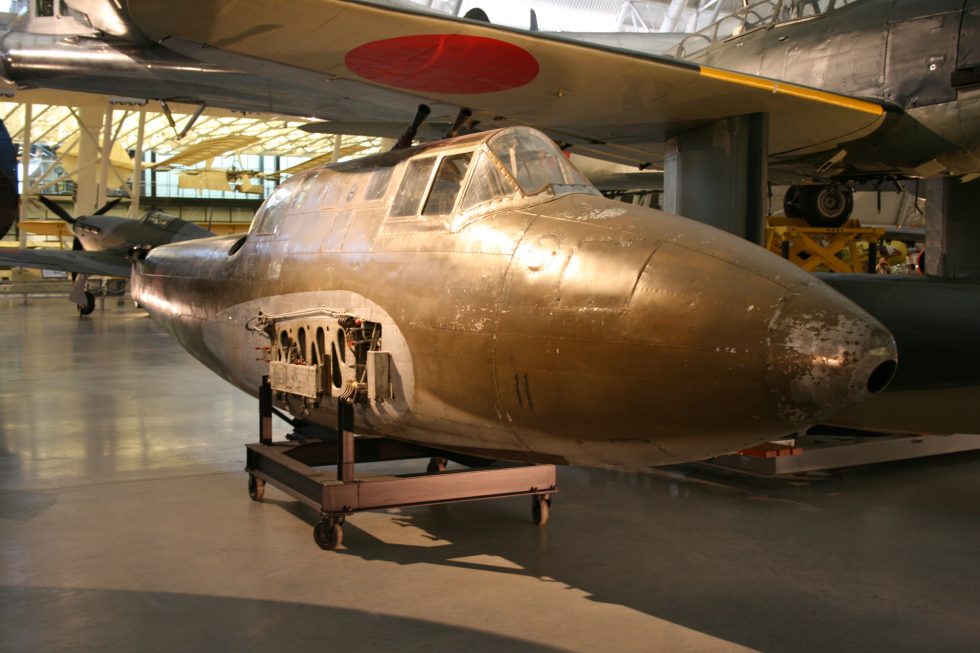
As B-29s flew higher and faster, and as radar sets never arrived in reliable numbers, interception grew desperate. Some units turned to taiatari — deliberate ramming. Of roughly 1,700 Toryu built, exactly one complete aircraft survives today, at the Smithsonian: the last Dragon Slayer.
01The Kawasaki Ki-45 Toryu’s troubled birth: why the first design nearly failed
The original Ki-45 was a disappointment. Its Nakajima Ha-20 engines were underpowered and unreliable, the nacelles created drag, and performance fell short of the Army’s hopes. Rather than abandon the concept, Kawasaki’s team — led by Takeo Doi — reworked the aircraft almost completely: cleaner nacelles, better cooling, and progressively more powerful radials, first the Nakajima Ha-25 and finally the Mitsubishi Ha-102 of roughly 1,050–1,080 hp each. The rebuilt Ki-45 KAI (“modified”) flew in 1941 and reached squadrons in 1942. The lesson of the Toryu is that its success was not in the first design but in the willingness to fix it.
What made the Ki-45 Toryu special
Japan’s first operational twin-engine heavy fighter
The Toryu gave the Army something its single-seaters could not: two engines, two crew and the reach to escort, intercept and strike far from base. A pilot flew and fought while a rear crewman worked the radio and a flexible machine gun. That capacity for heavy weapons and long range is what made the type so adaptable across so many roles.
A 37 mm nose gun — and upward-firing cannon
Toryu variants carried heavy, ship- and bomber-killing armament: a nose 37 mm Ho-203 cannon, 20 mm guns, and a rear-firing machine gun. The night-fighter KAI Hei added two obliquely-mounted 20 mm cannon firing upward and forward — Japan’s equivalent of the German Schräge Musik — so a fighter could attack a bomber from directly below.
Built for the night war over Japan
From 1944 the Toryu became the Army’s main home-defence night fighter against the B-29. Airborne and ground radar were intended but never reliably fitted, so crews hunted largely by eye, searchlight and ground control. It was, by most accounts, the only Japanese Army night fighter to see significant action — effective at first, then outpaced as the bombers climbed higher.
02The Kawasaki Ki-45 Toryu’s oblique cannon: Japan’s answer to Schräge Musik
The definitive night fighter, the Ki-45 KAI Hei (Model C), mounted two 20 mm cannon obliquely in the upper fuselage, angled upward and forward. The tactic mirrored the Luftwaffe’s Schräge Musik installations: rather than chase a bomber into the fire of its tail and dorsal guns, the fighter formed up in the bomber’s blind spot below and behind, then raked the wings and fuselage from beneath. Against the B-29 — heavily defended and fast — getting into that position at night was the hard part, but when it worked the oblique guns were devastating. A nose-mounted 37 mm cannon gave the same aircraft a heavy forward punch.
03The Kawasaki Ki-45 Toryu as night fighter: hunting the B-29 in the dark
When XX Bomber Command opened the strategic campaign against Japan in June 1944, the Army had no purpose-built night fighter ready — so it pressed the Toryu into the role. Dedicated night-fighter Sentai defended the industrial heartland, the Kanto plain and the approaches to Tokyo. Early results against B-29s flying at medium altitude were encouraging; the type’s top B-29 killer, Captain Isamu Kashiide of the 4th Sentai, was credited with a large personal tally (claims that, as with all such figures, exceed confirmed losses). But the plan depended on radar that never arrived in numbers, and as the B-29s switched tactics and pressed home low-level fire raids, the ageing Toryu was increasingly overwhelmed.
Kawasaki Ki-45 Toryu: full specifications
Baseline note: the figures below describe the Ki-45 KAIc (Army Type 2 Two-Seat Fighter Model Hei; "Nick" to Allied intelligence), the mark built in the largest numbers and the one that flew the night defence of the Home Islands. Deltas for the earlier KAIa and for the failed 1939 Ki-45 prototypes are in grey. One correction before the tables: the gross weight of 8,820 kg that appears in several widely copied reference tables is a transcription error — it is the empty weight of 4,000 kg re-expressed in pounds and then relabelled. The KAIc weighed 5,500 kg loaded, which is what the same tables’ own wing loading of 171.9 kg/m² actually implies.
Dimensions & weights
- Crew
- 2 — pilot, and a rear crewman who was gunner, radio operator and, on the KAIb, the man who hand-loaded a tank gun between passes. The KAId deleted the rear machine gun but kept the second man
- Length
- 11.00 m (36 ft 1 in)
- Wingspan
- 15.02 m (49 ft 3 in); Japanese airframe tables give 15.07 m (49 ft 5 in). The 50 mm gap is a measuring convention, not a change of mark
- Height
- 3.70 m (12 ft 2 in)
- Wing area
- 32.00 m² (344 sq ft); Japanese sources 32.20 m² (347 sq ft)
- Aspect ratio
- 7.05 — a long, high-aspect wing built for range, which is why the aeroplane was a good bomber-killer and a poor dogfighter
- Aerofoil
- NACA 24015 at the root, NACA 23010 at the tip
- Empty weight
- 4,000 kg (8,818 lb); the lighter KAIa was 3,695 kg (8,146 lb)
- Loaded weight
- 5,500 kg (12,125 lb); KAIa 5,276 kg (11,632 lb). Japanese tables for the Ki-45 KAI generally quote 5,270 kg, which is the KAIa figure
- Wing loading
- 171.9 kg/m² (35.2 lb/sq ft) — heavy for 1942 and utterly conventional for a twin, but carried on two engines of only 1,080 hp apiece
- Power loading
- 2.55 kg/hp (5.61 lb/hp) on take-off power. A Ki-43 managed about 2.2 kg/hp; the difference is the whole argument about whether the Toryu was a fighter
- Internal fuel
- Not consistently published in the accessible literature. The quoted 2,000 km range on two Ha-102s implies something over 1,000 l in wing tanks, but no primary figure is offered here because none could be corroborated
- External stores
- Two underwing hardpoints, each rated for a 250 kg (551 lb) bomb or a 200 l (44 imp gal) drop tank
- Structure
- All-metal stressed-skin low-wing monoplane, flush-riveted, with a retractable tailwheel undercarriage. The KAI was not a modified Ki-45 but a new airframe that borrowed the basic design of Kawasaki’s own Ki-48 twin-engined light bomber
Performance
- Maximum speed
- 540 km/h (336 mph, 292 kn) at 6,000 m (19,685 ft); the lighter KAIa reached 547 km/h (340 mph) at 7,000 m (22,965 ft)
- Speed as flown
- Lower. Japanese unit accounts are explicit that service aircraft, with worn engines and wartime finish, did not make the catalogue figure — and 540 km/h was already below the 1937 requirement the type was ordered against
- Cruising speed
- 350 km/h (217 mph) at 3,000 m (9,840 ft), the figure carried in Francillon and repeated by most Western tables
- Rate of climb
- 11.7 m/s (2,300 ft/min) initial
- Time to 5,000 m
- 7 min 0 sec (to 16,400 ft)
- Service ceiling
- 10,000 m (32,810 ft); the KAIa is credited with 10,730 m (35,200 ft), and the difference is armament weight, not altitude capability
- Performance where the B-29 flew
- This is the row that decided the type’s career. A B-29 bombing from 9,000–10,000 m (30,000–33,000 ft) sat at the Toryu’s absolute ceiling. Climbing there took the best part of half an hour, arrived with almost no speed margin over a bomber cruising at 350 km/h, and left the pilot one wallowing pass with mushy controls
- Range
- 2,000 km (1,243 miles, 1,080 nmi); KAIa 2,260 km (1,404 miles). Japanese tables give 1,500 km for the KAI, which is a combat rather than a ferry figure
- Power-to-weight
- 0.285 kW/kg (0.17 hp/lb) at loaded weight
- Take-off and climb
- Rated Good by American testers who flew the captured aircraft at Wright Field — a short run and a respectable climb were the type’s genuine virtues
- Ground handling
- Rated Very poor in the same American report, the worst mark the aeroplane received for anything. Taxiing, take-off and landing directional control were all bad
- Handling in the air
- Rated Good to Excellent for control and manoeuvrability at normal speeds; high-speed manoeuvrability, workmanship and equipment were all judged inferior to American practice. Persistent complaints: a cramped cockpit, poor view from it, and heavy vibration
Propulsion & systems
- Engines
- Two Mitsubishi Ha-102 (Navy designation MK2D Zuisei 21) 14-cylinder two-row air-cooled radials driving three-blade constant-speed metal propellers
- Engine dimensions
- 28.0 l (1,710 cu in), bore and stroke 140 × 130 mm (5.5 × 5.1 in), 1,118 mm (44.0 in) diameter, 540 kg (1,190 lb) dry — one of the smallest 14-cylinder engines built anywhere
- Power ratings
- 1,080 hp (805 kW) for take-off at 2,700 rpm; 1,055 hp at 2,800 m (9,190 ft) in low blower; 950 hp at 5,800 m (19,030 ft) in high blower
- Supercharger
- Single-stage geared centrifugal. Japanese power tables quote two distinct full-throttle heights, which implies a two-speed drive; some Western engine listings describe the Zuisei as single-speed. The two-speed reading is the one the Japanese figures support
- Fuel
- 87 octane, with a compression ratio of 6.5 — a low-grade fuel that capped what the engine could ever be asked to do at height
- Earlier engines
- Two Nakajima Ha-20 Otsu of 820 hp on the 1939 prototypes (underpowered and chronically unreliable), then two Nakajima Ha-25 of 1,000–1,050 hp on the 1940 pre-production machines
- Nacelles
- The original Ki-45 suffered nacelle stall, the flow off the engine cowlings separating the airflow over the wing upper surface. Kawasaki cured it on the KAI by moving the nacelles below the wing chord line — the single most important change in the whole programme
- Exhaust
- Collector rings on early aircraft; individual ejector stacks fitted to late night-fighter production for a small thrust gain, with flame damping that mattered more
- Radio
- Army radio-telephone. Unusually for Japanese practice it worked, and the 4th Sentai built its whole B-29 interception method around it: the commander directing the fight by voice from a ground command post
- Radar
- None in service. The Taki-2 airborne set was tested on the Ki-45 KAIe prototype, and a single KAIc is recorded as radar-fitted; production could not deliver, and the centimetric nose set intended for the night-fighter mark never arrived. Ground control, searchlights and the crew’s eyes did the work instead
- Protection
- Thin by 1944 standards: some armour for the crew, no comprehensive tank protection, and no system that would keep a wing on after a burst of 12.7 mm from a B-29 turret
- Undercarriage
- Retractable main gear and tailwheel. The retraction system was one of the named defects of the 1939 prototypes and took two redesigns to become dependable
04The Kawasaki Ki-45 Toryu’s cost: why no reliable price survives
The Toryu was a wartime product of the Japanese state, built for the Imperial Japanese Army and never traded on any open market. No dependable flyaway unit price — in yen or dollar-equivalent — survives in the public record, and no credible cost-per-flight-hour figure exists for the type. Any precise number attached to a Ki-45 today should be treated as an estimate at best. What can be said is that the twin-engine Toryu was more expensive and material-hungry than a single-seat fighter, one reason Japan also fielded cheaper single-engine interceptors alongside it.
Armament & payload
The Toryu was rearmed four times, and every change was an admission that killing a bomber needs a bigger gun than killing a fighter
No Japanese aircraft of the war had its guns swapped about so often or so revealingly. The Ki-45 began in 1942 with a fighter’s battery — two 12.7 mm in the nose and a single 20 mm in a ventral tunnel — discovered within months that this would not bring down a B-17, and answered by bolting an infantry tank gun into the belly that the rear crewman reloaded by hand, one round every thirty seconds. The proper answer arrived with the Ho-203, a genuine 37 mm automatic in the nose, and the aeroplane finally became what the Army had wanted all along: a mobile heavy gun. The last change was the cleverest and the least Japanese-sounding — two 20 mm Ho-5 mounted behind the cockpit and canted upwards, so that a night fighter could sit in a bomber’s blind spot beneath it and shoot into the wing roots without ever entering the arc of a single defensive turret. Gun fits varied by mark, by batch and by depot rework, and Japanese, American and Western reference sources disagree over which suffix carried what; the account below follows the Japanese variant literature where the three conflict.
Gun
- KAIa (Ko): two 12.7 mm Ho-103 in the nose (12.7 × 81SR, up to 900 rounds/min unsynchronised, firing the Ma-103 fuzed and Ma-102 fuzeless high-explosive incendiary rounds), one 20 mm Ho-3 in a ventral tunnel offset to starboard (20 × 125, 43 kg, 820 m/s, only 300–400 rounds/min, drum-fed, descended from the Type 97 anti-tank rifle), and one 7.92 mm Type 98 on a flexible mount in the rear cockpit
- KAIb (Otsu): the ventral 20 mm replaced by a 37 mm tank gun taken from the Type 95 light tank. Devastating on impact and almost useless in practice — the rear crewman worked the breech by hand and the aircraft could manage roughly one round every thirty seconds, in practical terms two shots per firing pass. Japanese sources name it the Type 98 37 mm tank gun; English-language sources usually say Type 94. Both weapons existed and both armed the Type 95; the Japanese attribution is the better-documented one
- KAIc (Hei): one 37 mm Ho-203 automatic cannon in the nose — 89 kg, 570 m/s, 120 rounds/min, a 475 g projectile, a long-recoil automation of the Year 11 Type infantry gun. Magazine capacity is disputed: a 25-round closed-loop belt in general references, 16 rounds in the Ki-45 installation according to others. The ventral 20 mm Ho-3 was restored alongside it
- The oblique pair: two 20 mm Ho-5 (20 × 94, 37 kg, 750 m/s, about 750 rounds/min, belt-fed, developed from the Ho-103) mounted between the pilot’s and rear seats and canted upwards and forwards. Trialled first as the Tei-soubi or "Tei fit" on existing KAIc airframes with the ventral Ho-3 removed to compensate for the weight, then standardised as the KAId, on which the rear flexible gun was also deleted. Early conversions used Ho-103 machine guns in the oblique mounting before Ho-5 supply allowed the change to 20 mm
- Experimental and small-batch nose guns: the 37 mm Ho-204 (a belt-fed, higher-velocity, far better 37 mm than the Ho-203); the 40 mm Ho-301 firing caseless ammunition at 245 m/s with an effective range of about 150 m, fitted to the KAIe alongside Taki-2 radar; and the 57 mm Ho-401, whose Ki-45 installation was in effect the prototype of the Kawasaki Ki-102b
Air-to-air
- No guided air-to-air weapon existed in Japanese service at any point, and none was ever projected for the Toryu. The guns were the entire battery and the tactics were built around them
- The oblique installation deserves stating carefully, because the popular account is wrong in both directions. It was not a German import: the Imperial Japanese Navy arrived at upward-firing cannon independently, on Commander Kozono Yasuna’s initiative at the 251st Kokutai, and a field-modified J1N1 shot down two B-17s over Rabaul on 21 May 1943. Nor did it predate the German work — Rudolf Schoenert was experimenting with upward-firing guns from 1941, the first installation went into a Do 17Z-10 late in 1942, and his first Schräge Musik victory came the same month as Kozono’s. The two lines of development were genuinely independent and very nearly simultaneous
- The Army copied the Navy, not the Germans. Japanese accounts are explicit that the Ki-45’s oblique guns followed directly from the Navy’s results at Rabaul from May 1943, reaching the Toryu as a field fit and then as a production standard during 1944
- Type 3 air-to-air bombs: phosphorus and shrapnel weapons dropped into a bomber formation from above and fuzed to burst among it. The Ki-45 is among the aircraft best attested to have used them, and one B-29 lost over Yawata on 20 August 1944 is credited to air-to-air bombing in American records
- Ramming. It belongs in this card because by late 1944 it was a doctrine rather than a desperate improvisation: on 7 November 1944 the 10th Air Division ordered each subordinate sentai to form a four-aircraft air-to-air special attack flight, named Shinten Seikutai by General Prince Higashikuni Naruhiko. The Western District’s 12th Air Division called its equivalents Kaiten-tai
Air-to-surface guided
- None carried, none projected, and none existed. Japan fielded no operational air-to-surface guided weapon of any kind for a fighter airframe during the war
- The Toryu did the anti-shipping job the hard way, with a 37 mm cannon at low level against small craft and a pair of 250 kg bombs against anything larger, and it did that job better than it did any other
- The card is kept for consistency across this encyclopedia. The honest entry is that the category was empty for every Japanese combat aircraft of the period bar a handful of trials weapons that never reached a unit
Bombs
- Two 250 kg (551 lb) bombs on underwing racks — the standard load for the ground-attack and anti-shipping work in China, Burma and New Guinea, and the reason some units called the aeroplane the Type 2 Twin-Engined Ground-Attack Aircraft rather than a fighter at all
- Smaller loads of anti-personnel and fragmentation bombs were carried on the same racks against airfields and troop concentrations
- Type 3 air-to-air bombs against B-29 formations, released from above — a low-probability weapon that nonetheless killed at least one bomber
- No dive brakes, no bombsight worth the name in the rear cockpit, and no pretension to accuracy above low level. This was a strafing aeroplane that also happened to carry bombs
Rockets
- No rocket armament is attested on operational Ki-45s. The card is kept and the entry is honest: this is a gun aeroplane
- The Imperial Japanese Army’s air-to-air rocket work went to other airframes and never produced a weapon that reached a Toryu unit
- What filled the same tactical niche — a heavy, short-range punch delivered in one pass — was the 37 mm nose cannon and, at the extreme, the 40 mm Ho-301, which with its 245 m/s muzzle velocity and 150 m effective range was closer to a rocket launcher than to a gun
Pods & other stores
- Two 200 l (44 imp gal) drop tanks on the underwing racks, alternative to the bombs — the fit that made the 1942 long-range escort role possible at all
- Taki-2 airborne radar on the KAIe prototype and a single recorded KAIc. It never entered service, and the centimetric nose set promised for the night-fighter mark was defeated by Japanese electronics production
- A handful of one-off conversions carried radio direction-finding equipment or beacon receivers for night navigation and recovery — a partial substitute for the radar that never came
- Exhaust flame dampers on night-fighter aircraft; no ejection seats, no drop-tank jettison sophistication, no external gun pods of any kind
- The Shinten ramming aircraft carried nothing at all. Guns, armour plate and radio were all stripped out, producing what Japanese crews called a muteikoki, a "no-resistance aircraft", worth a few hundred metres of extra ceiling
Three typical loadouts
- Anti-shipping strike, New Guinea, 1943
- One 37 mm in the ventral tunnel or nose, one 20 mm Ho-3, the rear 7.92 mm manned, and two 250 kg bombs under the wings. Flown at low level against barges, PT boats and coastal shipping. This is the mission the Toryu was actually good at, and the one its crews liked
- Night interception over the Kanto plain, spring 1945
- One 37 mm Ho-203 in the nose, two 20 mm Ho-5 canted upward behind the cockpit, ventral gun and usually the rear gun removed, exhaust flame dampers fitted, no external stores. Vectored by ground control and searchlight, closing from below and behind a B-29 running in at 1,500–3,000 m on a LeMay incendiary raid — the one tactical situation in which this aeroplane held every advantage
- Shinten ramming sortie, winter 1944–45
- Nothing. A worn-out airframe with the cannon, armour and radio removed, four such aircraft to a sentai, climbing above 9,000 m to strike a B-29 with a wing or a propeller. The pilots were expected to bail out and come back; two men of the 244th Sentai’s Hagakure flight rammed twice each and survived both times
Sourcing caveat: the mark-to-armament mapping for the Hei and Tei is genuinely contested. English-language references commonly place the oblique cannon on the KAId only; Japanese variant literature and the Smithsonian’s own catalogue entry for the surviving airframe put them on Hei-built aircraft with the "Tei fit", which was then formalised as the KAId. Some English-language references acknowledge the conflict in their own text. Ammunition capacities for the Ho-203 and the Ho-3 vary between sources by a factor approaching two.
Variants
Kawasaki spent four years failing to build this aeroplane, then built it twice
The Ki-45 is one of the longest and least dignified development programmes of the Japanese aircraft industry. Ordered in December 1937 in the wake of the Bf 110 and the Potez 630, first flown in January 1939, it was still not in service when the Pacific War began — four years from specification to squadron, against a requirement it never actually met. Two things killed the first aeroplane: the Nakajima Ha-20 Otsu engine, which was both underpowered and unreliable, and nacelle stall, in which flow off the engine cowlings separated the air over the wing and took the lift with it.
Re-engining with the proven Ha-25 in 1940 fixed the power and not the stall, and eight promising pre-production machines were still refused. What finally worked was giving up. Kawasaki abandoned the Ki-45 airframe altogether and designed a new one around the basic layout of its own Ki-48 light bomber, hanging the nacelles below the wing chord line, and it is this aircraft — the Ki-45 KAI, adopted in February 1942 — that everyone means by "Toryu". Even the name came late: it was lifted in November 1944 from an Army citation to Lieutenant Colonel Shindo Tsuneemon for the Philippines campaign, and released to the newspapers as a morale story.
- Ki-38 (1937 / mock-up only)
- Kawasaki’s first answer to the Army’s twin-engined two-seat fighter study. Never built beyond a wooden mock-up; the Army ordered a flying prototype instead in December 1937
- Ki-45 prototypes (1939–40 / six aircraft, 45.01–45.06)
- Two Nakajima Ha-20 Otsu of 820 hp. First flight January 1939. Successive cowling changes and even ducted cooling spinners lifted the top speed only to about 480 km/h against a requirement near 540 km/h; unreliable undercarriage and persistent nacelle stall stopped the programme in late 1939
- Ki-45 re-engined (1940 / six to eight aircraft, 45.07–45.12)
- Nakajima Ha-25 of 1,000–1,050 hp in tight NACA cowlings, chief designer changed from Ichimachi Isamu to Doi Takeo. Flew well from July 1940 and was still rejected: the nacelle stall was unsolved. Sources differ over whether seven or eight were completed
- Ki-45 KAI (1941 / two prototypes plus about twelve pre-production)
- The new airframe on Ki-48 lines with Mitsubishi Ha-102 engines, ordered October 1940. Sources place the first flight in May 1941 and the definitive prototype’s completion in September 1941; adopted as the Army Type 2 Two-Seat Fighter in February 1942
- Ki-45 KAIa (Ko, 1942 / main early production)
- Two 12.7 mm Ho-103 in the nose, one 20 mm Ho-3 ventral, one flexible 7.92 mm aft. The escort fighter that was beaten by P-40s over Guilin and Hanoi in 1942 and was then sent to do something else
- Ki-45 KAIb (Otsu, 1942–43 / roughly twenty aircraft)
- Ventral 20 mm replaced by a hand-loaded 37 mm tank gun to deal with the B-17. Two shots a pass. Also the mark that made the type’s reputation as a low-level ground-attack and anti-shipping aircraft in China, Burma and New Guinea
- Ki-45 KAIc (Hei, April 1944–45 / 477 aircraft)
- The definitive mark. Automatic 37 mm Ho-203 in the nose, ventral 20 mm Ho-3 restored, rear gun retained. Most were later given, or built with, the oblique 20 mm "Tei fit" with the ventral gun removed
- Ki-45 KAId (Tei, 1944–45)
- The Tei fit made a production standard: nose 37 mm plus two obliquely mounted 20 mm Ho-5, rear flexible gun deleted. This is the night fighter of the home-defence sentai, and it was meant to have a centimetric nose radar that Japanese industry never delivered
- Ki-45 KAIe (Bo, 1944–45 / prototype only)
- Taki-2 airborne radar and one 40 mm Ho-301 caseless-ammunition cannon in the fuselage. Both halves of the idea failed: the radar was not producible and the gun could not reach further than 150 m
- One-off conversions (1944–45 / single figures)
- Nose installations of the 37 mm Ho-204 and the 57 mm Ho-401, the latter effectively the prototype of the Ki-102b; direction-finder and beacon-receiver fits for night work; and engine and intake modifications intended to make 9,000 m a usable operating altitude rather than a ceiling
- Ki-45-II (1943 / redesignated)
- A single-seat development with 1,500 hp Mitsubishi Ha-112-II engines. So different that the Army renumbered it the Ki-96, from which came the Ki-102 in high-altitude fighter, ground-attack and night-fighter forms and the pressurised Ki-108. The Ki-102 was to have replaced the Toryu and had not done so by August 1945
- Foreign and post-war users (1945–early 1950s / a handful)
- No licence production and no wartime export beyond nominal Manchukuo Air Force association. Three Ki-45s fell into Chinese Communist hands after the surrender and, unusually for captured Japanese aircraft, were assigned to the 1st Squadron of the Combat Flying Group in March 1949 and flown on operations before retirement in the early 1950s
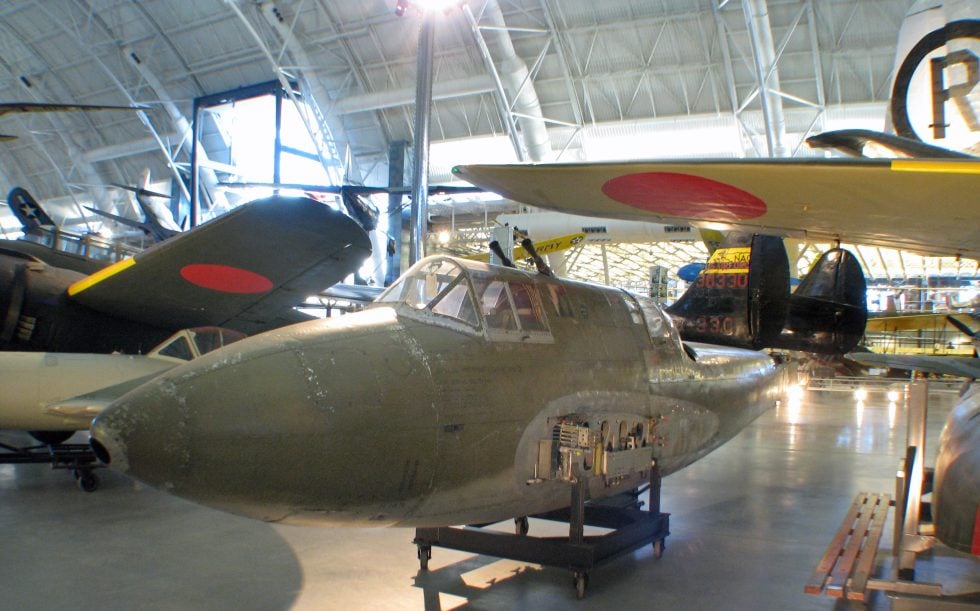
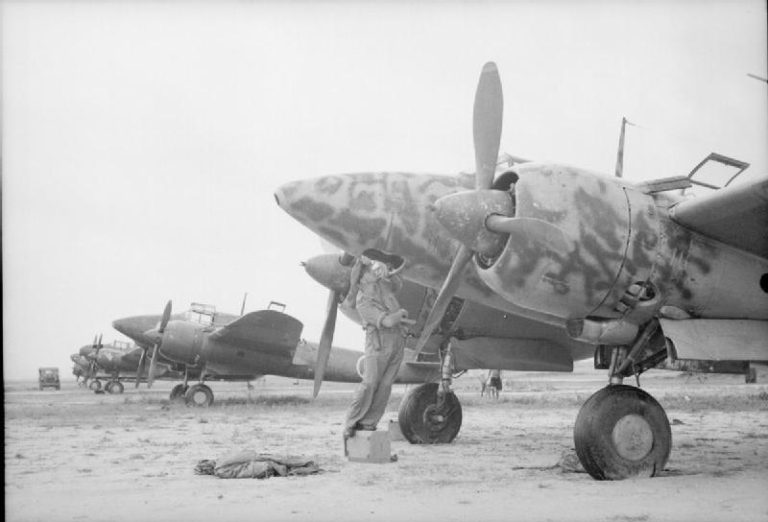
Production totals are given as 1,690 or 1,691 by Green and Swanborough, 1,701 by Francillon and 1,704 in Japanese sources; the differences are prototypes and pre-production airframes counted in or out. On survivors, the common statement that no Ki-45 survives is not quite right and the common statement that one complete aircraft survives is not right either. The National Air and Space Museum holds one airframe, brought to the United States aboard USS Barnes with about 145 other Japanese aircraft, overhauled at Middletown Air Depot and flight-tested at Wright Field and NAS Anacostia before being donated to the Smithsonian in June 1946. Its fuselage — complete with the oblique cannon mounting behind the cockpit — is on public display at the Steven F. Udvar-Hazy Center; the wings, engines and remaining components exist but are held disassembled in storage and are not exhibited. No Ki-45 anywhere is assembled, and none has flown since the 1940s. Beyond that airframe there are relics rather than aircraft: a Ha-102 engine and propeller raised from the seabed off Oarai and displayed at the Mito Tsubasa-no-To park on the site of the Mito Army Flying School, and the engine and fragments of a Toryu that rammed a B-29 over the Kanto plain, recovered from a field in Chiba prefecture. The rows of abandoned 71st Independent Chutai machines photographed at Kallang in Singapore in September 1945 were all scrapped.
From heavy-fighter dream to last-ditch night defender
The requirement
The Imperial Japanese Army calls for a long-range twin-engine heavy fighter in the class of the Bf 110. Kawasaki takes on the design.
First flight
The original Ki-45 flies in January but proves underpowered and unreliable with its Nakajima Ha-20 engines.
The KAI redesign
A thoroughly reworked, re-engined Ki-45 KAI flies, finally delivering the performance the Army wanted.
Into service
The Toryu enters service and sees first combat over Burma, then spreads to China, New Guinea and the Philippines.
The B-29 arrives
XX Bomber Command opens the raids on Japan; Toryus scramble against the Superfortress and the type shifts to home defence.
The first ram over Japan
Sergeant Shigeo Nobe of the 4th Sentai deliberately rams a B-29 during the Yawata raids — credited with bringing down two bombers.
Night hunter
KAI Hei night fighters with oblique 20 mm cannon defend the Home Islands; dedicated ramming flights are formed as losses mount.
War’s end
Production ends with roughly 1,700 built. Today a single complete Ki-45 survives, preserved at the Smithsonian.
From the cockpit: twelve Toryu stories
The destroyer Japan wanted
The Army watched Europe field twin-engine heavy fighters and demanded one of its own.
Read the full story
The engines that never delivered
The first Ki-45 was underpowered and unreliable — and nearly killed the whole programme.
Read the full story
Reborn as the KAI
A near-total rework with Mitsubishi Ha-102 radials turned a failure into a workhorse.
Read the full story
First blood over Burma
The Toryu opened its account in the skies over Burma in 1942.
Read the full story
Hunting the Liberator
The heavy, steady Toryu proved a capable destroyer of Allied four-engine bombers.
Read the full story
Ships, tanks and troops
Beyond air combat, the Toryu strafed, bombed and struck shipping.
Read the full story
When the B-29 came
With no purpose-built night fighter ready, Japan turned to the Toryu.
Read the full story
Guns that fired upward
The night-fighter Toryu carried oblique cannon to strike bombers from below.
Read the full story
The first ram over Japan
On 20 August 1944, Sergeant Shigeo Nobe deliberately rammed a B-29.
Read the full story
Captain Kashiide’s war
The Toryu’s leading B-29 killer flew with the 4th Sentai.
Read the full story
The ramming flights
As losses mounted, whole flights were told to ram.
Read the full story
Sole survivor
Of roughly 1,700 Toryu, exactly one complete aircraft survives.
Read the full story
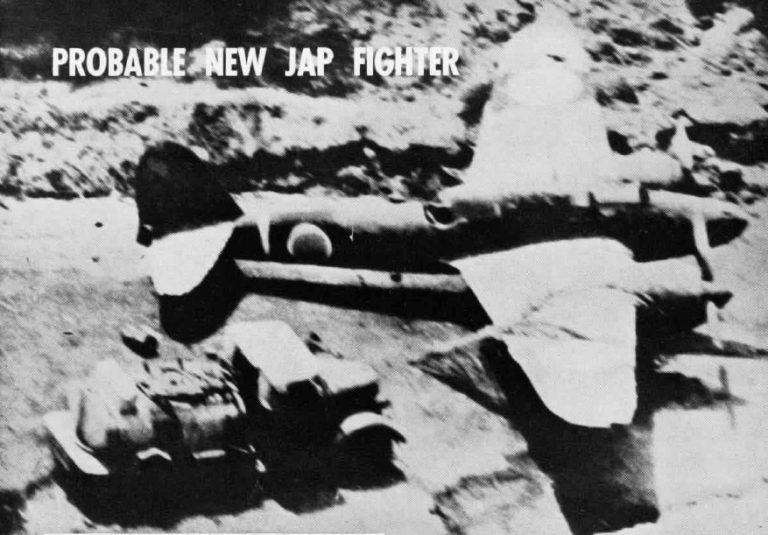
The Ki-45 Toryu in pictures
The Ki-45 Toryu in motion
AeroDepth: a 25-minute documentary on the Kawasaki Ki-45 Toryu — its troubled birth, its many roles and its final, desperate service as a night hunter of the B-29 — from an established aviation-history channel.
Where the Ki-45 Toryu flew
The Ki-45 Toryu: the score that defines it
The Toryu’s record is not a tidy tally of dogfight kills but a story of a heavy fighter pressed into ever-harder work — from bomber-hunting over Asia to the night defence of Japan itself. Its most famous moments came against the B-29, in the dark and, when all else failed, by ramming.
Compare the combat record of every military aircraft. B-29 “kill” figures for the type are claims and generally exceed confirmed Allied losses.
Everything people ask about the Ki-45 Toryu
Can I fly in a Kawasaki Ki-45 Toryu?
What does “Toryu” mean?
Why was the Ki-45 called “Nick”?
Was the Ki-45 a good night fighter?
Did Ki-45s really ram B-29s?
What were the oblique cannon?
How many Ki-45s were built, and do any survive?
You can’t fly the Kawasaki Ki-45 Toryu.
These, you can.
Some legends only live in museums — others are fuelled and waiting. MiGFlug has put civilians in real military jet cockpits since 2004.
 Fly the L-39 AlbatrosThe world’s most-flown jet trainer — aerobatics included
 Fly the F-104 Starfighter“The missile with a man in it”
 Fly the MiG-21The Cold War’s most-produced jet
 Fly the T-33 Shooting StarAmerica’s first jet trainer
 Fly the DH VampireA piece of early jet history
 Fly the S.211Agile Italian jet trainer
 Fly the MB-326The classic Aermacchi jet
 Fly the MiG-15The Soviet legend of the Korean War
Continue the tour
Every fact, checked
- Smithsonian National Air and Space Museum — Ki-45 KAI Hei “Toryu”Primary reference for the sole surviving airframe, its armament and the “Dragon Killer” translation.
- History of War — Kawasaki Ki-45 ToryuDevelopment history, the troubled Ha-20 origin, the KAI redesign and variant armament.
- Pacific Wrecks — Sgt Shigeo NobeThe 20 August 1944 ramming over Yawata, and its two credited B-29s.
- Aviation of Japan — 53rd Hiko SentaiThe night-fighter Sentai, home-defence organisation and ramming flights.
- Military Factory — Kawasaki Ki-45 ToryuSpecifications, engines, production and variant data.
- Aeropedia — Kawasaki Ki-45 ToryuProduction figures and the Kashiide B-29 claims.
- National Museum of the US Air ForceReference for the B-29 strategic campaign the Toryu was raised to counter.
- René J. Francillon — Japanese Aircraft of the Pacific WarThe standard scholarly reference behind the differing ~1,675–1,701 production totals.