
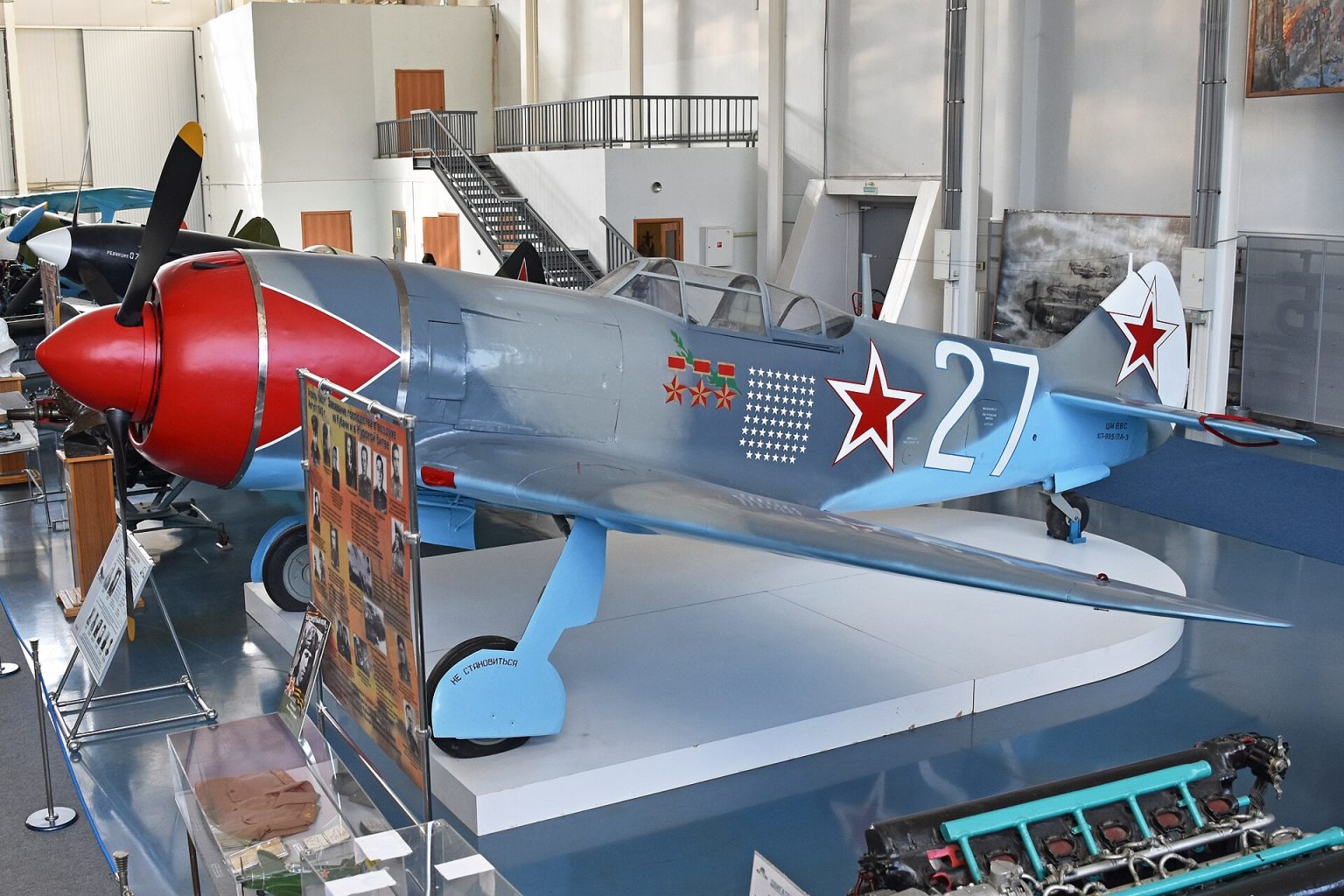
Lavochkin La-7
The wooden fighter that mastered the Eastern Front
A radial-engine air-superiority fighter refined from the wooden LaGG-3 and La-5 — fast and deadly at low altitude, built largely of wood to beat a metal shortage, and the mount of the top Allied ace of the war, Ivan Kozhedub.
The wooden fighter that caught up with Germany
The La-7 began life as one of the least-loved aircraft in the Soviet inventory. Its ancestor, the LaGG-3 of 1940, was an all-wooden fighter built around a Klimov inline engine — sturdy but heavy and underpowered, so disliked that pilots joked its initials stood for a “varnished, guaranteed coffin.” Semyon Lavochkin’s design bureau was close to losing its production lines. The rescue came in late 1941, when the team grafted a bulky Shvetsov M-82 (ASh-82) 14-cylinder radial onto the LaGG-3 airframe in place of the inline. The transformation was dramatic, and the result became the La-5.
The La-5 reached the front around the fighting at Stalingrad in 1942; the fuel-injected La-5FN followed in 1943 and, at Kursk, showed it could trade blows with the Messerschmitt Bf 109G and Focke-Wulf Fw 190. Lavochkin then cleaned up the design — better aerodynamics, lighter structure with metal wing spars where scarce aluminium allowed, and the more powerful ASh-82FN — to produce the La-7 in 1944. It is widely rated one of the best Soviet piston fighters of the war: exceptional at the low and medium altitudes where most Eastern Front air combat took place, and a match for late-war German types down low, if less commanding at high altitude.
Above all, the La-7 is bound to one man. Ivan Kozhedub, the highest-scoring Allied ace of the war with around 62 victories, flew La-5s and La-7s throughout — scoring his final 17 kills in the La-7 and, on 19 February 1945, reportedly downing a Messerschmitt Me 262 jet. He was never shot down. Roughly 5,750 La-7s were built before production ended in 1946, most of them still largely of wood; postwar, Czechoslovakia was among the few foreign operators before jets swept the type aside in the early 1950s.
01The Lavochkin La-7’s wooden airframe: how a metal shortage shaped a front-line fighter
The Soviet Union entered the war desperately short of aviation-grade aluminium, so its fighter designers leaned on what they had in abundance: wood. The LaGG-3 and the La-5/La-7 that grew from it used delta-drevesina (“delta wood”) — birch plywood impregnated with resin and compressed into a tough, fire-resistant material — for much of the structure, with fabric-covered control surfaces. The approach made the fighters cheap and easy to mass-produce in factories staffed largely by unskilled labour, and it kept scarce metal for engines and other aircraft.
As the aluminium supply eased later in the war, Lavochkin worked metal back into the design — notably metal wing spars on the La-7 — which cut weight and improved strength. But the La-7 remained, to the end, a substantially wooden aeroplane. Its wartime record is a reminder that a fighter’s materials matter less than how well the whole package is matched to the fight it has to win.
What makes it special
Radial power and low-altitude punch
At the La-7’s heart is the Shvetsov ASh-82FN, a fuel-injected 14-cylinder air-cooled radial of about 1,850 hp. Air-cooling made it robust and hard to kill — no vulnerable coolant system to be shot away — and it gave the light airframe roughly 661 km/h plus strong climb and acceleration low down, exactly where most Eastern Front dogfights were decided.
A fighter built mostly of wood
Facing a chronic aluminium shortage, Lavochkin built the La-5/La-7 largely from resin-impregnated birch plywood (“delta wood”) and fabric, adding metal spars on the La-7 as supplies improved. Cheap, robust and easy to mass-produce, the design let Soviet factories turn out roughly 5,750 La-7s in two years of war.
Cannon firepower — and Kozhedub’s record
The La-7 carried its guns in the nose: usually two 20 mm ShVAK cannon, with a heavier three-cannon version using 20 mm B-20 guns built in smaller numbers. Concentrated, hard-hitting and accurate, that armament served the war’s top Allied ace, Ivan Kozhedub, through his final and deadliest campaigns.
02The La-7’s ASh-82FN radial: why air-cooling suited the Eastern Front
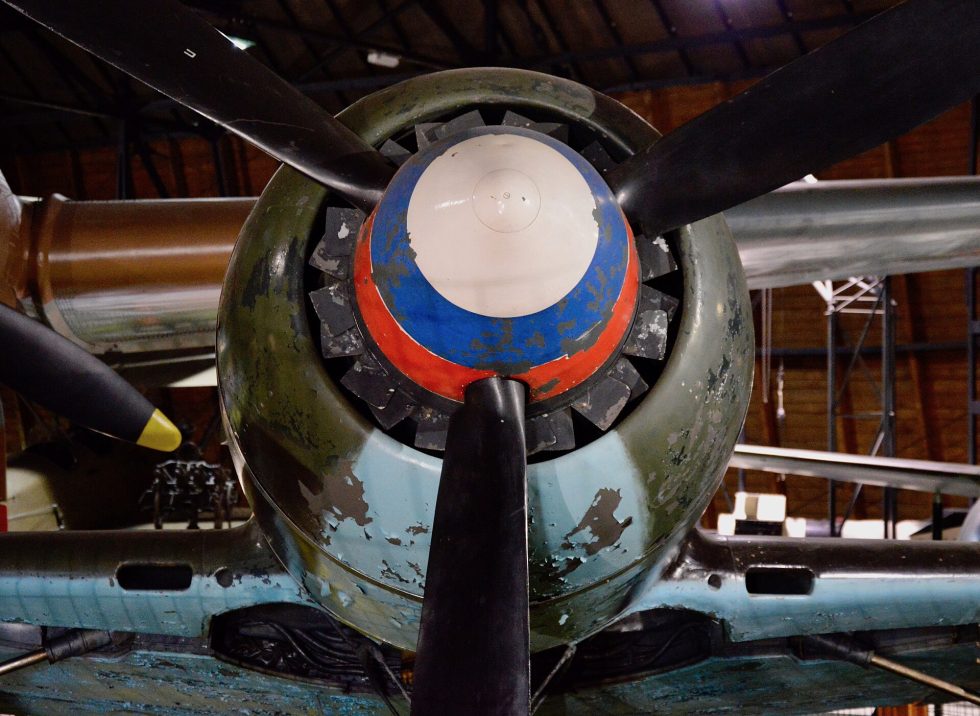
Most of the Luftwaffe’s single-seat fighters on the Eastern Front used liquid-cooled inline engines whose radiators and coolant lines were a battle-damage weak point. The La-7’s ASh-82FN radial had no such plumbing: an air-cooled engine could keep running with cylinders shot out, a real advantage in the low-level, close-range brawls typical of the front. Fuel injection (the “FN”) let it perform manoeuvres that would starve a carburetted engine, and its power-to-weight suited a light fighter optimised for the thick air below about 5,000 metres. The trade was drag and forward view over a slim inline — a price the Lavochkin design absorbed well.
03The Lavochkin La-7’s guns: two cannon, sometimes three
Standard La-7s were armed with two synchronised 20 mm ShVAK cannon firing through the propeller arc — lighter than some rivals but concentrated on the centreline, which made aiming simple and hits telling. A three-cannon variant armed with the newer 20 mm Berezin B-20 was produced in more limited numbers, boosting weight of fire at some cost in complexity. Sources differ on exactly how many three-gun aircraft were built, so the type is best described as carrying two to three 20 mm cannon depending on the batch.
Full specifications
Baseline note: the figures below describe the series La-7 of 1944–45 (works type 45, factory No. 21 at Gorky and No. 381 in Moscow) with the standard two-ShVAK armament — the aeroplane that actually flew the last year of the war. Deltas for the La-5 "etalon 1944" prototype that became the La-7, and for the three-cannon B-20 aircraft of 1945, are given in grey. The distinction matters more here than on most types: the prototype and the production article were not the same aeroplane. TsAGI’s clean-up bought some 60–80 km/h in the laboratory, and series manufacture gave roughly half of it back, so a figure quoted without saying which airframe it came off is close to meaningless. Where Soviet state-trial, troop-trial and Western compilation figures disagree, all are given.
Dimensions & weights
- Crew
- 1
- Length
- 8.67 m (28 ft 5 in), identical to the La-5FN. The La-7 is the same fuselage mould with the plumbing rearranged inside it
- Wingspan
- 9.80 m (32 ft 2 in) — unchanged since the LaGG-3 of 1940, four years and three engines earlier
- Height
- 2.54 m (8 ft 4 in); some Russian tables round to 2.60 m (8 ft 6 in)
- Wing area
- 17.59 m² (189.3 sq ft). The 17.50 m² usually printed for the La-5 is the same wing measured to a different convention at the reshaped root fillets, not a larger one
- Wing section
- NACA 23016 at the root, NACA 23010 at the tip, dihedral 5°, with automatic duralumin slats on the outer leading edges. The La-7 did not have a laminar-flow wing. That belongs to the experimental "120" and "126" and is one of the most persistent errors written about the type
- Empty weight
- 2,605 kg (5,743 lb) in Russian tables; Gordon gives 2,638 kg (5,816 lb)
- Normal take-off weight
- 3,265 kg (7,198 lb). GKO decree No. 5404 of 15 March 1944 set the target at 3,250 kg (7,165 lb) and it was practically met; Czech and Western tables print 3,240–3,315 kg (7,143–7,308 lb). Three-cannon aircraft were 65 kg (143 lb) heavier
- Maximum take-off weight
- 3,400 kg (7,496 lb) with two 100 kg bombs on the wing racks
- Internal fuel
- 466 l (~103 imp gal) in three protected tanks: one in the centre section and two in the outer wing panels. This is a quiet but real gain. Slimmer metal spars freed the outer-wing volume the La-5 had given up when its outer tanks were deleted to save weight in 1942
- Wing loading
- 186 kg/m² (38.1 lb/sq ft) at normal take-off weight
- Power loading
- 1.77 kg/hp (3.90 lb/hp) — very slightly worse than the La-5FN’s 1.71. The whole point of the La-7 is that it was faster on the same engine and a marginally worse power loading, because it was cleaner
- Structure
- Wooden semi-monocoque fuselage of oval section: four pine longerons and fifteen frames reinforced with delta wood, birch-veneer skin, a welded steel truss carrying engine and guns. Wing centre section and outer panels each built on two metal spars with ten ribs, wooden stringers and veneer skin. The metal spars saved roughly 100 kg (220 lb) in the spars alone and, being slimmer, gave back tankage — the single most productive change in the programme
- Armour
- 8.5–10 mm (0.33–0.39 in) plate behind the seat depending on the year of manufacture, and 55 mm (2.2 in) armour glass inside the windscreen
Performance
- Maximum speed at altitude
- 658 km/h (409 mph) at 5,900 m (19,360 ft), measured on series aircraft during troop trials in autumn 1944. The 680 km/h (423 mph) at 6,000 m so often printed is the "etalon 1944" prototype; three-B-20 aircraft are usually given 661 km/h (411 mph)
- Maximum speed at sea level
- 578 km/h (359 mph) at rated power and 644 km/h (400 mph) on boost, on 63 GIAP aircraft. The prototype made 597 km/h (371 mph). Series machines ran about 40 km/h (25 mph) below the prototype, blamed on poor ASh-82FN finish, badly made propeller blades and inadequate fuselage sealing — the factories undoing much of what TsAGI had won
- Rate of climb
- 21 m/s (4,130 ft/min) at sea level on the prototype; 1,111 m/min (18.5 m/s, 3,645 ft/min) in Russian series tables; 15.7 m/s (3,090 ft/min) in Gordon. Climb was the La-7’s decisive advantage over both German fighters below 5,000 m
- Time to 5,000 m (16,400 ft)
- 4 min 57 s on troop trials. The prototype reached 4,000 m (13,120 ft) in 3 min 24 s
- Service ceiling
- 10,750 m (35,270 ft) in most Russian tables. Other Russian tables give 11,300 m (37,070 ft) and Gordon 10,450 m (34,280 ft). An 850 m spread on a single figure is a fair measure of how loosely this type is documented
- Range
- 635 km (395 miles) on internal fuel; 665 km (413 miles) is given for the three-B-20 aircraft. No drop tank was ever fitted to an La-7
- Sortie endurance
- 30 to 40 minutes of patrol over the battlefield, with a whole sortie running to about 1 h 10 min — the figures the 63 GIAP troop-trial report actually recorded, and better than the La-5FN’s 40 minutes because the outer-wing tanks had come back
- Turn time
- 20 s for a full circle at 1,000 m (3,280 ft) in troop trials; Russian tables give 20.5 s and the usual quoted band is 19–21 s. That is about level with the Bf 109G and comfortably inside the Fw 190A
- Combat turn
- 1,400 m (4,590 ft) gained in a climbing combat turn. This one number is why the covering group no longer needed to stack high above the striking group, and why Soviet tactics changed when the La-7 arrived
- Dive behaviour
- At full throttle from 550–600 km/h (342–373 mph) the aeroplane was sucked into the dive and had to be pulled out until speed fell back to 400–450 km/h (249–280 mph); one LII pilot reported heavy buffet from 550 km/h. Not a fault that killed anyone, but not a machine to chase an Fw 190 downhill in
- Stability and handling
- The honest verdict, from LII test pilots flying aircraft No. 45210139 in June 1944: longitudinal stability sharply reduced against the La-5, elevator over-light with almost no force gradient, so that turns had to be flown by feel of g rather than stick load — "in pitch it has become like an I-16". Directional stability insufficient, a larger fin asked for, and a marked tendency to wander on the landing run. The new wing-root fillets were the pilots’ chief suspect: the aerodynamic clean-up bought speed and cost stability
- Slats
- Automatic and, on early aircraft, badly made: the left slat on No. 45210139 opened from 300–320 km/h (186–199 mph) and at any speed under g, which the test pilot said made a best-rate turn impossible. Non-synchronous slat extension was still on the defect list in November 1945
Propulsion & systems
- Engine
- One Shvetsov ASh-82FN 14-cylinder two-row air-cooled radial with direct fuel injection and a two-speed supercharger, 41.2 l (2,514 cu in), 1,260 mm (49.6 in) in diameter. The same engine as the La-5FN. Nothing about the La-7’s advantage comes from more power, which is exactly what makes it interesting
- Power ratings
- The engine in the state-trials aircraft — series 3 No. 8213374 from factory No. 19, built 6 June 1944 — was logged at 1,855 hp (1,383 kW) at 2,560 rpm and 1,200 mmHg boost in low blower, 1,545 hp (1,152 kW) rated at 2,400 rpm in low gear and 1,210 hp (902 kW) in high gear. The round 1,850 hp of the tables is a take-off rating, not a combat one
- Propeller
- VISh-105V-4 three-blade constant-speed unit of 3.10 m (10 ft 2 in) diameter using the TsAGI V-4 blade profile, chosen because the tips ran close to sonic speed
- Cowling and sealing
- The heart of the programme. Complete sealing of the cowling, every gap closed and every pipe penetration of the firewall made tight; an individual exhaust stack for each cylinder in place of the collectors; the number of access covers cut and the side cooling flaps reduced in size. On the La-5, sealing alone had been worth 24 km/h in the TsAGI full-scale tunnel. Cowl-flap operation also became far lighter than on the La-5
- Oil system
- Cooler type No. 293 moved out of the chin position under the cowling to a tunnel under the fuselage behind frame 5, with its air taken in the centre-section leading edge: 7 dm² frontal area, 8 m² (86 sq ft) of cooling surface, 12 l (2.6 imp gal) capacity, 2.8 dm² inlet. This relocation, more than anything else, is how you tell an La-7 from an La-5FN in a photograph
- Engine air intakes
- Carburettor and supercharger intakes moved from the top of the cowling first to its underside and then into the wing roots. This cleaned the nose, markedly improved the view forward and on landing, and — in theory — supplied bleed air to ventilate the cockpit
- Fuel system
- Three protected tanks totalling 466 l, one in the centre section and one in each outer panel, on B-78 leaded petrol. Filters were added in the supercharger and oil-cooler intakes from aircraft No. 38102663 in May 1945
- Cockpit environment
- The La-7’s worst fault and the one its own designer named first. LII measured 65°C (149°F) in the cockpit on boost — the thermometer’s scale stopped there and the pilot judged the true figure nearer 70°C — and reported that the control stick grew hot enough to burn a gloved hand. Poor sealing let exhaust gas into the cockpit in quantity, with a permanent smell of burnt rubber. Of the twelve defects listed in the 1945 GKO decision, Lavochkin told the NKAP meeting of 14 November 1945 that cabin heat was the chief one; nine of the others were cured quickly, this one never entirely was. After further TsAGI tunnel work the best achieved was +15°C to +30°C, against about 50°C on the earlier machines
- Engine controls
- Throttle, propeller pitch, mixture, cowl flaps and supercharger gear all on separate levers. LII pilots asked for the pitch lever to be moved up beside the throttle and both to be lengthened so that small changes of boost and rpm could be made in a fight. German fighters with the BMW 801 did all of it from the Kommandogeraet on one lever, and this remained the La-7 pilot’s largest workload penalty
- Electrical and radio
- Single-wire electrical system, adopted as a weight saving; RSI-4 set with both receiver and transmitter moved back into the rear fuselage. No artificial horizon and no radio semi-compass as standard — 63 GIAP asked for both in October 1944, and they were still being specified as options a year later
- Pneumatics and undercarriage
- An 8 l bottle at 140–150 atm (2,060–2,200 psi) worked the wheel brakes, gun charging, bomb release and emergency undercarriage lowering; mains retracted inwards hydraulically, tailwheel retractable. Russian accounts say the prototype’s main legs were shortened by 80 mm (3.1 in); Gordon says the shock struts were lengthened. Both cannot be right and no source reconciles them
- Unit cost
- 310,000 roubles on average in the second quarter of 1945 for an La-7 built by factory No. 99 at Ulan-Ude, less the engine
04The Lavochkin La-7’s cost: why no dollar price exists
The La-7 was a Soviet wartime state product, built to a central plan and accounted for in rubles and labour-hours rather than sold on any open dollar market. No meaningful flyaway unit price or cost-per-flight-hour figure exists in the public record, and any precise dollar number attached to the type should be treated as a modern estimate rather than a sourced fact. What the record does show is the design intent: a fighter cheap and simple enough to build in the thousands from wood, at a time when every ton of aluminium was needed elsewhere.
Armament & payload
The La-7 was designed for three cannon and fought the war with two, because the third gun was not ready when the aeroplane was
The La-7 was designed around three cannon and spent almost its whole career carrying two. The 1944 standard-setter flew with three synchronised UB-20s above the engine, but when NII VVS recommended the type for production on 15 March 1944 it added a condition: build it with the serial armament, two ShVAK with 340 rounds, because the new Berezin gun’s trials were not finished. They were not finished for another six months. The first three-gun tests in June and July 1944 found that spent cases thrown clear of the wing fillets were damaging the outer wing panels and the tail, and only after the ejection chutes were rerouted under the centre section did the installation pass, in September. Series production of the three-cannon aircraft began in 1945 and only at Moscow factory No. 381, which built 368 of them; factory No. 21 at Gorky, which made about four out of every five La-7s, never converted. The result is a fighter that out-flew the Fw 190A-8 and could not reliably out-shoot it — Soviet pilots opening at 50 to 100 m and still not bringing one down in a burst. Round counts in particular vary by source and by series: 170, 180 and 200 rounds per gun are all printed for the ShVAK, and 100 and 130 for the B-20. The 1945 service manual is followed here.
Gun
- Standard fit: two synchronised 20 mm ShVAK of the SP-20 pattern on the steel truss above the cylinders, firing through the propeller disc. 340 rounds in all is the state-trials figure; 180 and 200 rounds per gun both appear in Russian tables. Cyclic rate about 800 rounds/min unsynchronised and roughly 700 through the disc; 96 g high-explosive incendiary and 96.6 g armour-piercing incendiary shells at 750–790 m/s (2,460–2,590 ft/s), the AP round good for 20 mm of plate at 100 m
- Three-cannon fit: three synchronised 20 mm Berezin B-20. The 1945 armament manual gives 750–850 rounds/min, 750–790 m/s, a gun weighing 25.5 kg (56 lb) and 2,035 mm (80.1 in) long, fed from three boxes of 130 rounds for 390 in all, pneumatic charging and electro-pneumatic firing through an ELS-1 trigger on the stick. Salvo about 3.1 kg/s against roughly two-thirds of that for the pair of ShVAK, for 65 kg of added weight
- Why most kept two: the B-20 was an unfinished weapon when the aeroplane was cleared, the case-ejection problem cost another three months, and by the time the fit was ready only one of the three factories took it up. The three-gun aircraft are recognisable by the long aerodynamic fairings along the top of the cowling
- Sighting was by PBP-1B reflector sight, which doubled as the dive-bombing sight. There was no gun camera on most aircraft, so the claims below rest on witnesses
- Roads not taken: two synchronised 23 mm NS-23 were tested at the air armament proving ground late in 1944 by pilot P.V. Romanov — 544 rounds/min, a shell of just over 200 g at 688–732 m/s (2,260–2,400 ft/s), 60 kg installed, and the first synchronised gun of that calibre anywhere in the world. Three Shpitalny SSh-20, lighter than the ShVAK and with two-sided belt feed for half again the salvo weight, were rejected by the customer in flight test
Air-to-air
- No guided weapon of any kind, and none proposed. The whole air-to-air system is two or three cannon, an RSI-4 radio, a PBP-1B sight and the pilot’s eyes
- First combat 24 June 1944 near Baranovichi: pilots of 176 GIAP claimed two Fw 190s for no loss. New Lavochkins went to the best regiments first, so the type met the Luftwaffe’s better formations, JG 54 among them
- Troop trials, 63 GIAP on the Baltic Front, 15 September to 15 October 1944, during the Riga operation: 116 group sorties, 47 encounters, 268 enemy aircraft sighted of which 254 were Fw 190s, 39 combats. Fifty-five claimed — 52 Fw 190s and three Bf 109Gs — for eight La-7s lost, four of them in combat, three pilots killed. Every one of the four non-combat losses was an engine failure, which is the other half of the story
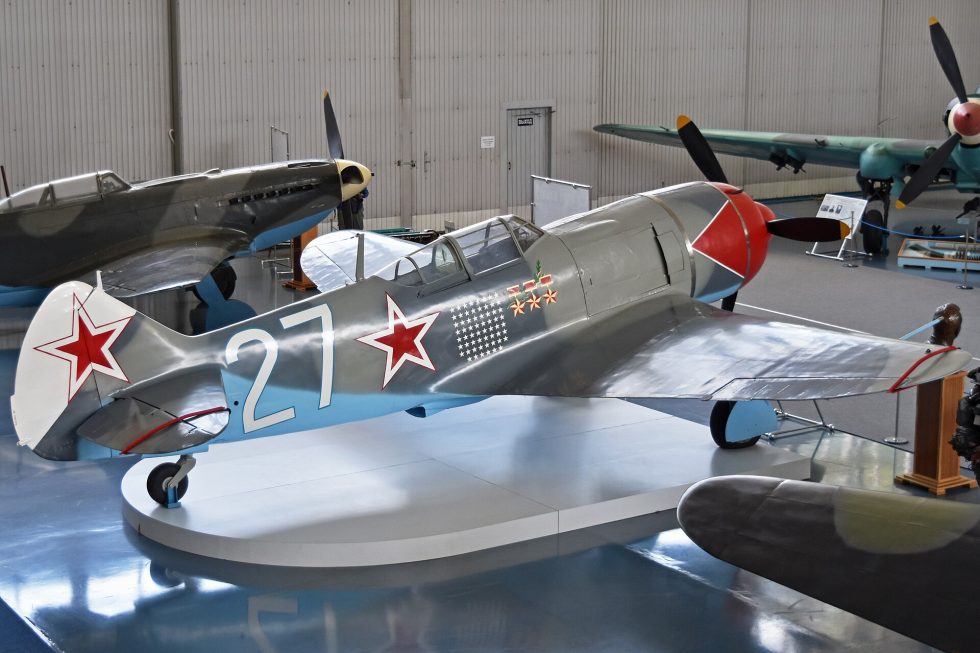
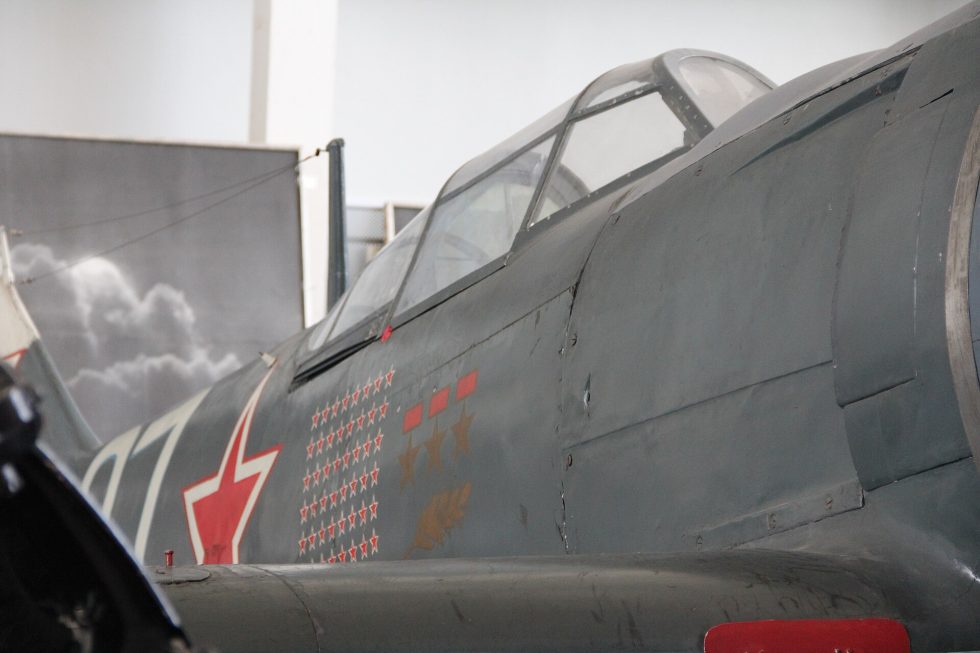
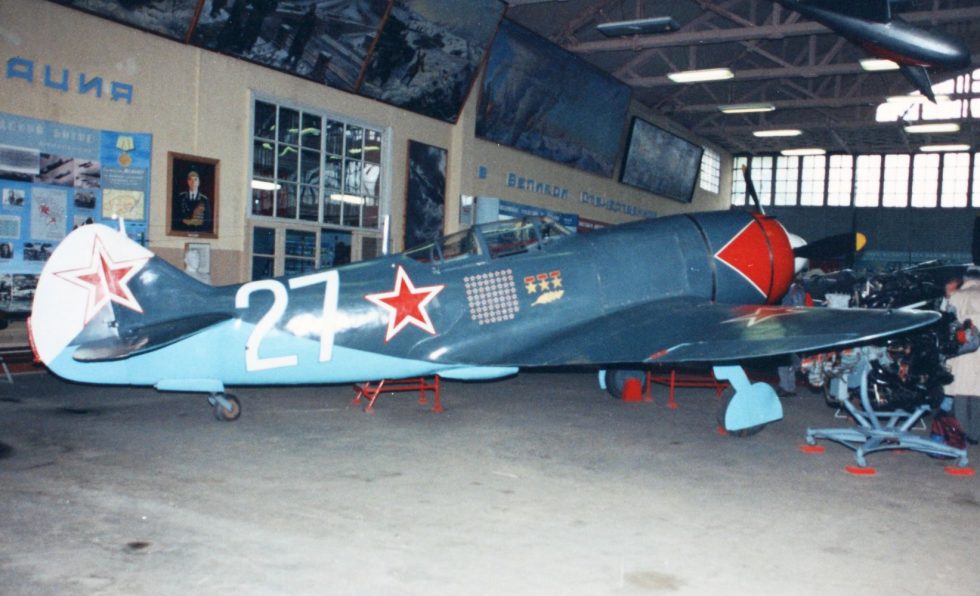
- Ivan Kozhedub joined 176 GIAP, a dedicated free-hunting regiment, in August 1944 and flew La-7 White 27. His first La-7 claim is dated 22 September 1944 and his last two on 17 April 1945; seventeen or eighteen of his 64 credited victories were scored on the type, depending on which tally is used
- What it could not do: above about 6,000 m it fell away sharply, and 179 GIAP admitted in December 1944 that they had never taken one higher than 5,000 m. It carried no drop tank, and the Fw 190A-8 threw roughly twice the weight of fire
Air-to-surface guided
- None. No Soviet fighter of the Great Patriotic War carried a guided air-to-surface weapon and none was ever proposed for the La-7
- The card is kept rather than dropped because the omission is worth stating plainly. Everything the La-7 delivered against a ground target it delivered by pointing the aeroplane at it, aimed through the same PBP-1B used for the guns
- The experimental work done on La-7 airframes after 1944 — liquid rocket, pulsejets, ramjets — was all about speed, never about a stand-off weapon
Bombs
- Two underwing racks, each taking a 100 kg store: FAB-50 and FAB-100 high-explosive or ZAB-50 and ZAB-100 incendiary bombs. Maximum external load 200 kg (440 lb)
- Carried rarely. The troop-trial report listed bombing among the type’s tasks with the qualification "in individual cases", and that is exactly how it was used
- The La-7 went to Guards fighter regiments to clear the sky, not to work the ground. The Il-2 did that underneath it, and the La-7’s job was to be overhead when the Fw 190s arrived
- The racks cost speed, and after the series aircraft came out 40 km/h below the prototype there was no speed to spare
Rockets
- None as an air-to-ground weapon. Unlike the LaGG-3 and the I-16 from which the line descends, the La-7 carried no RS-82 rails, and this is easy to get wrong
- The two wing hardpoints were stressed and plumbed for bombs only. By 1944 Soviet fighter practice had abandoned unguided rockets for air combat as a waste of drag
- Rocketry on the La-7 was propulsion instead: a Glushko RD-1 liquid-fuel motor in the tail of the La-7R, Chelomey D-10 pulsejets under the wings of the La-7D, and Bondaryuk RD-430 ramjets on the La-7S. All three added speed while running and cost far more than they gave once shut down
Pods & other stores
- Nothing. No gun pods, no reconnaissance pods and no camera installation on the production fighter
- Above all, no drop tank — never trialled, never standardised. 466 l internal bought 30 to 40 minutes over the battlefield, which was enough for the Soviet way of using fighters and would have been useless for anyone else’s
- Equipment asked for and only partly delivered: 63 GIAP requested an artificial horizon for cloud flying and a radio semi-compass for navigation in October 1944. The RPKO-10M semi-compass, an AFA-IM camera, a PAU-22 gun camera, an artificial horizon and a course indicator were all specified for the La-7UTI in 1945 rather than for the fighter
- The one addition that mattered to the fighter went in through the intakes: dust filters for the supercharger and oil cooler from aircraft No. 38102663 in May 1945, and cockpit ventilation and canopy demisting introduced after trials of No. 38101356 in March and April 1945
Three typical loadouts
- Free hunt, 176 GIAP, winter 1945
- Clean wing, 340 rounds of 20 mm, full 466 l internal. A pair working at 2,000–4,000 m near the front line with no assigned task but to find something. This is the loadout Kozhedub was flying over the Oder in February 1945, and the one on which the type’s reputation rests.
- Cover of ground troops and bombers, 63 GIAP, autumn 1944
- Clean wing, guns only, 30 to 40 minutes on station and about 1 h 10 min for the whole sortie. Patrolling was deliberately flown fast and with height variation to deny the Germans surprise, coordinated by a radio direction station on the battlefield — the tactical change the La-7’s climb made possible.
- Escort and opportunist bombing
- Clean or with two FAB-100 on the wing racks, escorting Il-2s at an average 300–350 km/h for 30 to 40 minutes, the covering section standing off outside the flak and engaging the moment German fighters appeared. Two hundred kilogrammes of bombs is trivial by Western standards; it was never what the aeroplane was for.
Sourcing caveat: gun fits, round counts and sight types changed between factories and series and are recorded inconsistently in NII VVS reports, factory documents and post-war compilations. Figures here follow the 1945 Voenizdat instruction on La-7 armament compiled by the GK NII VVS armament test directorate, the state-trial report on the "etalon 1944", and the airwar.ru and Yakubovich accounts where those agree. Where they do not, the disagreement is stated rather than resolved.
Variants
Every La-7 variant is the same wooden airframe pushed further, and the two that mattered were a gun fit and a trainer
The La-7 is not a new aeroplane and never pretended to be. It is a 1940 wooden airframe, already re-engined once in 1942, taken apart in a wind tunnel and put back together with every avoidable source of drag and weight removed. That makes it the clearest case study in the war of how much can be had from an existing design without a new engine — and, in its production history, of how easily a factory can give it back.
The programme ran in two stages. First a flying laboratory: La-5FN No. 39210206, rebuilt by the bureau with TsAGI on complete cowling sealing, individual exhaust stacks, a rearranged centre section and the oil cooler moved aft behind frame 5. It made 684 km/h at 6,150 m, 64 km/h faster than a production La-5FN, and then burned in the air on 10 February 1944, LII pilot N. Adamovich taking to his parachute. Second the standard-setter, the La-5 "etalon 1944", which added metal wing spars, intakes in the wing roots, reshaped fillets, fewer cowling covers and smaller cooling flaps, the radio and air bottle moved aft and a single-wire electrical system. Each change was small. Together they were worth some 80 km/h at sea level over the La-5FN of a year earlier, on the same engine.
The cost is visible in the same documents. Empty weight came down by 71 kg and the centre of gravity moved aft, cutting the longitudinal stability margin; LII pilots found the aeroplane close to neutral in pitch and blamed the new fillets. State trials from 16 February 1944 managed only nine flights before a connecting rod broke and then a fuselage frame failed on the taxiway, and the type was accepted anyway on 15 March. The designations below mix official marks with bureau and works numbers, which is how the Soviet record actually keeps them.
- La-5FN No. 39210206 (winter 1943–44, one aircraft)
- The flying laboratory that proved the case. Complete cowling sealing, individual exhaust stacks, rearranged centre section, oil cooler moved behind frame 5. 684 km/h (425 mph) at 6,150 m, some 64 km/h (40 mph) better than a production La-5FN. Destroyed by an engine-bay fire on 10 February 1944.
- La-5 "etalon 1944", bureau designation La-120 (first flight 1 February 1944; one aircraft)
- Metal wing spars, oil cooler under the fuselage with its air taken in the centre-section leading edge, carburettor intakes in the wing roots, improved wing-fuselage fillets, individual exhaust stacks, fewer cowling covers and smaller side flaps, main legs shortened 80 mm, air bottle and radio moved aft, single-wire electrics, VISh-105V-4 propeller with the TsAGI V-4 blade profile, and three synchronised UB-20. Flown by LII’s G.M. Shiyanov; state trials from 16 February with engineer V.P. Alekseenko and pilot A.G. Kubyshkin. 597 km/h at sea level, 670 km/h at 3,250 m, 680 km/h at 6,000 m; 21 m/s at sea level. Accepted 15 March 1944 as the La-7. Russian sources also date the first flight to 30 January 1944.
- La-7, works type 45, two ShVAK (May 1944 – 1946; the great majority of production)
- The aeroplane that fought. Series machines came out roughly 40 km/h slower than the prototype, blamed on engine finish, propeller blade quality and fuselage sealing. Improvements were fed in through the trials of individual aircraft: No. 38101356 in March and April 1945 brought cockpit ventilation and canopy demisting, No. 38102663 in May 1945 brought intake filters. Control tests of No. 45212225 in 1945 still found a machine 28 km/h down on standard.
- La-7 with three B-20 (1945; 368 aircraft, all from factory No. 381 in Moscow)
- Three synchronised Berezin B-20 with 390 rounds, cases ejected under the centre section after the first arrangement damaged wings and tail, and long aerodynamic fairings on the cowling top. 65 kg heavier and about half again the salvo weight. Western sources date the start of production to January 1945 and Russian ones to the summer; the discrepancy is unresolved.
- La-7UTI, works type 46 (1945–47; 584 or 592 built)
- Two-seat conversion trainer: instructor’s cockpit behind the pilot’s, dual controls, right cannon, seat armour and the tailwheel retraction deleted. It failed its state trials three times. The first aircraft, No. 45211521, had a centre of gravity at 25 per cent of mean chord and lost all stick force on the approach; the second was ballasted with 25 kg of cast iron under the cowling; the fourth carried the ballast on the reduction-gear casing and was judged dangerous. Only when the oil cooler was moved under the second row of cylinders on No. 46210514 in 1946 did the balance come right, and the aircraft lost 111 kg with it. Front cockpit 28°C and rear 35°C with 10°C outside. Empty 2,625 kg, normal take-off 3,293 kg, 558 km/h at sea level and 648 km/h at height.
- La-7TK (NKAP order of 6 June 1944; ten aircraft)
- High-altitude interceptor with two TsIAM TK-3 turbochargers on the ASh-82FN. Factory trials in July and August 1944 with both ShVAK removed: 676 km/h (420 mph) at 8,000 m (26,250 ft) and a ceiling of 11,800 m (38,710 ft), a full 1,000 m above the standard aircraft. Rejected, and rightly: the state commission observed that most air combat happened between 1,000 and 5,000 m. The survivors, armed with a single ShVAK, went to a Moscow air-defence regiment.
- La-7R-1 and La-7R-2 (October 1944 – 1945; two aircraft)
- Glushko RD-1, later RD-1KhZ, liquid-fuel rocket of 300 kgf in the tail, built by the Moscow branch under S.M. Alekseev. 270 kg of red fuming nitric acid replaced the centre fuel tank and 60 kg of tractor kerosene went in the right wing, good for 3.5 to 3.8 minutes; petrol fell from 340 to 210 kg. Fifteen flights on R-1 to February 1945, nineteen on R-2 to March; speed gains of 85 and 95 km/h at 2,600–3,000 m. The motor failed in fifteen of forty-five starts, and the acid attacked the aeroplane. Flown with the rocket lit at the Tushino display in August 1946.
- La-7 with ASh-83 (August 1944 – September 1945; one aircraft)
- The ASh-83 offered only 50 hp more on take-off but better altitude performance and a combat rating. In August 1944 this aircraft became the first of the family to exceed 700 km/h (435 mph). The engine never became reliable and was cancelled. Some Western accounts describe an La-7 with the M-71; that engine belongs to the La-5 M-71F of 1943, not to the La-7.
- La-7D and La-7S (1946; two aircraft)
- Auxiliary-propulsion testbeds. The La-7D carried two Chelomey D-10 pulsejets under the wings and gained 193 km/h (120 mph) at 800 m with them running, then lost far more than that to their weight and drag once they stopped; the programme closed on 15 October 1946. The La-7S carried two Bondaryuk RD-430 ramjets and was tested from June to September 1946. Braking parachutes, later standard on Soviet jets, were also first tried on an La-7.
- S-97 and CS-97 (Czechoslovak service, 1945–50; 56 aircraft)
- The only export operator. La-7s went to the 1st and 2nd Fighter Regiments of the Czechoslovak air force, whose pilots had flown the type in Soviet service under Lieutenant-Colonel Ludvik Budin, and served until 1950, three years after Soviet withdrawal at the end of 1947. Post-war they were designated S-97, the two-seaters CS-97. Note also what did not happen: no La-7 was ever supplied to the People’s Republic of China or to North Korea. The "Chinese La-7s" of older literature are La-9s and La-11s, which those countries did receive.
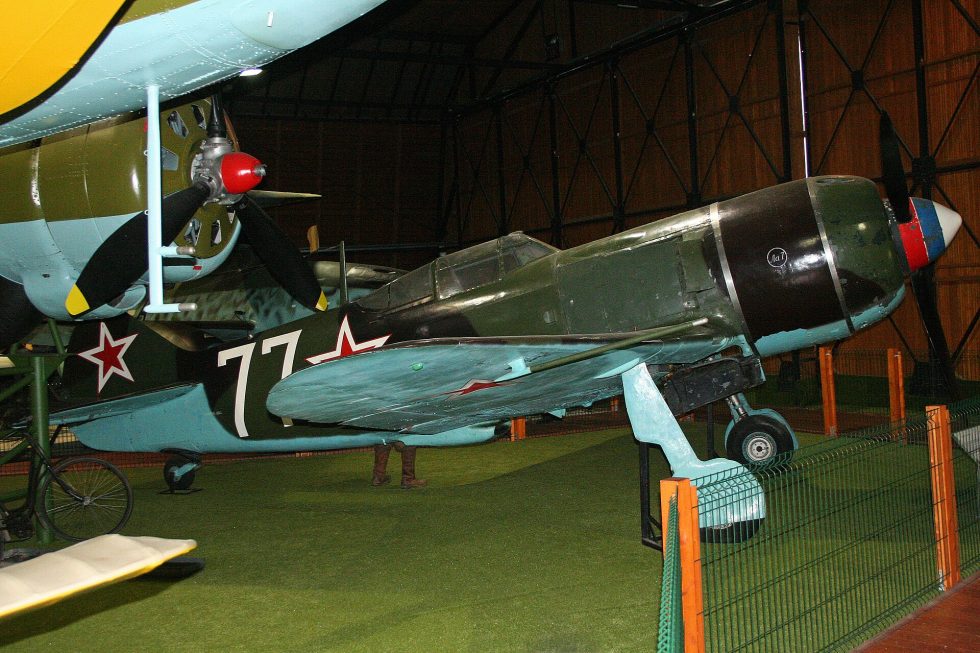
Production and survivors. Soviet factory returns give 5,753 La-7 fighters and 584 to 592 La-7UTI trainers, 6,337 aircraft in all: factory No. 21 at Gorky 4,197 fighters (1,558 in 1944, 2,586 in 1945, 53 in 1946) plus all the trainers, factory No. 381 in Moscow 1,298, and factory No. 99 at Ulan-Ude 250. A Czech compilation drawn from Leonard gives a materially different split — 4,610, 1,928 and 250 for 6,788 — and no source reconciles the two. Front-line strength was 398 La-7s on 1 January 1945, of which 107 were unserviceable, and 967 on 9 May 1945 with only 169 unserviceable; 313 went to the Manchurian campaign in August. Combat losses were remarkably light for a Soviet fighter, 115 in air combat over the whole war, about half the Yak-3’s, but accidents were not: wings shed skin panels in level flight on factory No. 21 machines from October 1944 and the VVS grounded that factory’s entire output in November until the cause was found. Survivors are two original airframes and no more. Ivan Kozhedub’s La-7 White 27, credited in Russian sources with sixteen of his victories, stands in the Central Air Force Museum at Monino outside Moscow. La-7 works No. 45210860, White 77, delivered from the Soviet Union in May 1945 to the 1st Czechoslovak Mixed Air Division, is at the Prague Aviation Museum at Kbely, owned by the National Technical Museum. Everything else displayed anywhere as an La-7 is a reproduction, for the same reason as with the La-5 and the LaGG-3: a glued birch-veneer airframe worn out or broken up after 1945 leaves nothing to recover. Post-war NATO gave the type the reporting name "Fin".
From a wooden coffin to a war-winning fighter
The LaGG-3 enters production
Lavochkin, Gorbunov and Gudkov field an all-wooden inline-engined fighter — robust but heavy and underpowered.
A radial engine changes everything
Late in the year Lavochkin grafts the Shvetsov M-82 radial onto the LaGG-3 airframe, transforming its performance.
The La-5 reaches the front
The re-engined fighter enters combat around the fighting at Stalingrad and quickly proves its worth.
La-5FN at Kursk
The fuel-injected La-5FN shows it can trade blows with the Bf 109G and Fw 190 at low and medium altitude.
The La-7 enters service
An aerodynamically refined airframe with the ASh-82FN engine reaches front-line regiments — among the best Soviet piston fighters.
Kozhedub and the jet
On 19 February, Ivan Kozhedub reportedly downs a Messerschmitt Me 262 in his La-7; the war ends with the type at its peak.
Production ends
Roughly 5,750 La-7s have been built; Lavochkin turns to the all-metal La-9 and La-11.
Postwar service
Czechoslovakia and a handful of other operators fly the La-7 until jet fighters render it obsolete.
From the front line: twelve La-7 stories
The “varnished coffin”
Pilots joked the LaGG-3’s initials stood for a lacquered, guaranteed coffin.
Read the full story
A radial where an inline had been
Fitting a bulky Shvetsov M-82 radial to the slim LaGG-3 airframe transformed it.
Read the full story
Baptism over Stalingrad
The re-engined fighter entered combat during the fighting around Stalingrad.
Read the full story
The La-5FN proves itself
The fuel-injected La-5FN could trade blows with the best German fighters.
Read the full story
The pilot who was never shot down
Ivan Kozhedub scored around 62 victories and was never lost in combat.
Read the full story
A piston fighter downs a jet
On 19 February 1945 Kozhedub reportedly shot down an Me 262 jet in his La-7.
Read the full story
Carved from wood
A chronic aluminium shortage made the La-7 a largely wooden aircraft.
Read the full story
Two cannon in the nose
The La-7 usually carried two 20 mm cannon, with a three-gun version built too.
Read the full story
Kozhedub’s golden-star La-7
His preserved La-7, side number 27, survives at the Monino air-force museum.
Read the full story
Against the Focke-Wulf
Down low, the La-7 could out-turn and out-accelerate its German rivals.
Read the full story
The Czechoslovak La-7
Czechoslovakia was among the few foreign operators after the war.
Read the full story
From La-7 to La-9 and La-11
The wooden La-7 led directly to Lavochkin’s all-metal postwar fighters.
Read the full story
The La-7 in pictures
The La-7 in motion
Video coming soon — we are sourcing a high-quality, authoritative documentary clip on the Lavochkin La-7 and will add it here.
Where the La-7 flew
The score that defines it
The La-7 was a front-line dogfighter, not a specialist, and its record is written across the Eastern Front of 1944–45 — and above all in the logbook of one pilot. Ivan Kozhedub flew Lavochkin fighters throughout his career, and the La-7 carried him through his final, deadliest campaigns to become the highest-scoring Allied ace of the war.
Compare the combat record of every military aircraft. Figures as of July 2026.
Everything people ask about the La-7
Can I fly in a La-7?
What made the Lavochkin La-7 special?
Was the La-7 really made of wood?
Who was Ivan Kozhedub?
Did a La-7 shoot down a jet?
How did the La-7 compare to the Bf 109 and Fw 190?
What is the difference between the La-5 and La-7?
Is the La-7 still flying today?
You can’t fly the La-7.
These, you can.
Some legends only live in museums — others are fuelled and waiting. MiGFlug has put civilians in real military jet cockpits since 2004.
 Fly the L-39 AlbatrosThe world’s most-flown jet trainer — aerobatics included
 Fly the F-104 Starfighter“The missile with a man in it”
 Fly the MiG-21The Cold War’s most-produced jet
 Fly the T-33 Shooting StarAmerica’s first jet trainer
 Fly the DH VampireA piece of early jet history
 Fly the S.211Agile Italian jet trainer
 Fly the MB-326The classic Aermacchi jet
 Fly the MiG-15The Soviet legend of the Korean War
Continue the tour
Every fact, checked
- Military Machine — WW2 Aircraft Encyclopedia: La-7Specifications, production numbers and combat-performance summary.
- MilitaryFactory — Lavochkin La-7Dimensions, weights, powerplant and armament reference.
- WW2-Weapons — Lavochkin La-5 & La-7Development history from the LaGG-3 through the La-5FN to the La-7.
- World War II Database — La-7Service history and technical data for the type.
- The National Interest — Kozhedub and his LavochkinsIvan Kozhedub’s career flying the La-5 and La-7.
- Russia Beyond — Ivan KozhedubBiographical detail on the top-scoring Allied ace of the war.
- Kyiv Post — Ivan KozhedubAccount of the Me 262 claim and his combat record.
- MiGFlug Afterburner — Ivan KozhedubMiGFlug’s own profile of the ace and his Lavochkin fighters.