
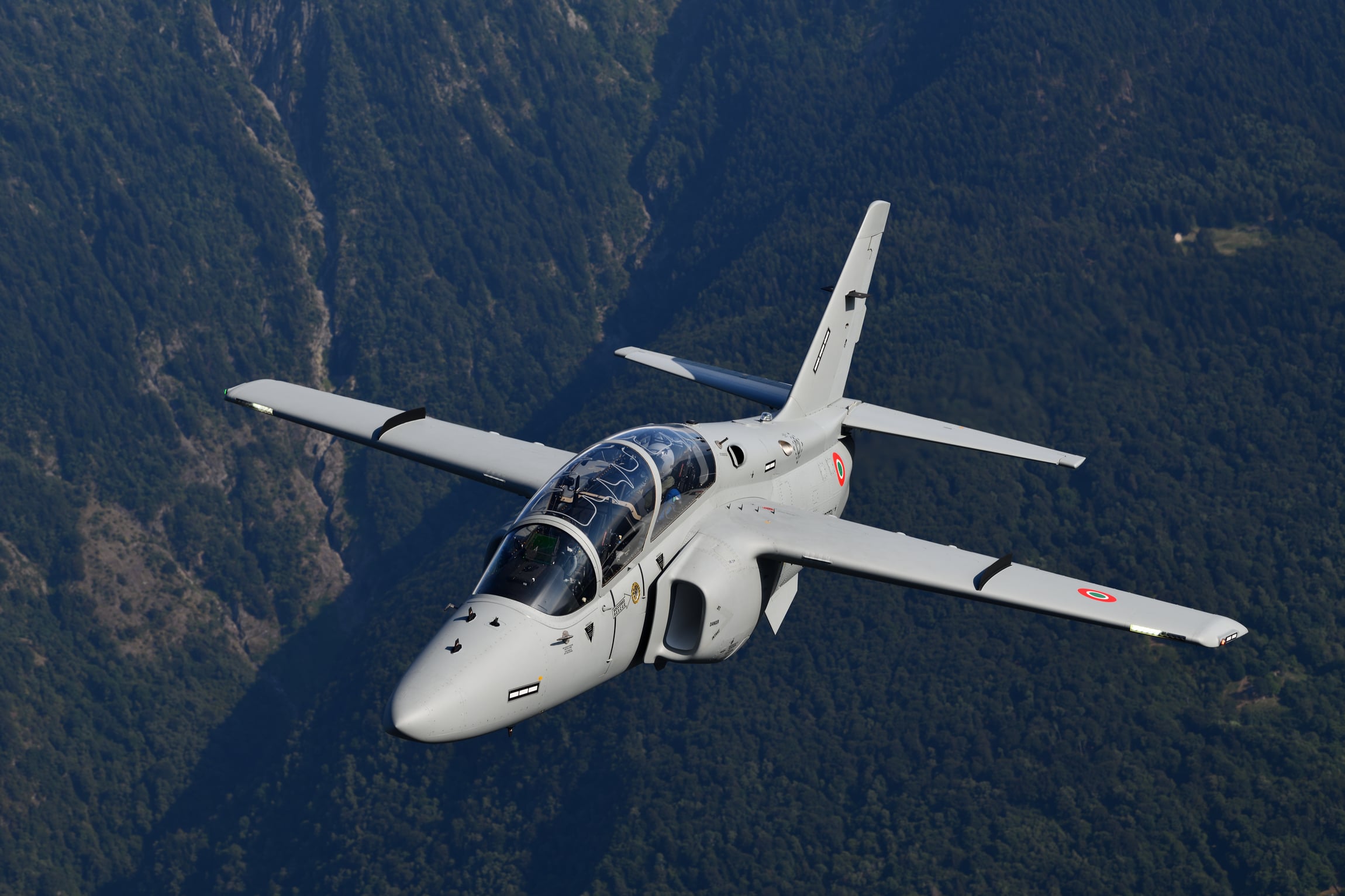
Leonardo M-345
“HET”
A modern Italian jet trainer built on one simple promise — deliver the performance of a jet at the running cost of a turboprop. Leonardo’s answer to replacing the MB-339, now in service with the Italian Air Force as the T-345A.
The Leonardo M-345: jet training on a turboprop budget
Every air force that flies fast jets faces the same expensive problem: teaching pilots to fly them. A frontline fighter burns fuel and airframe hours at a punishing rate, so the early stages of training are pushed onto cheaper aircraft. For decades that meant a split fleet — economical turboprops for the basics, then a jump to a “real” jet trainer. The Leonardo M-345 was conceived to blur that line: a genuine jet that could be flown for something close to turboprop money.
Its roots run deep into Italian training aviation. The M-345 is the latest branch of a family tree that starts with the SIAI-Marchetti S.211, a light jet trainer first flown in 1981, which Aermacchi later reworked into the M-311. Leonardo (the group that absorbed Alenia Aermacchi) took that airframe, redesigned its systems, avionics and engine, and rebranded it the M-345 “HET” — High Efficiency Trainer. The name is the entire pitch: efficiency, not raw speed, is the selling point.
The heart of that idea is a single Williams FJ44-4M-34 turbofan, deliberately run cool and unstressed for a long service life. Leonardo says the aircraft delivers a near — 50% cut in operating costs compared with the MB-339 it replaces, while still handling like a jet: fully aerobatic, +7/−3.5 g, pressurised, with a modern glass cockpit and zero-zero ejection seats. It is aimed squarely at the same market as the Pilatus PC-21, but with a turbofan rather than a turboprop.
After a first flight in its definitive configuration in December 2016, the M-345 was ordered by the Aeronautica Militare (Italian Air Force), which designates it the T-345A. It formally entered service in June 2025 at the 61st Wing at Galatina, beginning the long job of replacing Italy’s veteran MB-339 fleet. As a brand-new, low-production type, its full story is still being written.
01The Leonardo M-345’s purpose: why an air force wants a “cheap” jet
Modern pilot training is built as a pyramid. At the top sit the multi-role fighters — Eurofighter, F-35 — whose flight hours are extraordinarily expensive. Beneath them, advanced jet trainers such as Leonardo’s own M-346 teach the high-performance handling and mission systems that lead into a fast jet. But the earliest jet-familiarisation and basic phases don’t need that capability, and running an advanced trainer for them wastes money.
The M-345 is designed to fill exactly that lower tier: a real jet, so students learn jet handling early, but with acquisition and running costs kept deliberately low. Paired with the M-346 in an integrated syllabus — complete with simulators and Live-Virtual-Constructive training — Leonardo markets the two as a complete Italian training system. The M-345 is the affordable foundation that keeps the whole pyramid economical.
What makes the M-345 special
One turbofan, turboprop economics
Power comes from a single Williams FJ44-4M-34 turbofan of about 15 kN (3,400 lbf) thrust. Crucially it is run below its full rating, so it stays cool and lightly stressed — Leonardo cites a time-between-overhaul of around 3,500 flight hours and an operating cost said to be roughly half that of the MB-339 it replaces. The whole design chases running cost, not top speed.
A glass cockpit and zero-zero seats
The tandem cockpit is fully modern: three 5×7-inch colour displays per seat, a head-up display, HOTAS controls and an embedded simulation capability that lets a student “see” virtual threats and wingmen in real flight. Both crew sit on Martin-Baker Mk16 zero-zero ejection seats — the same family used on the M-346 — so students train on frontline-standard escape systems from day one.
From the S.211 to the M-345
The airframe traces back to the SIAI-Marchetti S.211 of 1981, later developed by Aermacchi into the M-311. The M-345 keeps that clean, straight-wing layout but is effectively a new aircraft — redesigned structure, new avionics, a more powerful engine and a strengthened airframe cleared for full aerobatics at +7/−3.5 g. Heritage, but thoroughly modernised.
02The Leonardo M-345’s engine: why Williams derated the FJ44
The M-345 could have used a more powerful engine, but Leonardo chose a version of the Williams FJ44 — the same commercially proven turbofan family found on light business jets — tuned to the M-345’s specific needs. Running the engine below its maximum rating keeps turbine temperatures down, which reduces wear and stretches the interval between overhauls. For a trainer that will fly thousands of routine sorties, a long-lived, cheap-to-maintain engine matters far more than a few extra knots of top speed. It is the single clearest expression of the “High Efficiency Trainer” philosophy.
03The Leonardo M-345 and the Frecce Tricolori question
Italy’s famous Frecce Tricolori aerobatic team has flown the Aermacchi MB-339 since 1982, and as the M-345 arrived to replace the MB-339 in training units, it was widely discussed as a possible future team aircraft. Reporting around the type’s 2025 entry into service, however, indicates the aerobatic-team replacement role has been associated with the larger M-346 rather than the M-345. The situation is still evolving, so any claim that the Frecce will — or will not — adopt the M-345 should be treated with caution.
Leonardo M-345 full specifications
Baseline: the production M-345 HET in Italian Air Force service as the T-345A, the standard first flown in December 2018 and delivered to 61° Stormo from December 2020, with the Williams International FJ44-4M-34 turbofan. That is the only mark anyone actually operates, so it is the only honest baseline. Deltas for the two ancestors this aeroplane grew out of — the SIAI-Marchetti S.211 of 1981 and the Aermacchi M-311 of 2005 — are in grey. Two warnings before reading the numbers. First, there is no independent flight-test literature on this type whatsoever: every figure below traces to Leonardo product material or to the reference compilations that copy it, and none of it has been audited by anyone outside the programme or a customer air force. Second, the published weight and performance figures do not close. An empty weight of 3,300 kg plus 700 kg of internal fuel plus two crew already exceeds 4,100 kg, which leaves under 400 kg of the quoted 4,500 kg maximum take-off weight for an external load advertised as more than 1,000 kg. Either the empty weight is quoted for a fully equipped armed aeroplane, or the maximum take-off weight applies only to the clean trainer, or one of the two is simply wrong. Leonardo has never published a reconciled set, and this page prints the figures as found rather than quietly adjusting them.
Dimensions & weights
- Crew
- 2, in tandem on Martin-Baker Mk.IT16D zero-zero ejection seats, full dual controls, the rear (instructor's) seat raised under a one-piece canopy. Zero-zero seats and a genuinely stepped rear cockpit were both weaknesses of the original S.211, and both were fixed
- Length
- 9.85 m (32 ft 4 in)
- Wingspan
- 8.47 m (27 ft 9 in) — no wingtip tanks and no tip rails, and dimensionally almost unchanged from the S.211 of 1981
- Height
- 3.74 m (12 ft 3 in)
- Wing area
- 12.6 m² (136 sq ft) — a very small wing by trainer standards, roughly a quarter smaller than a Hawk's
- Aspect ratio
- 5.7:1, computed from the published span and area. Nothing exotic: a stiff, short, supercritical-section wing that stalls predictably and recovers conventionally, which is the entire point of a basic trainer
- Wing planform
- Cantilever monoplane with a high-set (shoulder) wing carried straight through the fuselage, the arrangement inherited from the S.211 and left essentially alone. Italian sources describe it as mid-set; the difference is descriptive, not structural
- Structure
- All-metal primary structure with extensive composite secondary structure and bonded assembly, the composite content increased at the M-311 stage over the S.211
- Undercarriage
- Retractable tricycle gear, hydraulically actuated, designed for unprepared-strip tolerance and for the high sortie rates a basic training wing needs
- Empty weight
- 3,300 kg (7,275 lb) see the reconciliation problem in the baseline note; this figure is difficult to square with the quoted maximum take-off weight
- Maximum take-off weight
- 4,500 kg (9,921 lb)
- Internal fuel
- ~700 kg (~1,543 lb)
- External fuel
- Underwing drop tanks are offered and lift the published range from 1,410 km to 1,850 km. Leonardo does not publish the tank capacity
- Maximum external stores
- ~1,000 kg (~2,205 lb) on four underwing hardpoints. Summaries crediting the type with five stations circulate widely; neither Leonardo's product material nor the reference literature supports a fifth, and four underwing pylons is what the S.211 and M-311 also carried
- Wing loading
- 357 kg/m² (73.2 lb/sq ft) at maximum take-off weight — high for a basic trainer, and the direct consequence of putting a heavier engine and a heavier structure on a 1981 wing
- Thrust-to-weight
- 0.35 at the quoted maximum take-off weight. Leonardo publishes 0.45, which corresponds to roughly 3,400 kg — a clean aeroplane part-fuelled for a training sortie, not a loaded one
- Design airframe life
- 15,000 flight hours, the figure established for the M-311 airframe and carried forward. On a machine intended to fly six or seven sorties a day for thirty years, structural life is a more consequential number than top speed
Performance
- Maximum level speed
- 704 km/h (437 mph, 380 kn) at sea level and 787 km/h (489 mph, 425 kn) at 20,000 ft, per Leonardo. The reference literature prints a single figure of 740 km/h (460 mph, 400 kn) without stating an altitude, which is why the two disagree
- Never-exceed speed
- 795 km/h (494 mph, 429 kn)
- Stall speed
- 170 km/h (106 mph, 92 kn) — the number that matters most to a student, and the one that governs circuit speeds and approach discipline
- Limiting Mach number
- Not published for the M-345. The S.211 was cleared to M0.8 and the M-345 airframe is aerodynamically its descendant, but Leonardo has not restated the limit and it is not assumed here
- Rate of climb
- 24 m/s (4,720 ft/min) at sea level — about a sixth better than the S.211 on roughly forty per cent more thrust, most of the gain having gone into carrying the extra weight rather than into climb
- Service ceiling
- 12,192 m (40,000 ft)
- Range, internal fuel
- 1,410 km (880 miles, 760 nm)
- Range, external tanks
- ~1,850 km (~1,150 miles, ~1,000 nm) — a ferry figure, and the one that lets a customer collect its own aeroplanes in short hops
- Load factor limits
- +7.0 g / −3.5 g, a full aerobatic clearance. The S.211 was cleared to +6 / −3 clean, so the structural margin was genuinely increased rather than merely re-advertised
- Aerobatic and spin work
- Full aerobatic clearance is the design premise of the type and the reason it exists at all. Leonardo has not published the cleared spin envelope or the recovery technique, and no figure is invented here
- Take-off and landing distance
- Not published by the manufacturer and not reliably in print anywhere. Figures circulate in secondary compilations but cannot be traced to a primary source, and are omitted rather than repeated
- Sortie turnaround
- Short turnaround between sorties was an explicit M-311 design goal and is claimed for the M-345, but no manufacturer figure in minutes has been published, and no customer has published one either
Propulsion & systems
- Engine
- One Williams International FJ44-4M-34 turbofan, 15.40 kN (3,460 lbf, 1,540 kgf). It is the military variant of a business-jet engine built in commercial quantities, and that — not the airframe — is the whole economic argument for the aeroplane
- Engine selection
- Announced October 2014 after a competition against Honeywell and Pratt & Whitney Canada proposals. Choosing an American engine of high commercial production over the incumbent JT15D was the single decision that turned a stalled programme into a flying one
- Ancestral powerplants
- S.211: one Pratt & Whitney Canada JT15D-4C of 11.12 kN (2,500 lbf). M-311: one JT15D-5C. The FJ44-4M gives the M-345 roughly 38 per cent more thrust than the original S.211
- Engine control
- Full-authority digital engine control, standard across the FJ44-4 family. On a basic trainer this matters more than it sounds: it removes throttle mishandling as a failure mode for a student on his first jet
- Cockpit displays
- Three identical 5 × 7 in (125 × 180 mm) colour liquid-crystal multi-function displays, a forward-mounted wide-angle head-up display, and a full-size HUD repeater for the instructor driven by a fourth dedicated display in the rear cockpit
- Controls
- Hands-on-throttle-and-stick, laid out to match the M-346 and, through it, the front-line types the student is being fed towards. The point of the fit is not capability but continuity
- Mission systems
- Dual mission computers, embedded GPS/inertial navigation, radar altimeter. There is no radar and none is offered
- Embedded simulation
- Embedded Tactical Training System, the same ETTS carried by the M-346. It synthesises radar contacts, weapons, threats and other aircraft inside the cockpit displays, so a pupil can fly an intercept or a weapons event in an unarmed aeroplane. This is the most consequential thing on the aircraft and it is the reason a customer would pay jet money for a basic trainer
- Ground-based training system
- The airframe is sold only as part of an integrated system with full-mission and part-task simulators, ground training devices and live-virtual-constructive networking, on the argument that hours moved off the aeroplane are hours that cost almost nothing
- Escape system
- Martin-Baker Mk.IT16D zero-zero ejection seats, command-eject capable, under a canopy cleared for through-canopy escape
- External stations
- Four underwing hardpoints, more than 1,000 kg total, wired for gun pods, unguided bombs, rocket pods and infrared-guided air-to-air missiles. No Italian T-345A has been fielded armed
- Operating cost claim
- Leonardo's standing claim is jet performance at turboprop cost. The only concrete number ever attached to it dates from the M-311 and asserts a direct operating cost only about 5 per cent above a turboprop competitor despite a fuel burn some 30 per cent higher. It is a manufacturer figure, it covers direct operating cost only, and it has never been tested by a competitive customer evaluation — see the analysis below
- Certification
- Initial military type certification May 2020, under the Italian AER.P-2 and European EMAR-21 military airworthiness framework. That is a real and non-trivial credential, and it is what makes the type saleable to European and NATO-aligned customers
04The Leonardo M-345’s operating costs: the number that is the whole point
Low cost per flight hour is the M-345’s core selling point — yet Leonardo has never published a firm dollar-per-hour figure, and no reliable independent number exists in open sources. What the company does state, repeatedly, is comparative: the M-345 is designed to deliver a near-50% reduction in operating costs versus the MB-339 it replaces, and to approach the running economics of a turboprop trainer such as the Pilatus PC-21 while offering jet performance. Treat any precise per-hour price you see attached to the M-345 as an estimate, not a sourced fact. As a new, low-production type, its true through-life costs are still being established in service.
Armament & payload
The M-345 carries a tonne of weapons it has never used, and a simulated war it uses every day
The M-345 is a trainer that is sold with a weapons capability and has never used one. Four underwing hardpoints carry a little over 1,000 kg between them — gun pods, iron bombs, rocket pods, and infrared-guided air-to-air missiles for the air-policing pitch. That is roughly half what a Hawk lifts and about a tenth of a Su-25, and Leonardo has never pretended otherwise: the armament exists so that a small air force can buy one aeroplane and get a trainer, a display machine and a light strike asset for the money.
The trouble is that the pitch has found no buyer. The sole operator, Italy, flies the T-345A clean as a phase-two basic trainer and has no requirement to arm it. The 2018 memorandum with South Africa's Paramount Group to develop an explicitly combat-oriented M-345 for African customers has produced no aircraft, no named weapon and no order in the years since. No M-345 has fired anything.
What the aeroplane does carry, and what genuinely matters, is simulated. The Embedded Tactical Training System generates radar pictures, threats, targets and weapon releases inside the cockpit displays of an aircraft with nothing on the pylons. A student can fly a full intercept or a weapons event and be scored on it without a single round leaving the airfield — which is both cheaper and, for a basic trainer, more useful than actually bolting a bomb underneath. Everything in the six cards below except the drop tanks and the training pods is a manufacturer's offering rather than a fielded fit. There is exactly one operator, it flies the type unarmed, and no weapon has been publicly integrated, qualified or released from an M-345.
Gun
- No built-in gun. The M-345 has never had one, nor did the S.211 or the M-311 — the fuselage was never designed with the volume for it
- Podded guns on the underwing stations are the offered solution, as they were on the S.211, which carried 7.62 mm and 12.7 mm machine-gun pods
- Leonardo's published M-345 material says "gun pods" without naming a calibre, weapon or round count, and no specific pod has been photographed on the aircraft
- Aiming would be through the wide-angle head-up display. There is no radar and therefore no ranging solution: gunnery on this aeroplane is taught, not computed
Air-to-air
- Infrared-guided air-to-air missiles are listed as a capability of the four underwing stations. This is the core of the light air-policing pitch to small air forces
- No missile has ever been named by the manufacturer for the M-345. The obvious candidate for an Italian aeroplane is the AIM-9L Sidewinder, but no integration, qualification or firing has been announced and the type is not credited with one here
- There is no radar, no helmet-mounted sight and no datalink. Any engagement would be visual, within a few kilometres, against something slower and non-manoeuvring
- In practice this is an intercept-the-light-aircraft capability, not a fighting one. No M-345 has ever been armed operationally, let alone fired a missile
Air-to-surface guided
- None. Not integrated, not offered on the standard aircraft, and not demonstrated. This is not a gap in the sources — the M-345 has no guided air-to-ground weapon and no sensor with which to deliver one
- There is no laser designator, no targeting pod in the published fit, and no electro-optical sensor of any kind on the Italian aircraft
- The Paramount Group memorandum of 20 September 2018 was explicitly aimed at a combat-capable derivative for African customers. It named no weapon, produced no prototype and has yielded no order
- This is precisely the capability gap that the armed turboprops — the A-29 Super Tucano above all — have spent twenty years filling, and it is a large part of why the light-strike case for the M-345 has not sold
Bombs
- Unguided general-purpose bombs on the four wing pylons, within a total external load a little above 1,000 kg. The per-station limit is not published
- No guided bomb of any kind, laser or satellite, is offered or integrated
- Practice bomb carriers with light inert and smoke stores — which, on the rare occasions an aircraft of this class carries anything at all, is what it actually carries
- Release would be through the head-up display in a visual dive. The M-345 has no bombing computer worth the name and no sensor to feed one
Rockets
- Unguided rocket pods on the wing pylons, the standard light-attack fit for the class
- Leonardo names no rocket type or calibre for the M-345. The 70 mm / 2.75 in family is the NATO-standard assumption but is not stated in the product material and is not asserted as fact here
- Firing would be through the same fixed head-up sight used for the gun pods, with accuracy a function of dive discipline and nothing else
- For a small air force with no combat type, this would be the aeroplane's real weapon — cheap, plentiful and adequate against soft targets. No operator has bought it for that
Pods & other stores
- Underwing drop tanks, the only external store the type is routinely shown carrying. They raise published range from 1,410 km to about 1,850 km and are what a delivery flight or a long navigation exercise needs
- Embedded Tactical Training System — not a pod at all, but the store that matters. Radar contacts, threats, targets and weapon effects are synthesised inside the aircraft and shown on the displays, giving a clean aeroplane a tactical syllabus. Shared with the M-346, so the pupil sees the same picture on both
- Live-virtual-constructive networking ties the airborne aircraft to simulators and synthetic entities on the ground, so a four-ship exercise can be flown with one real aeroplane in it
- Gun and target-towing installations of the kind fitted to earlier Aermacchi trainers are not part of the published M-345 fit
- No reconnaissance, targeting or self-protection pod is offered. The aircraft has no radar-warning receiver, no chaff or flare dispensers and no armour
Three typical loadouts
- Phase-two basic training sortie
- Clean. No pylons loaded, internal fuel only, two crew. This is what every M-345 flight to date has looked like: handling, circuits, aerobatics, instrument work and formation, in the aircraft's natural configuration.
- Tactical familiarisation with embedded simulation
- Clean airframe, ETTS active. Simulated radar picture, simulated threats and simulated weapon releases generated inside the displays and scored on the ground afterwards. Nothing hangs under the wing and the sortie is the most valuable one the aeroplane flies.
- Light attack demonstration configuration
- Two rocket pods or light bombs inboard, a gun pod or a drop tank outboard, within about 1,000 kg total. This is a brochure configuration. It has been offered to prospective customers since 2015 and has never been flown operationally by anybody.
Sourcing. The weapons list derives from Leonardo product material and the reference compilations that follow it; no national air force publication describes an armed M-345 because none exists. Specific weapon names are given only where a manufacturer or operator has stated them, and are otherwise flagged as assumptions. The four-hardpoint figure and the load above 1,000 kg are the best-attested numbers; claims of a fifth station could not be corroborated in any primary source.
Variants
The M-345 is the third name given to one 1981 airframe, and the first that sold anything
The M-345 is the third attempt to sell the same aeroplane. The airframe traces in an unbroken line to the SIAI-Marchetti S.211, a private-venture basic jet trainer announced at Paris in 1977 and first flown on 10 April 1981 — a genuinely advanced design for its day, with a supercritical wing and unusually heavy use of composites and bonding for a 1980s trainer. It sold about sixty aircraft: ten to Singapore in 1983 and eventually thirty-two in all, twenty-five to the Philippines, four to Haiti, and no one else. It was too small, too underpowered and too lightly equipped, and it lost the American JPATS competition of the mid-1990s to the Pilatus PC-9 derivative that became the T-6 Texan II.
Aermacchi bought SIAI-Marchetti in 1997 and with it the S.211 rights, then spent twenty-five years trying to make the design pay. The M-311 of 2004 was the first attempt: new cockpit, more composite structure, a 15,000-hour airframe life, longer maintenance intervals, and a bigger JT15D. It flew on 1 June 2005 into a forecast of 350 sales by 2030 and sold nothing at all. The 2012 relaunch as the M-345 HET changed the marketing name to sit alongside the M-346, and the October 2014 selection of the Williams FJ44-4M — a commercially mass-produced business-jet engine — finally gave the programme the cost story it had been claiming for a decade without being able to support.
The recurring pattern is worth naming plainly. Three times this airframe has been offered as a jet with turboprop economics, and three times the market has preferred an actual turboprop. Singapore, the S.211's largest customer, replaced its fleet from the end of 2008 not with the M-311 that was on offer but with the Pilatus PC-21 — the same aeroplane that has since taken Switzerland, Australia, France, Jordan and Qatar. That is the clearest verdict on the concept that exists.
- SIAI-Marchetti S.211 (first flight 1981; ~60 built)
- The origin. Shoulder-wing two-seat basic jet trainer, JT15D-4C of 11.12 kN, +6 / −3 g, four hardpoints for 660 kg, M0.8 limit, 1,668 km range. Everything the M-345 is, in miniature and forty years earlier.
- S.211 licence assembly — Singapore (1983–1990s; 32 acquired)
- Singapore Aircraft Industries assembled 24 of the RSAF's aircraft; 130 Squadron flew 25 airframes, mostly from Australia, and lost seven in accidents. Retired from the end of 2008 in favour of the PC-21 and largely sold to an Australian civil operator in 2009.
- AS-211 — Philippine Air Force (1989–1994; 25 delivered)
- Eighteen ordered 1988 and six more in 1992, fifteen assembled locally by the Philippine Aerospace Development Corporation. Nicknamed "Warrior", locally fitted with salvaged F-5 gunsights and radios and Philippine-built 12.7 mm gun pods, and pressed into a light strike role the type was never designed for after the F-5s went in 2005.
- S-211A (1990s; 2 conversions)
- Two ex-Haitian airframes rebuilt as JPATS contenders, marketed first with Grumman and then with Northrop Grumman. Beaten by the Raytheon/Pilatus entry that became the T-6 Texan II — the first time this airframe lost to a turboprop, and not the last.
- Aermacchi M-311 (first flight 1 June 2005; prototypes only)
- Announced 2004, briefly designated S-311. New glass cockpit, more composite structure, 15,000-hour airframe life, reduced maintenance and turnaround times, JT15D-5C. Technically the aeroplane the M-345 is; commercially a complete failure, with no production order ever placed.
- M-345 HET (redesignated 2012; first flight 29 December 2016)
- The M-311 relaunched with a marketing name aligned to the M-346 and, from October 2014, the Williams FJ44-4M-34 in place of the JT15D. First flown from Venegono by Quirino Bucci and Giacomo Iannelli.
- M-345 production standard (first flight December 2018)
- The definitive build, flown from Venegono Superiore and awarded initial military type certification in May 2020 under AER.P-2 and EMAR-21. This is the aircraft all published figures describe.
- T-345A (Italian Air Force; 18 ordered, requirement up to 45)
- The Italian service designation. Five ordered 13 January 2017, thirteen more in June 2019, against a stated requirement of up to 45 to replace some 137 MB-339s. Operated by 61° Stormo at Lecce-Galatina alongside the MB-339 and M-346.
- M-345 armed derivative (2018 memorandum; no aircraft)
- Memorandum of understanding with South Africa's Paramount Group, 20 September 2018, to develop a combat-oriented M-345 for African customers. Nothing has been built, named or sold.
- M-345 South American proposal (2015 memorandum; no aircraft)
- March 2015 agreement with ENAER of Chile to explore joint manufacture and sale in South America, and a June 2015 pitch to the French DGA for the Alpha Jet replacement. Neither produced an order; France went its own way and the Chilean arrangement lapsed.
Status and numbers, stated plainly, because this is a young programme with a very small fleet and it would be dishonest to imply otherwise. There is one operator: Italy. Eighteen aircraft are on firm order against a stated requirement of up to 45. Deliveries that can be corroborated in open sources amount to four airframes — the first two accepted by 61° Stormo on 23 December 2020 and inducted in January 2021, and two more on 19 December 2023 after technical problems had paused deliveries in between. The Italian Air Force declared the T-345A formally in service in June 2025. A precise current delivery total is not determinable from open sources and none is guessed at here. Two corrections to the record that circulates about this aeroplane. First, the Frecce Tricolori are not getting it: the M-345 was announced as the MB-339PAN replacement in 2013, blocked in 2014, reconfirmed in 2016 for a 2020 entry that never happened, and on 12 September 2024 the Italian Air Force unveiled the larger twin-engine M-346 instead, in a Pininfarina livery — the single-engine M-345 having been judged unsuitable for large-formation display flying. Second, no export order for the M-345 exists. Not one, in twenty-two years of trying under three names. The S.211 sold about sixty aircraft to three countries; the M-311 sold none; the M-345 has so far sold eighteen to its own air force. The aeroplane is competent, the training system around it is genuinely modern, and the market has still not been persuaded that a small jet beats a large turboprop.
From the S.211 to the M-345 in service
The S.211 flies
SIAI-Marchetti flies the S.211, the light jet trainer whose airframe is the distant ancestor of the M-345.
The M-311 emerges
Aermacchi reworks the S.211 into the M-311, a modernised jet trainer and the direct stepping-stone to the M-345.
Rebranded M-345 HET
The programme is relaunched as the M-345 “High Efficiency Trainer,” promising jet training at turboprop-like cost.
First flight, final form
On 29 December the M-345 flies in its definitive configuration with the Williams FJ44 engine and new avionics.
Italy orders in
The Italian Air Force places an initial order, launching a planned fleet of roughly 45–50 aircraft under the designation T-345A.
Certification & deliveries
The type is certified and the first aircraft are delivered, entering operational test and evaluation with the Aeronautica Militare.
Enters service
On 12 June the M-345/T-345A formally enters service at the 61st Wing, Galatina, beginning to replace the MB-339.
The M-345 in twelve short stories
What “HET” actually means
High Efficiency Trainer — the clue is in the title.
Read the full story
A family tree from 1981
S.211, then M-311, then M-345.
Read the full story
The engine that runs cool on purpose
Derating the Williams FJ44 buys long life.
Read the full story
Frontline systems for a student
Glass displays and zero-zero seats from day one.
Read the full story
Taking on the turboprops
A jet aimed at the PC-21’s market.
Read the full story
The number Leonardo won’t print
Half the running cost of the MB-339 — but no dollar figure.
Read the full story
The T-345A
What the Italian Air Force calls it.
Read the full story
December 2016
The definitive M-345 takes to the air.
Read the full story
Entry in 2025
A long road to the flight line.
Read the full story
More than a trainer
Hardpoints for a secondary role.
Read the full story
The Frecce Tricolori and the MB-339
A replacement question still open.
Read the full story
Selling the M-345 abroad
A new type still chasing its first exports.
Read the full story
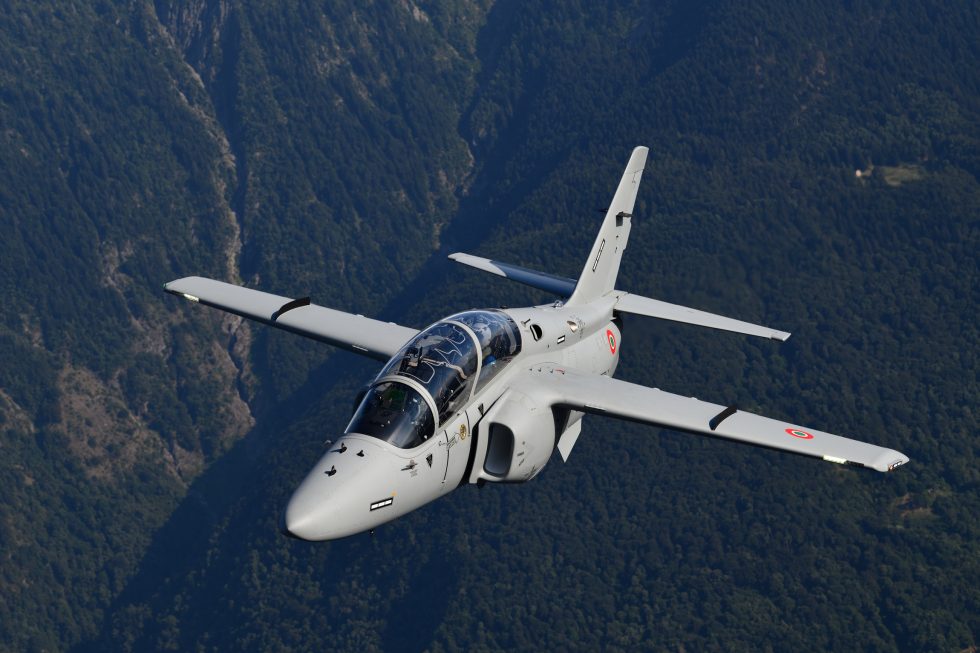
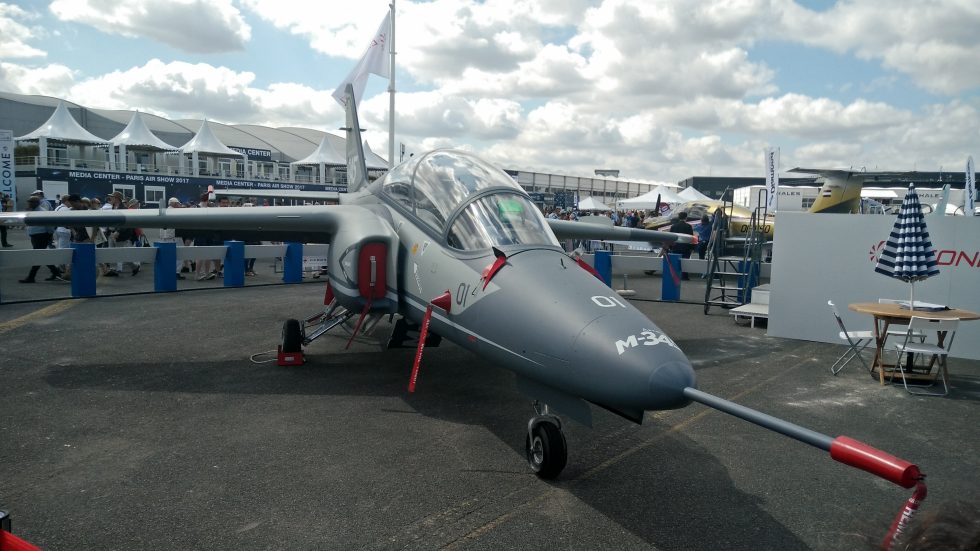
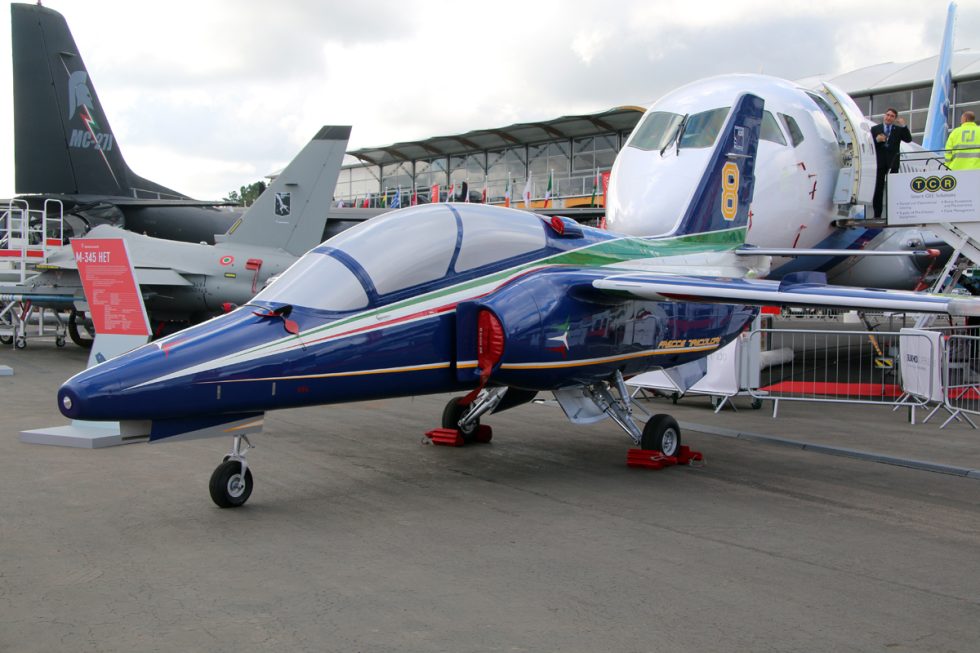
The M-345 in pictures
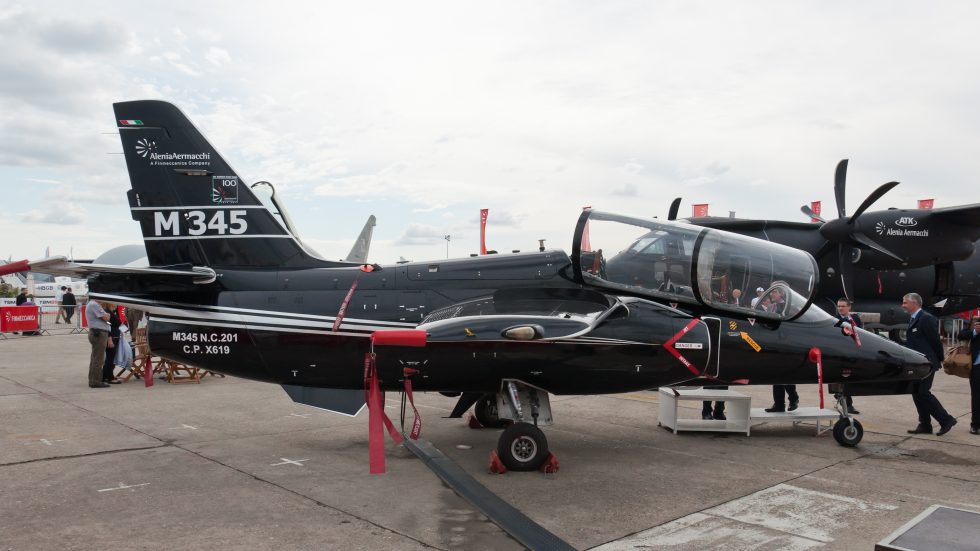
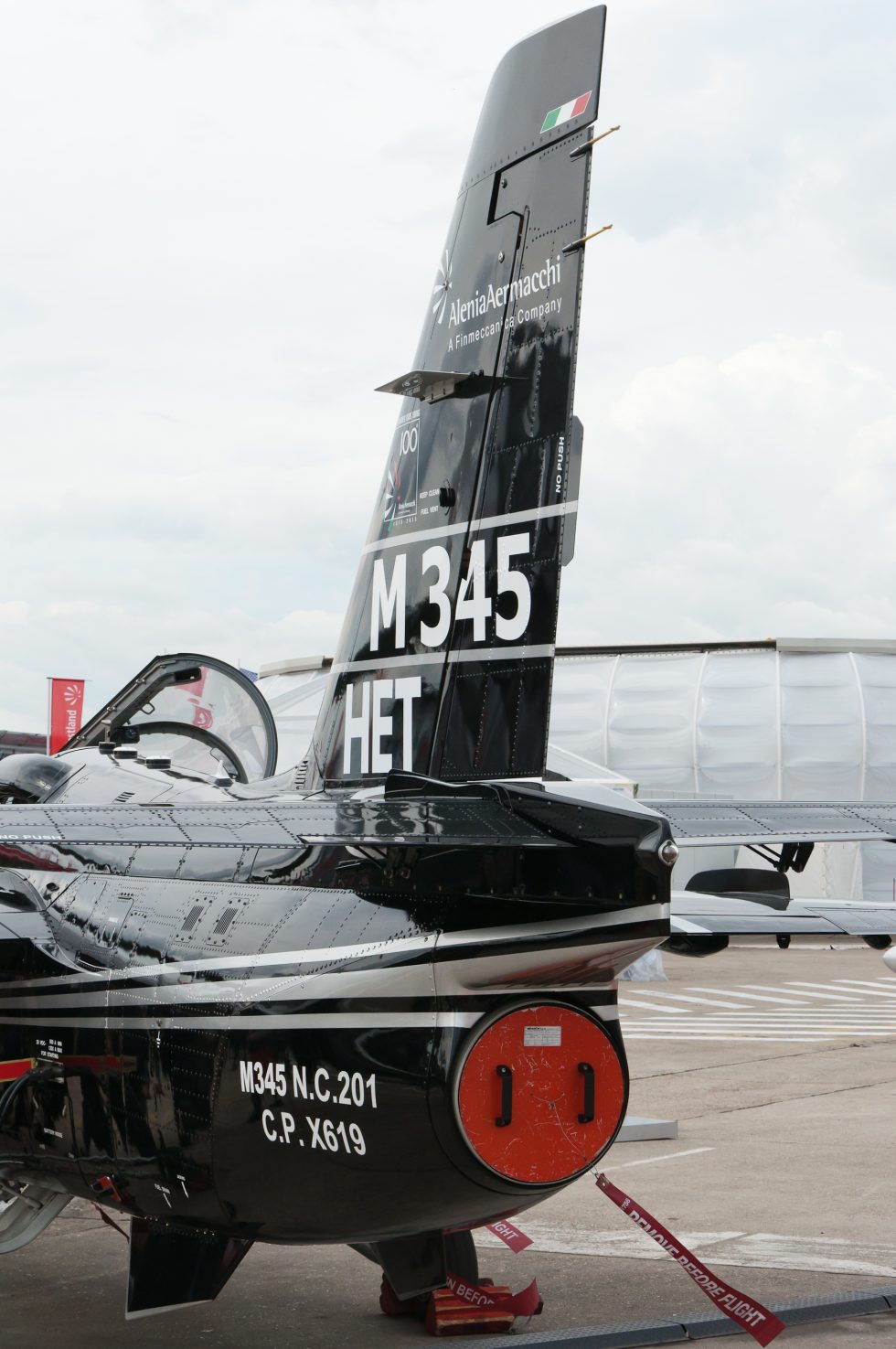
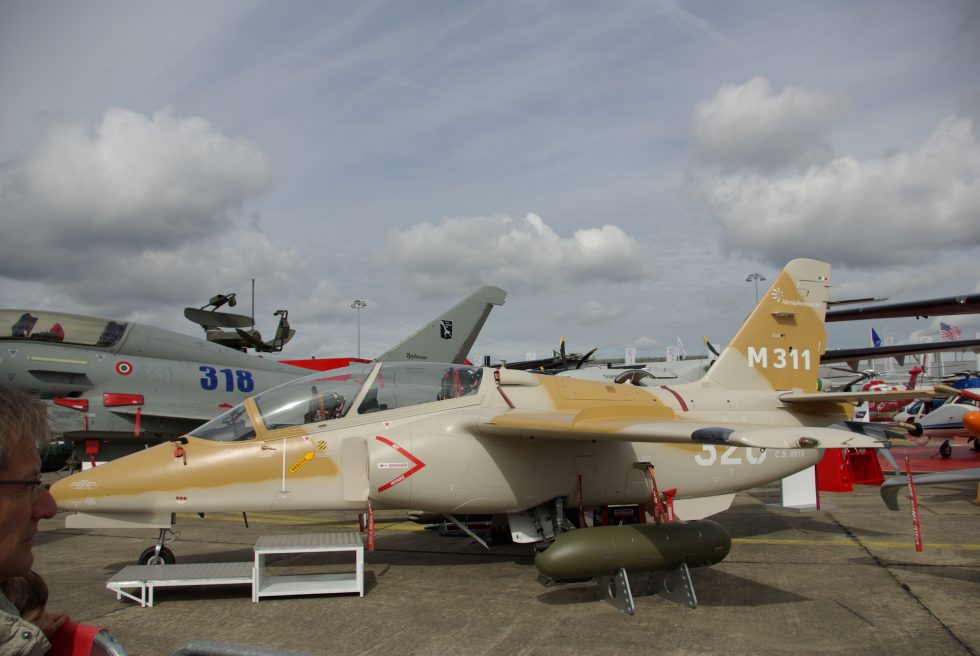
The M-345 in motion
Leonardo: M-345 HET. The manufacturer’s own short film on the High Efficiency Trainer — the clearest official look at the aircraft in the air and on the ground.
Where the M-345 flies
The M-345 by the numbers
The M-345 has no air-to-air combat record — it is a trainer, and its job is to build the pilots who will fly the fighters. Its story is measured in orders, deliveries and running cost rather than kills. As of the mid-2020s Italy is the only confirmed operator, with the fleet still growing.
Curious how the fast jets it prepares pilots for stack up? See the combat record of every military aircraft. Figures as of 2026.
Everything people ask about the Leonardo M-345
Can I fly in an M-345?
What does “HET” mean?
How fast is the M-345?
What engine does the M-345 use?
Is the M-345 related to the S.211?
Who operates the M-345?
Do the Frecce Tricolori fly the M-345?
How much does the M-345 cost to fly?
You can’t fly the M-345.
These, you can.
Some legends only live in museums — others are fuelled and waiting. MiGFlug has put civilians in real military jet cockpits since 2004.
 Fly the L-39 AlbatrosThe world’s most-flown jet trainer — aerobatics included
 Fly the F-104 Starfighter“The missile with a man in it”
 Fly the MiG-21The Cold War’s most-produced jet
 Fly the T-33 Shooting StarAmerica’s first jet trainer
 Fly the DH VampireA piece of early jet history
 Fly the S.211Agile Italian jet trainer
 Fly the MB-326The classic Aermacchi jet
 Fly the MiG-15The Soviet legend of the Korean War
Continue the tour
Every fact, checked
- Leonardo — M-345 product pageManufacturer specifications, engine, avionics and the High Efficiency Trainer concept.
- Leonardo — M-345 enters service (2025)Official announcement of entry into service with the Aeronautica Militare.
- Defense NewsOrder numbers, deliveries, the MB-339 replacement and the Frecce Tricolori question.
- Breaking DefenseEntry-to-service detail at the 61st Wing, Galatina, and fleet plans.
- Key.Aero — High Efficiency TrainerEngine derating, TBO, cockpit systems, Martin-Baker seats and the S.211/M-311 lineage.
- FlightGlobalCertification milestone and programme background.
- GlobalSecurity.orgAirframe dimensions, performance figures and development history.
- The AviationistWalkaround and pilot perspective on the M-345 and its training role.