
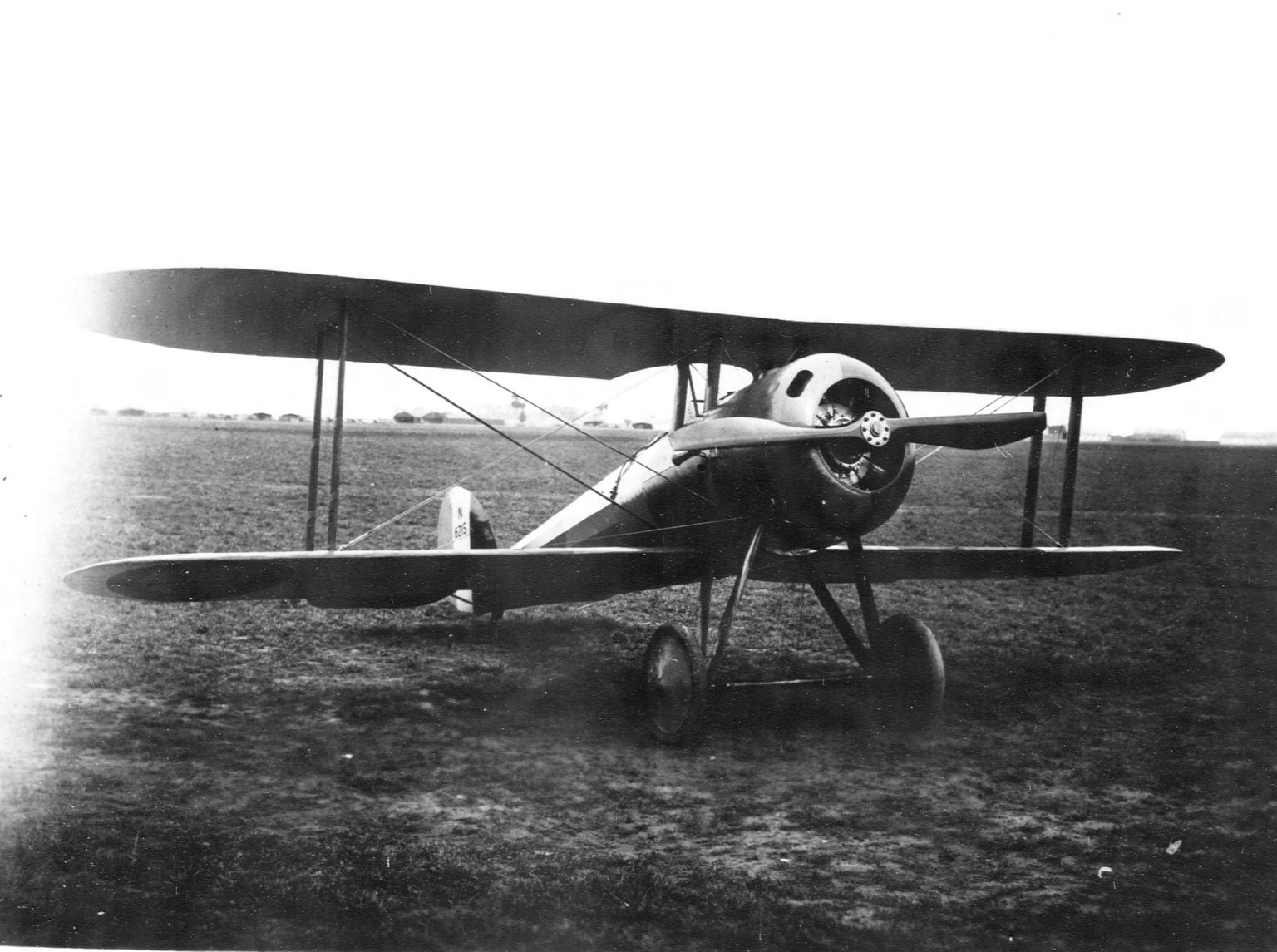
Nieuport 28
“The French fighter America took to war”
The nimble Nieuport that France turned down — and that the United States flew into its first air battles, carrying Rickenbacker, Campbell and Quentin Roosevelt aloft, with one dangerous flaw sewn into its upper wing.
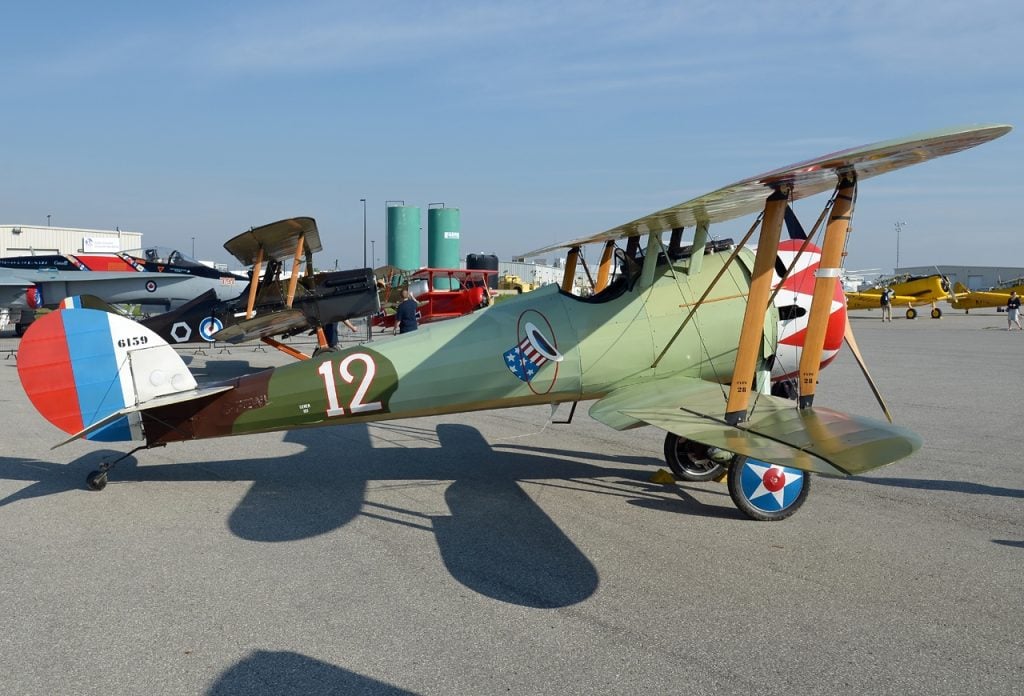
The Nieuport 28: the French fighter America took to war
In the spring of 1918 the United States had declared war on Germany a year earlier but still had almost no fighters of its own. American pilots trained in France and flew French machines, and the fighter that carried them into their first real air battles was one the French themselves no longer wanted: the Nieuport 28.
The Nieuport company had built a legend on light, agile sesquiplane scouts — the Nieuport 11, 17 and their successors — whose narrow lower wing gave superb visibility and turn at the cost of strength. The Nieuport 28, first flown in 1917, broke with that formula. It kept the delicacy but gave the lower wing real chord and area, hung a powerful 160 hp Gnome Monosoupape 9N rotary in the nose and, for the first time on a production Nieuport, mounted two synchronised Vickers guns. It was faster, better armed and cleaner than anything Nieuport had built before.
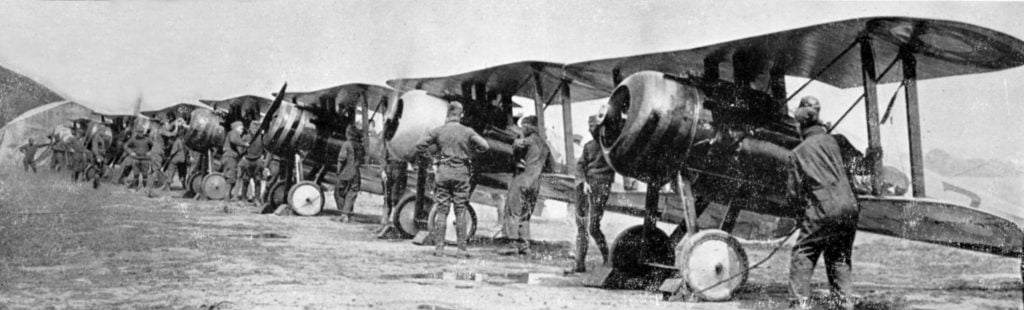
And the French Air Service turned it down. By 1918 their standard fighter was the sturdier, faster-diving SPAD S.XIII, and the Nieuport 28 offered no advantage France needed. But the Americans, waiting for SPADs that production could not yet deliver, took what was available — and so the rejected Nieuport became the first fighter to see operational combat in the hands of American-flagged squadrons, equipping the 27th, 94th, 95th and 147th Aero Squadrons.
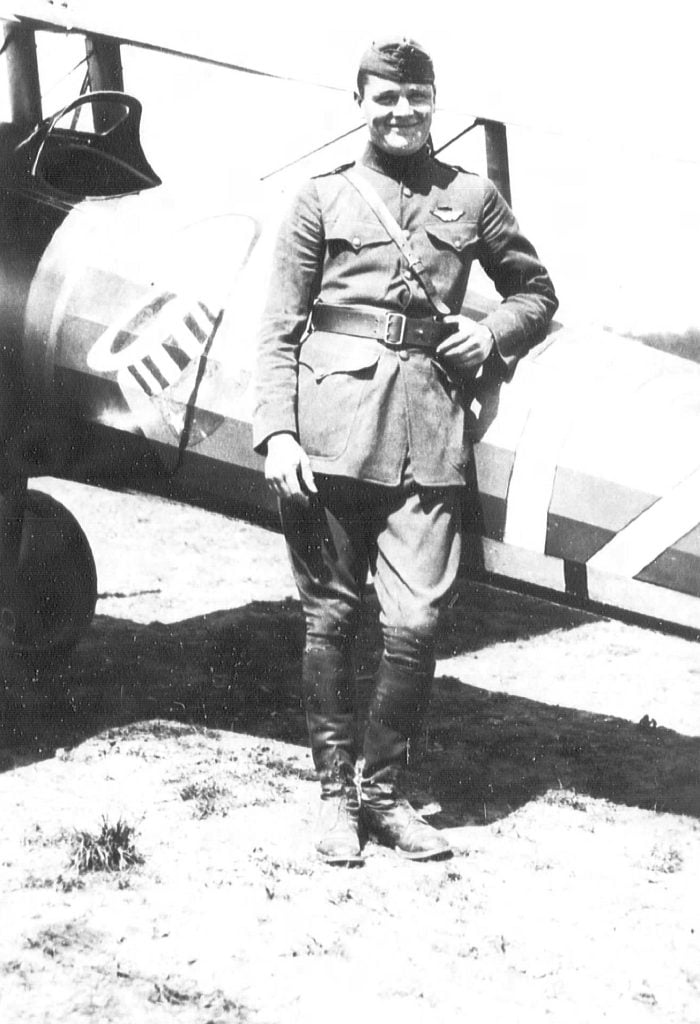
It gave America its first aces and its first heroes — Eddie Rickenbacker, Douglas Campbell, Raoul Lufbery — and, in July 1918, its most public loss when Quentin Roosevelt, a president’s son, was killed flying one. It also had a habit that could kill a pilot in a dive. This is the story of both.
01The Nieuport 28 and the SPAD shortage: how a cast-off became America’s first fighter
When the American Expeditionary Forces reached France they had pilots but no modern fighters. The obvious choice, the SPAD S.XIII, was in such demand that French factories could not spare enough of them. The Nieuport 28, already in production and surplus to French needs, filled the gap.
The result was an accident of supply that made history: the type the French had passed over became the mount on which the United States Air Service learned to fight in the air. By late summer 1918, as SPAD deliveries caught up, the Americans re-equipped with the S.XIII — but the Nieuport 28 had already carried them through their bloodiest first months.
02The Nieuport 28’s pilots: Rickenbacker, Campbell, Lufbery and Quentin Roosevelt
The 94th “Hat in the Ring” and 95th Aero Squadrons flew the type first. Eddie Rickenbacker scored his opening victories in it before becoming America’s 26-kill ace of aces; Douglas Campbell became the first American-trained ace on it; and Alan Winslow shared the squadron’s celebrated first double victory over the airfield at Gengoult on 14 April 1918.
Not every story ended well. Raoul Lufbery, the veteran Lafayette Escadrille ace, died in May 1918, and Quentin Roosevelt was shot down and killed in a Nieuport 28 over France on 14 July 1918 — a loss that made headlines around the world.
What makes the Nieuport 28 special
A fuller lower wing, not a sesquiplane
Earlier Nieuports used a narrow single-spar lower wing that flexed and, in hard manoeuvres, could fail. The Nieuport 28 gave the lower wing genuine chord and a second spar, moving away from the classic sesquiplane. It was a cleaner, stronger, more modern two-bay biplane — even if its upper wing still hid a weakness.
160 hp Gnome Monosoupape and two Vickers
The Gnome Monosoupape 9N rotary gave around 160 hp — a big step up from the ~110 hp of the Nieuport 17 — pushing the aircraft to roughly 196 km/h. For the first time on a production Nieuport the pilot had two synchronised Vickers guns firing through the propeller, doubling the firepower of the single-gun scouts before it.
The flaw in the upper wing
In sustained high-speed dives the fabric could peel from the upper wing’s leading edge, sometimes tearing the plywood covering with it. It was a genuine, dangerous defect that killed and frightened pilots, and it — as much as the SPAD’s arrival — sealed the type’s replacement in U.S. service by late 1918.
03The Nieuport 28’s airframe: how it differed from the Nieuport 17
Where the Nieuport 17 was a small, single-gun sesquiplane of about 110 hp, the Nieuport 28 was larger, heavier and far more powerful. Its two-spar lower wing and raked, rounded wingtips gave it a distinctly different silhouette, and its twin guns and 160 hp rotary put it in a different class of fighter altogether.
It was, in effect, Nieuport’s attempt to keep pace with the SPAD — lighter and more agile than the S.XIII, but never as strong.
04The Nieuport 28’s rotary engine: the Gnome Monosoupape 9N
The Monosoupape (“single valve”) rotary spun its whole cylinder block with the propeller, throwing castor-oil mist over the pilot and controlling power partly by blipping the ignition. It was powerful for its weight but thirsty and temperamental, giving the Nieuport 28 its lively performance and its short, roughly 90-minute endurance.
Figures for output vary around ~160 hp; treat exact numbers as period estimates.
05The Nieuport 28’s wing failures: what actually happened in a dive
Reports describe the leading-edge fabric of the upper wing stripping back under the airloads of a prolonged dive, occasionally taking structure with it. Rickenbacker himself survived such an event and landed with wing fabric gone. Riggers introduced field fixes and stronger attachment, and the problem eased — but confidence never fully recovered, and the sturdier SPAD S.XIII soon took over.
Numbers of aircraft or pilots lost specifically to the fault are not reliably recorded; contemporary accounts agree it was real and feared.
Nieuport 28 specifications
Figures are for the standard Nieuport 28 C.1 on the Gnome Monosoupape 9N; sources vary and several values are hedged. Production and cost figures for a 1917–18 aircraft are approximate.
Baseline note: the figures describe the production Nieuport 28 C.1 with the 160 hp Gnome Monosoupape 9 Type N, the only version that saw combat, as tabulated by Bowers in The Nieuport 28C-I. Deltas for the prototypes, for the postwar Nieuport 28A built by Lioré et Olivier and for the Swiss and American civil aircraft are in grey. Climb is given as time to a stated height and endurance in place of range, as period practice required, and the maximum speed below carries the altitude it was flown at. Note that this is an American-sourced set: the type was rejected by France, so most of the surviving performance data was recorded by the United States Army Air Service rather than by the Aviation Militaire.
Dimensions & weights
- Crew
- 1
- Length
- 6.20 m (20 ft 4 in) — longer and considerably slimmer than the Nieuport 27 it replaced, and the slimness is why the guns ended up where they did
- Wingspan
- 8.00 m (26 ft 3 in)
- Height
- 2.50 m (8 ft 2½ in); French tables give 2.48 m
- Wing area
- 19.97 m² (215 sq ft); French tables round it to 20 m²
- Wing cellule
- Conventional single-bay biplane with two spars in both wings and one pair of parallel interplane struts each side. This is the first production Nieuport fighter that is not a sesquiplane, and it is the exact reversal of the V-strut layout that made the company famous from the Nieuport 11 to the 27.
- Wing detail
- Elliptical tips instead of the raked Nieuport tips; upper wing built in two panels joined on the fuselage centreline with slight dihedral; leading edges of both wings laminated with plywood; ailerons on the lower wing only, worked by torque tubes. Taller cabane struts than the prototypes, specifically to make room for a second machine gun beneath the centre section.
- Empty weight
- 532 kg (1,172 lb)
- Loaded weight
- 737 kg (1,625 lb); French tables give 740 kg
- Wing loading at loaded weight
- 36.9 kg/m² (7.6 lb/sq ft) — against 41.5 for a SPAD S.VII. That eleven per cent is most of the reason American pilots preferred the Nieuport in a turning fight.
- Power loading
- 4.61 kg/hp (10.2 lb/hp), or 0.16 kW/kg
- Fuel capacity
- ~114 l (30 US gal, 25 Imp gal) in a main and a reserve tank. In American service the reserve tank was deliberately left part-empty as the accepted fix for the fuel-fire problem, so the usable figure in the field was lower than the design figure and endurance suffered accordingly.
- Production
- About 300 Nieuport 28 C.1 built. The United States purchased 297, and French sources give 287 as the number actually delivered to the American Expeditionary Force. A further order for 600 improved Nieuport 28A aircraft produced 170 complete machines and parts for 100 more before the balance was cancelled at the Armistice. France ordered none for its own squadrons.
- Service dates
- First flight 14 June 1917; delivered to the AEF from mid-February 1918 without guns; operational with the 94th and 95th Aero Squadrons from March 1918 and with the 27th and 147th from 2 June 1918; all four squadrons re-equipped with SPAD XIIIs by the end of August 1918. Swiss service 1919 to 1930.
Performance
- Maximum speed at 2,000 m
- 196 km/h (122 mph at 6,560 ft) — the useful figure, because it is the one with a height attached. French tables give 195 km/h without stating an altitude, which is close enough to be the same measurement.
- Time to 3,000 m
- 11 minutes 30 seconds (to 9,840 ft) — slightly better than a SPAD S.VII and a long way short of the Fokker D.VII that arrived on the other side of the lines the same summer
- Rate of climb
- 360 m/min (1,180 ft/min) initial, per French tables. Quoted here only for comparison; period practice is the time-to-height figure above.
- Service ceiling
- 5,180 m (17,000 ft); French tables give 5,200 m
- Endurance
- 1 hour 30 minutes — short, and shorter still once crews stopped filling the reserve tank. A Nieuport 28 patrol was a brief affair by 1918 standards.
- Still-air range
- 400 km (250 miles) in French tables; a paper figure derived from endurance rather than flown
- Manoeuvrability against the SPAD XIII
- Clearly better, and every account agrees. The pilots of the 27th and 147th Aero Squadrons were described as heartbroken when their Nieuports were taken away; Harold Hartney recorded the reaction as "another catastrophe befell the squadron — they took away our beloved Nieuports and gave us 220 hp gear driven SPADs."
- Dive limit
- The type's fatal defect. In a hard pull-out from a steep dive the plywood-laminated leading edge of the upper wing could break away and take the fabric with it. Hamady's appendix is the definitive study; the failure was not a rigging fault or a pilot fault but a structural one, and it killed pilots.
- Structural confidence
- Broken, in the precise sense that matters operationally. Pilots of the 94th and 95th liked the aircraft's handling and were reasonably content with its performance, and still did not trust it. That is a worse condition for a fighter squadron than simply flying something slow.
- Undercarriage
- Early aircraft suffered undercarriage failures on landing. The cure was heavier bracing wire and it worked; unlike the wing and the engine, this fault was fixed quickly and stayed fixed.
- Engine reliability
- The other fatal defect. The Gnome 9N and its fuel system were unreliable and prone to fires. Field improvements to the fuel lines and growing American familiarity with monosoupape practice reduced the problem; the definitive remedy was to under-fill the reserve tank and accept the loss of endurance.
- Combat record
- Better than the type's reputation. American squadrons scored substantially more victories than they suffered losses on the Nieuport 28 in five months of operations, and the first two official American aerial victories, the first American-trained ace and Eddie Rickenbacker's first five were all achieved on it.
Propulsion & systems
- Engine
- One 160 hp (119 kW) Gnome Monosoupape 9 Type N, a nine-cylinder air-cooled rotary in which the entire engine revolves with the propeller around a fixed crankshaft
- Engine dimensions
- Bore 115 mm (4.53 in), stroke 170 mm (6.69 in), capacity 15.8 l (964 cu in), diameter 95 cm (37.4 in) — a larger crankcase than the 100 hp Type B-2 it grew from
- Valve gear
- Monosoupape means single valve, and that is literally the design: one cam-operated exhaust valve per cylinder and no inlet valve at all. The charge enters through 36 small transfer ports around the cylinder base, uncovered by the piston as in a two-stroke, drawing an over-rich mixture from the crankcase. It removed the unreliable automatic inlet valve of earlier Gnomes at the cost of heavy fuel consumption.
- Ignition
- Dual, with two spark plugs per cylinder and two magnetos — a distinguishing feature of the 9N against earlier monosoupapes. There is no high-tension wiring to the plugs; a stationary magneto discharges across a gap as each rotating plug terminal passes it.
- Engine control
- No throttle. Power was set by a single petrol regulating lever and trimmed with a coupe or blip switch cutting the ignition, plus — unusually — a five-position rotary selector wired to the right magneto that cut out cylinders at evenly spaced intervals to give roughly one-half, one-quarter or one-eighth power. To use it the pilot first had to switch off the left magneto. That is the state of the art in engine control in 1918, and it explains a good deal about landing accidents.
- Lubrication
- Total-loss castor oil, pumped into the fuel-air mixture and thrown out through the exhaust valves. Over two gallons an hour went into the slipstream, which is why rotary cowlings are cut away at the bottom and why rotary pilots were famously unwell.
- Fuel system
- Main and reserve tanks with a pressurised feed. This is where the fires started: leaking lines and fuel finding hot cylinders. The AEF's remedy of leaving the reserve tank part-empty was crude and it worked, and it says everything about how urgent the problem was.
- Propeller
- Two-blade fixed-pitch wooden airscrew, direct drive from the rotating crankcase
- Gun synchronisation gear
- The Nieuport gear, called the "Gnome gear" in the American documentation that is now its only surviving description. A drive shaft spun by the rotating crankcase of the Gnome 9N turned two separately adjustable trigger motors, each passing firing impulses to its own gun through a short rod. Being separately adjustable, the two guns could be timed to fire at the same point on the propeller disc a fraction of a second apart, which is what a twin installation requires. Photographic evidence suggests a single-gun version of the same gear was fitted to the Nieuport 23 and the Hanriot HD.1.
- Cowling
- Circular cowl with the lower segment open, in the standard rotary arrangement, throwing the castor oil clear of the pilot
- Alternative engines tested
- Nieuport 28 airframes were used as flying testbeds for the Nieuport 29 programme with the 300 hp Hispano-Suiza 8Fb, the 170 hp Le Rhône 9R, the 275 hp Lorraine-Dietrich 8Bd and the 200 hp Clerget 11E. None of these was a production Nieuport 28. The 8Fb installation is the direct ancestor of the Nieuport-Delage NiD 29, which was the fighter France actually wanted.
06The Nieuport 28’s cost: why the numbers aren’t reliably recorded
The Nieuport 28 was bought in the chaos of 1917–18 wartime procurement, when aircraft were ordered in batches at prices that were rarely published and are not consistently preserved. The United States acquired roughly 300 of them — about 297 for the Army Air Service and 12 for the Navy — but a clean per-unit dollar figure is not part of the reliable record.
Running one today is equally unofficial: a single airworthy original and a few replicas exist, maintained by specialist warbird operators whose hourly costs are private. Any figure you see quoted should be treated as an estimate.
07The Nieuport 28 family and variants: C.1 and the naval aircraft
The main production type was the single-seat Nieuport 28 C.1 fighter. After the war the U.S. Navy used a small number for pioneering shipboard flying-off trials, launching them from platforms built over the gun turrets of battleships — an early step toward carrier aviation.
Note: the Nieuport 28 is a different, later aircraft than the earlier Nieuport 17 sesquiplane scout; the two are often confused but share little beyond the maker’s name.
Armament & payload
The Nieuport 28 was delivered to the Americans with no guns at all, and had to wait a month for them
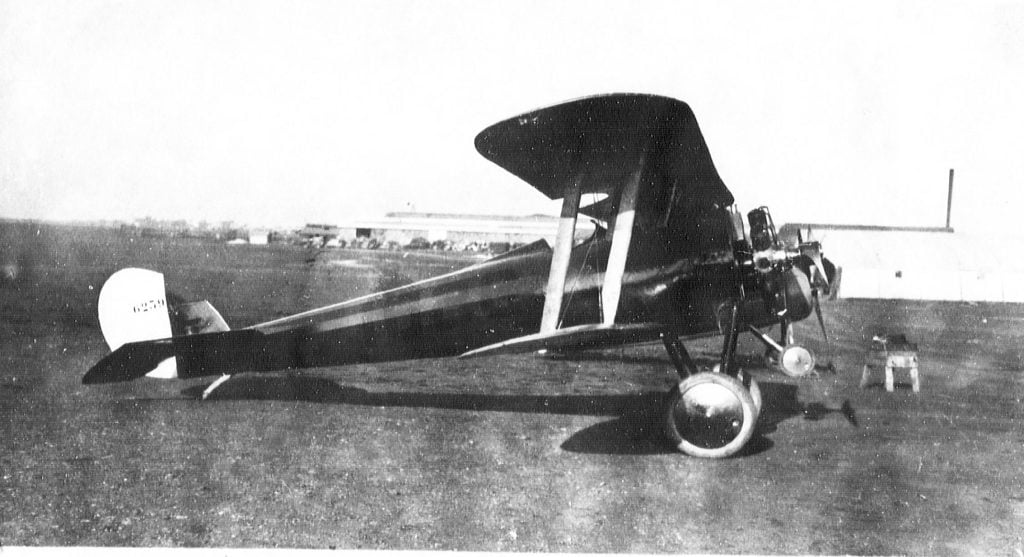
Two synchronised Vickers guns, both offset to port because the fuselage was too narrow to straddle them across the centreline, is the armament of a Nieuport 28. One sits between the cabane struts and one just outboard of them, and the asymmetry is visible in every photograph of the type. It is the same armament a SPAD XIII carried and twice what a SPAD S.VII carried, and by 1918 it was simply the international standard for a single-seat fighter.
What is not standard is how the aircraft arrived. Nieuport delivered the first machines to the American Expeditionary Force in mid-February 1918 without armament, and the AEF had no spare Vickers guns to fit. The first weeks of American fighter operations were therefore flown unarmed, purely to let pilots learn the aeroplane. When guns began arriving in mid-March there were not enough to go round, and some aircraft flew operational patrols over the lines with a single gun fitted. That detail tells you more about the state of American air power in the spring of 1918 than any performance table can. Fits varied within and between the four squadrons and changed month by month as guns arrived; the postwar Nieuport 28A was designed around a different pair of guns entirely.
Guns
- Two .303 in (7.7 mm) Vickers machine guns, fixed, forward-firing, synchronised to fire through the propeller disc.
- Both offset to port: one between the cabane struts and one immediately outboard of them, under and beside the upper wing centre section rather than on the fuselage decking. The fuselage had been slimmed for speed until there was no room to do it any other way.
- The taller cabane struts of the production aircraft, compared with the prototypes, exist specifically to create the space for the second gun beneath the centre section.
- The offset is not cosmetic. It puts the guns to one side of the pilot's natural sight line and above it, which makes a Nieuport 28 a harder aeroplane to shoot accurately from than a SPAD with its guns squarely in front of the windscreen.
- Some aircraft flew on operations in March and April 1918 with only one gun installed, because the AEF did not yet have enough Vickers to arm the fleet.
Ammunition, feed and sights
- Belt-fed Vickers with disintegrating metal links, the standard by 1918; the canvas belt and take-up drum that plagued the early SPAD S.VII had been left behind.
- Ammunition load is not consistently recorded for the type, and the reference works that give a figure for the SPAD S.VII generally do not give one for the Nieuport 28. This page will not invent a number.
- Aiming was through a ring-and-bead sight, with Aldis tube telescopic sights fitted to some aircraft. With the guns offset and raised, harmonisation was set on the ground and could not be adjusted in the air.
- Belts mixed ball with tracer, and incendiary rounds were carried for balloon and fabric targets.
- Clearing a stoppage meant reaching up and forward to a gun mounted beside and above the head, in the slipstream, which was harder than on a fuselage-mounted installation.
The Nieuport, or Gnome, synchronisation gear
- Unlike the Alkan-Hamy gear used by earlier rotary-engined Nieuports, the 28 used a gear now known only through American documentation, where it is called the "Nieuport Synchronizing gear" or simply the "Gnome gear".
- A drive shaft spun by the rotating crankcase of the Gnome 9N drove two trigger motors, each imparting firing impulses to its gun through its own short rod. Taking the drive off the rotating crankcase is the neat part: on a rotary the crankcase turns with the propeller, so the timing reference is exactly where you want it.
- Each trigger motor was separately adjustable. That matters: two synchronised guns must fire at the same point on the propeller disc, which means one must fire a fraction of a second after the other, and a gear that cannot be trimmed gun-by-gun cannot do it.
- Photographic evidence suggests a single-gun version of the same gear was fitted to the Nieuport 23 and the Hanriot HD.1, but the documentary trail for the French original has not survived.
- French and British aircraft supplied to the AEF kept their native gears throughout — this one in Nieuports, Birkigt in SPADs, Constantinesco C.C. in British types — so American mechanics had to master three unrelated synchronisers at once.
Bombs, and the absence of them
- None. The Nieuport 28 C.1 had no bomb racks, no release gear and no provision for external stores of any kind.
- It is a pure pursuit aircraft in the American sense of the word: built to intercept, escort and patrol a sector, and nothing else.
- Ground strafing was flown by American squadrons on the type, using the guns alone, and it was expensive; the aircraft had no armour and its structural problems were worst in exactly the sort of steep pull-out a strafing run demands.
- No provision for a camera, so it could not double as a reconnaissance machine the way a two-seater could.
- The absence is worth stating rather than skipping, because the second generation of American fighters was expected to carry bombs and the SPAD XIII that replaced the Nieuport could and did carry small ones.
The Nieuport 28A, Marlin guns and the naval fit
- In late 1918, as the type was leaving the front line, the United States Army ordered 600 improved aircraft designated Nieuport 28A. They were intended mainly as advanced trainers but the option of returning them to squadron service was deliberately kept open, because the SPAD XIII was giving trouble in American hands.
- The 28A had an improved upper wing leading-edge structure and a redesigned fuel system, addressing the two faults that had killed people, and provision for twin M1917 or M1918 Marlin guns mounted side by side under the centre section instead of the offset Vickers.
- Nieuport was busy with later designs, so production went to Lioré et Olivier, who completed 170 aircraft and parts for 100 more before the balance was cancelled.
- Twelve Army Nieuport 28s went to the United States Navy for flying-off platforms built over the forward turrets of eight battleships, in the same manner as the Royal Navy's Sopwith Camel 2F.1s. These carried hydrovanes to reduce the risk of nosing over in a ditching, and compressed-air flotation gear to keep the aircraft afloat afterwards.
- Civil racers went the other way and stripped weight: span cut by up to five feet and the parallel interplane struts replaced by a single I-strut each side.
What it did not carry, and the limit that mattered
- No armour, no fireproofing and no self-sealing tank — on an aircraft whose defining fault was fuel fires. Raoul Lufbery, the most experienced pilot in the American service, jumped to his death from a burning Nieuport 28 on 19 May 1918.
- No parachute. The German aircrew the AEF was fighting began receiving Heinecke parachutes in 1918; Allied single-seat pilots did not get them, and Lufbery's death is the reason that decision is still argued about.
- No oxygen, at a ceiling above 5,000 m; no wireless; no navigation equipment beyond a compass.
- No throttle, no brakes and no self-starter, all normal for a rotary-engined fighter and all contributors to the accident rate in the hands of newly trained pilots.
- No structural margin for a hard pull-out. The upper wing leading edge could shed its plywood lamination and its fabric in a steep dive recovery. That single sentence is why the Nieuport 28 lasted five months at the front and not fifteen.
Three typical loadouts
- Unarmed familiarisation flight, 94th and 95th Aero Squadrons, February and March 1918
- No guns, no gear, nothing but the aeroplane. The factory delivered the Nieuports without armament and the AEF had no Vickers to fit, so the first American fighter squadrons spent weeks flying an unarmed fighter while their pilots learned to handle a rotary that had no throttle, and the ground crews learned a monosoupape from scratch. The 94th flew its first patrols over the lines in this state. It is not a heroic loadout and it is the honest starting point of American combat aviation.
- Line patrol, 94th Aero Squadron, Toul sector, April to June 1918
- Two Vickers with the Gnome gear, a partly filled reserve tank, roughly ninety minutes of fuel, no bombs and no wireless, flown from Gengoult aerodrome over the sector from Saint-Mihiel to Pont-à-Mousson. On 14 April, on the second armed patrol the squadron ever flew, Lieutenants Douglas Campbell and Alan Winslow shot down two aircraft of Jasta 64 within sight of their own field — the first official American aerial victories of the war. Eddie Rickenbacker scored his first on 29 April and his fifth on 17 June, all on this aeroplane; Campbell reached five on 31 May to become the first American-trained ace.
- Battleship turret-platform flight, United States Navy, 1919 to the early 1920s
- Guns often removed, hydrovane fitted forward of the undercarriage, compressed-air flotation gear stowed in the fuselage, launched from a wooden platform built over a forward 14-inch turret. The aircraft could take off and could not land back aboard: the pilot ditched alongside and hoped the flotation bags worked. Twelve Army Nieuport 28s were transferred for this, on eight battleships including USS Arizona. It is the least famous chapter of the type's life and the one that leads most directly to the aircraft carrier.
Sourcing caveat: this page prefers figures that state an altitude, and the Nieuport 28 is unusually well served in that respect because the surviving performance data is largely American and was recorded in service rather than compiled from a manufacturer's brochure — the maximum speed of 196 km/h carries its 2,000 m, and the climb figure carries its 3,000 m. Beyond that the record thins fast. Ammunition capacity is not reliably documented and this page declines to guess one. Production is given as "about 300", with 297 purchased by the United States and 287 recorded as delivered, and the three numbers have never been reconciled. Swiss holdings are given as 15 aircraft in the English literature and, more precisely, as one interned machine in 1918 plus fourteen bought from French surplus in 1923 in the Swiss account. The location of individual survivors is contested even now: the Swiss aircraft numbered 688 is credited to the Flieger Flab Museum at Dübendorf in one source and to the Swiss Museum of Transport at Lucerne in another. Where authorities disagree this page says so rather than picking the tidier number.
Variants
The Nieuport 28 is remembered only because France did not want it
This is the honest frame for the whole type and it should be stated first. By the time the Nieuport 28 was ready for production in early 1918, the Aviation Militaire had already settled on the SPAD S.XIII as its standard fighter for the year and had no use for another. The Americans had wanted SPAD XIIIs too and could not get them, because Hispano-Suiza engine production could not meet French demand and American demand at once. So the Nieuport was offered to the American Expeditionary Force as an interim aircraft, and the AEF took it because the alternative was no fighters at all. Every famous thing about the Nieuport 28 follows from that: it became the first fighter flown in combat by American-trained, American-organised pursuit squadrons, and that is essentially the whole of its claim on history.
One qualification belongs here, because the usual formula — "America's first fighter" — is not quite right. The 103rd Aero Squadron, United States Air Service, was formed in February 1918 around the American veterans of the Lafayette Escadrille, began combat operations in early March flying SPAD S.VIIs under French command, and recorded its first victory on 11 March 1918, more than a month before Campbell and Winslow. The precise claim the Nieuport 28 can support is that it was the first fighter taken into combat by squadrons the American service had raised and trained itself. That is still a real distinction and it does not need improving.
Structurally the aircraft is the opposite of the Nieuports that preceded it. From the Nieuport 11 of 1916 through the 17, 21, 24 and 27, every one was a sesquiplane: a full upper wing over a narrow single-spar lower wing joined by a V-strut each side, which gave a superb downward view and a wing that could twist and fail. Gustave Delage abandoned that layout entirely for the 28 and gave it two spars in both wings, parallel interplane struts, elliptical tips and ailerons on the lower wing. It was the right decision. The bitter joke is that the new wing then failed in a different way, shedding its plywood-laminated leading edge and its fabric in hard dive recoveries, so that a design change made specifically to cure the family's structural weakness produced a fresh one.
The type's front-line life was five months. The 94th and 95th Aero Squadrons went operational in March 1918, the 27th and 147th on 2 June. In July the 94th and 95th received their first SPAD XIIIs and passed their surviving Nieuports on; by the end of August 1918 all four squadrons were on SPADs. The 94th and 95th were glad to see them go. The 27th and 147th, who had been warned about the wing but had not seen it happen, were not. Both squadrons kept flying long after the aeroplane was gone, and the Nieuport 28 spent the next fifteen years being crashed on purpose in Hollywood.
- Prototypes (1917 / several)
- First flown 14 June 1917. Three dihedral settings were tried for the upper wing, from flat to a marked dihedral that sat very close to the top of the fuselage. Production settled on an intermediate arrangement with slight dihedral and taller cabane struts, which is what made room for the second gun.
- Nieuport 28 C.1 (1918 / about 300)
- The production and only combat version. 160 hp Gnome Monosoupape 9N, two offset Vickers, the Nieuport synchronising gear. C.1 denotes a single-seat fighter. Rejected by France, bought by the United States, flown by four AEF squadrons between March and August 1918.
- Nieuport 28A (1918–19 / 170 built of 600 ordered)
- The corrected aircraft, built by Lioré et Olivier. Improved upper wing leading-edge structure, redesigned fuel system, provision for twin Marlin M1917 or M1918 guns side by side under the centre section. Intended mainly as an advanced trainer with the option of a return to combat units; the order was cut at the Armistice, and about 50 were shipped to the United States afterwards.
- United States Navy shipboard aircraft (1919–early 1920s / 12)
- Twelve Army aircraft transferred to the Navy for flying-off platforms over the forward turrets of eight battleships, fitted with hydrovanes and compressed-air flotation gear. One of the earliest American attempts to put a fighter to sea.
- Nieuport 29 development airframes (1917–18 / individual aircraft)
- Nieuport 28 airframes rebuilt to test features of the coming Nieuport 29, including a wooden monocoque fuselage and alternative engines — the 300 hp Hispano-Suiza 8Fb, the 170 hp Le Rhône 9R, the 275 hp Lorraine-Dietrich 8Bd and the 200 hp Clerget 11E. The 8Fb line leads directly to the Nieuport-Delage NiD 29, the fighter that dominated the early 1920s.
- Swiss aircraft (1919–1930 / 15)
- One American machine force-landed near Solothurn in the summer of 1918 and was interned, repaired and taken into Swiss service; fourteen more unarmed examples were bought from French surplus in 1923 and used for fighter training. In 1926 aircraft 691 was tested statically to destruction and the airframe was judged sound. In 1930 the first aircraft to reach 600 flying hours was stripped for a major inspection, cracks were found in almost every metal fitting, and the entire fleet was condemned on the spot. It is the most thorough structural verdict anyone ever passed on the type.
- Argentine aircraft (1920s / 2)
- Two aircraft to the Argentine Air Force. A handful also reached White Russian units in the Russian Civil War, flown by aces including Ivan Loiko and Vasily Yanchenko.
- Civil racers (1920s / several)
- Surplus aircraft modified for American air races: wingspan reduced by up to five feet and the parallel interplane struts replaced by a single I-strut each side.
- Hollywood aircraft (1930–1958 / a substantial fraction of all survivors)
- Not a variant but the type's real second career, and the reason so many survive. Nieuport 28s appeared in The Dawn Patrol in 1930 and again in 1938, Ace of Aces in 1933, Men with Wings in 1938 and Lafayette Escadrille in 1958. Frank Tallman and Paul Mantz of Tallmantz Aviation owned several from the 1930s to the 1960s.
- Garland-Lincoln LF-1 (early 1930s / small number)
- Listed here to be dismissed. As original airframes ran short, the LF-1 was built in Glendale, California to stand in for a generic First World War fighter on film. It looks like a Nieuport 28, is shorter, has a steel-tube fuselage, a one-piece upper wing without dihedral and a 200 hp Wright J-4-B radial. It is not a Nieuport 28, it is not a replica of one, and it appears in Dawn Patrol mixed in with genuine aircraft, which has confused people ever since.
Survivors, stated precisely, because with a First World War type the distinction between an original airframe and a reproduction matters far more than the count. Roughly half a dozen original Nieuport 28s survive, which is a good showing for a type built in about three hundred examples, and Hollywood is the reason: aircraft that would otherwise have been scrapped in 1920 were kept flying as film props into the 1960s. The originals are in Switzerland at the Flieger Flab Museum in Dübendorf and the Swiss Museum of Transport in Lucerne, both survivors of the fleet condemned in 1930; in the United States at the National Naval Aviation Museum in Pensacola, which holds one of the twelve Navy battleship aircraft, at the San Diego Air and Space Museum, and at the Smithsonian's Steven F. Udvar-Hazy Center, whose aircraft was flown for decades at Old Rhinebeck Aerodrome and donated by Cole Palen. The only airworthy original is at the American Heritage Museum in Hudson, Massachusetts, restored over two years by Mikael Carlson in Sweden and completed in 2023; it was previously a Tallmantz film aircraft and was bought at auction in 1968 by the racing driver Jim Hall for 14,500 dollars. It crashed at a museum event in September 2023 and the museum has stated its intention to repair it. Everything else carrying the name is a reproduction, and the categories are worth separating. Static full-scale reproductions are displayed at the National Museum of the United States Air Force, at the Stampe et Vertongen Museum in Belgium and at the Commemorative Air Force's Airbase Arizona; a flying full-scale reproduction in Rickenbacker's colours is operated by the Great War Flying Museum at Brampton in Ontario. Below those sit a large and growing number of homebuilt replicas on modern engines such as the Rotec R3600 radial, some with steel-tube fuselages, which are correct in outline and modern in every other respect. And below those sits the Garland-Lincoln LF-1, which is not a reproduction of anything. Six aeroplanes in the world are 1918. The rest are tribute, film prop or kit.
The Nieuport 28 through the war
First flight
Nieuport flies the new Model 28, a cleaner, two-gun, 160 hp development that abandons the narrow sesquiplane lower wing of earlier scouts.
France says no
The French Air Service, committed to the sturdier SPAD S.XIII, declines the Nieuport 28 for its own front-line squadrons.
America adopts it
Short of SPADs, the U.S. Air Service equips its first pursuit squadrons — the 27th, 94th, 95th and 147th — with available Nieuport 28s.
First victories
Lieutenants Alan Winslow and Douglas Campbell down two German aircraft over their own airfield at Gengoult — the first victories in American hands.
First U.S.-trained ace
Douglas Campbell becomes the first American-trained pilot to reach five victories, all on the Nieuport 28; Raoul Lufbery is killed the same month.
The wing problem bites
Upper-wing fabric shedding in dives frightens and kills pilots; Eddie Rickenbacker survives one such failure and scores his first kills on the type.
Quentin Roosevelt falls
Quentin Roosevelt, son of the former president, is shot down and killed flying a Nieuport 28 over France — the war’s most public American air loss.
Replaced, then retired
U.S. squadrons re-equip with the SPAD S.XIII; post-war survivors serve with the U.S. Navy for deck trials and with Switzerland and Argentina.
The Nieuport 28 in the words of those who flew it
Two kills before breakfast
Winslow and Campbell downed two German aircraft over their own field within minutes.
Read the full account
Rickenbacker starts here
America’s top ace opened his account in a Nieuport 28 with the 94th.
Read the full account
Douglas Campbell
Five victories, all flown on the Nieuport 28.
Read the full account
Quentin Roosevelt
Theodore Roosevelt’s youngest son was killed flying the type in July 1918.
Read the full account
Raoul Lufbery
The old hand of the Lafayette Escadrille died in May 1918.
Read the full account
Fabric off the wing
In a hard dive the upper wing could shed its leading-edge fabric.
Read the full account
Agile by design
Pilots praised the Nieuport 28’s manoeuvrability against German scouts.
Read the full account
The 94th Aero Squadron
The most famous American squadron of the war flew the Nieuport 28 first.
Read the full account
Enter the SPAD S.XIII
By late 1918 the tougher SPAD had taken over.
Read the full account
U.S. Navy deck trials
After the war, Nieuport 28s flew off platforms on battleship turrets.
Read the full account
Switzerland and Argentina
A handful served on quietly into the 1920s and beyond.
Read the full account
The 2023 airworthy original
The sole airworthy original Nieuport 28 returned to flight in Massachusetts.
Read the full account
The Nieuport 28 in pictures
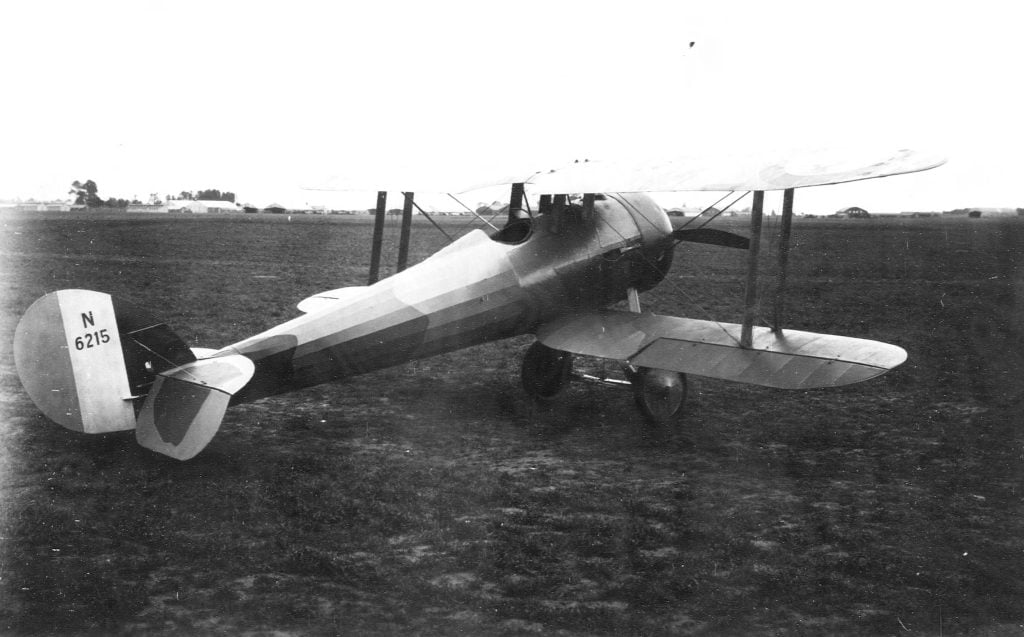
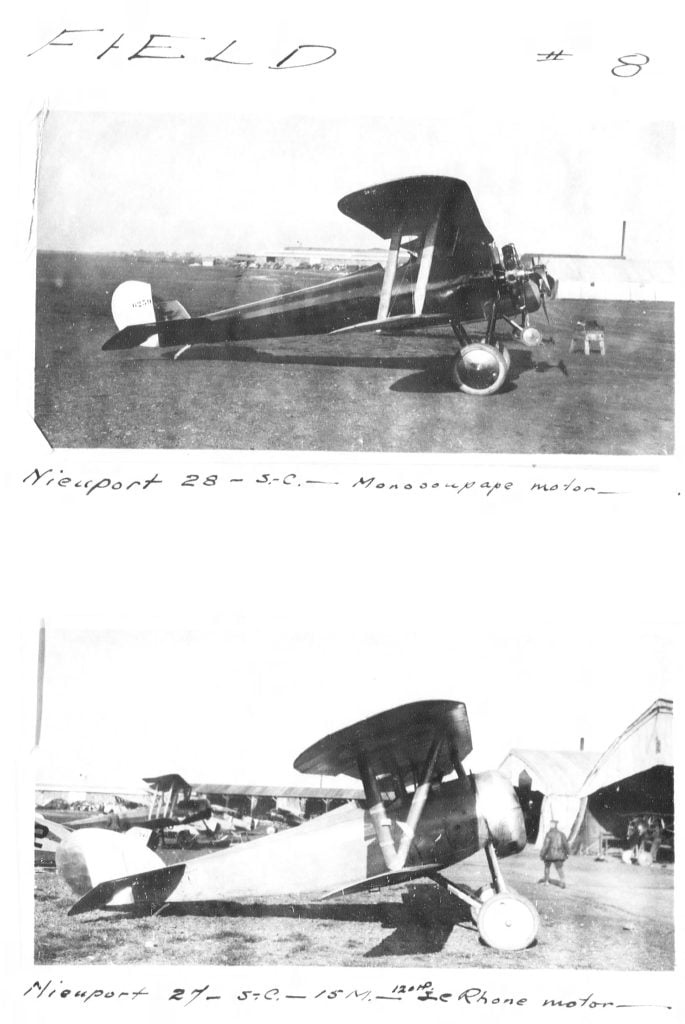
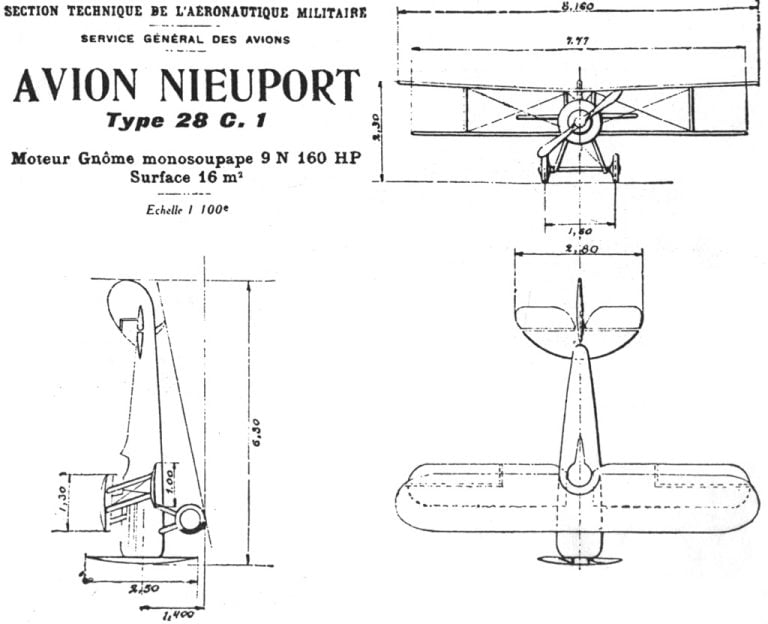
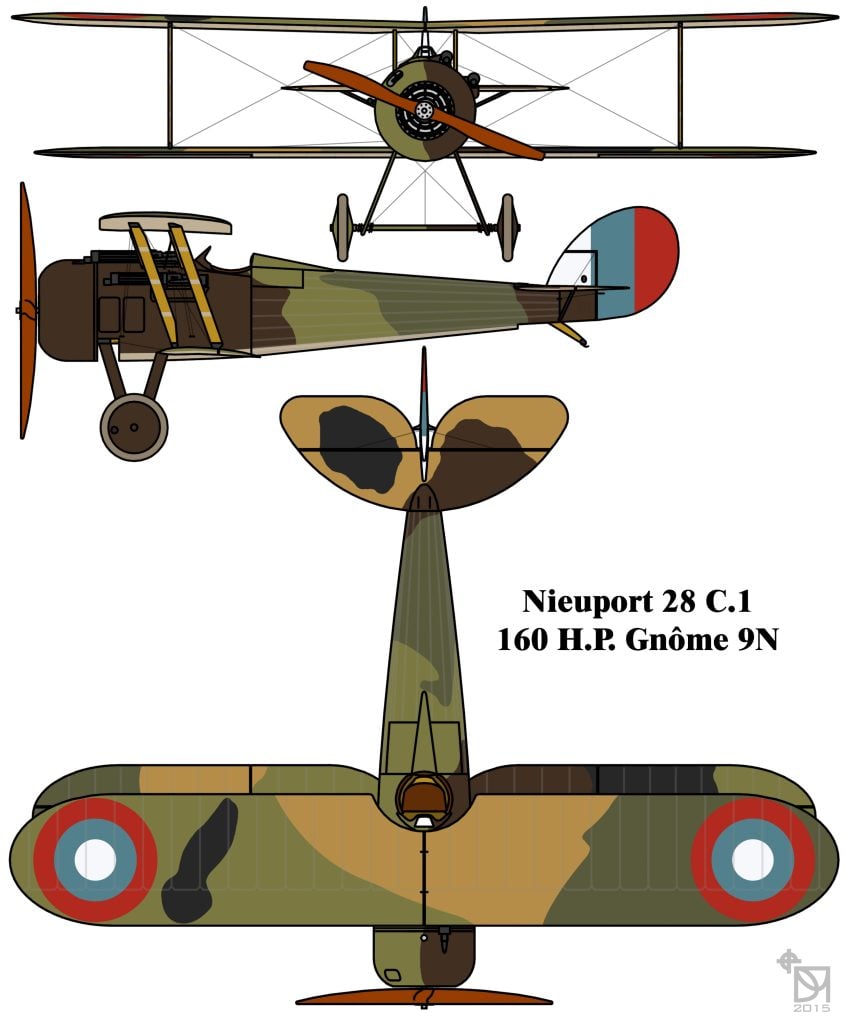
The Nieuport 28 in the air
The sole airworthy original Nieuport 28 takes to the air after its 2023 restoration. Footage from the American Heritage Museum / Collings Foundation official channel — one of the most authoritative sources on this aircraft, showing the actual 1918 fighter flying again.
Where the Nieuport 28 flew
Designed and built in France, rejected by the French, and flown into combat almost entirely by the United States Air Service over the Western Front in 1918 — the Nieuport 28 also served after the war with the U.S. Navy for shipboard trials and with Switzerland and Argentina. Toggle the categories to see its French origin, its American wartime service, its post-war operators, and where surviving airframes are preserved today.
The record the Nieuport 28 left behind
The Nieuport 28 was a front-line American fighter for only a few months in 1918 before the SPAD S.XIII replaced it, so it has no long combat ledger. Its significance is historical rather than statistical: it was the machine on which the United States Air Service first fought, and first won, in the air. Victory tallies for individual pilots vary between sources and mix Nieuport 28 and later SPAD claims.
Nieuport 28: your questions answered
Can I fly in a Nieuport 28?
Why did American squadrons fly a French fighter that France had rejected?
Was the Nieuport 28 a good fighter?
What was the Nieuport 28's wing problem?
Which famous pilots flew the Nieuport 28?
How many Nieuport 28s survive, and can I see one?
You can’t fly the Nieuport 28.
These, you can.
Some legends only live in museums — others are fuelled and waiting. MiGFlug has put civilians in real military jet cockpits since 2004.
 Fly the L-39 AlbatrosThe world’s most-flown jet trainer — aerobatics included
 Fly the F-104 Starfighter“The missile with a man in it”
 Fly the MiG-21The Cold War’s most-produced jet
 Fly the T-33 Shooting StarAmerica’s first jet trainer
 Fly the DH VampireA piece of early jet history
 Fly the S.211Agile Italian jet trainer
 Fly the MB-326The classic Aermacchi jet
 Fly the MiG-15The Soviet legend of the Korean War
Explore more of the collection
Every fact, checked
- Smithsonian National Air and Space Museum — Nieuport 28C.1Museum collection record for the preserved original and its U.S. service history.
- National Naval Aviation Museum, PensacolaDocuments the U.S. Navy Nieuport 28s and the battleship flying-off trials.
- American Heritage Museum / Collings FoundationRestoration and 2023 return-to-flight of the sole airworthy original.
- National Museum of the United States Air ForceBackground on the AEF pursuit squadrons and Eddie Rickenbacker.
- Naval History and Heritage CommandNaval Nieuport 28 record and post-war platform experiments.
- Eddie Rickenbacker, “Fighting the Flying Circus”First-hand memoir describing flying the Nieuport 28 with the 94th Aero Squadron.
- Imperial War MuseumsContext on Western Front air fighting in 1918.
- Fliegermuseum Dübendorf & Swiss Museum of TransportRecords of the Swiss Nieuport 28 fleet and preserved airframes.
- Contemporary squadron historiesUsed to cross-check dates, pilots and unit assignments.
- Figures hedged throughoutProduction, speed and cost values for a 1917–18 aircraft are approximate.