
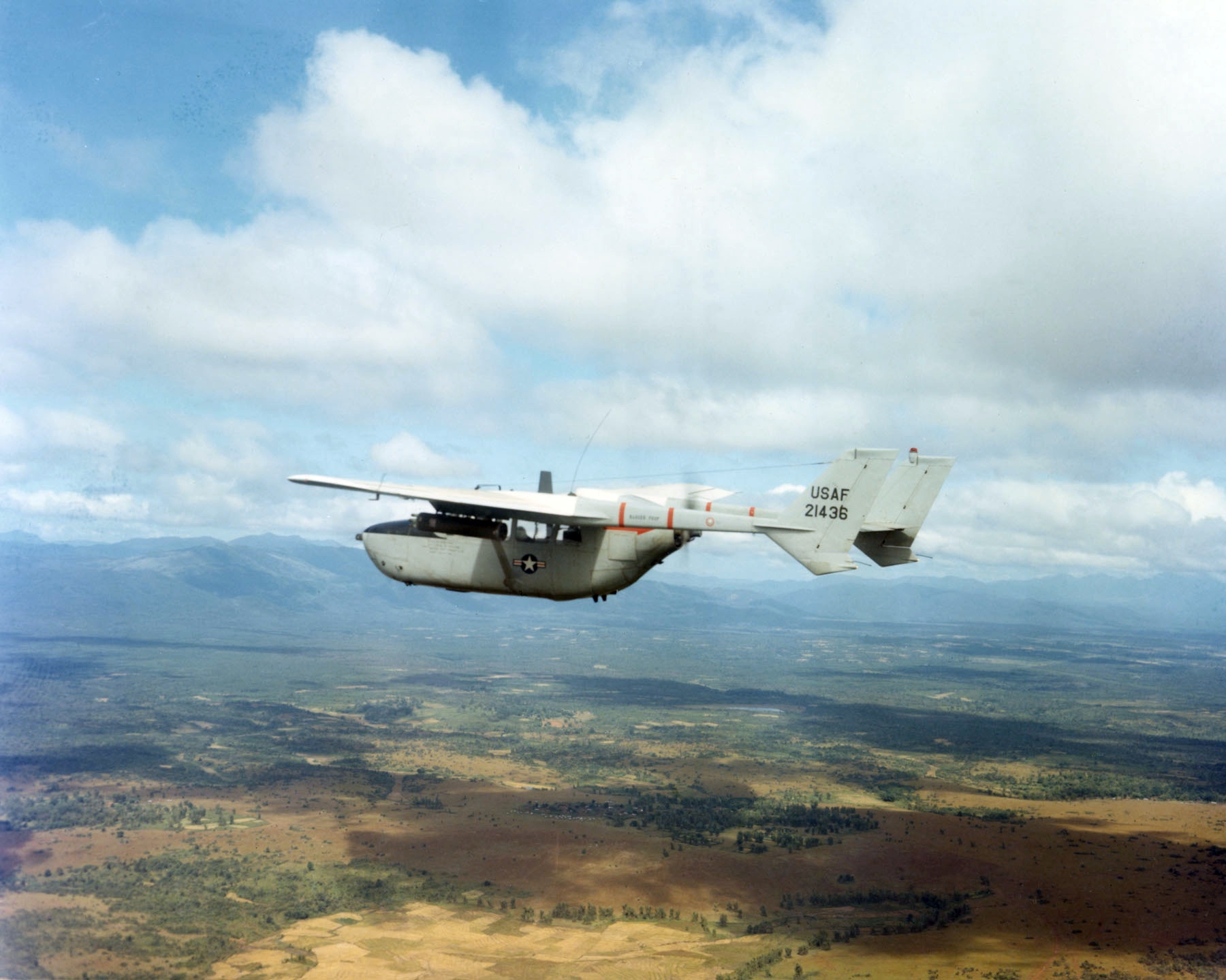
Cessna O-2 Skymaster
“Oscar Deuce”
A militarised civilian Cessna — twin-boomed, with one engine pulling and one pushing — sent low and slow over the jungle to find the enemy, mark them with smoke, and call down the fast jets.
Cessna O-2 Skymaster: a civilian Cessna sent to war as an eye in the sky
By the mid-1960s the U.S. Air Force had a problem over Vietnam. Its forward air controllers — the pilots who found the enemy on the ground and directed fighter-bombers onto them — were flying the O-1 Bird Dog, a single-engine tail-dragger that was slow, ageing and being lost in growing numbers. The Air Force needed more FAC aircraft, quickly, and preferably something already in production. Cessna had exactly that: the civilian Model 337 Super Skymaster. Militarised with underwing pylons, radios and self-sealing tanks, it entered service in 1967 as the O-2.
Its defining feature was the layout Cessna called centerline thrust. One engine sat in the nose pulling, a second at the back of the fuselage pod pushing — both on the aircraft’s centreline, slung between twin tail booms. Two engines gave redundancy over hostile ground, and because the thrust was in line, losing one did not produce the vicious asymmetric yaw that makes a conventional twin so dangerous engine-out. Two crew sat side by side under a greenhouse of glazing, with the all-round view a controller lived by.
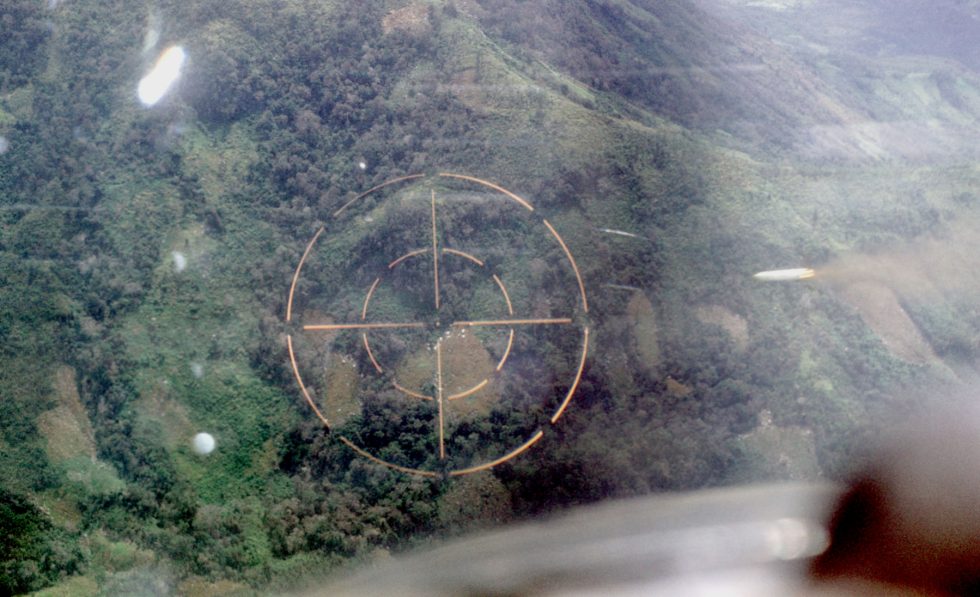
The O-2A’s job was blunt and dangerous: fly low over the jungle for hours, spot troops, trucks and guns, and mark them with 2.75-inch white-phosphorus “Willie Pete” rockets fired from four underwing pylons. The controller then talked the arriving jets onto the column of white smoke. O-2 units flew under callsigns such as Nail and Covey. The aircraft could also carry 7.62 mm minigun pods and flares, but its real weapons were the radio and the rocket.
A minority of airframes — roughly thirty — became the O-2B, stripped of ordnance and fitted instead with loudspeakers and leaflet dispensers for psychological operations, broadcasting surrender appeals and snowing the jungle with paper.
Being cheap and civilian-derived had a price. The O-2 was slow (under 200 mph), low and unarmoured, loitering for hours inside the range of every rifle below. Roughly 178 were lost in the Vietnam War to all causes — more than a hundred of them to enemy fire, though the exact split varies between sources. From 1968 the purpose-built OV-10 Bronco began to take over, yet the O-2 was kept on for night work, because the Bronco’s brighter cockpit ruined a crew’s night vision.
The type soldiered on with the Air National Guard into the 1980s and was widely exported — El Salvador flew it hard through its civil war, and Iran, South Vietnam, the Dominican Republic and others operated it. Cheap, docile and plentiful, hundreds of civilian 337s and ex-military O-2s still fly today as private aircraft and warbirds. MiGFlug does not offer O-2 flights — but the FAC story is one of the most human in the whole air war.
01The Cessna O-2 Skymaster’s push-pull layout: why two engines in a line mattered
A normal twin hangs its engines on the wings. Lose one and the live engine’s thrust, now far off-centre, tries to roll and yaw the aircraft into the dead engine — a classic killer of low, slow pilots. Cessna’s centerline-thrust Skymaster avoided that entirely by mounting both engines on the fuselage centreline, one tractor and one pusher. An engine failure over the jungle cost the O-2 climb performance but not control, which is exactly what you want when you are being shot at at 1,500 feet.
The layout had quirks. The buried rear engine ran hotter and was harder to cool, and because it was out of sight and its thrust was in line, crews could — and occasionally did — begin a take-off roll with the rear engine not actually producing power, unaware until the aircraft refused to climb. The distinctive fore-and-aft propeller arrangement earned the Skymaster the nickname “Mixmaster.” For all that, it did the one thing the FAC mission needed: it kept flying, and it kept the crew alive long enough to make the call.
What makes the O-2 Skymaster special
A civilian airliner, militarised
The O-2 was not a clean-sheet warplane. It was Cessna’s off-the-shelf Model 337 Super Skymaster — a light civilian twin already rolling off the production line — fitted with four underwing pylons, military radios and self-sealing tanks. That is exactly why the Air Force chose it: it was cheap, it was proven, and it could be delivered fast when Vietnam demanded more forward air controllers than the O-1 Bird Dog fleet could provide.
Centerline thrust: two engines in a line
Its signature was the push-pull layout — one engine pulling from the nose, one pushing from the tail of the pod, both on the centreline between twin booms. Twin Continental IO-360 engines of about 210 hp each gave redundancy, and because their thrust was in line, an engine failure over hostile ground cost climb but not control. No lethal asymmetric yaw — a real edge for a low, slow FAC.
Built to see, not to fight
The O-2 was a sensor with wings. Wraparound cabin glazing gave the two-man crew the all-round visibility the FAC job demanded; the aircraft’s weapons were marking rockets, a radio and a pair of eyes, not a gunsight. The O-2A hung white-phosphorus rockets, flares and minigun pods on its pylons; the psywar O-2B swapped all of it for loudspeakers and leaflet chutes.
02The Cessna O-2 Skymaster’s armament: marking rockets, miniguns and a loudspeaker
The O-2A carried its stores on four underwing pylons. The staple load was tube-launched 2.75-inch folding-fin rockets tipped with white phosphorus — “Willie Pete” — whose dense white smoke marked a target far better than any spoken map reference. On top of the markers the aircraft could carry 7.62 mm SUU-11 minigun pods, flares for night work and other light ordnance, but the controller almost never tried to fight a battle himself; his job was to find, mark, and hand off to the fast jets.
The psychological-warfare O-2B was a different animal. It carried no ordnance at all. Instead it mounted high-power loudspeakers and a leaflet dispenser, orbiting over villages and jungle to broadcast surrender appeals and rain down printed propaganda — part of the wider “Chieu Hoi” open-arms campaign. Authoritative museum sources describe the loudspeaker-and-leaflet fit but do not publish a firm speaker wattage, so any exact figure should be treated with caution.
03The Cessna O-2 Skymaster vs the OV-10 Bronco: why the Air Force flew both
The O-2 was an interim answer, and everyone knew it. The purpose-built OV-10 Bronco that began arriving from 1968 was faster, better armed, armoured, and built from the start for the FAC and light-strike role. On paper it made the militarised Cessna redundant. In practice the two served side by side for years: the O-2 was far cheaper to buy and run, and — crucially — it was kept on for night forward air control precisely because the Bronco’s brighter, busier cockpit spoiled a crew’s night vision. The humble Skymaster outlasted many predictions of its retirement.
Cessna O-2 Skymaster full specifications
Baseline note: the figures below describe the O-2A as delivered to the United States Air Force between March 1967 and June 1970 — the armed forward air control model, and all but a handful of the military Skymasters built. Deltas for the unarmed O-2B psychological-warfare conversion, for the Reims-built FTB337G and for the civil Cessna 337 the whole thing came from are in grey. Four disagreements are worth settling before the tables start. Production first: the National Museum of the United States Air Force says 532 O-2s were built for the Air Force and almost every later book copies it, Jane’s says 513 military Skymasters, and the USAF Statistical Digests for 1967 to 1972 — the primary acceptance ledgers — add up to 502: 467 O-2As taken on charge in 1967, 1968, 1969 and 1970, 31 O-2Bs in 1967, and four grant-aid civil 337s in 1972. The digests are the better evidence, and the round 532 cannot be reconciled with them. Second, the airframe itself: this article gives 29 ft 9 in long and 9 ft 4 in high, the Air Force museum placard 29 ft 2 in and 9 ft 5 in, which is the same aeroplane measured to a different datum with a different aerial fit. Third, weight: the museum quotes a loaded weight of 4,900 lb, a normal mission figure rather than the 5,400 lb structural maximum to which the military modification was actually cleared. Fourth, and worst, the German-language specification table for the O-2 lists a crew of one, five passengers, a 4,630 lb maximum weight and IO-360-GB engines — those are the numbers for a 1973 civil 337G and not for any military Skymaster, and they have been reprinted for years.
Dimensions & weights
- Crew
- 2 — pilot and observer side by side, in the front two seats of what had been a six-seat light twin. The rear seating was stripped out, the upholstery went with it, and extra view panels were let into the cabin doors so that both men could look straight down past the strut. The claim of "fore-and-aft seating" found in some online references is simply wrong; the proof is the Cessna 351 project, which was drawn up precisely because a tandem cockpit would have been better. Sitting shoulder to shoulder cost the pilot his view to the right and behind — the exact quadrant a forward air controller needs after a marking pass, and the most-repeated complaint against the type
- Length
- 9.07 m (29 ft 9 in); the National Museum of the USAF gives 8.89 m (29 ft 2 in) for the same mark
- Wingspan
- 11.58 m (38 ft 0 in) — strut-braced, high, and unchanged from the civil 337. It is why the observer could see the ground, and why an aeroplane sold as a battlefield machine still needed a proper runway
- Height
- 2.84 m (9 ft 4 in); museum placards say 2.87 m (9 ft 5 in)
- Wing area
- 18.81 m² (202.5 sq ft); Jane’s gives 18.67 m² (201 sq ft) for the civil 337D, the difference being the conical cambered tips fitted from the 1970 model year
- Aspect ratio
- 7.13:1 — aerofoil NACA 2412 at the root, NACA 2409 at the tip. A Cessna wing in every sense: thick, docile, and designed for a light aeroplane rather than for war
- Empty weight
- 1,292 kg (2,848 lb) — roughly 88 kg (193 lb) more than the civil 337D, the cost of military radios, aerials, four bomb racks and reticulated foam in the fuel tanks
- Max take-off weight
- 2,449 kg (5,400 lb), against 1,996 kg (4,400 lb) for the 1968 civil 337C. Cessna strengthened the structure to carry the extra 1,000 lb but did nothing whatever to the engines, and that one line explains most of what was wrong with the aeroplane
- Useful load
- 1,158 kg (2,552 lb) — two men, about 470 l of fuel, four pylons, the radios and the survival kit, with very little left over for anything heavier than smoke rockets
- Wing loading
- 130.2 kg/m² (26.7 lb/sq ft) at maximum weight
- Power loading
- 7.82 kg/kW (12.9 lb/hp) — the number to remember. A fully loaded O-2A had less installed power for its weight than most single-engined tourers, which is why it climbed like a laden trainer rather than like a light twin
- Internal fuel
- ~470 l (~124 US gal) — the civil aircraft’s 92 US gal mains plus auxiliary tanks, less about three per cent surrendered to the flame-retardant reticulated foam packed into the wing tanks. Enough for the six- to seven-hour loiter the FAC job demanded, which was the O-2’s one unambiguous advantage over the O-1 it replaced
- Undercarriage
- Retractable tricycle — hydraulically actuated, inherited from the Cessna 210 by way of the 337. The original 1961 Model 336 had fixed gear; the military aeroplane did not
Performance
- Maximum speed
- 320 km/h (199 mph, 173 kn) at sea level, clean. Hang four rocket pods and the full aerial farm on it and the useful number is a good deal lower — but it was still half as fast again as the O-1 Bird Dog, which was the whole point
- Cruising speed
- 232 km/h (144 mph, 125 kn) at 3,050 m (10,000 ft), economical cruise
- Stalling speed
- 111 km/h (69 mph, 60 kn) with flaps and undercarriage down, at the civil 4,400 lb weight; appreciably higher at the O-2A’s 5,400 lb
- Rate of climb, both engines
- 6.0 m/s (1,180 ft/min) at sea level. Cessna’s own last civil model managed only 940 ft/min, which is feeble for a light twin and tells you how little margin the design ever had
- Rate of climb, one engine
- No honest published O-2A figure exists — and the absence is itself the story. Investigating the loss of a Cessna 337G at Alamosa, Colorado on 10 November 2011, from a field more than 7,000 ft above sea level, the NTSB calculated a single-engine climb of about 0.50 m/s (99 ft/min): not enough to hold altitude. At a hot, high, loaded 5,400 lb the O-2A on one engine was descending, and every crew knew it
- Service ceiling
- 6,035 m (19,800 ft). The Air Force museum says 19,300 ft and Jane’s gives 19,500 ft for the civil 337D; none of the three describes a loaded aeroplane over Laos in the wet season
- Typical working height
- 450–1,500 m (1,500–5,000 ft) — low enough to see a track through triple canopy, low enough for a 12.7 mm machine gun. This band, not the ceiling, is where the type lived and where it died
- Range
- 1,706 km (1,060 miles, 921 nmi); Jane’s gives 1,553 km (965 miles) for the civil 337D at economical cruise on normal fuel
- Endurance
- ~5–7 hours — contemporary USAF accounts speak of a seven-hour linger time, roughly double what an O-1 could offer. A FAC who can stay on station is worth more than a FAC who is fast
- Take-off distance to 15 m
- 471 m (1,545 ft) for the civil 337D at 4,400 lb; the O-2A at 5,400 lb needed materially more, and on a hot in-country strip with a full load the margin over a single-engine failure was nil
- Landing distance from 15 m
- 503 m (1,650 ft), civil 337D
- Load factor
- +3.8 / −1.52 g — Normal category, which is what a six-seat tourer is certificated to and not what an aeroplane being shot at should be. There were no ejection seats and no armour
Propulsion & systems
- Engines
- 2 × Continental IO-360 — the IO-360-C in the nose and the IO-360-D, with piston-cooling nozzles, in the tail. Air-cooled, fuel-injected, horizontally opposed six-cylinder engines out of the general-aviation catalogue, unsupercharged and unarmoured
- Rated power
- 157 kW (210 hp) each at 2,800 rpm, 313 kW (420 hp) total. Identical to the civil 337 despite an extra 1,000 lb of gross weight
- Capacity
- 5.90 l (360 cu in) each; bore 112 mm and stroke 98 mm (4.438 × 3.875 in), compression ratio 8.5:1
- Engine dry weight
- 133 kg (294 lb) each
- Propellers
- McCauley two-blade constant-speed, fully feathering, 1.93 m (6 ft 4 in) — a tractor at the nose and a pusher between the booms, each with its own blade set. The military aircraft flew without spinners, which is the quickest way to tell an O-2 from a civil 337 in a photograph
- Layout
- Push-pull centreline thrust — the argument for the whole aeroplane. Both propellers turn on the fuselage axis, so losing one produces no yaw, there is no minimum control speed to be caught below, and a pilot at 500 ft over hostile ground does not have to make a correct rudder input in the two seconds after a hit. Many national authorities issued a separate centreline-thrust rating for it. What the layout does not do is make the aeroplane climb on one engine
- Rear-engine cooling
- Dorsal scoop and cowl flaps — the family’s chronic weak point. The rear engine sits in the wake of the fuselage, runs hot on the ground, is documented to quit while taxiing on very hot days, and leaks oil. It is also the engine a pilot is least likely to notice has stopped
- Operating limitation
- FAA Airworthiness Directive 77-08-05 (28 April 1977) prohibits single-engine take-offs in the Skymaster family and requires a placard reading "Do not initiate single engine takeoff". An airworthiness directive exists because aeroplanes were being lost: pilots taxied and opened the throttles with the rear engine silent, never noticed on a machine that pulls straight either way, and ran out of runway. The centreline layout that removed one killer quietly introduced another
- Fuel and protection
- 100/130 avgas in wing tanks packed with reticulated flame-retardant foam — the only concession to combat damage. No armour, no self-sealing tanks, no ejection seats, no crew protection of any kind beyond the airframe and a flak vest to sit on
- Electrical
- 28 V split-bus system with two 38 A alternators, one per engine, introduced on the 337B airframe the O-2A was built from
- Radios
- FM, VHF, UHF and HF — the real weapon. A FAC had to talk simultaneously to troops on the ground, to fighters arriving on station, to an airborne command post and to his own operations centre, and the fit of four radios in a 5,400 lb aeroplane is why the O-2 mattered at all
- Hardpoints
- Four MAU-3A bomb racks under the wings on the O-2A; none on the O-2B, which was fitted with loudspeakers and a leaflet chute instead
04The Cessna O-2 Skymaster’s operating costs: why no reliable price exists
The O-2 was chosen precisely because it was cheap — a lightly modified civilian Cessna 337 rather than a bespoke warplane. Yet a firm, sourced flyaway unit price is surprisingly hard to pin down: the authoritative museum references (the National Museum of the U.S. Air Force and the Smithsonian) publish specifications but no unit cost. Figures that circulate online — such as a low-tens-of-thousands-of-dollars price in 1967 terms — come from low-authority aggregators and should be treated as unverified.
The same is true of running costs. No reliable public cost-per-flight-hour figure exists for the O-2 in open sources. What can be said with confidence is comparative: as a piston-engined light twin derived from a mass-produced civilian design, the Skymaster was dramatically cheaper to buy and operate than the turboprop OV-10 Bronco or any jet — which is exactly why it was bought, and why it lingered in service long after it was meant to be replaced.
Armament & payload
The O-2A carried almost no weapons, and the smoke rockets it did carry decided where everybody else’s bombs fell
The four MAU-3A racks under an O-2A’s wings existed to put a white cloud on a piece of jungle. A forward air controller found the target, rolled in, fired a 2.75 in white phosphorus rocket, told the inbound flight to hit fifty metres north of the smoke, and watched. Everything else the aeroplane was cleared to carry — the minigun pod, the bomblet dispenser — was a theoretical capability that made the type look more warlike in a specification than it ever was over Laos, because 210 lb of ordnance costs an aeroplane with 12.9 lb per horsepower far more than it is worth. The honest summary is that the O-2A was an unarmoured radio station with a rocket launcher, that its crews knew this, and that the Air Force lost 178 of them in Southeast Asia to all causes doing it. Store fits varied enormously by squadron, theatre and date; the Salvadoran, Rhodesian and Summit Sentry aircraft carried real weapons that no USAF O-2A ever routinely flew with, and are treated separately below.
Gun
- No built-in gun of any kind. Nothing was fixed to the airframe, and no O-2 ever had a fighter’s sight
- SUU-11/A pod — a 7.62 mm GAU-2B/A Minigun with about 1,500 rounds, cleared on the inboard racks. It appears in the technical order and very rarely in operational photographs; the weight and drag were more than the aeroplane could spare
- Crew small arms were the practical answer: an M16 or a CAR-15 behind the seats, and grenades and smoke canisters thrown out of the window, which is exactly as improvised as it sounds
- Armed export Skymasters went much further. The Rhodesian Reims FTB337G Lynx carried twin .303 in Browning machine guns mounted above the wing, and the Summit Sentry O2-337 offered 7.62 mm and 12.7 mm gun pods on all four pylons
Air-to-air
- None, ever. No air-to-air weapon was fitted, cleared or seriously proposed for any O-2 variant
- This card is not padding: the O-2 was on the receiving end of the air-to-air problem rather than the giving end. It had no radar warning receiver, no chaff, no flares and a top speed of 199 mph
- The family’s only air-to-air entry is a grim one. On 24 February 1996 two civil Cessna 337s flown by the Cuban exile group Brothers to the Rescue were shot down over the Florida Straits by a Cuban MiG-29, killing four men
- Against ground fire the answer was height, speed and unpredictability, and at 1,500 ft over the Ho Chi Minh Trail there was not much of any of the three
Air-to-surface guided
- None. No O-2 carried a guided weapon of any description in any air force
- Nor could it designate for one. The laser-designator programme that gave FACs a precision capability in Southeast Asia — Pave Nail, with the AN/AVQ-10 Pave Knife derivative and a LORAN fit — went to the OV-10A Bronco, not to the Skymaster
- The O-2 marked with smoke and with voice, and if that sounds primitive, it directed a very large proportion of the tactical air effort in a nine-year air campaign
- The closest thing to guidance the type carried was the observer’s Starlight scope, first trialled in the O-2 for night work over the Trail before moving to better aircraft
Bombs
- SUU-14/A bomblet dispenser — six tubes of BLU-3/B anti-personnel bomblets, cleared on the O-2A and carried very seldom
- No conventional iron bomb was standard on a USAF O-2A. The racks were rated for the type of light store a FAC needed, not for a Mark 82
- The Rhodesian Lynx is the exception that proves how much the airframe could be pushed: locally made Mini Alpha bomblets, the 204 kg (450 lb) Mini Golf blast and fragmentation bomb, and Frantan napalm in frangible drop tanks
- Summit Sentry pylons were rated at 159 kg (350 lb) each and advertised for bombs, markers and flares, which is roughly double what the USAF ever asked of the same wing
Rockets
- The real armament, and effectively the only one. 2.75 in (70 mm) Mk 4 folding-fin aerial rockets with the Mk 5 white phosphorus warhead — "Willie Pete" — fired to mark, never to destroy
- Launchers were the seven-tube LAU-59/A and the MA-2/A. A full four-rack fit was 28 rockets; the common load was 14 in two pods, leaving two stations for flares or nothing at all
- Aiming was by pointing the aeroplane in a shallow dive with a grease-pencil mark on the windscreen. Accuracy came from the pilot’s eye and from repetition
- Rhodesian Lynxes fired 37 mm SNEB rockets in anger against ground targets, a genuine attack role that the USAF never gave the type
Pods & other stores
- Parachute flares and flare dispensers for night work, used with C-130 Blind Bat flareships over the Trail: the C-130 lit the ground, the O-2 marked what the light revealed
- The O-2B’s entire payload was words. Three 600 W audio amplifiers driving directional loudspeakers, plus a leaflet chute in the cabin floor; the psychological operations aircraft had no pylons and no observer view panels
- Leaflet loads for the 4th Psychological Operations Group ran to millions of sheets a month, dropped by day, with loudspeaker broadcasts flown at night
- Ancillary kit that mattered more than ordnance: the four-band radio fit, a hand-held camera, binoculars, the map board, and a flak vest under the seat cushion
Three typical loadouts
- Day visual FAC, 20th Tactical Air Support Squadron, Da Nang, 1968
- Two LAU-59/A launchers with fourteen 2.75 in white phosphorus marking rockets, full internal fuel for a five- to six-hour patrol, four radios, two men, a camera and a map board. Call sign Covey for cross-border work. No gun, no bombs, no armour.
- Night interdiction over the Ho Chi Minh Trail with a Blind Bat flareship
- Marking rockets inboard, flare dispenser outboard, a Starlight scope in the observer’s hands and the cockpit lighting turned down as far as it would go. This was the mission the O-2 kept after the OV-10 arrived in 1968, because the Bronco’s cockpit was too brightly lit for night reconnaissance until it was modified.
- Psychological operations sortie, 9th Special Operations Squadron, O-2B, 1969
- Three 600 W amplifiers and directional loudspeakers, a full leaflet load in the cabin, no pylons and no weapons. Leaflets by day over South Vietnam, Laos and Cambodia; recorded broadcasts by night from a few thousand feet, in support of the US Army 4th Psychological Operations Group.
Sourcing caveat: the store list above comes from the O-2A technical order and from unit accounts, and the two do not agree about what was ordinary. Clearance is not carriage. Photographic evidence from Southeast Asia shows rocket pods on almost every armed sortie and gun pods or bomblet dispensers on very few, and several published O-2 armament tables silently import stores that belong to the Summit Sentry brochure or to Rhodesian practice. Where an item here is export-only or trials-only, it says so.
Variants
Cessna sold one push-pull airframe as a family tourer, a forward air controller, a loudspeaker van and a Rhodesian light bomber
The O-2 exists because in 1966 the Air Force needed a better FAC aeroplane immediately and had no appetite for a development programme. Buying a catalogue light twin, bolting four racks to it and painting it olive drab took months rather than years, and the aircraft was flying in January 1967 and in Vietnam by the summer. The price of that speed is visible in every line of the specification: Normal-category structure, no armour, no ejection seats, no crew protection, and the same 420 hp asked to lift an extra half-ton.
The interesting variants are mostly not American. Reims Aviation in France kept the airframe alive after Wichita stopped building it in 1982, and the militarised Reims FTB337G with Robertson short-field modifications turned out to be the genuinely warlike Skymaster — in Rhodesian hands it flew Fire Force counter-insurgency strikes with guns, rockets and napalm, work no USAF O-2A was ever asked to do. Summit Aviation in Delaware then discovered a third market by remanufacturing tired civil 337s into armed Sentries for small air forces that could not afford anything else.
- Cessna 337 Super Skymaster (civil, 1965–1982; 2,993 Skymasters of all marks)
- The parent. Retractable gear, 210 hp Continental IO-360s and a dorsal scoop for the rear engine, replacing the fixed-gear 1961 Model 336 of which only 197 were built. Turbocharged T337 from 1966 and pressurised P337G from 1973.
- O-2A, Cessna model M337B (1967–1970; 467 accepted by the USAF)
- The armed FAC version: four MAU-3A racks, military radios and aerials, door view panels, foam-filled tanks, no spinners, no upholstery, gross weight raised from 4,400 lb to 5,400 lb. The Skymaster the whole story is about.
- O-2B, Cessna model MC337A (1967; 31 converted)
- Thirty-one former civil 337A airframes fitted with three 600 W amplifiers, directional loudspeakers and a leaflet dispenser for psychological warfare. Unarmed, no pylons, no observer view panels. Serials 67-21457 to 67-21487, flown by the 9th Special Operations Squadron from 1968 to January 1972.
- Cessna 348, designated O-2T (one prototype, first flight autumn 1969)
- The turboprop answer to the power problem: two 317 shp Allison 250-B15s, a longer wing and better high-lift devices on an M337B airframe. It flew, it performed as promised, and the Air Force bought OV-10s instead.
- Cessna 351, designated O-2TT (mock-up only)
- The production O-2T that never was: a 9.85 m fuselage, a 13.11 m wing and, crucially, a tandem cockpit that would have fixed the side-by-side seating every FAC complained about. It got as far as a mock-up.
- Reims F337E to F337H (France, 1970–1978; about 86 built)
- Licence production of the unpressurised civil marks for the European market by Reims Aviation: 24 F337E, 31 F337F, 29 F337G and 2 F337H.
- Reims FT337GP and FT337HP (France, 1973–1978; 23 built)
- The pressurised Reims marks, 22 and 1 respectively. Together with the unpressurised aircraft and the FTB337G this gives about 170 French-built Skymasters, against the 94 quoted in German sources and 154 in others — a discrepancy nobody has resolved.
- Reims FTB337G Milirole, in Rhodesia the Lynx (1973–1980; 61 built)
- The military Reims: Robertson STOL modifications, strengthened structure and underwing hardpoints. Rhodesia obtained 21 for No. 4 Squadron at Thornhill despite sanctions and armed them with twin .303 in Brownings above the wing, 37 mm SNEB rockets, Mini Alpha and 450 lb Mini Golf bombs and Frantan napalm for Fire Force operations from 1974. Portugal bought 32, delivered from December 1974 and retired on 25 July 2007; three ex-Portuguese aircraft went to Mozambique in 2011–12.
- Summit Sentry O2-337 (Middletown, Delaware; still offered in 1987)
- Used civil 337s remanufactured by Summit Aviation into armed light attack and observation aircraft with four NATO-standard pylons rated at 159 kg (350 lb) each for gun pods, rocket launchers, bombs, markers and flares. Sold to Haiti, Honduras, Nicaragua, Senegal and the Royal Thai Navy, which took eleven.
- Conversions and dead ends (1970s to date; ones and twos)
- The Conroy Stolifter and the Spectrum SA-550 both replaced the piston pair with a single turboprop; the AVE Mizar bolted Skymaster wings, tail and rear engine to a Ford Pinto and killed its two occupants in 1973; the Ampaire Electric EEL flew on 6 June 2019 with an electric motor in the nose and a piston engine at the back, and VoltAero used another as the testbed for its Cassio. The layout keeps attracting people who think it solves a problem.
Survivors, service and the shape of what is left. Every surviving Skymaster is an original airframe — nobody has ever built a reproduction, and the type’s peculiar problem is the reverse of the usual one: a fair number of aircraft flying today in Vietnam-era FAC markings are civil 337s wearing an O-2 paint scheme rather than genuine military machines, and the difference is a construction number, not a colour. Of the roughly 500 built for the Air Force, the Warbird Registry documents 43 ex-military airframes still accounted for; about two dozen are on public display in the United States, from the National Museum of the USAF at Wright-Patterson to Pima, Castle, Hill, Evergreen, Travis, March Field and a long line of base gate guards, with the Smithsonian holding 67-21396, an aircraft that flew hundreds of sorties with the 20th TASS at Da Nang, was hit by ground fire more than once, and retired after 4,851 hours. That published display list is unreliable in detail — it carries serial 67-21331 and 67-21395 twice each and omits the Smithsonian aircraft entirely. Several dozen more are on the United States civil register and a modest number fly each year as warbirds; the type is cheap to buy and expensive to keep, and the flying population drifts downward. Military service has almost ended: the USAF gave up its last operational O-2s in the late 1980s, the Navy used six as range controllers at NAS Lemoore from 1983, two went to the Army in 1990, and the final pair retired from the Yuma Proving Ground in October 2010 and went to a museum. Abroad, the Salvadoran Air Force is still credited with five to nine O-2As after a civil war in which it lost two to SA-7 missiles in 1990, one to mortar fire and two in accidents, and the Uruguayan Navy took three ex-Chilean aircraft in June 2017. Between 1974 and the mid-1990s CAL FIRE flew twenty of them as air attack aircraft, picked by hand from forty stored at Davis-Monthan, shipped to Fresno in pieces and rebuilt by California Conservation Corps crews — a second career longer than the first.
From civilian twin to Vietnam FAC and back to the warbird ramp
The civilian Skymaster
Cessna flies the push-pull Model 336 (1961) and the retractable-gear Model 337 Super Skymaster (1965) — the civil aircraft the O-2 would be built from.
The Air Force needs FACs, fast
With the O-1 Bird Dog stretched thin over Vietnam, the USAF selects a militarised 337 — the O-2 — to supplement it, off the shelf and in a hurry.
First flight and into service
The O-2 first flies in January 1967; deliveries begin that March and the type is quickly in combat as the O-2A forward air controller and the O-2B psywar aircraft.
The Bronco arrives — and the O-2 stays
The purpose-built OV-10 Bronco begins replacing it, but the O-2 is kept on for night forward air control, where the Bronco’s bright cockpit is a liability.
Production ends
Cessna completes the last of 532 O-2s built for the USAF — roughly 500 FAC O-2As and about 30 psywar O-2Bs.
Guard service and hard exports
The O-2 passes to the Air National Guard and is widely exported. El Salvador flies it intensively through its civil war; Iran, South Vietnam, the Dominican Republic and others also operate the type.
Out of U.S. front-line use
The Skymaster fades from U.S. military service as newer FAC and reconnaissance systems take over, though a handful linger in support roles for years.
Still flying as warbirds
Cheap, docile and plentiful, hundreds of civilian 337s and ex-military O-2s remain airworthy in private and warbird hands — among the most accessible piston warbirds you can own.
From the cockpit: twelve O-2 Skymaster stories
The airliner that went to war
A civilian Cessna 337 became a warplane almost unchanged.
Read the full story
Find, mark, hand off
The FAC found the enemy, fired a smoke rocket, and called the jets.
Read the full story
Nail and Covey
Behind the squadron numbers were the names crews answered to.
Read the full story
The Mixmaster
One propeller pulling, one pushing — and a nickname to match.
Read the full story
The engine you forgot to check
The hidden rear engine could quietly fail to make power.
Read the full story
A voice from the sky
The O-2B carried no rockets — only loudspeakers and paper.
Read the full story
Low, slow, and shot at
Being cheap and unhurried made the O-2 desperately exposed.
Read the full story
Replaced, but not retired
The Bronco was better — yet the O-2 kept the night.
Read the full story
Taking over from the Bird Dog
The O-2 came to supplement the O-1 Bird Dog, not erase it.
Read the full story
El Salvador’s hard war
Ex-U.S. O-2s saw heavy combat long after Vietnam.
Read the full story
The affordable warbird
You can still buy and fly one — just not through MiGFlug.
Read the full story
Oscar Deuce
A workhorse picks up a fistful of nicknames.
Read the full story
The O-2 Skymaster in pictures
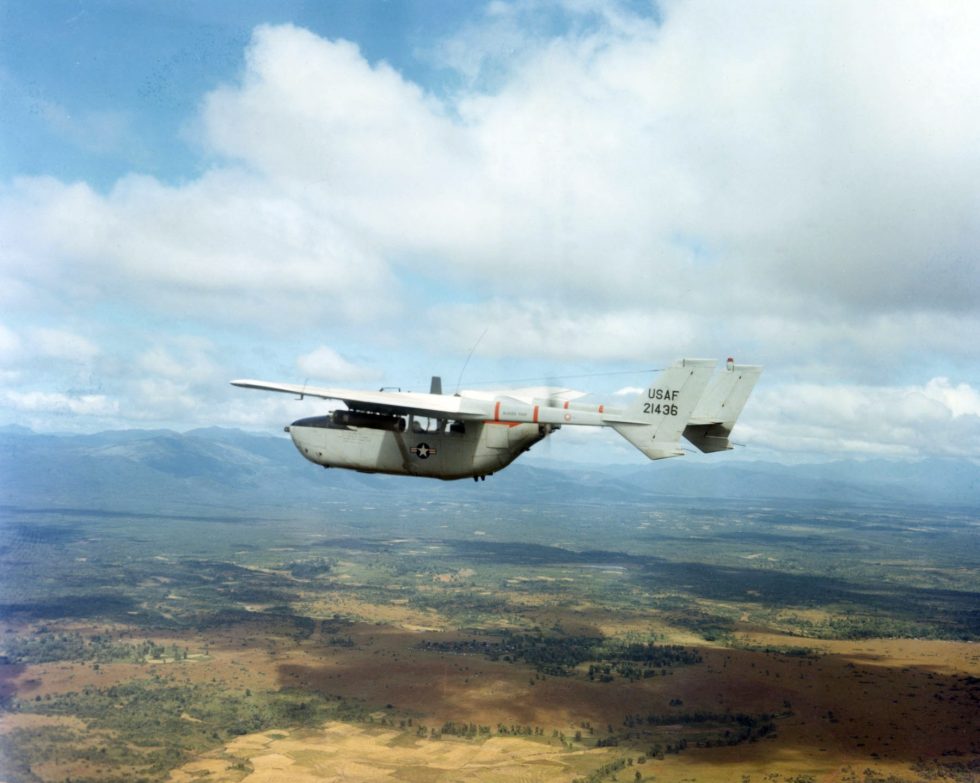
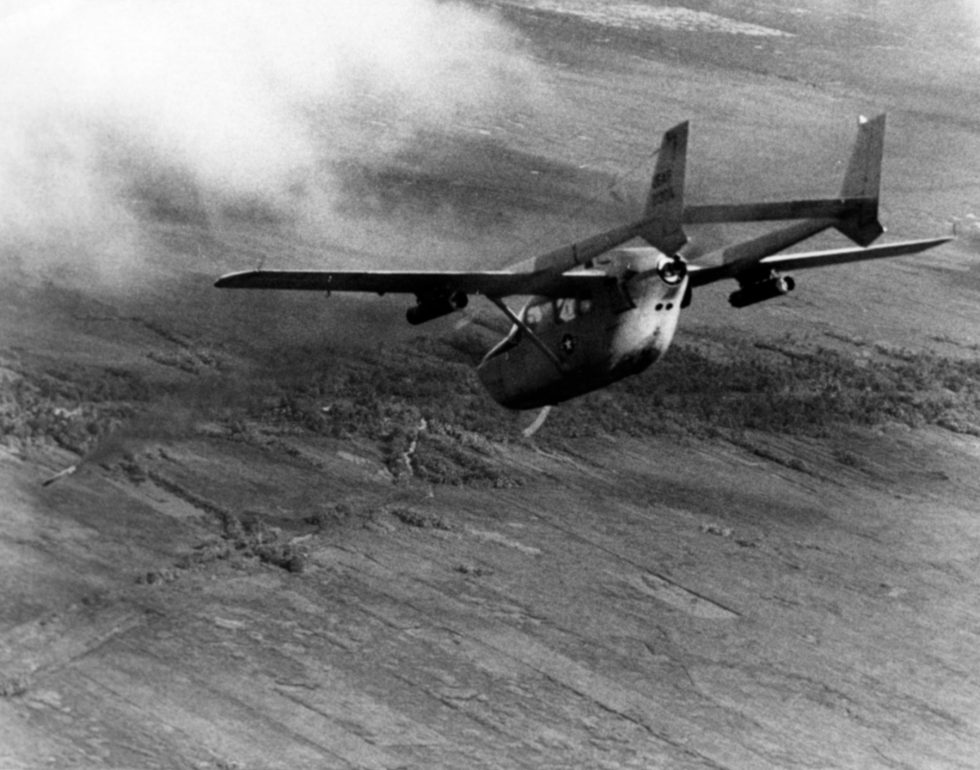
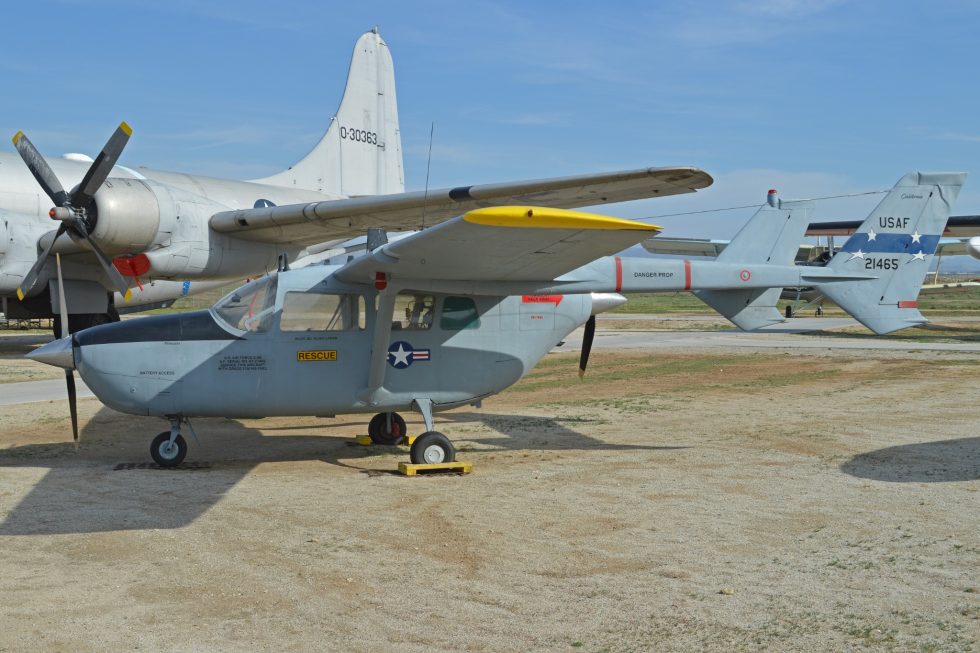
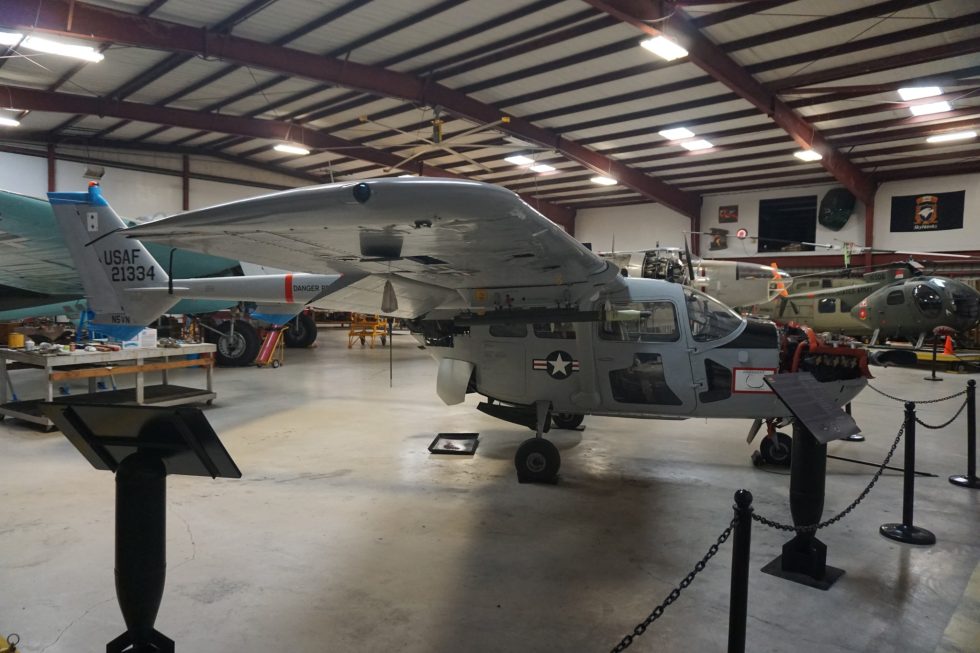
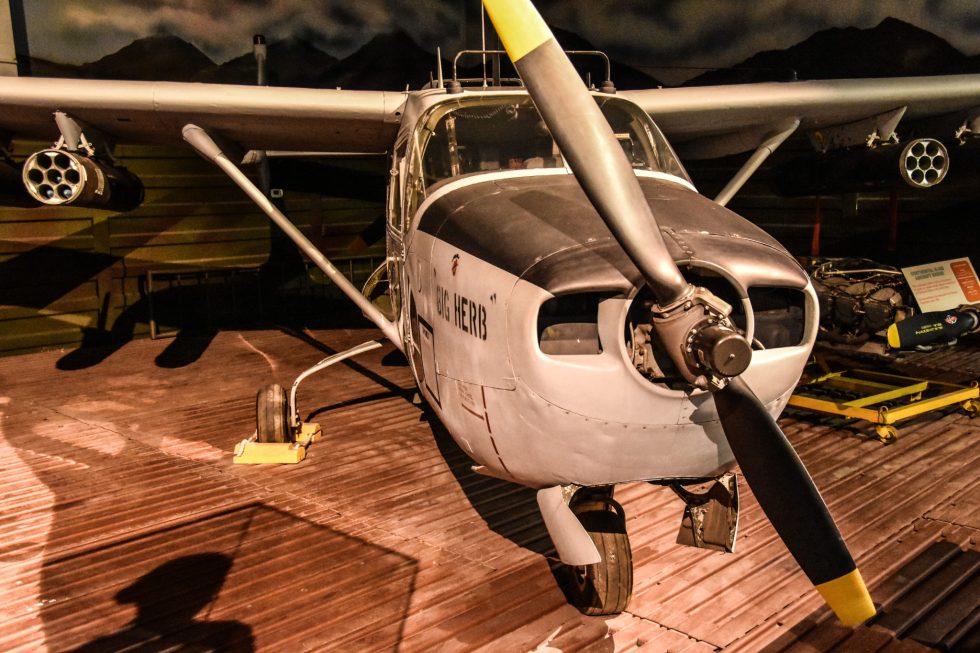
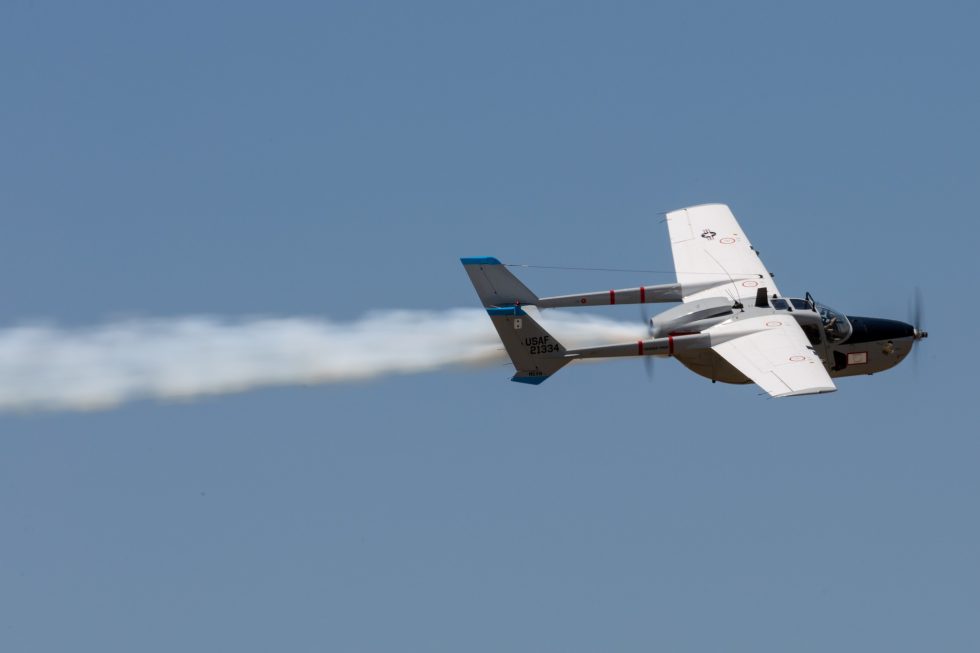
The O-2 Skymaster in motion
The Most Dangerous Plane to Fly in Vietnam from Behind the Wings, produced by the Wings Over the Rockies Air & Space Museum. A well-made walkaround and history of the O-2 Skymaster and the forward-air-control mission, built around a real museum airframe.
Where the O-2 Skymaster flew
The O-2 Skymaster’s war, by the numbers
The O-2 was never built to win dogfights — it had none. Its combat record is written in patience and risk: hours spent low and slow over hostile ground, finding the enemy and marking them so that others could strike. That work was extraordinarily dangerous, and the loss figures show it.
For how purpose-built strike and fighter types compare, see the combat record of every military aircraft. Loss figures for the O-2 vary between sources and are best read as approximate.
Everything people ask about the O-2 Skymaster
Can I fly in a Cessna O-2 Skymaster?
What was the O-2 Skymaster used for?
Why does the O-2 have two propellers in a line?
What is the difference between the O-2A and O-2B?
How many O-2 Skymasters were built?
Is the O-2 the same as the Cessna 337?
What replaced the O-2 Skymaster?
Are any O-2 Skymasters still flying?
You can’t fly the O-2 Skymaster.
These, you can.
Some legends only live in museums — others are fuelled and waiting. MiGFlug has put civilians in real military jet cockpits since 2004.
 Fly the L-39 AlbatrosThe world’s most-flown jet trainer — aerobatics included
 Fly the F-104 Starfighter“The missile with a man in it”
 Fly the MiG-21The Cold War’s most-produced jet
 Fly the T-33 Shooting StarAmerica’s first jet trainer
 Fly the DH VampireA piece of early jet history
 Fly the S.211Agile Italian jet trainer
 Fly the MB-326The classic Aermacchi jet
 Fly the MiG-15The Soviet legend of the Korean War
Continue the tour
Every fact, checked
- National Museum of the U.S. Air Force — Cessna O-2A SkymasterPrimary reference for production total (532), specifications and roles.
- Smithsonian National Air and Space MuseumCollection record for the O-2A, its push-pull layout and the O-2B psywar fit.
- HistoryNet — the O-2 over VietnamSquadrons, callsigns (Nail, Covey), armament and loss breakdown.
- Southern Museum of Flight — “The Oscar Deuce”FAC mission narrative and why the O-2 was kept on for night work.
- Warbirds Resource Group — O-2 SkymasterService history and transfers to the South Vietnamese air force.
- Military Factory — Cessna O-2 SkymasterTechnical data and export-operator overview.
- Wikimedia CommonsSource of the public-domain USAF and Creative Commons photographs used here.