
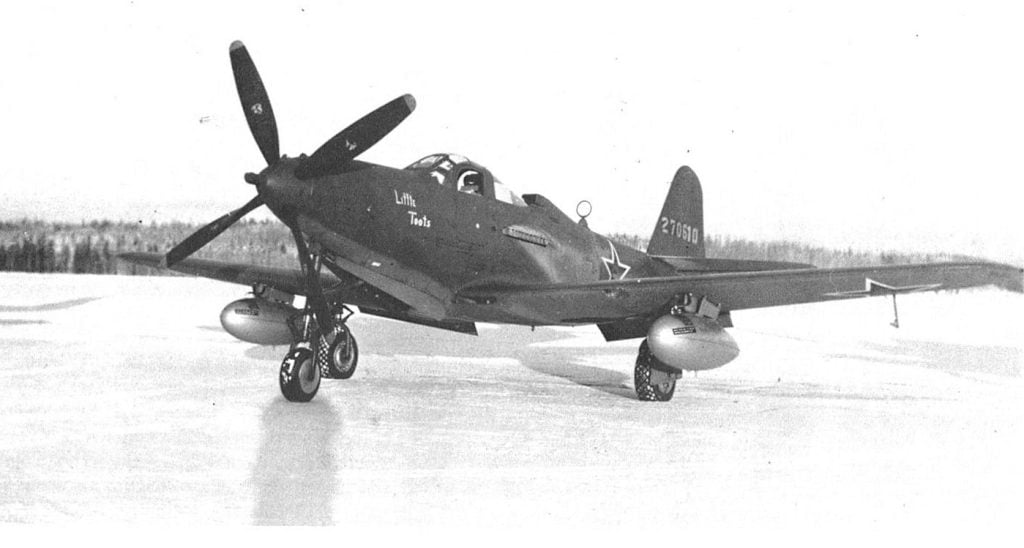
P-63 Kingcobra
The fighter America built and Russia flew
Bell’s mid-engined follow-on to the Airacobra — a cannon-nosed fighter the USAAF didn’t want, sent by the thousand to the Soviet Union, and turned into the strangest gunnery target ever flown.
The Kingcobra: an American fighter with a Soviet heart
The P-63 Kingcobra was Bell Aircraft’s second attempt at the same radical idea. Its predecessor, the P-39 Airacobra, had mounted its engine behind the pilot and fired a cannon through the propeller hub — a layout that gave superb forward visibility and a hard-hitting nose, but left the Airacobra gasping at altitude. The Kingcobra kept the concept and fixed the flaws.
A new laminar-flow wing, a more powerful Allison V-12 and better supercharging gave the P-63 the height and performance the Airacobra lacked. The essentials remained gloriously odd: the engine sat behind the cockpit, a long driveshaft ran forward beneath the pilot’s seat to a nose gearbox and propeller, a 37 mm cannon fired through the spinner, and the pilot climbed in through car-style doors.
And yet, at home, almost nobody wanted it. By the time the Kingcobra was ready, the USAAF had all the Mustangs and Thunderbolts it needed. The P-63 never flew combat in American hands — a first-rate fighter with no war to fight.
The Soviet Union solved that problem. Roughly three-quarters of all Kingcobras — some 2,400 aircraft — went east under Lend-Lease. Soviet pilots had already fallen in love with the Airacobra’s cannon and low-altitude punch, and they took to the bigger, better P-63 as well. It served in the Far East during the Soviet drive into Manchuria against Japan in August 1945.
Then there was the Pinball. The strangest Kingcobras never carried guns at all: the RP-63 was a heavily armoured flying target, fitted with sensors and hit-registering lights, so that air gunners could fire frangible bullets at a real, maneuvering fighter and see their hits flash. No other combat aircraft was ever built to be shot at on purpose.
France flew the P-63 over Indochina into the early 1950s, and 3,303 were built in all. The Kingcobra never became a household name, but it was a capable, characterful fighter that found its fame far from the country that built it.
01Why the Kingcobra mattered: the right fighter, the wrong air force
The P-63 is a study in how much context decides an aircraft’s fate. On its own terms it was a genuine improvement over the Airacobra — faster, higher-flying and better armed — but it arrived into a US Army Air Forces already swimming in superb fighters, and so was judged surplus at home.
Handed to the Soviet Union, the same aircraft slotted perfectly into a doctrine built around low-altitude fighting and heavy nose cannon. The Kingcobra is a reminder that “good” is never absolute for a warplane: it is always good for a particular war, flown by a particular air force.
How Bell perfected its mid-engine fighter
Fixing the Airacobra
The P-39 had been fast and hard-hitting down low but hopeless at altitude. For the Kingcobra, Bell fitted a new laminar-flow wing, a more powerful Allison engine and better supercharging, curing the altitude problem while keeping everything that had made the Airacobra distinctive.
Engine behind the pilot
Like the Airacobra, the Kingcobra hid its V-12 behind the cockpit, with a long driveshaft running forward beneath the pilot’s seat to a nose gearbox and propeller. The layout freed the nose for a heavy cannon and gave superb visibility — and the pilot boarded through automobile-style side doors.
A cannon through the spinner
The Kingcobra’s main weapon was a 37 mm cannon firing straight through the propeller hub, backed by four .50-calibre machine guns and a useful bomb load. It was a nose built to smash aircraft, tanks and river craft alike.
02The Pinball: a fighter engineered to be shot at
The oddest Kingcobra of all carried no guns. The RP-63 “Pinball” was a flying gunnery target: its skin was thickened into heavy armour, its cockpit and vitals protected, and it was wired with sensors and lights so that when trainee air gunners hit it with special frangible (breakable) bullets, the strikes would register and the aircraft would flash. It let gunners practise against a real, evading fighter — a role no other combat aircraft has ever filled.
Bell P-63 Kingcobra — by the numbers
Baseline note: the figures below describe the P-63A-10 of late 1944 (Bell Model 33, built at Niagara Falls, New York) — the last and fullest of the A-blocks, with the belt-fed M10 cannon, underwing rocket tubes and the heaviest armour of the series, and the mark most Soviet acceptance crews actually signed for. Deltas for the P-63C of 1944–45, and for the one-off P-63D, are given in grey. One warning about the literature: the most widely reproduced P-63 table pairs A-model airframe weights with the C-model’s 1,800 hp engine rating and the A-model’s 43,000 ft ceiling, describing an aeroplane that never existed. The columns below keep the marks apart, and where the authorities genuinely disagree the disagreement is stated rather than averaged away.
Dimensions & weights
- Crew
- 1
- Length
- 9.96 m (32 ft 8 in), against 9.19 m (30 ft 2 in) for the P-39Q. The Kingcobra was a bigger aeroplane in every dimension, and no major component of the two types was interchangeable
- Wingspan
- 11.68 m (38 ft 4 in), against 10.36 m (34 ft 0 in) on the P-39. Several widely copied sources state that the P-63C’s span was cut by 250 mm (10 in); Baugher and the Bell general-arrangement drawings give the same 11.68 m for both. Treat the reduction as unproven
- Height
- 3.84 m (12 ft 7 in) on the tricycle undercarriage
- Wing area
- 23.04 m² (248 sq ft). The P-63D and P-63E went to 11.94 m (39 ft 2 in) span and 23.69 m² (255 sq ft)
- Wing section
- NACA 66(215)-116 at the root, 66(215)-216 at the tip — a genuine low-drag laminar section, and the single largest structural difference from the P-39. Post-war Royal Aircraft Establishment work on a P-63A found the laminar run only appeared when surface waviness was held below about 0.13 mm (0.005 in), which no operational finish achieved; in squadron condition the wing behaved as a good conventional aerofoil, not a magic one
- Empty weight
- 2,892 kg (6,375 lb). P-63C: 3,084 kg (6,800 lb)
- Normal take-off weight
- 3,992 kg (8,800 lb) clean, with cannon, four machine guns and full internal fuel
- Maximum take-off weight
- 4,763 kg (10,500 lb). P-63C: 4,853 kg (10,700 lb)
- Fuel
- ~379 l (~100 US gal, 83 imp gal) internal in self-sealing wing cells; P-63C ~405 l (~107 US gal). One 284 l (75 US gal) drop tank on the fuselage rack, with no provision for wing tanks in service. This is small tankage for a 4-tonne fighter and it is the number behind the type’s modest radius
- Wing and power loading
- 173 kg/m² (35.5 lb/sq ft) and 2.66 kg/hp (5.87 lb/hp) on war emergency power, both at normal take-off weight. The wing loading is high for 1944 and part of why the type turned less well than a Yak and dived better than one
- Armour
- 107 kg (236.3 lb) on the A-10, raised progressively from 86 kg (188.8 lb) on the A-8 at Soviet insistence. P-63C-5: 91 kg (201 lb). Armour glass ahead of and behind the pilot; the engine behind the seat was itself a large piece of protection
- Structure
- All-metal stressed-skin, the Allison carried amidships on a welded steel truss behind the cockpit, entry through two automobile-style side doors with wind-down windows. The doors were popular on the ground and detested in an emergency: they could not be jettisoned cleanly at speed, and Soviet units lost pilots who could not get out
Performance
- Maximum speed
- 660 km/h (410 mph) at 7,620 m (25,000 ft). The clean XP-63A prototype reached 678 km/h (421 mph) at 7,345 m (24,100 ft) and the A-8 was measured at 671 km/h (417 mph); service aircraft carrying gun gondolas, racks and rocket tubes were slower than any of these
- Speed at medium level
- Soviet comparative trials put the P-63 about 9 km/h (6 mph) below the Bf 109G-4 at 5,000 m (16,400 ft) while beating both the Bf 109G-4 and the Fw 190A-4 in sustained horizontal manoeuvre. That is the honest shape of the aeroplane: not the fastest thing in the sky, but very hard to shake in a turning fight at the heights the Eastern Front was fought at
- Rate of climb
- 12.7 m/s (2,500 ft/min) initial, at normal take-off weight on military power
- Service ceiling
- 13,100 m (43,000 ft). P-63C: 11,765 m (38,600 ft). The C had the more powerful engine and the lower published ceiling, which should make any reader suspicious: the 43,000 ft figure is a light, clean-airframe number and the 38,600 ft one reflects a combat-loaded aeroplane. Do not read the pair as a regression
- Combat range
- ~724 km (~450 miles) on internal fuel. P-63C ~515 km (~320 miles). Radius of action was correspondingly short, and the type was used as a front-line fighter and fighter-bomber rather than an escort
- Ferry range
- ~3,540 km (~2,200 miles) with the fuselage drop tank — the figure that mattered most in practice, because the great majority of Kingcobras were flown to war rather than shipped, up the Northwest Staging Route to Alaska and across the Bering Strait
- Roll rate
- 110° per second at 443 km/h (275 mph), better than the contemporary P-47, P-40 and P-51. The mid-fuselage engine put the mass close to the roll axis, and pilots noticed it immediately
- Stall and approach
- The laminar wing stalled with markedly less warning than the P-39’s and needed a faster approach. French pilots of GC 2/6 Normandie-Niemen, converting at Casablanca on 18 July 1945 straight off the Airacobra, remarked on it at once
- Spinning
- The type’s worst vice. At aft centres of gravity it would enter a flat spin from which recovery was doubtful and in which the rear fuselage could buckle. Soviet test pilot Andrey G. Kochetkov and engineer Fyodor P. Suprun flew the investigation at Bell in early 1944; the aft CG limit was moved forward as a result, and until it was, the standing instruction was to leave the aeroplane rather than fight the spin
- Dive and high-speed handling
- Solid and much liked — heavy ailerons at the top end but no compressibility reputation of the kind that dogged the P-38, and a tricycle undercarriage that made the whole business of taking off and landing easy for pilots with thin training hours
- High-altitude behaviour
- The two-stage supercharger did what the P-39’s single stage could not: the Kingcobra held its power to roughly 7,600 m (25,000 ft) and was a usable aeroplane above 6,000 m. That capability was bought at some cost and, on the Eastern Front where the fighting sat below 5,000 m, was largely wasted
Propulsion & systems
- Engine
- One Allison V-1710-93 (E-11), liquid-cooled 60° V-12 of 28.0 l (1,710 cu in), mounted behind the pilot
- Ratings
- 1,325 hp (988 kW) take-off and military; 1,500 hp (1,120 kW) war emergency at low level
- Supercharging
- An engine-driven single-stage centrifugal blower plus a separate auxiliary stage behind the engine, driven through a variable-speed hydraulic coupling. This second stage is the entire reason the P-63 exists: it restored the high-altitude power the P-39 lost when its turbocharger was deleted in 1940
- P-63C engine
- Allison V-1710-117 (E-21): 1,500 hp (1,120 kW) at sea level and 1,800 hp (1,340 kW) with water-alcohol injection. The P-63D used the V-1710-109, the P-63E the same, the P-63F the V-1710-135 of 1,425 hp (1,063 kW)
- Propeller
- Aeroproducts four-blade constant-speed unit of 3.35 m (11 ft 0 in) diameter, hollow steel blades, with the cannon barrel passing through the hollow hub and out through the spinner
- Drive train
- An extension shaft roughly 3 m (10 ft) long running forward beneath the cockpit floor between the pilot’s feet at crankshaft speed, to a remote reduction gearbox in the nose. Bell’s shaft gave far less trouble than its reputation suggests; the arrangement was chosen to free the nose for a heavy gun and to put the mass on the centre of gravity, and it did both
- Cooling
- Glycol radiator and oil coolers buried in the wing centre section, fed through leading-edge ducts and exhausting through controllable flaps under the trailing edge. Neat aerodynamically and vulnerable in practice — a hit in a wing-root duct was frequently fatal to the engine
- Fuel system
- Self-sealing wing cells only, with a single fuselage rack able to take a 284 l (75 US gal) tank in place of a bomb
- Radio and electrics
- SCR-522 VHF command set and SCR-695 IFF as delivered. Soviet regiments generally re-equipped with RSI-4 sets on receipt; French machines kept American equipment throughout
- Cockpit
- Roomy, well heated, with an exceptional forward and downward view over the short nose and a good reflector sight. Soviet pilot reports single out precisely these things — comfort, heating, visibility, instruments — and Soviet fighters of 1944 offered none of them
- Target-aircraft fit (RP-63)
- All armament and internal armour stripped, replaced by an outer skin of 6.35 mm (0.25 in) duralumin, thick-walled hollow propeller blades, steel exhaust guards, intake grilles, glazing over 25 mm (1 in) thick, more than 100 pressure-sensitive pickups beneath the skin and a light in the propeller hub that flashed on every hit
03A fighter shaped by Lend-Lease
Because the vast majority of Kingcobras were built for export to the Soviet Union, much of the type’s service data comes from Soviet rather than American use. Figures vary between the P-63A and the uprated P-63C, and between standard fighters and the heavily modified RP-63 targets, so the numbers above are representative of the type rather than any single mark.
Armament & payload
The Kingcobra kept the Airacobra’s cannon through the propeller hub and finally gave it enough ammunition to matter
The P-63’s armament is the P-39’s argument, settled. A 37 mm gun on the centreline of a fighter is a devastating thing if it hits, and the mid-mounted engine made the installation possible; the P-39’s problem was never the gun but the thirty rounds behind it and the jamming feed that often delivered fewer. From the P-63A-9 the belt-fed M10 nearly doubled the magazine to 58 rounds and fed reliably, and with four 12.7 mm Brownings alongside it — two synchronised in the nose, two in bolt-on underwing gondolas — the Kingcobra had a battery that could open a tank’s engine deck or take a Ju 88 apart. What it could not do was reconcile the trajectories: the 37 mm shell left the muzzle at roughly 610 m/s against about 880 m/s for the .50 calibre, so beyond about 300 m the two streams diverged badly and a pilot had to choose which weapon he was aiming. Fits varied by block and by operator: early A-blocks carried the 30-round M4, Soviet regiments frequently flew with the underwing gondolas removed for speed and rate of roll, and French aircraft in Indochina were often limited less by what they could carry than by what ammunition Saigon could get.
Gun
- One 37 mm M4 automatic cannon firing through the hollow propeller shaft and out of the spinner, 30 rounds, roughly 610 m/s (2,000 ft/s) muzzle velocity and about 150 rounds/min cyclic. Shell weight about 608 g (1.34 lb)
- From the P-63A-9, the 37 mm M10 with a disintegrating-link belt: 58 rounds and a slightly higher rate of fire. This is the single most important armament change in the type’s history and the one the Soviets had been asking for since the P-39
- Two 12.7 mm (0.50 in) M2 Browning synchronised in the upper nose, 250 rounds per gun
- Two more 12.7 mm M2 in detachable underwing gondolas, 200 rounds per gun. Full battery salvo weight was on the order of 3.5–3.7 kg/s, heavy for a single-engined fighter of 1944
- Sighting by an American reflector sight, praised by Soviet pilots in their reports. The P-63E was offered with a 20 mm T31 cannon and 175 rounds as an alternative to the M10; thirteen P-63Es were built and the option never reached a squadron
Air-to-air
- None beyond the guns. No guided air-to-air weapon existed in any air force during the P-63’s service life, and the type carried no radar and, on most airframes, no gun camera
- The USAAF never took a Kingcobra into combat. Having ordered it before the prototype flew, the Air Force compared it with the P-51 and declined to buy more, and not one American P-63 fired at an enemy aeroplane
- Soviet air-to-air use is genuinely difficult to document. Official Soviet records show no P-63 combats over Europe, yet 4 GvIAP of the Baltic Fleet is credibly reported to have converted in 1944, and Hans-Ulrich Rudel wrote of meeting Kingcobras over the Courland pocket in early 1945. Claims and counter-claims here rest on memoir rather than on unit documents
- Against Japan in August 1945 the type is endlessly said to have fought, and the evidence is thin. Roughly 97 Kingcobras of the 190th and 245th air divisions covered the Manchurian and North Korean operations, and one claim survives in the literature — Lieutenant I. F. Miroshnichenko of 17 IAP, 190 IAD, credited with a Nakajima Ki-43 off the Korean coast on 15 August 1945. Japanese loss records do not corroborate it, no second claim is documented, and Japanese air units barely contested the campaign at all
- The fair summary is that the P-63 was a good air-combat aeroplane that hardly ever got an air combat: fast-rolling, forgiving, heavily armed, and delivered to a front where the Luftwaffe was already broken and to a theatre where the enemy did not come up
Air-to-surface guided
- None carried operationally. Nothing of the kind was fitted, proposed or trialled on a combat P-63
- The card is worth keeping because the airframe did brush against guided weapons after the war: two P-63Es were converted as manned remote-control and guidance test aircraft for the US Navy’s Chance Vought Regulus cruise-missile programme
- In 1948 the surviving RP-63A, RP-63C and RP-63G target aircraft were redesignated QF-63A, QF-63C and QF-63G under the pilotless-drone prefix. Not one of them was ever flown as a drone; the designation was administrative
Bombs
- Three racks: one under the fuselage on the centreline and one under each wing, each rated for a 227 kg (500 lb) AN-M64. Maximum external load ~680 kg (~1,500 lb)
- The fuselage rack was normally occupied by the 284 l (75 US gal) drop tank, so the realistic combat load was two 500-pounders
- Soviet aircraft flew with FAB-100 bombs on the wing racks. Soviet employment leaned to ground attack and armed reconnaissance, and Russian accounts describe the 37 mm gun being used against soft-skinned vehicles and rolling stock rather than against tanks, whose armour it could not reliably beat
- The French in Indochina used the type hardest of anyone. From April 1949 Kingcobras of five groupes de chasse put bombs and napalm on Viet Minh positions across Tonkin, at low level, without opposition in the air and with a great deal of it from the ground
- Attrition in Indochina ran at roughly a quarter of the force a year: about thirty aircraft lost between 1949 and 1951 to ground fire and accidents, on an inventory that never exceeded sixty serviceable machines.
Rockets
- The P-63A-10 of 1944 introduced three 114 mm (4.5 in) M8 rocket launch tubes under each wing, six rockets in all — the same bazooka-type cluster fitted to the P-40 and P-47
- The tubes cost speed and rate of roll and were commonly removed in the field; they appear far more often in factory photographs than in front-line ones
- No Soviet rocket armament was fitted. Where a P-63 regiment wanted rockets it flew alongside Il-2s that carried them properly
- French aircraft in Indochina occasionally carried rockets, but napalm and bombs were the weapons of choice against a dispersed enemy in jungle and paddy
Pods & other stores
- The underwing 12.7 mm gun gondolas were the standard pod fit and the standard thing to take off: they added 400 rounds and cost several miles an hour and a noticeable slice of roll rate
- One 284 l (75 US gal) ferry and combat tank on the fuselage rack — the store that made the Alaska-Siberia delivery route possible
- Ski undercarriage was trialled on a P-63A-6 at Soviet request for winter operation from unprepared strips. It worked well enough in test and never entered production
- The strangest store of all was carried by the RP-63: not a weapon but more than a tonne of armour, over a hundred impact pickups and a hub light. On the RP-63C-2 the armoured outer skin alone weighed 675 kg (1,488 lb)
- No reconnaissance pod, no radar pod and no external gun pack beyond the gondolas were ever fitted to a service Kingcobra
Three typical loadouts
- Soviet free hunt, East Prussia and the Baltic, spring 1945
- Clean airframe, gondolas often removed. One 37 mm M10 with 58 rounds and two nose 12.7 mm with 500 rounds; no external stores; full internal fuel for roughly an hour and a quarter of useful patrol. The configuration Soviet pilots liked best, and the one in which the aeroplane rolled fastest.
- French ground attack, Tonkin delta, 1950
- Two 227 kg (500 lb) bombs or two napalm tanks on the wing racks, drop tank on the centreline, full gun battery. Launched from Bach Mai or Cat Bi against Viet Minh concentrations, flown low, and flown until the spares ran out — which, with Washington declining to supply parts, they did.
- RP-63C-2 Pinball target sortie, Buckingham Army Airfield, Florida, 1945
- No armament whatsoever. 675 kg (1,488 lb) of duralumin armour skin, over 100 pressure pickups, a hub light, a cockpit hit counter, glazing over 25 mm (1 in) thick and bright orange paint. The pilot flew live firing passes at B-17 and B-24 turrets loaded with frangible ammunition and counted the hits on the way home.
Round counts and rates of fire follow US ordnance data and Baugher’s block-by-block notes; salvo weights are calculated, not measured. Soviet and French field modifications were extensive and poorly documented, so any stated fit should be read as typical of a block rather than universal within it.
Variants
Bell built 3,303 Kingcobras, sent roughly two-thirds to the Soviet Union, and turned several hundred of the rest into aeroplanes designed to be shot at
The P-63 has one of the strangest production records of any American fighter. It was ordered in quantity in September 1942, before the prototype flew; the USAAF then decided it wanted P-51s instead and never sent a single Kingcobra into combat. Rather than cancel the line, Washington fed it into Lend-Lease. Between 2,397 and about 2,670 aircraft went to the Soviet Union depending on which accounting one accepts — call it 72 per cent of all production — and 114 P-63Cs went to France. What remained in American hands was, in the main, converted into targets.
The development sequence itself was orderly and rational: prototypes in 1942, the A-blocks through 1944 gaining armour, ammunition and rocket rails largely at Soviet request, then the C with water injection, then the bubble-canopy D and the enlarged-wing E which arrived just as the war ended and the contracts collapsed. Two P-63s went on to become the swept-wing Bell L-39 research aircraft, flying data that fed the X-2 and the first generation of American swept wings. It is a fair verdict that the P-63 was a better aeroplane than the P-39 in every measurable way and arrived at a moment when nobody who could choose freely needed it.
- XP-63 (1942–43 / 2)
- Serials 41-19511 and 41-19512, first flight 7 December 1942 with Jack Woolams. Allison V-1710-47 with an auxiliary supercharger stage. Both were lost within months — the first to an undercarriage failure on 28 January 1943, the second to a thrown connecting rod on 25 May 1943.
- XP-63A (1943 / 1)
- Serial 42-78015, first flown 26 April 1943. Laid down for a Packard Merlin and completed with the Allison V-1710-93 when every Merlin went to the Mustang line. Added wing racks, underwing gun gondolas and a revised dorsal scoop, and at 678 km/h (421 mph) was among the fastest Kingcobras ever flown. The Merlin-engined P-63B it should have been was cancelled outright, no engines being sparable from P-51 production.
- P-63A-1 to A-10 (1943–44 / 1,725)
- The main first-generation production run, deliveries from October 1943. Progressive armour increases; a dorsal mast on the A-5; a fuselage hardpoint and then underwing hardpoints and extra fuel at Soviet request; the belt-fed 37 mm M10 with 58 rounds from the A-9; rocket tubes and the heaviest armour on the A-10.
- P-63C-1 and C-5 (1944–45 / 1,227)
- Allison V-1710-117 with water injection, 1,800 hp on emergency power. The C-5 added the ventral fin under the rear fuselage to cure directional wandering. Deliveries from December 1944; almost all went east, and 114 to France.
- P-63D-1 (1945 / 1)
- Serial 43-11718. A one-off with a sliding bubble canopy in place of the car doors and a larger wing of 11.94 m (39 ft 2 in) span. The best-looking and probably the best-flying Kingcobra of all; the series died with the war.
- P-63E-1 (1945 / 13 of 2,930 ordered)
- The D’s wing and ventral fin with the standard framed cockpit restored, V-1710-109 of 1,425 hp, M10 cannon or a 20 mm T31 alternative. Contracts for nearly three thousand aircraft were cancelled at the Japanese surrender and thirteen were completed. Four later went to Honduras.
- P-63F (1945 / 2)
- Serials 43-11719 and 43-11722. Enlarged vertical tail plus the ventral fin, Allison V-1710-135. A test aeroplane for tail changes intended for a Soviet-bound P-63E-5 that was never built.
- RP-63A-11, A-12, RP-63C-2 and RP-63G-1 — "Pinball" (1944–46 / 5 + 95 + 200 + 30)
- The manned targets, and the most remarkable thing the type ever did. Five P-63A-9s were converted from August 1944, the first flying on 1 September; 95 followed as RP-63A-12 and 200 as RP-63C-2. Armament and internal armour came out; a 6.35 mm duralumin armoured skin, thick-walled hollow propeller blades, exhaust guards, intake grilles, inch-thick glazing and over a hundred impact pickups went in, with a light where the cannon had been that flashed on every hit and bright orange paint so the gunners could find it. The definitive RP-63G-1 of 1945–46 added hit lights in the fuselage sides and outer wings, a flush dorsal intake and the V-1710-135; 30 were built of 450 ordered and one, 45-57300, was flown with a V-tail. Gunnery students in B-17s and B-24s fired live at them with the .30 in M22 frangible round, a lead-and-Bakelite bullet developed with Duke University, the University of Michigan and the Bakelite Corporation that flew true and disintegrated harmlessly on armour. Aircraft were lost and pilots took to their parachutes — a frangible round in a wing-root coolant duct could still kill an engine — but no pilot is known to have been killed by the bullets themselves. The programme wound down in 1948; the survivors were redesignated QF-63 and never flown as drones.
- Soviet two-seaters and post-war conversions (1946–50s / several hundred)
- Soviet workshops grafted a second cockpit into the nose ahead of the original to produce a conversion trainer, sometimes styled P-63U or 63UTI. Moving weight forward improved the spin behaviour into the bargain. These served as jet-conversion hacks well into the 1950s.
- Bell L-39-1 and L-39-2 (1946 / 2)
- Two Kingcobras rebuilt for the US Navy with 35° swept outer wing panels, bolt-in leading-edge slots and cameras to film tuft behaviour. First flight 23 April 1946 by "Tex" Johnston at Niagara Falls. The L-39-2 later flew a fully swept wing of X-2 design. Slow-speed swept-wing behaviour was poor, and finding that out on a piston fighter was very much cheaper than finding it out on a jet.
Survivors: about twenty original airframes are accounted for worldwide — the Warbird Registry lists twenty-one — and there are no reproductions, so every P-63 in existence is a genuine wartime Bell airframe. Four are airworthy: P-63A 42-68864 "Pretty Polly" at the Palm Springs Air Museum, P-63A 42-68941 with the Commemorative Air Force at Peachtree City, Georgia, P-63A 42-69080 "Fatal Fang" at the Yanks Air Museum, Chino, and P-63C 43-11223 at the Legacy Flight Museum, Rexburg, Idaho. Static aircraft include P-63A 42-70609 at the Military Aviation Museum, Virginia Beach, P-63E 43-11727 at Pima and P-63E 43-11728 at the Museum of Aviation, Warner Robins, both on loan from the National Museum of the USAF, RP-63G 45-57295 at Lackland Air Force Base, and two in Moscow — one at the Russian Air Force Museum at Monino and P-63C 44-4011 at the Museum of the Great Patriotic War. P-63A 42-70255 "Edyth Louise" is held unrestored by the National Air and Space Museum, RP-63C 43-11117 is at Fantasy of Flight in Florida, and several projects are in hand in Britain and the United States. Honduras, which flew four P-63Es until October 1960 — the type’s longest military career anywhere — preserves one, restored in 2013–14. The airworthy total was five until 12 November 2022, when P-63F 43-11719, the only P-63F ever completed and a veteran of the 1946 Thompson Trophy, collided with the B-17G "Texas Raiders" at Dallas; six people died. Surplus Kingcobras were prominent on the post-war racing circuit — Charles Tucker’s clipped-wing "Flying Red Horse" ran in the 1946 Thompson with the span cut to 7.85 m (25 ft 9 in), and John Sandberg’s "Tipsy Miss" and Larry Havens’s bubble-canopied "Crazy Horse Campgrounds" raced into the 1970s — and that circuit is why several of these aeroplanes survived at all.
From surplus fighter to Soviet workhorse
From Airacobra to Kingcobra
Bell reworks its mid-engine fighter with a new wing and more power. The first XP-63 prototype flies on 7 December 1942, a year to the day after Pearl Harbor.
Built for a war it won’t fight
Production begins in October 1943, but the USAAF — already well supplied with Mustangs and Thunderbolts — declines to use the Kingcobra in combat.
Lend-Lease to the Soviet Union
About three-quarters of all Kingcobras — some 2,400 aircraft — are shipped east to the Soviet VVS, which puts them straight to work.
The Pinball target
The RP-63 “Pinball” manned flying target enters US training service, letting air gunners fire frangible rounds at a real, maneuvering fighter.
War against Japan
Soviet Kingcobras fly in the Far East during the invasion of Manchuria in the final days of the Second World War.
Postwar service
France operates the P-63 over Indochina into the early 1950s before the type is retired.
Eight chapters in the Kingcobra’s odd career
An engine behind the pilot
The Kingcobra inherited the Airacobra’s radical layout: the engine sat behind the cockpit, driving the propeller through a long shaft beneath the pilot.
The full story
The fighter the USAAF didn’t want
By the time the P-63 was ready for service, the US Army Air Forces had all the fighters it needed — and quietly declined to send the Kingcobra into combat.
The full story
Three-quarters went to Russia
Rather than waste a good aircraft, the United States shipped most Kingcobras to the Soviet Union under Lend-Lease.
The full story
A fighter built to be shot at
The strangest Kingcobras carried no guns at all — they were armoured flying targets, designed to be fired on by trainee gunners.
The full story
Kingcobras over Manchuria
In the final days of the Second World War, Soviet P-63s went into action in the Far East against Japan.
The full story
The truth about the 37 mm gun
The Kingcobra is often called a “tank buster,” but the reality of its big hub cannon is more nuanced.
The full story
France’s postwar Kingcobras
After the war the P-63 found one more operator — France, which flew it over Indochina into the early 1950s.
The full story
From Airacobra to Kingcobra
The P-63 was the last and best of Bell’s cobra-family fighters — the end of a distinctive American design line.
The full story
The Kingcobra in pictures
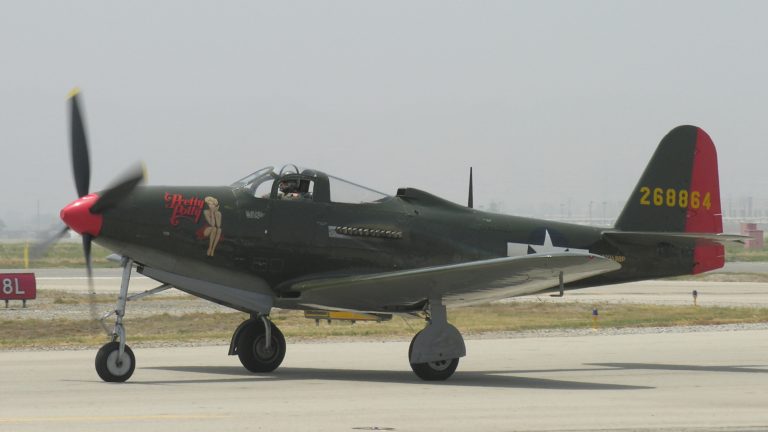
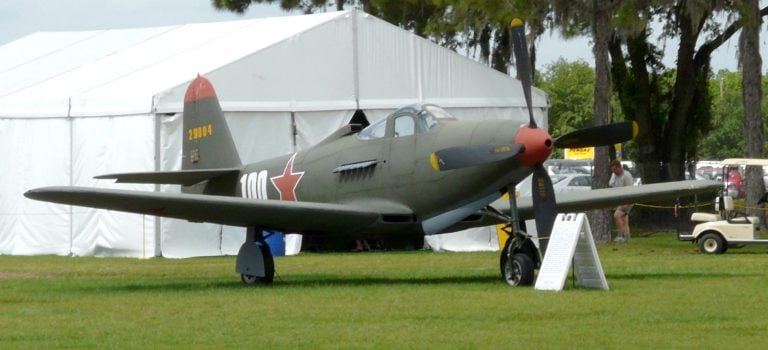
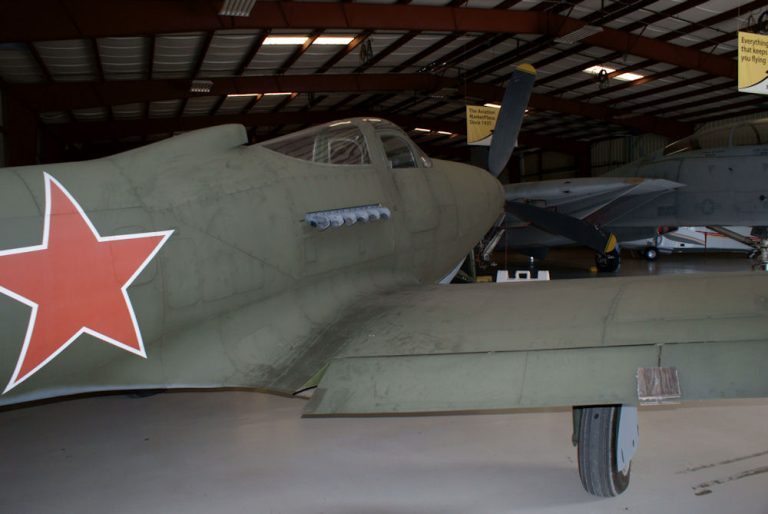
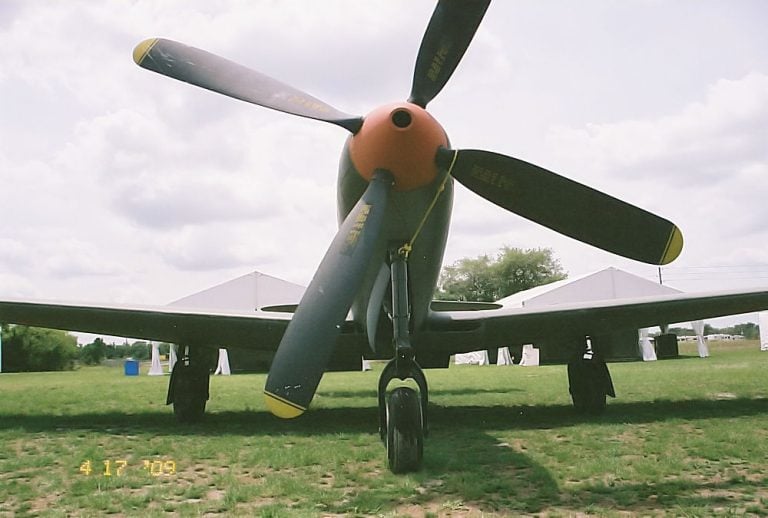
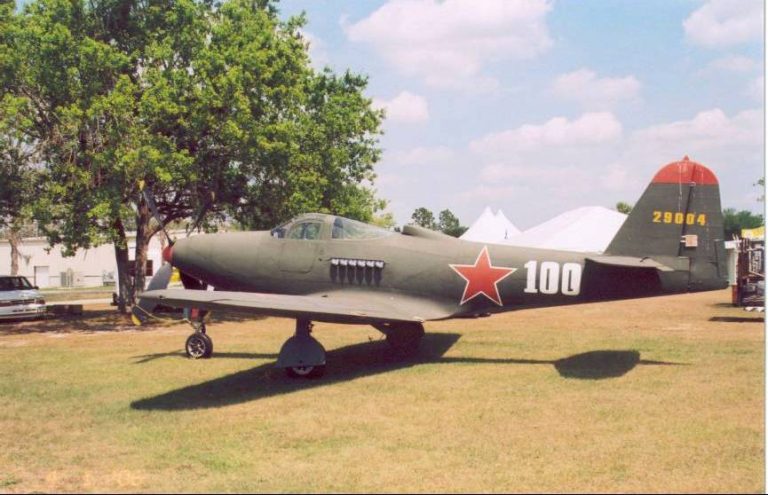
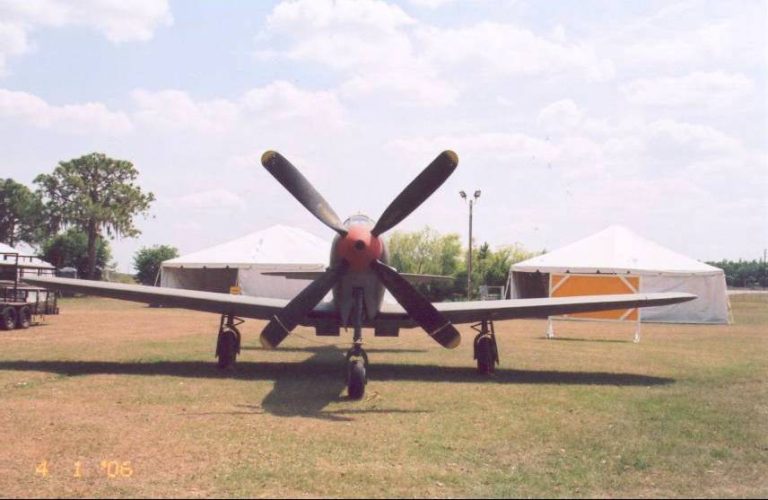
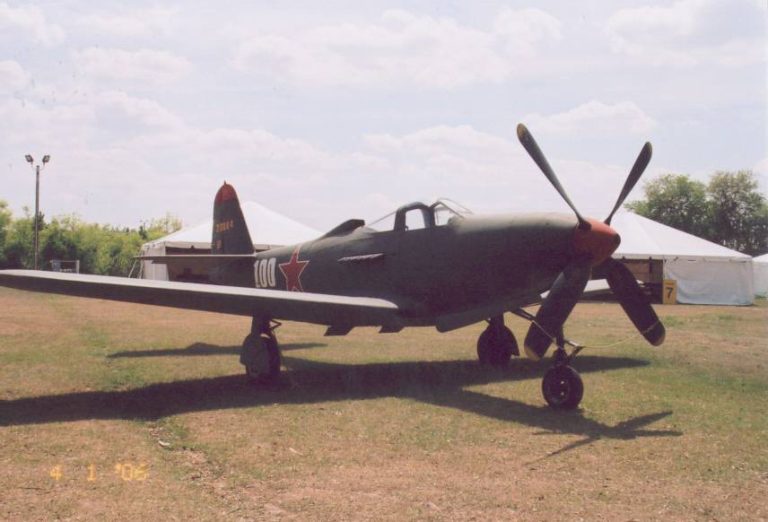
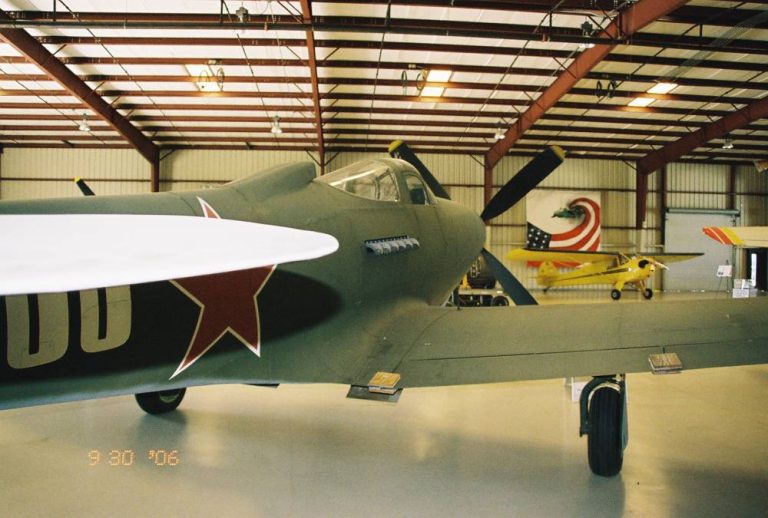
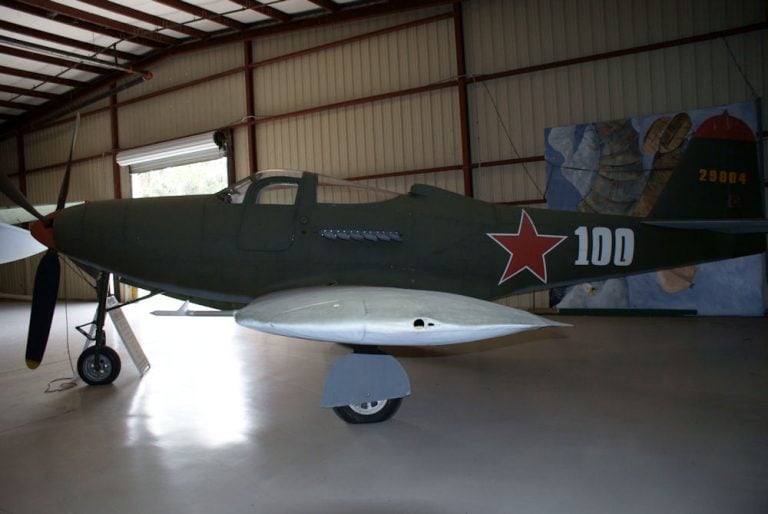
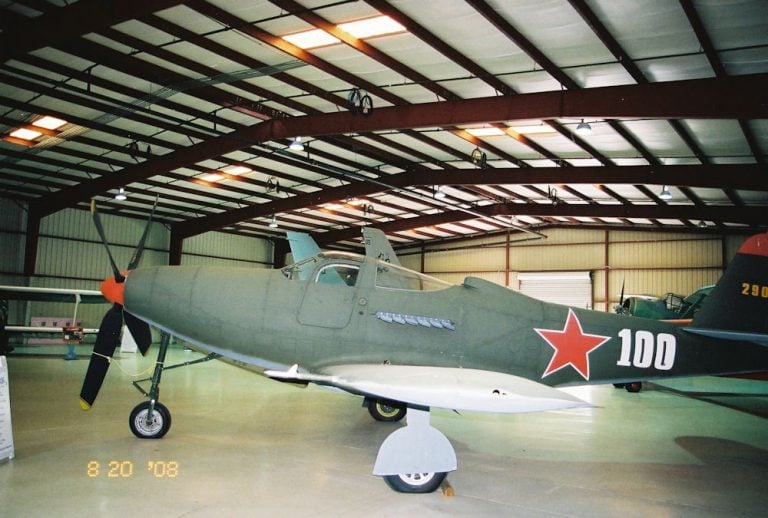
See the Kingcobra up close
Was the Kingcobra secretly one of the best dogfighters of the war? This detailed technical history digs into the P-63’s design, performance and its curious career as an American fighter flown mostly by the Soviet Union.
Video: “P-63 King Cobra, Best US WW2 Dogfighter?” by Greg’s Airplanes and Automobiles (~188,000 views). Embedded via YouTube.
Where the Kingcobra fought
The Kingcobra, by the numbers
The P-63 has one of the strangest combat records of any major wartime fighter: it flew almost no missions for the country that built it, and most of its war service was in Soviet hands, in a theatre and a style of fighting far removed from Bell’s drawing board in New York State. Its numbers tell a story less of aces and kills than of production, Lend-Lease and adaptation.
Soviet combat records for the P-63 are incomplete and sometimes contradictory; the figures above reflect commonly cited production and delivery totals rather than a detailed tally of sorties or victories.
Bell P-63 Kingcobra — questions & answers
Can you fly a Bell P-63 Kingcobra today?
A small number of P-63s remain airworthy and appear at airshows in the United States, but there are no public Kingcobra flights. If you want to fly a real fighter yourself, MiGFlug offers cockpit experiences in genuine jet fighters you can actually strap into.
Why didn’t the USAAF use the P-63 in combat?
By the time the Kingcobra entered production in 1943, the US Army Air Forces was already well supplied with P-51 Mustangs and P-47 Thunderbolts, which had the range and high-altitude performance it needed. The P-63 offered no decisive advantage, so it was passed to Lend-Lease rather than into American combat units.
What was the RP-63 “Pinball”?
The RP-63 was a heavily armoured, unarmed Kingcobra used as a manned flying gunnery target. Trainee air gunners fired frangible bullets that broke apart on impact, and sensors and lights registered each hit — letting crews practise against a real, maneuvering fighter.
Did the Soviet Union like the P-63?
Yes. Soviet pilots had already embraced the earlier P-39 Airacobra, and they took to the larger, higher-performing Kingcobra as well. Most P-63s served with the Soviet VVS, and they saw action in the Far East against Japan in August 1945.
What was the difference between the P-39 and the P-63?
The P-63 was a larger, more powerful development of the P-39 with a new laminar-flow wing and better supercharging, curing the Airacobra’s weak high-altitude performance while keeping its mid-engine layout and 37 mm hub cannon.
You can’t fly a Kingcobra — but you can fly a fighter jet
The Kingcobra’s war belongs to history, but the thrill of flying a real fighter doesn’t. With MiGFlug you can strap into a genuine jet — from the L-39 Albatros to a MiG-29 at the edge of space — with an experienced fighter pilot beside you.
 Fly the L-39 AlbatrosThe world’s most-flown jet trainer — aerobatics included
 Fly the F-104 Starfighter“The missile with a man in it”
 Fly the MiG-21The Cold War’s most-produced jet
 Fly the T-33 Shooting StarAmerica’s first jet trainer
 Fly the DH VampireA piece of early jet history
 Fly the S.211Agile Italian jet trainer
 Fly the MB-326The classic Aermacchi jet
 Fly the MiG-15The Soviet legend of the Korean War
Related aircraft
Where these facts come from
- National Museum of the U.S. Air ForceKingcobra type history & surviving airframe
- Vintage Aviation News — P-63 first flightDevelopment & first-flight history
- San Diego Air & Space MuseumArchive photography of Bell aircraft
- War History Online — P-63 KingcobraSoviet Lend-Lease service overview
Figures are drawn from museum and reference sources and cross-checked; where sources differ, the most commonly cited value is given. Performance and production figures varied between the P-63A, P-63C and the modified RP-63 target aircraft.