
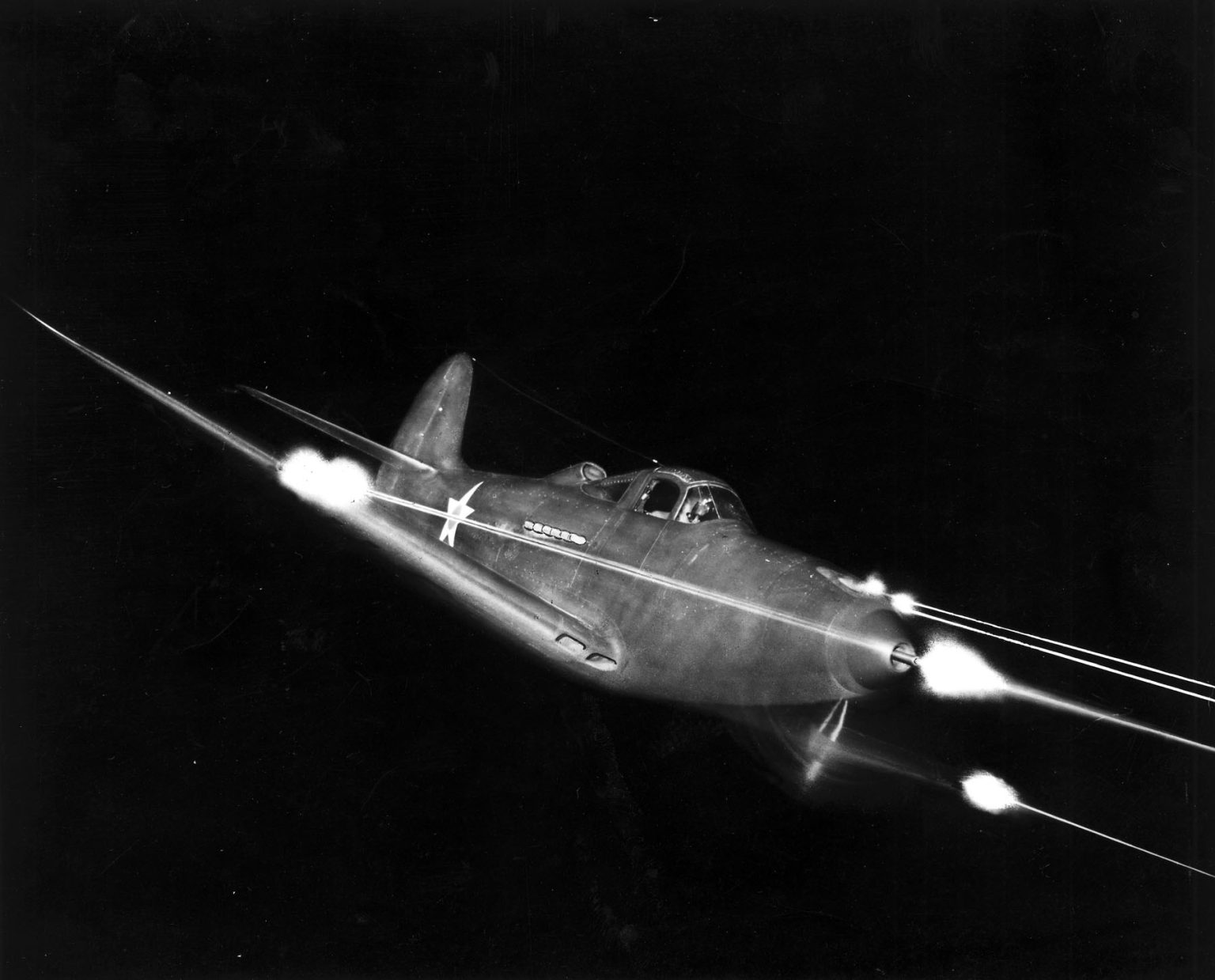
Bell P-39 Airacobra
A radical American fighter with its engine behind the pilot, a cannon firing through the propeller hub and car-style cockpit doors — scorned over Europe, but the mount of the Soviet Union’s deadliest aces at low level on the Eastern Front.
The upside-down fighter the Soviets loved
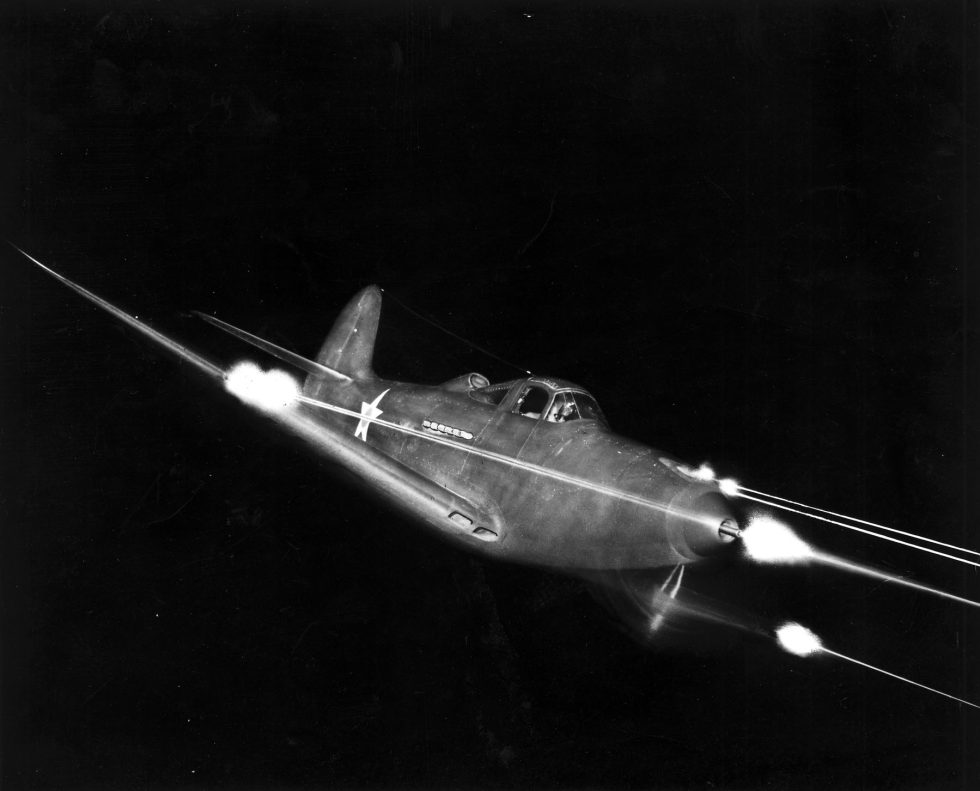
The Bell P-39 Airacobra was one of the strangest fighters of the Second World War. Where almost every other single-engine fighter carried its engine in the nose, Bell’s designers put the Allison V-1710 in the middle of the fuselage, directly behind the pilot, and drove the propeller through a long extension shaft running under the cockpit floor. That freed the nose for a heavy 37 mm cannon firing through the propeller hub, and let Bell fit the aircraft with tricycle landing gear and automobile-style side doors — the pilot climbed in through a car door and wound down a side window, not a sliding canopy.
The design began as an answer to a 1937 US Army Air Corps request for a high-performance interceptor, built around the big Oldsmobile cannon. The prototype XP-39 first flew on 6 April 1939, and on paper it was fast and futuristic. But when the prototype was handed to the NACA for wind-tunnel drag studies, the turbo-supercharger that gave it high-altitude punch was deleted from the production design in favour of a cleaner airframe. It was a fateful call: without the turbo, the Airacobra’s performance fell away sharply above roughly 15,000 feet.
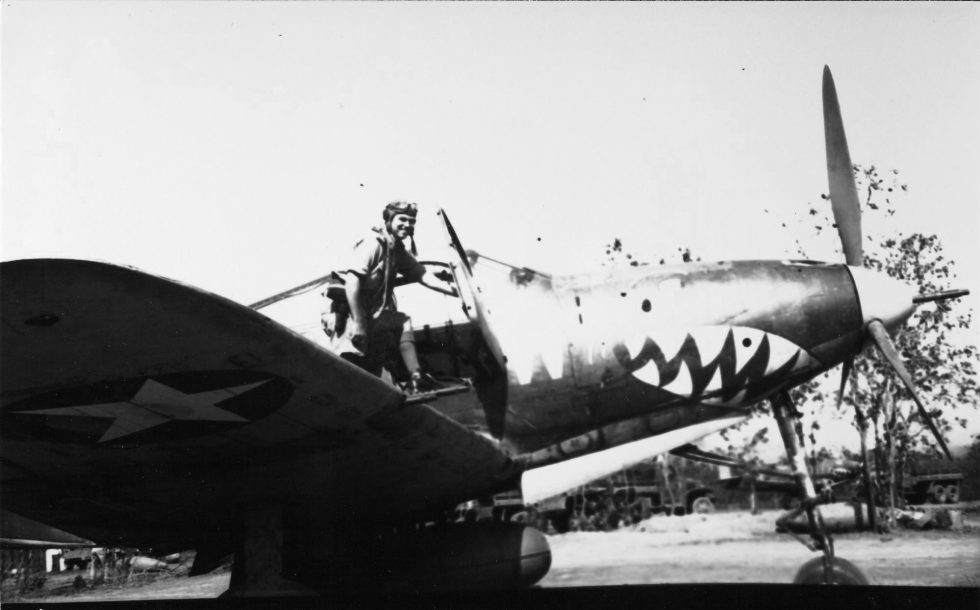
That single decision defined the P-39’s reputation. Entering service in 1941, it disappointed the crews who most needed high-altitude performance. The RAF tested the Airacobra I in 1941, flew it operationally only briefly, and quickly withdrew it. American squadrons in the Pacific and over the Mediterranean found it outclassed by Japanese and German fighters at height, though it proved rugged and useful lower down — strafing, escorting and attacking shipping. It was never the interceptor the Air Corps had wanted.
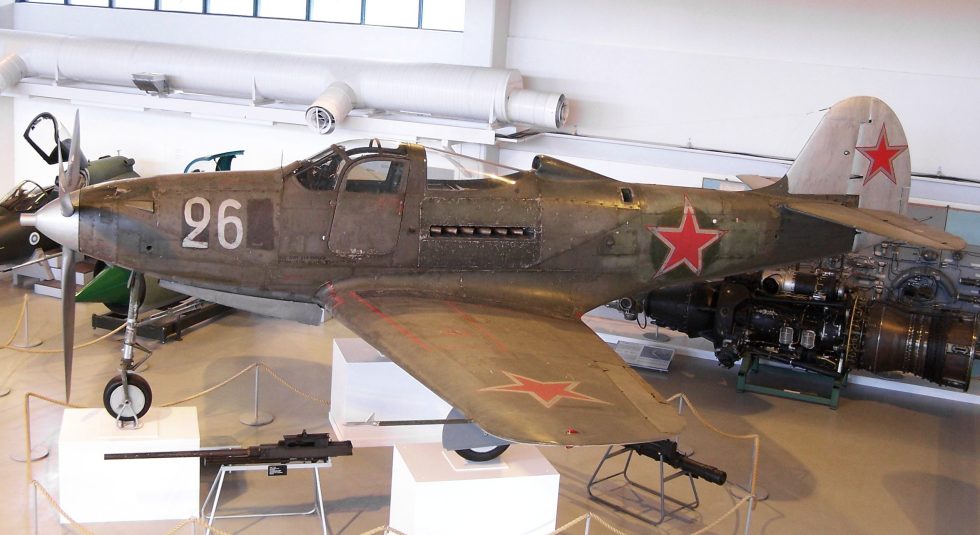
And yet, sent east under Lend-Lease, the same aircraft became a war-winner. On the Eastern Front most air combat happened low, where the P-39’s weakness never mattered. Soviet VVS pilots prized its heavy cannon, tough construction, good low-level speed and excellent cockpit visibility. Roughly half of all P-39s built — on the order of 4,700 aircraft — went to the Soviet Union, delivered along the Alaska–Siberia ferry route and through Iran. Several of the USSR’s highest-scoring aces, above all Aleksandr Pokryshkin, ran up huge tallies in the type; the Soviets nicknamed it the Kobra and flew it until 1949.
Around 9,600 Airacobras were built between 1940 and 1944. The design was refined into the larger, better P-63 Kingcobra — itself largely shipped to the USSR. Misunderstood in the West and celebrated in the East, the P-39 remains one of aviation’s great what-ifs: a mediocre interceptor that turned out to be a superb low-altitude killer in the right hands.
01Why the Bell P-39 Airacobra put its engine behind the pilot
The whole layout flowed from one weapon: the 37 mm T9/M4 cannon. To fire a gun that large straight down the aircraft’s centreline and through the spinning propeller, Bell needed the nose clear of any engine. So the Allison V-1710 was mounted amidships, over the wing and behind the cockpit, driving the propeller through a roughly 3-metre (10-foot) extension shaft that passed beneath the pilot’s seat to a gearbox in the nose. The mid-fuselage engine also put the aircraft’s mass near its centre of gravity, which helped Bell adopt tricycle landing gear — a nose-wheel arrangement still unusual for a fighter in 1939 — and the distinctive automobile-style doors with wind-down windows. The trade was cooling and centre-of-gravity complexity, and an early reputation for tumbling if mishandled; the payoff was a hard-hitting, easy-to-service, good-visibility fighter.
What makes it special
Mid-engine, nose cannon, tricycle gear
The Airacobra’s defining feature: the Allison V-1710 sat behind the pilot, driving the propeller through a long shaft so the nose could carry a 37 mm cannon firing through the hub. The layout also enabled tricycle landing gear and car-style side doors — the pilot entered through a door and wound down a window rather than sliding a canopy back.
No turbo-supercharger — a low-altitude fighter
The XP-39 flew with a turbo-supercharger, but it was deleted from the production design after drag-reduction studies. Without it, performance collapsed above about 15,000 feet, crippling the P-39 as a high-altitude interceptor. Down low, though, it was fast, rugged and hard-hitting — exactly where the Eastern Front fought.
The Soviet Lend-Lease success story
Rejected as an interceptor by the USAAF and RAF, the P-39 thrived with the Soviet VVS. About half of all Airacobras built went to the USSR, where its cannon, toughness and low-level speed suited the fighting. Aces such as Aleksandr Pokryshkin scored the bulk of their kills in it — the highest-scoring use of any American fighter.
02The P-39 Airacobra’s missing supercharger: the decision that shaped its whole war
The single-stage Allison V-1710 made good power at low and medium altitude, but its performance faded higher up unless boosted by a turbo-supercharger. The XP-39 prototype had one; the production P-39 did not. After NACA wind-tunnel work aimed at cutting drag, the turbo installation — bulky and aerodynamically awkward — was dropped. The result was a fighter that ran out of breath above roughly 15,000 feet, precisely the band where the air wars over Britain, Germany and the high-flying Pacific were decided. Historians still debate whether keeping the turbo would have made the Airacobra a front-rank interceptor; what is certain is that its deletion pushed the type toward the low-altitude ground-attack and Eastern-Front roles where it excelled.
03The P-39 Airacobra in Soviet hands: Pokryshkin and the Kobra
Soviet pilots called the P-39 the Kobra, and it became one of the most valued Lend-Lease aircraft they received. Most Eastern-Front combat happened below 5,000 metres, where the Airacobra’s lack of a supercharger was irrelevant and its heavy 37 mm cannon, four machine guns, rugged airframe and superb forward view were decisive. Aleksandr Pokryshkin, the second-highest-scoring Allied ace of the war, is commonly credited with scoring most of his 59 victories in the P-39, and refined his “altitude–speed–manoeuvre–fire” tactics in it. Fellow ace Grigori Rechkalov was also among the top Airacobra scorers. No other American fighter was flown to greater effect by a foreign air force.
Full specifications
Baseline note: the figures below describe the P-39Q-5-BE of 1943 (Bell Model 26, built at Niagara Falls, New York) — the largest single block of the largest production mark, and the aeroplane that Soviet acceptance crews at Ladd Field, Fairbanks signed for in the greatest numbers. Deltas for the P-39D of 1941, the lightened P-39N of 1943 and the export Airacobra I are given in grey. Two warnings about the literature. First, published empty weights for the same mark differ by nearly 400 kg because some authorities quote the bare airframe and others basic weight with fixed equipment; both appear below rather than being averaged into a number nobody measured. Second, almost every P-39 table in circulation describes a light, clean aeroplane, while the machine that flew combat carried armour, a centreline rack and, on the Q, a pair of underwing gun gondolas, and was slower than any of it.
Dimensions & weights
- Crew
- 1
- Length
- 9.19 m (30 ft 2 in), unchanged across every production mark. The XP-39B was stretched 330 mm (13 in) over the original prototype during the NACA drag clean-up of 1939
- Wingspan
- 10.36 m (34 ft 0 in). The XP-39 spanned 10.92 m (35 ft 10 in); 560 mm (22 in) came off in the same rebuild
- Height
- 3.78 m (12 ft 5 in) on the tricycle undercarriage. Sources quoting 3.61 m (11 ft 10 in) are measuring an early P-39D with the smaller propeller
- Wing area
- 19.79 m² (213 sq ft) — a small wing, and the root of both the type’s lively roll and its indifferent behaviour high up
- Wing section
- NACA 0015 at the root, NACA 23009 at the tip. A conventional section chosen for structure and handling; the low-drag laminar wing arrived only on the P-63 Kingcobra, which is a different aeroplane in every major component
- Empty weight
- 2,560 kg (5,645 lb) on Baugher’s block figures for the Q-5. Other authorities give 2,956 kg (6,516 lb) for the same mark. The gap is definitional — bare airframe against basic weight with fixed equipment — and neither figure is wrong so much as differently scoped
- Normal loaded weight
- 3,447 kg (7,600 lb) with the cannon, four machine guns, full internal fuel and armour
- Maximum take-off weight
- 3,765 kg (8,300 lb). On the P-39N the permissible gross was cut from 4,128 kg (9,100 lb) to 3,969 kg (8,750 lb) to buy back climb — one of several places where the type was lightened rather than improved, because the one improvement it needed was no longer available to it
- Fuel
- ~416 l (~110 US gal, 93 imp gal) internal in self-sealing wing cells on the Q-5, plus one 284 l (75 US gal) drop tank on the centreline station. The P-39N began with 454 l (120 US gal) and was cut to 329 l (87 US gal) after the first 166 aircraft, with retrofit kits offered to put it back. This is the number behind the type’s very short legs
- Wing and power loading
- 174 kg/m² (35.7 lb/sq ft) and 2.87 kg/hp (6.33 lb/hp) at normal loaded weight — heavier on the wing than a Bf 109F and poorer on power than a Spitfire V, which is about where it fought
- Armour
- 105 kg (231 lb) of face-hardened plate and armour glass on the early P-39N, cut to 87.5 kg (193 lb) on the N-5 and increased again on the P-39Q-10 blocks built for Russia. The Allison sitting against the pilot’s back was itself the largest single piece of protection in the aeroplane, and Soviet pilots said so
- Structure
- All-metal stressed skin, the engine carried amidships on a welded steel truss behind the cockpit, entry through two sideways-opening automobile doors with wind-down windows. The roof was fixed and the doors could not be jettisoned. Getting out of a burning P-39 in a hurry was genuinely difficult, and No. 601 Squadron RAF put that in writing within weeks of receiving the type
Performance
- Maximum speed
- 605 km/h (376 mph) at 4,570 m (15,000 ft); 575 km/h (357 mph) at 3,050 m (10,000 ft); 531 km/h (330 mph) at 1,525 m (5,000 ft)
- Fastest mark
- The stripped P-39N reached about 642 km/h (399 mph) at 2,955 m (9,700 ft). That is genuinely quick, and quick at precisely the height at which the Eastern Front was fought — the single most important coincidence in the aeroplane’s history
- Prototype against production
- The turbocharged XP-39 did 628 km/h (390 mph) at 6,100 m (20,000 ft) and climbed to that height in five minutes. The XP-39B, with the turbo deleted, did 604 km/h (375 mph) at 4,570 m (15,000 ft). The type never got back the 1,525 m it lost in that one line of the specification
- Rate of climb
- 1,525 m (5,000 ft) in 2.0 minutes and 6,100 m (20,000 ft) in 8.5 minutes for the Q-5. The 19.3 m/s (3,805 ft/min) initial figure widely quoted for the type is a light-weight number and should not be read as a squadron condition
- Service ceiling
- 10,670 m (35,000 ft) on paper; 11,735 m (38,500 ft) for the P-39N. Both are clean, light figures. A combat-loaded Airacobra above 6,000 m was a mushy, wallowing aeroplane that a Bf 109G could climb away from at will, and every operator who tried to fight it up there reached the same conclusion independently
- Critical altitude
- The V-1710-85 held 1,125 hp (839 kW) to 4,725 m (15,500 ft) with ram. Above roughly 5,200 m (17,000 ft) power fell away steeply. This is the most consequential number on the page: it is the whole distance between the aeroplane Bell designed and the aeroplane the Army bought
- Combat range
- ~845 km (~525 miles) clean at 6,100 m and ~1,730 km (~1,075 miles) with the centreline tank. Radius of action was correspondingly small; the P-39 escorted nothing and was never asked to
- Turning flight
- Better than the type’s reputation allows. RAF trials found an Airacobra could out-turn a Bf 109E, and Soviet comparative work below 4,000 m reached the same conclusion against the Bf 109G. Where the P-39 lost was in the vertical, because above its critical altitude it had no power left to spend
- Roll
- Quick, and the first thing every pilot account mentions. Fuel, guns, engine and pilot were all clustered close to the roll axis, giving low rolling inertia. Soviet regiments improved it further by simply unbolting the wing guns
- Stall and spin
- The wing stalled sharply and would flick without much warning, and at aft centres of gravity the aeroplane could enter a flat spin that was very hard to recover from. This was the real vice, it killed people, and it is not the vice the type is famous for
- The tumble, properly stated
- Bell test pilots made 86 deliberate attempts to reproduce an end-over-end tumble and failed every time. Bob Hoover, whose demonstration seeded the legend, wrote later that he had been flying a Lomcovak and could do the same thing in a P-40. In the 1970s NASA Langley put the original wartime spin-tunnel model back in the tunnel: ballasted for a full nose ammunition load it never tumbled, and ballasted for empty nose bays — the rearward centre of gravity a pilot reached only after firing out — it did. The honest verdict is that the P-39 had a genuine and dangerous aft-CG departure problem, and that what pilots reported as tumbling was almost always a violent stall departure rather than an aeroplane going end over end
- Dive and ground handling
- Solid and well liked in the dive, with none of the compressibility reputation that dogged the P-38. The tricycle undercarriage made take-off and landing markedly easier than any taildragger, a real and badly under-credited advantage in Soviet service, where pilots frequently arrived on the type with very few hours in their logbooks
Propulsion & systems
- Engine
- One Allison V-1710-85 (E19), liquid-cooled 60° V-12 of 28.0 l (1,710 cu in), bore 139.7 mm and stroke 152.4 mm (5.5 × 6.0 in), mounted amidships directly behind the pilot’s seat
- Ratings
- 1,200 hp (895 kW) for take-off at sea level, 1,125 hp (839 kW) military at 4,725 m. Earlier marks: V-1710-35 (E4) of 1,150 hp on the P-39D, V-1710-63 (E6) of 1,325 hp on the D-2, K and L, and V-1710-83 (E18) of 1,200 hp on the M
- Supercharging
- One engine-driven single-stage, single-speed centrifugal blower. That is the entire system, and it is the reason a 1943 fighter with 1,200 hp could not fight above about 5,200 m. The two-stage installation that fixed it went into the P-63 Kingcobra, an aeroplane that arrived in 1944 and was never needed by anyone who could choose freely
- What was taken out
- The XP-39 flew with a General Electric B-5 exhaust-driven turbo-supercharger in the left fuselage side feeding the engine-driven stage — in effect the P-38’s arrangement in a single-engined airframe. It was deleted from the production design in the summer of 1939 and nothing replaced it. Two explanations compete: that NACA’s full-scale tunnel work showed the installation cost more in drag than it returned in power, and that Bell wanted a simpler aeroplane it could build and sell at once. They are not mutually exclusive. Benjamin Kelsey, the officer who wrote the original requirement, said afterwards that had he been present at the August 1939 meeting he would have overruled it
- Propeller
- Three-blade constant-speed, 3.16 m (10 ft 4 in) on early aircraft and 3.53 m (11 ft 7 in) from the 167th P-39N, Curtiss Electric or Aeroproducts depending on block. A four-blade Aeroproducts unit was fitted to 89 to 109 P-39Q-21s depending on the source; it hurt handling and the Q-30 went back to three blades
- Drive train
- A 3.05 m (10 ft) extension shaft in two sections with a self-aligning bearing to absorb fuselage flexing, running at crankshaft speed beneath the cockpit floor between the pilot’s feet to a remote 1.8:1 reduction gearbox in the nose. The shaft is the most libelled component in American fighter history: there were no propeller-shaft failures in service, and pilots reported nothing worse than noise and a warm cockpit floor
- Armament installation
- The reason for all of the above. With the engine amidships the nose was free for a 37 mm gun firing down the thrust line through a hollow propeller shaft, its ammunition, the nosewheel and two synchronised machine guns — a concentration of fire on the centreline that no conventional layout of 1939 could match. The aeroplane was designed around the gun, and everything else in it follows from that decision
- Cooling
- Glycol radiator and oil coolers buried in the wing centre section, fed through leading-edge ducts and exhausting through controllable flaps — moved there from the fuselage sides during the XP-39B rebuild. Aerodynamically tidy and tactically fragile: a hit in a wing root took the engine with it
- Fuel system
- Self-sealing cells in the wing centre section only, with a single centreline station that took either the drop tank or the bomb and never both. There was no provision for wing tanks at any point in the type’s life
- Oxygen
- The detail that decided a campaign. The export Airacobra I, and the P-400s taken over from British contracts, used the British high-pressure oxygen system, which American ground equipment at Henderson Field could not recharge. The 67th Fighter Squadron’s P-400s on Guadalcanal were therefore pinned below roughly 3,600 m (12,000 ft) and could not reach the Japanese bombers at all — which is how a fighter squadron became a ground-attack squadron in a fortnight
- Radio and electrics
- SCR-274N command set on early aircraft, SCR-522 VHF later, with SCR-535 or SCR-695 IFF. Soviet regiments generally substituted RSI-4 sets on receipt. What they valued was not the American radio itself but the fact that every airframe had a working one, which Soviet-built fighters of 1943 frequently did not
- Cockpit
- Two automobile doors with wind-down windows, a fixed roof, an exceptional view forward and down over the short nose, and a comfortable, well-heated interior with instruments Soviet pilots singled out for praise. RAF pilots complained that the windscreen had no clear-vision panel: in heavy rain forward visibility disappeared unless the door windows were wound down and speed cut to about 240 km/h (150 mph)
04The P-39 Airacobra’s costs: a $50,000 wartime fighter
As a mass-produced wartime fighter, the Airacobra was relatively cheap. Period figures put its flyaway cost in the region of $50,000 in early-1940s dollars — an order-of-magnitude figure that varied by block and year, not a fixed price. No meaningful cost-per-flight-hour figure exists for the type in service; the only modern operating costs come from the handful of airworthy warbirds, whose owners typically cite piston-warbird running costs in the low thousands of dollars per hour. Treat any precise dollar figure attached to a P-39 as an estimate.
Armament & payload
The Airacobra was designed outwards from a 37 mm cannon and then issued with thirty rounds for it
Everything unusual about the P-39 exists to serve one gun. Putting the Allison behind the pilot freed the entire nose for a 37 mm M4 firing down the thrust line through a hollow propeller shaft, with no convergence to set and no synchronisation to lose, and a 608 g high-explosive shell that ended most arguments on contact. The problem was never the gun’s destructiveness but its economy: 30 rounds in an oval "horsecollar" magazine at about 150 rounds per minute is roughly twelve seconds of fire, delivered at 610 m/s against about 880 m/s for the .50 calibre Brownings beside it, so beyond about 275 m the two streams parted company and the pilot had to choose which weapon he was actually aiming. Feed jams were common enough that some pilots counted on fewer than thirty. Fits varied enormously by mark and operator: the export Airacobra I and P-400 carried a 20 mm Hispano with 60 rounds instead of the 37 mm, the P-39D to N carried four rifle-calibre wing guns where the P-39Q carried two heavy ones in gondolas, and Soviet regiments routinely flew with the wing guns taken off altogether.
Gun
- One 37 mm M4 automatic cannon — developed as the American Armament Corporation T9 — firing through the hollow propeller shaft and out of the spinner. 96.6 kg (213 lb), barrel 1.65 m (65 in), muzzle velocity 610 m/s (2,000 ft/s), about 150 rounds per minute cyclic, 30 rounds carried
- Ammunition: the M54 high-explosive shell of about 608 g (1.34 lb), and the M80 armour-piercing round, which could beat 25 mm (1 in) of plate at 460 m (500 yd). The United States shipped the Soviet Union 1,232,991 M54 HE rounds and essentially no M80 — which is the documentary end of the persistent story that Soviet Airacobras were tank-busters. They were not, and the ammunition supply proves it
- Two 12.7 mm (0.50 in) M2 Brownings synchronised in the upper nose, 200 rounds per gun on the P-39Q
- Wing battery, by mark: four 7.62 mm (0.30 in) M1919 with 1,000 rounds per gun on the P-39D through P-39N; two 12.7 mm M2 with 300 rounds per gun in detachable underwing gondolas on the P-39Q. The export Airacobra I and P-400 substituted a 20 mm Hispano with 60 rounds for the 37 mm, plus four .303 in the wings
- Sighting by an American reflector sight. Pokryshkin had his P-39s rewired so that cannon and machine guns fired from a single button, on the ground that reaching for a second trigger pulled the sight off the target at the worst possible moment
Air-to-air
- Nothing guided. No air-to-air missile existed in the P-39’s service life, the type carried no radar, and gun-camera fits were uncommon — which is one reason claim verification on this aeroplane is unusually hard
- Alexander Pokryshkin scored 47 of his victories on the Airacobra, making him the highest-scoring P-39 pilot of any nation and the highest-scoring Allied pilot on any American fighter. His total is variously given as 59 solo and 6 shared, or 65 on official credits; the historiography is genuinely unsettled and 1941 records are lost
- Grigoriy Rechkalov, credited with 56 solo and 6 shared by operational documents and 61 and 4 by certification, took the large majority on the type. Nikolai Gulaev, Dmitry and Boris Glinka and Aleksandr Klubov all flew it; the 9th Guards Fighter Aviation Division was in effect an Airacobra formation, and it produced more aces than any other Soviet division of the war
- American air-to-air work was thin by comparison. Fifth Air Force P-39 units claimed about 80 Japanese aircraft in 1942 and lost a comparable number, and Lieutenant Bill Fiedler was the only American pilot to become an ace exclusively on the type
- First combat came on 30 April 1942 at low level near Lae, New Guinea. At those heights the A6M Zero was roughly equal in speed and much better in climb and turn; above them it was simply gone. The Pacific joke — that a P-400 was a P-40 with a Zero on its tail — was cruel and broadly fair in the theatre where it was told
Air-to-surface guided
- None, ever. No guided air-to-ground weapon was carried, trialled or proposed on a P-39, and the card is kept here only because it was possible to be honest about it in one line
- The nearest the airframe came to unmanned or guided work was as a target: two P-39Qs went to the US Navy as XTDL-1 radio-controlled drones, later redesignated F2L-1K, and a handful of others were converted for the same purpose by the Army
- Everything the P-39 dropped or fired at a ground target it aimed by eye, through a reflector sight, from low level, in the oldest way there is
Bombs
- One centreline rack beneath the fuselage rated for a 227 kg (500 lb) AN-M64, or the 284 l (75 US gal) drop tank. Never both, and that single station is the whole of the type’s ordnance capacity in most blocks
- Underwing shackles for light bombs appear on some late P-39Q aircraft in the literature but are poorly documented and were plainly not standard; the centreline was the station that mattered. Soviet aircraft carried FAB-100 bombs when they carried any at all
- The most useful bombing the type ever did was done by the worst version of it. The 67th Fighter Squadron’s P-400s at Henderson Field, unable to reach the bombers for want of chargeable oxygen, put 500-pounders and cannon fire into Japanese troops at treetop height through the last week of August and during the Battle of Edson’s Ridge on 13–14 September 1942. Marine officers who had nothing good to say about the aeroplane said a great deal about what it did those nights
- The Italian Co-Belligerent Air Force flew the type hardest of anyone in the last year of the war. Of 170 received from 15th Air Force surplus at Naples-Capodichino in June 1944, 149 were used; the 4° Stormo flew over 3,000 combat hours of ground attack over Albania, Yugoslavia and the Balkans and lost ten aircraft to German flak between 4 November and 3 December 1944 alone
- Italian training losses were worse than the combat ones at first: eleven accidents in three months at Campo Vesuvio in mid-1944 killed three pilots, and Italy’s ace of aces, Teresio Vittorio Martinoli, was killed converting to the type on 25 August 1944.
Rockets
- The P-39 was not a rocket aeroplane, and any table that lists rockets as standard equipment is overstating the case
- Triple 4.5 in tube clusters of the pattern fitted to the P-40 and P-47 appear on a small number of late-block aircraft, but they were never a standard fit and are close to absent from front-line photography. Treat rocket armament on the P-39 as experimental rather than operational.
- Soviet aircraft were trialled with RS-82 rails; nothing came of it and no regiment adopted them
- Where a Soviet Airacobra regiment wanted rockets put on a target, it flew top cover for Il-2s that carried them properly. That division of labour is the key to understanding what the P-39 actually did in Soviet service
Pods & other stores
- The underwing 12.7 mm gun gondolas of the P-39Q were the standard pod fit and the standard thing to remove. Nikolai Golodnikov: "We immediately removed the wing machine guns, leaving one cannon and two machine guns" — the aircraft rolled faster and accelerated better without them, and lost firepower nobody missed
- One 284 l (75 US gal) centreline tank. On the ALSIB ferry route from Great Falls, Montana through Fairbanks and Nome to Uelkal and Krasnoyarsk, that tank was the difference between arriving and not, and most Soviet Airacobras were flown to the war rather than shipped to it
- Reconnaissance conversions with oblique cameras in the rear fuselage were extensive: P-39D-3 and D-4, N-2, N-3B and N-6, Q-2, Q-6 and Q-11 blocks together account for roughly 450 airframes rebuilt for tactical photography, more than most air forces operated of anything
- Two-seat trainers — the TP-39F, TP-39Q-5 and twelve RP-39Q-22s — carried an added cockpit ahead of the standard one and needed extra ventral fin area to stay directionally stable, which tells you how marginal the original was in that respect
- No radar pod, no external gun pack beyond the gondolas, no napalm and no reconnaissance pod were ever carried by a service Airacobra
Three typical loadouts
- Soviet free hunt over the Kuban, spring 1943
- A P-39D-2 or Airacobra I of 16 GvIAP with the wing guns unbolted and left in the tent: one nose cannon, two nose 12.7 mm, no external stores, full internal fuel. Flown in pairs, high, fast and in the vertical — Pokryshkin’s formula of altitude, speed, manoeuvre, fire — over a battle that gave both the pilot and the aeroplane their reputations.
- 67th Fighter Squadron P-400, Henderson Field, September 1942
- One 227 kg (500 lb) bomb on the centreline, a 20 mm Hispano with 60 rounds, four .303 in the wings, and a British oxygen system nobody on Guadalcanal could refill. Flown at treetop height against Japanese infantry because the alternative — intercepting bombers at 8,000 m — was physically impossible.
- Italian Co-Belligerent Air Force ground attack, Canne, winter 1944–45
- A P-39Q of 10° or 9° Gruppo with the full battery of one 37 mm and four 12.7 mm, one 500 lb bomb on the centreline, flown over northern Yugoslavia against an enemy who no longer contested the air and contested the ground with a great deal of flak. Three Gold Medals for Military Valour were awarded to the wing’s dead in ten months.
Round counts and rates of fire follow United States ordnance data and Baugher’s block-by-block notes; the Lend-Lease ammunition totals come from American shipment records. Soviet and Italian field modification was extensive and thinly documented, so any stated fit should be read as typical of a block rather than universal within it.
Variants
Bell built 9,558 Airacobras, and the air force that ordered the aeroplane gave most of them away
The P-39 was ordered in February 1937 against Circular Proposal X-609 — a specification written by Lieutenants Benjamin Kelsey and Gordon Saville for a high-altitude interceptor with heavy nose armament and a turbo-supercharger. Robert J. Woods and Harland M. Poyer answered it with the most radical American fighter layout of the decade, and it worked: the prototype reached 628 km/h at 6,100 m and climbed there in five minutes. Then, in the summer of 1939, the turbo-supercharger came out of the production design, and the aeroplane that entered squadron service could not do the job the specification had been written to describe. Nothing else in the type’s history comes close to that decision in consequence.
What follows in the variant list is therefore not a development sequence but a long, careful programme of compensation. Successive marks got more power at low level, less weight, less armour, less fuel, smaller wing batteries and bigger propellers, and every one of them was still an aeroplane that ran out of engine at 5,200 m. Britain took 675 on contract, flew them operationally for one afternoon and handed the rest on. The USAAF fought them in New Guinea, the Solomons, the Aleutians and the Mediterranean and replaced them everywhere as soon as P-38s, P-47s and P-51s could be found. Bell’s real answer — a two-stage supercharger, a laminar wing and a belt-fed cannon — became the P-63 Kingcobra, and by the time it flew nobody with a choice needed it either.
And yet 4,773 P-39s went to the Soviet Union, where the fighting sat below 5,000 m, where a heated cockpit and a working radio and a nosewheel were worth more than a service ceiling, and where the aeroplane was not asked to do the one thing it could not do. That is the honest reason it failed in Britain and the Pacific and succeeded in Russia: not national temperament, not superior Soviet tactics alone, but the plain fact that the Eastern Front was the only theatre whose air war was fought at the P-39’s altitude. Production totals differ slightly between authorities — 9,558 is the best-attested figure and the one used here, but 9,584 and 9,589 both circulate, the differences arising from how prototypes, conversions and cancelled-then-completed airframes are counted.
- XP-39 and XP-39B (1939 / 1 airframe, rebuilt)
- Serial 38-326, ordered 7 October 1937 and first flown by Bell test pilot James Taylor at Wright Field on 6 April 1939, with a 1,150 hp Allison V-1710-17 and a General Electric B-5 turbo. Rebuilt after NACA Langley full-scale tunnel work as the XP-39B, flown 25 November 1939: turbo deleted, V-1710-37 of 1,090 hp, radiators moved into the wing roots, fuselage lengthened, span reduced, canopy revised. Destroyed after 28 flying hours. Several secondary sources date the first flight to 6 April 1938; Baugher and the airvectors monograph both give 1939, which fits the contract and test chronology far better, and is used here.
- YP-39 and YP-39A (1940–41 / 14)
- Thirteen service-test YP-39s ordered in April 1939, first flown 13 September 1940, plus one YP-39A intended for a high-altitude engine rating that was never pursued. These aircraft confirmed the production configuration and confirmed, to anyone reading the climb figures, what had been lost.
- P-39C (1941 / 20)
- Initially designated P-45. The first production Airacobras, without self-sealing tanks or pilot armour, and consequently the lightest and best-performing of the breed. All were relegated to training almost at once.
- Airacobra I and P-400 (1941–42 / 675)
- Bell Model 14 for Britain, ordered September 1940 with a 20 mm Hispano in place of the 37 mm and .303 wing guns. Acceptance trials found production machines making 371 mph at 14,090 ft against a contract 394 mph; Bell got one hand-finished aircraft to 391 mph by removing 200 lb, shrinking the tail surfaces and applying twenty rubbed-down coats of primer, and applied none of it to the rest. About 80 reached No. 601 Squadron from 6 August 1941; their only operational sortie was four aircraft strafing barges near Dunkirk on 9 October 1941, and the squadron re-equipped with Spitfire VBs in March 1942. Roughly 200 undelivered airframes went to the Soviet Union and about 200 to the USAAF as the P-400.
- P-39D, D-1 and D-2 (1941–42 / 923)
- The first genuinely combat-equipped mark: self-sealing tanks, armour, the 37 mm restored, two nose 12.7 mm and four wing 7.62 mm. 429 P-39Ds, 336 Lend-Lease D-1s with the 20 mm gun, and 158 D-2s with the 1,325 hp V-1710-63. This was the aeroplane that fought at Lae and Guadalcanal and the one on which Pokryshkin’s regiment converted in January 1943.
- P-39F and P-39J (1942 / 254)
- 229 P-39Fs with an Aeroproducts propeller in place of the Curtiss Electric unit and revised exhaust, and 25 P-39Js with the 1,100 hp V-1710-59 and automatic boost control. Minor marks that mostly served in the Pacific and the Aleutians.
- P-39K, P-39L and P-39M (1942–43 / 700)
- 210 K-1s and 250 L-1s with the 1,325 hp V-1710-63, then 240 M-1s with the V-1710-83 trading a little take-off power for better altitude rating, good for 370 mph at 15,000 ft. All three blocks came out of the enormous cancelled P-39G order of 1,800 aircraft, which is why no P-39G was ever delivered under that letter.
- P-39N (1942–43 / 2,095)
- The lightened mark, and the one Soviet pilots liked best: V-1710-85 of 1,200 hp, a larger 11 ft 7 in propeller from the 167th aircraft, internal fuel cut from 120 to 87 US gallons and armour reduced from 231 to 193 lb on the N-5. About 640 km/h at 2,955 m and a real climb rate. Almost the entire block went to the Soviet Union.
- P-39Q (1943–44 / 4,905)
- Half of all Airacobras, in blocks from Q-1 to Q-30. The four rifle-calibre wing guns gave way to two 12.7 mm in underwing gondolas; the Q-10 added armour and cold-weather equipment for Russia; the Q-15 and Q-25 progressively reinforced the structure and the aft fuselage after in-service failures; the Q-21 tried a four-blade propeller and the Q-30 abandoned it. Production ended in August 1944.
- XP-39E, XFL-1 Airabonita and the conversion fleet (1940–44 / ~470)
- Three XP-39Es of 1942 with a laminar-flow wing and a squared tail, flown as the aerodynamic bridge to the P-63; one XFL-1 Airabonita of 1940, a tailwheel carrier version for the US Navy, first flown 13 May 1940 and rejected. Add roughly 450 camera conversions across the D, N and Q blocks, a handful of two-seat trainers and a few radio-controlled drones. Separately, the extensively modified racer "Cobra II" won the 1946 Thompson Trophy against modified Mustangs — the P-39 airframe’s one unambiguous victory.
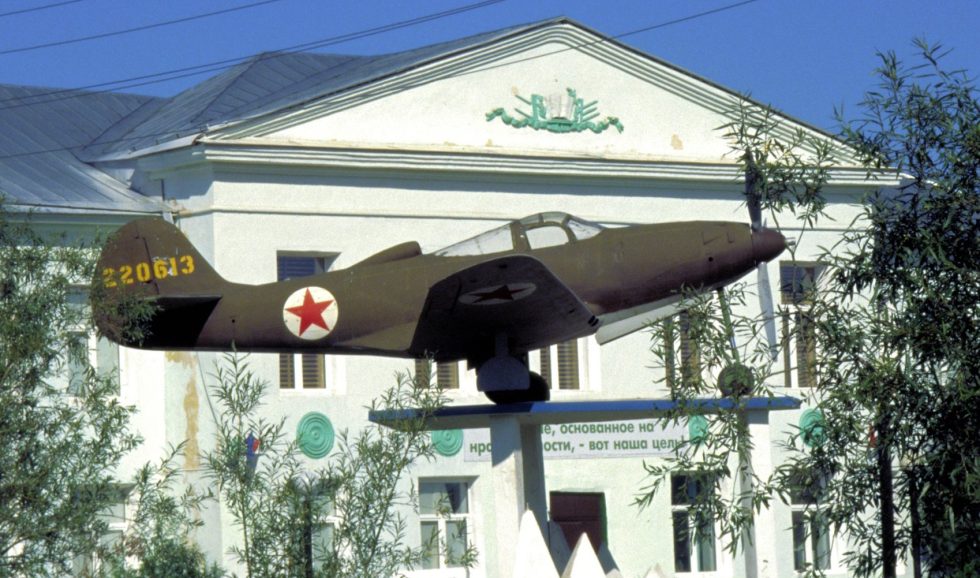
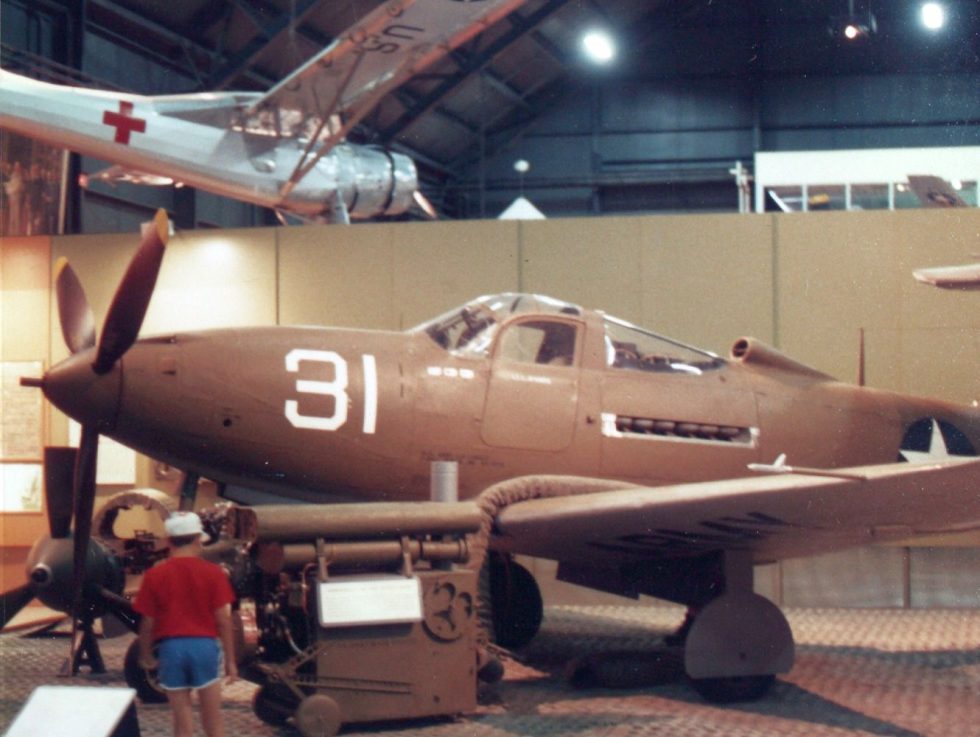
Survivors: roughly twenty original Bell airframes exist worldwide and no P-39 reproduction has ever been built, so every aircraft below is a genuine wartime machine. Four are airworthy: P-39F 41-7215 at the Military Aviation Museum, Virginia Beach, recovered from near Weipa, Queensland after a forced landing on 1 May 1942, rebuilt by Pioneer Aero at Ardmore in New Zealand and flown again on 26 February 2019 in the markings of Lend-Lease P-39Q-5 42-20341; P-39N 42-8740 at the Yanks Air Museum, Chino; P-39Q 42-19597 at the Commemorative Air Force CenTex Wing, San Marcos, Texas; and P-39Q 42-19993 with Lewis Air Legends, San Antonio. On static display: P-39D 41-6951 at Mareeba, Queensland; P-39N 42-18814 at Pima, recovered from Tadji in New Guinea in 1972; P-39N 42-18408 at the Buffalo and Erie County Naval and Military Park, on the ground where it was built; P-39Q 42-20000 at March Field; P-39Q 42-20007 at the Virginia Air and Space Center, Hampton; P-39Q 44-2485 at the Erickson Aircraft Collection, Madras, Oregon; RP-39Q 44-3887 at the National Museum of the United States Air Force, Dayton; RP-39Q 44-3908 at the Air Zoo, Kalamazoo; P-39Q 44-2664 at the Anti-Aircraft Museum, Tuusula, Finland; and two Soviet-operated aircraft in Russia, at the UMMC complex in Verkhnyaya Pyshma and at Yakutsk. Under restoration or in store: P-39M 42-4725 at Edmonton, P-39N 42-19027 at Planes of Fame, P-39Q 44-2433 at the Smithsonian’s Garber facility, and P-39Q 44-2911 at the Niagara Aerospace Museum in Niagara Falls, recovered from a Russian lake with two snapped connecting rods still in its engine block. Recoveries from Soviet lakes and Pacific jungle continue, so the total creeps slowly upward and any count is a snapshot.
From radical interceptor to Eastern-Front ace-maker
The cannon comes first
Bell Aircraft designs a fighter around the big 37 mm cannon in response to a US Army Air Corps request, forcing the engine behind the pilot.
XP-39 first flight
The prototype flies on 6 April 1939 — fast, futuristic, and fitted with a turbo-supercharger for high-altitude work.
The turbo is deleted
After NACA drag studies, the turbo-supercharger is dropped from the production design — sealing the P-39’s fate as a low-altitude fighter.
Service and the RAF trial
The P-39 enters USAAF service. The RAF tests the Airacobra I, flies it only briefly in late 1941, and quickly withdraws it.
Pacific and the Aleutians
P-39s and export P-400s fight over New Guinea, Guadalcanal and the Aleutians — struggling at altitude, effective low down against ships and troops.
Lend-Lease to the USSR
Airacobras flow east via the Alaska–Siberia ferry route and Iran. Soviet pilots find the P-39 ideal for low-level combat.
Pokryshkin over the Kuban
Aleksandr Pokryshkin runs up his tally in the P-39 during the Kuban air battles; the type also flies ground-attack in the Mediterranean with US, Free French and Italian co-belligerent units.
End of the line, and the Kingcobra
Production ends in 1944 at about 9,600 aircraft; the design evolves into the P-63 Kingcobra. The Soviets fly the P-39 on until 1949.
Twelve Airacobra stories
The gun that came first
Everything about the P-39 flowed from one big cannon in the nose.
Read the full story
Doors, not a canopy
The P-39 was one of very few fighters you entered like a car.
Read the full story
The missing supercharger
One deleted component defined the P-39’s entire career.
Read the full story
The tumbling myth
The P-39 earned a fearsome reputation for tumbling — part real, part legend.
Read the full story
Britain says no
The Royal Air Force bought the Airacobra, then quietly showed it the door.
Read the full story
P-400s over Guadalcanal
Export Airacobras fought a desperate low-level war in the Solomons.
Read the full story
The long road east
Nearly half of all P-39s were flown or shipped to the Soviet Union.
Read the full story
Pokryshkin’s Cobra
The Soviet Union’s second-ranking ace scored most of his kills in a P-39.
Read the full story
Rechkalov and the top scorers
Several of the VVS’s deadliest pilots made their names in the Airacobra.
Read the full story
Thirty rounds of 37 mm
The Airacobra’s cannon hit hard — when it worked.
Read the full story
Ground-attack in the south
US, Free French and Italian units flew P-39s over the Mediterranean.
Read the full story
From Cobra to Kingcobra
The P-39 led directly to a bigger, better successor.
Read the full story
The Airacobra in pictures
The Airacobra in motion
A hand-picked, high-authority P-39 Airacobra documentary is being selected for this exhibit. Video coming soon.
Where the Airacobra flew
The score that defines it
The P-39’s combat legacy is split in two. In Western hands it was a disappointment at altitude and did its best work low down, strafing and attacking shipping. In Soviet hands it became one of the deadliest fighters of the Eastern Front — the mount of some of the highest-scoring aces of the entire war.
Compare the combat record of every military aircraft. Figures as of July 2026.
Everything people ask about the P-39 Airacobra
Can I fly in a P-39?
Why did the P-39 have its engine behind the pilot?
Why was the P-39 bad at high altitude?
Why did the Soviets like the P-39 so much?
Who was the top P-39 ace?
How many P-39s were built?
What replaced the P-39 Airacobra?
You can’t fly the Airacobra.
These, you can.
Some legends only live in museums — others are fuelled and waiting. MiGFlug has put civilians in real military jet cockpits since 2004.
 Fly the L-39 AlbatrosThe world’s most-flown jet trainer — aerobatics included
 Fly the F-104 Starfighter“The missile with a man in it”
 Fly the MiG-21The Cold War’s most-produced jet
 Fly the T-33 Shooting StarAmerica’s first jet trainer
 Fly the DH VampireA piece of early jet history
 Fly the S.211Agile Italian jet trainer
 Fly the MB-326The classic Aermacchi jet
 Fly the MiG-15The Soviet legend of the Korean War
Continue the tour
Every fact, checked
- National Museum of the US Air ForceP-39Q fact sheet: specifications, mid-engine layout and Soviet Lend-Lease service.
- Warfare History Network — The P-39 AiracobraDesign, low-altitude combat, Lend-Lease numbers and Pokryshkin’s tactics.
- March Field Air MuseumP-39Q specifications and production and Soviet-service figures.
- Vintage Aviation NewsThe 6 April 1939 XP-39 first flight and the mid-engine design.
- HistoryNet / Aviation HistoryThe turbo-supercharger deletion and the P-39’s reputation in Western service.
- Smithsonian InstitutionReference for the Airacobra’s configuration and preserved airframes.
- War History OnlineThe Airacobra as WWII’s most controversial low-altitude fighter.
- Wikimedia CommonsPublic-domain USAAF, NACA and archive photography used in this exhibit.