
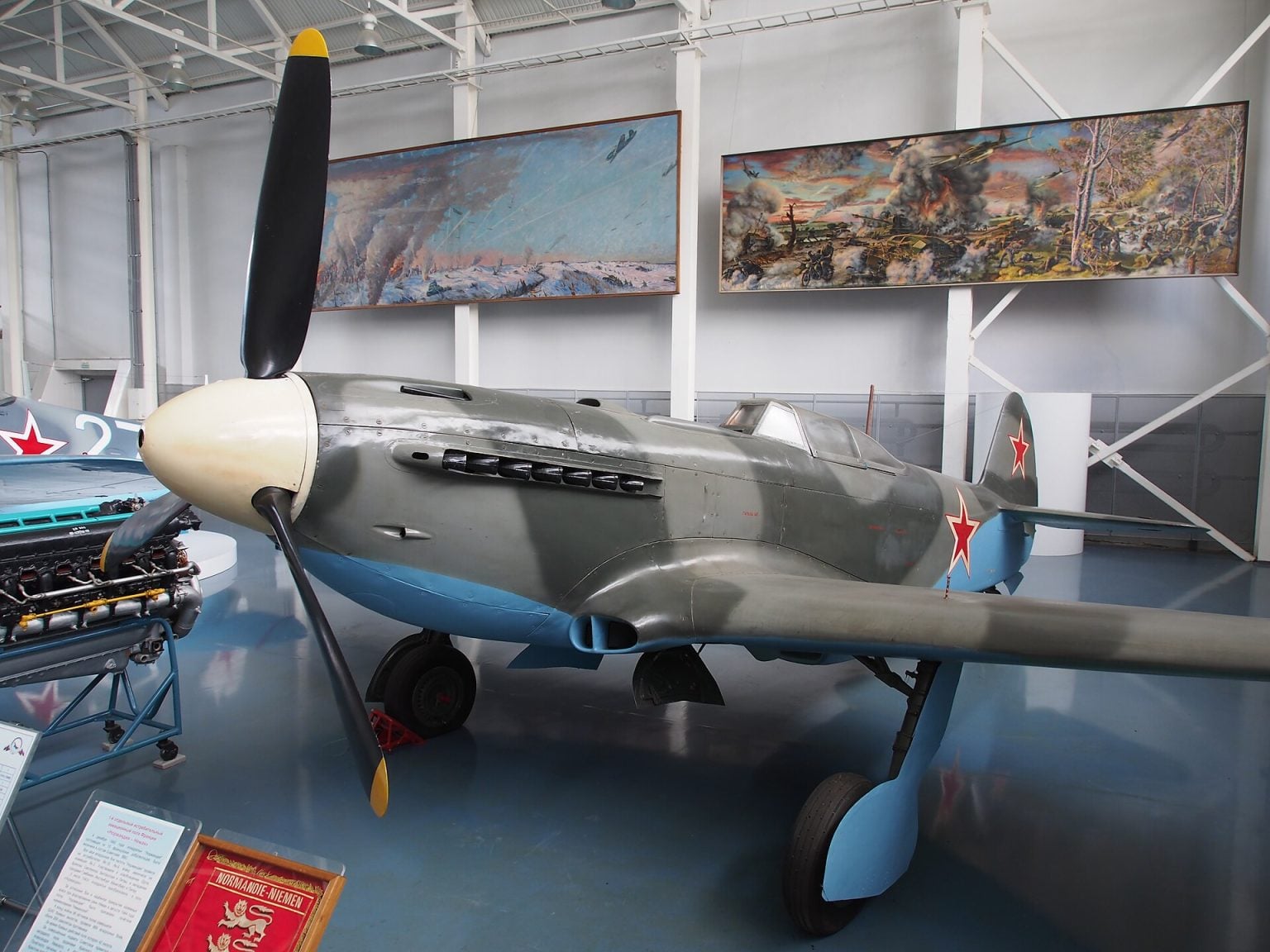
Yak-9
The Red Air Force’s workhorse fighter
The most-produced Soviet fighter of the war — a light, versatile Yakovlev that gave the VVS the numbers and the punch to wrest air superiority from the Luftwaffe.
The Yak-9: the fighter that took back the sky
The Yak-9 was the last and most refined of Alexander Yakovlev’s wartime fighters, a direct descendant of the Yak-1 and Yak-7. Where its predecessors mixed wood and fabric, the Yak-9 adopted metal wing spars — a small change that freed up weight and volume for more fuel, heavier guns and a whole family of specialised versions.
Above all, it was built to be built. With Soviet industry racing to replace catastrophic early-war losses, the Yak-9 was designed for mass production by a semi-skilled workforce. The result was staggering: 16,769 were produced, making it the most numerous Soviet fighter of the Second World War and the numerical backbone of the VVS from 1943 onward.
It was less a single aircraft than a toolkit. Long-range Yak-9D and Yak-9DD variants escorted bombers deep into enemy territory; the Yak-9T carried a 37 mm cannon firing through the propeller hub, and the Yak-9K an enormous 45 mm gun, for smashing tanks, trains and river craft. There were photo-reconnaissance and two-seat trainer versions, and finally the high-performance Yak-9U.
From the Battle of Kursk in the summer of 1943, Yak-9s helped the Red Air Force claw back air superiority from the Messerschmitt Bf 109G and Focke-Wulf Fw 190. In the low- and medium-altitude fighting that defined the Eastern Front, the light, nimble Yak was in its element.
Pilots liked it. It was easy to fly and forgiving — an important quality when replacement pilots reached the front with only a handful of training hours. It never had the firepower or high-altitude reach of Western fighters, but it did not need to: it was tuned precisely for the war the Soviets were fighting.
The Yak-9 outlived the war. It equipped the Free French Normandie-Niémen regiment, served with Soviet satellite air forces, and fought again over Korea in North Korean hands. It was the fighter that carried the VVS from the depths of 1942 to victory — and one of the great production aircraft of the piston era.
01Why the Yak-9 mattered: quantity was a quality all its own
The Yak-9 is often overshadowed by flashier Western fighters, but its contribution was decisive in the most literal sense: there were simply enough of them, in the right place, tuned for the right fight. By concentrating on low- and medium-altitude performance, easy handling and mass production, Yakovlev built an aircraft that ordinary pilots could fight in and Soviet factories could turn out by the tens of thousands.
That combination — good enough, available everywhere, and endlessly adaptable — is what let the VVS overwhelm a technically sophisticated but numerically stretched Luftwaffe. The Yak-9 was the workhorse that made Soviet air superiority a matter of arithmetic.
How Yakovlev built a fighter for total war
Engineered for the factory
The Yak-9 was designed as much for the production line as for the sky. Metal wing spars replaced the wood of earlier Yaks, simplifying construction and freeing weight, while the whole airframe was laid out so that a semi-skilled wartime workforce could turn out fighters by the thousand. Quantity was built into the blueprint.
One hub, many guns
Like all the Yak fighters, the Yak-9 mounted its main weapon as a “motornaya pushka” — a cannon firing straight through the propeller hub. That layout let Yakovlev bolt on ever-bigger guns: the standard 20 mm ShVAK, the 37 mm of the tank-busting Yak-9T, and the massive 45 mm of the Yak-9K, all without redesigning the wing.
Tuned for the Eastern Front
Soviet air combat was fought low, where bombers, tanks and troops were. The Yak-9 was optimised for exactly that arena: light, agile and quick at low and medium altitude, if short-legged and lightly armed by Western standards. It was a scalpel shaped for one very specific war.
02The family tree: a version for every mission
No single Yak-9 tells the whole story. The long-range Yak-9D and ultra-long-range Yak-9DD escorted bombers and even shuttled over the Balkans; the Yak-9T and Yak-9K turned the fighter into an anti-armour and anti-shipping weapon; the Yak-9U, with the more powerful Klimov VK-107 engine and cleaned-up aerodynamics, was among the best Soviet piston fighters of the war. One airframe, stretched across a dozen roles.
Yakovlev Yak-9 — by the numbers
Baseline note: the figures below describe the Yak-9D of 1943, the long-range production standard built at Novosibirsk Factory No. 153 — Klimov M-105PF (redesignated VK-105PF in 1944), four wing tanks holding 650 litres, one 20 mm ShVAK through the propeller hub and one 12.7 mm UBS over the engine. Deltas for the original 1942 Yak-9, the 37 mm Yak-9T, the VK-107A Yak-9U and the German fighters it met are in grey. Three warnings apply to every Yak-9 number in print. Soviet published performance is acceptance performance flown on a hand-finished machine; series aircraft from a plant running three shifts of teenage and female labour were routinely slower than their own data sheet, and the NII VVS said so. Second, the family is not one aeroplane: two wings, five engines, six fuel systems and seven gun fits went out of the door under the same designation, so a single specification table for "the Yak-9" is always a fiction and this one is a fiction about the Yak-9D. Third, the production total. 16,769 aircraft is right, and it is the largest of any Soviet fighter, but it runs from October 1942 to December 1948 — 14,579 of them were delivered by the end of the first half of 1945 and 1,299 came after 1945 altogether. The often-repeated claim that this made the Yak-9 the second most-produced fighter of the war after the Bf 109 does not survive the arithmetic: wartime Yak-9 deliveries sit behind the Focke-Wulf Fw 190 (over 20,000), and are line-ball with the P-47 Thunderbolt and P-51 Mustang at roughly 15,600 each. The Yak-9 only overtakes them by counting three years of peace.
Dimensions & weights
- Crew
- 1 (2 in the Yak-9V and Yak-9UV trainers, the instructor in a second cockpit aft)
- Length
- 8.55 m (28 ft 1 in); the Yak-9T grew to 8.66 m (28 ft 5 in) because the cockpit had to move aft
- Wingspan
- 9.74 m (31 ft 11 in) — 26 cm less than the Yak-1, clipped when the wing was rebuilt around metal spars
- Height
- 3.00 m (9 ft 10 in), tail down
- Wing area
- 17.15 m² (184.6 sq ft) — unchanged from the Yak-1 despite the shorter span, and still about a square metre more than a Bf 109G
- Aerofoil
- Clark YH, 14 per cent at the root and thinning outboard — the same section Yakovlev had used since the I-26 prototype
- Structure — the change that made the type
- Welded steel-tube fuselage truss, duralumin panels forward and fabric aft; wooden wing with two spars whose booms and webs were extruded duralumin instead of pine, metal ribs from February 1943, plywood skin. This is the whole Yak-9 story in one row: the aluminium plants evacuated to the Urals had come back on stream and Lend-Lease metal was arriving, so from the autumn of 1942 Yakovlev could buy back structural weight the wooden Yak-1 and Yak-7 had been forced to carry — of the order of 150 kg, though Soviet accounts differ on how much of that saving was the spars alone and how much came with the other detail changes made at the same time
- What the saving bought
- Nothing in the Yak-9 was more powerful or cleaner than a Yak-7B. There was simply margin to spend, and every variant below is a different way of spending it: 210 more litres of fuel in the Yak-9D, a 37 mm cannon in the Yak-9T, four bomb tubes behind the pilot in the Yak-9B
- Empty weight
- 2,350 kg (5,181 lb); the original 1942 Yak-9 came in near 2,270 kg (5,004 lb) and the Yak-9U at 2,512 kg (5,538 lb)
- Normal take-off weight
- 3,117 kg (6,872 lb); Russian factory tables more often print 3,174 kg (6,997 lb) for the same aeroplane. The base Yak-9 weighed 2,873 kg (6,334 lb) and the Yak-9U 3,204 kg (7,064 lb)
- Wing loading
- 182 kg/m² (37.2 lb/sq ft) at normal take-off weight — the Yak-1b carried 168 kg/m² and the Yak-9U 187 kg/m². The long-range Yaks paid for their fuel in the turn
- Power loading
- 3.54 kg/kW (5.82 lb/hp); the Yak-9U with the VK-107A came down to 2.60 kg/kW (4.28 lb/hp), which is the single number that explains why it was the best of them
- Internal fuel
- 650 litres (~143 imp gal, ~172 US gal, about 486 kg) in four wing tanks, against 440 litres in the base Yak-9 and 845 litres in the Yak-9DD. No Yak-9 of any mark ever carried a drop tank — the answer to range was always more tankage inside the wing
Performance
- Maximum speed
- 591 km/h (367 mph) at 3,650 m (11,980 ft) — note the height: the M-105PF was rated low deliberately, because the Eastern Front air war happened below 4,000 m (13,000 ft)
- Maximum speed, sea level
- 533 km/h (331 mph), the figure that decided actual fights over the front line
- Base Yak-9, for comparison
- 599 km/h (372 mph) at 4,300 m (14,100 ft); published values run from 595 to 602 km/h. The Yak-9D gave up roughly 8 km/h and a little climb for 210 litres, which was a bargain
- Yak-9U (VK-107A), for comparison
- 672 km/h (418 mph) at 5,000 m (16,400 ft) in NII VVS trials. Other tables give 690 km/h at 5,900 m and 700 km/h at 5,600 m; the spread is genuine and unresolved, the higher figures almost certainly being prototype or lightened-aircraft numbers. Even the conservative value made it one of the fastest production piston fighters flying in 1944
- Time to 5,000 m
- 6.1 min (16,400 ft); the lighter base Yak-9 needed 5.1 min and the Yak-9U 4.5 min. Sources scatter by half a minute either way
- Rate of climb
- 13.7 m/s (2,700 ft/min) averaged to 5,000 m, derived from the climb time above; the Yak-9U managed 18.9 m/s (3,720 ft/min), a step change rather than an improvement
- Service ceiling
- 9,800 m (32,150 ft); the base Yak-9 reached 10,750 m (35,270 ft) and the Yak-9U 10,650 m (34,940 ft). Above 5,000 m (16,400 ft) any VK-105 Yak was out of its element and its pilots knew it
- Range, internal fuel
- 1,360 km (845 miles); some tables give 1,400 km (870 miles). Against 848 km (527 miles) for the base Yak-9 and 675 km (419 miles) for the thirsty Yak-9U — the family got shorter-legged again as it got faster
- Range, Yak-9DD
- 2,285 km (1,420 miles) on 845 litres — more than three times the Yak-9U, and the reason a dozen of them could be flown non-stop from Bessarabia to southern Italy
- Endurance
- About 2 hr 40 min at economical cruise for the Yak-9D, roughly double a Yak-1’s — the difference between a point-defence fighter and one that could escort Pe-2s to a target and back
- Time for a full 360° turn
- 19 to 20 s at 1,000 m (3,300 ft); the Yak-9T turned in 18 to 19 s and the heavier Yak-9U is credited with 23 s in trials, though 20 s appears in other tables. A Bf 109G-6 needed about 21 s
- Take-off run
- 380 m (1,250 ft) at normal weight; published values run from 340 to 400 m depending on load and surface, and a fully fuelled Yak-9DD needed a great deal more
- For comparison: Bf 109G-6 and Fw 190A-8
- 640 km/h (398 mph) at 6,600 m and 656 km/h (408 mph) at 6,000 m respectively. Both were faster than a Yak-9D at height, the Focke-Wulf out-rolled it decisively and out-gunned it three to one, and both were out-turned by it below 4,000 m. That trade is the whole tactical argument of the Eastern Front
Propulsion & systems
- Engine
- 1 × Klimov M-105PF (redesignated VK-105PF in 1944), 12-cylinder 60° vee, liquid-cooled — a licence-descended and heavily reworked Hispano-Suiza 12Y. From 1944 many aircraft had the VK-105PF2 at 1,300 hp
- Take-off power
- 880 kW (1,180 hp)
- Rated power
- 897 kW (1,210 hp) at 700 m (2,300 ft) in first supercharger speed; 880 kW (1,180 hp) at 2,700 m (8,900 ft) in second
- Displacement
- 35.1 litres (2,142 cu in); bore 148 mm, stroke 170 mm, compression 7.0:1, 95-octane petrol
- Engine dry weight
- 600 kg (1,323 lb) — a fifth of the loaded aeroplane, and the reason a 37 mm gun could be hung on the same crankcase without wrecking the balance
- Induction
- Two-speed single-stage centrifugal supercharger, carburettor fed — and therefore intolerant of negative g, so a Yak pilot could not simply bunt away from an attack the way a Fw 190 pilot could
- Propeller
- VISh-61P three-blade constant-speed, 3.00 m (9 ft 10 in) diameter, turning clockwise seen from behind — a detail that matters when identifying today’s flying aircraft, which all turn the other way
- Cooling
- Ventral water radiator in a duct beneath the cockpit, oil cooler in the chin intake. The Yak-9U moved the water radiator further aft and buried the oil coolers in the wing roots, a genuine drag reduction worth a good part of its speed gain
- Fuel system
- Four self-sealing wing tanks totalling 650 litres, filled with inert exhaust gas above the fuel; the Yak-9DD took the count to eight tanks and 845 litres, which left almost nothing in the wing that was not petrol
- Radio and equipment
- RSI-4 transmitter and receiver, universal from 1943 rather than one set per flight leader as on early Yak-1s; the Yak-9DD and Yak-9M PVO added an RPK-10 radio compass for night and bad-weather work, and the Yak-9R carried an AFA-IM camera in the rear fuselage
- Protection
- 8.5 mm armoured seat back and a 55 mm laminated armour-glass windscreen; no armour behind the pilot’s head, which cost lives and was a standing complaint
- Klimov VK-107A, for comparison
- 1,230 kW (1,650 hp) for take-off — 40 per cent more power in the same airframe. It also arrived with a service life of about 25 hours, overheating, oil leaks, pressure loss in the climb and plugs that burned out continuously. Regiments loved the aeroplane and dreaded the engine, and a good many Yak-9Us were re-engined with the reliable M-105PF-3 rather than grounded
03Why the numbers vary so much
The Yak-9 spanned six years and many marks, from the wood-and-metal 1942 original to the all-metal, VK-107-powered Yak-9U and the postwar Yak-9P. Speed, weight, range and armament all shifted between versions, so the figures above are representative rather than definitive. Contemporary Soviet performance data also came from tightly controlled test conditions, and are best treated as indicative.
Armament & payload
The Yak-9 was one airframe built around one hole in the propeller boss, and the Soviets kept putting bigger guns through it
Every Yak-9 fired along its own thrust line. The main gun sat in the vee of the Klimov and fired through a hollow reduction-gear shaft and out of the spinner, with one or two heavy machine guns synchronised over the cowling beside it. There was no convergence to set and no dispersion pattern to learn, which mattered in an air force sending pilots to the front with twenty hours on type — but it also meant the airframe’s firepower was capped by whatever would physically fit between the cylinder banks. The remarkable thing about the Yak-9 is how far the Soviets pushed that limit. A standard Yak-9D threw about 2.0 kg of metal per second, well under a Bf 109G-6 with the MG 151/20 and a fraction of a Fw 190A-8’s four cannon and two machine guns. Put the 37 mm NS-37 in the same hole and the Yak-9T threw 3.74 kg/s; the 45 mm NS-45 in the Yak-9K took it to 5.53 kg/s, more than any single-engine fighter of the war fired from one barrel. The catch was that neither gun could be aimed after the first round, and both of them were shaking the aeroplane they were bolted to. Ammunition counts are unsettled across sources. The 120 rounds for the ShVAK and 200 for the UBS used here are the usual Western figures; Russian tables sometimes print 220 for the machine gun and different totals for the two-gun Yak-9U. Where a variant’s fit changed mid-production — and most of them did — both numbers are correct for some aircraft.
Gun
- 1 × 20 mm ShVAK motornaya pushka in the engine vee firing through the hollow propeller shaft, 120 rounds — the standard fit on the Yak-9, Yak-9D, Yak-9M, Yak-9DD and Yak-9U. The 20 × 99R round left the muzzle at 750 to 790 m/s at roughly 800 rounds per minute, giving about nine seconds of fire
- 1 × 12.7 mm Berezin UBS synchronised on the port side of the cowling, 200 rounds; the Yak-9U carried two of them with 340 rounds between them, the only Yak-9 with a genuinely adequate secondary battery
- 1 × 37 mm Nudelman-Suranov NS-37, 30 rounds (Yak-9T). About 170 kg of gun, roughly 900 m/s, some 5.5 tonnes of recoil, and 30 mm of armour beaten at 500 m at 45 degrees. Pilots were told to fire single rounds or pairs, from 500 to 600 m against a single aircraft and 1,000 to 1,200 m to break up a formation
- 1 × 45 mm Nudelman-Suranov NS-45, 29 rounds (Yak-9K). A 1.065 kg projectile at 780 m/s, 260 to 280 rounds per minute, about 7 tonnes of recoil and the first muzzle brake ever fitted to a Soviet aircraft gun. Below 350 km/h the recoil could take the aeroplane away from the pilot entirely
- Later and postwar fits: 1 × 37 mm N-37 with two 20 mm B-20S on the Yak-9UT, later standardised on the 23 mm NS-23; three 20 mm B-20 on the definitive Yak-9P, which is a modern-looking battery on a 1942 airframe
Air-to-air
- No guided air-to-air weapon existed in Soviet service, or in anyone’s service, during the type’s war. Guns were the entire argument
- The Yak-9T was built for air-to-air use of a heavy gun, not for tank-busting as is often assumed: a 735 g high-explosive shell was a bomber-killer and a Fw 190-killer, and A. I. Vybornov took 19 individual victories on the type
- The Yak-9K’s combat trials from August 1944 to February 1945 across two fronts produced 12 claims — eight Fw 190s and four Bf 109Gs — for an average of ten rounds each, which is a startling ratio and a very small sample
- The Yak-9U was the family’s real air-superiority answer. The 163rd IAP flew 398 sorties on it between 25 October and 25 December 1944 and claimed 27 Fw 190As and one Bf 109G for two aircraft lost
- On 22 March 1945 Lieutenant L. I. Sivko of 812 IAP shot down a Messerschmitt Me 262 in a Yak-9 and was killed minutes later by a second one. Both halves of that sentence are the point
Air-to-surface guided
- None. The Soviet Union fielded no guided air-to-surface weapon in the Second World War, and none was ever proposed for a Yak-9
- The card is kept because the absence is structural, not accidental. The VVS wanted its Yaks winning the fight over the battlefield and left ground attack to the Il-2, which was built for it and armoured for it
- The nearest thing to a precision anti-armour weapon the Yak-9 ever carried was the PTAB shaped-charge bomblet, and it was scattered rather than aimed
- Anti-shipping work in the Black Sea and Baltic was done with the NS-37 in flat attacks on lighters and small craft — a 37 mm shell will open a barge, and did
Bombs
- 2 × FAB-100 of 100 kg (220 lb) on underwing racks where fitted; the Yak-9TD added provision for four 50 kg (110 lb) bombs
- The Yak-9B is the interesting case: four vertical tubes behind the cockpit, arranged two by two, taking 4 × FAB-100 or four cassettes of 32 PTAB-2.5 hollow-charge bomblets — 128 bomblets in all. Maximum 400 kg, though 200 kg in the forward pair was the normal load
- The tubes sat aft of the centre of gravity, so a full load moved the balance and a Yak-9B with bombs aboard handled poorly enough to be a liability if it was intercepted
- There was no bombsight of any kind. The pilot dived and guessed, which is why accuracy was poor and why the type stopped at 109 aircraft rather than becoming a standard
- The honest verdict on Yak-9 bomb carriage across the whole family: a fighter with 880 kW and no margin should not have been carrying bombs, and front-line regiments stripped the racks whenever they were allowed to
Rockets
- Effectively none, and this is a deliberate break with the earlier Yaks rather than an oversight
- The RS-82 rails carried by early Yak-1s and Yak-7s cost 15 to 20 km/h in level speed for a weapon too inaccurate to hit a moving vehicle, and they had already been deleted in the 1942 weight-reduction drive
- The Yak-9 was designed from the start around the opposite instinct: put the weight inside the aeroplane, where it does not make drag. Every mark from the Yak-9D to the Yak-9B follows that rule
- Where a Soviet fighter needed rockets after 1943 it was generally not a Yak — the Il-2 and the Petlyakov Pe-2 carried that work
Pods & other stores
- No drop tanks. Not on any mark, at any point. The Yak-9D, Yak-9DD and Yak-9M all answered the range question with internal tankage instead, which is cleaner aerodynamically and far worse for combat persistence once the fuel is gone
- AFA-IM vertical camera in the rear fuselage on the Yak-9R, the only sensor the family ever carried
- A retractable landing light and RPK-10 radio compass on the Yak-9 MPVO night fighter, an improvisation for Moscow air defence rather than a real night-fighting fit — there was no airborne radar
- The Yak-9DD was given full radio navigation for the long overwater and over-enemy legs, and it is the only Yak-9 that could reasonably be called an instrument aeroplane
- The Yak-9P of 1946 finally added an oxygen system, better instrumentation and a reversible-pitch propeller that halved the landing run — peacetime refinements the wartime aircraft never got
Three typical loadouts
- Bomber escort, Yak-9D, 3rd Ukrainian Front, spring 1944
- 650 litres in four wing tanks, ShVAK with 120 rounds, UBS with 200 rounds, nothing whatever under the wings. Two and a half hours of endurance and a 2.0 kg/s battery — a light gun, but enough of it to stay with the Pe-2s all the way to the target and home again
- Anti-shipping and heavy interception, Yak-9T, Black Sea Fleet aviation, 1944
- NS-37 with 30 rounds and UBS with 200, cockpit shifted 0.4 m aft to balance 170 kg of gun. Attacks pressed to 500 m and fired in ones and twos; a hit anywhere on a Ju 87 or a lighter usually ended the argument, and a miss meant the aeroplane had been slowed and shaken for nothing
- Fighter-bomber sortie, Yak-9B, 130th Fighter Air Division, summer 1944
- Four internal tubes loaded with 4 × FAB-100 or four PTAB cassettes, guns as standard, dive attack by eye with no bombsight. Bombs gone, it was a Yak-9D again; bombs aboard, it was a fighter that could not fight
Sourcing caveat: weight-of-fire figures are the Soviet one-second salvo masses quoted in Russian technical literature and are not directly comparable with Western burst-mass calculations, which usually assume different rates of fire. Claim totals for the Yak-9K and Yak-9U come from unit trial reports rather than from cross-checked loss records, and should be read as what the VVS believed rather than what the Luftwaffe lost.
Variants
Twenty-two modifications, fifteen of them in production, and no two Yak-9 regiments flew quite the same aeroplane
The metal spar is the hinge of the whole story. The Yak-1 and Yak-7 carried a one-piece wooden wing with pine spar booms and plywood webs, and every kilogram of that structure was weight Yakovlev could not spend on anything useful. From the autumn of 1942, with the evacuated aluminium plants back in production and Lend-Lease metal arriving, the Yak-7DI prototype went out with duralumin spar booms and webs; metal ribs followed in February 1943. Nothing got more powerful and nothing got cleaner. There was simply structural margin where there had been none, and the entire variant spread is a catalogue of ways to spend it.
Read the list below in that light and it stops looking like Soviet indecision. The Yak-9D spent the margin on 210 more litres of petrol and got a fighter that could actually escort. The Yak-9T spent it on 170 kg of cannon. The Yak-9B spent it on four bomb tubes. The Yak-9U spent it on a bigger engine and a cleaner cooling installation and became, briefly and expensively, one of the best low-altitude fighters in the world. Some of these were mistakes — the Yak-9K plainly was — but they were cheap mistakes, tried in dozens rather than thousands, on a production line that could absorb them.
Two service histories deserve naming. The Free French Normandie regiment, in the Soviet Union since late 1942, converted from the Yak-1 to the Yak-9 in the second half of 1943 and fought the Smolensk and Orsha battles on it, taking the Yak-9T and Yak-9D before moving to the Yak-3 in July 1944; Stalin gave it the honour title Niemen on 28 November 1944 and made a present of its Yak-3s in June 1945, and the unit finished the war with 273 confirmed victories in about 5,240 sorties for 42 pilots killed. The other history is bleaker. The Korean People’s Army Air Force went to war in June 1950 with some 79 Yak-9s, mostly postwar Yak-9Ps, and about 32 combat-qualified pilots. It claimed three American aircraft in air combat in the whole war. It was effectively finished by 10 August 1950 and wiped out by a US Navy strike on 22 August. A section of the Yak-9’s handling notes had been dropped in translation — the instruction to hand-crank the cockpit oil pump 25 times before start — and engines seized on take-off through 1950, killing men who never saw an F-80. Put a 1944 piston fighter against jets, with untrained pilots and a mistranslated manual, and this is the result; it says nothing about the aeroplane and a great deal about the decision.
- Yak-9 (October 1942 – 1943)
- The original: Yak-7DI with metal spars, cut-down rear fuselage, all-round-vision hood, retractable tailwheel, 440 litres, ShVAK and one UBS. In action at Stalingrad within weeks of the first deliveries.
- Yak-9T (1943–1945, 2,748 built)
- 37 mm NS-37 with 30 rounds through the propeller hub, cockpit moved 0.4 m aft to hold the balance and the fuselage stretched to suit. The most successful big-gun fighter any air force put into mass production.
- Yak-9D (1943–1945, 3,058 built; Russian factory tables say 3,068)
- Fuel raised from 440 to 650 litres in four wing tanks for 1,360 km of range. The workhorse escort Yak, and the mark that finally let Soviet fighters cover a bomber force properly.
- Yak-9DD (1944, 399 built)
- 845 litres in eight tanks, 2,285 km, full radio navigation. In August 1944 twelve of them flew Bel’tsy to Bari non-stop — nearly 1,300 km, most of it over hostile ground — then flew 150 sorties from Italy escorting C-47s to the Yugoslav partisans and covering B-17 and B-24 shuttle missions, reportedly without a single system failure.
- Yak-9B, factory designation Yak-9L (1944, 109 built)
- Four vertical bomb tubes behind the cockpit for 4 × FAB-100 or 128 PTAB bomblets. Trialled by the 130th Fighter Air Division; no bombsight, poor accuracy, unpleasant handling loaded, and correctly not repeated.
- Yak-9K (1944, 53 built)
- 45 mm NS-45 with 29 rounds and a muzzle brake. Roughly 40 km/h slower than a Yak-9T, needed a Yak-3 escort to survive, and lost control if fired below 350 km/h. Twelve claims in trials, then quietly dropped.
- Yak-9M (1944–1945, 4,239 built)
- The Yak-9D airframe with the Yak-9T’s rearward cockpit and a long list of service fixes; later aircraft took the 1,300 hp VK-105PF2. Numerically the most-built Yak-9 of all, and the least talked about.
- Yak-9R, Yak-9PD and Yak-9 MPVO (1943–1944, small series)
- The special-purpose margins: a tactical reconnaissance version with an AFA-IM camera; a stripped high-altitude interceptor on the M-105PD and later the water-injected M-106PV that reached 12,500 m chasing Ju 86P reconnaissance aircraft over Moscow; and a single-seat night fighter with a landing light and radio compass.
- Yak-9U and Yak-9UT (1944–1945, 1,134 delivered by December 1944 and roughly 3,900 in all)
- The best of them. VK-107A of 1,650 hp, refined airframe, water radiator moved aft and oil coolers buried in the wing roots, two UBS instead of one. Fast enough to fight a Bf 109G-6 or Fw 190A-8 on its own terms below 6,000 m, and saddled with an engine that needed replacing every 25 hours. The Yak-9UT swapped the nose battery for a 37 mm N-37 and two 20 mm B-20S, about 6 kg/s.
- Yak-9V, Yak-9UV and Yak-9P (1945–1948, 456 and 801 built)
- The postwar tail. Yak-9V and Yak-9UV two-seat conversion trainers; the Yak-9P of 1946, NATO reporting name Frank, with an all-metal wing with elliptical tips on 772 of the 801 built, three 20 mm B-20, oxygen and a reversible propeller. Exported to Poland, Yugoslavia, Bulgaria, Hungary, Albania, China, Mongolia and North Korea, and the last Yak-9 in first-line service anywhere.
On survivors, be exact, because almost every "Yak-9" the public sees is not one. Original airframes number roughly ten worldwide and all but one are static: the Yak-9U at the Central Air Force Museum at Monino and a Yak-9 at the Zadorozhny museum outside Moscow; Yak-9Ps at the Krumovo museum near Plovdiv, at the Victorious War Museum in Pyongyang, at the Polish Navy Museum in Gdynia and the Polish Army Museum in Warsaw, and in store at the Belgrade aeronautical museum; a Yak-9 at the National Museum of the History of Ukraine in the Second World War in Kyiv; and the rebuilt Yak-9U at the Museum of Flight in Seattle, which the museum itself describes as possibly incorporating parts of a postwar Yak-9P and which is the only original Yak-9 on public display in the West. Every airworthy "Yak-9" flying today is a new-build. Between 1991 and 2002 the Strela works at Orenburg turned out 21 aircraft to the Yak-3, Yak-7 and Yak-9 patterns from original drawings and tooling — among them at least eight all-metal Yak-9U-M exported to the United States by mid-1999 and five more ordered for 2002 delivery. They are powered by reconditioned Allison V-1710s or Pratt & Whitney R-1830 radials rather than Klimov V-12s, with the carburettor intake moved above the cowling and modern instrumentation, and their propellers turn anti-clockwise where every wartime Yak’s turned clockwise. A separate line of "Yak-3U" conversions from surplus Yak-11 trainers muddies the water further. These are honest, beautifully made aeroplanes and they are not war veterans; a source that calls one a 1944 Yak-9 is wrong.
From the brink of 1942 to victory and beyond
From Yak-1 to Yak-9
Yakovlev refines his line of light fighters. The Yak-7DI prototype — effectively the first Yak-9 — makes its first flight on 6 July 1942, as the Soviet Union fights for survival.
Baptism over Stalingrad
The Yak-9 enters service in late 1942 and is thrown straight into the enormous air battles over Stalingrad, quickly proving itself against the Luftwaffe’s best.
Kursk and the turning tide
At the Battle of Kursk and after, sheer numbers of Yak-9s help the Red Air Force wrest air superiority from the Bf 109G and Fw 190.
The specialist Yaks
Long-range (D/DD) and big-gun (T/K) variants appear, turning the fighter into an escort, tank-buster and ship-killer. The Free French Normandie-Niémen regiment re-equips with Yaks.
The Yak-9U and the drive to Berlin
The high-performance Yak-9U, with the VK-107 engine, reaches front-line units. On 22 March 1945 a Yak-9 pilot even claims a Messerschmitt Me 262 jet.
After the war
The Normandie-Niémen pilots fly their Yaks home to France. The all-metal Yak-9P serves Soviet allies, and Yak-9s fight again over Korea before fading into retirement.
Eight chapters in the Yak-9’s war
Taking back the sky
In the huge air battles of 1943, Yak-9s in growing numbers helped the Red Air Force wrest control of the air from the Luftwaffe.
The full story
The French squadron that chose the Yak
A regiment of Free French volunteers fought on the Eastern Front in Soviet Yaks — and grew so attached to them that they flew their fighters home to France.
The full story
A cannon that fired through the propeller
The Yak-9T mounted a 37 mm cannon in the nose, firing straight through the propeller hub — a gun powerful enough to wreck a bomber or an armoured vehicle in a single hit.
The full story
The Yak-9K’s oversized gun
If the 37 mm was heavy, the Yak-9K’s 45 mm cannon was enormous — about the largest gun ever fitted to a single-engine fighter of the era.
The full story
The Yak that escorted bombers deep
Standard Yaks were short-legged, so Yakovlev built long-range Yak-9D and ultra-long-range Yak-9DD versions to escort bombers far behind the front.
The full story
A piston fighter downs an Me 262
In the war’s final weeks, a Yak-9 pilot claimed one of the fastest aircraft in the world — a Messerschmitt Me 262 jet.
The full story
The Yak-9 goes to war again
Five years after 1945, the Yak-9 fought a second war — this time over Korea, in North Korean hands.
The full story
The most-produced Soviet fighter
With 16,769 built, the Yak-9 was the most numerous Soviet fighter of the war — the aircraft that, more than any other, filled the VVS’s ranks.
The full story
The Yak-9 in pictures
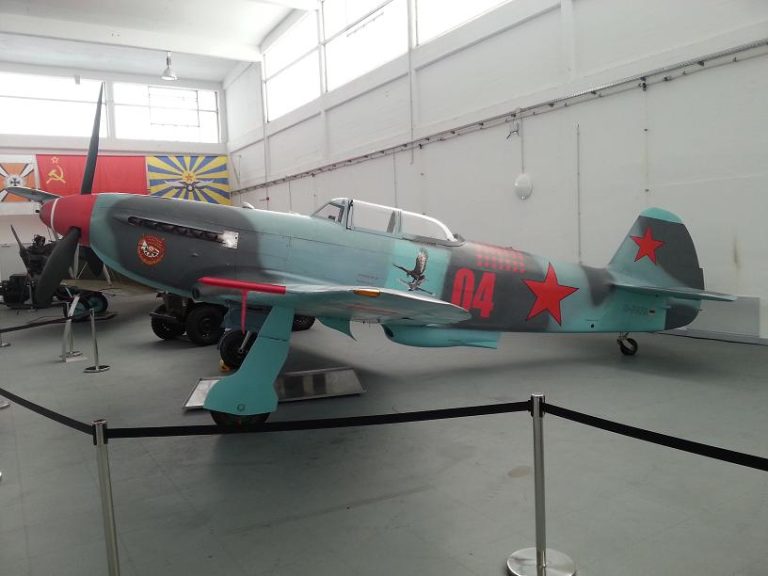
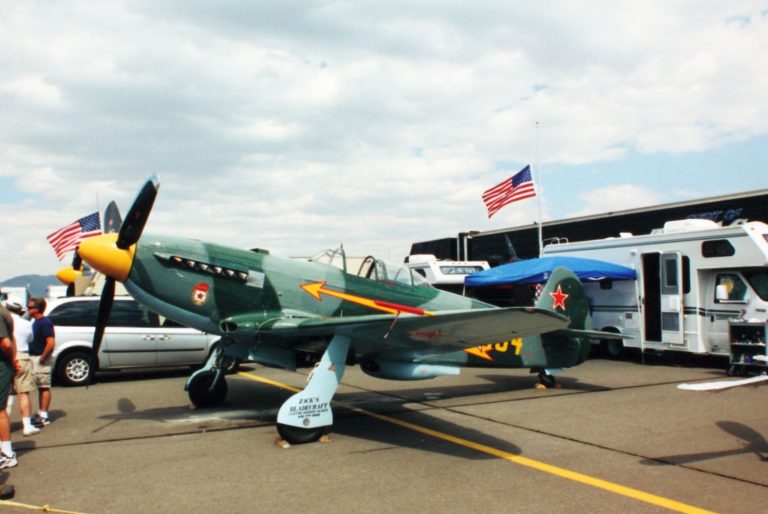
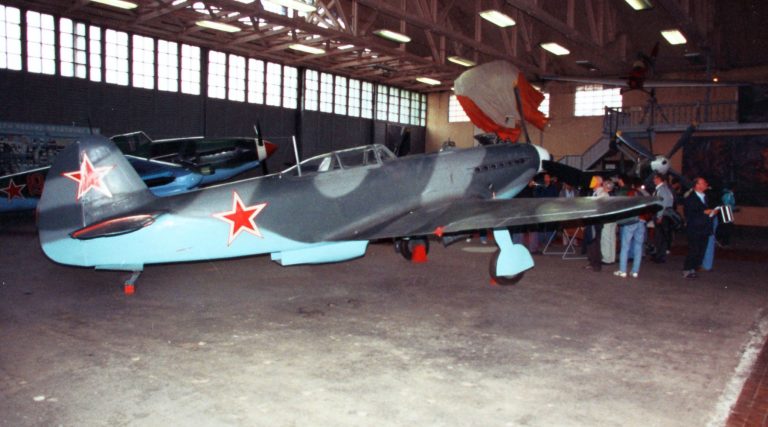
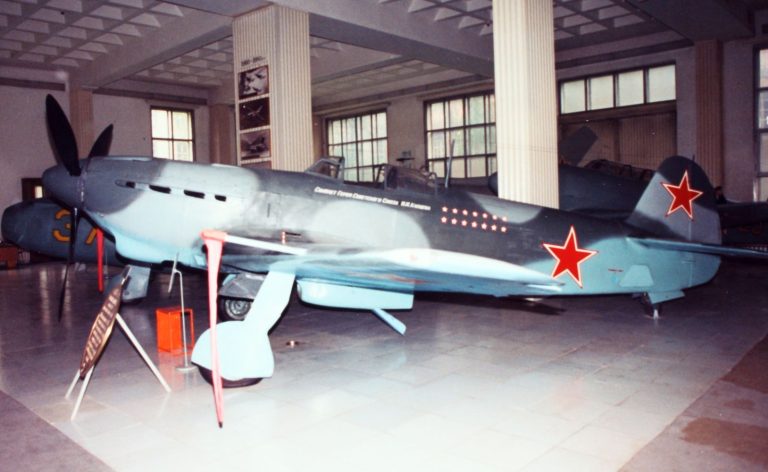
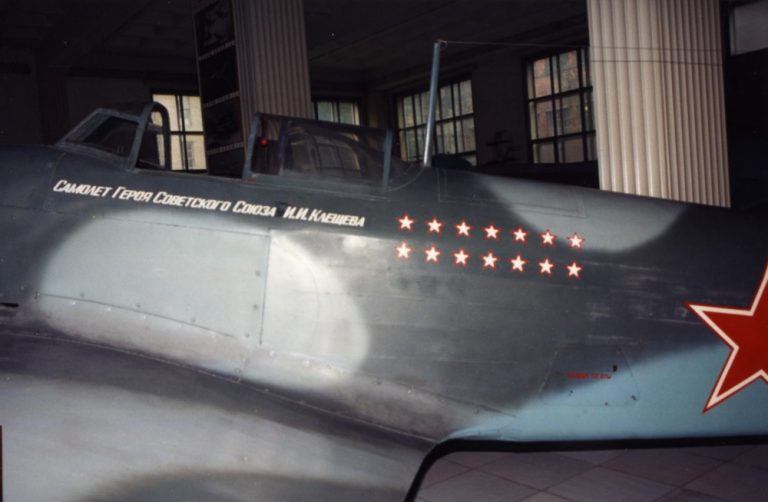
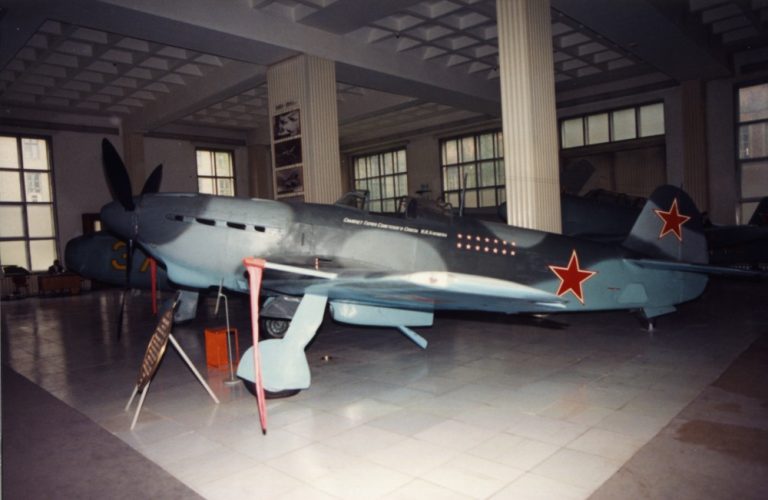
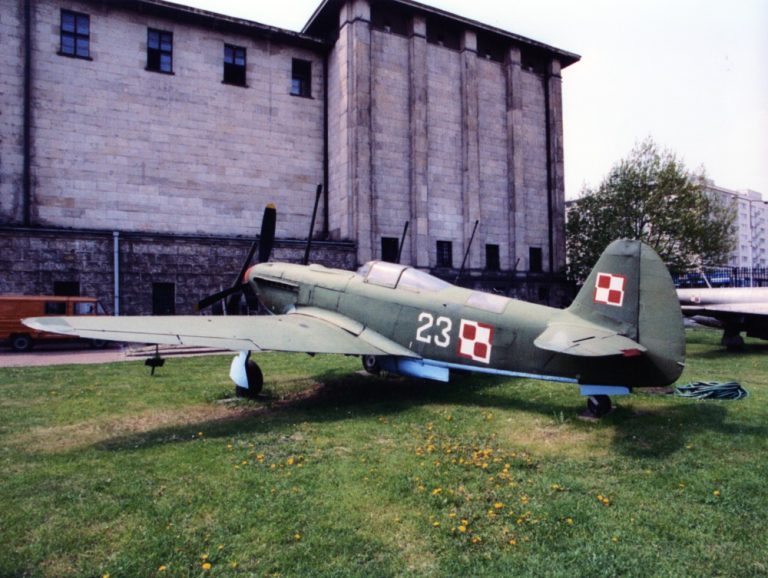
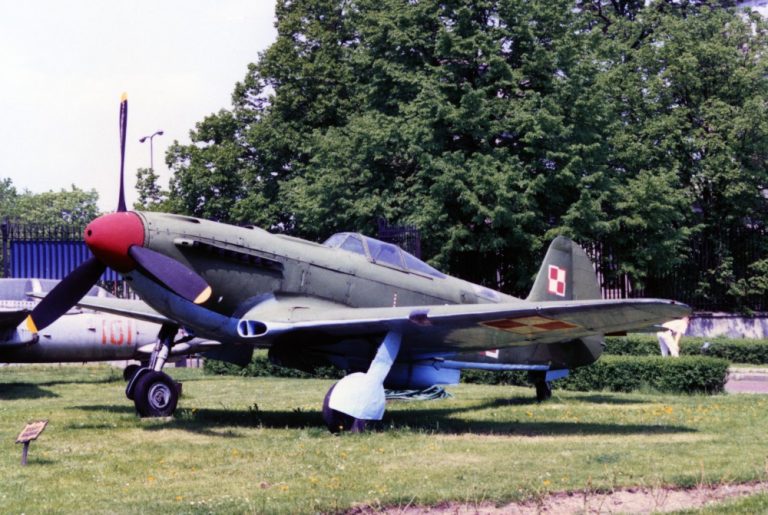
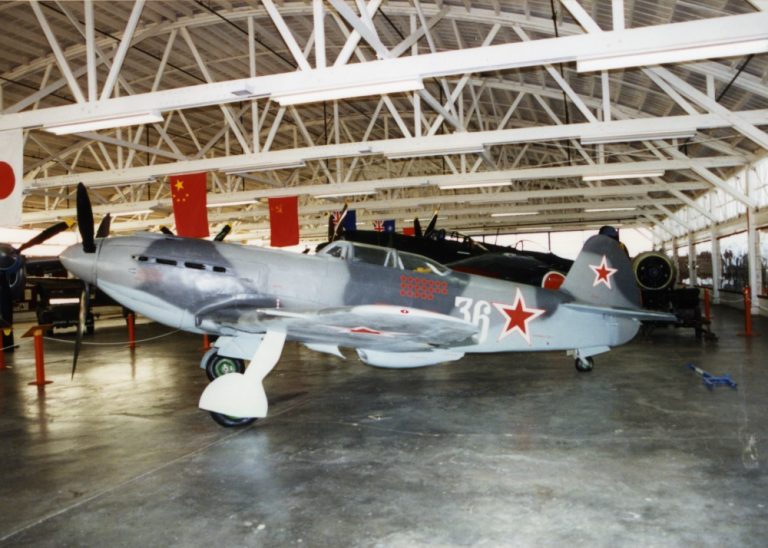
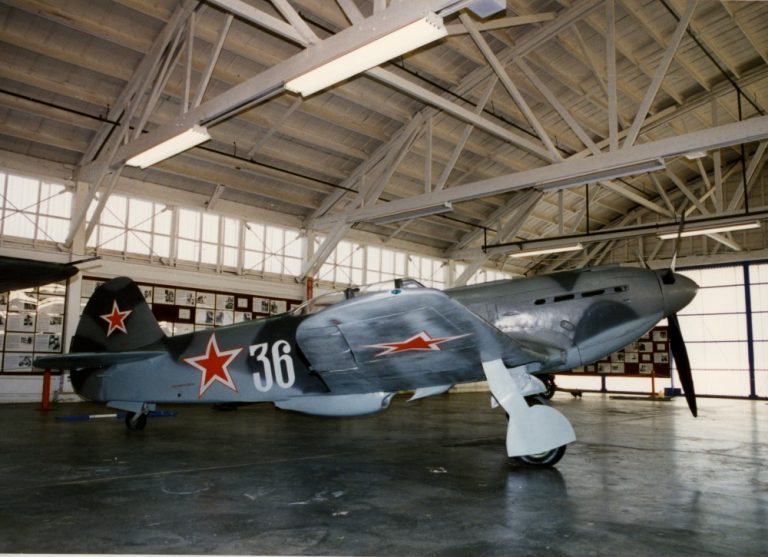
See the Yak-9 up close
The Yak-9 was really a whole family of fighters. This deep-dive looks at one of its most extreme members — the Yak-9T and its huge 37 mm hub cannon — and what happens when you bolt a very big gun onto a very light fighter.
Video: “When a Perfect Gun Turned a Good Fighter Useless — the Yak-9T and NS-37 story” by Paper Skies (~1.3M views). Embedded via YouTube.
Where the Yak-9 fought
The Yak-9, by the numbers
The Yak-9 was the workhorse of Soviet fighter aviation in the second half of the Second World War, flying escort, interception, ground-attack and anti-armour missions from Stalingrad to Berlin. Its story is one of scale: not the highest-scoring individual fighter, but the one that equipped more Soviet regiments than any other and, by sheer numbers, helped decide the air war in the East.
Soviet-era records vary and are sometimes incomplete; the figures above reflect commonly cited production and loss totals and should be read as indicative of the type’s enormous scale rather than as exact accounts.
Yakovlev Yak-9 — questions & answers
Can you fly a Yakovlev Yak-9 today?
Only just. A small number of Yak-9s have been restored to airworthiness — some rebuilt in the 1990s with modern engines — and a few appear at airshows, but there are no public Yak-9 flights. If you want to fly a real fighter yourself, MiGFlug offers cockpit experiences in genuine jet fighters you can actually strap into.
Was the Yak-9 a good fighter?
In its element, yes. At the low and medium altitudes where the Eastern Front air war was fought, the Yak-9 was fast, agile and easy to fly. It lacked the high-altitude performance and heavy firepower of some Western fighters, but it was precisely tuned for the war the Soviets were actually fighting.
What made the Yak-9T special?
The Yak-9T carried a 37 mm cannon firing through the propeller hub — powerful enough to destroy a bomber or an armoured vehicle with a single hit, though its heavy recoil and small ammunition load made it a specialist’s weapon.
How many Yak-9s were built?
16,769 were produced between 1942 and 1948, making the Yak-9 the most-produced Soviet fighter of the Second World War and one of the most-built fighters in history.
Did the Yak-9 fight in the Korean War?
Yes. North Korea operated a force of Yak-9s at the start of the Korean War in 1950, flying early ground-attack missions before jet-age opposition swept the piston fighters from the sky.
You can’t fly a Yak-9 — but you can fly a fighter jet
The Yak-9’s war belongs to history, but the thrill of flying a real fighter doesn’t. With MiGFlug you can strap into a genuine jet — from the L-39 Albatros to a MiG-29 at the edge of space — with an experienced fighter pilot beside you.
 Fly the L-39 AlbatrosThe world’s most-flown jet trainer — aerobatics included
 Fly the F-104 Starfighter“The missile with a man in it”
 Fly the MiG-21The Cold War’s most-produced jet
 Fly the T-33 Shooting StarAmerica’s first jet trainer
 Fly the DH VampireA piece of early jet history
 Fly the S.211Agile Italian jet trainer
 Fly the MB-326The classic Aermacchi jet
 Fly the MiG-15The Soviet legend of the Korean War
Related aircraft
Where these facts come from
- The Museum of Flight — Yakovlev Yak-9USurviving airframe & type history
- Vintage Aviation News — Yak-9U profileRestoration & variant detail
- San Diego Air & Space MuseumArchive photography of the type
- Imperial War MuseumsEastern Front operational context
Figures are drawn from museum and reference sources and cross-checked; where sources differ, the most commonly cited value is given. Performance and armament varied considerably across the Yak-9’s many marks.