
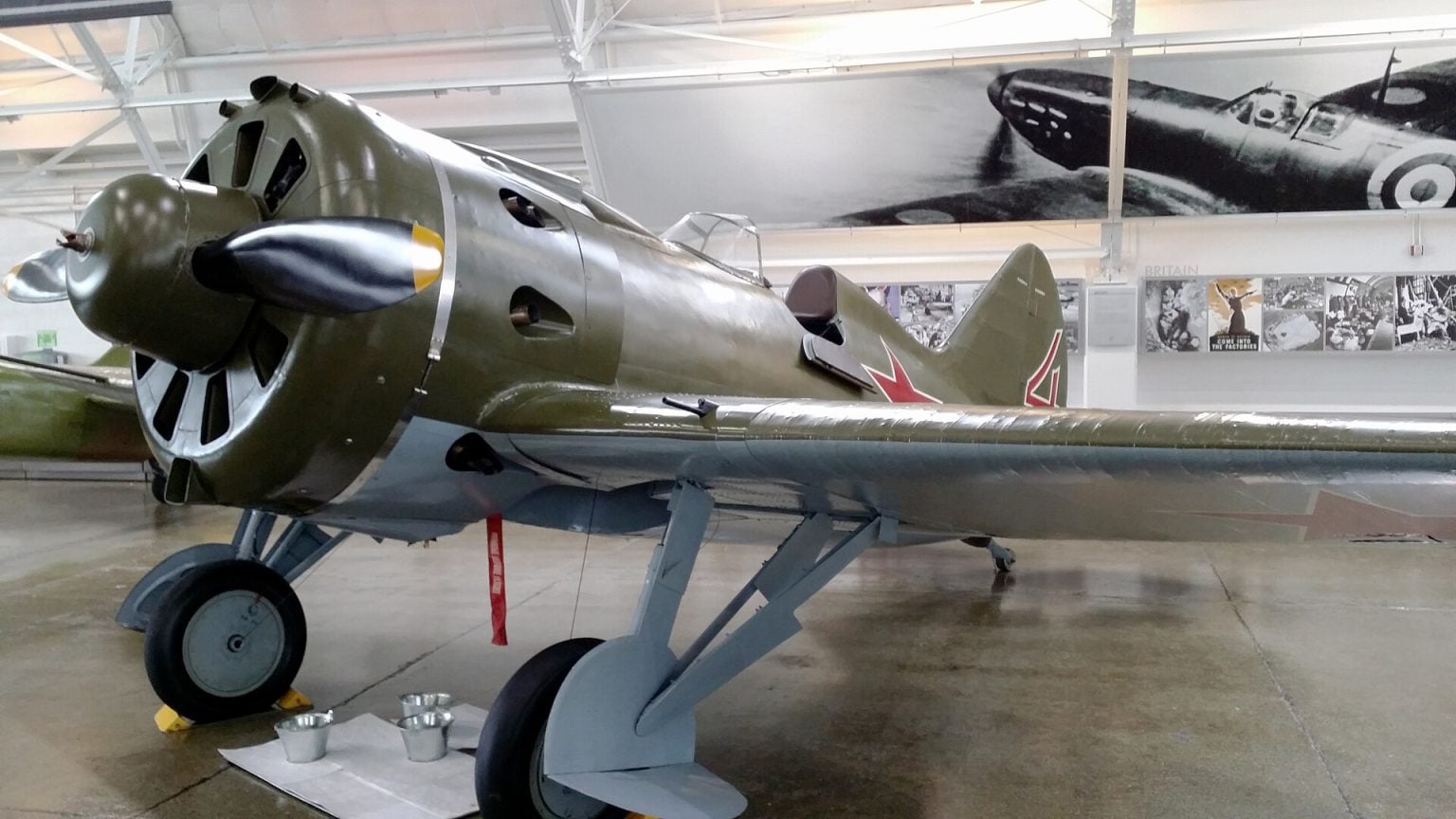
Polikarpov I-16
“Ishak”
The stubby, barrel-shaped Soviet fighter that pioneered the modern monoplane — a nimble but unforgiving little machine that fought from the skies of Spain to the opening days of Operation Barbarossa.
The little fighter that opened the monoplane age
In the early 1930s the fighter still meant a biplane — two wings, fixed wheels, an open cockpit. Then a short, fat, barrel-shaped machine from the Soviet Union rewrote the rulebook. The Polikarpov I-16, designed by Nikolai Polikarpov and his team at the Central Design Bureau (TsKB) as the TsKB-12, is widely credited as the world’s first mass-produced low-wing cantilever monoplane fighter to reach front-line service combining a retractable undercarriage and, early on, an enclosed cockpit.
Polikarpov built it under extraordinary duress: he had been arrested and sentenced to death on trumped-up charges, the sentence commuted to work in a prison design bureau, where he produced both the I-15 biplane and this radical monoplane. The prototype first flew on 30 December 1933, ski-equipped, in the hands of the legendary test pilot Valery Chkalov — who then spun it dozens of times to map its temper. The type entered squadron service around 1935.
The I-16 was fast and agile for its day, but it was also famously tricky to fly. Its very short fuselage and rearward centre of gravity made it longitudinally unstable and hair-trigger in pitch; it could flick into a spin, landed fast, and offered poor forward visibility. Raising the wheels meant spinning a hand crank roughly 44 turns. Soviet lore held that if you could master the “Ishak” (donkey), you could fly anything.
Its combat debut came in the Spanish Civil War from November 1936, where Republican pilots nicknamed it “Mosca” (fly) and their Nationalist opponents called it “Rata” (rat). It fought the Japanese in China and, decisively, over Mongolia at Khalkhin Gol in 1939, where rocket-armed I-16s scored what are reported as the first air-to-air rocket kills in history. When Germany invaded in June 1941 the I-16 was still the most numerous Soviet fighter — by then outclassed by the Messerschmitt Bf 109, yet it fought on into 1942–43. Around 10,000 were built.
01The Polikarpov I-16’s revolutionary design: the world’s first modern monoplane fighter
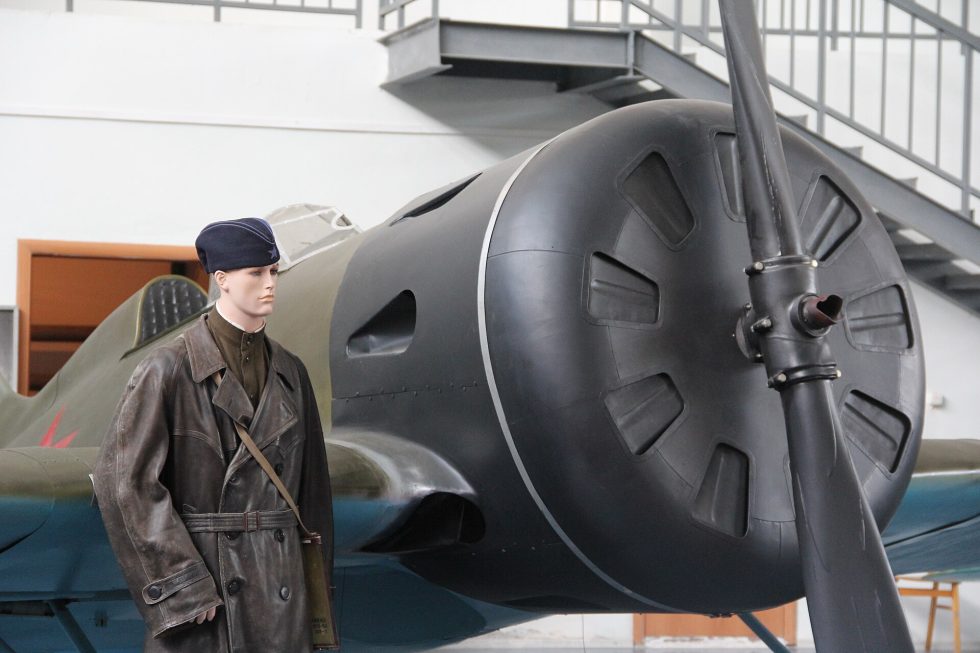
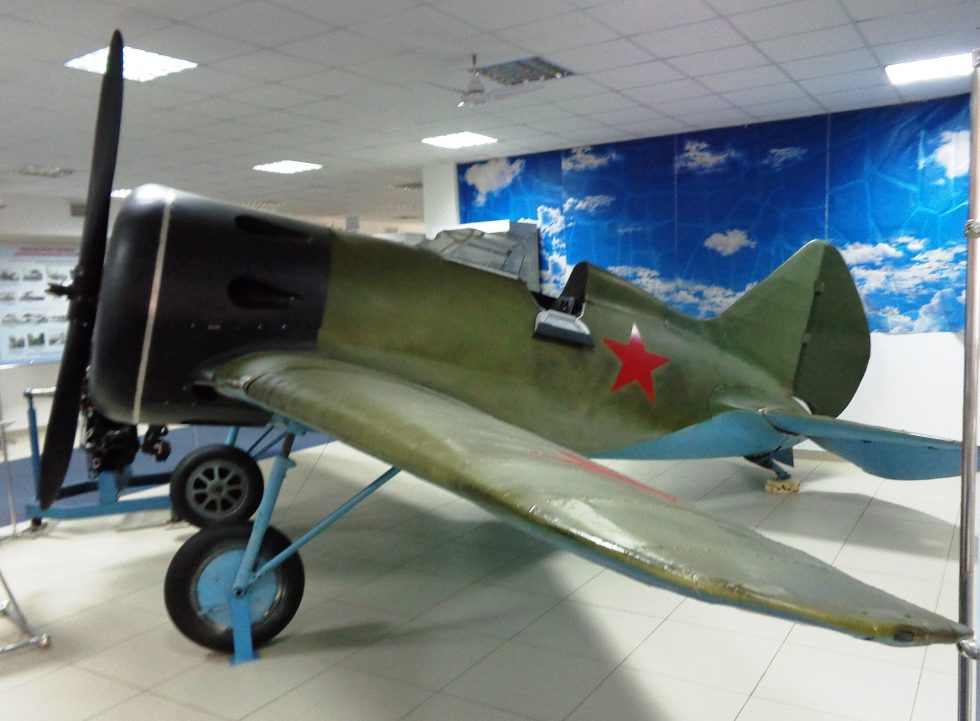
Where its contemporaries were fabric-and-wire biplanes, the I-16 was a low-wing cantilever monoplane with a retractable undercarriage — a combination widely credited as the first to reach front-line fighter service anywhere in the world. The stubby fuselage was a wooden monocoque skinned in birch plywood, mated to a fat air-cooled radial chosen partly for its tolerance of battle damage. Some pilots disliked the sliding canopy so much that later batches reverted to an open cockpit. Radical and cramped, it pointed straight at the fighters of the Second World War.
What makes it special
A monoplane when the world flew biplanes
The I-16 is widely credited as the first mass-produced low-wing cantilever monoplane fighter with retractable landing gear to reach front-line service. Its stubby fuselage was a wooden monocoque skinned in birch plywood, built around a fat radial engine. It was a genuine leap — a glimpse of the fighter’s future while most air forces still flew open-cockpit biplanes.
Agile but unforgiving: the twitchy “Ishak”
That short fuselage and rearward centre of gravity made the I-16 longitudinally unstable and extremely sensitive in pitch — quick to turn, but quick to bite. It landed fast, saw poorly forward, and its undercarriage retracted only by a hand crank of roughly 44 turns. It was a fighter for skilled hands, and Soviet crews respected it accordingly.
From Spain to Barbarossa: rockets and rams
The I-16 pioneered the RS-82 unguided rocket in air combat, credited with the first air-to-air rocket kills at Khalkhin Gol in 1939. Outclassed by the Bf 109 by 1941, it soldiered on regardless — its pilots sometimes resorting to the taran, deliberately ramming enemy aircraft when guns or options ran out.
02The Polikarpov I-16’s handling: why it took a skilled pilot
The I-16’s virtues and vices came from the same source: a very short fuselage. It made the fighter light on the controls and vicious in a horizontal turn, but also unstable in pitch — it “reacts to the slightest deviation of the controls,” as one account put it, and could snap into a spin. High approach speeds and an oil-fouled windscreen made landings a handful, and the manually cranked gear (about 44 turns) often left novices porpoising as they wound the wheels up. The maxim followed naturally: master the Ishak and you could fly anything.
03The Polikarpov I-16 at Khalkhin Gol: the first air-to-air rocket kills
Over the Mongolian steppe in August 1939, a flight of I-16s under Captain N. Zvonarev carried something new beneath their wings: RS-82 rockets. Salvoed into Japanese formations, they are credited with the first aircraft ever downed by air-to-air rockets — Soviet claims range from around 13 to 19 machines, and should be read as claims. It was a preview of a weapon that would define the jet age, fired from a propeller fighter.
Full specifications
Baseline note: the figures below describe the I-16 Type 24, the definitive Shvetsov M-63 aircraft ordered into production in 1939 and the mark that equipped most of the fighter regiments destroyed in the first weeks of the German invasion. Deltas for the M-25A Type 5 of Spain and China, the four-gun Type 10, the ShVAK-armed Type 17, 27 and 28 and the Berezin-armed Type 29 are given in grey. The tabulated figures come from the Zavod No. 21 and NII VVS data reproduced by Maslov; where Russian and Western reference works disagree the disagreement is stated rather than averaged. On climb, note the method: Soviet practice of the 1930s quoted time to a stated height, and those rows are kept because they are the primary evidence, but a rate of climb in metres per second is also tabulated because the same sources give one, and it is placed first.
Dimensions & weights
- Crew
- 1
- Length
- 6.13 m (20 ft 1 in). Type 5 5.985 m (19 ft 8 in); Type 4 5.86 m (19 ft 3 in) — the aeroplane grew nine inches in seven years and never lost the stubbiness that defined its handling
- Wingspan
- 9.004 m (29 ft 6 in), unchanged from the Type 5 onwards
- Height
- 3.25 m (10 ft 8 in), tail down; 3.218 m (10 ft 7 in) on the Type 29
- Wing area
- 14.5 m² (156.1 sq ft) on every type from the prototype to the last, which is the single most important number on this page
- Aerofoil
- TsAGI R-II, 16 per cent thickness at the root, on a cantilever low wing with a marked taper and rounded tips
- Fuselage proportions
- Length only 1.53 times the tail-to-wing arm of a conventional fighter of the period. The I-16 is short coupled by design: the barrel fuselage was drawn tightly around the Cyclone-derived radial to cut drag, which put the tail surfaces close behind the wing and left the aeroplane with too little in the way of a stability lever
- Empty weight
- 1,490 kg (3,285 lb). Type 5 1,119 kg (2,467 lb); Type 10 1,327 kg (2,926 lb); Type 17 1,426 kg (3,144 lb); Type 29 1,547 kg (3,411 lb)
- Equipped weight
- 1,751 kg (3,860 lb)
- Normal take-off weight
- 1,941 kg (4,279 lb). Type 5 1,508 kg (3,324 lb); Type 10 1,716 kg (3,783 lb); Type 17 1,810 kg (3,991 lb); Type 28 1,988 kg (4,383 lb); Type 29 1,966 kg (4,334 lb)
- Maximum take-off weight
- 2,050 kg (4,519 lb) with drop tanks and underwing stores
- Useful load
- 451 kg (994 lb) at normal weight, of which 190 kg (419 lb) is fuel
- Wing loading
- 133 kg/m² (27.2 lb/sq ft). Type 5 103.5 kg/m² (21.2 lb/sq ft) — a 28 per cent rise on an unchanged wing, and the reason the later marks lost the turn the early ones had
- Power loading
- 2.37 kg/kW (3.89 lb/hp) at take-off power
- Undercarriage
- Two main legs retracting inwards into the centre section, wound up and down by a cable-and-drum crank on the right-hand cockpit wall at frame No. 5; 700 × 150 mm wheels with cable-operated drum brakes, oleo-pneumatic legs charged to 35 atmospheres. Fixed sprung tailwheel from the Type 18; a plain sprung skid before that. Skis for winter, retractable from the Type 10 onward
Performance
- Maximum speed
- 462 km/h (287 mph) at 4,700 m (15,400 ft)
- Maximum speed, sea level
- 410 km/h (255 mph)
- Maximum speed, Type 5
- 445 km/h (277 mph) at 2,700 m (8,900 ft), 390 km/h (242 mph) at sea level — the figure that mattered over Madrid in 1936, when nothing on the Nationalist side could match it
- Maximum speed, Type 10
- 448 km/h (278 mph) at 3,160 m (10,400 ft)
- Maximum speed, Type 17
- 425 km/h (264 mph) at 2,700 m (8,900 ft) — the cannon aircraft was the slowest of the family, which is the whole difficulty with it
- Maximum speed, Types 28 and 29
- 463 km/h (288 mph) at 2,000 m (6,600 ft) and 470 km/h (292 mph) at 4,480 m (14,700 ft) respectively; the Type 29 was the fastest I-16 built in quantity
- Landing speed
- 130 km/h (81 mph); Type 5 117 km/h (73 mph). High for 1941, on a small wing with a narrow track, and a substantial share of I-16 write-offs never met an enemy
- Rate of climb
- 14.7 m/s (2,890 ft/min) at sea level. Type 5 14.2 m/s (2,795 ft/min); Type 17 11.5 m/s (2,265 ft/min); Type 18 17.2 m/s (3,390 ft/min), the best of the family
- Time to 3,000 m
- 3 min 24 s (to 9,800 ft); Type 5 4 min 0 s; Type 18 2 min 54 s
- Time to 5,000 m
- 5 min 12 s (to 16,400 ft); Type 10 6 min 54 s; Type 17 8 min 54 s; Type 29 5 min 48 s
- Service ceiling
- 9,700 m (31,800 ft); Type 5 9,100 m (29,900 ft); Type 17 8,240 m (27,000 ft)
- Sustained turn, 360 degrees
- 17–18 s at low level against 14–15 s for the Type 5. The Type 5 turned inside a Fiat CR.32 with difficulty and the Type 24 could not, because every kilogram added between 1936 and 1940 went onto the same 14.5 m² wing
- Range
- 440 km (273 miles) on internal fuel; ~700 km (~435 miles) with two underwing tanks. Type 5 540 km (336 miles). Endurance on internal fuel was well under an hour and a half, which confined the type to point defence
- Take-off run / landing run
- 260 m / 300 m (850 ft / 985 ft) at normal weight, landing run with flaps and brakes
- For comparison: Messerschmitt Bf 109B-2
- 465 km/h (289 mph) — the version that reached Spain in 1937 and which the I-16 Type 10 could fight on level terms
- For comparison: Messerschmitt Bf 109F-2
- 600 km/h (373 mph) — a deficit of nearly 140 km/h (87 mph) in June 1941. A gap that size means the German pilot decides whether a fight happens, and the I-16 pilot decides nothing at all
Propulsion & systems
- Engine
- 1 × Shvetsov M-63 nine-cylinder air-cooled radial of 29.8 litres (1,819 cu in), compression 7.2:1, with a two-speed geared centrifugal supercharger. A much-developed Soviet descendant of the Wright R-1820-F3 Cyclone by way of the M-25 and M-62; dry weight 515 kg (1,135 lb)
- Ratings
- 820 kW (1,100 hp) for take-off at 2,300 rpm, limited to five minutes; 746 kW (1,000 hp) at 1,800 m in low blower; 671 kW (900 hp) at 4,500 m in high blower; 624 kW (837 hp) continuous at sea level. Dive rpm limited to 2,500 for no more than thirty seconds
- Alternative engines
- M-22 358 kW (480 hp), a licensed Bristol Jupiter, on the Type 4; M-25A 537 kW (730 hp) on the Type 5 and 12; M-25V 559 kW (750 hp) on the Types 10 and 17; M-62 746 kW (1,000 hp) on the Types 18 and 27, and on a proportion of Type 24 airframes
- Propeller
- Two-blade AV-1 or VV-1 constant-speed metal airscrew, 2.8 m (9 ft 2 in) diameter, 73 kg (161 lb), hydraulic pitch change from 17 to 47 degrees with an R-2 governor, later restricted to 43 degrees. Direct drive, no reduction gear
- Starting
- RI-12 or RI-24 inertia starter with an Eclipse flywheel spun to 10,000–12,000 rpm, normally from a ground supply, from the aircraft battery, or by hand crank. A ratchet in the spinner allowed a ground starter to turn the propeller directly
- Internal fuel
- 260 l (~57 imp gal) in a single welded AMts alloy tank between frames 1 and 4, immediately ahead of the pilot, with an external protective covering rather than a self-sealing liner
- External fuel
- 2 × 93 l (~20 imp gal) fibre and plywood underwing tanks introduced on the Type 20 and standard on the Type 24. Some Russian sources give a pair totalling 200 l and a main tank of 254 l; the 1941 M-63 technical description gives 93 l and 260 l, and that is what is quoted here. The gauge read the main tank only, so drop tanks were burnt first and jettisoned empty
- Structure
- Wooden semi-monocoque fuselage: a shell moulded from several plies of 0.5 mm birch veneer laid at 90 degrees to one another and 45 degrees to the aircraft axis, glued with casein to a frame of eleven bulkheads, four pine longerons and chrome-molybdenum tube bracing, then puttied, covered in fine cloth and doped. Steel-tube spars in the centre section with duralumin ribs; fabric-covered outer wing panels, with 3 mm plywood added between the spars on the Type 24 to cure the wing twist that had been observed in service; metal-framed, fabric-covered tail surfaces
- Aerodynamic and control detail
- The fin leading edge is offset two degrees to the left to trim out propeller torque, the front fin fitting being displaced 30 mm from the centreline. Two-section flaps run across the whole centre section on the Type 24; earlier aircraft used drooping ailerons instead. Elevator and ailerons on push rods, rudder on cables
- Cockpit and canopy
- Open, behind a plexiglas windscreen on a stainless steel frame, with hinged duralumin side panels to help the pilot climb in. The Types 4 and 5 had a fully enclosed sliding canopy — the first on any mass-produced fighter — and it was deleted at pilots’ insistence from the Type 6 onwards: the glazing was poor, it fouled with engine oil, the hood was narrow and the opening mechanism unreliable, and it had a habit of slamming shut in hard manoeuvre. Where canopies were still fitted, crews commonly wired them open or removed the sliding portion
- Protection
- An 8.5 mm (0.33 in) steel back armour plate behind the seat, fitted for operations; improvised armour was already being added in Spain. No self-sealing tank, no cockpit floor armour, and an unprotected fuel tank one bulkhead ahead of the pilot’s knees
- Sights and cameras
- OP-1 tube sight on early aircraft, PBP-1A reflector sight on later ones; PAU-22 gun camera where fitted
- Electrical and radio
- 27 V two-wire DC system with a GS-10-350 generator and a 12A-5 battery, feeding navigation lights, pitot and gun heating, engine start and rocket firing. Provision for the RSI-3 Oryol transmitter existed from mid-1940 and some 1940 Type 24s carried an RSI-4 Sokol receiver under the instrument panel; the great majority of I-16s went to war with no radio at all, and fought on hand signals
- Unit cost
- ~50,000 roubles for a Type 5, ~90,000 for a Type 10 and ~135,000 for a cannon-armed Type 17, at Zavod No. 21 in 1938; a UTI-4 trainer cost ~40,000. These are factory cost prices in a command economy and do not convert meaningfully into any Western currency.
04The Polikarpov I-16’s cost: why no reliable price exists
The I-16 was a Soviet state product of the 1930s, built by the thousand in a command economy and never sold on an open market, so no dependable flyaway unit price or cost-per-flight-hour figure survives in the public record. What is documented is scale, not money: production is commonly estimated at around 10,000 airframes (counts range roughly 8,600 to 10,300 depending on how two-seat trainers are tallied). Any precise dollar figure attached to an I-16 today is, in practice, guesswork.
Armament & payload
The I-16 fired the first air-to-air rockets in the history of air combat, and spent the rest of its career losing an argument about calibre
The armament story of the I-16 is one long attempt to put enough weight of fire into an aeroplane whose wing could not carry it. It began in 1934 with two rifle-calibre PV-1 guns in the wings, reached four 7.62 mm ShKAS by 1938, and produced in the Type 17 the first Soviet fighter with a pair of 20 mm ShVAK cannon — a genuinely lethal battery that cost the aircraft some 23 km/h and almost a quarter of its rate of climb. Nothing in the family solved the problem, because the wing area never changed while the loaded weight rose by nearly a third.
What the I-16 did achieve, and what no other fighter had achieved before, was the first successful use of unguided rockets in air-to-air combat. On 20 August 1939 over the Khalkhin Gol a flight of five rocket-armed I-16s led by Captain N. I. Zvonarev fired RS-82s at Japanese Ki-27s from roughly a kilometre; the group is credited with thirteen to nineteen aircraft over the campaign. It was a curiosity at the time and it is a milestone now: every air-to-air rocket battery of the 1950s, and by extension the guided missile, descends from a weapon that was really designed to be shot at ground targets. Gun fits, ammunition allowances and rocket provision varied by production batch, by factory and by unit modification, and the Spanish, Chinese and Finnish airframes were not maintained or armed to a single standard.
Gun
- Baseline Type 24: 4 × 7.62 mm ShKAS, two synchronised above the engine and two in the centre section outside the propeller disc, with about 3,100 rounds in total
- ShKAS cyclic rate about 1,800 rounds per minute per gun — the fastest rifle-calibre aircraft gun of its generation, and correspondingly sensitive to ammunition quality and to synchronisation gear
- Type 4: 2 × 7.62 mm PV-1 in the wings, a water-cooled Maxim adapted for air use, later replaced by ShKAS. Type 5: 2 × ShKAS in the wings only, which is why Spanish pilots asked for more
- Types 12, 17, 27 and 28: 2 × 20 mm ShVAK cannon in the wings with 150 rounds per gun, plus the two synchronised ShKAS. About 715 cannon-armed I-16s were built in all — 22 Type 12, 341 Type 17 and 352 Type 27 and 28 together
- Type 29: 2 × synchronised ShKAS plus a single 12.7 mm Berezin BS in the underside of the centre section, firing through the propeller disc. Fewer barrels than a Type 24 and a heavier throw weight, which was the correct answer arriving in 1940
Air-to-air
- 6 × RS-82 82 mm unguided rockets under the outer wing panels on the Types 24 and 29, on box-section rails between ribs 7 and 9, with a duralumin skin panel let into the fabric to take them
- This is the type’s claim on aviation history: the first rockets fired successfully from one aeroplane at another, at Khalkhin Gol on 20 August 1939, from a distance of about a kilometre
- The tactic was a salvo into a bomber formation rather than aimed fire at a single machine. Dispersion was wide, the fuzing was crude, and the psychological effect on the target formation was probably worth more than the warheads
- No guided air-to-air weapon existed in any air force during the type’s service life; the gun and the rocket were all there was
- Soviet claims for the Zvonarev flight range from thirteen to nineteen aircraft depending on the source, and cannot be reconciled with Japanese loss returns.
Air-to-surface guided
- None, and the card is kept rather than dropped because the absence explains how the type was used up
- Guided air-to-surface weapons did not exist in Soviet service until long after the last I-16 had left the front line
- Ground attack meant a shallow dive into the target’s own light flak with rockets, small bombs and rifle-calibre guns, flown by pilots with no armour under them and no self-sealing tank in front of them
- Through the winter of 1941–42 that is what most surviving I-16 regiments did, because the aeroplane was no longer competitive as a fighter and was still available in numbers
- The one precision method the type ever had was not guidance but dive bombing from a parasite launch, described under Bombs
Bombs
- 2 × 100 kg FAB-100 or 2 × 50 kg FAB-50 on underwing racks, 200 kg (441 lb) being the realistic maximum from a ground take-off
- Small fragmentation loads — AO-25 and AO-10 — were common against columns and troops in the open
- The often-repeated figure of 500 kg for the Type 24 belongs to a different aircraft in a different configuration: only the Zveno-SPB conversion carried 2 × 250 kg FAB-250, and it did so because a TB-3 mother ship lifted it off the ground
- Zveno-SPB, Black Sea Fleet, 1941: I-16s slung beneath a TB-3-4AM-34FRN, released 40 km short, dive bombing from about 1,800 m. The Constanta oil depot on 26 July, then the Danube bridge at Cernavoda on 10 and 13 August, where five direct hits dropped a span
- The Zveno raids are among the best-documented Soviet operations of 1941 and among the least representative; treat them as a footnote to the type’s war, not a summary of it.
Rockets
- RS-82: 82 mm calibre, about 6.8 kg (15 lb) all-up with roughly 0.36 kg of explosive, solid-fuel motor burning out at around 350 m/s
- Six carried on the Types 24 and 29; the Types 18, 27 and 28 could also be fitted, and unit-level conversions of earlier marks were common
- Fired singly, in pairs or as a full salvo by an electrical circuit off the 27 V bus. Quoted maximum range runs to several kilometres and useful aiming range was a small fraction of it
- Against soft-skinned vehicles, parked aircraft, columns and troops in the open the salvo effect was real; against a point target the RS-82 was arithmetic in name only
- The rails and rounds cost speed on an aeroplane with none to spare, which is a familiar bargain and rarely a good one
Pods & other stores
- 2 × 93 l underwing drop tanks on a duralumin beam between ribs 2 and 3, standard from the Type 20 and Type 24; roughly a 60 per cent increase in radius, and the tanks went first in any interception
- PAU-22 gun camera, wired into the aircraft electrical system, on a minority of airframes
- Retractable ski undercarriage from the Type 10 onwards, pulled up almost flush with the centre section; a genuine seasonal store on Soviet fighters and one Western types largely lacked
- Zveno attachment fittings on the SPB conversions, plus dive brakes and a strengthened centre section
- What was not carried is as telling: no radio on most airframes, no gyro instruments to speak of, no oxygen worth the name above the type’s working height
Three typical loadouts
- Point-defence interception, Type 24, summer 1941
- 4 × ShKAS with 3,100 rounds, full 260 l internal tank, no external stores. Take-off weight about 1,941 kg, endurance well under 90 minutes, and a scramble radius that assumed the enemy would come to the aerodrome. In June 1941 he generally did.
- Rocket-armed close support, Type 24 or 29, winter 1941–42
- 6 × RS-82 on underwing rails plus 2 × FAB-50, guns loaded, no drop tanks. Take-off weight approaching 2,050 kg, top speed down by several tens of km/h, flown at low level against columns and airfields. This is how most surviving I-16s were expended.
- Zveno-SPB parasite dive bomber, Black Sea Fleet, 1941
- 2 × FAB-250 under a modified Type 5 airframe carried beneath a TB-3 mother ship, released roughly 40 km from the target and diving from about 1,800 m. A 500 kg bomb load on an aeroplane that could not have taken off with it, used against Constanta and the Cernavoda bridge, and one of the very few genuinely successful parasite-fighter operations of the war.
Sourcing caveat: ammunition allowances and rocket provision are given as they appear in Soviet factory and NII VVS documents reproduced by Maslov and in the 1941 M-63 technical description. Front-line practice diverged constantly — guns were removed to save weight, rocket rails were fitted to marks that never received them at the factory, and cannon-armed aircraft were reworked back to machine guns when ShVAK ammunition ran short. Claim totals on all sides at Khalkhin Gol and in 1941 substantially exceed verified losses.
Variants
Eleven production types in seven years, each adding weight to a wing that never grew
The I-16 was aviation’s great leap and its great trap in the same airframe. Nikolai Polikarpov’s TsKB-12 first flew on 30 December 1933 in the hands of Valery Chkalov, and it was the first fighter anywhere to combine a cantilever low wing, a retractable undercarriage and an enclosed cockpit in genuine mass production. The precedents deserve stating precisely, because the claim is often made too broadly: the Grumman FF that reached service with retractable gear was a biplane, the Consolidated P-30 monoplane was a two-seater built in very small numbers, Boeing’s P-26 had fixed gear, and Sukhoi’s all-metal I-14 flew seven months before the I-16 but was ordered in numbers too small to matter. It was the I-16 that made the configuration ordinary, and something over 10,000 were built.
The trap was that Polikarpov bought his speed by wrapping the smallest possible fuselage around a big radial, which left the aeroplane short coupled and longitudinally unstable. It could not be flown hands off. The controls were light to the point of treachery, an abrupt input would put it into a spin, and the addition of armour, radio, battery and flaps through the late 1930s moved the centre of gravity further aft until a 1939 state study found pilots holding forward stick just to fly level. Against that it rolled at over 240 degrees per second, which in the hands of a Spanish or Chinese veteran was a weapon in itself. It rewarded expertise absolutely and punished inexperience absolutely, and in 1941 the VVS was full of inexperience.
The type’s combat career divides cleanly. Over Madrid from 13 November 1936 it was the best fighter in Spain, faster than the Heinkel He 51 and the Fiat CR.32 and a match for the first Bf 109Bs; Republican pilots called it Mosca, the fly, and Nationalist pilots Rata, the rat, and both names stuck. Somewhere between 276 and 475 reached Spain depending on which delivery return is counted, with fourteen more assembled locally under a 1937 licence; 52 were captured and Spain flew them until 1953. Against Japan it was competitive but no better, losing 88 of roughly 300 to 500 committed at Khalkhin Gol in 1939, mostly to Nakajima Ki-27s. And then on 22 June 1941 it was obsolete: 1,635 of the 4,226 VVS aircraft in the frontier districts were I-16s, only 937 survived the first 48 hours, and by the end of the year front-line strength was about 240.
- TsKB-12, Type 4 and UTI-2 (1933–36, 555 Type 4 and 49 UTI-2)
- The M-22 Jupiter aircraft: 480 hp, two wing guns, 362 km/h, and a fully enclosed sliding canopy. Underpowered and already the fastest fighter in Soviet service. The UTI-2 was the first two-seat conversion, with fixed gear.
- I-16 Type 5 (1936–37, 2,859 built)
- The M-25A of 730 hp, new cowling, spinner and starting ratchet; two wing ShKAS, 445 km/h, and the aircraft that fought in Spain and China. Retained the enclosed canopy, which Spanish veterans disliked so intensely that its deletion became a formal requirement.
- I-16 Type 6 and Type 12 (1937–38, small batches; 22 Type 12)
- The direct Spanish lessons. The Type 6 added a synchronised gun under the engine, an oil cooler and back armour, and deleted the canopy at pilots’ demand; the ship carrying the batch to Spain was sunk. The Type 12 was the first ShVAK cannon aircraft, on a Type 5 airframe.
- I-16 Type 10 (1938–39, 934 built)
- The definitive four-gun aeroplane and the one most people picture: M-25V of 750 hp, two synchronised ShKAS added over the engine with 650 rounds each, open cockpit, retractable skis. Assembled under licence in Spain and supplied in quantity to China. Reached Spain almost simultaneously with the Bf 109D.
- I-16 Type 17 and Type 27 (1938–40, 341 and part of 352 with the Type 28)
- Two 20 mm ShVAK in the wings with 150 rounds per gun, in place of the wing ShKAS. The Type 27 was the same aircraft re-engined with the M-62. Formidably armed, more than 20 km/h slower and markedly worse in climb, and some 300 kg heavier at take-off than the Type 5 airframe it came from.
- I-16 Type 18 and Type 20 (1939, 1,322 including the Type 24)
- The M-62 with its two-speed supercharger, a VISh-6A propeller and a tailwheel in place of the skid. A field idea from Khalkhin Gol, worked up from I-153 repair kits, that improved longitudinal stability in turns and loops and made the aircraft less prone to being over-rotated on landing. The Type 20 added drop-tank plumbing.
- I-16 Type 24 (1939–41, see Type 18)
- The baseline of this page. M-63 of 1,100 hp, strengthened structure, 3 mm plywood between the wing spars to cure wing twist, drop tanks, flaps across the centre section, four ShKAS and six RS-82. The best-developed I-16 and still a 1933 aeroplane, which is why 1941 went the way it did.
- I-16 Type 28 and Type 29 (1940–41, 352 and 650)
- The last two. The Type 28 was a Type 24 with the wing ShVAK of the Type 27; the Type 29 dropped the wing guns entirely for a single 12.7 mm Berezin BS under the centre section, and at 470 km/h was the fastest production I-16. Both were, in armament terms, right; both were far too late.
- UTI-4 (Type 15) and special conversions (1937–41, 3,184 UTI-4)
- The tandem two-seat trainer accounted for very nearly a third of all I-16 production and taught most of the Soviet fighter pilots of the early war. Alongside it ran the I-16SPB and Zveno parasite dive bombers, the turbocharged I-16TK that reached 494 km/h at 8,600 m without entering production, and various pressure-cabin and ramjet experiments.
- Export, licence and captured service (1936–53)
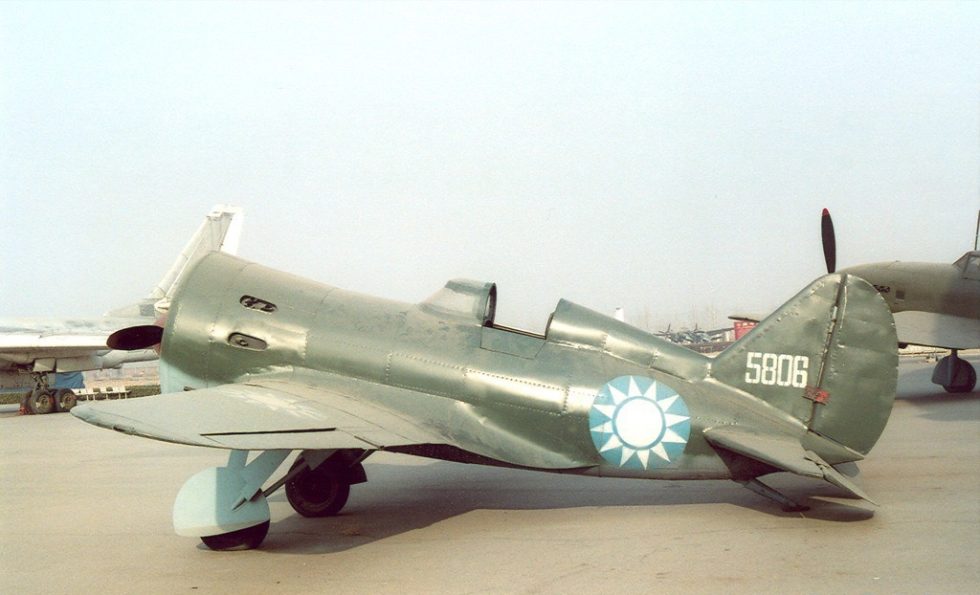
- No foreign licence except Spain, where the Republic built fourteen aircraft under a 1937 agreement and Nationalist Spain flew 52 captured machines until 1953. China received at least 215 up to 1941 and built about 32 copies, calling the type Yanzi, the swallow; Plant No. 600 at Urumqi assembled Soviet kits, 111 Type 24s being flown out to Alma-Ata by September 1941. Mongolia had 30. Finland flew seven captured aircraft, Germany a handful for training and liaison, and Romania used a single captured Type 29 as a dissimilar sparring partner.
Survivors, stated precisely, because the flying aircraft are almost universally mislabelled. Original airframes are few and all are static. The Central Naval Museum in St Petersburg holds Type 28 No. 2821395, the aircraft flown by the twice Hero of the Soviet Union Boris Safonov, which fell four to five metres during the museum’s 2012 move, was badly damaged and has since been restored. Type 5 No. 5210708 is in the Chkalov Memorial Museum at Chkalovsk, and Type 5 No. 521A124, recovered in 1980 from a site 55 km from Murmansk, is in the Northern Fleet Air Force Museum at Safonovo. A UTI-4 trainer survives in the Finnish Aviation Museum. The Chinese Aviation Museum at Datangshan and the museum at Monino display aircraft built up around original components rather than complete original machines. Now the flyers, and the distinction matters: in the early 1990s Sir Tim Wallis and Ray Mulqueen of New Zealand located the crash sites of six I-16s shot down in 1941–42 and had them rebuilt at the Novosibirsk aircraft plant, alongside three I-153s, the last arriving in New Zealand in 1999. Russian accounts are blunt that in practice only some instruments from the wrecks were reused; these are new-build airframes carrying recovered identities and a small number of original parts, not restored original aeroplanes. None uses an original engine: all fly on geared Shvetsov ASh-62IR radials taken from the An-2, where the wartime M-62 and M-63 drove their propellers direct, and the mismatched propeller leaves the rebuilds slower and worse-climbing than the originals they represent. Two, ZK-JIN and ZK-JIO, stayed at Wanaka; ZK-JIQ became N7459 with the Flying Heritage collection in 1998, ZK-JIP became N30425 and went to Midland, Texas in 2002, ZK-JIR became N1639P with the Military Aviation Museum at Virginia Beach in 2003, and ZK-JJC went to Spain in 2005. A seventh was later completed for the American collector Jerry Yagen, and further examples on the German and Russian civil registers come from the same Novosibirsk programme. Any photograph captioned as a restored I-16 in flight is, on present evidence, a photograph of a 1990s Novosibirsk airframe.
From design bureau to the Eastern Front
Design begins
Polikarpov’s TsKB team starts work on the TsKB-12 — a radical stubby monoplane fighter. It is ordered into production before it has even flown.
First flight
Test pilot Valery Chkalov lifts the ski-equipped prototype into the winter sky, powered by an M-22 radial, and later maps its spin behaviour.
Trials and service
State acceptance trials run from March 1934; the I-16 enters Soviet squadron service around 1935 as the VVS’s first modern monoplane fighter.
Spanish Civil War
Combat debut with Republican forces from November. Republicans call it “Mosca” (fly); Nationalists call it “Rata” (rat). It dominates the biplanes it meets.
China and Mongolia
Fights the Japanese in China with Soviet volunteer pilots, then over Mongolia at Khalkhin Gol, where rocket-armed I-16s are credited with the first air-to-air rocket kills.
Operation Barbarossa
Still the most numerous Soviet fighter — over 1,600 front-line — but outclassed by the Bf 109. Losses are catastrophic in the opening months.
Fading from the line
Production ends in 1942 and the I-16 is steadily replaced by newer fighters, though it fights on where nothing better is available.
Last sorties
Isolated operational use is reported as late as August 1945, closing out a front-line career that spanned the biplane age to the jet threshold.
From the front: twelve I-16 stories
Chkalov takes the barrel aloft
The stubby prototype flew a month after it was ordered into mass production.
Read the full story
Forty-four turns to fly
Raising the wheels was a genuine arm workout.
Read the full story
Rata versus Mosca — same plane, two names
One fighter, two enemies, two very different nicknames.
Read the full story
The first rocket kills in history
August 1939, over Mongolia, aviation crossed a threshold.
Read the full story
Why Soviet pilots called it “donkey”
Ishak — little donkey — was equal parts insult and affection.
Read the full story
When the guns ran dry, they rammed
Desperation turned the little fighter into a weapon itself.
Read the full story
Everywhere, and already obsolete
On 22 June 1941 it was the most numerous Soviet fighter — and outclassed.
Read the full story
Safonov of the Arctic
The Northern Fleet’s greatest ace made his name on the little Polikarpov.
Read the full story
The two-seat Ishak
To tame a killer, they built a double-seat version.
Read the full story
Ishak against Emil
Speed against the turn — the I-16 met its match in the Bf 109.
Read the full story
The monoplane and its biplane brother
Polikarpov fielded two fighters at once — and used them as a team.
Read the full story
Raised from Russian lakes, flying again
A handful of Ishaks fly today — rebuilt from wartime wrecks.
Read the full story
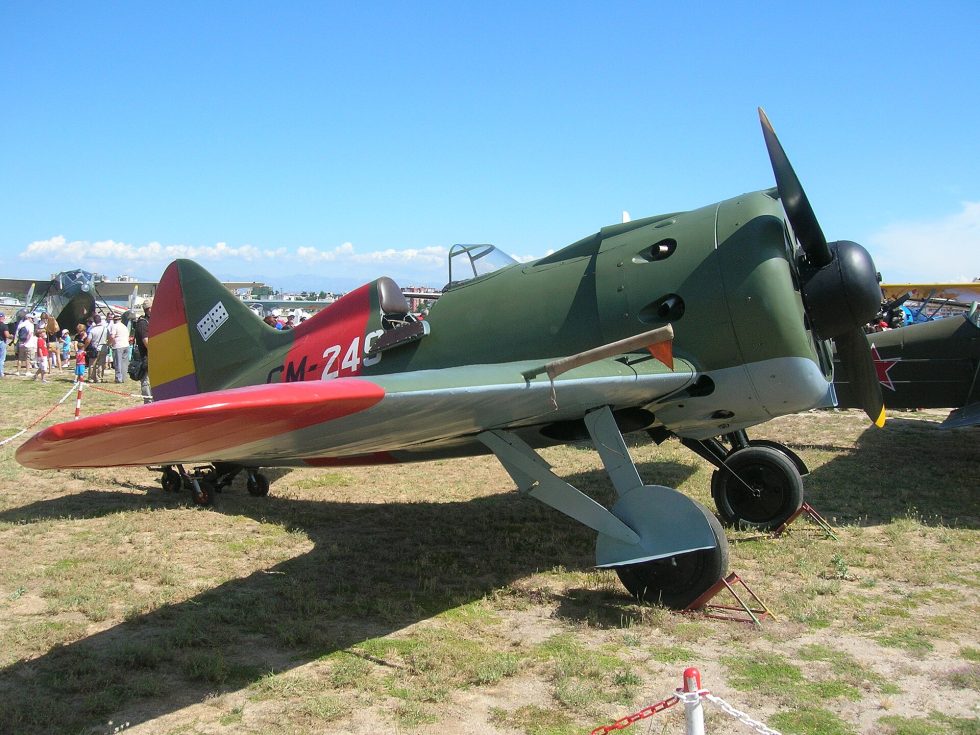
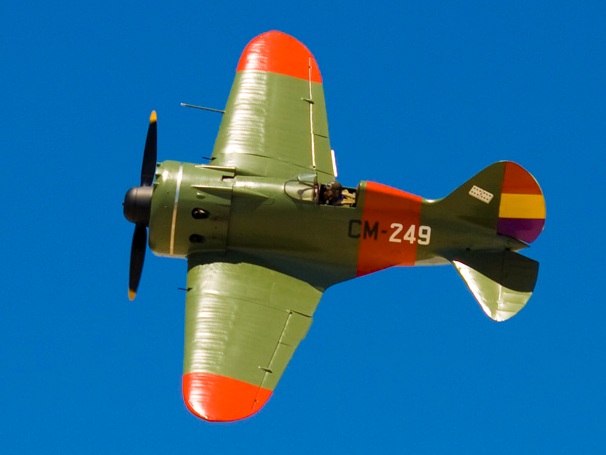
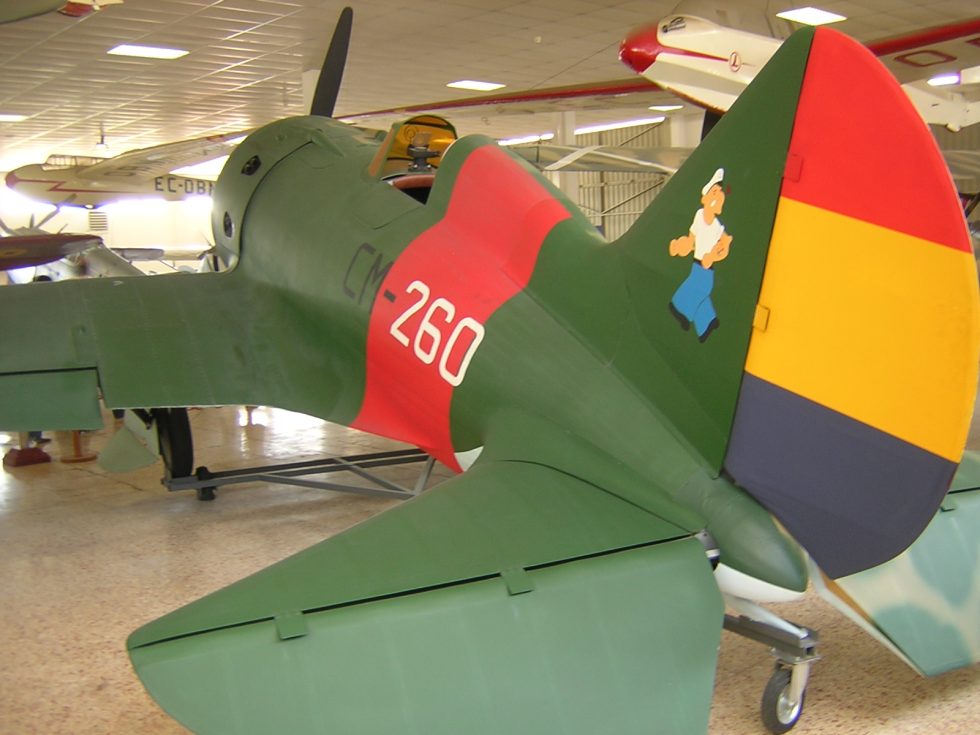
The I-16 in pictures
The I-16 in motion
A verified documentary feature for the I-16 is still being sourced — video coming soon. In the meantime, explore the photo gallery and stories above.
Where the I-16 flew
The score that defines it
The I-16 was a first-generation monoplane thrown into a decade of war — Spain, China, Mongolia and the Eastern Front. Its record is one of pioneering firsts and stubborn endurance rather than a tidy kill tally: it dominated the biplanes it first met, pioneered the air-to-air rocket, and fought on long after newer fighters had passed it by.
Compare the combat record of every military aircraft. Figures are commonly cited estimates.
Everything people ask about the I-16
Can I fly in an I-16?
Was the I-16 really the first of its kind?
Why was the I-16 so hard to fly?
Where does the nickname “Ishak” come from?
Did the I-16 really fire the first air-to-air rockets?
How did the I-16 compare to the Messerschmitt Bf 109?
How many I-16s were built?
Which countries operated the I-16?
You can’t fly the I-16.
These, you can.
Some legends only live in museums — others are fuelled and waiting. MiGFlug has put civilians in real military jet cockpits since 2004.
 Fly the L-39 AlbatrosThe world’s most-flown jet trainer — aerobatics included
 Fly the F-104 Starfighter“The missile with a man in it”
 Fly the MiG-21The Cold War’s most-produced jet
 Fly the T-33 Shooting StarAmerica’s first jet trainer
 Fly the DH VampireA piece of early jet history
 Fly the S.211Agile Italian jet trainer
 Fly the MB-326The classic Aermacchi jet
 Fly the MiG-15The Soviet legend of the Korean War
Continue the tour
Every fact, checked
- History of War — Polikarpov I-16Development, variant table, and combat numbers for Spain, China, Khalkhin Gol and Barbarossa.
- Naval Encyclopedia — Polikarpov I-16Design significance, handling and the “Ishak” nickname, plus naval-aviation service and operators.
- Military Aviation MuseumPolikarpov’s imprisonment, the “first monoplane with retractable gear” claim, and restoration history.
- Warbirds Resource GroupFirst-flight chronology, Chkalov’s spin testing, and Spain and China delivery figures.
- Liquisearch — I-16 Type 24 specificationsDimensions, weights, M-63 power, speed, ceiling, range and armament data.
- Vintage Aviation NewsThe Alpine Fighter Collection remanufacture of I-16s from Karelian wrecks and today’s flying examples.
- Iron Dice — The Little Ishak That CouldNickname origins, 1941 front-line strength, and turn-fighting tactics against the Bf 109.
- gw2ru — Donkey, Rat and FlyThe nicknames and the aircraft’s twitchy handling character.