
Sopwith Triplane
The single-seat scout with three narrow wings that out-climbed everything over the Western Front in 1917 — and frightened the German air service into building triplanes of its own.
The Sopwith Triplane's story: how three narrow wings won the sky over Flanders
For a few violent months in the spring and summer of 1917, the fastest-climbing, best-visibility fighter over the Western Front was not a biplane at all. It was the Sopwith Triplane — the "Tripehound" — a compact scout that stacked three slim wings where its rivals used two, and used them to climb away from trouble that no German pilot could follow.
The Triplane was the work of Herbert Smith, chief designer at the Sopwith Aviation Company in Kingston upon Thames. Sopwith already had a winner in the little Pup, a delightful biplane scout that was beautifully balanced but modestly powered. Smith's question was simple: how do you give a fighter far more lift and a far better rate of climb without making it big, heavy and slow? His answer was to take the Pup's philosophy of lightness and add a third wing.
Three wings meant a large total lifting area packed into a very short span. Because each wing could be made narrow — short from front to back, what engineers call narrow-chord — the whole aircraft stayed small and light, yet it generated the lift of a much larger machine. The narrow wings did something else that mattered enormously in a dogfight: they got out of the pilot's way. Sitting between the upper and middle wings, a Triplane pilot could see over the top surface and under the lower one, with far less structure blocking the sky than in a broad-winged biplane. In a war where the pilot who saw first usually shot first, that was a gift.
There was nothing inevitable about the shape. Rival designers were experimenting with everything from pusher fighters to gun-toting two-seaters, and the biplane was the settled orthodoxy of 1916. Smith's triplane was a considered gamble: he was betting that low wing loading and a clear field of view would beat the extra drag of a third wing and its rigging. For a crucial window in 1917, before engine power grew enough to make the biplane the better bet again, that gamble paid off spectacularly.
The prototype, serial N500, first flew on 28 May 1916 and was in France with the Royal Naval Air Service within weeks of testing — an almost unheard-of pace. Pilots were astonished. The Triplane could reach 10,000 feet in about half the time of the fighters around it and could out-turn almost anything. Reports came back describing a machine that felt light, quick and obedient, one that a good pilot could throw about the sky with a confidence the heavier German scouts did not allow. Word travelled fast, and squadrons clamoured for the type.
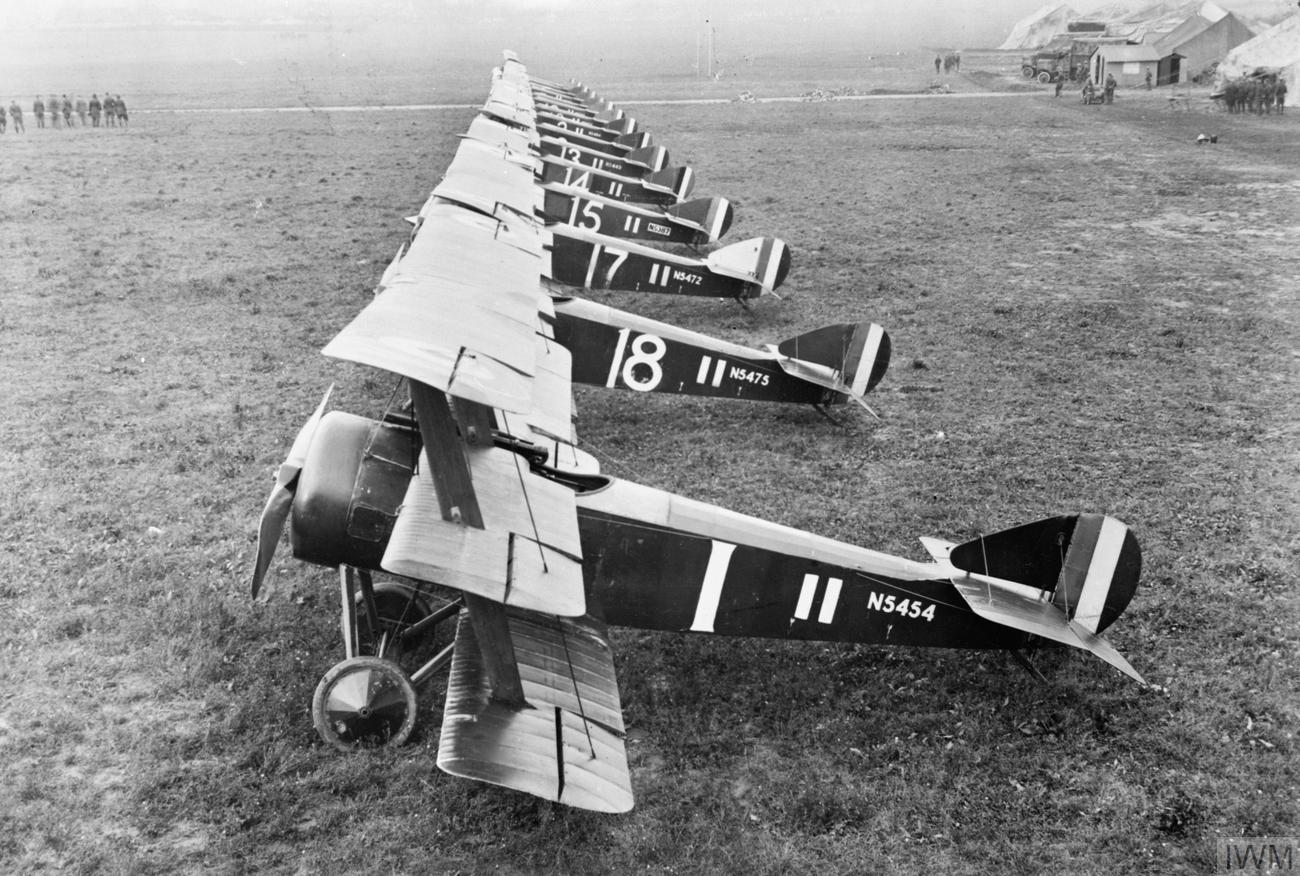
When production machines reached the RNAS naval squadrons in northern France and Flanders in early 1917, they arrived at exactly the moment the Royal Flying Corps was suffering its worst mauling of the war, the losses of "Bloody April". Against that backdrop the Triplane looked like a revelation: here, at last, was an Allied fighter that could meet the feared Albatros scouts on better than equal terms. The naval squadrons — "Naval One", "Naval Eight", "Naval Nine" and "Naval Ten" — became the type's showcase, and their pilots its legend.
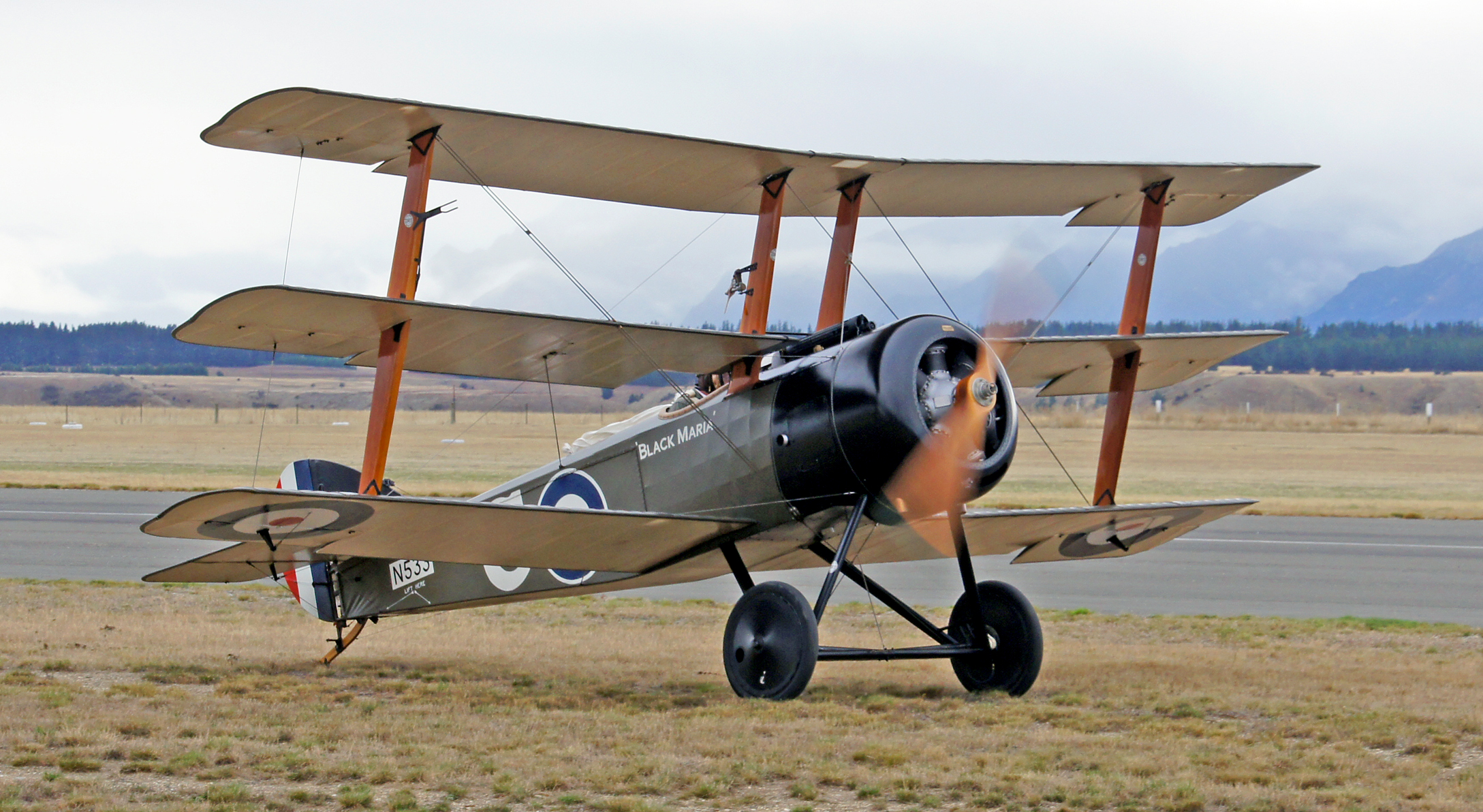
The most famous of them all was "B" Flight of No. 10 (Naval) Squadron, the all-Canadian "Black Flight" led by Raymond Collishaw. Flying Triplanes with black-painted cowlings and names like Black Maria and Black Prince, the flight ran up an astonishing tally — on the order of 87 enemy aircraft claimed in the space of a few summer months — while losing remarkably few of its own. Collishaw would end the war as one of the highest-scoring fighter pilots of the entire British Empire, and the Triplane made his early reputation.
And yet the Triplane's front-line career was startlingly short. It was built in small numbers — only around 147 machines, though sources differ slightly — and the Royal Flying Corps traded away its share of the order so that Sopwith and its sub-contractors could concentrate on the S.E.5 and the French SPAD. The three-wing layout, so brilliant in the air, made some servicing awkward on the ground: the fuel and oil tanks were buried in the fuselage and the extra wing and its bracing added structure to inspect and rig. Before 1917 was out, a new Sopwith — the Camel — was replacing the Triplane in the very squadrons that had made it famous. The Tripehound blazed, and then it was gone.
Its deepest mark was not the number of enemy aircraft it shot down but the alarm it caused. German and Austro-Hungarian designers, unnerved by a fighter that could climb out of reach, launched a whole wave of triplane prototypes in response — and the most famous of them, Anthony Fokker and Reinhold Platz's Fokker Dr.I, owed its very existence to the Sopwith. The scarlet triplane that Manfred von Richthofen made immortal was, in a real sense, the Sopwith Triplane's grandchild. Few aircraft with so brief a career have cast so long a shadow.
01Why the Sopwith Triplane had three wings: lift, climb and the view from the cockpit
+
The physics is less exotic than the silhouette suggests. Lift depends on wing area; manoeuvrability and light weight favour a short span; and a short, deep single wing that generated enough area would have been thick, heavy and draggy. By splitting the lifting surface into three narrow-chord planes stacked vertically, Herbert Smith packed a large total area into a span of only about 26 feet 6 inches. The result was a wing loading low enough to give an exceptional rate of climb and a very tight turning circle.
The narrow chord of each wing — roughly a metre from leading to trailing edge — is the detail that made the layout work rather than merely look strange. Narrow wings are light, and three of them braced together form a rigid, strong cell. They also open up the pilot's field of view: with slim planes above and below, a Triplane pilot could search the sky through gaps that a fat-winged biplane simply did not have. Combat reports from 1917 repeatedly single out visibility and climb as the type's decisive advantages, and both flow directly from the decision to divide the lift three ways.
The wings also carried ailerons on all three surfaces on production machines, giving a powerful and quick roll response that helped the type reverse a turn faster than its opponents. Combined with the light structure and the eager rotary, this made the Triplane feel nimble in a way that surprised pilots stepping up from heavier machines.
There was a price. Three wings, multiple sets of interplane struts and the associated rigging wires meant more drag than a clean biplane and more structure to maintain. The layout was a specialist's answer to a specific 1916 problem — get a lightly powered scout to climb and turn better than anything else — and it solved that problem superbly before engine power caught up and made the biplane the better all-round bet again.
02Bloody April 1917 and the Sopwith Triplane: the right fighter at the worst moment
+
In April 1917 the Royal Flying Corps lost aircraft and crews at a catastrophic rate as German Albatros scouts dominated the air over the Arras battlefield. Life expectancy for a new RFC pilot at the front fell to a matter of weeks. It is one of the grim ironies of the period that the Allied fighter best able to deal with the Albatros — the Sopwith Triplane — was flown not by the hard-pressed RFC but by the Royal Naval Air Service squadrons lent to the Western Front.
Where Triplanes met Albatros scouts, the results were often lopsided in the Triplane's favour. A Triplane pilot who did not like the odds could simply climb away, reposition, and dive back into the fight on his own terms. That single tactical freedom — the ability to choose whether to fight — is worth more in air combat than almost any other quality, and the Triplane had it in abundance.
German pilots recorded a real reluctance to mix with the type on equal terms, and some units were warned to avoid it when it held a height advantage. The Triplane did not win Bloody April on its own — it was never numerous enough for that, and the tide only truly turned as newer Allied types arrived in quantity — but it proved, unmistakably, that the German ascendancy of early 1917 could be broken by the right aeroplane. For morale as much as for kills, that mattered.
03The Sopwith Triplane and the "triplane craze": how it fathered the Fokker Dr.I
+
The Sopwith Triplane's most lasting legacy is written in the enemy's aircraft, not its own. So striking was the type's climb and agility that the German air service concluded it needed a triplane of its own. Captured and studied examples confirmed the impression the type had made in combat, and over 1917 German and Austro-Hungarian firms produced a rush of experimental triplane fighters — a genuine craze — most of which came to nothing.
The exception was decisive. At Fokker, the designer Reinhold Platz worked up a compact triplane fighter, and Anthony Fokker pushed it hard; leading German pilots, Manfred von Richthofen among them, championed the concept after seeing what a triplane could do. The result was the Fokker Dr.I, the aircraft now inseparable from the "Red Baron" legend. It shared the Sopwith's core idea — a small, light, hard-climbing triplane scout — even as its structure and cantilever-style wing were quite different.
It is fair, and honest, to say that without the Sopwith Triplane there would very probably have been no Fokker triplane. The Tripehound's influence on aircraft design outran its own brief combat career many times over. That a British fighter's greatest monument should be its most famous German opponent is one of the more elegant ironies in the history of air power.
04The Sopwith Triplane's squadrons: the RNAS "Naval" units that made it famous
+
The Triplane belonged above all to the Royal Naval Air Service. In early 1917 several RNAS squadrons were operating from airfields in northern France and Flanders in support of the Royal Flying Corps, and it was these naval units — not the RFC — that received the bulk of the type. Numbers 1, 8, 9 and 10 (Naval) Squadrons became the Triplane's home, and their informal names — "Naval One", "Naval Eight", "Naval Nine", "Naval Ten" — are woven through the type's story.
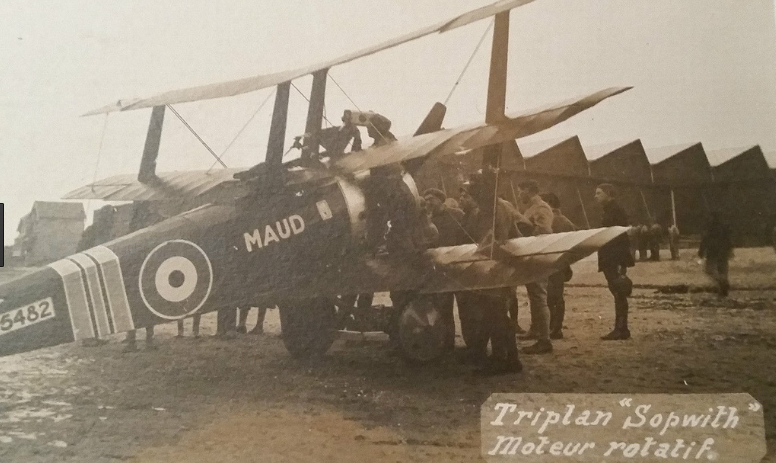
No. 8 (Naval) Squadron, "Naval Eight", was among the first to prove the type in combat and produced several of its leading aces. No. 10 (Naval) Squadron gave the world the "Black Flight". No. 1 and No. 9 added their own tallies over the Ypres and coastal sectors. Individual aircraft carried names painted on their cowlings — "Maud", "Blymp", "Black Maria" — a very naval habit that has helped later historians trace particular machines and their pilots.
Because the RNAS controlled its own procurement, it could equip its squadrons with the Triplane quickly and in concentration, which is precisely why the type made such an outsized impression despite its small production run. When the naval squadrons converted to the Camel later in 1917, the Triplane's front-line story effectively ended with them.
05The Sopwith Triplane's aces: Collishaw, Little and the men who scored on the Tripehound
+
The Triplane's reputation rests heavily on the pilots who flew it. Raymond Collishaw, the Canadian who led No. 10 (Naval) Squadron's Black Flight, is the name most associated with the type; under his leadership the flight claimed on the order of 87 enemy aircraft in May to July 1917, and Collishaw finished the war as one of the top-scoring Commonwealth aces of all.
He was far from alone. The Australian Robert Little, the highest-scoring Australian ace of the First World War, flew Triplanes with "Naval Eight" and added a substantial part of his score on the type before moving to the Camel. Roderic "Stan" Dallas, another Australian and one of the RNAS's most respected fighter leaders, was closely linked with the Triplane and helped develop the tactics that made it so effective. Charles Dawson Booker of "Naval Eight" flew the named Triplane "Maud" with distinction.
What these men had in common was an understanding of how to use the Triplane's strengths: climb for height, keep the energy advantage, and fight in the vertical where the type's rate of climb and quick roll told most heavily. In their hands a lightly armed scout with a single machine gun became one of the most feared Allied fighters of its brief moment.
How the Sopwith Triplane was built: three wings, a rotary heart and one gun
Three narrow-chord wings
A large total lifting area in a span of only about 8.1 metres, giving a low wing loading, a superb rate of climb and a tight turn — with slim planes that left the pilot an unusually clear view of the sky, and ailerons on all three wings for a quick roll.
Clerget rotary engine
Most Triplanes used a 130 hp Clerget 9B nine-cylinder rotary; some flew behind the 110 hp Clerget 9Z, and a handful trialled other rotaries. The whole engine spun with the propeller — light, powerful for its day, and thirsty on castor oil.
A single Vickers gun
Standard armament was one synchronised .303 in Vickers machine gun firing through the propeller arc. A small number of aircraft were fitted experimentally with twin Vickers, but the single gun was the norm — firepower deliberately traded for climb.
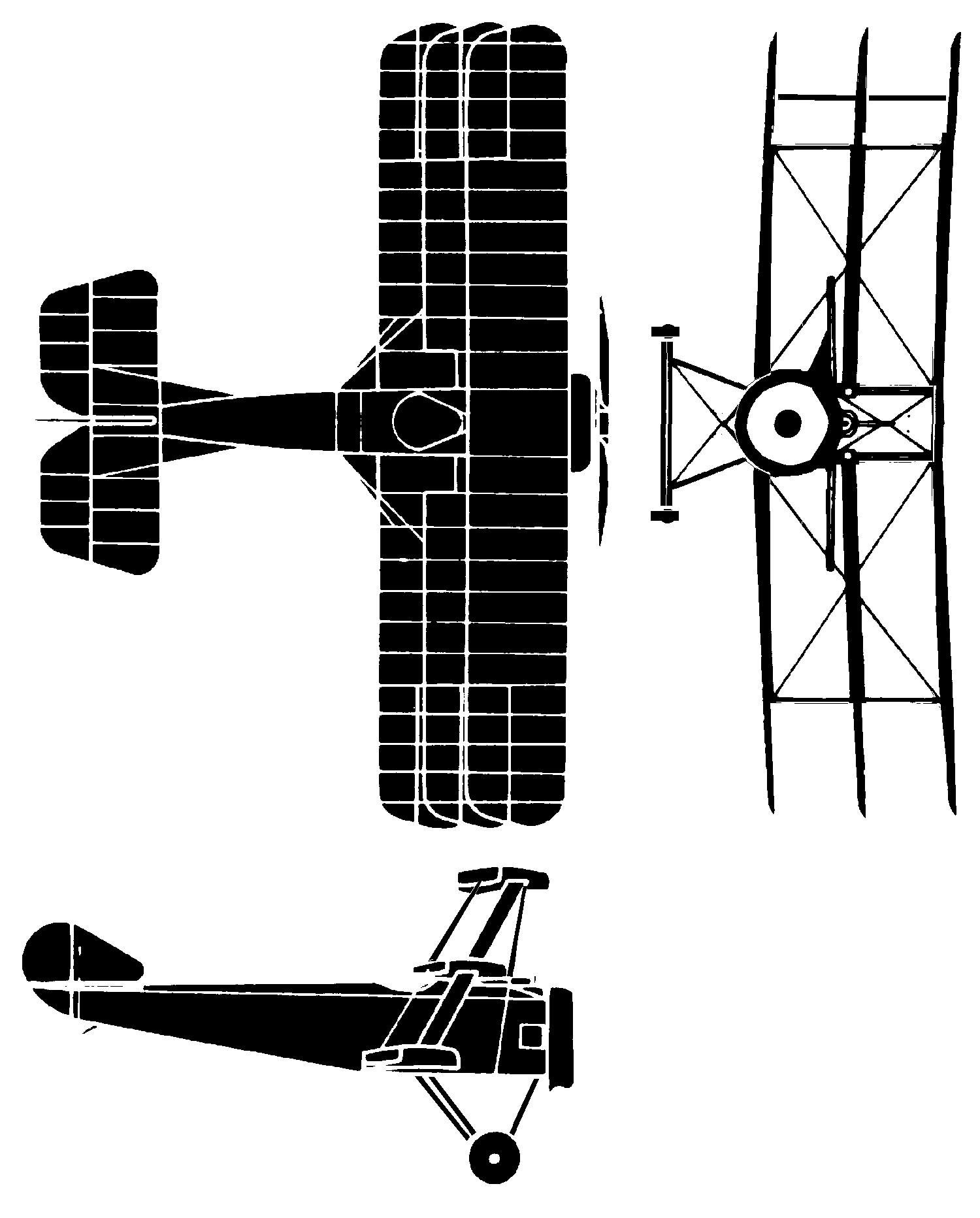
Structurally the Triplane was a conventional wood-and-fabric aircraft of its day, built around a wire-braced wooden fuselage with a fabric covering over most of the airframe and metal panels around the engine. What set it apart was the wing cell: three narrow wings, braced by single-bay interplane struts and flying wires into a light but rigid box that could take the loads of hard manoeuvring. The tailplane was adjustable in flight on many machines, letting the pilot trim out changes in speed and load — a refined touch for 1917.
06The Sopwith Triplane's Clerget rotary: power, castor oil and the smell of the front
+
The rotary engine defined the Triplane's character. In a rotary, the crankshaft is fixed and the entire cylinder block — and the propeller bolted to it — spins around it. That spinning mass is beautifully smooth and self-cooling, which is why rotaries powered so many nimble First World War scouts, but it also produces a strong gyroscopic effect that a pilot has to fly around, tightening turns in one direction and slowing them in the other.
The 130 hp Clerget 9B was a nine-cylinder rotary that burned a total-loss lubrication system fed on castor oil, some of which was flung out with the exhaust; the smell and the fine oil mist were part of every rotary pilot's day, and the mild laxative effect of inhaled castor oil was a running joke among aircrew. Engine control was cruder than a modern throttle — pilots managed power with fuel and air mixture levers and a "blip" switch that momentarily cut the ignition — and a Triplane approaching to land would often be heard blipping its engine on and off as the pilot managed his descent.
Rotaries had hard limits. They could not be throttled smoothly, they consumed oil at a prodigious rate, and their power did not grow easily; as the war went on and opponents fielded more powerful in-line and V-type engines, the rotary scout's days were numbered. But in 1917, on a light airframe like the Triplane's, the eager, free-revving Clerget was exactly the right heart for the job.
07Flying the Sopwith Triplane: climb, visibility and the handling that made aces
+
Pilots' accounts agree on the essentials. The Triplane climbed superbly, could hold a tighter turn than the German scouts it met, and gave a field of view that flattered a good lookout. It was, by the standards of 1917, a pleasant and responsive machine to fly — light on the controls and quick to answer, with a roll rate that let a skilled pilot flick from one turn into the opposite direction faster than an opponent could follow.
It was not without vices. Like all rotary scouts it demanded respect in the stall and the spin, and the gyroscopic pull of the engine had to be managed, especially in tight turns close to the ground. Structurally the type earned a reputation, largely from later hard use and a few in-service failures, for needing careful rigging and maintenance of its multi-wing cell; there were cautionary notes about pulling too hard in a dive.
But in the hands of the RNAS naval-squadron pilots who mattered — men like Raymond Collishaw and Robert Little — the Triplane was a match-winner, and the scores they ran up on it in mid-1917 speak for themselves. Modern display pilots who fly the surviving airworthy reproductions describe much the same character: light, agile, eager to climb, and endlessly rewarding to fly well.
08One gun or two? The Sopwith Triplane's armament and the climb it protected
+
The Triplane's armament looks meagre beside the twin-gun fighters that followed it: a single synchronised .303 in Vickers machine gun, firing forward through the propeller arc by means of an interrupter gear that timed the shots to miss the blades. In an era when the Albatros scouts opposite carried two guns, one gun was a real limitation on hitting power.
It was a deliberate choice. Every pound of gun, ammunition and mounting is a pound that eats into climb and manoeuvrability, and the Triplane's whole reason for existing was to out-climb and out-turn the enemy. Herbert Smith and the RNAS judged that the type's performance edge was worth more than a second gun, and for its brief heyday they were probably right.
Experiments were made. A number of Triplanes were fitted with twin Vickers guns to test heavier firepower, but the extra weight blunted the very climb performance that made the type worth flying, and the single gun remained standard. The lesson was absorbed into the design of the Sopwith Camel, which mounted two guns from the start and accepted a heavier, less climb-focused airframe to carry them.
09Wood, wire and fabric: how the Sopwith Triplane's airframe was put together
+
Like almost every fighter of its generation, the Triplane was built from wood, wire and fabric. The fuselage was a wire-braced wooden box girder, faired to a rounded section and covered mostly in doped fabric, with detachable metal or plywood panels around the engine bay for access. It was light, repairable in the field, and cheap in materials if not in skilled labour.
The wing cell was the clever part. Three narrow wooden wings, each built around spars and ribs and covered in fabric, were joined by interplane struts and tensioned by flying and landing wires into a rigid unit. Rigging that cell correctly — getting every wire to the right tension so the wings sat true — was a skilled and time-consuming job, and it is one of the practical reasons the type was more demanding to maintain than a simple biplane.
The buried tanks compounded the problem. With fuel and oil carried inside the fuselage rather than in easily accessed external tanks, some servicing tasks meant working around structure and plumbing that a two-wing scout did not have. None of this mattered in the air, where the Triplane was a delight; all of it mattered in a busy front-line hangar trying to turn aircraft around quickly, and it counted against the type when the decision came to standardise on other fighters.
Sopwith Triplane specifications: dimensions, performance and cost
Baseline note: the figures describe the production Triplane with the 130 hp Clerget 9B, the engine of the overwhelming majority of the 147 aircraft built, as tabulated by Bruce in British Aeroplanes 1914–18 and in Profile 73. Deltas for the 110 hp Clerget 9Z of the first prototype N500 and for the single 110 hp Le Rhône 9J trial installation are in grey. Climb is given as time to a stated height and endurance in place of range, as period practice required; unusually for a 1917 type, the maximum speed here does carry a stated altitude.
Dimensions & weights
- Crew
- 1
- Length
- 5.74 m (18 ft 10 in)
- Wingspan
- 8.08 m (26 ft 6 in) — exactly the same span as the Pup, which is the clue to what Sopwith was doing
- Height
- 3.20 m (10 ft 6 in), a foot and a bit taller than the Pup
- Wing area
- 21.46 m² (231 sq ft) — only 21 sq ft less than the Pup, spread over three planes instead of two
- Wing cellule
- Three narrow-chord planes of equal span, ailerons on all three, and a single broad-chord interplane strut per side running the full height of the cellule. The strut was unique to the Triplane and is the reason the aeroplane looks the way it does.
- Tailplane
- Variable-incidence, adjustable in flight so the aircraft could be trimmed to fly hands-off. A smaller 2.44 m (8 ft) span tailplane was introduced in February 1917 for better elevator response; squadrons were slow to fit it, probably because kits were short.
- Structure
- Wooden framework, fabric covering, fuselage and empennage substantially those of the Pup
- Empty weight
- 499 kg (1,101 lb)
- Loaded weight
- 699 kg (1,541 lb)
- Wing loading at loaded weight
- 29.9 kg/m² (6.13 lb/sq ft) — higher than the Pup's 4.8, and still very low by any later standard
- Production
- 147 completed — 95 ordered from Sopwith on two Admiralty contracts, 46 from Clayton & Shuttleworth, and 25 from Oakley & Co., of which Oakley delivered three before cancellation in October 1917
- Orders not fulfilled
- A War Office contract with Clayton & Shuttleworth for 106 Triplanes for the RFC was traded away in February 1917 for the Admiralty's SPAD S.VII contracts and then simply cancelled rather than transferred, for reasons nobody has established
Performance
- Maximum speed
- 188 km/h (117 mph) at 1,525 m (5,000 ft) — an altitude is stated, which is rarer than it should be for aircraft of this period
- Time to 1,830 m
- 5 minutes 50 seconds (to 6,000 ft)
- Time to 5,000 m
- 26 minutes 30 seconds (to 16,400 ft)
- Service ceiling
- 6,250 m (20,500 ft)
- Endurance
- 2 hours 45 minutes
- Still-air range
- 517 km (321 miles), derived from endurance rather than flown
- Rate of climb and ceiling in combat
- The margin over the Albatros D.III in climb and ceiling was marked, and it was the first thing German pilots reported. In April 1917 Manfred von Richthofen called the Triplane the best Allied fighter then flying.
- Dive
- Slower than the Albatros D.III. A German pilot who could not climb with a Triplane could usually leave one by diving, and that is how most of them survived the encounter.
- Roll and control
- Ailerons on three planes gave a rate of roll that startled observers on both sides; one described a rolling Triplane as looking like "a drunken flight of steps". Controls were light and well harmonised.
- First flight behaviour
- Harry Hawker looped N500 three times in succession within three minutes of leaving the ground on 28 May 1916, which tells you what the test pilot thought of it
- Structural limit
- Wings collapsed in steep dives on some aircraft, traced to light-gauge bracing wires in the 46 Clayton & Shuttleworth machines. Pilots of 10 Naval rigged extra cables themselves; the RAF ordered a spanwise compression strut between the inboard cabane struts in 1918. Bruce argued the reputation was never substantiated.
Propulsion & systems
- Engine
- One 130 hp (97 kW) Clerget 9B nine-cylinder air-cooled rotary designed by Pierre Clerget, built in France by Clerget-Blin and in Britain by Gwynnes and Ruston Proctor
- Engine dimensions
- Bore 120 mm (4.72 in), stroke 160 mm (6.30 in), capacity 16.29 l (994 cu in), compression 4.56:1
- Rated power
- 130 hp at 1,250 rpm
- Engine weight
- 173 kg (381 lb), diameter 102 cm (40.15 in)
- Fuel and lubrication
- Bloctube carburettor; petrol mixed with castor oil on a total-loss system, consumed at roughly 0.09 pints per horsepower-hour
- Alternative engines
- 110 hp (82 kW) Clerget 9Z on the first prototype N500 and early aircraft; one Triplane was flown with a 110 hp Le Rhône 9J, which gave a slightly better climb and nothing else worth the disruption
- Propeller
- Two-blade fixed-pitch wood
- Gun synchronisation gear
- Sopwith-Kauper mechanical gear, the same tension-actuated cam-and-pushrod system used on the Pup and early Camels, of which 2,750 were installed before the hydraulic Constantinesco-Colley gear replaced it as the British standard from November 1917
- Maintainability
- Poor, and it shortened the type's life. The fuel and oil tanks could not be reached without dismantling the wings and fuselage, so even minor work went back to a rear-echelon repair depot instead of being done on the squadron.
- Spares and engine supply
- Spare parts became hard to get during the summer of 1917, and No. 1 Naval Squadron's establishment was cut from 18 aircraft to 15 as a result. Clerget supply was a constant British problem throughout 1917.
- Pilot equipment
- None beyond the basic instruments: no oxygen, no heating and no radio, in an aeroplane whose whole advantage lay above 16,000 ft
Period figures for First World War aircraft vary between sources and between individual airframes and engine fits; the values above are representative and rounded, and contested figures are flagged as estimates. Speed, ceiling and weights differed with the engine installed (130 hp Clerget 9B, 110 hp Clerget 9Z or other rotaries) and with operational loading. The rate of climb, rather than top speed, was the Triplane's stand-out figure and the quality most praised in service.
10Sopwith Triplane variants and engines: 9B, 9Z and the twin-gun experiments
+
The Triplane was not a heavily sub-divided type — its production run was too short for that — but there was meaningful variation. Most aircraft flew behind the 130 hp Clerget 9B; a number used the 110 hp Clerget 9Z, and small numbers or prototypes trialled other rotaries of differing rating. The prototype N500 was followed by further development machines that tested engine and armament options.
Production was spread across Sopwith itself and sub-contractors including Clayton & Shuttleworth and Oakley & Co., which introduced minor differences between batches in fittings and detail. This dispersal of manufacture was normal wartime practice, letting a small design office get its aircraft built in quantity, but it also means surviving records of exact numbers and standards vary a little from source to source.
Armament was the other axis of experiment. The standard fit was a single synchronised Vickers gun, chosen deliberately to keep weight down and climb up. A handful of aircraft were fitted with two Vickers guns to test heavier firepower, but the extra weight blunted the very climb performance that made the Triplane worth flying, and the single gun remained standard. A separate, much larger long-range triplane, the Sopwith L.R.T.Tr., was an unrelated experimental machine and never entered service; it should not be confused with the fighter.
11The Sopwith Triplane's cost: what a 1917 scout was worth — and what a replica costs today
+
Honest answer first: the unit cost of a Sopwith Triplane in 1917 is not reliably recorded in a form worth quoting to the pound. Wartime aircraft procurement mixed government-furnished engines and instruments with airframe contracts spread across Sopwith and its sub-contractors, and the figures that survive are inconsistent and hard to compare with modern money. Anyone quoting a precise 1917 price for a Triplane is guessing; we would rather flag the gap than invent a number.
For context, a First World War single-seat scout of this class represented a serious but not extravagant investment by the standards of the day — the engine was often the single most valuable component, which is one reason engines were carefully salvaged and reused. But turning that into a defensible unit price, or a "cost per flight hour", for a 1917 rotary fighter is simply not something the surviving records support, and we will not pretend otherwise.
What we can say, clearly flagged as a modern estimate, is that building a faithful airworthy Sopwith Triplane reproduction today — a hand-built wooden airframe, a rebuilt or reproduction rotary engine, and the skilled labour of a specialist workshop — runs comfortably into the hundreds of thousands of pounds, and can approach seven figures for a museum-quality machine. That, rather than any 1917 invoice, is the meaningful "cost" figure for a Triplane in the twenty-first century.
12Sopwith Triplane versus the Albatros: how the Tripehound beat Germany's best
+
The Triplane's opponent, for most of its front-line life, was the German Albatros scout — the D.II and D.III of early 1917 and, later, the D.V. On paper the Albatros looked the stronger fighter: it carried two machine guns to the Triplane's one, and its powerful in-line engine gave it a fine turn of speed, especially in a dive.
In the climb and the turn, though, the Triplane held the advantage. Its low wing loading let it out-climb the Albatros and reach a fight from above, and its quick roll and tight turn let it stay inside the German scout in a dogfight. The Albatros pilot's best answer was to use his speed and dive away, then zoom back up — but a Triplane that kept its height and energy could refuse that game and keep the initiative.
The upshot was a genuine rock-paper-scissors of 1917 air combat: the Albatros hit harder and dived faster, but the Triplane climbed and turned better and saw the enemy first. Handled well, the Triplane won more of these encounters than it lost, which is exactly why the German response was not to dismiss it but to build triplanes of their own. When the Camel and S.E.5a arrived with two guns and better all-round performance, the specialist Triplane had done its job and could be retired.
Armament & payload
The Triplane flew like nothing else at the front and shot like a 1916 aeroplane
One synchronised Vickers. That was the standard armament of the aeroplane that Richthofen called the best Allied fighter of the spring of 1917, and it was already a mark behind: the Albatros D.III and D.V it was fighting carried two. Sopwith and Clayton & Shuttleworth both tried to fix it, and the six twin-gun Triplanes that reached the front in July 1917 confirmed what everyone feared, which is that the airframe had no performance to spare. The Triplane's brief and brilliant career is a demonstration that in 1917 you could still win with manoeuvre, and that you could not win with manoeuvre for long. A handful of aircraft carried two guns; a very few naval machines carried non-standard fits. Everything else in this section describes one gun.
Gun
- One .303 in (7.7 mm) Vickers machine gun, belt-fed, mounted centrally in front of the cockpit on the fuselage decking and firing through the propeller disc.
- The prototype N500 flew unarmed and was fitted with its Vickers afterwards, before being sent to Dunkirk in July 1916 — where it went into action against enemy aircraft within fifteen minutes of arriving.
- Fixed gun, no deflection sighting aid: the pilot aimed the aeroplane, and the Triplane was a very good aeroplane to aim.
- The single gun is listed by Franks among the principal reasons the type was withdrawn, alongside its repairability. It is not a small point — a Triplane pilot who caught a D.III often could not finish it.
Ammunition and sights
- One belt of .303 in ammunition, fed from a box in the fuselage. As with the Pup, period tables for the Triplane rarely record the round count and this page will not invent one.
- Ring-and-bead sighting, with an Aldis tubular telescopic sight on many aircraft. The narrow chord of the three wings gave the pilot an unusually clear field of view to sight through, which was one of the design's stated aims.
- No gun heating. At the Triplane's best fighting height a Vickers could and did freeze.
- Stoppage clearance was by hand, in the slipstream, with the gun immediately in front of the pilot — the one thing the fuselage-decking mounting was genuinely good for.
Synchronisation gear
- Sopwith-Kauper mechanical gear, standard on the Triplane exactly as on the Pup.
- Harry Kauper's improvement over earlier gears was to generate the firing impulse at a low point on the cam, so the pushrod worked in tension and could be made lighter and quicker; early versions gave two firing impulses per cam revolution.
- A single lever engaged the gear and fired the gun in one action, instead of the two-stage arrangement of earlier gears — a real improvement in a fight.
- It wore. By late 1917 the gears were "running away" and shooting through propellers, and the hydraulic Constantinesco-Colley gear became the British standard. The Triplane was gone from the front before that mattered much to it.
The twin-gun Triplanes
- Clayton & Shuttleworth built six experimental Triplanes with two synchronised Vickers guns.
- Some of these flew in combat with Nos. 1 and 10 Naval Squadrons in July 1917. Performance fell off measurably with the extra weight and drag, and the single gun remained the standard.
- Oakley & Co.'s 25 aircraft were to have been built with twin guns from the start. The engineering change was one of the reasons that contract fell so far behind that only three aircraft were delivered before it was cancelled.
- The honest reading is that the Triplane could not be up-gunned without becoming a worse aeroplane, and that the Camel — two guns, more power, a shorter and much less forgiving airframe — was the answer instead.
Bombs and external stores
- None. The Triplane carried no bombs, no racks and no external stores of any kind in service.
- No Le Prieur rockets, unlike the Pup: the interplane strut arrangement of a triplane cellule is a poor place to hang rocket tubes, and the type was never used for anti-airship work.
- No shipboard fit, no skids, no flotation gear. The Triplane was a land-based fighter operated by naval squadrons, which is a distinction worth keeping straight.
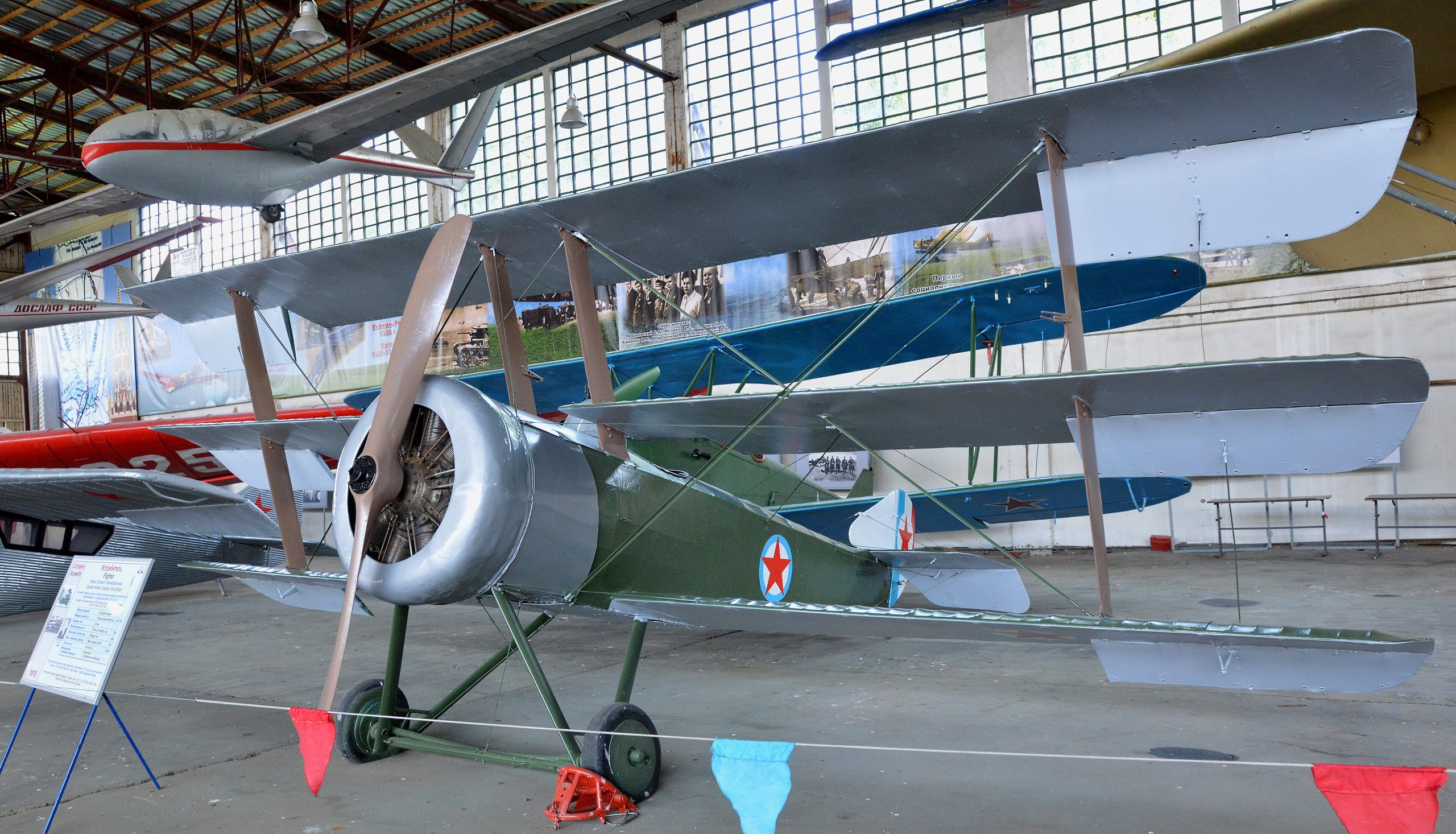
- One aircraft in Russian service was fitted with skis for winter operations — the only significant external modification the type is known to have received.
What it lacked, and what that cost
- No armour, no radio, no oxygen, no heating, no parachute — all normal for a 1917 British fighter, and all relevant to an aeroplane designed to fight above 16,000 ft.
- No second gun as standard, at a moment when every German single-seater it met carried two. The Triplane's answer was to be somewhere the Albatros could not follow, and that answer had a shelf life.
- No practical field repairability: fuel and oil tanks were inaccessible without dismantling the aircraft, so serviceability collapsed as spares dried up in the summer of 1917.
- The Triplane was out of front-line service by December 1917, less than a year after it reached it. Camels replaced it in 4, 8 and 9 Naval between June and August, 10 Naval converted in late August, and only 1 Naval soldiered on to December — reportedly at a cost in casualties.
Three typical loadouts
- Standard offensive patrol, No. 1 Naval Squadron, spring 1917
- One Vickers, one belt, Aldis sight, 2 hours 45 minutes of fuel, and a climb to 16,400 ft in 26 minutes 30 seconds. Nothing else. The fighting plan was to arrive above the enemy formation and stay above it, and against the Albatros D.III that worked.
- Black Flight offensive patrol, "B" Flight 10 Naval Squadron, June–July 1917
- The same single Vickers, flown by five Canadians in aircraft with black-painted cowlings and fins named Black Maria, Black Prince, Black George, Black Death and Black Sheep. The flight claimed 87 German aircraft in three months on the type. Raymond Collishaw scored 34 of his eventual 60 victories on Triplanes, making him the top Triplane ace; Gerald Nash, one of the five, was shot down and taken prisoner in June. Claims of this period were made in good faith and confirmed loosely, and the figure should be read as claims rather than confirmed losses.
- Twin-gun experimental Triplane, Nos. 1 and 10 Naval Squadrons, July 1917
- Two synchronised Vickers on one of the six Clayton & Shuttleworth conversions, with the ammunition and structure to feed them. Combat-flown, measurably slower and slower-climbing, and not adopted. This loadout is the type's epitaph.
Sourcing caveat: the Triplane is better served than most contemporaries because Bruce's figures give an altitude for the maximum speed — 117 mph at 5,000 ft — and stated climb times to two heights, so the numbers above can be compared with other types honestly. They still describe one aircraft on one day: individual Clerget 9Bs varied widely in delivered power, and a squadron machine in July 1917 with a worn engine and improvised bracing wires was not a Martlesham aeroplane. Victory claims for the Black Flight and for Collishaw are claims as recorded by the RNAS, not German loss returns, and the two never match for any unit on either side. The structural-failure story rests on a small number of accidents and Bruce regarded it as unproven.
Variants
The Triplane frightened the Germans into building triplanes, which is its real legacy
Sopwith built the Triplane as a private venture, without an order, on the reasoning that three narrow-chord planes would give a pilot a view a biplane could not and a rate of climb nothing else could match. Both propositions turned out to be true. What nobody planned was the effect on the other side. Multiple Triplanes were captured and taken apart. Richthofen and other senior German officers said openly that it was the best Allied fighter at the front. And on 13 June 1917, returning from a visit to the front line where he had spoken to those pilots, Anthony Fokker instructed Reinhold Platz to abandon the biplane V.4 he was building and make it a triplane.
The V.4 flew about twelve days later. It became the F.I and then the Fokker Dr.I, the aeroplane in which Werner Voss and Manfred von Richthofen were both killed and the most famous triplane in history. It was not alone: the German industry produced no fewer than 34 triplane prototypes in the craze that followed. The causal chain from Sopwith's private venture to the Red Baron's Dr.I is short, documented and direct, and it is the most consequential thing the Triplane ever did — more consequential, in the end, than anything it shot down.
Against that, the type's own service life was eleven months. There is no mark series, because there was no time for one.
- N500, first prototype (May 1916 / 1)
- 110 hp Clerget 9Z, initially unarmed. First flown by Harry Hawker on 28 May 1916 and looped three times within three minutes. Sent to Dunkirk in July 1916 and in action within a quarter of an hour of arrival.
- N504, second prototype (August 1916 / 1)
- Introduced the 130 hp Clerget 9B that became the production standard. Sent to France in December 1916 and used as a conversion trainer by several squadrons.
- Production Triplane, Sopwith-built (1916–17 / 95 ordered)
- The standard aircraft: 130 hp Clerget 9B, one Vickers, variable-incidence tailplane, smaller 8 ft tailplane from February 1917.
- Clayton & Shuttleworth-built (1916–17 / 46)
- First delivery 2 December 1916. These are the aircraft in which light-gauge bracing wires were later blamed for wing failures in steep dives.
- Oakley & Co.-built (1917 / 25 ordered, 3 delivered)
- A firm with no previous aircraft experience, ordered to build twin-gun aircraft. Three were completed before the contract was cancelled in October 1917. One of the three is the aeroplane in the RAF Museum today.
- Twin-gun Triplane (1917 / 6)
- Clayton & Shuttleworth experimental conversions with two synchronised Vickers. Flown in combat by 1 and 10 Naval in July 1917; performance suffered and the single gun stayed standard.
- Le Rhône test aircraft (1917 / 1)
- At least one Triplane was flown with a 110 hp Le Rhône 9J. Slightly better climb, no other gain, not adopted.
- RFC contract (1916–17 / 106 cancelled)
- The War Office ordered 106 Triplanes from Clayton & Shuttleworth for the Royal Flying Corps, then in February 1917 exchanged its Triplane orders for the Admiralty's SPAD S.VII contracts. The RFC never operated the type.
- French naval Triplanes (1917 / 17)
- The only substantial foreign operator: a French Aéronautique navale squadron based at Dunkirk. Effectively the Triplane fought only in French skies, flown by British and French naval pilots.
- Single-aircraft exports (1917 / 3)
- One to Imperial Russia in May 1917, fitted with skis and used operationally before being captured by the Bolsheviks and flown by the Red Air Force; one to Greece; one shipped to the United States for exhibition in December 1917. A single British aircraft went to the Aegean and crashed at Salonika on 26 March 1917.
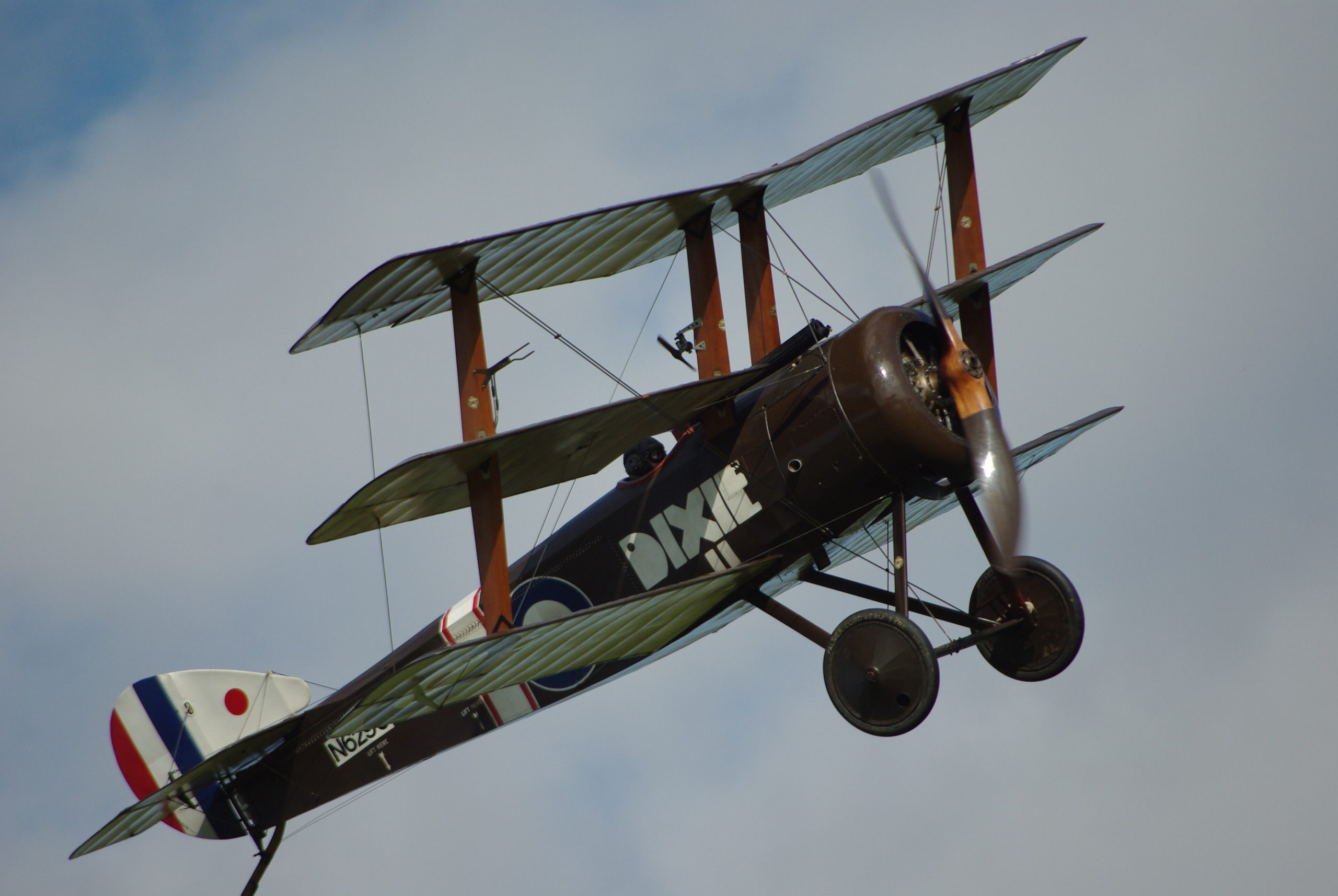
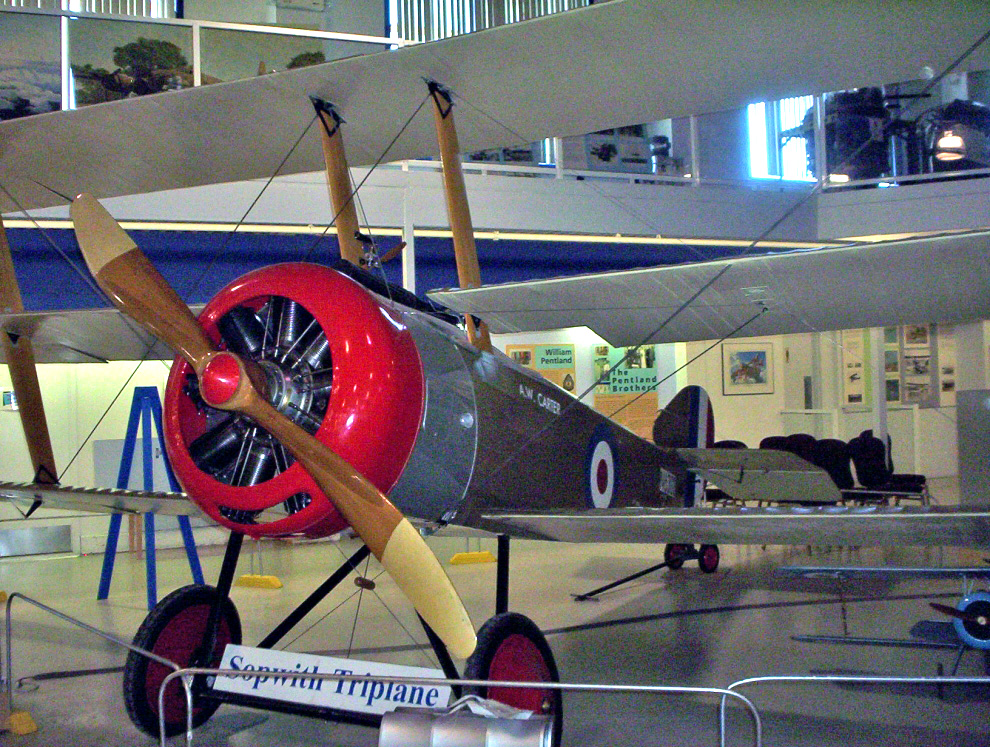
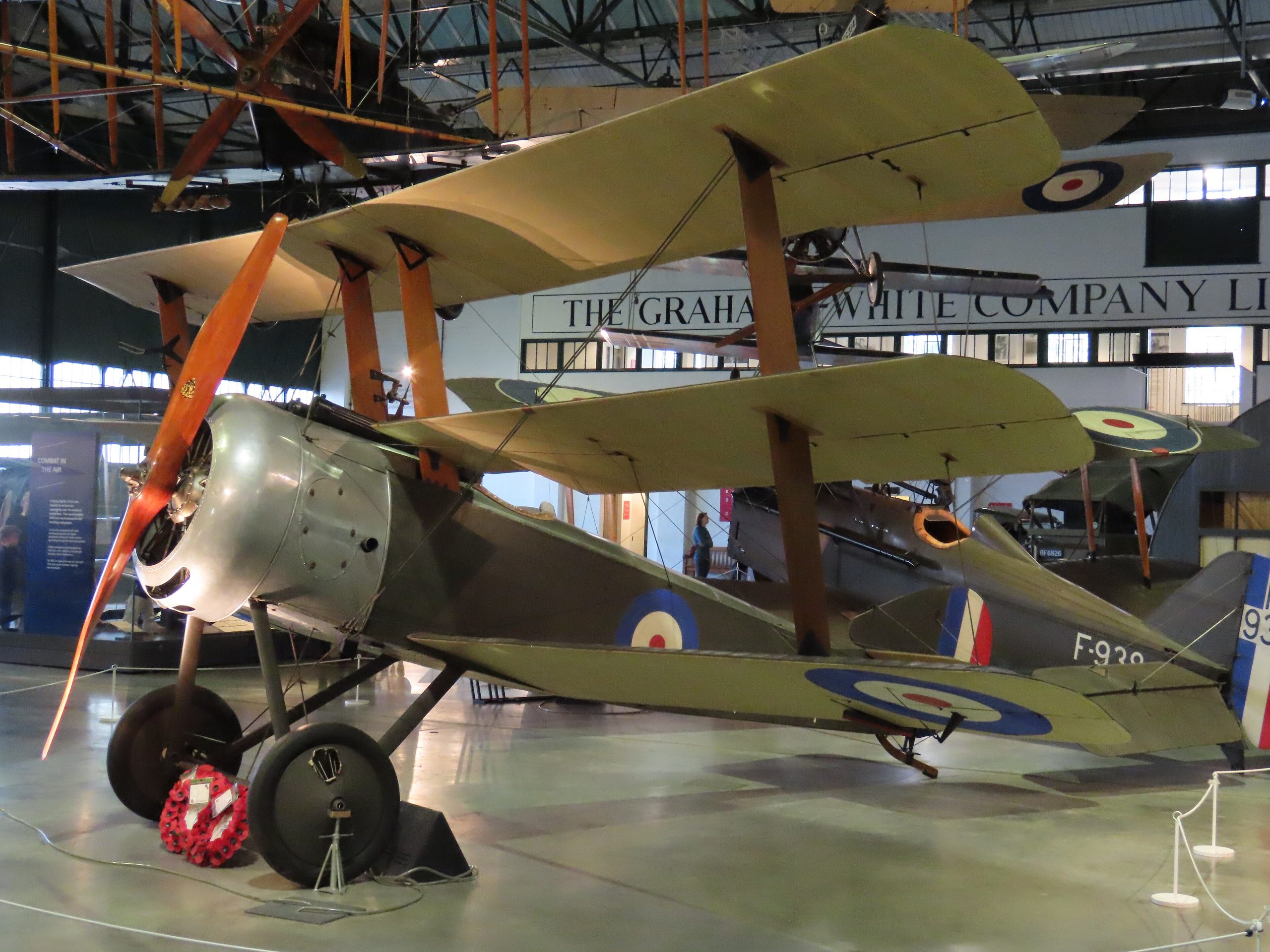
Survivors, stated precisely, because for a type of which 147 were built the distinction is the whole story. Two original Sopwith Triplanes exist. N5912, one of Oakley's three aircraft, delivered late in 1917, never in combat and used by No. 2 School of Aerial Fighting and Gunnery at Marske, is on static display at the Royal Air Force Museum London; it was flown at RAF pageants at Hendon in the late 1930s after restoration. N5486, the aircraft sent to Russia in May 1917, flown on skis, captured by the Bolsheviks and rebuilt many times as a Red Air Force trainer, is on static display at the Central Air Force Museum at Monino outside Moscow. Nothing else is original. The airworthy Triplane at the Shuttleworth Collection, G-BOCK, marked as Dixie II for N6290 of 8 Naval, is a reproduction — a superb one, flying behind an original Clerget 9B, but a reproduction. So are the Great War Display Team aircraft marked N500, the static machines at The Hangar Flight Museum in Calgary and the Canada Aviation and Space Museum in Ottawa, and the aircraft at MAPS Air Museum in Ohio, which was built from original Sopwith drawings by Bill Woodall. No original Sopwith Triplane has flown since the 1930s.
The Sopwith Triplane's timeline: from Kingston prototype to museum survivor
May 1916
The prototype Sopwith Triplane, serial N500, makes its first flight and is sent to the Royal Naval Air Service in France for evaluation within weeks — an astonishingly quick debut that reflects how promising the design looked.
Mid–late 1916
Further development machines test engine and armament options; production orders are placed with Sopwith and sub-contractors such as Clayton & Shuttleworth and Oakley.
Early 1917
Production Triplanes reach the RNAS naval squadrons in France and Flanders. Their rate of climb and visibility make an immediate impression on the Western Front.
April 1917
During "Bloody April", when German Albatros scouts dominate the RFC, RNAS Triplanes prove they can out-climb and out-turn the enemy's best, offering a glimpse of how the balance could be redressed.
May–July 1917
No. 10 (Naval) Squadron's all-Canadian "Black Flight", led by Raymond Collishaw, runs up a remarkable score on Triplanes — some 87 enemy aircraft claimed in a few months — for very light losses.
Mid 1917
Impressed and alarmed, German and Austro-Hungarian firms launch a wave of triplane prototypes. Fokker's response, worked up by Reinhold Platz and backed by leading pilots, becomes the Dr.I.
Late 1917
With production limited to around 147 aircraft and the RFC concentrating on the S.E.5 and SPAD, the new Sopwith Camel replaces the Triplane in front-line service.
1918 onward
Surviving Triplanes serve in training and second-line roles. The type is effectively gone from the front by the war's later stages, its work done.
Post-war
Almost all Triplanes are scrapped. The type becomes rare almost immediately, and within a generation genuine originals can be counted on one hand.
Today
The genuine original N5912 is preserved at the Royal Air Force Museum, and airworthy reproductions fly at Shuttleworth's Old Warden and other collections, keeping the Tripehound in the air for new audiences.
The Sopwith Triplane in service: aces, nicknames and the fight for 1917
"Tripehound" and "Tripe"
Affection and dark humour ran together at the front. Pilots and ground crews shortened "triplane" to "Tripe" and christened the machine the "Tripehound" — a name that has stuck to the type for more than a century and still raises a smile among warbird enthusiasts today.
Collishaw's Black Flight
The most famous Triplane unit was "B" Flight of No. 10 (Naval) Squadron — the all-Canadian "Black Flight", its aircraft marked with black cowlings and named Black Maria, Black Prince, Black Roger, Black Sheep and Black Death. In May–July 1917 it claimed around 87 enemy aircraft for very light losses of its own.
One of the Empire's great aces
Leading Black Flight, the Canadian Raymond Collishaw scored heavily on the Triplane and finished the war as one of the highest-scoring fighter pilots of the entire British Empire. The Triplane made his early reputation and remained the aircraft most associated with his name.
Australia's top scorer
The Australian Robert Little, the highest-scoring Australian ace of the war, flew Sopwith Triplanes with No. 8 (Naval) Squadron and added many of his victories on the type before moving to the Camel. He was a byword for aggressive, close-range shooting.
The thinking fighter leader
Another Australian, Roderic "Stan" Dallas, was one of the RNAS's most respected fighter pilots and tacticians and was closely linked with the Triplane, helping to develop the ways of fighting that made the most of its climb and agility.
No. 8 (Naval) Squadron
Alongside Naval Ten, No. 8 (Naval) Squadron RNAS was a celebrated Triplane unit, its aircraft carrying names like "Maud" and "Blymp". Its pilots helped prove the type over the coastal and Flanders fronts in the crucial months of 1917.
A fighter they respected
German combat reports and memoirs record a marked wariness of the Triplane. A scout that could simply climb out of a fight and return on its own terms was, from the other side of the lines, an unpleasant opponent — and one worth copying.
The triplane craze
The German response was not just tactical but industrial: a rush of experimental triplane fighters from firms across Germany and Austria-Hungary through 1917, as designers scrambled to match the Sopwith's climb. Most of these prototypes led nowhere.
The most famous descendant
Reinhold Platz's Fokker triplane, backed by Anthony Fokker and championed by pilots including Manfred von Richthofen, became the Dr.I — the aircraft forever linked to the Red Baron, and a direct consequence of the Sopwith Triplane's success.
Why the RFC let it go
With production limited and the S.E.5 and SPAD promising better all-round fighters, the Royal Flying Corps traded its Triplane allocation away. The type's future was sacrificed to standardise on more numerous, twin-gun designs.
Awkward to service
The three-wing cell and internally mounted fuel and oil tanks made some maintenance jobs fiddly, and rigging the wings true was a skilled task. What was a gift in the air cost time in the hangar — one more reason the type had a short front-line life.
N500 takes to the air
The prototype, serial N500, first flew and was rushed to the RNAS in France within weeks. Pilots who flew it came back astonished at how quickly it climbed — the whole legend of the type starts here.
"Maud", "Blymp" and the rest
In a very naval habit, individual Triplanes carried names painted on their cowlings — "Maud", "Blymp", "Black Maria". The practice has since helped historians match particular airframes to particular pilots and stories.
Flying at Old Warden
The Shuttleworth Collection keeps an airworthy Sopwith Triplane reproduction flying at Old Warden, where its easy climb and blipping rotary give modern crowds the closest possible sense of what so impressed both sides in 1917.
N5912 endures
Of the ~147 built, essentially one genuine original survives: N5912, preserved at the Royal Air Force Museum. Airworthy reproductions at Shuttleworth and elsewhere keep the type flying, so that new generations can watch a triplane climb.
Sopwith Triplane photographs: period images and preserved aircraft
The Sopwith Triplane in the air: a preserved reproduction flying today
There is no better way to understand the Tripehound than to watch one fly. The footage below shows the Shuttleworth Collection's airworthy Sopwith Triplane reproduction displaying at Old Warden — the stacked wings, the rotary's distinctive blipping note and the type's easy climb all on show. It is the closest most of us will get to seeing exactly what so impressed pilots on both sides in 1917.
Sopwith Triplane flying display at the Shuttleworth Collection, Old Warden. Video by the High Flight channel on YouTube (approx. 3,200 views at time of writing). Shown here for reference; all rights remain with the creator.
Sopwith Triplane operations map: origin, wartime fronts and where it survives
The Sopwith Triplane was a British fighter with a very concentrated story: designed and built in England, fought over the Western Front by the Royal Naval Air Service, studied hard by its enemies, and preserved today in a handful of countries. The map colours Britain as origin and manufacturer, marks the wartime fronts and the countries that received examples, shows where the type's influence and evaluation were felt, and highlights where original and reproduction airframes survive. Toggle the categories and hover a country for detail.
The Sopwith Triplane by the numbers: service, scores and standing
The numbers tell the paradox of the Sopwith Triplane in a single glance. Almost nothing was built, and the type was gone from the front within about a year and a half of its first flight — yet in that brief window it ran up remarkable scores, so unsettled the enemy that it changed the direction of German fighter design, and left behind a single cherished survivor. Few aircraft have achieved so much on so little.
The Sopwith Triplane today: the last original and the reproductions that fly
For an aircraft that so shaped its moment, the Sopwith Triplane very nearly vanished. Almost every one of the ~147 built was scrapped in the years after the war, and the type became one of the rarest of all First World War fighters — a shape everyone recognises from photographs and almost no one has seen in the metal.
The great exception is N5912. Preserved at the Royal Air Force Museum, it is to all intents and purposes the sole surviving genuine Sopwith Triplane — an actual 1917 airframe rather than a later reconstruction. Standing beneath it, you can read the whole design argument at a glance: the three slim wings stacked close together, the compact fuselage, the single gun, the neat rotary cowling. It is a small aeroplane, and that smallness was the point.
Beyond that one original, the Triplane lives on through reproduction. Because the type is so admired and so photogenic — and because a handful survived long enough to be measured and documented — skilled workshops have built faithful airworthy reproductions that fly at airshows and keep the sight and sound of a triplane climbing available to modern audiences. The best known flies with the Shuttleworth Collection at Old Warden in England, where it displays the type's easy climb before crowds who have never seen anything quite like it.
These reproductions are not toys. Building one means reproducing a wood-and-fabric airframe to original drawings, sourcing or manufacturing a suitable rotary engine, and learning to fly and maintain a machine whose handling and quirks belong to 1917. Groups and individuals in Britain, the United States, New Zealand and elsewhere have taken on that work, and between them they ensure that the Tripehound is not merely a museum silhouette but a living, flying shape.
13The last original Sopwith Triplane: N5912 at the RAF Museum
+
N5912 is the aircraft that lets us say, honestly, that a genuine Sopwith Triplane still exists. A production machine of the type that fought in 1917, it survived the post-war scrapping that claimed almost all its sisters and passed eventually into the national collection, where it is preserved and displayed at the Royal Air Force Museum.
Its value is out of all proportion to its size. With essentially no other original Triplanes left anywhere in the world, N5912 is the reference point — the airframe that reproductions are measured against and that historians return to when the written record is unclear. To see it is to understand why pilots loved the type: everything about it is light, compact and purposeful.
Like all century-old wood-and-fabric aircraft it is fragile, and it will never fly again; its job now is to be seen and studied, not flown. That is exactly the right role for the last of its kind, and it is why the airworthy examples that do fly are, without exception, reproductions rather than originals.
14Building an airworthy Sopwith Triplane today: wood, wire and a rotary again
+
Making a Sopwith Triplane fly in the twenty-first century is an act of craftsmanship as much as engineering. The airframe is rebuilt to original practice — spruce and ply, fabric and dope, hundreds of hand-fitted parts — because that is what the design assumes and what keeps the weight and behaviour authentic. Getting the three-wing cell rigged true is as skilled a task now as it was in 1917.
The engine is the hardest part. An original Clerget rotary is a rare and precious thing, so builders rely on carefully overhauled period engines or on reproduction rotaries made to original specifications. A running rotary demands its own expertise: the total-loss oil system, the blip-switch handling, the gyroscopic effects on take-off and landing are all part of the deal, and display pilots train specifically to manage them.
The reward is unique. A flying Triplane reproduction is the only way to experience the type as its pilots did — to watch those stacked wings bite the air and climb, and to hear the distinctive stutter of a blipped rotary on the approach. It is living history in the most literal sense, and the workshops and pilots who make it possible are the reason the Tripehound is still a flying aircraft and not just a photograph.
The Sopwith Triplane in context: the Sopwith dynasty and the 1917 air war
The Sopwith Triplane did not appear from nowhere, and it did not end the story. It sits in the middle of one of the most remarkable runs of fighter design in aviation history — the Sopwith line that ran from the Pup through the Triplane and Camel to the Dolphin and the Snipe — and it belongs to a very specific turning point in the air war of 1917.
Its ancestor was the Sopwith Pup, the light, sweet-handling biplane scout that established the company's philosophy: give a pilot a small, honest, beautifully balanced aeroplane and let his skill do the rest. The Triplane took that philosophy and asked what would happen if you kept the lightness but multiplied the lift. Its successor, the Camel, went the other way — heavier, twin-gunned, tricky, and lethally effective — and became the highest-scoring British fighter of the war. Seen together, the three make a single argument worked out in aluminium, spruce and fabric over three short years.
The Triplane's particular contribution was to prove, at exactly the right moment, that the German ascendancy of early 1917 was not permanent. When the RNAS naval squadrons brought it to the Western Front, the Royal Flying Corps was reeling; the Triplane showed that a well-designed Allied fighter could out-climb and out-turn the best the enemy had. That lesson, and the shock the type delivered to German fighter designers, rippled outward far beyond the small number of aircraft actually built.
There is a neat symmetry to its place in history. The Triplane's greatest monument is its most famous opponent — the Fokker Dr.I it directly inspired — and its design lineage runs straight on into the Camel that replaced it. Few fighters have been so thoroughly a hinge: closing one phase of the air war, opening another, and pointing the enemy toward the aircraft that would carry the Red Baron's legend. For a machine that served at the front for barely a year, that is an extraordinary footprint.
15Pup, Triplane, Camel: where the Sopwith Triplane sits in the Sopwith fighter line
+
The Sopwith Aviation Company produced a run of scouts in the First World War that few manufacturers have ever matched for influence. The Pup came first: light, docile and much loved, it set the template of the small, agile Sopwith fighter. The Triplane followed, keeping the Pup's lightness but trading two wings for three in pursuit of climb and visibility, and briefly outperforming everything around it.
The Camel came next and became the most famous of all — two guns, a concentrated mass of engine, guns, pilot and fuel that made it viciously manoeuvrable and demanding, and credited with more aerial victories than any other British fighter of the war. Later still came the Dolphin, with its unusual back-staggered wings, and the Snipe, which carried the line into the war's final months and beyond.
In that company the Triplane is the bold experiment — the one that pushed a single idea, low wing loading through a multi-wing layout, further than anyone else dared. It worked brilliantly for its moment and then handed the baton on. Understanding the Triplane means seeing it as one deliberate step in a designer's argument, not as an isolated oddity.
16Why the triplane layout faded: engine power and the return of the biplane
+
If the triplane was so good in 1917, why did almost no one build fighter triplanes afterwards? The answer is engine power. The whole point of the triplane layout was to wring the best possible climb and manoeuvrability out of a modestly powered airframe by keeping the wing loading very low. It was a clever way to make a little power go a long way.
As the war went on, engines grew rapidly more powerful. With more power available, a designer could get excellent climb and speed from a clean two-wing aircraft without paying the triplane's penalty in drag and maintenance. The extra wing and its bracing, once a worthwhile trade for lift, became simply extra weight and drag that a stronger engine made unnecessary.
So the triplane craze of 1917 burned out almost as fast as it flared. By the war's end the biplane was firmly re-established as the fighter layout of choice, and it stayed there until the monoplane revolution of the 1930s. The Sopwith Triplane and the Fokker Dr.I stand as the two great monuments to a brief, brilliant moment when stacking three wings really was the best answer to the question.
Sopwith Triplane: frequently asked questions
Can I fly in a Sopwith Triplane?
Not as a passenger — and not with MiGFlug. The Sopwith Triplane was a single-seat fighter, so there is no second seat to carry you, and the one genuine original (N5912) is a static museum exhibit at the Royal Air Force Museum. Airworthy Triplane reproductions do fly at airshows such as those at Shuttleworth's Old Warden, but they are single-seaters flown by specialist display pilots and are not available as rides. MiGFlug does not offer Sopwith Triplane flights.
What you can do is fly in a real, genuine fighter today. MiGFlug arranges flights in aircraft such as the MiG-29 to the edge of space and the L-39 Albatros jet in Europe and the USA. See migflug.com/flights-prices for the current line-up.
Why did the Sopwith Triplane have three wings?
Three narrow wings packed a large total lifting area into a very short span, giving a low wing loading and therefore an outstanding rate of climb and a tight turn — all while keeping the aircraft small and light. Because each wing was narrow, the layout also gave the pilot an unusually clear view of the sky, a decisive advantage in a dogfight where seeing the enemy first often decided the outcome.
Did the Sopwith Triplane really inspire the Fokker Dr.I?
Yes — this is widely regarded as its greatest legacy. The Triplane's climb and agility so impressed the German air service that it triggered a wave of German and Austro-Hungarian triplane prototypes in 1917. Fokker's response, designed by Reinhold Platz and championed by pilots including Manfred von Richthofen, became the Fokker Dr.I. Without the Sopwith Triplane, the Red Baron's famous triplane would very probably never have been built.
How many Sopwith Triplanes were built?
Only around 147 — a deliberately small run (sources vary, with figures up to roughly 150). Production was limited because the Royal Flying Corps traded away its share of the order to concentrate on the S.E.5 and SPAD, and the Sopwith Camel soon replaced the Triplane in front-line service.
Who was the Sopwith Triplane's most famous pilot?
The Canadian ace Raymond Collishaw, who led No. 10 (Naval) Squadron's all-Canadian "Black Flight" to some 87 claimed victories on Triplanes in mid-1917 and finished the war among the highest-scoring pilots of the British Empire. Australia's top ace, Robert Little, also scored heavily on the type with No. 8 (Naval) Squadron.
What engine and guns did the Sopwith Triplane use?
Most Triplanes were powered by a 130 hp Clerget 9B rotary engine (some used the 110 hp Clerget 9Z). Standard armament was a single synchronised .303 in Vickers machine gun firing through the propeller; a small number of aircraft were fitted experimentally with two guns, but the single gun remained standard to preserve the type's climb.
Was the Sopwith Triplane better than the Sopwith Camel?
They were built for different priorities. The Triplane was a specialist climber and turner with a single gun; the Camel that replaced it carried two guns and hit far harder, at the cost of trickier handling. For the specific job of out-climbing the 1917 Albatros the Triplane was superb, but the Camel was the more complete and more numerous fighter, which is why it took over.
Why did the Sopwith Triplane have such a short front-line career?
A mix of reasons. Production was small; the RFC traded its order away to standardise on the S.E.5 and SPAD; the three-wing structure and buried tanks made some maintenance awkward; and the arrival of the twin-gun Sopwith Camel offered a better all-round fighter. Together these meant the Triplane was replaced within about eighteen months of its first flight, even though it had performed brilliantly.
Are there any original Sopwith Triplanes left?
Essentially just one genuine original: N5912, preserved at the Royal Air Force Museum. Beyond that, the type survives through faithful airworthy reproductions — such as the one flown by the Shuttleworth Collection — and static replicas in museums around the world.
How fast was the Sopwith Triplane?
Roughly 188 km/h (about 117 mph) at low level, with a service ceiling around 6,250 m (20,500 ft). Raw speed was never the Triplane's headline figure, though — its defining quality was an exceptional rate of climb, which let it fight on its own terms.
Where can I see a Sopwith Triplane today?
The genuine original N5912 is on display at the Royal Air Force Museum in London. Airworthy reproductions are flown by the Shuttleworth Collection at Old Warden in England and by other collections and museums internationally, so with a little planning it is quite possible to see a Triplane both on the ground and in the air.
What did the "Tripehound" nickname mean?
It was affectionate front-line slang. Aircrew and ground crews shortened "triplane" to "Tripe" and then to the "Tripehound" — the sort of wry, unglamorous nickname British servicemen tended to give the machines they actually liked. The name has stuck to the type for more than a century.
Did the Sopwith Triplane serve anywhere other than the Western Front?
Its front-line career was overwhelmingly with the RNAS over the Western Front in France and Flanders. A small number of examples were passed to allies such as France and at least one to Imperial Russia for evaluation, and surviving aircraft later served in training and second-line roles, but the type's real story is the fighting over northern France and Flanders in 1917.
Fly a real fighter yourself
The Sopwith Triplane is a museum piece and a single-seater, so no one can take you up in one. But MiGFlug can put you in the cockpit of a genuine fighter today — from a Cold War jet trainer to a Mach-2 interceptor at the edge of space.
Explore more First World War fighters
Sopwith Triplane sources & further reading
- Royal Air Force MuseumCollection record for the surviving original Sopwith Triplane N5912, London.
- The Shuttleworth CollectionAircraft profile for its airworthy Sopwith Triplane reproduction, Old Warden.
- Fleet Air Arm MuseumReference material on Royal Naval Air Service fighter operations, 1916–18.
- Imperial War MuseumsPhotographs and records of RNAS squadrons and Western Front air fighting.
- J. M. Bruce, British Aeroplanes 1914–1918The standard technical reference on Sopwith Triplane design, variants and production.
- Military Aviation Museum (Virginia Beach)Aircraft profile and specifications for its flying Sopwith Triplane.
- The Museum of Flight, SeattleReference on the Sopwith Triplane reproduction and the type's history.
- Smithsonian National Air and Space MuseumBackground on First World War fighter development and the rotary-engine scout.
- Canadian aces of the First World War (biographical references)Accounts of Raymond Collishaw and No. 10 (Naval) Squadron's Black Flight.
- MiGFlug Afterburner magazineArticles on flyable warbirds and the fighters of the First World War.