
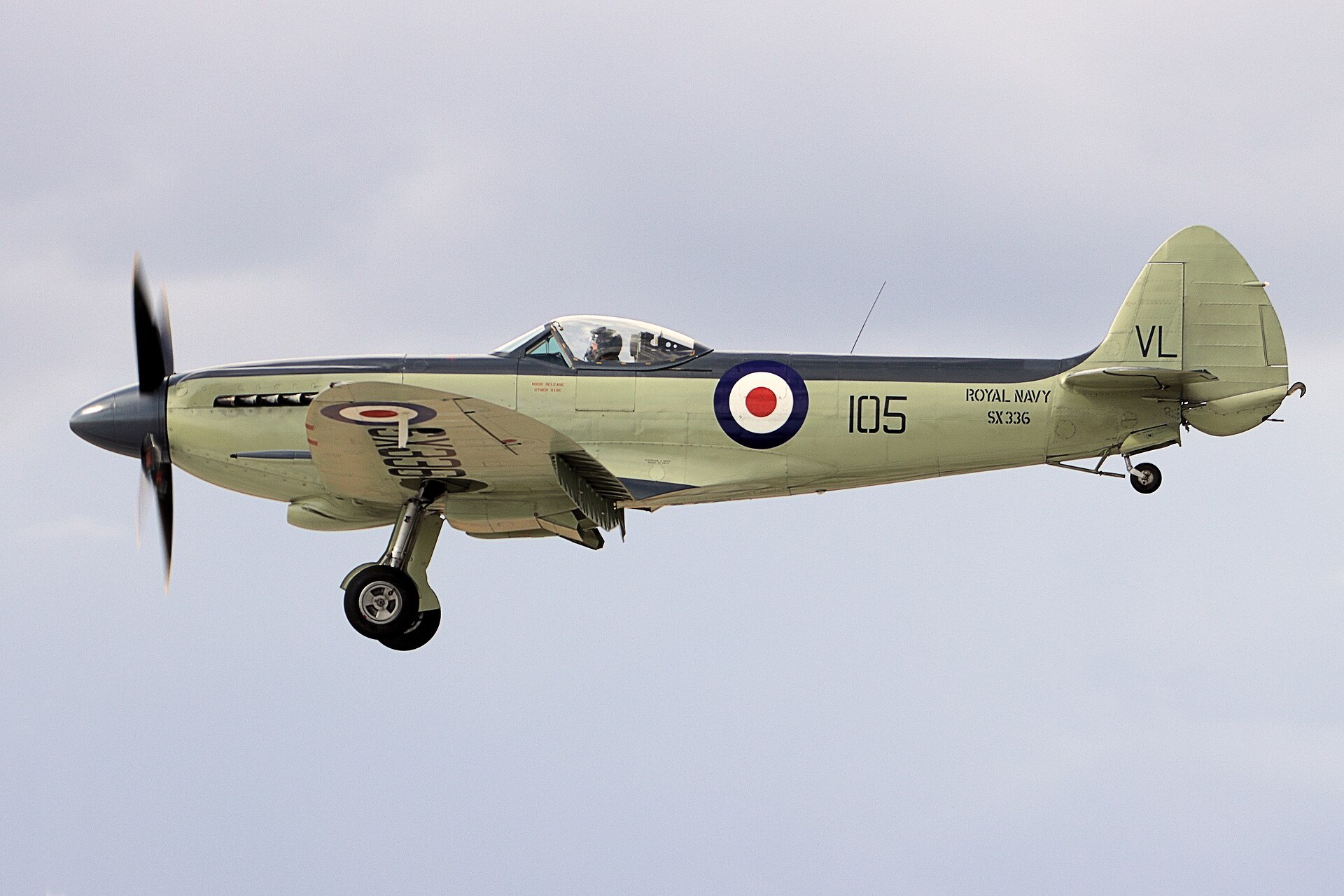
Supermarine Seafire
The Spitfire That Went to Sea
The naval Spitfire: brilliant in the air and brutal on a carrier deck, it covered the landings at Salerno, fought kamikazes off Japan and flew in Korea, and taught the Fleet Air Arm hard lessons about what a sea fighter needs.
The Seafire: how the Spitfire was made into a carrier fighter, and what it cost
The Admiralty wanted a naval Spitfire as early as 1938, and again in 1940, when 50 folding-wing aircraft were requested; Winston Churchill, then First Lord, cancelled the order to keep Fairey Fulmar production going. By late 1941 the Fleet Air Arm’s need for a modern fighter was desperate, and the first Seafire Mk Ibs were simply Spitfire Vbs converted with an A-frame arrester hook, strengthened longerons and naval radio. The first squadron, 807, took delivery in June 1942. The Seafire kept almost all of the Spitfire’s speed, climb and handling. What it lacked was everything a deck asks for: a strong, wide undercarriage, good slow-speed manners, long range and the ability to survive heavy arrivals.
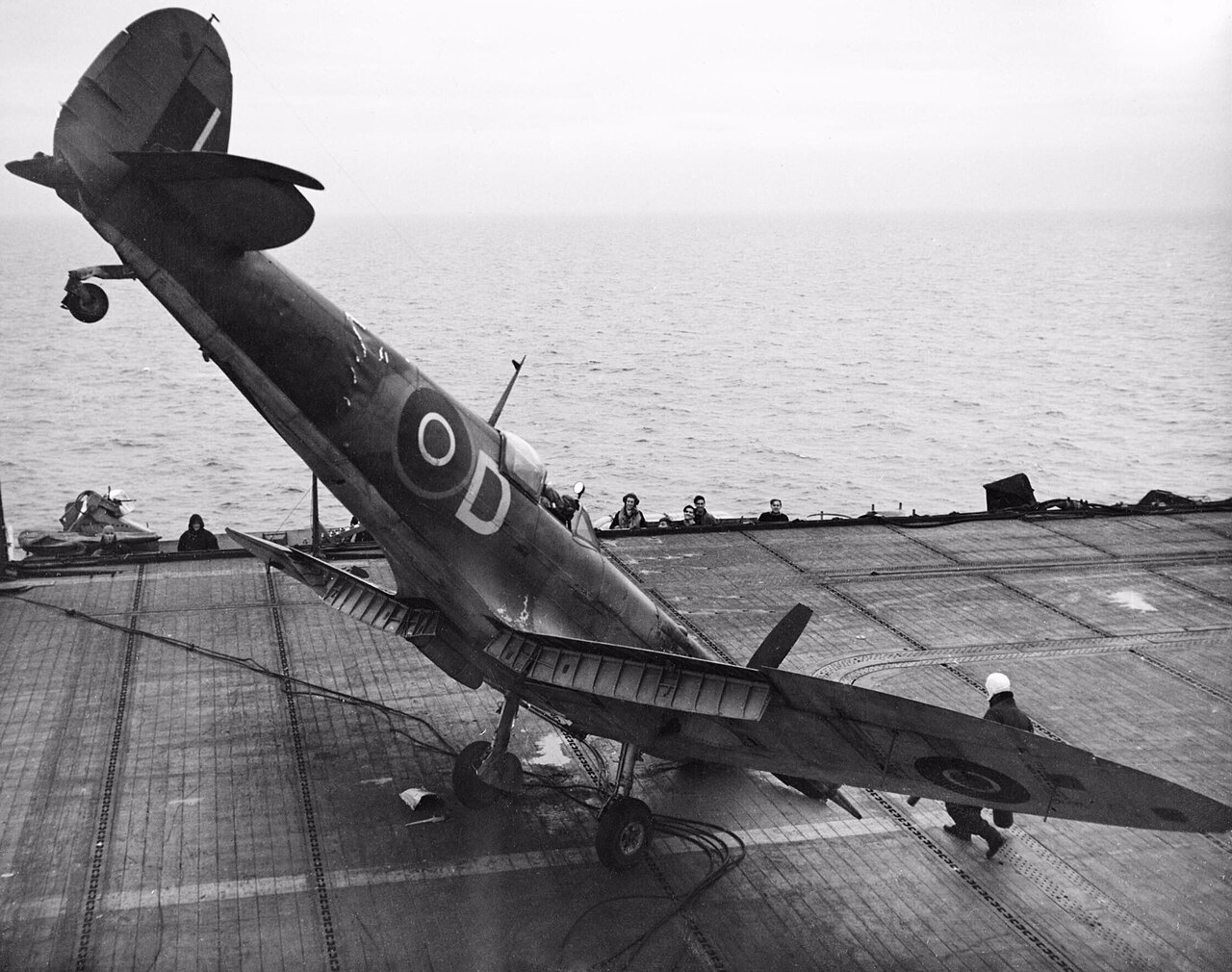
It went to war in November 1942 over the Operation Torch landings in North Africa, its aircraft painted with temporary American stars. The low point came off Salerno in September 1943, where some 106 Seafire IICs on escort carriers and HMS Unicorn had to cover the beachhead in almost windless weather. Pilots came in fast, tore off hooks, collapsed undercarriages and bounced over the barriers; dozens of aircraft were wrecked in landing accidents while the fighters still flew hundreds of sorties a day. The folding-wing Seafire F Mk III, built in greater numbers than any other mark, followed, and by Operation Dragoon in August 1944 better-trained pilots had brought the crash rate below one in 50 landings.
In the Pacific, Seafires of the British Pacific Fleet flew combat air patrol over the carriers while Hellcats and Corsairs went inland, and they met the kamikazes off Okinawa and Japan. Fitted with American drop tanks to stretch their range, they shot down eight attackers on 15 August 1945, the last day of the war. Griffon engines and new undercarriages produced better post-war marks, ending with the Seafire 47, whose contra-rotating propellers cured the vicious take-off swing. From HMS Triumph it flew ground-attack sorties in Korea in 1950. Canada, France and Ireland flew Seafires too, and a handful still fly today.
01The Seafire at Salerno: four days that made a reputation
The plan for Operation Avalanche on 9 September 1943 put the Allied landings in the Gulf of Salerno about 200 miles from fighter bases in Sicily. Air cover for the first day was to come from Seafires: some 106 Seafire LF IICs in 11 squadrons on the escort carriers Attacker, Battler, Hunter and Stalker and the maintenance carrier Unicorn, under Rear-Admiral Philip Vian. Many pilots had little experience of the type, let alone of deck landing it, and the morning dawned almost windless. The escort carriers, flat out at about 17 knots, could not make enough wind over the deck, and haze hid the horizon.
The Seafires flew 265 sorties on the first day and 232 on the second, breaking up dozens of fighter-bomber attacks. But the landings were carnage. The airfield ashore took four days to secure, not one, and by the analysis that followed the Seafire force had flown 713 sorties, shot down two enemy aircraft and lost 42 aircraft in accidents, none to enemy action. Crews cut 2 in off the propeller tips to stop them hitting the deck. Vian blamed the aircraft; many pilots blamed Vian.
02The Seafire in the Pacific and Korea
Seafires of 887 and 894 Squadrons went east aboard HMS Indefatigable and joined the British Pacific Fleet in late 1944. They had about an hour less endurance than the American-built Hellcats and Corsairs alongside them, so the fleet gave them the defensive job: combat air patrols over the carriers. Pilots adapted surplus P-40 Warhawk drop tanks to extend their patrols. The Seafires met the kamikazes during the Okinawa campaign and stayed in action off Japan until the very end; on 15 August 1945 they shot down eight attacking aircraft for one loss. Sub-Lieutenant R. H. Reynolds of 894 Squadron became the top-scoring Seafire pilot, credited with four and a half victories.
Five years later Seafire 47s of 800 Squadron flew from HMS Triumph off Korea, carrying out ground attack and patrols from July to September 1950. They flew 360 operational sorties; one was shot down in error by a B-29 gunner. The heavy landings took their toll, wrinkling rear fuselages, and when peacetime rules returned almost all of 800 Squadron’s Seafires were declared unserviceable. Sea Furies took their place.
What makes the Seafire special
A Spitfire with a hook
The first Seafires were straight conversions. An A-frame arrester hook was fitted under the rear fuselage, the lower longerons were strengthened and naval radio, IFF and a homing beacon were installed; instruments were recalibrated in knots. The Mk IIc added catapult spools and slinging points, and the Mk III finally brought folding wings, hinged just outboard of the wheel wells with the tips folding too, so that more aircraft could be stowed in British carriers’ small lifts and hangars. The basic Spitfire structure, though, was never designed for repeated heavy deck arrivals.
The narrow undercarriage problem
The Spitfire’s narrow-track, outward-retracting undercarriage was fine on grass and runways. On a pitching deck it was a liability. Heavy landings broke oleo legs, the long nose blocked the pilot’s view on approach, and the aircraft’s tendency to float on touchdown sent it past the wires and into the barrier. The modifications had moved the centre of gravity aft, making slow-speed control harder. Only the post-war Seafire XVII received a reinforced undercarriage with longer, softer oleos, which stopped the propeller tips pecking the deck and the aircraft bouncing over the wires.
Griffon power and contra-rotating propellers
From the Seafire XV the Rolls-Royce Griffon replaced the Merlin. It gave far more power but turned the opposite way, and at full throttle the swing on take-off could drive the aircraft towards the carrier’s island even with full opposite rudder, often with a series of hops on the light undercarriage. The answer came with the Seafire 46 and 47: contra-rotating Rotol propellers, six blades in two units, which cancelled the torque. The Mk 47 also gained power-folding wings and fuel injection on later aircraft, and is regarded as the definitive Seafire.
03The Seafire’s marks: from Mk Ib to Mk 47
- Mk Ib: converted Spitfire Vbs, the first 48 converted at Hamble in late 1941 and a further 118 with reinforced fuselages.
- Mk IIc: first built as a Seafire, based on the Spitfire Vc, with catapult spools; L Mk IIc had a low-altitude Merlin 32. Supermarine built 262, Westland 110.
- Mk III: folding wings and Merlin 55; 1,220 built by Westland and Cunliffe-Owen, the most numerous mark.
- Mk XV: Griffon VI, Spitfire VIII-style fuel tanks and tail; 390 built from late 1944, later aircraft with a sting hook.
- Mk XVII: reinforced undercarriage, extra fuel and bubble canopy; 232 built.
- Mk 45 / 46: navalised Spitfire 21 and 22 with two-stage Griffons and non-folding wings; 50 and 24 built.
- Mk 47: definitive version with contra-rotating propellers and hydraulically folding wings; 90 built at South Marston.
Supermarine Seafire F Mk III specifications
Specifications
- Crew
- 1
- Length
- 9.21 m (30 ft 2.5 in)
- Wingspan
- 11.23 m (36 ft 10 in)
- Height
- 3.49 m (11 ft 5.5 in)
- Empty weight
- 2,412 kg (5,317 lb)
- Max take-off weight
- 3,280 kg (7,232 lb) gross
- Powerplant
- 1 × Rolls-Royce Merlin 55M V-12, 1,585 hp
- Maximum speed
- 578 km/h (359 mph) at 1,830 m (6,000 ft)
- Cruise speed
- 438 km/h (272 mph)
- Range
- 748 km (465 mi) at cruising speed
- Service ceiling
- 10,970 m (36,000 ft)
- Climb rate
- 16.5 m/s (3,250 ft/min); 20,000 ft in 8.1 minutes
- Armament
- 2 × 20 mm Hispano cannon and 4 × .303 in Browning machine guns; up to 2 × 250 lb bombs under the wings or 1 × 500 lb under the fuselage
Costs & production
- Unit cost
- No reliable per-aircraft figure found in the sources used
- Cost per flight hour
- No official figure. For an airworthy Seafire today a rough estimate is several thousand pounds per hour, by analogy with privately operated Merlin- and Griffon-engined Spitfires, where engine overhaul reserves dominate; an order of magnitude only, not a quoted rate
- Production
- About 2,600 built (2,646 commonly given) by Supermarine, Westland and Cunliffe-Owen, plus conversions
- Programme
- First squadron June 1942; first combat November 1942; last of 22,000 Spitfires and Seafires (a Seafire 47) completed 28 January 1949; front-line service ended 1951
04The Seafire’s operating costs: the price of a borrowed fighter
The Seafire’s real cost was attrition. At Salerno the force lost 42 aircraft to accidents in four days; 32 deck-landing crashes wrote off the machine, 17 were lost to undercarriage failures and 24 were found to have distorted rear fuselages. The Fleet Air Arm accepted those losses because the Seafire was available, fast and could be built on existing Spitfire lines, while the best purpose-built carrier fighters came from America. Post-war, wrinkled fuselages grounded much of 800 Squadron after Korea. For today’s owners the costs are those of any Spitfire, with the added rarity of naval parts.
The Seafire from hooked Spitfire to Korea
First idea
The Admiralty first discusses a carrier-borne Spitfire; the idea is dropped.
Order cancelled
A request for 50 folding-wing Spitfires is cancelled by Churchill in favour of the Fulmar.
Hooked Spitfires
48 Spitfire Vbs are converted at Hamble into the first Seafire Mk Ibs.
Into service and into action
807 Squadron receives Seafires in June; in November they fly over the Torch landings in North Africa.
Salerno
In September 106 Seafires cover the beachhead; 42 are lost in accidents in four days.
Dragoon and the Pacific
Crash rates fall during the landings in southern France; 887 and 894 Squadrons join the British Pacific Fleet.
Kamikazes and VJ Day
Seafires defend the fleet off Okinawa and Japan, shooting down eight attackers on 15 August.
Exports
Canada flies Seafire XVs from HMS Warrior and HMCS Magnificent; Ireland receives 12 Mk IIIs in 1947; French Seafires go to Indochina in 1948.
The last of 22,000
Seafire 47 VR971, the last of the Spitfire and Seafire line, leaves South Marston on 28 January.
Korea
800 Squadron’s Seafire 47s fly 360 sorties from HMS Triumph between July and September.
Withdrawn
All Seafires are withdrawn from front-line Fleet Air Arm service.
Stories & eyewitnesses: the Seafire on the deck
Eric Brown: exhilaration at the challenge
The test pilot who deck-landed it most still loved it.
Read the full story
First blood over Oran
Operation Torch put Seafires in American stars against the French.
Read the full story
Simpson’s two Messerschmitts
On Salerno’s second day a squadron CO showed what the Seafire could do.
Read the full story
The major with pearl-handled revolvers
A friendly-fire incident at Paestum produced a famous outburst.
Read the full story
Hugh Popham: hangars choked with wrecks
A Seafire pilot sent to reinforce Unicorn described what he found.
Read the full story
Hunter’s lucky flight
One New Zealand CO’s deck-landing drill kept his whole flight flying.
Read the full story
Warhawk tanks over the Pacific
The British Pacific Fleet’s Seafires borrowed range from the RAAF.
Read the full story
Korea: the last Seafire war
800 Squadron flew 360 sorties from HMS Triumph in 1950.
Read the full story
SX336: a scrapped fuselage that flies again
A Westland-built Seafire XVII is now flown by Navy Wings.
Read the full story
The Mk XVs of Canada and Missouri
Two rare Griffon Seafires survive on either side of the border.
Read the full story
The Seafire in pictures
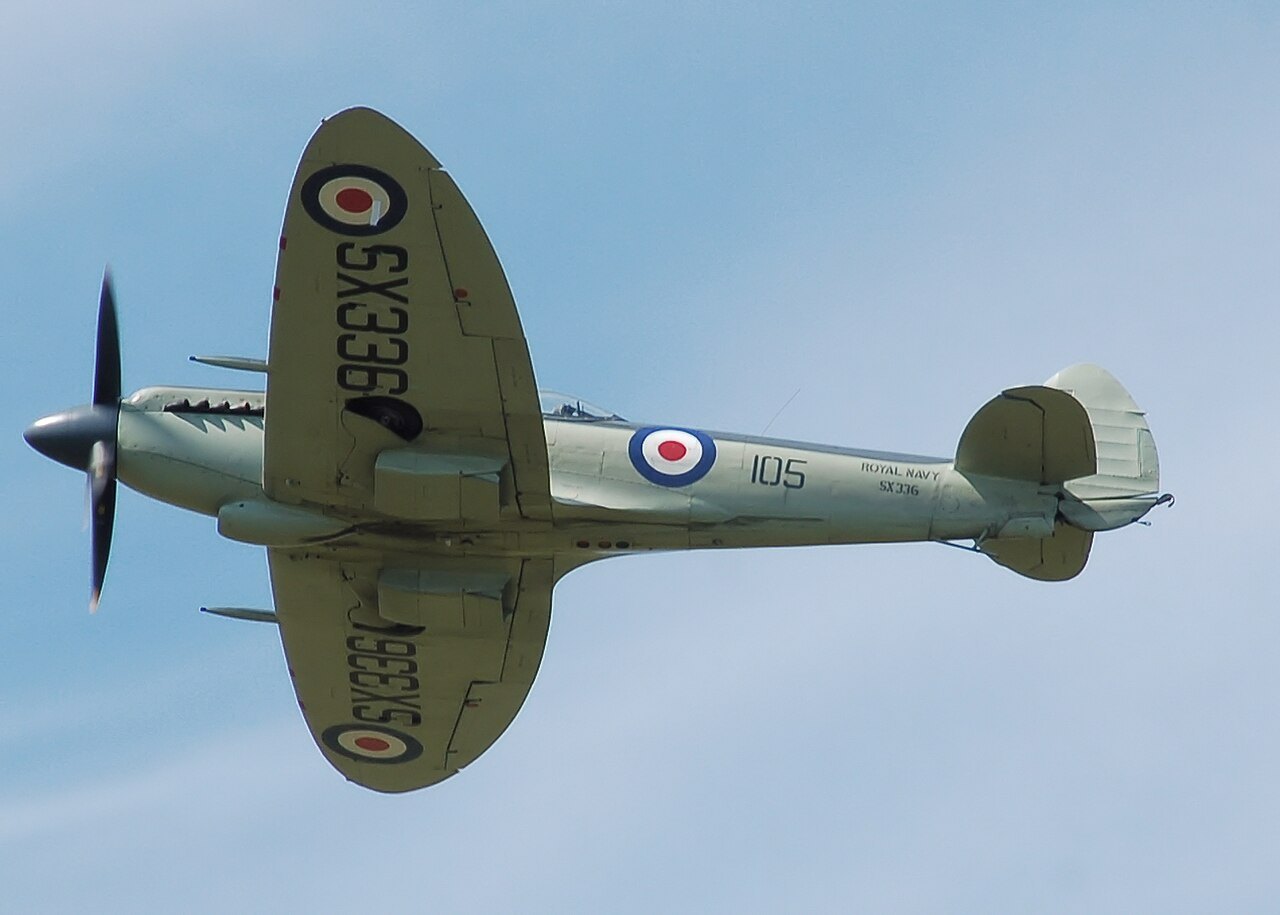
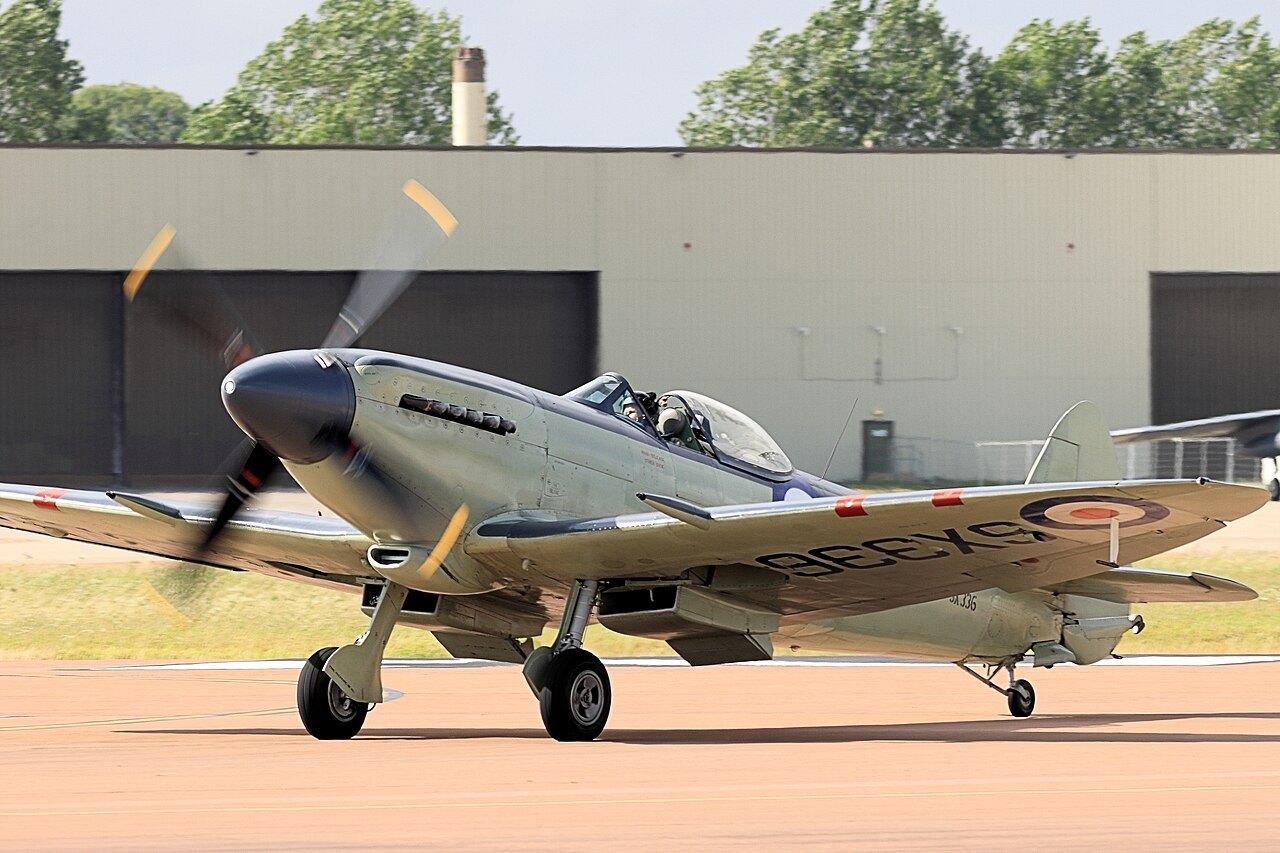
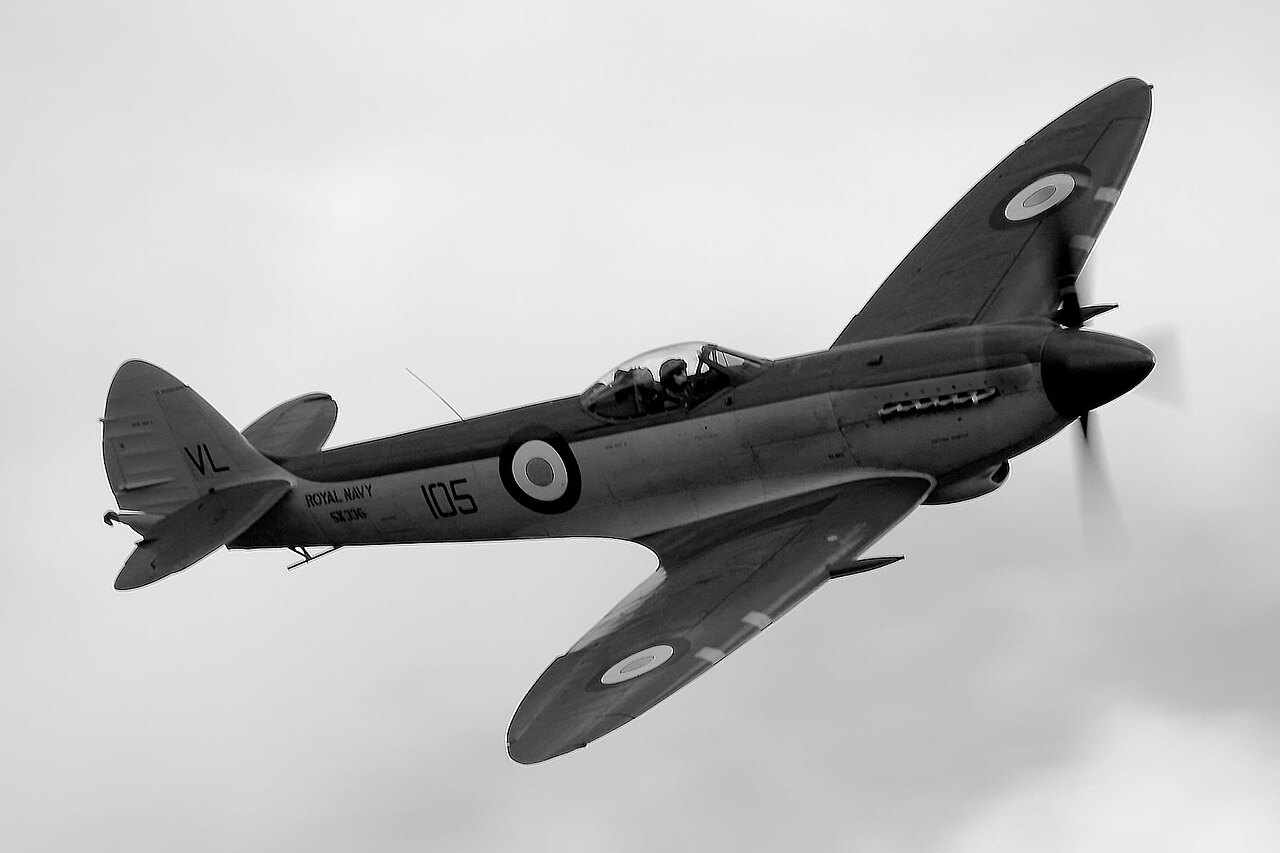
Where the Seafire flies and flew
The Seafire’s record
The Seafire flew in the Mediterranean landings of 1942–44, over Norway, Normandy and southern France, with the British Pacific Fleet against kamikazes in 1945, with France in Indochina and with the Royal Navy in Korea in 1950. Its air-to-air record was modest; its accident losses at Salerno became notorious.
See how training and combat types compare in the military aircraft statistics database. Figures are approximate.
Everything people ask about the Seafire
Can I fly in a Supermarine Seafire?
What is the difference between a Spitfire and a Seafire?
Why was the Seafire hard to land on a carrier?
How many Seafires were built?
Did the Seafire fight in Korea?
Which countries flew the Seafire?
Are any Seafires still flying?
You can’t fly the Seafire.
These, you can.
Most of this museum you can only look at. These genuine military jets you can fly yourself with MiGFlug — with aerobatics and time on the controls.
 Fly the L-39 AlbatrosThe world’s most-flown jet trainer — aerobatics included
 Fly the F-104 Starfighter“The missile with a man in it”
 Fly the MiG-21The Cold War’s most-produced jet
 Fly the T-33 Shooting StarAmerica’s first jet trainer
 Fly the DH VampireA piece of early jet history
 Fly the S.211Agile Italian jet trainer
 Fly the MB-326The classic Aermacchi jet
 Fly the MiG-15The Soviet legend of the Korean War
Continue the tour
Every fact, checked
- Seafire Part 3: Operational HistoryArmoured Aircraft Carriers: Torch, Salerno sortie and loss analysis, Dragoon, Pacific drop tanks; quotes Eric Brown, Hugh Popham, Vian and David Brown
- Seafire SX336Navy Wings: history and restoration of Seafire XVII SX336 and a type summary
- Supermarine Seafire Mk. XVAirworthy Seafire XV PR503 in Missouri; Griffon swing and undercarriage problems
- Canadian Naval Aviation exhibitNaval Museum of Alberta: its Seafire, one of two remaining Mk XVs