Vultee A-31 / A-35 Vengeance
The American dive bomber that Britain and France ordered — and America barely wanted. Built to plunge straight down, it found its war not over Europe but in the jungles and hills of Burma.
The Vultee Vengeance: a dive bomber ordered by everyone except the country that built it
Museum piece · not a MiGFlug rideFew combat aircraft carry a stranger biography than the Vultee Vengeance. It was an American design, drawn up in California and built in Tennessee, yet it was conceived from the start to satisfy a European appetite for a purpose-built dive bomber that the United States itself did not really share.
In 1940 the Vultee Aircraft Corporation offered a private-venture design, the company Model V-72, aimed squarely at foreign buyers. The idea was simple and of its moment: the German Junkers Ju 87 Stuka had just terrorised Poland and France, and both France and Britain wanted a dedicated aircraft that could do the same for them. France ordered around 300 examples in 1940, with deliveries planned for that autumn. Before a single machine could reach the Armée de l'air, France had fallen. The order passed to the British Purchasing Commission, which had already placed its own contract for 200 aircraft on 3 July 1940 and named the type Vengeance — a piece of wartime branding aimed at the enemy across the Channel.
So the aircraft that would carry a Royal Air Force roundel over Burma was ordered by Britain, funded partly through Lend-Lease, and built by three separate American factories: Vultee's own plant at Downey, California; a large new line at Nashville, Tennessee; and Northrop's works at Hawthorne, California. When the United States Army Air Forces did take the type on charge — under the designations A-31 and later the redesigned A-35 — it did so with little enthusiasm. By the time the Vengeance was arriving in quantity in 1942 and 1943, the very concept it embodied was already going out of fashion.
“The Vengeance was built for a doctrine that was dying even as the first aircraft came off the line.”The dedicated dive bomber — overtaken by the fighter-bomber
That is the paradox at the heart of the Vengeance. The lessons of the Battle of Britain and the North African desert had shown that a slow, specialised dive bomber was desperately vulnerable to enemy fighters. Western air forces were turning instead to the fighter-bomber — a fast single-seater that could fight its way to the target, drop its bombs and fight its way home. Against that trend a two-seat machine that spent long seconds hanging in a near-vertical dive looked like an aircraft designed for the last war.
And yet, sent to the right theatre, the Vengeance did genuinely valuable work. In Burma, where Japanese fighter opposition was thin and the terrain was a nightmare of jungle-covered ridges, the type's one great virtue — astonishing dive-bombing accuracy — came into its own. RAF, Royal Australian Air Force, Indian Air Force and Royal Indian Air Force squadrons used it to place bombs precisely onto Japanese supply dumps, bridges, bunkers and troop concentrations during the Arakan campaigns of 1943–44 and the decisive battles of Imphal and Kohima. For close air support in that unforgiving country, a machine that could drop its load almost straight down was exactly what the ground troops needed.
By 1944 the front-line career was already ending. Australia withdrew its Vengeances in favour of fighter-bombers and Liberators; the RAF pulled them out of Burma; and hundreds of surviving airframes were stripped of their guns and turned into target tugs — unglamorous but useful work towing gunnery sleeves behind fighter bases. It was a quiet end for an aircraft that had never quite been given the war it was designed for.
That the Vengeance is barely remembered today is partly an accident of geography. Its war was fought in Burma and the South-West Pacific — the “Forgotten Army’s” theatre, far from the cameras and correspondents that made legends of the Spitfire and the Lancaster over Europe. The men who flew and serviced it, and the Indian and British soldiers whose advances it supported, knew exactly how useful an accurate dive bomber could be in country where a bomb dropped a hundred metres wide was a bomb wasted. But there was no glamour in it, and no war-winning narrative to hang on the type afterwards.
There is also an honest ambivalence in the records themselves. Commonwealth assessments describe the Vengeance's dive-bombing as very effective, and ground commanders valued it. Yet the same reports note that it was slow, that it could not defend itself against fighters, and that it demanded the kind of local air superiority that only became available late in the Burma campaign. It was, in other words, a specialist tool: superb at one job in the right conditions, and close to useless outside them. Air forces that need aircraft to do several jobs at once had little use for such a thing, which is exactly why the fighter-bomber won the argument.
So the Vengeance sits in an unusual category: not a bad aeroplane, not a famous one, but a revealing one. Its whole story — ordered by France, inherited by Britain, built by America, flown in anger mainly by Australians and Indians, and ended towing targets — is a compact history of how quickly air warfare changed between 1940 and 1944, and of how an aircraft can be both genuinely good and quietly obsolete at the same moment.
01The Vultee Vengeance's origins: the dive bomber Britain and France ordered, not America+
The Vengeance is one of the clearest examples in aviation history of an aircraft built to someone else's requirement. In 1940 the United States Army Air Corps had no serious interest in a single-engine dive bomber — that was a US Navy speciality, embodied by carrier aircraft like the Douglas SBD Dauntless. Vultee's Model V-72 was therefore aimed entirely at export customers who had watched the Ju 87 Stuka smash through Poland and France and wanted an equivalent of their own.
France moved first, ordering roughly 300 aircraft for delivery from late 1940. The collapse of France in June 1940 killed that contract before any aircraft were delivered, and the British Purchasing Commission — which had ordered 200 on 3 July 1940 and added a further hundred that December — absorbed much of the programme. When the United States entered the war and Lend-Lease came into force, the American government took nominal charge of production and issued the type its own designations, A-31 and A-35. But the customer the aircraft had been designed for was always across the Atlantic.
It is worth stating this plainly because it is often lost: the Vengeance was not an American aircraft that Britain happened to buy. It was, in effect, a British (and originally French) aircraft that America happened to build. That origin explains almost everything odd about its later career.
It also explains the aircraft's split personality in the record books, where the same machine appears under a British mark number in one document and a US Army designation in another. Historians untangling the Vengeance's story have to hold both identities in mind at once — the British Vengeance I–IV and the American A-31 and A-35 are, for the most part, the same aircraft wearing different paperwork.
02Why the Vultee Vengeance's dive-bomber concept fell out of favour by 1943+
The dedicated dive bomber had a very short golden age. In 1939–40 the Stuka looked like a war-winning weapon. But it had succeeded in conditions of German air superiority, where enemy fighters were swept aside first. The moment the Luftwaffe met determined fighter opposition — over southern England in 1940 — the Ju 87 suffered so badly it had to be pulled from the battle. The lesson was noted in every Allied air staff.
By the time large numbers of Vengeances were arriving in 1942–43, the Western Allies had concluded that a slow two-seat dive bomber was too vulnerable to risk over a contested front. The future belonged to the fighter-bomber: a Typhoon, Thunderbolt or Mustang that could carry bombs or rockets, hit a target and then defend itself or run. A Vengeance could do none of that. It needed an escort, needed local air superiority, and spent long, exposed seconds in its dive.
So the RAF declined to use the Vengeance over Western Europe or the Mediterranean at all, and confined it to Burma, where Japanese fighters were few. Even there its career was brief. This is the honest context for the type: not a failure exactly, but an aircraft whose founding idea was already obsolete when it reached the squadrons.
It is easy, with hindsight, to call the whole programme a mistake. That would be unfair. In 1940, when the orders were placed, no one could be certain the fighter-bomber would render the dive bomber redundant so quickly, and a nation facing invasion could not afford to gamble against a weapon that had just worked so spectacularly for the enemy. The Vengeance was a reasonable bet in 1940 that a fast-moving war had turned into a poor one by 1943 — which is a very different thing from a bad design.
How the Vultee Vengeance was built to fall out of the sky
Everything about the Vengeance's shape was subordinated to one job: diving vertically onto a target and pulling out with the bombs on the mark. It was not designed to be fast, or nimble, or comfortable, or even easy to see out of on the approach — it was designed to fall out of the sky in a controlled, accurate, near-vertical plunge, and to survive the pull-out. Three design choices tell that story, and each of them cost the aircraft something elsewhere.
A wing set at zero incidence
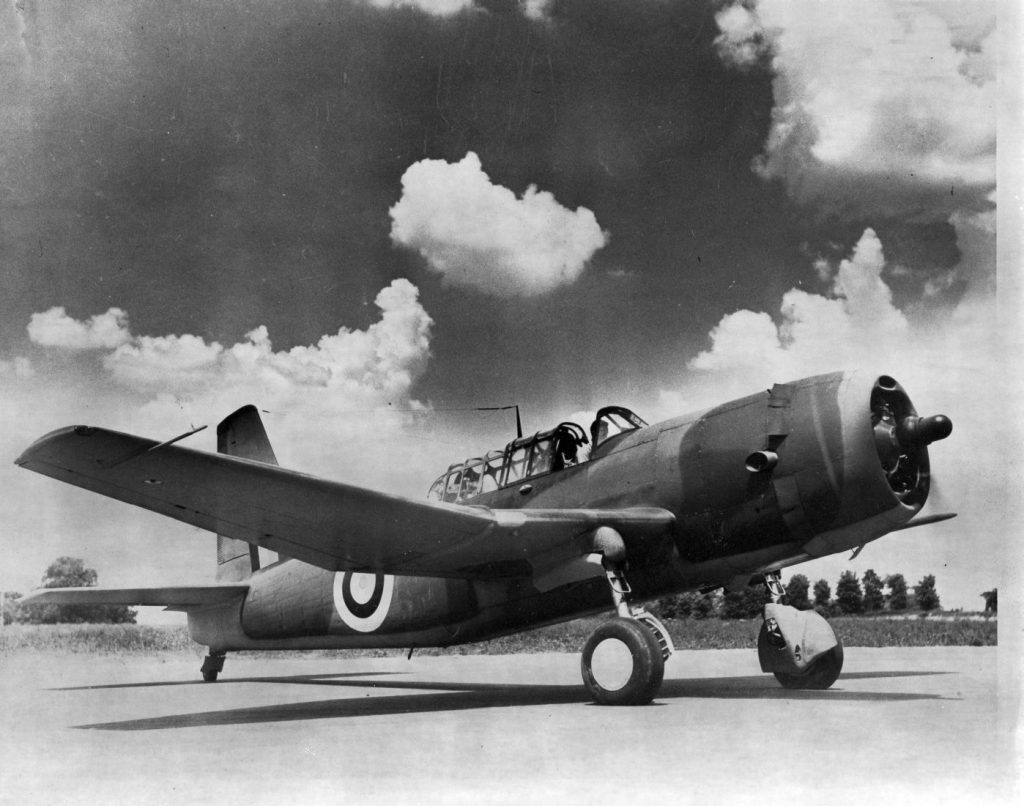
Most aircraft mount the wing at a few degrees of positive incidence so it makes lift in level flight. The Vengeance's wing was set at roughly zero (or slightly negative) incidence, so that in a true 90-degree dive the fuselage hung vertically, nose straight down. The pilot looked down the nose directly at the target — a superb sight-picture no shallow-diving aircraft could match.
Dive brakes and a heavy structure
Perforated hydraulic dive brakes held the aircraft to a controllable speed in the plunge, and the airframe was stressed to take the violent pull-out forces. The trade was weight and drag: the Vengeance was never fast or nimble, and it needed friendly fighters overhead to survive.
A big radial and a two-man crew
Power came from a Wright R-2600 Twin Cyclone radial of around 1,600 hp (1,700 hp in the A-35). A pilot flew the dive; a rear crewman navigated and manned a flexible machine gun against fighters closing from behind.
03The Vultee Vengeance's zero-incidence wing: engineering a true vertical dive+
The single most distinctive feature of the Vengeance is invisible in most photographs but obvious the moment you understand it. On a conventional aircraft the wing is bolted on at a small positive angle — the angle of incidence — so that when the fuselage is level, the wing is already meeting the air at an angle that generates lift. Put such an aircraft into a vertical dive and the lift pulls it off the vertical, so the pilot is really diving at 70 or 80 degrees, aiming through a canted sight-picture.
Vultee's engineers set the Vengeance's wing at essentially zero, or very slightly negative, incidence. In a genuine 90-degree dive the fuselage hangs straight down, nose pointed directly at the ground, and the wing is not fighting to pull it off line. The pilot sights along the nose at the target as if aiming a rifle. The result, widely praised by crews, was exceptional dive-bombing accuracy. A side effect was an unusual wing planform — sometimes described as W-shaped when viewed in plan — because the centre section and outer panels were arranged to make that geometry work.
The zero-incidence idea was not unique to Vultee — other dive-bomber designers wrestled with the same trade-off between diving accuracy and everyday handling — but the Vengeance committed to it more wholeheartedly than most, which is exactly why the later A-35 felt the need to walk it partly back. That single design decision, and the argument over it between the British and American versions, sums up the whole aircraft: everything bent toward the dive.
To picture it, imagine the difference between a diver who enters the water at a slight angle and one who goes in perfectly vertical. The Vengeance was built to be the second kind — nose down, wings not fighting the plunge, the pilot's eye running straight down the fuselage to the target. Every crew account of the type comes back to this sensation of a genuinely vertical dive, and to the accuracy it made possible. It was the one thing the aircraft did better than almost anything else in the sky, and the whole airframe was shaped around delivering it.
The price was paid in every other phase of flight. Because the wing made little lift at a level attitude, the Vengeance flew and especially landed in a marked nose-up attitude, which hurt the pilot's forward view. The redesigned USAAF A-35 gave the wing about 4 degrees of incidence to improve the cruising and landing attitude — at the cost, purists noted, of some of the very dive accuracy the whole design existed to deliver.
04The Vultee Vengeance's Wright R-2600 engine and its cooling troubles+
Power came from the Wright R-2600 Twin Cyclone, a 14-cylinder twin-row radial of around 1,600 horsepower in the early marks and about 1,700 in the A-35. It was a thoroughly conventional, widely used American engine — the same family that powered the B-25 Mitchell and the Avenger — and in most respects it was reliable.
In Vengeance service, though, engine cooling caused real trouble, particularly in the heat of India and the tropics and during the long climb to bombing altitude. Early aircraft suffered overheating that grounded machines and, in the worst cases, contributed to accidents. The RAF worked through a series of modifications to cure it; unmodified aircraft handed to the Free French were judged uneconomical and unreliable and were largely grounded.
There were also handling traps unrelated to the engine. Flown with the rear cockpit open and no rear gunner aboard — a common ferry or training configuration — the centre of gravity shifted enough to cause fatal accidents if dive procedures were not followed exactly. The Vengeance was a demanding aircraft that rewarded discipline and punished carelessness.
None of this made the R-2600 a bad engine — it was one of the great American radials of the war — but it does illustrate a recurring theme with the Vengeance: a fundamentally sound aircraft whose real-world service was dogged by teething troubles, tropical conditions and the demands of a difficult flight regime, all of which took time and modification to master.
05The Vultee Vengeance's armament, bomb load and the rear gunner's job+
The Vengeance's offensive punch was its bombs, not its guns. It could carry up to roughly 680 kg (1,500 lb) of ordnance — typically a pair of 500 lb bombs housed in an internal bay together with lighter bombs on external wing racks, the exact fit varying by mark and mission. Delivered from a near-vertical dive, that load could be placed with an accuracy that level bombers of the period could only dream of.
Defensive and strafing armament evolved through the marks. Early British-contract aircraft carried four fixed .30-calibre Browning machine guns in the wings for strafing on the way down, plus a single flexible .30-calibre gun in the rear cockpit for the observer/gunner to fend off pursuing fighters. The redesigned USAAF A-35 marks upgraded the wing battery to six heavier .50-calibre guns and added bomb racks — a reflection of American practice and of the growing realisation that a dive bomber needed to be able to hurt targets on the way in as well as at the bottom of the dive.
The rear crewman's role was more than manning a gun. He navigated the aircraft to and from the target — no small task over featureless jungle — watched the sky behind during the vulnerable dive and pull-out, and in some configurations helped manage the aircraft's systems. In the close air support role over Burma, getting to exactly the right patch of jungle at exactly the right moment was as important as the bombing itself, and that was the back-seater's work.
In this the Vengeance was typical of its generation of two-seat attack aircraft: the aeroplane was a system operated by a crew, and its effectiveness depended as much on the coordination between the two men as on any specification. Strip out the gunner-navigator — as the target-tug conversions later did — and much of what made the Vengeance a weapon disappeared, leaving only the airframe and the engine.
06The Vultee Vengeance's dive brakes and the physics of the pull-out+
A vertical dive is easy to start and dangerous to finish. Without some way of limiting speed, a dive bomber would accelerate to the point where the pull-out either tore the wings off or drove the aircraft into the ground before it could recover. The Vengeance solved this the way most dive bombers of the era did — with hydraulically operated, perforated dive brakes that deployed to add drag and hold the aircraft to a controllable terminal velocity in the plunge.
Holding a steady, controlled dive is what made accuracy possible. With the brakes out and the fuselage pointed straight down the zero-incidence wing's nose, the pilot had a stable platform from which to aim, correct and release. Then came the hard part: a firm, high-g pull-out at low altitude, hauling the aircraft from vertical back to level flight in a few hundred metres while the airframe and the crew's bodies absorbed the loads. The Vengeance was stressed heavily for exactly this, which is part of why it was never light or fast.
It is this whole choreography — roll into the dive, brakes out, sight down the nose, release, pull — that the type existed to perform. Everything the Vengeance did badly (cruise, visibility, speed, self-defence) was the price of doing that one thing well. When air forces stopped valuing that one thing, there was nothing left to justify the compromises.
The dive brakes themselves were a small engineering triumph of the era, common to the Ju 87, the Dauntless and the Vengeance alike. That three separate nations' dive bombers converged on the same solution — deploy drag surfaces, hold a steady dive, aim, release, pull hard — is a reminder that the type was a coherent, well-understood class of aircraft, not an experiment. It simply had a short life as a class.
Vultee Vengeance specifications, dimensions and cost
Figures below are representative of the Vengeance dive-bomber family (Vengeance I–IV / A-31 / A-35). Specifications varied between marks and factories — engine sub-type, gun fit, wing incidence and equipment all changed across the production run — so the numbers here should be read as typical rather than exact. Where sources disagree, the value is flagged as approximate, in keeping with the honest treatment this aircraft deserves.
Baseline: the Vengeance Mk I as delivered to the RAF and the RAAF during 1942 — Wright R-2600-A5B-5 Twin Cyclone of 1,600 hp, four fixed guns in the wings, two flexible guns in the rear cockpit, 1,500 lb of bombs, and the zero-incidence wing exactly as Vultee drew it. Deltas for the Mk IA and Mk III (Lend-Lease airframes with the R-2600-19), the Mk II, the redesigned A-35A with its 4° wing, and the A-35B — issued to the Commonwealth as the Vengeance Mk IV — are in grey. Four warnings before the figures. First, length is printed as 12.12 m in every serious reference and converted in some of them as 40 ft 9 in; 12.12 m is 39 ft 9 in, and the larger imperial figure is a transcription slip that has been copied from book to book for sixty years. Second, the production total is given as 1,931 and as 1,930, and neither reconciles with the per-mark figures most often quoted: 200 Mk I, 200 Mk IA, 500 or 501 Mk II, 200 Mk III, 99 A-35A and 831 A-35B sums to well over 2,000. The totals balance only if the Mk III run is 100 rather than 200, which is how the more careful British sources set it out. Third, every speed here is a clean aeroplane at rated altitude; a tropical Vengeance in Assam with bombs, racks, sand filter and aerials was slower by a margin nobody tabulated. Fourth, the range figure is a still-air number and had almost nothing to do with what the type could reach and return from, which is the criticism that eventually killed it in both Australian and British service.
Dimensions & weights
- Crew
- 2 — pilot and observer/wireless operator-air gunner in tandem under a long glazed canopy The back-seater worked the radio, fired the flexible gun and, in RAF and Indian Air Force practice, called the pull-out altitude in the dive. He had no flying controls.
- Wingspan
- 14.63 m (48 ft 0 in) Large for the job. A Douglas SBD Dauntless spanned 12.65 m (41 ft 6 in) and a Junkers Ju 87B 13.80 m (45 ft 3 in). The Vengeance was a big aeroplane built around a small bomb load.
- Length
- 12.12 m (39 ft 9 in) Printed as 40 ft 9 in in several widely used references alongside the identical 12.12 m. The metric figure is the reliable one.
- Height
- 4.67 m (15 ft 4 in) tail down
- Wing area
- 30.84 m² (332 sq ft)
- Wing angle of incidence
- 0° on the V-72, Mk I, Mk IA, Mk II and Mk III The defining number on this page. The wing was bolted on at zero incidence to the fuselage datum so that in a vertical dive the fuselage — and therefore the pilot’s sight line and the bombs — pointed exactly where the aeroplane was going. Most aeroplanes carry two to four degrees of positive incidence, which means that in a true vertical dive the fuselage is not quite aligned with the flight path and the bomb line has to be corrected for. Vultee removed the correction by removing the incidence.
- Wing angle of incidence, A-35A onwards
- 4° The Americans reset the wing to conventional incidence for the A-35A. That cured the nose-high cruise and gave a better view over the nose, and it cost the aeroplane precisely the property it had been designed around. The A-35 was a more pleasant machine and a less exact dive bomber.
- Wing planform
- the celebrated W: centre section swept back on the leading edge with a straight trailing edge, outer panels with a straight leading edge and a swept-forward trailing edge Not aerodynamic sophistication. The centre of gravity had been miscalculated, and sweeping the centre section aft to move the wing back was cheaper and quicker than redesigning the wing root and the fuselage frames around it. The aeroplane wore the fix in public for its whole career.
- Attitude in cruise
- markedly nose-up The direct consequence of zero incidence: the wing needs a positive angle of attack to fly, and with the wing square to the fuselage the whole aeroplane must be pitched up to give it one. The forward view was poor in cruise and worse on the approach, which is the complaint that recurs in RAF, RAAF and Free French pilot reports. It is also why the A-35A exists.
- Empty weight
- 4,411 kg (9,725 lb) A-35B: 4,672 kg (10,300 lb)
- Maximum take-off weight
- 6,486 kg (14,300 lb) A-35B: 7,439 kg (16,400 lb)
- Bomb load
- 680 kg (1,500 lb) — two 500 lb bombs in the internal bay and two 250 lb bombs on wing racks A-35B: up to ~907 kg (~2,000 lb) with the additional racks. For comparison a single-engine Dauntless carried 1,200 lb and a Ju 87B 1,100 lb, so the Vengeance was competitive on load and expensive on everything else.
- Wing loading
- 210 kg/m² (43.1 lb/sq ft) at maximum take-off weight
- Power loading
- 4.05 kg/hp (8.9 lb/hp) at maximum take-off weight on 1,600 hp Respectable for a loaded 1941 bomber and the reason the Vengeance was never in serious trouble once it was flying. Its problems were geometry and logistics, not power.
- Structure
- all-metal stressed-skin semi-monocoque fuselage; two-spar all-metal wing with split flaps, hydraulically retracted main legs folding inward into the centre section and a tailwheel Conventionally and solidly built. Ground crews in India complained about access to the accessory section and about corrosion in the monsoon, not about the airframe.
Performance
- Maximum speed
- 443 km/h (275 mph) at 3,350 m (11,000 ft) Clean, at rated altitude. Combat-loaded and tropicalised aircraft in Assam were slower, and no operational figure was ever published.
- Maximum speed, A-35B
- 449 km/h (279 mph) Six .50 in guns, more weight and a hundred more horsepower cancelled each other almost exactly.
- Cruising speed
- 378 km/h (235 mph)
- Rate of climb
- no consistent figure appears in the standard references, and several omit it altogether This page will not invent one. It mattered less than usual: the Vengeance’s working profile was a shallow climb to the roll-in altitude near the target, not an interception.
- Service ceiling
- 6,860 m (22,500 ft) A-35B: 6,795 m (22,300 ft)
- Range
- 2,253 km (1,400 miles) Still air, no bombs, no reserve, no allowance for a target. Treat it as a delivery-flight number.
- Ferry range, A-35B
- 3,701 km (2,300 miles)
- Combat radius
- no published figure; working back from the still-air range, ~400 km (~250 miles) with a full bomb load is the right order of magnitude This is an estimate and is flagged as one. It is also the number that ended the type’s career: the RAAF judged the Vengeance less efficient than a fighter-bomber precisely because of short range and a long runway requirement, and Fourteenth Army’s advance in Burma soon put targets beyond it.
- Dive attack profile
- roll in from about 3,000–3,700 m, dive brakes out, near-vertical, release and pull-out well above the tree line The zero-incidence wing is what made the vertical dive worth having: the pilot aimed the aeroplane rather than aiming a sight through a correction. Squadron accounts from the Arakan repeatedly describe bombs put inside a bunker complex rather than merely on it.
- Shallow-attack release altitude
- 240 m (800 ft) Indian Air Force practice during the monsoon, when cloud made a proper dive impossible. It was unorthodox and it worked well enough that commanders told crews to use it whenever conditions repeated. It is one of the few genuinely inventive things anybody did with this aeroplane.
- Take-off run
- long — no figure is quoted consistently, but the requirement for a long, firm strip is recorded as an operational objection by both the RAAF and RAF units A heavy aeroplane on a wing set at zero incidence has to be flown off rather than allowed to fly itself off, and in New Guinea and Assam the strips were short, wet and improvised.
- Landing and forward view
- poor over the nose on the approach, a direct consequence of the nose-high attitude The A-35A’s 4° wing was the fix. By the time it arrived, the aeroplane it fixed was already being counted out of the front line.
Propulsion & systems
- Powerplant, Mk I
- one Wright R-2600-A5B-5 Twin Cyclone, 14-cylinder two-row air-cooled radial, 1,600 hp (1,193 kW) The same family that powered the B-25 Mitchell, the A-20 Havoc and the TBF Avenger. On this airframe it drove one propeller instead of two, and it was the largest single-row-per-bank radial anybody hung on a dive bomber.
- Powerplant, Mk IA and Mk III
- Wright R-2600-19 The Lend-Lease airframes. Externally indistinguishable; the difference is accessory and rating detail.
- Powerplant, A-35A and A-35B
- Wright R-2600-13 or R-2600-8, 1,700 hp (1,268 kW)
- Engine displacement
- 42.7 litres (2,604 cu in) Enormous for a two-seat bomber carrying 1,500 lb. The Vengeance burned a heavy-bomber engine’s worth of fuel and shipping to deliver a light bomber’s payload, which is the underlying economic argument that the Hurricane IV fighter-bomber eventually won.
- Supercharging and rated altitude
- single-stage geared supercharger; the quoted maximum speed is at 3,350 m (11,000 ft) Above that the aeroplane fell away quickly. It did not matter: dive bombing in Burma was done from under 12,000 ft.
- Propeller
- three-blade constant-speed metal airscrew
- Dive brakes
- slotted all-metal brakes on the underside of the outer wing panels Perforated-type brakes of this kind hold the dive speed down without the buffet that killed early dive-bomber programmes elsewhere. They are the other half of the vertical-dive design, alongside the zero-incidence wing.
- Bomb bay and racks
- internal bay under the centre section for two 500 lb bombs, plus one rack under each outer wing panel for a 250 lb bomb The A-35B added further racks to reach ~2,000 lb.
- Fuel
- wing tanks; capacity is not consistently published The absence of a reliable figure in the literature is itself telling. The RAAF and the RAF both measured this aeroplane by what it could not reach rather than by what it carried.
- Target-towing equipment
- all armament removed, a light cable winch installed in the rear fuselage, sleeve targets streamed from it The conversion that a large majority of the 1,930-odd airframes ended up receiving, in RAF, Fleet Air Arm, RAAF and Eighth Air Force hands.
- Serviceability
- poor by 1944–45 in American hands; the surviving A-35Bs were redesignated RA-35B, R for Restricted, and were regarded as troublesome to maintain The Free French experience was worse still: their aircraft were flown without the reliability modifications that Britain and Australia had developed in service, suffered extremely high oil consumption, and were declared uneconomical to operate.
Metric conversions are rounded. Unit cost, programme cost and fleet flight-hour totals for the Vengeance were not recorded to modern standards and are not reliably documented.
07The Vultee Vengeance's variants: from the Model V-72 to the A-35B+
The Vengeance family runs through a confusing mix of British mark numbers and US Army designations, reflecting its split identity. The direct British-purchase and Lend-Lease aircraft were the Vengeance I, IA, II, III and IV; the equivalent US designations were the A-31 series and the redesigned A-35 series.
Broadly: the Vengeance I and II were early British-contract machines from Northrop and Vultee. The Vengeance IA and III corresponded to Lend-Lease A-31 aircraft with updated R-2600 engines. The A-35A was a redesigned USAAF version with the 4-degree wing incidence and a heavier gun fit, and the A-35B — the most numerous single model, with six .50-calibre wing guns and additional bomb racks — supplied the RAF and RAAF as the Vengeance IV. Total production across all factories and marks is usually given as around 1,931 aircraft, though as with much wartime accounting the exact figure varies between sources.
A great many A-35B / Mk IV airframes never saw combat at all: built as the dive-bomber era ended, they went straight into second-line and target-tug duties.
For collectors and historians the mark numbers matter, but for understanding the type the key point is simpler: the Vengeance family was numerous, broadly similar across its variants, and produced in quantity even after the mission it was designed for had lost its rationale. That surplus of late-build airframes is the direct reason so many ended up towing targets, and why the type's production total looks impressive for an aircraft with so short a combat career.
08The Vultee Vengeance's operating costs: what a wartime dive bomber cost to run+
Unlike modern aircraft, the Vengeance has no reliably documented cost-per-flight-hour, unit price or programme cost in the terms a comparison tool would use. Wartime production accounting, Lend-Lease transfers and multi-national ownership make any single figure meaningless, so this page records the cost row honestly as “not reliably recorded (WWII)”.
What can be said qualitatively is that the Vengeance was a relatively cheap, conventional aircraft to build — a single radial engine, a two-man crew, no exotic materials — which is part of why so many were completed even after the type's front-line usefulness had passed. The real cost of the Vengeance was not financial but strategic: production capacity and aircrew training were committed to a dive-bomber concept that the Western Allies had already decided to abandon, and hundreds of finished airframes ended their days towing targets rather than carrying bombs.
For MiGFlug's forthcoming comparison tools this page therefore records the cost fields honestly as unavailable rather than inventing a number. It is better to say plainly that wartime cost accounting for a multi-national, Lend-Lease dive bomber cannot be reduced to a single credible cost-per-hour figure than to publish a false precision. Where a figure genuinely is not known, this museum says so.
09The Vultee Vengeance compared to the Ju 87 Stuka and the SBD Dauntless+
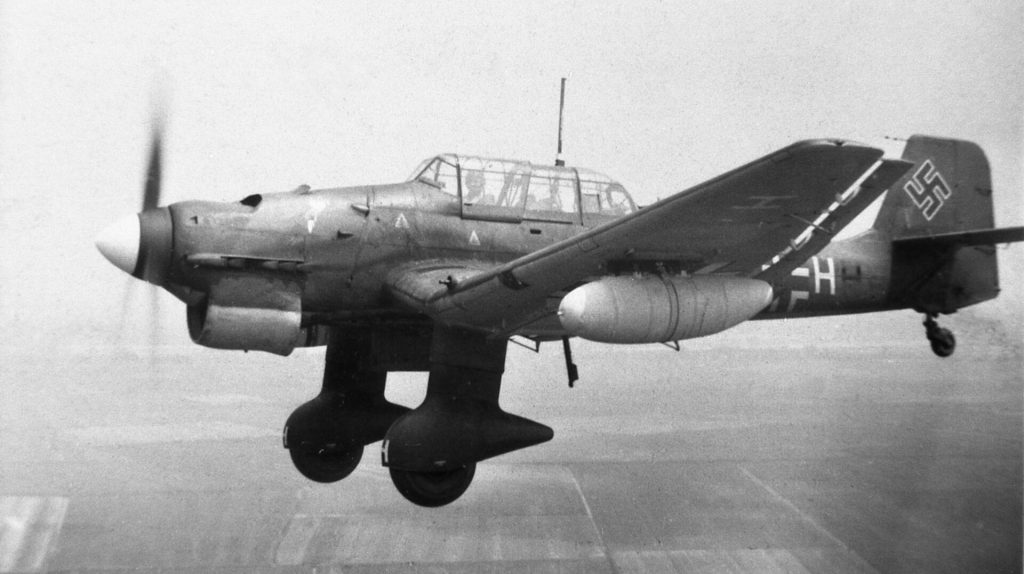
The Vengeance is best understood alongside the two dive bombers it is most often measured against. The Junkers Ju 87 Stuka was its inspiration — the aircraft whose success in 1939–40 created the demand the Vengeance was built to fill. But the Stuka's story is a warning as much as a model: once it met determined fighter opposition over Britain, it proved so vulnerable that it had to be withdrawn from the battle. The Vengeance, arriving later, inherited that vulnerability without ever quite inheriting the conditions of air superiority in which the Stuka had shone.
The Douglas SBD Dauntless makes an even sharper contrast. The Dauntless was a US Navy carrier dive bomber that fought in exactly the environment the doctrine promised — it helped sink four Japanese carriers at Midway — and it earned a permanent place in history. The difference was not so much the aircraft as the mission: the Dauntless dived on ships, where a dedicated naval dive bomber remained genuinely valuable for years, while the Vengeance dived on land targets in a European doctrine that had already moved on. Two similar aircraft, two very different reputations, largely because of where and against what they were used.
There is a lesson in that comparison for anyone tempted to rank aircraft by raw specification. The Vengeance, the Stuka and the Dauntless were technically similar answers to the same problem; their wildly different reputations were decided less by engineering than by doctrine, theatre and timing. The Vengeance drew the worst hand of the three, and its obscurity today is the result.
Set against both, the Vengeance was competitive as a diving machine — arguably more accurate than either in a pure vertical plunge, thanks to its zero-incidence wing — but it lacked a theatre in which that advantage translated into fame. It did its best work quietly, over the jungle, for an army the newsreels forgot.
10The Vultee Vengeance in RAAF service: Australia's ~342 dive bombers+
Australia operated the largest Vengeance fleet of any nation — commonly given as around 342 aircraft — and the RAAF's experience is in many ways the fullest account of what the type could and could not do. Australian squadrons, beginning with No. 12 Squadron, took the Vengeance into action in the South-West Pacific from 1943, flying strikes from bases in the Northern Territory against Japanese-held targets such as Selaru and the Tanimbar Islands in the Dutch East Indies.
The RAAF found the Vengeance accurate and effective as a dive bomber, but ran squarely into the same strategic problem the RAF had: by 1943–44 the specialised dive bomber no longer fitted the way the war was being fought. Australian planners wanted aircraft that could range further, carry more, and defend themselves. The Vengeance could do none of these especially well, and its front-line career with the RAAF was correspondingly short — the last operational Australian sorties came in early March 1944, after which squadrons re-equipped with fighter-bombers and, in the heavy-bomber role, Consolidated B-24 Liberators.
Because Australia flew so many and kept such good records, a large share of the surviving Vengeance airframes and relics are Australian, and the restoration and museum efforts that keep the type's memory alive today are concentrated there.
Australian records also give us some of the most reliable numbers we have for the type. Where global production figures vary between sources, the RAAF's careful accounting of its own fleet — roughly 342 aircraft, tracked serial by serial — provides a firm anchor for anyone trying to understand how many Vengeances there were and what became of them.
Armament & payload
The Vengeance carried an ordinary bomb load with an extraordinary aiming method, and rifle-calibre guns that nobody defended
The Vengeance was armed like a 1938 aeroplane and aimed like a 1943 one. Its guns were an afterthought — four rifle-calibre Brownings in the wings and two more on a flexible mounting for the man in the back, a fit that could strafe a bullock cart and not much else — and its bomb load of 1,500 lb was ordinary for the class. What was not ordinary was the delivery. The zero-incidence wing and the slotted underwing dive brakes together let a pilot roll in from around 10,000 ft, point the fuselage vertically at a bunker, and have the bomb go where the nose was pointing without a correction for the difference between where the aeroplane was looking and where it was going. Squadron accounts from the Arakan and from the Imphal box describe accuracy that the Hurricane fighter-bombers replacing the type could not match, and Fourteenth Army asked for the Vengeances specifically. The Americans, who had already decided that dive bombing was a dead end for a land air force, never sent one into combat under their own roundels. Fits varied enormously by mark and operator: the British-ordered Mk I to Mk III carried rifle-calibre guns whose calibre is given in the sources as both .30 in (7.62 mm) and .303 in (7.7 mm) depending on whether the aircraft was built to American or British ammunition standard, and the American A-35A and A-35B replaced the lot with half-inch Brownings.
Gun
- Mk I, Mk IA, Mk II and Mk III: four fixed forward-firing rifle-calibre Browning machine guns in the wings, outboard of the propeller disc, fired by the pilot. No synchronisation gear was required and none was fitted
- Two further rifle-calibre Brownings on a flexible mounting in the rear cockpit, worked by the observer/gunner, covering the upper rear quadrant only
- A-35A: four fixed 12.7 mm (.50 in) M2 Brownings in the wings and one flexible .50 in gun in the rear cockpit — a real strafing battery at last
- A-35B: six fixed 12.7 mm (.50 in) M2 Brownings in the wings, plus the flexible rear gun. This is the Vengeance Mk IV as supplied to the RAF and RAAF, and by the time it arrived most of them were being turned into target tugs with the guns taken out again
- The calibre of the early guns is genuinely disputed in print. American-built airframes to an American standard took .30-06; airframes finished to British requirements took .303 in. Both appear in reputable references and the difference is a supply question rather than a ballistic one.
Air-to-air
- No guided air-to-air weapon existed anywhere in the Vengeance’s service life. Air combat meant the gunner’s flexible mounting and, in theory, the pilot’s wing guns
- The Vengeance could not fight and was never expected to. Fully loaded it was slower than a Nakajima Ki-43 Oscar by a wide margin and had no manoeuvre margin at all with bombs aboard
- Burma operations were therefore built around escort: Hurricanes and later Spitfires covered the dive-bomber formations, and Vengeance losses to Japanese fighters stayed low largely because the escort worked and because Japanese fighter strength in Burma was thin from late 1943
- The defensive gun’s real value was suppressive during the pull-out and the run for home at low level, where the threat was ground fire rather than fighters
- Squadron-level claim and loss totals for Vengeance units are poorly consolidated; this page offers no aggregate figure because the ones in circulation cannot be corroborated.
Air-to-surface guided
- None, and none was ever proposed for the type. The first operational guided air-to-surface weapons — the German Fritz X and Henschel Hs 293 — entered service in 1943, and nothing comparable reached the South-East Asia theatre
- This card is worth keeping because the Vengeance existed to solve, mechanically, the problem that guidance later solved electronically: putting a bomb on a point target rather than in its neighbourhood
- The zero-incidence wing was a guidance system made of aluminium. It worked, and it cost the aeroplane its cruise attitude, its forward view and, arguably, its career
- By 1945 the same job in Burma was being done by rocket-armed Hurricane IVs and Beaufighters — less accurate per weapon, far more flexible per sortie, and able to reach targets the Vengeance could not
Bombs
- Standard Mk I to Mk III load: two 500 lb bombs in the internal bay under the centre section and two 250 lb bombs on underwing racks — 1,500 lb (680 kg) total
- A-35B: additional racks raised the maximum to about 2,000 lb (~907 kg)
- In Burma the working load was general-purpose 500 lb and 250 lb bombs against bunkers, supply dumps, river craft and troop concentrations, with instantaneous or short-delay fuzing depending on whether the target was surface or dug in
- The internal bay doors and the wing racks were designed for the dive: the bay released cleanly at high dive angles, which is the whole reason for putting bombs inside a single-engine aeroplane at all
- Indian Air Force crews in the monsoon released at 800 ft (240 m) in a shallow attack when cloud prevented a proper dive, and hit enough to have the method endorsed by their commanders
Rockets
- None. No operational Vengeance carried rocket projectiles, and no rocket installation was standardised for the type in any air force
- This is a real gap rather than a formality. The RP-3 60 lb rocket transformed British ground attack in Burma from 1944, and the aircraft that carried it — the Hurricane IV, the Beaufighter, later the Thunderbolt — were the aircraft that displaced the Vengeance
- A rocket-armed Vengeance was never seriously pursued: by the time rails were available in theatre in quantity, the type was already being withdrawn from operations
- The comparison is unkind but fair. A Hurricane IV carried eight rockets, flew itself home after the attack, operated from shorter strips and needed no escort
Pods & other stores
- Target-towing installation: a light cable winch in the rear fuselage streaming a fabric sleeve or banner target, with all armament removed. This became the type’s principal fit
- The scale of it is the point. Four RAF squadrons and two Indian Air Force squadrons flew the Vengeance in combat; at least a dozen RAF units — Nos. 288, 289, 291, 567, 577, 587, 595, 631, 667, 679, 691 and 695 Squadrons — flew it as a target tug, alongside Fleet Air Arm and Eighth Air Force target flights
- Anti-aircraft co-operation and gunnery training duties with No. 22 Anti-Aircraft Co-operation Unit and No. 1 Target Towing Flight
- No long-range tanks, no reconnaissance pod, no torpedo. The TBV-1 Georgia torpedo bomber for the US Navy was proposed and never built
- Photographic and radio fits differed between American, British, Australian and Free French aircraft, and the reliability modifications developed in British and Australian service were not applied to the French machines — which is why theirs failed.
Three typical loadouts
- Close support, Arakan and Imphal, 1943–44
- Two 500 lb general-purpose bombs in the bay and two 250 lb bombs on the wing racks, full ammunition for the wing and rear guns. Roll-in at 10,000 ft or so, brakes out, near-vertical dive against a bunker complex or a supply dump, pull-out and low-level egress under Hurricane escort. This is the load that made the type’s reputation with Fourteenth Army.
- Monsoon shallow attack, Indian Air Force, 1944
- Same bomb load, no dive. Approach under the cloud base, shallow run, release at 800 ft, accept the reduced accuracy and the increased exposure to small-arms fire. Improvised in the field by No. 7 and No. 8 Squadron IAF crews and subsequently recommended by their commanders.
- Target towing, RAF, Fleet Air Arm and Eighth Air Force, 1944–45
- Guns and bomb gear stripped out, winch in the rear fuselage, a sleeve target on several thousand feet of cable, and a slow straight run past a gunnery range or a bomber crew replacement centre. Not a footnote: this is what most Vengeances built actually did for a living.
Sourcing caveat: armament tables for the Vengeance are unusually messy. The standard specification block for the A-31 lists only the four wing guns and omits the rear pair entirely; other references count six .30 in guns for the same aeroplane. The bomb figures are firmer, but the A-35B maximum is quoted variously as 1,800 lb and 2,000 lb depending on rack fit. Where this page gives a single number it has taken the figure supported by the widest set of sources and said so.
Variants
Two designation systems, one aeroplane, and a wing that was reset four degrees too late
The Vengeance was ordered by France, built for Britain, paid for by Lend-Lease, flown in combat by the RAF, the RAAF and the Indian Air Force, and never taken into battle by the country that built it. That tangle is why the designation history looks the way it does: two entirely separate naming systems running in parallel over the same production lines, with British mark numbers and American A-31 and A-35 designations attached to the same airframes at different points in their paperwork.
The substantive engineering break comes between the A-31 family and the A-35. Everything up to the Mk III is the aeroplane Vultee designed: zero-incidence wing, rifle-calibre guns, 1,500 lb. The A-35A resets the wing to 4° and re-arms with half-inch Brownings, and the A-35B adds two more of them and more racks. The first family dived better; the second flew better. Both were obsolete as combat aircraft before the second was delivered in quantity.
- Vultee V-72 (Model 72) (1940–41, 1 prototype)
- Designed on Vultee’s own money in 1940 against a French requirement. France ordered 300 with deliveries to begin in October 1940; the fall of France in June 1940 ended that before a single aircraft was built. The British Purchasing Commission ordered 200 on 3 July 1940 and a further 100 that December, and named it Vengeance. First flight in 1941.
- Vengeance Mk I / A-31-NO (1942, 200)
- Built by Northrop under licence against the direct British order. R-2600-A5B-5 of 1,600 hp. The baseline for this page.
- Vengeance Mk IA / A-31-NO (1942–43, 200)
- Northrop-built but supplied under Lend-Lease rather than direct purchase, with the R-2600-19. Otherwise the Mk I. The distinction is contractual, not technical.
- Vengeance Mk II (1942–43, 500 or 501)
- Vultee-built against the direct British purchase, with small detail differences from the Northrop machines. The largest single British block.
- Vengeance Mk III / A-31-VN (1943, 100 — some sources say 200)
- Vultee-built Lend-Lease equivalent of the Mk IA. The quantity is the single worst discrepancy in the type’s literature; 100 is the figure that lets the overall total balance.
- A-35A (Vultee V-88) (1943, 99)
- The redesign. Wing incidence reset to 4°, R-2600-13 or -8 of 1,700 hp, four fixed .50 in guns and one flexible. Better to fly, better to see out of, and measurably less precise in the dive — the aeroplane had been improved into ordinariness.
- A-35B / Vengeance Mk IV (1943–44, 831; 458 to the RAF, 121 to the RAAF)
- Six fixed .50 in guns and additional bomb racks for about 2,000 lb. The most-built version and the one least used in anger: the great majority were delivered into a world that had already stopped wanting dive bombers.
- RA-35B (from 1944–45)
- Not a new build but a status. R for Restricted. Surviving American A-35Bs, mostly on target-towing and crew training duties, were reclassified as non-combat aircraft; serviceability was poor and the airframes were regarded as troublesome to maintain.
- Vengeance TT Mk IV and other target-tug conversions (1944–46, several hundred)
- Armament removed, a light cable winch fitted in the rear fuselage, sleeve targets streamed astern. Flown by at least a dozen RAF squadrons, by the Fleet Air Arm, by the RAAF and by Eighth Air Force target flights in Britain from April 1944. Numerically this, and not dive bombing, is what the Vengeance was.
- XA-31A, XA-31B, XA-31C and YA-31C (1942–44, 3 plus 5)
- Engine testbeds, and the most historically consequential Vengeances of all. The XA-31B took the 3,000 hp Pratt & Whitney XR-4360-1 Wasp Major; the XA-31C and five YA-31Cs carried Wright R-3350 Duplex Cyclones, flying development engines for the B-29 Superfortress. A failed dive bomber spent its best years as a flying test stand for the engine that bombed Japan.
- TBV-1 Georgia (proposed, none built)
- A carrier torpedo-bomber development for the US Navy. Cancelled on paper.
Survivors, precisely. Of roughly 1,930 built, one complete airframe exists: Vengeance Mk IA A27-99, RAF serial EZ999, at the Camden Museum of Aviation at Narellan in New South Wales. Australian serial records describe it as the only complete Vengeance in the world, and it never saw squadron service. The Historical Aircraft Restoration Society at Albion Park holds substantial components of a second Australian airframe, serial A27-247, for long-term restoration; this aircraft is published in some places as "A24-247", which cannot be right — A24 was not a Vengeance serial block. Beyond those two there are recovered relics and wreck sites in Australia and New Guinea and a scatter of components in private hands, but nothing that can honestly be called an airframe. There is no airworthy Vengeance anywhere and there never has been a post-war one: no example of a type built in four figures has flown since the 1940s. Claims of preserved Vengeances in Indian and Brazilian collections circulate but could not be corroborated for this page and are therefore not listed.
The Vultee Vengeance from drawing board to target tug
The Vultee Vengeance from drawing board to target tug
From a 1940 export gamble to a 1948 retirement towing gunnery targets, the Vengeance packed a complete rise and fall into just eight years — a compressed history of the dive bomber itself.
A private venture for a foreign war
Vultee offers the Model V-72 dive bomber for export. France orders around 300; Britain's Purchasing Commission orders 200 on 3 July and names the type Vengeance.
France falls, Britain inherits the order
With France defeated, the whole programme flows to Britain, later underwritten through Lend-Lease. Production is set up at Downey and Nashville, with Northrop building a batch at Hawthorne.
Deliveries begin as doctrine shifts
Vengeances reach Commonwealth units from mid-1942. The USAAF reluctantly takes the type as the A-31, even as Western air forces lose faith in the dedicated dive bomber.
First blood over Burma
RAF Nos. 82 and 110 Squadrons fly the first dive-bombing sorties against Japanese forces on 19 March 1943. Indian Air Force and RAAF squadrons follow, hitting supply lines and strongpoints.
The A-35 redesign and the RAAF's Pacific war
The redesigned USAAF A-35 introduces a 4-degree wing incidence and heavier .50-calibre guns. In the South-West Pacific, RAAF squadrons strike Japanese positions in the Dutch East Indies from Northern Territory bases.
Imphal, Kohima — and withdrawal
Vengeances give close support during the Imphal and Kohima battles that break the Japanese invasion of India. By mid-1944 the RAF and RAAF withdraw the type from front-line service.
The target-tug years
Hundreds of surplus airframes, especially Mk IV / A-35B machines, have their armament removed and winches fitted to tow gunnery targets. The USAAF flies the type in this role until final retirement in April 1948.
Twelve stories from the Vultee Vengeance's war
Scroll for episodes from the Vengeance's odd, under-told career — from the Nashville production line to the ridges above Kohima.
Each card opens to a short account. Together they trace the arc of the whole type: conceived in a panic after the fall of France, built by American women on the home front, blooded over Burma, admired by the soldiers it supported, and finally stripped of its guns to tow targets while newer aircraft took over its war.
The ideaThe Stuka that started it all
A German dive bomber convinced Britain and France they needed one too.
In 1939 and 1940 the Junkers Ju 87 seemed to define modern air power, screaming down onto columns and ships with terrifying accuracy. Both France and Britain wanted an aircraft that could do the same. Vultee's Model V-72 was the answer they reached for — an American-built Stuka equivalent for European air forces that had none of their own ready.
What none of the buyers fully appreciated in 1940 was how narrow the Stuka's window of success had been. It had worked against enemies with little air defence; it would fail the moment it met massed fighters. The Vengeance was therefore an answer to a question that the war was already in the middle of re-asking.
1940A contract that outlived its customer
France ordered ~300 Vengeances, then fell before one arrived.
France's order for roughly 300 machines was overtaken by the German invasion of June 1940. Not a single aircraft reached the Armée de l'air. Britain, which had ordered its own batch days earlier, inherited much of the programme — and so an aircraft designed on two continents' worth of borrowed urgency became, on paper, British.
The French connection lingered oddly: years later the Free French finally received Vengeances in North Africa, only to find them unmodified and unreliable. The aircraft their country had wanted first arrived last, and in a form they could not use.
It was a bitter irony. The nation that had first identified the need for a dedicated dive bomber in 1940 ended up with an aircraft it judged not worth operating, while Australians and Indians on the far side of the world were putting the same type to good use over Burma.
Home frontRosie the Riveter's aircraft
The Nashville line became an icon of the American war effort.
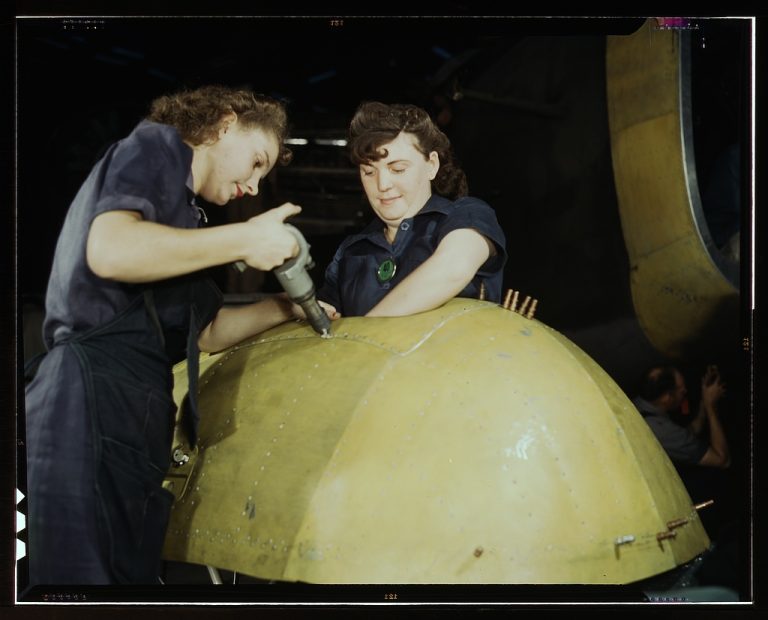
Some of the most famous American home-front photographs — women assembling aircraft, including the widely reproduced “Rosie the Riveter” images by Alfred T. Palmer — were taken on the Vultee Vengeance production lines at Nashville and Downey. The aircraft may be little remembered today, but its factory floors are among the most photographed of the war.
Those images did real work. At a moment when America was converting its industry and its workforce for total war, photographs of women building dive bombers at Nashville helped sell the idea of the arsenal of democracy — even if the particular aircraft they were building would soon be overtaken by events.
19 March 1943First blood over Burma
RAF Nos. 82 and 110 Squadrons open the Vengeance's combat account.
After forming on the type from October 1942, RAF Nos. 82 and 110 Squadrons flew the first Vengeance dive-bombing sorties against Japanese forces on 19 March 1943. It was the beginning of the only sustained combat career the type would have — and, against a thin Japanese fighter presence, it was where the aircraft finally made sense.
The squadrons had spent months working up on the type in India, wrestling with cooling troubles and the demands of accurate dive-bombing. When they finally went into action, they found a theatre almost tailor-made for them: targets that needed pinpoint attacks, and skies that Allied fighters could usually keep clear of the enemy.
In the diveStraight down the nose
Crews praised a sight-picture no shallow-diving aircraft could match.
With its zero-incidence wing, the Vengeance could be held in a genuine vertical dive, fuselage pointing straight at the target. Pilots aimed along the nose as if sighting a rifle, released low and pulled out hard. In the close, cluttered terrain of Burma that accuracy let crews drop bombs onto pinpoint targets metres from friendly troops.
That intimacy cut both ways. Getting bombs onto a bunker fifty metres ahead of one's own infantry demanded nerve, discipline and trust, and it made the back-seater's navigation and the pilot's dive discipline literally a matter of life and death for the men on the ground below.
1944Imphal and Kohima
Close support in the battles that broke Japan's invasion of India.
During the desperate fighting at Imphal and Kohima between April and July 1944, Vengeance squadrons delivered close air support against Japanese positions in the surrounding hills. Placing bombs accurately in that steep, jungle-covered country was work that a near-vertical dive bomber was uniquely suited to — and it helped the Allied ground forces hold.
Imphal and Kohima are remembered as the battles that broke the Japanese invasion of India, fought in appalling monsoon conditions. In that setting, an aircraft that could drop its load almost vertically onto a hillside strongpoint was worth a great deal — one of the clearest vindications the Vengeance ever received.
RAAFThe South-West Pacific war
Australia flew the largest Vengeance fleet against Japanese island targets.
The Royal Australian Air Force operated the largest Vengeance fleet — around 342 aircraft. RAAF squadrons, beginning with No. 12 Squadron, struck Japanese positions such as Selaru and the Tanimbar Islands from bases in the Northern Territory. Their last operational sorties came in early March 1944 before the type was withdrawn in favour of fighter-bombers and Liberators.
Australia's experience distilled the type's whole dilemma. The RAAF found the Vengeance accurate and useful, yet still chose to replace it, because the war now demanded aircraft that could do several jobs and defend themselves — things the single-minded dive bomber simply could not offer.
Free FrenchA disappointment in North Africa
Handed unmodified aircraft, French crews found them unreliable.
The Free French received a batch of Vengeances in North Africa but got aircraft that had not received the RAF's cooling and reliability modifications. Judged uneconomical to operate, most were grounded. It was a frustrating footnote — the type the French had originally wanted in 1940 arriving years late, and in a form they could not use.
BrazilAtlantic patrols
The Brazilian Air Force flew Vengeances on anti-submarine work.
Away from the main theatres, the Brazilian Air Force used a modest number of Vengeances — commonly given as somewhere around 29 to 33 aircraft — for coastal anti-submarine patrols over the South Atlantic. It was undramatic maritime work, far from the type's dive-bombing origins, but it kept a few Vengeances usefully employed.
Brazil's use is a reminder that the Vengeance's story is genuinely global: designed in California, ordered in Paris and London, built across three American factories, flown in anger over Burma and the Pacific, and pressed into maritime patrol over the South Atlantic. Few aircraft of its size travelled so far in reputation and role.
Second lifeFrom bomber to target tug
Hundreds ended the war towing gunnery sleeves, guns removed.
As the dive-bomber era closed, hundreds of surplus Vengeances — especially Mk IV / A-35B machines — had their armament stripped out and winches fitted to tow target sleeves. From April 1944 the type served the US Eighth Air Force in Britain in this role at gunnery and replacement training units. The USAAF flew Vengeances as target tugs until final retirement in April 1948.
The target-tug role kept the type flying for years after its combat relevance had ended — a quiet, useful afterlife that also explains why so many late-production airframes never fired a shot in anger.
HazardsHeat, cooling and ferry losses
Engine overheating and CG traps cost aircraft and crews.
Vengeance operations were dogged by engine cooling problems in tropical heat, and by handling dangers when the aircraft was flown light and tail-heavy — rear canopy open, no gunner aboard. Improper dive procedures in that configuration caused fatal accidents. The RAF's modification programme fixed much of it, but the type earned a reputation for demanding respect.
These hazards are part of the honest picture. The Vengeance was not a forgiving trainer of an aircraft; it was a specialised machine that punished shortcuts, and its accident record in ferrying and working-up reflects that as much as any enemy action.
TodayThe survivors: Camden and HARS
A complete airframe in New South Wales, and a restoration in progress.
Only a handful of Vengeances survive. The Camden Museum of Aviation in New South Wales displays a complete Vengeance IA, A27-99 (EZ999), and the Historical Aircraft Restoration Society holds components of A24-247 for a long-term restoration project in Australia. Reports of a return to airworthy condition should be treated as hopeful rather than confirmed — no Vengeance flies today.
For anyone who wants to stand next to one, Australia is the place: the Camden airframe is a rare survivor of a type that helped hold the line in Burma and then vanished from memory almost as quickly as it had appeared.
It is worth being clear, for anyone hoping otherwise, that no amount of enthusiasm changes the basic fact: there is no flying Vengeance to book a ride in, and there may never be. The type's memory is kept alive on the ground, in museums and archives and restoration workshops, rather than in the air.
The Vultee Vengeance in photographs
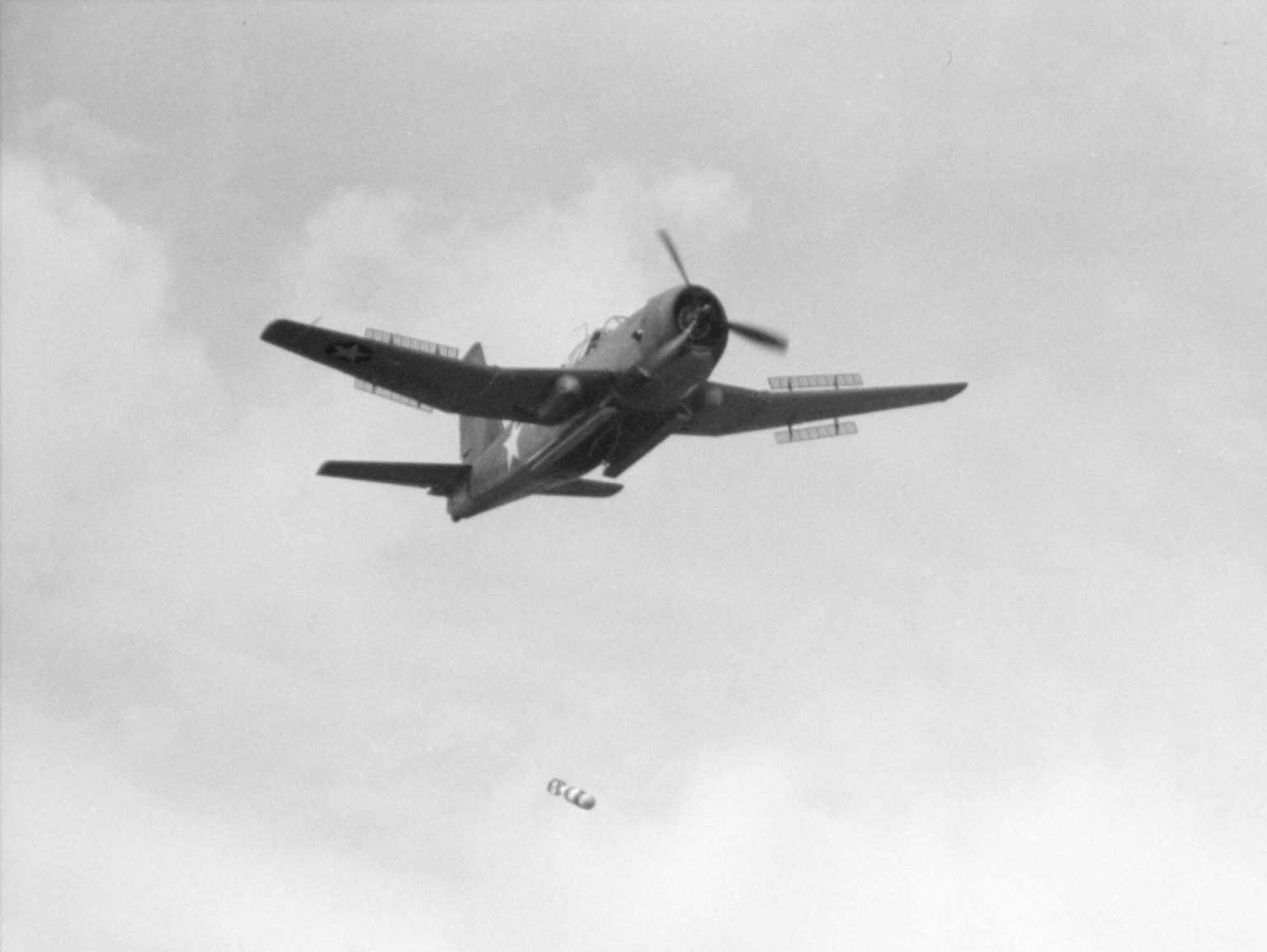
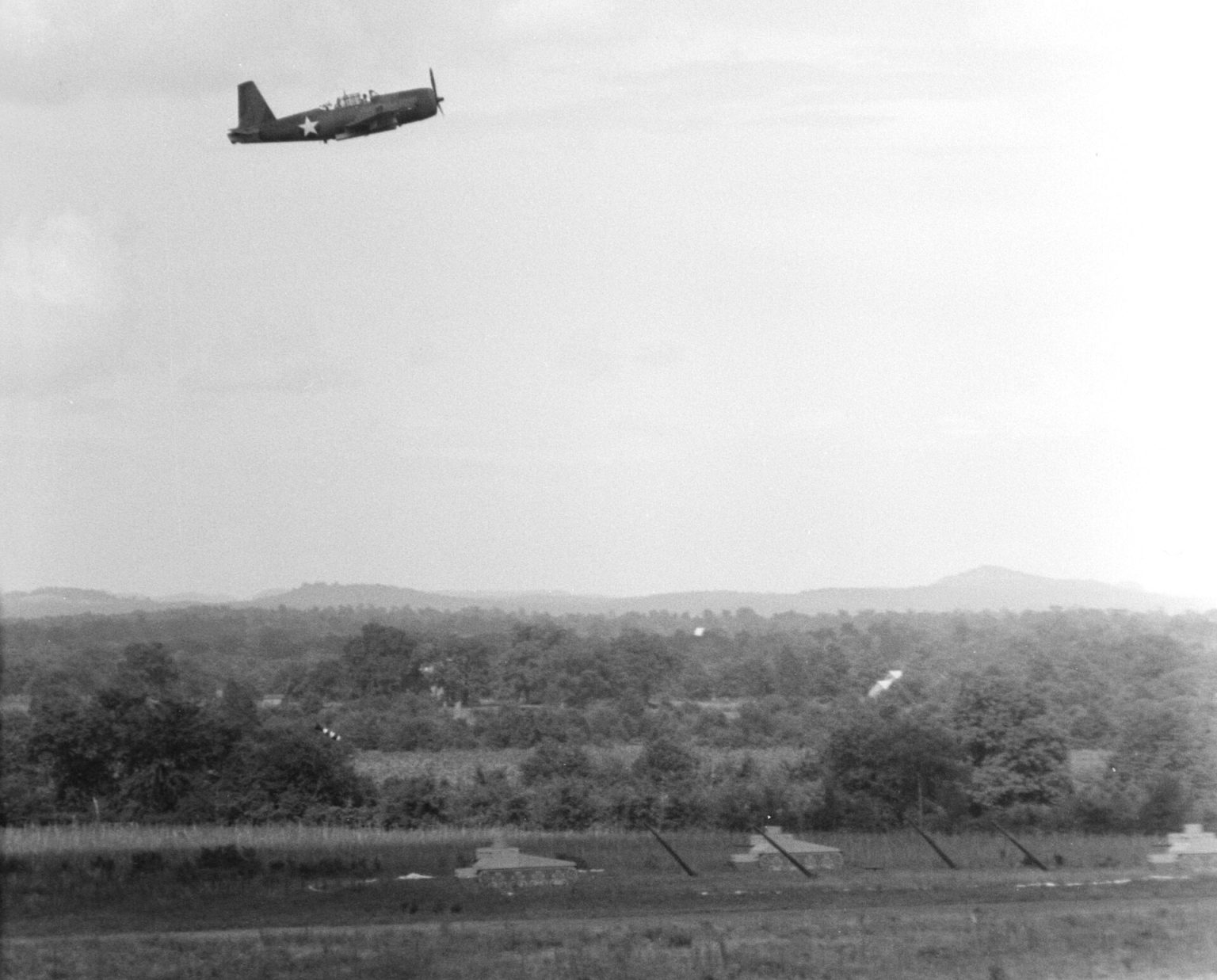
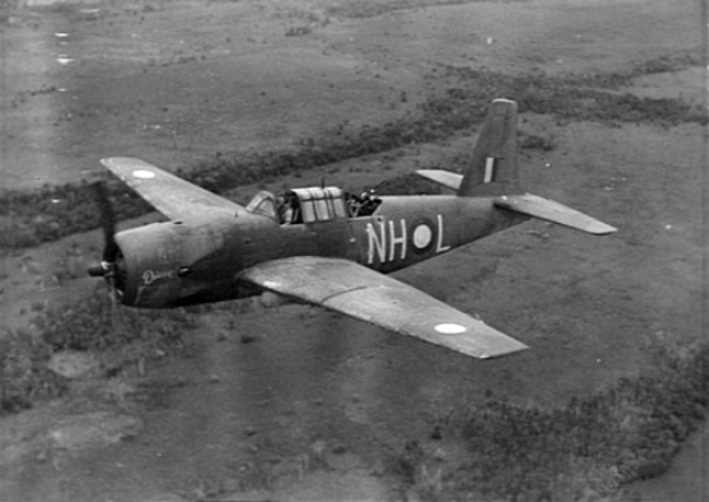
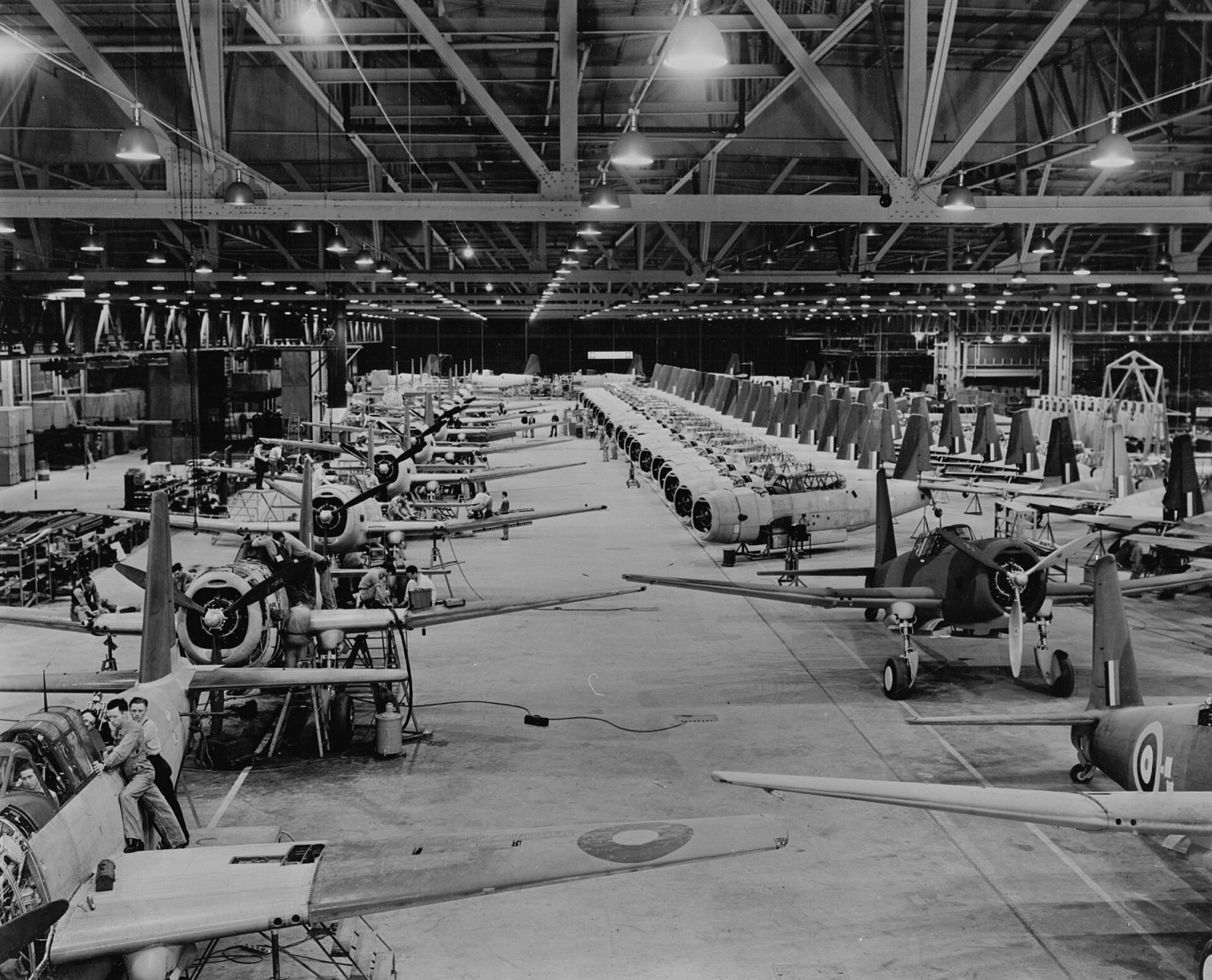
Wartime images of the Vengeance in the air, on the production line and in Commonwealth service. Click any photograph to enlarge. All images are public domain; credits are listed with each frame.
The surviving photographic record leans heavily toward the factory and the training field — a reflection of how much of the type's life was spent far from the front — but it also preserves striking images of Vengeances in the dive and in Commonwealth service. Read together, the pictures tell the same story as the text: an aircraft photographed most where it was safest, and fighting where the cameras rarely followed.
The Vultee Vengeance on video: a forgotten plane from a forgotten campaign
This documentary from the aviation-history channel IHYLS tells the Vengeance's full story — the export origins, the vertical-dive design and the Burma campaign that finally gave it a purpose.
We verified the video on YouTube before embedding it: an established aviation-history channel, a dedicated full-length treatment of the Vengeance rather than a clip, and a healthy view count for so obscure a subject. It is a good starting point for anyone who wants the type's story told at length and in context.
“Forgotten Plane From A Forgotten Campaign: Vultee A-31 Vengeance” — IHYLS (~87,000 views). Verified on YouTube before embedding.
Where the Vultee Vengeance was built, fought and survives
An overview of the Vengeance's global footprint: its American origin, the WWII theatres where it saw combat (above all Burma and the South-West Pacific), the air forces that operated it in other roles, and the countries where airframes survive today. Hover or tap a country for detail; toggle the categories below the map.
The map is deliberately organised around the Vengeance's unusual biography rather than a simple operator list. “Origin & Manufacturer” marks the United States, where every airframe was built. “WWII Combat Service” highlights the theatres where the type actually fought — Burma above all, plus the South-West Pacific and Brazil's Atlantic coast — rather than the home countries of the air forces involved. “Other Roles & Operators” gathers the six nations that flew it, including in target-tug and training roles, and “Surviving Airframes” points to Australia, where the last complete examples remain.
The Vultee Vengeance by the numbers
The Vengeance kept no dramatic scoreboard. It shot down no enemy aircraft to speak of, sank no famous ships, and fought in theatres where statistics were kept less obsessively than over Europe. Its record is one of production totals, fleet sizes and quiet effectiveness rather than headline victories — which is itself a fair summary of the type. The figures below sketch the scale of the programme and the shape of its short career.
The Vengeance was never credited with air-to-air victories — it was a bomber, not a fighter. Its record is written in accurate dive-bombing against ground targets in Burma and the South-West Pacific, not in kill tallies.
11The Vultee Vengeance in the Burma campaign: close support where accuracy mattered+
Burma was the making of the Vengeance, such as it was. The campaign against the Japanese in 1943–44 was fought over some of the most difficult country in the world — dense jungle, steep ridges, few roads, monsoon weather — and it placed a premium on hitting small, well-camouflaged targets close to friendly troops. That was precisely the task a steep, accurate dive bomber could do better than a level bomber or a fast fighter-bomber making a shallow pass.
RAF squadrons Nos. 82 and 110 led the way from the first sorties in March 1943, joined by Nos. 84 and 45 and by Indian Air Force / Royal Indian Air Force units including Nos. 7 and 8 Squadrons. Together they hammered Japanese supply dumps, bridges, river craft, bunkers and troop concentrations across the Arakan and along the central front. During the pivotal battles of Imphal and Kohima in the first half of 1944 — where the Japanese invasion of India was fought to a standstill and then broken — Vengeance close support helped Allied troops hold and then advance in terrain that gave the defenders every advantage.
The type's Achilles' heel was ever-present: it needed the sky more or less to itself. As long as Allied fighters kept the Japanese air force away, the Vengeance could work in peace and do real damage. The moment enemy fighters appeared, the slow dive bombers were in serious trouble. That the Burma theatre allowed the former condition more often than not is the main reason the Vengeance has any combat reputation at all — and even there, it was withdrawn by mid-1944 as newer aircraft and changing doctrine caught up with it.
12The Vultee Vengeance's second life as a target tug+
For a great many Vengeances, the war meant towing, not bombing. As the dive-bomber concept was abandoned in the West, the aircraft rolling out of the factories — especially the numerous Mk IV / A-35B machines — were surplus to any combat need almost from birth. Rather than waste them, the Allies put them to a humble but genuinely useful task: target towing for gunnery training.
Armament was stripped out and cable winches were fitted, often in the rear fuselage, to stream a fabric target sleeve behind the aircraft. Fighter pilots and air gunners then practised deflection shooting against the towed sleeve. From April 1944 a batch of Vengeance Mk IV aircraft supplied to the US Eighth Air Force in Britain took up exactly this role at combat crew replacement centres and fighter bases; some retained their British markings and serials. By the middle of 1944 numerous RAF stations held A-35B airframes as tugs.
It is a strangely fitting end for the type. An aircraft built to a doctrine that had passed found its longest-lasting employment not in delivering ordnance but in helping other pilots learn to shoot — and it stayed on that duty, in USAAF hands, right up to its final retirement in April 1948, years after the guns of the war it was designed for had fallen silent.
Seen from the gunnery ranges of 1946 or 1947, the Vengeance had become something almost poignant: a dive bomber that no longer dived on anything, earning its keep by flying straight and level so that others could practise. It is not the ending anyone imagined for it in the anxious summer of 1940, but it is the one the type actually got.
13The surviving Vultee Vengeances: what is left, and where+
Very few Vengeances survive, which is unsurprising for a type built in modest numbers, used in secondary theatres, and scrapped in bulk once the war ended. The best-known survivor is a complete Vengeance IA, serial A27-99 (RAF serial EZ999), preserved and displayed at the Camden Museum of Aviation in Narellan, New South Wales — a rare chance to see the type's distinctive zero-incidence wing and deep fuselage in the metal.
In addition, the Historical Aircraft Restoration Society (HARS) in Australia holds components of another airframe, generally identified as A24-247, with a view to long-term restoration. Reports occasionally circulate that a Vengeance is being returned to airworthy condition; these should be treated with caution. Restoring any rare warbird to flight is a project measured in decades and often never completed, and as of now no Vultee Vengeance anywhere in the world is airworthy. The honest position is that survivors exist as static museum and restoration pieces, and that seeing one on the ground is the closest anyone can currently get to the aircraft.
This is exactly why the Vengeance cannot be offered as a flying experience. Where MiGFlug can put you in the cockpit of aircraft that survive in flyable numbers — jet trainers, Cold War fighters and a handful of piston warbirds — the Vengeance belongs to the other category: types that exist today only as museum exhibits and long-term projects. To experience the era it came from, the closest realistic option is a flight in a genuine, airworthy warbird of the period, which is a real and bookable thing even though a Vengeance ride is not.
Beyond complete airframes, fragments, instruments and relics — many recovered from Australian and Burmese crash sites — are held in museum collections and by enthusiasts, and photographic archives such as those of the Australian War Memorial and the San Diego Air & Space Museum preserve a rich visual record of the type in service.
14The squadrons and airmen who flew the Vultee Vengeance+
The Vengeance was a Commonwealth aircraft in practice, and the units that flew it in anger reflect that. On the RAF side, Nos. 82, 110, 84 and 45 Squadrons carried the type through the Burma campaign, converting from other aircraft and learning the exacting discipline of accurate dive-bombing in tropical conditions. Alongside them flew Indian squadrons — including Nos. 7 and 8 of the Indian Air Force / Royal Indian Air Force — whose crews were fighting, in many cases, to defend their own country's frontier at Imphal and Kohima.
In the South-West Pacific the Royal Australian Air Force fielded the largest force of all, its squadrons beginning with No. 12 and striking Japanese island positions from the Northern Territory. The men who crewed these aircraft — a pilot up front managing the dive, an observer/gunner behind navigating and watching the sky — worked in a machine that demanded precision and offered little forgiveness. Their war was fought far from the headlines, in a theatre the British public later called the “forgotten front,” and their aircraft has been forgotten along with it.
For Indian aircrew in particular there is an added significance. Flying Vengeances in the defence of Imphal and Kohima, they were among the airmen helping to stop a Japanese invasion of the Indian subcontinent itself — a chapter of the war in which the type, obscure as it is elsewhere, played a genuinely meaningful part.
It is worth remembering that for these crews the Vengeance's obsolescence in Western doctrine was an abstraction. What mattered to them was whether the aircraft could put a bomb where the army needed it, and by most Commonwealth accounts it could — which is why, for all its faults, the men who flew it in Burma tended to speak of it with a certain respect.
That respect is a useful corrective to the type's obscurity. History has largely forgotten the Vengeance, but the people who actually depended on it — the aircrew who flew it and the soldiers whose advances it covered — did not regard it as a joke or a failure. They regarded it as a tool that, used correctly and in the right place, did a hard job well.
15Why the Vultee Vengeance is so little remembered today+
Plenty of Second World War aircraft were built in larger numbers and did less; yet the Vengeance has slipped almost entirely out of popular memory. Several things conspired to make it so. First, its theatre: Burma and the South-West Pacific were the war's least-reported fronts, and an aircraft that fought there almost exclusively had little chance of entering the public imagination the way the Spitfire, Lancaster or Mustang did.
Second, its timing: the Vengeance arrived just as the dedicated dive bomber was being written off, so it never got a signature victory to be remembered by. There was no Vengeance equivalent of the Dauntless at Midway — no single day on which the type visibly changed the course of a battle in a way history would record. Its contribution was cumulative, distributed across hundreds of unglamorous close-support sorties.
Third, its fate: a large share of the production run never saw combat at all, going straight to target-towing, and the survivors were scrapped quickly after 1945. With few airframes preserved and those mostly in Australia, there has been little physical presence to keep the type in view. The result is an aircraft that is historically interesting precisely because it is forgotten — a case study in how doctrine, geography and luck decide which machines become legends and which vanish.
16The Vultee Vengeance and the death of the dedicated dive bomber+
The Vengeance's career is, in miniature, the story of how the dedicated land-based dive bomber lived and died within about five years. In 1939 the concept looked like the future of tactical air power. By 1944 it was finished, at least in the West, and the Vengeance's relegation to target-towing is one of the clearest markers of that shift.
What replaced it was the fighter-bomber — and the logic was overwhelming. A single aircraft that could carry bombs or rockets, hit a target with reasonable accuracy in a shallow dive, and then either fight or run gave commanders far more flexibility than a specialist that could only dive-bomb and could not survive without an escort. As Allied fighters gained the power to carry meaningful ordnance, the case for a separate dive bomber collapsed. The dive-bombing mission did not disappear; it was simply absorbed into aircraft that could do other things too.
Naval dive bombers lingered a little longer, because attacking ships remained a specialised task, but even there the writing was on the wall. Seen in that light, the Vengeance was not so much a failure as a casualty of progress — a competent aircraft built to a template that the war rendered obsolete faster than anyone in 1940 could have guessed. That is why it repays study: it marks, almost to the year, the end of an entire class of combat aircraft.
17The Vultee Vengeance's place in aviation history: an honest verdict+
How should the Vengeance be judged? Not as a war-winner, and not as a failure either. The fairest verdict is that it was a competent, even excellent, execution of an idea that the war made obsolete. As a pure dive-bombing machine it was accurate and effective; the crews who used it in Burma valued it, and the ground troops it supported had good reason to be grateful for its precision in country where precision was everything.
Its weaknesses were real and are worth stating plainly: it was slow, poorly suited to self-defence, hampered early on by cooling troubles, awkward to see out of on the approach, and dependent on friendly air superiority to operate at all. But most of these were not defects of workmanship — they were the inevitable price of building a specialist dive bomber, and they would have been forgiven had the mission itself remained central. It did not.
That distinction — between an aircraft that is badly made and one that is well made for a job nobody needs any more — is the single most important thing to understand about the Vengeance, and it is why the type rewards a closer look than its reputation would suggest.
So the Vengeance's true significance is as a marker. It shows, more clearly than almost any other aircraft, the exact moment when the dedicated land-based dive bomber ceased to make sense — ordered in the concept's heyday, delivered as it collapsed, and retired towing targets. For the historian and the enthusiast alike, that makes it far more interesting than its modest fame suggests: a well-made answer to a question the war had already stopped asking, and a small, honest window onto how fast the air war changed.
Few aircraft illustrate so neatly that a machine can be both good and obsolete at once. The Vengeance was not beaten by a better dive bomber; it was beaten by a better idea — the multi-role fighter-bomber — that made its entire specialty redundant. Understanding that is worth more than any single performance figure, and it is why the type still earns its place in a serious aircraft museum despite never becoming a household name.
18The Vultee Vengeance and MiGFlug: why you can fly a warbird but not this one+
People discovering the Vengeance for the first time often ask a natural question: can I fly in one? The honest answer, given in full elsewhere on this page, is no — there is no airworthy Vengeance anywhere, and MiGFlug does not and cannot offer flights in the type. It survives only as museum airframes and long-term restoration projects, chiefly in Australia.
That is not the end of the story for anyone drawn to the era, though. The whole point of the MiGFlug Aircraft Museum is to tell the stories of aircraft you cannot fly — and then to point you toward the ones you can. Where a rare type like the Vengeance has vanished from the skies, other genuine military aircraft of the propeller and early-jet age remain airworthy and bookable, flown by professional display and warbird operators. A flight in one of those is the closest a modern enthusiast can get to the sensations the Vengeance’s crews knew: the weight of a real combat aircraft, the noise, the g of a hard manoeuvre.
So this page ends where the museum always does — with the truth about the exhibit, and a door to a real experience. You can read the Vengeance’s story here; and when you want to actually get airborne in a piece of aviation history, the current, verified options are gathered at migflug.com/flights-prices. No false promises about the Vengeance itself — just the honest history, and a real way to fly.
Vultee Vengeance: your questions answered
Vultee Vengeance: your questions answered
Common questions about the Vultee A-31 / A-35 Vengeance — what it was, who flew it, why the United States barely used it, and whether you can fly one today.
Can I fly in a Vultee Vengeance?+
No. Only a handful of Vengeances survive anywhere in the world, all of them in museums or under long-term restoration, and none is airworthy or available to fly. MiGFlug does not offer Vengeance flights, and you should treat any claim that you can fly one as mistaken.
However, you can fly in genuine military aircraft today. MiGFlug arranges cockpit experiences in real, flyable warbirds and Cold War jets — from piston trainers to supersonic fighters. Browse the current options at migflug.com/flights-prices.
What exactly was the Vultee Vengeance?+
The Vultee Vengeance (company Model V-72; US designations A-31 and A-35) was an American single-engine, two-seat dive bomber of the Second World War. It was powered by a Wright R-2600 Twin Cyclone radial of around 1,600–1,700 hp, carried a crew of two, used perforated dive brakes, and could deliver up to about 680 kg (1,500 lb) of bombs in a steep dive.
Who actually flew the Vengeance in combat?+
Its real combat career was in the Far East. The Royal Air Force, Royal Australian Air Force, Indian Air Force and Royal Indian Air Force flew Vengeances very effectively as accurate dive bombers in the Burma campaign against Japan in 1943–44, including close support during the Arakan campaigns and the battles of Imphal and Kohima. The Free French operated a small, largely grounded batch in North Africa, and Brazil used a few for coastal anti-submarine patrols.
Why did the United States barely use it?+
Because it was never really an American aircraft. The Vengeance was designed to a French and then British requirement for a dedicated dive bomber; the USAAF took A-31 and A-35 examples somewhat reluctantly. By the time they arrived in numbers in 1942–43, the dedicated dive bomber had fallen out of favour in Western air forces, which were switching to fighter-bombers. Most US Vengeances were therefore relegated to target-tug and training duties, a role the type filled until 1948.
What made its vertical dive special?+
The wing was set at roughly zero (or slightly negative) incidence, so that in a true 90-degree dive the fuselage hung vertically with the nose pointed straight at the target. The pilot could sight along the nose for an excellent aiming picture, giving the Vengeance a reputation for accurate dive-bombing. The trade-off was a nose-up attitude in cruise and landing that hurt forward visibility; the A-35 added about 4 degrees of wing incidence to ease that, at some cost to dive accuracy.
How many were built, and how many survive?+
Production is usually given as around 1,931 aircraft across all marks and factories between 1941 and 1944, although figures vary between sources. Only a few complete airframes survive today — notably a complete Vengeance IA at the Camden Museum of Aviation in New South Wales — with additional components held for restoration by the Historical Aircraft Restoration Society in Australia. No Vengeance is currently airworthy.
Was the Vengeance a good aircraft?+
It depends on when and where you judge it. As a dive bomber it was genuinely accurate and did valuable work in Burma, where its steep, precise attacks suited the terrain and the light fighter opposition. But it was slow, vulnerable to fighters, needed escort and local air superiority, and embodied a doctrine the Western Allies were already abandoning. It is best understood as a capable aircraft that arrived just as its whole category was becoming obsolete — under-appreciated, often relegated to target-towing, yet effective in the one theatre that fitted it.
In short: a good aircraft, in the wrong decade, remembered by almost no one except the men whose war it quietly helped to win in a corner of the world the history books tend to skip.
No Vengeance is airworthy — but genuine warbird flights are real
Only a handful of Vengeances survive, all in museums or under restoration, and none is available to fly. But MiGFlug does put you in the cockpit of real, flyable military aircraft — piston warbirds and Cold War jets alike. Here are a few you can actually book.
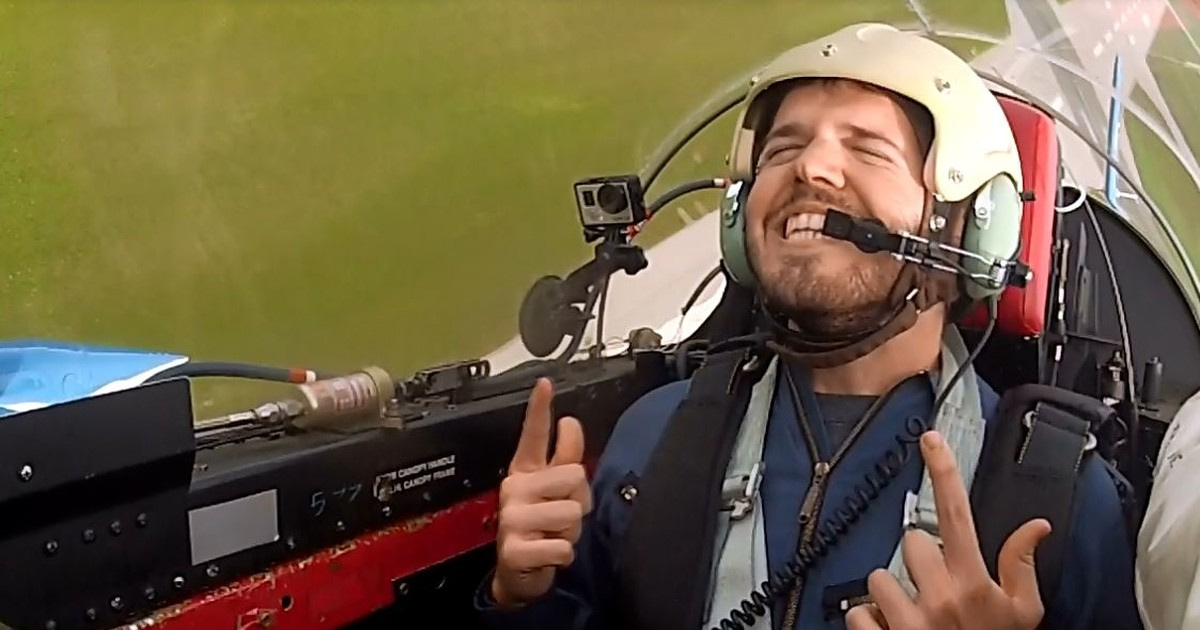
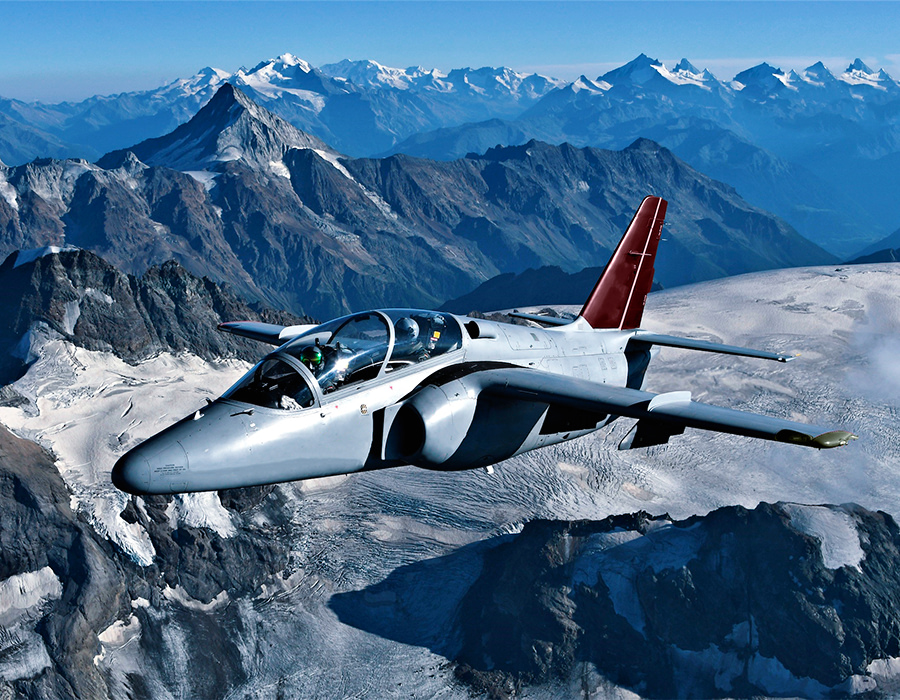
Other dive bombers in the Book of Beasts
Other dive bombers in the Book of Beasts
The Vengeance belongs to a small, short-lived class of purpose-built dive bombers. Explore its closest relatives — the aircraft that inspired it, the naval dive bomber that outshone it, and the type that succeeded it — elsewhere in the Book of Beasts.