
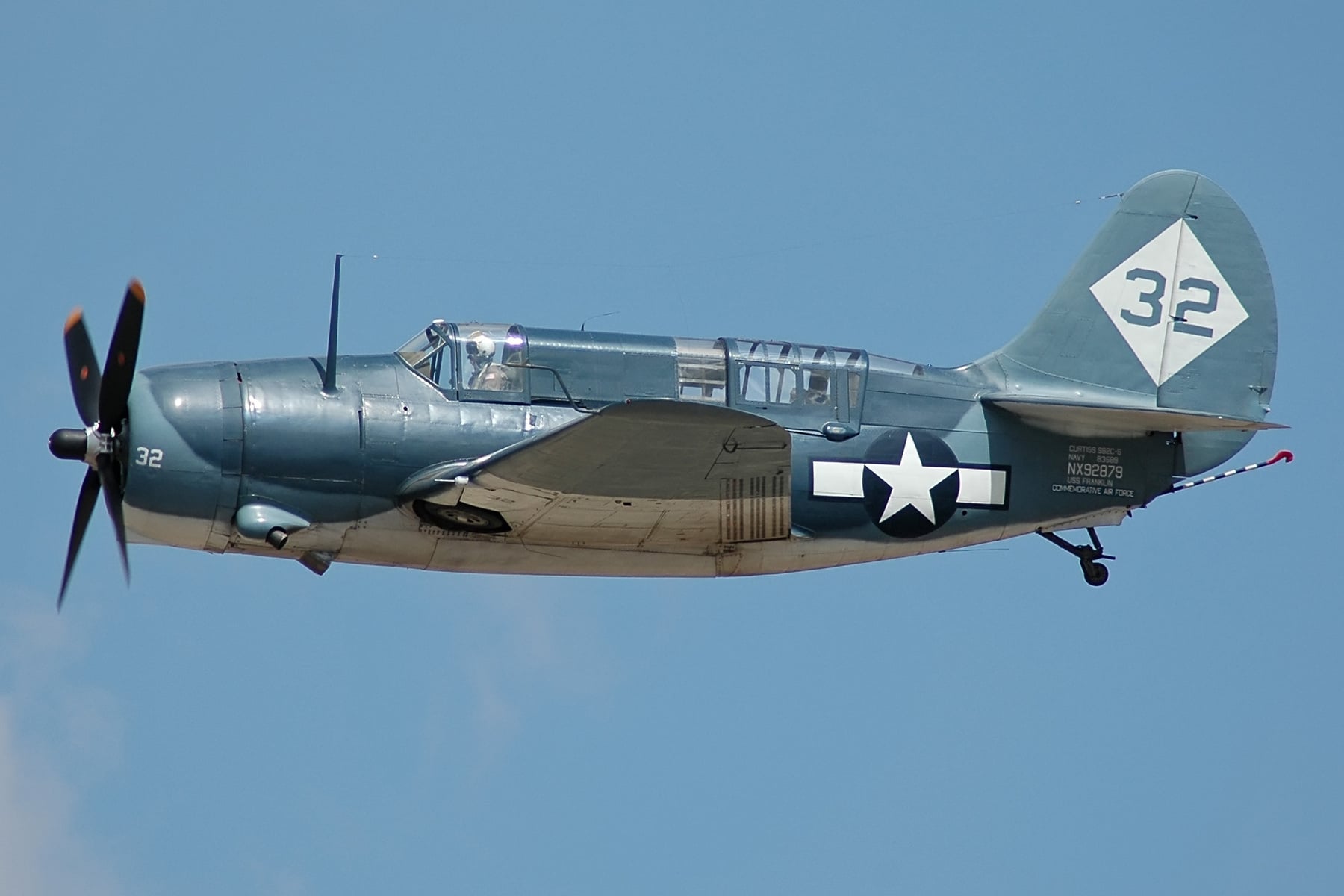
SB2C Helldiver
“The Beast” that sank the battleships
The US Navy’s troubled carrier dive bomber — cursed by its crews, plagued in development, and yet the aircraft that helped send the super-battleships Yamato and Musashi to the bottom.
The Helldiver: from “The Beast” to battleship-killer
By the early 1940s the US Navy needed a new dive bomber. The Douglas SBD Dauntless had won the Battle of Midway and was loved by its crews, but it was small and slow, and the Navy wanted something that could carry a heavier load faster and further — and still fit two aircraft on a carrier deck-edge elevator. Curtiss won the contract with the SB2C Helldiver.
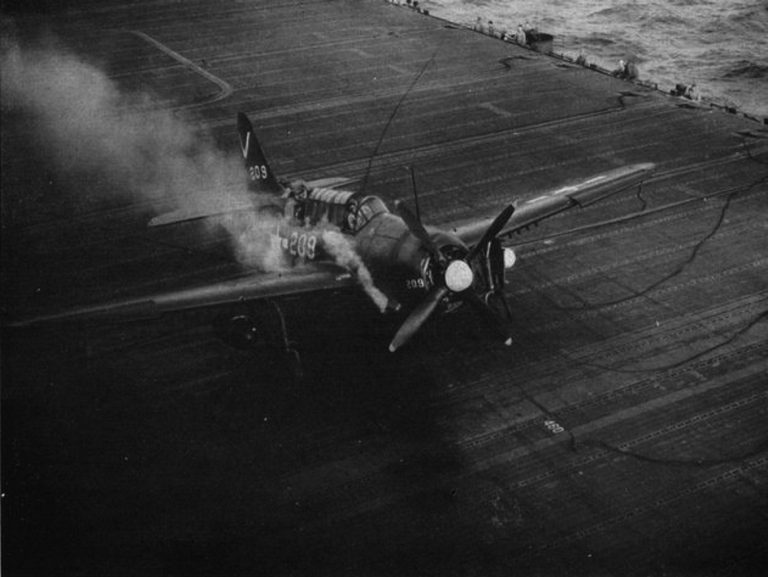
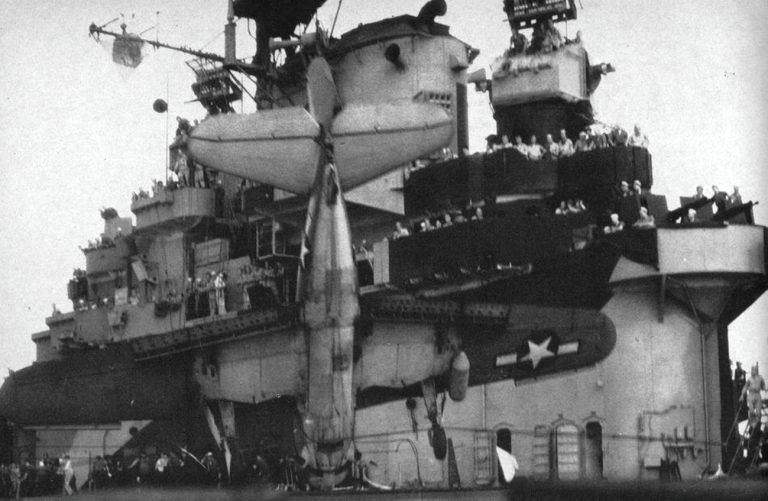
Its development was a nightmare. The prototype crashed, the aircraft came out overweight and unstable, its structure was too weak, and its handling — especially at low speed near the carrier — was treacherous. The Navy demanded some 880 modifications before it would accept the type, and crews gave it names to match: “The Beast,” and, punning on its designation, “Son of a Bitch, 2nd Class.”
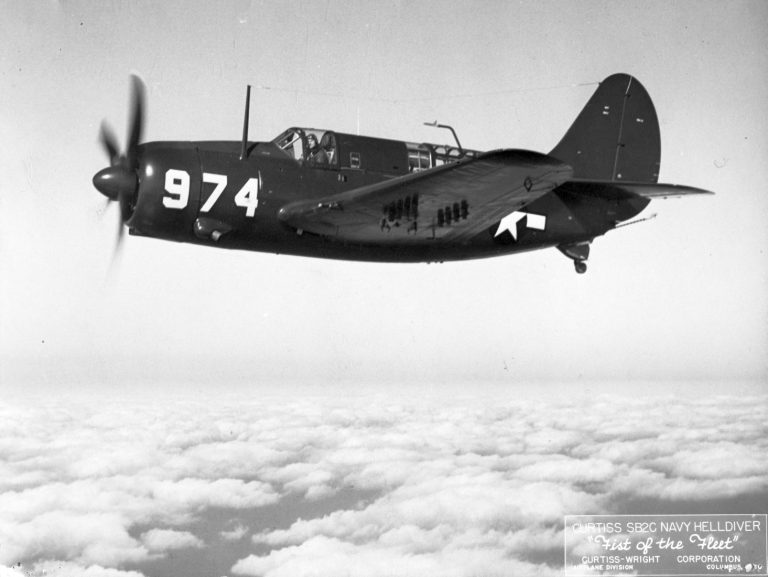
And yet, once the worst of the bugs were worked out, the Helldiver delivered what the Navy had asked for. It carried its bombs internally, mounted 20 mm cannon in the wings, and could haul a heavier load faster and further than the Dauntless it replaced. From late 1943 it became the US Navy’s standard carrier dive bomber.
Helldivers were at the heart of the great Pacific carrier battles of 1944–45 — the Marianas “Turkey Shoot,” the vast clash at Leyte Gulf, the strikes on the Japanese home islands. Most famously, Helldiver dive bombers helped sink the two largest battleships ever built: the Musashi in 1944 and her sister, the Yamato, in 1945.
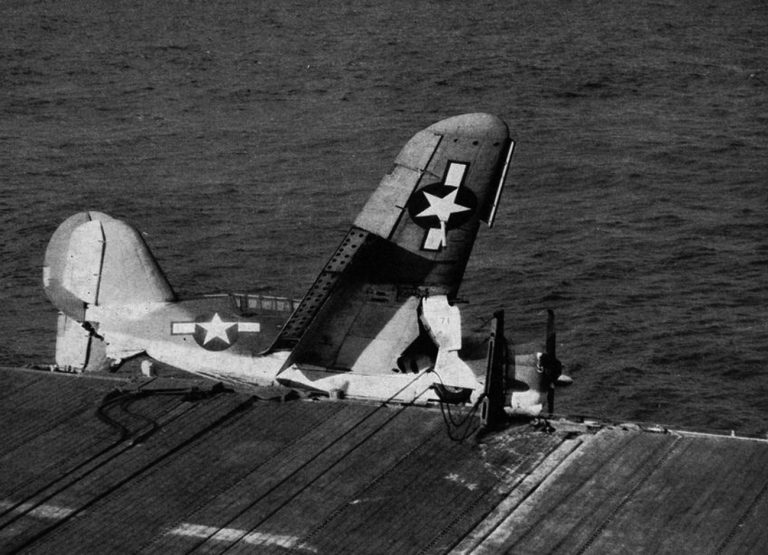
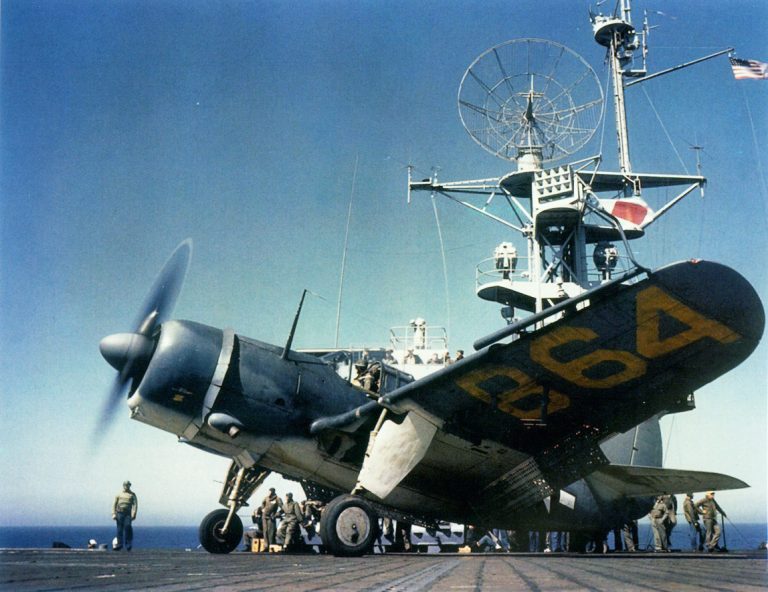
It was very much a machine of its moment: a two-man aircraft with a pilot and a rear gunner, a perforated dive brake for near-vertical attacks, and wings that folded for the crowded carrier deck. The Helldiver was the last of the classic American carrier dive bombers — a breed that the war itself was already making obsolete.
Some 7,140 were built, including Canadian production. After the war the type served with France, Italy, Greece and others before the US Navy retired it in 1947, as the pure dive bomber gave way to multi-role attack aircraft. A single Helldiver still flies today, preserved by the Commemorative Air Force.
01Why the Helldiver mattered: a troubled aircraft that still did the job
The SB2C is remembered as much for its flaws as its feats, and both are real. It was genuinely difficult and disliked, and a better-developed aircraft might have reached the fleet sooner and killed fewer of its own crews in accidents. But it also arrived exactly when the US Navy’s carrier striking power was reaching its peak, and it carried that striking power to the enemy’s heaviest ships.
The Helldiver is a reminder that war rarely waits for perfection. An imperfect aircraft, available in numbers and flown by superbly trained crews, helped win the Pacific carrier war — and then quietly bowed out as the technology of naval air power moved on.
How Curtiss tried to out-do the Dauntless
Bigger, but boxed in
The Helldiver was designed to carry more bombs faster and further than the SBD Dauntless — but it also had to fit two aircraft on a carrier deck-edge elevator. Squeezing a heavier, more powerful aircraft into that footprint drove a stubby, deep fuselage and folding wings, and helped make the early SB2C overweight and awkward.
Bombs inside, cannon outside
Unusually for a dive bomber, the Helldiver carried its main load in an internal bomb bay — up to 2,000 lb, or a torpedo — keeping it clean in the dive. Two 20 mm cannon in the wings gave it real strafing punch, backed by a rear gunner to fend off fighters.
“The Beast”
The early SB2C was structurally weak and unstable, and dangerous to handle at the low speeds of a carrier approach. The US Navy demanded roughly 880 modifications before it would accept the aircraft — and crews, unimpressed, nicknamed it “The Beast” and worse.
02The dive brakes and the vertical attack
Dive bombing demanded that an aircraft point almost straight down at a target, hold a steady aim through a screaming dive, and then pull out low without tearing off its wings or flying into the sea. The Helldiver used perforated split flaps as dive brakes, holding its speed in check so the crew could aim precisely before releasing and hauling out.
Done right, it was devastatingly accurate — accurate enough to plant heavy bombs onto the decks of manoeuvring warships. It was also physically brutal and utterly unforgiving of mistakes, which is part of why the Helldiver’s early structural weaknesses were taken so seriously.
Curtiss SB2C Helldiver — by the numbers
Baseline note: the figures below describe the SB2C-4, the most numerous mark at 2,045 built and the aeroplane that flew most of the dive-bombing at Leyte Gulf, Iwo Jima and Okinawa. Deltas for the XSB2C-1 prototype, the SB2C-1 and SB2C-1C, the SB2C-3, the SB2C-5 and the land-based A-25A Shrike are given in grey. Curtiss quoted performance for a clean aeroplane at a 16,616 lb gross; squadron machines in 1944 flew heavier, with radar, rocket rails and a full gunner’s load. Most published tables reprint a single performance column across marks whose engines differed by 200 hp and whose propellers differed by a blade, so where a figure belongs to one mark it is named here.
Dimensions & weights
- Crew
- 2 — pilot, and a radioman-gunner facing aft who worked the ASB radar, the radio and the twin flexible guns (the A-25A Shrike kept the two seats but lost the naval equipment; nothing on the type was ever flown single-seat)
- Length
- 11.18 m (36 ft 8 in) — the fuselage was lengthened and the fin enlarged after the first prototype was written off in February 1941, and it was still too short: the length that would have cured the longitudinal instability was the length that would not let two aeroplanes share an Essex-class lift
- Wingspan
- 15.16 m (49 ft 9 in), hydraulically folded upward outboard of the main gear for stowage
- Height
- 4.01 m (13 ft 2 in). Several widely copied tables print 5.16 m (16 ft 11 in) instead, which is the height with the wings folded vertically — a common source of disagreement between compilations
- Wing area
- 39.2 m² (422 sq ft); the design began at about 35.8 m² (385 sq ft) and the wing was enlarged during development to carry the weight the Navy kept adding
- Aspect ratio
- 5.8, straight taper with rounded tips
- Aerofoil
- NACA 23017 at the root, NACA 23009 at the tip — a conventional mid-1930s section, not a laminar-flow wing
- Internal bomb bay
- one enclosed bay with powered doors, rated at 907 kg (2,000 lb) — the feature that justified the whole aeroplane, and the reason the fuselage was so deep
- Empty weight
- 4,784 kg (10,547 lb)
- Gross weight
- 7,537 kg (16,616 lb) — against 4,245 kg (9,359 lb) for the SBD-5 Dauntless it replaced. The Helldiver was very nearly two Dauntlesses
- Weight growth
- about 42 per cent above the design figure, the cumulative price of some 880 changes the Navy demanded before it would accept the aeroplane — self-sealing tanks, armour, heavier armament, more fuel, a bigger tail. Every one of them was defensible on its own; together they produced an aeroplane that was underpowered until 1944
- Wing loading
- 192 kg/m² (39.4 lb/sq ft) at gross — against 141 kg/m² (28.8 lb/sq ft) for the SBD-5. This single comparison explains most of what carrier pilots disliked about the Helldiver
- Power loading
- 3.97 kg/hp (8.7 lb/hp) on the 1,900 hp R-2600-20; on the 1,700 hp engine of the SB2C-1C it was 4.43 kg/hp (9.8 lb/hp), which is the arithmetic behind the early aeroplane’s reputation
Performance
- Maximum speed
- 475 km/h (295 mph, 256 kn) at 5,090 m (16,700 ft)
- Maximum speed, sea level
- 435 km/h (270 mph, 235 kn)
- Against what it replaced
- the SBD-5 Dauntless managed 410 km/h (255 mph) — so the Helldiver was about 65 km/h (40 mph) faster while carrying roughly twice the ordnance a Dauntless normally took to sea. That was the whole case for the aeroplane, and it was a real one
- Cruising speed
- 254 km/h (158 mph, 137 kn)
- Carrier approach speed
- about 157 km/h (98 mph, 85 kn) — and the ailerons went sloppy below roughly 90 kn. The aeroplane was at its worst precisely where a carrier pilot needed it to be at its best
- Rate of climb
- 9.1 m/s (1,800 ft/min); the SB2C-1C on the smaller engine and three-blade propeller was appreciably worse, which is why deck-launch performance was an early complaint
- Service ceiling
- 8,870 m (29,100 ft)
- Combat range, 1,000 lb bomb
- ~1,875 km (1,165 miles)
- Scouting range, clean
- ~3,049 km (1,895 miles) on internal fuel in the search role
- The range question
- the SBD-5’s combat range was 1,794 km (1,115 miles), so the mature Helldiver was barely 5 per cent better carrying twice the load. Aircrew nonetheless insisted the Helldiver had less reach, and for the SB2C-1C on the earlier engine they were right — it drank more for the same tankage. The claim that the type flew "further" than the Dauntless holds only for the -3 and later, and only just
- Dive
- bombing dives of about 70° behind perforated split flaps opened above and below the wing; the second prototype was destroyed on 21 December 1941 when a wing failed during dive testing, and dive-recovery structural limits shadowed the programme into service
- Endurance in practice
- on 20 June 1944 at the Philippine Sea, 51 Helldivers were launched near the limit of their radius in the late afternoon; roughly 43 to 45 of them were lost, almost all to fuel exhaustion in the dark rather than to enemy action — the single worst day in the type’s history, and a fault of the mission rather than of the aeroplane, though the two are hard to separate
Propulsion & systems
- Engine
- 1 × Wright R-2600-20 Twin Cyclone, 14-cylinder two-row air-cooled radial, 1,900 hp (1,417 kW) for take-off — fitted from the SB2C-3 of 1944 onward and the change that finally made the aeroplane adequate
- Earlier marks
- Wright R-2600-8, 1,700 hp (1,268 kW) in the XSB2C-1, SB2C-1, SB2C-1C and the A-25A Shrike. The XSB2C-6 pair of 1945 tested the 2,100 hp (1,566 kW) R-2600-22; it went no further
- Engine data
- 42.67 litres (2,604 cu in), bore 155.6 mm and stroke 160.3 mm (6 1/8 in × 6 5/16 in), compression 6.9:1, single-stage two-speed centrifugal supercharger, dry weight about 928 kg (2,045 lb)
- Propeller
- Curtiss Electric four-blade constant-speed, 3.70 m (12 ft 2 in) diameter, from the SB2C-3; the SB2C-1 and -1C had a three-blade unit that could not absorb the power the aeroplane needed
- Fuel
- ~1,210 litres (320 US gal) internal on the SB2C-1C and SB2C-4, raised to ~1,340 litres (353 US gal) on the SB2C-5; up to ~2,470 litres (653 US gal) with a bay tank and drop tanks for long searches
- Dive brakes
- split flaps in the trailing edge, the upper and lower halves opening together as an airbrake and the lower half alone serving as a landing flap; the panels were perforated to break up the wake that had been buffeting the tail — a fix inherited from the SBD and applied here after the fact
- Flap actuation
- electric on the SB2C-1, hydraulic from the SB2C-1C onward — one of many places where the aeroplane’s reliance on electrical actuation was walked back
- Electrical system
- unusually extensive electric actuation for 1943, and unusually unreliable; poor quality control at a brand-new plant turned a design weakness into a maintenance crisis, and squadron availability suffered accordingly
- Carrier equipment
- hydraulic upward wing fold, arrester hook, catapult points and provision for a bay-mounted auxiliary tank; on the SB2C-5 the hook was left fixed in the extended position, a small admission that the retraction mechanism was more trouble than it saved
- Radar
- ASB search radar with yagi aerials under the outer wings as standard equipment; the SB2C-3E and SB2C-4E carried AN/APS-4 in a wing-mounted pod instead. The SB2C-5 deleted ASB
- Protection
- self-sealing fuel tanks and armour for both crew members, all of it added at Navy insistence after the prototype flew — and all of it part of the 42 per cent weight growth
- Production
- 7,140 is the total normally quoted for 1942–1945, of which 1,194 were built in Canada — though the published variant totals sum to about 7,200 (5,106 Curtiss naval machines, 900 A-25As, 300 by Fairchild and 894 by Canadian Car and Foundry), so the round figure and the itemised figures do not quite agree
03A big, complicated family
The Helldiver went through a long line of marks, from the early, troublesome SB2C-1 to the refined SB2C-5, plus Canadian-built SBW and SBF versions and a land-based US Army variant, the A-25 Shrike. Weights, equipment and armament shifted across the run, so the figures above are representative of the mature carrier Helldiver rather than any single sub-type.
Armament & payload
The Helldiver was an internal bomb bay with an aeroplane wrapped round it
Everything that was wrong with the SB2C followed from the one thing that was right about it: a 2,000 lb enclosed bay, twice what the Dauntless normally carried, on an airframe short enough for two to share an Essex-class lift. To get the bay, Curtiss accepted a deep fuselage, a high wing loading and a tail arm that was never long enough. The offensive fit was genuinely superior to the aeroplane it replaced — two 20 mm cannon in the wings from the SB2C-1C onward instead of the Dauntless’s pair of rifle-calibre-plus Brownings, a bay that swallowed a 1,600 lb armour-piercing bomb, wing racks that took 1,000-pounders or eight 5-inch rockets from the SB2C-4.
The defensive fit was ordinary and stayed ordinary: twin 0.30-inch flexible guns on a folding mount in the rear cockpit, the same calibre the Navy had been putting behind dive-bomber crews since the mid-1930s. Radioman-gunners were credited with 41 aerial victories across the war, a figure that is almost certainly generous. The type flew 18,808 combat sorties and was credited with sinking or damaging some 301 Japanese vessels, including shares in Musashi at Leyte Gulf and Yamato off Okinawa — a record that reads nothing like the reputation. Fits varied widely by mark and operator: the SB2C-1 had four 0.50-inch wing guns and one rear gun, the -1C substituted cannon, the -4 added rocket rails, and the Greeks bolted underwing gun pods onto their SB2C-5s for a war the aeroplane was never designed to fight.
Gun
- Two 20 mm AN/M2 cannon in the wings, about 200 rounds per gun, standard from the SB2C-1C onward and on every Canadian-built and export machine
- The first 200 SB2C-1s instead carried four 0.50-inch Browning M2 machine guns in the wings — itself a doubling of the two guns originally specified
- Two 0.30-inch Browning M1919 flexible guns on a folding mount in the rear cockpit, roughly 2,000 rounds between them; a rifle-calibre defence against Zeros and, later, against flak-suppressed shipping
- Optional pods of four 0.50-inch guns under the wings, used chiefly postwar — the Royal Hellenic Air Force added them for ground attack in the Greek Civil War
- The A-25A Shrike, built for the USAAF, carried the same wing guns but no naval fittings; almost none of them fired a shot in anger
Air-to-air
- No air-to-air missile existed in United States service during the type’s war; this card belongs to the rear gunner
- Helldiver radioman-gunners were credited with 41 aircraft shot down — a total that says more about the Japanese pilots they met in 1944 and 1945 than about two 0.30-inch guns
- The wing cannon were used against aircraft only opportunistically; a loaded SB2C had no business manoeuvring with a fighter and its crews knew it
- The type was never a fighter-bomber in the way the F6F Hellcat and F4U Corsair became, and the rise of those aircraft in the strike role is precisely why the Navy stopped ordering dedicated dive bombers
Air-to-surface guided
- None. No guided weapon was ever fitted to an SB2C in operational service
- The card is kept because the Helldiver’s job was precision, delivered the hard way: a 70-degree dive behind perforated brakes, released low, by a crew trained for it
- The United States Navy’s wartime guided anti-ship weapon, the ASM-N-2 Bat glide bomb, went to the PB4Y-2 Privateer patrol bomber, not to the carrier dive bombers
- The one guided-weapon-shaped store the Helldiver could take was unguided: a single Mark 13-2 aerial torpedo in the bay. It was cleared and it was carried in trials, but torpedo work in a carrier air group belonged to the TBF and TBM Avenger and the Helldiver almost never did it
Bombs
- Internal bay: up to 907 kg (2,000 lb) — typically two 1,000 lb general-purpose or semi-armour-piercing bombs, or one 1,600 lb armour-piercing bomb for shipping, or four 500-pounders
- Wing racks: one 500 lb bomb under each wing on early marks; the SB2C-4 raised this to 1,000 lb a side, giving a nominal maximum around 1,360 kg (3,000 lb) that squadrons rarely carried from a deck
- Against Musashi on 24 October 1944 and Yamato on 7 April 1945 the Helldivers put semi-armour-piercing bombs into armoured decks that the fighters’ lighter stores could not have penetrated — the clearest demonstration of why the Navy had wanted a big dive bomber at all
- Depth bombs and smoke tanks were carried by the postwar European operators, whose Helldivers spent most of their lives hunting submarines rather than diving on ships
- The bay could take an auxiliary fuel tank in place of bombs, which is how the type flew the long search legs that were, numerically, much of its work
Rockets
- Eight 5-inch HVAR "Holy Moses" rockets on wing rails, standard from the SB2C-4 of 1944 and the single most useful addition the type ever received
- Earlier 3.5-inch and 5-inch forward-firing aircraft rockets on rails or launcher tubes appeared from 1944 on -3 and -4 airframes as stocks allowed
- Rockets rather than bombs became the standard load for airfield and barge strikes in the Philippines and the Ryukyus, where a shallow rocket run was safer and quicker than a full dive
- The 11.75-inch Tiny Tim rocket was trialled on the type; the weapon went to war on Corsairs and Avengers rather than Helldivers
- Greek SB2C-5s fired rockets in the ground-attack role against guerrilla positions in 1949, the type’s only European combat use apart from the French in Indochina
Pods & other stores
- ASB search radar with yagi aerials under the outer wing panels as standard; AN/APS-4 in a streamlined wing pod on the SB2C-3E and SB2C-4E, the radar-equipped sub-types
- Underwing drop tanks and a bay-mounted auxiliary tank, raising usable fuel to roughly 2,470 litres (653 US gal) for the scouting mission
- Underwing gun pods of four 0.50-inch Brownings, a field and export fit rather than a factory one
- Target-towing gear, fitted to large numbers of A-25A Shrikes and to Italian and Portuguese aircraft at the end of their careers — the fate of most Helldivers that never saw a carrier
- Camera installations for photographic reconnaissance; the Greeks kept a handful flying in this role until about 1957, years after the bombers had gone
Three typical loadouts
- Strike on a capital ship, Leyte Gulf, October 1944
- Bay: two 1,000 lb semi-armour-piercing bombs, or one 1,600 lb AP for an armoured target. Wings: clean, or two 250 lb general-purpose. Guns: two 20 mm with 200 rounds a side, twin 0.30-inch aft. Released in a 70-degree dive; this is the load that helped put Musashi on the bottom of the Sibuyan Sea.
- Airfield and shipping suppression, Okinawa, spring 1945
- Bay: two 500 lb general-purpose bombs. Wings: eight 5-inch HVAR. The SB2C-4 load that made the type genuinely useful against dispersed targets, flown in a shallow run rather than a full dive.
- Long-range search, fast carrier task force, 1944–45
- Bay: auxiliary fuel tank, no bombs. Wings: drop tanks. ASB radar working. Unglamorous, numerically common, and the mission for which the aeroplane’s size was an advantage rather than a liability.
Sourcing caveat: ordnance figures come from United States Navy characteristics sheets for the SB2C-4 and SB2C-5 and from the standard postwar compilations. Cleared loads and carried loads differ sharply — the nominal 3,000 lb maximum assumed a long deck and light fuel, and a Helldiver launching for a 250-mile strike carried nothing like it. Rocket and radar fits varied between airframes on the same carrier in the same month.
Variants
Curtiss built six naval marks, an army version nobody wanted, and two Canadian lines that duplicated the lot
The Helldiver was ordered in quantity before it had flown properly, and the variant list is the record of a design being corrected in production. The first prototype flew on 18 December 1940 and was destroyed on 8 February 1941 when its engine failed on the approach; rebuilt with a longer fuselage and a bigger tail, it flew again on 20 October 1941 and was destroyed a second time on 21 December when a wing failed in dive testing. By then the Navy had ordered production and the United States was at war, so there was no going back.
Roughly 880 modifications were demanded before the Navy would accept the aeroplane, and a brand-new plant at Columbus, Ohio was building it while the drawings changed underneath. The Truman Committee investigated the programme and reported scathingly; the episode is usually taken as one of the milestones in Curtiss-Wright’s fall from being the largest aircraft manufacturer in the United States to building nothing at all within a decade of the war.
Bombing Squadron 17 took the SB2C-1C into combat from USS Bunker Hill against Rabaul on 11 November 1943. It went badly — unserviceability, handling complaints, losses — and the type came close to cancellation on the strength of it. What saved it was the SB2C-3 of 1944: the 1,900 hp engine and four-blade propeller cured the power shortfall, and the aeroplane that fought at the Philippine Sea, Leyte Gulf and Okinawa was a different machine from the one that had embarrassed itself over New Britain.
- XSB2C-1 (1940–41 / 1)
- The prototype, R-2600-8. Lost twice, rebuilt once. An MIT aeronautics professor who assessed its controllability is quoted as saying that if they built more than one they were crazy; they built more than seven thousand.
- SB2C-1 (1942–43 / 200)
- First production mark: four 0.50-inch wing guns, one 0.30-inch rear gun, electric flaps, enlarged fin, self-sealing tanks. Judged unfit for combat and kept in the United States for training and development flying.
- SB2C-1C (1943 / 778)
- Two 20 mm cannon in place of the four Brownings, hydraulic flaps, twin rear guns. The first combat mark and the one that earned the nickname; still on the 1,700 hp engine and the three-blade propeller, and still underpowered.
- SB2C-3 and SB2C-3E (1944 / 1,112)
- The 1,900 hp R-2600-20 with a four-blade Curtiss Electric propeller and improved dive brakes. This is where the Helldiver became an adequate aeroplane. The -3E carried AN/APS-4 radar in a wing pod.
- SB2C-4 and SB2C-4E (1944–45 / 2,045)
- The definitive wartime mark and the most numerous: wing racks for eight 5-inch rockets or 1,000 lb bombs a side, perforated flaps as standard. The -4E again added APS-4. Most Helldivers over Iwo Jima and Okinawa were -4s.
- SB2C-5 (1945 / 970, with 2,500 cancelled)
- More internal fuel, a frameless sliding hood, ASB radar deleted and the arrester hook left permanently extended. Too late for the war; almost every postwar export Helldiver, French, Greek, Italian, Portuguese and Thai, was a -5.
- XSB2C-2, SB2C-2, XSB2C-5 and XSB2C-6 (1942–45 / 1, 2 and 2 conversions; 287 cancelled)
- The dead ends. One SB2C-1 was put on twin floats in 1942 as the XSB2C-2 and the 287 production seaplanes were cancelled; two -4s became XSB2C-5 prototypes; two -1Cs became XSB2C-6s with the 2,100 hp R-2600-22 and more fuel, and went nowhere.
- A-25A Shrike (1943–44 / 900)
- The United States Army Air Forces land-based version: no arrester gear, and folding wings on only the first ten. By the time it arrived the Western Allies had given up on the dedicated dive bomber, and the Army did not want it. 410 went to the Marine Corps as the SB2C-1A, of which only VMSB-151 flew bombing missions, against bypassed Japanese garrisons; ten went to the Royal Australian Air Force, where A69-4 did performance trials from December 1943 to April 1944 and nine were handed back to the USAAF by mid-January. The rest towed targets and trained gunners.
- SBF-1, SBF-3, SBF-4E — Fairchild Aircraft Ltd, Longueuil, Quebec (1943–45 / 300)
- Canadian licence production matching the SB2C-1, -3 and -4E. Fifty, 150 and 100 respectively. The Royal Canadian Air Force never operated the type it built.
- SBW-1, SBW-1B, SBW-3, SBW-4E, SBW-5 — Canadian Car and Foundry, Fort William, Ontario (1943–45 / 894)
- The larger Canadian line: 38, 28, 413, 270 and 85, with 165 SBW-5s cancelled. The 28 SBW-1Bs went to the Royal Navy under Lend-Lease as the Helldiver I against an order for 450; the Fleet Air Arm took delivery of about 26, found the handling unacceptable, never used them operationally and cancelled the rest. Surplus SB2C-5s later served Thailand as the B.J.3.
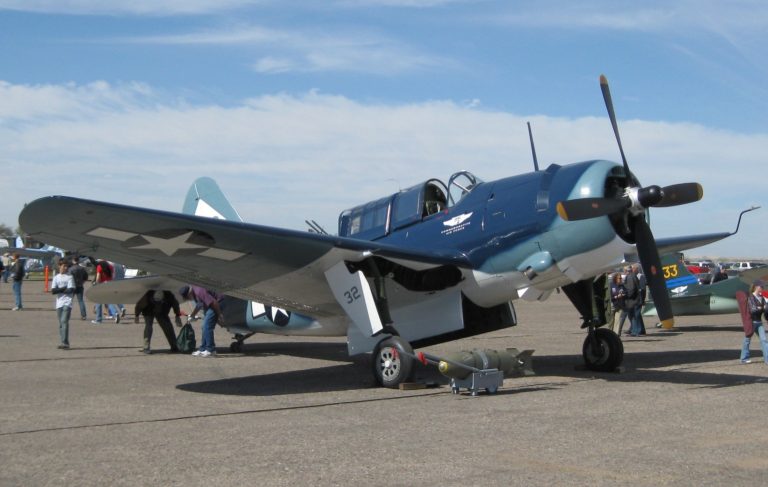
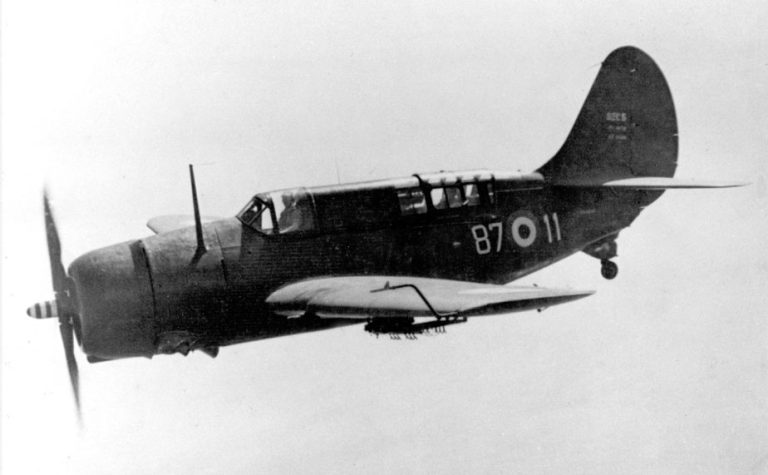
Closing caveat and survivors. Postwar service ran far longer than the type’s American career, which ended with the Navy in 1947 and the Naval Reserve in 1950: France took 110 SB2C-5s between 1949 and 1954 and flew them with Flottilles 3F and 9F from Arromanches, Bois Belleau and La Fayette in Indochina, including at Dien Bien Phu in 1954, retiring them in 1958; Greece received 48 in the spring of 1949 for 336 Squadron and used them in the Civil War, withdrawing the bombers by 1953 and keeping a few photographic machines to about 1957; Italy received 48 under the Mutual Defense Assistance Program from September 1950, dropped the "B" from the designation because the peace treaty forbade bombers, and flew them as anti-submarine aircraft with 86 and 87 Gruppo Antisom until early 1959; Portugal took 24 for the naval air arm at Aveiro from 1950, passed them to the new Air Force at Montijo in 1952 and disbanded the unit in 1958; Thailand operated a small number as the B.J.3. Roughly a dozen airframes survive, all of them original — there are no Helldiver reproductions. Three are airworthy, all of them in the United States and all restored within the last two years: the Commemorative Air Force West Texas Wing’s SB2C-5 N92879, for decades the only flying example and grounded from 2019 to 2023 after an engine failure; Fagen Fighters WWII Museum’s SB2C-5 N48HD, BuNo 83393, flown again in July 2024 after a seventeen-year rebuild; and the National Museum of World War II Aviation’s SB2C-1A N75552, built as A-25A 42-80387, dumped in Lake Washington in January 1945, recovered in the 1980s and flown on 8 August 2024. The three flew together over Colorado Springs on 20 August 2026, the first such formation in decades. Static survivors include SB2C-5 BuNo 83479 at the Smithsonian’s Udvar-Hazy Center, built in May 1945 and flown by VB-92 from USS Lexington in occupied Japan; SB2C-5 BuNo 83321 at the Hellenic Air Force Museum, the last of the Greek batch; an SB2C-5 as J3-4 at the Royal Thai Air Force Museum, Bangkok; an SB2C-4 at the National Naval Aviation Museum and an A-25A at the National Museum of the United States Air Force; SB2C-3 BuNo 19075 at Yanks Air Museum; and at the USS Midway Museum an A-25A, BuNo 76805, alongside SB2C-4 BuNo 19866 raised from the Lower Otay Reservoir in August 2010. Sources disagree on some export totals — English-language references credit Italy with 42 aircraft where the Italian record shows 48 delivered — and on the production total, which is conventionally given as 7,140 although the itemised variant figures sum nearer 7,200.
From a crashed prototype to the sinking of the Yamato
Replacing the Dauntless
The US Navy sets out to replace the SBD. The XSB2C-1 prototype first flies on 18 December 1940 — and is soon lost in a crash, the first of many troubles.
Fixing “The Beast”
Overweight and unstable, the Helldiver needs some 880 modifications before the Navy will accept it, delaying its combat debut until November 1943 over Rabaul.
The carrier war’s peak
Helldivers fight through the great carrier battles of 1944 — the Marianas and Leyte Gulf — and help sink the giant battleship Musashi.
Yamato and the home islands
In April 1945 Helldivers join the strike that sinks the Yamato, the largest battleship ever built, and pound targets across the Japanese home islands.
Postwar and retirement
With the war over, surplus Helldivers pass to France, Italy, Greece and others, while the US Navy retires the type in 1947.
One still flies
A single airworthy Helldiver survives, kept flying by the Commemorative Air Force — the last of more than seven thousand.
Eight chapters in the Helldiver’s war
The plane the crews loved to hate
Few American aircraft of the war were as disliked by their own crews as the early Helldiver.
The full story
The Navy’s long list
Before it would accept the Helldiver, the US Navy handed Curtiss a staggering list of required fixes.
The full story
Following the Dauntless
The Helldiver had the unenviable job of succeeding one of the most successful dive bombers ever built.
The full story
Sinking the giant
In October 1944, Helldivers helped send one of the two largest battleships ever built to the bottom.
The full story
The last battleship dies
Six months later, the Helldivers were there again — for the death of the Musashi’s even more famous sister.
The full story
How dive bombing worked
The Helldiver’s whole reason for existing was to point almost straight down and place a bomb on a moving ship.
The full story
Foreign Helldivers
When the US Navy was done with the Beast, several other air forces were glad to take it on.
The full story
The last of the Beasts
Of more than seven thousand built, a single Helldiver remains airworthy today.
The full story
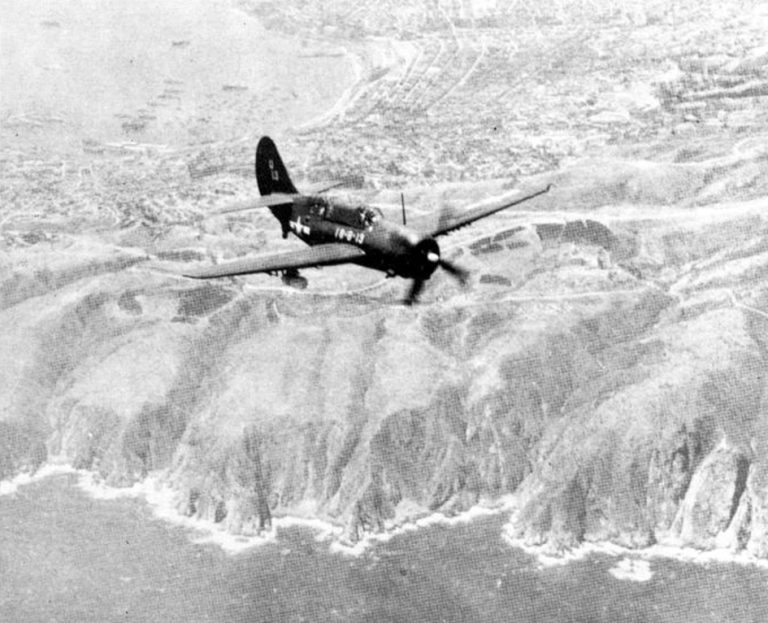
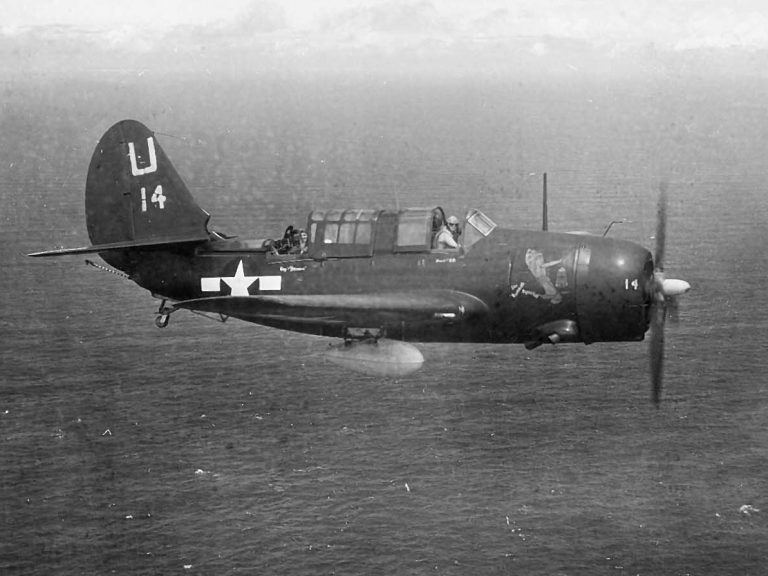
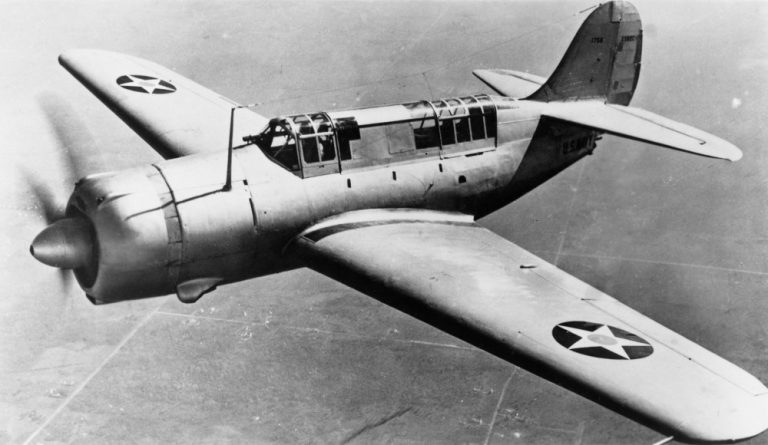
The Helldiver in pictures
See the Helldiver in context
How did an aircraft this troubled end up sinking the world’s biggest battleships? This detailed history follows the SB2C from its disastrous early testing through the hundreds of fixes to its hard-fought Pacific career.
Video: “A Bomber So Bad It Took 800+ Changes To Fix — Curtiss SB2C Helldiver” by Rex’s Hangar (~376,000 views). Embedded via YouTube.
Where the Helldiver fought
The Helldiver, by the numbers
For all the trouble of its birth, the SB2C ended the war as the US Navy’s standard carrier dive bomber, flying from the fast carriers through the climactic battles of the Pacific. Its record is inseparable from that of the carrier task forces it served: a story of overwhelming, precisely-delivered striking power in the war’s final two years.
The great warship sinkings of 1944–45 were combined efforts by many aircraft types; the Helldiver’s role was central but shared with the Avenger torpedo bombers and others. Figures above reflect the type’s scale and key actions.
Curtiss SB2C Helldiver — questions & answers
Can you fly a Curtiss SB2C Helldiver today?
Only one Helldiver remains airworthy — kept flying by the Commemorative Air Force — and it appears at airshows rather than carrying passengers. If you want to fly a real fighter yourself, MiGFlug offers cockpit experiences in genuine jet fighters you can actually strap into.
Why was the Helldiver called “The Beast”?
The early SB2C was overweight, unstable and difficult to handle, especially near the carrier, and its crews disliked it intensely. “The Beast” — and a ruder pun on its SB2C designation — stuck, even after the aircraft was much improved.
Did the Helldiver sink the battleship Yamato?
Helldiver dive bombers were part of the huge US carrier strike that sank the Yamato in April 1945, attacking alongside Avenger torpedo bombers. They had earlier helped sink her sister ship, the Musashi, at Leyte Gulf in 1944.
Was the SB2C better than the SBD Dauntless it replaced?
On paper, yes — it carried a heavier load, faster and further, with an internal bomb bay and 20 mm cannon. But it was far more troublesome and less loved than the Dauntless, and the debate over which was the better aircraft continued long after the war.
How many Helldivers survive?
A handful survive in museums, and just one remains airworthy, flown by the Commemorative Air Force in the United States.
You can’t fly a Helldiver — but you can fly a fighter jet
The Helldiver’s war belongs to history, but the thrill of flying a real combat aircraft doesn’t. With MiGFlug you can strap into a genuine jet fighter — from the L-39 Albatros to a MiG-29 at the edge of space — with an experienced fighter pilot beside you.
 Fly the L-39 AlbatrosThe world’s most-flown jet trainer — aerobatics included
 Fly the F-104 Starfighter“The missile with a man in it”
 Fly the MiG-21The Cold War’s most-produced jet
 Fly the T-33 Shooting StarAmerica’s first jet trainer
 Fly the DH VampireA piece of early jet history
 Fly the S.211Agile Italian jet trainer
 Fly the MB-326The classic Aermacchi jet
 Fly the MiG-15The Soviet legend of the Korean War
Related aircraft
Where these facts come from
- Smithsonian NASM — Curtiss SB2C-5 HelldiverSurviving airframe & type history
- Naval History and Heritage CommandOfficial US Navy photography
- HistoryNet — The Last Dive BomberDevelopment & combat history
- San Diego Air & Space MuseumArchive photography of the type
Figures are drawn from museum and official naval sources and cross-checked; where sources differ, the most commonly cited value is given. Production totals include Canadian-built aircraft, and specifications varied between the many Helldiver marks.