
Yakovlev Yak-18
The Cosmonaut’s First Trainer
The post-war Soviet primary trainer that taught Yuri Gagarin to fly, equipped flying schools from Warsaw to Beijing, flew night raids in Korea and grew into a world-championship aerobatic mount.
The Yak-18: how a modest radial trainer schooled a generation of Eastern Bloc pilots
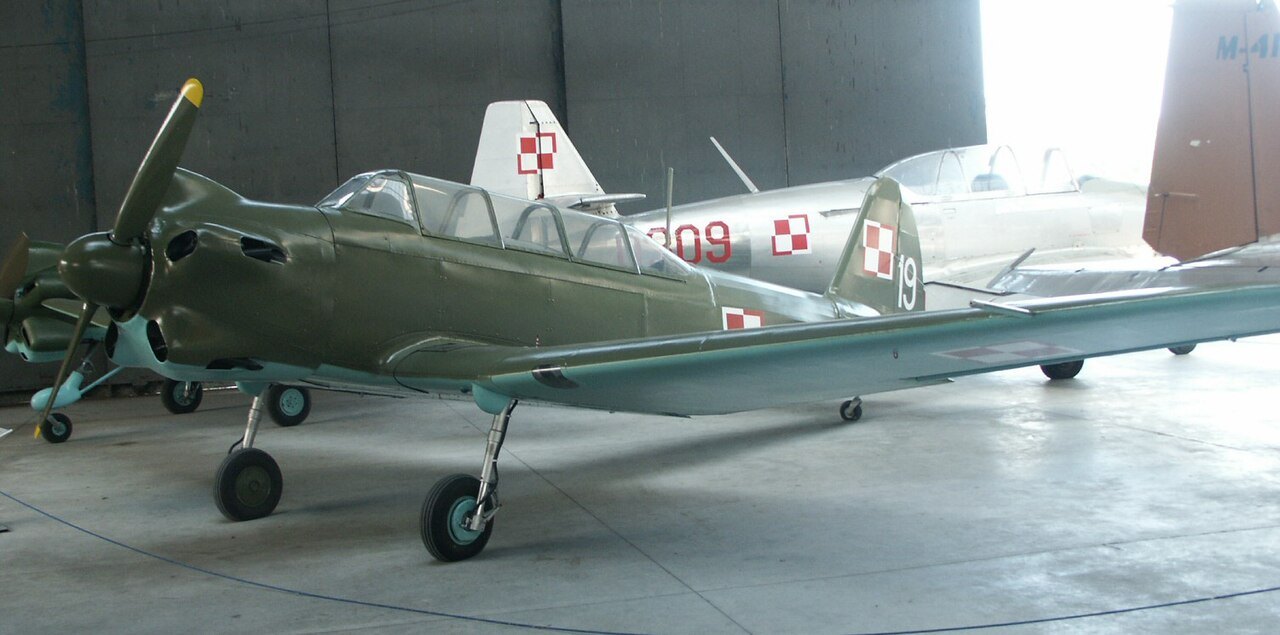
In May 1945, days after the war in Europe ended, Aleksandr Yakovlev’s bureau began work on a two-seat primary trainer to replace the open-cockpit UT-2 it had built before the war. The result was a neat, low-wing monoplane with a tandem enclosed cockpit, retractable main wheels and a fixed tailwheel, powered by a 160 hp Shvetsov M-11FR five-cylinder radial, a development of the engine that drove the Po-2. Test pilot G. S. Klimushkin flew the prototype on 6 May 1946. Air force state trials judged it a clear improvement on the UT-2 in every respect, and the Yak-18 was approved for service in March 1947. NATO later called it Max. It was not fast or powerful, but it was rugged, simple to fix and forgiving of the mistakes cadets were bound to make.
Production spread across three Soviet factories, at Leningrad, Kharkiv and Arsenyev in the Far East, and the Yak-18 became the first aircraft that tens of thousands of Soviet airmen ever flew solo, in air force schools and in the paramilitary DOSAAF flying clubs. One of them, at the Saratov aero club in 1955, was a foundry student named Yuri Gagarin, who made his first solo flight on the type six years before he became the first human in space. The aircraft went to every Warsaw Pact air force and to China, North Korea, Egypt, Iraq, Syria and others. China built 379 under licence at Nanchang as the CJ-5 before designing its own successor, the CJ-6.
The basic design proved remarkably elastic. The Yak-18U of 1954 moved to a tricycle undercarriage to prepare students for nosewheel jets such as the MiG-15, and the Yak-18A of 1957 added a nine-cylinder Ivchenko AI-14R radial of about 260 hp. Single-seat Yak-18P, PM and PS aerobatic versions followed, and in 1966 the Soviet team won the world aerobatic championship title flying the PM. The type also had a stranger career: in Korea, North Korean crews hung small bombs under Yak-18s and flew them by night over UN lines. They were slow enough to slip under the radar-directed defences, and in June 1953 a handful of them set a vast fuel dump ablaze near Inchon. Today a few dozen originals survive, a handful of them still airworthy in the United States, Europe and China.
01The Yak-18’s war in Korea: trainers as night bombers
North Korea received Yak-18s as trainers, but by 1952 and 1953 its air force was flying them, together with Po-2 biplanes, on low-level night harassment raids against UN positions. The aircraft were fitted with bomb racks on the wing centre section and flew slowly enough, and low enough, to slip past radar-directed jet night fighters that were simply too fast to stay behind them. UN troops gave the night raiders names such as Washing Machine Charlie and Bed Check Charlie, after the clattering engines that arrived just as men tried to sleep.
The raids were mostly a nuisance, but not always. In June 1953, in the final weeks of the war, a small formation of four or five Yak-18s is credited with setting fire to a fuel dump near Inchon holding some 5.5 million US gallons. The response was to borrow the right tool from the US Navy: piston-engined, radar-equipped F4U-5N Corsairs that could fly as slowly as their quarry. On 29 June 1953 Lieutenant Guy Bordelon of VC-3, flying from land bases after detachment from USS Princeton, shot down two Yak-18s at night. He went on to claim three Lavochkin fighters within three weeks and became the US Navy’s only ace of the Korean War, every victory scored in darkness.
What makes the Yak-18 special
A small radial, honestly used
The original Yak-18 used the Shvetsov M-11FR, a five-cylinder air-cooled radial of about 160 hp descended from the engine of the Po-2. It was low on power but extremely tolerant: easy to start in a Russian winter, simple to overhaul at a club airfield and with no cooling system to fail. The penalty was modest performance, around 250 km/h at best, which was entirely acceptable for teaching basic handling, circuits and gentle aerobatics.
Retractable wheels from day one
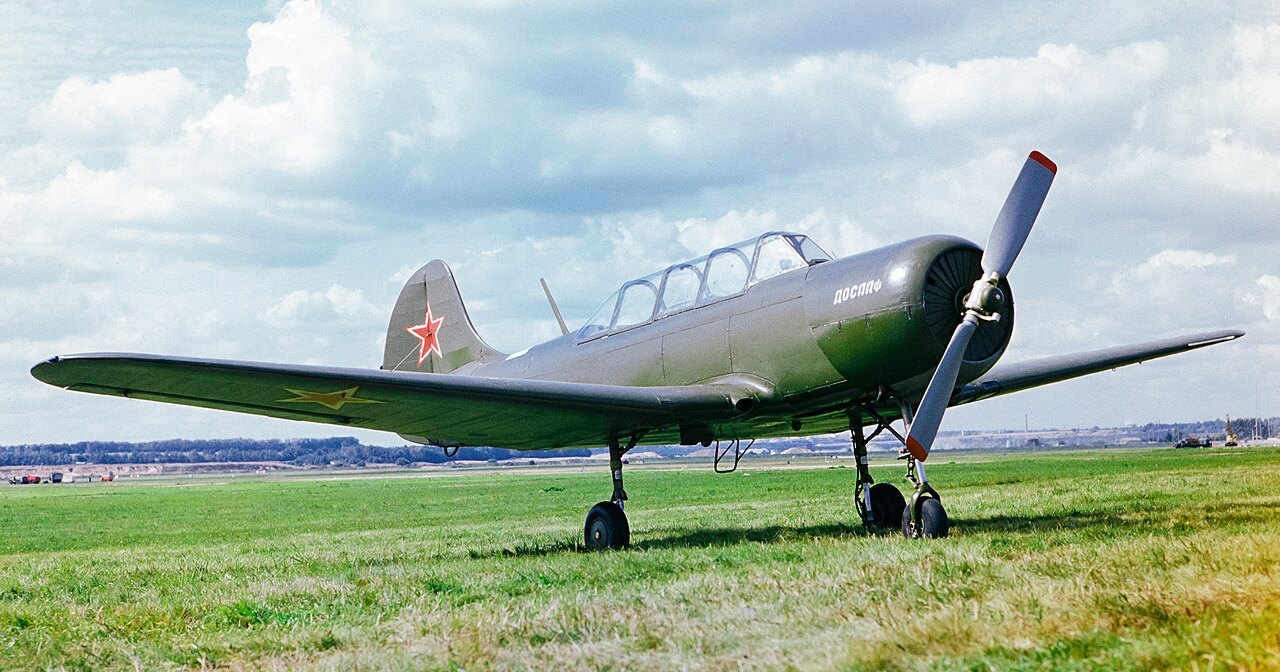
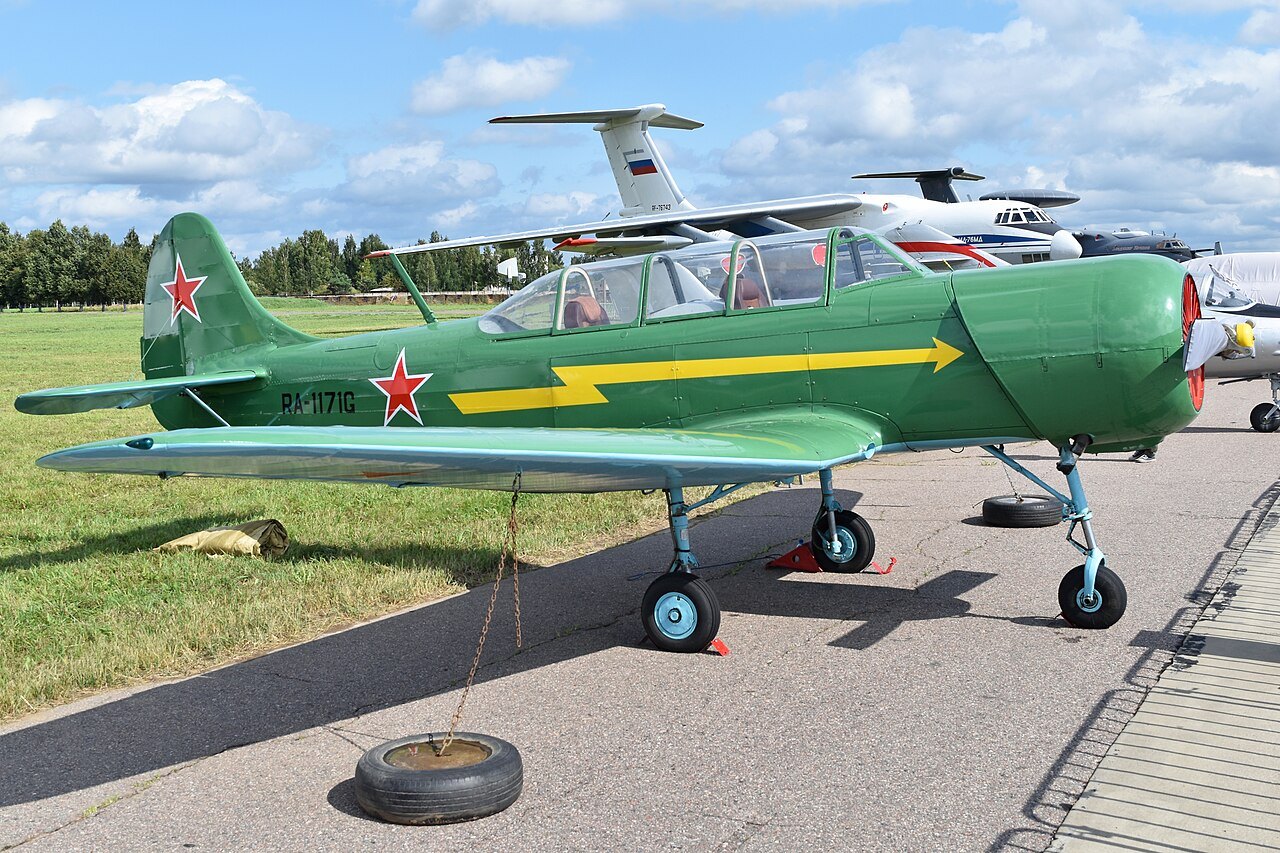
Unlike the fixed-gear UT-2 it replaced, the Yak-18 had main wheels that retracted rearwards into the wing, leaving part of each tyre exposed so that a wheels-up landing did limited harm. Cadets therefore learnt undercarriage drills, propeller pitch and flap management on their very first aircraft, habits that carried straight into fighters. The later Yak-18U and Yak-18A moved to a tricycle layout, matching the nosewheel jets students would meet next.
From trainer to aerobatic champion
The sturdy airframe invited competition flying. Yakovlev produced single-seat aerobatic variants, the Yak-18P, PM and PS, with the cockpit moved aft and the more powerful AI-14 family of radials. The PM, first flown in December 1965, was built for top-level sport pilots, and in 1966 the Soviet team took the title at the fourth World Aerobatic Championships. The line led on to the dedicated Yak-50 and Yak-52.
02The Yak-18’s family tree: from M-11 to AI-14
- Yak-18 (1946): two-seat primary trainer, M-11FR of 160 hp, tailwheel undercarriage with retractable main legs. Built in thousands until 1956.
- Yak-18U (1954): tricycle undercarriage to prepare cadets for jets; about 960 built from 1955.
- Yak-18A (1957): cleaned-up airframe, nine-cylinder Ivchenko AI-14R of about 260 hp, larger fuel capacity. The principal late-production version.
- Yak-18P / PM / PS: single-seat aerobatic versions; the PM (1965) was built for elite sport pilots, the PS reverted to a tailwheel.
- Nanchang CJ-5: Chinese licence-built Yak-18, 379 completed by 1958.
- Yak-18T (1967): a largely new four-seat cabin aircraft sharing the name, still used by Russian flying schools.
Yakovlev Yak-18A specifications
Specifications
- Crew
- 2 (tandem)
- Length
- 8.35 m (27 ft 5 in)
- Wingspan
- 10.6 m (34 ft 9 in)
- Height
- 3.35 m (11 ft 0 in)
- Wing area
- 17.8 m² (192 sq ft)
- Empty weight
- 1,025 kg (2,260 lb)
- Max take-off weight
- 1,320 kg (2,910 lb)
- Powerplant
- 1 × Ivchenko AI-14R 9-cylinder radial, about 260 hp (194 kW)
- Maximum speed
- about 263–300 km/h (163–186 mph), figures vary by source
- Range
- about 700–725 km (435–450 mi)
- Service ceiling
- about 5,000 m (16,400 ft)
- Armament
- None as built; North Korean aircraft carried light bombs on improvised racks
Costs & production
- Unit cost
- No reliable Soviet-era price has been published; the type was cheap to build in large series
- Cost per flight hour
- Roughly US$250–450 per hour for a privately operated warbird today, an estimate based on fuel and oil burn of a small radial plus engine and airframe reserves; not an official figure
- Production
- Commonly given as 6,000+ two-seat and aerobatic aircraft in the USSR plus 379 CJ-5s in China; some totals that include later variants exceed 8,000
- Programme
- 1946–1960s (classic Yak-18 family); Yak-18T four-seater produced later
03The Yak-18’s numbers: why the production totals disagree
Production of the Yak-18 family was split between factories at Leningrad, Kharkiv and Arsenyev and ran in several overlapping variants, so published totals differ widely. Russian-language accounts give between about 3,750 and 4,830 for the original tailwheel Yak-18, around 960 Yak-18U and roughly 950 Yak-18A, before counting the aerobatic single-seaters and the 379 Chinese CJ-5s. Some popular references quote far higher figures because they fold in the unrelated four-seat Yak-18T. We use 6,000+ as a cautious floor for the trainer family.
04The Yak-18’s operating costs: a frugal radial
For its era the Yak-18 was among the cheapest military aircraft to run: a small radial, a light airframe and simple systems that flying-club mechanics could maintain. For civilian owners today, the main costs are fuel, engine overhauls and sourcing parts for the M-11 or AI-14 radials. Our estimate of about US$250–450 per flight hour is based on typical private warbird operation of comparable radial trainers and should be read as an order of magnitude only.
The Yak-18 from Yakovlev’s drawing board to today’s warbird scene
Design begins
In May Yakovlev starts work on a two-seat primary trainer to replace the UT-2.
First flight
Test pilot G. S. Klimushkin flies the prototype on 6 May, powered by a 160 hp M-11FR.
Into service
Approved for Soviet service in March after favourable state trials; production expands across three factories.
Exports to China
Yak-18s reach China; licence production as the Nanchang CJ-5 follows, 379 built by 1958.
Night raids in Korea
North Korean Yak-18s harass UN lines; in June a small formation fires a fuel dump near Inchon and Guy Bordelon downs two on 29 June.
Tricycle Yak-18U
A nosewheel version is introduced to prepare cadets for jet trainers and fighters.
Gagarin goes solo
Yuri Gagarin makes his first solo flight on the type at the Saratov aero club.
Yak-18A
The AI-14R-powered Yak-18A enters production as the definitive two-seat version.
World champions
Flying the single-seat Yak-18PM, the Soviet team wins the title at the fourth World Aerobatic Championships.
Retracing the route
Modernised Yak-18Ts fly more than 3,000 km from Saratov to Baikonur in tribute to Gagarin’s path from aero club to cosmodrome.
Stories & eyewitnesses: the Yak-18 in schools, war and sport
Klimushkin’s first flight
A year after the war, a modest trainer takes to the air.
Read the full story
Gagarin at Saratov
The first man in space learnt to fly on a Yak-18.
Read the full story
No Kum-sok’s first wings
The defector who delivered a MiG-15 started on the same trainer.
Read the full story
Washing Machine Charlie
Slow trainers that kept a whole army awake.
Read the full story
The Inchon fuel dump
The night a handful of trainers burned millions of gallons.
Read the full story
Bordelon’s two Yaks
A Corsair pilot catches the hecklers in the dark.
Read the full story
China’s CJ-5
A licence-built Yak that taught China to build trainers.
Read the full story
World champions on the PM
A trainer derivative tops the world’s aerobatic rankings.
Read the full story
Forty left
Rare originals among thousands of later Yaks and Nanchangs.
Read the full story
The Yak-18 in pictures
Where the Yak-18 flies and flew
The Yak-18’s record
The Yak-18 was above all a schoolroom: the first aircraft for a generation of Soviet, Warsaw Pact and Chinese military pilots. Its only real combat came in Korea, where North Korean crews used it for night harassment raids in 1952 and 1953, losing at least two to a US Navy night fighter.
See how training and combat types compare in the military aircraft statistics database. Figures are approximate.
Everything people ask about the Yak-18
Can I fly in a Yakovlev Yak-18?
Did Yuri Gagarin learn to fly on the Yak-18?
Was the Yak-18 used in combat?
How many Yak-18s were built?
What engine does the Yak-18 use?
Is the Yak-18T the same aircraft as the Yak-18?
What replaced the Yak-18?
You can’t fly the Yak-18.
These, you can.
Most of this museum you can only look at. These genuine military jets you can fly yourself with MiGFlug — with aerobatics and time on the controls.
 Fly the L-39 AlbatrosThe world’s most-flown jet trainer — aerobatics included
 Fly the F-104 Starfighter“The missile with a man in it”
 Fly the MiG-21The Cold War’s most-produced jet
 Fly the T-33 Shooting StarAmerica’s first jet trainer
 Fly the DH VampireA piece of early jet history
 Fly the S.211Agile Italian jet trainer
 Fly the MB-326The classic Aermacchi jet
 Fly the MiG-15The Soviet legend of the Korean War
Continue the tour
Every fact, checked
- Yak-18A historyDesign history, Korean War use, Gagarin and No Kum-sok, survivor numbers
- Yak-18 entry, AeropediaVariants and Korean night raids; production figures treated with caution
- Yak-18PM, State Aviation Museum of UkraineYak-18PM first flight, 1966 world championship, production of about 30
- Navy pilot comes up aces during the Korean War, US Navy HistoryGuy Bordelon’s night victories over two Yak-18s on 29 June 1953
- Guy P. Bordelon Jr., Gathering of Eagles FoundationProfile of the Navy’s only Korean War ace
- 60-year air superiority milestone, PACAFContext on North Korean Bed Check Charlie night raids
- Yak-18T aircraft retrace Gagarin’s flight (in Russian)Gagarin’s 1955 first solo at Saratov; 2026 commemorative flight
- No Kum-Sok and J. Roger Osterholm, A MiG-15 to Freedom (McFarland, 1996), review at Pacific WrecksMemoir of the North Korean defector who trained on the Yak-18