
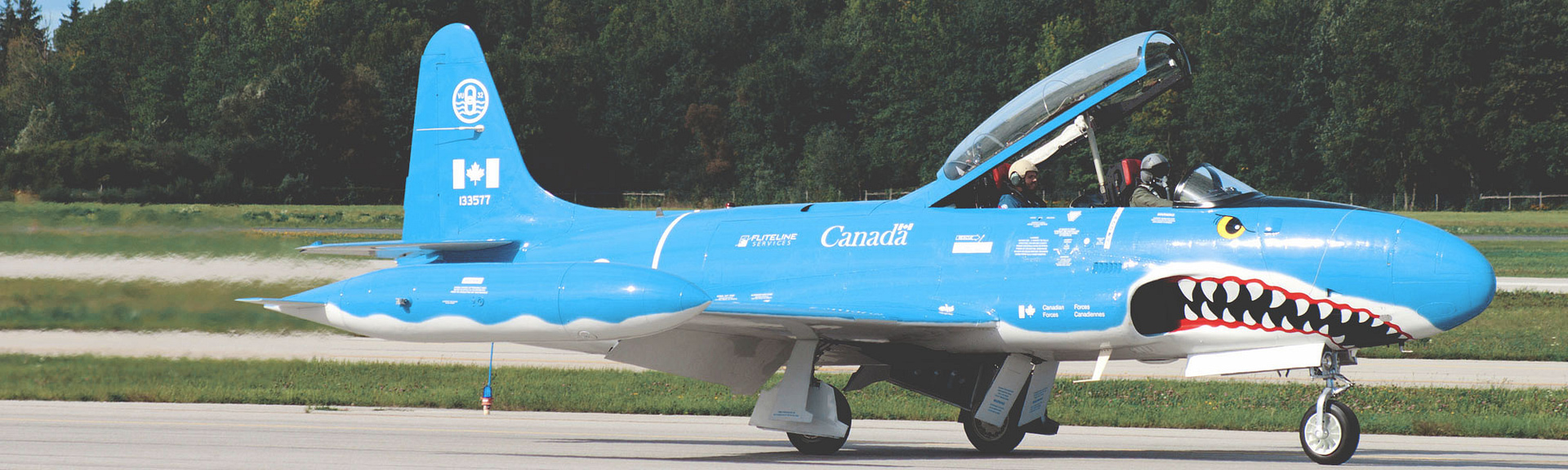
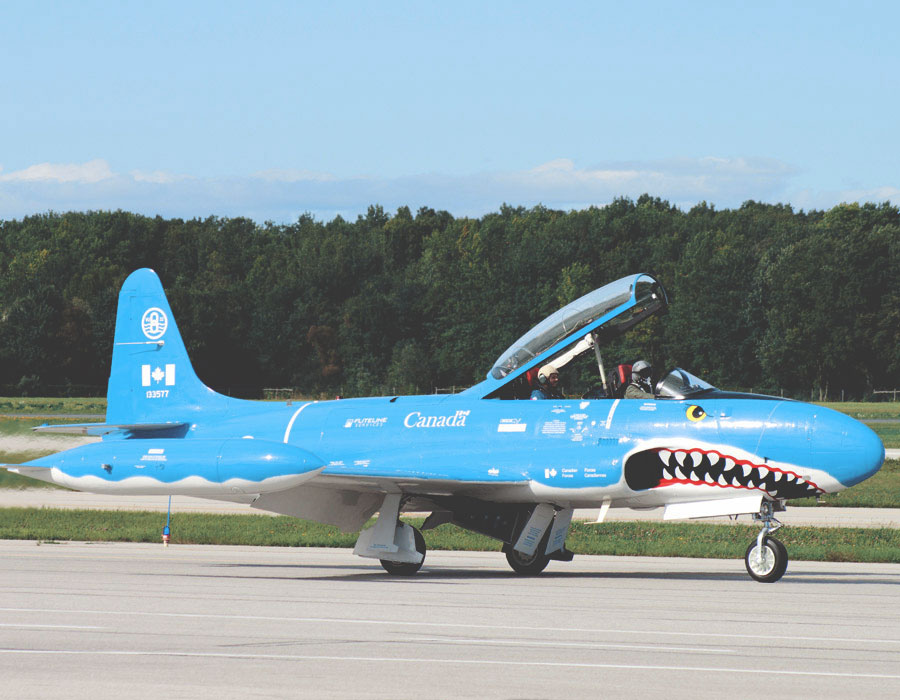
Fly the T-33 Shooting Star
The T-33 Shooting Star is where the jet age began for tens of thousands of military pilots. Derived directly from the Lockheed F-80 - America's first operational jet fighter - the T-Bird entered service in 1948 and went on to train generations of aviators across more than 30 air forces on every continent. Over 6,557 were built, with licence production in Canada and Japan extending the type's reach across NATO and beyond. Subsonic, honest, and built around the same Allison turbojet that powered the F-80 into combat over Korea, the T-33 is not a watered-down trainer - it is a direct descendent of a frontline fighter, with the handling to prove it. The last military operator retired the T-33 in July 2017, after nearly seven decades of continuous service. Few aircraft of any era can claim that record.
A Fighter Jet's DNA
When the United States Air Force needed pilots who could handle jet-powered aircraft, it turned to Lockheed - the company behind the F-80 Shooting Star, America's first operational jet fighter. In May 1947, Lockheed initiated the design of a two-seat trainer at its own expense. The solution was precise: take the F-80 airframe, insert a 26.6-inch plug forward of the wing and a 12-inch plug aft, fit a second seat with dual controls under a lengthened single-piece canopy, and put the result into production. The prototype flew on 22 March 1948 with test pilot Tony LeVier at the controls. Production ran until 1959. By then, 6,557 T-33s had been built - 5,691 by Lockheed in Burbank, 656 by Canadair in Quebec, and 210 by Kawasaki in Japan - making it one of the most widely produced jet trainers in history. More than 30 air forces flew it. The last military operator retired the type in July 2017, nearly seven decades after first flight.
Beyond the training role. The T-33 was adapted into a range of frontline and specialist versions:
- Reconnaissance (RT-33A): Outfitted with camera arrays in the nose and additional systems in the rear cockpit.
- Electronic warfare & adversary training: Used sophisticated radar jammers to train ground defences, simulate anti-ship missiles, and act as target/intercept adversaries.
- Operational missions: Flew covert overflights in Southeast Asia (such as the FIELD GOAL program) and served as a utility “hack” aircraft.
- 1. Direct Lineage from a Combat Fighter
The T-33 is not a purpose-built trainer - it is a lengthened F-80 Shooting Star, America's first operational jet fighter and the aircraft that scored history's first all-jet aerial victory in Korea. Every T-33 carries that bloodline in its airframe. - 2. The World's Most Widely Used Jet Trainer
6,557 built across Lockheed, Canadair and Kawasaki. More than 30 air forces on every continent flew the T-Bird. No other jet trainer of its era came close to that reach or that record. - 3. Allison J33 Turbojet - A Frank Whittle Descendant
The J33-A-35 delivers 24 kN (5,400 lbf) of thrust - a direct development of Sir Frank Whittle's original turbojet design. The same engine, reverse-engineered by the Soviet Union, powered the MiG-15. - 4. Pressurised Cockpit
The T-33 features a pressurised tandem cockpit - a rarity among aircraft of its generation. Both crew seated under a single-piece canopy with a bulletproof centre windshield panel. - 5. 48,000 ft Service Ceiling
The T-Bird climbs to 48,000 ft - well into the stratosphere. At that altitude, the sky turns deep violet and the curvature of the Earth is unmistakable. Few aircraft available for civilian jet flight experiences can take you there. - 6. Nearly Seven Decades of Continuous Service
First flight 1948. Final military retirement 2017. The T-33 served longer than any comparable jet trainer in history - across Cold War, Korea, Vietnam and beyond. That longevity is the only endorsement it needs.
T-33 Design and Airframe
The T-33 was never designed from scratch - and that was the point. By taking an airframe already proven in combat over Korea and adding a second cockpit, Lockheed gave student pilots the real thing from day one. The fuselage was lengthened by approximately three feet to accommodate the instructor behind the student, both seated under a single-piece clamshell canopy with a bulletproof centre panel. Controls were fully duplicated front and rear. The wing, empennage, landing gear, and powerplant remained essentially identical to the F-80 - a single Allison J33 turbojet, culminating in the A-35 variant producing 5,400 lb of thrust. A pressurised cockpit and a structure stressed for aerobatics and instrument training gave the T-Bird a capability that outlasted almost every contemporary. The T-33A was the only jet trainer in the USAF inventory from 1948 until 1957 - simple, honest, and direct enough to teach a generation what jet flight actually felt like.
T-33 Shooting Star. Global Reach, Fighter Roots.
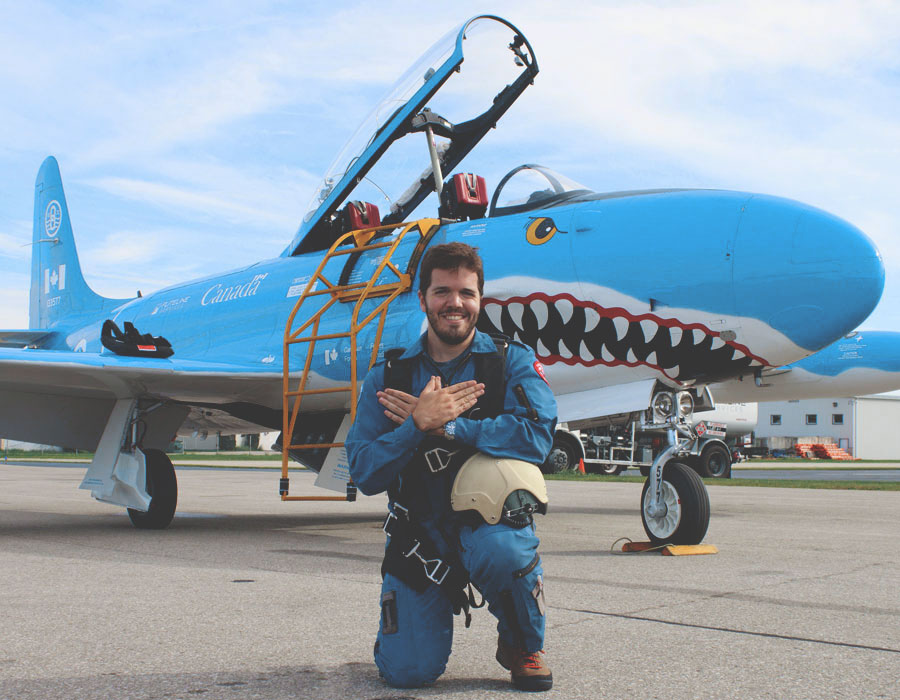
The T-33 was never just a trainer. Born from the F-80 Shooting Star - America's first operational jet fighter - it carried combat DNA into the cockpits of a generation. Over 6,500 were built across three countries, flying with more than 30 air forces on every continent. Canada licence-built 656 as the Silver Star. Japan produced 210 under Kawasaki. The T-Bird trained NATO pilots through the Cold War, flew reconnaissance missions over Southeast Asia, and remained in front-line service for nearly seven decades. The interactive map below shows T-33 operations worldwide.
T-33 Technical Data
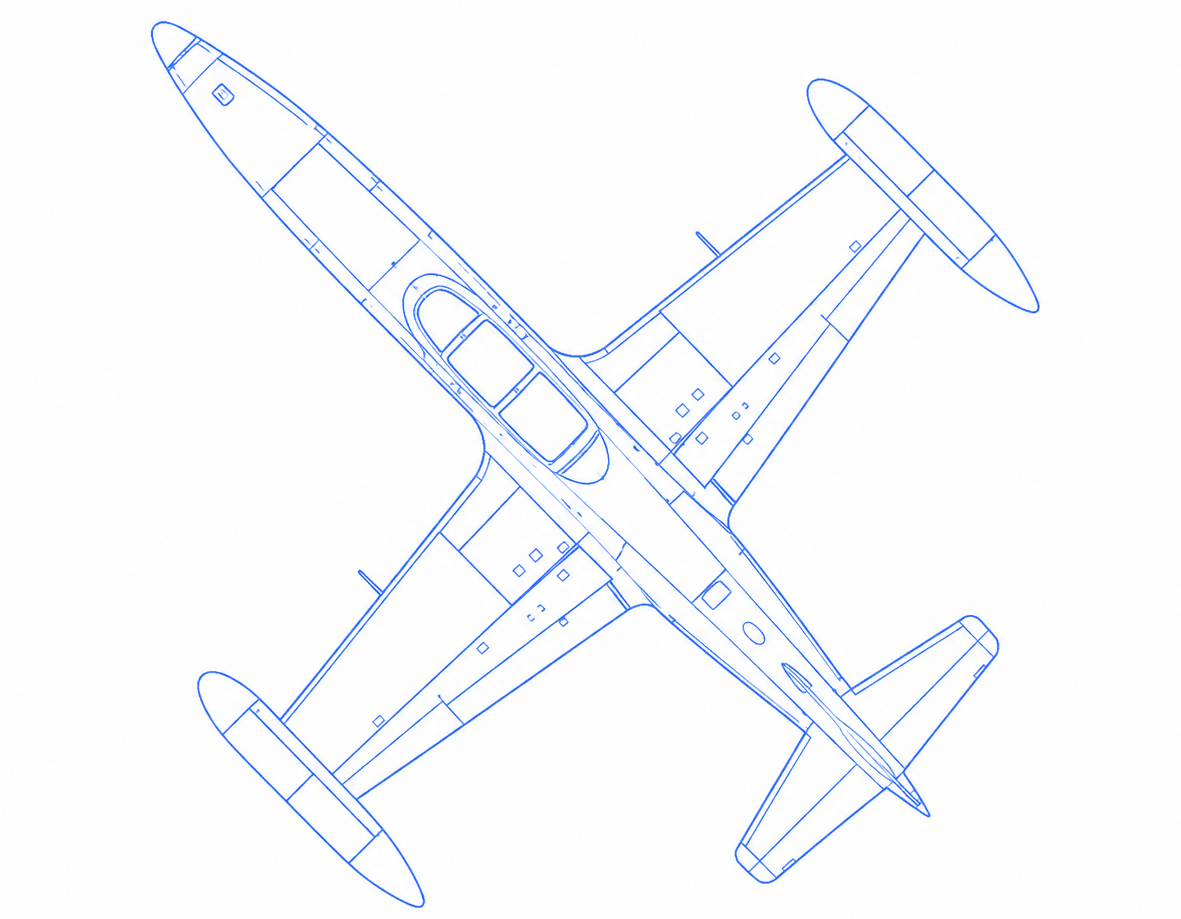
The T-33 was built around one principle: take the fastest American jet fighter of its era and make it teachable. The Allison J33 turbojet, straight low wing, and pressurised tandem cockpit gave student pilots a genuine high-performance experience from the first sortie. Simple enough to maintain anywhere in the world, capable enough to serve in front-line roles for nearly seven decades.
m
WINGSPAN
m
LENGTH
m
HEIGHT
km/h
MAX SPEED
km
RANGE
m/s
CLIMB RATE
m
SERVICE CEILING
kN
ENGINE THRUST
For aviation enthusiasts who want to go deeper, here is a broader technical snapshot of the MB-326.
| Crew | 2 (tandem) |
| Engine | Allison J33-A-35 centrifugal flow turbojet |
| Engine thrust | 24 kN / 5,400 lbf (with water injection) |
| Maximum speed | 965 km/h / 600 mph |
| Range | 2,050 km / 1,275 mi |
| Climb rate | 24.7 m/s / 4,870 ft/min |
| Wingspan | 11.85 m / 38.9 ft |
| Length | 11.51 m / 37.8 ft |
| Height | 3.56 m / 11.7 ft |
| Empty weight | 3,794 kg / 8,365 lb |
| Maximum take-off weight | 6,832 kg / 15,061 lb |
Why the T-33 stands alone
There are faster jets and more modern jets. But few aircraft available for civilian flight experiences carry this kind of history - a direct line from the first American jet fighter to the cockpits of NATO's Cold War generation.
Fighter DNA, Trainer Soul
The T-33 is a direct descendant of the F-80 Shooting Star - America's first operational jet fighter. Every control input, every response, every instrument reflects that lineage. This is not a civilian jet dressed up for the occasion.
Flown by 30 Air Forces
Over 6,500 built. More than 30 air forces on every continent. Cuba used the T-33 in combat during the Bay of Pigs. Bolivia flew it until 2017. Few military jets have served longer or reached further.
No Fly-By-Wire. No Shortcuts.
The T-Bird flies on analogue controls and a centrifugal-flow Allison turbojet - no digital assistance, no augmentation. Every input is yours. This is what jet flight felt like before computers got involved.
Fly a T-33
Select a location and make your dream of flying a real fighter jet come true.
Book now →
What Customers Say
★★★★★
Overall it was a perfect experience from start to finish. My husband absolutely loved it and we can’t wait to come back. Huge shoutout to Krystin, Doug and of course Ray for making the experience so excellent.
★★★★★
The Waterloo Flight crew was absolutely AMAZING. They were all so kind and patient! The knowledge and professionalism was well beyond my expectations.
★★★★★
This was the best adrenaline experience ever! Despite some challenges with my outdated computer and infrequent internet use, the helpful team made sure my flight was set up perfectly. Overall, an unforgettable adventure!