
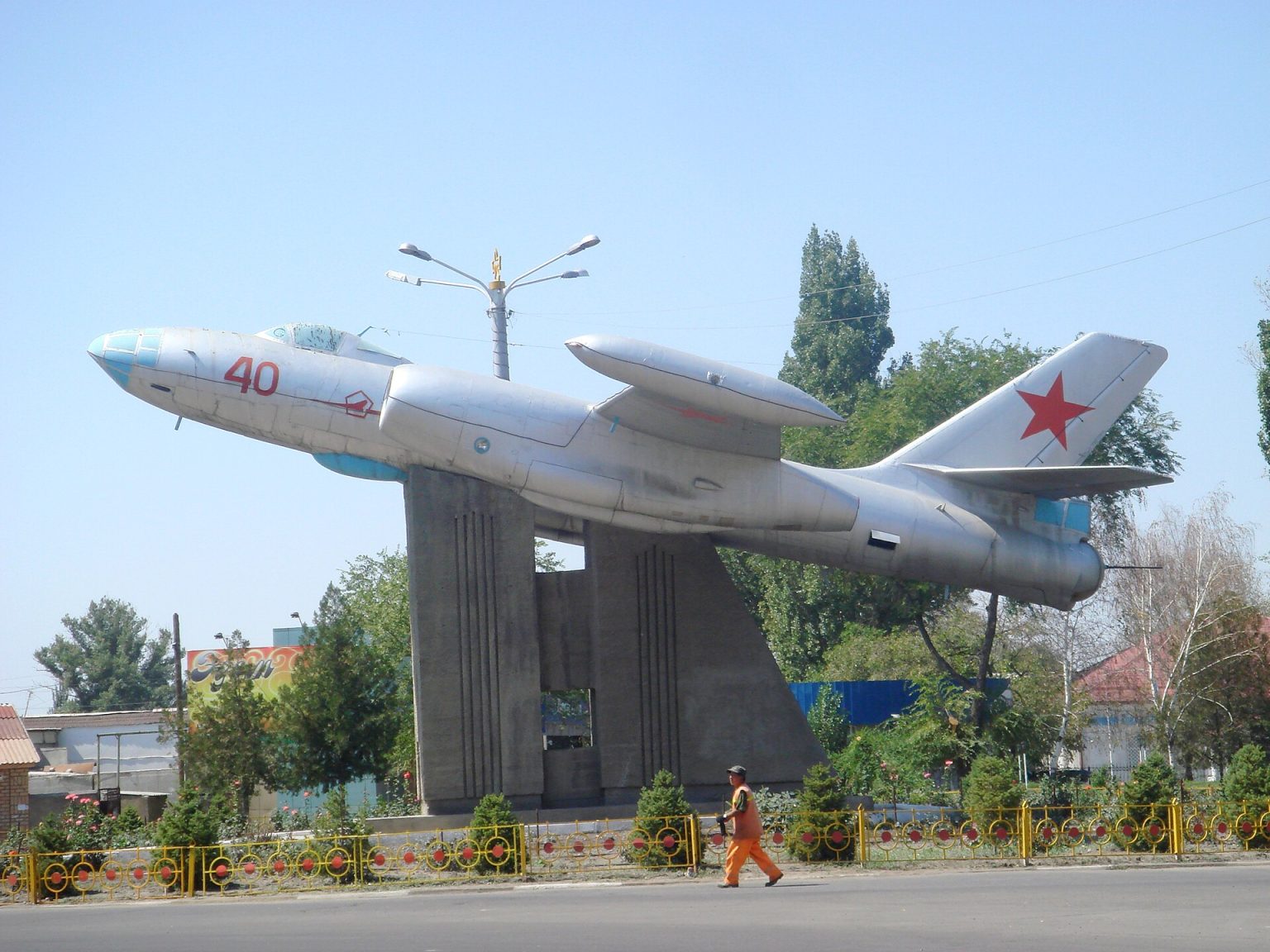
Ilyushin Il-28
“Beagle”
The Soviet Union’s first mass-produced jet bomber — a simple, rugged straight-winged aircraft built in thousands, licence-rebuilt in China as the Harbin H-5, and exported to air forces across three continents.
The Soviet Union’s first mass-produced jet bomber
In the years after 1945 the Soviet Air Force needed to replace its piston-engine tactical bombers, above all the wartime Tupolev Tu-2, with something built around the new jet engine. The task fell to the Ilyushin design bureau (OKB-240) under Sergei Ilyushin. Its answer was deliberately conservative: a clean, straight-winged aircraft with two engines slung in underwing nacelles, a glazed nose for the navigator and a defended tail. The prototype first flew on 8 July 1948, and the type entered Soviet service around 1950 as the Il-28 — the first jet bomber to reach the Soviet bomber regiments in quantity.
The engines mattered as much as the airframe. The Il-28 was powered by two Klimov VK-1 centrifugal turbojets, a Soviet development of the British Rolls-Royce Nene, samples of which Britain had sold to the USSR in 1946–47. Reliable and well understood, the VK-1 gave the bomber a top speed of roughly 900 km/h without the risks of unproven swept-wing research. Combined with a robust, bolt-together airframe that was easy to build and to repair in the field, this made the Il-28 cheap to mass-produce — commonly cited figures put Soviet output at more than 6,000 aircraft, with several thousand more of the Chinese version.
That simplicity turned the Beagle, as NATO named it, into one of the most widely exported bombers of the early Cold War. It served across the Warsaw Pact — from Poland and Czechoslovakia to Romania and Bulgaria — and was supplied to the Middle East, Asia and Africa. Egypt used it in the 1956 Suez Crisis and again in 1967, when many were destroyed on the ground; a handful fought in the Nigerian civil war over Biafra; and in China the design was reverse-engineered and re-produced as the Harbin H-5, keeping the basic aircraft in service and in export markets for decades. Nuclear-capable Il-28s shipped to Cuba even became a sticking point in the 1962 Cuban Missile Crisis, when the United States insisted they be withdrawn alongside the ballistic missiles.
01The Ilyushin Il-28’s British heart: how a Rolls-Royce Nene ended up in a Soviet bomber
In 1946–47 the British government approved the export of a small number of Rolls-Royce Nene and Derwent centrifugal-flow jet engines to the Soviet Union — a decision later regarded in Britain as a serious strategic misjudgement. Soviet engineers under Vladimir Klimov reverse-engineered the Nene as the RD-45 and then developed it into the improved VK-1. That engine powered both the MiG-15 fighter and the Il-28 bomber, giving the early Soviet jet fleet a proven, reliable powerplant far sooner than domestic development alone would have allowed.
For the Il-28 the choice was pragmatic. A centrifugal engine was bulkier than the axial designs that would follow, but it was rugged, well understood and easy to build in numbers — exactly the qualities Ilyushin wanted in a bomber meant for mass production and hard field service. The Chinese H-5 later used a locally built VK-1 derivative, the WP-5.
What makes it special
A straight wing and two Nene-derived engines
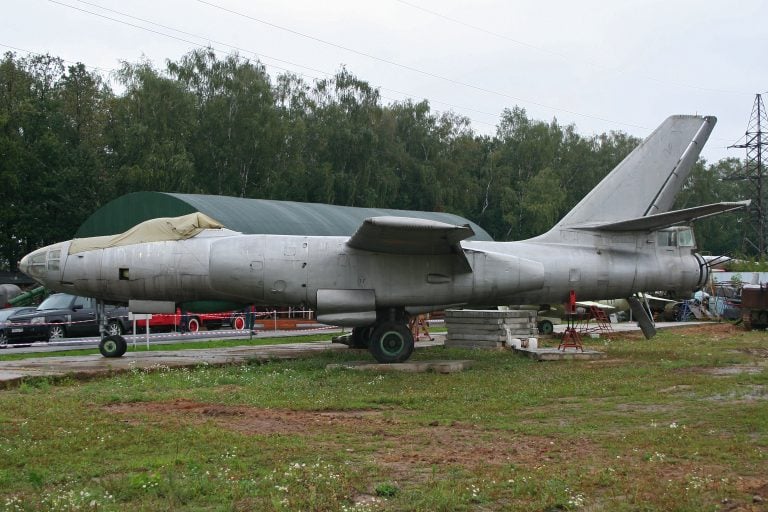
Rather than gamble on the swept wings then being explored, Ilyushin gave the Il-28 a simple unswept high-mounted wing and two Klimov VK-1 centrifugal turbojets — each about 26.5 kN (5,950 lbf) — in large underwing nacelles. The layout was conservative but dependable, delivering near-transonic speed with engines that were easy to build, maintain and overhaul in the field.
A glazed nose and pressurised crew stations
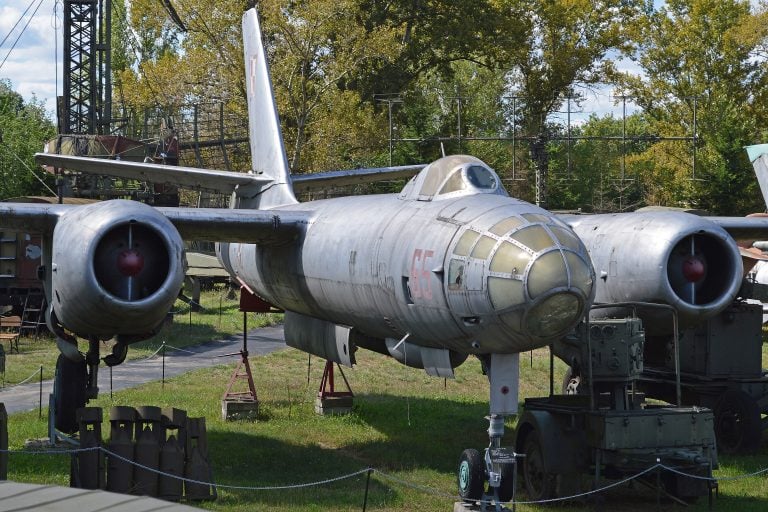
The three-man crew sat in pressurised compartments: the pilot under a fighter-style canopy, the navigator/bombardier in a fully glazed nose with an optical bombsight, and the radio operator/gunner in the tail. Pilot and navigator had ejection seats — an advanced survivability feature for a design of the late 1940s.
A powered tail turret for self-defence
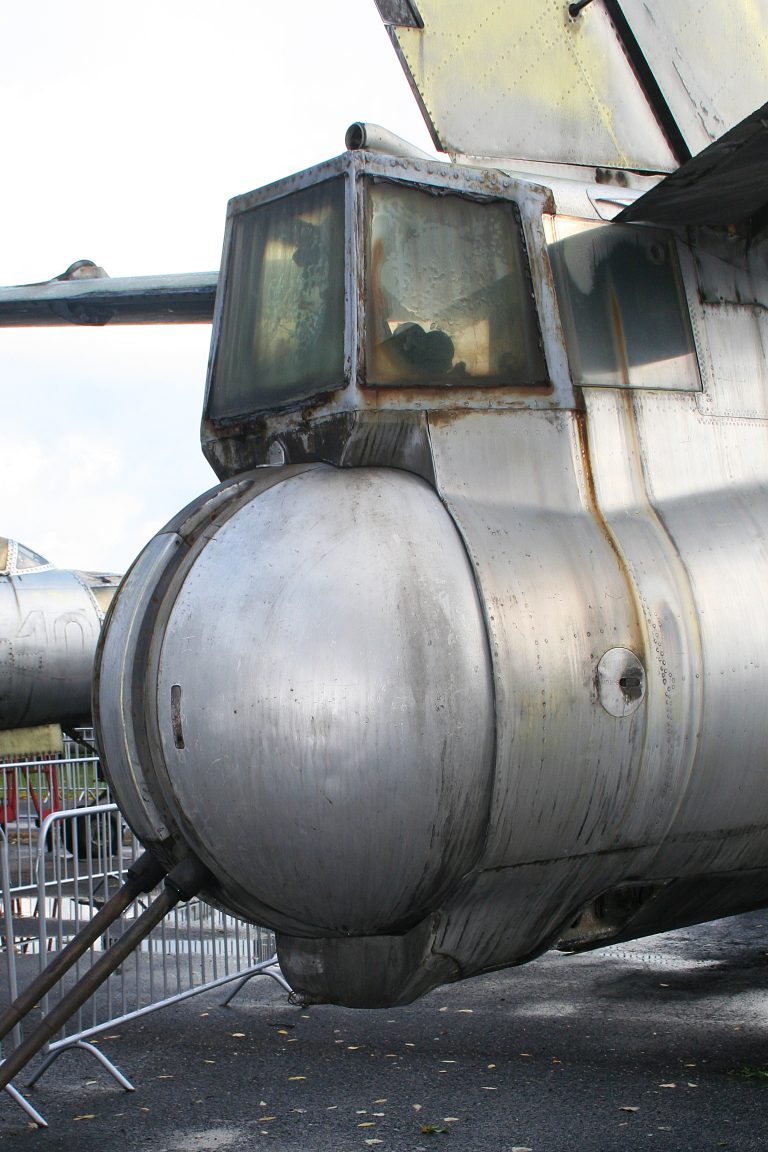
Unusually for a tactical bomber, the Il-28 carried a powered tail turret — commonly designated Il-K6 — with two 23 mm cannon giving all-aspect rearward defensive fire, plus two fixed forward-firing 23 mm guns. Combined with a modular, bolt-together airframe built for mass production, it made the Beagle both defensible and exportable.
02The Il-28 Beagle’s crew layout: the glazed nose, the ejection seats and the lone tail gunner
The Il-28 was flown by a crew of three, split between separate pressurised sections. Up front the pilot sat beneath a bubble canopy with an armoured windscreen. Ahead and below him, in the fully glazed nose, the navigator doubled as bombardier, aiming through an optical sight. Both men had ejection seats. The third crewman, in the tail, operated the radio and the defensive gun turret — but had no ejection seat, relying instead on an escape hatch. The arrangement reflected the aircraft’s late-1940s origins: modern enough to protect the two forward crew with ejection seats, yet leaving the gunner in the older position of the wartime bomber.
03The Il-28 Beagle’s bolt-together airframe: why simplicity made it a global bomber
Much of the Il-28’s long career comes down to how it was built. The airframe was designed for straightforward mass production, assembled from sections that bolted together, with systems that were simple to service. That made it cheap to build in Soviet factories and, just as importantly, easy to keep flying in less-industrialised air forces with limited maintenance infrastructure. The same qualities let China re-derive the design as the Harbin H-5 and keep it in production and service long after Soviet output ended. It is a clear example of an aircraft whose ruggedness and simplicity, rather than raw performance, defined its place in history.
Full specifications
Figures are for the standard Soviet-built Il-28 bomber. Sources vary on weights and production totals; contested values are hedged below. The Chinese Harbin H-5 differed in detail (revised structure, WP-5 engines, a different tail turret).
Baseline note: the figures below describe the Il-28 tactical bomber as it left the Soviet production lines from 1950 — the three-seat, straight-winged, VK-1A-engined light bomber that filled Frontal Aviation regiments and was then sold to more air forces than almost any other jet bomber in history. Deltas for the Il-28R reconnaissance aircraft, the Il-28T torpedo bomber, the Il-28U trainer and the Chinese Harbin H-5 are given in grey. Three cautions before any number here is quoted elsewhere. First, the production total. The figure usually printed, 6,316, is Soviet output alone, from the Moscow, Voronezh and Omsk plants; it does not include the 319-plus Chinese H-5 bombers, the 187 HJ-5 trainers, or whatever Czechoslovakia actually completed. The honest world total is therefore comfortably above 6,800 rather than "about 6,300", and published estimates nonetheless run from roughly 3,000 to 8,000, which tells you how loosely this aeroplane has been counted. Second, the airframe barely moved across fifteen years and four countries: the dimensional rows travel to almost every mark, the weight, speed and range rows do not. An Il-28R with permanent wingtip tanks, a camera pallet and an extra fuselage cell is a different aeroplane on the stopwatch from the clean bomber whose figures fill the tables. Third, range is quoted three different ways in the literature — still-air maximum range, combat range with a stated bomb load, and radius — and sources print one beside another without labelling which is which.
Dimensions & weights
- Crew
- 3 — pilot under a fighter-style bubble canopy well forward, navigator/bombardier in a fully glazed nose entered through his own hatch, and a gunner/radio operator in the tail turret with a separate hatch under the fin. The three compartments were pressurised but not connected; a crewman could not move between them in flight. The Il-28U trainer deleted the nose station for a raised instructor’s cockpit; Il-28R and Il-28REB kept three men and changed what the third one did
- Length
- 17.65 m (57 ft 11 in). Rounded to 17.6 or 17.7 m in various tables; the Il-28T lengthened the weapons bay internally without altering overall length appreciably
- Wingspan
- 21.45 m (70 ft 4 in), quoted without tip tanks. Detachable wingtip tanks were standard on the bomber and permanent on the Il-28R, and both add to span and to drag
- Height
- 6.70 m (22 ft 0 in) on the undercarriage
- Wing area
- 60.8 m² (654 sq ft). A widely reproduced specification table rounds this to 60 m²; 60.8 is the figure in the airframe descriptions and is the one used for the wing loading below
- Aerofoil
- TsAGI SR-5S, 12 per cent thickness — a thick, forgiving, entirely conventional section. It is the single most revealing number on this page: Ilyushin picked a wing that would behave, not a wing that would go fast
- Wing planform
- Unswept, two-spar, mild taper — while Tupolev swept the competing Tu-73’s wing, Ilyushin kept his straight and swept only the fin and tailplane. That decision cost perhaps 50 km/h at the top end and bought docile stalling, an easy approach and a bomber that a conscript-trained pilot could land at night on a wet strip
- Empty weight
- 12,890 kg (28,418 lb). The H-5 saved about 110 kg by deleting the horizontal production break through the wing
- Normal take-off weight
- 18,400 kg (40,565 lb) with the standard 1,000 kg bomb load and internal fuel
- Maximum take-off weight
- 21,200 kg (46,738 lb). Sources between 17,700 and 21,200 kg circulate because some quote normal and some maximum without saying so
- Normal bomb load
- 1,000 kg (2,200 lb) internal — the load the aeroplane was designed around and the one flown on almost every operational sortie in its career
- Maximum bomb load
- 3,000 kg (6,600 lb) internal, as a single large store. There are no external bomb pylons on the standard bomber; the Il-28Sh conversion added twelve, and nothing else did
Performance
- Maximum speed
- 902 km/h (560 mph, 487 kn) at 4,500 m. Some tables give 900 or 906 km/h; aviastar quotes 935 km/h, which is an outlier and probably a clean, light-weight figure
- Cruising speed
- 770 km/h (478 mph) at 10,000 m — the speed at which range figures were calculated
- Rate of climb
- 15 m/s (2,950 ft/min) initial, at normal take-off weight. Unremarkable in 1950 and dangerous by 1965
- Service ceiling
- 12,300 m (40,350 ft). Sources to 12,500 m appear; the operational ceiling with a war load was lower again
- Range
- 2,180 km (1,355 mi) with the normal 1,000 kg bomb load
- Maximum range
- 2,400 km (1,490 mi) clean with wingtip tanks. Figures of 2,260 km also appear; the spread is a labelling problem, not a disagreement about the aeroplane
- Combat radius
- ~1,100 km (~685 mi), which is the honest planning number and the one that mattered: it put NATO’s Central Front airfields, and later Israel, within reach of the aircraft and its owners
- Endurance
- ~4 h at economic cruise; less on any sortie that included a low-level run
- Take-off run
- 875 m (2,870 ft) at normal weight from a paved runway. Published figures run from 875 m to well over 1,000 m depending on weight, surface and source; treat the shorter figure as a best case. The type was cleared for compacted earth and pierced-plank strips, which is a large part of why it went everywhere
- Wing loading
- 303 kg/m² (62 lb/sq ft) at normal take-off weight — low for a jet bomber, and the reason for the benign handling
- Thrust-to-weight ratio
- 0.29 at normal take-off weight, computed from two engines at 26.5 kN. At maximum weight it falls to about 0.26, which is why hot-and-high export operators complained
Propulsion & systems
- Engines
- 2 × Klimov VK-1A centrifugal-flow turbojet in nacelles slung under and forward of the wing, where they could be changed on a hardstanding with a gantry and two men
- Rated thrust
- 26.5 kN (2,700 kgf, 5,950 lbf) each, dry. No afterburner, no water injection, no complication of any kind
- Engine ancestry
- Rolls-Royce Nene — sold to the Soviet Union by the Attlee government in 1947, copied without licence as the Klimov RD-45F, then developed into the VK-1. The prototype Il-28 flew on RD-45Fs on 8 July 1948 with Vladimir Kokkinaki at the controls; the VK-1 installation followed in 1949 and became the production standard. The Nene is thus the common ancestor of the Il-28 and the MiG-15 that escorted it
- Chinese powerplant
- 2 × Wopen WP-5 on the Harbin H-5 — the Chinese VK-1 copy, itself a copy of a copy of a British engine
- Internal fuel
- ~7,900 l (~1,740 imp gal) in fuselage cells, plus detachable wingtip tanks. Figures vary between sources and the Il-28R added a further fuselage tank and made the tip tanks permanent; treat the exact number as soft
- Bombing and navigation radar
- PSBN-M ground-mapping radar in a ventral radome behind the nosewheel bay, used for blind release and for coastal navigation. Crude by Western standards of the same date and adequate for area targets, which is what the aeroplane was for. The Il-28N nuclear carrier had a deeper radome for a revised set
- Bombsight
- OPB-5 optical bombsight — a direct descendant of the American Norden, which had reached the Soviet Union by routes nobody advertises. Accurate in daylight from level flight, useless in cloud, and the reason Il-28 crews trained relentlessly on the radar
- Defensive mounting
- Il-K6 electro-hydraulic tail turret — the first Soviet powered turret of its type, protected by steel plate and armour glass, carrying two NR-23 and worked by its own gunner with an optical sight. Ilyushin was openly proud of it, and it was the last aircraft turret of consequence the bureau ever built
- Crew escape
- Ejection seats for pilot and navigator — the tail gunner had no seat and left through his own hatch under the fin, a distinction Soviet crews were entirely aware of
- Undercarriage
- Retractable tricycle, twin-wheel main units retracting into the nacelles, with low-pressure tyres for unpaved operation. The Il-28R added hydraulic wheel spin-up before touchdown to reduce tyre wear on rough strips
- Structure
- All-metal, split for mass production — the wings and tail were split horizontally through the centre of the wing and the fuselage vertically down the centreline, so major assemblies were built as open halves, fitted out at the bench and closed like a plastic kit. It is the most important engineering fact about the Il-28: the aeroplane exists in thousands because of it. The Chinese deleted the wing’s horizontal break on the H-5, saving 110 kg at the price of much harder assembly
04The Ilyushin Il-28’s cost and production: why a simple bomber was built in the thousands
Unlike Western aircraft, the Il-28 has no reliable published unit price or cost-per-flight-hour — Soviet programme economics were not disclosed and any dollar figure would be a guess. What is clear is that the design was optimised for cheap mass production. Commonly cited figures put Soviet output at more than 6,000 aircraft, with the Chinese Harbin H-5 adding several hundred to well over a thousand more depending on the source. That scale, rather than any single flyaway cost, is the meaningful economic fact: the Il-28 was affordable enough to equip the Soviet Air Force and a long list of client states, and simple enough to keep flying for decades. Treat all production totals as approximate; sources differ.
Armament & payload
The Il-28 carried one tonne of iron bombs and a man with two cannon in the tail, and for twenty-five years that was enough for any air force that could not afford better
The armament was deliberately ordinary and that was the point. Two fixed NR-23 cannon in the lower nose fired by the pilot, two more NR-23 in a powered tail turret worked by a gunner, and a bomb bay sized around 1,000 kg of free-fall ordnance with 3,000 kg possible if you were willing to shorten the sortie. No radar-directed gunnery, no guided weapon, no external pylon on the standard bomber, no system that could not be understood by a technician with a torch. What the Il-28 offered instead was that a conscript air force could arm it, load it, fly it and get it back, and that promise was kept in a dozen countries for four decades.
The Il-K6 tail turret deserves its own paragraph, because it was the part Ilyushin was proudest of and the part that dated fastest. It was the first Soviet electro-hydraulic powered mounting of its class, armoured with steel plate and armour glass, carrying two 23 mm cannon with 225 rounds each and laid optically by a gunner sitting in his own pressurised compartment at the back of the aeroplane. Against an F-84 or a Sea Fury in 1950 it was a genuine deterrent, and Egyptian, Chinese and Nigerian crews all flew with the reassurance of it. Against a Mirage III with cannon and a Shafrir, or an F-4 firing Sparrows from eight miles, it was two men and 450 rounds against the second half of the twentieth century. Israeli planners understood this perfectly: the Il-28 was rated a priority target on the ground, not in the air, and in 1967 that is where it was destroyed.
Two things the tables understate. The first is that this was a nuclear aircraft: the Il-28A and Il-28N had heated, lined bays for a single RDS-4 "Tatyana"-class weapon of roughly thirty kilotons, and it is precisely that capability which put a light tactical bomber into the middle of the most dangerous fortnight of the Cold War. The second is that the Il-28 spent far more of its operational life bombing people who could not shoot back than fighting an air war it was designed for — Yemen, Biafra, the Afghan valleys — and any honest account of the armament has to say what it was actually used to do. Fits varied sharply by mark and operator: the Il-28T deleted a nose gun to clear the torpedo sighting station, the Il-28U carried no guns at all, ammunition counts appear as both 225 and 250 rounds per tail gun, late Soviet and export aircraft are photographed with one nose cannon and with two, and Chinese, North Korean and Afghan airframes were modified locally without documentation. A photograph of an export Beagle proves very little about what that airframe carried.
Gun
- 4 × 23 mm Nudelman-Rikhter NR-23, about 850 rounds a minute each — the same gun family carried by the MiG-15bis and MiG-17
- 2 fixed in the lower nose with 100 rounds per gun, fired by the pilot and aimed by pointing the aeroplane; there was no lead-computing sight, so these were strafing and morale weapons
- 2 in the Il-K6 tail turret with 225 rounds per gun, on a powered mounting with an optical sight; 250 rounds per gun is also published
- The Il-28T deleted the starboard nose gun for torpedo sighting equipment; the Il-28U trainer was unarmed; the Il-28R kept the full fit
- No gun-laying radar was ever fitted — unlike the Tu-16, whose tail mounting had the PRS-1 Argon. The Beagle’s gunner fought by eye, day or night
Air-to-air
- None. No air-to-air missile was ever carried by a production Il-28, Il-28U, Il-28R or H-5, in any air force, at any point in the type’s service life
- The only air-to-air capability was defensive and it was the tail turret. Everything forward of the wing was for hitting the ground
- Doctrine answered fighters with altitude, darkness and escort; in practice Il-28 formations flew with MiG-15 and MiG-17 cover where cover existed, and without it where it did not
- Kill claims by Il-28 tail gunners appear in Chinese and Egyptian accounts and none of them is well corroborated. The realistic verdict is that the turret deterred more attacks than it defeated
Air-to-surface guided
- None in Soviet, Warsaw Pact or Chinese front-line service. The Il-28 pre-dated the Soviet tactical guided-weapon generation and no production variant carried a guided air-to-surface weapon
- The airframe was a useful and much-used testbed: Chinese H-5s carried avionics and weapons trials fits, including work associated with the Xian JH-7 programme
- The single genuine exception is North Korean. H-5s are reported to have been adapted to launch an air-launched anti-ship cruise missile of the Kumsong-3 family, with tests reported in 2008 and 2011. The reporting rests on North Korean state imagery and Western analysis of it, and should be held loosely
- No laser designation, no television-guided weapon, no anti-radiation missile, ever
Bombs
- Free-fall FAB series in the internal bay: FAB-100, FAB-250, FAB-500, FAB-1500 and a single FAB-3000. The standard 1,000 kg load was typically twelve FAB-100 or four FAB-250
- 3,000 kg maximum as one large store, at a heavy cost in range; the bay was designed around volume for a nuclear weapon as much as around weight
- Nuclear: one RDS-4 "Tatyana"-class weapon of roughly 30 kilotons in the heated and lined bay of the Il-28A/Il-28N. This is the fit that made the Il-28 a subject of the Cuban Missile Crisis rather than a footnote to it
- Naval stores from the same bay on the Il-28T: one 45-36AN low-altitude torpedo, or a pair of RAT-52 rocket-propelled torpedoes, or AMD-series air-dropped mines
- Cluster containers of the RRAB type and incendiaries. Egyptian aircraft operated in the Yemen campaign in which chemical bombs were dropped from 1963; sources rarely tie an individual chemical attack to a named aircraft type, and we will not do so here
Rockets
- None on the standard bomber. The production Il-28 had no external stores pylons of any kind, which is unusual for an aircraft that spent so much of its life on counter-insurgency work
- The Il-28Sh conversion added twelve underwing pylons, six a side, for UB-16-57 pods firing 57 mm S-5 rockets and for light bombs
- The Il-28Sh was built in small numbers and went nowhere. A straight-winged bomber with a fixed forward sight is a poor rocket platform, and the Soviet Union solved the problem properly twenty years later with the Su-25
- Chinese H-5 airframes and some export aircraft received locally engineered underwing rails; the documentation for these is poor and the numbers are unknown
Pods & other stores
- Detachable wingtip fuel tanks, standard on the bomber; permanent and enlarged on the Il-28R, where they are the quickest way to identify the mark in a photograph
- Reconnaissance fit: AFA-series day cameras on a pallet in the bomb bay, with photoflash bombs for night work (Il-28R, HZ-5)
- Il-28REB and Il-28PP jamming aircraft carried wingtip pods deliberately shaped to look exactly like the Il-28R’s tip tanks — a piece of low-cost operational deception that says a good deal about Soviet thinking
- Target-towing gear: East German, Finnish, Polish and Soviet aircraft ended their careers towing banners and sleeve targets for gunnery schools
- Il-28M and M-28 conversions were stripped as radio-controlled target drones, which is how a number of surviving airframes were finally used up
Three typical loadouts
- Front-line tactical strike, Soviet Frontal Aviation, mid-1950s
- 1,000 kg internal — twelve FAB-100 or four FAB-250 — wingtip tanks fitted, 100 rounds per nose gun, 225 per tail gun. Level release from medium altitude on the OPB-5 optical sight in daylight or the PSBN-M radar in cloud, against an airfield, a bridgehead or a marshalling yard, with MiG-17 escort where the front line allowed it.
- Nuclear strike, Il-28A
- One RDS-4-class weapon of about 30 kilotons in the heated bay, wingtip tanks, reduced gun ammunition, single aircraft, single pass, a target chosen for a weapon that did not need to be accurate. This is the loadout inside the crates a US Navy reconnaissance aircraft photographed on the deck of the Soviet freighter Kasimov in late September 1962.
- Export counter-insurgency, Egypt over Yemen and Nigeria over Biafra, 1963–1970
- Four to eight FAB-100 or FAB-250, no escort, no opposition, released from medium level over targets with no air defence at all. Nigerian Il-28s flown by Egyptian crews bombed markets, schools, hospitals and Red Cross facilities so consistently that the Federal government replaced the Egyptian pilots with European ones in the spring of 1969, on the grounds of accuracy rather than conscience.
Sourcing caveat: no single English-language source is authoritative on Il-28 weapons fits, and the discrepancies are real rather than typographical. Ammunition counts for the tail guns appear as both 225 and 250 rounds per gun; the nose battery is given as one gun and as two depending on the mark and the observer; internal bay capacity is quoted as 1,000 kg normal and 3,000 kg maximum with no consistent statement of what the 3,000 kg figure costs in fuel. Yefim Gordon’s monograph on the type is the best single reference in English and disagrees with the general aviation encyclopedias on several points. Where they conflict, we have followed the more specific source and said so.
Variants
Ilyushin drew one airframe simple enough that three countries could build it and two dozen could keep it flying
The Il-28 won its place by being finished. In the 1948 competition against Tupolev’s Tu-73 it was the less advanced aeroplane on paper, with a straight wing where Tupolev had swept his and two engines where Tupolev wanted three, and it won anyway because it flew, it worked and it could be built. The split-half construction scheme — wings and tail divided horizontally, fuselage vertically, each half fitted out at the bench and then closed — is the reason the number at the bottom of this page has four digits. It is a production engineer’s aeroplane far more than a designer’s one, and its virtues are production engineer’s virtues.
What followed was the widest distribution any jet bomber has ever achieved. Poland, Czechoslovakia, East Germany, Hungary, Bulgaria and Romania inside the Warsaw Pact; China, which reverse-engineered it without a licence and built it for another thirty years; Egypt, Syria, Iraq, Algeria, Morocco, Yemen, Somalia and Nigeria across Africa and the Middle East; North Korea, North Vietnam and Indonesia in Asia; Afghanistan, Cuba and even Finland, which flew four for target-towing and maritime patrol. The type was in Soviet first-line service from 1950, in Chinese production into the 1980s and in somebody’s order of battle for over seventy years.
The designation soup needs care. NATO reporting names are not Soviet designations: the bomber is "Beagle" but the Il-28U trainer has its own name, "Mascot", and calling a trainer a Beagle is simply wrong. Chinese designations are not Soviet ones and the H-5 is not a licence-built Il-28 but a reverse-engineered aircraft with a different wing structure and different engines. And Czechoslovak designations are the murkiest of the lot, for reasons set out below.
- Il-28 (1949–1955 in production; 6,316 built in the USSR)
- The baseline three-seat tactical bomber: two VK-1A, four NR-23, 1,000 kg normal bomb load, PSBN-M radar and the Il-K6 tail turret. Everything below is this aeroplane with something added or taken away.
- Il-28U "Mascot" (from 1950)
- Conversion trainer. The glazed nose is replaced by a stepped instructor’s cockpit ahead of and below the standard one, guns and bombing gear are deleted, and performance is essentially unchanged — the point being that a pilot converting to jets learned on an aeroplane that flew exactly like the one he would fly next.
- Il-28R (from the early 1950s)
- Tactical reconnaissance. Camera pallet in the bomb bay, photoflash bombs for night sorties, an additional fuselage fuel cell, permanent enlarged wingtip tanks, uprated hydraulics and wheel spin-up gear for unpaved strips. The heaviest and shortest-legged-looking mark that in fact flew furthest.
- Il-28T (from 1951; small series for Soviet Naval Aviation)
- Torpedo bomber. Lengthened weapons bay with the wing moved aft to hold the centre of gravity, revised nose glazing for the torpedo sighting station, starboard nose gun deleted. Carried the 45-36AN low-altitude torpedo, the RAT-52 rocket torpedo or AMD mines; also exported in small numbers to Indonesia, which flew eleven with its navy.
- Il-28A and Il-28N (nuclear carriers)
- Heated and lined bomb bay, revised release and navigation equipment, and on the N a much deeper radome for an improved radar. These were the aircraft that made the Il-28 a strategic object rather than a tactical one, and the reason Cuba mattered.
- Il-28REB and Il-28PP (conversions)
- Electronic warfare. Jamming equipment in wingtip pods shaped to mimic the Il-28R’s tip tanks, plus internal receivers; the Il-28RTR was the related electronic-intelligence conversion. Small numbers, long careers, almost no published detail.
- Il-28Sh (conversions, 1960s)
- Ground attack. Twelve underwing pylons for rocket pods and light bombs, intended for close support of ground forces. Few were converted, the concept did not suit the airframe, and it was abandoned.
- Il-28M, M-28, Il-28P and Il-20 (second-line conversions)
- Radio-controlled target drones for missile trials, and unarmed high-speed mail and jet-familiarisation aircraft for Aeroflot with the turret faired over. This is how a great many airframes were finally consumed.
- Harbin H-5 (China; series production from the mid-1960s; over 319 H-5 plus 187 HJ-5 built)
- Reverse-engineered from Soviet-supplied aircraft without a manufacturing licence after the Sino-Soviet split, with the wing’s horizontal production break deleted — 110 kg lighter, much harder to build — and Wopen WP-5 engines. Sub-variants: HJ-5 trainer, HZ-5 (H-5R) reconnaissance with underwing tanks, HD-5 jammer, and B-5, B-5R and BT-5 export designations. Sources place the first Chinese aircraft between 1964 and 1966 and the start of series production between 1965 and 1967; Chinese service ran until about 2000.
- Avia B-228 and CB-228 (Czechoslovakia; in service 1954–1973)
- Czechoslovak designations for the Il-28 and Il-28U, with 90 bombers and 30 reconnaissance aircraft delivered. How much Avia actually manufactured, as opposed to assembling and finishing Soviet-supplied components, is genuinely disputed — and the "70 Czechoslovak-built Il-28s" commonly said to have gone to Egypt in 1956 came out of the 1955 arms deal in which Czechoslovakia was the cover for a Soviet transaction, with the Egyptian procurement office sitting in Prague only until the pretence was no longer needed. That same deal is itemised elsewhere as 30 Il-28s rather than 70. Both the builder and the number should be treated as unresolved.
Closing note on survivors and the last operator, and why there is no fleet chart on this page. Every air force that once flew the Beagle has retired it but one. China withdrew the last H-5 around 2000; Poland was the European hold-out, its naval aviation flying Soviet- and Chinese-built Il-28s until June 2001, fifty-three years after the prototype first flew. The sole remaining operator is the Korean People’s Army Air Force, and the numbers there are an object lesson in how fleet counts work. The IISS Military Balance 2023 credits North Korea with roughly 80 Il-28/H-5 airframes. The recorded deliveries behind that figure are about 24 Soviet-built aircraft and a further 18 Chinese H-5s handed over in 1974–1975, and the standard assessment is that most of the 80 are hulks held for spares, keeping perhaps a dozen airworthy at any time. One corroborated operator, with a paper figure and a serviceable figure that differ by a factor of six, is a sentence rather than a bar chart, so we have deliberately not drawn one. As for survivors: every preserved Il-28 is an original airframe — nobody has ever built a replica or a reproduction of one, and no civil owner or warbird operator flies the type anywhere in the world. Examples stand in museums and on plinths in Russia, Poland, Hungary, Germany, the Czech Republic, Finland and China, most of them gate guardians rather than machines that will ever move again.
From Tu-2 replacement to Cold War export
Requirement issued
The Soviet Air Force calls for a jet bomber to replace the piston-engine Tupolev Tu-2; Ilyushin’s OKB-240 begins design work.
First flight
The prototype makes its maiden flight on 8 July 1948, initially powered by imported Rolls-Royce Nene engines.
Enters service
The Il-28 reaches Soviet bomber regiments — the first jet bomber in widespread Soviet service — alongside trainer (Il-28U) and reconnaissance (Il-28R) variants.
Suez Crisis
Egyptian Il-28s are among the targets struck on the ground during the 1956 Suez Crisis.
Cuban Missile Crisis
Nuclear-capable Il-28s shipped to Cuba become a sticking point; the US demands their removal alongside the missiles, and they are withdrawn by late 1962.
Six-Day War & Biafra
Many Egyptian and Syrian Il-28s are destroyed on the ground in the opening Israeli strikes; the same year, a few Il-28s enter the Nigerian civil war over Biafra.
Harbin H-5 in production
China begins series production of its re-derived version, the Harbin H-5, keeping the design in service and export long after Soviet output ends.
Retired from Soviet first line
The Il-28 is withdrawn from front-line Soviet units, though many serve on in export air forces and in secondary roles.
Long afterlife
Romania retires its fleet around 2001; North Korea is still commonly listed as an operator decades later, making the Beagle one of the longest-serving early jet bombers.
Twelve Il-28 Beagle stories
The bomber that jetted the Soviet Air Force
Built to replace the piston Tu-2, the Il-28 became the USSR’s first mass jet bomber.
Read the full story
A British engine at its core
The Il-28’s Klimov VK-1 engines descended from the Rolls-Royce Nene sold to the USSR in 1946–47.
Read the full story
The navigator’s greenhouse
The Il-28’s fully glazed nose gave the navigator/bombardier a panoramic aiming position.
Read the full story
The lone crewman facing backwards
The Il-28 kept a manned tail turret with twin 23 mm cannon for self-defence.
Read the full story
A flashpoint in the missile crisis
Nuclear-capable Il-28s in Cuba became a sticking point the US demanded be resolved.
Read the full story
China rebuilds the Beagle
After the Sino-Soviet split, China re-derived the Il-28 as the Harbin H-5.
Read the full story
A handful over a civil war
A small number of Il-28s flew in the Nigerian civil war over Biafra, 1967–70.
Read the full story
Caught on the ground
Many Egyptian Il-28s were destroyed on the ground in the first hours of the Six-Day War.
Read the full story
The living fossil
North Korea is still commonly listed as an Il-28/H-5 operator in the 21st century.
Read the full story
Recon, trainer and torpedo Beagles
The Il-28 spawned reconnaissance, training and naval torpedo versions.
Read the full story
The Beagle that sampled the air
Finland flew a handful of Il-28s on survey and air-sampling duties into the 1980s.
Read the full story
Simplicity as a superpower
The Il-28’s ruggedness, not its speed, made it one of the most widely exported bombers.
Read the full story
The Beagle in pictures
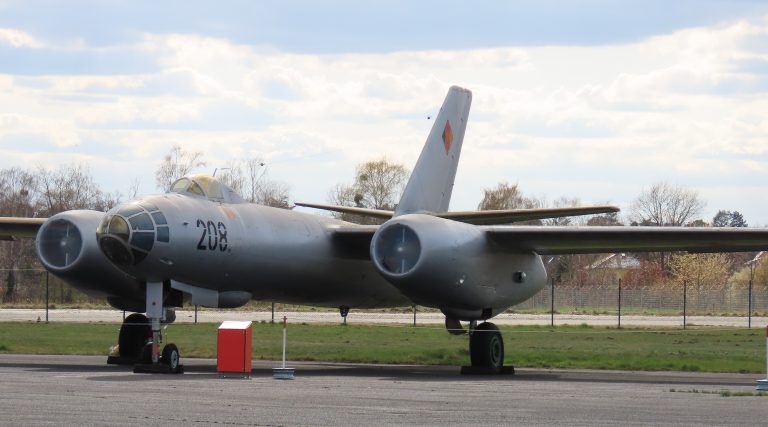
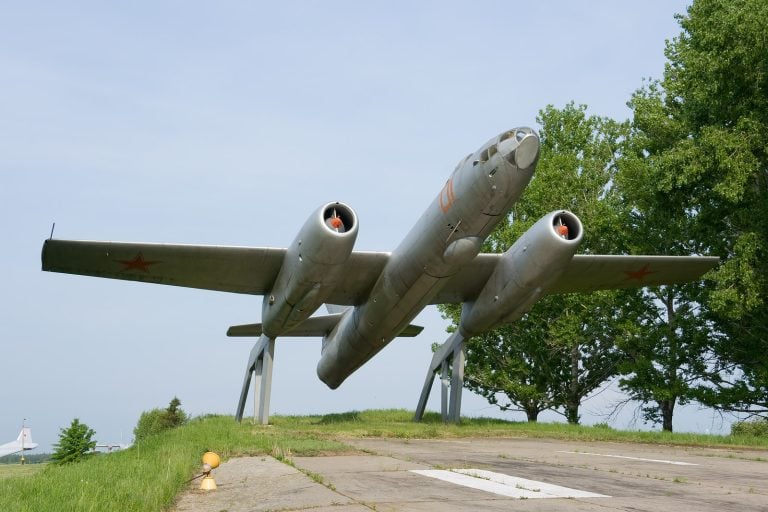
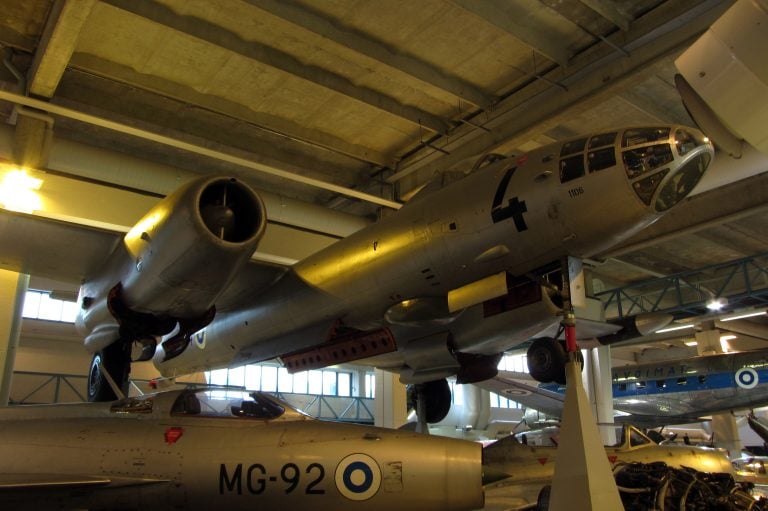
The Il-28 Beagle in motion
A curated video feature for the Il-28 Beagle is coming soon. In the meantime, explore the photo gallery above and the operations map below.
Where the Il-28 flew
The record that defines it
The Il-28 is a bomber, not a fighter, and its record is measured in service and export rather than aerial victories. It saw combat with several operators: Egypt used it in the 1956 Suez Crisis, the North Yemen civil war and the 1967 Six-Day War — in which many Egyptian and Syrian Il-28s were destroyed on the ground; a small number flew for the Federal side in the Nigerian civil war over Biafra; and it served with North Korea, Afghanistan and others. Its most famous moment was political rather than tactical: nuclear-capable Il-28s in Cuba became a sticking point in the 1962 missile crisis. Figures for losses and sorties are contested and should be treated as approximate.
Compare the combat record of every military aircraft. Figures as of July 2026.
Everything people ask about the Il-28 Beagle
Can I fly in an Il-28?
What was the Ilyushin Il-28?
What is the difference between the Il-28 and the Harbin H-5?
Why were Il-28s part of the Cuban Missile Crisis?
How many Il-28s were built?
Who used the Il-28 in combat?
Is the Il-28 still in service?
You can’t fly the Il-28.
These, you can.
Some legends only live in museums — others are fuelled and waiting. MiGFlug has put civilians in real military jet cockpits since 2004.
 Fly the L-39 AlbatrosThe world’s most-flown jet trainer — aerobatics included
 Fly the F-104 Starfighter“The missile with a man in it”
 Fly the MiG-21The Cold War’s most-produced jet
 Fly the T-33 Shooting StarAmerica’s first jet trainer
 Fly the DH VampireA piece of early jet history
 Fly the S.211Agile Italian jet trainer
 Fly the MB-326The classic Aermacchi jet
 Fly the MiG-15The Soviet legend of the Korean War
Continue the tour
Every fact, checked
- The Aviationist — Ilyushin Il-28 BeagleOverview of the first Soviet jet bomber, its VK-1/Nene engines and construction.
- Federation of American Scientists — Il-28First jet bomber in Soviet service; production scale and Cuba/Middle East notes.
- MilitaryFactory — Ilyushin Il-28Dimensions, weights, performance and armament figures.
- GlobalSecurity.org — Harbin H-5Chinese H-5 production timeline and how it differed from the Il-28.
- Skytamer — Harbin H-5H-5 variants, export operators and design differences.
- Finnish Air Force Museum — Ilyushin Il-28RFinland’s four Il-28s, 1960–1981, and their reconnaissance/survey role.
- Arms Control Association — The Cuban Missile CrisisThe US demand to remove the Il-28s as offensive weapons in 1962.
- National Security Archive — Cuban Missile CrisisDocumentary record of the Il-28 withdrawal negotiations, late 1962.