
Grumman OV-1
“Mohawk”
The U.S. Army’s own battlefield spy — a bug-eyed, triple-tailed turboprop with ejection seats, built to find the enemy by radar, infrared and camera from the jungles of Vietnam to the deserts of Iraq.
The OV-1 Mohawk: the U.S. Army’s own eyes over the battlefield
In the late 1950s the U.S. Army and Marine Corps drew up a joint requirement for a rugged battlefield observation aircraft — something that could operate from short, rough forward strips, survive ground fire, and bring back hard intelligence on what the enemy was doing just over the next ridge. Grumman’s answer was the G-134, and it first flew on 14 April 1959. The Marines soon dropped out, but the Army pressed on, and the aircraft entered service in 1961 as the OV-1 Mohawk — first with U.S. Army units based in West Germany.
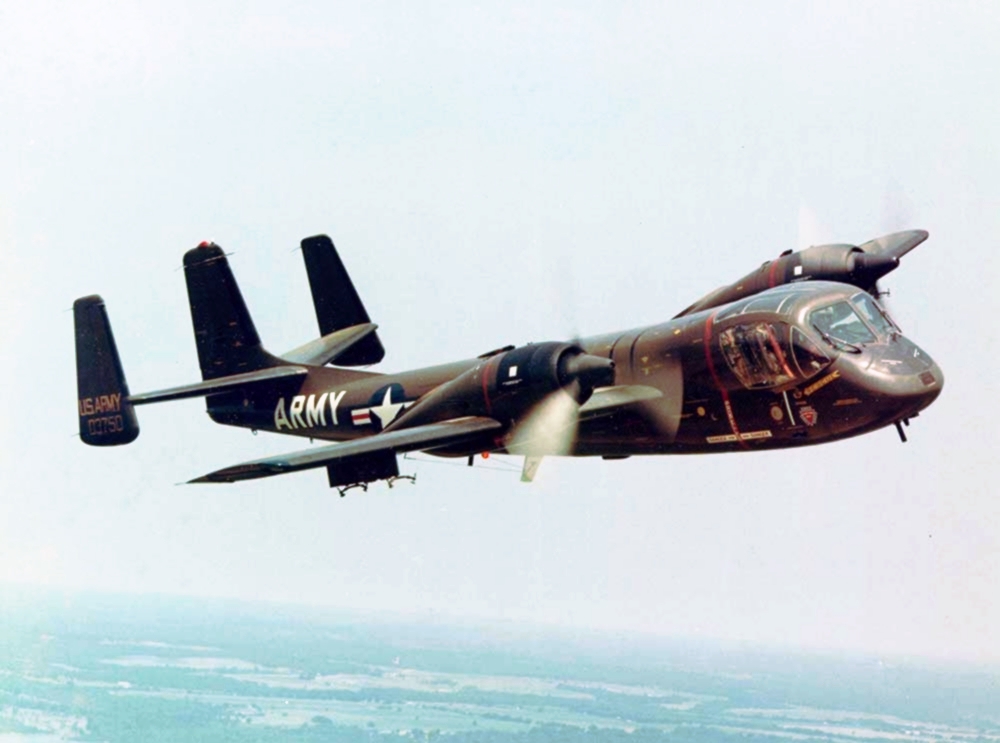
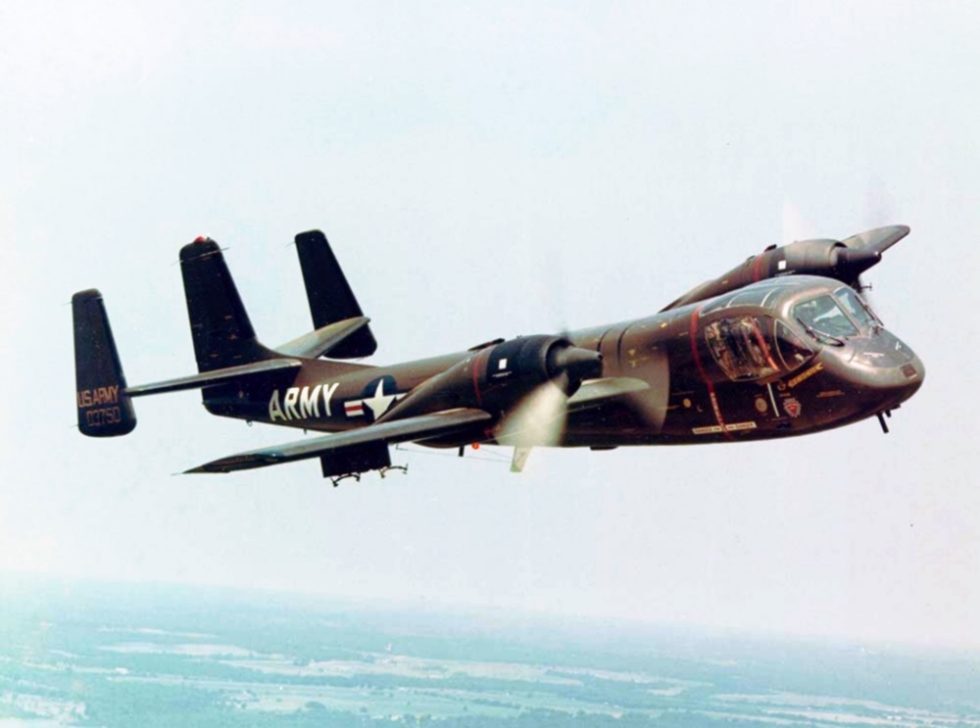
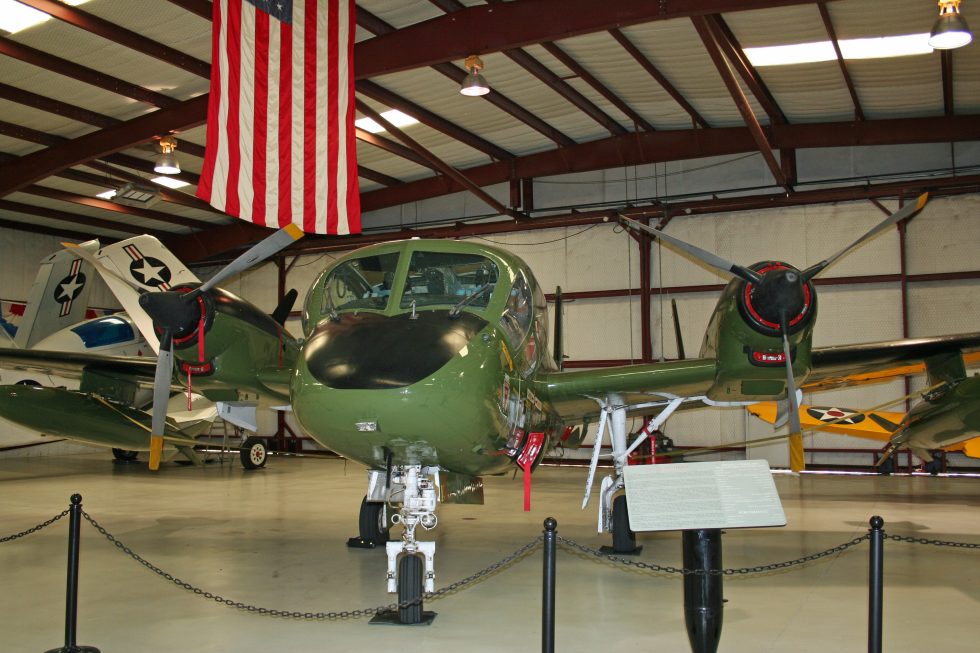
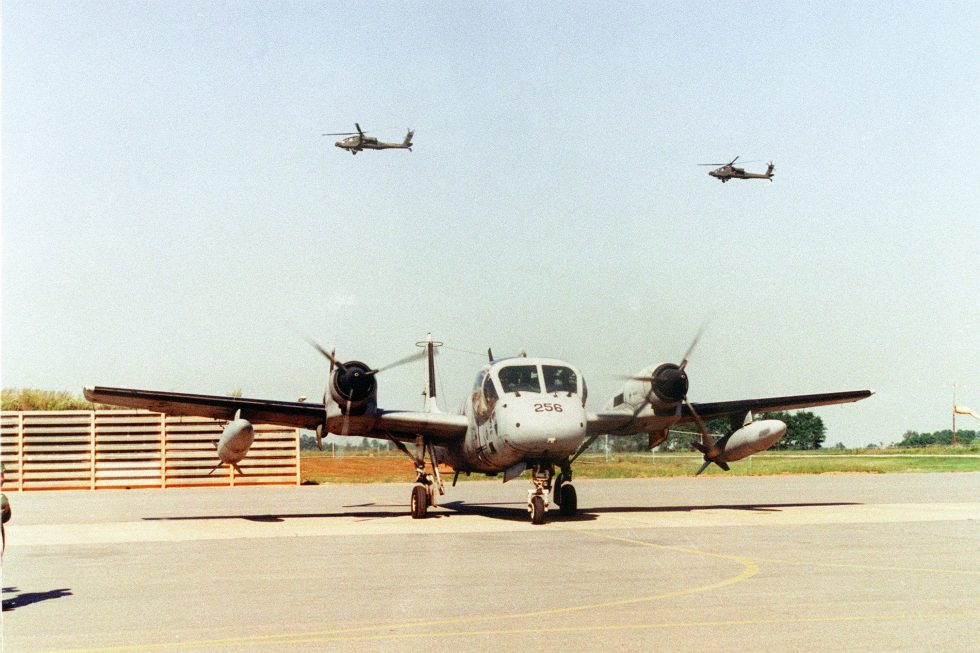
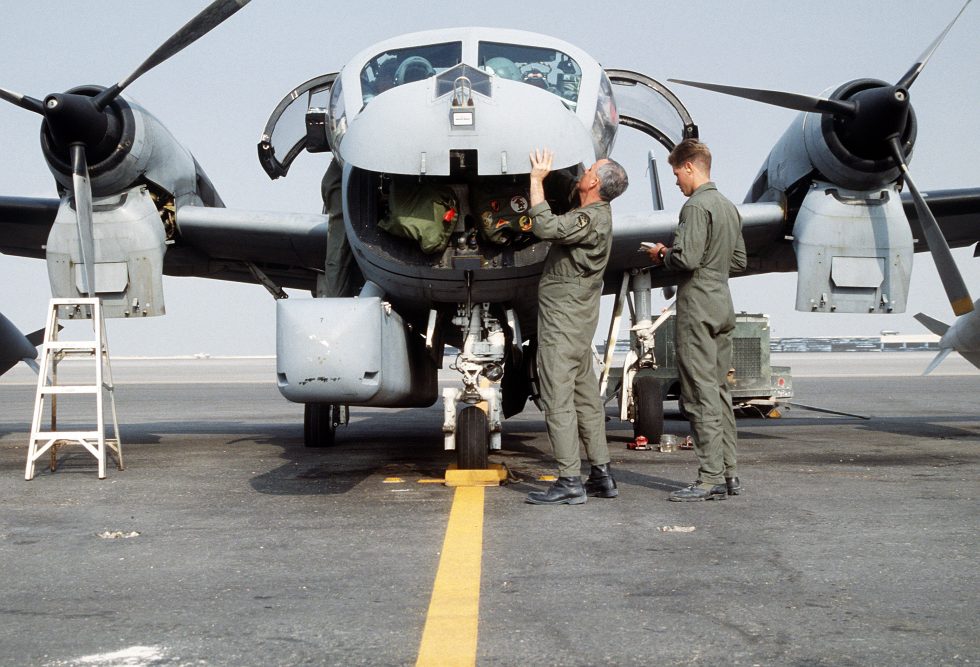
It looked like nothing else in Army service. Two Lycoming T53 turboprops — the same engine family that powered the UH-1 Huey — hung from a stubby wing; three vertical tails rose from the back; and the crew of two sat side-by-side under a huge, bulged “greenhouse” canopy that let them look almost straight down. Most striking of all, it carried Martin-Baker ejection seats, making it one of very few fixed-wing aircraft the Army ever sent into combat that its crews could bang out of.
The Mohawk’s real weapon was its sensors. Different versions carried cameras (OV-1A), a side-looking airborne radar in a long belly “canoe” (OV-1B), or infrared scanners (OV-1C), and the definitive OV-1D could swap between radar and infrared pallets. Deployed to Vietnam from 1962, the type flew relentless day-and-night reconnaissance. Armed “JOV-1” Mohawks carrying rockets and gun pods sparked a bitter turf war with the Air Force — settled by the 1966 Johnson-McConnell agreement, which stripped the Army of its armed fixed-wing ambitions. The Mohawk soldiered on as an unarmed sensor platform over Korea, Cold-War Europe and, finally, Desert Storm, before retiring in 1996.
01The Grumman OV-1 Mohawk’s inter-service war: why the Army couldn’t keep its armed Mohawks
From the 1948 Key West Agreement onward, the U.S. Air Force jealously guarded control of fixed-wing combat aircraft. So when the Army sent armed JOV-1 Mohawks — bristling with rocket pods, gun pods and even small bombs — into Vietnam from 1962, the Air Force objected loudly that the Army was building its own private air force. The dispute was formally resolved by the 1966 Johnson-McConnell agreement, in which the Army gave up armed fixed-wing aircraft in exchange for a free hand with armed helicopters. The armed Mohawk was effectively legislated out of existence, and the type spent the rest of its long career as an unarmed reconnaissance aircraft — a rare case of an aircraft’s mission being decided by a memo rather than the enemy.
What makes the OV-1 Mohawk special
A cockpit built to see everything
The Mohawk’s defining feature is its bulged “bug-eyed” canopy. The two crew sat side-by-side with glazing that curved down past their elbows, giving near-vertical downward vision so the observer could spot movement directly beneath the aircraft. Uniquely for an Army fixed-wing type, both sat on Martin-Baker ejection seats in an armored cockpit — survivability designed in from the start.
Three tails and two Huey engines
Power came from two Lycoming T53 turboprops, the same engine family as the UH-1 Huey, driving the Mohawk to around 490 km/h — fast for an observation aircraft. An early T-tail caused handling trouble, so Grumman fitted the distinctive triple vertical tail. Rugged landing gear and short-field performance let it work from crude forward strips close to the front line.
Radar, infrared and cameras
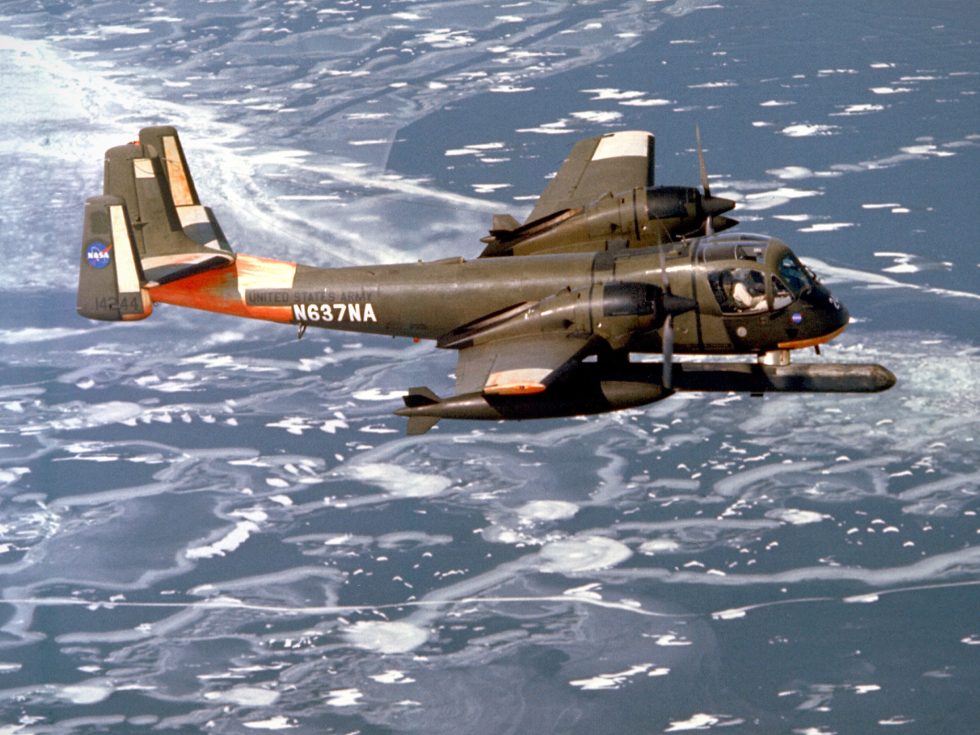
The Mohawk was a flying sensor truck. The OV-1B carried the AN/APS-94 side-looking airborne radar (SLAR) in a long ventral pod that imaged terrain and moving vehicles well off to the side; the OV-1C added the AN/AAS-24 infrared scanner for night work; and all versions could carry cameras. The final OV-1D could swap radar and infrared mission pallets between sorties.
02The Grumman OV-1 Mohawk’s ejection seats: an Army fixed-wing rarity
Ejection seats were standard on jet fighters, but almost unheard-of on a slow, propeller-driven Army observation aircraft. The Mohawk broke that mould with Martin-Baker Mk. J5 seats (later improved to the J5D, with a rocket pack that allowed safe ejection at very low speed, reportedly down to around 60 knots). For crews flying low and slow over hostile jungle — exactly where ground fire was deadliest — that escape system saved lives, and it set the Mohawk apart from every other fixed-wing aircraft in Army green.
03The Grumman OV-1 Mohawk’s sensors: SLAR, infrared and the all-seeing night mission
The Mohawk’s side-looking airborne radar was its signature trick. Flying a straight line parallel to the front, the OV-1B’s AN/APS-94 built up a radar “photograph” of the ground off to one side, and a moving-target mode could pick out vehicles and troops on the move — by day, by night, and through cloud that blinded cameras. The OV-1C’s infrared scanner complemented it, sensing the heat of engines and campfires in darkness. Together they gave Army commanders a near-continuous, all-weather picture of enemy movement that no pair of human eyes could match.
Full OV-1 Mohawk specifications
Baseline note: the figures below describe the OV-1D — the definitive mark, 37 built new and 82 rebuilt from earlier airframes, the version that flew over Germany, Korea and Kuwait and the version almost every surviving Mohawk represents. Deltas for the OV-1A, OV-1B and OV-1C are in grey. Four disagreements are worth settling before the tables start. First, the wing: the OV-1A and OV-1C flew on a 42 ft (12.80 m) span, the OV-1B and OV-1D on 48 ft (14.63 m), and museum pages routinely print OV-1D dimensions and engine ratings against short-wing OV-1A airframes — the Planes of Fame entry for 59-2604, the second production Mohawk built, lists a 48 ft span and 1,400 shp engines that aircraft never had. Second, engines: 1,005 shp T53-L-3 on the earliest machines, 1,150 shp T53-L-7 on the OV-1B and OV-1C, 1,400 shp T53-L-701 on the OV-1D. A widely mirrored European table gives 810 kW, which is 1,086 shp and matches none of the three. Third, speed and ceiling: 305 mph and 25,000 ft come from the OV-1D on the infrared mission, while other reference works quote 347 mph and 35,100 ft, or 308 mph at 5,000 ft with a 30,000 ft ceiling. The spread is not carelessness, it is the radar: an 18 ft fibreglass canoe slung under the right side of the fuselage costs a great deal of drag. Fourth, weight: the Mohawk has two published gross weights because it has two missions, and quoting one against the other produces nonsense.
Dimensions & weights
- Crew
- 2 — pilot left, technical observer right, side by side under a canopy so deeply bulged that the crew could look almost straight down past their own elbows. Both sat on ejection seats, which no other US Army aeroplane has ever needed, and both sets of controls were live: the observer could fly it home
- Length
- 12.50 m (41 ft 0 in), the same on every mark. The nose changed contents constantly and length hardly at all
- Wingspan
- 14.63 m (48 ft 0 in) on the OV-1B and OV-1D. The OV-1A and OV-1C used a 12.80 m (42 ft 0 in) wing; the long span was bought to carry the SLAR pod and its weight without losing the field performance the whole design existed for
- Height
- 3.86 m (12 ft 8 in) over the centre fin. Three fins, not one — short enough to clear a hangar door, spread wide enough to keep the rudders working in the propeller wash on one engine
- Wing area
- 33.4 m² (360 sq ft) at 48 ft span; roughly 30.7 m² (330 sq ft) on the short-wing marks
- Aspect ratio
- 5.35 — aerofoil NACA 2412, a thick, docile, high-lift section of the sort found on light aeroplanes. Nothing about this wing was drawn to go fast, and it shows
- Empty weight
- 5,468 kg (12,054 lb). The OV-1C is generally given as 4,764 kg (10,504 lb), which is the honest measure of what a decade of added sensors, armour and self-protection kit cost
- Gross weight, infrared mission
- 7,051 kg (15,544 lb) — the light configuration, and the one every quoted speed and climb figure belongs to
- Maximum take-off, SLAR mission
- 8,214 kg (18,109 lb) with the radar pod and external tanks. One US dealer profile quotes 18,900 lb, which is above the published limit and is probably an overload ferry figure
- Wing loading
- 246 kg/m² (50.3 lb/sq ft) at maximum weight, 211 kg/m² (43.2 lb/sq ft) on the infrared mission. High for a short-field aeroplane, which is why the Mohawk needed slats and very large flaps to do what it did
- Power loading
- 2.93 kg/shp (6.47 lb/shp) at maximum weight on two 1,400 shp engines. The early OV-1A on 1,005 shp engines was a markedly less confident aeroplane, and the extra power is the single biggest reason the D-model outlived every other mark
- Internal fuel
- 1,040 L (276 US gal, 230 imp gal) in the fuselage
- External fuel
- 2 × 568 L (150 US gal) underwing tanks, about 910 kg (2,010 lb) of fuel. Tanks were the normal fit on surveillance work and the reason a SLAR sortie could run past four hours
- Underwing stores stations
- ~4–6 on the armed JOV-1A and JOV-1C conversions, carrying up to roughly 1,000 kg (2,200 lb). Unarmed surveillance Mohawks kept the wet pylons for tanks and, on the Quick Look aircraft, for electronic intelligence pods
Performance
- Maximum speed
- 491 km/h (305 mph, 265 kn) on the infrared mission. Reference works that print 558 km/h (347 mph) are quoting a clean airframe with no mission pod, which is a condition an operational Mohawk almost never flew in
- Never-exceed speed
- 724 km/h (450 mph, 390 kn). A number that says more about the airframe than the mission — this was a strong aeroplane cruising slowly, not a slow aeroplane flat out
- Cruising speed
- 333 km/h (207 mph, 180 kn), economical cruise. Radar imaging wanted a steady, unhurried track more than it wanted speed
- Stalling speed
- 135 km/h (84 mph, 73 kn) with slats and flaps out. The gap between that and the cruise is the whole argument for the high-lift wing
- Rate of climb
- 17.6 m/s (3,466 ft/min) on the SLAR mission at 1,400 shp per side. The OV-1A on 1,005 shp engines managed nothing like it
- Service ceiling
- 7,620 m (25,000 ft). Sources quoting 30,000 or 35,100 ft are again describing a stripped aeroplane; nobody flew a Mohawk high on purpose, because the sensors wanted to be low
- Range
- 1,520 km (944 miles, 820 nmi) with external tanks on the SLAR mission
- Endurance
- 4 hr 21 min on the SLAR mission with tanks. Long enough to walk the whole inner-German border sector, or the width of the Korean Demilitarized Zone, several times over
- Take-off to 15 m
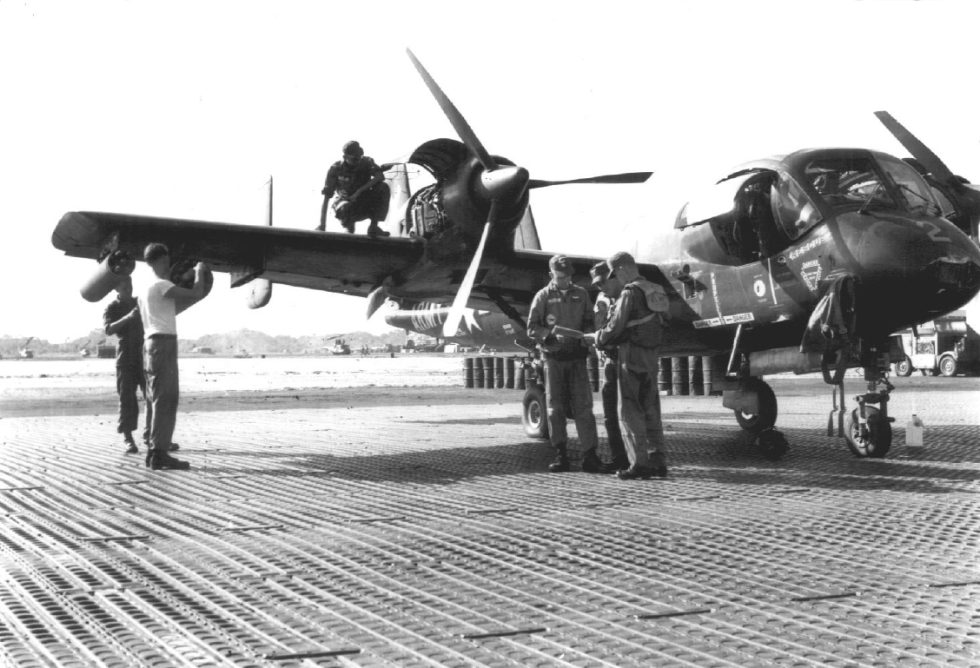
- 358 m (1,175 ft) over a 50 ft obstacle. The requirement had asked for operation from small unimproved fields, and the Mohawk genuinely delivered it — it flew from pierced-steel planking, dirt and grass throughout the Vietnam War
- Landing from 15 m
- 320 m (1,060 ft) over a 50 ft obstacle, using the flaps and the fully reversible propellers
- Load factors
- +5 g / −1.5 g — fully aerobatic and cleared for it, which is not a sentence normally written about a surveillance aeroplane. Mohawk crews rolled and looped them, and the strength was bought back in survivability at fifty feet over hostile ground
- Combat radius
- ~300 km (160 nmi) for a typical armed reconnaissance profile in South Vietnam with gun and rocket pods, an estimate rather than a manual figure
Propulsion & systems
- Engines
- 2 × Lycoming T53-L-701 turboprops, 1,400 shp (1,044 kW) each. The T53 is the same engine family that powered the UH-1 Huey, which mattered enormously to an Army logistics chain that already stocked its parts
- Earlier engine fits
- T53-L-3 of 1,005 shp on the first OV-1As; T53-L-7 of 1,150 shp on the OV-1B and OV-1C — the OV-1D’s 40 per cent power increase over the original aircraft is the reason it could carry either sensor pallet without becoming dangerous
- Propellers
- 3-blade Hamilton Standard 53C51-27 constant-speed, 3.05 m (10 ft 0 in) diameter, fully feathering and reversible. Reverse thrust is what turned a 360 sq ft wing into a short-field aeroplane on landing
- High-lift and control
- Leading-edge slats, large hydraulically driven flaps and speed brakes — the speed brakes let crews come down steeply onto a short strip without running the propellers up, and let them stay behind the target on a marking run
- Ejection seats
- Martin-Baker Mk 5, ground level to 15,240 m (50,000 ft), 90–600 kn indicated. A rare and expensive fit that came from the abandoned Marine Corps requirement, and it repaid the cost: Mohawk crews ejected successfully from heights measured in tens of feet
- Side-looking airborne radar
- AN/APS-94 — X-band, 9,100–9,400 MHz, 160 kW peak, a 5.5 m (18 ft) back-to-back slotted-waveguide antenna in a yaw-stabilised fibreglass pod under the right side of the fuselage. About 50 nmi (92 km) of swath, 30 m range resolution, imaging both fixed returns and moving targets, written continuously onto film. The OV-1D added a data link that threw the imagery to a ground station as it was made
- Infrared
- AN/AAS-24 infrared surveillance set scanning through a belly aperture, drawing a thermal strip map of the ground beneath the aircraft. In Vietnam it found cooking fires, recently run engines and truck parks under triple canopy, and Red Haze imagery routinely turned into an artillery mission within the hour
- Cameras
- KA-60 panoramic and KA-76 serial-frame cameras in the nose and fuselage, with photoflash cartridges for night work. On the OV-1A this was the entire mission fit; on the OV-1D it was what remained after the pallets came out
- Mission pallets
- Interchangeable SLAR and infrared installations, swapped by ground crew in about an hour — the single most useful idea in the whole programme, and the reason one D-model could do the work that had needed a B and a C
- Self-protection
- AN/ALQ-147 Hot Brick infrared jammer, radar warning receiver and chaff and flare dispensers on later aircraft — retrofits, not original equipment, and a tacit admission that a low, slow aeroplane over a modern battlefield is a target
- Cockpit protection
- Armour panels around the crew stations and a windscreen able to take small-arms fire — specified because the design assumption was work at treetop height over people who would shoot at it, which is exactly what happened
04The Grumman OV-1 Mohawk’s operating costs: why no reliable dollar figure exists
The Mohawk was a U.S. government aircraft, procured and operated inside Army budgets rather than sold on an open market, so a clean flyaway unit price and a published cost-per-flight-hour simply do not exist in the public record. Figures that circulate online are almost always estimates or back-calculations, not sourced government numbers. We have deliberately left both the unit cost and the cost-per-flight-hour as “no reliable public figure” rather than repeat a number we cannot stand behind — any precise dollar value you see attached to an OV-1 should be treated with caution.
Armament & payload
The Mohawk spent thirty years carrying sensors on pylons built for bombs
The Mohawk was designed from the start to carry weapons, and spent most of its life forbidden to. Grumman’s G-134 answered a 1956 joint Army and Marine specification for an observation and attack aeroplane, and the underwing pylons, the gun and rocket pods and the ejection seats are all fossils of the Marine half of that requirement — a half that vanished in September 1957 when the Navy spent the money on a fleet oiler instead. What remained was a US Army aeroplane with hardpoints, and the US Air Force spent the next decade trying to have them removed, arguing from the 1948 Key West Agreement that armed fixed-wing aviation was its business alone. The Army fought back with paperwork: armed conversions were designated JOV-1A and JOV-1C, the J prefix meaning a temporary special test installation, which allowed the service to describe an operational light attack aeroplane as an experiment. By 1963 the Army Concept Team in Vietnam was reporting that test restrictions were preventing exploitation of the aircraft’s full capabilities; by 1964 armed Mohawks were being told they could fire only in self-defence, with a load of two gun pods and flares. Almost everything in the cards below was cleared, trialled or offered rather than routinely flown in anger: the trials programme threw an extraordinary variety of ordnance at this aeroplane between 1960 and 1964, and the operational fit in Vietnam was usually two XM14 gun pods and two rocket pods or nothing at all.
Gun
- No built-in gun. Every Mohawk gun was a pod on a wing pylon, and the standard one was the XM14 — a single .50 in (12.7 mm) M3 machine gun with roughly 750 rounds, fired straight ahead and aimed by pointing the aeroplane
- An earlier and cruder .50 in pod borrowed from the Air Force T-28 held only about 100 rounds, which is barely three seconds of firing
- Also trialled: the XM13 with a single 40 mm M75 automatic grenade launcher, the M18 pod with a 7.62 mm Minigun, and the XM19 with a pair of 7.62 mm M60 machine guns
- Grumman proposed a 20 mm M61 Vulcan in a ventral blister fairing. It was never built, and given what the Air Force made of two rifle-calibre pods, it was never going to be
- The gun pods are the reason for the Mohawk’s single strangest claim: in February 1968 Captain Ken Lee is credited with downing a MiG-17 over South Vietnam using XM14 fire and rockets, the only Army aviator ever recognised with a MiG kill. The Army confirmed it only in 2007, and sceptics note the MiG may simply have flown into a mountain trying to follow a slower aeroplane down
Air-to-air
- The AIM-9B Sidewinder was cleared on the Mohawk during the 1960–64 armament trials, envisaged as a self-defence and local air-defence fit
- No Mohawk ever fired an air-to-air missile operationally, and none carried one on a combat sortie in any air arm
- The type’s only claimed aerial victory was made with a machine-gun pod and unguided rockets, which tells you plainly what class of aeroplane this was
- Against a jet the Mohawk had exactly one asset, and Vietnam crews knew it: at 130 kn with slats out it could turn inside anything sent after it, and a fighter that tried to match the turn at low level was in more danger than the Mohawk
Air-to-surface guided
- Essentially none in service. The AGM-12 Bullpup radio-command missile was trialled in the early 1960s and never adopted; a Grumman promotional concept showed an anti-radiation missile that existed only on paper
- The Mohawk was not a designator aircraft either. It never carried a laser pod, and it did not guide anyone else’s weapons
- What it did instead was better suited to its actual job: it found the target, fixed it on film or on the data link, and passed it to artillery. Within one division, air-directed artillery fires were reported to have nearly tripled once Mohawk observers were working
- A 2011 industry proposal by Alliant Techsystems and Mohawk Technologies for a counter-insurgency Mohawk with a FLIR turret and an M230 chain gun would have finally given the type a modern precision fit. Nobody bought it
Bombs
- Mk 80-series low-drag general-purpose bombs, principally the Mk 81 250 lb (113 kg) and Mk 82 500 lb (227 kg), plus a stock of leftover Second World War iron still in the inventory in 1962
- Napalm tanks and incendiary cluster munitions were both cleared during the armament programme and used in the early Vietnam armed reconnaissance period
- Bombs made little sense on this aeroplane and were rarely carried operationally. Four pylons filled with ordnance is four pylons not carrying the tanks and sensors that were the point of the exercise
- Flare racks for night illumination were the store that mattered most after the guns, and they survived the disarmament because nobody could plausibly call a parachute flare a weapon
Rockets
- 2.75 in (70 mm) folding-fin aerial rockets in pods, the standard fit being the M159 with 19 tubes; seven-tube pods were also used
- 5 in (127 mm) high-velocity aircraft rockets left over from Korea, and the 5 in Zuni — a great deal of rocket for a 7-tonne turboprop
- Rockets were the armed Mohawk’s real weapon. They were cheap, they suited a diving pass from low level, and they let a crew that had just found something act on it in the ninety seconds before it disappeared
- White phosphorus rounds were used for marking as well as for effect, putting smoke on a target for fighters or for naval gunfire — the last combat mission flown by one Vietnam Mohawk pilot, on 5 January 1970, was exactly that
Pods & other stores
- The AN/APS-94 SLAR pod: 5.5 m (18 ft) of yaw-stabilised fibreglass under the right side of the fuselage, offset so the antenna looked sideways past the propeller disc. This, not any weapon, is the store the Mohawk was built around
- Quick Look electronic intelligence pods on the RV-1C, RV-1D and EV-1E conversions, hung on the wing pylons in place of ordnance to locate and classify hostile emitters along the inner-German border and the Korean Demilitarized Zone
- Two 150 US gal (568 L) underwing drop tanks, the standard surveillance fit and the difference between a two-hour sortie and a four-hour one
- AN/ALQ-147 Hot Brick infrared jammer, chaff and flare dispensers, and photoflash cartridges for night photography
- The 1966 settlement did not remove the pylons, it removed what could hang on them. For the last thirty years of its life the Mohawk carried tanks, radars, cameras and jammers on hardpoints designed for bombs
Three typical loadouts
- Armed reconnaissance, Nha Trang, 1963
- JOV-1A: two XM14 .50 in gun pods inboard, two M159 nineteen-tube 2.75 in rocket pods outboard, flares, nose cameras. The configuration the 23rd Special Warfare Aviation Detachment flew for South Vietnamese divisions and the Railway Security Agency — and the configuration that made the Air Force complain to the Pentagon.
- Red Haze night infrared, III Corps, 1968
- OV-1C: AN/AAS-24 infrared set on the belly pallet, KA-60 panoramic camera, two 150 US gal drop tanks, no weapons. Four hours at 1,500 ft over the trails, imagery developed on landing and read by an interpretation team before dawn.
- Border SLAR patrol, Germany or Korea, 1985
- OV-1D: AN/APS-94 SLAR pod to starboard, data link to a ground processing station, two drop tanks, AN/ALQ-147 jammer. Flown parallel to the boundary and never across it, mapping vehicle movement 50 nmi into the other side’s territory in weather that grounded everything else.
Sourcing caveat: the armament list above is assembled from trials records and period Grumman marketing as well as from operational reporting, and the two are not the same thing. Several stores — the Bullpup, the Sidewinder, the 40 mm grenade pod — were fired on ranges and never in combat. Round counts for the XM14 pod vary between sources, and the February 1968 MiG-17 claim remains contested even though the Army recognised it.
Variants
Four sensor fits, one airframe, and a fight the Army lost in 1966
Every Mohawk variant is a sensor argument. The airframe barely changed between 1959 and 1970 — same length, same triple tail, same cockpit — while the thing it carried changed completely three times. The OV-1A was a photographic aeroplane with a panoramic camera and nothing else. The OV-1B put the AN/APS-94 side-looking radar in an 18 ft canoe under the right side of the fuselage and needed six extra feet of wing to carry it. The OV-1C put an AN/AAS-24 infrared scanner in the belly and went back to the short wing. The OV-1D ended the argument by making the radar and the infrared installations interchangeable pallets that ground crew could swap in about an hour, on the long wing, with 1,400 shp engines to carry either of them.
The other half of the story is institutional. The Air Force objected to an Army aeroplane with hardpoints from the moment the Marines walked away in 1957. Orders stopped in fiscal year 1964; in 1964 the 23rd Special Warfare Aviation Detachment was dissolved into the conventional 73rd Aviation Company and dedicated armed Mohawk operations effectively ended; in 1965 a Defense Department directive prohibited the Army from operating armed fixed-wing aircraft outright. It is worth being precise about what came next, because the Johnson–McConnell agreement of 6 April 1966 is routinely described as the document that disarmed the Mohawk and it is not. That agreement, signed by Army Chief of Staff General Harold K. Johnson and Air Force Chief of Staff General John P. McConnell, traded the Army’s CV-2 Caribou and CV-7 Buffalo transports and all future fixed-wing tactical airlift to the Air Force in exchange for the Air Force abandoning its claim on Army helicopters. The Mohawk is not named in it. What the agreement did was settle the wider question the armed Mohawk had been the test case for, and it settled it against the Army: fixed wings belonged to the Air Force, rotors belonged to the Army, and an armed Army fixed-wing aeroplane had no constitutional space left to occupy. Army officers felt they had traded real capability for empty guarantees. They were largely right, and the surveillance Mohawk that survived was the compromise.
Vietnam then contradicted the paperwork, as Vietnam usually did. Operational success produced fresh orders in 1966, and by 1968 five aerial surveillance companies — the 73rd, 131st, 225th, 244th and 245th — were flying Mohawks in Southeast Asia. Sixty-five were lost there to ground fire and accidents, a brutal rate for a fleet of 380 aircraft, and the reason is not mysterious: the sensors worked best low and slow, and low and slow over an alerted enemy is how crews die.
The long peace afterwards was the Mohawk’s real career. The first Mohawks to leave the United States went to Seventh Army at Sandhofen airfield near Mannheim in mid-1961, and for three decades OV-1Ds and RV-1Ds flew the inner-German and Czechoslovak borders, mapping the far side with radar in weather that stopped everything else and cataloguing Warsaw Pact emitters. SLAR Mohawks began patrolling the Korean Demilitarized Zone in 1963 and did not stop; missions were cancelled only in the very worst weather, and in February 1977 three OV-1Ds were ferried from Fort Huachuca to Korea across more than sixteen countries, a first for the US Army. From 1972 the Army National Guard took the type on as well, eventually operating thirteen OV-1Bs, twenty-four OV-1Cs and sixteen OV-1Ds with units in Georgia and Oregon. The last shooting war was Operation Desert Storm, where Mohawks flew battlefield surveillance over open desert — almost perfect SLAR country, and the one theatre that finally played to the aeroplane’s strengths without putting it at treetop height. Then it ended quickly: withdrawn from Europe in 1992, from Korea in September 1996, and from the United States the same year, displaced by the EO-5C Airborne Reconnaissance Low, by the Air Force’s E-8 Joint STARS, and by satellites. The Mohawk was the last manned aeroplane the US Army built for itself to look at a battlefield, and nothing has replaced the idea.
- YAO-1AF / YOV-1A (1959–60, 9 built)
- Prototypes and service-test aircraft; first flight 14 April 1959. The original designation is the giveaway — AO for Army Observation, in the Navy-style system the Army still used before the 1962 tri-service rationalisation renamed everything OV-1.
- OV-1A (AO-1AF) (1959–65, 64 built)
- Daylight visual and photographic reconnaissance on the short 42 ft wing with 1,005 shp T53-L-3 engines. Cameras in the nose, no radar, no infrared: the plainest Mohawk and the one whose specifications museums most often get wrong.
- JOV-1A and JOV-1C (1962 onwards, 59 conversions)
- Armed conversions with underwing pylons for gun pods, rocket pods, bombs and flares. The J prefix denoted a temporary special test installation and was, in practice, a bureaucratic device to fly an armed Army aeroplane while insisting it was only an experiment.
- OV-1B (AO-1BF) (1960–64, 101 built)
- The radar Mohawk: AN/APS-94 SLAR in the ventral pod, 48 ft wing, 1,150 shp T53-L-7 engines. First over the Korean Demilitarized Zone in 1963, and the aircraft that made all-weather day and night battlefield imaging an Army capability rather than an Air Force favour.
- OV-1C (AO-1CF) (1961–70, 169 built)
- The infrared Mohawk and the most numerous mark, with the AN/AAS-24 scanner in the belly on the short wing. Its Red Haze night missions over Vietnam found what the eye and the camera could not: engines, fires and freshly used trails.
- OV-1D (1968–70, 37 new and 82 conversions)
- The definitive Mohawk. Long wing, 1,400 shp T53-L-701 engines, interchangeable SLAR and infrared pallets swappable in about an hour, and a data link that put radar imagery into a ground station in near real time. This is the mark that flew in Germany, Korea and Desert Storm.
- RV-1C and RV-1D Quick Look (1970s, 2 and 31 conversions)
- Electronic intelligence conversions of OV-1C and OV-1D airframes, carrying emitter-location pods on the wing pylons instead of ordnance. Quick Look II on the RV-1D was the workhorse, listening along the inner-German border for the radars of an army that was never going to come.
- EV-1E Quick Look III (16 conversions)
- The final electronic intelligence standard, with improved emitter processing. The E designation marks the point at which a battlefield observation aeroplane had become a signals platform that happened to have windows.
- OV-1E (1 prototype, not produced)
- A stretched-fuselage proposal with room for extra sensor operators or cargo. It was the obvious next step and it was never funded, which is the recurring verdict on Army fixed-wing ambitions after 1966.
- Grumman Model 134R (proposal, 1964, not built)
- A tandem-cockpit Mohawk derivative offered for the Light Armed Reconnaissance Aircraft competition. It lost to the North American Rockwell OV-10 Bronco — the aeroplane that took over the armed observation job the Mohawk had been forbidden to do.
Survivors, and the numbers behind them. Of roughly 380 built, about forty-five airframes are accounted for today, all of them original military aircraft — no Mohawk reproduction exists or is ever likely to, since nobody builds a triple-tailed turboprop for fun. The oldest is YAO-1 57-6539 at the US Army Aviation Museum at Fort Novosel, Alabama; 59-2604, the second production machine, is at Planes of Fame in Chino, California. Static examples are spread across the Pima Air & Space Museum, the Cradle of Aviation Museum, Evergreen, the Air Zoo, the Fort Worth Aviation Museum, Hickory, MAPS and a dozen Army posts from Fort Huachuca to United States Army Garrison Humphreys in South Korea, where 69-17022 stands as a gate guard on the ground the type patrolled until 1996. Roughly ten Mohawks passed into civil hands, most of them concentrated with Mohawk Technologies and associated owners at Palm Beach County Park Airport, Lantana, Florida, and a handful of these are maintained in airworthy condition and appear at airshows in any given year; published claims of "about ten airworthy" date from before 2015 and count Argentine aircraft that no longer fly. That population is fragile: OV-1D 68-15958 was destroyed and its pilot killed at the Stuart Air Show in Florida on 1 November 2019. Argentina’s Ejército Argentino bought 23 to 25 ex-US airframes between December 1992 and August 1994 — sources differ, partly because two were delivered purely as spares — and never had more than about ten serviceable; the fleet was grounded after a 2006 accident and formally retired in 2012, though 2015 is also widely quoted, with one aircraft preserved at the Argentine Army aviation museum in Buenos Aires. Israel is the other export operator and the least documented: two OV-1Ds delivered in 1974 flew ceasefire monitoring with 122 Squadron under the name Atalef, the bat, and were given up after about eight years when unmanned aircraft and the E-2C took over the job.
From Cold-War eyes to Desert Storm veteran
A joint requirement
The Army and Marine Corps issue a joint requirement for a rugged battlefield observation aircraft; Grumman’s G-134 design wins.
First flight
The prototype flies on 14 April with its triple tail and glazed nose. The Marines soon withdraw, leaving the Army as the sole customer.
Enters service
The OV-1 Mohawk joins U.S. Army units, first deploying to West Germany for Cold-War battlefield surveillance.
Into Vietnam
Armed JOV-1 Mohawks deploy to South Vietnam, flying armed reconnaissance — and starting a turf war with the Air Force.
Disarmed by memo
The Johnson-McConnell agreement ends the Army’s armed fixed-wing role; the Mohawk becomes a pure sensor platform.
A Mohawk vs a MiG
Capt. Ken Lee is widely reported to have downed a North Vietnamese MiG-17 — the only claimed U.S. Army fixed-wing air-to-air kill of the war.
Desert Storm
Sixteen Mohawks fly long battlefield-surveillance missions over Iraq and Kuwait with no combat losses.
The last Mohawks
The U.S. Army retires the type in September 1996; Argentina flies its ex-Army OV-1Ds on until around 2015.
From the cockpit: twelve OV-1 Mohawk stories
A plane the Marines walked away from
The Mohawk began as a joint Army-Marine project; the Marines dropped out and left it to the Army.
Read the full story
Grumman’s bug-eyed prototype
The prototype flew on 14 April 1959 with its triple tail and deeply glazed cockpit.
Read the full story
An Army plane you could bang out of
Uniquely for an Army fixed-wing type, the Mohawk carried Martin-Baker ejection seats.
Read the full story
The armed JOV-1 experiment
Six armed Mohawks deployed to Vietnam in 1962 carrying rockets and gun pods.
Read the full story
The plane the Air Force wanted grounded
The armed Mohawk triggered a turf war settled by a 1966 agreement.
Read the full story
The Mohawk that reportedly downed a MiG
Capt. Ken Lee is widely reported to have shot down a North Vietnamese MiG-17 in 1968.
Read the full story
Seeing in the dark
Infrared and side-looking radar let the Mohawk map the enemy at night and through cloud.
Read the full story
The canoe under the belly
The OV-1B carried a long side-looking radar pod that imaged movement miles away.
Read the full story
Eyes on the Fulda Gap
From West Germany, Mohawks watched the inner-German border for a Soviet advance.
Read the full story
Thirty years on the DMZ
Mohawks flew border surveillance along the Korean DMZ until the type retired.
Read the full story
The Mohawk’s last war
In 1991, sixteen Mohawks flew long surveillance missions over Iraq with no combat losses.
Read the full story
Mohawks over the Pampas
Argentina flew 23 ex-U.S. Army OV-1Ds until around 2015 — the last military operator.
Read the full story
The OV-1 Mohawk in pictures
The OV-1 Mohawk in motion
AIRBOYD: Grumman OV-1 Mohawk (1961). Genuine period film of the new Army observation aircraft, from AIRBOYD — one of YouTube’s largest aviation archive channels.
Where the OV-1 Mohawk served
The OV-1 Mohawk’s combat record
The Mohawk was a reconnaissance aircraft, not a fighter — but it flew into harm’s way constantly, and paid for it. Its record is one of relentless surveillance under fire, a Vietnam loss list that ran into the dozens, and one famous, disputed brush with a MiG. Its clearest victories were the ones it never fired a shot to win: the enemy movements it revealed.
Compare the combat record of every military aircraft. Figures are best estimates and vary between sources.
Everything people ask about the OV-1 Mohawk
Can I fly in a Grumman OV-1 Mohawk?
What was the OV-1 Mohawk used for?
Why did an Army aircraft have ejection seats?
Did a Mohawk ever shoot down an enemy aircraft?
Which countries flew the OV-1 Mohawk?
How many OV-1 Mohawks were built, and when did it retire?
What engines did the Mohawk use?
You can’t fly the OV-1 Mohawk.
These, you can.
Some legends only live in museums — others are fuelled and waiting. MiGFlug has put civilians in real military jet cockpits since 2004.
 Fly the L-39 AlbatrosThe world’s most-flown jet trainer — aerobatics included
 Fly the F-104 Starfighter“The missile with a man in it”
 Fly the MiG-21The Cold War’s most-produced jet
 Fly the T-33 Shooting StarAmerica’s first jet trainer
 Fly the DH VampireA piece of early jet history
 Fly the S.211Agile Italian jet trainer
 Fly the MB-326The classic Aermacchi jet
 Fly the MiG-15The Soviet legend of the Korean War
Continue the tour
Every fact, checked
- Smithsonian Air & Space — “The Last of the Mohawks”Design, the triple tail and bulged canopy, sensor variants and service to 1996.
- FAS / IRP — OV-1 intelligence-collection profileEngines, SLAR and infrared variants, ~380 built, 1996 retirement and Desert Storm.
- The War Zone — the Mohawk as light attack aircraftThe armed JOV-1 and the Key West / Johnson-McConnell inter-service dispute.
- HistoryNet — “Silent Warrior: Grumman’s OV-1 Mohawk”Variants, the T53-L-701 engines, and the Argentine and European service histories.
- The Aviation Geek Club — the Mohawk MiG-17 storyThe widely told account of Capt. Ken Lee’s 1968 air-to-air claim.
- Fort Worth Aviation Museum — OV-1 MohawkEngine details and the Israeli EV-1E “Atalef” and Argentine operator histories.
- The Ejection Site — OV-1 Mohawk seatsThe Martin-Baker Mk. J5 ejection-seat detail behind the Army’s rare escape system.
- Vintage Aviation News — Flight Test Files: OV-1CA pilot’s-eye account of flying the multi-sensor Mohawk.