
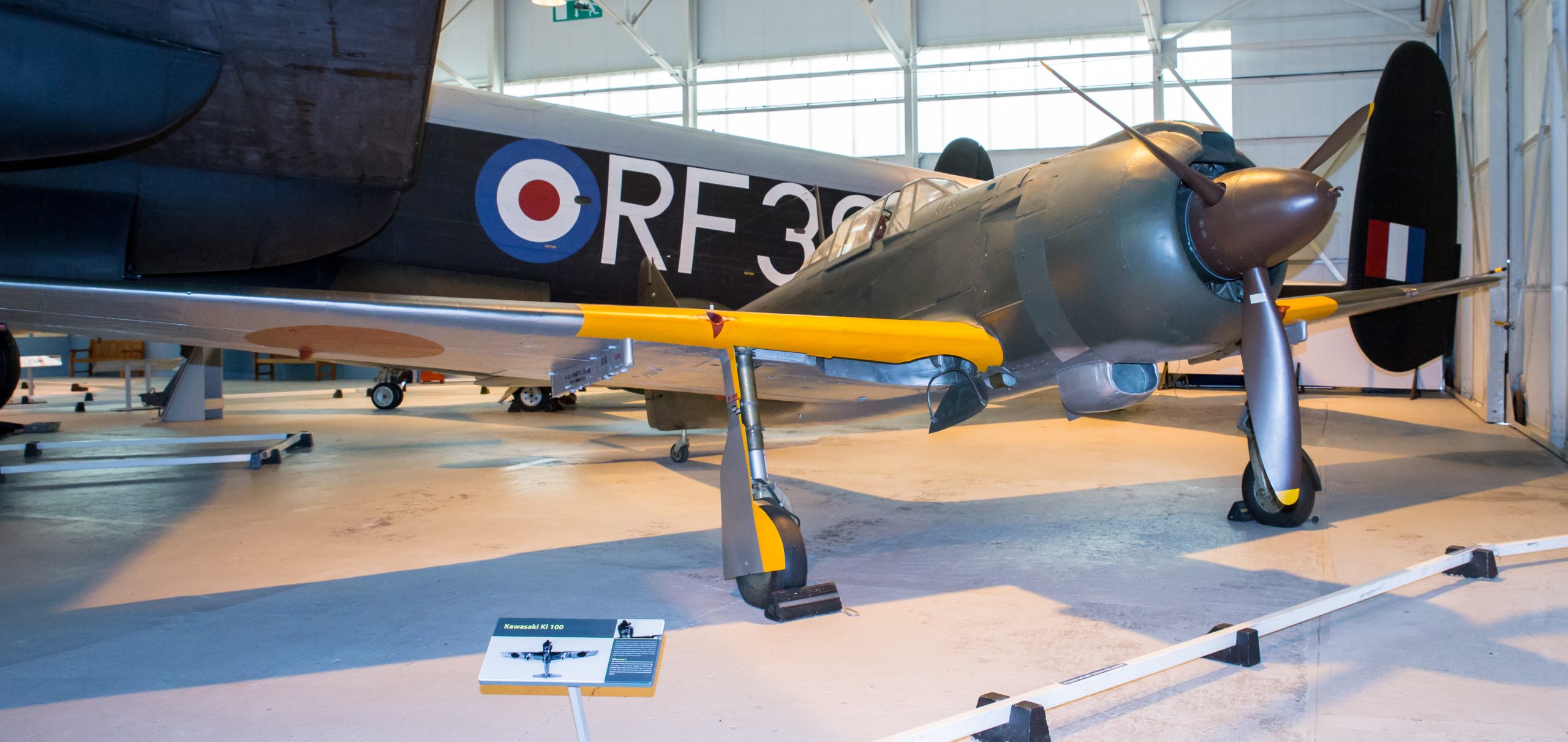
Kawasaki Ki-100
Army Type 5 Fighter
The fighter Japan built by accident — hundreds of Ki-61 Hien airframes left engineless by a bombed factory, rescued with a Mitsubishi radial, and turned into one of the finest fighters the Imperial Army ever flew.
The best fighter Japan built by accident
By the winter of 1944 the Imperial Japanese Army had a distinctly modern problem: a warehouse full of fighters with no engines. Kawasaki’s Ki-61 Hien — the only mass-produced Japanese fighter with a liquid-cooled inline engine — depended on the Ha-140, a licence-derived Daimler-Benz V12 built at the Akashi factory. The Ha-140 was troublesome from the start, and when American bombing wrecked the Akashi engine plant in January 1945 the supply collapsed. Around 275 Ki-61-II airframes stood completed and useless, their nose bays empty.
The fix was audacious. Kawasaki’s design team under Takeo Doi proposed mating the slim Ki-61 fuselage to a fat Mitsubishi Ha-112-II — a compact, reliable 14-cylinder radial of about 1,500 hp. On paper the marriage looked ugly: a broad radial cowling grafted onto an airframe designed around a pointed inline nose. To smooth the join the engineers studied a captured Focke-Wulf Fw 190 and reworked the cowling and exhaust. The first converted prototype flew on 1 February 1945 — and to nearly everyone’s surprise it was not a compromise. It was better.
The new fighter, designated Ki-100 and formally the Army Type 5 Fighter, was lighter on the nose than the Hien, better balanced and vastly more dependable. Pilots found it forgiving, superbly manoeuvrable and able to fight from the deck to medium altitude against almost anything the Allies flew — holding its own with the F6F Hellcat and dangerous even to the P-51 Mustang below about 6,000 m. The air-cooled radial shrugged off the maintenance nightmares that had grounded the inline Hien; units that had spent months nursing sick engines suddenly had an aeroplane that simply worked.
It came far too late. The first Ki-100s reached front-line Sentai in March 1945, as Japan’s fuel, pilots and industry were all failing at once. Only around 390 were built — 272 converted from engineless Ki-61 airframes and roughly 118 new-built machines, many with an all-round-vision bubble canopy — before the war ended in August. Elite home-defence units such as the 244th Sentai flew them against B-29 raids and US Navy carrier fighters, and in several engagements the type gave a very good account of itself. But a few hundred excellent fighters, flown by a shrinking cadre of trained pilots on dwindling fuel, could not change the outcome.
The Ki-100 never even earned an Allied reporting name — the war ended before Western intelligence caught up with it, and it is sometimes still mislabelled ‘Tony’, the codename of its Ki-61 parent. Historians have been kinder than the wartime recognition manuals: many rank it among the finest fighters Japan produced. The great irony is that it was born not from a triumph of design but from a disaster of engine supply.
01The Kawasaki Ki-100’s origin: how a wrecked engine factory created Japan’s best fighter
The Ki-61 Hien was unique among Japanese wartime fighters in using an inline, liquid-cooled engine — the Kawasaki Ha-40 and its uprated successor the Ha-140, both derived from the German Daimler-Benz DB 601. The engines were powerful but chronically unreliable and hard to build, and when US bombing devastated the Akashi engine works in January 1945, Ki-61-II production ground to a halt with roughly 275 airframes finished but engineless.
Rather than scrap them, Takeo Doi’s team fitted the readily available Mitsubishi Ha-112-II radial. The conversion cost some frontal area but saved weight over the nose, cured the reliability crisis outright, and produced a fighter that was, by broad agreement of pilots and later historians, better than the Hien it replaced. Necessity, not ambition, delivered the Imperial Army’s finest fighter.
What makes the Ki-100 special
A Ki-61 airframe, re-engined out of desperation
The Ki-100 was not a clean-sheet design but a rescue. When the Ha-140 inline failed, roughly 275 completed Ki-61-II fuselages had no engine. Kawasaki grafted a radial onto the existing airframe rather than scrap it — keeping the Hien’s wing and tail while swapping its long, pointed nose for a stubby cowling.
The Mitsubishi Ha-112-II radial that changed everything
Power came from a single Mitsubishi Ha-112-II, a 14-cylinder air-cooled radial of about 1,500 hp. It was compact, proven and dependable — everything the troublesome inline was not. Air cooling also deleted the Hien’s vulnerable radiators and plumbing, a real advantage on a battered wartime supply chain.
Handling good enough to fight Hellcats and Mustangs
The lighter nose moved the balance and made the Ki-100 beautifully manoeuvrable and forgiving. Pilots rated it able to dogfight the F6F Hellcat on even terms and to threaten the P-51 Mustang at low and medium altitude. Its one real weakness was performance high up, where the B-29 preferred to cruise.
02The Kawasaki Ki-100’s engine swap: why a radial beat the inline it replaced
Swapping a slim liquid-cooled V12 for a broad radial should, in theory, have hurt performance — more drag, a blunter nose. In practice the Ki-100 lost only a little top speed and gained enormously everywhere else. The Ha-112-II was lighter and shorter than the Ha-140, improving the centre of gravity and making the aircraft far more agile. It ran reliably where the inline had constantly failed, and air cooling removed the radiators that were a favourite target and a maintenance burden. The result was a fighter that was easier to fly, easier to keep flying, and better in a turning fight than the Hien it was built from.
03The Kawasaki Ki-100 in combat: the 244th Sentai and the B-29 problem
The Ki-100 entered service as a home-defence interceptor in the last months of the war. Veteran units such as the 244th Sentai, famous for their B-29 interceptions, converted to it and used it against both the bombers and the US Navy fighters escorting the carrier strikes on Japan. Against fighters at low and medium altitude the Ki-100 was excellent. Against the B-29 it faced the same problem as every Japanese interceptor: the Superfortress cruised near 10,000 m, at the very edge of the fighter’s comfortable performance, and climbing to it burned time and fuel Japan no longer had. The Ki-100 was a superb dogfighter that arrived in a war being decided far above its best altitude.
Kawasaki Ki-100 full specifications
Baseline note: the figures below describe the Ki-100-I as delivered between March and August 1945 — the Army Type 5 Fighter, Model 1a (Ki-100-I-Ko) and Model 1b (Ki-100-I-Otsu) were aerodynamically all but identical, the Otsu differing in its cut-down rear fuselage, all-round-vision canopy and reshaped oil-cooler fairing rather than in any figure quoted here. Deltas for the parent Ki-61-II-KAI and for the turbocharged Ki-100-II are given in grey. Japanese manufacturer’s data of 1945 survive unevenly; where the United States Strategic Bombing Survey returns and René Francillon’s reconstruction disagree, both are named.
Dimensions & weights
- Crew
- 1
- Length
- 8.82 m (28 ft 11 in)
- Wingspan
- 12.00 m (39 ft 4 in), unchanged from the Ki-61
- Height
- 3.75 m (12 ft 4 in), tail down
- Wing area
- 20.0 m² (215 sq ft)
- Aerofoil
- NACA 2R1 16 at the root, NACA 24009 at the tip
- Undercarriage track
- 4.05 m (13 ft 3 in) — wide, inward-retracting, and one reason the type was forgiving on rough dispersal strips
- Fuselage width at the firewall
- 840 mm (33 in) against an engine 1,218 mm (48 in) across — the central problem the whole conversion had to solve
- Empty weight
- 2,525 kg (5,567 lb)
- Loaded weight
- 3,495 kg (7,705 lb)
- Weight saved against the Ki-61-II-KAI
- 329 kg (725 lb) — the lighter engine, the deleted radiator, coolant and plumbing, and the lead ballast that could now come out of the tail
- Wing loading
- 174.8 kg/m² (35.8 lb/sq ft), down from 189 kg/m² (38.8 lb/sq ft) on the Ki-61-II-KAI
- Power loading
- 3.12 kg/kW (5.14 lb/hp) at loaded weight
Performance
- Maximum speed
- 580 km/h (360 mph) at 6,000 m (19,700 ft)
- Ki-61-II-KAI, for comparison
- 610 km/h (379 mph) — the radial cost 30 km/h (18 mph), the one column in which the Ki-100 was the poorer aeroplane
- Cruising speed
- 400 km/h (249 mph) at 4,000 m (13,100 ft)
- Time to 5,000 m
- 6 min 0 s (16,400 ft)
- Time to 10,000 m
- 20 min (32,800 ft) — far too long to reach a B-29 stream that was already overhead
- Service ceiling
- 11,000 m (36,100 ft), but the Ha-112-II was falling away hard above 8,000 m (26,000 ft)
- Range, internal fuel
- 1,400 km (870 miles)
- Range with two 200 litre tanks
- 2,200 km (1,370 miles)
- Endurance
- 3 hr 30 min
- Dive
- Would stay with a P-51 in the dive and hold speed through the pull-out — a thing most Japanese fighters could not do, and the trait Allied pilots noticed first
- Ki-100-II
- 590 km/h (367 mph) at 10,000 m (32,800 ft), ceiling 10,670 m (35,000 ft), range 2,000 km (1,240 miles) — prototype figures only, never confirmed by a service aeroplane
- For comparison: P-51D Mustang
- 703 km/h (437 mph) at 7,600 m (25,000 ft) — the Ki-100 could not run, only turn
Propulsion & systems
- Engine
- 1 × Mitsubishi Ha-112-II (unified Army-Navy designation Ha-33/62; the Navy knew it as the Kinsei 62), 14-cylinder two-row air-cooled radial
- Take-off power
- 1,120 kW (1,500 hp)
- Rated power at altitude
- 1,007 kW (1,350 hp) at 2,000 m (6,600 ft); 932 kW (1,250 hp) at 5,800 m (19,000 ft)
- Displacement
- 32.3 litres (1,970 cu in); bore 140 mm, stroke 150 mm
- Engine dry weight
- 545 kg (1,202 lb) — 54 kg (119 lb) less than the Ha-140 it replaced, which is why the nose grew heavier-looking and the aeroplane got lighter
- Induction
- Single-stage centrifugal supercharger with direct fuel injection; water-methanol boost carried but sparingly used
- Exhaust
- Twelve individual thrust-augmenting ejector stacks, six a side, taken in principle from the Focke-Wulf Fw 190A-5 sample aircraft; the exhaust jet scavenged the cowling and did the work a long fairing would otherwise have had to do
- Cowling
- Second skin riveted over the original Ki-61 fuselage to fair 1,218 mm of engine into 840 mm of airframe — a bulged nose in plan view and one of the cleanest radial grafts of the war
- Propeller
- Three-blade constant-speed metal airscrew, 3.00 m (9 ft 10 in)
- Internal fuel
- 595 litres (131 imp gal, 157 US gal)
- Water-methanol
- 95 litres (21 imp gal, 25 US gal)
- Protection
- Pilot armour plate and self-sealing tanks inherited from the Ki-61 — rare among Japanese fighters and a large part of the type’s reputation for bringing pilots home
- Ki-100-II powerplant
- Mitsubishi Ha-112-II-Ru with an Ru-102 exhaust-driven turbo-supercharger and no intercooler; roughly 1,020 kW (1,370 hp) sustained at 7,700 m (25,300 ft)
04The Kawasaki Ki-100’s cost: why no dollar figure exists
The Ki-100 was a wartime product of the Japanese state aircraft industry, built under emergency conditions in 1945 and never sold on any open market, so a meaningful unit price simply does not exist in the public record — and any single figure quoted for it should be treated as an estimate rather than a sourced fact. For the same reason there is no reliable cost-per-flight-hour figure for the type: Japan kept no comparable operating-cost accounting, the fleet existed for only a few months, and no credible open-source number has ever been published. Where cost data would normally go, the honest answer for the Ki-100 is that none survives.
Armament & payload
The Ki-100 carried the Ki-61’s guns unchanged, and against a B-29 that was the weak link
Nothing about the armament was new, because nothing about the armament was allowed to be new: the conversion had to reuse Ki-61-II-KAI airframes exactly as they stood, so the Ki-100 inherited two 20 mm Ho-5 cannon in the upper fuselage decking, synchronised to fire through the disc, and two 12.7 mm Ho-103 machine guns in the wings. That is a respectable fighter-versus-fighter battery and a thin one for killing a Superfortress. The Ho-5 was a scaled-up Browning firing a short 20 × 94 mm round at a modest muzzle velocity, and wartime quality control forced the propellant charge to be reduced further still; pilots had to close to knife-fighting range or come head-on, and a head-on pass leaves a fighter almost stationary in eleven gunners’ sights. Ammunition figures are genuinely disputed: Francillon and most Japanese sources give 200 rounds per Ho-5 and 250 per Ho-103, while some widely reproduced English-language tables state 400 and 500 — almost certainly a confusion of per-gun and total figures. The lower pair is used here.
Gun
- 2 × 20 mm Ho-5 cannon in the upper fuselage decking, synchronised, 200 rounds per gun
- 2 × 12.7 mm Ho-103 machine guns in the wings outboard of the undercarriage, 250 rounds per gun
- Ho-5 cyclic rate about 850 rounds per minute; the 20 × 94 mm round left the muzzle at roughly 735 m/s, well below German or American 20 mm practice
- Ho-103 was a licence-derived Browning firing the 12.7 × 81SR Breda round, including an explosive-tipped Ma-103 shell that was more useful against aircraft than its calibre suggests
- About 12 seconds of cannon fire and rather more of machine-gun fire — enough for two or three firing passes and no more
Air-to-air
- No guided air-to-air weapon of any kind; guns were the entire air-to-air armament, as they were for every Japanese fighter of 1945
- Standard tactic against B-29 formations was the head-on pass, the only aspect from which the bomber’s structure and its gunners were both vulnerable, and the one that gave the fighter least time to shoot
- Against Allied fighters the Ki-100 fought by turning: instructors at the Akeno Army Flying School concluded in March and April 1945 that between pilots of equal experience the Ki-100 would beat the Nakajima Ki-84, then the Army’s best fighter
- Comparative trials at Yokota against a captured P-51C showed the Japanese fighter the more agile and the equal in the dive, but unable to prevent a Mustang breaking off at will
- Army air-to-air cluster bombs of the Ta-Dan type were dropped into B-29 formations by other units in 1944–45; there is no good evidence that Ki-100 units used them, and the practice is not claimed here.
Air-to-surface guided
- None. No guided air-to-surface weapon reached Japanese service in a form a single-seat fighter could carry
- The card is kept because the absence is the point: in the last year of the war the Ki-100 was a pure interceptor with an improvised secondary bombing capability and nothing else
- What the Army did plan was cruder — Ki-100 units were among the formations husbanded for Operation Ketsu-Go, the defence against the expected invasion, in which fighters were to attack landing shipping directly
- Roughly half the surviving Ki-100 force was being held back from daily interception duty by August 1945 for exactly that purpose, and therefore never fought at all
Bombs
- 2 × 250 kg (551 lb) bombs on the two underwing racks, the same fittings that carried the drop tanks
- Smaller 30 kg and 50 kg weapons could be substituted, though there was little call for them in a home-defence unit
- Bombing was rare in practice: from March 1945 the Ki-100 was flown almost exclusively against aircraft, and every kilogramme of external store cost climb rate the type could not spare
- The ground-attack and anti-shipping fit mattered chiefly as a plan for an invasion that never came
Rockets
- None. No Ki-100 is recorded as having carried rocket projectiles operationally
- The Army’s 20 cm and 30 cm air-to-air rockets and the Ro-Ta weapons were fired from twin-engined types such as the Ki-45 and Ki-46, which had the airframe and the crew to aim them
- Neither the wing structure nor the Ha-112-II offered any margin for that kind of drag on a fighter already short of altitude performance
- The Ki-100’s answer to the B-29 remained two cannon, closed to about 200 m and fired head-on
Pods & other stores
- 2 × 200 litre (44 imp gal, 53 US gal) drop tanks, raising range from 1,400 km to 2,200 km (870 to 1,370 miles)
- Drop tanks were seldom carried in earnest: home-defence interceptions were flown from bases the bombers were already crossing, and tanks meant slower climb
- Radio fit was the Army’s standard set of the period and, as on most Japanese fighters, was frequently unreliable and sometimes removed to save weight, which crippled controlled interception
- Camera gun provision for gunnery training and the assessment of claims
- No armoured windscreen upgrade, no gunsight change and no pressurisation were ever fitted, which is why the type worked at 6,000 m and struggled at 10,000 m
Three typical loadouts
- Daylight B-29 interception, Kobe, 5 June 1945
- Clean airframe, no external stores, full 200 rounds a cannon, scrambled to be at 8,000 m (26,000 ft) before the stream arrived. Thirteen Ki-100s of the 111th Sentai went up and claimed six bombers and five probables; the Americans lost nine B-29s over the target area that day to all causes.
- Anti-fighter sortie over Ise Bay, 16 July 1945
- Two 200 litre drop tanks for the transit and the loiter, jettisoned on sighting. Guns full. This was the mission the Ki-100 was actually good at, and the one the Army could least afford to fly — five were lost and three pilots killed for a claim of six Mustangs that American records do not support.
- Anti-invasion strike, held in reserve, August 1945
- Two 250 kg (551 lb) bombs on the wing racks, no tanks, a one-way profile against landing shipping off Kyushu under Operation Ketsu-Go. Aircraft in this role were dispersed, camouflaged and forbidden to intercept, and the surrender found most of them still on the ground.
Sourcing caveat. Japanese ordnance records for 1945 are fragmentary and much of what circulates traces to post-war interrogation and to Francillon’s 1970 reconstruction. Ammunition loads, external-store clearances and the exact Ho-5 propellant loading of late production are all reported inconsistently, and the more conservative figure has been taken throughout.
Variants
Two production marks, three turbocharged prototypes and a total that barely cleared 390 aircraft
The Ki-100 exists because a different aeroplane failed. Kawasaki’s Ki-61 Hien was the only Japanese fighter of the war with a liquid-cooled inline engine, a licence-built Daimler-Benz DB 601 called the Ha-40, and it was chronically unreliable. The uprated Ha-140 intended for the Ki-61-II was worse: of twenty engines scheduled in July 1944, eight arrived; September delivered one. By the winter of 1944–45 Kawasaki’s Kagamigahara works held a growing park of complete, engineless Ki-61-II-KAI fuselages standing on their undercarriages with nothing in the nose.
In October 1944 the Koku Hombu ordered Kawasaki to try a radial. Takeo Doi, the Ki-61’s designer, and a small team faced an unpromising sum: the Mitsubishi Ha-112-II was 1,218 mm across and the Ki-61 fuselage was 840 mm wide at the firewall, and every previous attempt to hang a fat radial on a slim inline-engined fighter had produced a draggy, nose-heavy disappointment. The answer came from a Focke-Wulf Fw 190A-5 that Japan had bought from Germany and had on hand for evaluation. The German installation did not fair the engine into the fuselage with a long cowling; it fitted the cowling tightly and used twelve individual thrust-augmenting exhaust stacks, six a side, to blow the separated flow off the shoulders of the fuselage. Doi’s team copied the principle, added a second skin riveted over the existing fuselage to carry the fairing, and left the rest of the aeroplane alone.
The Ha-140 plant at Akashi was destroyed by B-29s on 19 January 1945, ending any argument. The first converted prototype flew on 1 February, thirteen days later. The aeroplane that resulted was 329 kg lighter than the Ki-61-II-KAI, turned tighter, took off shorter, landed slower, dived with a Mustang and — the decisive point — started every time. It was also 30 km/h slower, and it arrived with five months of the war left to run.
- Kawasaki Ki-61-II-KAI (1944–45, 374 airframes)
- The parent. Enlarged-wing Hien for the Ha-140; only about 99 ever received an engine, leaving 275 complete airframes with empty noses — the raw material for everything below.
- Ki-100 prototypes (Feb–Mar 1945, 3)
- Three Ki-61-II-KAI airframes converted by hand; first flight 1 February 1945. Flight test found no vices at all, an outcome nobody in the programme had dared expect.
- Ki-100-I-Ko, Army Type 5 Fighter Model 1a (Mar–Jun 1945, 271)
- Series conversions of the remaining engineless airframes, retaining the Ki-61’s faired rear decking and its restricted rearward view. This is the aircraft that fought from March 1945.
- Ki-100-I-Otsu, Army Type 5 Fighter Model 1b (May–Jul 1945, 118)
- Built new rather than converted, with a cut-down rear fuselage and all-round-vision canopy derived from Ki-61 development work, plus a more streamlined oil-cooler fairing under the nose.
- Ki-100-II (1945, 3)
- Ha-112-II-Ru with an Ru-102 exhaust-driven turbo-supercharger for the high-altitude interception the Model 1 could not do. No intercooler was fitted and reliability was untested, but power above 8,000 m improved sharply. None flew operationally.
- Ki-100-II production programme (1945, none delivered)
- Two hundred airframes a month were planned at a new plant at Ichinomiya; the plant was abandoned before it delivered anything, and the Kagamigahara works was bombed in June 1945, after which output fell from 131 aircraft in May to 23 in July.
- Allied reporting name (none allocated)
- The Ki-100 never received one. It appeared too late for the naming system to catch up and was routinely reported as "Tony", the Ki-61’s name, or simply as an unidentified radial-engined fighter — a small measure of how little the Allies knew they were fighting a new type.
- Export and licence production (none)
- There was none, and there could not have been. Japan exported no fighters in 1945, the Ki-100 never left the home islands except as ferried individual aircraft, and no foreign air arm ever operated one.
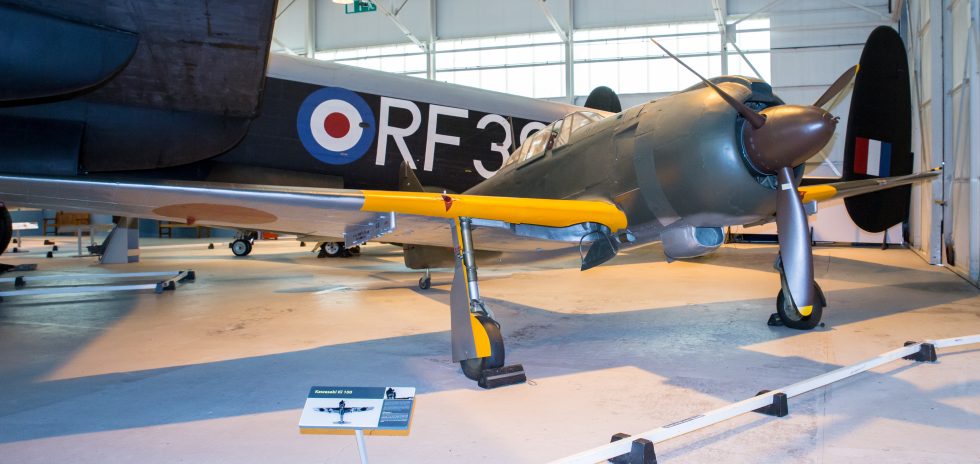
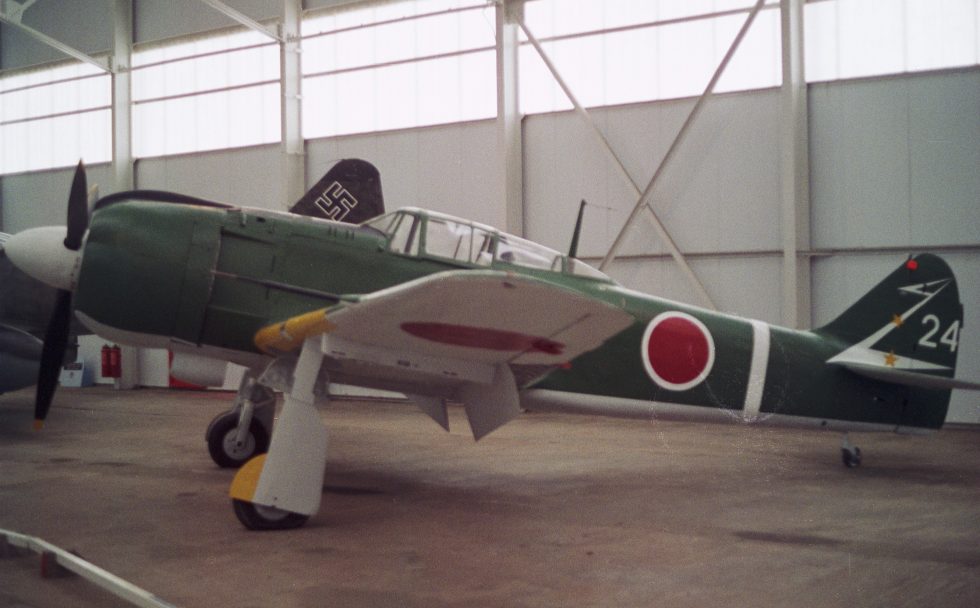
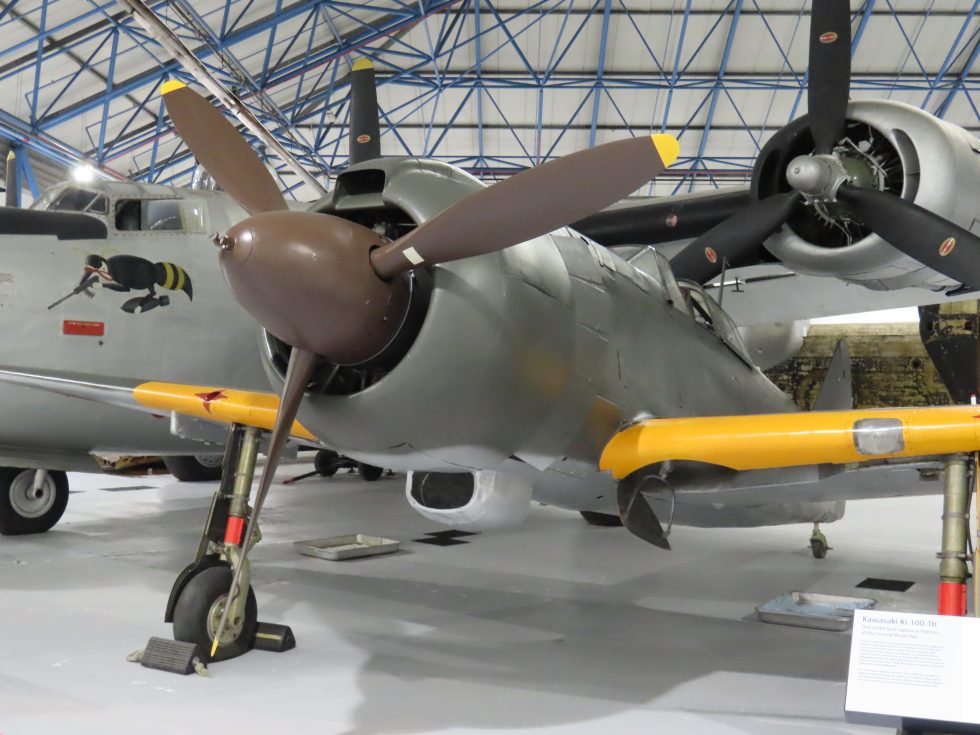
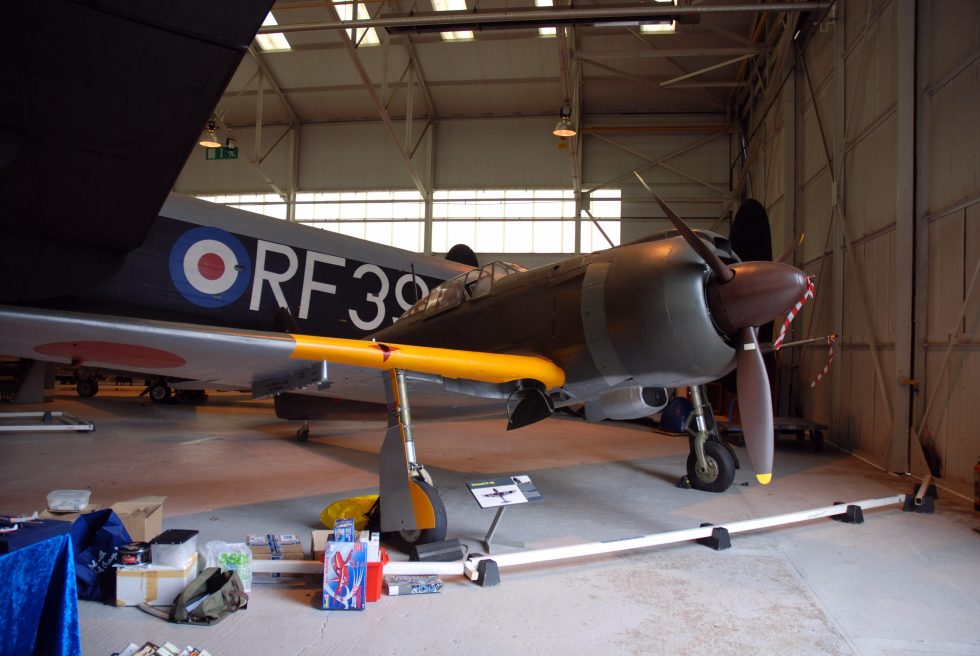
Production and survivors, counted carefully. Totals differ: adding the marks above gives 395 aircraft, Francillon is usually cited as 396, and the United States Strategic Bombing Survey monthly returns come to 378 — 1 in February 1945, 36 in March, 89 in April, 131 in May, 88 in June, 23 in July and 10 in August. It is also worth correcting a common claim: only 274 Ki-100s were conversions of engineless Ki-61-II-KAI airframes. The 118 Ki-100-I-Otsu, roughly thirty per cent of all production, were built new. Exactly one original airframe survives anywhere in the world and there are no reproductions and no flying example. It is a Ki-100-I-Otsu, constructor’s number 16336, completed at Kagamigahara in late June 1945 and accepted by the Army in early July. Sergeant Y. Kishi ferried it some 4,000 km (2,500 miles) to Tan Son Nhut airfield at Saigon, where it was one of twenty-four Japanese aircraft surrendered serviceable in August 1945. On 26 November 1945, with Kishi again at the controls for a British test flight to Bien Hoa, the undercarriage failed to lower and the aircraft was belly-landed, damaging the propeller, oil cooler and tailwheel; Japanese ground crews repaired it with parts cannibalised from Ki-46, Ki-84 and Ki-61 wrecks. Crated in April 1946 and landed at Portsmouth that August, it sat in RAF storage until 1955 catalogued as an "Oscar II", was correctly identified and rebuilt at RAF Colerne in 1960, and was allocated the British ground-instructional serial 8476M in February 1976. Its engine was restored to ground-running condition at RAF St Athan in 1986. Held as accession 85/AF/68, it has worn seven paint schemes, including spurious 244th and 5th Sentai markings, and has moved between Cosford and Hendon several times — to Hendon in November 2003, back to Cosford in September 2011, on public display there from 30 January 2012, and listed by the RAF Museum in London’s Hangar 5 more recently.
From an engine crisis to Japan’s finest fighter
The inline Hien enters service
The Ki-61 Hien reaches units with its liquid-cooled Ha-40/Ha-140 inline — powerful, but complex and unreliable.
The engine supply falters
Ha-140 production lags badly; completed Ki-61-II airframes begin piling up without engines to fit.
Akashi is bombed
US raids wreck the Akashi engine plant. Around 275 Ki-61-II airframes now stand finished but engineless.
The Ki-100 flies
The first converted prototype — a Ki-61 fuselage mated to a Mitsubishi Ha-112-II radial — takes off and proves a success.
Into service
The Army Type 5 Fighter reaches home-defence Sentai as Japan braces for the final air battles over the home islands.
Home defence
The 244th and other Sentai fly the Ki-100 against B-29 raids and US Navy carrier fighters, often on roughly even terms.
War’s end
Production stops at around 390 aircraft. Too few, too late — the Ki-100 never gets the chance to matter.
A single survivor
One airframe (c/n 16336) is shipped to Britain for evaluation. Today it is the only Ki-100 left in the world, preserved by the RAF Museum.
From the last year of the war: twelve Ki-100 stories
A warehouse of engineless fighters
When the Ha-140 inline collapsed, hundreds of finished Ki-61 airframes had nowhere to put an engine.
Read the full story
Grafting a radial onto an inline airframe
Takeo Doi’s team mated a fat Mitsubishi radial to the Hien’s slim fuselage — and it worked.
Read the full story
Better than the Hien it replaced
Test pilots expected a compromise. They got a lighter, more agile, more reliable fighter.
Read the full story
The Army Type 5 Fighter
Formally the Go-shiki-sen, the Ki-100 was Japan’s last piston fighter to enter service.
Read the full story
The 244th Sentai
Japan’s most famous home-defence fighter unit re-equipped with the Ki-100.
Read the full story
Even terms with the Hellcat
At low and medium altitude the Ki-100 could turn and fight the US Navy’s best.
Read the full story
A superb fighter, aimed too low
The Ki-100 was excellent where the war was not being decided — far below the Superfortress.
Read the full story
The Ki-100-I-Otsu
Later new-built Ki-100s traded the razorback for an all-round-vision canopy.
Read the full story
The Ki-100-II
Kawasaki tried a supercharged high-altitude version — but only three were built.
Read the full story
The fighter the Allies never named
The war ended before Western intelligence assigned the Ki-100 a reporting name.
Read the full story
Among Japan’s best
Historians rank the accidental Ki-100 with the very finest fighters Japan produced.
Read the full story
The only one left
A single Ki-100 survives, preserved by the RAF Museum in Britain.
Read the full story
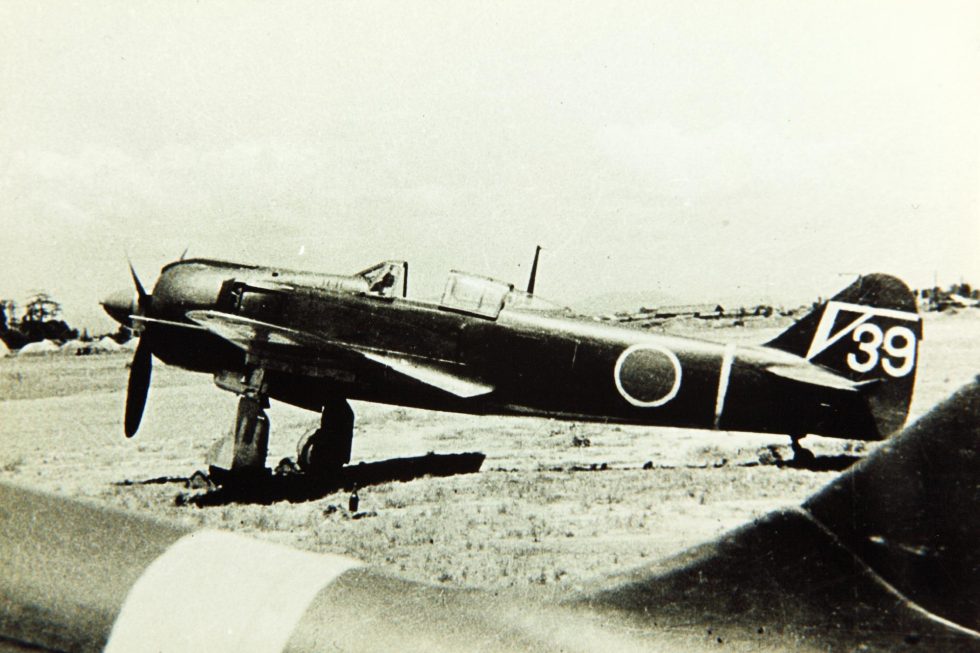
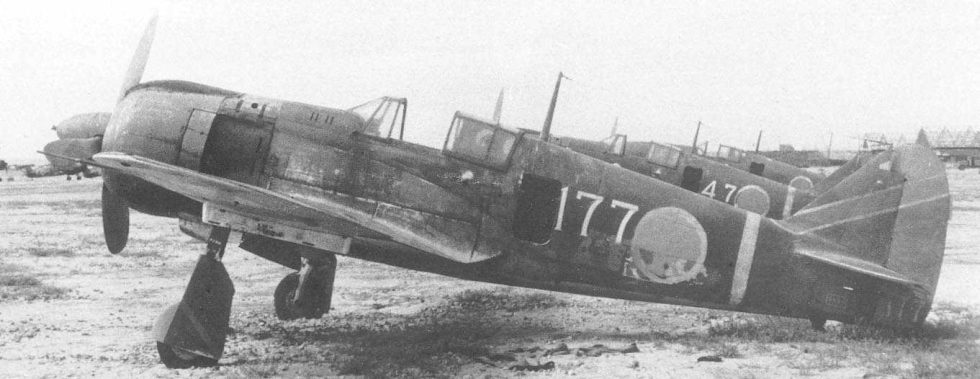
The Ki-100 in pictures
The Ki-100 in motion
Rex’s Hangar: The (Kind of) Accidental Superplane — Kawasaki Ki-100. A detailed aviation-history documentary on how a failed engine programme produced one of Japan’s best fighters.
Where the Ki-100 flew
The Kawasaki Ki-100’s combat record
The Ki-100 fought for barely five months, entirely in defence of the Japanese home islands. It never had the numbers, the fuel or the time to compile a decisive record — but in the hands of veteran units it proved one of the few late-war Japanese fighters that could still meet the best Allied types on even terms at low and medium altitude.
Compare the combat record of every military aircraft.
Everything people ask about the Kawasaki Ki-100
Can I fly in a Kawasaki Ki-100?
Why was the Ki-100 built from a Ki-61?
Was the Ki-100 really one of Japan’s best fighters?
How many Ki-100s were built?
Did the Ki-100 have an Allied codename?
Could the Ki-100 fight the P-51 Mustang and F6F Hellcat?
How many Ki-100s survive today?
You can’t fly the Ki-100.
These, you can.
Some legends only live in museums — others are fuelled and waiting. MiGFlug has put civilians in real military jet cockpits since 2004.
 Fly the L-39 AlbatrosThe world’s most-flown jet trainer — aerobatics included
 Fly the F-104 Starfighter“The missile with a man in it”
 Fly the MiG-21The Cold War’s most-produced jet
 Fly the T-33 Shooting StarAmerica’s first jet trainer
 Fly the DH VampireA piece of early jet history
 Fly the S.211Agile Italian jet trainer
 Fly the MB-326The classic Aermacchi jet
 Fly the MiG-15The Soviet legend of the Korean War
Continue the tour
Every fact, checked
- Royal Air Force Museum — Kawasaki Ki-100-1bCollection record for the world’s only surviving Ki-100 (c/n 16336); production and conversion figures.
- René J. Francillon — Japanese Aircraft of the Pacific War (Putnam)The standard reference on Imperial Japanese aircraft; Ki-100 development, variants and assessment.
- Nicholas Millman — Ki-61 and Ki-100 Aces (Osprey Aircraft of the Aces)Unit histories, the 244th Sentai and combat operations of the type in 1945.
- Henry Sakaida — Japanese Army Air Force Aces 1937–45 (Osprey)Pilot accounts and the home-defence battles the Ki-100 was thrown into.
- Pacific Wrecks — Ki-100 c/n 8476M / 16336Post-war history of the surviving airframe and its transfer to Britain.
- Smithsonian National Air and Space MuseumContext on late-war Japanese fighter development and the radial-versus-inline problem.
- Rex’s Hangar — The (Kind of) Accidental Superplane: Kawasaki Ki-100Detailed aviation-history documentary on the type’s origin, engineering and service.