
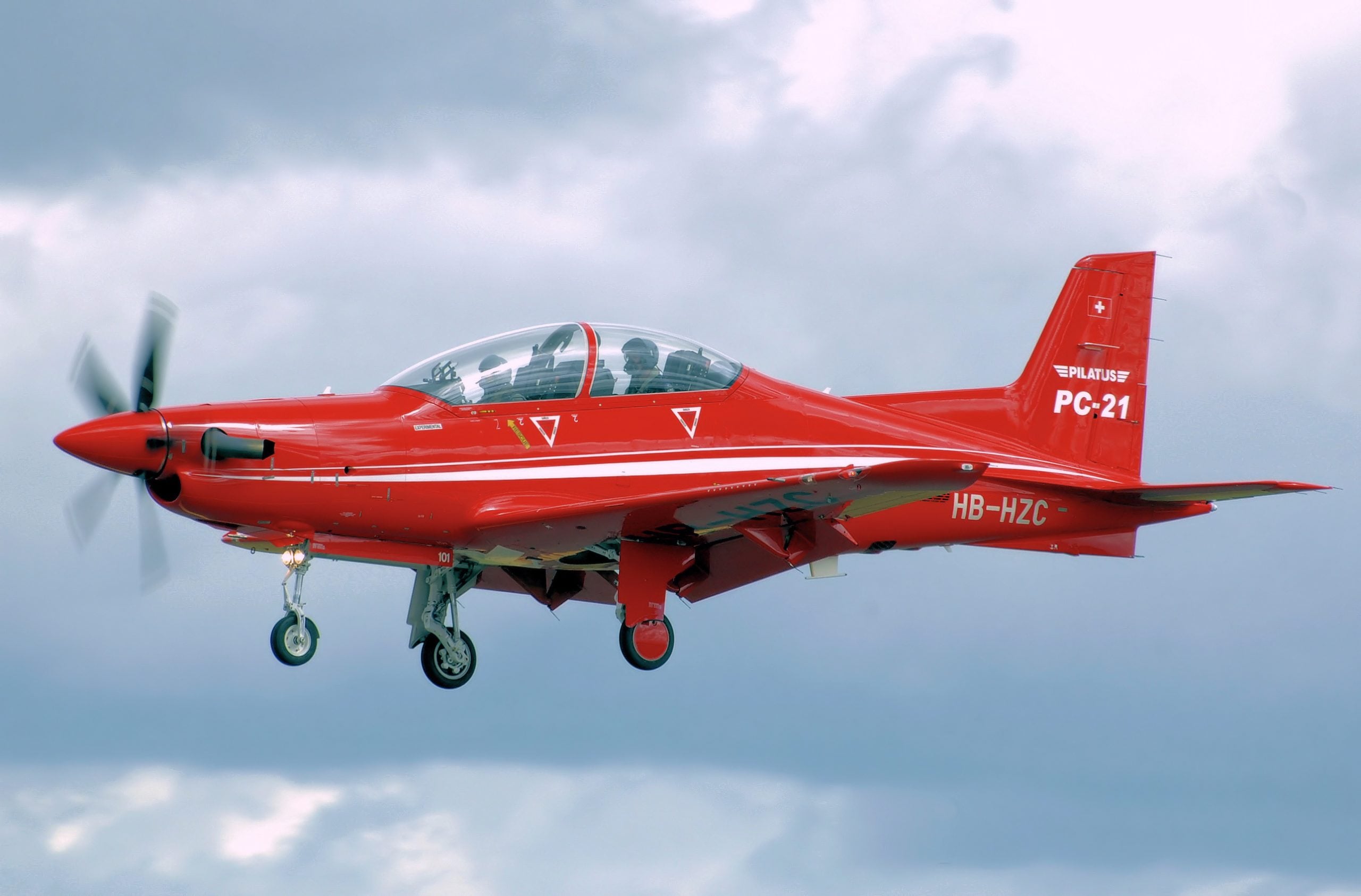
Pilatus PC-21
The jet trainer that isn’t a jet
A single-engined Swiss turboprop engineered to fly, feel and cost like a jet trainer — built to move basic and advanced fast-jet training onto a fraction of the fuel bill.
The Pilatus PC-21: a turboprop built to kill the jet trainer
Training a fast-jet pilot is punishingly expensive. For decades air forces ran a long ladder of aircraft — a piston or turboprop for screening, then a light jet, then an advanced jet trainer — each rung burning more fuel and maintenance hours than the last. In the late 1990s the Swiss manufacturer Pilatus Aircraft, based at Stans, made a bold bet: that a single, cleverly engineered turboprop could swallow most of that ladder and deliver both basic and advanced training at a jet-like standard for a fraction of the cost.
The result was the PC-21, first flown on 1 July 2002. On paper it is a propeller aircraft, but almost everything about the way it flies is designed to feel like a jet. A single Pratt & Whitney Canada PT6A-68B turboprop, flat-rated to around 1,600 shaft horsepower and turning a five-blade graphite propeller, is managed by a digital power-management system that smooths the throttle response so students experience jet-like handling and acceleration rather than the torque and lag of a classic turboprop.
The real revolution sits inside the cockpit. The PC-21 has a fully digital glass cockpit — large colour displays, a head-up display and HOTAS controls — wired to an embedded training system that can simulate a radar, sensors, weapons, datalinks and hostile threats that the aircraft does not physically carry. In effect the turboprop can pretend to be a front-line fighter, letting students practise intercepts, air-to-ground attacks and sensor management at turboprop running costs.
That proposition proved a commercial success for Pilatus. Switzerland flies it at home, but the PC-21 has been widely exported: Singapore (whose crews train in France and Australia), Australia, Qatar, Saudi Arabia, the United Arab Emirates, Jordan, Spain and France have all bought the type. More than 200 have been ordered — a strong result for a specialised trainer, and a very Swiss piece of engineering: precise, expensive to buy, and cheap to run.
01The Pilatus PC-21’s training revolution: how a turboprop replaced the jet trainer
The economics are the whole point. An advanced jet trainer such as a Hawk or an L-39 can cost several thousand US dollars per flight hour to operate; a turboprop like the PC-21 is widely estimated to run at a small fraction of that. By pairing low turboprop running costs with a jet-like cockpit and an embedded simulation system, Pilatus argued that air forces could push far more of the syllabus — including advanced tasks once reserved for jets — down onto the cheaper aircraft, and cut expensive live jet hours to the minimum.
Several customers restructured their whole pilot pipeline around exactly that idea. Australia, for example, retired both its PC-9 turboprops and much of its jet lead-in flying in favour of a PC-21-centred system, and other operators followed similar logic. The precise savings vary by air force and are hard to verify independently, but the direction is clear: the PC-21 was designed to make the traditional multi-type training ladder look wasteful.
What makes the PC-21 special
A turboprop tuned to feel like a jet
Power comes from one Pratt & Whitney Canada PT6A-68B, flat-rated to around 1,600 shp and driving a five-blade graphite composite propeller. A digital power-management system meters the throttle so the aircraft accelerates and responds with a jet-like feel, hiding the torque and lag students would meet on an older turboprop. Flat-rating keeps that power available high and hot, where piston and older turboprops fade.
A full glass cockpit and HOTAS
The tandem, stepped cockpit is pure fast-jet: three large colour multifunction displays, a head-up display and HOTAS controls, so a student learns the same information flow and switchology they will use on a front-line type. Crews sit on Martin-Baker Mk16 zero-zero ejection seats, and the instructor in the raised rear seat has a genuine view forward.
An aircraft that can pretend to be a fighter
The PC-21’s embedded simulation and training system can generate a virtual radar picture, simulated sensors, weapons, datalink and hostile threats that the airframe does not physically carry. Students fly simulated intercepts and attacks against synthetic targets — advanced training that once demanded a real jet and real hardware, done at turboprop cost.
02The Pilatus PC-21’s cockpit: fast-jet avionics on a training airframe
The design brief was that a pilot stepping from the PC-21 into a Hornet, Typhoon, Rafale or F-15 should find the cockpit philosophy familiar rather than foreign. That meant a fully digital glass cockpit with multifunction displays and a HUD, HOTAS controls, and an open-architecture mission computer that can be reprogrammed to mimic different front-line types. The rear instructor station mirrors the student’s displays and can inject failures and threats in real time. The goal is not to teach a pilot to fly a turboprop, but to teach them to operate a modern combat aircraft’s systems while flying something far cheaper.
03The Pilatus PC-21’s embedded simulation: virtual radar, sensors and weapons
Embedded, or synthetic, training is the feature that lets the PC-21 reach into advanced-jet territory. Because the radar picture, targeting sensors, weapons and even opposing aircraft can be simulated inside the mission system, a formation of unarmed turboprops can rehearse a beyond-visual-range intercept or a precision attack without any of the hardware — or the fuel and range — a real fighter would need. Threats and targets can be networked between aircraft so students train together against a shared synthetic battlespace. It is the clearest expression of the PC-21’s core idea: move as much of the syllabus as possible off the jet and onto software.
Pilatus PC-21 full specifications
Baseline note: the figures below describe the production PC-21 as delivered from April 2008 onwards — the 1,600 shp Pratt & Whitney Canada PT6A-68B aeroplane with the five-blade Hartzell graphite propeller — which is also the only version Pilatus has ever built. There is no armed derivative, no single-seater, no re-engined mark and no licence production, so the deltas in grey are differences between published sources rather than differences between marks. Three of those disagreements are worth settling before the tables start. First, the ceiling: 11,580 m (38,000 ft) appears in almost every table and is an aerodynamic figure, while Pilatus’s own technical data gives a maximum operating altitude of 7,620 m (25,000 ft) — the number the pressurisation, the oxygen system and the certification basis actually support, and the one a training sortie is flown to. Second, the "maximum speed" of 685 km/h is a limit rather than an achievement: it is Vmo/Mmo, 370 KIAS or Mach 0.72, and an independent flight test recorded 294 KIAS indicated for 323 kt true. Third, take-off and landing distances of 490 m and 600 m are ground rolls, while the 725 m and 900 m widely quoted are distances over a 15 m obstacle; both are right, and they are not the same measurement.
Dimensions & weights
- Crew
- 2 — student forward, instructor aft on a stepped rear seat with a genuine view over the front canopy bow. Both cockpits carry a head-up display, and their systems can be electronically decoupled so that the instructor flies one aeroplane while the student flies a different, degraded, deliberately sabotaged version of it
- Length
- 11.23 m (36 ft 10 in)
- Wingspan
- 9.11 m (29 ft 11 in) — shorter in span than a Beechcraft T-6 Texan II by roughly 1.1 m while being longer in the fuselage. That combination is the whole aerodynamic argument of the aeroplane in one line
- Height
- 3.74 m (12 ft 3 in). French-language sources give 4.05 m (13 ft 3 in), which appears to be measured to a different datum rather than to describe a different aircraft
- Wing area
- 15.22 m² (163.8 sq ft) — small. A T-6 carries about 16.5 m² and a PC-9 about 16.3 m² for a similar mission
- Aspect ratio
- 5.45 — low, and chosen to be low. A stubby, highly loaded wing gives the roll authority and the firm turbulence response that make the aeroplane feel like a jet; it costs endurance, and Pilatus paid that bill knowingly
- Propeller diameter
- 2.39 m (7 ft 10 in), five graphite scimitar blades. The five-blade disc is smaller in diameter than the four-blade unit on a T-6, which is what allows the shorter undercarriage and the low, jet-like sit on the ramp
- Empty weight
- 2,270 kg (5,004 lb); German-language tables give 2,280 kg (5,027 lb), a difference of equipment fit rather than of substance
- Maximum ramp weight
- 3,120 kg (6,878 lb)
- Max take-off weight, aerobatic
- 3,100 kg (6,834 lb) — the clean limit, and the weight nearly every sortie the type has ever flown was flown at
- Max take-off weight, with stores
- 4,250 kg (9,370 lb). The 1,150 kg between the two figures is the entire theoretical external payload, and no operator has ever fielded the aeroplane in that configuration
- Wing loading
- 204 kg/m² (41.7 lb/sq ft) at the aerobatic limit, rising to 279 kg/m² (57.2 lb/sq ft) at 4,250 kg; published tables round to 208 kg/m². A PC-9 sits near 138 kg/m² and a T-6A near 179. This single number is why test pilots describe the PC-21’s ride in turbulence as jet-like: it simply does not get thrown about the way a lighter-loaded trainer does
- Power loading
- 1.94 kg/shp (4.27 lb/shp) clean, equivalent to 0.39 kW/kg. That is a startling figure for a trainer — better than most first-generation jet trainers — and it is available only above 200 KIAS
- Internal fuel
- ~545 kg (1,200 lb) usable, roughly 680 L (180 US gal) of Jet A-1 in integral wing tanks. Fuel flow runs about 700 lb/h low level and 300–400 lb/h higher up, which sets the sortie length rather than any airframe limit
- External fuel
- 2 × 248 L (2 × 65 US gal) drop tanks on the inboard pylons — a ferry and repositioning fit, rarely seen on a training sortie
Performance
- Maximum operating speed
- 685 km/h (370 KIAS, 426 mph) / Mach 0.72 — a placarded limit, not a level-flight maximum. It is also, pointedly, a limit a student can reach in a shallow dive, which is the point of quoting it in a training syllabus
- Cruise speed
- 620 km/h (335 kt, 385 mph) at 3,050 m (10,000 ft); airforce-technology gives a low-altitude figure of 590 km/h (319 kt)
- Demonstrated in flight test
- 294 KIAS indicated for 323 kt (598 km/h) true — the number an independent evaluation actually recorded, and a more honest description of what the aeroplane does than the Vmo placard
- Stall speed
- 150 km/h (81 kt, 93 mph) with gear and flaps down; 170 km/h (92 kt, 106 mph) clean. The behaviour at the stall is benign, which matters because the aeroplane is otherwise doing everything it can to feel unforgiving
- Rate of climb, sea level
- 20.3 m/s (4,000 ft/min). Pilatus publishes 4,010 ft/min, airforce-technology 4,250 ft/min, and a flight test recorded 3,900 ft/min initial at a realistic sortie weight. Climb speed is 190 KIAS
- Roll rate
- 200°/s at 3,050 m (10,000 ft) — hydraulically boosted ailerons with roll spoilers, a combination no other turboprop trainer carries. It is the specification that most annoys people who insist a turboprop cannot stand in for a jet, and it is measured rather than claimed
- Service ceiling
- 11,580 m (38,000 ft) aerodynamic; maximum operating altitude 7,620 m (25,000 ft) per Pilatus. Treat the second as the real one
- Range
- ~1,300 km (700 nmi, 808 mi) on internal fuel; English tables give 1,333 km and airforce-technology 1,297 km, all describing the same still-air ferry condition
- Endurance
- ~2 h 20 min in the cruise. Short by turboprop standards and irrelevant in practice — a training sortie is 60 to 90 minutes and the aeroplane is on the ground for the debrief, not loitering
- Take-off distance
- 490 m (1,608 ft) ground roll; 725 m (2,379 ft) over a 15 m (50 ft) obstacle
- Landing distance
- 600 m (1,969 ft) ground roll; 900 m (2,953 ft) over a 15 m (50 ft) obstacle
- Load factor
- +8.0 / −4.0 g aerobatic and clean; +5.0 / −2.5 g with underwing stores. The +8 g clearance is the headline: a T-6 stops at +7 / −3.5 g, and the extra g is the difference between practising a fighter manoeuvre and practising an approximation of one
- Ambient temperature envelope
- −55 °C to +55 °C (−67 °F to +131 °F) — a range set by the customer list, which runs from Emmen in February to Riyadh in August
- Turnaround time
- 12 min by a single technician between sorties, a figure quoted in flight-test reporting and the least glamorous but most commercially decisive number on this page
Propulsion & systems
- Engine
- 1 × Pratt & Whitney Canada PT6A-68B free-turbine turboprop, 1,193 kW (1,600 shp). The same engine family as the T-6’s PT6A-68, but rated at 1,600 shp rather than flat-rated to 1,100 — roughly 45 per cent more power in an airframe that is barely heavier
- Digital power management
- Speed-scheduled power limiting — the single most important system on the aeroplane. Below 80 KIAS the engine is held to about 1,080 shp; the limit rises with airspeed until the full 1,600 shp is available above 200 KIAS. The effect is that a slow PC-21 accelerates like a jet with the engine spooling up, not like a turboprop with a propeller biting instantly. Pilatus deliberately threw away a third of its available thrust at low speed in order to make the aeroplane worse, because worse in that specific way is what a fast-jet student needs to learn
- Propeller
- Hartzell E8991KX five-blade constant-speed graphite scimitar, 2.39 m (7 ft 10 in). Graphite blades keep the disc light enough that the aeroplane does not fly like a gyroscope with wings
- Rudder trim aid device
- Computed rudder trim scheduled on airspeed, torque, angle of attack and load factor — the second half of the jet illusion. It cancels propeller torque and slipstream so completely that a flight-test report described the pilot workload of coordinating the propeller as "effectively nil". A student never learns the boot-full-of-rudder reflexes of a conventional turboprop, because those reflexes are actively harmful in a jet
- Flight controls
- Reversible mechanical, with hydraulically boosted ailerons augmented by roll spoilers; airbrake fitted — the airbrake matters, because energy management on a jet is an airbrake problem and on a turboprop it usually is not. Stick-force gradient is around 10 lb per g, a fighter-like figure
- Cockpit displays
- Three 152 × 203 mm (6 × 8 in) portrait active-matrix LCDs per cockpit — centre display as primary flight display, two as multi-function displays — plus Meggitt standby displays. The trim gauge is the only analogue instrument in the aeroplane
- Head-up display
- Flight Visions SparrowHawk with FVD-4000 symbol generator, in both cockpits — with a fighter-style up-front control panel and full HOTAS. A student who has flown 100 hours on this cockpit is not learning to find switches when they reach a Rafale or an F-35
- Mission computer
- CMC Electronics FV-4000, twin 500 MHz PowerPC G4 processors with 512 MB each — 1990s-generation silicon by today’s standards, and the part of the aeroplane most obviously due a refresh. Safety-critical and non-safety-critical software are deliberately partitioned, which is why the mission system can be rewritten per customer without recertifying the aircraft
- Embedded simulation
- Cross-platform cockpit emulation, simulated radar (including AN/APG-73 modes), simulated electronic warfare and surface-to-air threats, stores management and weapons emulation, tactical situation display — and the instructor can inject synthetic radar contacts, degrade sensor performance and fail systems in real time from the back seat while the student flies
- Data link
- Air-to-air tactical data link between PC-21s — so a four-ship of trainers shares a synthetic picture and students learn to fight from a network rather than from what they can see. Nothing else in the turboprop trainer class had this when it was introduced
- Ejection seats
- 2 × Martin-Baker Mk 16L (Pilatus designation CH16C), zero-zero, with command ejection. The 28 November 2023 Swiss accident at Emmen is the demonstration: the aircraft left the runway on landing, both crew ejected, both walked away
- Life support
- Pressurised cockpit, on-board oxygen generation system (OBOGS), air conditioning and an anti-g system — the anti-g system is the giveaway. Trainers that only expect +6 g do not need one
- Navigation and utility systems
- Laser inertial reference with GPS and Kalman blending, dual civil-certified flight management systems, dual inertial reference units, ILS, MIL-STD-1553B and ARINC buses, military tactical and civil navigation modes, health and usage monitoring system (HUMS) with full-scale fatigue tracking
- External stations
- 4 underwing and 1 centreline hardpoint, 1,150 kg (2,535 lb) maximum external load. Provisioned for a counter-insurgency role that has never been bought by anyone
04The Pilatus PC-21’s operating costs: buying a turboprop to save jet hours
The PC-21 is not cheap to buy — unit prices are commonly reported in the region of US$9–11 million, though the figure varies widely with configuration, spares, simulators and support in each contract, so any single number should be treated as an estimate. Its selling point is the cost per flight hour, which is commonly estimated in the low single-digit thousands of US dollars — a small fraction of an advanced jet trainer’s. Precise, verified CPFH figures are rarely published and differ between air forces, so these numbers are best read as order-of-magnitude estimates. The economic case is not the sticker price but the lifetime saving from flying advanced sorties on a turboprop instead of a jet.
Armament & payload
The PC-21 carries no weapons at all, and its weapon system is the best thing about it
The PC-21 has five hardpoints, a published external load of 1,150 kg (2,535 lb) and a counter-insurgency capability in its brochure, and in more than twenty years of service not one of the eleven operators has fielded it armed. That is not an oversight. The aeroplane’s weapon system is software: a stores management system with nothing on the pylons, an emulated air-to-air radar with AN/APG-73 modes, simulated missiles, bombs and rockets that fly ballistics adjusted for turboprop speeds, simulated surface-to-air threats and electronic warfare, and a data link that lets a four-ship of trainers share one synthetic tactical picture. A student in a Spanish or Australian PC-21 runs an intercept, is locked up by a SAM that does not exist, defends, and then shoots a missile that was never bought — and every one of those events is recorded for the debrief. The Australian experience is the honest test of where the line falls: four RAAF PC-21s of No. 4 Squadron support Joint Terminal Attack Controller training, and Defence assesses them as about 80 per cent effective in that role precisely because they cannot drop a live weapon, which is why Project AIR 6016 will replace them with something that can. Everything below describes provision rather than practice: the pylons and the 1,150 kg figure are certified options in Pilatus literature, and no announced operator, including the Gulf customers whose contracts would have permitted it, has taken up an armed configuration.
Gun and gunnery training
- No internal gun on any PC-21 ever built, and no operator has requested one. The airframe was never laid out around a fixed weapon.
- Podded guns are a theoretical wing-station option in the counter-insurgency brochure; nothing of the sort has appeared on an in-service aircraft.
- Gunnery is taught entirely synthetically — HUD gunsight symbology, computed pipper, tracking film for the debrief — with no round ever leaving the aeroplane.
- The trade is deliberate. Live gunnery costs a range, an armourer and a safety trace; simulated gunnery costs a software licence and can be flown over a Swiss valley.
Air-to-air, emulated
- Simulated short-range infrared missiles and beyond-visual-range radar missiles, with realistic seeker and launch-envelope behaviour presented on the HUD and multi-function displays.
- Emulated fire-control radar with air-to-air modes drawn from the F/A-18’s AN/APG-73, including synthetic contacts the instructor can create, move and delete from the rear cockpit.
- Weapon models are dynamically rescaled so that an engagement flown at 300 kt produces the same decision timeline a student would face at 450 kt in a jet.
- No PC-21 has ever carried a real air-to-air missile. Sidewinder carriage is not offered and would be pointless.
Air-to-surface, emulated
- Simulated laser-guided and GPS-guided bombs, simulated air-to-ground missiles, and a full stores management system driving them.
- Emulated synthetic-aperture and ground-mapping radar imagery, described in flight-test reporting as pseudo-photographic, on the same displays a student will later use for real.
- Simulated surface-to-air threats and electronic warfare indications — the student learns to be shot at long before they fly anything worth shooting at.
- There is no targeting pod, no laser designator and no real sensor of any kind. What the aeroplane teaches is the decision sequence, not the physics.
Bombs and practice stores
- Practice bomb carriers are the only ordnance any PC-21 operator is known to fit, and even those are rare because most weapons training is done synthetically.
- Free-fall bombs to Mk 82 class appear in Pilatus counter-insurgency literature within the 1,150 kg external limit.
- Carrying stores drops the manoeuvre envelope from +8.0 / −4.0 g to +5.0 / −2.5 g — roughly the whole reason the aeroplane exists, surrendered for the sake of an iron bomb.
- The RAAF JTAC assessment is the plain verdict: without a live weapons pass the aeroplane is 80 per cent of what that mission needs, and no software fixes the missing 20.
Rockets and the counter-insurgency option
- Seven-tube 70 mm (2.75 in) launchers are the standard rocket option in Pilatus marketing, on the inboard and outboard wing stations.
- Marking rockets would make the type a competent forward air control aircraft, which is exactly the role the RAAF has been trying to fill with it and cannot.
- No PC-21 operator has bought the fit. Pilatus sells the armed light-attack niche with the PC-7 MKX and, historically, the PC-9; the PC-21 is priced and configured as a training system.
- Judge this card honestly: it is a capability that exists on paper to widen the sales case, and after twenty years the market has declined it.
Pods, tanks and the data link
- Two 248 L (65 US gal) drop tanks on the inboard pylons — the only external stores routinely seen on the type, and only for ferry flights.
- Air-to-air tactical data link between aircraft, sharing the synthetic picture across a formation. This was genuinely new in the turboprop trainer class in 2002 and is still the type’s sharpest advantage.
- Mission Planning System and Mission Debriefing System on the ground, with HUD video, cockpit audio and three-dimensional battlespace reconstruction; the debrief is treated as part of the weapon system.
- No targeting pod, no reconnaissance pod, no self-protection dispensers in service. The French Air and Space Force did press unarmed PC-21s into airspace-policing patrols against slow movers during the 2024 Paris Olympics, which is the closest the type has come to an operational sortie.
Three typical loadouts
- Basic and advanced flying training — Ejercito del Aire, Academia General del Aire, San Javier
- Clean airframe, full internal fuel, no external stores. Aerobatic limits of +8.0 / −4.0 g apply, spinning is cleared, sortie length 60 to 90 minutes. Thirty-eight of Spain’s forty aircraft do this and nothing else, replacing both the CASA C-101 Aviojet and much of the T-35 Pillan syllabus at a stroke.
- Tactical phase, four-ship, data link active — Ecole de l’aviation de chasse, Cognac
- Clean airframe again, but the mission system running a full synthetic scenario: emulated radar, simulated hostiles, simulated SAM threats, weapons employment and a shared tactical picture across four aircraft. The instructor in the rear cockpit degrades the student’s sensors and fails systems in real time. In French service this replaced Alpha Jet sorties at roughly €1,500 per hour against €7,800.
- Joint Terminal Attack Controller support — No. 4 Squadron RAAF, Williamtown
- Clean or with practice stores, working with controllers on the ground, simulating attack runs the aircraft cannot actually deliver. Four airframes are held for this. Defence rates the arrangement 80 per cent effective and is buying a replacement under Project AIR 6016 so that the PC-21s can be returned to the pilot training system.
Sourcing caveat: Pilatus publishes no weapons manual for the PC-21 and no operator has released a stores clearance list, because none of them arms the aircraft. The hardpoint count, the 1,150 kg external limit and the counter-insurgency claim come from Pilatus fact sheets and airforce-technology’s project file; the emulated radar and weapon behaviour from independent flight-test reporting; the JTAC assessment from Australian Defence Magazine’s reporting of Project AIR 6016. Where a specific weapon is named above it is a brochure option, not a fielded fit, and readers should treat any table listing the PC-21’s "armament" as describing a sales possibility rather than a squadron capability.
Variants
Pilatus built one PC-21 and sold it eleven times, and the variant list is a list of paint schemes
There is almost nothing to say about PC-21 variants, and that is the most interesting fact about the programme. Pilatus committed roughly CHF 200 million of its own money in November 1998, started design in January 1999, rolled out the first prototype at Stans on 30 April 2002 and flew it on 1 July with Bill Tyndall at the controls. Swiss type certification followed in December 2004. From that point the company built one aeroplane, over and over, for twenty years: no armed version, no single-seat version, no stretched or re-engined mark, no licence production anywhere. What changed between customers was the software load, the paint and the national serial block. That is a deliberate and unusual industrial choice, and it is the reason a Qatari airframe and a Canadian one thirteen years apart are recognisably the same product.
The programme’s real innovation was never the airframe anyway. Pilatus sold an Integrated Training System — aircraft, full-flight and mission simulators, cockpit procedure trainers, computer-based instruction, mission planning and debriefing tools, and a contracted availability arrangement — and then let customers restructure their pipelines around it. Singapore bought the system through Lockheed Martin and flies it in Australia. France bought the aircraft through Babcock on a short lease and deleted the Alpha Jet from its fast-jet pipeline. Saudi Arabia bought fifty-five inside a £1.6 billion BAE Systems package that also included twenty-two Hawks. Canada folded nineteen into a twenty-five-year SkyAlyne contract covering five aircraft types. In every case the aeroplane is a line item in a training contract rather than a fleet purchase, which is why the type’s variant list is short and its customer list is not.
- P01, HB-HZA (2002, 1 built)
- First prototype; rolled out 30 April 2002, first flight 1 July 2002. Survives as a company demonstrator and made the type’s early sales tours.
- P02, HB-HZB (2004–2005, 1 built)
- Second development aircraft, first flown 7 June 2004; destroyed at Buochs on 13 January 2005 during practice for an aerobatic display. Chief test pilot Andreas Ramseier was killed and a person on the ground seriously injured; the investigation, reported in August 2006, found pilot error.
- Pre-series aircraft (2005–2007, small batch)
- First pre-series machine flew in late August 2005. These aircraft carried the production avionics fit and completed the certification and customer-evaluation programme; HB-HZD toured Australia in February and March 2010 and helped win AIR 5428.
- PC-21 production standard (2008–present, the only production model)
- PT6A-68B, five-blade Hartzell, Martin-Baker Mk 16L seats, three AMLCDs and a HUD per cockpit, embedded simulation and data link. Every delivered aircraft is this aeroplane with a customer-specific mission software load.
- Swiss A-101 to A-108 (2008 and 2012, 8 aircraft)
- Bought under Armament Programme 2006 for the JEPAS jet-pilot training system at Emmen. Six delivered in 2008, two more in April 2012. These replaced BAe Hawk Mk 66 advanced training capacity that Switzerland had given up in 2002–03, which makes the PC-21 the only case of a turboprop directly succeeding a jet trainer in a European air force.
- Gulf standards — UAE, Saudi Arabia, Qatar, Jordan (2011–2019, 116 aircraft)
- Hot-and-high and high-temperature operating clearances to +55 °C, customer mission software, and in the Saudi case delivery inside a BAE Systems training package. UAE serials 934–958, Saudi 901–922, 2201–2220 and 7701–7711.
- E.27 (Spain, 2021–2025, 40 aircraft)
- Spanish military designation. Thirty-eight at the Academia General del Aire at San Javier and two at CLAEX at Torrejon for flight-test training and experimental work. The type now covers primary, basic and advanced training in one aeroplane, displacing both the C-101 and much of the T-35 Pillan course.
- CT-157 Siskin II (Canada, 2026–, 19 on order)
- Canadian designation under the Future Aircrew Training programme, prime contractor SkyAlyne. Ordered November 2024 for advanced fixed-wing and advanced jet training at 15 Wing Moose Jaw, replacing both the CT-156 Harvard II and the CT-155 Hawk. First aircraft accepted May 2026. On 19 May 2026 the RCAF also selected it to replace the Snowbirds’ CT-114 Tutors, with the team standing down after August 2026 and returning on type in the early 2030s.
- Display fits (no airframe changes)
- The RAAF Roulettes (seven aircraft, six flying, since 2019), Spain’s Formacion Mirlo standing in for the Patrulla Aguila since summer 2025, France’s two-ship Mustang X-Ray tactical demonstration team, a Qatari six-ship and a Swiss solo display. Smoke systems and paint; nothing structural.
Closing caveat: production totals for the PC-21 are unusually slippery because Pilatus reports deliveries by fiscal year rather than cumulative type totals. The 100th aircraft left Stans on 20 February 2015 and was also the 1,000th Pilatus turboprop trainer of any kind; French-language sources put the type past 250 built by December 2024; the English Wikipedia infobox still carries 211, which comes from a 2018 press release and is badly stale. Adding up corroborated national deliveries gives roughly 260 airframes by mid-2026 against about 312 ordered, and Pilatus delivered fourteen PC-21s in fiscal 2025 alone. One airframe has been destroyed — prototype HB-HZB in 2005, the type’s only fatality — with Swiss A-105 substantially damaged at Emmen on 28 November 2023 after a landing excursion from which both crew ejected safely, and RAAF A54-030 substantially damaged at East Sale on 3 October 2024 when a low-speed runway excursion collapsed the nose gear, the student uninjured. For a high-performance +8 g trainer flown by ab initio students across eleven air forces and a fleet that has flown well into the hundreds of thousands of hours, that is an exceptional record, and it deserves to be stated as plainly as the criticisms elsewhere on this page.
Operators
The Pilatus PC-21 is the trainer that let air forces retire their jet trainers.
Since Singapore took the first aircraft in 2006 the PC-21 has replaced jets such as the Hawk, C-101, S.211 and Alpha Jet in the advanced-training syllabus of eleven air arms, with Saudi Arabia, Australia, Spain and France the largest customers and Switzerland, the home air force, flying just eight. Canada began CT-157 Siskin II deliveries in 2026 and Indonesia has ordered 24. Figures are aircraft ordered or delivered rather than daily availability; Singapore’s fleet is based in Australia under a contractor-supported arrangement.
In service with
- Royal Saudi Air ForceSaudi Arabia · ordered May 2012 via BAE Systems, replacing the PC-9
- 55 · 2014–
- Royal Australian Air ForceAustralia · ordered September 2015, deliveries completed November 2019; East Sale, Pearce, No. 4 Squadron and ARDU
- 49 · 2017–
- Spanish Air and Space ForceSpain · 24 ordered 2020 and 16 in 2023, last delivered November 2025; Academia General del Aire and Patrulla Águila
- 40 · 2021–
- French Air and Space ForceFrance · 17 ordered 2017 and 9 in 2021; École d’aviation de chasse at Cognac
- 26 · 2018–
- United Arab Emirates Air ForceUnited Arab Emirates · CHF 520 million deal, replaced the Hawk Mk 63
- 25 · 2011–
- Qatar Emiri Air ForceQatar · ordered July 2012
- 24 · 2014–
- Republic of Singapore Air ForceSingapore · launch customer; Basic Wings Course at RAAF Pearce, Australia
- 19 · 2006–
- Royal Jordanian Air ForceJordan · order of 2015 for PC-9M switched to PC-21; 12 delivered by 2019
- 12 · 2017–
- Swiss Air ForceSwitzerland · six delivered 2008 and two in 2012 for advanced training after the Hawk’s retirement
- 8 · 2008–
- Empire Test Pilots’ School (QinetiQ)United Kingdom · contractor-operated for the UK MoD test pilot school at Boscombe Down
- 2 · 2018–
- Royal Canadian Air ForceCanada · first CT-157 Siskin II delivered May 2026 under the Future Aircrew Training programme, 19 planned; also chosen for the Snowbirds
- 2 · 2026–
Formerly operated by
- None recorded
- —
11 operators, 11 current. Quantities are airframes taken on charge; dates are first delivery to last retirement. Air forces with a MiGFlug Order of Battle page are linked (1 so far); the rest follow as the database grows.
The Pilatus PC-21 from clean sheet to global trainer
Programme launched
Pilatus commits to a clean-sheet, next-generation trainer designed to cover both basic and advanced training in one airframe.
First flight
The PC-21 prototype makes its maiden flight on 1 July 2002 from Pilatus’ home at Stans, Switzerland.
Testing and a setback
During the flight-test programme a prototype is lost in a crash that kills its test pilot — a sober reminder of the risks of developing a new type.
First orders
Switzerland and Singapore become launch customers, with Singapore the first export buyer of the type.
Enters service
The PC-21 enters operational training service, beginning with the Swiss Air Force and the Republic of Singapore Air Force.
Australia selects the PC-21
Australia chooses the PC-21 at the heart of its AIR 5428 pilot-training system, operated under a Lockheed Martin Australia service model.
RAAF fields the type
The Royal Australian Air Force introduces the PC-21 and its Roulettes display team converts to it in 2019.
Europe and the Gulf expand
Spain and France build their pipelines around the PC-21 while Gulf air forces grow their fleets; total orders pass 200 aircraft.
From the flight line: twelve PC-21 stories
One aircraft for the whole ladder
Pilatus set out to replace a multi-type training fleet with a single turboprop.
Read the full story
Making a propeller feel like a jet
A digital power-management system hides the turboprop’s torque and lag.
Read the full story
The turboprop that pretends to be a fighter
Embedded simulation conjures a radar, sensors, weapons and threats the aircraft never carries.
Read the full story
Built and flown at home
Pilatus designs and builds the PC-21 at Stans; the Swiss Air Force flies it.
Read the full story
Training far from home
Singapore was the first export customer and trains its crews abroad.
Read the full story
The Roulettes go turboprop
The RAAF built its pilot training around the PC-21 and re-equipped its display team.
Read the full story
A Gulf sales sweep
Qatar, Saudi Arabia, the UAE and Jordan all bought the PC-21.
Read the full story
Replacing an old fleet
Spain chose the PC-21 to modernise its pilot training in 2020.
Read the full story
Trained under contract at Cognac
France runs PC-21 training through an industry-operated service model.
Read the full story
Cheap hours, expensive lessons
The PC-21’s appeal is running cost, not sticker price.
Read the full story
A jet mindset on day one
Instructors report students arrive at front-line types already fluent in modern avionics.
Read the full story
The benchmark advanced trainer
With 200-plus ordered, the PC-21 set the template rivals now chase.
Read the full story
The Pilatus PC-21 in pictures
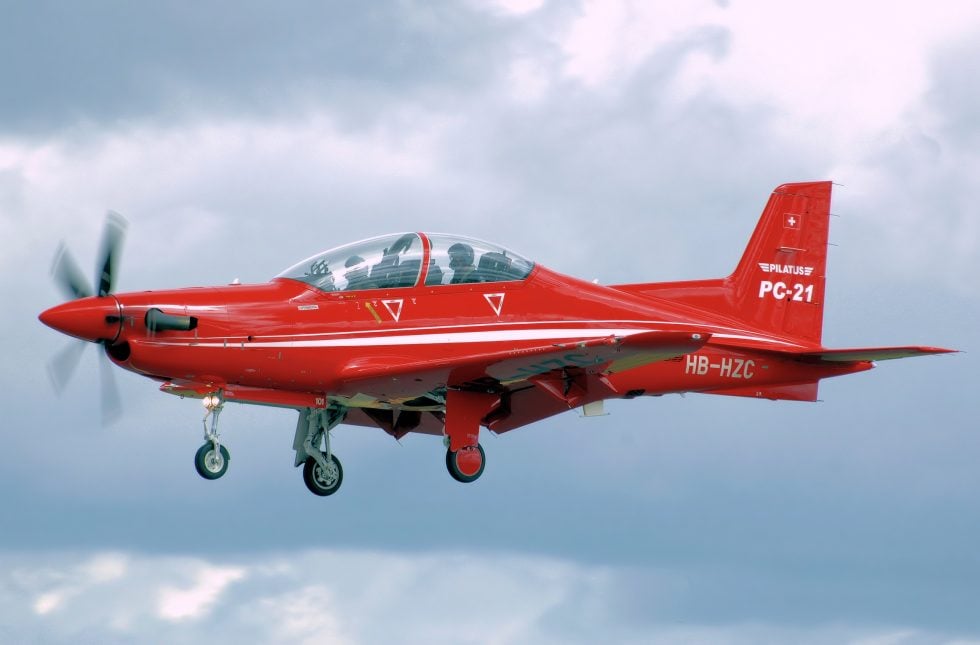
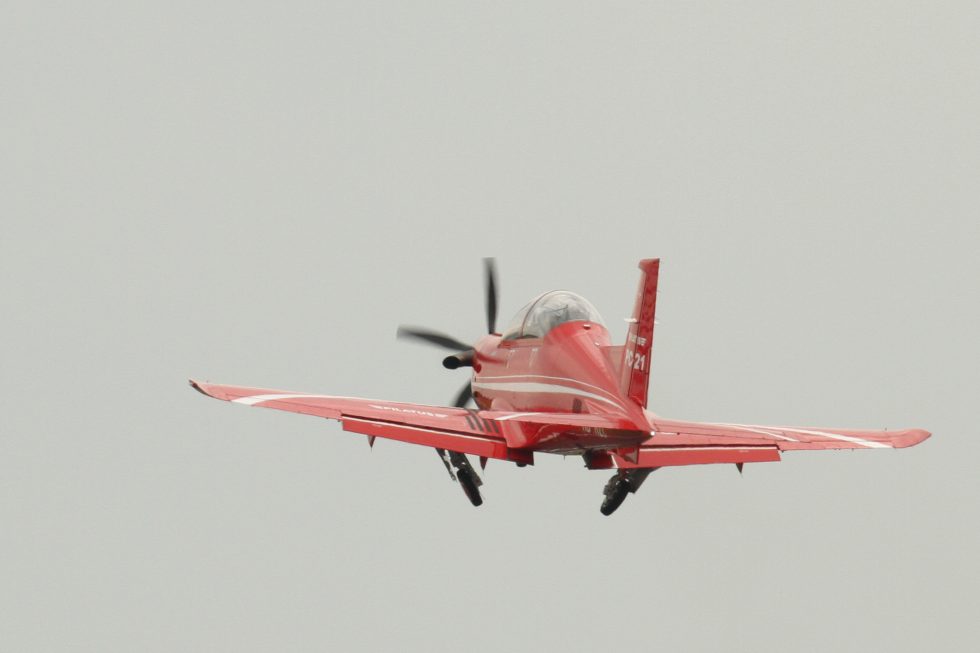
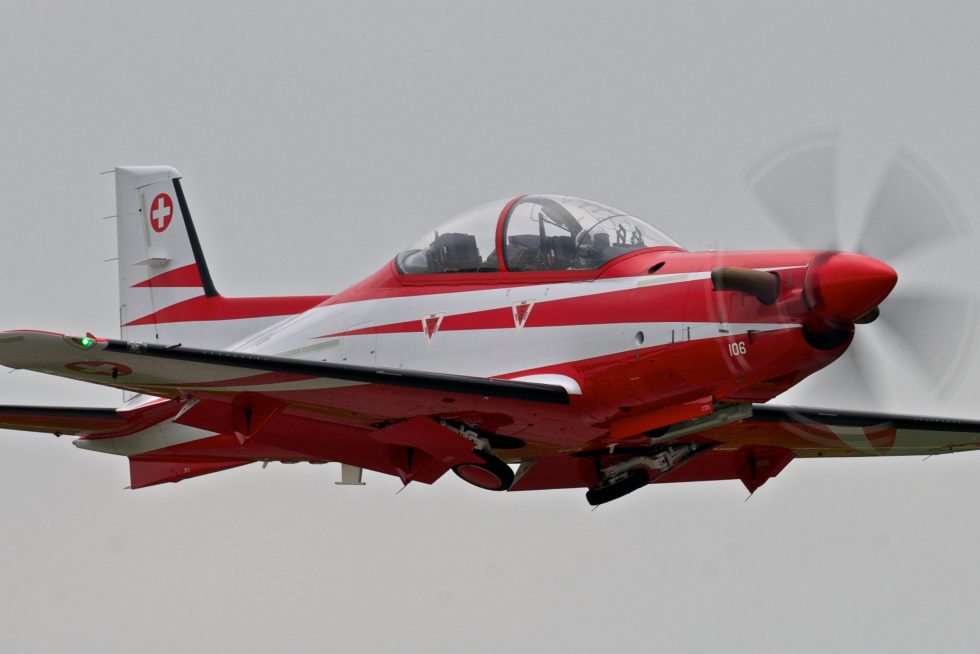
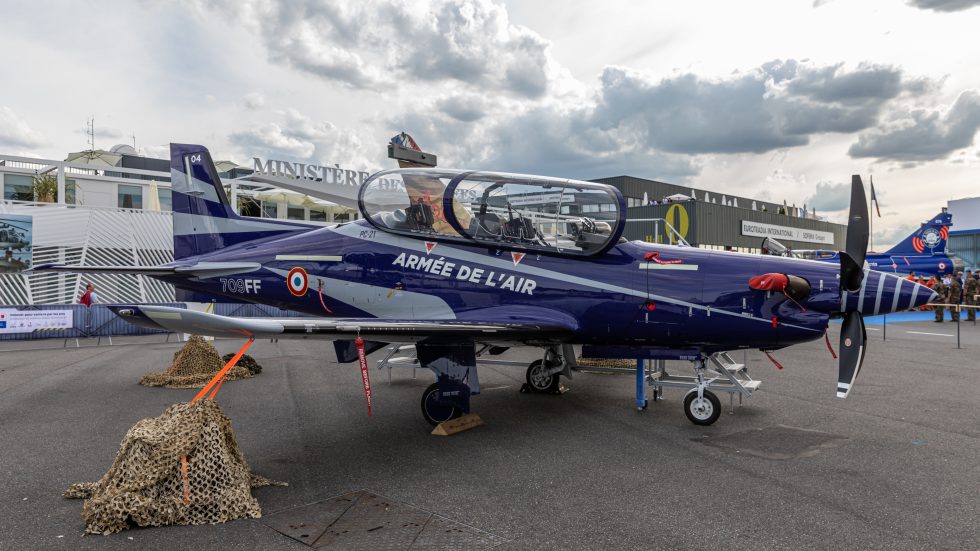
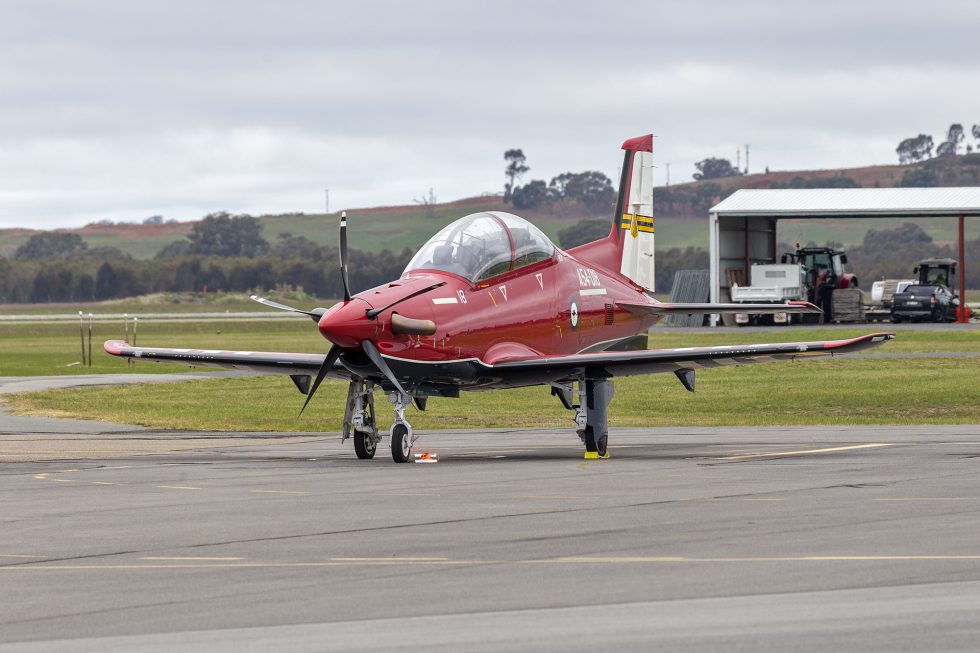
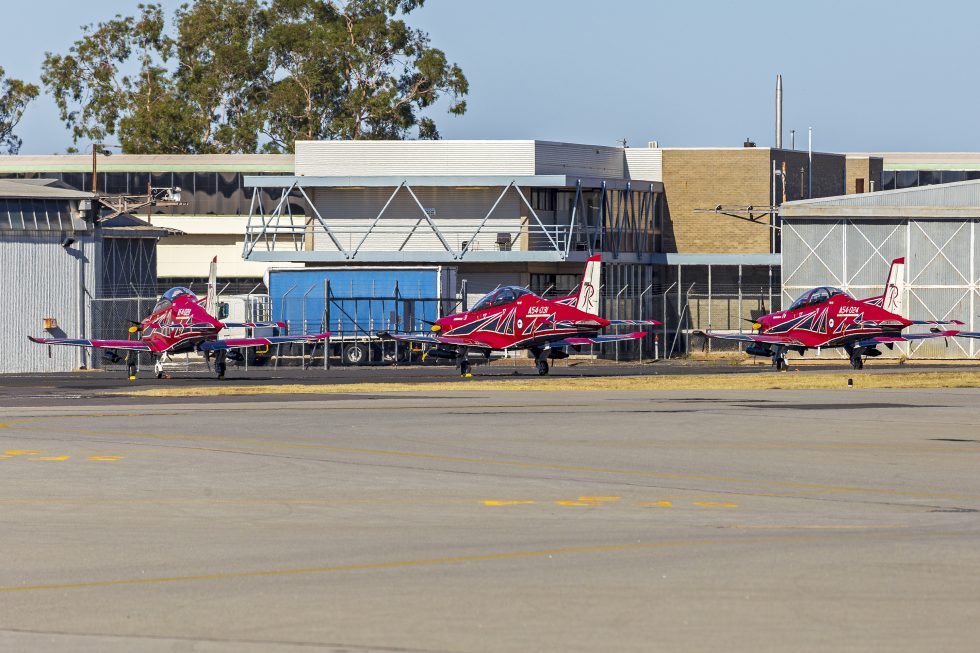
The Pilatus PC-21 in motion
Pilatus Aircraft: PC-21 – Test Flight in 360 Degree View. The manufacturer’s own onboard test-flight film — well over a million views — showing the trainer’s glass cockpit and jet-like handling from the pilot’s seat.
Where the Pilatus PC-21 flies
The Pilatus PC-21’s record: hours, not kills
The PC-21 has no air-to-air score, and that is the point — it is an unarmed advanced trainer, not a combat aircraft. Its record is measured in graduated pilots, exported fleets and jet hours saved. Where a fighter is judged on kills, the PC-21 is judged on how efficiently it prepares aircrew for the fighters they will go on to fly.
See how the front-line jets its graduates go on to fly stack up in the combat record of every military aircraft. Figures as of 2026.
Everything people ask about the Pilatus PC-21
Can I fly in a Pilatus PC-21?
Is the Pilatus PC-21 a jet?
What engine does the PC-21 have?
Who flies the Pilatus PC-21?
Why is the PC-21 cheaper to run than a jet trainer?
Is the PC-21 armed?
What does the PC-21 replace?
How fast is the Pilatus PC-21?
You can’t fly the Pilatus PC-21.
These, you can.
Some legends only live in museums — others are fuelled and waiting. MiGFlug has put civilians in real military jet cockpits since 2004.
 Fly the L-39 AlbatrosThe world’s most-flown jet trainer — aerobatics included
 Fly the F-104 Starfighter“The missile with a man in it”
 Fly the MiG-21The Cold War’s most-produced jet
 Fly the T-33 Shooting StarAmerica’s first jet trainer
 Fly the DH VampireA piece of early jet history
 Fly the S.211Agile Italian jet trainer
 Fly the MB-326The classic Aermacchi jet
 Fly the MiG-15The Soviet legend of the Korean War
Continue the tour
Every fact, checked
- Pilatus Aircraft — PC-21Manufacturer data on the airframe, engine, cockpit and training system.
- Royal Australian Air ForceRAAF PC-21 fleet, the AIR 5428 training system and the Roulettes conversion.
- JanesOrders, fleet numbers and export contracts across operators.
- FlightGlobalProgramme history, first flight and development milestones.
- Aviation WeekAnalysis of the trainer market and embedded-training concept.
- Key AeroOperator profiles, air-show reporting and technical background.
- Airforce TechnologySpecifications summary and programme overview.
- Aviation Safety / accident recordsReference for the flight-test prototype loss.