
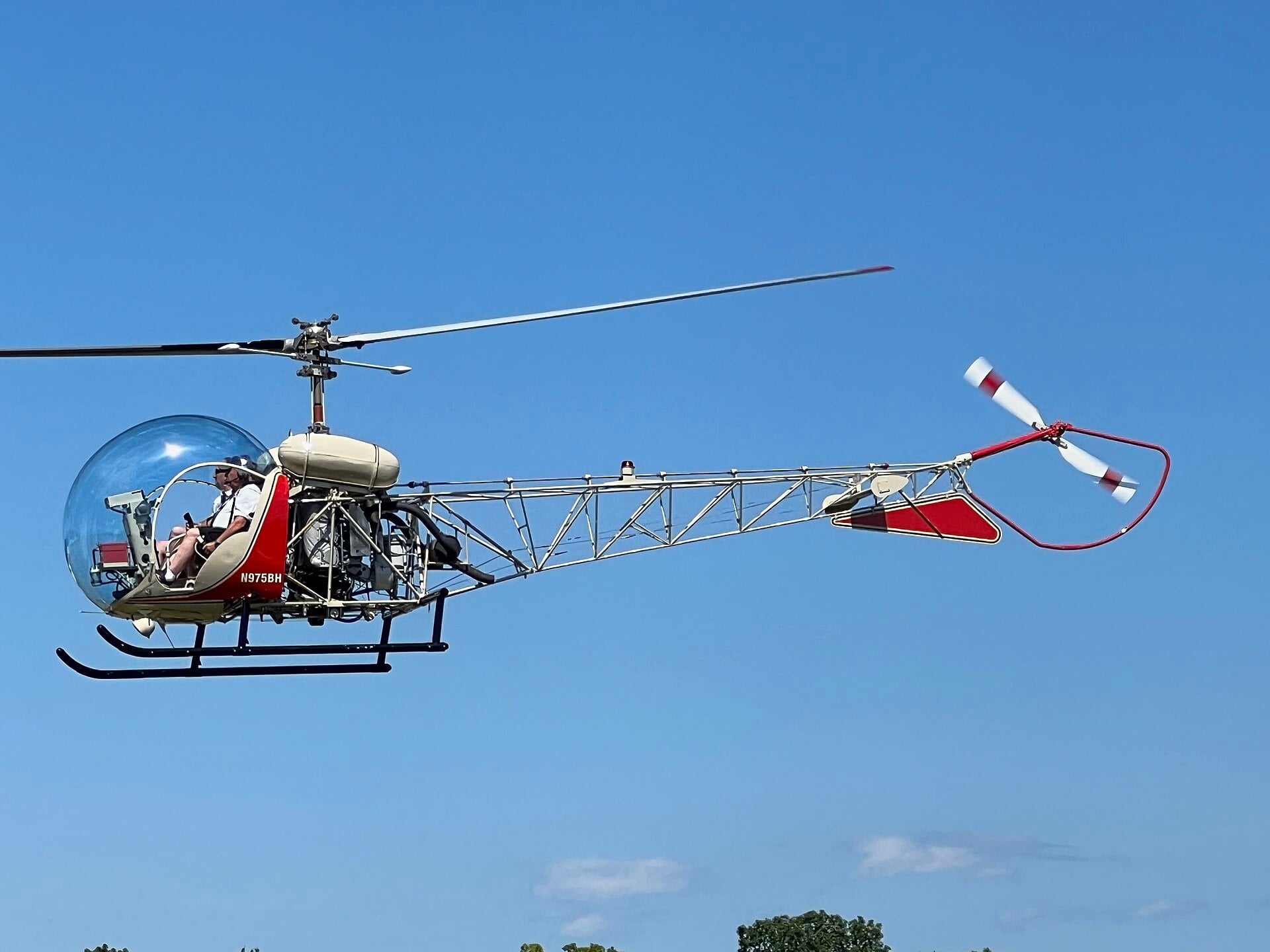
Bell 47 / H-13 Sioux
The Bubble That Carried Korea’s Wounded
The first helicopter certified for civil use became the H-13 Sioux, carried most of the Korean War’s helicopter casualties to MASH units and taught generations of military pilots in more than thirty countries.
The Bell 47: how Arthur Young’s bubble became the H-13 Sioux
The Bell 47 began in a barn. In 1928 Arthur M. Young, a Pennsylvania inventor who was also a philosopher and painter, started building small electric model helicopters on his family estate, and after thirteen years he found the key to a stable two-blade rotor: a weighted stabiliser bar set at right angles to the blades. In September 1941 he demonstrated a model to Larry Bell in Buffalo, and from June 1942 a small team worked in secret at Gardenville, New York, on the Model 30, which flew in 1943. Its production successor, the Model 47, first flew on 8 December 1945. On 8 March 1946 it became the first helicopter in the world to receive a commercial type approval, and in May the Civil Aeronautics Administration issued helicopter type certificate No. 1. The first was delivered to an operator on 31 December 1946.
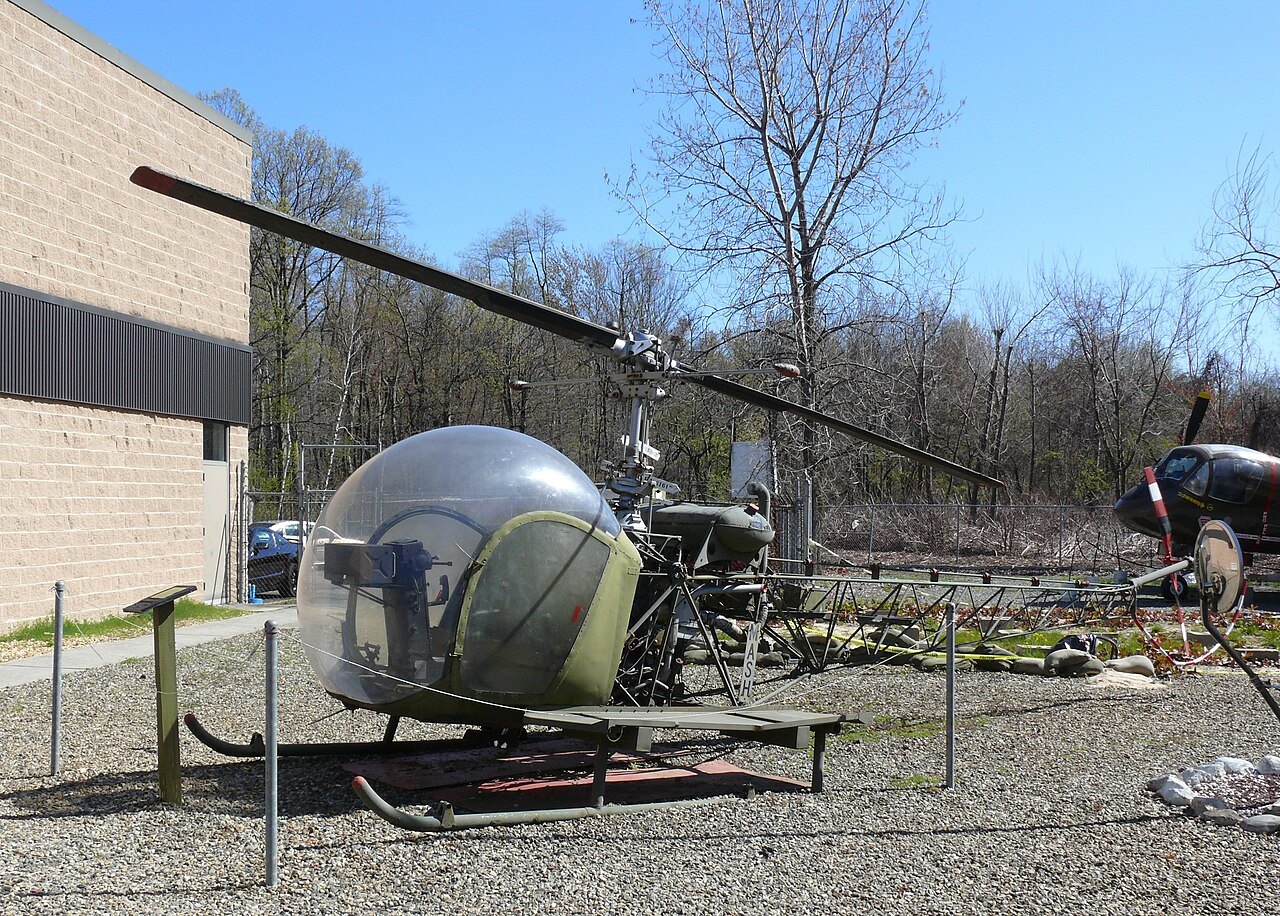
The military bought it at once. The US Army Air Forces ordered 28 Model 47As as YR-13s in 1947, the Navy took some as HTL-1s, and in 1948 the Army ordered 65 H-13Bs, later named Sioux. With the 47D came the famous one-piece Plexiglas bubble, the open welded-tube tail boom and skid undercarriage. In Korea the H-13 found its role: the Army had 56 when the war began, and from January 1951, with a stretcher pannier on each skid, its helicopters carried about 18,000 of the war’s 23,000 helicopter-evacuated casualties to forward surgical hospitals. The image of the bubble landing at a MASH tent later opened every episode of the television series M*A*S*H.
The 47G of 1953, with saddle fuel tanks and the full soap-bubble canopy, became the definitive model. The US Army flew OH-13 observation versions into the early Vietnam War, until the Hughes OH-6 replaced them from 1966, and TH-13T instrument trainers taught a generation of Army pilots. Agusta in Italy, Kawasaki in Japan and Westland in Britain built it under licence; Westland’s Sioux AH.1 equipped the British Army Air Corps. Bell built more than 5,000 in 27 years of production to 1973, and licensees well over 1,000 more. The New Zealand air force retired the last of its Sioux in 2012, and hundreds still fly privately, while the Museum of Modern Art in New York keeps a Bell 47D-1 in its design collection.
01The Bell 47 in Korea: the Angel of Mercy
When North Korea invaded in June 1950, the US Army had 56 H-13s. The 2nd Helicopter Detachment arrived in Korea in November 1950 with four, and in January 1951 four helicopter detachments were assigned to the Eighth Army surgeon. On 3 January 1951 1st Lt. Willis G. Shawn and 1st Lt. Joseph L. Bowler flew the Army’s first aerial medical evacuation missions. From then on the pattern was set: a single pilot, a wounded soldier strapped into a covered pannier on each skid, and a short, low flight from the front to a Mobile Army Surgical Hospital.
The H-13D, the most common Korean War variant, had skids, stretcher carriers and a Franklin O-335-5 engine. The US Army credits its helicopters with carrying 18,000 of the war’s 23,000 helicopter-evacuated casualties to forward hospitals, and reports that the death rate among evacuated wounded fell from 4.5 per cent in the Second World War to 2.5 per cent in Korea. The H-13 also flew observation, reconnaissance and rescue, and earned the nickname Angel of Mercy. Its MASH image was fixed for good by the 1970 film and the 1972 to 1983 television series, both of which featured the H-13 in their opening sequences.
02The Bell 47 abroad: Agusta, Westland and the British Sioux
Bell licensed production widely. Agusta in Italy built the Model 47 from 1954, and its Agusta-Bell versions served the Italian services and many export customers. Kawasaki built it in Japan and developed the four-seat KH-4. When the British Army needed a light helicopter, Westland faced a problem: its Sikorsky licence barred it from building a competitor’s design, so it licensed the 47G from Agusta, which held the Bell licence. The first contract was for 200 Sioux AH.1s, the first 50 built by Agusta at Gallarate and the rest by Westland at Yeovil, where the first British-built Sioux flew on 9 March 1965.
The Sioux became the Army Air Corps’ standard light helicopter, with a small number in the Royal Marines’ 3 Commando Brigade Air Squadron, and the RAF used 15 Sioux HT.2 trainers. In Germany the Bundeswehr flew 45 Bell and Agusta-Bell 47G-2s until the mid-1970s. Far away, the Royal New Zealand Air Force bought six 47G-3B-1s in 1965 and seven more in 1970 for army observation and helicopter conversion training; they served for 47 years, until 2012, although eight were written off, the highest peacetime loss rate of any RNZAF type. A Sioux AH.1, XT131, still flies with the Historic Army Aircraft Flight.
What makes the Bell 47 special
Young’s stabiliser bar
Arthur Young’s breakthrough was a short weighted bar mounted beneath and at right angles to the two main rotor blades and linked to the cyclic control. Acting as a gyroscopic flywheel, it kept the rotor plane steady regardless of gusts moving the fuselage, which made a simple two-blade teetering rotor stable enough for ordinary pilots. It also stored enough inertia to help autorotation if the engine failed. The bar became the signature of Bell’s early helicopters and the reason the 47 was forgiving enough to become a trainer.
The goldfish bowl
The first 47B looked like a car, with a windscreen styled with help from a Detroit motor manufacturer, upholstered seats, ashtrays and doors large enough for a man in a top hat. Military use changed that. The 47D introduced the single-piece Plexiglas bubble, which MoMA praises because its seamless transparency, paired with the open tail boom, makes the machine’s beauty inseparable from its efficiency. Pilots got superb visibility; wounded soldiers rode outside on the skids.
From grease nipples to 200 hours
Early Bell 47s were maintenance-hungry. Before sealed bearings, the helicopter and its transmission had to be taken apart every 25 flying hours to be lubricated and have bearings repacked with grease, and a leaking transmission seal once forced Bell to ground 27 aircraft. Intervals rose to 50, 100 and finally 200 hours, and Bell sent a mobile service unit to customers in the field. That steady improvement is what turned the 47 into the world’s standard training helicopter.
03The Bell 47’s military variants: YR-13 to Sioux AH.1
- YR-13 / HTL-1: 28 Model 47As for the USAAF, 1947; ten to the Navy as HTL-1s, and three winterised YR-13As tested in Alaska.
- H-13B: 65 for the Army, ordered 1948; H-13C stretcher conversions.
- H-13D and OH-13E: Korean War two-seat and three-seat versions with skids and stretcher carriers; 87 and 490 built.
- OH-13G, OH-13H, OH-13S: 47G-based observation versions; the OH-13S replaced the H with 265 aircraft.
- UH-13J: two enclosed 47J Rangers for presidential VIP transport.
- TH-13T: 411 two-seat instrument trainers for the Army.
- HTL-2 to HTL-7, HUL-1: Navy trainers and icebreaker helicopters; HUL-1G / HH-13Q for the Coast Guard.
- XH-13F: the first turbine-powered Bell, with a Continental XT51.
- Sioux AH.1 and HT.2: Agusta and Westland-built 47G-3B-1s for the British Army and RAF.
- Model 207 Sioux Scout: armed experimental derivative with a turbocharged engine.
- Kawasaki KH-4: four-seat Japanese development.
Bell 47G-4 specifications
Specifications
- Crew
- 1 pilot
- Capacity
- 2 passengers, or 2 stretcher panniers on military versions
- Main rotor diameter
- 11.32 m (37 ft 2 in)
- Tail rotor diameter
- 1.78 m (5 ft 10 in)
- Length
- 9.90 m (32 ft 6 in)
- Height
- 2.72 m (8 ft 11 in)
- Empty weight
- 827 kg (1,823 lb)
- Max take-off weight
- 1,338 kg (2,950 lb)
- Internal fuel
- 216 litres (57 US gal)
- Powerplant
- 1 × Lycoming VO-540 six-cylinder piston, 305 hp (227 kW), derated to 280 hp (209 kW)
- Maximum speed
- 169 km/h (105 mph)
- Cruise speed
- 143 km/h (89 mph)
- Range
- 416 km (258 mi)
- Service ceiling
- 3,415 m (11,200 ft)
- Hover ceiling
- 2,345 m (7,690 ft)
- Climb rate
- 244 m/min (800 ft/min)
- Armament
- Normally none; experimental machine-gun and, in France, SS.10 missile installations
Costs & production
- Unit cost
- About US$25,000 for a Bell 47B in 1946, three times the price of a light aeroplane; Bell’s internal standard cost was US$21,771 (Heli Archive)
- Cost per flight hour
- Military figures were not published. For privately operated Bell 47s today, a hedged estimate is a few hundred US dollars per hour, based on the fuel burn of a six-cylinder piston engine plus overhaul and component reserves
- Production
- Estimates vary: more than 5,000 by Bell from 1946 to 1973, plus over 1,400 under licence by Agusta, Westland and Kawasaki (Heli Archive); other sources give about 5,600 in all (Airport Technology)
- Programme
- First flight 8 December 1945; first commercial helicopter approval 8 March 1946; production ended at Bell in 1973
04The Bell 47’s operating costs: the helicopter that made rotary flying affordable
At launch the Bell 47 was expensive: about US$25,000 in 1946, three times the price of a light aeroplane and ten times the cost of a luxury car, and early versions needed a strip-down every 25 hours. Bell had invested more than a million man-hours, 4,000 hours of flight testing and almost US$5 million in the programme, and before the Korean War it sold only about 175 helicopters.
Korea and the military orders that followed changed everything. Long production runs, longer overhaul intervals and simple piston engines made the 47 the cheapest practical way to train helicopter pilots for decades, which is why so many armies used it as their primary trainer and why so many survive in private hands. No military operator published a cost per flight hour; the figure in the table is a hedged estimate for civil operation today.
The Bell 47 from Gardenville to the last military Sioux
Young meets Bell
Arthur Young demonstrates his model helicopter to Larry Bell in Buffalo in September.
Model 30
The first Bell prototype flies at Gardenville.
Model 47 flies
The production design makes its first flight on 8 December.
Certificate No. 1
Commercial approval on 8 March and CAA helicopter type certificate No. 1 in May.
Military orders
The USAAF orders 28 Model 47As as YR-13s; the Navy takes HTL-1s.
First Army medevac
Lieutenants Shawn and Bowler fly the Army’s first aerial medical evacuation missions in Korea on 3 January.
Distance record
A Bell 47D-1 flies 1,958.8 km non-stop from Hurst, Texas, to Buffalo on 17 September, a piston helicopter record that still stands.
Bell 47G
The definitive soap-bubble 47G enters production.
British Sioux
The first Westland-built Sioux AH.1 flies on 9 March; New Zealand’s first Sioux arrive.
Replaced in Vietnam
The Hughes OH-6 begins to replace the OH-13 as the Army’s observation helicopter.
Production ends
Bell closes the Model 47 line after 27 years.
Last RNZAF Sioux
The Royal New Zealand Air Force retires its Bell 47s after 47 years.
Stories & eyewitnesses: the Bell 47 from MASH to MoMA
A philosopher’s helicopter
Arthur Young spent thirteen years with model rotors before Bell took him on.
Read the full story
The first Army medevac
Two lieutenants started the helicopter ambulance service on 3 January 1951.
Read the full story
Eighteen thousand of twenty-three thousand
The H-13 carried most of Korea’s helicopter casualties.
Read the full story
Hurst to Buffalo non-stop
A 1952 distance record for piston helicopters still stands.
Read the full story
Grounded twice
The early 47B nearly killed the programme.
Read the full story
The helicopter in the museum of art
MoMA collects a Bell 47D-1 as a masterpiece of design.
Read the full story
Forty-seven years in New Zealand
The RNZAF’s Sioux taught its helicopter pilots for decades.
Read the full story
Missiles on a bubble
France tried anti-tank missiles on the H-13.
Read the full story
Where to see one
The Bell 47 is among the most widely preserved helicopters.
Read the full story
The Bell 47 in pictures
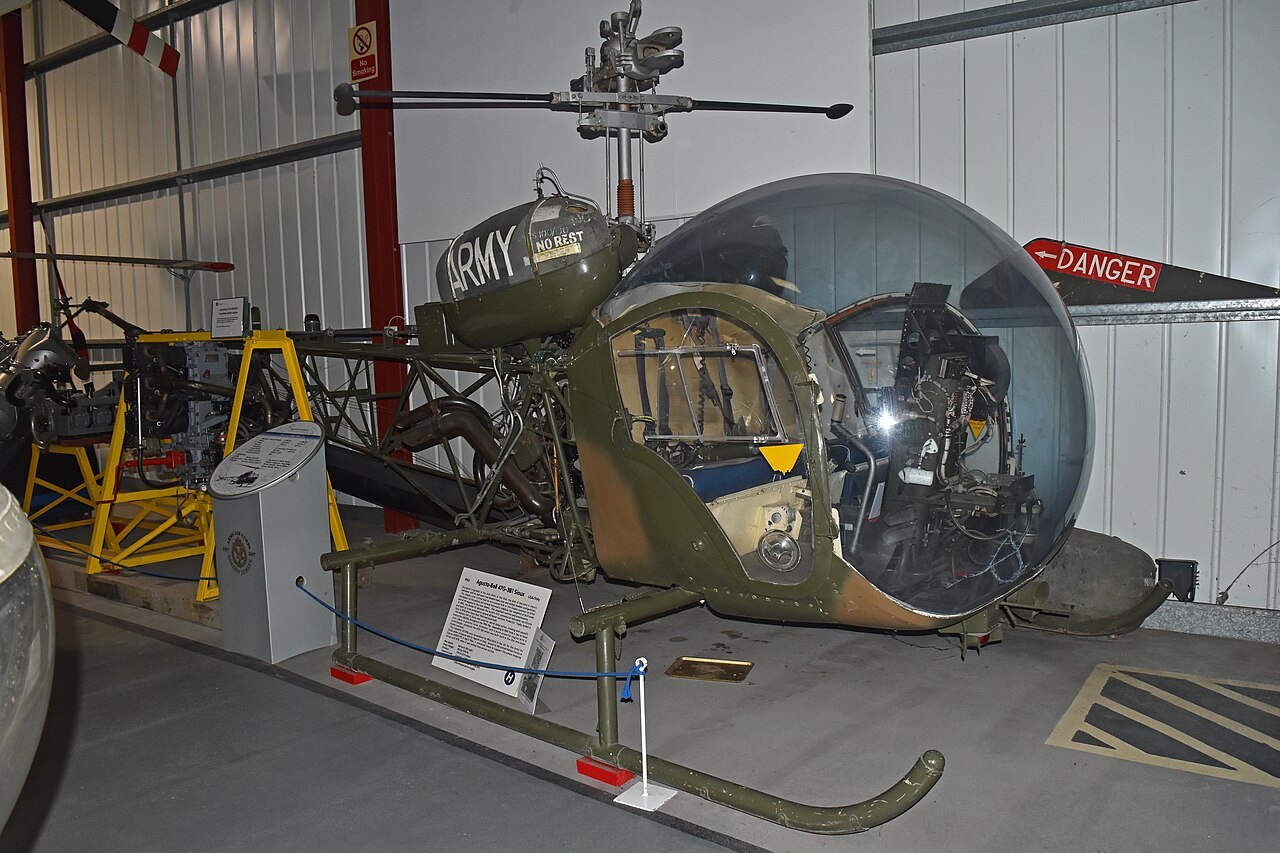
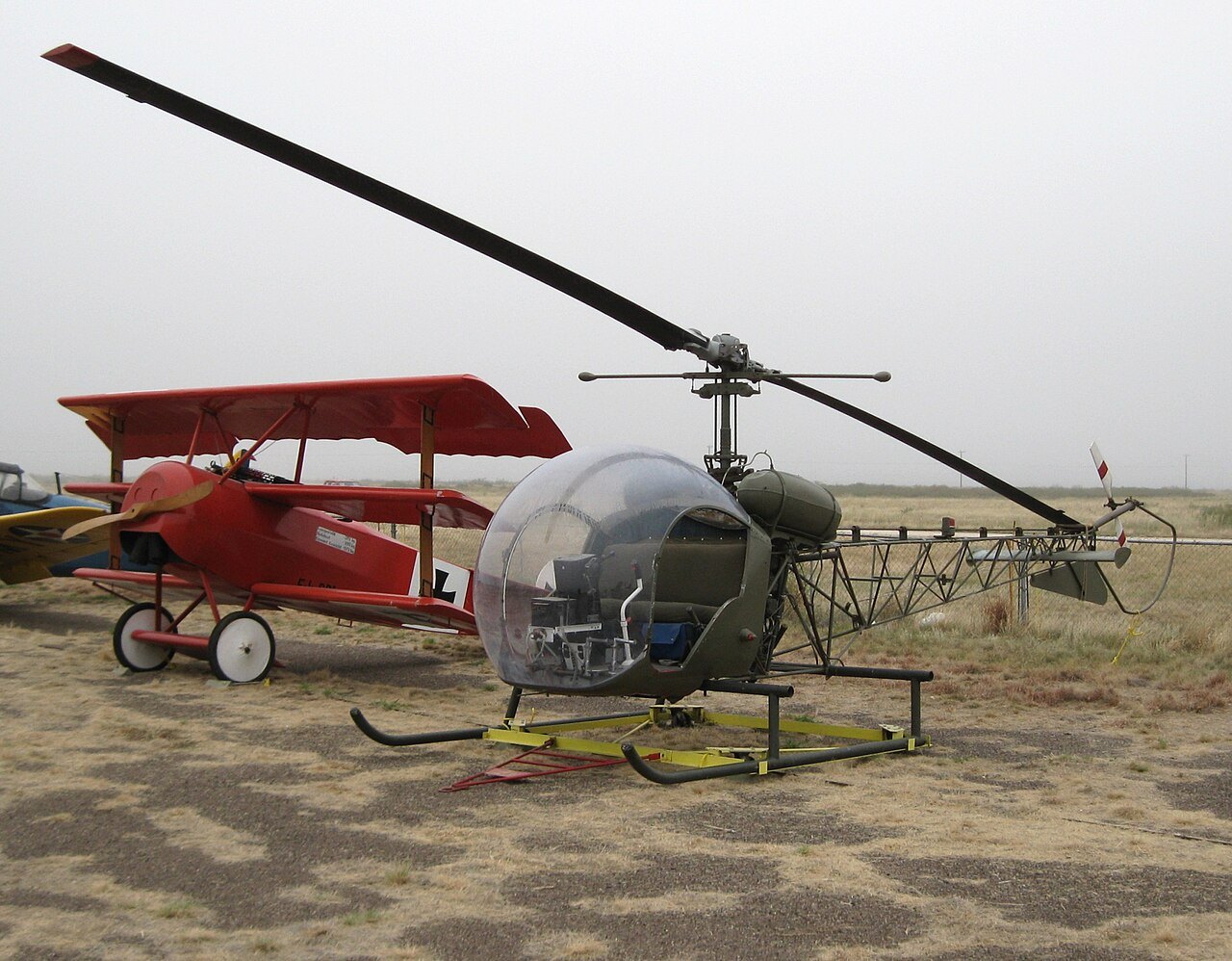
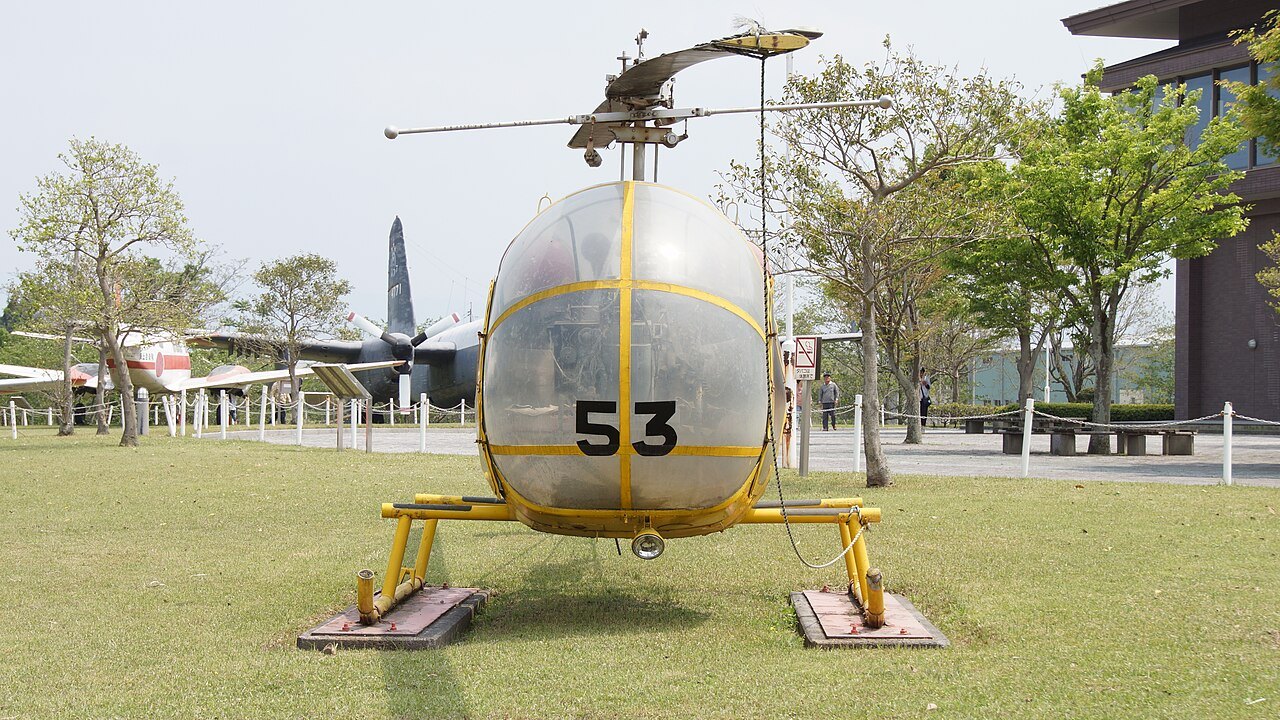
Where the Bell 47 flies and flew
The Bell 47’s record
The H-13 flew throughout the Korean War in medical evacuation, observation and rescue, and served early in the Vietnam War as an observation helicopter. Figures are as published by the US Army.
See how training and combat types compare in the military aircraft statistics database. Figures are approximate.
Everything people ask about the Bell 47
Can I fly in a Bell 47 / H-13 Sioux?
Is the Bell 47 the helicopter from M*A*S*H?
Was the Bell 47 the first certified helicopter?
How many Bell 47s were built?
Why is it called Sioux?
What is the stabiliser bar on a Bell 47?
Do Bell 47s still fly?
You can’t fly the Bell 47.
These, you can.
Most of this museum you can only look at. These genuine military jets you can fly yourself with MiGFlug — with aerobatics and time on the controls.
 Fly the L-39 AlbatrosThe world’s most-flown jet trainer — aerobatics included
 Fly the F-104 Starfighter“The missile with a man in it”
 Fly the MiG-21The Cold War’s most-produced jet
 Fly the T-33 Shooting StarAmerica’s first jet trainer
 Fly the DH VampireA piece of early jet history
 Fly the S.211Agile Italian jet trainer
 Fly the MB-326The classic Aermacchi jet
 Fly the MiG-15The Soviet legend of the Korean War
Continue the tour
Every fact, checked
- Bell 47BHeli Archive in-depth article: Arthur Young, certification, early accidents, price, maintenance and production totals
- Army helicopters in Korea, 1950 to 53US Army article: H-13 inventory, first medevac missions and casualty figures
- Bell-47D1 Helicopter (Arthur Young, 1945)Museum of Modern Art, New York: design collection object 126.1984
- UH-13 Sioux (encyclopedia entry)Ugolok Neba Russian aviation encyclopedia: military variants, licence production and data for the 47G-4
- Bell 47G-3B-1 SiouxAir Force Museum of New Zealand: RNZAF service 1965 to 2012 and museum aircraft
- Bell 47GMusée de l’Air et de l’Espace: French ALAT and Gendarmerie use, museum aircraft No. 714