
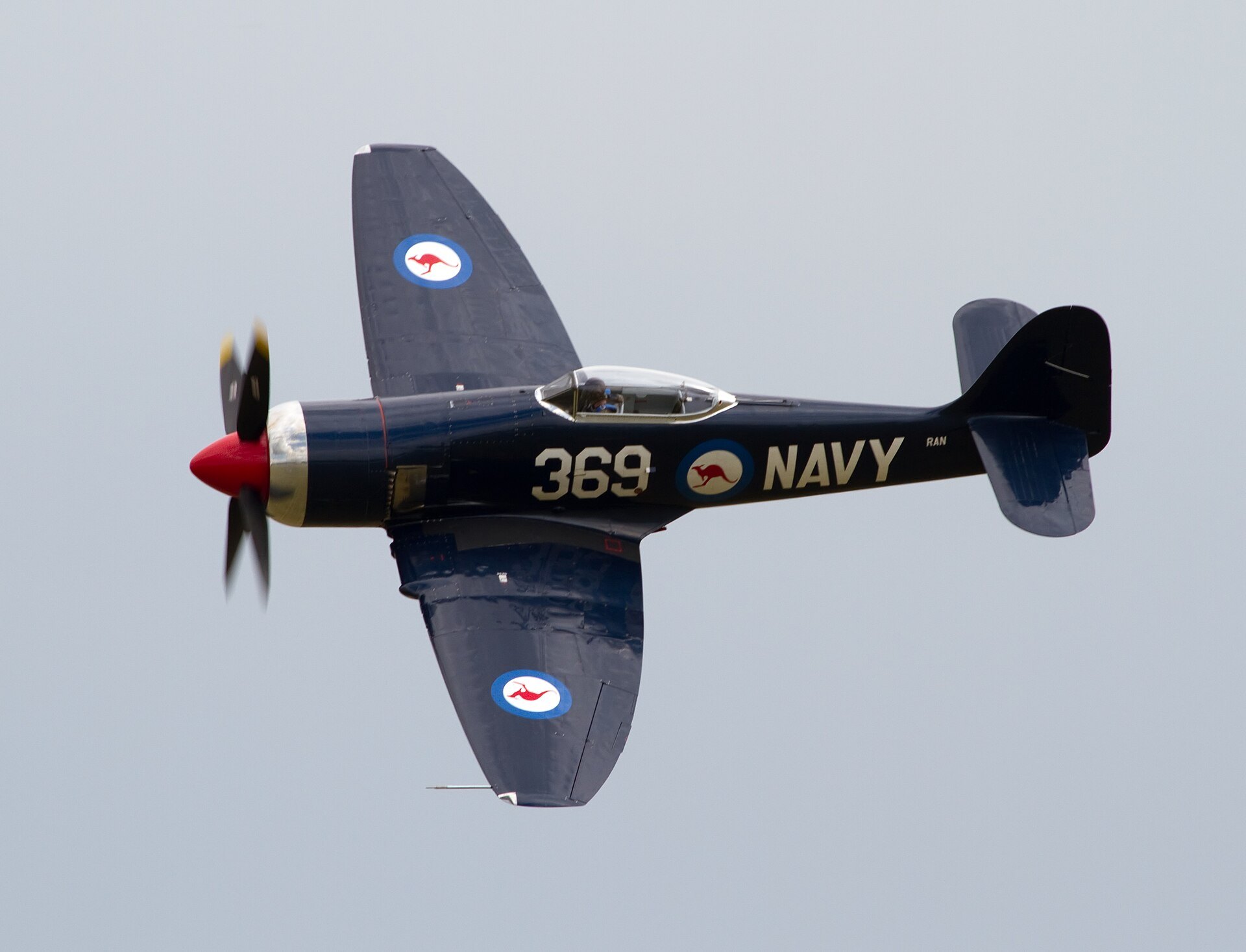
Hawker Sea Fury
The Last Piston Fighter
The last and fastest of Hawker’s piston fighters: a Fleet Air Arm ground-attack workhorse in Korea, credited with a MiG-15, flown by a dozen nations, and still a star of air races and airshows.
The Sea Fury: how Hawker’s last piston fighter went to war in the jet age
The Sea Fury began as a lighter, smaller Tempest. In 1942 and 1943 the Air Ministry asked Sydney Camm’s team at Hawker for a lightweight fighter, and the Admiralty soon wanted a naval version. In April 1944 orders were placed for 200 Furies for the RAF and 200 Sea Furies for the Fleet Air Arm. The first Fury prototype flew on 1 September 1944 and the first Sea Fury on 21 February 1945. Then the war ended: the RAF cancelled its Fury and the naval order was cut to 100, which might have been the end of the story.
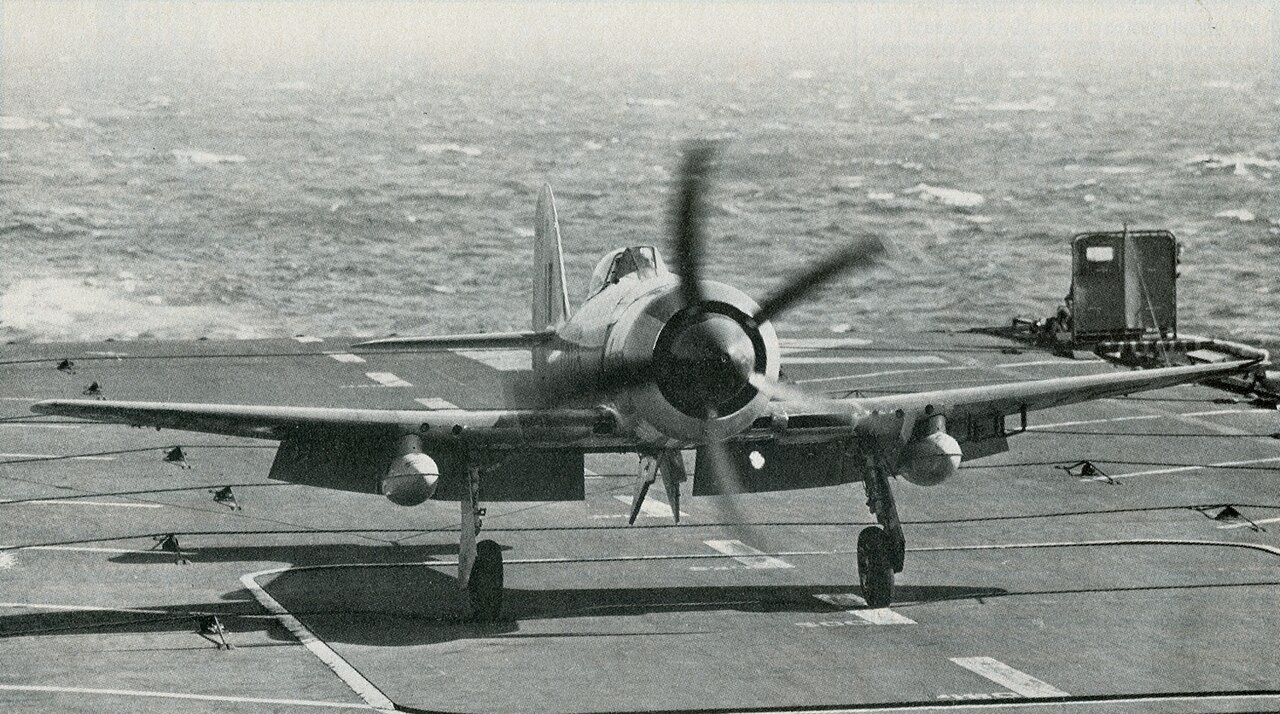
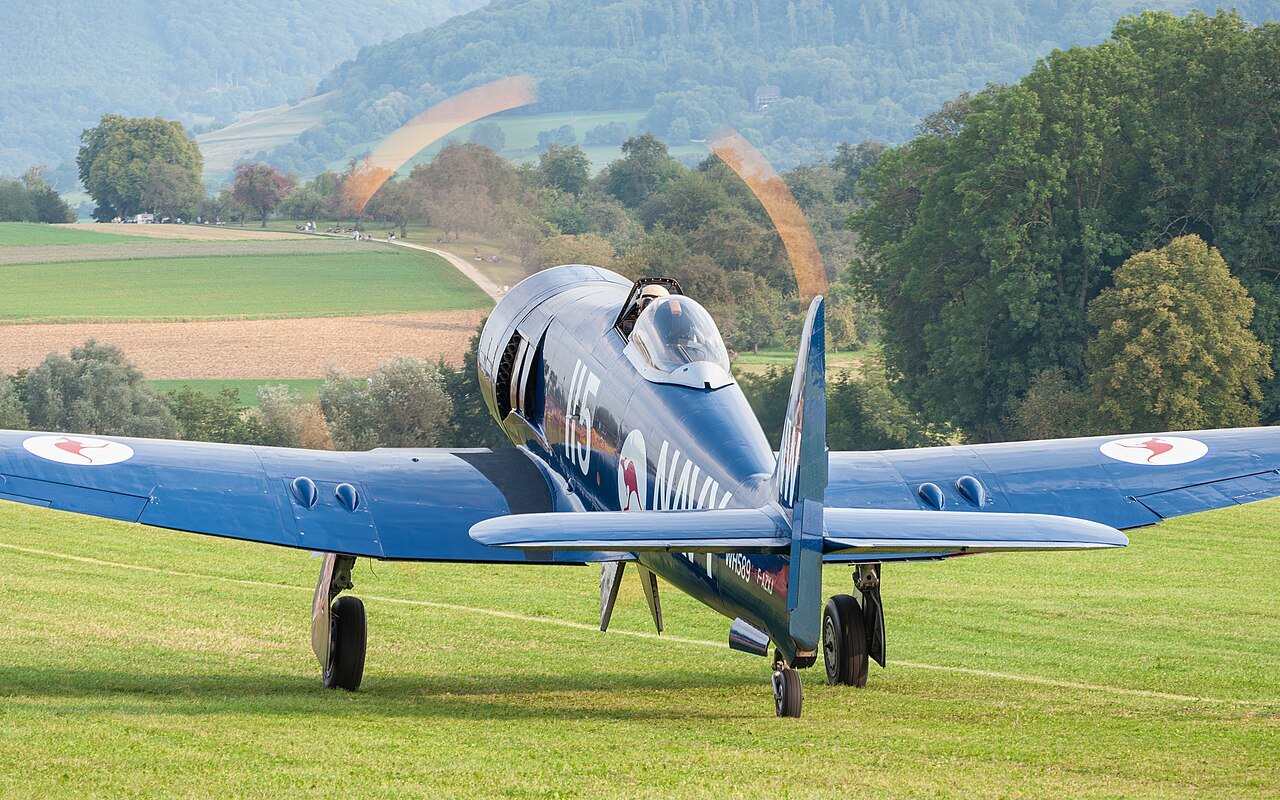
Instead the Navy found it had an outstanding aircraft. The Sea Fury had folding wings, an arrester hook and catapult fittings, and a five-bladed propeller driven by the big Bristol Centaurus sleeve-valve radial. The main production version, the FB.11 fighter-bomber, entered service with 802 Naval Air Squadron in May 1948, and 565 were built for the Fleet Air Arm at about ten a month until 1951. With a top speed of around 460 mph it was among the fastest piston-engined fighters ever to enter service.
In Korea the Sea Fury flew from British and Australian carriers from October 1950, attacking bridges, railways and troops with rockets, bombs and cannon. On 9 August 1952 pilots of 802 Squadron were credited with shooting down a MiG-15 jet, an achievement still celebrated by the Navy. Exports went to Australia, Canada, the Netherlands, Pakistan, Iraq, Egypt, Burma and Cuba, where Fidel Castro’s Sea Furies fought at the Bay of Pigs in 1961. Today the type is a favourite of air racers and historic flights.
01The Sea Fury in Korea: rockets, railways and a MiG
The Sea Fury’s war began in October 1950 when HMS Theseus arrived off Korea with 807 Squadron. Over the next three years Sea Fury squadrons rotated through Theseus, Glory, Ocean and the Australian carrier HMAS Sydney, flying armed reconnaissance, close support and interdiction missions from the Yellow Sea. Their usual loads were 3-inch rockets or 500 lb and 1,000 lb bombs plus four 20 mm cannon, and their targets were bridges, rail lines, junks, gun positions and troops. Losses to ground fire were steady, because the work was done low and slow over heavily defended country.
The famous day came on 9 August 1952. A flight of Sea Furies from 802 Squadron on HMS Ocean, led by Lieutenant Peter Carmichael, was jumped by MiG-15s and one of the jets went down. The kill was credited to Carmichael and made him famous, although later accounts suggest that his wingman, Sub-Lieutenant Brian Ellis, may have fired the decisive shots. Either way, it was one of the very few occasions when a piston-engined fighter was credited with destroying a jet in air combat.
02The Sea Fury abroad: from the Dutch navy to the Bay of Pigs
The Sea Fury was a strong export success for a piston fighter built so late. The Netherlands bought them for its navy and built more under licence; Pakistan took the largest export fleet; Iraq bought land-based Furies; Canada and Australia flew them from their own carriers; Egypt, Burma and Cuba followed, and West Germany used two-seat TT.20s as target tugs.
Cuba’s small fleet, delivered in the late 1950s, saw the most dramatic action. In April 1961, during the CIA-backed Bay of Pigs invasion, the few serviceable Sea Furies of Castro’s air force attacked the invasion shipping. Sea Furies flown by pilots including Enrique Carreras and Gustavo Bourzac set the transport Houston on fire with rockets and cannon, and the ammunition ship Rio Escondido was sunk in the air attacks. Those strikes did much to doom the landing.
What makes the Sea Fury special
The Centaurus: a sleeve-valve giant
The Sea Fury’s heart was the 18-cylinder Bristol Centaurus, a two-row sleeve-valve radial of around 2,480 hp in its Mark 18 form. Instead of poppet valves, sleeves sliding around each piston opened and closed the ports, allowing a very compact, powerful engine. It drove a big five-bladed propeller, which gave the Sea Fury tremendous acceleration and a strong torque swing on take-off that pilots had to respect, especially from a carrier deck.
A smaller, lighter Tempest
Hawker took the Tempest’s thin elliptical wing, removed its centre section so the two halves joined at the fuselage centreline, and built a slimmer, lighter monocoque fuselage. The result was smaller and lighter than the Tempest yet more powerful. For the Navy it gained folding wings, an arrester hook and catapult spools. With a top speed of about 460 mph and a climb to 30,000 ft in under 11 minutes, it rivalled the best late-war fighters.
A fighter that became a bomb truck
The Sea Fury entered a world where jets owned the sky, so the Navy turned it into a fighter-bomber. The FB.11 carried four 20 mm Hispano cannon with about 145 rounds each, plus twelve 3-inch rockets, or two 500 lb or 1,000 lb bombs, or drop tanks. Range was about 700 to 780 miles on internal fuel and over 1,000 miles with tanks, enough for long armed reconnaissance patrols over Korea from a carrier in the Yellow Sea.
03The Sea Fury’s afterlife: racers and two-seaters
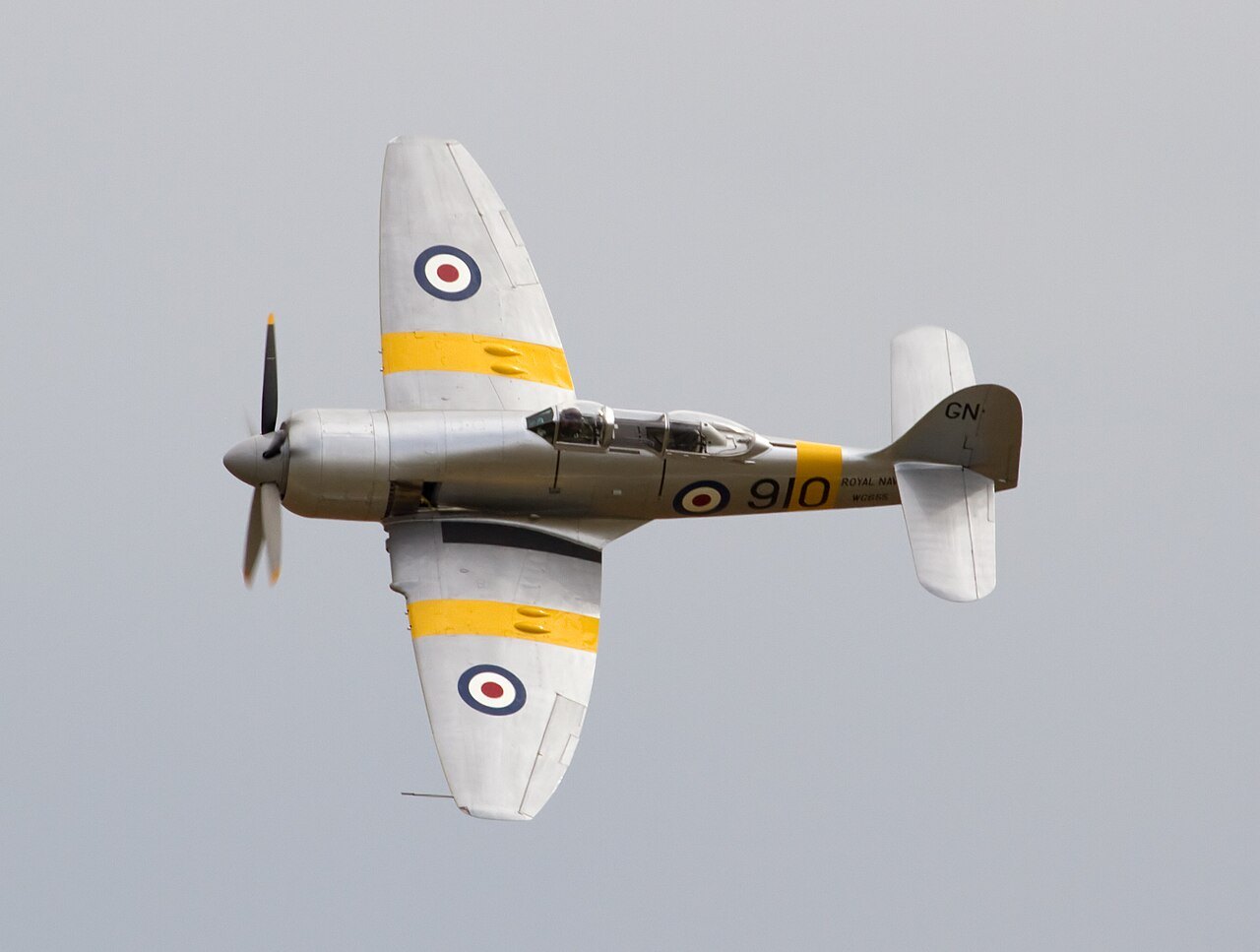
The two-seat T.20 trainer, with a second cockpit behind the first under a separate canopy, was built for the Navy and later used as a target tug.
Their speed made them natural air racers. At Reno several Sea Furies have been fitted with American radials in place of the Centaurus, Dreadnought famously with a Pratt & Whitney R-4360 Wasp Major; the best-known racers include “Dreadnought” and “Furias”. In Britain, Navy Wings keeps the Fleet Air Arm’s Sea Fury heritage alive with aircraft such as FB.11 VR930.
Hawker Sea Fury FB.11 specifications
Specifications
- Crew
- 1
- Length
- 10.57 m (34 ft 8 in)
- Wingspan
- 11.70 m (38 ft 4.75 in)
- Height
- 4.84 m (15 ft 10.5 in)
- Wing area
- 26 m² (280 sq ft)
- Empty weight
- 4,191 kg (9,240 lb)
- Gross weight
- 5,602 kg (12,350 lb)
- Powerplant
- 1 × Bristol Centaurus 18 two-row radial, about 2,480 hp (1,850 kW)
- Maximum speed
- 740 km/h (460 mph) at 5,500 m (18,000 ft)
- Range
- about 1,250 km (780 mi); about 1,670 km (1,040 mi) with drop tanks
- Service ceiling
- 10,900 m (35,800 ft)
- Climb rate
- 21.9 m/s (4,320 ft/min); 30,000 ft in 10.8 minutes
- Armament
- 4 × 20 mm Hispano Mk V cannon; up to twelve 3-inch rockets or 2 × 1,000 lb (454 kg) bombs
Costs & production
- Cost per flight hour
- No published military figure; for privately operated warbirds today, a commonly assumed order of magnitude is several thousand US dollars per hour, driven by fuel for a large radial, insurance and the scarcity of Centaurus overhauls
- Production
- About 864 built from 1945 to the mid-1950s, including 565 FB.11s for the Fleet Air Arm, delivered at about ten a month between 1948 and 1951
- Programme
- Orders for 200 Furies and 200 Sea Furies placed in April 1944; RAF Fury cancelled in 1945 and naval order cut to 100, later expanded
04The Sea Fury’s variants: from Fury prototype to target tug
- Fury prototypes: land-based RAF fighter; first flight 1 September 1944; cancelled in 1945, though export Furies were later built for Iraq and Pakistan.
- Sea Fury F.X: first naval fighter version, 50 built.
- Sea Fury FB.11: main fighter-bomber, 565 for the Fleet Air Arm plus export aircraft.
- Sea Fury T.20: two-seat trainer.
- Sea Fury TT.20: target-tug conversions, including aircraft used in West Germany from the late 1950s.
05The Sea Fury’s operating costs: a big radial today
No reliable official cost per flight hour for the Sea Fury in naval service has been published. For modern civil owners the expense is dominated by the engine: the Centaurus is a complex sleeve-valve radial with few specialists left, which is why some owners have re-engined their aircraft with American radials. The figure above is an order-of-magnitude estimate for a large-radial warbird, not a published number.
The Sea Fury from Tempest offshoot to Reno racer
Orders and first flight
In April orders are placed for 200 Furies and 200 Sea Furies; the first Fury prototype flies on 1 September.
Sea Fury flies
The first Sea Fury prototype flies on 21 February; the RAF Fury is cancelled at the end of the war.
Cleared for service
The Sea Fury is cleared for Fleet Air Arm service in the summer.
FB.11 enters service
802 Naval Air Squadron receives the fighter-bomber version in May.
Korea
Sea Furies of 807 Squadron go into action from HMS Theseus in October.
MiG-15 credited
On 9 August pilots of 802 Squadron from HMS Ocean are credited with a MiG-15.
Armistice
The Korean War armistice is signed on 27 July; the Sea Fury is soon withdrawn from front-line Navy squadrons.
Bay of Pigs
Cuban Sea Furies attack the invasion shipping at the Bay of Pigs in April, setting the transport Houston on fire.
VR930 flies again
Fleet Air Arm FB.11 VR930 returns to the air after a rebuild at Brough.
Navy Wings
VR930 is gifted to the Navy Wings charity in November.
Stories & eyewitnesses: the Sea Fury
Carmichael’s MiG
On 9 August 1952 a Sea Fury flight from HMS Ocean met MiG-15s and came home a jet ahead.
Read the full story
“Schmoo” Ellis and the MiG
The wingman many Sea Fury pilots believed deserved the kill.
Read the full story
Theseus opens the Sea Fury’s war
In October 1950 807 Squadron took the Sea Fury into battle.
Read the full story
HMAS Sydney’s war
Australia’s carrier took Sea Furies to Korea in 1951.
Read the full story
Castro’s Sea Furies at the Bay of Pigs
A handful of British-built fighters helped defeat a CIA invasion.
Read the full story
Sydney Camm’s last propeller fighter
The designer of the Hurricane ended the piston era with the Fury.
Read the full story
VR930: a Fleet Air Arm veteran
A Sea Fury that served with 802 and 801 Squadrons and flew again in 1998.
Read the full story
Dreadnought and the Reno racers
The Sea Fury found a second career in the Nevada desert.
Read the full story
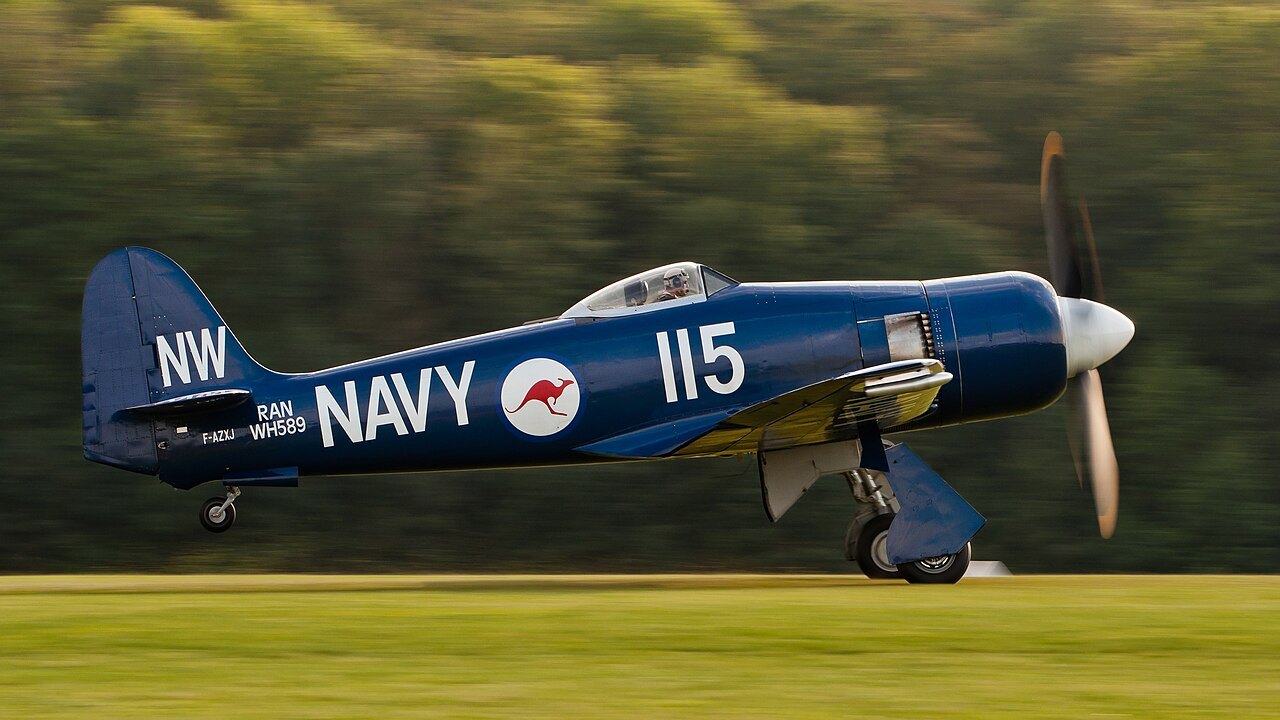
The Sea Fury in pictures
Where the Sea Fury flies and flew
The Sea Fury’s record
The Sea Fury’s war record rests mainly on Korea, where British and Australian squadrons flew it as a carrier-based ground-attack aircraft from 1950 to 1953. It was credited with a MiG-15 in 1952 and, in Cuban hands, helped defeat the Bay of Pigs invasion in 1961.
See how training and combat types compare in the military aircraft statistics database. Figures are approximate.
Everything people ask about the Sea Fury
Can I fly in a Hawker Sea Fury?
Did a Sea Fury really shoot down a MiG-15?
How fast was the Sea Fury?
What engine did the Sea Fury use?
How many Sea Furies were built?
Which countries flew the Sea Fury?
Do Sea Furies still fly?
You can’t fly the Sea Fury.
These, you can.
Most of this museum you can only look at. These genuine military jets you can fly yourself with MiGFlug — with aerobatics and time on the controls.
 Fly the L-39 AlbatrosThe world’s most-flown jet trainer — aerobatics included
 Fly the F-104 Starfighter“The missile with a man in it”
 Fly the MiG-21The Cold War’s most-produced jet
 Fly the T-33 Shooting StarAmerica’s first jet trainer
 Fly the DH VampireA piece of early jet history
 Fly the S.211Agile Italian jet trainer
 Fly the MB-326The classic Aermacchi jet
 Fly the MiG-15The Soviet legend of the Korean War
Continue the tour
Every fact, checked
- Hawker Sea FuryRickard, History of War: April 1944 orders, prototype first flights, variant totals, Korean service, export totals by country
- Hawker Sea Fury FB.11Rickard, History of War: 565 FB.11s, about ten a month 1948–51, 802 Squadron from May 1948, performance
- Sea Fury FB.11 VR930Navy Wings: VR930 service, 1998 rebuild at Brough, 2019 gift and R-2800 re-engining for a 2026 return to flight
- Sea Fury vs MiG-15: the true storyRoyal Aeronautical Society: the 9 August 1952 fight, Carmichael credited, Ellis’s role
- Hawker Sea FuryClassic Warbirds: first flight, service entry August 1947, 860 built, FB.11 performance and exports
- Hawker Fury and Sea Fury registryWarbird Registry: surviving airframes, including the racers Dreadnought and Furias