
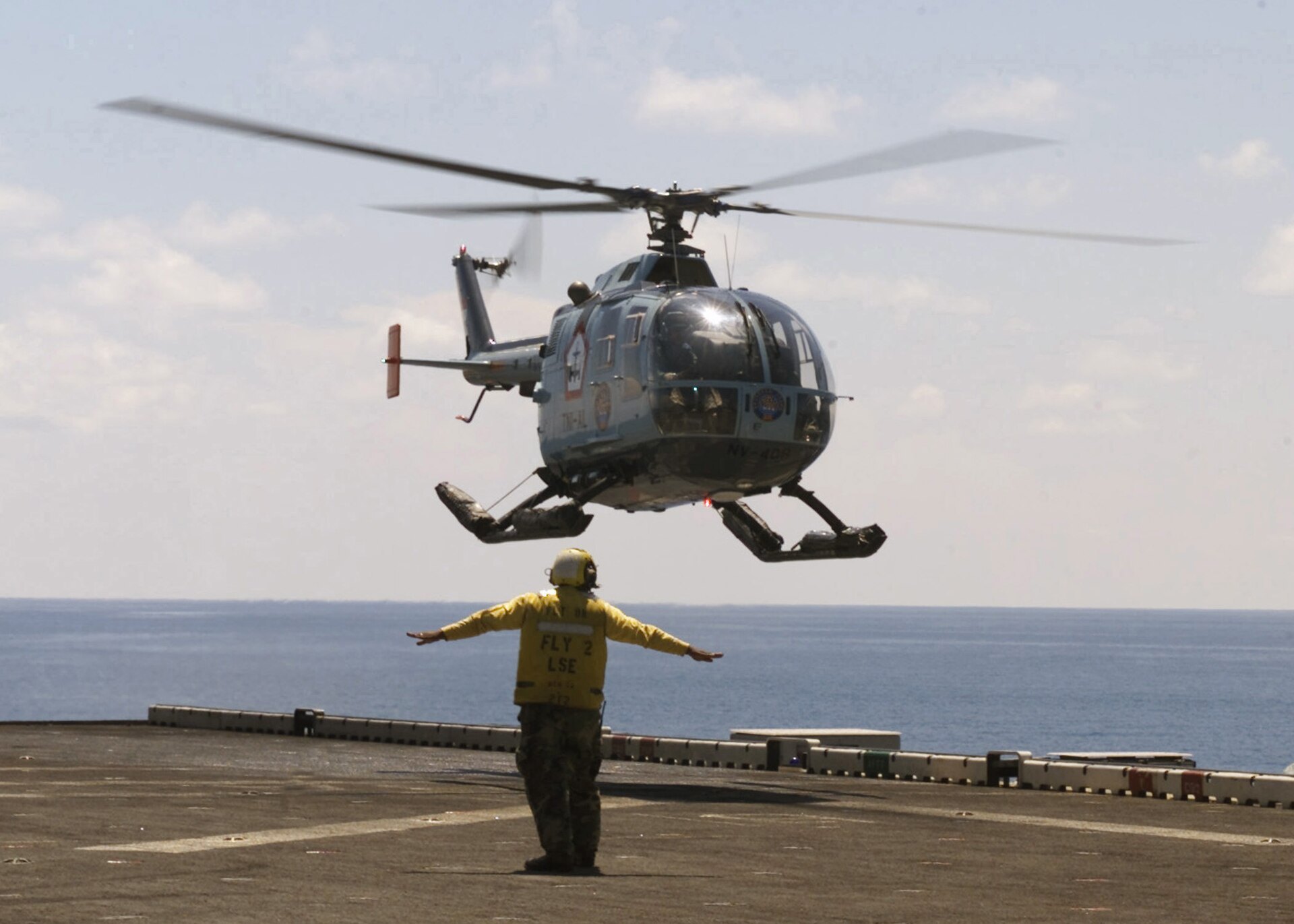
MBB Bo 105
The Helicopter That Loops
The world’s first light twin-engined helicopter: its rigid titanium rotor let it fly loops, built Germany’s air-rescue network, hunted tanks for the Bundeswehr and served in some 55 countries.
The Bo 105: how a small German firm reinvented the helicopter rotor
After the war the Allies had banned aircraft building in Germany, so when Ludwig Bölkow and Emil Weiland began designing helicopters in the early 1960s they were years behind the Americans and French. They looked for a gap in the market and found one: a light helicopter that was safe because it had two engines and duplicated systems, cheap to maintain, easy to fly and roomy enough for a stretcher. Sixty per cent of the development money came as federal loans, and suppliers such as ZF Friedrichshafen shared the risk. The prototype’s first successful flight, an 18-minute hop at Ottobrunn with chief test pilot Wilfried von Engelhardt, came on 16 February 1967. By then Bölkow was on its way to becoming Messerschmitt-Bölkow-Blohm, and German civil certification followed on 13 October 1970.
The secret was the rotor. The Bo 105 had no flapping or lead-lag hinges at all: four glass-fibre blades bolted to a solid titanium hub, their own flexibility doing the work that hinges did on other helicopters. The result was fewer moving parts, less vibration, long blade life and a crisp, almost aeroplane-like response to the controls. The first customers were ADAC air rescue and the Bavarian police, and from 1 November 1970 the yellow Christoph 1 at Munich-Harlaching began the German air-rescue network that the Bo 105 would dominate for decades. Police forces, oil companies and air ambulance services across Europe and North America followed, and in the United States Boeing Vertol marketed a stretched version for emergency medical work. By 1998 the Bo 105 and its larger BK 117 sibling held about 35 per cent of the EMS helicopter market.
Armies wanted it too. The Bundeswehr bought 212 PAH-1 anti-tank helicopters armed with six HOT missiles and 100 Bo 105M liaison and observation machines; Sweden, Spain, the Netherlands, Indonesia, Mexico, South Korea and many others followed. Licence lines ran in Spain, Indonesia, the Philippines and Canada, and by the end of production in 2001 about 1,640 had been built, 1,404 of them in Germany. The Bo 105’s descendants, the BK 117 and the EC 135, now fill the skies it pioneered, and in 2014 Airbus Helicopters counted 8 million fleet hours and about 700 Bo 105s still in service. Some have found unexpected new careers, from an aerobatic display team in Austria to a donated reconnaissance and casualty-evacuation helicopter in Ukraine.
01The Bo 105 in German air rescue: Christoph 1 and the yellow angels
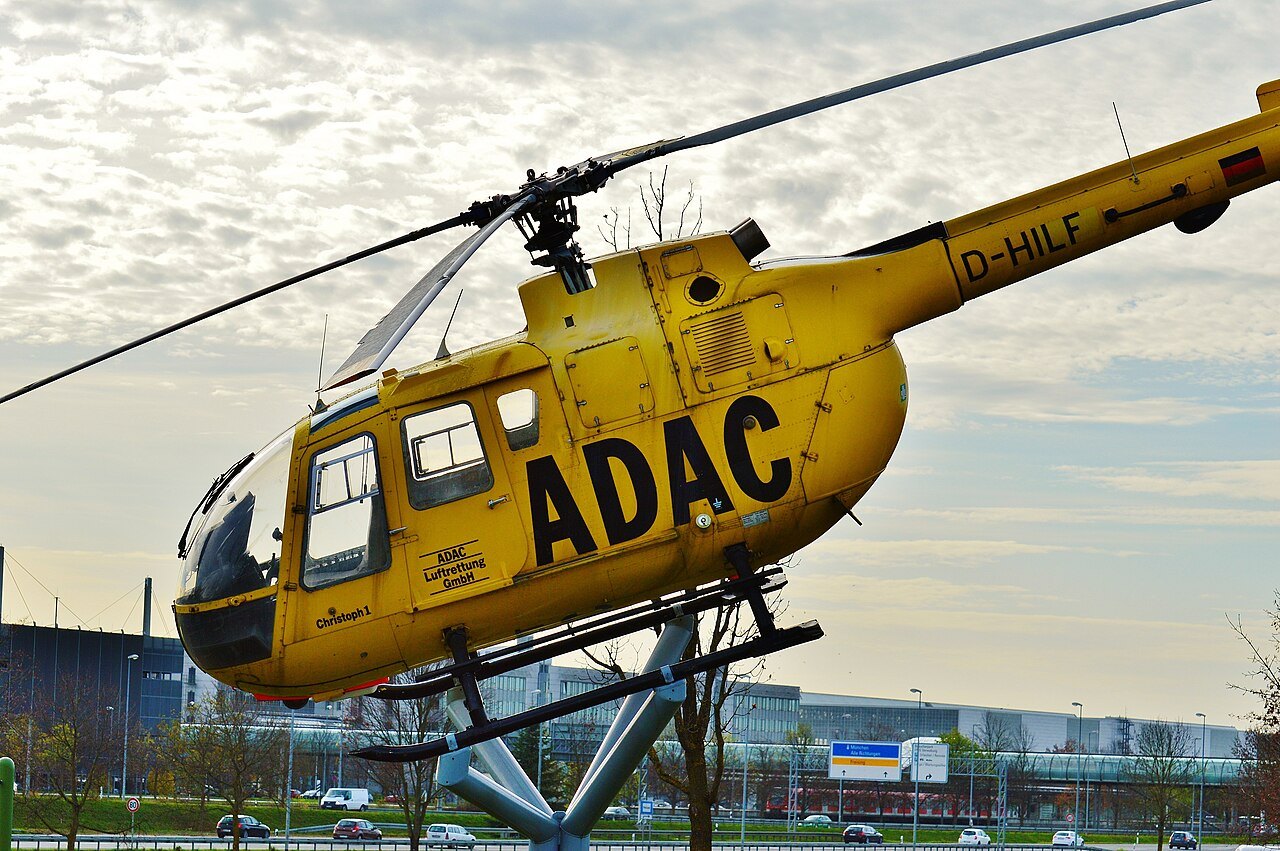
In 1967 road deaths in West Germany reached about 20,000 a year, and emergency doctors argued that the doctor should be flown to the patient rather than the patient driven to the doctor. The motoring club ADAC ran trials with hired helicopters and, on 1 November 1970, stationed Christoph 1 at Munich-Harlaching: the first permanently operated civil rescue helicopter in Germany, flown by a pilot and an emergency doctor. It was a Bo 105, at first a Bo 105A, and for years almost every German rescue helicopter was one. The ADAC, the Deutsche Rettungsflugwacht and the federal interior ministry built a network that eventually covered nearly the whole country, and the stretched Bo 105 CBS, with its third side window and 25 cm of extra cabin, became the classic rescue machine.
The type’s small cabin was eventually its undoing. Doctors complained that a patient’s legs could not be reached in flight and that there was too little room and power for modern intensive-care equipment. European JAR-OPS 3 rules then demanded the highest performance class for rescue flights from 2010. The ADAC retired its last Bo 105 at Senftenberg in 2007, the interior ministry in 2008 and the DRF at Zwickau in May 2009, mostly replacing them with the Bo 105’s own descendant, the EC 135.
02The Bo 105 at war: PAH-1 tank hunters and armed export versions
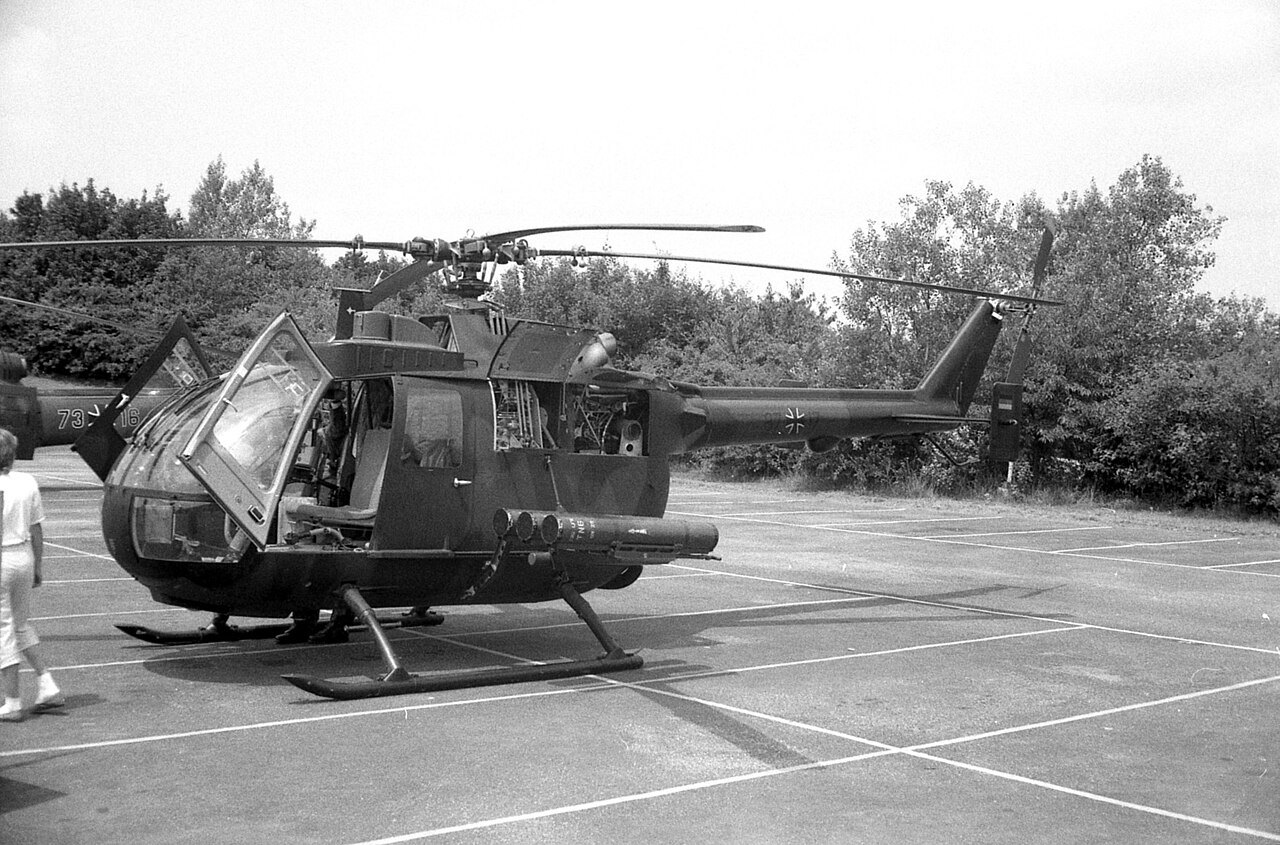
In 1975 the German Army chose an anti-tank Bo 105, the PAH-1 (Panzerabwehrhubschrauber), and 212 were delivered between 1979 and 1984. With a strengthened airframe, a roof-mounted gyro-stabilised SFIM sight above the commander and six wire-guided HOT missiles in tubes on outriggers, it was meant to ambush Warsaw Pact armour from behind tree lines, popping up to fire at long range before dropping back into cover. Crews flew in swarms of four, refuelling at forward points close to their firing positions. The Army regarded it as a stopgap, unhappy that it could not fight at night and had little self-protection; the upgraded PAH-1A1 appeared from 1991, and the type was replaced by the Tiger, firing its last live HOT during Exercise Griffin Strike at Idar-Oberstein in August 2013.
Abroad, armed Bo 105s took many forms. Sweden’s Hkp 9A carried HeliTOW missiles from 1987 to 1998; Spain flew HOT-armed and gun-armed versions, the latter with a 20 mm Rheinmetall cannon under the fuselage; Mexico’s navy upgraded its Bo 105s with FLIR, radar and weapon pylons. Indonesian military Bo 105s were reportedly used during the 1999 East Timor crisis and the Papua conflict, and Sudan’s can carry 50 mm rocket pods and twin machine-gun pods.
What makes the Bo 105 special
A rotor without hinges
Most helicopters of the 1960s used hinged rotor heads full of bearings, dampers and grease points. The Bo 105’s four glass-fibre blades were bolted to a solid titanium block and simply flexed. Fewer parts meant easier maintenance and long blade life: by 1991 the fleet had flown more than six million hours with no recorded failure of the rotor system. The stiffness gave a fast, precise response to the cyclic and good resistance to dynamic rollover, and it made low-level tactical flying and aerobatics possible.
Two engines in a light helicopter
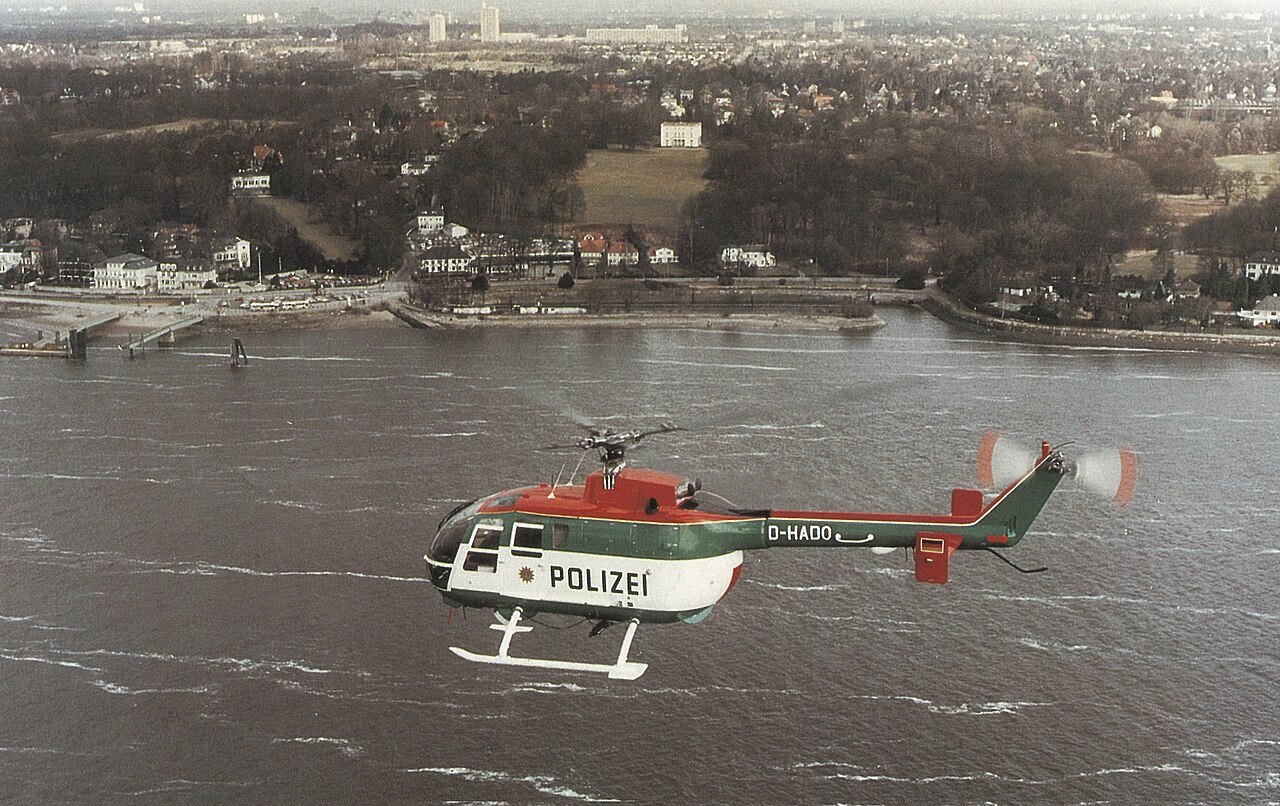
The Bo 105 was the world’s first light twin-engined helicopter, with duplicated hydraulics and electrics as well. Two Allison 250 turboshafts sat on the cabin roof; if one failed, the helicopter could usually fly on at reduced speed. That redundancy persuaded German police forces to switch from single-engined Alouettes and Gazelles to fly over crowded cities such as the Ruhr,. It also suited offshore oil work, and a dedicated Bo 105D was certified in Britain for that role.
Clamshell doors for a stretcher
Two pilots sit up front, with a removable bench for three passengers behind. Take the bench out and a stretcher slides in through two clamshell doors at the back of the cabin, which is exactly what rescue services wanted. The stretched CBS added 25 cm of cabin and an extra window. Maritime versions carried flotation gear, a life raft, folding blades and high skids, and auxiliary tanks gave a basic Bo 105 about five hours’ endurance under load. It was compact enough to operate from small patrol vessels, as the Mexican Navy’s did.
03The Bo 105’s aerobatics and speed record: loops, rolls and 404 km/h
The Bo 105 is regarded as the first helicopter capable of flying a loop, and according to MBB it was cleared to +3.5 g and −1 g. In 2005 the Bo 105 CB received approval for aerobatic flight, and the Austrian Flying Bulls took on two examples built in 1974 that had served as police helicopters. Their pilots, among them Rainer Wilke, have flown loops, rolls and inverted manoeuvres at air shows across Europe; the Flying Bulls describe it as still the only helicopter that can perform the same manoeuvres as a conventional aeroplane. A Bo 105 in Flying Bulls colours is now displayed at the Helicopter Museum in Bückeburg.
Speed was explored too. Between 1973 and 1975 MBB modified the fourth prototype, D-HAPE, as the Bo 105 HGH high-speed test aircraft. On 25 September 1973 it reached 200 knots (373 km/h) without wings, and on 4 March 1975, fitted with a fuselage fairing, a 6.2 m auxiliary wing, a faired rotor head and stub skids, it reached 404 km/h in a shallow dive, achieving the 400 km/h target for a helicopter with a hingeless rotor. That aircraft survives in the Deutsches Museum in Munich.
MBB Bo 105 CB specifications
Specifications
- Crew
- 1 or 2 pilots
- Capacity
- 3 or 4 passengers, or 1 stretcher
- Length
- 11.86 m (38 ft 11 in) including rotors
- Main rotor diameter
- 9.84 m (32 ft 3 in)
- Height
- 3.00 m (9 ft 10 in)
- Empty weight
- 1,276 kg (2,813 lb)
- Max take-off weight
- 2,500 kg (5,511 lb)
- Powerplant
- 2 × Allison 250-C20B turboshafts, 313 kW (420 shp) each
- Maximum speed
- 242 km/h (150 mph); never-exceed speed 270 km/h (168 mph)
- Cruise speed
- 204 km/h (127 mph) best-range cruise
- Range
- 657 km (408 mi) with standard fuel and maximum payload; 1,112 km (691 mi) with auxiliary tanks
- Service ceiling
- 5,180 m (17,000 ft)
- Climb rate
- 8.0 m/s (1,575 ft/min)
- g limits
- +3.5 / −1
- Armament
- PAH-1: 6 × HOT anti-tank missiles; export options for TOW, rocket pods, gun pods or a 20 mm cannon
Costs & production
- Cost per flight hour
- No official military figure published. Hedged estimate: in the low thousands of US dollars per hour, based on a light twin of 2.5 tonnes with two Allison 250 turbines, where engine overhauls and ageing-airframe maintenance dominate; actual costs vary widely between police, rescue and military operators
- Production
- 1,404 built in Germany (1967–2001); about 1,640 in total including licence production in Spain (115), Indonesia (122), the Philippines and Canada
- Programme
- Design from 1961–1964; first flight 16 February 1967; German certification 13 October 1970; production ended 2001; German Army retirement December 2016
04The Bo 105’s variants: from Bo 105A to PAH-1 and the Canadian LS
- Bo 105A: first production version with Allison 250-C18 engines, certified October 1970.
- Bo 105C / CB: more powerful Allison 250-C20 and C20B engines; the CB became the main production version.
- Bo 105CBS: cabin stretched by 25 cm with an extra window, popular in air rescue and in the US as the Twin Jet.
- Bo 105CBS-5 (Super Five): modernised version from the mid-1990s with improved rotor blades and gearbox.
- Bo 105LS: hot-and-high version with Allison 250-C28C engines, built with Eurocopter Canada; the last LS-A3 was delivered in 2009.
- Bo 105M (VBH): German Army liaison and observation version; 100 bought.
- Bo 105P (PAH-1, PAH-1A1): German Army anti-tank version with six HOT missiles; 212 delivered; many later disarmed as the Bo 105 P1M.
- Bo 105ATH, GSH, LOH: Spanish Army anti-tank, armed scout and observation versions.
- Hkp 9A / 9B: Swedish anti-tank (HeliTOW) and rescue versions.
- NBO-105: Indonesian licence-built version, 122 produced.
- Bo 105 KLH: Korean Light Helicopter, a combat version co-produced with KAI.
- Bo 105 E-4: ex-German Army aircraft overhauled for Albania from 2007.
- Bo 106 and Bo 105 HGH: one-off wide-cabin and high-speed research aircraft.
05The Bo 105’s operating costs: cheap to run, until the rules changed
Low running costs were part of the original Bölkow brief. The hingeless rotor removed most of the bearings and lubrication points of a conventional head, glass-fibre blades lasted far longer than metal ones, and German police forces found that the low-vibration, low-maintenance design raised availability for daily duty. For decades that made the Bo 105 one of the cheapest twin-engined helicopters to own and operate.
What ended its civil career in Germany was not cost but regulation and size: JAR-OPS 3 performance rules barred it from commercial rescue flights from 2010, and modern intensive-care kit needed a bigger cabin. No manufacturer or air arm publishes a reliable cost per flight hour for the type today, so the figure in the table is an estimate based on its class and engines, not an official number.
The Bo 105 from Ottobrunn prototype to Bundeswehr farewell
Design begins
Bölkow starts work on the light twin, building on hingeless rotor studies begun earlier.
First flight
The prototype flies at Ottobrunn on 16 February with Wilfried von Engelhardt at the controls.
Certified and Christoph 1
German certification on 13 October; ADAC’s Christoph 1 begins rescue flights in Munich on 1 November.
FAA and CAA approval
US and British certification open the export market.
404 km/h
The Bo 105 HGH reaches 404 km/h on 4 March; the German Army chooses the PAH-1.
PAH-1 deliveries
The first of 212 HOT-armed anti-tank helicopters reach the Bundeswehr.
Bo 105LS
The hot-and-high LS appears, later built in Canada.
Swedish HeliTOW
Sweden’s Hkp 9A anti-tank helicopters enter service.
Production ends
Eurocopter ends German production; the EC 135 takes over.
Aerobatic approval
The Bo 105 CB is approved for aerobatics; the Flying Bulls acquire two.
Last HOT fired
German Bo 105s fire their final live HOT missile at Idar-Oberstein in August.
Bundeswehr farewell
The German Army retires the type on 13 December with an 18-aircraft formation at Celle.
Stories & eyewitnesses: the Bo 105 in rescue, combat and display
Christoph 1
The Bo 105 that started German air rescue.
Read the full story
Upside down with the Flying Bulls
2,400 kg flying upside down, “a piece of cake”.
Read the full story
Tank hunters of the Cold War
212 PAH-1s waited behind the tree lines of West Germany.
Read the full story
The Bohicans say goodbye
Eighteen helicopters and 1.38 million hours.
Read the full story
Sweden’s HeliTOW companies
Twenty-one Bo 105s guarded the north and the south.
Read the full story
Back from the dead in Sudan
Iranian engineers helped return four Bo 105s to flight.
Read the full story
Attack over Caracas
A police Bo 105 was turned against Venezuela’s Supreme Court.
Read the full story
Made in Manila
The Philippines assembled at least 44 Bo 105s.
Read the full story
A gift to Ukraine
A businessman handed his own Bo 105 to the armed forces.
Read the full story
Eight angels on the autobahn
A retired Bo 105 now flies over the Kamener Kreuz.
Read the full story
The Bo 105 in pictures
Where the Bo 105 flies and flew
The Bo 105’s record
The Bo 105’s most important work was saving lives: it founded Germany’s air-rescue network and served police and rescue services worldwide. Its military career was mostly Cold War deterrence, though armed Bo 105s were reportedly used by Indonesia in East Timor and Papua and remain in service in several air arms.
See how training and combat types compare in the military aircraft statistics database. Figures are approximate.
Everything people ask about the Bo 105
Can I fly in an MBB Bo 105?
Can the Bo 105 really fly a loop?
What is a hingeless rotor?
How many Bo 105s were built?
What was the PAH-1?
Why did German rescue services stop using the Bo 105?
Is the Bo 105 still flying?
You can’t fly the Bo 105.
These, you can.
Most of this museum you can only look at. These genuine military jets you can fly yourself with MiGFlug — with aerobatics and time on the controls.
 Fly the L-39 AlbatrosThe world’s most-flown jet trainer — aerobatics included
 Fly the F-104 Starfighter“The missile with a man in it”
 Fly the MiG-21The Cold War’s most-produced jet
 Fly the T-33 Shooting StarAmerica’s first jet trainer
 Fly the DH VampireA piece of early jet history
 Fly the S.211Agile Italian jet trainer
 Fly the MB-326The classic Aermacchi jet
 Fly the MiG-15The Soviet legend of the Korean War
Continue the tour
Every fact, checked
- Geschichte der ADAC LuftrettungADAC Luftrettung history: Christoph 1 stationed in Munich-Harlaching on 1 November 1970
- Hubschraubertyp MBB/Eurocopter BO 105rth.info on the Bo 105 in German air rescue and its replacement under JAR-OPS 3
- Der gelbe Engel am Kamener Kreuzrth.info on the 2011 Bo 105 sculpture at the Kamener Kreuz
- BO 105 CThe Flying Bulls on their two aerobatic Bo 105s and the type’s history
- BO 105 CBS-5Federation of American Scientists military analysis of military Bo 105 versions
- Back From Retirement: Sudan’s BO-105s Take To The SkiesOryx on Sudan’s 1977 order and the 2012 overhaul
- 4 incógnitas que deja el ataque desde un helicóptero protagonizado por el inspector del CICPC Oscar Pérez en VenezuelaBBC Mundo on the June 2017 Caracas helicopter attack
- Knowing the Philippine Army’s BO-105 HelicoptersPitz Defense Analysis on PADC licence assembly and Philippine users
- The Ukrainian Armed Forces received a demilitarized German MBB Bo 105 helicopterMilitarnyi, June 2022, on the donated Bo 105