
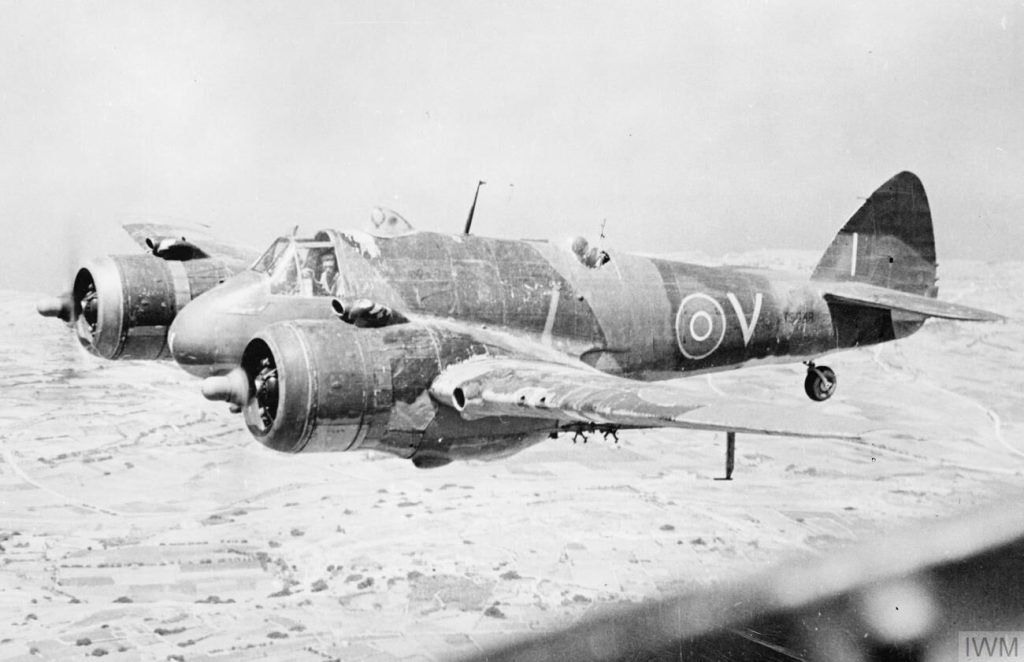
Beaufighter
Britain’s “Whispering Death”
The RAF’s first great radar night fighter and its deadliest anti-shipping striker — a heavily-armed twin that hunted bombers over Britain and ships across every sea.
The Beaufighter: a heavy fighter for every job
The Bristol Beaufighter was born of a hurry. In 1938, with war looming and the RAF short of a heavily-armed fighter, Bristol proposed grafting a new, cannon-armed fighter fuselage onto the wings, tail and engines of its Beaufort torpedo bomber. It was quick, cheap and pragmatic — and it produced one of the most versatile combat aircraft of the war. The prototype flew on 17 July 1939, just weeks before the war began.
Its first job was the night. When the Luftwaffe turned to bombing British cities in the dark in late 1940, the RAF had a new weapon: airborne-interception radar. The Beaufighter — big enough to carry the bulky early radar sets and a two-man crew, and armed with a shattering battery of four 20 mm cannon and six machine guns — became the first truly effective radar night fighter. On the night of 19 November 1940 a Beaufighter scored the first kill by a radar-equipped fighter, and through 1941 it turned the night Blitz from a one-sided slaughter into a costly business for the Germans.
Then it found a second calling over the sea. Fitted with rockets, bombs and torpedoes, Coastal Command’s “Torbeaus” hunted enemy shipping along the coasts of occupied Europe, attacking convoys at mast height through walls of flak. Strike wings such as the one at North Coates sank hundreds of thousands of tons of shipping — and paid for it in blood, losing scores of aircraft and hundreds of aircrew.
In the Far East it earned its most famous name. Flying low over the jungles of Burma, the Beaufighter’s quiet sleeve-valve engines were said to give little warning of its approach, and Japanese troops reportedly called it “Whispering Death.” Whether or not they truly coined the phrase, it stuck — a fitting name for an aircraft that arrived fast, hit hard, and was gone.
It was flown by almost everyone: fifty-nine RAF squadrons, the Fleet Air Arm, and the air forces of Australia, Canada, New Zealand, South Africa, Poland and the United States. Around 5,900 were built, in Britain and Australia, across night-fighter, strike and torpedo variants, and night-fighter aces such as John “Cat’s Eyes” Cunningham built their reputations on it.
By the war’s end faster, more specialised aircraft had taken over its jobs, but the Beaufighter soldiered on — through the Greek Civil War and the Malayan Emergency, and finally as an RAF target tug until 1960. Tough, adaptable and heavily armed, it was one of those aircraft that never had a single role, because it could do so many so well.
01Why the Beaufighter mattered: the aircraft that made radar night-fighting work
Airborne radar was the key to stopping the night bomber, but early sets were heavy and needed an operator, and killing a bomber required firepower a small fighter could not carry. The Beaufighter solved both problems at once: it was big enough for the radar and the second crewman, and heavily enough armed to destroy a bomber the moment it was found. It turned a promising technology into a working weapon.
That combination — sensors, a specialist operator, and the punch to finish the job — is the template every all-weather fighter has followed since. The Beaufighter was where night air defence stopped being a matter of luck and started being a matter of engineering.
How Bristol turned a torpedo bomber into a cannon fighter
Bomber bones, fighter build
Faced with a slow torpedo bomber and an urgent need for a heavy fighter, Bristol grafted a stubby new fuselage onto the wings, tail and undercarriage of its Beaufort. Re-using proven components let the Beaufighter reach first flight barely eight months after the drawing board — a speed of development almost unthinkable for a clean-sheet aircraft.
Two Hercules, brute punch
A pair of Bristol Hercules sleeve-valve radials — roughly 1,600 hp apiece — gave the airframe the power to haul heavy armament, radar and later a torpedo. The engines sat well forward of the short nose, and the aircraft’s quiet approach in the Far East helped earn its most famous nickname.
Four cannon in the belly
The Beaufighter carried four 20 mm Hispano cannon in the lower fuselage, backed by six wing-mounted .303 machine guns — one of the heaviest gun batteries fitted to any fighter of its era. A single half-second burst threw enough metal to tear apart a bomber, a surfaced U-boat or a coastal freighter.
02From gun-fighter to ship-killer: how the strike marks evolved
Later strike marks swapped some of the wing machine guns for underwing rockets and added a centreline torpedo, turning the “Beau” into Coastal Command’s primary anti-shipping weapon. The same airframe could suppress flak with cannon, salvo rockets into a ship’s hull and drop a torpedo — roles that would normally demand three different aircraft.
Bristol Beaufighter — by the numbers
Figures below are for the Beaufighter TF Mk X — the torpedo- and rocket-armed Coastal Command strike aircraft with Hercules XVII engines, which was by a wide margin the most-produced mark. Where the Mk IF night fighter of 1940 and the Mk VIC Coastal fighter differ materially, the delta is given in grey alongside.
Dimensions & weights
- Crew
- 2 (pilot, and navigator/radar operator in a separate rear cupola)
- Length
- 12.60 m (41 ft 4 in)
- Wingspan
- 17.63 m (57 ft 10 in)
- Height
- 4.83 m (15 ft 10 in, tail down)
- Wing area
- 46.7 m² (503 sq ft; the wing was inherited from the Beaufort)
- Empty weight
- 7,072 kg (15,592 lb)
- Loaded weight
- 9,798 kg (21,600 lb, typical strike configuration)
- Max takeoff weight
- 11,521 kg (25,400 lb, overload with torpedo and full tanks)
- Internal fuel
- ~2,500 l (~550 imp gal in four wing tanks; ~3,100 l / ~682 imp gal with overload tankage on long-range Coastal marks)
Performance
- Max speed
- 515 km/h at 3,050 m (320 mph at 10,000 ft; about 488 km/h / 303 mph down on the deck. The Mk IF on Hercules XI managed roughly 520 km/h / 323 mph at 4,600 m / 15,000 ft)
- Cruise speed
- 400 km/h (249 mph, economical cruise)
- Rate of climb
- 8.1 m/s (1,600 ft/min at sea level, clean)
- Service ceiling
- 4,570 m (15,000 ft — the Hercules XVII was deliberately geared for low-level power. The high-blown Mk IF reached about 8,080 m / 26,500 ft)
- Range
- ~2,370 km (~1,470 miles at 1,500 m / 5,000 ft on internal fuel)
- Ferry range
- ~2,820 km (~1,750 miles with overload tanks and no external stores)
- Takeoff run
- 400 m (about 1,300 ft ground run at loaded weight; roughly 840 m / 2,750 ft to clear a 50 ft screen)
- Landing run
- 450 m (about 1,480 ft on a hard runway at normal landing weight)
- Wing loading
- 210 kg/m² (43 lb/sq ft at loaded weight)
Propulsion & systems
- Engines
- 2 × Bristol Hercules XVII (14-cylinder two-row air-cooled radials with Bristol's sleeve-valve system, which gave smooth running and a notably muted exhaust note. Mk IF used the Hercules III or XI, the Mk VI the Hercules VI or XVI, and the Australian Mk 21 the Hercules XVIII)
- Power each
- 1,294 kW (1,735 hp for take-off; the XVII's supercharger was rated low down for anti-shipping work. The Mk IF's Hercules XI gave about 1,180 kW / 1,590 hp)
- Propellers
- 3-blade de Havilland Hydromatic (constant-speed, fully feathering, 3.89 m / 12 ft 9 in diameter)
- Origins (Beaufort DNA)
- Private-venture Beaufort derivative Bristol proposed the Type 156 in 1938 off its own bat, mating an entirely new slim fuselage with a four-cannon nose to the wings, tail surfaces, undercarriage and much of the systems layout of the Beaufort torpedo bomber already in production. That is why it went from proposal to prototype in about eight months and into squadron service within roughly a year of first flight — exactly the moment the RAF urgently needed a cannon-armed aircraft big enough to carry airborne radar and a second crewman.
- Armament
- 4 × 20 mm Hispano cannon in the nose, plus up to 6 × .303 in Browning machine guns in the wings on many marks; TF Mk X typically deleted the wing guns and carried a single .303 in Vickers K on a rear flexible mount, an 18 in torpedo or 8 × RP-3 rockets
- Radar
- AI Mk IV, later AI Mk VIII (metric AI Mk IV with arrowhead and dipole aerials on the Mk IF from 1940; the centimetric AI Mk VIII in a nose thimble radome from the Mk VIF onward, with ASV Mk VIII for surface search on Coastal marks)
- First flight
- 17 July 1939 (prototype R2052, flown by Cyril Uwins at Filton)
- Service entry
- 1940 (first squadron deliveries from late summer, night-fighter operations from September)
- Built
- ~5,900 (~5,560 in Britain by Bristol, Fairey, Rootes and MAP shadow factories, plus ~360 Mk 21s by DAP in Australia; ~5,928 is the figure most often cited)
- Unit cost
- ~GBP 20,000–25,000 (order-of-magnitude estimate in wartime money for a twin of this class; no consistently published contract price for the Beaufighter has been located, and wartime figures varied by mark, batch and whether government-furnished engines, guns and radar were counted — treat with caution)
- Cost per flight hour
- Not meaningfully established No Beaufighter has flown for decades — the type effectively disappeared from the air after the RAF retired its last target tugs in 1960, and no example has been on the civil warbird circuit since, so there is no operating-cost record of the kind that exists for Spitfires or Mustangs. Long-running restoration-to-flight projects are under way in Britain, Australia and the United States, and if one succeeds, a rough comparison with other Hercules- or twin-radial-powered warbirds suggests something in the order of ~GBP 8,000–15,000 per hour in current money. That is an inference, not a quoted rate, and the airworthy position may have changed since writing.
03Why the numbers vary so much between marks
The Beaufighter was built in night-fighter, long-range fighter, ground-attack and torpedo-strike versions, and each traded something away. Radar marks carried an extra crewman and antennas; torpedo marks hauled an external weapon that cut speed and ceiling; tropicalised aircraft added filters and fuel. The figures quoted here are therefore typical values rather than a single definitive specification.
Armament & payload
Beaufighter firepower: four nose cannon, and then rockets and a torpedo
The Beaufighter was built around its guns. Four 20 mm Hispano cannon in the nose gave it a weight of fire no single-engined fighter of 1940 could approach, and the roomy fuselage that carried them also had space for a second crewman and the bulky, temperamental airborne radar of the day. That combination — heavy battery, radar, endurance — is the whole reason the aircraft mattered. Coastal Command later added rockets and an 18-inch torpedo and turned the same airframe into one of the war's most feared anti-shipping weapons.
Cannon
Four 20 mm Hispano Mk II (later Mk III) cannon in the lower nose, with roughly 240 rounds per gun. Early production fed them from 60-round drums that the navigator had to change by hand in flight, crouching in a pitching fuselage; belt feed arrived during 1941 and transformed the aircraft's practical firepower. Four cannon was an exceptionally heavy battery for 1940, when most RAF fighters still carried rifle-calibre guns, and a one-second burst was enough to wreck a bomber or hole a coaster below the waterline.
Machine guns
Six .303 in Browning machine guns in the wings on the Mk IC, Mk VI and many Mk Is — four in the starboard wing and two in the port, the asymmetry forced by the landing lamp. They added tracer for aiming and a useful strafing capability, but were increasingly seen as dead weight on strike aircraft and were usually deleted on the TF Mk X, which instead gave the navigator a single .303 in Vickers K gun on a rear flexible mount. The Australian-built Mk 21 substituted four .50 in Browning guns in the wings.
Rockets
Eight RP-3 three-inch rocket projectiles on rails or zero-length launchers under the wings, fired in ripple or salvo from a shallow dive. With the 60 lb semi-armour-piercing head they were a general demolition weapon; with the 25 lb solid armour-piercing head they punched straight through a ship's hull below the waterline and were the more lethal option against merchant shipping. Coastal Command strike wings used them to devastating effect from 1943 onward, and rockets ultimately displaced the torpedo as the wings' main ship-killer.
Torpedo
One British 18 in Mk XII or Mk XV torpedo of roughly 730 kg (1,600 lb) carried semi-recessed under the fuselage. The torpedo-fitted aircraft, first trialled on the Mk VIC and standardised on the TF Mk X, was universally known as the Torbeau. Dropping it demanded a straight, level, low and slow run into massed flak, and losses were correspondingly heavy; strike wings soon flew mixed formations in which cannon- and rocket-armed aircraft suppressed the escorts while the Torbeaus made their attack.
Radar & night fighting
AI Mk IV metric radar from late 1940, with its arrowhead nose aerial and wing dipoles, gave a usable but cluttered picture that faded into ground return at low level. The centimetric AI Mk VIII, in a nose thimble radome from the Mk VIF, cured that and made interception genuinely repeatable. The Beaufighter was the first radar-equipped aircraft anywhere to become consistently successful at night interception — the point at which airborne radar stopped being a promising experiment and became a weapon. Coastal aircraft carried ASV Mk VIII for surface search.
Bombs & other stores
Two 250 lb bombs on underwing racks were common on Coastal and Far East aircraft, and some carried a pair of 500 lb weapons in place of rockets. Long-range Coastal marks traded ordnance for overload fuel tanks. Later strike aircraft added a nose-mounted camera gun and, on some Mk Xs, a vertical camera for damage assessment. Maximum external load was ~1,000 kg (~2,200 lb), and in practice the useful mix was set by how far the target lay from base.
Three typical Beaufighter fits
- Night fighter, Britain, winter 1940–41 (Mk IF)
- 4 × 20 mm Hispano cannon (240 rpg) and 6 × .303 in Browning with AI Mk IV radar, no external stores and full internal fuel for patrols of three hours or more under GCI control. This is the fit that flew against the night Blitz.
- Anti-shipping strike, North Sea, 1944 (TF Mk X)
- 4 × 20 mm cannon and 8 × RP-3 rockets with 60 lb SAP heads or, in the Torbeau role, one 18 in Mk XV torpedo in place of the rockets; ASV Mk VIII radar, wing machine guns deleted, rear Vickers K fitted. Flown as part of a mixed wing with dedicated anti-flak aircraft.
- Ground attack and shipping, South West Pacific, 1943–45 (Mk 21 / Mk IC)
- 4 × 20 mm cannon, 4 × .50 in Browning in the wings and 2 × 250 lb bombs or eight rockets on late aircraft, flown at mast height and treetop level against barges, airfields and convoys. Long-range tankage mattered more than radar in this theatre.
Armament varied a great deal by mark, by theatre and by squadron improvisation, and the tables in different references disagree accordingly. The four nose cannon are the one constant; almost everything else — wing guns, rockets, torpedo, bombs, radar fit, rear gun — depends on which mark and which year you are looking at, and field modifications were common in Coastal Command and in the Far East.
Variants
Beaufighter variants: from night-fighter stopgap to Coastal Command ship-killer
The Beaufighter had two careers, and the second was arguably the greater. It was the RAF's first genuinely effective radar-equipped night fighter, and from the winter of 1940–41 it did much to blunt the night Blitz, raising interception rates from near-futility to something the Luftwaffe could feel — before the faster Mosquito took the night-fighting role over from 1942. It then found its true metier with Coastal Command, where rocket- and torpedo-armed strike wings attacked German shipping off Norway and the Low Countries at extremely low level and at heavy cost in crews. In the Pacific, RAF and RAAF Beaufighters strafed Japanese shipping and airfields; RAAF aircraft played a prominent part in the Battle of the Bismarck Sea in March 1943.
The nickname Whispering Death, said to have been coined by Japanese troops on the receiving end of low-level attacks and often attributed to the quiet exhaust of the sleeve-valve Hercules, is repeated in almost every account of the aircraft. It should be treated with caution: like the Corsair's Whistling Death, it is very widely quoted but poorly attested in contemporary sources, and no clear wartime Japanese origin has been documented. Enjoy it as folklore rather than as fact.
- Mk IF
- Night fighter, ~910 built Hercules III or XI, four cannon and six machine guns, AI Mk IV radar. The mark that took the aircraft into service in 1940 and fought the night Blitz.
- Mk IC
- Coastal Command long-range fighter, ~400 built Radar and some equipment traded for fuel and navigation gear; used over the Mediterranean, the Bay of Biscay and later the Far East as a long-range strafer and convoy escort.
- Mk IIF
- Merlin-engined night fighter, ~450 built Rolls-Royce Merlin XX in place of the Hercules, adopted purely because Hercules production was needed for bombers. Handling on one engine was poorer and the mark was not repeated.
- Mk VIF
- Night fighter with centimetric radar, ~690 built Hercules VI or XVI and AI Mk VIII in a thimble nose. The most capable Beaufighter night fighter, and the one that made radar interception routine.
- Mk VIC
- Coastal strike fighter, ~690 built The Coastal equivalent of the VIF, with ASV radar and provision for torpedo gear on later aircraft — the first true Torbeaus and the pattern for the TF Mk X.
- TF Mk X
- Torpedo/strike fighter, ~2,230 built — the most-produced mark Low-rated Hercules XVII, ASV Mk VIII radar, torpedo or eight rockets, enlarged tailplane dihedral to cure a nose-up tendency with stores. The definitive Coastal Command Beaufighter; the Mk XIC was a near-identical version without torpedo gear, ~160 built.
- Mk 21
- Australian DAP-built strike fighter, ~360 built Hercules XVIII, four cannon and four .50 in wing guns, provision for rockets and bombs, built at Fishermans Bend for the RAAF and used across the South West Pacific.
- Target tug conversions
- TT Mk 10 and similar, several hundred converted Postwar conversions of surplus TF Mk Xs with a winch and windsock target gear. These outlasted every combat role: the RAF's last Beaufighter target tug was retired at Seletar, Singapore, in May 1960.
A handful of Beaufighters survive as static museum aircraft — in Britain (including the RAF Museum), in Australia and in the United States (including the National Museum of the US Air Force) — and several long-running restoration-to-flight projects have been under way for many years, notably in Australia and the United States. As of writing, no Beaufighter is believed to be airworthy, and none has flown for decades; restoration timelines of this kind routinely run long, so treat the airworthy position as provisional and check current museum and project sources, since it may change.
From stopgap fighter to Whispering Death
From Beaufort to Beaufighter
With no modern heavy fighter available, Bristol proposes a cannon-armed derivative of its Beaufort torpedo bomber. The prototype makes its first flight on 17 July 1939, weeks before war breaks out.
Radar’s first night kills
The Beaufighter enters RAF service and becomes the first aircraft to carry effective airborne-intercept radar into battle. On the night of 19/20 November 1940 a 604 Squadron crew scores the type’s first radar-guided night victory.
The Torbeau goes to sea
Coastal Command adopts torpedo- and rocket-armed strike variants. The “Torbeau” begins hunting German and Italian shipping along the enemy-held coasts of Europe.
Whispering Death over Burma
In the Far East the Beaufighter’s low-level attacks against Japanese forces earn it a fearsome reputation — and, by tradition, the nickname “Whispering Death.”
The North Coates Strike Wing
Massed Beaufighter anti-shipping wings sink well over 150,000 tons of enemy vessels, pioneering the coordinated cannon, rocket and torpedo strike.
The long fade-out
Postwar the Beau soldiers on as a target tug and second-line type. The RAF’s last example, a TT.10, is retired in 1960.
Eight moments that made the legend
Radar’s opening night victory
On the night of 19/20 November 1940, a Beaufighter of 604 Squadron scored one of the first air-to-air kills guided purely by airborne radar — proof the night sky was no longer a safe haven for German bombers.
The full story
How “Cat’s Eyes” Cunningham hid the radar
To explain his run of night victories without revealing the secret of airborne radar, the RAF told the public that ace John Cunningham owed his night vision to a diet of carrots.
The full story
Australia’s Beaufighters go in at mast height
On 2–4 March 1943, RAAF Beaufighters made devastating low-level strafing runs against a Japanese convoy in the Bismarck Sea, helping to annihilate it.
The full story
The name that came from the jungle
By tradition, Japanese troops in Burma gave the Beaufighter its most famous nickname — “Whispering Death” — because its quiet approach gave little warning before the cannon opened up.
The full story
Cannon, rockets and torpedoes as one blow
From 1943, Coastal Command massed its Beaufighters into strike wings that hit enemy convoys with a single coordinated storm of fire.
The full story
A fighter that carried a torpedo
Fitting a torpedo to a cannon-armed fighter turned the Beaufighter into Coastal Command’s primary ship-killer.
The full story
Hunting Condors over the Bay of Biscay
Long-range Beaufighters patrolled far out over the Atlantic approaches, driving off the Focke-Wulf Condors that shadowed and bombed Allied convoys.
The full story
Built in Britain and Australia
Around 5,900 Beaufighters were built between 1940 and 1946, in Britain and under licence in Australia, serving on almost every front.
The full story
The Beaufighter in pictures
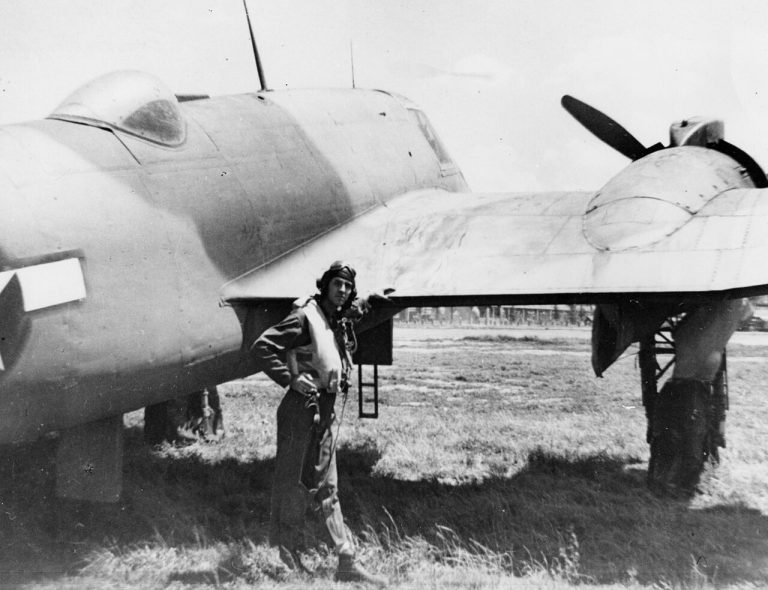
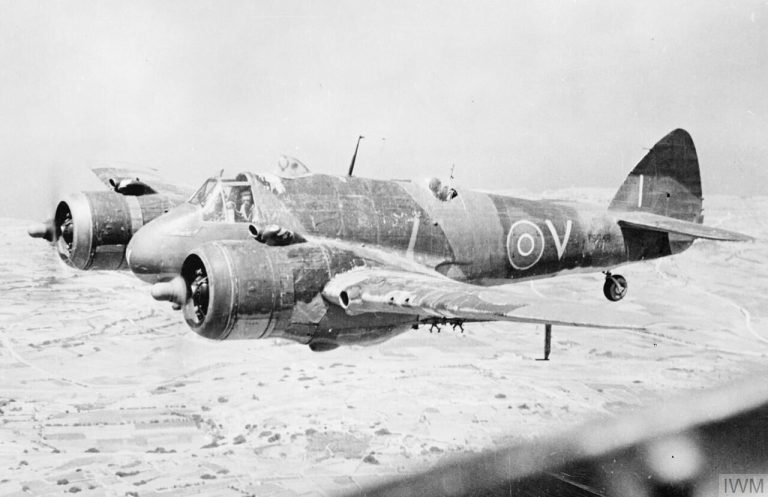
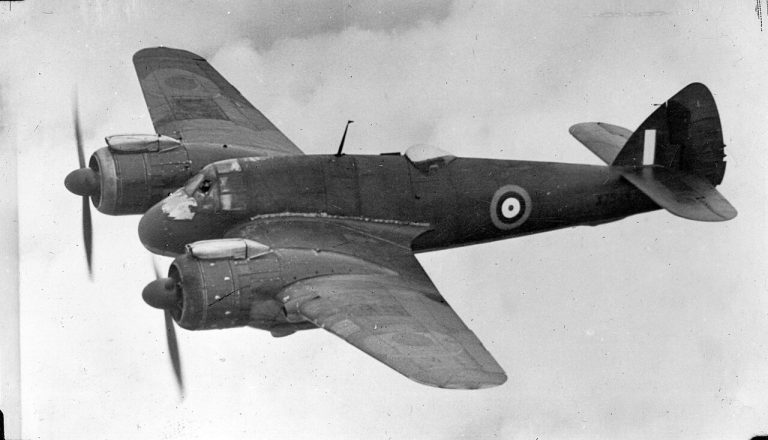
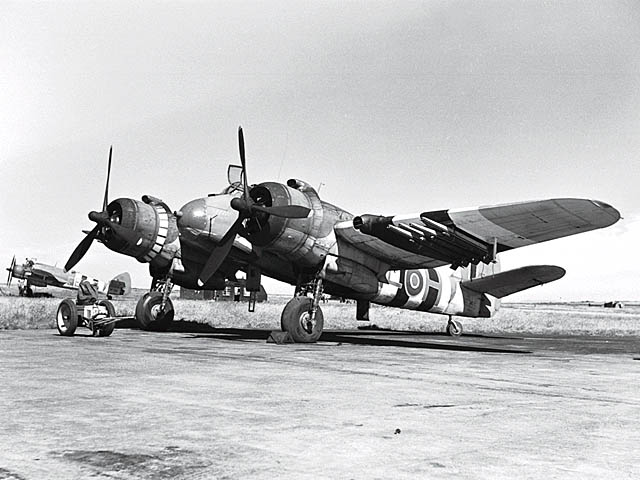
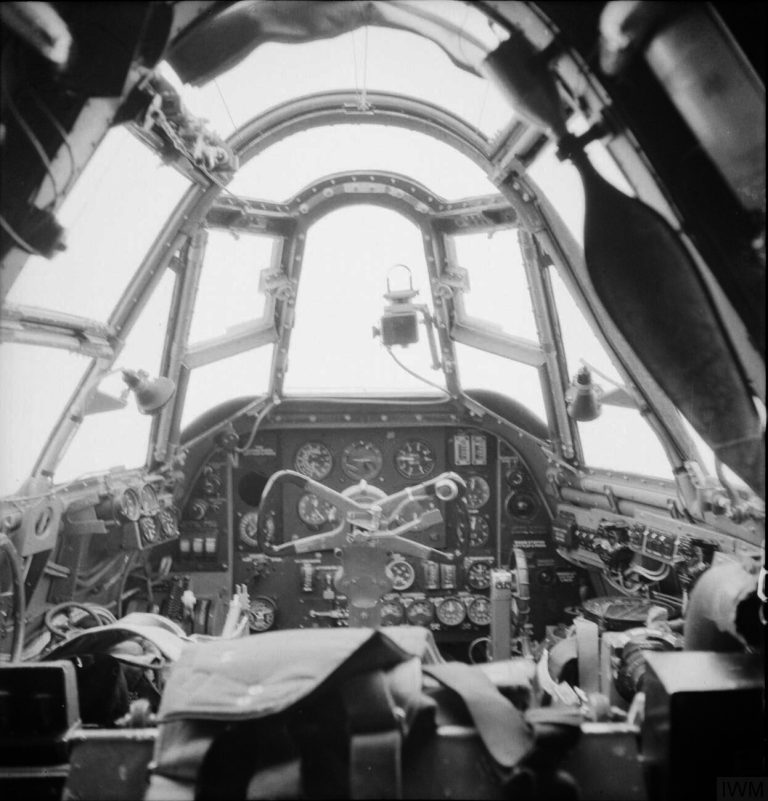
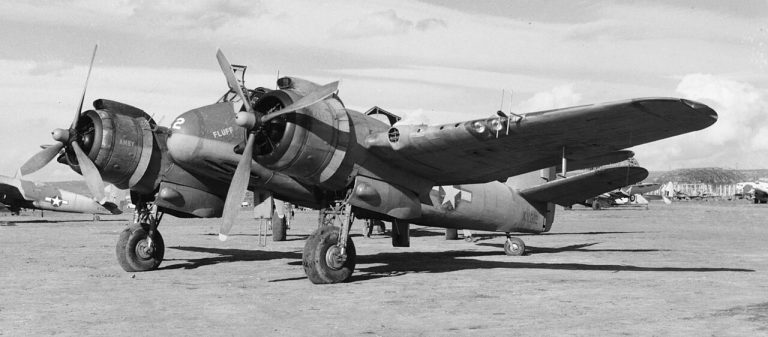
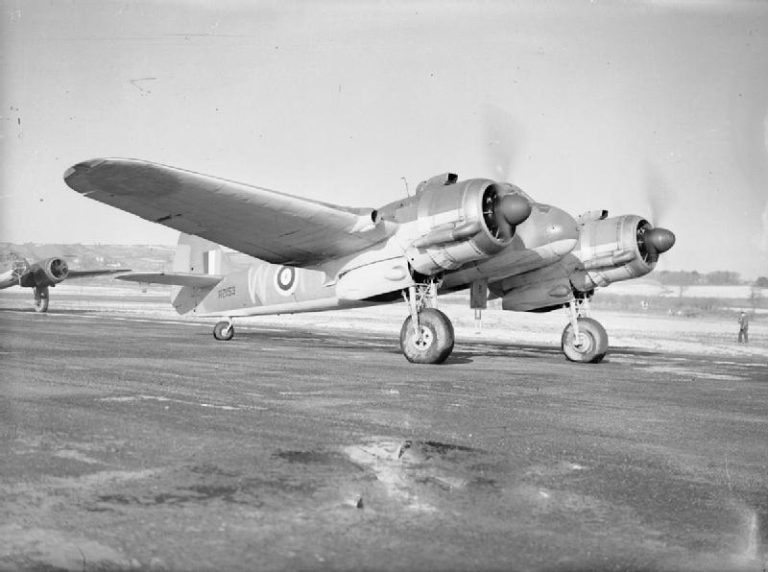
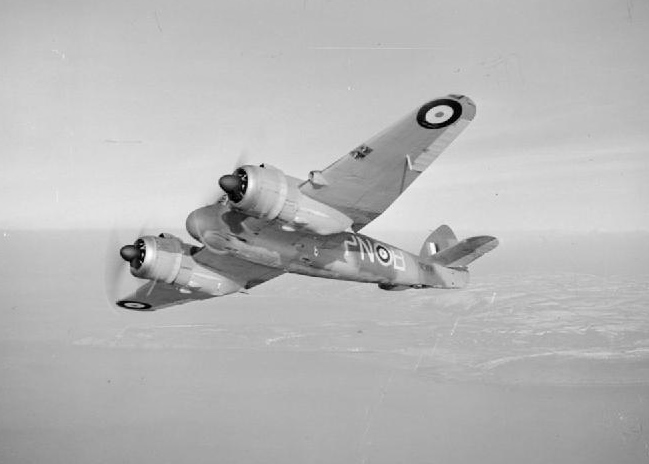
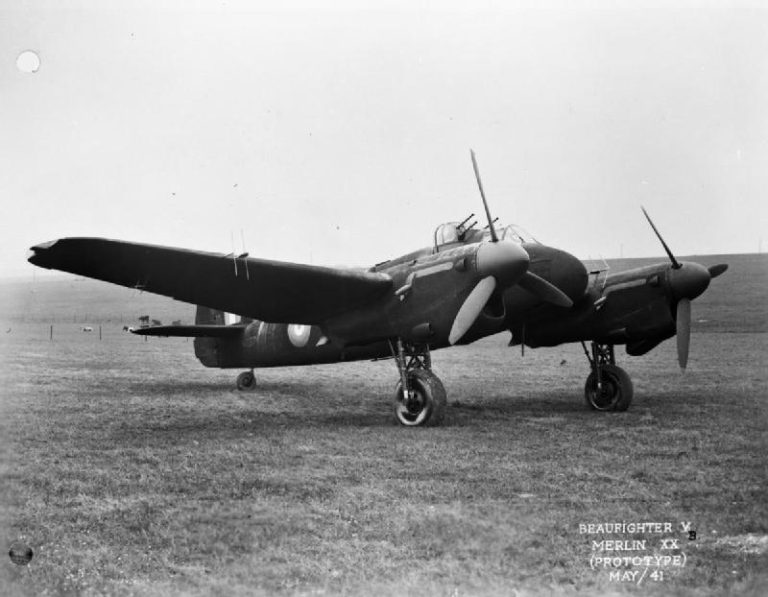
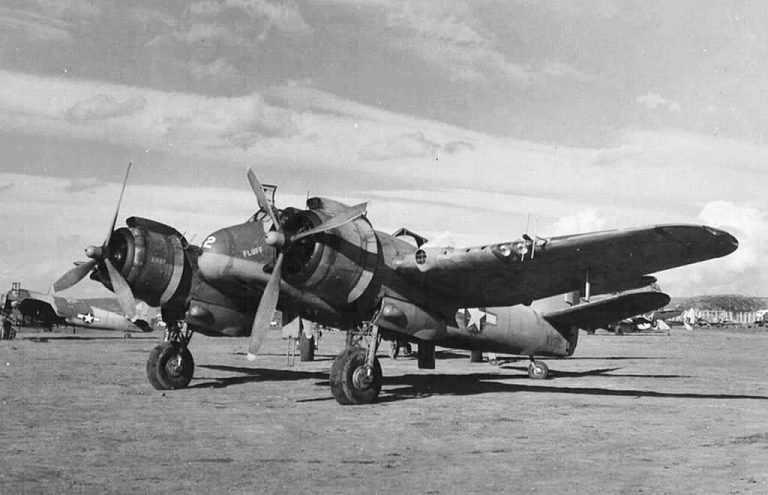
See the Beaufighter in action
Few aircraft packed so many roles into one airframe. This short history traces the Beaufighter from Beaufort-derived stopgap to radar night-fighter, anti-shipping striker and the low-level terror of the Burma jungle.
Video: “A Brief History of the ‘Whispering Death’” by Rex’s Hangar (~214,000 views). Embedded via YouTube.
Where the Beaufighter fought
Whispering Death, by the numbers
The Beaufighter fought on almost every front of the Second World War: as the RAF’s first radar night-fighter over Britain, as Coastal Command’s ship-killer over the North Sea, and as a low-level scourge in the Mediterranean, Burma and the Pacific. Its combination of heavy cannon armament and long range made it one of the most versatile combat aircraft of its generation.
Exact victory and loss tallies vary by source and theatre; the figures above reflect commonly cited totals for the type’s wartime service across RAF, RAAF and Allied units.
Bristol Beaufighter — questions & answers
Can you fly a Bristol Beaufighter today?
No — of the nearly 6,000 built, only a handful of complete airframes survive, and just one or two are under restoration toward airworthiness. There are currently no public Beaufighter flights anywhere in the world. If you want to fly a piece of aviation history yourself, MiGFlug offers cockpit experiences in warbirds and real jet fighters that you can actually strap into.
Why was the Beaufighter called “Whispering Death”?
The nickname is traditionally attributed to Japanese troops in Burma, who reportedly heard little of the aircraft’s smooth sleeve-valve engines before its cannon opened fire. Historians debate exactly how the name arose, but it stuck because it captured the aircraft’s sudden, low-level striking power.
Was the Beaufighter a good night fighter?
Yes — it was the first aircraft to carry effective airborne-intercept radar into battle, and it helped break the Luftwaffe’s night raids on Britain in 1940–41. Its heavy cannon armament meant that once radar brought a crew within range, a single burst was usually decisive.
What was a “Torbeau”?
“Torbeau” was the nickname for the torpedo-carrying strike versions of the Beaufighter flown by Coastal Command. Blending a fighter’s speed with cannon, rockets and a torpedo, the Torbeau became the RAF’s primary anti-shipping aircraft in the second half of the war.
How many Beaufighters were built, and are any left?
About 5,900 were built in Britain and Australia between 1940 and 1946. Only a small number of complete airframes survive today, preserved in museums such as the RAF Museum, the Imperial War Museum and collections in the United States and Australia, with a few restoration projects underway.
You can’t fly a Beaufighter — but you can fly a fighter jet
The Beaufighter’s war belongs to history, but the thrill of strapping into a real combat aircraft doesn’t. With MiGFlug you can fly a genuine jet fighter — from the L-39 Albatros to a MiG-29 at the edge of space — with an experienced fighter pilot at your side.
 Fly the L-39 AlbatrosThe world’s most-flown jet trainer — aerobatics included
 Fly the F-104 Starfighter“The missile with a man in it”
 Fly the MiG-21The Cold War’s most-produced jet
 Fly the T-33 Shooting StarAmerica’s first jet trainer
 Fly the DH VampireA piece of early jet history
 Fly the S.211Agile Italian jet trainer
 Fly the MB-326The classic Aermacchi jet
 Fly the MiG-15The Soviet legend of the Korean War
Related aircraft
Where these facts come from
- RAF Museum — Bristol Beaufighter TF.XSurviving airframe & type history
- Imperial War MuseumsWartime photographs & operational records
- Australian War MemorialRAAF Beaufighters & the Bismarck Sea
- RAF Museum — Beaufighter nose section (PDF)Primary structural & technical notes
Figures are drawn from museum and official records and cross-checked; where sources differ, the most commonly cited value is given. Performance and armament varied significantly between the type’s many marks.