
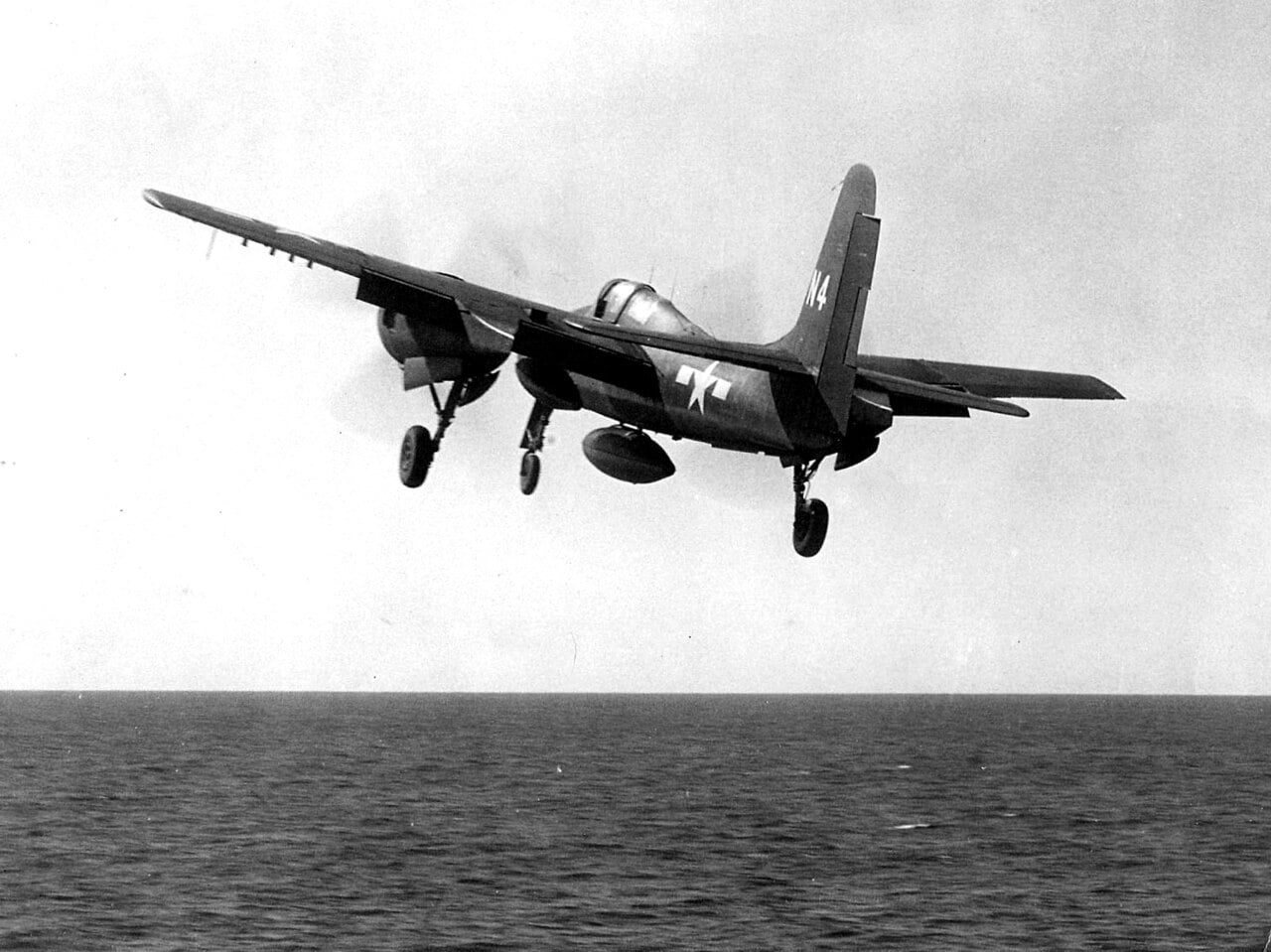
F7F Tigercat
Grumman’s twin-engine heavy fighter
One of the fastest piston fighters ever built — a twin-engine Navy fighter that arrived just too late for its war, and found its niche in the dark skies over Korea.
The F7F Tigercat: the ultimate piston naval fighter, born too late
The Grumman F7F Tigercat was meant to be the most powerful carrier fighter in the world. Ordered in 1941 for the big new Midway-class carriers, it broke Grumman’s own mould: two Pratt & Whitney R-2800 Double Wasp engines, more than 4,000 horsepower between them, four 20 mm cannon and four .50-calibre machine guns, and a top speed around 460 mph — some 70 mph faster than the Hellcat it was meant to succeed. It was fast, heavy, and beautifully built.
It was also too much aircraft, too late. The Tigercat first flew in November 1943, but shifting priorities meant it never reached squadrons in numbers before the war ended. And it struggled at the very thing it was designed for: with one engine out it handled badly on a carrier approach, and its tailhook gave trouble, so it failed carrier qualification. Only the final variant, the F7F-4N — just twelve aircraft — ever qualified for the deck. In practice the Tigercat became a land-based fighter for the U.S. Marine Corps.
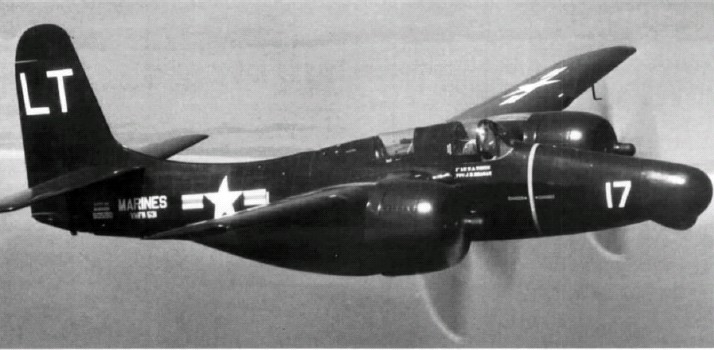
Its real war came in Korea. Marine night-fighter squadrons flew the radar-equipped F7F-3N on night-interdiction and heckler missions, hunting truck convoys and flying close support in the dark. In one of the type’s very few air-to-air engagements, a VMF(N)-513 Tigercat shot down a North Korean Po-2 biplane at night — a strange duel between a 460 mph twin-engine fighter and a wood-and-fabric trainer.
The night-fighter role suited it. With a second crewman working the radar, long endurance, heavy firepower and the reassurance of two engines over hostile ground, the F7F-3N was a capable nocturnal hunter — even if the enemy it mostly hunted was trucks rather than aircraft.
It never became famous, because it never got its moment. Overtaken by the jets almost as soon as it entered service, the Tigercat ended production at around 364 aircraft and was retired from U.S. service by 1954. Many surplus airframes then found a second life as fire-bombers, dropping retardant on wildfires into the 1980s.
Today it is a warbird favourite — a handful still fly, their twin Double Wasps making a sound enthusiasts travel to hear. The Tigercat is remembered less for what it did than for what it was: arguably the ultimate expression of the piston-engine naval fighter, perfected at the very moment the piston fighter became obsolete.
01Why the F7F Tigercat arrived too late to matter
The Tigercat is a study in unlucky timing. Conceived in 1941 as the fighter for a new generation of large carriers, it was a big, complex, twin-engine machine that took time to develop — and by the time it was ready in 1944–45, the Pacific war was won and the jet age was dawning. Its carrier-suitability problems pushed it ashore, away from the fleet role it was built for, and the Marines who flew it did so from land.
Had it appeared two years earlier, the Tigercat might have been a war-winner. Instead it became a footnote: a superb piston fighter that reached the fight just as pistons were bowing out to jets.
How the F7F Tigercat was built
Two Double Wasps
The Tigercat’s speed came from a pair of Pratt & Whitney R-2800 Double Wasp radials — over 4,000 hp together. Two engines gave it exceptional performance for a piston fighter, and a margin of safety over water and enemy territory that single-engine fighters lacked.
A very heavy punch
Four 20 mm cannon in the wing roots and four .50-calibre machine guns in the nose made the Tigercat one of the most heavily armed fighters of its era. It could also carry bombs, rockets or even a torpedo, doubling as a potent attack aircraft.
Radar and a second seat
The night-fighter variants — the -1N, -2N and -3N — added airborne-intercept radar in a lengthened nose and a second crewman to work it, turning the Tigercat into a genuine all-weather, night-capable fighter.
02The F7F Tigercat’s carrier problem: why a Navy fighter served ashore
The Tigercat was ordered for carriers, but it never really went to sea. Twin-engine aircraft are unforgiving if one engine fails at low speed on a carrier approach, and the F7F’s directional control on a single engine was marginal; its tailhook and arresting behaviour also gave trouble in trials. Early variants failed carrier qualification outright.
Only the much-modified F7F-4N — a mere twelve aircraft — was eventually cleared for carrier operations. The rest of the fleet flew from land with the U.S. Marine Corps, which is why a fighter designed for the Navy’s biggest carriers is remembered as a land-based Marine machine.
03The F7F Tigercat as a night fighter over Korea
The Tigercat found its true calling in the dark. Fitted with radar and a radar operator, the F7F-3N flew night-interdiction and close-support missions in Korea with Marine squadrons such as VMF(N)-513, prowling for truck convoys and troop movements under cover of night. Its heavy armament, long endurance and two engines made it well suited to lonely work over hostile ground.
Air-to-air work was rare — the type’s handful of night kills were against slow Po-2 biplane harassers — but as a nocturnal hunter of ground targets the Tigercat was effective, bridging the gap until jet night fighters took over.
Grumman F7F-3 Tigercat specifications
Baseline note: the figures below describe the F7F-3, the mark that dominated the programme — 250 airframes accepted in 1945–46 out of 364 Tigercats built, and the airframe from which every night fighter and photo aircraft that saw operational use was converted. Deltas for the earlier F7F-1 and F7F-2N and for the carrier-qualified F7F-4N are in grey. Two corrections before the tables. First, the Tigercat was not the first twin-engined fighter designed for United States Navy carrier operation — Grumman’s own XF5F-1 Skyrocket of 1940 was, and the F7F grew out of it by way of the land-based XP-50 and the XP-65. What the F7F was is the first twin-engined fighter the Navy actually deployed. Second, the widely repeated production split of "189 F7F-3 and 60 F7F-3N" does not reconcile with the 364 total. René Francillon’s acceptance table does: 2 XF7F-1, 34 F7F-1, 1 XF7F-2, 65 F7F-2N, 250 F7F-3 and 12 F7F-4N, which sums exactly to 364. The night fighters and photo aircraft were F7F-3 airframes diverted on the line, not separate production runs.
Dimensions & weights
- Crew
- 1 in the F7F-1 and F7F-3 day fighters; 2 in the F7F-2N, -3N and -4N night fighters, the radar operator sitting behind the pilot in the space the fuselage fuel tank had occupied. This is the row that explains the whole family: the second seat and the radar were bought with fuel, which is why the night fighters gave away range to the day fighters
- Length
- 13.83 m (45 ft 4 in) — the night-fighter noses were longer, the radome replacing the four machine guns rather than being added ahead of them
- Wingspan
- 15.70 m (51 ft 6 in), the outer panels folding upward just outboard of the nacelles. A Grumman fighter with folding wings that could not use most of the Navy’s decks is the central irony of the type
- Height
- 5.05 m (16 ft 7 in)
- Wing area
- 42.27 m² (455 sq ft)
- Aspect ratio
- 5.83 — short and broad, sized for lift at weight rather than for cruise efficiency
- Airfoil
- NACA 23015 at the root, NACA 23012 at the tip — the same family Grumman used on the Hellcat, chosen for docile stall behaviour rather than for speed
- Empty weight
- 7,380 kg (16,270 lb). Empty, a Tigercat weighed more than a fully loaded Grumman F6F-5 Hellcat
- Normal loaded weight
- 9,853 kg (21,720 lb)
- Maximum take-off weight
- 11,666 kg (25,720 lb) with external tanks or ordnance. The March 1946 Bureau of Aeronautics characteristics chart gives the F7F-2N 11,881 kg (26,193 lb)
- Wing loading
- 233 kg/m² (47.7 lb/sq ft) at normal loaded weight — high for a 1945 fighter and very high for one expected to come aboard a wooden-decked escort carrier, which is a large part of why it never did
- Power loading
- 2.35 kg/hp (5.17 lb/hp) at normal loaded weight on two 2,100 hp engines. A contemporary F8F-1 Bearcat was near 2.5 kg/hp on one. This single figure is the whole performance story
- Internal fuel
- ~1,420 l (~375 US gal, ~312 imp gal) in self-sealing wing and fuselage cells on the F7F-2N per the Navy characteristics chart; the F7F-3 carried more, and published internal totals for it disagree. Up to 2,271 l (600 US gal) could be added in three external tanks
- The shape of it
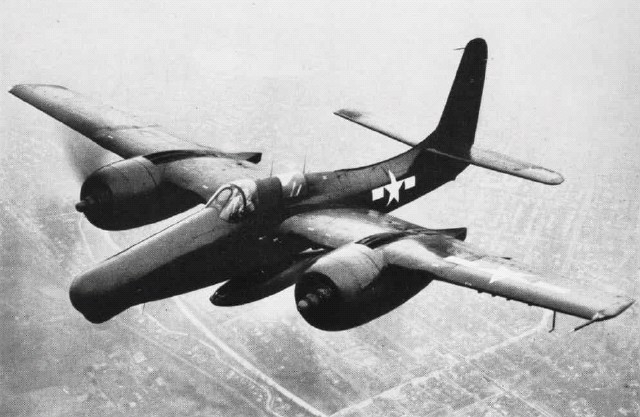
- The Tigercat is remembered as enormous, and by naval fighter standards it was — a wingspan within a foot of a Douglas A-20 medium bomber. But the fuselage itself was extraordinarily slim, barely wider than the pilot, because the engines, fuel, guns and undercarriage all lived in the wing and nacelles. Head-on it presents almost nothing. Grumman was chasing drag, and got it: the F7F is one of the cleanest large piston aeroplanes anyone built
Performance
- Maximum speed
- 700 km/h (435 mph, 378 kn) at 6,770 m (22,200 ft) — the figure the specialist literature settles on for the F7F-3
- Maximum speed at sea level
- 583 km/h (362 mph, 315 kn) at combat weight on emergency power with water injection, clean. Corwin Meyer’s figure of 71 mph faster than an F6F Hellcat at sea level is arithmetic on exactly this number, and it is the most useful single statistic about the aeroplane
- Cruising speed
- 295 km/h (183 mph, 159 kn) at the maximum-range setting from the Navy chart. That is a loiter speed, not a tactical one; a Tigercat transiting to a target area on a Korean interdiction sortie flew far faster
- Rate of climb
- 23.0 m/s (4,530 ft/min) initial at combat weight on emergency power — better than most single-engined fighters of 1945 and roughly double a P-61B Black Widow
- Time to 6,100 m
- 5.3 min (to 20,000 ft), clean, at emergency power. A P-61B took twelve minutes to the same altitude
- Service ceiling
- 12,300 m (40,400 ft); the F7F-2N chart gives 12,131 m (39,800 ft). The F7F-3 got an enlarged fin partly to keep it controllable up there
- Range
- 1,900 km (1,200 miles, 1,040 nautical miles) on internal fuel
- Ferry range
- 2,543 km (1,580 miles, 1,373 nautical miles) with one 1,136 l (300 US gal) centreline tank, per the F7F-2N chart
- Single-engine behaviour
- The defect that decided the type’s career. With one engine shut down and the other at power the Tigercat had poor directional stability, and a wave-off from a carrier approach on one engine — the exact case a naval fighter must survive — was not reliably controllable. On a runway with room ahead this was an emergency procedure. Over a deck it was a reason to reject the aeroplane, and the Navy did
- Approach and landing
- Fast, and unforgiving of a low approach. The combination of high wing loading, a long nose ahead of the pilot and a tailhook installation that gave trouble in trials meant that even after the F7F-3 was reworked to fix the F7F-1’s failings it broke a wing on a heavy landing during qualification aboard USS Shangri-La
- How it compared
- Against the other big piston twins the numbers are flattering. It was faster than a P-61B Black Widow by some 45 mph and climbed twice as well; it was in the same class as a de Havilland Mosquito NF and slightly slower than the later de Havilland Hornet, which is the aeroplane the Royal Navy chose over it. Captain Fred Trapnell, the Navy’s senior test pilot of the era, said of it simply: "It’s the best damn fighter I’ve ever flown"
- A figure to treat with care
- Jane’s Fighting Aircraft of World War II gives 460 mph (740 km/h) and it is quoted everywhere, including in many online specification tables. It is an outlier against both the Bureau of Aeronautics charts and the standard type monographs, and it is most likely a clean, lightened, best-day figure rather than a service one. The 435 mph above is the honest number
Propulsion & systems
- Engines
- Two Pratt & Whitney R-2800 Double Wasp eighteen-cylinder two-row air-cooled radials, one in each wing nacelle, driving three-blade constant-speed fully feathering propellers. R-2800-22W on the F7F-1 and F7F-2N; R-2800-34W on the F7F-3, -3N and -4N
- Ratings
- 2,100 hp each for take-off. The Navy chart for the R-2800-22W records 2,413 PS (about 2,380 hp) emergency at sea level with water injection, falling to 1,876 PS at 4,267 m, and 2,129 PS military power to 1,036 m
- Water injection
- Anti-detonant injection, the "W" in the engine designation, allowed the emergency rating to be held for a few minutes without pre-ignition. It is what makes the sea-level speed figure possible and it is the reason the aeroplane felt so fast low down, where naval fighters actually fight
- Propellers
- Three-blade constant-speed units with full feathering. Feathering mattered more here than on any other Grumman: with one propeller windmilling the directional problem became acute, so the drill was to feather at once
- Fuel system
- Self-sealing cells in the wing centre section, with a fuselage tank in the single-seat marks that the night fighters gave up to the radar operator. One centreline hardpoint took a 568 l (150 US gal) drop tank in normal use or a 1,136 l (300 US gal) tank for ferrying
- Undercarriage
- Retractable tricycle gear — single nosewheel, single main wheels folding back into the nacelles. The Tigercat was the first fighter with a nosewheel that the United States Navy put into production, and the layout is one reason it was a pleasant aeroplane to land ashore and a difficult one to land aboard: no three-point attitude, no tail-down deceleration
- Airframe
- All-metal stressed skin, mid-wing, with hydraulically folding outer wing panels and an arrester-hook installation carried from the first prototype. The F7F-3 introduced a taller fin for stability at altitude; the F7F-4N added structural reinforcement throughout
- Radar
- AN/APS-6 in the F7F-1N and F7F-2N, a lightweight airborne-interception set housed in the nose in place of the machine guns. The F7F-3N and F7F-4N carried the later AN/APS-19 in a lengthened nose — a longer-ranged, more usable set with a beacon and homing modes, and the standard American night-fighter radar of the Korean period. Some accounts credit the earliest F7F-3N deliveries with the older -6; the type literature is not unanimous
- Carrier equipment
- Arrester hook, folding wings and catapult provision were designed in from the start. Only the F7F-4N, extensively rebuilt and strengthened, actually passed qualification; it was delivered from November 1946 and declared fit for service in 1947, by which time twelve had been built and the carriers it had been drawn for were flying jets
- Protection
- Armour for the pilot and self-sealing tanks throughout — conventional 1943 American practice, and unremarkable except that the Tigercat carried it without the performance penalty that usually came with it
- Cockpit and view
- The pilot sits well forward of the wing leading edge with an exceptionally clean view for a twin, which is why the type was so well liked for photo-reconnaissance and later for fire-bombing lead work. The radar operator behind him, by contrast, sat in a compartment with almost nothing to see out of and a scope to stare at
04The F7F Tigercat’s variants: from day fighter to night hunter
Around 364 Tigercats were built across several variants: the single-seat F7F-1 day fighter (34 built); the radar-equipped F7F-2N night fighter (65); the improved single-seat F7F-3 (189); the two-seat F7F-3N night fighter (60); and the carrier-qualified F7F-4N (12). Photo-reconnaissance F7F-3Ps were also produced. It was a small production run for such a capable aircraft — a consequence of arriving as the war ended and the jets arrived.
05After service: the Tigercat as a fire-bomber and warbird
Retired from the military by 1954, many Tigercats were sold as surplus and converted into aerial fire-fighters, dropping retardant on wildfires across the American West into the 1980s. Their speed and payload made them effective tankers. A handful survive in flying condition today, prized on the warbird circuit for their looks, their rarity and the unmistakable roar of two Double Wasp engines.
Armament & payload
The Tigercat carried a heavier gun battery than any other American single-seat fighter, and unlike its only rival for that title it never lost half of it
Four 20 mm cannon in the wing roots and four .50 calibre Brownings in the nose put something on the order of 8 kg (about 18 lb) of projectiles into the air every second, all of it from one aeroplane flown by one man. That is the basis of the claim, repeated in almost every account, that the Tigercat was the most heavily armed American fighter of the war. The claim needs a qualification. Northrop’s P-61B Black Widow carried the identical nominal battery — four AN/M2 cannon and four .50s — so on paper the two are equal. The difference is that the Black Widow’s machine guns lived in a remotely controlled dorsal barbette that buffeted the tail, was deleted from most production blocks, and needed a third crewman to aim; the Tigercat’s were fixed, forward, always there, and boresighted with the cannon. Concentration is the other half of it: the cannon sat in the wing roots and the machine guns in the nose, so convergence hardly mattered and the whole battery arrived in one place at any range. Against that, the day fighter’s external load was modest for so large an aeroplane, and the night fighters gave up the machine guns entirely to make room for radar. Ammunition figures vary by source — 300 rounds per machine gun in the German and Fliegerrevue accounts, 400 in the English-language ones — and cannon marks changed during production.
Gun
- Four 20 mm cannon in the wing roots, 200 rounds per gun, 800 rounds in all. Wartime aircraft carried the AN/M2, the American Hispano; later airframes had the faster-firing AN/M3. Roughly 5.5 kg (12 lb) of shells a second from the cannon alone
- Four .50 in (12.7 mm) Browning M2 in the nose, 300 rounds per gun in the figures Grumman published (400 rounds per gun in most English-language sources), adding some 2.4 kg (5 lb) a second
- The night fighters gave up the nose battery. In the F7F-2N, -3N and -4N the four machine guns came out and the radar went in, leaving four cannon — still a heavier armament than any Allied single-seat night fighter carried, and enough that VMF(N)-513’s Korean crews complained about muzzle flash blinding them rather than about weight of fire
- Why the wing roots. Putting the cannon inboard, close to the centreline and to the aeroplane’s roll axis, gave a tight cone of fire without the convergence compromises of a wing battery, and kept the guns out of the propeller arcs without any synchronising gear at all — the advantage a twin has over a single
- A gun-camera detail worth keeping: the concentrated battery made the Tigercat a formidable strafer, and in Korea the cannon rather than the bombs did most of the damage to trucks and rolling stock at night
Air-to-air
- No guided air-to-air weapon existed in American service in this period and none was ever fitted. Every Tigercat victory was a gun kill
- The weapon was really the system: AN/APS-19 in the nose, a radar operator behind the pilot, ground-controlled interception vectoring, and four cannon that would destroy anything they touched in one pass
- Two confirmed victories, both Polikarpov Po-2 biplanes, both to VMF(N)-513 in Korea. The first is generally credited to Captain Edwin B. Long with radar operator Warrant Officer Robert C. Buckingham on the night of 30 June 1951 — the Marine Corps’ first night kill of the war. The date and crew of the second are given differently in different accounts
- The absurdity is worth stating plainly. The fastest piston-engined fighter the United States Navy ever bought, with the heaviest gun battery of any American fighter, ended its combat career shooting down fabric-covered trainers that cruised at 100 km/h. The Po-2 flew so slowly that a Tigercat could barely stay behind one without stalling, and its wood-and-fabric structure returned almost no radar echo
- Nothing else. The Tigercat met no jets, no fighters, and nothing else that shot back in the air. In the Second World War it arrived too late; in Korea the North Korean and Chinese air forces did not fly at night in any strength except in Po-2s
Air-to-surface guided
- None. No guided air-to-surface weapon was ever carried or trialled on the Tigercat
- The card is kept because the omission is the point: the type’s ground-attack war was fought entirely with unguided ordnance and the gun, at night, at low level, over Korean mountain roads
- What stood in for guidance was the radar and the second crewman. VMF(N)-513 used the AN/APS-19 to find road and rail traffic and to navigate to it in the dark, then attacked visually by the light of parachute flares
- Flare-and-attack pairs became the standard method: one aircraft laid flares, another rolled in. It was crude, dangerous in mountainous terrain, and for a long stretch of 1951 it was the only night interdiction the United Nations command had
- No torpedo guidance either — the torpedo the day fighter could carry was a straight-runner, and there is no record of one being dropped in anger from an F7F
Bombs
- Two 454 kg (1,000 lb) bombs on underwing racks, the standard heavy fit
- Up to about 908 kg (2,000 lb) of bombs, rockets or a torpedo in total — modest for an aeroplane of this size, and a reminder that the F7F was designed as a fighter with an auxiliary attack capability rather than as an attack aircraft
- One 568 l (150 US gal) tank on the centreline could be filled with napalm instead of fuel. In Korea this was the Tigercat’s most-used weapon after the cannon
- One torpedo under the fuselage on day-fighter aircraft only. It is one of very few fighters ever cleared to carry one, a legacy of the Navy wanting a single type that could do everything from the big new carriers
- Parachute flares for night interdiction, carried in place of or alongside bombs. Unglamorous, and central to what the type actually did in combat
Rockets
- Eight 127 mm (5 in) High Velocity Aircraft Rockets on underwing rails, the standard American HVAR
- Fired in salvo or ripple, these were the weapon of choice against locomotives, bridges and truck convoys. A 5 in HVAR would open a boiler or a bridge span in a way the cannon could not
- The rockets and the cannon together made the Tigercat a genuinely heavy night intruder — comparable in throw weight to a Douglas A-26 Invader on a single pass, from an aeroplane that could then leave at 400 mph
- No rocket pods and no folding-fin rockets: this was 1945 technology, rail-launched and unguided, aimed with the same fixed sight as the guns
- The night-fighter marks carried rockets as readily as the day fighters. Losing the nose machine guns cost nothing in the ground-attack role, which is why VMF(N)-513 flew the -3N on interdiction as often as on interception
Pods & other stores
- One 568 l (150 US gal) drop tank on the centreline for normal operations; one 1,136 l (300 US gal) tank for ferrying. Up to 2,271 l (600 US gal) could be carried externally in three tanks
- Camera installations in the F7F-3P photo-reconnaissance conversions — vertical and oblique fits in the rear fuselage, the aeroplane’s speed and ceiling doing the rest
- Electronic countermeasures equipment in the small number of F7F-3E conversions, an early and poorly documented Marine Corps venture into the business
- Drone-control equipment in the F7F-2D conversions, with a bubble canopy grafted over the rear cockpit so the controller could see the target aircraft
- What was never fitted: no gun pods, no external radar pods, no air-to-air missiles, no in-flight refuelling. The Tigercat’s equipment list closed in 1946 and never reopened
Three typical loadouts
- Night interdiction, Korea, 1951
- F7F-3N. Full cannon load of 800 rounds, eight 5 in HVAR under the wings, a 150 US gal napalm tank on the centreline, parachute flares. Launched from Pusan West (K-1) after dark, worked a stretch of road or rail under ground control, attacked by flare light. In March 1951 alone VMF(N)-513 flew 604 night combat sorties for 2,086 hours on this profile with a mixed force of fifteen Tigercats and fifteen Corsairs.
- Night fighter patrol and ground-controlled interception
- F7F-3N. Cannon only, centreline drop tank, no external ordnance. Vectored by a ground station onto a contact, the radar operator working the AN/APS-19 to bring the pilot into visual range astern. This is the profile that produced the type’s only two air victories, and the aircraft was wildly over-qualified for both of them.
- Photo-reconnaissance, Okinawa, July–August 1945
- F7F-3P of VMP-354. Cameras, drop tank, guns retained. Flown from Yontan Airfield over southern Kyushu to photograph the landing beaches for Operation Downfall. These were operational sorties over enemy territory, which is worth remembering whenever the type is described as having missed the war entirely.
Armament figures follow the Bureau of Aeronautics characteristics charts and René Francillon’s Grumman history where they can be checked. Ammunition capacities, cannon marks and the exact fit of the F7F-3E and F7F-3P conversions differ between sources, and the Korean sortie and loss totals quoted in the variants section below come from a single published compilation rather than an official consolidated return.
Variants
The Tigercat was designed for carriers that were not built in time, failed the ones that existed, and spent its life ashore with the Marine Corps
The Tigercat was drawn for ships that did not exist yet. The Midway class — 45,000-ton armoured-deck carriers ordered in 1942 — were the only American decks big enough and strong enough for a fighter of this weight and landing speed, and the first of them, USS Midway, was not commissioned until 10 September 1945, eight days after the Japanese surrender. The aeroplane and the ships it was sized for both arrived after the war they were meant for.
What killed it as a carrier fighter was not size alone. The F7F-1 failed carrier suitability trials on two counts: poor directional stability with one engine out, and a tailhook installation that would not behave. The F7F-3 was reworked to cure both and failed again when a wing gave way on a heavy landing during qualification aboard USS Shangri-La. Only the F7F-4N, rebuilt and strengthened throughout, passed — twelve of them, delivered from November 1946 into a Navy that was already ordering jets. Everything else went to the Marine Corps and flew from runways.
The result is a type whose variant list reads as a series of adaptations to a role it was not designed for. A day fighter with no war to fight became a night fighter, a photo aircraft, an electronic-warfare aircraft, a drone controller, and finally — and this is why any survive — a fire bomber. Grumman also proposed the name Tomcat for it, and dropped it as too suggestive; it went instead, thirty years later, to the F-14.
- XP-65 (Model G-51, 1941–43, none built)
- The Army Air Forces version of the same design, developed alongside the Navy aeroplane as a "convoy fighter" after the sole XP-50 prototype was destroyed by a turbosupercharger explosion on 14 May 1941. Army and Navy requirements diverged too far to reconcile and the Army walked away in 1943, leaving Grumman’s capacity to the Navy.
- XF7F-1 (1943–44, 2 built)
- Prototypes, ordered under a contract signed on 30 June 1941. First flight 2 November 1943 (some sources, including the German literature, give 3 November). Performance met expectations from the start; the airframe did not, and simulated carrier landings in spring 1944 forced a strengthened rear fuselage.
- F7F-1 and F7F-1N (1944, 34 built)
- Single-seat fighter-bomber with R-2800-22W engines, delivered from April 1944 to VMF-911 at Cherry Point and in small numbers to the Navy’s VF(N)-52. The F7F-1N designation covers aircraft fitted with AN/APS-6 radar and flown as single-seat night fighters. Structural failures dogged the block, and the first aircraft was lost with a Navy test pilot aboard on 1 May 1944.
- XF7F-2N and F7F-2N (1944–45, 1 + 65 built)
- Two-seat night fighter: nose machine guns removed for AN/APS-6 radar, fuselage fuel tank removed for a radar operator. The first Marine squadron aircraft reached Guam in the summer of 1945 and Okinawa within days of the Japanese surrender, too late for anything. Sources name both VMF(N)-533 and VMF(N)-531 as the squadron concerned.
- F7F-2D (conversions, late 1940s)
- Most surviving F7F-2Ns were converted to control target drones for gunnery training, gaining a bubble canopy over the rear cockpit so the controller could see out. One was used for pilot transition training with the same modification. An undignified but genuinely useful second career.
- F7F-3 (1945–46, 250 accepted)
- The definitive airframe: R-2800-34W engines, more fuel, an enlarged fin for high-altitude stability, maximum weight up to 11,666 kg. Every operational Tigercat variant that mattered was an F7F-3 airframe, either delivered as a day fighter or diverted on the line.
- F7F-3N (1945–46, 49 converted on the line, 57 more later)
- Two-seat night fighter with AN/APS-19 in a lengthened nose and no machine guns. This is the aircraft that fought in Korea with VMF(N)-513, flying night interdiction from Pusan West and Wonsan and scoring the type’s only two air victories. One published compilation credits the Tigercat with 7,119 sorties in Korea for 27 aircraft lost.
- F7F-3P and F7F-3E (58 converted on the line, at least 3 more later)
- Photo-reconnaissance and electronic-warfare conversions. VMP-354 flew F7F photo aircraft from Yontan on Okinawa in July and August 1945, photographing the invasion beaches of southern Kyushu — the only Tigercat operations of the Second World War. The -3E electronic-warfare aircraft were few and are poorly documented.
- F7F-4N (1946, 12 built)
- The only carrier-qualified Tigercat: extensively rebuilt for strength and stability, tailhook and naval equipment refitted, AN/APS-19 radar. Delivered from November 1946 and declared operational in 1947. Twelve aeroplanes, six years after the contract, for a requirement that had by then moved to jets.
- Evaluation aircraft and projects (1944–46)
- Two aircraft, serials TT346 and TT349, went to the Royal Navy in 1945 and were rejected in favour of a naval de Havilland Hornet. Grumman also projected the XTSF, a torpedo and scout development of the Tigercat with the radar operator moved and a weapons bay added; it was never built.
Survivors, precisely. There are no Tigercat reproductions and no replicas — every surviving airframe is an original Grumman machine, and almost all of them owe their existence to the fire-bombing contracts of the 1960s and 1970s. Tigercats went into Navy storage at Litchfield Park, Arizona from 1949; the great majority were scrapped, and the aircraft that were bought as surplus were converted to water bombers, with Sis-Q Flying Services of Santa Rosa, California flying an F7F-3N tanker until it was retired in the late 1980s. The Warbird Registry tracks about twenty Bureau numbers that outlived military service, many of them now projects or parts. The survivor list compiled from FAA civil aircraft registry entries and the operators’ own records names eight as airworthy: F7F-3s 80374 and 80375 with the National Museum of World War II Aviation at Colorado Springs, 80411 at the Palm Springs Air Museum, 80425 privately owned at Seattle, 80483 privately owned at Houston, 80503 with Lewis Air Legends at San Antonio, 80532 privately owned at Bentonville, Arkansas, and F7F-3P 80390, also with Lewis Air Legends. Three are on static display — F7F-3 80373 at the National Naval Aviation Museum, Pensacola, F7F-3 80410 at the Pima Air & Space Museum, Tucson, and F7F-3N 80382 at Planes of Fame, Chino — and F7F-3 80404 is in storage at Fantasy of Flight, Polk City, Florida. Airworthy status changes with maintenance and ownership and these lists go out of date quickly; treat the count of flyers as a snapshot rather than a constant.
The F7F Tigercat, from carrier hope to warbird
Ordered for the fleet
Grumman is contracted to build a twin-engine fighter for the new Midway-class carriers.
First flight
The XF7F-1 makes its maiden flight in November.
Too late for the war
Only reconnaissance Tigercats deploy (to Okinawa) before Japan surrenders; the type sees no WWII combat.
Grounded from carriers
Carrier-qualification problems push the Tigercat ashore with the U.S. Marine Corps.
Into Korea
Marine night-fighter squadrons fly the F7F-3N on night interdiction and close support.
A rare night kill
A VMF(N)-513 Tigercat downs a North Korean Po-2 biplane in the dark.
Retired
The Tigercat leaves U.S. service as jets take over.
A second career
Surplus Tigercats fight wildfires as aerial fire-bombers.
The F7F Tigercat in eight stories
A test pilot’s verdict
Grumman’s chief test pilot loved it.
The full story
The carrier fighter that couldn’t
A Navy fighter that failed carrier trials.
The full story
The Tigercat’s real war
It hunted in the dark, five years late.
The full story
A very odd duel
A modern twin-engine fighter met a wood-and-fabric trainer.
The full story
A family of fighters
Wildcat, Hellcat, Bearcat — and Tigercat.
The full story
A second life over wildfires
Surplus Tigercats fought fires for decades.
The full story
Ready just as it ended
The Tigercat reached the fleet too late to fight.
The full story
Perfected, and obsolete
It was the peak of an era that was already over.
The full story
The F7F Tigercat in photographs
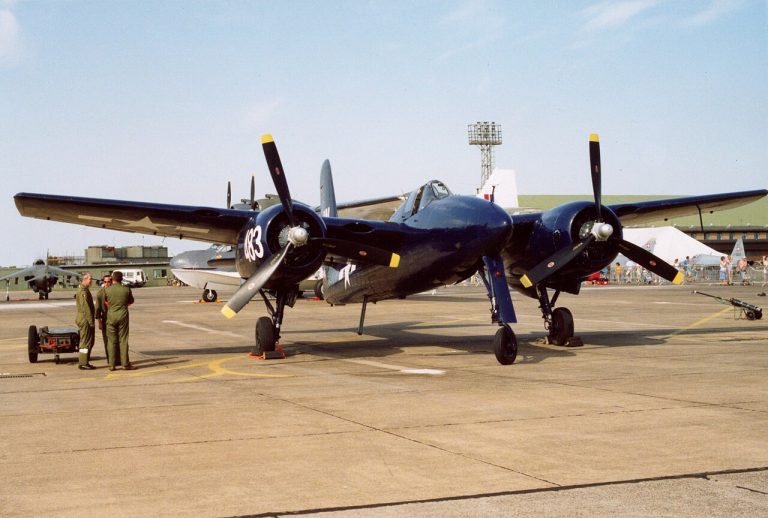
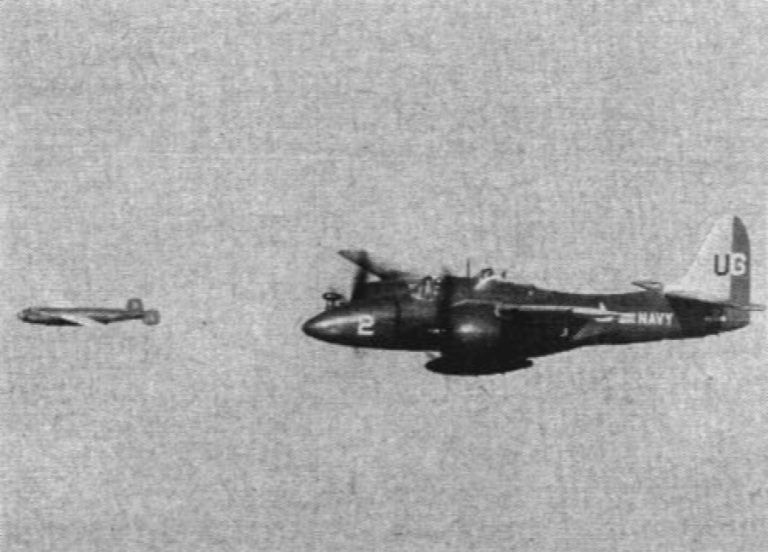
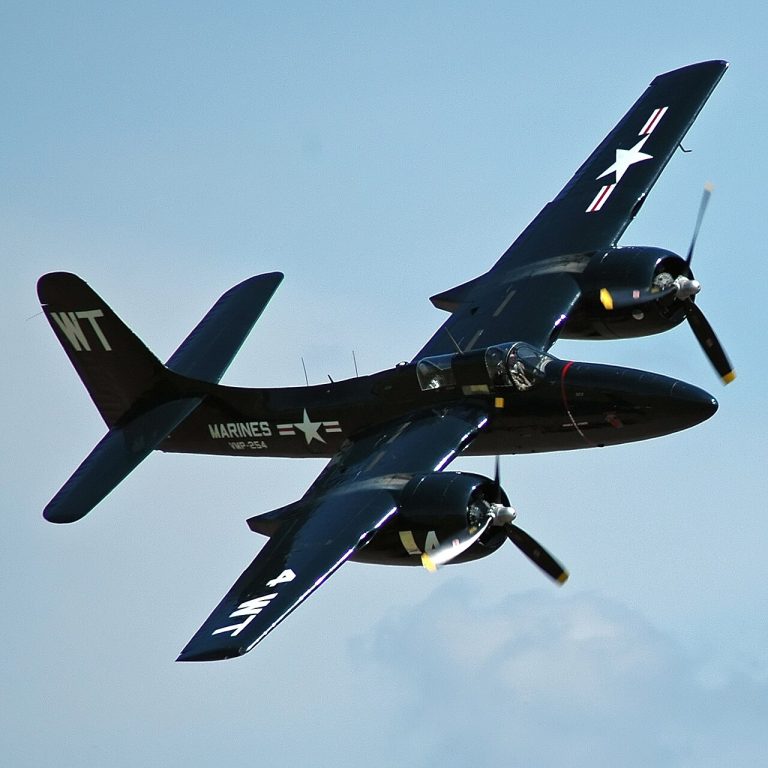
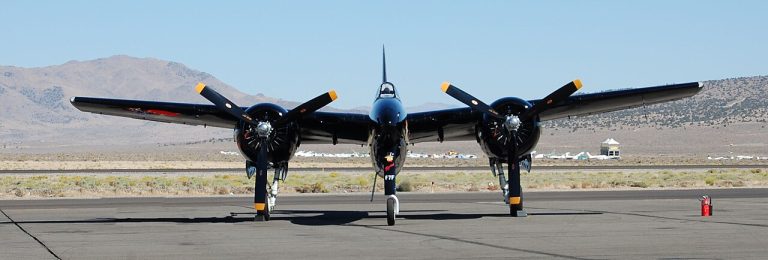
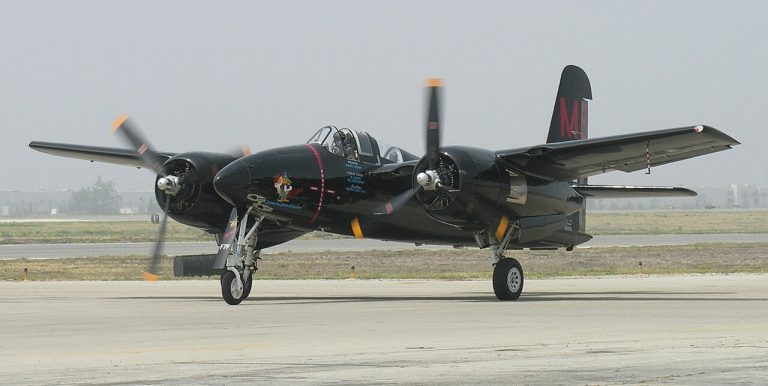
Flying the Tigercat
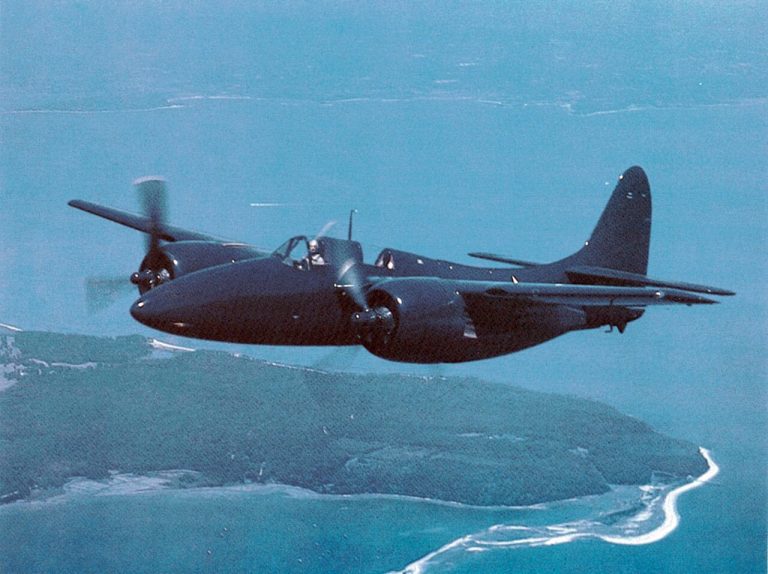
One of the surviving airworthy Tigercats in the air — the sound and shape of Grumman’s twin-engine heavyweight.
Flying the Grumman F7F Tigercat — a look at one of the surviving warbirds (WingsTV Channel).
Where the F7F Tigercat flew
A quiet war record
The Tigercat missed the Second World War entirely and saw only limited action in Korea — mostly at night, and mostly against ground targets. Its air-to-air tally is a historical footnote, but a memorable one.
Fast and heavily armed, the Tigercat simply arrived after the war it was built for; its lasting role was as a Marine night fighter over Korea. Compare the combat record of every military aircraft.
F7F Tigercat: your questions, answered
Can I fly in an F7F Tigercat?
No — the few airworthy Tigercats are privately owned warbirds, not passenger rides. But you can fly in a real military jet today: MiGFlug offers flights in genuine fighters and jet trainers such as the L-39 Albatros and the MiG-29. See migflug.com/flights-prices.
Was the F7F Tigercat a carrier aircraft?
It was designed to be, but it failed carrier qualification because of poor single-engine handling and tailhook problems. Only twelve F7F-4Ns were ever carrier-qualified; the rest served ashore with the U.S. Marine Corps.
Did the F7F Tigercat fight in World War II?
No. It reached units too late; only a reconnaissance detachment deployed before Japan surrendered, and the type saw no WWII combat.
How fast was the F7F Tigercat?
About 460 mph (740 km/h) — among the fastest piston-engine fighters ever built, roughly 70 mph faster than the F6F Hellcat it was meant to replace.
What did the F7F Tigercat do in Korea?
Marine night-fighter squadrons flew the radar-equipped F7F-3N on night interdiction and close support, hunting truck convoys and downing two Po-2 biplanes.
Why is it called the Tigercat?
Grumman named its naval fighters after cats — the Wildcat, Hellcat, Bearcat and Tigercat. The F7F was the largest and most powerful of the piston-engine cats.
Do any F7F Tigercats still fly?
Yes — several survive as airworthy warbirds and a few are on museum display. Many surplus Tigercats also served as aerial fire-bombers into the 1980s.
You can’t fly the F7F Tigercat.
These, you can.
The Tigercat’s fighting days are long over — but you can still strap into a genuine military jet. MiGFlug flies civilians in real fighters and jet trainers around the world.
 Fly the L-39 AlbatrosThe world’s most-flown jet trainer — aerobatics included
 Fly the F-104 Starfighter“The missile with a man in it”
 Fly the MiG-21The Cold War’s most-produced jet
 Fly the T-33 Shooting StarAmerica’s first jet trainer
 Fly the DH VampireA piece of early jet history
 Fly the S.211Agile Italian jet trainer
 Fly the MB-326The classic Aermacchi jet
 Fly the MiG-15The Soviet legend of the Korean War
Related aircraft
Where this chapter comes from
- National Museum of the U.S. Air ForceReference material on the Tigercat and its contemporaries.
- National Naval Aviation MuseumOn Grumman’s naval fighters and the F7F’s development and service.
- Smithsonian National Air and Space MuseumBackground on the Tigercat and late-war piston fighters.
- National Museum of the Marine CorpsOn Marine night-fighter operations in Korea, including VMF(N)-513.
- MiGFlug — AfterburnerMiGFlug’s aviation magazine, on the great piston fighters and the dawn of the jet age.
Production totals and variant figures vary slightly between sources; the commonly cited figure of roughly 364 aircraft is used here.