
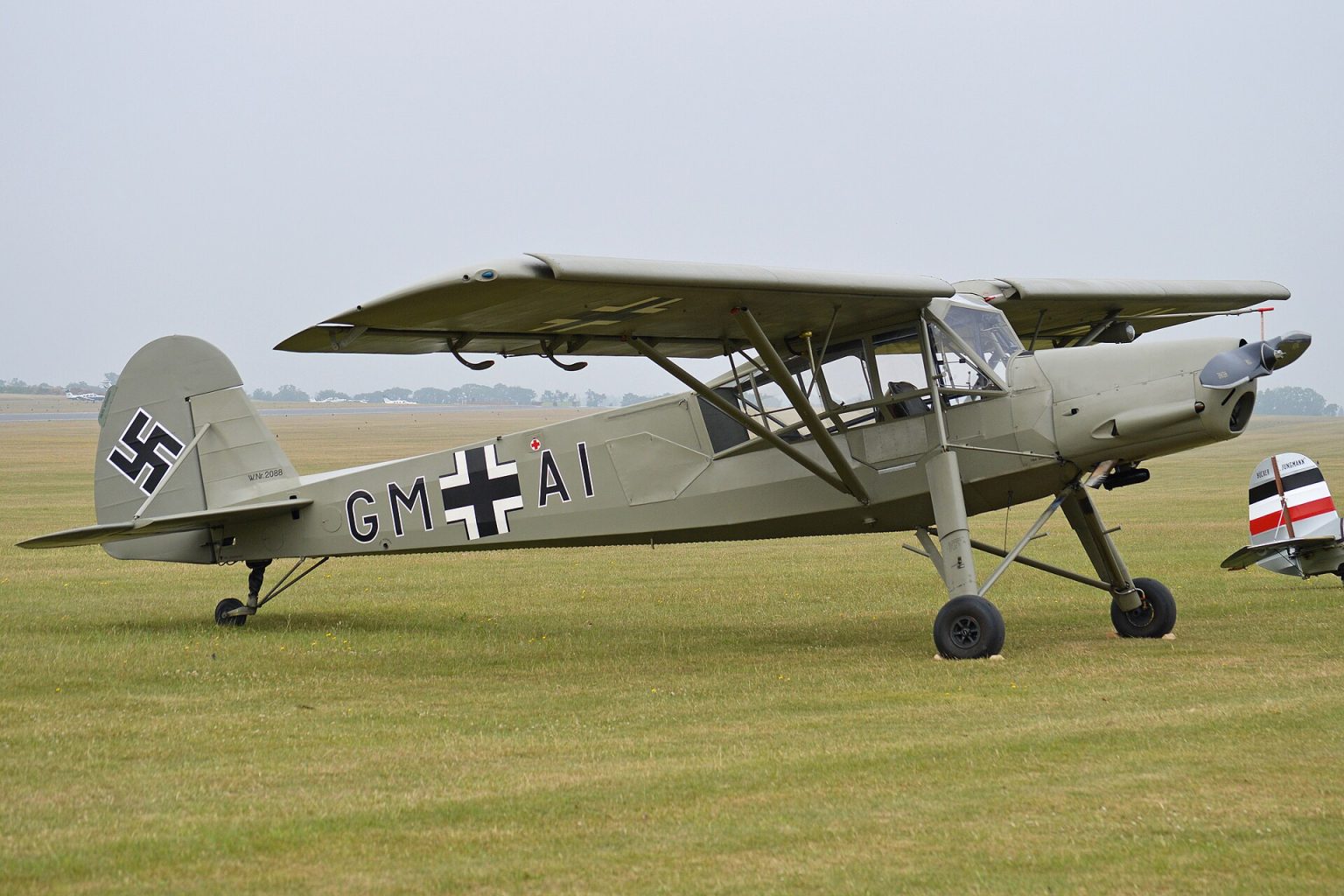
Fieseler Fi 156 Storch
The “Stork”: a German liaison aircraft so slow and short-legged it could land in a tennis court, take off in the length of a cricket pitch, and seem to hang motionless in a stiff breeze.
The Fieseler Fi 156 Storch: the aircraft that made slowness a superpower
In the summer of 1936 the German air ministry asked its aircraft firms for a Storch — not the bird, but a specification for a slow-flying army-cooperation machine that could take off and land almost anywhere. Gerhard Fieseler, an aerobatic champion turned manufacturer, and his chief designers Reinhold Mewes and Erich Bachem answered with something that looked less like a warplane than a dragonfly: a spindly, high-winged monoplane on absurdly long legs, its wing fringed along the entire leading edge with fixed slats. The result, the Fieseler Fi 156 Storch, would become one of the most quietly extraordinary aircraft of the Second World War.
The Storch never broke a speed record. Its top speed was around 175 km/h — slower than many biplanes of the previous war. What it did instead was fly slowly, and do it with a control and precision no other production aircraft of its day could match. With full-span leading-edge slats, slotted flaps and drooping ailerons that behaved like extra flaps, the whole trailing edge of the wing could be turned into lift. Into a moderate headwind the Storch could be flown so slowly that observers on the ground swore it was hovering; it could touch down in under twenty metres and be airborne again in the length of a garden.
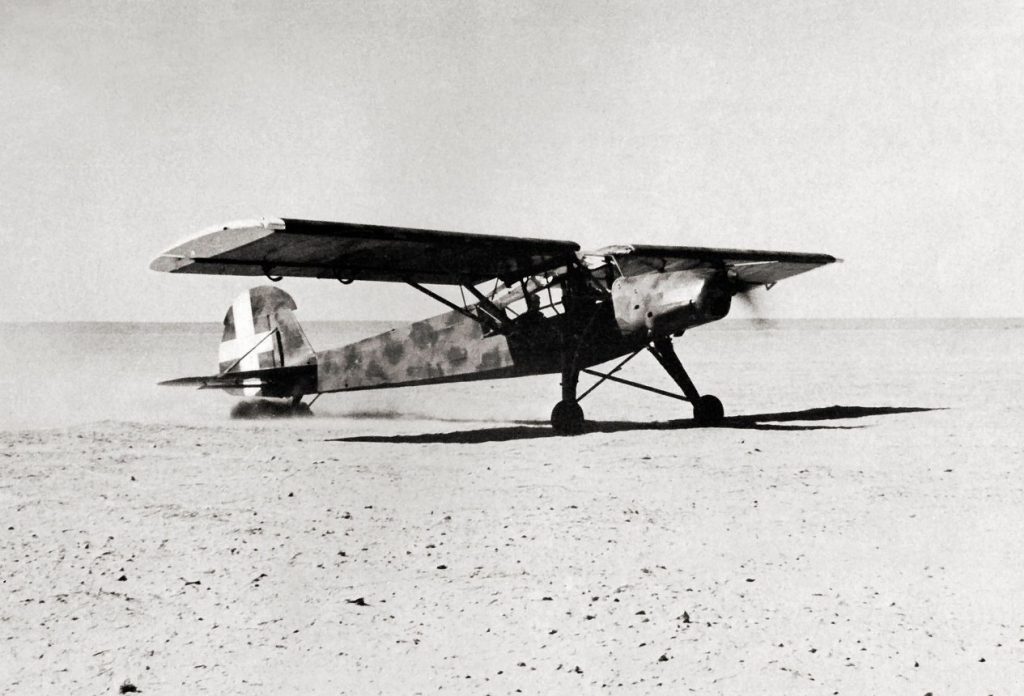
That party trick had deadly serious uses. From 1937 the Luftwaffe took the Storch to every front it fought on. It carried commanders forward to see the battle for themselves, spotted for the artillery, flew wounded men out of positions no ambulance could reach — a stretcher slid in through a hinged panel behind the cabin — and ferried staff officers and dispatches between headquarters. Field Marshal Erwin Rommel used Storchs as personal runabouts in North Africa, hopping between desert units and landing beside his forward tanks. Where there was a strip of level ground a few dozen metres long, the Storch could operate.
It is remembered, though, for a handful of exploits that read like fiction. On 12 September 1943 a Storch clattered onto the boulder-strewn plateau of the Gran Sasso, high in the Italian Apennines, to snatch the deposed dictator Benito Mussolini from the hotel where he was being held — then, dangerously overloaded, staggered off the mountainside and flew him to safety. In the last days of the Reich a Storch was reported to have been among the very last aircraft to land in the burning ruins of Berlin, flown in under fire by the test pilot Hanna Reitsch with General Robert Ritter von Greim. And when the war ended, Allied commanders queued up to fly captured Storchs of their own; Field Marshal Montgomery kept one as a personal hack.
The aircraft outlived the regime that built it. After 1945 the Storch was produced under licence in France as the Morane-Saulnier MS.500 Criquet and in Czechoslovakia as the Mráz K-65 Čáp, and it soldiered on with air forces and civilian owners into the 1960s. Because so many were built — more than 2,900 in Germany alone, plus large post-war production — a good number survive today, and a remarkable share of them still fly, gathering at airshows to hang once more, impossibly slow, in the wind.
It is worth pausing on how unusual all of this was. In the late 1930s the whole momentum of aviation ran the other way — toward more speed, more power, more altitude, retractable undercarriages and clean monoplane lines. The Storch ignored the fashion entirely. It kept its wheels hanging out on long spindly legs, wore its wing high and braced, and traded every knot of top speed for the ability to fly slowly and land anywhere. In an age obsessed with going fast, its genius was in going slow, and no aircraft of its era did that so well.
That single-mindedness is why the Storch is remembered with such affection rather than merely respect. It was not the fastest, the strongest or the most heavily armed aircraft of its war — it was none of those things — but it did one difficult thing better than anyone else, and it did it with a strange, spindly elegance that has never been forgotten. Eighty years on, an airworthy Storch settling onto a few metres of grass, or hanging motionless in a stiff breeze, is still one of the most extraordinary sights in aviation.
01How the Fieseler Fi 156 Storch got its name and its shape+
Fieseler’s designers were answering a 1935–36 requirement for a Verbindungsflugzeug — a liaison and army-cooperation aircraft — that could work from unprepared ground close to the front. The competing designs from Messerschmitt, Siebel and Focke-Wulf were conventional. Fieseler’s was not: it threw away every assumption about how fast an aeroplane needed to be and optimised ruthlessly for slow, controllable flight.
The nickname “Storch” (Stork) came from the aircraft’s appearance on the ground: a small fuselage perched high on long, splayed, shock-absorbing legs, with a big braced wing above. Once you have seen the resemblance you cannot un-see it. The name stuck so completely that the type is almost never called anything else.
02The Fieseler Fi 156 Storch and the men who designed it+
Gerhard Fieseler was a First World War fighter ace and a celebrated aerobatic pilot before he built aircraft, and his feel for slow, precise flying shaped the company’s work. The detailed engineering of the Storch is usually credited to Reinhold Mewes, with Erich Bachem — later notorious for the rocket-powered Natter interceptor — as works manager. Their insight was that high lift, not raw power, was the key: a very large wing area for the aircraft’s weight, worked hard by slats and flaps, would let a modest engine do remarkable things.
How the Fieseler Fi 156 Storch was built to land anywhere
Three ideas, worked out with unusual single-mindedness, gave the Storch its impossible short-field manners: a wing that refused to stall, a leg that could absorb a fall, and a body built to see and to carry.
A wing that would not stall
Fixed slots ran the full span of the leading edge, feeding smooth air over the wing at extreme angles of attack. Slotted flaps and drooping ailerons turned the whole trailing edge into a lift device. The Storch could be flown, under control, down to around 50 km/h.
Legs that could take a drop
The long-travel oleo undercarriage had roughly 40 cm of stroke and pivoted outward, letting the aircraft absorb a near-vertical arrival onto rough ground. On landing the legs compressed and the machine simply stopped; there was little to bounce.
A cabin built to see and to carry
The heavily glazed cabin bulged outward so crew could look down past the wing. Three could be carried — pilot and two — or a single stretcher loaded through a hinged rear panel, turning the Storch into an air ambulance.
03The Fieseler Fi 156 Storch’s wing: slats, slots and slow-flight aerodynamics+
The secret of the Storch is on the leading edge. Along the entire span run fixed slots — a narrow gap ahead of the main wing that channels high-pressure air from below up and over the top surface. At high angles of attack, where an ordinary wing’s airflow separates and it stalls, the slotted flow stays attached and the wing keeps making lift. Behind, the trailing edge carries slotted flaps inboard and ailerons that droop with the flaps, so almost the whole wing works as a high-lift surface.
The numbers that result are routinely quoted: a take-off run of roughly 45–60 metres, a landing roll near 18–20 metres, and a minimum controllable speed of about 50 km/h — figures that vary with load, wind and surface, and should be read as representative rather than exact. Into a headwind of 40 km/h the aircraft’s ground speed on landing could fall to a walking pace, which is the origin of the “it can hover” stories.
What is easy to miss is how integrated the solution was. It would have been possible to bolt slats or big flaps onto a conventional aircraft and gain some short-field ability. Fieseler instead designed the whole machine around slow flight — the enormous wing area for the weight, the light structure, the soft undercarriage and the high-lift devices all working together. The extreme performance came not from any single clever part but from the coherence of the whole, which is why the Storch remained hard to match even decades later.
04The Fieseler Fi 156 Storch’s Argus As 10 engine and how it flew+
Power came from an Argus As 10 — an air-cooled, inverted-V8 of about 240 hp (240 PS). Inverting the V put the cylinder heads low and gave the pilot a clean view forward over a slim nose, which mattered in an observation aircraft. It was not a powerful engine; the Storch’s performance came from lift, not thrust, and cruised at around 130–150 km/h with a top speed near 175 km/h.
Because it flew so slowly, the Storch handled unlike anything else. Approaches were flown steeply and slowly, almost parachuting down; in a strong wind the pilot could feel the aircraft being blown backwards over the ground. Pilots who converted to it describe an aircraft that demanded to be flown by feel and rewarded gentleness.
The Argus engine deserves a word of its own. Air-cooled and undramatic, it was reliable and simple to maintain in the field — important qualities for an aircraft expected to work from primitive strips far from any workshop. Its modest output was never a handicap because the airframe asked so little of it; the whole design was a lesson in doing more with less. A more powerful engine would have added weight and complexity to solve a problem the wing had already solved.
05The Fieseler Fi 156 Storch as an air ambulance and utility aircraft+
One of the Storch’s quiet contributions was casualty evacuation. A panel behind the cabin hinged up so that a single stretcher case could be slid in lengthwise, the patient’s feet reaching almost to the tail. From a forward dressing station a Storch could lift a badly wounded man and set him down at a field hospital within minutes, over ground that would have taken an ambulance hours or been impassable altogether. The same versatility made it a courier, a reconnaissance platform, a supply-dropper and a commander’s taxi.
This breadth of roles is the real key to the Storch’s value. It was not a specialist that did one thing; it was a genuine utility aircraft that could turn its hand to almost any light task an army required, and do so from ground that grounded everything else. A single squadron of Storchs could, in the course of a day, spot for the guns, evacuate wounded, carry a general forward and deliver a bundle of dispatches — a flexibility out of all proportion to the aircraft’s size and cost.
Fieseler Fi 156 C Storch — specifications
Figures are for the common Fi 156 C series with the Argus As 10 engine. Contemporary sources differ on details — weights, ranges and short-field distances especially — so several values below are best read as representative.
Baseline note: the figures below describe the Fi 156 C-3 and C-3/Trop of 1940–42, the mark that accounts for roughly two-thirds of all German-built Störche and the one almost every wartime photograph shows. Deltas for the A-series, the three-seat C-1 and C-7, the camera-carrying C-5, the D-1 ambulance and the French and Czech licence aircraft are given in grey. Two figures in general circulation need correcting at the outset. First, production: the commonly quoted "about 2,900 Storchs" is German output alone (2,867 is the usual total, and 2,549 also circulates), not a worldwide figure — add 925 Morane-Saulnier Criquets built in France up to 1965, 138 wartime Mráz machines in Bohemia plus postwar K-65 production to 1949, and about 80 Romanian IAR aircraft, and the family total passes 4,000. Second, the famous short-field numbers: a take-off run of 45 m and a landing run under 20 m are real, but they are measured into a headwind at light weight, not in still air at 1,325 kg. German sources give 50 m and 20 m; English-language tables give anything from 45 m to 65 m for the take-off. The spread is not sloppiness — on an aeroplane whose minimum flying speed is close to a stiff breeze, the wind is a bigger variable than the aeroplane.
Dimensions & weights
- Crew
- 2 — pilot and observer in tandem on the C-2 and C-3. The C-1 and C-7 seated three; the D-1 ambulance carried pilot, one stretcher case and an attendant; the stretched Fi 256 was drawn for five
- Length
- 9.90 m (32 ft 6 in)
- Wingspan
- 14.25 m (46 ft 9 in) — nearly a Spitfire and a half in span on an aeroplane weighing less than a loaded Bf 109 fuselage
- Height
- 3.05 m (10 ft 0 in) — tall for its size, because the undercarriage legs are half the aeroplane
- Wing area
- 26.0 m² (280 sq ft)
- Aspect ratio
- 7.8 — high, and deliberately so: induced drag dominates at the speeds this aeroplane was built to fly at
- Empty weight
- 930 kg (2,050 lb)
- Loaded weight
- 1,325 kg (2,921 lb); 1,320 and 1,325 kg both appear in the tables and the difference is equipment fit, not disagreement
- Wing loading
- 51 kg/m² (10.4 lb/sq ft) at loaded weight — the single number that explains the aeroplane. A Bf 109E sat at about 160 kg/m², a Piper Cub at about 33. The Storch is a light aeroplane wing carrying a light aeroplane, with military equipment added and nothing else
- Power loading
- 5.5 kg/hp (12.2 lb/hp) — unremarkable. The Storch was not overpowered; it was over-winged, which is a different and cheaper trick
- Undercarriage
- Fixed tailwheel type on long, outward-raked V-strut legs with combined oil and spring shock absorbers giving 40 cm (15¾ in) of travel, plus roughly 20 cm of free pre-travel before the damping bites — the legs are effectively a pair of pogo sticks, and they exist because an aeroplane that touches down at 50 km/h in a field arrives with a vertical component the wheels must absorb rather than the airframe. Skis were fitted routinely on the Eastern Front
- Wing folding
- Both wings hinge 90 degrees rearward to lie alongside the fuselage, in the manner of a Fairey Swordfish — a Storch could be towed on its own wheels behind a lorry or hidden in a barn, and Luftwaffe liaison flights routinely moved them by road when the weather closed in
- Cabin glazing
- Extensively glazed all round, with the side windows bulged outward so that both occupants could look vertically downward past the fuselage — an observation aeroplane in which the observer can actually see the ground beneath him, which sounds obvious and was rare
Performance
- Maximum speed
- 175 km/h (109 mph) at sea level — slower than a Sopwith Camel of 1917. The full-span slats stand permanently in the airflow and the undercarriage never retracts; this is the bill for the short-field figures below, and it was paid in full every hour the aeroplane flew
- Cruising speed
- 150 km/h (93 mph) normal; 130 km/h (81 mph) at economical cruise
- Minimum flying speed
- 50 km/h (31 mph) is the figure in every German source, and it is a light-weight, power-on number read off an air-speed indicator that is barely trustworthy at that end of its scale. At 1,325 kg the honest stall is nearer 60–65 km/h. Both statements are true and the second is the one a pilot flies by
- Take-off run
- 45–60 m (150–200 ft) depending on source, weight and wind; German figures give 50 m into a headwind. At Gran Sasso, heavily overloaded and downhill, it took 80 m
- Landing run
- 18–20 m (60–65 ft) — the more astonishing of the two numbers, and the one that is not a wind trick: with full flap and a steep sideslipping approach the Storch arrives so slowly and so steeply that the brakes have almost nothing left to do
- Effect of wind
- In a 40–50 km/h headwind the ground run at both ends approaches zero, and the aeroplane can be flown at a standstill relative to the ground or made to travel backwards — the party trick that made the Storch famous, performed by Hanna Reitsch inside the Deutschlandhalle in Berlin in February 1938 in front of a crowd, and repeated at air displays ever since
- Rate of climb
- 4.6 m/s (905 ft/min) at sea level
- Service ceiling
- 4,600 m (15,090 ft) — academic. The Storch worked between 50 and 500 m, where it could see, and where it could be shot at by anyone with a rifle
- Range
- 390 km (240 miles) at 150 km/h and 1,000 m on internal fuel; roughly 1,000 km with the underfuselage tank carried on the C-5. Short legs were the type’s real operational limitation and the reason it lived at the front rather than behind it
- Endurance
- About 3 hours normally, extended to some 8 hours on the C-5 with the ferry tank — an artillery-spotting sortie was typically 60 to 90 minutes, because that was as long as the observer could usefully stare at the same piece of ground
- Approach technique
- Steep, slow and slipping. With flaps down the drooping ailerons keep roll authority to well below the speed at which a conventional wing would have dropped, so the aeroplane could be flown onto a clearing over trees at an angle no other 1940 type could survive — the sideslip was standard practice, not showmanship, because there were no airbrakes and the descent path had to be steepened somehow
- Ground handling in wind
- The worst thing about it. Enormous keel area, a very light wing loading and a tall narrow undercarriage make the parked and taxiing Storch a menace above about 25 km/h of crosswind; Störche were routinely lost on the ground, tied down, in gales — the same low wing loading that lets it land in 20 m also means the wind can fly it while it is standing still
Propulsion & systems
- Engine
- 1 × Argus As 10C, air-cooled inverted V-8 — inverted so the crankcase sits on top and the cylinder banks hang down, which puts the thrust line high, keeps the propeller clear of rough ground and gives the pilot an unobstructed view forward over a narrow, pointed nose. The nose shape is the fastest way to identify a genuine German-built airframe
- Capacity and dimensions
- 12.67 litres (773 cu in); bore 120 mm × stroke 140 mm; compression ratio 5.9:1
- Rated power
- 240 PS (237 hp; 177 kW) at 2,000 rpm on the five-minute rating. English tables round this to 240 hp, which is 3 hp of free horsepower created by a units conversion
- Fuel and carburation
- 80-octane B4 petrol; two Sun carburettors; dry-sump lubrication — a low-stressed, low-octane, thoroughly unglamorous engine, which is exactly what a machine expected to operate from a meadow needed
- Engine dry weight
- 213 kg (470 lb) — nearly a quarter of the aeroplane’s empty weight
- Propeller
- Two-blade fixed-pitch wooden propeller — no constant-speed unit, no feathering, nothing to go wrong and nothing to adjust. The MS.504 and MS.505 Criquets swapped it for a metal propeller on the Jacobs radial
- Fuel capacity
- ~150 litres (33 imp gal) in a fuselage tank behind the cabin; a further ~135 litres in the underfuselage tank on the C-5
- High-lift system
- Fixed slats running the full length of each leading edge, feeding a slot that never closes; slotted flaps over the inboard half of the trailing edge; slotted ailerons with Flettner tabs over the outboard half, rigged to droop with the flaps so that the whole trailing edge changes camber together. Nothing here is retractable and nothing is clever — it is a permanently high-lift wing, and the aeroplane simply lives with the cruise drag — the first production aeroplane in which high-lift devices were the design rather than an addition to it
- Structure
- Welded steel-tube fuselage with fabric covering; two-spar wooden wings, plywood-clad forward of the rear spar and fabric behind; single lift strut each side; wooden tail surfaces — cheap, repairable in the field with glue and dope, and unhappy in tropical damp. Wing rot was a real problem for the Afrika Korps machines and for postwar survivors alike
- Radio and equipment
- A light R/T set for artillery cooperation and liaison, with the exact fit varying by role, mark and unit; a ventral station on the C-5 for a camera, a supply container or the ferry tank; a large hatch in the starboard rear fuselage on the D-1 to admit a standard stretcher — there was never any armour, any self-sealing tank or any radar
- Unit cost
- No reliable Reichsmark figure for the Fi 156 is published, and none is invented here. What can be said is that steel tube, wood, fabric and a 240 PS engine put it at the very cheap end of the Luftwaffe’s inventory — a fraction of a Bf 109 and a small fraction of a Ju 88 — which is why it was still being ordered in 1944 when far more valuable programmes were being cancelled
06The Fieseler Fi 156 Storch’s variants: from A-series to Criquet and Čáp+
The main wartime versions were the early Fi 156 A, the definitive Fi 156 C (in liaison, ambulance and reconnaissance sub-types, some with a defensive machine gun in a raised rear position) and the Fi 156 D ambulance with an enlarged loading hatch. A tropicalised desert version served in North Africa.
After 1945 the design lived on. In France, Morane-Saulnier — which had built Storchs under German occupation — continued production as the MS.500 Criquet (“Locust”), building on the order of 900–925 aircraft, some with radial engines. In Czechoslovakia the type was built as the Mráz K-65 Čáp (“Stork”). These licence-built machines account for a large share of the survivors flying today, and are often indistinguishable to a casual eye from the wartime originals.
07The Fieseler Fi 156 Storch’s operating costs: what a liaison aircraft cost to run+
No reliable wartime unit price or cost-per-flight-hour figure is recorded for the Storch, and any published number should be treated with caution. As a light, single-engined utility type it was cheap to build and run by the standards of combat aircraft — that affordability, and its ability to work from anywhere, were the whole point.
Today the meaningful cost is the warbird market. Airworthy Storch originals and MS.500 Criquets change hands for a wide range — very roughly €250,000 to well over €500,000 depending on originality, engine and history — and are expensive to maintain, insure and store. Those figures are estimates offered for context only, not a valuation.
Armament & payload
The Storch carried one rearward-firing rifle-calibre machine gun, and its real payload was a pair of eyes, a stretcher or a general
There is almost nothing to say about the Fi 156 as a weapons platform, and saying it plainly is more useful than padding out six cards with denials. From the C-2 onward the aeroplane carried a single 7.92 mm MG 15 on a pintle in a raised, fully glazed rear position, firing aft and upward over the tail. That gun existed to make the observer feel better and to force a fighter pilot to think for two seconds about his overtake. It never shot anything down in any quantity worth recording.
What the Storch actually carried was information, casualties and people. An observer with a map and a radio, directing divisional artillery onto a target he could see and the gunners could not. A wounded man on a stretcher, lifted out of a field dressing station six kilometres behind the front line and delivered to a surgeon in twenty minutes. A field marshal who needed to be somewhere that had no airfield. On the underfuselage station of the C-5 it could take a reconnaissance camera, a 135-litre ferry tank, a supply container, or a small rack of 50 kg bombs that nobody who flew the type took very seriously.
The honest verdict is that the Storch was defenceless and knew it. Its survival tactics were flying at 30 m over hedgerows where a fighter could not get a firing pass without hitting the ground, turning inside anything that attacked it — a Storch at 90 km/h has a turn radius that no 1943 fighter can match — and simply landing in the nearest field. All three worked often enough to keep the type in production until the factories were overrun. Store fits varied enormously by mark, by theatre and by unit improvisation, and armed Störche in wartime photographs frequently carry combinations that appear in no official loading table; treat any single armament list, this one included, as one configuration among many.
Gun
- 1 × 7.92 mm MG 15 machine gun on a flexible pintle in the raised rear cabin position, introduced with the Fi 156 C-2 in 1940 and standard on the C-3 and later marks
- Muzzle velocity about 765 m/s, cyclic rate roughly 1,000 rounds per minute, in the standard 7.92 × 57 mm Mauser round — a rifle-calibre weapon that was already obsolete as an air-to-air gun when the Storch entered service
- Field of fire rearward and upward through the aft glazing only. There is no forward-firing gun of any kind and there never was one on a production German Storch
- The A-series and the civil B-0 carried no armament whatever; many C-series aircraft in liaison and ambulance work flew with the mount empty to save weight, and the D-1 ambulance was unarmed by design and marked with red crosses
- The Fi 156 F and P armed-reconnaissance conversions of 1942 added further machine guns and light bomb racks. Very few were built and the idea went nowhere, because arming a 175 km/h aeroplane makes it a slightly heavier 170 km/h aeroplane
Ammunition, mounting and sights
- Fed from 75-round Doppeltrommel saddle magazines — the twin-drum type universal to the MG 15 — with spare drums stowed in the cabin; a handful of drums is the entire ammunition supply
- Ring-and-bead sighting on the flexible mount. There was no reflector sight, no gyro lead computer and no need for either, given what the gun was realistically going to be used for
- Changing a drum in flight in an aeroplane being flown at low level in a hard turn was, by every account, an unrewarding experience
- No synchronisation gear of any kind, because there is no gun anywhere near the propeller disc — the one piece of interwar gun engineering the Storch never needed
- The gun and its ammunition together were worth around 30 kg, which on an aeroplane with a 395 kg useful load is the difference between carrying a second passenger and not
Bombs and underfuselage stores
- A ventral rack, standardised on the Fi 156 C-5, took one item at a time: a 135-litre auxiliary fuel tank, a Reihenbild camera installation, or a supply container for dropping to isolated units
- Up to 3 × SC 50 bombs of 50 kg are quoted for the armed conversions. There was no bomb sight; aiming was by eye, over the side, at low level
- The Fi 156 U of 1940 was a small anti-submarine conversion carrying depth charges for coastal patrol — an idea that assumed a submarine would be found by an aeroplane with a three-hour endurance and no radar
- Supply dropping mattered far more than bombing: Störche fed cut-off pockets on the Eastern Front and delivered water, ammunition and mail to desert outposts that no other aircraft could reach
- Any bomb load is at the direct expense of range on an aeroplane that only had 390 km to begin with. In practice, German Störche flew unarmed or with the MG 15 alone
Cameras, radio and observation
- The primary sensor was the observer, sitting behind the pilot with a map board, looking down through bulged side windows that gave a genuinely vertical view — the aircraft was shaped around that sightline
- A Reihenbild series camera could be mounted on the C-5’s ventral station for vertical photography; hand-held cameras were used constantly for oblique work. The exact camera fit varied by unit and by what was available
- Radio for artillery cooperation: the Storch was the German army’s airborne observation post, ranging batteries onto targets over the ridge in the same way that Austers and Piper L-4s did for the Allies
- Signalling by dropped message container remained routine practice throughout, because radio at 30 m in mountainous country was unreliable and a weighted bag was not
- No radar, no night vision, no direction-finding gear beyond the basic set. Everything the Storch discovered, it discovered by somebody looking out of a window in daylight
Casualty and cargo payload
- Fi 156 D-0 and D-1 ambulance: a large loading hatch cut into the starboard rear fuselage to admit one standard army stretcher, with room for the pilot and a medical attendant. Around 137 were built as such, and a great many C-series machines were used for casualty evacuation with the seats out
- This was the aeroplane’s most important and least celebrated job. A Storch could land beside a regimental aid post, in the road, in a clearing, on a beach, and have a man on an operating table within the hour — helicopter casualty evacuation, ten years before the Korean War made it famous
- Two combat-equipped infantrymen could be squeezed into a C-series machine, which is what made Operation Niwi possible on 10 May 1940: about 100 Störche lifted a battalion of Infanterie-Regiment Grossdeutschland two men at a time and landed them on roads behind the Belgian frontier defences in the Ardennes
- Useful load is 395 kg all in — crew, fuel, gun, ammunition and cargo. The Storch could go anywhere, but it could not bring much with it
- Passengers of consequence were a payload in their own right: Rommel, Kesselring and Model all used Störche as personal transport, and Bernard Montgomery flew a captured one
What the Storch never carried
- No armour anywhere, for crew or engine. A single rifle bullet through the As 10 ended the sortie, and a burst of small-arms fire from a farm cart routinely ended the aeroplane
- No self-sealing fuel tanks. The fuel sat in a plain tank immediately behind the two occupants, in a fabric-covered steel-tube fuselage
- No forward-firing gun, no bomb sight, no gunsight worth the name, no ejection route beyond climbing out of the door
- No radar, no autopilot, no de-icing, no cabin heating worth mentioning, and no oxygen system — the type never worked at heights that needed one
- Consequently, no survivability against a fighter that got a clean firing pass. Störche were shot down in numbers by Soviet Yaks and by Allied fighter-bombers, and the type’s reputation for invulnerability comes from the survivors, who by definition were not the ones the Yaks found
Three typical loadouts
- Artillery observation, Eastern Front 1943
- Pilot and observer, MG 15 with four spare drums, full internal fuel, map board and radio. Take-off from a strip of pasture beside the divisional headquarters, 90 minutes at 200–400 m behind the friendly forward line, ranging a battery onto a target the gunners could not see, then home before the fighters came looking. Nothing external, because everything external costs endurance.
- Casualty evacuation, Fi 156 D-1, North Africa 1942
- Pilot, one stretcher case through the starboard hatch, medical attendant, gun removed, red crosses on wings and fuselage, minimum fuel for a 100 km round trip. Landing on the track beside the aid post, engine left running, wounded man aboard in two minutes, airborne again in 50 m. The Afrika Korps also ran two dedicated desert rescue squadrons on Störche to recover downed aircrew from open sand.
- Extraction under fire, Gran Sasso, 12 September 1943
- Pilot, one passenger and, over the pilot’s objection, a second. Minimum fuel, no gun, no equipment. Landed on the sloping meadow beside the Campo Imperatore hotel in about 30 m; took off in about 80 m at a weight the aeroplane was never cleared for, ran off the lip of the plateau and fell into the valley before it flew. Delivered to Pratica di Mare, from where a He 111 took the passenger to Vienna.
Sourcing caveat: German armament tables for the Fi 156 are thin because armament was an afterthought on this type, and unit-level modifications — extra guns, improvised racks, gun removed entirely — are recorded mostly in photographs rather than documents. The 3 × 50 kg figure and the depth-charge fit for the Fi 156 U are widely repeated in secondary works and poorly documented in primary ones; both are given here with that reservation attached.
Variants
The Storch was built in Kassel, Bohemia, Bucharest and Puteaux, and the aeroplane most people photograph at air displays today is French
The German variant sequence is simple: a handful of prototypes and pre-production machines, a civil B-0 batch, then the C-series in overwhelming numbers, a purpose-built ambulance D-series, and a scatter of experiments that went nowhere. Production began at the Gerhard-Fieseler-Werke in Kassel, moved progressively to occupied territory as the Kassel plant was bombed and turned over to Fw 190 work, and ended in 1945 with the factories in Bohemia and France under new management.
That last point is the important one for anyone standing in front of a Storch today. Morane-Saulnier at Puteaux was set to building the type for the Luftwaffe in 1942, and simply carried on after the liberation of France, first for the Armée de l’Air and the Aviation Légère de l’Armée de Terre and then for anyone who would buy one, until 1965. Mráz at Choceň did the same thing on a smaller scale in Czechoslovakia. Between them they built more Storchs after the war than Germany built C-3s during it.
Where sources disagree, they disagree badly. English-language tables credit the C-3 with 1,755 aircraft and the C-7 with 354; German sources split the C-3 into 274 standard and 1,742 tropicalised machines and give the C-7 as 130. Total German production is quoted as both 2,867 and 2,549. The figures below follow the better-documented German breakdown and flag the conflicts.
- Fi 156 V1 to V5, A-0 and A-1 (1936–38, about 31)
- Prototypes and first service machines; V1 flew on 24 May 1936 as D-IKVN. Unarmed, three-seat, and already possessing essentially the final aerodynamics: everything after this is detail.
- Fi 156 B-0 (1939, 14)
- Civil version for Deutsche Luft Hansa and private owners, with the slats faired to reduce drag and raise cruising speed. It worked, marginally, and the war ended civil production before anyone cared.
- Fi 156 C-1 (1939–40, 286)
- First mass-produced military mark; three-seat staff and liaison aircraft, unarmed. The version that carried the Grossdeutschland battalion into the Ardennes in May 1940.
- Fi 156 C-2 (1940, 239)
- Two-seat observation aircraft, and the first to introduce the raised, fully glazed rear position with the flexible MG 15. The characteristic Storch cabin profile dates from here.
- Fi 156 C-3 and C-3/Trop (1940–42, 274 plus 1,742)
- The definitive mark: one universal cabin fit that could be configured for liaison, observation or casualty work without changing the airframe. The tropicalised version, with sand filters and desert equipment, was built in far larger numbers than the standard one, which says a great deal about where the Luftwaffe expected to need it.
- Fi 156 C-5, C-5/Trop and C-7 (1941–45; C-7 quoted as 130 or 354)
- C-5 added the ventral station for a camera, a ferry tank or a supply container, giving the type a genuine reconnaissance and long-range ferry capability. C-7 reverted to a three-seat liaison layout with revised, flatter cabin glazing, and was the last German production mark.
- Fi 156 D-0 and D-1 (1941–45, 20 plus 117)
- Purpose-built air ambulance with an enlarged loading hatch in the starboard rear fuselage sized for a standard army stretcher. Small numbers, disproportionate importance: this was the role the aeroplane was best in the world at.
- Fi 156 E-0, F, P, U and the Fi 256 (1940–43, a few dozen in total)
- The dead ends. E-0 replaced the wheels with tracked undercarriage units for soft ground and swamp. F and P were armed reconnaissance conversions. U carried depth charges for coastal anti-submarine patrol. The Fi 256 was a widened five-seat development built in France; it flew and went no further.
- Morane-Saulnier MS.500 to MS.506 Criquet (France, 1942–65, 925 in total, of which 141 for the Luftwaffe)
- The licence aircraft that outlived the original. MS.500 kept the Argus As 10 while German engine stocks lasted; MS.501 substituted a 233 hp Renault 6Q inverted six; MS.502 a 230 hp Salmson 9Ab radial; MS.504 and MS.505 a 304 hp Jacobs R-755 radial, giving a visibly blunt round nose and noticeably better performance; MS.506 a Lycoming flat six. French forces flew Criquets in Indochina and Algeria between 1945 and 1958 for liaison, observation and casualty evacuation, doing exactly the work the Luftwaffe had used them for.
- Mráz K-65 Čáp, Romanian IAR machines and the Soviet OKA-38 Aist (1943–49; 138 wartime Czech plus postwar production, about 80 Romanian, a small Soviet series)
- Beneš-Mráz at Choceň built 138 for Germany and then continued for the Czechoslovak air force and civil users as the K-65 Čáp — stork in Czech — until 1949, some of which were exported. IAR in Bucharest managed 10 for Germany before the plant was bombed in May 1944, then some 70 more for Romanian use to 1946. The Soviet OKA-38 Aist was Oleg Antonov’s unlicensed copy: heavier, longer-legged, with more range and load, and needing 160 m of field against the German aircraft’s 55 m, which is a useful reminder that copying the shape was not the same as copying the aeroplane.
Survivors, precisely. Several dozen airframes of the Storch family survive worldwide, in museums and on civil registers across Europe, North America and Australia, and the type is unusually well represented for a wartime German aircraft. But the marking on the fuselage is very often not the truth about the airframe. The great majority of the machines that actually fly today are French-built Morane-Saulnier MS.500-series Criquets, with a smaller number of Czech Mráz K-65 Čáps; original German-built Fieseler or Leichtbau-Budweis airframes in genuinely airworthy condition can be counted on the fingers of two hands in any given year, and a substantial proportion of the aeroplanes displayed in Luftwaffe camouflage at air shows and in museums are postwar Criquets repainted. The quickest honest test is the nose. A narrow pointed cowling with the cylinder heads of an inverted V-8 standing proud is an Argus As 10, and therefore either a German airframe or an early Argus-engined MS.500. A round radial cowling is a Salmson 9Ab or a Jacobs R-755, which means MS.502, MS.504 or MS.505, and cannot be German-built under any circumstances. Separately, and not to be confused with either, there is a healthy population of new-build lookalikes — the three-quarter-scale Slepcev Storch, the Pazmany PL-9 Stork, the RagWing RW19 — which are homebuilt aeroplanes shaped like a Storch and are not Fi 156s in any sense. The Swiss Air Force, incidentally, flew the real thing longest in a military role, keeping Störche in mountain-rescue service until 1963; two of them lifted the twelve survivors of a crashed American C-53 off the Gauli glacier in November 1946, an operation generally regarded as the beginning of organised Swiss mountain air rescue and the best possible argument for the whole design.
What it is like to fly the Fieseler Fi 156 Storch
Pilots who fly surviving Storchs and Criquets describe an aircraft that rewrites the rulebook on speed — gentle, honest and endlessly entertaining, provided you trust its wing and respect the wind.
The first thing that strikes anyone converting to the Storch is how slow everything happens. Take-off needs almost no run: with full slat and a burst of the Argus engine the tail comes up, the wing bites, and the aircraft is flying at a speed a car would find sedate. Climb-out is unhurried; the world goes by at walking pace and every detail of the ground is visible through the great glazed cabin. It is less like conventional flying than like being suspended over a moving map.
The approach is where the Storch feels most alien and most magical. Full flap and slat let the aircraft descend steeply and slowly, almost parachuting toward the strip; the pilot’s job is to believe the wing will keep flying at speeds that feel impossibly low, and to arrive with barely any forward motion. Get it right and the aircraft simply settles and stops. Carry a few extra knots and it floats, wasting the tiny field the type exists to use. The Storch rewards pilots who trust its numbers and punishes timidity with a long float.
And then there is the wind. On a gusty day a Storch pilot can point into a strong breeze, ease the power, and watch the ground stop moving beneath them — the party trick that made the type famous. Handled with respect it is one of the most delightful aircraft in the sky; handled carelessly in a strong crosswind, its big wing and light weight demand attention on the ground. Everyone who flies one seems to come away grinning.
08The Fieseler Fi 156 Storch’s cockpit and controls+
The Storch’s cabin was designed for the job of seeing. Deep, bulged side glazing let the crew look down past and below the wing, essential for observation and for judging those precise short landings. The controls are conventional in layout but unusual in feel: at very low speeds the ailerons and rudder stay effective where other aircraft would go slack, thanks to the slotted wing keeping airflow attached. It is an aircraft flown by feel and by attitude far more than by chasing an airspeed needle.
09Storch, Criquet or Čáp: which one are you actually flying?+
Because the surviving fleet is a mix of German-built Storchs and post-war French and Czech licence machines, a flying “Storch” today may be any of the three. The differences are mostly in the engine and small details: some French MS.500 Criquets carry radial engines that change the nose profile and sound, while German originals and many Criquets keep the inverted-V Argus. To spectators they are all simply the Storch — the unmistakable long-legged, high-winged silhouette hanging in the wind.
The Fieseler Fi 156 Storch in action, front by front
Wherever the German army went, the Storch went with it. Its war was fought not in dogfights but in the daily, essential business of seeing, carrying and connecting — from the forests of Poland to the sands of Libya and the mountains of Italy.
Poland, Scandinavia and France, 1939–40
From the opening campaigns the Storch established the pattern it would follow for six years. As German columns pushed into Poland in 1939 and then through the Low Countries and France in 1940, Storchs flew ahead of and alongside them — carrying commanders to vantage points, spotting for the guns, and threading messages between fast-moving headquarters at a time when radio was unreliable. In the fluid, fast-advancing warfare of 1940 an aircraft that could land beside a general’s command post and take him to see the next objective was worth a great deal.
The Eastern Front, 1941–45
The vast, roadless spaces of the Soviet Union were made for the Storch, and the Eastern Front became its largest theatre. Distances that defeated wheeled transport were nothing to an aircraft that could hop from one improvised strip to the next. Storchs flew liaison and observation across the whole front, evacuated wounded from positions cut off by mud, snow or encirclement, and carried couriers where the telephone lines had been cut. As Soviet air power grew, the same missions became steadily more dangerous, and losses mounted — but the type remained indispensable to the end.
North Africa and the Mediterranean, 1941–43
In the desert the Storch came into its own as a command aircraft. Rommel and his subordinates used tropicalised Storchs to range across a theatre with almost unlimited landing ground and almost no airfields, exercising a personal, forward style of command that the aircraft made possible. The Storch also flew the usual observation, casualty-evacuation and courier work over Libya, Egypt and Tunisia — until Allied fighter superiority made low, slow flying over the desert increasingly costly.
Italy and the Gran Sasso, 1943
It was in Italy that the Storch flew its most famous single mission. When German forces mounted the daring raid to free Mussolini from the Campo Imperatore hotel high on the Gran Sasso in September 1943, it was a Storch — the only aircraft that could operate from the boulder-strewn plateau — that flew him off the mountain. No other aeroplane could have done it, and the exploit sealed the type’s legend.
The final days, 1945
To the very end the Storch was flying the missions that mattered most in a collapsing front: carrying commanders, dispatches and the occasional escaping passenger through skies now dominated by the enemy. The reported flights into and out of besieged Berlin in late April 1945, with Hanna Reitsch at the controls, are the dramatic coda to a career spent doing quiet, essential work — and, as ever with the last days of the war, some details are contested and are best treated as reported.
10The Fieseler Fi 156 Storch and the German way of command+
The Storch fitted, almost perfectly, the German army’s doctrine of forward, personal command. Commanders like Rommel believed in seeing the battle for themselves and making decisions at the point of action rather than from a distant headquarters. An aircraft that could carry a general to the front line, land him beside his forward units, and lift him out again gave that doctrine wings — quite literally. In a real sense the Storch was a tool of a particular philosophy of war, not just a liaison aircraft.
11The Fieseler Fi 156 Storch as a flying ambulance+
The casualty-evacuation role deserves its own note. With a stretcher loaded lengthwise through the hinged rear panel, a single Storch could reach a forward aid post, take on a seriously wounded man, and deliver him to a field hospital in minutes over terrain that was roadless, mined or under fire. For the soldier on the stretcher the difference between an hours-long jolting ambulance ride and a few minutes in a Storch could be the difference between life and death. It is one of the type’s least celebrated but most humane contributions.
The Fieseler Fi 156 Storch among its contemporaries
Every major army of the Second World War wanted an aircraft that could work from a field beside the front. Each answered differently — and the Storch answered most emphatically. Here is how it compared with the best-known Allied army-cooperation and liaison types.
| Aircraft | Origin · engine · role notes |
|---|---|
| Fieseler Fi 156 Storch | Germany · ~240 hp Argus As 10 V8 · the STOL benchmark: take-off ~45–60 m, land ~18–20 m, min speed ~50 km/h |
| Westland Lysander | UK · ~870–900 hp radial · larger and more powerful; good short-field performance, later famous for clandestine agent flights |
| Piper L-4 Grasshopper (Cub) | USA · ~65 hp flat-four · tiny, cheap and ubiquitous; excellent slow flight but far less capable than the Storch in load and range |
| Auster AOP | UK · ~130 hp · light artillery-spotting monoplane derived from the American Taylorcraft; simple and numerous |
| Polikarpov Po-2 | USSR · ~110 hp biplane · the Soviet maid-of-all-work; slow, forgiving and built in enormous numbers, used even for night harassment |
The comparison flatters the Storch in exactly the area it was designed for. The American L-4 Grasshopper was lighter, cheaper and made in vast numbers, and it too could operate from tiny strips — but it could not match the Storch’s combination of load, glazing, range and sheer short-field theatre. The British Lysander was bigger and much more powerful, and could carry more, but it was never as balletic at walking-pace speeds. The Storch’s achievement was to make genuinely useful short-field performance look almost casual, and to do it with a small engine.
What none of these aircraft could escape was the problem of the sky above them. All were slow, and slowness — the very quality that made them useful over their own lines — made them fragile wherever the enemy held the air.
12The Fieseler Fi 156 Storch versus the Westland Lysander: two STOL philosophies+
The Storch and the Lysander were built to the same broad idea — an aircraft that could cooperate with the army from rough ground — but they solved it very differently. The Lysander was a big, powerful, purpose-built machine with a ~870–900 hp radial and clever automatic slats and flaps of its own; it could lift a useful load and, later in the war, found immortality flying agents into occupied France by moonlight.
The Storch went the other way: minimum power, maximum lift, minimum weight. Where the Lysander was a muscular workhorse, the Storch was a featherweight that could be set down in a space the Lysander needed to taxi through. Both were superb; they simply optimised opposite ends of the same problem. It is fitting that the two types sit side by side in this museum.
13The Fieseler Fi 156 Storch and the birth of practical STOL flight+
The Storch did not invent the leading-edge slat — Handley Page and Lachmann had pioneered slots in the 1920s — but it demonstrated, more completely than any aircraft before it, what a whole airframe optimised for slow flight could do. The full-span fixed slot, the flap-and-drooping-aileron trailing edge and the long-travel undercarriage together defined a template that post-war STOL designers, from bush planes to military utility aircraft, would return to again and again.
In that sense the Storch is an ancestor of every modern short-field aircraft. Its influence is visible wherever an aeroplane is asked to get in and out of somewhere impossibly small.
The Fieseler Fi 156 Storch’s great weakness: it was slow
The quality that made the Storch a legend also made it desperately vulnerable. An aircraft that cruises at 130 km/h and can be seen for miles is a gift to any fighter that finds it.
For the first years of the war, when the Luftwaffe held the air over most of its battlefields, the Storch’s slowness was an asset and rarely a liability. It pottered over friendly ground, spotting and liaising, largely unmolested. But as Allied air power grew — over North Africa, over the Eastern Front, over Normandy — a lone, slow, unarmed-or-lightly-armed liaison aircraft became easy prey. A single pass from a fighter was usually enough.
Crews adapted the way slow-aircraft crews always have: flying very low, using terrain for cover, keeping close to their own lines, and choosing their moments. The Storch’s one aerial advantage was its agility at low speed — a Storch pilot who saw a fighter coming could sometimes turn so tightly and slowly, right down among the trees, that a fast attacker overshot and could not bring guns to bear. There are accounts of Storchs escaping much faster aircraft precisely by being slower. But these were exceptions; against a determined, well-positioned fighter the Storch had no answer but the ground.
None of this diminishes the type. It was never meant to fight; it was meant to see, to carry and to connect, and it did those jobs better than anything else in its class. But an honest account has to record the cost: many Storchs and their crews were lost doing quiet, essential work in skies that had turned hostile, and the aircraft’s charm should not obscure that.
14How a 50 km/h aircraft sometimes escaped fighters+
The physics that made the Storch vulnerable occasionally saved it. A fighter attacking at 400–500 km/h has a large turning radius; a Storch flying at 60–80 km/h can reverse direction almost on the spot. Down among trees, hills or buildings, a Storch pilot who timed a hard, slow turn could force an attacker to overshoot, and by the time the fighter came round again the Storch might have vanished into cover. It was never a reliable defence — but the type’s extreme low-speed agility gave it a slim, real chance that faster liaison aircraft lacked.
15The Fieseler Fi 156 Storch as a captured trophy and post-war survivor+
The Storch’s usefulness did not respect uniforms. Allied units that captured intact examples often kept and flew them, and senior officers adopted them as personal transport — Montgomery’s is the famous case. After 1945 that same usefulness, plus the aircraft’s simplicity and the survival of the French and Czech production lines, meant Storchs and their licence-built cousins stayed in service and in private hands for decades.
That is why the type is so well represented among the world’s flying warbirds today: it was built in quantity, it kept being built after the war, it was cheap and forgiving, and everyone who flew one seems to have wanted to keep it.
The Fieseler Fi 156 Storch’s legacy and lasting influence
The Storch outlived its war, its regime and its rivals. Its ideas echo through every bush plane and military utility aircraft that followed, and its survivors still draw crowds today.
The most direct legacy was physical: the aircraft kept being built. French and Czech licence production put hundreds more Storchs into the world after 1945, and those machines — MS.500 Criquets and K-65 Čáps — carried the design into the 1950s and 1960s with military and civilian operators across Europe and beyond. For years after the war, a Storch was simply a useful light aircraft, not a relic.
The deeper legacy was conceptual. The Storch proved, more thoroughly than anything before it, that an airframe optimised end to end for slow flight — full-span slats, a high-lift trailing edge, a soft long-travel undercarriage, minimum weight — could achieve short-field performance that looked like magic. Post-war designers of bush planes, observation aircraft and military utility STOL types returned to that template again and again. When a modern light aircraft plants itself onto a gravel bar or a mountain strip in a few dozen metres, it is working in a tradition the Storch did more than anyone to establish.
And then there is the simple matter of affection. Few aircraft are as instantly recognisable or as universally liked. The Storch’s ungainly elegance, its gentle manners and its genuine ability to defy the wind make it a perennial favourite among pilots, restorers and airshow crowds. It is one of those rare machines whose reputation, decades on, rests not on how fast or how deadly it was, but on how astonishing it remains to watch.
16The Fieseler Fi 156 Storch’s influence on post-war STOL and bush aircraft+
The lineage is not always a matter of direct copying, but of proof of concept. The Storch demonstrated that high lift beat high power for short-field work, and that a whole airframe — not just a flap here or a slot there — could be tuned for slow flight. Later STOL designs, from military utility aircraft to the specialised bush planes that operate in Alaska, Africa and the Alps, pursue the same goals with the same basic toolkit of slats, big flaps and forgiving undercarriage. The Storch is the great early exemplar of the breed.
17Why the Fieseler Fi 156 Storch endures as a warbird+
Four things keep the Storch flying: it was built in large numbers, it kept being built after the war, it is cheap and forgiving compared with a fighter, and it has enormous character. The result is one of the best-represented warbirds in the airworthy fleet, with originals and Criquets appearing at airshows across Europe and North America. For a crowd, the appeal is obvious — an aeroplane that can take off in a few metres and hang in the wind is far more astonishing to watch than something that merely goes fast.
The Fieseler Fi 156 Storch: a service history
The Fieseler Fi 156 Storch in sixteen stories
Rescues, escapes, desert taxis and captured trophies — the Storch collected more good stories than aircraft ten times its size. Here are sixteen, told as honestly as the record allows.
The Gran Sasso rescue, 1943
On 12 September 1943 a Storch landed on a mountaintop to fly Mussolini out of captivity.
Read the full story
What actually happened is more remarkable than the legend. German commandos led by Otto Skorzeny landed by glider beside the Campo Imperatore hotel high on the Gran Sasso, where the deposed Mussolini was held. A Storch was flown in to extract him; according to the widely repeated account, the pilot Heinrich Gerlach took off dangerously overloaded, dropping off the edge of the plateau to gain flying speed before climbing away and delivering Mussolini to Rome. Only an aircraft that could operate from a boulder-field made the escape possible.
The raid, codenamed Operation Oak, is the single event that fixed the Storch in popular memory. Strip away the propaganda that surrounded it at the time and the aeronautical fact remains striking: no other aircraft in the world could have landed and taken off again from that plateau with a passenger aboard. It was the ultimate demonstration of the quality the whole design existed to provide. We attribute the finer details — who flew, exactly how heavy — as reported, since accounts vary.
Rommel’s desert runabout
The Desert Fox used Storchs to command from the front, landing beside his forward tanks.
Read the full story
Erwin Rommel understood that a general who could see the battle could shape it. In North Africa he used the Storch to fly along his own front line, dropping in on units, reading the ground and reappearing where he was least expected. The aircraft’s ability to put down on any flat stretch of desert let him command with a mobility his opponents struggled to match — until Allied fighters made low, slow flying over the desert increasingly lethal.
Other senior commanders used Storchs the same way, but Rommel’s name is the one bound most tightly to the type. The image of the Desert Fox stepping out of a Storch beside his forward tanks captures a whole philosophy of command — forward, personal, mobile — that the little Fieseler was uniquely able to serve. When the desert air turned hostile, that same low, slow flying became a mortal risk, and the aircraft’s golden period in North Africa closed.
The last aircraft into Berlin
In April 1945 a Storch was reported to have landed in the burning capital under fire.
Read the full story
As Soviet forces closed on Berlin, the test pilot Hanna Reitsch flew General Robert Ritter von Greim into the city — landing, by widely repeated accounts, on an improvised strip near the Brandenburg Gate — and out again days later. The flights are often described as among the last aircraft movements into and out of the besieged capital. Details vary between sources and some are contested; we relay them as reported rather than as settled fact.
Whatever the precise truth, the episode is a fitting bookend. An aircraft that had spent the war landing where nothing else could was, at the very end, the machine chosen to reach a capital that had become almost unreachable. The Storch’s war began with generals flying to see victories and ended with a desperate flight into a burning city — the same rare ability serving very different masters of the moment.
Montgomery’s captured Storch
Allied commanders prized captured Storchs; Montgomery flew one of his own.
Read the full story
The Storch was so useful that senior Allied officers adopted captured examples as personal aircraft. Field Marshal Bernard Montgomery is the best-known example, using a captured Storch as a personal hack. It was a backhanded tribute: the enemy’s liaison aircraft was simply better at the job than anything the Allies fielded in the same class, and everyone who flew one knew it.
Captured Storchs were also flown by Allied test establishments, which were keen to understand how the type achieved its remarkable short-field numbers. The verdict was consistent admiration. There is no higher compliment in wartime than an enemy who wants to keep your equipment for himself — and the Storch collected that compliment repeatedly.
A stretcher through the tail
The Storch’s hidden talent was carrying a wounded man out of places no ambulance could reach.
Read the full story
Behind the cabin a panel hinged up to admit a single stretcher, loaded lengthwise so the casualty lay along the fuselage. From a forward aid post the Storch could lift a seriously wounded soldier and land him at a field hospital within minutes. For men hurt in country that was roadless, mined or under fire, the little aircraft was sometimes the difference between living and dying.
It is one of the type’s least celebrated roles, precisely because it was so undramatic: no dogfights, no headlines, just a small aeroplane quietly ferrying broken men to help over ground that nothing else could cross. But for the soldiers it carried, the Storch’s short-field ability was not a party trick — it was survival.
Flying backwards over the ground
In a strong enough headwind, a Storch could make negative progress across the earth below.
Read the full story
Because the aircraft could fly under control at around 50 km/h, a headwind of similar strength cancelled its forward motion. Pilots and spectators reported Storchs appearing to stand still in the air, or even drift backwards relative to the ground. It is the single image that best captures why the type became a legend — and it is aerodynamically real, not a tall tale, given a strong enough wind.
Modern airshow pilots still perform the trick deliberately: point the Storch into a fresh breeze, ease back the power, and let the crowd watch an aeroplane hover without a rotor. It never fails to draw a gasp, and it is the purest demonstration of what Fieseler’s designers set out to achieve — an aircraft that made slowness into a spectacle.
The wing that would not quit
Full-span slats meant the Storch simply refused to stall in the ordinary way.
Read the full story
Test and service pilots found that the Storch could be held at extreme nose-up attitudes and low speeds where a conventional aircraft would drop a wing and spin. The fixed slots kept the airflow attached; the aircraft would mush and sink rather than break away sharply. That forgiving behaviour, as much as the raw distances, is what let ordinary squadron pilots operate it from tiny, awful strips.
Forgiveness matters enormously in an aircraft meant to be flown hard from rough ground by pilots under pressure. A machine that stalled viciously would have killed its crews on the very approaches it was designed to make. The Storch instead simply sank when pushed too far, giving the pilot time and warning — a safety margin built into the aerodynamics rather than bolted on afterwards.
Every front, every job
From the Arctic to the desert, the Storch did the unglamorous work that kept armies moving.
Read the full story
The Storch spotted for artillery, carried dispatches, dropped supplies, flew reconnaissance and shuttled officers on every front the Wehrmacht fought on. It was rarely the star of any operation and almost never appeared in the propaganda reels, yet it was everywhere, doing the connective work that let larger, faster aircraft and the armies below them function.
That ubiquity is easy to overlook. Histories remember the fighters and the bombers, but armies run on liaison, observation and evacuation — the unglamorous tasks the Storch performed day in, day out, from the Arctic to the desert. If you wanted to understand how a mechanised army actually functioned in the field, the little Fieseler buzzing overhead told you more than any fighter.
The French afterlife: the Criquet
Morane-Saulnier had built Storchs under occupation; after 1945 it kept building them.
Read the full story
When France was liberated, the Morane-Saulnier factory that had produced Storchs for Germany simply continued, turning out the aircraft as the MS.500 Criquet. Hundreds were built, some re-engined with radial engines that changed the nose profile. Criquets served the French forces — including in colonial campaigns in North Africa and Indochina — and many later passed into civilian hands, which is why so many “Storchs” flying today are in fact French-built.
It is a neat irony: an aircraft designed as an instrument of the German army spent its longest and most productive years in French service and French skies, and it is French production — on the order of 900 or more aircraft — that did as much as anything to guarantee the type’s survival into the preservation era. The Criquet is not a copy of the Storch; it is the Storch, built by the same tooling for a new flag.
The Czech Stork: the K-65 Čáp
Czechoslovakia built its own post-war Storch and named it, again, after the bird.
Read the full story
In post-war Czechoslovakia the Mráz company produced the type as the K-65 Čáp — “Stork” in Czech, the same name the Germans had chosen. Like the French Criquet, the Čáp kept the Storch design alive for military liaison and civil flying into the 1950s, and a handful survive.
That two separate countries independently chose to keep building the Storch after the war, and that both reached for the same avian name, says a great deal about the design. It was simply too good, and too useful, to abandon just because the state that commissioned it had ceased to exist. The stork flew on under new flags and in new languages.
Neutral Storchs
Switzerland and other neutrals bought Storchs and kept them long after the war.
Read the full story
Neutral Switzerland acquired Storchs before the war and operated them for decades, valuing exactly the mountain-strip performance the type was designed around. Other operators across Europe used the aircraft into the 1950s and 1960s, so that for years after 1945 the Storch remained a common sight far from any battlefield.
For an Alpine nation, an aircraft that could get in and out of tiny mountain strips was an obvious asset, and Switzerland kept faith with the type long after the war that made it famous had ended. It is a reminder that beneath the dramatic exploits the Storch was, at bottom, simply a superb utility aircraft — useful to anyone with rough ground and a need to fly over it.
Why it still flies
A cheap, forgiving, characterful aircraft made in large numbers tends to survive — and the Storch did.
Read the full story
Large production, simple construction, low speeds and enormous character are the ingredients of a lasting warbird, and the Storch has all four. Restorers and collectors treasure it; it is gentle to fly, unmistakable to look at, and endlessly popular at airshows, where crowds still gasp at an aeroplane that seems to defy the wind. Originals and Criquets both keep the Stork in the sky.
Spotting for the guns
The Storch’s steadiest, least glamorous job was hanging over the battlefield, directing artillery fire.
Read the full story
Artillery observation was one of the Storch’s core roles and one it did superbly. Loitering slowly at low level with a superb downward view through its bulged cabin glazing, an observer could see the fall of shot, correct the gunners by radio, and keep a battery on target in a way no ground observer could. It was patient, dangerous, vital work — the aircraft’s slow flight let the observer study the ground, and its short-field ability let it operate from just behind the guns it served.
An aircraft that can loiter slowly and see clearly is worth many guns, because it lets the ones you have hit what matters. The Storch turned artillery from a blind, map-based art into something closer to precision, at least where it could fly unmolested. That it could also work from a strip a few dozen metres long, right behind the battery, meant the observer and the guns were never far apart.
The desert taxi and the tropical Storch
In North Africa the Storch wore sand filters and shade, and became the commander’s magic carpet.
Read the full story
The tropicalised Storch, fitted with dust filters and other desert modifications, was ideally suited to a theatre with endless flat ground and few real airfields. Commanders used it to cover distances that would have taken hours by vehicle over broken tracks, dropping in on units and returning before their absence was noticed. The image of a Storch settling onto the desert beside a cluster of tanks, its long legs soaking up the rough ground, is one of the defining pictures of the Afrika Korps.
The desert was, in a sense, the Storch’s ideal element — flat, open and airfield-poor, exactly the environment its designers had imagined. For as long as the Axis held air superiority over North Africa, the type ranged almost at will. When that superiority evaporated, the same open skies that had been its playground became a killing ground, and the desert Storch’s heyday ended as abruptly as it had begun.
Learning to land on nothing
Converting to the Storch meant unlearning almost everything about how fast an approach should be.
Read the full story
Pilots coming to the Storch from conventional aircraft had to retrain their instincts. Approaches were flown absurdly slowly and steeply, the aircraft almost descending vertically under full flap and slat; the trick was to trust the wing not to stall and to arrive with almost no forward speed. Done right, the Storch simply stopped where it touched. Done timidly — carrying too much speed — it floated and wasted the tiny strip. The aircraft rewarded pilots who believed its own numbers.
Warbird pilots who fly Storchs and Criquets today describe exactly the same lesson. The aeroplane will do everything the legends claim — but only if you commit to its impossibly slow speeds and let the wing do its work. Fly it like a normal light aircraft and you throw away its whole reason for existing. Fly it like a Storch and it becomes one of the most satisfying machines in the sky.
A bird by any name: Storch, Criquet, Čáp
Germany called it the Stork; France the Locust; Czechoslovakia, again, the Stork.
Read the full story
The names the aircraft collected trace its afterlife. In Germany it was the Storch — Stork — for its long-legged stance. In post-war France, Morane-Saulnier built it as the MS.500 Criquet, the Locust. In Czechoslovakia, Mráz produced it as the K-65 Čáp, which is simply the Czech word for stork. Three countries, three names, one unmistakable aeroplane — and the reason a “Storch” you see flying today might have been built in Kassel, in France, or in Czechoslovakia.
For the enthusiast, telling them apart is part of the fun: a radial nose usually means a French Criquet, an inverted-V a German original or an Argus-engined Criquet, and subtle detail differences betray the Čáp. For everyone else, they are simply the Storch — the long-legged bird that hangs in the wind, whatever the badge on the fin or the language of the handbook.
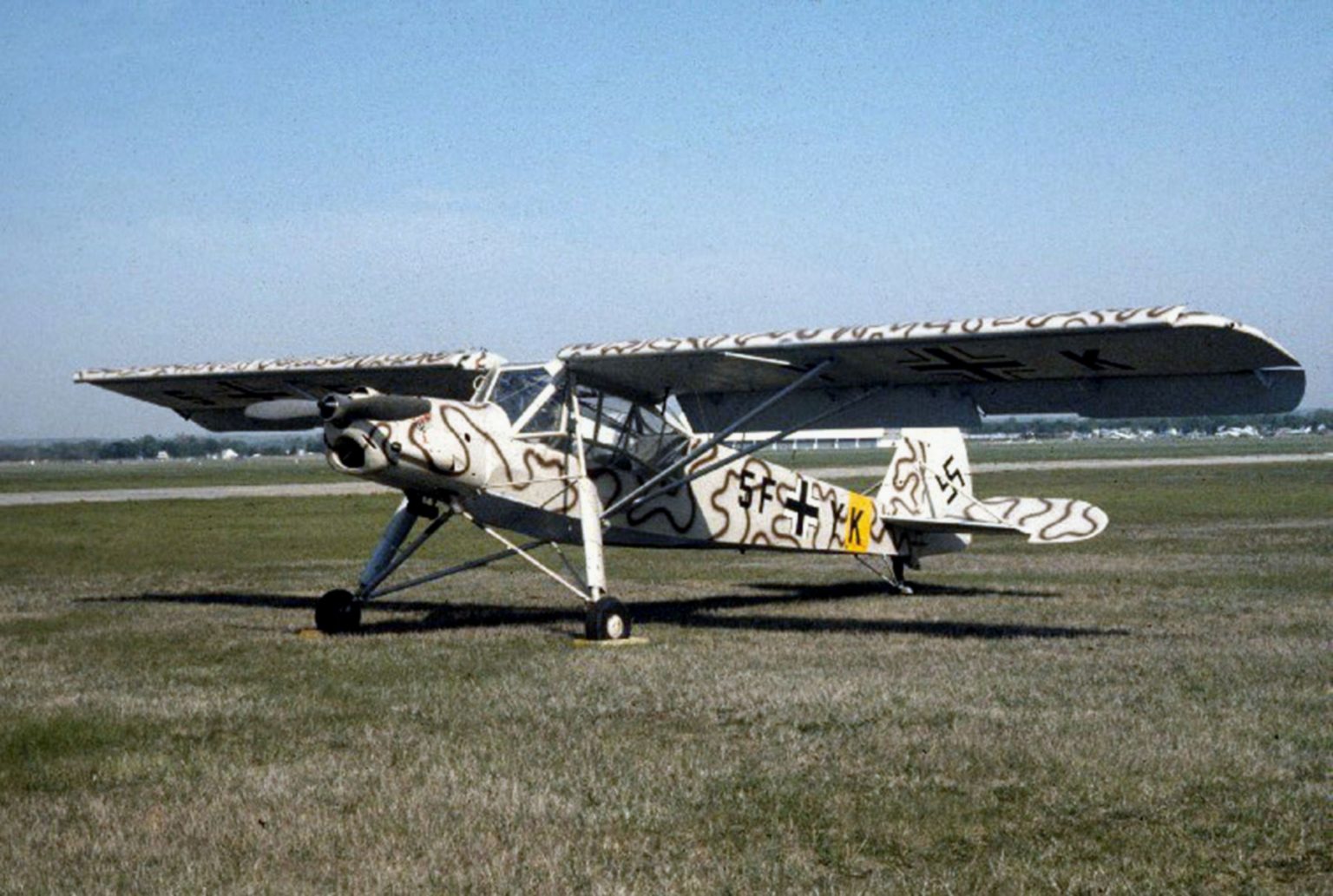
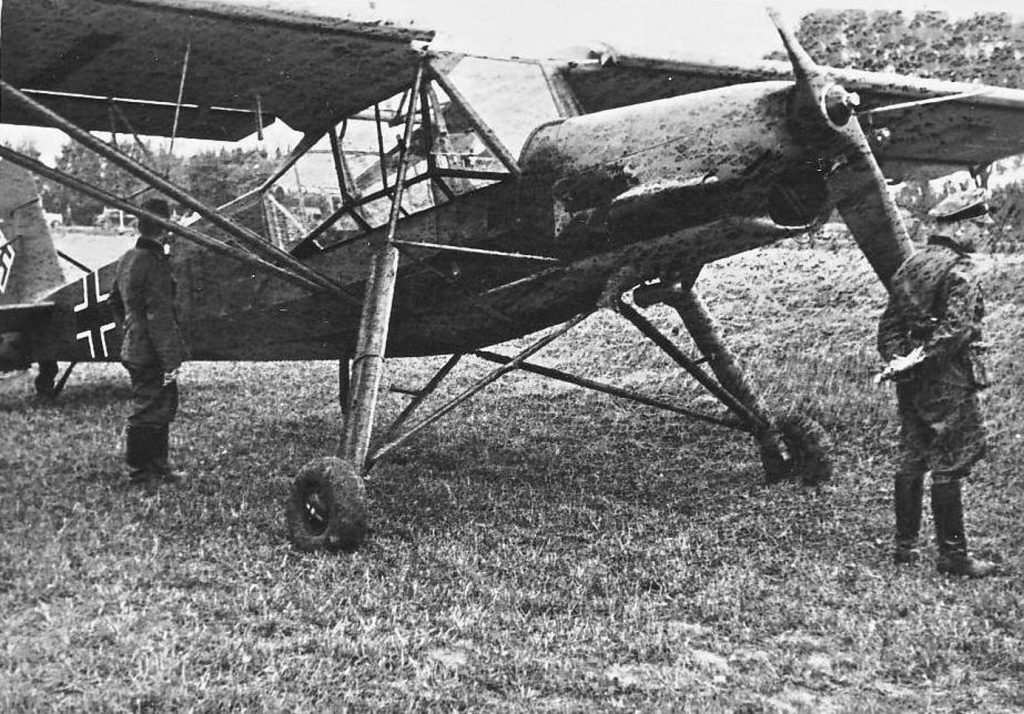
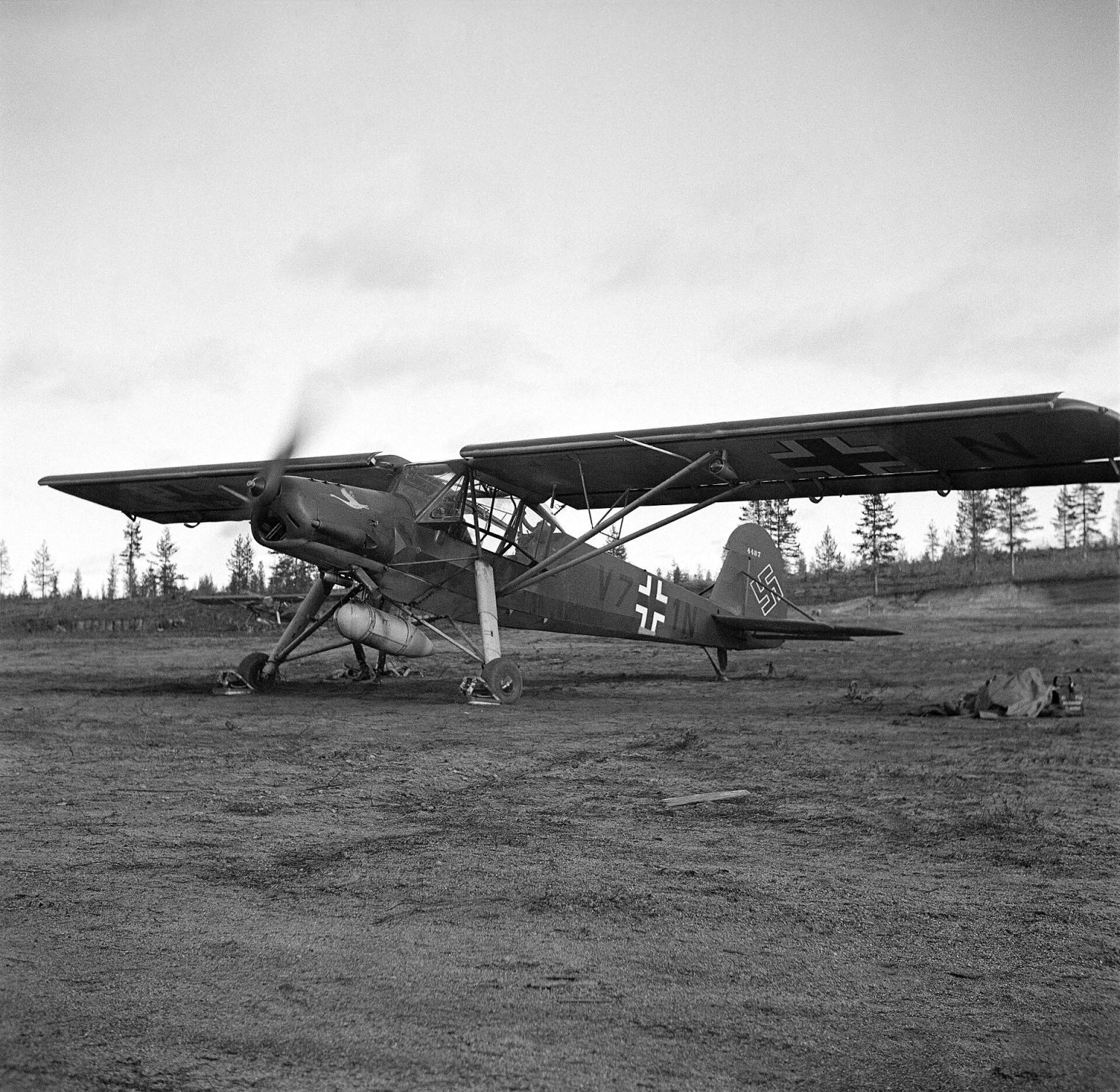
The Fieseler Fi 156 Storch in photographs
Wartime originals, museum survivors and the post-war French Criquet. Every image below is credited to its photographer and licence; scroll for more.
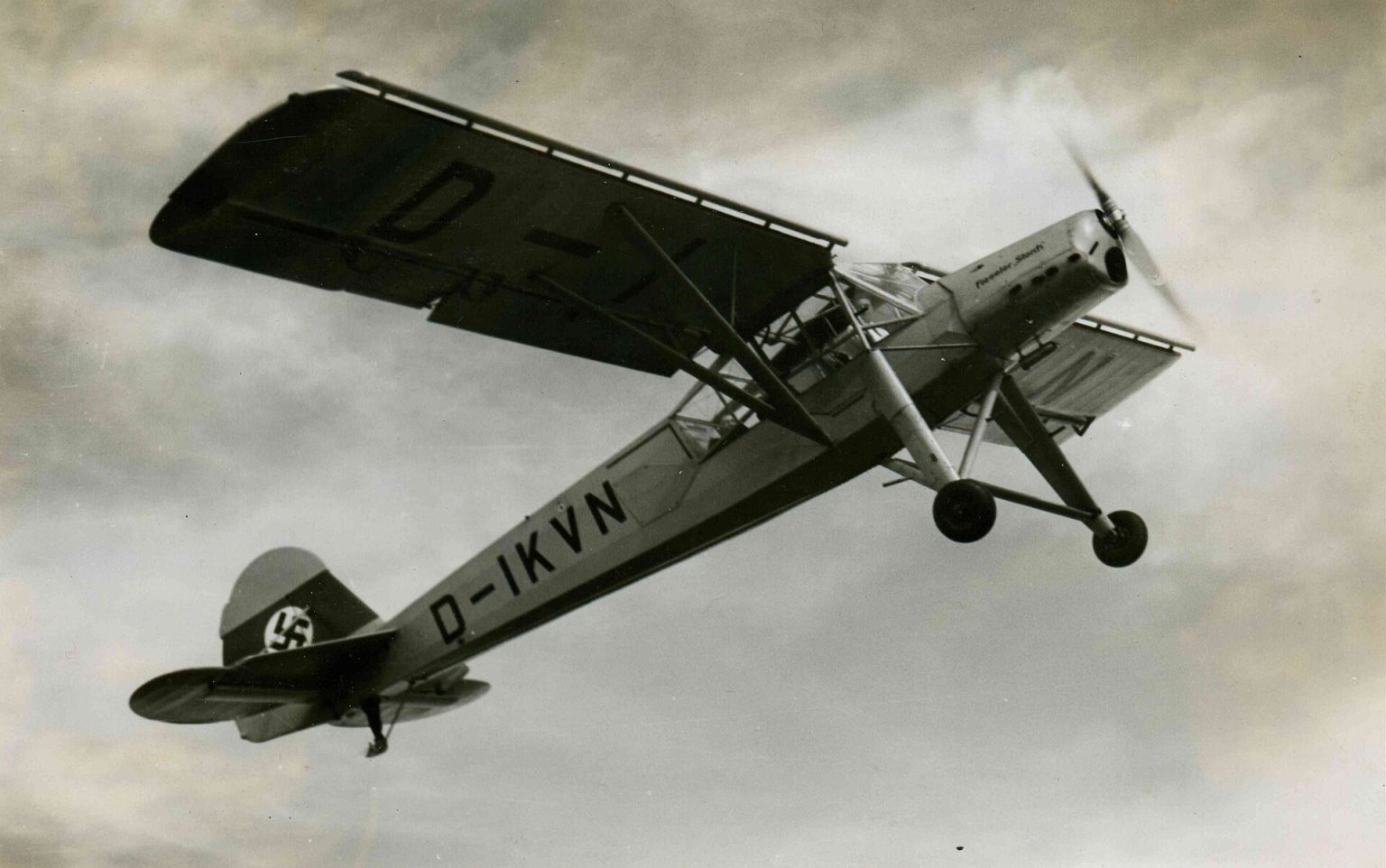
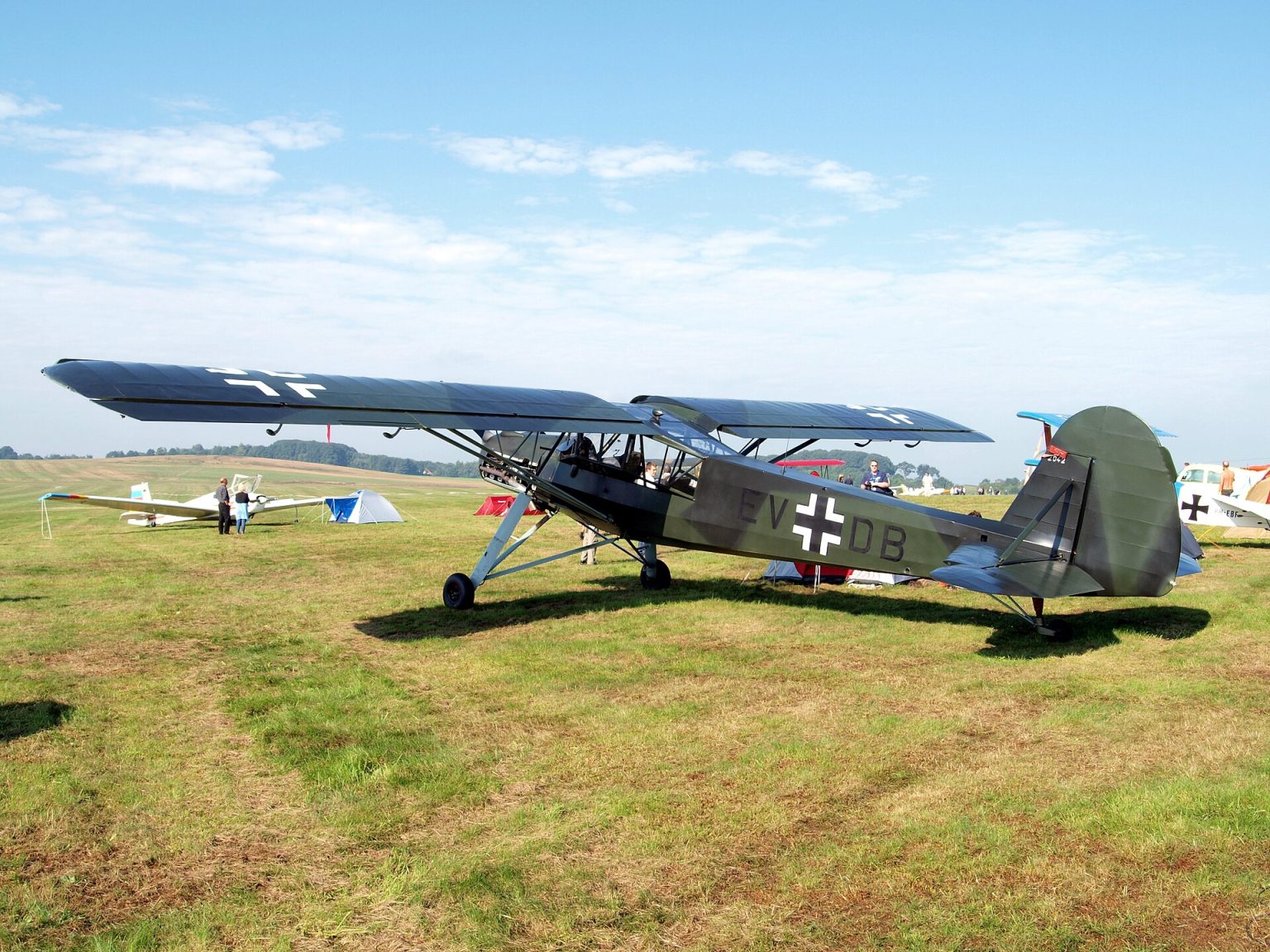
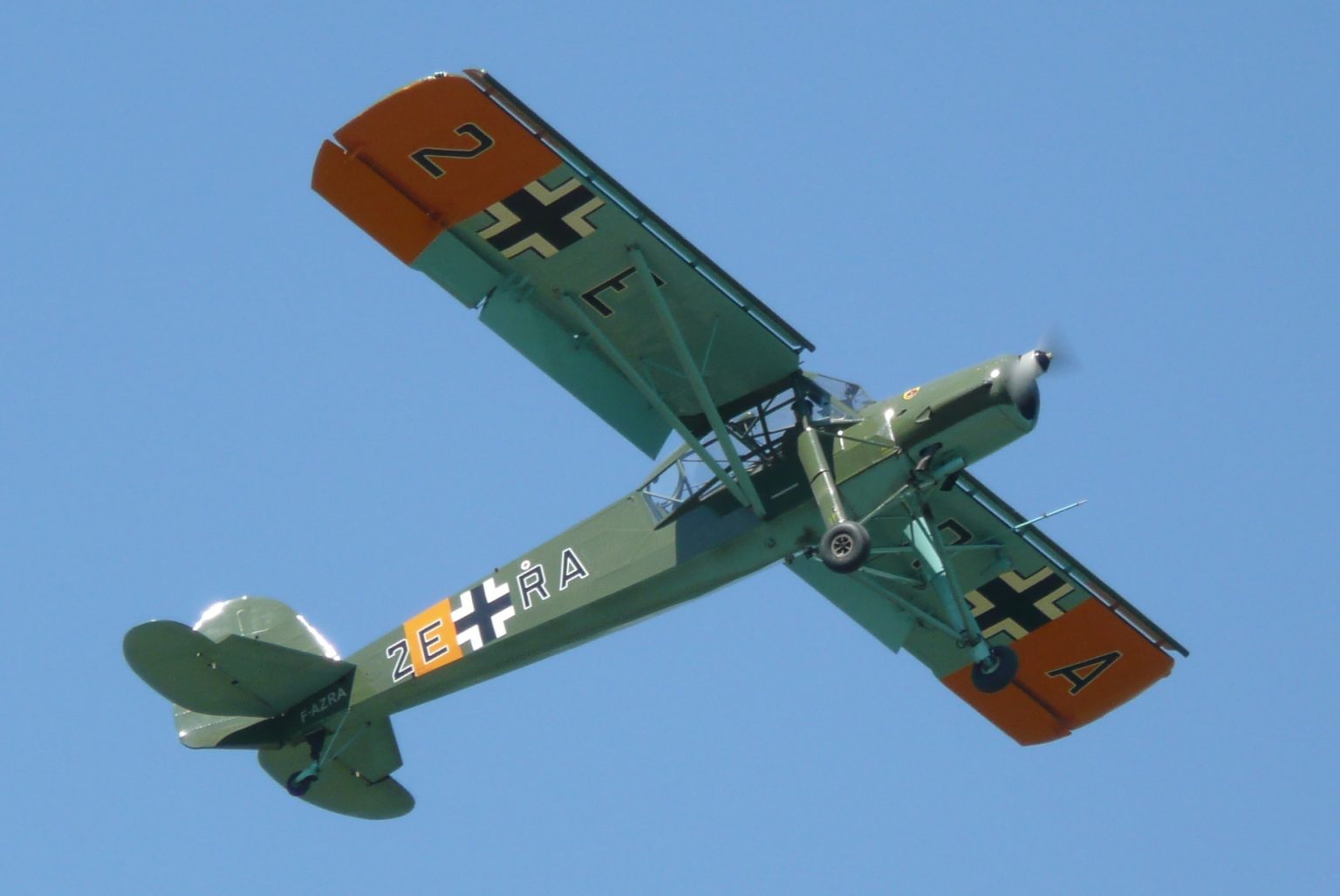
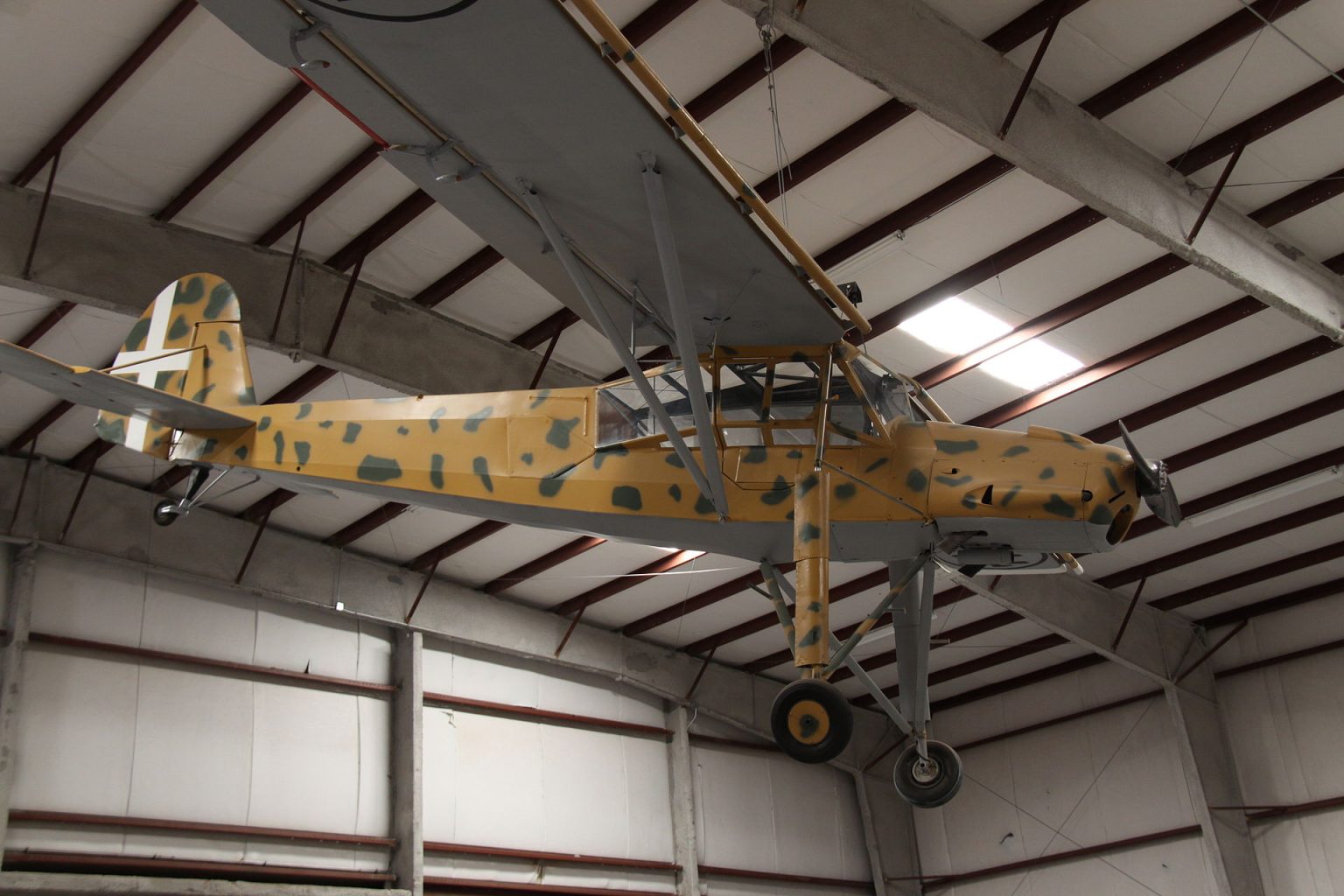
The Fieseler Fi 156 Storch: start-up, taxi and STOL demonstration
An airworthy original Storch from the Hangar 10 collection — its Argus As 10 inverted-V8 running, taxiing, and demonstrating the short take-off and landing that made the type famous.
“Fieseler Fi 156 Storch — Argus AS10C Inverted V8 | Hangar10” by PaddyPatrone — over 1.2 million views. Footage of an airworthy original Storch. Embedded from YouTube.
Where the Fieseler Fi 156 Storch flew: origin, war and afterlife
Hover or tap a country. Blue marks the Storch’s German origin; the camouflage shading its wartime operators and theatres; grey its post-war and licence operators (France’s MS.500 Criquet, Czechoslovakia’s K-65 Čáp and others); light grey the countries where airframes and replicas survive today.
The Fieseler Fi 156 Storch’s record at a glance
Fieseler Fi 156 Storch: questions and answers
Can I fly in a Fieseler Fi 156 Storch?
Not with MiGFlug — the Fieseler Fi 156 Storch is not part of the MiGFlug fleet, and we do not offer Storch flights. Airworthy original Storchs and post-war Morane-Saulnier MS.500 Criquets genuinely do still fly, and a small number of specialist warbird operators occasionally offer passenger rides in Storch-type aircraft — but those are independent third parties, nothing to do with MiGFlug, so we can’t book or vouch for them.
What you can do with MiGFlug is fly in a real military jet — a MiG-29 to the edge of space, or an L-39 Albatros jet trainer over the Alps, Florida or the Czech Republic. See migflug.com/flights-prices for everything currently bookable.
Why was the Fieseler Fi 156 Storch so good at short take-off and landing?
The whole wing was engineered for lift, not speed. Full-span fixed leading-edge slats kept the airflow attached at very high angles of attack, so the wing kept flying where an ordinary one would stall. Behind them, slotted flaps and ailerons that drooped with the flaps turned almost the entire trailing edge into a high-lift surface.
With a light airframe and a long-travel oleo undercarriage to soak up rough arrivals, the Storch could take off in roughly 45–60 m and land in about 18–20 m — figures that vary with wind, load and surface.
Could the Fieseler Fi 156 Storch really hover?
Not in the way a helicopter hovers — the Storch always needed airflow over its wing. But because it could fly under full control at around 50 km/h, a headwind of similar strength cancelled its progress across the ground. Relative to the earth below it could appear to stand still, or even move backwards.
So the famous “hovering Storch” is real physics, not a myth — given a strong enough wind.
Did a Storch really rescue Mussolini from a mountaintop?
Yes — this is one of the best-attested Storch stories. In the Gran Sasso raid of 12 September 1943, German commandos reached Mussolini at the Campo Imperatore hotel high in the Apennines, and a Storch was flown in to extract him. By the widely repeated account the pilot took off dangerously overloaded, dropping off the edge of the plateau to gain flying speed before climbing away.
The broad outline is solid history; a few specific details (exact weights, who was aboard) differ between sources, so treat the fine print with a little caution.
Was a Storch really the last aircraft to land in Berlin in 1945?
It is very frequently reported, and we relay it as reported. In late April 1945 the test pilot Hanna Reitsch flew General Robert Ritter von Greim into the encircled city — by common accounts landing on an improvised strip near the Brandenburg Gate — and out again days later, under fire. These flights are often described as among the last aircraft movements into and out of besieged Berlin.
Exactly which aircraft was truly “the last” is hard to establish and some details are contested, so we attribute the story carefully rather than stating it as settled fact.
How fast was the Fieseler Fi 156 Storch?
Deliberately slow. Top speed was only about 175 km/h (109 mph), with a cruise around 130–150 km/h, and a minimum controllable speed near 50 km/h. The Storch’s whole purpose was to fly slowly and precisely from tiny strips — speed was never the point.
What engine did the Fieseler Fi 156 Storch use?
An Argus As 10 — an air-cooled, inverted-V8 developing about 240 hp (240 PS). Inverting the V kept the cylinder heads low and gave a clean view forward over a slim nose, useful in an observation aircraft. The Storch’s performance came from lift rather than power. Some post-war French MS.500 Criquets were re-engined with radial engines, which changed the shape of the nose.
How many Fieseler Fi 156 Storch were built, and are any still flying?
More than 2,900 were built in Germany during the war — published totals vary and are often quoted as about 2,867–2,900 — on top of large post-war licence production in France (the MS.500 Criquet, roughly 925 aircraft) and Czechoslovakia (the Mráz K-65 Čáp).
Because so many were made, plenty survive: examples are on display in museums around the world, and an unusually high number remain airworthy, appearing regularly at airshows. Many of those flyers are in fact French-built Criquets.
What was the Fieseler Fi 156 Storch used for?
The Storch was a jack-of-all-trades liaison aircraft. Its core jobs were carrying commanders forward, spotting for the artillery, evacuating casualties (a stretcher loaded through a hinged rear panel) and moving staff officers and dispatches between headquarters. It also flew reconnaissance, courier and light supply missions, and served as a personal aircraft for senior commanders — Rommel among them. It did this on every front, from the Arctic to the North African desert.
Where can I see a Fieseler Fi 156 Storch today?
Preserved Storchs — and their French Criquet and Czech Čáp cousins — are held in aviation museums across Europe, North America and beyond, from the Smithsonian and the RAF Museum to German and French national collections and many private hangars. Because an unusually high number remain airworthy, the best way to see one actually flying is at a European or North American warbird airshow, where original Storchs and Criquets are regular and popular performers.
What does “Storch” mean, and why was it called that?
“Storch” is simply German for stork. The aircraft earned the name from its stance on the ground — a small fuselage perched high on long, splayed, shock-absorbing legs beneath a big braced wing, exactly like a stork standing in a meadow. The nickname stuck so thoroughly that the type is almost never called anything else. Fittingly, the post-war Czech licence version was named Čáp — the Czech word for stork — too.
You can’t fly the Storch — but these, you can
The Fieseler Fi 156 Storch isn’t a MiGFlug aircraft. But if the itch is to strap into a genuine military machine and feel it fly, MiGFlug can put you there — in a supersonic MiG-29 or an L-39 Albatros jet trainer. Real aircraft, real pilots, real G.
MiG-29 to the Edge of Space
Climb to the stratosphere at twice the speed of sound and see the curvature of the Earth.
See this flightL-39 Albatros in Florida
Fly the classic jet trainer over the Florida coast — aerobatics and a real fast-jet feel.
See this flightL-39 Albatros in the Italian Alps
A jet-trainer sortie through Alpine valleys and peaks.
See this flightL-39 Albatros in California
Loops, rolls and low-level runs in a genuine military jet trainer.
See this flightL-39 Albatros in Switzerland
Fly the Albatros over the Swiss Alps — MiGFlug’s home turf.
See this flightMore from the MiGFlug Aircraft Museum
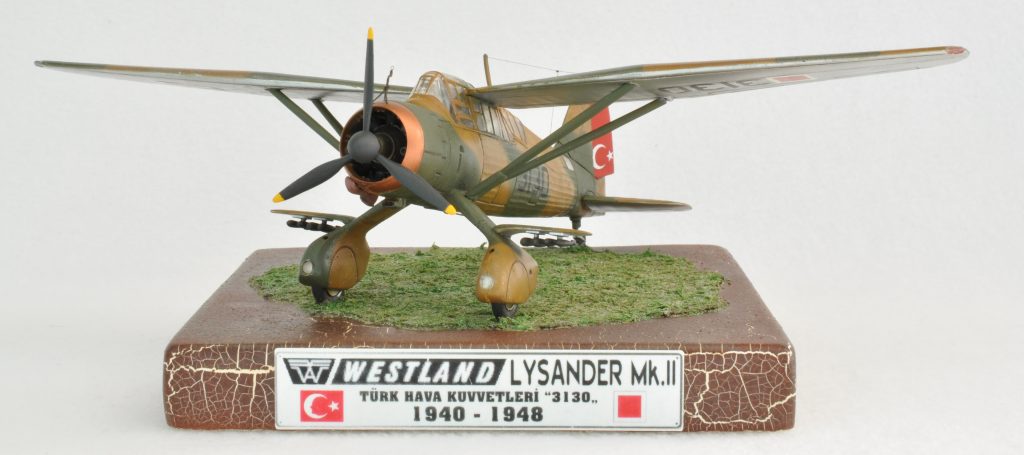 Westland LysanderBritain’s STOL army-cooperation aircraft — and the RAF’s clandestine agent-dropper for the moon squadrons.
 Junkers Ju 52The corrugated three-engined workhorse that carried the Luftwaffe’s troops, freight and paratroops.
 Junkers Ju 87 StukaThe siren-wailing dive bomber that became the symbol of Blitzkrieg.
Sources & further reading
Performance figures for the Storch — short-field distances, minimum speed, weights and total production — differ between sources and are given here as representative rather than definitive; contested figures are flagged in the text. Historic exploits (the Gran Sasso rescue and the reported last landing in Berlin) are attributed as reported. Photographs are credited to their authors and licences via Wikimedia Commons. This is an educational encyclopedia page; MiGFlug does not operate the Fieseler Fi 156 Storch.