
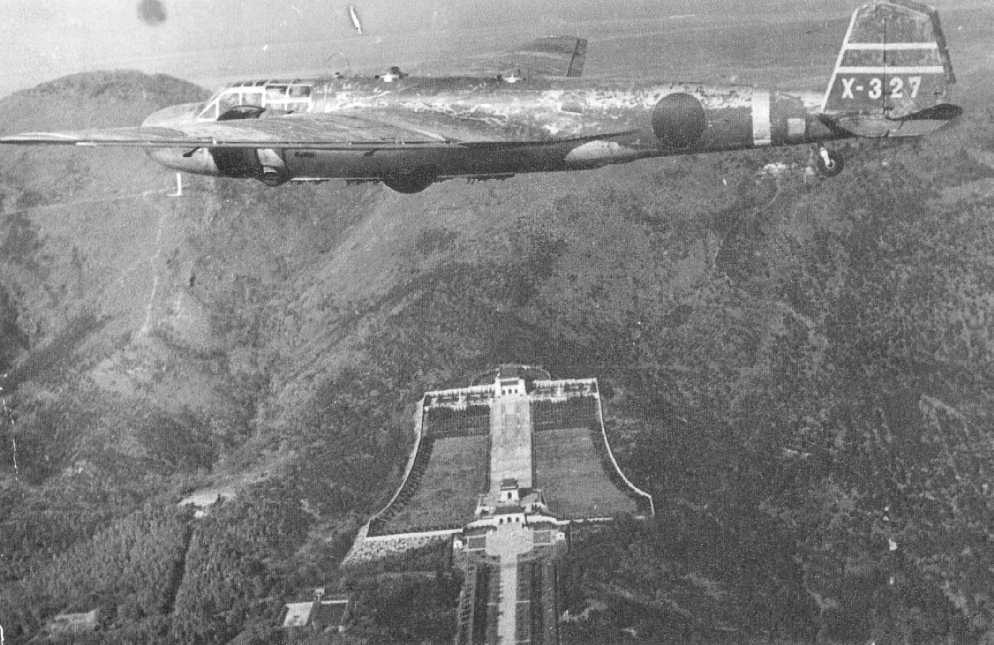
Mitsubishi G3M
“Nell”
The long-legged Imperial Japanese Navy bomber that flew the first trans-oceanic air raids in history — and then, off Malaya in December 1941, helped sink two British capital ships at sea and rewrote the rules of naval warfare.
The Mitsubishi G3M “Nell”: the long-range bomber that changed naval warfare
In the early 1930s the Imperial Japanese Navy gambled on an idea most air forces thought impossible: a land-based bomber with enough range to reach out hundreds of miles over open ocean and strike ships and cities far beyond the reach of any carrier. Admiral Isoroku Yamamoto himself championed the requirement. Mitsubishi’s answer, designed by a team under Kiro Honjo, first flew as the Ka-15 prototype in July 1935 and entered service in 1936 as the Navy Type 96 land attack aircraft — the rikko. To Allied crews it would later become simply “Nell.”
What set the G3M apart was reach. A slim fuselage slung under a long, high-aspect-ratio wing and two Mitsubishi Kinsei radials gave it a ferry range of roughly 4,380 km — extraordinary for a twin-engine bomber of the mid-1930s. That endurance was proved dramatically in August 1937, when Nells flew the first trans-oceanic bombing raids in history, crossing the East China Sea from Formosa and Kyushu to strike Chinese cities. The unescorted bombers were savaged by Chinese fighters — an early, bloody lesson that range alone did not make a bomber safe.
The G3M’s defining hour came on 10 December 1941. Land-based Nells and G4M “Bettys” of the 22nd Air Flotilla, flying from Indochina, found the British battleship HMS Prince of Wales and battlecruiser HMS Repulse steaming off Malaya without air cover. In about two hours of level bombing and torpedo attacks the two capital ships were sunk. It was the first time capital ships defending themselves at sea, underway, had ever been destroyed by air power alone — a moment that ended the age of the battleship.
By then the G3M was already ageing. Lightly built and lightly armed, it was increasingly outclassed as the war turned, and from 1942 it was gradually replaced by the newer G4M and pushed into transport, patrol and training roles. Around 1,048 were built before production ended in 1943. Not a single complete example survives today — a strange fate for the aircraft that helped prove air power could rule the sea.
01The Mitsubishi G3M’s design brief: Yamamoto’s bet on land-based range
Japan’s naval treaties of the era limited its carrier and battleship tonnage, so the Navy looked for another way to project power across the vast distances of the Pacific. The answer, pushed hard by then-Rear Admiral Isoroku Yamamoto in the Naval Aviation Department, was a shore-based bomber whose reach would let a handful of airfields cover great stretches of ocean. The 1934 specification asked for range far beyond anything then normal for a twin.
Mitsubishi’s engineers, led by Kiro Honjo, achieved it by wrapping a very slim fuselage around a long, efficient wing and accepting light structure and modest defensive armament as the price of endurance. The result was fast and far-reaching for 1936, but the same choices — thin skin, no self-sealing tanks, few guns — would later make the G3M and its Betty successor dangerously vulnerable once they met modern fighters and massed anti-aircraft fire.
What makes the G3M Nell special
A wing built for range
The Nell’s long, high-aspect-ratio wing and slim fuselage gave it a ferry range near 4,380 km — remarkable for a mid-1930s twin. That reach let land-based Navy bombers strike targets hundreds of kilometres out to sea, the whole point of the design and the reason it could find and sink ships far from any carrier.
Two Mitsubishi Kinsei radials
Power came from two Mitsubishi Kinsei 14-cylinder radials — about 1,075 hp each in the definitive G3M2, rising to roughly 1,300 hp in the late G3M3. They pushed the Nell to about 373 km/h, fast enough in 1937 to worry defenders, though its edge faded quickly as fighters improved.
Range bought with fragility
Endurance came at a cost. The G3M carried no armour and no self-sealing fuel tanks, and its defensive guns — a 20 mm dorsal cannon and a few rifle-calibre machine guns — were light. Over China in 1937 and again later in the war, unescorted Nells burned easily when caught by fighters. It was a bomber optimised for reach, not survival.
02The Mitsubishi G3M’s trans-oceanic raids: the first over-water strategic bombing
On 14 August 1937, days after fighting flared at Shanghai, G3M units launched what are widely regarded as the first trans-oceanic bombing raids in history. The Kanoya Air Group flew from Taihoku (Taipei) on Formosa and the Kisarazu Air Group from Omura in Kyushu, crossing hundreds of kilometres of the East China Sea to strike Shanghai, Hangzhou and Nanking. No aircraft had ever mounted sustained strategic strikes across so much open water.
The raids proved the range concept spectacularly — and exposed its flaw just as sharply. Flying without fighter escort, the Nells were mauled by Chinese pilots, with the two groups reportedly losing something like 40 per cent of their strength within about two weeks. It was one of the earliest demonstrations that even fast, long-ranged bombers needed escorts, a lesson every air force would relearn the hard way over the next decade.
03The Mitsubishi G3M and the sinking of Force Z: the end of the battleship
On 10 December 1941 the British battleship Prince of Wales and battlecruiser Repulse — the core of “Force Z” — were caught off the Malayan coast near Kuantan with no air cover. Land-based bombers of the 22nd Air Flotilla struck in waves: G3M level-bombers and torpedo bombers of the Genzan and Mihoro air groups, joined by G4M torpedo bombers of the Kanoya group, roughly 85 aircraft in all, of which about 59 were G3M Nells.
In a running attack of about two hours the two ships were hit by multiple torpedoes and sunk, for the loss of only three or four Japanese aircraft. It was the first time capital ships free to manoeuvre and defend themselves on the open sea had been sunk purely by air attack — a result that stunned the Royal Navy and confirmed that the battleship no longer ruled the ocean. The G3M, a design already five years old, was at the centre of it.
Mitsubishi G3M2 Nell full specifications
Baseline note: the figures below describe the Mitsubishi G3M2 Model 22 (Navy Type 96 Land-based Attack Aircraft Model 22, Allied reporting name “Nell”), the mark that made up the bulk of front-line strength in December 1941 and the first to carry a 20 mm gun. Deltas for the Ka-15 prototypes, the G3M1 Model 11 of 1936 and the Nakajima-built G3M3 Model 23 are given in grey. Note that the most widely reproduced online specification panel is headed “G3M2 Model 21” but reproduces Francillon’s Model 22 column — the crew of seven, the 4,965 kg empty weight and the 202 kt maximum are all Model 22 values, and the Model 21 was a five-man aeroplane with three rifle-calibre guns.
Dimensions & weights
- Crew
- 7 — pilot, co-pilot, navigator/bomb-aimer, radio operator and three gunners on the Model 22 and G3M3; the Ka-15, G3M1 and G3M2 Model 21 flew with five
- Length
- 16.45 m (54 ft 0 in) — unchanged from the first prototype to the last aircraft off the Koizumi line
- Wingspan
- 25.00 m (82 ft 0 in)
- Height
- 3.69 m (12 ft 1 in) — strikingly low for the span, which is what made the type so recognisable in profile
- Wing area
- 75.0 m² (807 sq ft); some English references round to 810 sq ft
- Wing
- Cantilever mid-set monoplane, all-metal stressed skin, high aspect ratio with the entire outer structure given over to fuel — a glider’s wing bolted to a bomber, and the single design decision that explains the aeroplane
- Fuselage
- All-metal semi-monocoque with fabric-covered control surfaces and no internal bomb bay; the torpedo or bomb load hung externally under the belly, which cost drag and capped the load at 800 kg
- Empty weight
- 4,965 kg (10,946 lb); Ka-15 4,400 kg (9,700 lb), G3M1 4,770 kg (10,516 lb), G3M3 5,243 kg (11,558 lb)
- Loaded weight
- 8,000 kg (17,637 lb); Ka-15 7,250 kg (15,984 lb), G3M1 7,642 kg (16,847 lb). The G3M3 carried more fuel and heavier engines within the same 8,000 kg, which is the whole reason its payload never grew
- Wing loading
- 106.7 kg/m² (21.9 lb/sq ft) — very low, and the reason a fully loaded G3M could get off short coral strips in the Marshalls
- Power loading
- 3.7 kg/hp (8.2 lb/hp); G3M3 3.1 kg/hp (6.8 lb/hp), G3M1 3.6 kg/hp
- Internal fuel
- ~3,874 l (~852 imp gal, ~1,023 US gal) in unprotected wing tanks. The record-flight conversion Nippon of 1939 carried ~5,200 l (~1,144 imp gal)
- Undercarriage
- Retractable tailwheel type, main units folding rearwards into the engine nacelles; fixed tailwheel
- Protection
- None. No armour for the crew, no self-sealing tanks, no fire suppression, at any point in the type’s life. The Navy traded protection for range as a matter of stated policy, and Allied pilots returned the compliment by calling the family “one-shot lighters”
Performance
- Maximum speed
- 374 km/h (232 mph, 202 kt) at 4,180 m (13,715 ft)
- Maximum speed, G3M3 Model 23
- 415 km/h (258 mph, 224 kt) at 5,900 m (19,355 ft) — the 1,300 hp Kinsei 51 bought 41 km/h and 1,700 m of altitude, and arrived too late to matter
- Maximum speed, G3M1 Model 11
- 348 km/h (216 mph, 188 kt) at 2,000 m (6,560 ft) — fast enough in 1936 to persuade the Naval Staff that escorts were optional
- Cruising speed
- 278 km/h (173 mph, 150 kt) at 4,000 m (13,125 ft); G3M3 296 km/h (184 mph, 160 kt)
- Climb to 3,000 m
- 8 min 19 s (to 9,845 ft); G3M1 9 min 47 s, Ka-15 9 min 40 s, G3M3 5 min 29 s
- Rate of climb
- 6.0 m/s (1,180 ft/min), the mean rate implied by the timed climb rather than an instantaneous sea-level figure
- Service ceiling
- 9,130 m (29,950 ft); G3M1 7,480 m (24,540 ft), G3M3 10,280 m (33,730 ft). English-language sources frequently quote 9,200 m for the Model 22
- Maximum range
- 4,380 km (2,722 miles, 2,365 naut miles) — the number the Navy bought, and a figure no Western twin of 1937 came close to
- Maximum range, G3M3
- 6,228 km (3,870 miles, 3,363 naut miles), which is why radar-equipped G3M3s were still flying ocean search in 1944 when the type was hopeless as a bomber
- Combat radius, torpedo strike
- ~1,000 km (~620 miles) with one Type 91 and a search allowance — the radius that killed Force Z from airfields in southern French Indochina, and the radius the Royal Navy did not believe existed
- Endurance
- Routinely eight hours and more; the 1939 Nippon circumnavigation covered 52,886 km (32,862 miles) in 194 flying hours over 55 days, which was a publicity stunt and also an accurate advertisement
- For comparison: Vickers Wellington Ic
- 378 km/h (235 mph) and 2,905 km (1,805 miles) with 1,814 kg (4,000 lb) — same speed, half the reach, more than twice the bomb load and a geodetic airframe that absorbed punishment
- For comparison: Heinkel He 111H-6
- 435 km/h (270 mph) but ~2,300 km (~1,430 miles) — the European answer to the same problem, faster and far shorter-legged, because Germany had no ocean to cross
- For comparison: Mitsubishi G4M1
- 428 km/h (266 mph) and up to 6,033 km (3,749 miles) — the successor, which carried the same doctrine and the same absence of protection to a larger scale
Propulsion & systems
- Engines
- 2 × Mitsubishi Kinsei 45 fourteen-cylinder twin-row air-cooled radials, 1,075 hp (802 kW) for take-off and 1,000 hp at 4,180 m; the Kinsei 41 and 42, also 1,075 hp for take-off but rated 990 hp at 2,800 m, were fitted to earlier G3M2s
- Engines, G3M3
- 2 × Mitsubishi Kinsei 51, 1,300 hp (969 kW) for take-off and 1,200 hp at 3,000 m — a 21 per cent power increase for the last and best version
- Earlier engines
- Ka-15 prototypes flew behind Hiro Type 91 twelve-cylinder liquid-cooled engines of 750 hp (559 kW), Mitsubishi Kinsei 2 radials of 830 hp, or Kinsei 3 radials of 910 hp; the G3M1 standardised on the Kinsei 3. The type is remembered as a Kinsei aeroplane, but it did not start as one
- Propellers
- Three-blade variable-pitch metal units on the G3M1 onwards; several Ka-15 prototypes flew with four-blade fixed-pitch wooden propellers
- Fuel system
- Wing tanks only, no protection of any kind, no inert-gas system. A single incendiary round in the wing was usually decisive, and the phrase Allied pilots used for the result was not a compliment
- Ordnance carriage
- External, under the fuselage centre section, on a single crutch: one 800 kg (1,764 lb) aerial torpedo or up to 800 kg of bombs. No bomb bay was ever fitted — a decision taken to save weight in 1934 that permanently capped what the aeroplane could do
- Defensive turrets
- Ka-15, G3M1 and G3M2 Model 21: two retractable dorsal turrets and one retractable ventral “dustbin”, all rifle-calibre. Model 22 and G3M3: a fixed dorsal turret with a 20 mm cannon, one retractable forward dorsal turret and glazed lateral blisters
- Bombsight
- Type 90 optical sight, crude beside the Norden or the Lotfe 7 — acceptable because the Navy expected to attack ships with torpedoes and to bomb area targets in mass formation, not to hit point targets from height
- Radio and navigation
- Long-range HF set, drift sight and a navigator trained specifically for over-water dead reckoning; the Navy’s investment in ocean navigation training, rather than any equipment, is what made 1,000 km strikes over empty sea routine
- Radar
- From 1943 surviving G3M2s and G3M3s carried the Type 3 Ku Mark 6 (H-6) air-to-surface search radar with Yagi aerials on nose and flanks, and served as long-range maritime search aircraft — the role in which the airframe remained genuinely useful to the end
- Designer and lineage
- Kiro Honjo’s team at Mitsubishi Nagoya, developed from the Ka-9 long-range research aircraft of 1934 against an 8-Shi and then 9-Shi Navy requirement; Honjo went on to design the G4M
- Production
- 1,048 in total: 636 by Mitsubishi at Nagoya (21 Ka-15 prototypes 1935–36, 34 G3M1 1936–37, 343 G3M2 Model 21 1937–39, 238 G3M2 Model 22 1939–41) and 412 G3M2 and G3M3 by Nakajima at Koizumi 1941–43
- Unit cost
- Not reliably published. Japanese Navy aircraft procurement figures for the 1930s survive only patchily, and no per-airframe cost for the G3M is quoted in the standard references
04The Mitsubishi G3M’s cost: why no reliable price exists
There is no credible unit cost or cost-per-flight-hour figure for the G3M in the public record. It was a wartime product of the Imperial Japanese Navy, procured through the Navy’s own arsenal-and-contractor system rather than sold on any open market; contemporary yen pricing was not published, and a great deal of Japanese industrial documentation was destroyed in 1945.
Any specific dollar or yen figure attached to a G3M online should be treated as unverified. Production figures are firmer but still vary between sources: roughly 1,048 aircraft were built in total, the great majority by Mitsubishi with a substantial batch by Nakajima, though the exact manufacturer split differs from reference to reference and should be read as an estimate.
Armament & payload
The G3M carried one torpedo, no armour and no self-sealing tanks, and that bargain sank two capital ships before it killed its own crews
The Imperial Japanese Navy built the G3M to solve a treaty problem. Limited to three capital ships for every five American ones, the Naval Staff planned to whittle the US battle fleet down as it crossed the Pacific, and land-based aircraft flying from the Mandated Islands were to do a large part of the whittling. That produced the rikko — the land-based attack aircraft, a category no other navy maintained — and the G3M was the first good one. Everything about it follows from the requirement: a wing that is mostly fuel tank, an external torpedo crutch instead of a bomb bay, retractable turrets to save drag, and not one kilogram of armour. It could fly 4,380 km (2,722 miles) and put an 800 kg (1,764 lb) torpedo into a ship at the end of it, in 1937, which nothing in Europe or America could do.
The August 1937 raids showed both halves of the bargain at once. On 14 August two formations of nine Kanoya Kokutai G3Ms flew from Taipei in Formosa through the edge of a typhoon to bomb Jianqiao airfield at Hangzhou and Guangde in Anhui; the next afternoon twenty Kisarazu Kokutai machines crossed the East China Sea from Omura in Kyushu to bomb Nanking. These were the first trans-oceanic bombing raids in history — the Japanese called the campaign toyo bakugeki, ocean-crossing bombing — and they were flown entirely without escort, because no fighter in the world had the legs to come along. Gao Zhihang’s 4th Pursuit Group met them over Jianqiao with Curtiss Hawk IIIs and shot bombers down; the Republic of China still keeps 14 August as Air Force Day. Chinese claims for 14–16 August run to eleven G3Ms destroyed, and by the end of the month the two kokutai had lost something close to half the aircraft committed.
The Navy drew the correct conclusion, and drew it fast. It moved the rikko to night attacks, it eventually gave the Model 22 a 20 mm cannon, and above all it rewrote the 12-Shi carrier fighter requirement in October 1937 “in light of experience obtained in fighting in China” to demand six to eight hours of endurance at economical cruising speed with drop tanks. No other navy asked a fighter for that. The aeroplane that answered was the A6M Zero, which first escorted the bombers over Chongqing on 13 September 1940, and the Zero’s legendary range — and the weight-saving that paid for it — is directly the bill for the G3M crews lost over China in August 1937. Chinese victory claims and Japanese loss records for the 1937 raids have never been reconciled; the figures above are the Chinese ones, and the Japanese admissions are lower.
On 10 December 1941 the doctrine worked exactly as written. The 22nd Air Flotilla put up 88 aircraft from Thu Dau Mot, Tan Son Nhut and Saigon against Force Z — 85 strike aircraft and three scouts, of which 26 were G4M1 “Betty” torpedo aircraft of the Kanoya Kokutai and the remaining sixty-odd were G3M2 “Nells” of the Genzan and Mihoro Kokutai. Thirty-four carried bombs and fifty-one carried Type 91 torpedoes. Ensign Masato Hoashi’s G3M scout found the ships at 10:15; because the force had spread out to search, it attacked in the order it arrived rather than concentrating. At 11:13 eight Mihoro G3Ms with 250 kg bombs hit Repulse once through the hangar for seven near misses, damaging five of their own number. At about 11:40 seventeen Genzan G3M torpedo aircraft attacked in two chutai, nine at Prince of Wales and eight at Repulse: no hits on the battlecruiser, and one hit on the battleship where her outer port propeller shaft left the hull. That single Nell’s torpedo decided the day — the racing shaft tore open the shaft glands, 2,400 tons of water came aboard, speed fell to 16 kt, the after 5.25 in turrets lost power and the ship listed 11.5° to port with half her anti-aircraft armament unusable.
The killing was done by the G4Ms. At about 12:20 the twenty-six Kanoya aircraft put three more torpedoes into Prince of Wales’s starboard side and caught Repulse — which had already dodged nineteen torpedoes — in a hammer-and-anvil attack from both bows; she took at least four hits, rolled over and sank stern-first at 12:33. A last high-level run at 12:41 by G3M level bombers put one 500 kg bomb through Prince of Wales’s upper deck into the Cinema Flat among the wounded, and she sank at 13:18. Eight torpedo hits out of forty-nine dropped, four on each ship; 840 British sailors dead including Admiral Phillips and Captain Leach; Japanese losses of three aircraft shot down (one Genzan Nell and two Kanoya Bettys), a fourth written off on landing, 28 damaged, two scout seaplanes missing and 18 aircrew killed. The Buffaloes of No. 453 Squadron RAAF arrived at 13:18, as the flagship went under. A widely reproduced online summary of the action gives “34 torpedo aircraft, 51 level bombers”, which is transposed — its own wave-by-wave narrative accounts for 43 torpedo aircraft before the Mihoro torpedo chutai are counted. The correct split, as given by Middlebrook and Mahoney, is 34 level bombers and 51 torpedo aircraft.
Gun
- Ka-15, G3M1 and G3M2 Model 21: 3 × 7.7 mm Type 92 flexible machine guns — one in each of two retractable dorsal turrets and one in a retractable ventral “dustbin”. The Type 92 was a Lewis derivative firing from a 97-round drum
- G3M2 Model 22 and G3M3: 1 × 20 mm Type 99 Model 1 cannon in a fixed dorsal turret — a licensed Oerlikon FF derivative, low muzzle velocity, 60-round drum
- Model 22 and G3M3 also retained 7.7 mm Type 92 guns in each lateral blister and in a retractable forward dorsal turret, with a fourth that could be fired from the cockpit windows: five guns, four of them rifle-calibre
- The retractable turrets were an aerodynamicist’s solution to a gunner’s problem. Extended, they cost speed; retracted, they were useless. Crews under attack had the worst of both
- L3Y1 and L3Y2 transports kept a single 7.7 mm Type 92 in a dorsal turret and nothing else
Air-to-air
- No guided air-to-air weapon existed in the G3M’s service life; the defensive guns were the entire air-to-air armament
- The single 20 mm Type 99 on the Model 22 was the only gun aboard that could hurt a fighter, and it covered one hemisphere from a hand-worked mounting
- Doctrine was formation defence plus speed plus altitude. It failed the first time it was tested, over Hangzhou and Nanking in August 1937, and it never worked afterwards
- Against Chinese Hawk IIIs, Boeing 281s and Gladiators in 1937, and against Wildcats and P-40s from 1942, the unprotected wing tanks made every firing pass potentially fatal
- The type’s one genuinely successful defensive day was 10 December 1941, when 88 aircraft attacked Force Z and lost three shot down — because no British fighter was present
Air-to-surface guided
- None, ever. The card is kept because the absence is the point: the G3M attacked ships with an unguided torpedo aimed by eye from 20 m (66 ft) above the water
- Japan’s guided-weapon work went elsewhere and arrived far too late; nothing of it reached a rikko unit flying G3Ms
- What the type did get, from 1943, was the Type 3 Ku Mark 6 (H-6) air-to-surface radar — a sensor for finding ships at night and in cloud, after which the attack was still made with unguided weapons
- The radar-equipped G3M3 was, in the end, a better maritime patrol aircraft than it had ever been a bomber
Bombs
- Maximum ~800 kg (1,764 lb), all carried externally under the fuselage — there was no bomb bay
- Typical fits: 12 × 60 kg (132 lb), 2 × 250 kg (551 lb), or 1 × 500 kg (1,102 lb) armour-piercing for use against warships
- On 10 December 1941 the Genzan Kokutai’s level bombers each carried one 500 kg armour-piercing bomb and the Mihoro Kokutai’s carried 250 kg bombs; a 250 kg hit on Repulse penetrated the hangar and burst in the marine mess, and a 500 kg hit went through Prince of Wales’s upper deck into the Cinema Flat among the wounded
- Against a 1941 capital ship this was a derisory bomb load, which is exactly why the Navy trained its rikko crews as torpedo men first
- In China the same load, dropped by whole chutai in formation on cities, was more than adequate for its purpose, and the type has a substantial share in the terror bombing of Shanghai, Nanking and Chongqing
Rockets
- None. No air-to-ground or air-to-air rocket was ever carried operationally by the G3M
- The single external crutch had no provision for rails, and the wing was a fuel tank from root to tip with no hard points
- Japanese Navy rocket work of 1944–45 went to interceptors and to the Ohka, not to a nine-year-old attack bomber that had already been withdrawn from strike duty
Pods & other stores
- Type 91 aerial torpedo — 835 kg (1,841 lb), 450 mm (17.7 in), 5.5 m (18 ft), 213.5 kg (471 lb) warhead containing 149.5 kg (330 lb) of explosive, 42 kt for 2,000 m (2,190 yd)
- The Type 91’s wooden tail stabilisers, the kyoban, sheared off on water entry and stopped the weapon diving deep — the modification that made drops from 20 m (66 ft) at up to 204 kt reliable, and without which Force Z would not have been sunk
- Type 3 Ku Mark 6 (H-6) ASV radar with Yagi aerials from 1943, on maritime search aircraft
- Transport and utility fits: the G3M1-L, L3Y1 and L3Y2 (Allied reporting name “Tina”) carried passengers and freight, and from 1943 surviving bombers served as glider tugs and paratroop trainers
- Long-range tankage: the 1939 Nippon conversion carried ~5,200 l (~1,144 imp gal) and circumnavigated the world — the same airframe, selling the same one virtue
Three typical loadouts
- Trans-oceanic level bombing, China, August 1937
- Crew of five, full internal fuel, 12 × 60 kg or 2 × 250 kg bombs on the external crutch, three rifle-calibre guns, no escort. Nine-aircraft chutai in tight formation, roughly 1,100 km (680 miles) each way across the East China Sea from Omura or Taipei. The mission the aeroplane was designed for, and the one that proved the doctrine incomplete.
- Anti-shipping torpedo strike, Malaya, 10 December 1941
- Crew of seven, one Type 91 torpedo under the belly, 20 mm dorsal cannon and four 7.7 mm guns, full tanks from Thu Dau Mot or Saigon. Search outbound in spread chutai, attack on arrival rather than waiting to concentrate, drop at 20 m (66 ft) and under 204 kt, split the target between port and starboard bows. Eight hits from 49 torpedoes and two capital ships on the bottom.
- Radar maritime search, Central Pacific, 1943–44
- G3M3 with H-6 radar and Yagi aerials, reduced crew, no ordnance or two 250 kg bombs, endurance stretched towards the type’s 6,228 km (3,870 miles) maximum. Flown singly, at night and in weather, looking for task groups. Obsolete as a bomber and still one of the longest-ranged search aircraft the Navy had.
Sourcing caveat: powerplant, weight and performance figures follow Francillon’s tables in Japanese Aircraft of the Pacific War and the Profile monograph The Mitsubishi G3M “Nell”; gun fits varied between production blocks and field modifications were common, and photographic evidence often disagrees with the official schedules. Torpedo data are for the Type 91 as revised by 1941.
Variants
Mitsubishi built 636 G3Ms and Nakajima 412, and the differences between them come down to engines, turrets and how much fuel would fit
The G3M never grew. Span, length, height and wing area are identical from the first Ka-15 prototype of 1935 to the last Nakajima-built G3M3 of 1943, and loaded weight never exceeded 8,000 kg (17,637 lb). Every improvement went into engines, fuel and guns, and every improvement was cancelled out by the extra crew and equipment it required. The result is a development history in which the last version flies 41 km/h faster and 1,848 km further than the second-to-last, carries exactly the same 800 kg of ordnance, and is no more survivable than the first.
What actually changed the aeroplane’s life was not a mark number but a date. From 1943 the majority of surviving G3Ms were pulled off strike duty and put to work as glider tugs, aircrew and paratroop trainers, VIP transports between the home islands and the fronts, and radar-equipped ocean search aircraft. It was a humiliating end for a type that had opened the Pacific war by sinking a British battleship, and it was the correct decision: a 374 km/h unarmoured bomber had no business over a 1943 battlefield, and the airframe’s one remaining virtue — range — was exactly what a search aircraft needs.
- Ka-15 (1935–36 / 21 built)
- Prototypes and development aircraft, first flown July 1935. Hiro Type 91 liquid-cooled inlines of 750 hp on four airframes, Mitsubishi Kinsei 2 of 830 hp or Kinsei 3 of 910 hp on the rest; glazed or solid noses; originally no defensive guns at all.
- G3M1 Model 11 (1936–37 / 34 built)
- First production mark, Kinsei 3 of 910 hp, crew of five, three retractable turrets with 7.7 mm Type 92 guns. The mark that flew the August 1937 ocean-crossing raids alongside early Model 21s and paid for the doctrine in blood.
- G3M1-L (conversions)
- G3M1 airframes rebuilt as armed or unarmed military transports with Kinsei 45 engines of 1,075 hp — the first sign of where the type would eventually spend the war.
- G3M2 Model 21 (1937–39 / 343 by Mitsubishi)
- Kinsei 41, 42 or 45 of 1,075 hp and increased fuel; turret arrangement unchanged from the G3M1. The most-produced single mark, the mainstay over China, and the aeroplane whose specification panel is routinely and wrongly printed with Model 22 figures.
- G3M2 Model 22 (1939–41 / 238 by Mitsubishi, plus Nakajima output)
- The real combat version: one retractable dorsal turret and the ventral dustbin deleted, a fixed dorsal turret with a 20 mm Type 99 cannon added, glazed lateral blisters, crew raised to seven. Faster and better armed, and no better protected.
- G3M3 Model 23 (1941–43 / Nakajima only, within 412 G3M2 and G3M3)
- Kinsei 51 of 1,300 hp and further increased fuel: 415 km/h, a ceiling of 10,280 m and a maximum range of 6,228 km (3,870 miles). Built only at Nakajima’s Koizumi plant, and by the time it was numerous the G4M had taken its job.
- L3Y1 Model 11 and L3Y2 Model 12 (Yokosuka conversions, Allied name “Tina”)
- Purpose-converted Navy transports built up by the Yokosuka Naval Air Technical Arsenal from G3M1 and G3M2 airframes; Kinsei 45 engines on the L3Y2, a single 7.7 mm dorsal gun, and passenger or freight accommodation in place of the ordnance crutch.
- Civil conversions (from 1938 / about two dozen)
- Roughly twenty-four G3M2 Model 21s converted for Nippon Koku K.K. and other Japanese civil operators, flying the routes that the military occupation of China and the Pacific had just opened.
- Nippon (1939 / one aircraft)
- A G3M2 Model 21 rebuilt for the Mainichi Shimbun with ~5,200 l of fuel; left Haneda on 25 August 1939 and returned on 20 October having flown 52,886 km (32,862 miles) in 194 flying hours by way of Alaska, the United States, South America, Dakar, Europe, India and Taipei.
- No licence production or export designations
- The G3M was never exported and never licence-built abroad. Nakajima’s 412 aircraft were second-source production for the same customer, not a licence in the export sense; the only foreign operators were the Chinese and Indonesian air arms flying abandoned airframes after 1945.
Closing caveat on survivors: not one complete G3M exists. Of 1,048 built, no museum anywhere holds an airframe, no restoration to display standard is known, and there are no flying or static reproductions. What survives is wreckage — corroded remains on Pacific island airfields and on the seabed, and recovered components in private and institutional hands. The Pacific Wrecks register for the type lists only wartime captures and crash sites (Clark Field, Lae, Gasmata, Cape Gloucester, Tarawa, Naha, Pagan, Maiana) rather than anything preserved, and the two most famous individual aircraft — the record-breaking Nippon and the Genzan and Mihoro machines that helped sink Force Z — are all long gone. For a type that flew the first trans-oceanic bombing raids in history and sank the first capital ships ever destroyed at sea by air attack, that is a remarkably thin material legacy.
The G3M Nell: from record-breaker to obsolescence
The requirement
The Navy, urged on by Isoroku Yamamoto, asks Mitsubishi for a land-based bomber with unprecedented over-water range.
First flight
The Ka-15 prototype flies in July 1935, revealing a slim, long-winged twin built around endurance.
Enters service
Accepted as the Navy Type 96 land attack aircraft — the rikko — later codenamed “Nell” by the Allies.
Trans-oceanic raids
Nells fly the first over-water strategic bombing raids in history, from Formosa and Kyushu against Chinese cities — and take heavy losses.
Around the world
The G3M-based “Nippon” makes a 52,886 km goodwill flight around the globe for the Mainichi Shimbun newspaper.
Force Z sunk
G3M and G4M bombers sink HMS Prince of Wales and HMS Repulse off Malaya — the first capital ships lost to air power at sea, underway.
Eclipsed
Increasingly outclassed, the Nell is supplanted by the newer G4M and shifts toward transport, patrol and training work.
End of the line
Production ends in 1943 after about 1,048 aircraft; surviving Nells serve secondary roles to the war’s end. No complete example survives today.
From the record: twelve G3M Nell stories
Yamamoto’s long-range gamble
Denied battleships by treaty, the Navy bet on a bomber that could reach far out to sea.
Read the full story
A wing built for endurance
Mitsubishi bought the Nell’s range with a long, slim wing and very light structure.
Read the full story
The first raids across an ocean
On 14 August 1937 Nells crossed the East China Sea to bomb Chinese cities.
Read the full story
The price of no escort
Unescorted over China, the Nells were torn apart by defending fighters.
Read the full story
Two hours that ended an era
Off Malaya on 10 December 1941, the Nell helped sink two British capital ships at sea.
Read the full story
Bomber and torpedo plane in one
The G3M could level-bomb from altitude or come in low with an 800 kg torpedo.
Read the full story
The Nell that flew around the world
In 1939 a civil G3M circled the globe on a goodwill flight for a Japanese newspaper.
Read the full story
Why the Allies called it “Nell”
Allied intelligence gave Japanese aircraft simple Western reporting names.
Read the full story
A bomber that burned
Light structure and unprotected tanks made the Nell easy to set alight.
Read the full story
Old before the big war
By 1942 the five-year-old Nell was already being pushed aside.
Read the full story
From bomber to transport
Beyond the bomber, the G3M served as a passenger and cargo transport.
Read the full story
The bomber that left no survivors
Not one complete G3M survives, despite its enormous historical importance.
Read the full story
The G3M Nell in pictures
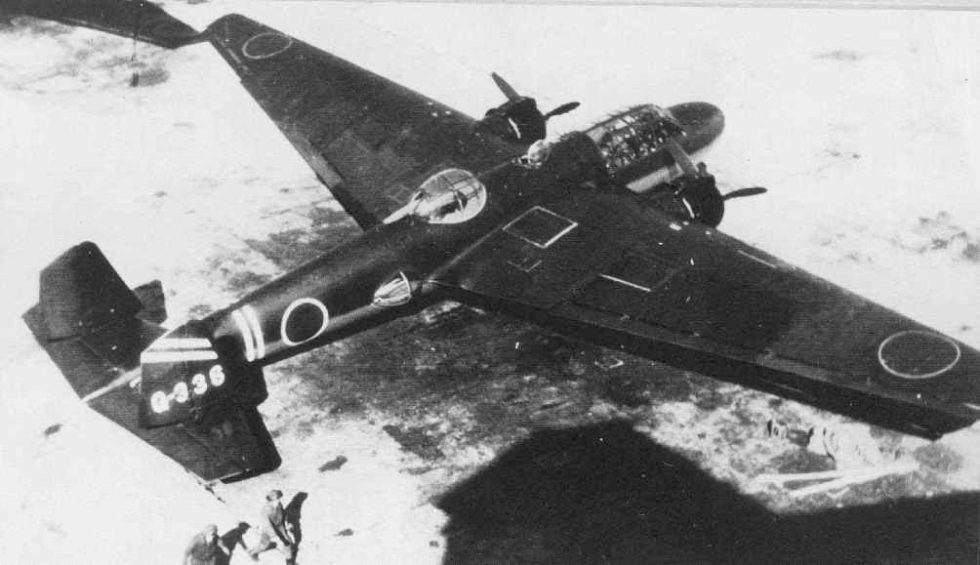
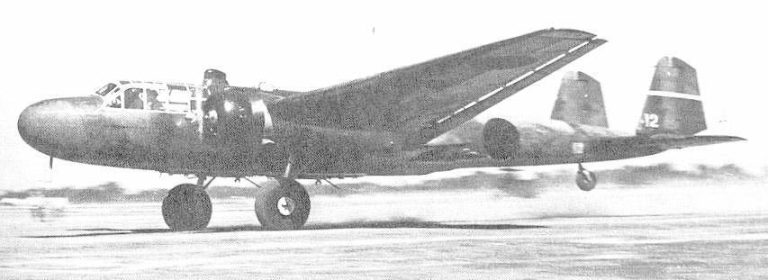
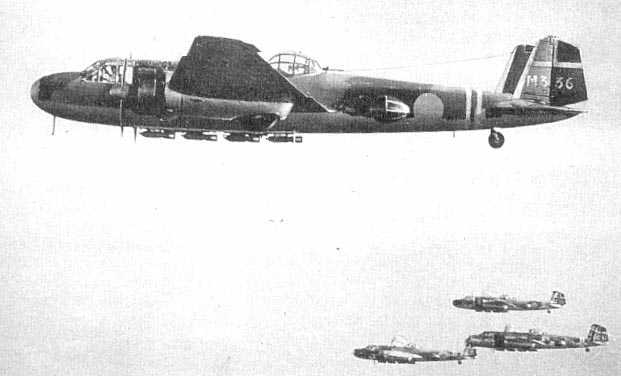
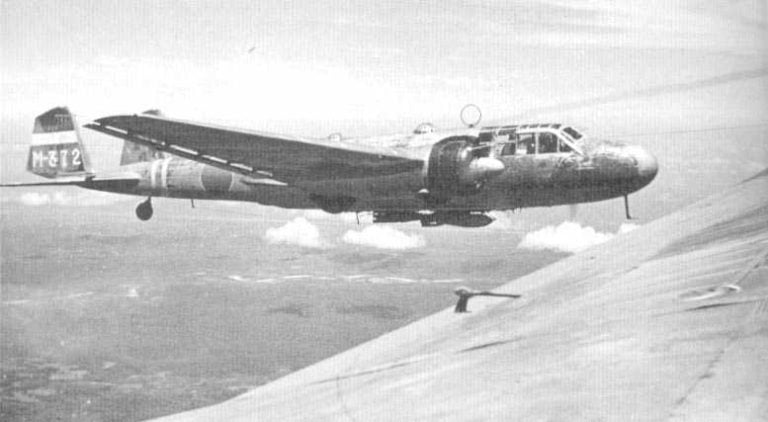
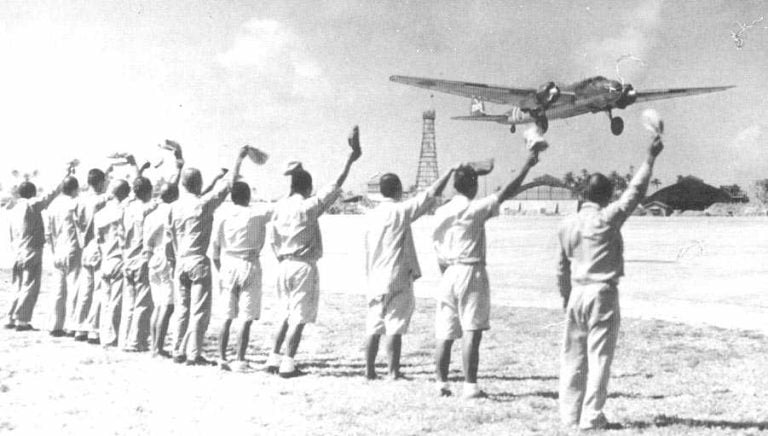
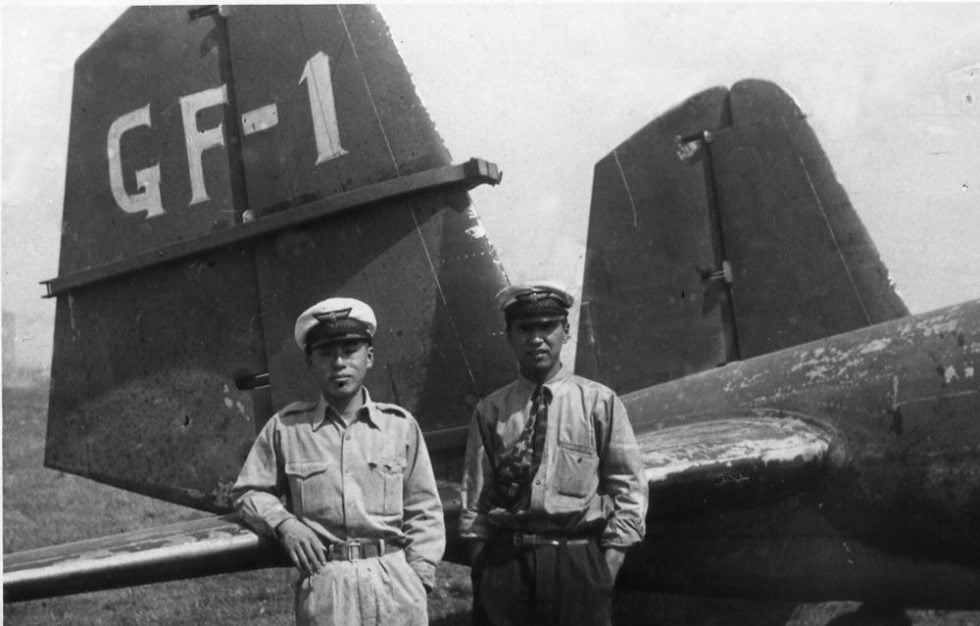
The G3M Nell in motion
History of the Mitsubishi G3M “Nell” bomber in WWII — a dedicated documentary tracing the type’s design, its pioneering trans-oceanic raids and its role in sinking Force Z. A useful visual introduction to an aircraft that is rarely filmed.
Where the G3M Nell flew
The G3M Nell’s combat record: range, torpedoes and the fall of Force Z
The G3M’s record is one of pioneering reach and a handful of history-changing strikes rather than air-to-air victories. It opened the war in China with the first over-water bombing raids ever flown, played the leading role in sinking two British capital ships off Malaya, and supported the sweep through the Philippines and the Dutch East Indies — before its own fragility and age pushed it into second-line roles.
Compare the combat record of every military aircraft. Figures are best-available estimates and are hedged where sources disagree.
Everything people ask about the Mitsubishi G3M Nell
Can I fly in a Mitsubishi G3M?
What was the Mitsubishi G3M, and why “Nell”?
What is the G3M most famous for?
How long was the G3M’s range?
Why was the Nell considered vulnerable?
How many G3M were built, and who built them?
Does any G3M Nell survive today?
You can’t fly the Mitsubishi G3M.
These, you can.
Some legends only live in museums — others are fuelled and waiting. MiGFlug has put civilians in real military jet cockpits since 2004.
 Fly the L-39 AlbatrosThe world’s most-flown jet trainer — aerobatics included
 Fly the F-104 Starfighter“The missile with a man in it”
 Fly the MiG-21The Cold War’s most-produced jet
 Fly the T-33 Shooting StarAmerica’s first jet trainer
 Fly the DH VampireA piece of early jet history
 Fly the S.211Agile Italian jet trainer
 Fly the MB-326The classic Aermacchi jet
 Fly the MiG-15The Soviet legend of the Korean War
Continue the tour
Every fact, checked
- The Pacific War Online Encyclopedia — G3M “Nell”Technical specifications, variants and service history of the Type 96 land attack aircraft.
- HistoryOfWar.org — Mitsubishi G3M “Nell”Design origin, the Kinsei-engined variants and the type’s combat career.
- Pacific Eagles — Trans-Oceanic Bombing of China, 1937Detailed account of the first over-water strategic raids and the losses the Nells suffered.
- Navy General Board — The loss of Prince of Wales and RepulseThe 10 December 1941 air attack, unit-by-unit, and the end of the battleship era.
- NavWeaps — Force Z Order of BattleBreakdown of the Japanese air strike: Genzan, Mihoro and Kanoya air groups and their aircraft.
- Pacific Wrecks — Mitsubishi G3MSurviving-airframe status: crash sites, recovered relics and the absence of a complete survivor.
- AirVectors (Greg Goebel) — The Mitsubishi G3M & G4MDevelopment narrative linking the Nell to its Betty successor.
- René J. Francillon, Japanese Aircraft of the Pacific War (Putnam) — via Naval EncyclopediaThe standard printed reference from which most G3M specifications and the ~1,048 production figure derive.