

Polikarpov I-153
“Chaika” (Seagull)
The gull-winged biplane the Soviet Union sent into a monoplane war — a nimble, retractable-gear fighter that won over Mongolia in 1939, then was slaughtered in the skies of 1941 and reborn as a rocket-armed ground-attacker.
The I-153 Chaika: a biplane born a decade too late
By the mid-1930s the fighter world was going monoplane, but the Soviet Union still believed in the biplane. Combat over Spain seemed to show that a tight-turning biplane could out-dogfight faster monoplanes, and the VVS wanted a new machine that married that agility to modern features. Nikolai Polikarpov’s answer was the I-153 — a thorough modernisation of his earlier I-15bis, first flown in 1938.
Two things set it apart. It brought back the gull-shaped upper wing of the original I-15 — the feature that gave the type its nickname Chaika, “Seagull” — for better pilot visibility and cleaner airflow. And, remarkably for a biplane, it had a manually retractable undercarriage, the wheels cranked up by hand into the fuselage to cut drag. Powered by an 800 hp Shvetsov M-62 radial and armed with four fast-firing ShKAS machine guns, it was arguably the finest biplane fighter ever built.
It was also obsolete before it was finished. The Chaika first tasted combat against Japan over the Khalkhin Gol in 1939 and did well, and it fought through the Winter War against Finland. But when Germany invaded in June 1941, roughly 1,500 I-153s were still on strength — and against the Messerschmitt Bf 109 the biplane was hopelessly outclassed. It survived by changing jobs, hanging RS-82 rockets and light bombs under its wings and going to war against tanks and troops instead of fighters.
01Why the Soviet Union built a new biplane fighter in 1938
The lesson Soviet planners took from the Spanish Civil War was ambiguous. Their monoplane I-16 was fast but tricky; the biplane I-15 could out-turn almost anything. Rather than commit fully to the monoplane, the VVS hedged — it kept developing both. The I-153 was the high-water mark of the biplane branch: gull wing, retractable gear, a more powerful engine and four machine guns. On its own terms it was excellent. The problem was strategic, not technical. While Polikarpov perfected the biplane, Germany was fielding the Bf 109, and the entire category the Chaika belonged to was becoming a dead end. By 1941 its virtues — agility, short-field performance — could not offset the brutal reality that it was 100 km/h slower than its enemies.
What makes the I-153 Chaika special
The gull wing that named it
The Chaika’s upper wing bends down to meet the fuselage in a gull shape — the feature that earned it the name Seagull. Beyond looks, the arrangement raised the wing roots clear of the pilot’s eyeline for better forward and upward visibility, and let the bracing struts be shorter and cleaner. It was a signature Polikarpov touch, carried over from the earlier I-15.
A biplane with retractable gear
Very few biplane fighters ever hid their wheels; the I-153 did. Its main undercarriage retracted by hand crank into wells in the fuselage sides, twisting flat as it came up. It was heavy, slow to operate and a workout for the pilot, but it cut drag enough to matter — a genuinely modern idea grafted onto an old-fashioned airframe.
Four guns, then rockets
The Chaika carried four 7.62 mm ShKAS machine guns, among the fastest-firing guns of their day, giving it a heavy volume of fire for a light fighter. When it was outclassed as a dogfighter it was re-roled for ground attack, carrying up to six RS-82 rockets or light bombs — one of the first fighters to fire air-to-ground rockets in anger.
02The I-153 Chaika’s engines: from the M-62 to the M-63
Most I-153s were built around the Shvetsov M-62, a two-row radial of roughly 800 hp derived from the American Wright Cyclone — the same engine family that powered the I-16. It gave the Chaika a top speed of about 425 km/h, brisk for a biplane but far short of a modern monoplane. A later batch of around 400 aircraft received the more powerful M-63 of about 1,100 hp, pushing speed closer to 440 km/h. No amount of extra power, though, could rewrite the aerodynamics of two wings and a fixed forest of struts and wires.
03Why the I-153 Chaika was obsolete against the Bf 109
The Chaika could out-turn almost anything in the sky — but in 1941 turning was no longer how air combat was won. German pilots flying the Bf 109 used energy tactics: dive from height, fire in a single fast pass, and climb away before the nimble biplane could bring its guns to bear. With a speed deficit of around 100 km/h, the I-153 could rarely force the turning fight it wanted. Thousands were destroyed in the opening months of Barbarossa, many on the ground. The survivors found a second life at low level, where their agility and rocket armament made them useful against ground targets.
Full I-153 Chaika specifications
Baseline note: the figures below describe the I-153 with the Shvetsov M-62, the mark that accounted for roughly 3,018 of the 3,437 aircraft built and the one that fought at Khalkhin Gol, over the Karelian Isthmus and through the summer of 1941. Deltas for the small first batch with the M-25V and for the some 409 machines completed with the M-63 are given in grey. Soviet performance data come from NII VVS trials on carefully finished aircraft; series machines from Zavod No. 1 in Moscow were routinely a few per cent slower, and published range figures for the type disagree by a wide margin.
Dimensions & weights
- Crew
- 1
- Length
- 6.17 m (20 ft 3 in)
- Wingspan, upper
- 10.00 m (32 ft 10 in), the centre section faired straight into the top of the fuselage with no cabane struts
- Wingspan, lower
- 7.50 m (24 ft 7 in); the cellule is markedly unequal-span, and lower-plane figures are quoted less consistently than upper
- Height
- 2.80 m (9 ft 2 in), tail down
- Wing area
- 22.14 m² (238.3 sq ft)
- Aerofoil
- Clark YH
- Wing cellule
- Single-bay braced biplane on N-form interplane struts; the upper centre section swept down into the fuselage in the shallow gull that gave the aeroplane its name
- Empty weight
- 1,452 kg (3,201 lb)
- Loaded weight
- 1,960 kg (4,321 lb) in clean fighter trim
- Maximum take-off weight
- 2,110 kg (4,652 lb) with rockets or bombs
- Wing loading
- 88.5 kg/m² (18.1 lb/sq ft) at loaded weight — low by 1940 fighter standards, and the whole basis of the type’s turn
- Power loading
- 2.63 kg/kW (4.32 lb/hp) at take-off power
- Undercarriage
- Manually retractable main legs: a cockpit handwheel and cable run drew them rearwards, the wheels rotating through 90 degrees to lie flat in the wing roots. Solid-rubber tailwheel, fixed and steered with the rudder; skis substituted in winter
Performance
- Maximum speed
- 444 km/h (276 mph) at 4,600 m (15,100 ft)
- Maximum speed, sea level
- 366 km/h (227 mph)
- Maximum speed, M-25V
- 424 km/h (263 mph) — the first production batch, and visibly short of what the design needed
- Maximum speed, M-63
- 443 km/h (275 mph) at 4,600 m; the bigger engine bought climb and low-level power, not top speed
- Cruising speed
- 297 km/h (185 mph) at 2,000 m (6,600 ft)
- Stalling speed
- 110 km/h (68 mph)
- Rate of climb
- 15 m/s (2,950 ft/min) at sea level
- Time to 5,000 m
- 6 min 24 s (to 16,400 ft), M-25V aircraft
- Time to 7,000 m
- 8 min 18 s (to 23,000 ft), M-62 aircraft
- Service ceiling
- 10,700 m (35,100 ft); early M-25V machines reached 8,700 m (28,500 ft)
- Range
- ~470 km (~290 miles). Russian sources quote up to 740 km at economical cruise, and about 50 naval aircraft carried enlarged tankage; the lower figure is the realistic combat one
- For comparison: Nakajima Ki-27
- 470 km/h (292 mph) — the fixed-undercarriage Japanese monoplane the I-153 met at Khalkhin Gol was faster and turned at least as tightly
- For comparison: Bf 109F-2
- 615 km/h (382 mph) — a deficit of roughly 170 km/h (105 mph) in June 1941, which meant the German pilot chose whether there was a fight at all
Propulsion & systems
- Engine
- 1 × Shvetsov M-62 nine-cylinder air-cooled radial, a licensed and much-developed descendant of the Wright Cyclone
- Take-off power
- 746 kW (1,000 hp); nominal rating 597 kW (800 hp) at altitude, which is the 801 hp figure repeated in many reference works
- Alternative engines
- M-25V 578 kW (775 hp) on the first batch; M-63 820 kW (1,100 hp) take-off on some 409 aircraft from 1940
- Supercharger
- Two-speed geared centrifugal — its failures held M-62 service life to 60–80 hours, and that shaped I-153 availability more than enemy action did
- Propeller
- Two-blade variable-pitch metal airscrew driven direct from the crankshaft, with no reduction gear
- Internal fuel
- ~300 l (~66 imp gal) in a single unprotected fuselage tank immediately ahead of the cockpit; no provision for drop tanks
- Fire protection
- None. No firewall separated tank from pilot, and air drawn through the open wheel wells fed any fire straight back into an open cockpit — the defect identified at Khalkhin Gol in 1939 and never rectified in production
- Structure
- Welded chrome-molybdenum steel tube fuselage truss, duralumin skin forward and fabric aft; wooden wings, fabric covered; duralumin tail surfaces, fabric covered
- Cockpit
- Open, behind a small windscreen. No canopy was fitted to any production I-153, and the gull centre section was adopted partly to open up the view forward and upward over the nose
- Gunsight
- OP-1 telescopic tube on earlier aircraft, PBP-1A reflector sight on later ones
- Radio
- RSI-3 and RSI-4 HF sets on a minority of airframes, generally flight and squadron leaders; most pilots flew on hand signals and wing-rocking
- Protection and stores fit
- No armour plate and no self-sealing tank. Roughly 400 aircraft received steel reinforcing plates under the lower wing for rocket rails
04The I-153 Chaika’s cost: why no reliable figure exists
The I-153 was built in Soviet state factories and never sold on an open market, so there is no meaningful flyaway unit price and no credible cost-per-flight-hour figure in the public record. Wartime Soviet production was measured in plan targets and raw-material allocations, not dollars. Any precise price attached to a Chaika today is an estimate or a conversion exercise, not a sourced number — which is why we list both cost rows as unknown rather than invent a figure.
Armament & payload
The I-153 carried four of the fastest-firing rifle-calibre guns in the world, and they were still not enough
Four synchronised 7.62 mm ShKAS in the upper forward fuselage threw about 120 rounds a second between them, which sounds formidable and was not: the total weight of fire was a little over a kilogram per second of rifle-calibre bullet, adequate against fabric and unarmoured structure and visibly inadequate against the armour and self-sealing tanks that German bombers carried by 1941. Polikarpov and the VVS knew it, and the answers — a 12.7 mm Berezin fit on about 150 aircraft, two 20 mm ShVAK on eight — came too late and in numbers too small to change anything. What did change the aeroplane was the RS-82 rocket: from 1940 some 400 airframes were plated under the lower wings for eight of them, and that turned an outclassed fighter into a usable close-support machine, which is how most I-153s were expended. Gun and ammunition fits varied between production batches and between operators, and the Chinese, Finnish and captured German airframes were not uniformly maintained to Soviet standard.
Gun
- 4 × 7.62 mm ShKAS machine guns, all four synchronised to fire through the propeller disc from the upper forward fuselage decking
- 2,600 rounds in total, about 650 per gun — roughly 20 seconds of continuous fire from the whole battery
- Cyclic rate about 1,800 rounds per minute per gun, the fastest rifle-calibre aircraft gun of its generation; the ShKAS was correspondingly sensitive to synchronisation gear and to poor ammunition, and stoppages were common
- I-153BS: about 150 aircraft completed at Zavod No. 1 in 1940 with heavy-calibre Berezin guns. Sources differ on the fit — some describe a single 12.7 mm gun (development designation TKB-150) in the fuselage with two ShKAS in the wings, others a four-gun heavy battery.
- I-153P: two synchronised 20 mm ShVAK cannon, eight aircraft only. It was the one genuinely dangerous I-153, and it was built in numbers that could not matter
Air-to-air
- Guns, and from 1940 the RS-82 rocket. No guided air-to-air weapon existed in any air force during the type’s service life
- Guns were harmonised at around 400 m in VVS practice of the period, a convergence that suited the close-in turning fight the aeroplane was designed to win
- On the first air-to-air rocket kills, be exact: on 20 August 1939 at Khalkhin Gol a flight of Polikarpov I-16s led by Captain N. Zvonarev claimed Japanese aircraft with RS-82s, the first known instance anywhere. Zvonarev’s group is credited with 16 fighters and 3 bombers over the campaign
- The I-153 carried the same rocket and fought in the same battle, but the milestone belongs to the I-16. Claims that the Chaika fired the first air-to-air rockets conflate the two Polikarpov types
- The type’s real air-to-air asset was its turn. Against the Ki-27 in 1939 that advantage was already marginal; against the Bf 109F in 1941 it was irrelevant, because a faster aeroplane declines the turning fight.
Air-to-surface guided
- None, and the card is kept because the absence describes the job: everything the I-153 did against ground targets it did by flying into the target’s own defensive envelope
- Guided air-to-surface weapons reached no air force until well after the last I-153 had left front-line service
- Attack meant a shallow dive with rockets, small bombs and four rifle-calibre guns, at heights and speeds where German light flak was thoroughly effective
- Ground-attack sorties in 1941–42 cost the type more aircraft than air combat did, and that was understood at the time and flown anyway
- Soviet claims for rocket and bomb effect in 1941 rest on pilot reports and cannot be reconciled airframe-for-airframe with German loss returns.
Bombs
- Up to 200 kg (441 lb) on four underwing racks; the usual fits were 4 × FAB-50 or 2 × FAB-100
- Smaller anti-personnel loads such as the AO-25 and AO-10 were common on close-support work against columns and troop concentrations
- VAP-6M spray containers and ZAP-6 incendiary containers for smoke, incendiary and chemical work
- Containers for AZh-2 spheres of KS self-igniting liquid were used on Soviet ground-attack types in 1941 and appear in some I-153 unit records
- Bomb fits were largely unit-level practice; there is no single official loadout table for the type, and photographs are often the only evidence for a given combination.
Rockets
- 8 × RS-82 82 mm unguided rockets, four rails under each lower wing, on some 400 aircraft fitted with steel reinforcing plates from 1940
- RS-82: about 6.8 kg all-up with roughly 0.45 kg of explosive, burnout speed about 340 m/s. Quoted maximum range runs to several kilometres; useful aiming range was a small fraction of that
- Fired singly, in pairs or as a full salvo. Dispersion was wide enough that against a point target the RS-82 was a weapon of hope rather than of arithmetic
- Against columns, soft-skinned vehicles, parked aircraft and troops in the open the salvo effect was real, and it is what kept the I-153 employable into 1942
- The rails and rockets cost speed. A rocket-armed Chaika struggled to hold 400 km/h, which mattered a great deal when it had to get home
Pods & other stores
- Retractable skis in place of wheels for winter operations — a fit that cost speed and kept the type flying from snow and ice when better aeroplanes were grounded
- No drop tanks were ever fitted; the combat radius was whatever the single fuselage tank allowed, and it was short
- Camera gun provision for gunnery training and the assessment of claims
- I-153Sh and I-153USh ground-attack conversions with underwing containers for small bombs and grenades
- Experimental only: the I-153DM carried two Merkulov ramjets beneath the lower wings, flown about 20 times from October 1940. The DM-4 units added as much as 51 km/h when lit and cost drag whenever they were not
Three typical loadouts
- Fighter sortie, Khalkhin Gol, July 1939
- Four ShKAS with 2,600 rounds, nothing external, and the undercarriage deliberately left down on the run-in so that Japanese pilots would take the aircraft for a fixed-gear I-15bis. About 1,960 kg loaded. The deception worked on 7 July and did not work again.
- Interception on skis, Karelian Isthmus, winter 1939–40
- Guns and full ammunition, skis in place of wheels, and a radio only in the leader’s aircraft. The ski fit cost perhaps 20–30 km/h against an already thin margin, but it was the difference between flying and not flying from frozen forward strips.
- Ground attack, western front, summer 1941
- Eight RS-82 under the lower wings with full gun ammunition, or two FAB-100 in their place; roughly 2,110 kg at take-off. Flown at low level against columns and bridgeheads, usually without escort, and this is the loadout in which most surviving I-153s were finally used up.
Sourcing caveat: Soviet armament records for the I-153 are batch-level rather than airframe-level, and the standard reference works disagree on ShKAS ammunition capacity, on the exact I-153BS gun fit and on how many aircraft were plated for rockets. Figures given here follow the most widely corroborated accounts; where they conflict, the conflict is stated rather than averaged.
Variants
Every I-153 variant was an attempt to make a 1933 layout do 1941 work
The I-153 was the third and last member of a family that began with the I-15 of 1933: a stubby, gull-winged biplane with a Wright-derived radial, superb in a turn and obsolete almost at once. The I-15bis of 1937 traded the gull for a conventional straight centre section on cabane struts, because VVS pilots had complained that the gull hurt the view and directional stability. Polikarpov put the gull back on the I-153 and added the one thing no other biplane fighter of the period had in quantity — retractable undercarriage — because a July 1937 meeting chaired by Stalin had concluded, from Spanish Civil War reports, that the Fiat CR.32 biplane had the better of the I-16 in a turning fight, and that the answer was a faster biplane rather than a better monoplane.
That conclusion was the wrong lesson drawn from the right data. The CR.32 did beat the I-16 in a turn; what the meeting missed was that a turning fight is one the faster aeroplane need not accept. Every subsequent I-153 variant is an attempt to buy back the margin the layout could not provide: more power, then turbochargers, then a pressure cabin, then ramjets. None of it worked, because the drag of two wings, their bracing and their interference set a ceiling that no engine available to Polikarpov could break through. The line ended with the I-190, and the VVS did not order another biplane fighter.
- I-15bis / I-152 (1937–39, 2,408 built)
- The direct predecessor: gull deleted in favour of a straight upper centre section on cabane struts, M-25V engine, four PV-1 guns, fixed undercarriage. Slower than the I-153 and much more numerous in 1939 than the VVS wanted to admit.
- I-153 M-25V (1939, small first batch)
- The gull restored and the undercarriage made to retract by handwheel; 775 hp and 424 km/h. Enough to prove the concept, not enough to justify it. First flight of the prototype was in 1938 with A. I. Zhukov at the controls; sources give May or August.
- I-153 M-62 (1939–40, ~3,018)
- The standard aircraft and effectively the only one that mattered: 1,000 hp for take-off, 444 km/h, four ShKAS, and from 1940 the rocket plates. Every combat description in this article refers to it unless stated otherwise.
- I-153 M-63 (1940–41, ~409)
- 1,100 hp for take-off. Better climb and better low-level performance, no meaningful gain in top speed, and a shorter engine life. The clearest possible demonstration that the airframe, not the engine, was the limit.
- I-153BS and I-153P (1940, ~150 and 8 built)
- The heavy-gun answers. The BS substituted 12.7 mm Berezin guns for part of the ShKAS battery; the P carried two synchronised 20 mm ShVAK. Both were the right idea, and both arrived after the type’s value as a fighter had gone.
- I-153TK, I-153V (GK) and I-153V-TKGK (1940, 20 TK plus single prototypes)
- Altitude experiments: TK-3 turbochargers on twenty production aircraft, then a pressure cabin, then both together. The pressure cabin worked; the performance penalty made a high-altitude biplane interceptor pointless.
- I-153UD (1940, prototype only)
- Wooden monocoque rear fuselage in place of the steel-tube truss, to conserve scarce strategic metal. It flew and was not produced, but the reasoning behind it explains a great deal about Soviet aircraft of 1941.
- I-153Sh and I-153USh (1940–41, conversions)
- Ground-attack fits with underwing containers for small bombs and grenades. Formalised at factory and unit level what the front was already doing with the type.
- I-153DM (1940–41, trials only)
- Two Merkulov ramjets under the lower wings, about 20 flights from October 1940. The DM-4 gave as much as 51 km/h with the ramjets burning; the drag when they were not burning ate most of the gain. A genuinely early piece of ramjet flight testing, on entirely the wrong aeroplane.
- I-190 and I-195 (1939–41, one flown)
- The intended successor: a strengthened, cleaned-up gull biplane around the M-88 radial. The I-190 first flew on 30 December 1939 and was destroyed in a crash on 13 February 1941; the I-195 was never completed. That is where the Soviet biplane fighter ends.
- Export and captured designations (1940–44)
- No licence production abroad. Ninety-three aircraft were delivered to China in the first half of 1940 and formed three groups for the air defence of major cities, where most were lost to Japanese fighters and bombers. Finland operated 21 — captured airframes plus eleven bought from Germany, of which ten were delivered — on serials IT-11 to IT-31, flying them with 3/LeLv 6 from Römpötti on the Karelian Isthmus and claiming at least five victories. Germany evaluated captured examples and used a handful for training and liaison.
Survivors, stated precisely, because the flying aircraft are widely and wrongly described as restorations. Four complete airframes are known. Only one is substantially original: c/n 7277, on static display at the Musée de l’Air et de l’Espace at Le Bourget and under long-term restoration by the Memorial Flight association. The three airworthy machines — c/n 6316 at the Military Aviation Museum, Virginia Beach (N153RP), c/n 7027 with the Fundació Parc Aeronàutic de Catalunya at Sabadell (EC-LJL) and c/n 6326 in the Vadim Zadorozhny collection near Moscow (RA-1562G, flown as Red 10) — all originate in the same programme: wrecks recovered from crash sites in the Murmansk and Karelia regions in the early 1990s and rebuilt by Aviarestavratsia in Novosibirsk under contract to Tim Wallis’s Alpine Fighter Collection in New Zealand, three I-153s and six I-16s being completed by 1999. They are new-build structures assembled around recovered original components and identities rather than restored original aeroplanes, and none of them uses an original engine: all fly on geared ASh-62IR radials, where the wartime M-62 and M-63 drove their propellers direct, which alters the propeller, the nose contours and the sound. That is worth knowing before believing any photograph.
From Spanish lessons to the Eastern Front
The gull-wing ancestor
Polikarpov’s I-15 biplane, with its distinctive gull upper wing, enters Soviet service and later fights in Spain.
Spanish lessons
Combat over Spain convinces Soviet planners that an agile biplane still has value — and prompts a modernised successor.
First flight
The I-153 flies for the first time and enters production — gull wing, retractable gear and four ShKAS guns.
Khalkhin Gol
The Chaika makes its combat debut against Japan over the Mongolian border, holding its own in fierce dogfights.
The Winter War
I-153s fight over Finland; Finnish forces later capture and operate around 21 of the type themselves.
Barbarossa
Roughly 1,500 Chaikas face the German invasion. Outclassed by the Bf 109, many are destroyed in the first weeks.
Rockets and ground attack
Survivors switch to low-level ground attack with RS-82 rockets; China had already received around 93 aircraft.
Recovered and restored
Airframes pulled from Russian lakes and swamps are rebuilt to fly — several in New Zealand — and put on museum display worldwide.
From dogfight to ground attack: twelve I-153 Chaika stories
The biplane that refused to die
Spanish combat convinced the Soviets to build one more biplane fighter — the best one yet.
Read the full story
Why they called it Seagull
The bent-down upper wing gave the fighter its nickname: Chaika, the Russian word for seagull.
Read the full story
Cranking up the wheels
Unusually for a biplane, the I-153 hid its landing gear — by hand.
Read the full story
Debut against Japan
Over the Mongolian steppe in 1939 the Chaika met the Japanese air force and gave a good account of itself.
Read the full story
The retracting-gear ruse
Soviet pilots are said to have baited enemies by lowering their gear like a slower, older biplane.
Read the full story
Fighting over Finland
The Chaika flew against Finland in 1939–40, in a war that would later see Finns flying the type themselves.
Read the full story
Massacre at dawn
On 22 June 1941 hundreds of Chaikas were caught and destroyed, many still on the ground.
Read the full story
From fighter to tank-buster
Outclassed in the air, the Chaika found a second career firing rockets at ground targets.
Read the full story
The Chaika goes east
Around 93 I-153s were supplied to China to fight the Japanese.
Read the full story
Cannon, floats and more
The Chaika spawned experiments from 20 mm cannon to a turbo-supercharged high-flyer.
Read the full story
Buried in the lakes
For decades the Chaika survived only where it had crashed — at the bottom of Russian lakes and bogs.
Read the full story
Seagulls fly again
A handful of rebuilt Chaikas fly at airshows, and museums preserve others around the world.
Read the full story
The I-153 Chaika in pictures


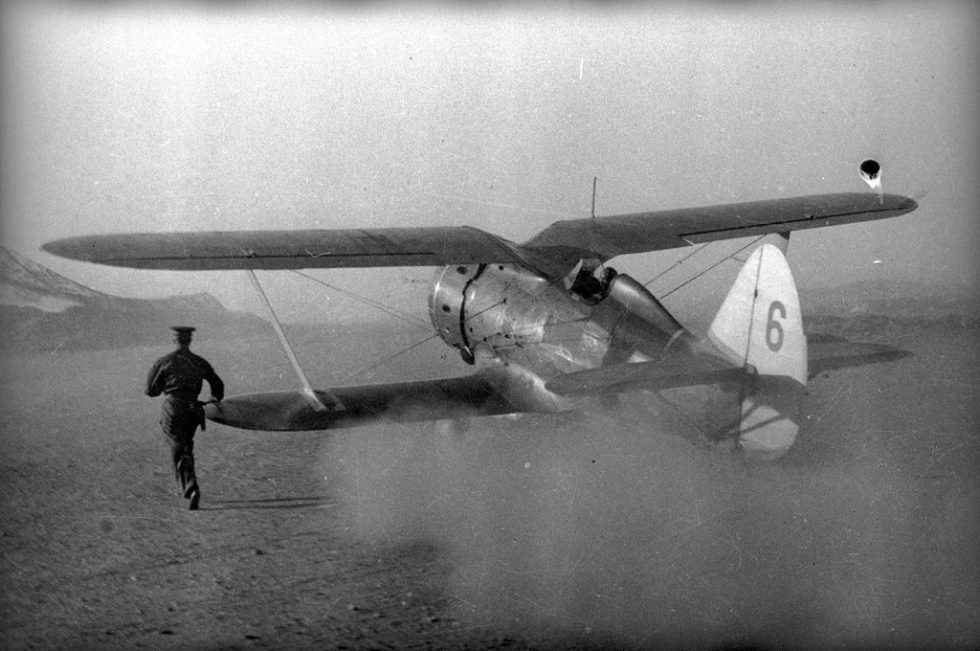
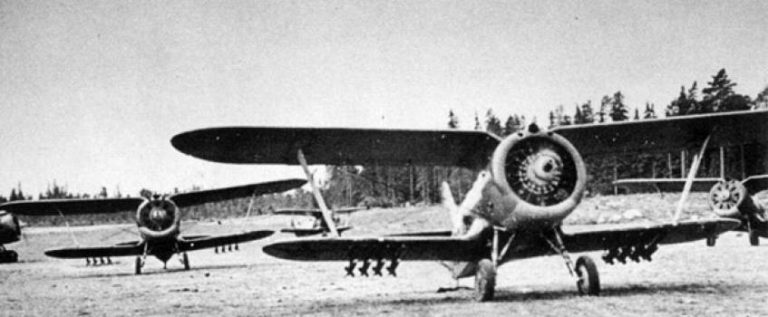
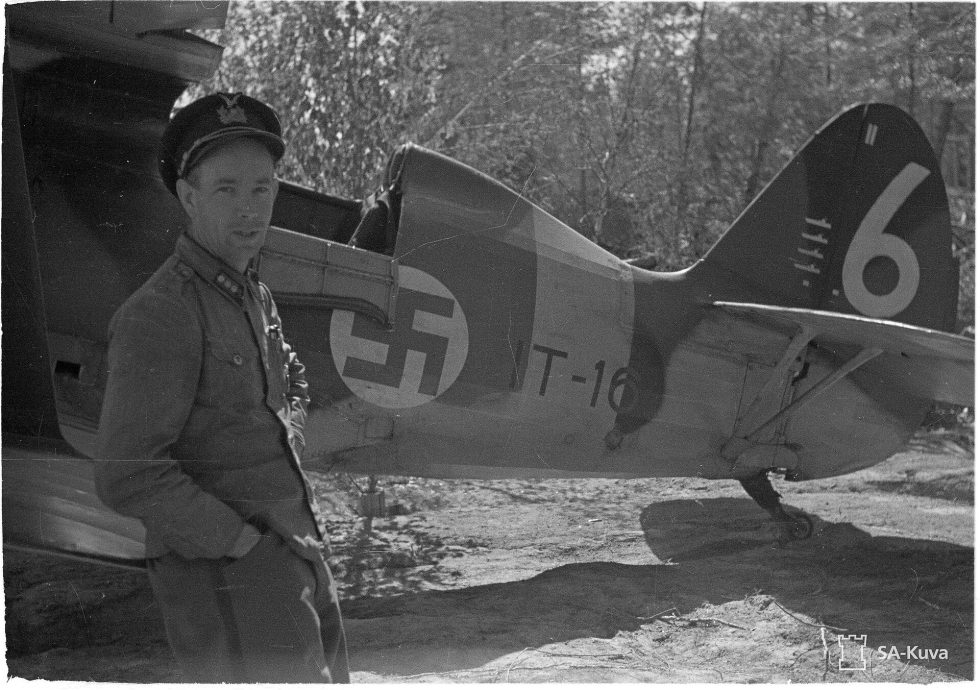
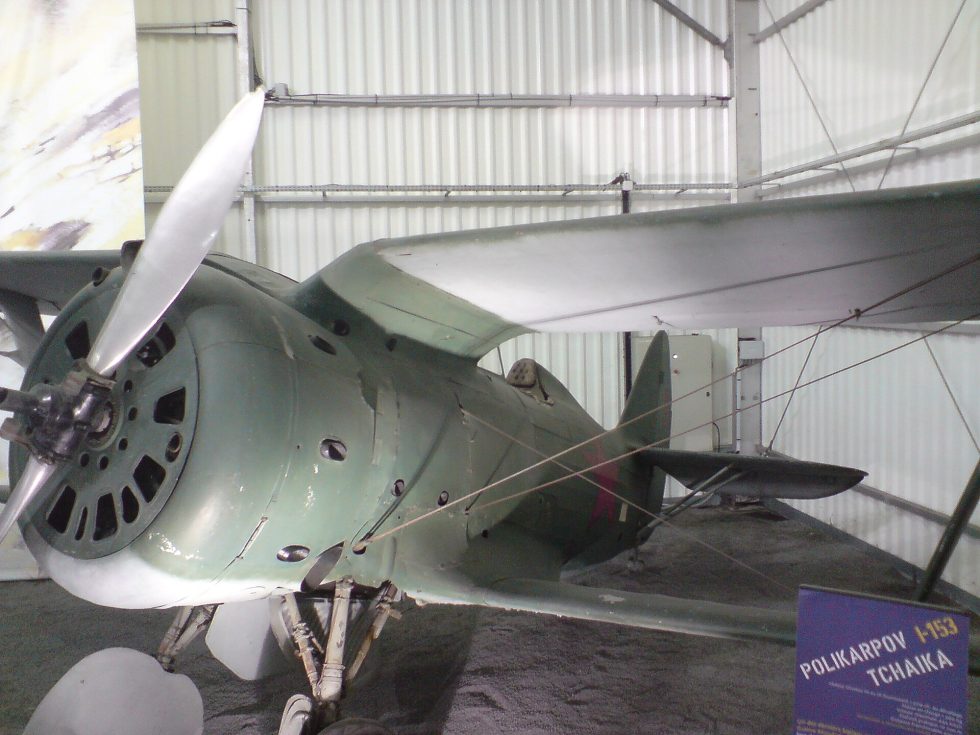
The I-153 Chaika in motion
A short history of the Polikarpov I-153 Chaika — its gull wing and retractable gear, its combat debut against Japan, and its hard war on the Eastern Front.
Where the I-153 Chaika flew
The I-153 Chaika’s combat record
The Chaika’s war splits neatly in two. As a fighter it peaked early — holding its own against Japan over Khalkhin Gol in 1939 and fighting through the Winter War — then was overwhelmed in 1941 by faster German monoplanes. As a ground-attack aircraft it soldiered on, one of the first fighters to fire salvoes of rockets at ground targets.
Compare the combat record of every military aircraft. Contemporary loss figures for 1941 are estimates and vary between sources.
Everything people ask about the I-153 Chaika
Can I fly in a Polikarpov I-153 Chaika?
What does “Chaika” mean?
Was the I-153 any good in combat?
Why did it have retractable landing gear?
How many I-153s were built?
Who else flew the Chaika besides the USSR?
Are any I-153s still flying today?
You can’t fly the I-153 Chaika.
These, you can.
Some legends only live in museums — others are fuelled and waiting. MiGFlug has put civilians in real military jet cockpits since 2004.
 Fly the L-39 AlbatrosThe world’s most-flown jet trainer — aerobatics included
 Fly the F-104 Starfighter“The missile with a man in it”
 Fly the MiG-21The Cold War’s most-produced jet
 Fly the T-33 Shooting StarAmerica’s first jet trainer
 Fly the DH VampireA piece of early jet history
 Fly the S.211Agile Italian jet trainer
 Fly the MB-326The classic Aermacchi jet
 Fly the MiG-15The Soviet legend of the Korean War
Continue the tour
Every fact, checked
- History of War — Polikarpov I-153 ChaikaProduction totals, engine variants, armament and combat history including Khalkhin Gol and Barbarossa.
- Military Aviation MuseumRestored airframe s/n 6316 recovered near Murmansk; Finnish capture and operation of the type.
- Military FactoryGeneral specifications, dimensions and variant summary for the I-153.
- Silver WingsDesign background, the gull wing and retractable undercarriage, and service use.
- VVS Air WarSoviet Air Force operational history and the Eastern Front ground-attack role.
- Aeropedia — Encyclopedia of AircraftDevelopment lineage from the I-15 and I-15bis and technical detail.
- Fédération Aéronautique InternationaleReference for aviation records and period performance context.