
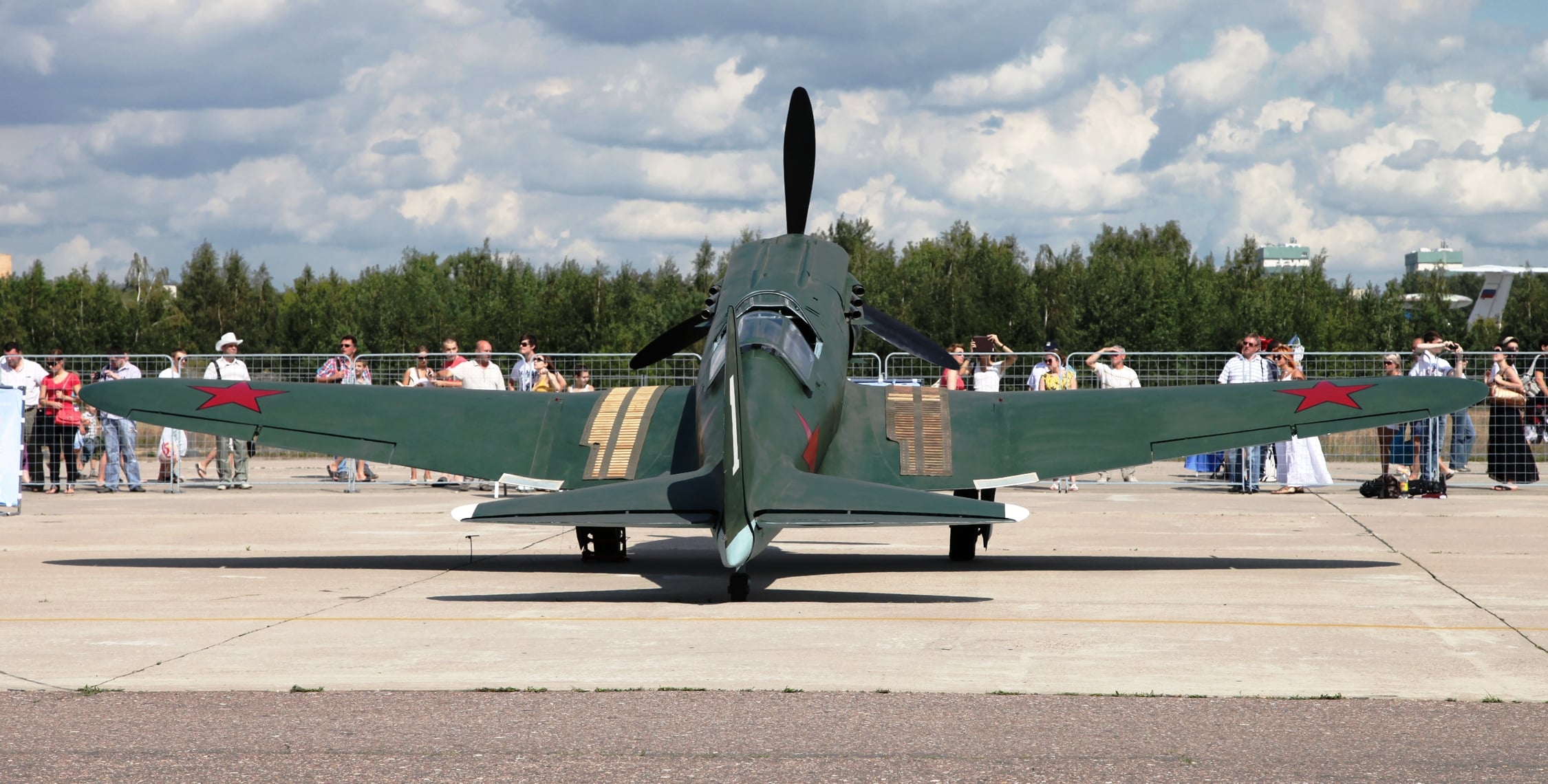
Mikoyan-Gurevich MiG-3
Soviet High-Altitude Interceptor
The fastest Soviet fighter of 1941 — a thoroughbred built to kill high-flying intruders, lethal above 4,000 m and a handful for green pilots down low, where the Eastern Front was actually fought.
The MiG-3: a stratosphere fighter thrown into a low-altitude war
In the late 1930s Soviet air planners wanted a fast interceptor that could catch high-flying bombers and reconnaissance aircraft over the homeland. The job went to a brand-new design office — the OKO at Moscow’s State Aircraft Factory No. 1 — led by two men whose initials would define a dynasty: Artem Mikoyan and Mikhail Gurevich. Working at speed, they wrapped an airframe around the biggest inline engine the USSR had, the Mikulin AM-35A, and produced the I-200. It first flew in the spring of 1940 and was, on paper, the fastest fighter in the Soviet inventory.
The first version, the MiG-1, was a dangerous animal — fast but unstable, with a short range and a reputation for biting inexperienced pilots. A revised model fixed the worst of it: the engine was moved forward, the wing gained dihedral, an extra fuel tank went in behind the pilot, and the canopy was reworked for a better view. That aircraft, heavier but far more usable, became the MiG-3. Its party trick was altitude: the AM-35A’s large supercharger kept the power up high, so above roughly 7,000–8,000 metres the MiG-3 was in its element, reaching about 640 km/h where rival fighters were gasping.
The problem was the war it actually got. When Germany invaded on 22 June 1941, the MiG-3 was the most numerous of the new-generation Soviet fighters — but most air combat on the Eastern Front happened low down, escorting or attacking troops, tanks and airfields. Down there the heavy, altitude-tuned MiG-3 was sluggish and unforgiving. One pilot called it, flatly, “a cow.” Worse, there were far more airframes than trained pilots to fly them, and many were destroyed on the ground in the first catastrophic days.
So the MiG-3 found its true calling not at the front but in home air defence — the PVO — guarding Moscow and Leningrad against high-flying intruders, exactly the mission it had been designed for. Its most famous pilot, Aleksandr Pokryshkin, cut his teeth on it in the opening days of the war before becoming the Soviet Union’s second-highest-scoring ace on later types. But the MiG-3’s fate was sealed by its engine: the AM-35 production line was needed to build the AM-38 for the Il-2 Sturmovik ground-attack aircraft, the machine Stalin wanted above all others. In late 1941 MiG-3 production was ordered to stop. Without an engine, the high-altitude falcon had no future.
01The MiG-3’s fatal compromise: a high-altitude fighter in a low-altitude war
Every strength of the MiG-3 pointed upward. The Mikulin AM-35A was geared with a large supercharger to hold its power at height, and the airframe carried a relatively high wing loading that made it stable and fast at altitude. Above about 7,000 metres it could out-run and out-climb the fighters sent against it. But that same recipe made it heavy, slow to accelerate and hard to turn down low — and it demanded a smooth, experienced hand.
The tragedy was that the 1941 air war was overwhelmingly a low-altitude war of close support: attacking columns, covering the retreat, dueling with Bf 109s a few thousand metres up. There the MiG-3 was outclassed, and it was handed to young conscript pilots with only a handful of flying hours. The aircraft that was superb where the fighting was not, and mediocre where it was, ended the year with the highest loss count of any Soviet fighter type.
What makes the MiG-3 special
An engine tuned for thin air
The heart of the MiG-3 was the Mikulin AM-35A, a liquid-cooled 60° V-12 of about 46.7 litres giving roughly 1,350 hp (sources vary, ~1,332–1,350 hp). Its large, high-boost supercharger kept power alive at altitude, so the fighter peaked around 7,000–8,000 m. The same big supercharger made the engine heavy and thirsty down low — strong exactly where the war mostly was not.
Fast, but lightly armed
Standard armament was modest: one 12.7 mm Berezin UBS and two 7.62 mm ShKAS machine guns, all cowling-mounted. Pilots widely judged it too light to down a bomber quickly. Field and factory kits added underwing 12.7 mm UBK gun pods, six RS-82 rockets or light bombs, and a few aircraft trialled 20 mm ShVAK cannon.
A demanding thoroughbred
High wing loading gave speed and stability at height but a tricky character near the ground: a sharp stall, an unforgiving spin and heavy controls. In skilled hands above 4,000 m it was formidable; in the hands of a barely-trained 1941 recruit it could be lethal to its own pilot. Pokryshkin likened it to a hot-tempered horse that rewarded a strong rider.
02The MiG-3’s MiG-1 origins: fixing a dangerous prototype
The MiG-3 was a rescue job on the MiG-1. Flight testing had shown the first model to be fast but directionally unstable, short on range and prone to vicious behaviour at the edge of the envelope. The fixes were methodical: the engine was shifted about 100 mm forward to improve longitudinal stability, the outer wings gained a degree of dihedral for lateral stability, a roughly 250-litre fuel tank was added under the seat to stretch the range, the radiator and oil systems were reworked, the cockpit glazing was enlarged for a better rearward view, and armour and ammunition were increased. The cost was about 250 kg of extra weight, which slightly dulled the climb and the ceiling — the price of making the design usable.
03The MiG-3’s guns: why Soviet pilots wanted more
Firepower was the MiG-3’s weakest suit. A single heavy Berezin and two rifle-calibre ShKAS were adequate against a fighter but slow to bring down a well-built bomber, the very target the interceptor existed to kill. Units improvised: some aircraft carried a pair of underwing UBK heavy machine-gun pods, others were fitted for RS-82 rockets or small bomb loads for ground attack, and a handful were tested with 20 mm ShVAK cannon. None of the fixes fully solved the problem before the type left the assembly line.
Full MiG-3 specifications
Baseline note: the figures below describe the standard production MiG-3 of 1941 as accepted at the NII VVS — the three-gun nose battery of two 7.62 mm ShKAS and one 12.7 mm BS, Mikulin AM-35A, no external stores. That aircraft accounted for 1,976 of the 3,172 built. Deltas for the MiG-1, for the five-gun aeroplane with underwing BK pods, for the 52 cannon-armed machines of the 34th series and for the I-230/MiG-3U are in grey. One warning runs through the whole table: the speeds quoted in almost every reference are those of the hand-finished reference machine. Soviet factory acceptance records for series aircraft give 462–472 km/h at sea level and 603–621 km/h at altitude, 20 to 40 km/h down on the book, and that gap is the difference between the aeroplane on paper and the one the regiments flew.
Dimensions & weights
- Crew
- 1
- Length
- 8.25 m (27 ft 1 in); the 1941 VVS Academy manual gives 8.255 m measured in the flying attitude. A long-fuselage "MiG-3ud" of 8.45 m appears in older Russian literature; modern researchers dispute that it ever existed
- Wingspan
- 10.2 m (33 ft 6 in) — unchanged from the MiG-1 and from the I-200 prototypes
- Height
- 3.325 m (10 ft 11 in)
- Wing area
- 17.44 m² (187.7 sq ft) — a small wing on a heavy aeroplane, which is the root of most of what follows
- Aspect ratio and aerofoil
- 5.97; Clark YH, 14 per cent at the root tapering to 8 per cent at the tip, set at +1° incidence with 6° of dihedral on the outer panels (one degree more than the MiG-1, added to buy back lateral stability)
- Undercarriage track
- 2.8 m (9 ft 2 in), on 650 × 200 mm (25.6 × 7.9 in) semi-balloon wheels with pneumatic bag brakes
- Empty weight
- 2,699 kg (5,950 lb); MiG-1 2,602 kg (5,736 lb), I-230 2,627 kg (5,791 lb)
- Normal loaded weight
- 3,355 kg (7,397 lb) with the three-gun battery; 3,510 kg (7,738 lb) with the two underwing BK guns fitted; 3,718 kg (8,196 lb) at overload with the full gun fit and 200 kg of bombs. The MiG-1 grossed 3,099 kg, so the MiG-3 bought its range with roughly 250 kg of added weight
- Wing loading
- 192 kg/m² (39.4 lb/sq ft) at normal loaded weight, rising to 201 kg/m² (41.2 lb/sq ft) with the wing guns. The 155 kg/m² printed in some widely reproduced English-language tables is the empty weight divided by the wing area and should be disregarded; Russian sources give 192 kg/m². Against roughly 160 kg/m² for a Bf 109F-2, this is why the MiG turned badly
- Power loading
- 2.49 kg/hp (5.48 lb/hp) on take-off power, against about 2.1 kg/hp for the Bf 109F-2 — a fifth worse, and no supercharger gearing can hide that below 5,000 m
- Internal fuel
- 640 l (~141 imp gal), 463 kg (1,021 lb) of leaded B-78, in four protected welded tanks: two of 140 l in the centre section, 110 l ahead of the cockpit and 250 l beneath the pilot behind the radiator. From 10 May 1941 the lower tank was cut to 140 l to move the centre of gravity forward; there was no automatic fuel-management gear and the pilot switched tanks by hand.
- Structure
- Mixed, and deliberately so to spare light alloy: a welded chrome-molybdenum steel truss forward under five quickly removable duralumin panels, an all-metal centre section, a wooden semi-monocoque rear fuselage of six layers of 0.5 mm birch veneer on casein glue, wooden outer panels with a delta-drevesina box spar and bakelite ply skin, a metal tailplane, a wooden fin built integral with the fuselage and fabric-covered control surfaces. Wooden aircraft parked in the open in the rain came apart: the ply skin unglued from the airframe, and most Soviet fighter regiments had nothing but open fields.
Performance
- Maximum speed, sea level
- 495 km/h (308 mph) for the reference aircraft; series machines measured 462–472 km/h (287–293 mph). Many English tables print 505 km/h (314 mph), which is an optimistic reading of the same trials. A Bf 109F-2 did 515 km/h (320 mph) down here
- Maximum speed at altitude
- 640 km/h (398 mph) at 7,800 m (25,590 ft) for the reference aircraft; 603–621 km/h (375–386 mph) for production examples. The Bf 109F-2 managed 615 km/h and a Spitfire V 603 km/h, so on its own ground the MiG really was the faster aeroplane
- Where the advantage lived
- Above roughly 5,000 m (16,400 ft), and only there. Below it the speed margin vanished and then reversed. Almost all air fighting on the Eastern Front happened below 5,000 m, which is the central fact of this aircraft’s career
- Dive limit
- 645 km/h (401 mph) indicated, an airframe-strength restriction rather than a handling one — low for a fighter whose only reliable tactic was to convert height into speed
- Landing speed
- 144.5 km/h (90 mph) with the Northrop-Schrenk flaps at 50°, against about 110 km/h for the I-16 the squadrons had come from. Take-off flap was 20°
- Time to 5,000 m (16,400 ft)
- 6.5 minutes
- Time to 8,000 m (26,250 ft)
- 10 min 17 s. State trials found the MiG-3 needed over a minute longer to 5,000 m than the lighter MiG-1 — the price of the extra fuel.
- Service ceiling
- 11,500 m (37,730 ft) on state trials; the 1941 service manual quotes 11,800 m (38,715 ft) and English sources round up to 12,000 m. In 1943 the NII VVS stripped a MiG-3 to 3,098 kg (6,830 lb) and took it to 11,750 m (38,550 ft).
- Time for a full turn
- 25–26 s at 4,000 m (13,120 ft), and 2–3 s better once the rear tank was reduced. A Bf 109F needed around 20 s. The MiG could not win a turning fight and its pilots were told not to try
- Range
- 820–857 km (510–533 miles) at 7,860 m on state trials with a 10 per cent fuel reserve. The specification demanded 1,000 km; Mikoyan and Gurevich flew two production aircraft over 1,100 km and 971 km routes in April 1941 to argue the point, and the head of the NII VVS, Major General A. I. Filin, was tried and shot on 31 May 1941 partly over this dispute.
- Take-off and landing run
- 347 m (1,139 ft) and 410 m (1,345 ft) — long for a 1941 fighter, and long enough to matter on the improvised strips of the retreat
- Handling
- Rearward centre of gravity, heavy elevator, poor longitudinal stability, a vicious tip stall and a spin that was hard to recover. Automatic leading-edge slats went into production from 10 July 1941 and improved matters. The stock verdict inside the VVS was that the MiG made an experienced pilot average, an average pilot inexperienced, and a novice a passenger; on 10 April 1941 three pilots of the 31st IAP PVO chasing a German reconnaissance aircraft at 9,000 m over Kaunas all spun in, and one was killed.
Propulsion & systems
- Engine
- One Mikulin AM-35A, a 60° liquid-cooled V-12 with a single-speed geared centrifugal supercharger using variable-incidence inlet vanes. Derived from the AM-34FRN; 4,659 AM-35 and AM-35A engines were built in all. The aircraft had been designed around the more powerful AM-37, which never became reliable.
- Capacity and dimensions
- 46.66 l (2,847 cu in), bore 160 mm (6.3 in), stroke 190 mm in the left bank and 196.7 mm in the right (7.48 in and 7.74 in) because of the articulated connecting rods; compression 7.0:1; dry weight 830 kg (1,830 lb) — a very heavy engine, and the heaviest single line in the MiG-3’s weight problem
- Power ratings
- 1,350 hp (993 kW) for take-off at 2,050 rpm, limited to five minutes; 1,200 hp rated at 6,000 m (19,685 ft); 1,120 hp at sea level. The rated altitude is the whole argument: the AM-35A did its best work at a height the war was not being fought at
- Reduction gear and propeller
- 0.902 reduction driving a three-blade VISh-22Ye of 3.0 m (9 ft 10 in) diameter, weighing 144 kg. From the second half of 1941 a 0.732 gear and an AV-5L-123 propeller with a wider 30° blade range were introduced. One aircraft was flown with a six-blade hub carrying six VISh-61 blades in an attempt to catch the Junkers Ju 86P reconnaissance aircraft then overflying Moscow.
- Fuel and tank protection
- 4B-78 leaded petrol, octane not below 95, with tetraethyl lead added at 4 cm³ per litre. Tanks were self-sealing and, on later aircraft, purged with cooled inert exhaust gas to reduce the fire risk
- Engine life
- Nominally 100 hours, of which no more than 3 h 20 min at take-off power. Regiments reported 20–30 flying hours in practice, and the AM-35A was fire-prone. Negative g and pushovers into a dive from level flight were forbidden because the oil system would not tolerate them — a serious restriction on a fighter.
- Cooling
- OP-310 plate water radiator in a duct beneath the cockpit, 64 l (~14 imp gal) of water with 0.3 per cent potassium dichromate by weight, plus a 17 l header tank. Oil: a 50 l main tank and a 13 l centre-section tank feeding two air-cooled matrices
- Pneumatics
- A single 6 l bottle charged to 120–150 atm from a ground source and reduced to 43–50 atm, replenished in flight by an AK-50 compressor, working the gun cocking and recharging, the undercarriage, the wheel brakes, the flaps and the engine start. One failed system took the guns, the brakes and the undercarriage together.
- Electrics and radio
- 27 V DC from a GS-10-350 generator with a 12A-5 lead-acid battery. An RSI-1 set, later the RSI-4, sat on a shelf behind the pilot in the space opened up by the MiG-3’s lengthened glazing. Sets were scarce; through 1941 most MiG-3s in the field flew without a working radio, and two aircraft were completed with neither armament nor radio at all.
- Cockpit and protection
- 8 mm of back armour, raised to 9 mm on later aircraft, an armoured windscreen panel introduced in the second half of 1941, a PBP-1A reflector sight, KPA-3bis oxygen equipment and a rear-sliding jettisonable canopy. Pilots repeatedly reported being unable to open the canopy at speed, which meant a damaged MiG-3 could not always be abandoned; Pokryshkin says so in his memoirs.
- Why there is no motor-cannon
- Every serious Soviet fighter of the period — Yak, LaGG, La — put a 20 mm cannon through the propeller hub. The Mikulin engines were not laid out for it, so on the MiG-3 the gun had to go in the cowling or under the wing, and that single mechanical fact set the ceiling on its firepower
04The MiG-3’s operating costs: why no dollar figure exists
The MiG-3 was built inside a wartime centrally planned economy and never sold on any open market, so a meaningful flyaway unit price — and any cost-per-flight-hour figure — simply does not exist in the public record. Soviet accounting used non-convertible rubles and factory quotas, not Western-style life-cycle costs. Any precise dollar number attached to a MiG-3 today is an invention. The production total is contested too: reputable sources cite anywhere from about 3,120 to 3,300 aircraft, and some totals fold in the ~100 MiG-1s. We use “roughly 3,100+” throughout.
Armament & payload
The MiG-3 flew into 1941 with two rifle-calibre guns and one heavy machine gun, and its engine ruled out the cannon that would have fixed it
The standard fit — two 7.62 mm ShKAS with 750 rounds each and one 12.7 mm Berezin BS with 300, all in the cowling and synchronised — was the armament of a 1938 fighter carried into a war of armoured, self-sealing aeroplanes. It was fitted to 1,976 of the 3,172 MiG-3s built, and it was the weakest battery of any of the three new Soviet fighters. The obvious cure, a 20 mm cannon firing through the propeller hub, was closed off by the architecture of Mikulin’s engine, so every attempt to add weight of fire went outboard or into the cowling and cost speed, which was the only thing the MiG-3 had. Alexander Pokryshkin, who flew the type with the 55th IAP from the first day of the war, put it carefully in his memoirs: the designers "rarely succeeded in matching both the fighter’s flight characteristics with its firepower". Alexander Shvarev put it less carefully — the guns jammed, and the sights were so inaccurate that "we closed in as much as we could and fired point blank". Fits varied by production batch, by month and by unit; regiments removed and added guns in the field, and the surviving factory tallies do not always agree with what the squadrons actually had on the flight line.
Gun
- Standard three-point battery: two 7.62 mm ShKAS with 750 rounds per gun and one 12.7 mm Berezin BS with 300 rounds, all synchronised in the upper cowling. 1,976 aircraft. The ShKAS fired fast — about 1,800 rounds per minute — but a rifle-calibre bullet did little to a Ju 88 or a He 111.
- Five-point fit: the above plus two 12.7 mm Berezin BK in underwing fairings with 145 rounds each, introduced at Factory No. 1 from 20 February 1941. 821 aircraft. It cost about 20 km/h at every altitude, and the BKs were eventually stripped from every aircraft that had them
- Two-point heavy fit: both ShKAS deleted for a second BS, ammunition raised from 300 to 700 rounds per gun, ordered under NKAP directive No. 752 of 27 July 1941 and in production from 20 September 1941. 315 aircraft in this family before the evacuation — 100 with the guns alone, 215 with rocket rails, and three oddities with two BS and one ShKAS retained.
- Cannon fit: two synchronised 20 mm ShVAK with 150 rounds each, trialled on MiG-3 No. 6005 in April 1942 and fitted to the 34th-series aircraft. 52 built — 22 at Kuybyshev during the evacuation and 30 assembled at Factory No. 155 from leftover components in 1942–43. This was the aeroplane the MiG-3 should have been from the start
- What was never possible: a motor-cannon. The Mikulin AM-35A had no provision for a gun between the cylinder banks, so unlike the Yak-1, the LaGG-3 and the La-5 the MiG could never carry a hub-firing cannon
Air-to-air
- No guided air-to-air weapon existed in any air force in 1941. The MiG-3’s air-to-air armament was its guns, plus RS-82 rockets fired into bomber formations by some PVO units
- The PBP-1A reflector sight was the standard fit and was disliked. Combined with the aircraft’s instability at speed — the point of aim wandered and had to be held with constant stick input — it made accurate deflection shooting very hard
- The tactic that worked was a diving pass from above, out of the altitude band the MiG owned, with a single firing opportunity. The tactic that killed MiG pilots was a turning fight below 3,000 m
- Ramming was used in earnest. On the night of 29 July 1941 Senior Lieutenant Pyotr Yeremeyev of the 6th Fighter Air Corps PVO rammed a Ju 88 near Novo-Petrovskoye in a MiG-3 — the first night ramming in Soviet military history. He was killed on 2 October 1941 and made a Hero of the Russian Federation in 1995.
- Against a Bf 109F the honest record is thin. The F-2 was lighter by some 620 kg, turned better, climbed better and below 5,000 m was faster; its 15 mm MG 151 and two MG 17s were only marginally heavier than the MiG’s battery, but the F-4’s 20 mm MG 151/20 was not. The MiG-3 suffered the highest loss rate of any VVS fighter type, 1,432 shot down
Air-to-surface guided
- None carried, and none existed. The Soviet Union fielded no air-to-surface guided weapon of any kind during the Second World War
- The airframe had no guidance equipment, no second crewman and no spare electrical capacity — a single 6 l air bottle worked the guns, the undercarriage and the brakes, and the 27 V system was strained by a radio
- This card is kept for consistency across the encyclopedia. For a 1941 Soviet single-seat fighter the honest entry is that the category was empty
Bombs
- Two FAB-100 of 100 kg (220 lb) or two FAB-50 of 50 kg (110 lb) on DZ-40 racks under the outer wing panels, released electrically through an ESBR-3P. Early aircraft had four racks and a stated limit of 220 kg (485 lb)
- The MiG-3 was the only one of the three new Soviet fighters delivered before the war with bomb racks and finished release wiring, which is precisely why it was pressed into ground attack in the autumn of 1941, and why it was slaughtered doing it
- BAS-1 bomb-ampoule clusters were trialled — incendiary ampoules dropped in a bundle. Like most of the ground-attack work, it was a use of the aeroplane against its own design
- MiG-3SPB: a proposed Zveno composite in which a Petlyakov Pe-8 would carry two MiG-3s, each with a 250 kg FAB-250 under each wing, to a target and release them. Calculated at 405–420 km/h and about 1,320–1,450 km; Factory No. 124 declined the conversion work and nothing was built.
- The aircraft had no dive brakes and no bombsight worth the name. Bombing was done by eye, in a shallow dive, by fighter pilots who had not been trained for it
Rockets
- Six RS-82 82 mm unguided rockets on two triple ZROB-82 launchers under the wings. 215 aircraft were completed with this fit, all of them in the two-BS armament group.
- Field installations of eight rockets were made by units, and trials were run with the heavier RBS-132 and ROFS-132
- Used against ground targets and, by PVO units, salvoed into bomber formations from beyond return-fire range. Accuracy was poor and the rockets cost speed and range, but they were the heaviest thing the MiG-3 could throw
- This was the one area where the MiG-3 was ahead of its Soviet contemporaries in 1941, purely because its external stores plumbing had been finished before the invasion
Pods & other stores
- Underwing BK 12.7 mm gun fairings on 821 aircraft, 145 rounds each — the most common external store of all, the most disliked, and the first thing pilots removed
- VAP-6M chemical spray containers on the wing racks, part of the standard cleared load and never used operationally in that role
- AFA-I reconnaissance camera installation, developed at Factory No. 1 under NKAP order No. 608 of 3 July 1941. Four production fighters were converted in days and sent to units; a fifth, incorporating the squadrons’ complaints, was approved by the NII VVS. Reconnaissance turned out to be the MiG-3’s best front-line use: it was fast, it flew high, and a fighter that could outrun trouble at 7,000 m made a good camera platform. Pokryshkin won the Order of Lenin for a low-level MiG-3 reconnaissance sortie in sleet and rain in the autumn of 1941 that relocated von Kleist’s 1st Panzer Group.
- Drop tanks: fitted to the I-200 and the first MiG-3 series, abandoned because of the drag penalty, then reinstated in the second half of 1941 when range mattered more than the last 15 km/h
- A pressure cabin was ordered for one aircraft in September 1940 and three designs were produced by A. Ya. Shcherbakov at Factory No. 482 during 1941. None was fitted; the war and the evacuation ended the work, and the MiG-3 fought its high-altitude war in an unpressurised cockpit on bottled oxygen.
Three typical loadouts
- Moscow air defence, winter 1941–42
- Clean aircraft, three-gun nose battery, no external stores, full 640 l internal fuel. Standing patrol or scramble under the 6th Fighter Air Corps PVO against He 111 and Ju 88 night raiders and Ju 88D and Ju 86P reconnaissance aircraft at 7,000–9,000 m. This is the one mission the MiG-3 was built for, and the one it did well — its ceiling and its speed at height were exactly what the PVO needed
- Front-line fighter-bomber, autumn 1941
- Five-gun fit — two ShKAS, one BS, two underwing BK — plus two FAB-100 on the DZ-40 racks, or six RS-82 on ZROB-82 rails in place of the bombs. Roughly 3,700 kg at take-off, some 40 km/h slower than a clean aeroplane and heavy on the controls. Flown at low level against columns and airfields because there were not enough Il-2s, and lost at a rate no fighter force could sustain
- Tactical reconnaissance, 1941–42
- AFA-I camera in the rear fuselage, guns retained, no external stores, transiting at 7,000–7,800 m where the MiG-3 was faster than anything the Luftwaffe had on that front. Single aircraft or a pair. The role that suited the aeroplane second best, and the one that kept surviving airframes useful long after the type had been withdrawn from fighter duty
Armament totals are taken from the Factory No. 1 and Factory No. 155 delivery records as published by Medved and Khazanov and reproduced by airwar.ru; ammunition figures come from the 1941 VVS Academy service manual, which gives 280 rounds for the BS where the aircraft record card gives 300. Where a unit history and a factory tally disagree about what a particular regiment’s aircraft carried, the unit history is usually the better guide — guns were swapped, removed and cannibalised constantly.
Variants
Every attempt to fix the MiG-3 led back to an engine that had been taken out of production
The MiG-3 was not killed by the Luftwaffe. It was killed by a decision about engine factories. The AM-35A that made it a high-altitude fighter was built at Factory No. 24, the same plant that built the AM-38 for the Ilyushin Il-2 — a closely related engine optimised for low altitude. By late 1941 the Red Army had three usable fighters and nowhere near enough ground-attack aircraft. On 23 December 1941 Stalin sent his notorious telegram to the directors of the Kuybyshev plants demanding Il-2s, which the army needed "as it needs air, as it needs bread". AM-35A production stopped, Factory No. 1 turned over to the Il-2, and the MiG-3 ended with 22 aircraft completed in evacuation and 30 more assembled at the new Factory No. 155 from leftover components.
Everything Mikoyan and Gurevich tried afterwards ran into the same wall. The AM-37 the aircraft had originally been designed for never became reliable and was cancelled. A radial-engined MiG was slower than the fighters already in production. A properly lightened, cannon-armed MiG-3 finally flew in 1943 and was rejected by the customer it was built for. By then the war had moved on: the low-altitude fight had been settled by the Yak and the Lavochkin, and nobody needed a high-altitude interceptor any more.
- I-200 / MiG-1 (1940; 3 prototypes and 100 production)
- Begun in the Polikarpov bureau as the "K" project and taken over by the newly formed OKO under Mikoyan and Gurevich while Polikarpov was abroad. First flight 5 April 1940 by Arkady Ekatov; 648.5 km/h at 6,900 m on 24 May 1940. Short-ranged, unstable and prone to spinning; renamed MiG-1 on 9 December 1940
- MiG-3 (1940–43; 3,172 built)
- The fourth I-200 prototype, first flown 29 October 1940, with the engine moved 100 mm forward, a new OP-310 radiator, a 250 l tank under the pilot, an extra degree of outer-panel dihedral, extended rear glazing, stronger undercarriage and underwing racks. First production aircraft completed 20 December 1940. Automatic slats from 10 July 1941; a Bf 109-style latched cowling from the 16th series
- MiG-3 armament sub-types (1941–43; 821 and 52 built)
- The five-point aircraft, with two 12.7 mm BK added in underwing fairings from 20 February 1941, cost roughly 20 km/h and had the guns stripped out again. The 34th series, at the other end, carried two synchronised 20 mm ShVAK with 150 rounds each after trials on aircraft No. 6005 in April 1942: 22 built in evacuation at Kuybyshev and 30 assembled at Factory No. 155 from stored components, delivered to the VVS (27) and Naval Aviation (3)
- MiG-3 with AM-38 (1941; 1 prototype, about 80 conversions)
- The Il-2’s low-altitude engine in a MiG-3, tested July 1941: 14 km/h faster at sea level and more manoeuvrable, recommended for production in September subject to curing overheating above 16 °C. The prototype was shot down on 5 October 1941 and all AM-38 output went to the Il-2. Later in the war around 80 grounded MiG-3s were re-engined with AM-38s to make them fly again, many rearmed with two ShVAK
- MiG-7 (1941; 1 built)
- The AM-37 installation the aircraft had always been meant to have. Poor longitudinal stability and inadequate radiators; testing abandoned, the engine removed and given to the DIS-200 long-range escort fighter, and the airframe passed to a Moscow repair base
- I-210 / MiG-3-82 / MiG-9 (1941–42; 5 built)
- Ordered 13 May 1941, the MiG-3 rebuilt around the Shvetsov ASh-82A radial. Hoped for 630 km/h at 6,500 m; the cowling redesign failed and it managed no more than 540 km/h at 5,000 m, slower than a Yak-1 or a LaGG-3. Three pre-production machines went to front-line trials in 1942 and reached 565 km/h at 6,150 m with a ceiling of 8,700 m
- I-211 / MiG-9Ye (1943; 1 built)
- The I-210 done properly: ASh-82F, cleaned-up cowling, cockpit moved 24.5 cm aft, oil coolers into the wing roots, larger tail, two ShVAK with 150 rounds each. First flight 24 February 1943 by V. N. Savkin; 670 km/h at 7,000 m and 5,000 m in four minutes. Excellent, and pointless — the La-5FN and then the La-7 were already in production and there was no case for disrupting a factory
- I-230 / MiG-3U (1943; 6 built)
- Ordered by GKO decree No. 2946 of 26 February 1943 for the PVO: an all-wood monocoque fuselage with a removable duralumin fin, metal wing spars, a wider cockpit moved aft, 440 l in a single bag tank, two ShVAK, and 150 kg saved. First flight 31 May 1943 by Savkin. State trials gave 656 km/h at 7,000 m and a ceiling of 11,900 m, with the landing still difficult and oil blowing past the reduction-gear seal on every high flight. D-04 flew with an 11.14 m, 18.22 m² wing. Four were accepted by the 12th Guards IAP of the 6th Fighter Air Corps PVO in August 1943; the PVO then refused the rest.
- I-231 / MiG-3DD (1943–44; 1 built)
- The I-230 with the 1,800 hp AM-39A, a larger radiator and a charge-air cooler. First flight 19 October 1943; 707 km/h at 7,100 m, the fastest thing ever built on a MiG-3 airframe. A supercharger failure on 5 November 1943 forced a landing at Noginsk, an undercarriage and brake failure wrecked it at the NII VVS on 8 March 1944, and a further engine failure on 19 May 1944 ended the programme
- Reconnaissance conversions (1941; 5 converted)
- AFA-I camera installation ordered on 3 July 1941 and fitted to four production fighters within days; a fifth, revised after squadron comment, was approved by the NII VVS. No separate designation was ever formalised, though the restored flying aircraft are often shown as "MiG-3R"
Production totals disagree and the disagreement is worth stating. The factory armament breakdown totals 3,172 MiG-3s, which is the figure Russian specialist literature uses and the one preferred here; the factory-by-factory delivery table in the same sources totals 3,178, and some English-language references give 3,422. Add 100 MiG-1s and three I-200 prototypes for the family. There was no licence production and no export: the only foreign operator was the Royal Romanian Air Force, which acquired a single aircraft in March 1942 when its pilot defected and used it as a dissimilar-combat trainer. Survivors need the same care. No MiG-3 survives as an original, complete, unmodified airframe. The Russian firm Aviarestavratsia has built at least three MiG-3s — the number is probably higher — from components recovered from crash sites in the Murmansk, Loukhi, Pskov and Lake Ilmen areas; these are modern reconstructions around salvaged parts rather than restored originals. The example at the Military Aviation Museum in Virginia Beach, construction number 3457, marked "White 17" for Colonel M. M. Golovnya’s 1941 forced landing, drew on as many as six separate wreck sites. Every airworthy example flies behind an American Allison V-1710, because no serviceable Mikulin AM-35A exists: the flying aircraft registered RA-1563G first flew again around the start of 2010 and RA-2224G appeared at Mochishche in 2014. A recovered airframe, construction number 3872, is held by the Vadim Zadorozhny Museum of Technology outside Moscow, and the aircraft displayed at the Central Air Force Museum at Monino is a replica, not a wartime machine. Anyone who tells you they have seen an original MiG-3 fly has seen a very good new aeroplane with an American engine.
From high-altitude hope to grounded falcon
A rushed new design office
The OKO team at Factory No. 1 under Mikoyan and Gurevich begins the I-200, wrapped around the powerful Mikulin AM-35A engine.
The MiG-1 flies
The I-200 prototype takes to the air — the fastest Soviet fighter yet, but unstable and short-ranged.
The MiG-3 takes shape
The refined configuration flies on 29 October and is accepted in December, entering service through the spring of 1941.
Barbarossa
With ~900–1,000 in service, the MiG-3 is the most numerous new Soviet fighter — but there are far more airframes than trained pilots. Pokryshkin flies his first, chaotic combats this day.
Guarding Moscow
As frontline units are ground down, survivors concentrate in PVO home defence around Moscow and Leningrad — the high-altitude role the aircraft was built for.
Traded for the Sturmovik
Production is curtailed: the AM-35 line is switched to the AM-38 engine for the Il-2. Without an engine, the MiG-3 is doomed.
Fading from the front
Frontline VVS use collapses; a dwindling number soldier on in home-defence and night interception before the type disappears.
Raised from the tundra
Aviarestoration in Novosibirsk rebuilds MiG-3s from wartime wrecks recovered near Murmansk; a restored example flies again decades after the war.
From the cockpit: twelve MiG-3 stories
The falcon built in a hurry
A brand-new design office wrapped a fighter around the biggest engine the USSR had — in months.
Read the full story
An engine that loved thin air
The AM-35A’s big supercharger kept the power up high — and weighed the fighter down low.
Read the full story
Fixing a dangerous prototype
The first model was fast but bit its pilots. The MiG-3 was the fix.
Read the full story
“A cow” at low level
Superb above 4,000 m, heavy and sluggish down where the fighting was.
Read the full story
Caught on the back foot
The most numerous new Soviet fighter — and one of the worst-placed to fight in June 1941.
Read the full story
A tragic first kill
On the war’s first day the future ace shot down one of his own side’s aircraft.
Read the full story
The Messerschmitt over the Prut
His first genuine kill — then, days later, shot down and a long walk home.
Read the full story
Guarding Moscow’s sky
Pushed out of the front line, the MiG-3 found its real job over the capital.
Read the full story
Three guns and a grievance
Light firepower for a bomber-killer — a complaint that followed the type to the end.
Read the full story
Traded for the Sturmovik
Stalin wanted Il-2s. The MiG-3 lost its engine to build them.
Read the full story
The most-lost Soviet fighter
A hard first year left the MiG-3 with a grim statistical record.
Read the full story
Raised from the tundra
Decades later, wrecks recovered from the Arctic put MiG-3s back in the air.
Read the full story
The MiG-3 in pictures
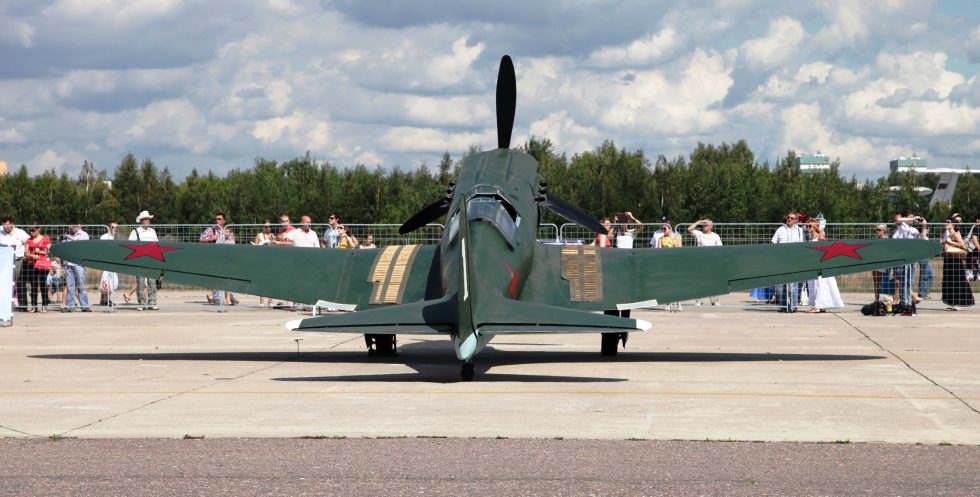
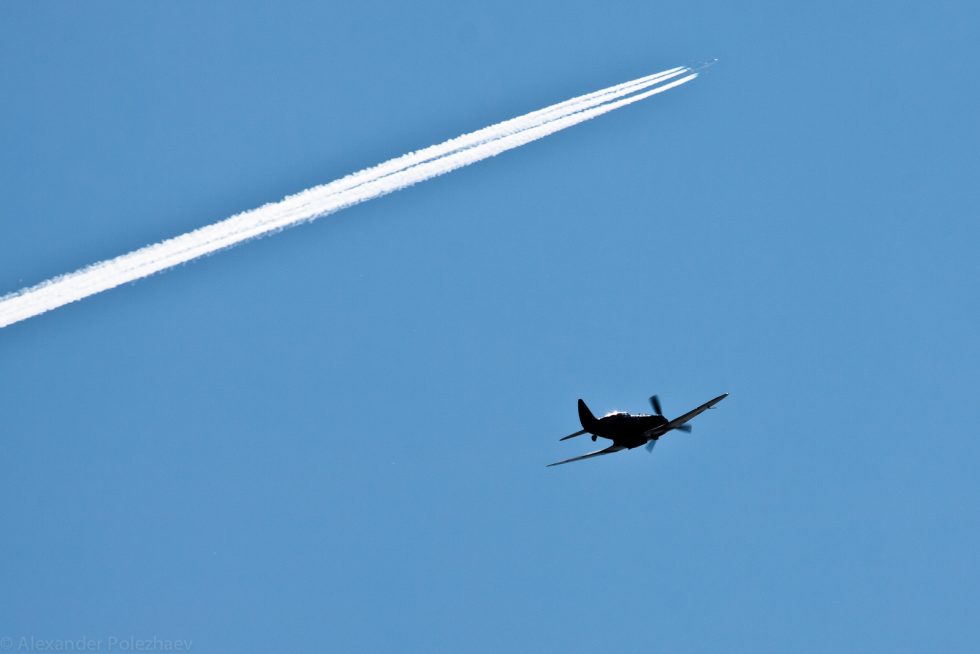
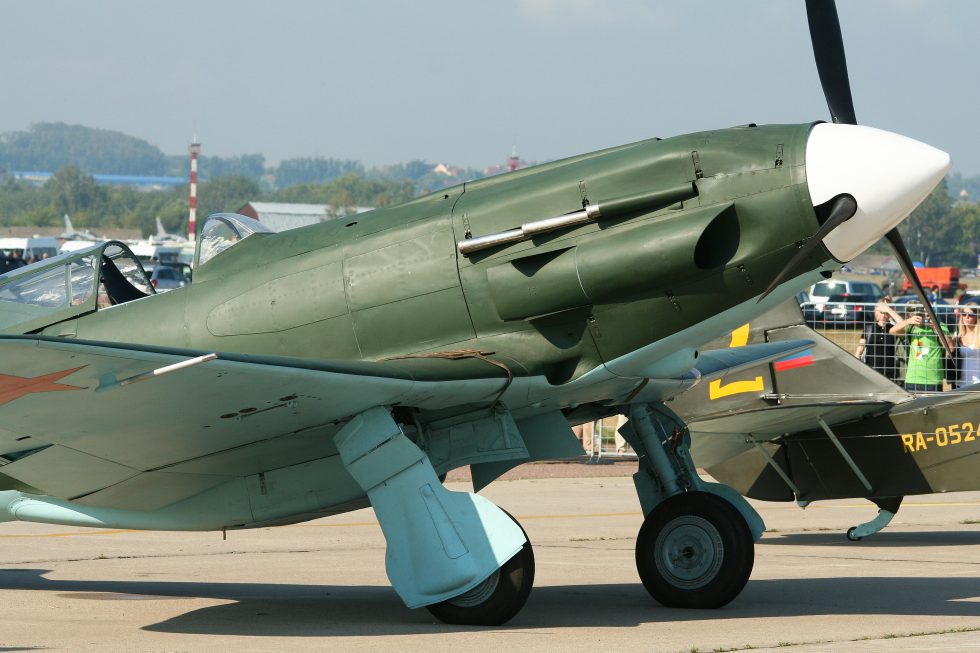
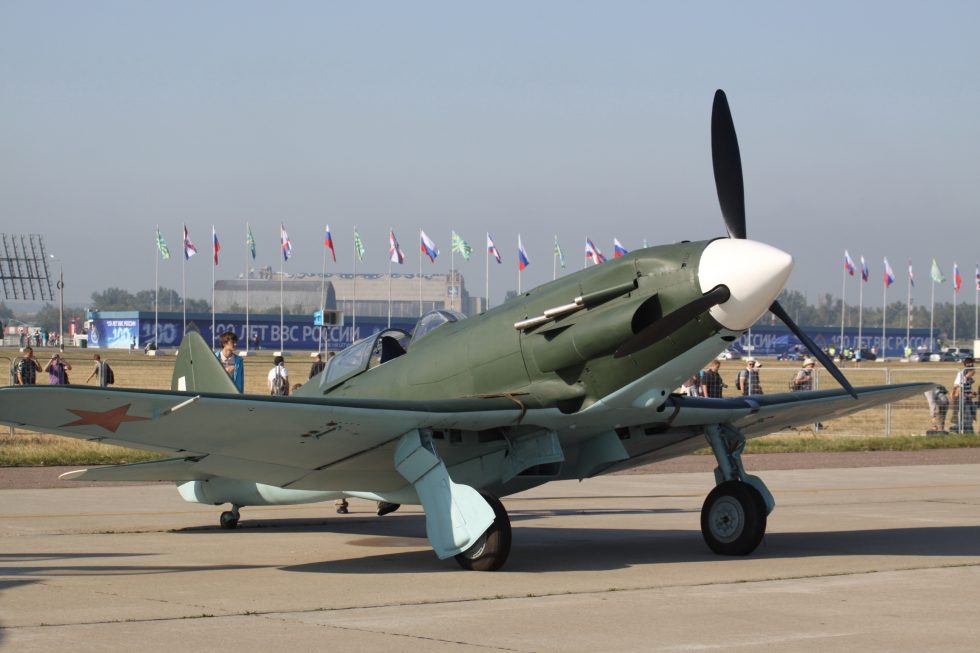
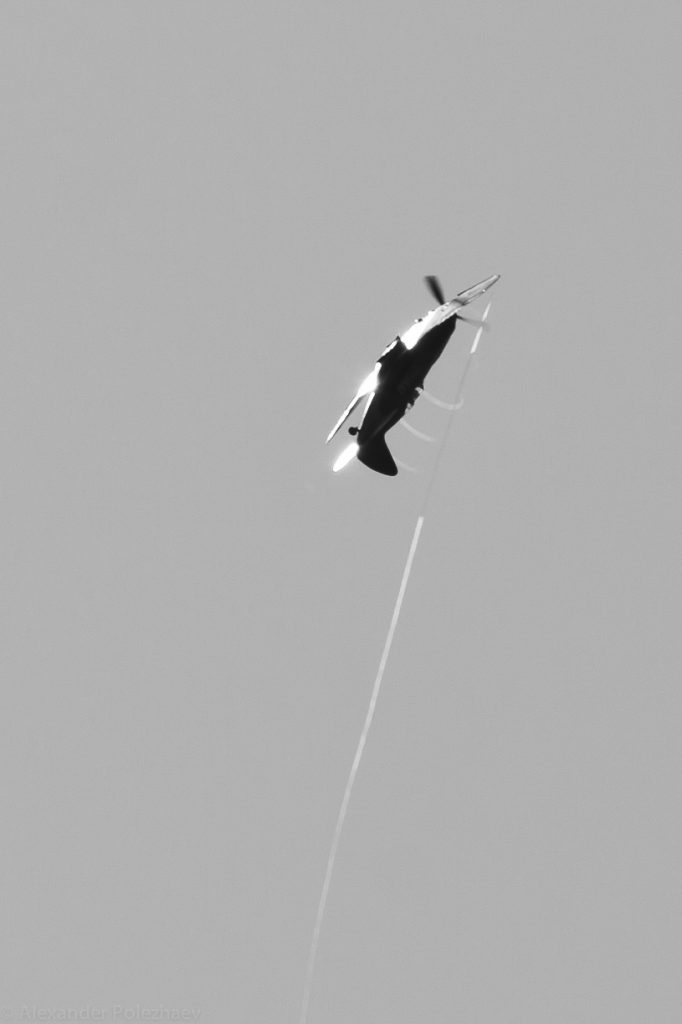
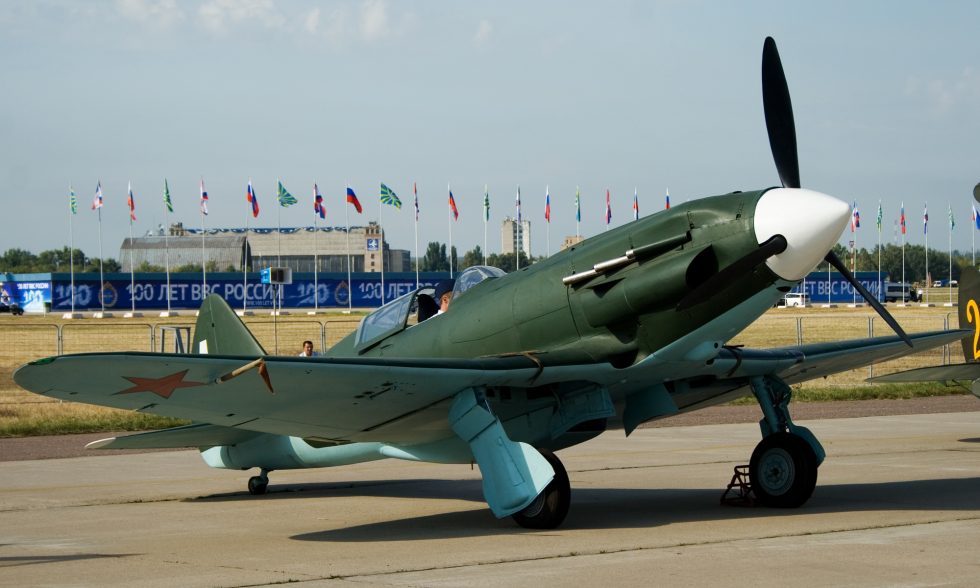
The MiG-3 in motion
Palm Springs Air Museum: MiG-3 — Warbird Wednesday Episode #88. An accredited museum’s on-camera history of the type, the engine that defined it and its hard first year on the Eastern Front.
Where the MiG-3 flew
The MiG-3’s war: defence, not dogfighting
The MiG-3 was an interceptor, and its record is written in home defence and hard first-year losses rather than in a long tally of dogfight kills. It was the most numerous modern Soviet fighter when Germany invaded, yet it was thrown into a low-altitude war it was never built for. Its best work was done high over Moscow and Leningrad — and in the hands of pilots like Pokryshkin, who learned to fight on it before moving to better types.
Compare the combat record of every military aircraft. Figures as of 2026.
Everything people ask about the MiG-3
Can I fly in a Mikoyan-Gurevich MiG-3?
How fast was the MiG-3?
Why was the MiG-3 poor at low altitude?
Why did MiG-3 production stop so soon?
Did Aleksandr Pokryshkin fly the MiG-3?
How many MiG-3s were built?
Are any MiG-3s still flying?
You can’t fly the MiG-3.
These, you can.
Some legends only live in museums — others are fuelled and waiting. MiGFlug has put civilians in real military jet cockpits since 2004.
 Fly the L-39 AlbatrosThe world’s most-flown jet trainer — aerobatics included
 Fly the F-104 Starfighter“The missile with a man in it”
 Fly the MiG-21The Cold War’s most-produced jet
 Fly the T-33 Shooting StarAmerica’s first jet trainer
 Fly the DH VampireA piece of early jet history
 Fly the S.211Agile Italian jet trainer
 Fly the MB-326The classic Aermacchi jet
 Fly the MiG-15The Soviet legend of the Korean War
Continue the tour
Every MiG-3 fact, checked
- Military Aviation Museum — Mikoyan-Gurevich MiG-3Owner of the only intact MiG-3 in North America; authoritative on the airframe and its restoration.
- VVS Air War — The MiG-1 & MiG-3 High-Altitude InterceptorsDetailed development, engine and production history of the type.
- Massimo Tessitori — Soviet Warplanes: MiG-3Long-running research site on Soviet aircraft, unit histories and the Pokryshkin combats.
- Warbird Digest — Aviarestoration’s MiG-3 restorationAccount of the Novosibirsk rebuilds from wartime wrecks.
- HistoryNet — Soviet warbird restorationsBackground on recovering and returning wartime Soviet types to the air.
- Palm Springs Air Museum — Warbird Wednesday #88Accredited-museum video history of the MiG-3 (embedded above).
- Imperial War MuseumsReference on the Eastern Front air war of 1941–42 in which the MiG-3 fought.
- Yefim Gordon & Dmitriy Komissarov — Mikoyan MiG-3Standard monograph on the design, variants and service of the aircraft.