
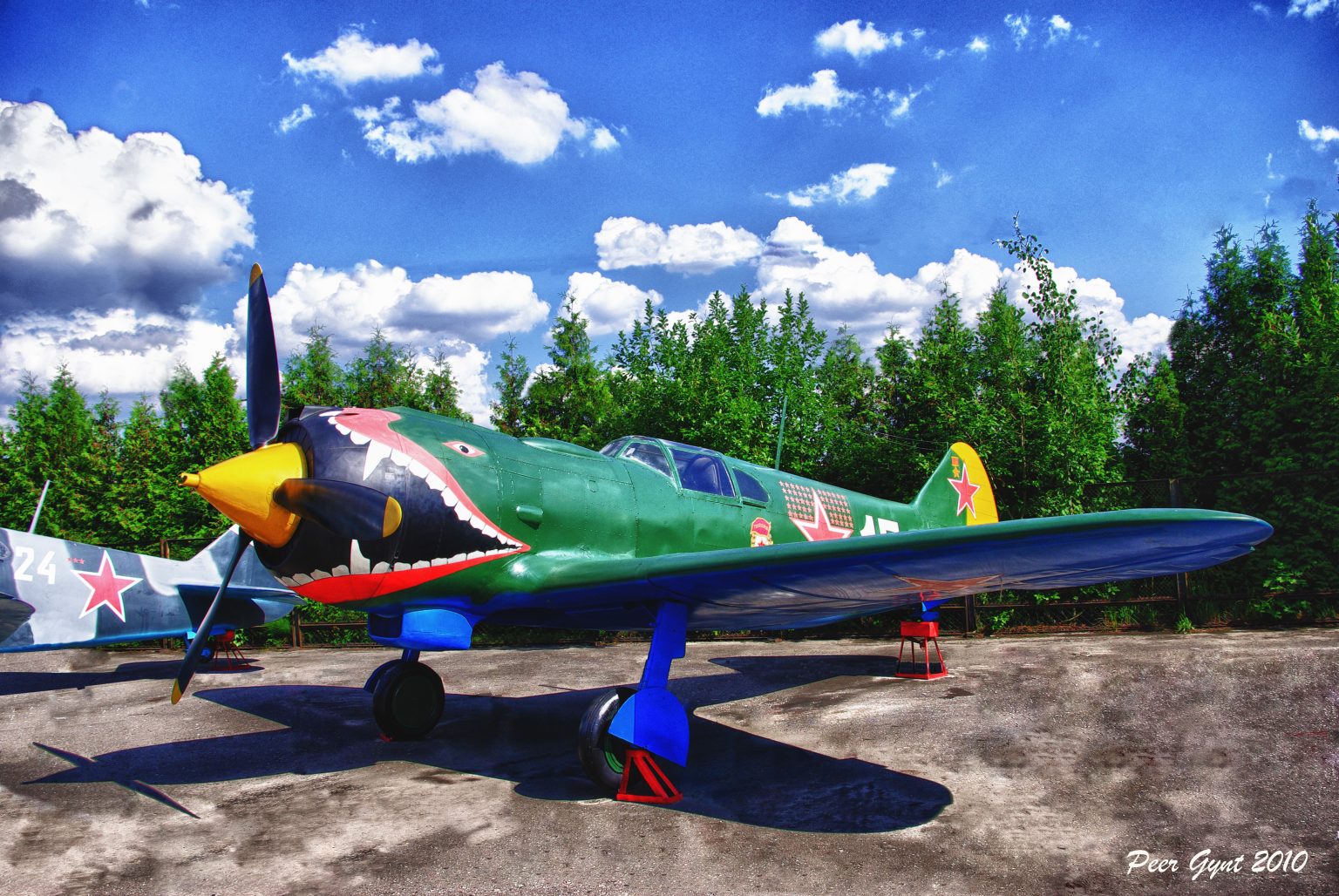
Lavochkin La-5
The wooden radial that clawed back the sky
A failing fighter re-engined in a hurry, built from glued wood while the USSR ran short of metal — and turned, at low altitude, into one of the deadliest dogfighters of the Eastern Front.
The Lavochkin La-5: the wooden fighter that clawed back the sky
In 1941 the Soviet Union’s newest fighter was a failure. The LaGG-3 was heavy, underpowered and so unloved that front-line pilots reworked its designers’ initials into a bitter joke — a “guaranteed varnished coffin.” Its design team, led by Semyon Lavochkin, was on the edge of losing its factory to rival bureaus. The fix they reached for was drastic: tear out the sleek but weak liquid-cooled inline engine and bolt on the fat, powerful Shvetsov M-82 radial instead.
It should not have worked — the M-82 was far wider than the slim LaGG fuselage — but with a redesigned cowling and careful ducting it did. Flown in early 1942 and rushed into production that May, the result was the La-5. It kept the LaGG’s cheap, non-strategic construction — a wooden airframe of resin-impregnated plywood, easy to build while the USSR was desperately short of aluminium — but now it had the power to fight. The type made its combat debut over Stalingrad in the autumn of 1942.
The definitive version, the fuel-injected La-5FN of 1943, produced around 1,850 hp and was a genuinely dangerous opponent below 3,000 metres — where most Eastern Front air combat happened. It was the mount of Ivan Kozhedub, the top-scoring Allied ace of the war, who claimed 62 victories (some accounts say 64) flying nothing but Lavochkins and was reportedly never shot down. Around 9,900 La-5s of all types were built before the refined all-metal La-7 took over the production lines.
01The Lavochkin La-5’s origins: how a radial engine rescued the doomed LaGG-3
By late 1941 the LaGG-3 was being cancelled in favour of Yakovlev fighters, and Lavochkin’s bureau faced extinction. The escape route had actually been explored by a colleague, Mikhail Gudkov, who had experimented with fitting the air-cooled M-82 radial to the LaGG airframe. Lavochkin’s team took the idea and made it work under enormous time pressure over the winter of 1941–42, grafting the broad radial onto the narrow wooden fuselage with a new cowling and cooling arrangement.
The gamble paid off spectacularly. The re-engined aircraft was faster, climbed better and, crucially, could absorb battle damage that would have downed a liquid-cooled fighter — a radial keeps running with cylinders shot away, where a single hit to a coolant line kills an inline engine. Stalin personally intervened to keep Lavochkin’s factory in business once the prototype’s results were known. The type was designated La-5 in the summer of 1942.
The Lavochkin La-5: what made it special
A radial transplant that saved a failing fighter
The La-5 was born by replacing the LaGG-3’s weak liquid-cooled inline with the fat Shvetsov M-82 14-cylinder radial. The engine was far wider than the fuselage, so engineers wrapped it in a redesigned cowling and cooling duct. The payoff was more power, better climb, and an air-cooled engine that could keep flying with cylinders shot away.
Built from wood, glue and ‘delta-drevesina’
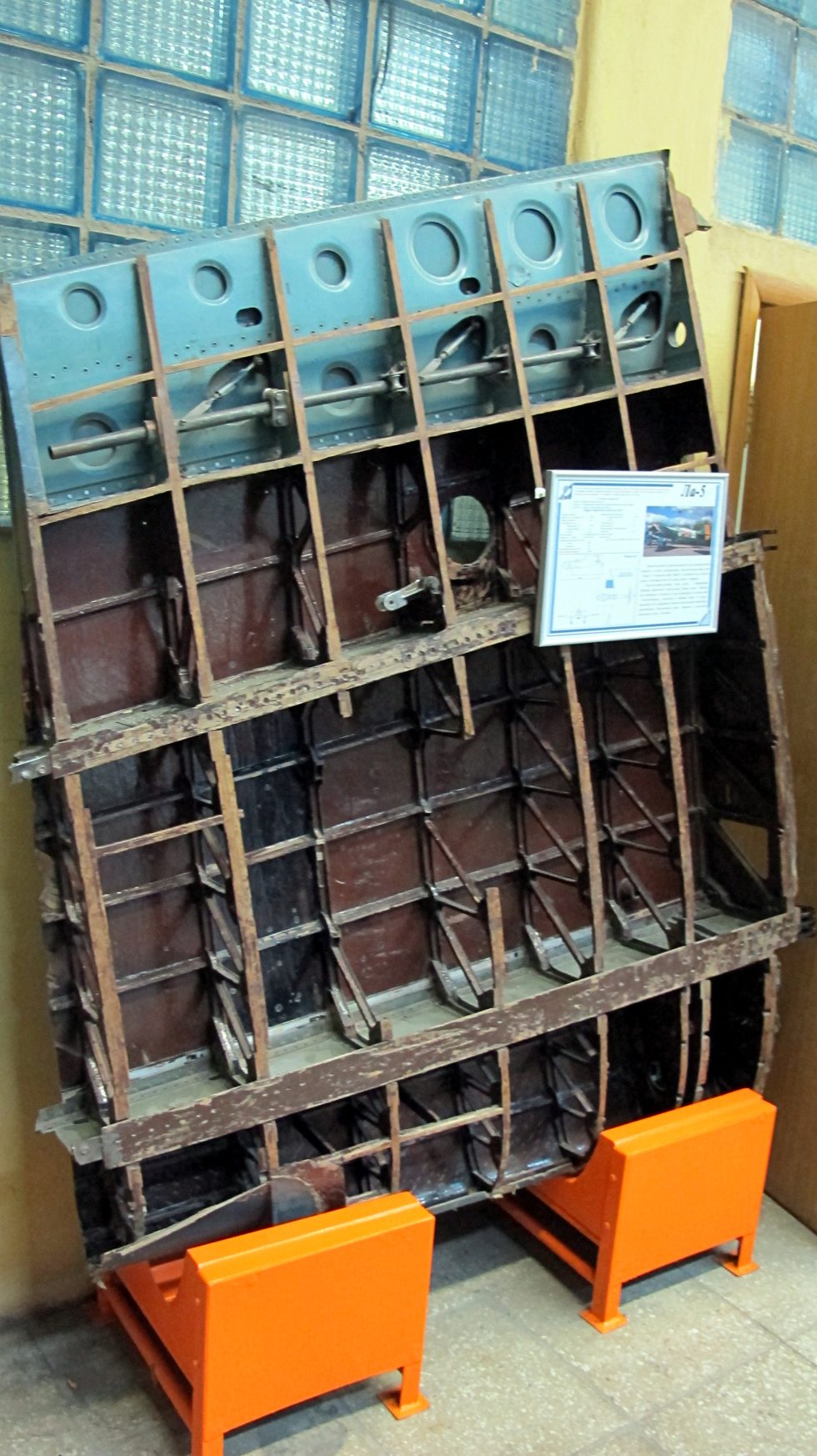
With aluminium in desperately short supply, the La-5 was built largely of wood — plywood skins over a wooden frame, reinforced with resin-impregnated “delta” laminate. It was heavier and rougher than a metal fighter, but cheap, quick to build and used no strategic metals — ideal for wartime mass production. Later La-5FNs added some metal in the wing.
The La-5FN: direct injection and a low-altitude killer
The definitive La-5FN of 1943 used the ASh-82FN with direct fuel injection, giving roughly 1,850 hp. Below about 3,000 metres — where most Eastern Front fighting took place — it could out-turn and out-accelerate the Focke-Wulf Fw 190, a fact the Germans confirmed for themselves when they captured and tested one.
02The Lavochkin La-5’s construction: why the Soviets built a front-line fighter from wood
The La-5 inherited the LaGG-3’s wooden airframe, and that was a feature, not a compromise. The USSR’s aluminium supply was strained to breaking point, much of its metals industry overrun or relocated east. Wood — birch plywood, pine and a phenol-resin-impregnated laminate the Soviets called delta-drevesina (delta-wood) — was plentiful, needed no strategic alloys, and could be worked by a semi-skilled wartime workforce in dispersed factories.
The cost was weight and a rough surface finish that shaved a little off top speed, and early aircraft suffered quality problems as production was rushed. But the trade was overwhelmingly worth it: the USSR could build La-5s in enormous numbers exactly when it needed them most. Only with the later La-7 did metal wing spars replace the wooden structure, saving weight and improving performance.
03The Lavochkin La-5 versus the Fw 190: what the Germans learned at Rechlin
In August 1944 a largely intact La-5FN fell into German hands and was flown to the Rechlin test centre, where test pilot Hans-Werner Lerche evaluated it that autumn. His findings were revealing. The La-5FN was excellent at low altitude: below about 3,000 metres it accelerated hard and could out-turn the Fw 190, though the lighter Bf 109 could still out-turn the Lavochkin.
Its weaknesses were just as clear: top speed stayed below the German fighters at every altitude (Rechlin measured only about 520 km/h at sea level on their test aircraft), performance fell away higher up, and endurance was very short — roughly 40 minutes at full power. Lerche’s advice to Luftwaffe pilots was blunt: don’t get into a low, slow turning fight with an La-5 — use height and dive-and-zoom tactics instead.
The Lavochkin La-5: full specifications
Baseline note: the figures below describe the La-5FN of 1943–44 (factory No. 21 at Gorky, works types 39 and 41), the definitive mark and the one that fought at Kursk and after. Deltas for the 1942 La-5 with the carburetted M-82A and for the 1943 La-5F are given in grey, because the three columns are the real story: the same wooden aeroplane, the same wing, the same two cannon, and roughly 140 km/h added at sea level in eighteen months. Where Soviet and German measured figures disagree the German ones are noted, since the Rechlin trial is the only independent test of the type ever flown.
Dimensions & weights
- Crew
- 1
- Length
- 8.67 m (28 ft 5 in) — 140 mm shorter than the LaGG-3 it was converted from, the radial being physically shorter than the Klimov V-12 it replaced
- Wingspan
- 9.80 m (32 ft 2 in), unchanged from the LaGG-3. Some Russian tables print 9.76 m (32 ft 0 in); it is a rounding convention, not a different wing
- Height
- 2.54 m (8 ft 4 in)
- Wing area
- 17.50 m² (188.4 sq ft)
- Wing section
- NACA 23016 at the root, NACA 23010 at the tip; dihedral 5°, automatic slots on the outer leading edges between ribs 6 and 14
- Empty weight
- 2,706 kg (5,966 lb). La-5 of 1942: 2,681–2,800 kg (5,911–6,173 lb) depending on the batch; La-5F 2,810 kg (6,195 lb)
- Normal take-off weight
- 3,168 kg (6,984 lb). La-5 3,230 kg (7,121 lb), La-5F 3,200 kg (7,055 lb). Batch-to-batch scatter was the type’s chronic disease: a Moscow-built La-5FN with steel spars weighed 3,145 kg (6,934 lb), while Gorky machine No. 39210206 came out at 3,445 kg (7,595 lb) — a 300 kg spread within one designation
- Maximum take-off weight
- 3,402 kg (7,500 lb) with two 100 kg bombs on the wing racks
- Internal fuel
- ~464 l (~102 imp gal), about 340 kg (750 lb), in three centre-section tanks. Aircraft up to the 9th series carried five tanks holding 539 l (119 imp gal); the two outer-wing tanks were deleted to save weight, and endurance never recovered
- Wing loading
- 181 kg/m² (37.1 lb/sq ft) at normal take-off weight
- Power loading
- 1.71 kg/hp (3.78 lb/hp) on take-off power, against 2.37 kg/hp for the best LaGG-3. That single ratio is the whole argument for the conversion
- Structure
- Wooden semi-monocoque: pine longerons and formers, birch-veneer skin laid at 45° in four to eight plies and glued with VIAM-B3 resin, delta-wood spar booms, fabric-covered metal control surfaces, a welded chrome-molybdenum steel truss carrying the engine and guns, and duralumin cowling panels. From 1944 the type 41 substituted heat-treated 30KhGSA steel spars for delta wood, and duralumin sheet on asbestos was laid along the forward fuselage sides to stop the exhaust charring the plywood
- Armour
- 8.5 mm (0.33 in) plate behind the seat, cut down from the 10 mm (0.39 in) of the early La-5 when the La-5F was lightened, plus armour glass ahead of and behind the canopy glazing from early 1943
Performance
- Maximum speed at altitude
- 648 km/h (403 mph) at 6,250 m (20,510 ft). La-5F: 600 km/h (373 mph) at 6,300 m; La-5 of 1942: 580 km/h (360 mph) at the same height
- Maximum speed at sea level
- 583 km/h (362 mph); Russian tables commonly give 593 km/h (368 mph) for the same aircraft. La-5F 560 km/h (348 mph), La-5 509 km/h (316 mph) — and it is at this end of the altitude band that the Eastern Front air war was fought
- Rate of climb
- 16.7 m/s (3,290 ft/min), quoted in Soviet tables as 1,064 m/min. La-5F 910 m/min, La-5 833 m/min
- Time to 5,000 m (16,400 ft)
- 5 min 12 s. La-5F 5 min 30 s, La-5 6 min 00 s, prototype 6 min 06 s
- Service ceiling
- 11,000 m (36,090 ft); Russian sources give 11,200 m (36,750 ft). La-5F 9,550 m (31,330 ft). The German trial measured a ceiling some 1,500 m lower, and speeds 10–50 km/h down across the band; captured aircraft always test badly, in both directions
- Range
- 765 km (475 miles) is the figure in Jane’s; Russian tables give ~1,000 km (~620 miles) for the La-5FN. NII VVS measurements on individual aircraft ranged from 970 km down to 580 km (603 to 360 miles) as aerodynamic finish and fuel state varied. Treat any single range figure for this type with suspicion
- Endurance
- 40 minutes at cruise power, and less on boost — Lerche’s measurement at Rechlin, and the single most damning number in the report. Patrols of 50 to 60 minutes were flown only by loitering at uneconomically low speed
- Turn time
- 18–19 s for a full circle at low level in Soviet testing. Lerche measured 25 s at 1,000 m (3,280 ft) on boost and 28–30 s at 2,400 m (7,870 ft) at cruise power — a large discrepancy that probably reflects technique and boost setting rather than a different aeroplane
- Roll
- A full roll in under 4 s at 450 km/h (280 mph). Lerche called the aileron authority outstanding; above 600 km/h (373 mph) stick forces became excessive
- Stall and spin
- Slats opened at 200–210 km/h (124–130 mph); below about 180 km/h (112 mph) the aeroplane dropped a wing if sideslipped. Spin trials on 6 May 1942 were flown against Lavochkin’s explicit instructions and showed clean recovery; an inverted flat spin killed a pilot of 32 GIAP on 31 May 1943, after which both normal and inverted spins were cleared above 1,500 m
- Landing speed
- 138 km/h (86 mph)
- Boost limit
- The forsazh over-boost could not be used above 2,000 m (6,560 ft) — the throttle body could not pass enough air. Below that it was worth 200–300 hp in combat
Propulsion & systems
- Engine
- One Shvetsov ASh-82FN (M-82FN) 14-cylinder two-row air-cooled radial with direct fuel injection, 41.2 l (2,514 cu in), bore 155.5 mm and stroke 155 mm, compression ratio 7.0, two-speed supercharger, 900 kg (1,984 lb) dry, 1,260 mm (49.6 in) in diameter and 1,980 mm (78.0 in) long. That diameter against the 798 mm width of the LaGG-3’s M-105P is the engineering problem the whole aeroplane exists to solve
- Take-off power
- 1,850 hp (1,380 kW) at 2,500 rpm, held for up to 10 minutes. La-5 with M-82A: 1,700 hp (1,270 kW)
- Rated power
- 1,460 hp (1,090 kW) at 2,400 rpm at 1,650 m (5,410 ft); 1,330 hp (990 kW) on the M-82A and M-82F. Direct injection cost only 30 kg of engine weight and bought 150 hp on take-off and 90 hp at rated altitude
- Fuel injection
- NB-3U pump feeding an FB-10 injector on each cylinder at 280–330 kg/cm² on the rated setting, with an RS-2 automatic mixture regulator; the whole installation weighed 27.7 kg. It replaced the AK-82VP carburettor, whose appetite was directly responsible for the earlier marks’ poor range
- Propeller
- VISh-105V three-blade constant-speed unit of 3.10 m (10 ft 2 in) diameter with an R-7 governor, blade angles 22° to 51° 30′, weighing 141 kg (311 lb). Ground clearance was tight and propellers were regularly damaged on rough strips
- Cooling
- Frontal louvres in the cowling ring and two large side flaps behind the engine — the improvisation that made the conversion possible, since a conventional cooling skirt would have meant a new fuselage. Per-cylinder deflectors developed by Shvetsov’s deputy Valedinsky evened out the head temperatures. Opening the cowl flaps stalled the airflow over the centre section and cost lift; cabin temperature was never solved, and pilots flew with the canopy open in defiance of orders
- Oil system
- 59 l (13 imp gal) tank behind the firewall and a semicircular OP-293 honeycomb cooler in a tunnel under the cowling with an adjustable exit flap. The prototype nearly failed its state trials on oil temperature; the cooler that saved it was found in a packing case in the assembly shop, apparently delivered for an M-107, and fitted overnight against Lavochkin’s express order not to take what was not theirs
- Fuel system
- Three duralumin centre-section tanks, B-78 leaded petrol of not less than 95 octane, ullage inerted with cooled and filtered exhaust gas. Rubber self-sealing was deleted from late 1942 on the ground that it did not stop cannon shells and cost weight
- Engine controls
- Throttle, mixture, propeller pitch, cowl flaps and supercharger gear all on separate manual levers — six to move for a rapid acceleration. German fighters with the BMW 801 had the Kommandogeraet doing all of it from one lever, and Lerche identified this as the La-5FN’s single greatest tactical handicap. Combined throttle and pitch control was trialled on La-5s from 1943 but only reached the La-7
- Electrical and radio
- 27 V DC from a 350 W GS-10-350 generator with a 12A-5 battery; RSI-4 short-wave set with the Oryol transmitter behind the armour plate and the Malyutka receiver in the cockpit. In 1942 only every third aircraft got a transmitter; the rest had receivers alone
- Oxygen
- One 4 l bottle at 150 atm, good for 1.5 hours between 4,500 and 10,000 m. Lerche judged that the system on the captured aircraft had apparently never been used
- Undercarriage
- Wide-track main legs retracting inwards hydraulically onto 650 × 200 mm wheels with pneumatic drum brakes; retractable tailwheel of 300 × 125 mm. The wide track made a wing-drop on the ground harmless, and the type was undemanding about the state of a field
04The Lavochkin La-5’s operating costs: why no reliable price exists
The La-5 was a Soviet state product, built and consumed inside a planned war economy and never sold on any open market, so a meaningful flyaway price in dollars simply does not exist. Wartime Soviet aircraft were costed internally in rubles, and those figures fell sharply as production scaled up — but no reliable, directly convertible La-5 unit cost or cost-per-flight-hour appears in open sources, and any precise number should be treated with suspicion.
What is clear is the design’s economic logic. Its wooden construction was deliberately cheap: it used no scarce aluminium, could be built in dispersed factories by a semi-skilled workforce, and let the USSR mass-produce a competitive fighter at a moment when metal and skilled labour were both critically short. The La-5’s real cost advantage was strategic, not a line on a price list.
Armament & payload
The La-5 carried two cannon above the engine and nothing else that mattered, and its own commanders said plainly that this was one gun too few
Everything about the La-5’s armament follows from where the engine went. A 1,260 mm radial leaves no room for a motor cannon through the propeller boss, so the LaGG-3’s excellent axial ShVAK had to come out and be replaced by two synchronised guns lying on the steel truss above the cylinders. The battery was still on the centreline, which forgave the poor gunnery of hastily trained pilots, and 340 rounds was a workable magazine. But it was two guns where the Fw 190A-4 had two cannon with 680 rounds plus two machine guns, and General Blagoveshchensky, who thought the La-5 the best fighter in Soviet service in the spring of 1943, put it bluntly: such a good aeroplane should not have so small a volume of fire. Three-gun installations were tried and none reached the front on the La-5; the third barrel arrived only with the La-7. Gun fits and round counts varied between factories and batches, and a handful of late-1942 aircraft flew with one cannon and one 12.7 mm machine gun purely to save weight; treat any stated fit as typical of a series rather than universal within it.
Gun
- Two 20 mm ShVAK, synchronised SP-20 pattern, on a welded truss above the engine and firing through the propeller disc. 170 rounds per gun, 340 in all; some sources give 200 per gun for the La-5FN. Cyclic rate about 800 rounds/min unsynchronised and roughly 700 through the propeller, 96 g shell at 750–790 m/s (2,460–2,590 ft/s)
- The salvo weight of the pair was about 3.4 kg/s. That is respectable against a fighter and thin against a bomber, and it is why La-5 pilots preferred to open fire close
- Sighting was by PBP-1a reflector sight, replaced on later aircraft by the simpler VV-1. Charging was pneumatic and mechanical; firing was pneumatic on early aircraft and pneumo-electric from the La-5FN. Gun stoppages from misfeeds plagued the state trials in May 1942 and took four flights to cure
- Very late La-5FNs substituted two 20 mm Berezin B-20 for the ShVAK — the same shell and the same salvo weight of 3.4 kg/s from a gun of 25 kg instead of about 42 kg, which is 34 kg saved for nothing given away
- Three-gun trials: an La-5FN with three UB-20 was tested at the factory No. 21 flight base from 30 January to 11 February 1944 and reached 596 km/h at sea level on rated power; a two-VYa-plus-one-BS scheme of late 1943 never left the drawing board. The original 1942 design intent had been four cannon, cut to two before the prototype flew because factory No. 21 held only about twenty synchronised ShVAK left over from I-16 production
Air-to-air
- No guided air-to-air weapon existed anywhere in Soviet service during the La-5’s life, and there was no rearward-firing gun, no gun camera on most aircraft and no radar of any kind. The two cannon, the RSI-4 and the pilot’s eyes were the entire system
- Ivan Kozhedub opened his account in an La-5 of 240 IAP from Urazovo on 6 July 1943, on his fortieth sortie, with a Ju 87 — nine victories by the end of Kursk. He took his score to about forty-five on La-5Fs and La-5FNs, including the machine paid for by the collective farmer V. V. Konev, moved to the La-7 in August 1944 and finished the war with 64 credited victories, every one of them on a Lavochkin
- Troop trials of the La-5FN with 32 GIAP on the Bryansk Front in July and August 1943 give the clearest single measure of the type at its peak: fourteen pilots, twenty-five combats, claims of 21 Fw 190s, three Bf 109G-2s, three He 111s, five Ju 88s and one Ju 87 for four aircraft lost. Claims are claims, and Soviet regimental tallies of 1943 were generous; the ratio is still striking
- Against Ju 87s the two cannon were lethal — Lieutenant Gorovets of 88 GIAP was credited with nine Stukas in a single sortie over Kursk in July 1943, the only such claim of the war, and was shot down and killed the same day — but that says more about the Ju 87 than about the La-5’s weight of fire
- Lerche’s tactical prescription at Rechlin, written for Fw 190 pilots, is the best short summary of how to fight it and therefore of what it was: draw it up to altitude, break off attacks by diving and then climbing away shallow at high speed, never lose speed, never accept a prolonged turning fight, and remember that it has forty minutes of fuel
Air-to-surface guided
- None. No Soviet fighter of the Great Patriotic War carried a guided air-to-surface weapon, and no such weapon was ever proposed for the La-5
- The card is kept here because the omission is worth stating plainly rather than passing over: everything the La-5 delivered against a ground target it delivered by pointing the aeroplane at it
- The nearest thing to a specialised ground-attack fit was the PBP-1B dive-bombing sight introduced on the La-5F, calibrated with two scales for release at 200 and 300 km/h
Bombs
- Two underwing racks, standard from the La-5FN, each taking a 50 kg FAB-50 (110 lb) or 100 kg FAB-100 (220 lb) high-explosive or incendiary bomb. Maximum external load ~200 kg (~440 lb)
- This is a modest load by any standard and it was used as such: airfield strafing with a pair of hundreds, not interdiction. The racks cost speed and were often left off
- Typical employment: on 2 May 1944 twenty-four La-5FNs of 113 GIAP worked over an enemy airfield near Stanislav and then climbed to 2,000 m to cover the Il-2s following them in; on 21 July 1944 twenty-eight La-5FNs destroyed or damaged fifteen Fw 190s on an airfield near Lvov
- Bomb carriage was a secondary role throughout. The La-5 existed to take the air over the battlefield away from the Luftwaffe, and the Il-2 did the work underneath it
Rockets
- None as standard. This is a real difference from the LaGG-3 and the I-16, both of which routinely carried RS-82 rails, and it is easy to get wrong
- The La-5’s two wing hardpoints were plumbed and stressed for bombs, and the weight and drag budget of a wooden fighter already 300 kg heavier than its predecessor left nothing for rocket rails
- Soviet fighter-launched rockets in any case had largely fallen out of favour by 1943 for air-to-air use, as fighter combat moved to speeds and ranges at which an unguided salvo was wasted
Pods & other stores
- Nothing. No gun pods, no reconnaissance pods, no camera installations of consequence on production fighters
- Above all, no drop tank. The La-5FN’s 40 minutes at cruise power was the type’s worst single failing and the Germans knew it — Lerche’s report ends by telling Fw 190 pilots to remember it — yet no external tank was ever standardised. The Lavochkin fighters flew on what fitted inside a wooden centre section, and no more
- Wing racks aside, the airframe was clean by design: even the radio mast and the wheel-well openings were treated as drag to be argued about, TsAGI having shown that sealing the aeroplane alone was worth 24 km/h
- The one significant non-weapon addition was the RPK-10 radio semi-compass on a minority of 1942 aircraft, which improved navigation in bad weather. There were never enough to go round
Three typical loadouts
- Free hunt, 1944
- Clean wing, 340 rounds, full 464 l internal fuel. A pair or a four hunting at 2,000–4,000 m over the front line, which is where the ASh-82FN gave the La-5FN its margin over the Bf 109G and Fw 190A and where the type won its reputation.
- Close escort of Il-2 shturmoviks
- Clean wing, guns only, 50 to 60 minutes over the target area — achievable only by loitering at low, economical speed, which handed the initiative to any German pilot who arrived with height and speed. 5 GIAP’s answer over the Dnepr in October 1943 was to patrol fast and short instead, and it worked.
- Airfield strike
- Two FAB-100 on the wing racks, PBP-1B sight, guns loaded, escorted by a covering group of clean La-5FNs. A regiment-sized effort delivering perhaps two and a half tonnes of bombs — trivial by Western standards, decisive when it caught a Gruppe on the ground.
Sourcing caveat: round counts, sight types and firing systems changed from series to series and are recorded inconsistently in factory documents, NII VVS reports and post-war compilations. Figures here follow the Soviet technical description of the La-5FN of 1944 and the airwar.ru and Yakubovich accounts where those agree; where they do not, the disagreement is noted in the text rather than resolved.
Variants
Every La-5 variant is the same 1940 wooden airframe with a better engine bolted to it, and the last one in the line stopped being an La-5 and became the La-7
The La-5 was not designed. It was improvised in a matter of weeks in the winter of 1941–42 by Lavochkin’s deputy Semyon Alekseyev with two assistants, working on a LaGG-3 airframe that had not yet received its engine, while the State Defence Committee was in the process of taking factory No. 21 away from Lavochkin, giving it to Yakovlev and sending the bureau to Tbilisi. The trick that made it work was structural luck: the LaGG-3’s wooden fuselage was deep enough that laying false side panels of laths and plywood over the existing skin faded the radial’s circular cowling into the original oval section by frame 5, without a new fuselage and without ruining the aerodynamics. Two 700 mm scoops let the cooling air out where a proper cooling skirt could not be fitted.
The engine, too, was luck of a kind. Shvetsov’s M-82 was going begging — more than a hundred accepted engines stacked at the works with no customer, and 412 built in 1941 — while the Klimov M-105s the Yaks and Pe-2s needed were desperately short. It weighed 250 kg more than the M-105P but sat further forward, so the centre of gravity barely moved. Mikhail Gudkov had already flown a radial LaGG as the Gu-82 in the autumn of 1941 and been ignored; Lavochkin, with a serial factory and better contacts, was not. The prototype flew on 21 March 1942, days before the bureau was to entrain for Georgia. Series production was ordered on 20 May, the first aircraft left the line on 27 June, and NKAP order No. 683 of 8 September 1942 gave the type its final name.
What followed were three visible steps — a better-breathing engine, a cut-down rear fuselage, direct injection — and one invisible one, the long TsAGI wind-tunnel campaign that eventually produced the La-7. The designations below mix official marks with factory type numbers, which is how Soviet documents actually record them.
- LaGG-3 M-82 prototype No. 372100, then LaG-5 and LaGG-5 (21 March 1942; 21 aircraft under the interim names to September 1942)
- A production LaGG-3 airframe with false side fairings, an M-82A, an oil-cooler beard under the nose and two ShVAK. First flown by works pilot Mishchenko; state trials 22 April to 6 May 1942, interrupted for ten days while the oil cooling was fixed; wrecked in an accident on 12 July 1943. Production machines were heavier than the prototype at 3,376 kg. The first 200 aeroplanes were still built with the false sides laid over an existing LaGG-3 fuselage; only then was a mould made to lay up a proper round-sectioned one. German pilots meeting it over Stalingrad in August 1942 took it for a new I-16 and called it the "new Rat".
- La-5, works type 37 (1942–43)
- M-82A of 1,700 hp take-off, high-mounted carburettor intake on the cowling top, three-tank fuel system from late 1942, back armour reduced to 8.5 mm. Sealing the cowling, on Polikovsky’s diagnosis, recovered the speed the first machines had inexplicably lacked. Inferior to the Bf 109G-2 above 3,000 m and better than it in the turn.
- La-5F, works type 37 (from December 1942; front-line from February 1943)
- The M-82F, in which the former five-minute take-off rating became the continuous rated setting — worth 200–300 hp in a fight and, just as valuable, one less thing to watch. From February 1943 the rear decking was cut down and a new canopy with front and rear armour glass gave a real view astern, the single most requested change in the type’s life. 557 km/h at sea level and 590 km/h at 6,200 m on test at Sverdlovsk in April 1943. NII VVS mock combats that year gave it a smaller turn time and radius than the Bf 109G-2 and G-4 up to 6,000 m — on the German’s tail in three or four turns — with the vertical about equal to 3,500 m and the Messerschmitt’s above it, and an advantage over the Fw 190A-4 and A-5 in speed and in every form of manoeuvre across the whole band where fighting actually happened.
- La-5FN, works type 39 (May 1943 onwards)
- Direct fuel injection: the ASh-82FN, 1,850 hp on take-off and boost sustainable for ten minutes, for 30 kg more engine. Larger elevator, revised differential aileron travel, pneumo-electric gun firing, cowl-top diamond marking with "FN" inside it. In mock combats at Lyubertsy in April 1943 against a captured Bf 109G-2 it was decisively faster at low and medium altitude and better in the vertical — results that changed Soviet fighter tactics.
- La-5FN, works type 41 (1944)
- Heat-treated 30KhGSA steel spars in place of delta wood in centre section and outer panels, more metal in the airframe generally, duralumin anti-scorch panels along the forward fuselage. The lightest recorded La-5FN, No. 3811022 from the Moscow factory, weighed 3,145 kg and made 595 km/h at 5,950 m.
- La-5UTI / UTILa-5 (from summer 1943)
- Two-seat conversion trainer on the La-5F airframe, the instructor’s cockpit in the radio bay, dual controls with automatic priority to the rear seat, same fuselage length, ASh-82F. Built on after La-5FN production ended and used to convert pilots onto the La-7 as well, since the La-7UTI arrived only in 1946 and in small numbers.
- La-5 M-71F (April–June 1943, one aircraft)
- Aircraft No. 39210204 with Shvetsov’s 2,200 hp M-71F. 685 km/h at 5,500 m, and TsAGI calculated that a properly shaped cowling would give 720 km/h. The engine was never made reliable and the work stopped — the great Soviet what-if of 1943, and the same engine that stranded the Polikarpov I-185.
- La-5 "206" and the etalon of 1944 (1943–44, one aircraft)
- Serial No. 39210206 rebuilt on TsAGI full-scale tunnel findings: intake moved under the cowling and then into the wing roots, complete sealing, individual exhaust stacks, improved fillets. 684 km/h at 6,150 m, 64 km/h faster than a production La-5FN. Combined with metal spars and 180 kg of weight saving, this aeroplane is the La-7 in all but name.
- Gudkov Gu-82 (autumn 1941, two aircraft) and the factory No. 381 "Gibrid" (1944, one)
- Two dead ends worth recording. Gudkov put an M-82 in a LaGG-3 six months before Lavochkin, using a Su-2-type cowling with folding frontal louvres; it reached 573 km/h, was 27 km/h slower than the La-5 would be, and got no factory. The 1944 "Gibrid" was a field-repair scheme putting an ASh-82FN into an La-5F airframe with the old exhaust collectors; it tested 68 km/h slower than a proper La-5FN and was recommended only as a last resort.
- S-95 and CS-95 (Czechoslovak service, 1944–c. 1950)
- La-5FN and La-5UTI supplied to the 1st Czechoslovak Fighter Regiment from July 1944 within the 2nd Air Army; from September 1944 the regiment operated from Tri Duby behind the lines in support of the Slovak National Uprising for over a month. Post-war survivors were concentrated in the 4th Air Division in Slovakia as S-95 and CS-95 alongside La-7 S-97s. Russian sources say the last were struck off at the end of 1947; Czech accounts have carefully housed machines serving into the early 1950s. Poland received a single La-5FN in 1945 and scrapped it in 1949; Mongolia was the only other operator.
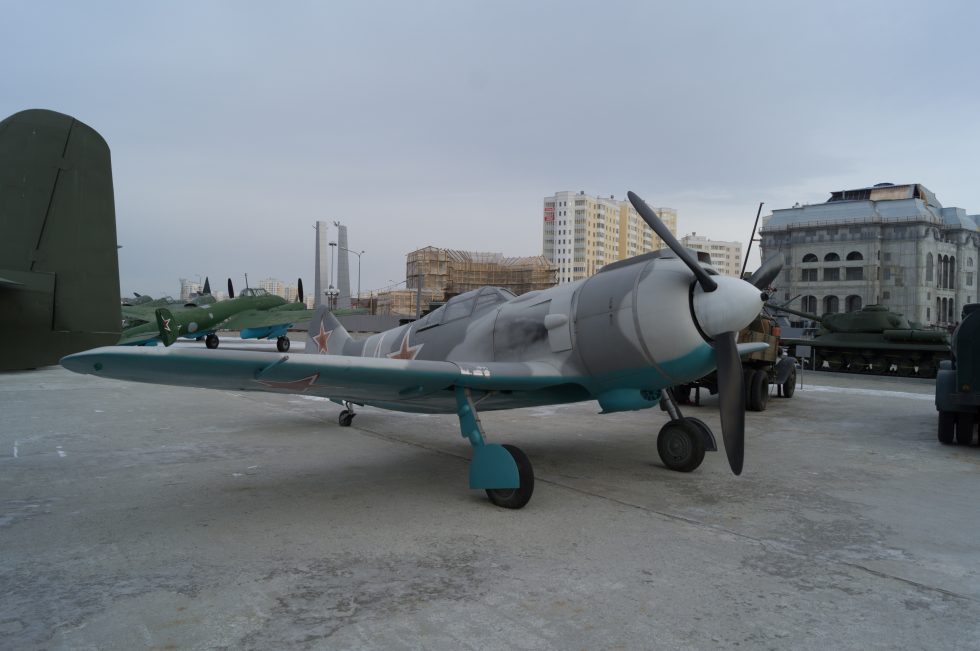
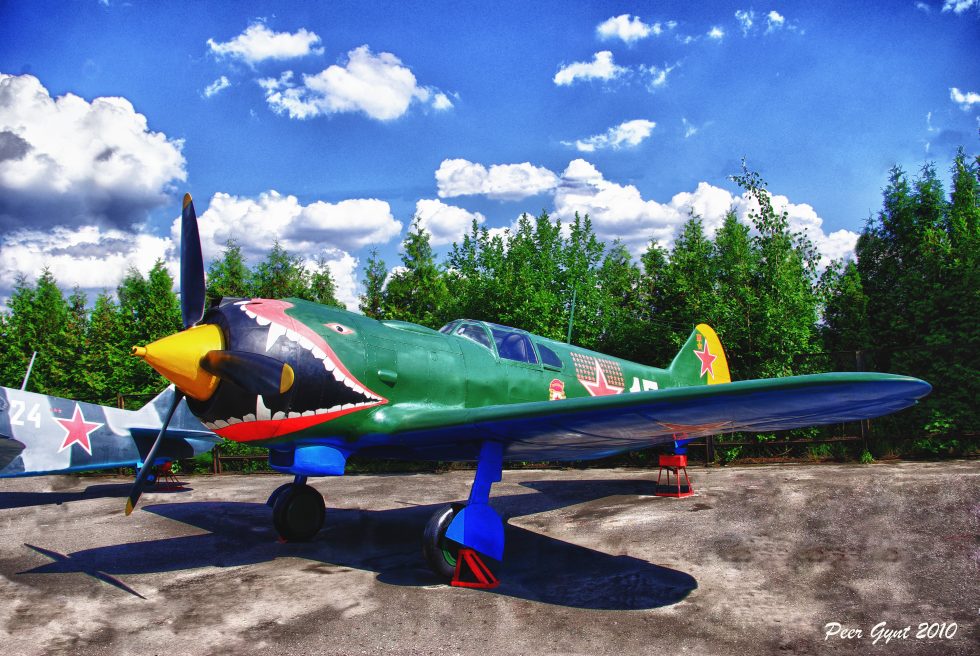
Production and survivors. The headline total is 9,920 aircraft of all marks, the figure carried in most references. A factory-by-factory table gives 10,002: 9,229 from No. 21 at Gorky (1,107 in 1942, 4,619 in 1943, 3,503 in 1944), 460 from No. 381 in Moscow, 286 from No. 99 at Ulan-Ude and 27 from No. 31 at Tbilisi. The gap is almost certainly a question of what is counted as an La-5 rather than a genuine dispute, but no source reconciles the two. Against that, VVS KA wrote off 2,591 La-5s in combat and accident — 73 in 1942, 1,460 in 1943, 825 in 1944, 233 in 1945 — the heaviest fighter losses of the war after the Yak-1. Survivors are worse than scarce: not one complete original La-5 of any mark is known to exist. What is left is a wreck held in store by the Military Aviation Museum at Virginia Beach, a preserved wing section in the Moscow Aviation Institute’s museum, and excavated fragments and ASh-82 engines in Russian collections and with search teams. Everything on public display as an La-5 is a reproduction: the Victory Museum on Poklonnaya Hill in Moscow shows a full-scale replica in the markings of Captain Georgii Kostylev’s White 15 of 4 GIAP of the Baltic Fleet, and the UMMC Museum Complex at Verkhnyaya Pyshma near Yekaterinburg displays a full-size mock-up of an La-5FN. Two genuine Lavochkin radial fighters do survive and are regularly mislabelled as La-5s in captions and picture credits: both are La-7s — Ivan Kozhedub’s White 27 at the Central Air Force Museum at Monino and White 77 at the Prague Aviation Museum at Kbely, which also holds a preserved ASh-82. The reason is the same as for the LaGG-3: a glued birch-veneer airframe that was worn out, shot up or simply broken up after 1945 leaves nothing to recover, and no lake has yet given up an La-5 worth rebuilding.
The Lavochkin La-5: from failed fighter to Kozhedub’s mount
A fighter in trouble
The underpowered LaGG-3 is being phased out; Semyon Lavochkin’s design bureau faces losing its factory.
The radial fix flies
Lavochkin’s team grafts the fat Shvetsov M-82 radial onto the wooden LaGG airframe; the prototype flies in early 1942.
Into production
Production is approved in May and the type is named La-5, kept cheap and wooden to ease mass production.
Debut over Stalingrad
The La-5 enters combat over Stalingrad in the autumn, giving Soviet pilots a fighter that can finally match the Luftwaffe at low level.
The La-5FN and Kursk
The fuel-injected La-5FN (~1,850 hp) reaches the front and fights through the vast air battles over Kursk.
Kozhedub’s rise
Ivan Kozhedub, flying an La-5FN, scores eight kills in seven days — on his way to becoming the top Allied ace of the war.
Captured and dissected
A near-intact La-5FN is captured and evaluated at Rechlin, where the Germans confirm its dangerous low-altitude performance.
To Berlin — and a jet kill
La-5s and their La-7 successors fight over Germany; Kozhedub downs a Messerschmitt Me 262 jet in February 1945.
Superseded by the La-7
La-5 production ends in 1944 as the refined La-7 takes over; Czechoslovakia flies Lavochkin fighters into the post-war years.
From the cockpit: twelve La-5 stories
The fighter nobody wanted
Pilots reworked the LaGG-3’s initials into “guaranteed varnished coffin.”
Read the full story
A radial in a hurry
Engineers grafted a fat air-cooled radial onto a slim wooden fuselage over one winter.
Read the full story
A fighter made of wood
With aluminium scarce, the La-5 was built from plywood and resin-impregnated laminate.
Read the full story
Baptism over the Volga
The La-5 first fought over Stalingrad in the autumn of 1942.
Read the full story
Direct injection changes everything
The fuel-injected La-5FN of 1943 turned a good fighter into a dangerous one.
Read the full story
The great air battle
La-5s fought through the enormous air battles over the Kursk salient.
Read the full story
Kozhedub: 62 kills, never shot down
The Allies’ top-scoring ace flew nothing but Lavochkin fighters.
Read the full story
The farmer’s fighter
A collective farmer paid for one of Kozhedub’s La-5FNs.
Read the full story
The Germans take one apart
A captured La-5FN was flown and tested at the Luftwaffe’s Rechlin centre.
Read the full story
Where the La-5 ruled
Its strength was the low, slow turning fight the Germans were told to avoid.
Read the full story
A piston fighter downs a Me 262
Flying a Lavochkin, Kozhedub shot down one of the world’s first jet fighters.
Read the full story
From La-5 to La-7
The La-5 evolved directly into the war’s finest Soviet piston fighter.
Read the full story
The Lavochkin La-5 in pictures
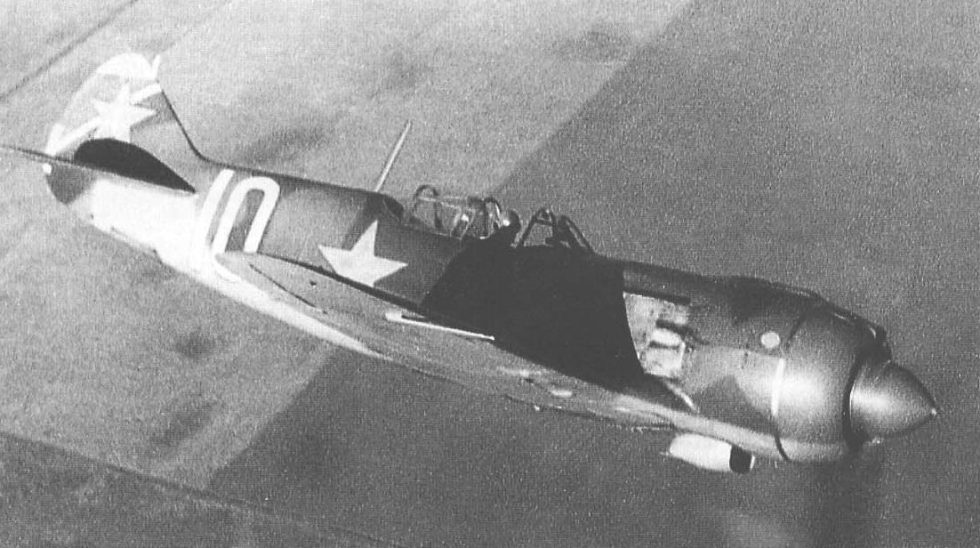
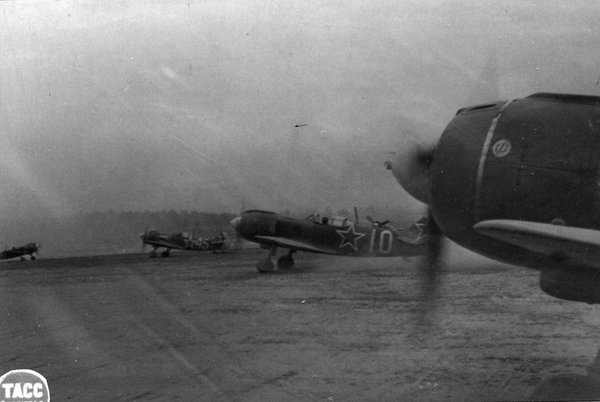
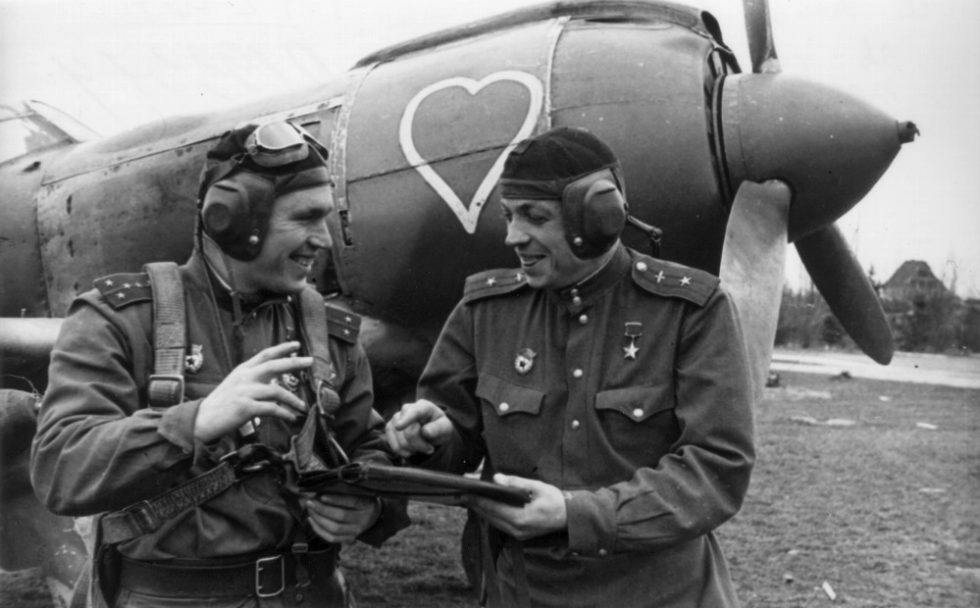
The Lavochkin La-5 in motion
AllthingsWW2: La-5 — The Soviet Game Changer. A concise, well-sourced history of how the La-5 grew out of the LaGG-3 and became a front-line fighter — around 279,000 views.
Where the Lavochkin La-5 flew
The Lavochkin La-5: the record that defines it
The La-5’s legacy is not a tidy kill tally but a shift in the balance of the Eastern Front air war. From its debut over Stalingrad through Kursk to Berlin, it gave Soviet pilots a fighter that could finally beat the Luftwaffe at low altitude — and it was the mount of the highest-scoring Allied ace of the entire war.
Compare the combat record of every military aircraft. Figures as of August 2026.
Everything people ask about the Lavochkin La-5
Can I fly in a Lavochkin La-5?
What was the Lavochkin La-5?
How fast was the La-5?
Was the La-5 really made of wood?
Who was the most famous La-5 pilot?
How many La-5s were built?
What is the difference between the La-5 and the La-7?
Are any La-5s left today?
You can’t fly the Lavochkin La-5.
These, you can.
Some legends only live in museums — others are fuelled and waiting. MiGFlug has put civilians in real military jet cockpits since 2004.
 Fly the L-39 AlbatrosThe world’s most-flown jet trainer — aerobatics included
 Fly the F-104 Starfighter“The missile with a man in it”
 Fly the MiG-21The Cold War’s most-produced jet
 Fly the T-33 Shooting StarAmerica’s first jet trainer
 Fly the DH VampireA piece of early jet history
 Fly the S.211Agile Italian jet trainer
 Fly the MB-326The classic Aermacchi jet
 Fly the MiG-15The Soviet legend of the Korean War
Continue the tour
Every fact, checked
- VVS Air War — Development of the La-5Detailed account of the LaGG-3 conversion, variants and production dates.
- Planes in Profile — captured La-5FN “White 21”The 1944 Rechlin evaluation and Hans-Werner Lerche’s test findings.
- HistoryNet — interview with Ivan KozhedubPrimary-source detail on Kozhedub’s Lavochkins, his first combat and the Me 262 kill.
- Military Factory — Lavochkin La-5Dimensions, weights and performance figures for the type.
- WW2 Weapons — Lavochkin La-5 / La-7Production breakdown, armament and combat-debut history.
- War History Online — development of the La-5Narrative of the type’s origins and wartime service.
- Military Machine — La-5FNSpecifications and combat record of the definitive La-5FN.