
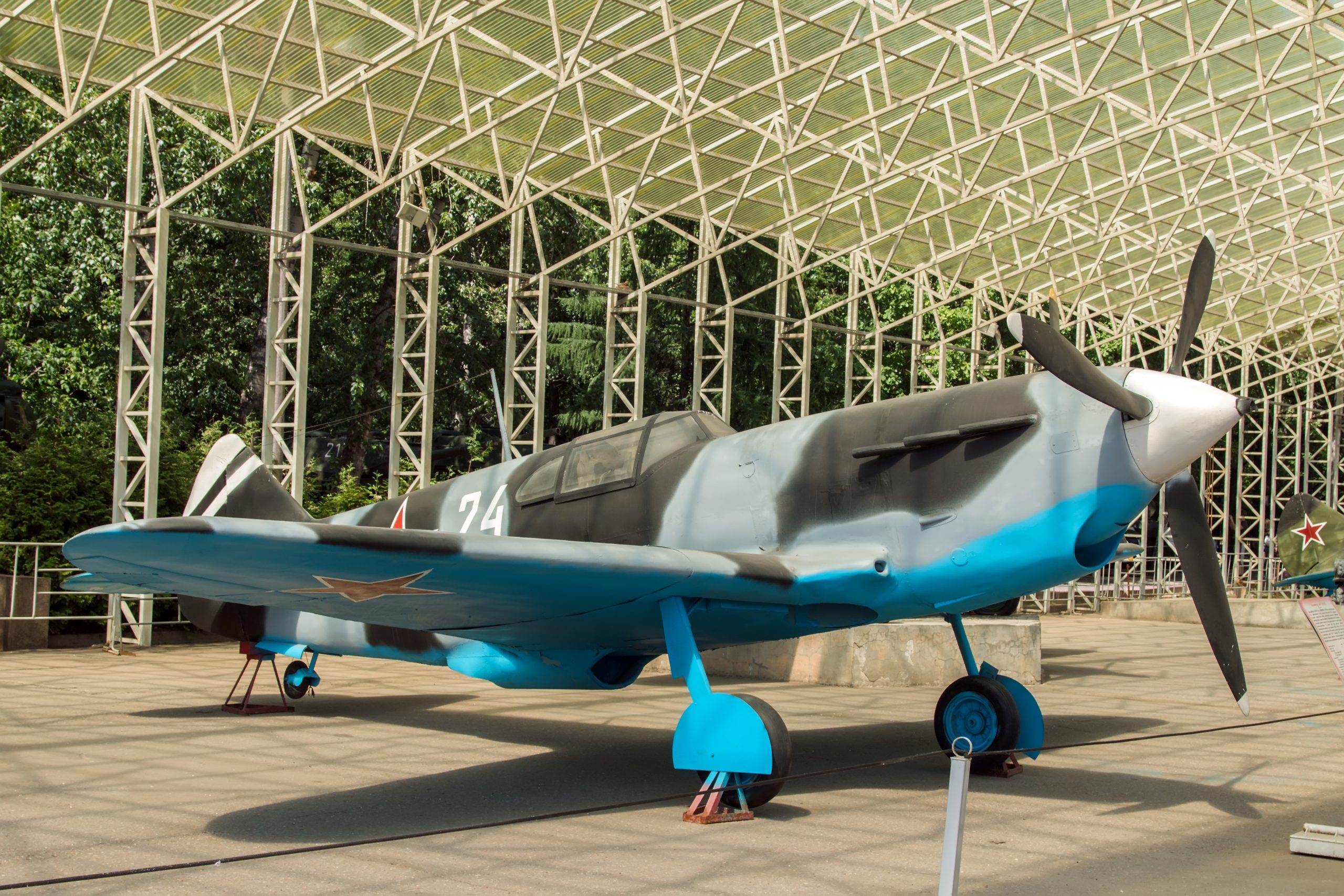
Lavochkin-Gorbunov-Gudkov LaGG-3
The wooden warrior of 1941
A Soviet WWII fighter carved almost entirely from resin-impregnated wood — heavy, underpowered and unloved by its pilots, yet tough enough to bring them home. Re-engined with a radial, its airframe became the superb La-5.
The LaGG-3: the wooden fighter the Soviet Union built out of necessity
In the late 1930s the Soviet Union needed a modern fighter to face the Messerschmitt Bf 109, and it needed one that did not devour the aluminium its factories could barely supply. The answer came from a three-man team — Semyon Lavochkin, Vladimir Gorbunov and Mikhail Gudkov — whose initials gave the aircraft its name. Their prototype, the I-301, first flew in the spring of 1940 and was accepted, after modification, as the LaGG-3.
Its defining feature was its material. Where other nations built fighters of light alloy, the LaGG-3 was made overwhelmingly of wood — not ordinary timber but delta-drevesina (“delta wood”), birch veneer impregnated with phenol-formaldehyde resin and hot-pressed into a dense, fire-resistant laminate as strong as some aluminium alloys. Wood and resin were non-strategic materials that could be worked in furniture-grade factories, freeing scarce duralumin for bombers. It was a clever wartime economy — but it came at a price.
That price was weight. The wooden structure was heavy, and when Stalin ordered the type’s range increased, the extra fuel made it heavier still. Bolted to the single Klimov M-105 V12, which never had power to spare, the LaGG-3 was sluggish in the climb and the turn and unforgiving to poorly trained pilots. According to a much-repeated pilots’ joke, the letters LaGG really stood for Lakirovanny Garantirovanny Grob — the “varnished guaranteed coffin.” Historians debate whether front-line airmen truly coined the phrase or whether it was pinned on the aircraft later, but the reputation stuck.
And yet the LaGG-3 had one genuine virtue that the joke obscured: it was tough. Its wooden structure did not splinter and spall the way thin metal did when hit; it soaked up cannon strikes and machine-gun fire and kept flying. With self-sealing tanks and a robust airframe, it brought many pilots home from fights that would have destroyed a lighter aircraft, and it made a steady gun platform against German bombers. Flown well, especially in the later, lightened production batches, it was far from helpless.
The LaGG-3 fought hardest in the desperate years of 1941 to 1943 — over Moscow and Leningrad, at Stalingrad, in the Caucasus and above the Baltic and Black Seas with the naval air arms — before newer fighters pushed it into second-line, training and reconnaissance duties. Its most important legacy, though, was not what it did but what it became. When Lavochkin’s team replaced the heavy inline engine with a powerful Shvetsov M-82 radial, the same wooden airframe was transformed into the La-5 — and, through it, the La-7, among the finest Soviet fighters of the war. The unloved wooden warrior was the seed of a dynasty.
01The LaGG-3’s delta-wood construction: how the Soviets built a fighter without aluminium
Delta wood (delta-drevesina, also called lignofol) was made by impregnating thin birch veneers with a phenol-formaldehyde resin and pressing them under heat into a hard, dense laminate. The result was strong, resistant to fire and immune to the corrosion that plagued metal aircraft — but heavier than the aluminium alloys used elsewhere. The Soviets adopted it deliberately: with duralumin reserved for bombers and in chronically short supply, a fighter that could be built largely of wood and resin in dispersed, low-skill-tolerant workshops was a strategic advantage in itself. The wing was even made detachable to ease transport and field repair. The trade-off — weight, and the labour-intensive, irritating job of sanding the laminate — was accepted as the cost of building fighters in the numbers the war demanded.
What makes the LaGG-3 special
An airframe of resin-bonded wood
The LaGG-3 was built overwhelmingly from delta wood — birch veneer impregnated with bakelite-type resin and hot-pressed into a laminate as strong as light alloy but far heavier. Wood was chosen to conserve the aluminium the USSR could not spare, and it made the aircraft fireproof and rugged. The penalty was a fighter that was always fighting its own weight.
The Klimov M-105 — and a chronic power deficit
Power came from a single Klimov M-105 liquid-cooled V12, about 1,050 hp early on and roughly 1,210 hp in the boosted M-105PF. It was never quite enough for so heavy an airframe, and the intended more-powerful M-106 was cancelled. The result was modest speed and a laboured climb that defined the type’s reputation.
A hub cannon — and a fighter that took a beating
The standard late armament was a 20 mm ShVAK cannon firing through the propeller hub plus a 12.7 mm UBS machine gun, with underwing rails for rockets or light bombs. What set the LaGG-3 apart was durability: its wooden structure did not fragment like metal when hit, and it repeatedly carried damaged aircraft — and their pilots — home.
02The LaGG-3’s engine problem: why Stalin’s range order cost it dearly
The light I-301 prototype was genuinely quick, but the production LaGG-3 was ordered to carry far more fuel — roughly doubling its range at Stalin’s insistence — and the extra tanks added weight the Klimov M-105 could not overcome. Contemporary verdicts were blunt: the aircraft was “too heavy for the engine installed.” The hoped-for M-106 never materialised, so designers instead spent the type’s whole career fighting the weight back out of it — deleting guns and fuel tanks, cleaning up the aerodynamics and fitting the boosted M-105PF. The best batches, notably the aerodynamically refined Series 66, were genuinely competitive fighters — but they arrived too late to rehabilitate the LaGG-3’s name.
03From LaGG-3 to La-5: the radial engine that changed everything
The LaGG-3’s single greatest contribution was its airframe. In 1942, with the inline-engined fighter falling behind, Lavochkin’s team grafted a powerful air-cooled Shvetsov M-82 (ASh-82) radial onto the wooden fuselage. The transformation was dramatic: the same basic aircraft, now with far more power, became the La-5, judged superior in trials and rushed into production. It led directly to the La-5FN and the superb La-7 — frontline fighters that helped win air superiority over the Eastern Front. The “guaranteed coffin” had fathered one of the best fighter families of the war.
Full LaGG-3 specifications
Baseline note: the figures below describe the LaGG-3 series 66 (1943–44, Factory No. 31 at Tbilisi), the last production standard and by a wide margin the best — which makes it a slightly dishonest baseline, because it flatters a fighter that spent most of its combat life three to four hundred kilogrammes heavier and some 40 km/h slower. Deltas for the 1941 series 4 and the 1942 M-105PF series 29 are given in grey, and the gap between those three columns is the real subject of this table.
Dimensions & weights
- Crew
- 1
- Length
- 8.81 m (28 ft 11 in)
- Wingspan
- 9.80 m (32 ft 2 in)
- Height
- 2.54 m (8 ft 4 in) in flying attitude. Russian tables often print 4.40 m (14 ft 5 in) instead; that is the same aeroplane measured to the tip of a vertical propeller blade, not a different machine
- Wing area
- 17.62 m² (189.7 sq ft) in Soviet sources; Western compilations usually give 17.4–17.5 m² (187–188 sq ft), a difference of measuring convention rather than of structure
- Aspect ratio
- 5.45
- Empty weight
- 2,205 kg (4,861 lb) — against 2,620 kg (5,776 lb) for a series 29 of 1942. Some four hundred kilogrammes came off the same airframe in eighteen months, and a good deal of it came off by taking the delta wood back out again
- Normal take-off weight
- 2,990 kg (6,592 lb). Series 29: 3,157 kg (6,960 lb). The 1941 series 4 left the ground at roughly 3,280 kg (7,230 lb) on 1,100 hp, which is the whole problem stated as one number
- Maximum take-off weight
- 3,190 kg (7,033 lb) with external stores; a fully loaded series 29 with rockets and bombs was tested at 3,701 kg (8,159 lb)
- Internal fuel
- ~340 l (~75 imp gal) in three protected tanks on late aircraft. Early machines carried five tanks holding ~450–467 l (~99–103 imp gal) to chase a 1,000 km range requirement; two were deleted from the 4th series onward the moment weight mattered more than endurance
- Wing loading
- 170 kg/m² (34.8 lb/sq ft) at normal take-off weight. The 1941 aircraft flew at about 186 kg/m² (38.1 lb/sq ft) — comparable to a Bf 109 F on two-thirds of the power
- Power loading
- 2.37 kg/hp (5.23 lb/hp) on take-off power. The series 4 of 1941 managed only 2.98 kg/hp (6.57 lb/hp) against roughly 2.15 kg/hp for a Bf 109 F-2. Everything pilots disliked about the LaGG-3 follows from that ratio
- Structure
- Wooden low-wing monoplane with a semi-monocoque fuselage of birch-veneer shell over pine formers and longerons, delta wood in the wing spars and the most heavily loaded fuselage members, fabric-covered metal-framed control surfaces, and duralumin cowling panels and flaps. The often-repeated claim that the airframe was built entirely of delta wood is wrong: delta wood was expensive, heavy and slow to make, and was used selectively where ordinary timber would not carry the load
Performance
- Maximum speed
- 591 km/h (367 mph) at 4,650 m (15,260 ft)
- Maximum speed at sea level
- 542 km/h (337 mph)
- Maximum speed, series 29 (1942)
- 573 km/h (356 mph) at 4,000 m (13,120 ft); 505 km/h (314 mph) at sea level
- Maximum speed, series 4 (1941)
- 549 km/h (341 mph) at 5,000 m (16,400 ft) — against 604 km/h (375 mph) for the hand-finished I-301 prototype. A loss of 55 km/h between prototype and production line was the worst of any Soviet fighter of the generation; the MiG-3 lost 15 km/h and the Yak-1 lost 26
- Cruising speed
- 450 km/h (280 mph)
- Rate of climb
- 14.9 m/s (2,930 ft/min) at sea level
- Time to 5,000 m (16,400 ft)
- 5.8 min for the series 66; about 7.4 min for the 1942 aircraft; 8.6 min for the first production series. Individual 1941 acceptance reports are worse still, and squadron aircraft with open canopies and mis-set radiator flaps were worse again
- Service ceiling
- 9,500 m (31,170 ft); 9,700 m (31,800 ft) is the figure most Western tables print, and 10,500 m appears in one Soviet test document for a lightly loaded series 29
- Range
- 650 km (404 miles) on internal fuel for the series 66; about 705 km (438 miles) for the five-tank series 4. The 1939 specification asked for 1,000 km and no LaGG-3 in squadron service ever delivered it
- Endurance
- About 2 hours 12 min at 3,000 m (9,840 ft) in economical cruise
- Turn time
- Roughly 20 s at 1,000 m for the lightened series 66; the 1941 aircraft needed appreciably longer. No LaGG-3 out-turned a Yak-1 of the same date, let alone a Bf 109 F, and a Gorbunov-lightened development aircraft of 1943 that managed 16 s was the exception that proved how much fat the standard machine carried
- Handling
- Heavy in pitch, slow in roll, high stick forces throughout, and a nose that would not come up quickly. Pulled hard in a turn it would flick and spin, and recovery cost height a fighter pilot rarely had. Against that: a fast, steady dive, excellent gun platform qualities, and a structure that took punishment without folding
Propulsion & systems
- Engine, series 29 onward
- One Klimov M-105PF, a 60° V-12 liquid-cooled unit of 35.08 l (2,141 cu in), developed from a Hispano-Suiza 12Y licence bought in 1935 and progressively Sovietised by Vladimir Klimov
- Take-off power
- 902 kW (1,210 hp); 940 kW (1,260 hp) at 700 m and 880 kW (1,180 hp) at 2,700 m
- Engine, earlier series
- M-105P and M-105PA of 820–895 kW (1,100–1,200 hp) for take-off. The PF bought its extra power by raising boost and lowering the supercharger gearing — more thrust below 3,000 m, less above it. That suited the Eastern Front, where the fighting was low, and suited nothing else
- Cannon provision
- The P suffix means pushechny — cannon-armed. The reduction gear carried a hollow output shaft so a 20 mm ShVAK could fire through the propeller boss, giving the LaGG-3 a centreline weapon with no convergence problem and no synchronisation losses
- Supercharging
- Single-stage, two-speed, gear-driven. Above about 5,000 m the aircraft was a passenger; the LaGG-3 was never a high-altitude fighter and the M-105PF made it less of one
- Propeller
- VISh-61P three-blade constant-speed unit of 3.00 m (9 ft 10 in); the VISh-105SV with a deeper spinner from the 33rd series
- Cooling
- Ventral OP-229 water radiator in a ducted tunnel with a controllable exit flap, and oil coolers in the wing-root leading edges, enlarged from the 4th series. There was no antifreeze in Soviet service: winter operations meant draining and refilling the system by hand, and cooling faults were a standing complaint through 1941–42
- Fuel system
- Protected tanks purged with cooled, filtered exhaust gas to keep the vapour space inert — a genuinely good feature, and one reason the type burned less readily than its reputation suggests
- Airframe materials
- Delta wood: birch veneer of 0.35–0.55 mm impregnated with the phenol-formaldehyde resin VIAM-B-3 and cured under heat and pressure. Tensile strength matched unhardened aluminium alloy and fell only about 30 per cent short of hardened D-1A duralumin; it did not burn, did not rot, and had a density near 1.3 g/cm³, about two and a half times that of pine
- Protection
- Armoured seat back of 8–9 mm (10 mm in some accounts), protected tanks, and a thick wooden structure that absorbed rifle-calibre fire without failing. There was no armoured windscreen on early production
- Avionics
- RSI-3 five-channel radio, fitted only to flight leaders and widely disliked; the variable-frequency RSI-4 from the 29th series. PBP-1a reflector gunsight. No oxygen equipment worth the name for high-altitude work
- Undercarriage
- Inward-retracting mainwheels on a pneumatic system, with a tailwheel that was retractable on the prototypes, fixed on much of the production run, and retractable again from the 35th series. Ski undercarriage was fitted for winter operations at a cost of roughly 40 km/h
04The LaGG-3’s cost: why no reliable price or per-hour figure exists
The LaGG-3 was a Soviet state product built to conserve strategic materials, never sold on an open market, so no trustworthy flyaway unit price survives in the public record. Its whole rationale was cheapness — wood and resin instead of aluminium, dispersed factories tolerant of unskilled labour — but that was measured in war-economy terms, not dollars. A modern “cost per flight hour” figure is a peacetime accounting metric that was neither computed nor published for wartime Soviet fighters: no reliable cost-per-flight-hour number exists for the type, and any precise figure you see attached to it should be treated as invention rather than record.
Armament & payload
The LaGG-3’s nose battery was the best thing about it, and the airframe behind it never had the power to bring the guns to bear
Soviet fighter design of 1940 put the guns in the nose because the Soviet Air Force was about to be flown by pilots with very few hours, and a centreline battery forgives poor gunnery in a way that wing guns do not. The LaGG-3 took that further than the Yak-1: a cannon through the propeller boss, machine guns in the cowl decking, everything inside a metre of the aircraft’s axis, no convergence to set and no wing flexing to spoil the pattern. In 1941 it was the most heavily armed single-seat fighter in Soviet service, and pilots who could get a shot said so. The difficulty was arriving in a firing position at all, and by 1942 the type was doing more of its useful work against ground targets and bombers than against fighters. Gun fits changed repeatedly and were not applied consistently between factories or even between batches at one factory; treat any stated fit as typical of a series rather than universal within it.
Gun
- I-301 and LaGG-1: one 23 mm Taubin MP-6 motor cannon with 81 rounds and two synchronised 12.7 mm Berezin UBS with 230 rounds each. The MP-6 never entered service — Yakov Taubin was arrested in May 1941 and shot that October, and his cannon died with him
- Series 1–3: a five-gun battery of three 12.7 mm Berezin UBS (one through the propeller boss, two synchronised in the cowl) and two 7.62 mm ShKAS. Heavy for 1941 and a real advantage over the contemporary Yak-1. Some accounts render the same fit as three ShKAS and two Berezins; the sources genuinely disagree
- Series 4 onward: one 20 mm ShVAK motor cannon with 120 rounds (160 on later aircraft) replacing the axial Berezin, with the starboard cowl Berezin deleted to save weight. This was the fit that defined the type
- Series 8 onward standardised on the ShVAK plus a single 12.7 mm UBS of about 200 rounds; the cowl ShKAS went because a rifle-calibre gun was no longer worth the weight of its ammunition. A minority of aircraft carried the 23 mm VYa-23 in place of the ShVAK
- Thirty-seven millimetre aircraft were built in small numbers: Gudkov’s K-37 with the Shpitalny Sh-37 and 21 rounds (about twenty aircraft, delivered to the 42nd IAP in the summer of 1942), and the 34th-series LaGG-3-37 with the Nudelman-Suranov NS-37 and 20 rounds, of which some forty went to Stalingrad. Both worked as weapons and both spoiled the aeroplane: the gun pushed the centre of gravity forward and the recoil punished the engine mounting
Air-to-air
- No guided air-to-air weapon existed in Soviet service at any point in the LaGG-3’s life. The guns above, and the RS-82 rocket used against formations, were the entire air-to-air armoury
- RS-82 rockets were salvoed into bomber and transport formations at ranges where aiming was a matter of geometry rather than sighting. It was a common Soviet practice in 1941–42 and it worked often enough to be persisted with
- The LaGG-3 was a good interceptor of bombers and a poor one of fighters. Against Ju 88s, He 111s and Ju 52s the centreline battery and the steady gun platform told; against a Bf 109 F the type was outclimbed, outturned and outrun
- Ramming was used and sometimes survived. Pilot S. F. Kyrchanov rammed a Bf 109 and brought his LaGG-3 home; the German aircraft broke up. The wooden structure’s tolerance of impact damage is part of why such stories exist for this type
- Tactically the type was flown flat and fast at low level, where the M-105PF had its power and where the aeroplane’s dive and structural strength counted for something. Taken above 5,000 m it had nothing left
Air-to-surface guided
- None carried, and none existed to carry. The Soviet Union fielded no operational air-to-surface guided weapon during the Second World War, for this or any other type
- The airframe had no provision for one: no guidance receiver, no second crew member, and an electrical system sized for a radio that was frequently removed anyway
- The card is kept for consistency across this encyclopedia. The honest entry is that the category was empty for every Soviet aircraft of the period, and the LaGG-3’s ground-attack work was done with iron bombs and unguided rockets
Bombs
- Two D3-40 underwing racks were introduced with the 11th series, each taking a 50 kg FAB-50 bomb. A 100 kg load per rack is quoted in some sources for late aircraft and is not well attested.
- The same racks took VAP-6M dispensers for chemical agents or thickened incendiary mixtures — a fit that was made available across much of the Soviet fighter fleet and used, when used at all, for incendiaries
- Bombing was secondary work but not marginal work. As the LaGG-3 fell behind German fighters through 1942 it was increasingly used against columns, river crossings and airfields, where its tough structure and low-level speed were assets rather than liabilities
- There were no dive brakes and no bombsight worth the name. Attacks were shallow, visual and short-ranged, and accuracy was whatever the pilot’s eye delivered
Rockets
- Six RO-82 launch rails under the outer wings from the 11th series, firing the 82 mm RS-82 unguided rocket; eight rails appear on some aircraft. The heavier RS-132 is listed by several sources and was carried far less often than the RS-82.
- A full rocket fit cost the aircraft perhaps 20–30 km/h and a good deal of what little climb it had. Rails were routinely removed by units flying pure fighter sorties
- Rockets were used against ground targets, against shipping in the Black Sea and Baltic, and against bomber formations. In an aeroplane that struggled to close on a fighter, a weapon that could be fired from outside gun range had obvious appeal
- Ground-attack work with rockets and bombs is where a good deal of the LaGG-3’s genuine wartime value lies, and it is systematically undercounted because the type is remembered as a failed fighter rather than a serviceable attack aircraft
Pods & other stores
- Two jettisonable drop tanks of about 83 l (~18 imp gal) each on the D3-40 racks, fitted from the 11th series to claw back some of the range lost when the internal tanks were deleted
- PBP-1a reflector gunsight; RSI-3 and later RSI-4 radio, fitted to leaders only in 1941 and often unserviceable or stripped out
- Retractable skis for winter operation from unprepared strips, at a cost of roughly 40 km/h — a straightforward trade in a Russian January, and one more reason service performance never matched test performance
- No reconnaissance, jamming or mission-equipment pods were developed for the type. The LaGG-3 carried guns, bombs, rockets, fuel and nothing else
Three typical loadouts
- Moscow air defence, 178th IAP, winter 1941–42
- Series 4 or 8 aircraft: one 20 mm ShVAK with 120 rounds and one 12.7 mm Berezin UBS with 200, no external stores, RSI-3 radio in the flight leader’s machine only. This is the configuration in which G. A. Grigoryev accumulated the score painted on his "Yellow 6" — eleven confirmed and two shared in the official record, fifteen stars in the photographs.
- Ground attack, Stalingrad Front, autumn 1942
- Series 29 with the M-105PF: ShVAK and UBS, six RS-82 rockets on RO-82 rails and two 50 kg FAB-50 bombs on the wing racks. Perhaps 30 km/h off the top speed and most of the climb gone, flown low against columns and crossings where those losses mattered least.
- Anti-tank and bomber-destroyer, 42nd IAP, summer 1942
- Gudkov K-37: one 37 mm Shpitalny Sh-37 through the propeller boss with 21 rounds and two 7.62 mm ShKAS. Devastating on the rare occasions the pilot got the sight on, unpleasant to fly because of the weight forward, and hard on an engine mounting that had not been designed for the recoil.
Sourcing caveat: Soviet series designations, per-series gun fits and per-series performance figures differ between Shavrov, Gordon and the Western compilations, and the NII VVS figures quoted here were obtained on hand-finished aircraft. Squadron machines, with rougher surface finish, badly rigged radiator flaps and canopies routinely flown open because the sliding hood jammed and the glazing was poor, were slower than every table above.
Variants
Sixty-six production series of the LaGG-3 amounted to one long campaign to get the weight back off it
The delta wood decision is the whole story of this aeroplane, and it was not a mistake — it was a correct answer to a question the Soviet Union was right to ask. In 1939 Soviet planners looked at their aluminium supply, at the aircraft programme they intended to build, and concluded that the two did not meet. Delta wood was the way out: birch veneer of 0.35–0.55 mm impregnated with phenol-formaldehyde resin and cured under heat and pressure, developed by Leonty Ryzhkov at the Kuntsevo propeller works and refined at VIAM, the All-Union Institute of Aviation Materials. It matched unhardened aluminium alloy in tensile strength, came within about 30 per cent of hardened duralumin, would not burn and would not rot. Crucially, it could be made and worked in furniture factories by carpenters, in a country that had furniture factories and carpenters and did not have enough light-alloy plant.
What it could not do was be light. At about 1.3 g/cm³ delta wood is denser than water and roughly two and a half times denser than pine, and a structure sized in it came out heavier than the metal one it replaced. The LaGG-3 therefore arrived in service carrying several hundred kilogrammes it had no power to lift. A 1,100 hp Klimov was asked to move 3,280 kg; the Messerschmitt it met over Smolensk had more power and less aeroplane. Everything followed: the poor climb, the wide turn, the reluctance to accelerate, the way the nose would not come up and then, if pulled, would flick into a spin. Serial quality made it worse. Factories that had never built aircraft were pushed to twelve machines a day, and by February 1941 some 2,228 modifications had been ordered against production aircraft; of the machines completed by May 1941, only 158 passed acceptance and just 39 reached units.
Hence the nickname. Lakirovanny Garantirovanny Grob — the varnished, guaranteed coffin — is a backronym on the letters LaGG, and it is real, but it deserves handling with care. It was coined by pilots converting from the I-16 onto a heavier, less forgiving machine in the worst months of the war, and it says as much about 1941 as about the aeroplane. The counter-nickname is older and kinder: when the I-301 prototype was rolled out in its deep polished cherry-red lacquer, people called it royal, the grand piano. Pilots who flew the type in 1943 rather than 1941 were markedly less hostile. Veterans consistently praise two things — the concentrated nose armament, and a wooden structure that soaked up damage which would have opened a metal aeroplane. D. V. Simonov brought a LaGG-3 home missing half a wing. The airframe was not a coffin; the power-to-weight ratio was.
So the design bureau spent three years taking weight out. Fuel tanks were deleted, machine guns were deleted, mass balances and equipment were deleted, aerodynamic cleaning was applied on TsAGI advice, and — the deep irony of the programme — delta wood was progressively replaced by ordinary pine wherever the loads allowed, because pine was lighter. The final series 66 came out roughly 175 kg below its predecessors and 591 km/h fast, and by then it was 1943 and the Yak-3, the La-5 and the Fw 190 had all arrived. The redemption came from a different direction entirely: with Lavochkin out of favour, his factory ordered onto Yakovlev fighters and his bureau facing closure, he fitted a Shvetsov M-82 radial to a LaGG-3 airframe. That aircraft flew in March 1942, became the La-5 in July, and led to the La-7. The LaGG-3’s fuselage, its wing and its structural philosophy all survived into the best Soviet fighters of the war. The airframe was never the problem. The engine was.
- I-301 and LaGG-1 (1940–41, prototypes plus about 100 aircraft)
- First flight 30 March 1940 in the hands of A. I. Nikashin; state acceptance trials at NII VVS from 16 June 1940, 42 flights in ten days. Hand-built, beautifully finished and genuinely fast at 604 km/h. The MP-6 cannon was abandoned, range was found wanting, and the redesign with wing fuel tanks produced the LaGG-3.
- LaGG-3 series 1–3 (1941)
- M-105P of 1,100 hp, five-gun battery, five fuel tanks, 10 mm seat armour and reinforced undercarriage. First production aircraft flew at Factory No. 21 on 23 January 1941. Top speed had already fallen to 549 km/h and time to 5,000 m stood at 8.6 minutes.
- LaGG-3 series 4 (1941)
- The 20 mm ShVAK motor cannon replaced the axial Berezin and one cowl gun went; two fuel tanks were deleted, cutting range to about 705 km. Enlarged wing-root and oil-cooler intakes, taller aerial mast. The first version that looks like the LaGG-3 as it is remembered.
- LaGG-3 series 8, 11 and 23 (1941–42)
- Armament settled at one ShVAK and one Berezin; the ShKAS was dropped as not worth its weight. The 11th series added D3-40 wing racks for 50 kg bombs, drop tanks or chemical dispensers and six RO-82 rocket rails — the fit that turned the LaGG-3 into a useful attack aircraft. The 23rd series brought a horn-balanced rudder and deleted mass balances.
- LaGG-3 series 29 (1942)
- The M-105PF of 1,260 hp at low level, worth 31 km/h; the exhaust collector deleted in favour of individual stacks; the poor RSI-3 radio replaced by the variable-frequency RSI-4. Visually the easiest series to identify, and the standard front-line LaGG-3 of the Stalingrad year.
- LaGG-3-37 and Gudkov K-37 (1942, roughly 60 aircraft between them)
- Thirty-seven millimetre axial cannon — the Shpitalny Sh-37 with 21 rounds in Gudkov’s K-37 for the 42nd IAP, the Nudelman-Suranov NS-37 with 20 rounds in the 34th series, some forty of which went to Stalingrad. Excellent against bombers and soft vehicles; the weight forward and the recoil made both a poor bargain overall.
- LaGG-3 series 35 (1942)
- Automatic leading-edge slats on the outer wings, which improved the stall and the turn and made the spin less sudden; retractable tailwheel restored; enlarged radiator. The most useful single set of handling changes made to the type.
- LaGG-3 series 66 (spring 1943 – mid-1944, Factory No. 31, Tbilisi)
- The lightweight endgame: about 175 kg saved, delta wood replaced by pine wherever loads permitted, TsAGI aerodynamic cleaning, four exhaust stacks, short aerial, reshaped radiator and oil-cooler fairings and a new windscreen. 591 km/h, the best climb and the best handling of any LaGG-3 — and comprehensively outclassed by the Yak-3, the Bf 109 G and the Fw 190 it now had to meet.
- LaGG-3 M-82, Gudkov Gu-82 and the La-5 (1941–42)
- Gudkov fitted a Shvetsov M-82 radial to a LaGG-3 using Su-2 cowling parts in 1941 and got no support; his refined Gu-82 flew on 11 September 1942, by which time the argument was over. Lavochkin’s own M-82 conversion, worked up in a hut beside the Gorky airfield while his factory was being turned over to Yakovlev fighters, flew in March 1942, was ordered into production in July and became the La-5 and then the La-7. Same fuselage, same wing, same construction, 1,700 hp instead of 1,100.
- Experimental one-offs (1942–44)
- A LaGG-3 with the Klimov M-107 flew 33 test flights, every one of them cut short by overheating, and showed no gain over the M-105P at reduced revolutions. Gorbunov’s lightweight "105" of May 1943 reached 618 km/h at 3,400 m, climbed to 5,000 m in 4.7 minutes and turned in 16 seconds; its test pilot judged it superior to the Messerschmitt in handling and manoeuvrability. The follow-on 105-2 of 1944 lost its comparison with the Yak-1M and overheated within three or four minutes at full throttle, and the effort went to the Yak-3 and La-5 instead.
- Finnish Air Force LG-1 to LG-3 (1942–45, three aircraft)
- The type’s only foreign operator of consequence. One aircraft, originally "Black 29", force-landed near Aunus in February 1942 and was recovered on 20 May; three LaGG-3s reached LeLv 32 at Nurmoila on the Olonets isthmus on 23 September 1942 and were flown chiefly against fast Pe-2 reconnaissance bombers. Warrant Officer Eino Koskinen scored the only Finnish victory in the type on 16 February 1944, shooting down a Soviet LaGG-3 while flying LG-1. The last flight was on 23 January 1945. Germany also flew captured examples for evaluation and put one in a 1943 propaganda film, and Japan tested a single machine flown into Manchuria.
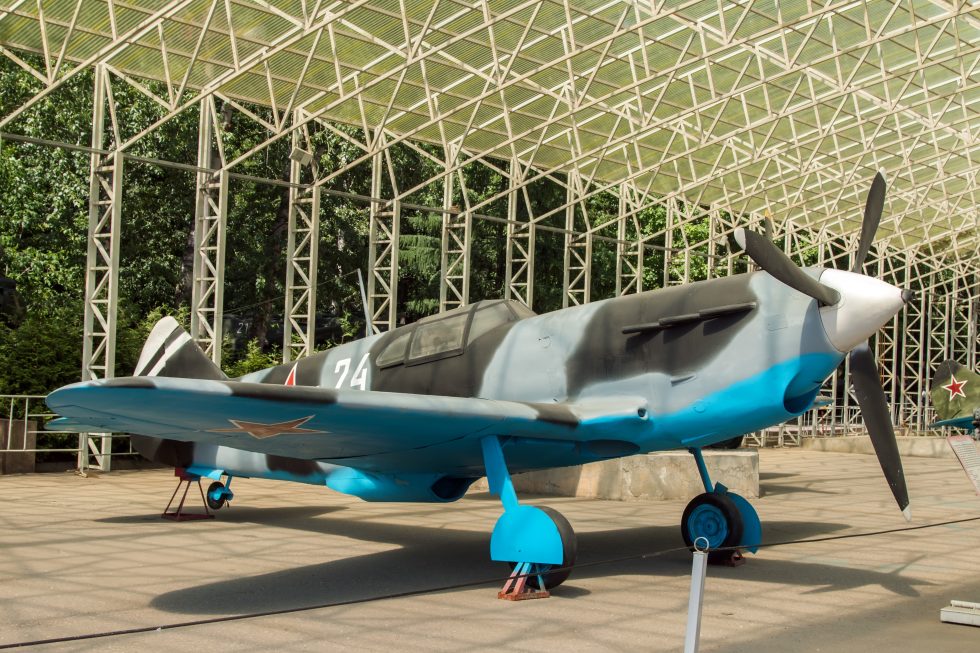
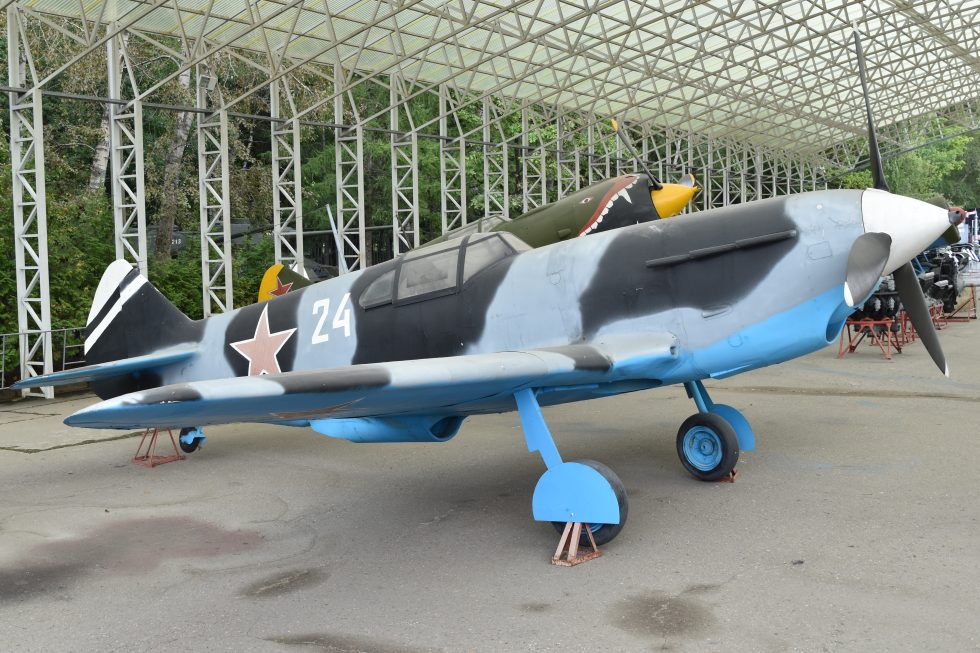
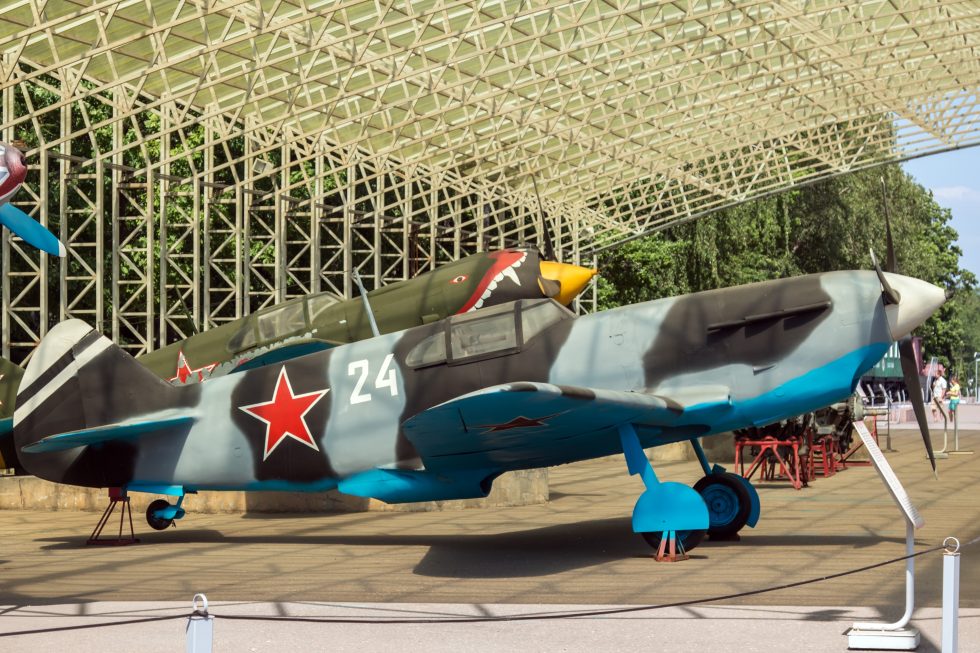
Survivors: not one complete, war-built LaGG-3 is known to exist, from a production run of 6,528 aircraft — among the emptiest survival records of any mass-produced fighter of the war, and a direct consequence of the material the type was made of. Wooden airframes that were shot down, written off or simply worn out left nothing recoverable; the last Soviet LaGG-3s were struck off charge in early 1947 and were burnt or broken up. What museums show are reconstructions. The most substantial is the full-scale LaGG-3 built by Aviarestavratsiya of Novosibirsk under Professor Vladimir Berns of Novosibirsk State Technical University, working from surviving manuals and archive photographs, complete with a working cockpit and moving control surfaces and fitted with an original M-105 engine recovered from a wartime crash site; it was delivered to the Museum of Military Equipment at Verkhnyaya Pyshma near Yekaterinburg on 23 April 2021. A simpler full-scale replica built in 1995 by the Tushino Machine-Building Plant, marked as a 1943 aircraft flown by Senior Lieutenant Shchipov, is also on Russian museum display, and the Central Museum of the Great Patriotic War on Poklonnaya Hill in Moscow lists a LaGG-3 in its collection; no source in general circulation identifies any of them as an original airframe. Beyond these there are excavated fragments, propeller blades, data plates and M-105 engines recovered from Karelia, the Murmansk region and the Black Sea littoral, held in Russian collections and by search teams. There is no airworthy LaGG-3 anywhere and, barring a wreck coming out of a lake in far better condition than any yet found, there will not be one. Production totals are firmer than the survivor record: 6,528 is the accepted figure, distributed as roughly 2,463 in 1941, 2,771 in 1942, 1,065 in 1943 and 229 in 1944, built at Factory No. 21 at Gorky, No. 23 at Leningrad (only some 65 aircraft before evacuation), No. 153 at Novosibirsk and No. 31 at Taganrog and then Tbilisi, which alone delivered more than 2,000 and kept building the type after everyone else had moved on.
The LaGG-3: from wooden hope to stepping stone
A wooden fighter is designed
Lavochkin, Gorbunov and Gudkov begin work on a modern fighter built from resin-bonded wood to spare scarce aluminium.
First flight
The I-301 prototype flies in the spring; after modifications for greater range it is standardised as the LaGG-3.
Into battle
The LaGG-3 enters service and fights in the defence of Moscow and Leningrad during the German invasion.
The radial conversion
Lavochkin fits a Shvetsov M-82 radial to the wooden airframe, creating the far superior La-5 — the type’s great legacy.
Stalingrad and the fleets
LaGG-3s serve at Stalingrad and the Caucasus and fly hard with Baltic and Black Sea naval aviation.
Pushed to the second line
Outclassed by newer fighters, the LaGG-3 shifts to training, air defence and reconnaissance; the refined Series 66 appears.
Production ends
The last LaGG-3s leave Factory 31 in Tbilisi, which switches to the Yak-3; about 6,528 have been built.
Legacy in the La-5 and La-7
The wooden airframe lives on in the Lavochkin radial fighters that helped win air superiority over the Eastern Front.
From the front: twelve LaGG-3 stories
Three designers, one aircraft
La-G-G: Lavochkin, Gorbunov and Gudkov gave the fighter their initials.
Read the full story
A fighter made of wood
With aluminium reserved for bombers, the LaGG-3 was built from resin-impregnated birch laminate.
Read the full story
The “varnished guaranteed coffin”
Pilots joked that LaGG stood for Lakirovanny Garantirovanny Grob.
Read the full story
Too heavy for its engine
Stalin’s order to add fuel and range piled weight onto an already heavy airframe.
Read the full story
Tough enough to fly home
Wood did not splinter like thin metal — the LaGG-3 soaked up damage and kept flying.
Read the full story
Kaberov over Kronstadt
Naval ace Igor Kaberov fought Stukas and Bf 109s in a damaged LaGG-3 defending Kronstadt.
Read the full story
The men who scored on it
Baltic ace Gerasim Kostylev is credited with close to 30 victories, many on the LaGG-3.
Read the full story
Finnish LaGG-3s
Finland flew a handful of captured LaGG-3s against their former owners.
Read the full story
Guarding the sea lanes
Over the Baltic and Black Seas the LaGG-3 protected fleets and convoys long after front-line units re-equipped.
Read the full story
“Soviet Georgia”
A LaGG-3 series 66 of the 88th Fighter Regiment carried a Georgian dedication on its fuselage.
Read the full story
The best came last
Continuous lightening and clean-up made the final LaGG-3 batches genuinely competitive — too late.
Read the full story
The seed of a dynasty
The wooden LaGG-3 airframe, re-engined with a radial, became the La-5 and then the La-7.
Read the full story
The LaGG-3 in pictures
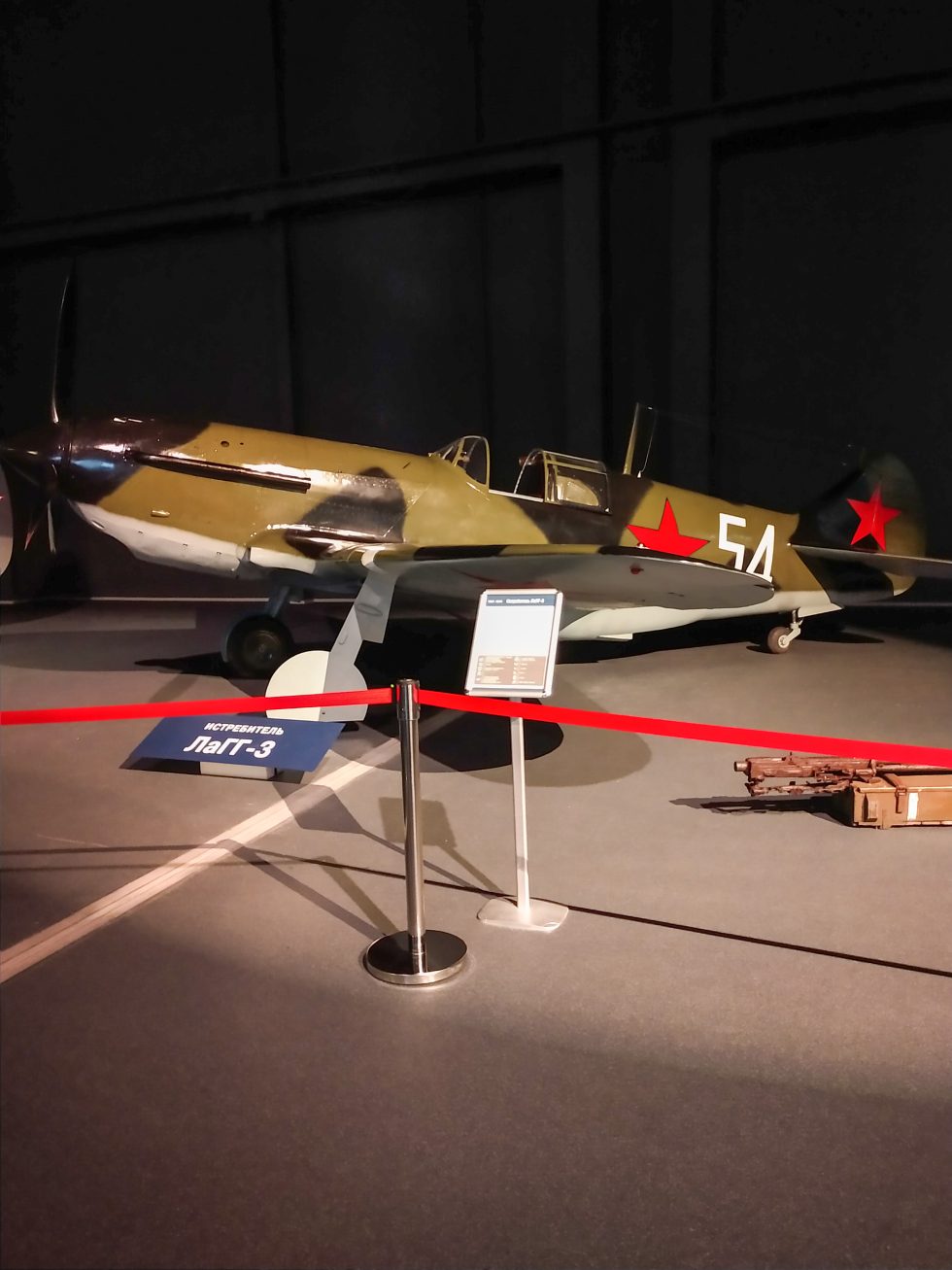
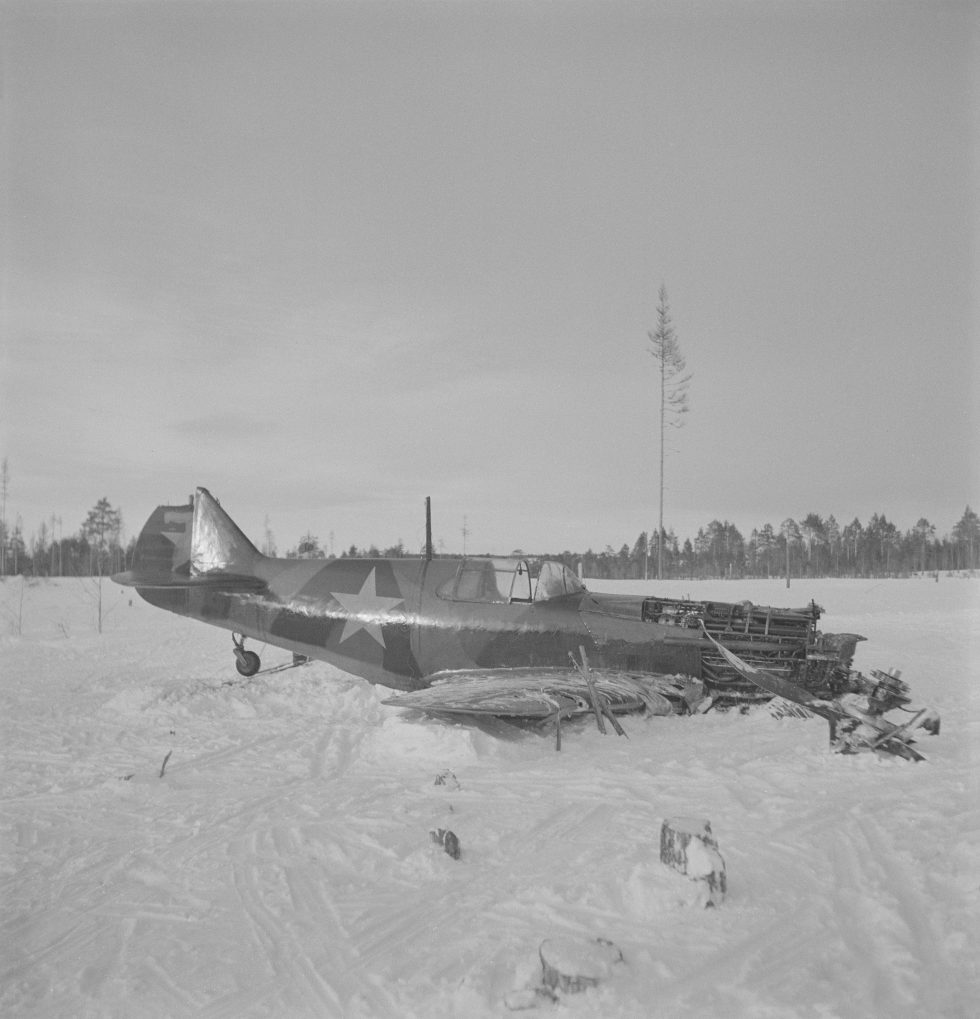
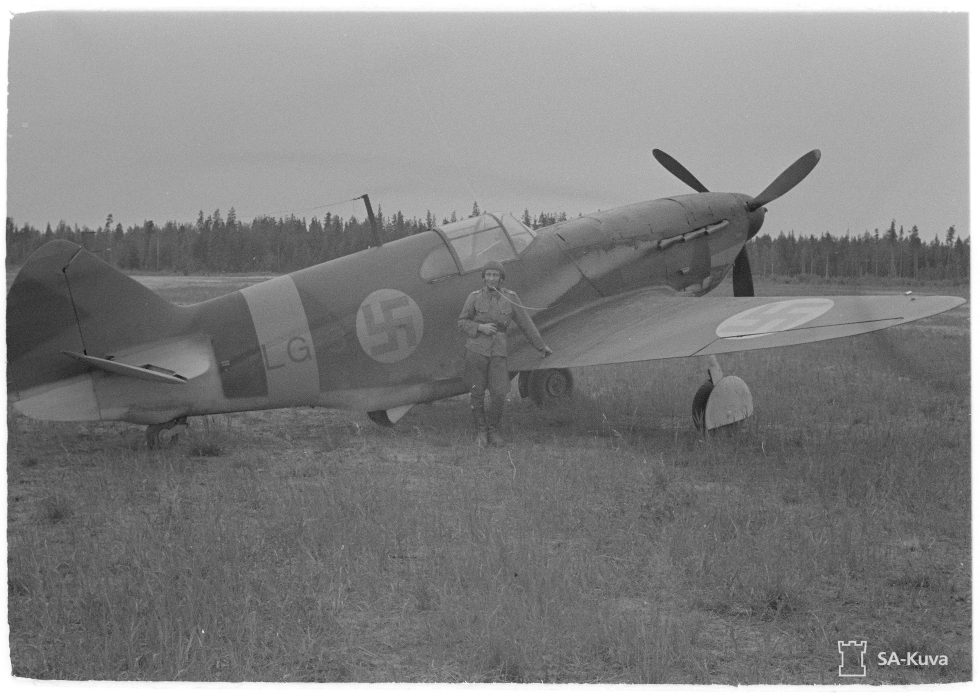
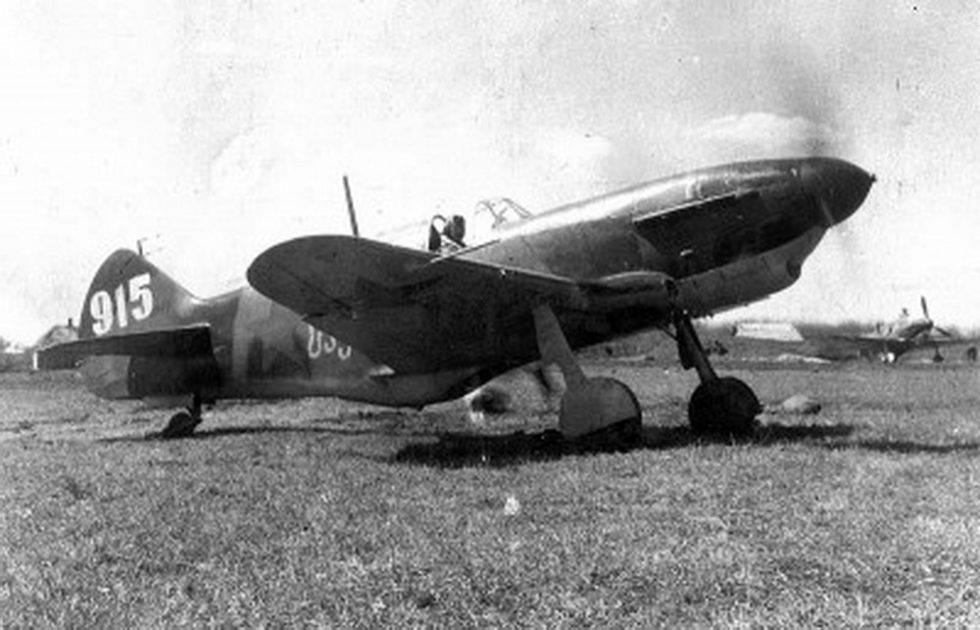
The LaGG-3 in motion
Aviation Tales: LaGG-3 — Failure or Necessary Stepping Stone? A documentary history of the wooden fighter, its troubled development and its evolution into the Lavochkin radial fighters.
Where the LaGG-3 flew
The LaGG-3’s war: outgunned, but never a walkover
The LaGG-3 fought its hardest battles in 1941–43, the grimmest years of the war in the East. It was outclassed in a dogfight by the Messerschmitt Bf 109F and paid a heavy price, but it was a steady gun platform against German bombers, absorbed damage that would have destroyed a lighter fighter, and served on long after front-line units re-equipped — especially with the Baltic and Black Sea fleets.
Compare the combat record of every military aircraft. Figures are best-available estimates and are hedged where sources disagree.
Everything people ask about the LaGG-3
Can I fly in a LaGG-3?
Why was the LaGG-3 made of wood?
What did “LaGG” stand for?
Was the LaGG-3 any good?
How is the LaGG-3 related to the La-5?
How fast was the LaGG-3?
How many LaGG-3s were built?
Are any LaGG-3s left today?
You can’t fly the LaGG-3.
These, you can.
Some legends only live in museums — others are fuelled and waiting. MiGFlug has put civilians in real military jet cockpits since 2004.
 Fly the L-39 AlbatrosThe world’s most-flown jet trainer — aerobatics included
 Fly the F-104 Starfighter“The missile with a man in it”
 Fly the MiG-21The Cold War’s most-produced jet
 Fly the T-33 Shooting StarAmerica’s first jet trainer
 Fly the DH VampireA piece of early jet history
 Fly the S.211Agile Italian jet trainer
 Fly the MB-326The classic Aermacchi jet
 Fly the MiG-15The Soviet legend of the Korean War
Continue the tour
Every fact, checked
- George Mellinger — LaGG & Lavochkin Aces of World War 2 (Osprey)Authoritative on the pilots, units and combat history of the type.
- GlobalSecurity.org — LaGG-3Production totals (6,528), factories, series count and service summary.
- MilitaryFactory — Lavochkin LaGG-3Reference specification table: dimensions, weights, speed, ceiling and armament.
- 1C Game Studios — IL-2 “Great Battles” developer museumWell-researched engine, series and pilot detail (Kostylev, Kamozin).
- Stormbirds — Legends of the East: LaGG-3 and La-5Narrative history of the design, nickname and evolution to the La-5.
- WW2DB — LaGG-3Cross-reference specification sheet for the type and its variants.
- Gordon & Khazanov — Soviet Combat Aircraft of the Second World War, Vol. 1Standard scholarly reference for LaGG-3 development and production.
- Igor Kaberov — Swastika in the GunsightBaltic Fleet pilot memoir with first-person LaGG-3 naval combat.