
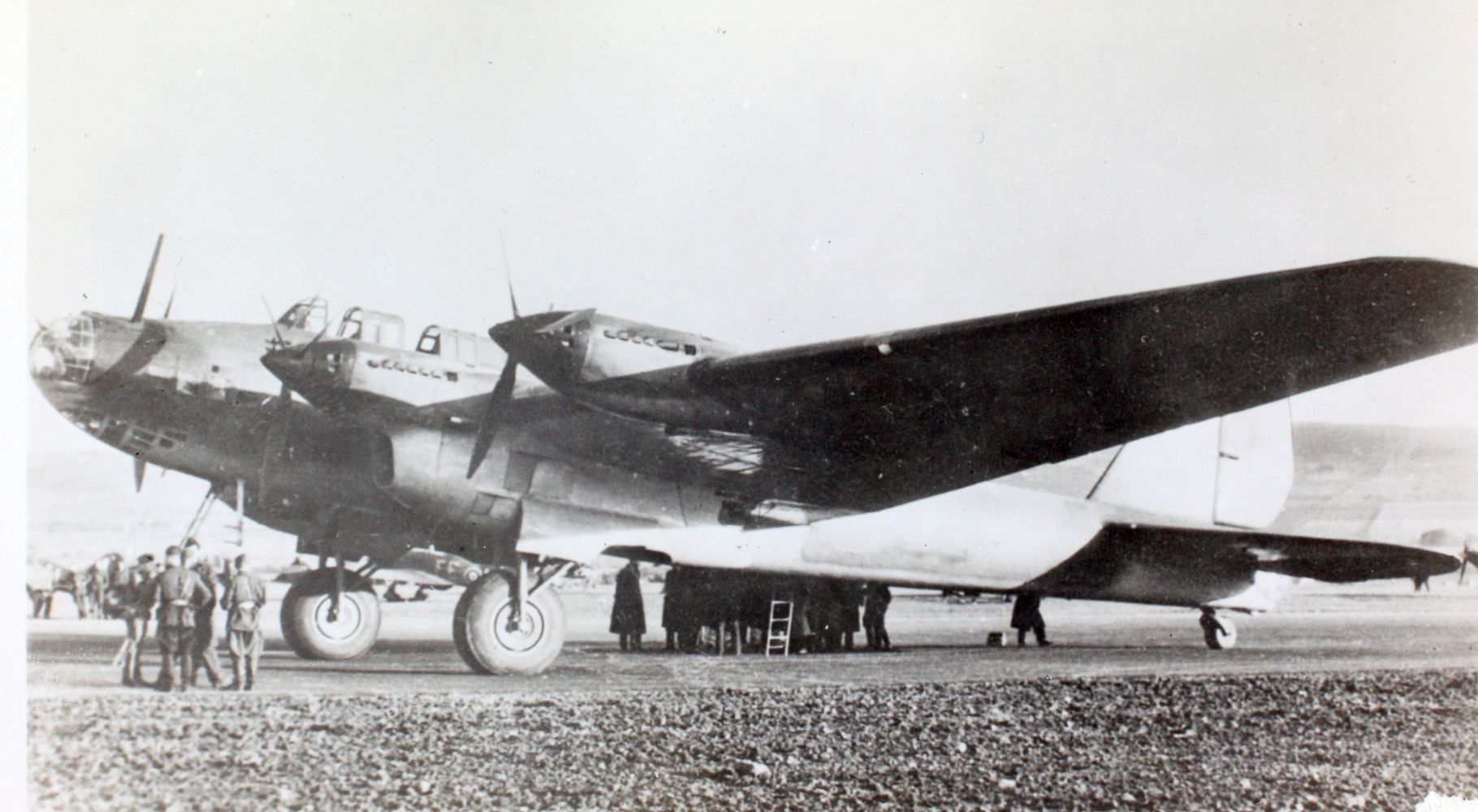
Petlyakov Pe-8
“TB-7”
The Soviet Union’s only four-engine strategic bomber of the Second World War — a rare, hand-built giant that raided Berlin, dropped the largest Soviet bomb of the war, and flew a foreign minister across German-occupied Europe to Washington and back.
The Petlyakov Pe-8: the USSR’s lone four-engine bomber
In the mid-1930s the Soviet Union set out to build a modern four-engine heavy bomber to replace the lumbering Tupolev TB-3. The task fell to a design brigade under Vladimir Petlyakov inside Andrei Tupolev’s bureau, and the aircraft that emerged — the ANT-42, later the service type TB-7 — first flew on 27 December 1936. On paper it was a genuine rival to the American B-17: fast, long-ranged and, thanks to an unusual fifth engine buried in the fuselage to feed its superchargers, able to bomb from altitudes that early fighters struggled to reach.
Reality was harsher. Political turbulence — Petlyakov was briefly imprisoned during the 1937–38 purges — engine shortages and the sheer difficulty of the design meant the bomber trickled off the line at the Kazan plant. Only around 90 to 93 were ever completed. When Petlyakov was killed in the crash of one of his own Pe-2 dive bombers in January 1942, the TB-7 was renamed the Pe-8 in his memory.
Yet this tiny fleet did outsized things. Pe-8s raided Berlin in August 1941, only weeks into the German invasion; they carried the five-tonne FAB-5000, the largest Soviet bomb of the war; and in May 1942 a specially converted example flew Foreign Minister Vyacheslav Molotov from Moscow, over occupied Europe, to Scotland and on to Washington — one of the most remarkable diplomatic flights of the conflict. No other Soviet-designed four-engine bomber saw operational service. The Pe-8 was, and remained, one of a kind.
01The Petlyakov Pe-8’s origins: how the ANT-42 became the TB-7 and the USSR’s only strategic bomber
The programme began with a 1934 requirement for a heavy bomber able to strike deep behind enemy lines. Petlyakov’s brigade, working under Tupolev at TsAGI, produced the ANT-42 — a clean, all-metal four-engine monoplane far more advanced than the TB-3 it was meant to replace. Series development was later led by Iosif Nezval, who nursed the difficult aircraft through years of slow, hand-built production at Kazan’s Plant No. 124.
Every stage was dogged by trouble: the purges swept up key engineers, the specialised engines were in chronically short supply, and the airframe was complex and costly to build. The result was a bomber produced in tiny numbers — commonly cited as about 90 to 93 aircraft — that nonetheless became the only four-engine strategic bomber the Soviet aircraft industry ever fielded in the war. Everything else the USSR flew in the long-range role was either obsolete, twin-engined, or supplied by Lend-Lease.
What makes the Pe-8 special
A fifth engine, hidden in the fuselage
To bomb from high altitude the early TB-7 carried an extraordinary solution: a fifth engine inside the fuselage — a Klimov M-100 driving a large centrifugal blower (the ATsN central supercharging unit) that force-fed compressed air to the four main engines’ superchargers. It let the bomber cruise high above the fighters of 1939, but it was heavy and troublesome, and was dropped from production once high-altitude engines matured.
Four inline engines — when they could be found
Standard aircraft used four Mikulin AM-35A liquid-cooled V12s of roughly 1,350 hp each. But the same engine powered the MiG-3 fighter, and the fighter had priority. Chronic shortages forced desperate substitutions: unreliable Charomskiy M-30 / M-40 diesels and, later, air-cooled ASh-82 radials. The engine story explains much of the Pe-8’s troubled service life.
The five-tonne bomb
The Pe-8 was the only Soviet aircraft that could lift the FAB-5000 — a five-tonne blast bomb, the heaviest the USSR used in the war. Carrying it meant exceeding the type’s rated four-tonne load, but from 1943 Pe-8s dropped these monsters on fortified German positions and cities, a rare Soviet foray into truly heavy strategic bombing.
02The Petlyakov Pe-8’s fifth engine: the ATsN central supercharger explained
High-altitude flight needs dense air fed to the engines, and in the mid-1930s no Soviet powerplant could supply enough on its own at 8,000–10,000 metres. The answer was the ATsN-2 — a Klimov M-100 engine mounted in the fuselage behind the crew, driving a centrifugal compressor that pumped pressurised air out to the four wing engines. With it, the prototype could operate at altitudes commonly cited near 11,000 metres, above the reach of most 1939 interceptors. But the unit added weight, complexity and a fire risk, and consumed internal volume. As dedicated high-altitude versions of the AM-35 became available, the fifth engine was deleted from production aircraft, and service Pe-8s topped out around 9,300 metres.
03The Petlyakov Pe-8’s engine crisis: diesels, radials and the AM-35A shortage
The Pe-8’s preferred AM-35A was also needed for the MiG-3, and fighter production came first. To keep bombers rolling, engineers fitted Charomskiy M-30 and M-40 aviation diesels, prized for their long range — but these proved dangerously unreliable, cutting out over enemy territory during the first Berlin raid of August 1941 and causing several losses. Many aircraft were retrofitted back to AM-35As, and when even those ran short, late Pe-8s received ASh-82 air-cooled radials of around 1,700–1,850 hp, which improved reliability at the cost of high-altitude performance. Few WWII bombers flew with such a bewildering variety of engines, and none of the fixes ever fully solved the problem.
Petlyakov Pe-8: full specifications
Baseline note: the figures below describe a production Pe-8 of the 1941–42 standard as it left State Aircraft Factory No. 124 at Kazan — four Mikulin AM-35A, the MV-6 retractable dorsal turret and the KEB tail turret each with a 20 mm ShVAK, and no ATsN-2 supercharging unit in the fuselage. Deltas for the ATsN-2 prototypes, the M-30 and M-40 diesel aircraft of 1941, the ASh-82 radial aircraft of 1943–44 and the Pe-8ON transports are given in grey. Three cautions apply. First, almost nothing about this aeroplane was standard: 93 airframes were built and they carried at least eight different powerplants between them, many aircraft being re-engined two or three times in service, so any single table is a snapshot rather than a description. Second, ceiling is genuinely contested — English-language tables print 9,300 m for the AM-35A aircraft while Russian ones give 11,000 m, and both are shown below rather than averaged. Third, crew is quoted as ten or eleven depending on the source and on whether the man who tended the fifth engine is counted.
Dimensions & weights
- Crew
- 11 in most English tables; Russian sources usually say ten. The variation is real rather than clerical: the ATsN-2 aircraft carried a man whose whole job was the supercharger engine, and the late ASh-82 aircraft lost the two nacelle gunners
- Length
- 23.20 m (76 ft 1 in) — longer than a Lancaster (21.18 m) and within a foot of a B-17G
- Wingspan
- 39.13 m (128 ft 5 in) — wider than a Lancaster (31.09 m) or a B-17 (31.62 m). This was a genuinely large aeroplane, larger than anything the Western allies put into mass production before the B-29
- Height
- 6.20 m (20 ft 4 in), tail down
- Wing area
- 188.66 m² (2,030.7 sq ft) — against 120.49 m² (1,297 sq ft) for a Lancaster. The Pe-8 was designed around lift at altitude, which is the whole logic of the ATsN-2
- Aerofoil
- TsAGI-40 — 19 per cent thickness at the root, 15.5 per cent at the tip
- Structure
- All-metal duralumin monocoque fuselage on two steel wing spars, with fabric-covered ailerons — the spar booms were 30KhGSA chromansil steel, a choice that came back to haunt the fleet in 1944
- Empty weight
- 18,571 kg (40,942 lb)
- Normal take-off weight
- 27,000 kg (59,525 lb)
- Maximum take-off weight
- 35,000 kg (77,162 lb) — the overload case, flown for maximum-range and maximum-bomb sorties and disliked by crews on the rough grass strips the regiment actually used
- Internal fuel
- ~17,000 litres (~3,740 imp gal) in 19 separate tanks — the figure most often quoted in Russian sources, and the reason the diesel-engined aircraft could be talked about as transatlantic machines
- Bomb load
- 4,000 kg (8,800 lb) maximum internal, plus one FAB-500 on an external rack under each wing; the FAB-5000 case took the aircraft well past its rated capacity and is discussed below
- Wing loading
- 143 kg/m² (29.3 lb/sq ft) at normal take-off weight — low by 1941 standards, and deliberately so
Performance
- Maximum speed
- 443 km/h (275 mph, 239 kn) on AM-35A in English-language tables. Russian tables print 403 km/h (250 mph) at 8,000 m for what is nominally the same standard; much of the gap is a question of the altitude at which the figure was taken, and the honest statement is 400 to 445 km/h depending on height and fit
- Maximum speed, ATsN-2 prototype
- 403 km/h (250 mph) at 8,000 m in 1937 — the number that made the aeroplane briefly look like a war-winner, since it put a loaded four-engined bomber above and faster than most single-engined fighters then in service. The ATsN-2 was worth roughly 40 km/h at height when it worked, which was seldom
- Cruising speed
- 350 km/h (217 mph) — the usual quoted figure; operational night sorties were flown slower still to stretch endurance
- Service ceiling
- 9,300 m (30,500 ft) in English tables; Russian tables give 11,000 m (36,100 ft) for the AM-35A aircraft. Both are shown because the disagreement is real and unresolved in the literature
- Typical bombing altitude
- 6,000 to 7,000 m (19,700 to 23,000 ft) on operations — high enough to make German flak work for its kills, and cold enough that frostbite was a routine crew hazard in an unheated aeroplane
- Rate of climb
- 5.9 m/s (1,160 ft/min) at sea level
- Range with 2,000 kg of bombs
- 3,700 km (2,300 miles) on AM-35A; ~5,460 km (3,390 miles) on M-30 diesels and ~5,800 km (3,600 miles) on ASh-82 in Russian tables. The diesels were fitted precisely for that range, and the range was real; the engines were not
- Combat radius
- ~1,600 km (~990 miles) with a useful load on AM-35A — enough to reach Berlin, Danzig, Königsberg and Helsinki from fields around Moscow and Leningrad, which is exactly what the regiment did
- Endurance
- ~12 hours at economical cruise; the Moscow to Scotland leg of the Molotov mission in May 1942 was flown non-stop across German-occupied Europe
- Power loading
- 0.140 kW/kg (0.085 hp/lb) at normal take-off weight
- Sortie loss rate
- One aircraft lost per 103 sorties in 1942, worsening to one per 46 sorties in 1944 — counting mechanical failure, enemy action and friendly fire together, because in this type’s records the three are frequently hard to separate
- Recorded effort
- 226 sorties and 606 tonnes of bombs between August 1941 and May 1942; 276 sorties in 1944 — small numbers by RAF or USAAF standards, and a fair measure of what 93 aeroplanes could actually do
Propulsion & systems
- Powerplant, baseline
- 4 × Mikulin AM-35A V-12 liquid-cooled, 1,340 hp (999 kW) for take-off, about 1,200 hp nominal at altitude — the same engine that powered the MiG-3, and the reason the two programmes were in direct competition for a scarce production line
- Engines fitted across the programme
- AM-34FRN, AM-34FRNV, AM-35, AM-35A, M-40 and M-40F diesels, M-30 diesels, M-82 and ASh-82 radials, ACh-30B diesels; postwar ASh-82FN and ASh-73 — at least eight powerplants on 93 airframes. The per-engine totals quoted in Russian sources add up to well over 93 because so many aircraft were re-engined, sometimes twice
- ATsN-2 central supercharging unit
- A fifth engine, the 860 hp Klimov M-100 (later the M-103), buried in the fuselage above the wing spars behind the pilots, driving a centrifugal compressor that fed pressurised air to all four main engines through internal ducting — a 1918 Zeppelin-Staaken idea revived. It was fitted to the two prototypes and only the first four production aircraft
- Why the ATsN-2 failed
- The M-100 would not hold its rated speed under load, it overheated, it vibrated, it upset the trim, and no one ever organised its manufacture in any systematic way; when M-100 supply dried up the installation had no future — deleting it freed the bay for the flight engineer and radio operator, which was the one unambiguous benefit the Pe-8 got out of the whole exercise
- Propellers
- Three-bladed constant-speed on all main production variants
- Cooling
- The inner nacelles carried shared radiator intakes serving both the inner and the outer engine on each side — one of the aeroplane’s few genuinely distinctive engineering features, and a recognition point in photographs
- Fuel system
- 19 tanks in wing and centre section — not self-sealing on early aircraft, and German flak that punctured a tank generally ended the sortie
- Landing gear
- Retractable main units with twin wheels folding aft into the inner nacelles, plus a tailwheel — a heavy, slow, hydraulically driven installation
- Crew environment
- Unpressurised throughout, bottled oxygen, effectively unheated — Molotov and his party crossed occupied Europe in flying suits, oxygen masks and parachutes, sitting in a bomber’s fuselage
- Wing spars
- Two steel spars with 30KhGSA chromansil booms — from February 1944 fatigue cracks began to appear in the booms; an inspection of the 45th Division found 19 of its 30 Pe-8s unfit to fly, which grounded a large part of the surviving force at a stroke
- Defensive turrets
- MV-6 electro-hydraulic retractable dorsal turret; KEB tail turret; two ShU barbettes at the rear of the inner nacelles — the nacelle gunners crawled out through the wing to reach their stations and could not get back quickly, which is the sort of detail that does not appear in specification tables
- Bomb bay
- One long internal bay rated at 4,000 kg, with Der-20U external locks under the centre section — the FAB-5000 would not fit: its tail unit was cut down by 350 mm, the bomb hung half outside the aeroplane and the doors closed only about 30° over it
04The Petlyakov Pe-8’s operating costs: why no reliable price exists
The Pe-8 was a Soviet state product, built in tiny numbers during wartime and never sold on any open market, so a firm flyaway unit price simply does not exist in the public record. Nor is there any credible cost-per-flight-hour figure for the type — the Soviet Union did not publish such data, and Western analysts never had the fleet to study. What sources do agree on is that the Pe-8 was expensive and slow to build: complex, largely hand-assembled and chronically short of engines, which is a large part of why only around 90 aircraft were ever completed. Any precise cost figure attached to a Pe-8 should be treated as guesswork rather than fact.
Armament & payload
The Pe-8 was the best-defended Soviet bomber of the war, and the only aeroplane that could lift a five-tonne bomb
Two 20 mm ShVAK cannon covering the upper and rear hemispheres was a serious defensive battery for 1941, at a date when Lancasters and B-17s were still relying on rifle-calibre and half-inch guns in the tail. Add two 12.7 mm Berezin UBT in barbettes let into the back of the inner engine nacelles, firing down and aft into the blind cone every other heavy bomber of the period left open, and on paper the Pe-8 was a hard aeroplane to attack. The offensive load was equally serious: 4,000 kg internally as standard, and from 1943 the FAB-5000NG, a 5.4-tonne blast bomb that no other aircraft in the world was carrying.
In practice the guns mattered less than the arithmetic. There were never more than about thirty serviceable Pe-8s at any one time, they flew at night in small numbers, and the losses that hurt came from engine failure, from German night fighters catching them over the target, and — repeatedly and embarrassingly — from Soviet anti-aircraft gunners and Soviet fighter pilots who had never seen a four-engined aeroplane wearing red stars and assumed the worst. The all-causes loss rate more than doubled between 1942 and 1944. Fits varied enormously between marks: the ASh-82-engined aircraft lost the nacelle guns because the radial’s exhaust ran through where the gunner sat, and from the end of 1943 the nose turret and its chin gondola — the "beard" — were deleted altogether for a clean glazed nose with two manually aimed ShKAS.
Gun
- 1 × 20 mm ShVAK in the nose turret on early production aircraft, covering a 120° cone ahead, with a prominent chin gondola beneath it that crews called the "beard"
- 1 × 20 mm ShVAK in the MV-6 retractable electro-hydraulic dorsal turret — the primary defensive weapon
- 1 × 20 mm ShVAK in the KEB tail turret — a cannon in the tail in 1941, which no British or American heavy bomber of that date had
- 2 × 12.7 mm Berezin UBT in ShU barbettes at the rear of the inner engine nacelles, covering below and behind; deleted on ASh-82 aircraft
- 2 × 7.62 mm ShKAS on manual mounts in the streamlined nose from the end of 1943, replacing the nose turret and the "beard" entirely
Air-to-air
- No guided air-to-air weapon existed in Soviet service in this aircraft’s lifetime. The card is kept because the Pe-8’s guns were used in earnest more often than its bombs were dropped accurately
- The four cannon and two heavy machine guns were the air-to-air armament, and the layout was well thought out: the ShU nacelle barbettes closed the low rear quarter that killed Lancasters and Halifaxes in their hundreds
- It was not enough. German night fighters took a rising toll from 1943, particularly during Operation Kutuzov in the summer of that year, and the type was effectively withdrawn from bombing operations in 1944
- Friendly fire deserves its own line. On the Berlin raid of 10–11 August 1941 the formation was fired on by Soviet coastal anti-aircraft batteries, and the divisional commander’s aircraft was attacked by Polikarpov I-16s of Soviet naval aviation over the Baltic and lost an engine to them
Air-to-surface guided
- None in wartime service, in any variant. Everything the Pe-8 dropped was unguided and aimed through a bombsight from six or seven thousand metres at night
- After the war the airframe became the Soviet Union’s first air-launch platform: Pe-8s carried and released the Chelomei 10Kh, the Soviet copy of the German V-1 flying bomb, in trials from 1945
- Pe-8 No. 42911 served as the mother ship for Matus Bisnovat’s rocket-powered 5-1 and 5-2 research aircraft in 1948–49
- Pe-8LL flying laboratories carried prototype piston engines, including a fifth engine mounted for test purposes on airframe 4218
- None of this was combat. The Pe-8 never released a guided weapon in anger
Bombs
- 4,000 kg (8,800 lb) maximum internal load, made up as required from FAB-100, FAB-250, FAB-500, FAB-1000 and FAB-2000 general-purpose bombs; up to about 40 FAB-100 in the small-bomb case
- 1 × FAB-500 on an external rack under each wing, in addition to the internal load
- FAB-5000NG: 5,400 kg all-up with a 3,200 kg filling of TGA (roughly 60 per cent TNT, 24 per cent RDX, 16 per cent aluminium powder), 5.20 m long and 1.0 m in diameter, designed by Nison Gelperin’s team at KB-35 and ready in February 1943
- Only ASh-82-engined Pe-8s could lift it, and even then it hung half outside the fuselage on Der-20U locks with the bay doors gaping. About 98 were built — a weapon of political and psychological effect more than of tonnage
- Leaflets. The August 1941 Berlin raid carried propaganda leaflets alongside the bombs, and so did many later sorties over the occupied cities
Rockets
- None, ever. The Pe-8 never carried the RS-82 or RS-132 rockets that were near-universal on Soviet tactical aircraft
- The reason is straightforward: it was a night bomber flown at 6,000 to 7,000 m against cities and marshalling yards, and unguided rockets are a daylight weapon fired from a diving aeroplane at something the pilot can see
- No defensive rocket or aerial-grenade device of the DAG-10 kind used on the Il-2 and Il-10 was fitted either
- The nearest thing to a rocket the type ever carried was the postwar 10Kh cruise missile on trials, which belongs in the guided-weapons card rather than this one
Pods & other stores
- Der-20U external bomb locks under the centre section — the mounting that made the FAB-5000 possible at all
- Additional fuel tanks and extra oxygen bottles, fitted for the April 1942 proving flight to Britain and for the Molotov mission the following month
- FOTAB photoflash bombs for night bomb-damage assessment, carried by the aircraft detailed to photograph the target
- Pe-8ON: a twelve-seat passenger cabin plus 1,200 kg (2,600 lb) of cargo, installed in place of the bomb load on two 1944-built aircraft
- Polar conversions carried survival equipment, extra tankage and, in place of guns, an orange paint scheme — the only Pe-8s that ever looked cheerful
Three typical loadouts
- Night raid on Berlin, 10–11 August 1941
- Maximum internal fuel, an internal load of FAB-100 and FAB-250 bombs together with propaganda leaflets, and the M-40F diesels running. This was the load the aeroplane was designed for and the sortie it was built to fly; five of the eight that set out did not come home, mostly because of the engines.
- Railway interdiction, Orel salient, summer 1943
- One FAB-5000NG on Der-20U locks, bay doors half open, ASh-82 radials, no external FAB-500s. Two aircraft so loaded destroyed roughly 100 m of track and the rolling stock standing on it at a station near Orel — the single clearest case of the Pe-8 doing something no other Soviet aeroplane could.
- Diplomatic mission, 19 May to 13 June 1942
- Aircraft No. 42066, AM-35A engines, no bombs, no leaflets: additional fuel tanks, oxygen for passengers, and Vyacheslav Molotov with his delegation in flying suits and parachutes. Moscow to Tealing in Scotland non-stop over occupied Europe, then Prestwick, Reykjavík and Goose Bay to Washington by 29 May, and the whole distance back again.
Sourcing caveat: Pe-8 armament fits are described inconsistently even in Russian specialist literature, because so few aircraft were built and so many were modified individually in the field. Bomb-load figures in particular should be read as what a given airframe could be made to carry rather than as a fleet standard. The first-use date of the FAB-5000 is disputed: the widely repeated claim of Königsberg on 29 April 1943 is doubted in the Russian bomb literature, which gives the first firmly documented drops around Orel in the summer of 1943.
Variants
Ninety-three aeroplanes, eight powerplants, and not one version that settled the design
The Pe-8 story is an engine story. The 1934 specification asked for 440 km/h at 10,000 m, and in 1936 the Soviet Union had no engine with a supercharger good enough to deliver it. Tupolev’s bureau solved the problem by installing a fifth engine — a Klimov M-100 driving a compressor that fed the other four — and the prototype duly did 403 km/h at 8,000 m, which in 1937 was extraordinary. Then the ATsN-2 turned out to be unbuildable in quantity and unreliable in the air, and every subsequent variant of the aeroplane is an attempt to get high-altitude performance some other way.
None of the attempts worked. AM-34FRNV production ended in 1939. The AM-35A was good but was wanted for the MiG-3 and went out of production in 1941. The M-40 and M-30 aviation diesels of 1941 gave spectacular range on paper and cut out at altitude in practice, with the crews expected to regulate fuel flow by hand. The ASh-82 radial fitted from late 1942 was at last reliable, and cost the aeroplane the altitude performance that had been its entire reason for existing. Four late aircraft got ACh-30B diesels. The type was built in ones and twos throughout — six in 1939, twelve in 1940, seventeen in 1941, twenty in 1942, eighteen in 1943 and eighteen in 1944, ninety-one production aircraft plus the two prototypes.
The politics were as damaging as the engineering. Tupolev, Petlyakov and Myasishchev were all arrested by the NKVD in October 1937, with deliberate obstruction of the TB-7 powerplant among the charges; the accusations were fabrications belonging to the general purge of the Soviet aviation industry, but the effect on the programme was entirely real. Iosif Nezval took over as chief designer from November 1937, the second prototype did not fly until 26 July 1938, and Petlyakov never worked on the aeroplane again. He spent his imprisonment designing what became the Pe-2, was released, and was killed in a Pe-2 crash on 12 January 1942; the TB-7 was renamed Pe-8 in his memory, which is one of the stranger honours in aviation history.
- ANT-42, first prototype (1936, 1)
- Four AM-34FRN plus the M-100 ATsN-2 supercharging unit. First flight 27 December 1936 at Khodynka in the hands of Mikhail Gromov; state trials with the ATsN-2 in August 1937.
- TB-7 dubler, second prototype (1938, 1)
- AM-34FRNV and ATsN-2. Begun in April 1936, flown only on 26 July 1938 — the delay is the arrests, in the plainest possible form.
- TB-7 with AM-34FRNV (1939, ~6)
- The first Kazan production batch. Four were completed with the ATsN-2 and were the last aircraft ever to carry it; the rest were finished without it, the space going to the flight engineer and radio operator.
- TB-7 / Pe-8 with AM-35 and AM-35A (1940–42, ~40 including re-engined aircraft)
- The standard wartime fit and the basis of every published specification table. Good engines, in permanent short supply, competing directly with the MiG-3 for the same production capacity.
- Pe-8 with M-40 and M-40F diesels (1941, 3–4)
- Charomskiy aviation diesels fitted for range. They stopped at altitude with no warning and no reliable relight; these were the aircraft sent to Berlin in August 1941, and the engines killed more of them than the Germans did.
- Pe-8 with M-30 diesels (1941, ~11)
- The second diesel attempt, with the same virtue and the same vice: about 5,460 km of range and an engine nobody trusted above 5,000 m. Most were re-engined later.
- Pe-8 with M-82 / ASh-82 (1942–44, ~34)
- The 1,850 hp Shvetsov radial, adopted when the AM-35A ran out. Reliability transformed, altitude performance surrendered, the nacelle guns deleted because of the exhaust routing. From the end of 1943 these aircraft also lost the nose turret for a streamlined nose. The only Pe-8s that could carry the FAB-5000.
- Pe-8 with ACh-30B (1944, 4)
- The final diesel, now with a centrifugal supercharger and at last more or less usable. It arrived at the moment the aeroplane stopped being needed as a bomber.
- Pe-8ON (1944, 2 — airframes 42612 and 42712)
- Osobovo Naznacheniya, special mission: twelve seats and 1,200 kg of cargo in place of bombs, ACh-30B engines and a fillet at the base of the fin. Built as VIP transports on the strength of what the Molotov flight had shown the aeroplane could do.
- Pe-8LL and polar conversions (1945 onwards, 5 aircraft to Aeroflot — N-395, N-396, N-419, N-550, N-562)
- Flying testbeds for prototype piston engines, and the Arctic transports: guns and military equipment removed, extra tanks fitted, ASh-82FN or ASh-73 engines installed, painted orange. One landed at the North Pole in 1954, and others supplied the drifting ice stations NP-2, NP-3 and NP-4 into the late 1950s. This was the type’s longest and least troubled career.
There were no export or licence-built Pe-8s, and no foreign operator: the type served only the Soviet Union. Nothing complete survives. Not one of the 93 aircraft was preserved — not the Molotov aeroplane, not a polar machine, not a museum airframe set aside while there was still time. The last substantial remnant was the Arctic conversion N-395, wrecked taking off from Cape Kosistiy on the Taimyr Peninsula in 1947; its recovered hulk eventually reached the Central Air Force Museum at Monino, lay outdoors and unrestored for decades, and had been largely broken up for scrap by the middle of the 2000s. What exists today is fragments: excavated wreckage from crash sites in Russia, Estonia and Finland in local and private collections, individual AM-35A and ASh-82 engines, instruments and structural sections in Russian museums, drawings and photographs in the archives. No reproduction has ever been built. The Soviet Union’s only four-engined heavy bomber is, as an artefact, extinct.
The Pe-8, from drawing board to retirement
Requirement issued
The Soviet air force calls for a modern four-engine heavy bomber to replace the Tupolev TB-3; Petlyakov’s brigade at Tupolev’s bureau begins the ANT-42.
First flight
The ANT-42 prototype flies on 27 December, test-piloted by M. M. Gromov — a genuine rival to contemporary Western heavy bombers.
Into service as the TB-7
Slow series production begins at Kazan Plant No. 124; the type enters service in tiny numbers as the TB-7.
The Berlin raids
On the night of 10–11 August, TB-7s bomb Berlin — but unreliable diesel engines cause heavy self-inflicted losses, including one aircraft downed over Finland.
Petlyakov dies; the TB-7 becomes the Pe-8
Vladimir Petlyakov is killed in a Pe-2 crash on 12 January; later that year the TB-7 is renamed the Pe-8 in his honour.
Molotov’s transatlantic flight
In May–June a converted Pe-8, flown by Major Endel Pusep, carries Foreign Minister Molotov from Moscow over occupied Europe to Scotland, on to Washington, and home again.
The FAB-5000
Pe-8s begin dropping the five-tonne FAB-5000 — the largest Soviet bomb of the war — on fortified German targets.
Withdrawn
Losses and obsolescence push the Pe-8 out of front-line bombing by 1944; survivors serve in transport and polar-aviation roles before the type is retired, superseded by the Tu-4.
From the archives: twelve Pe-8 stories
The bomber Stalin nearly didn’t get
Purges, engine shortages and sheer complexity kept the USSR’s only heavy bomber to a trickle.
Read the full story
The engine inside the engine bay
A whole fifth engine rode in the fuselage just to feed the other four.
Read the full story
Bombing Berlin as Moscow reeled
Weeks into the German invasion, Soviet heavy bombers struck the enemy capital.
Read the full story
The diesels that quit over enemy territory
Long range on paper, catastrophe in the air.
Read the full story
A bomber flies a minister to Washington
Molotov crossed occupied Europe and the Atlantic in the bomb bay of a Pe-8.
Read the full story
Endel Pusep’s impossible route
An Estonian test-pilot threaded a bomber between the front lines and the Atlantic.
Read the full story
The five-tonne surprise
Only the Pe-8 could carry the biggest Soviet bomb of the war.
Read the full story
Beyond Berlin
Konigsberg, Danzig and Helsinki all felt the Pe-8’s bombs.
Read the full story
A fleet too small to lose
With so few airframes, every loss mattered.
Read the full story
Eleven men in a cold steel giant
Long night missions demanded a big, specialised crew.
Read the full story
From heavy bomber to polar workhorse
When the war ended, the survivors found new lives in the Arctic.
Read the full story
The bomber that left almost nothing behind
No complete Pe-8 survives — the type is effectively extinct.
Read the full story
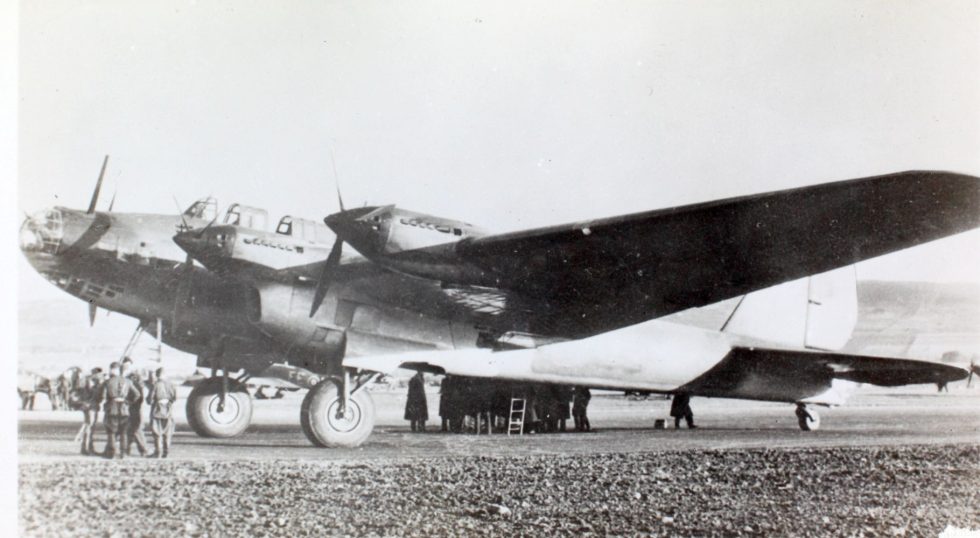
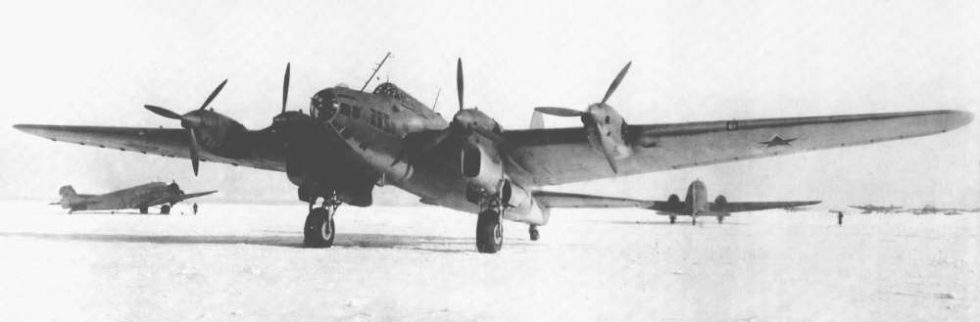
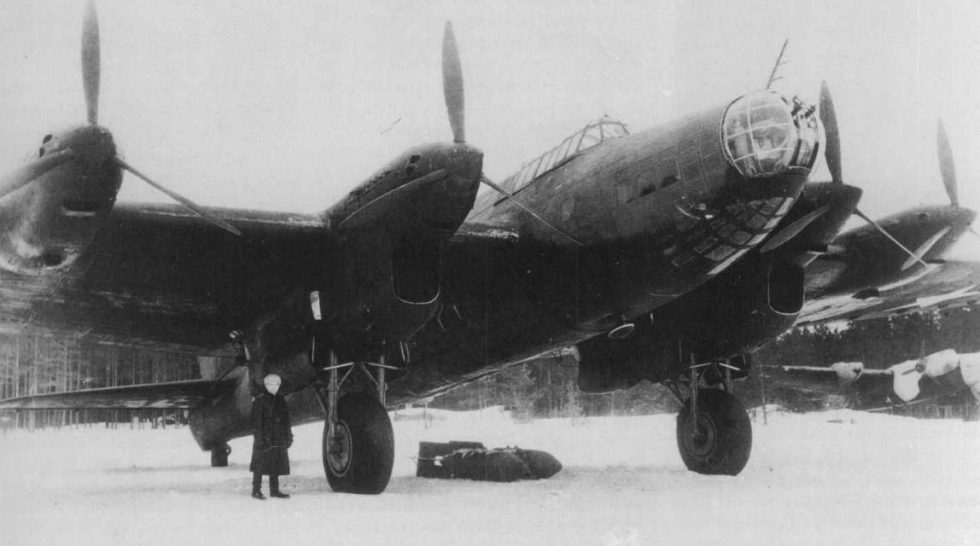
The Pe-8 in pictures
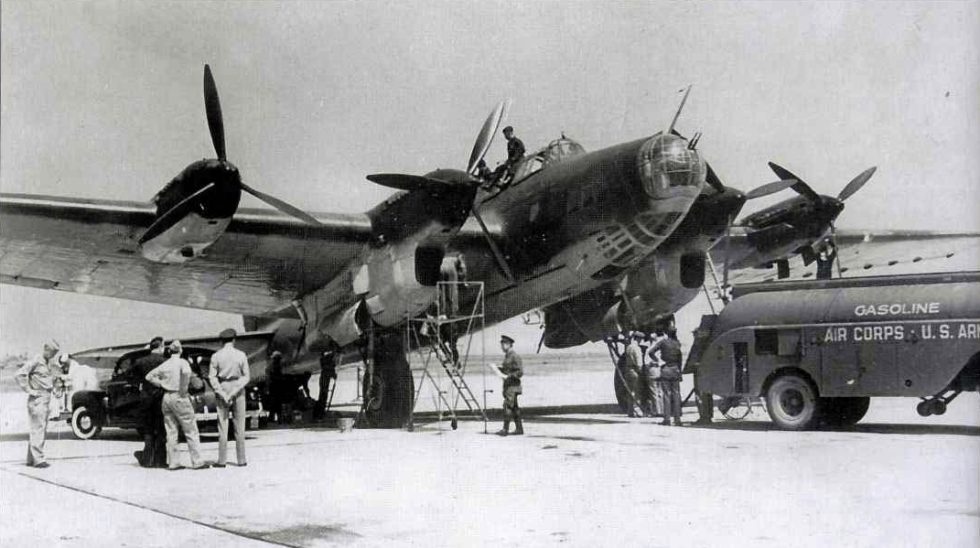
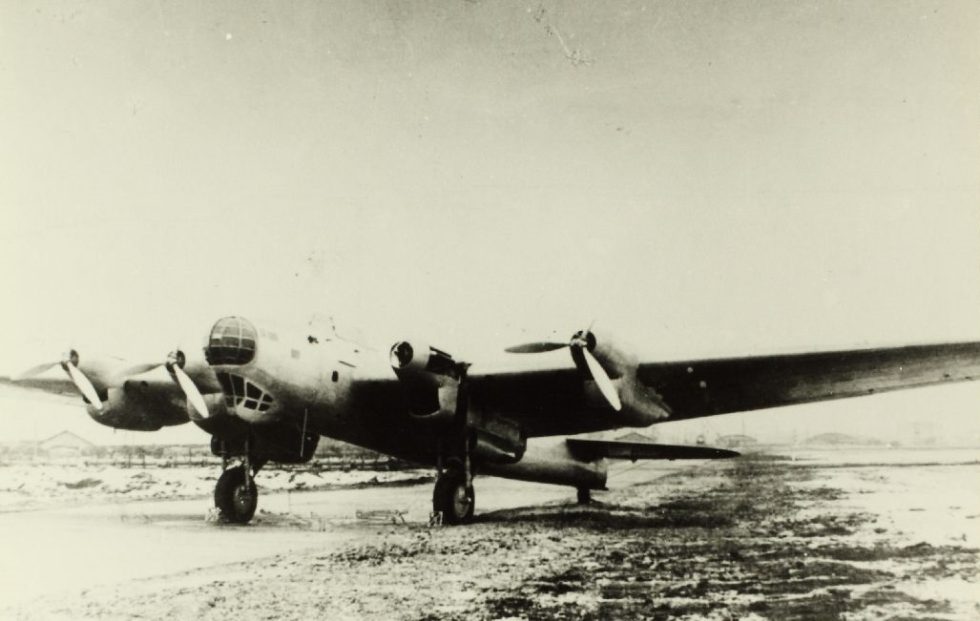
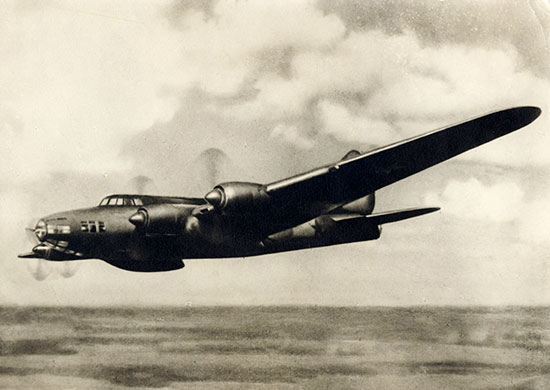
The Pe-8 in motion
Pe-8 Heavy Bomber — Weapons of Victory. A documentary profile of the Soviet Union’s only four-engine strategic bomber, its troubled engines and its long-range wartime missions.
Where the Pe-8 flew
The Pe-8’s war in numbers
The Pe-8 was never a mass weapon — its record is one of outsized deeds by a tiny fleet. It gave the Soviet Union the only true four-engine strategic reach it possessed, striking targets from Berlin to the Baltic and carrying both a foreign minister and the heaviest bomb in the Soviet arsenal.
Compare the combat record of every military aircraft. Figures are commonly cited estimates and vary between sources.
Everything people ask about the Petlyakov Pe-8
Can I fly in a Petlyakov Pe-8?
What was the Petlyakov Pe-8?
Why was the TB-7 renamed the Pe-8?
How many Pe-8s were built?
Did a Pe-8 really fly Molotov to the United States?
What was the FAB-5000?
Do any Pe-8s survive today?
You can’t fly the Petlyakov Pe-8.
These, you can.
Some legends only live in museums — others are fuelled and waiting. MiGFlug has put civilians in real military jet cockpits since 2004.
 Fly the L-39 AlbatrosThe world’s most-flown jet trainer — aerobatics included
 Fly the F-104 Starfighter“The missile with a man in it”
 Fly the MiG-21The Cold War’s most-produced jet
 Fly the T-33 Shooting StarAmerica’s first jet trainer
 Fly the DH VampireA piece of early jet history
 Fly the S.211Agile Italian jet trainer
 Fly the MB-326The classic Aermacchi jet
 Fly the MiG-15The Soviet legend of the Korean War
Continue the tour
Every fact, checked
- HistoryNet — “Red Stars Over Berlin”The Berlin raids, the diesel-engine failures, the Molotov flight and the FAB-5000.
- GlobalSecurity.org — TB-7 / Pe-8 designThe ATsN fifth-engine supercharger, the diesel and radial engine substitutions.
- GlobalSecurity.org — FAB-5000The five-tonne bomb, its designer and its combat use from 1943.
- The National Interest — Petlyakov Pe-8Overview of the type and confirmation that no example survives.
- Aviastar.org — Pe-8Technical data, variants and production history.
- Military Factory — Pe-8 (TB-7)Specifications, crew, armament and production figures.
- World War II Database (WW2DB) — Pe-8Dimensions, weights and performance figures cross-checked against other sources.
- San Diego Air & Space Museum ArchivesPublic-domain wartime photographs of the ANT-42, TB-7 and Pe-8.