
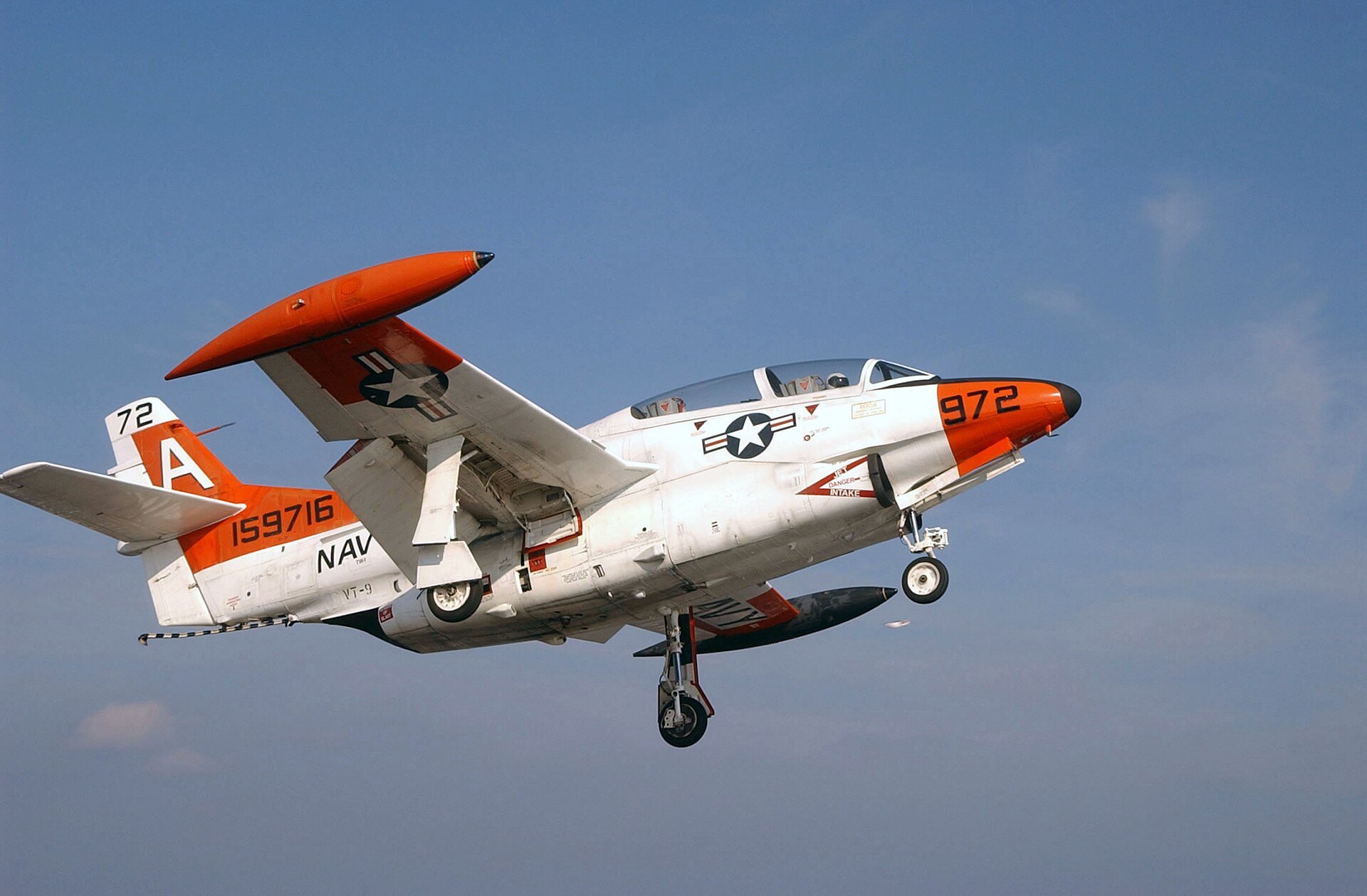
North American T-2 Buckeye
The Navy’s First Trap
For nearly half a century the T-2 Buckeye was where US Navy and Marine jet pilots made their first carrier landing, and it ended its career flying for Greece at Kalamata.
The T-2 Buckeye: how a plain-winged trainer taught the Navy to land on ships
In 1956 the US Navy wanted a single jet trainer that could do almost everything: basic jet training, formation, day and night navigation, gunnery, air combat tactics and, above all, carrier qualification. North American Aviation won the competition with a design that borrowed heavily from what it already had. The straight wing and landing gear came from the FJ-1 Fury, the Navy’s first operational jet fighter, and the flight controls from the T-28 Trojan piston trainer. Instructor and student sat in tandem, the rear seat raised, under a single canopy, with Martin-Baker ejection seats and 100-gallon tip tanks. The prototype, designated YT2J-1, flew at Columbus, Ohio on 31 January 1958, and a naming contest gave it the name of the Ohio state tree: Buckeye.
After evaluation at Patuxent River and carrier trials aboard USS Antietam in May 1959, deliveries began in July 1959 and Training Squadron VT-7 at Meridian, Mississippi took the first aircraft that November. The first version, the T2J-1 (later T-2A), had a single Westinghouse J34 of 3,400 lbf. It was steady rather than fast, which was exactly the point. The twin-engined T-2B followed, and then the definitive T-2C with two General Electric J85 turbojets of 2,950 lbf each, a combination that gave far better performance and engine-out safety over the sea. Production at Columbus ran into the 1970s and is commonly given as 609 aircraft, including export aircraft for Venezuela and Greece.
For the next five decades almost every Navy and Marine Corps jet pilot passed through the Buckeye. It was where they flew their first jet solo, first formation, first gunnery pattern and, the moment that defined the type, their first arrested landing on a carrier. It was also the Navy’s spin trainer, valued for its forgiving behaviour. The T-45 Goshawk took over pilot training in the early 2000s; the last student training flight was flown at Pensacola on 9 August 2008, and test-squadron chase aircraft kept a few Buckeyes in US service until 2015. Greece flew its T-2Es at Kalamata until a fatal accident at the end of 2023 ended the type’s flying career.
01The T-2 Buckeye’s design: built from proven parts
North American’s approach to the 1956 requirement was cautious and cheap. Rather than design a new wing, it took the unswept wing and undercarriage of the FJ-1 Fury, whose low-speed handling was well understood. The control system came from the T-28C Trojan, the Navy’s carrier-capable piston trainer, so instructors moving from one to the other found familiar responses. The fuselage was new, with a raised rear cockpit that gave the instructor a view over the student’s helmet, a pressurised and air-conditioned cockpit, an arrester hook and permanent wingtip tanks.
The result was not elegant, but it was safe and forgiving. It had to be, because its users were young men with only a few hundred hours, who would be asked to fly it on to a pitching deck. The low-speed manners that made it an excellent carrier trainer also made it the Navy’s chosen aircraft for teaching spin recovery to future tactical aviators. The Buckeye was also one of the last Navy aircraft launched from catapults with a bridle rather than a nose-tow launch bar, a reminder of how far back its design reached.
02The T-2 Buckeye abroad: Venezuela and Greece
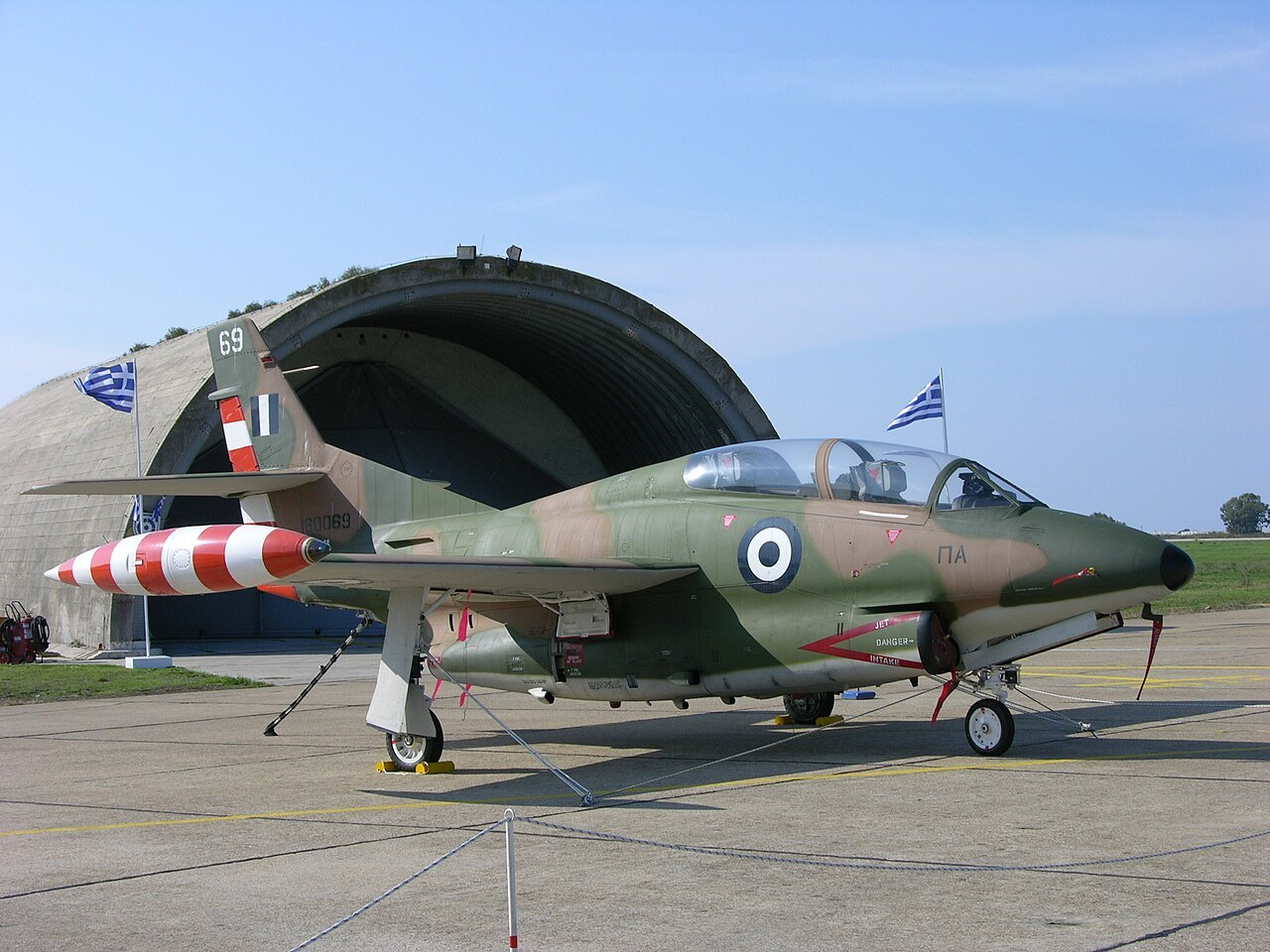
Two air forces bought new Buckeyes. Venezuela took the T-2D from 1973, with sources giving between 12 and 24 aircraft, and used them for advanced training. Greece received 40 T-2Es from 1976, replacing T-33s, with extra hardpoints that let them double as light-attack aircraft. They went to the 120 Air Training Wing at Kalamata, flown by 362 and 363 Squadrons.
In Greece the Buckeye outlived its American career by more than 15 years. By the 2020s only about two dozen remained, with a handful airworthy at any time, kept going with surplus US Navy spares. Students logged around 80 hours on the type before a further 60 hours of tactical training, and since 2009 some Greek students have finished their training in Italy. The first M-346 trainers arrived on 17 May 2023, under a government-to-government deal with Israel for ten aircraft, and the crash of a T-2E near Kalamata on 27 December 2023 effectively grounded the last Buckeyes for good.
What makes the T-2 Buckeye special
A carrier trainer first
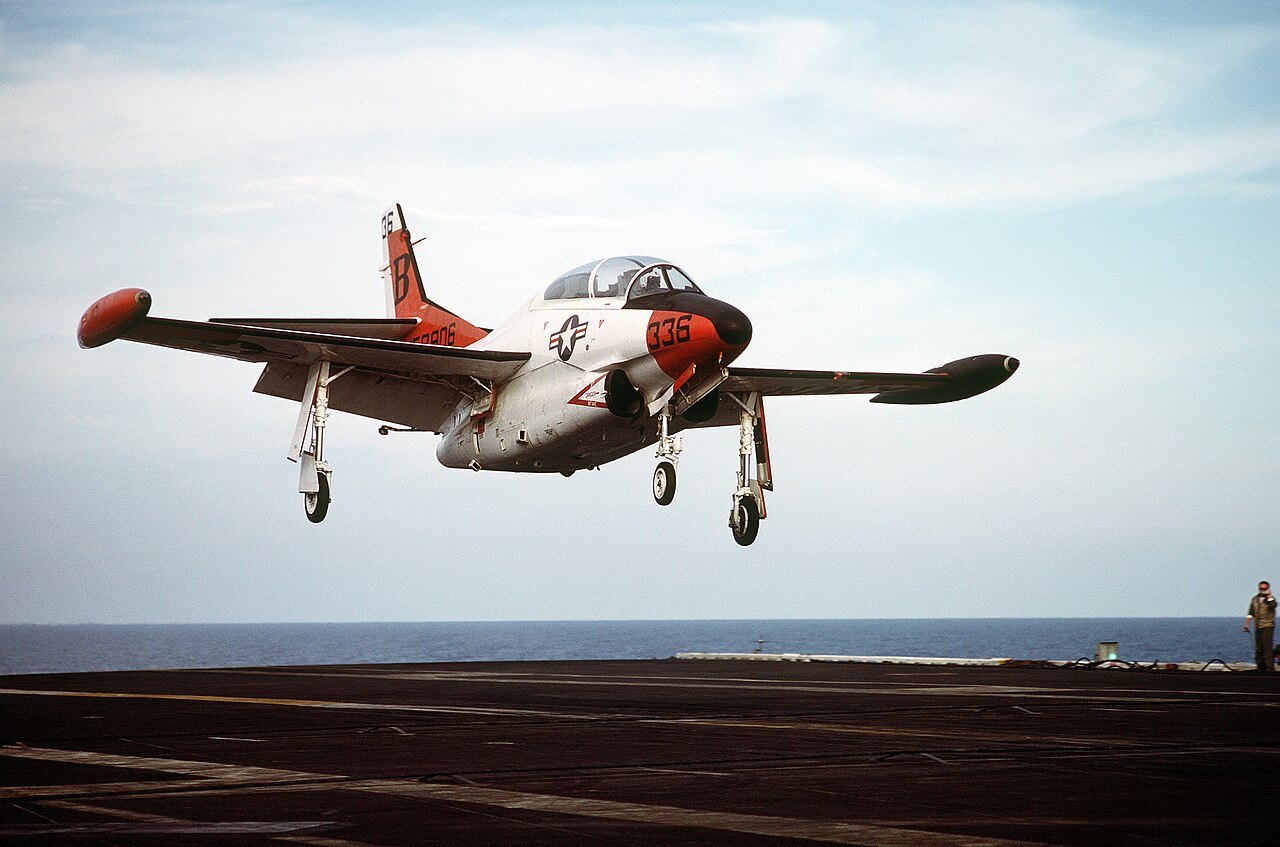
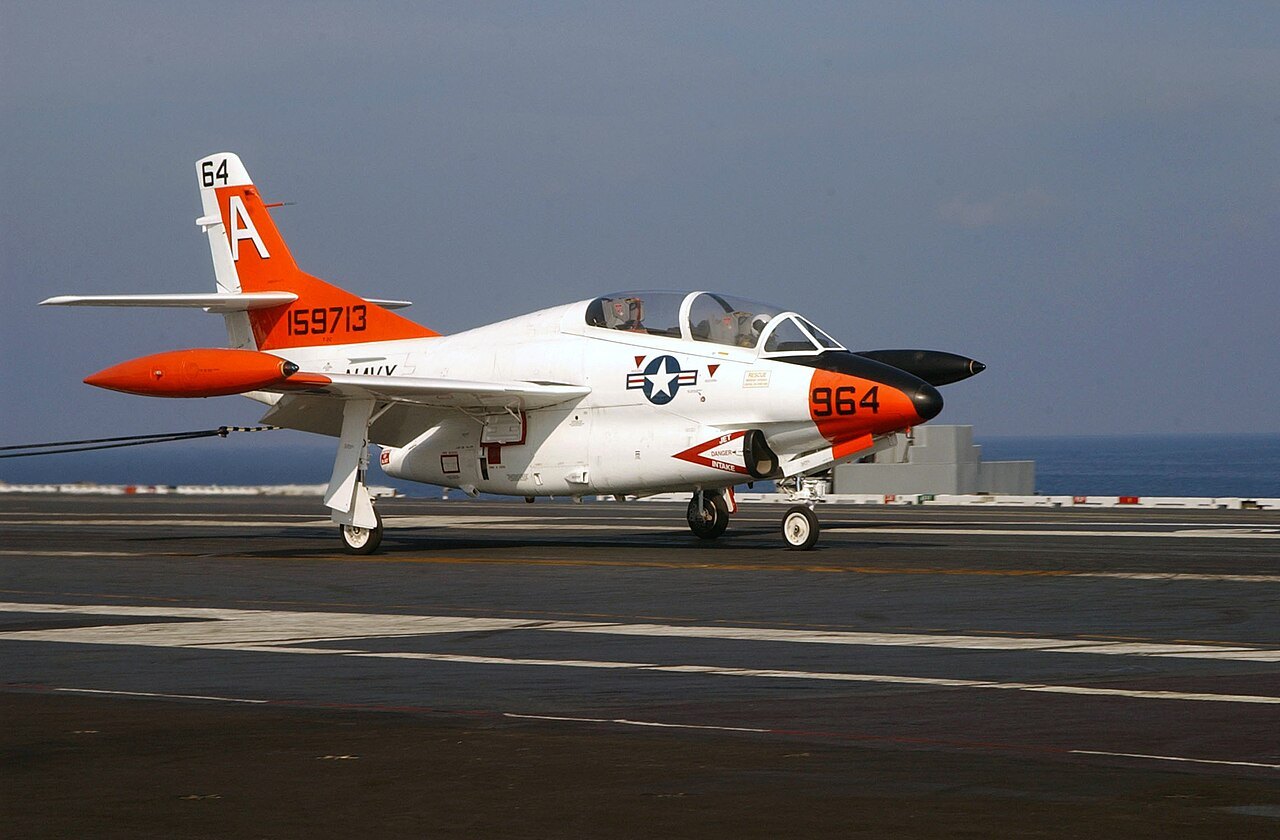
The Buckeye was built from the outset to go to sea. It had a strong undercarriage, an arrester hook, catapult fittings and approach handling good enough for students to fly it on to a carrier deck after a short course. Carrier qualification in the T-2 continued until July 2003, when the last Buckeye carrier qualifications were flown aboard USS Harry S. Truman. For several generations of naval aviators it was the aircraft of the first trap.
Two engines over water
The single-engined T-2A soon gave way to twin-engined versions. The T-2B used two Pratt & Whitney J60s; the definitive T-2C used two General Electric J85-GE-4 turbojets of 2,950 lbf each, the same engine family as the T-38 Talon and F-5. Two engines gave students a better chance of getting home after a failure over the Gulf of Mexico, and the extra thrust let the Buckeye reach about 522 mph at 25,000 ft.
The Navy’s spin school
Because it entered and recovered from spins predictably, the T-2 was used for the Navy’s spin-recovery training, teaching tactical aviators how a swept-wing fighter might behave when mishandled without the risk of doing it in one. Its forgiving nature also made it a long-lived workhorse: a single VX-20 aircraft, number 320, had logged 13,945 flight hours by the time it made the Navy’s final Buckeye flight in 2015.
03The T-2 Buckeye’s cockpit and systems: simple, strong, sea-going
The Buckeye’s tandem cockpit seated the student in front and the instructor behind and above. Both had Martin-Baker ejection seats and a full set of controls under one canopy, and the cockpit was pressurised and air-conditioned, a real comfort in the summer heat of Mississippi, Texas and Florida. Fuel was carried in the fuselage and in fixed wingtip tanks, 691 US gallons in all on the T-2C.
The aircraft had no internal guns, but underwing stations could carry gun pods with .50-calibre machine guns, practice bombs or 2.75-inch rockets, letting it teach weapons delivery as well as flying. Avionics were basic and analogue throughout its life, which kept it cheap to run but left it increasingly remote from the glass cockpits students would meet in the fleet. That gap, more than any fault in the airframe, was what finally drove the move to the T-45.
North American T-2C Buckeye specifications
Specifications
- Crew
- 2 (tandem)
- Length
- 11.67 m (38 ft 3.5 in)
- Wingspan
- 11.62 m (38 ft 1.5 in)
- Height
- 4.51 m (14 ft 9.5 in)
- Wing area
- 23.7 m² (255 sq ft)
- Empty weight
- 3,681 kg (8,115 lb)
- Max take-off weight
- 5,978 kg (13,179 lb)
- Powerplant
- 2 × General Electric J85-GE-4 turbojets, 13.1 kN (2,950 lbf) each
- Maximum speed
- 840 km/h (522 mph) at 7,620 m (25,000 ft)
- Range
- 1,683 km (1,046 mi)
- Service ceiling
- 12,300 m (40,400 ft)
- Climb rate
- 31.5 m/s (6,200 ft/min)
- Armament
- None fixed; underwing gun pods, practice bombs or 2.75 in rockets
Costs & production
- Cost per flight hour
- Hedged estimate: roughly US$3,000–5,000 in today’s money, based on two J85 turbojets of the T-38 class and the maintenance needs of an old analogue airframe; no official figure found
- Production
- Commonly given as 609 (217 T-2A, 97 T-2B, 231 T-2C plus export T-2D and T-2E), built at Columbus, Ohio
- Programme
- Competition won 1956; first flight 31 January 1958; US Navy training 1959–2008; chase use to 2015
04The T-2 Buckeye’s variants: from one engine to two
- YT2J-1: prototype, first flight 31 January 1958.
- T2J-1 / T-2A: single Westinghouse J34 of 3,400 lbf; 217 built.
- T2J-2 / T-2B: two Pratt & Whitney J60 turbojets; 97 built.
- T-2C: two General Electric J85-GE-4 turbojets; 231 built, the main US Navy version.
- T-2D: export version for Venezuela, delivered from 1973.
- T-2E: export version for Greece with additional hardpoints; 40 delivered from 1976.
05The T-2 Buckeye’s operating costs: cheap by design
No official cost per flight hour for the Buckeye has been published in the sources consulted, so any figure is an estimate. The T-2C’s two J85s are close relatives of the engines in the T-38 Talon, and the airframe was deliberately simple, with analogue avionics and parts shared with older aircraft. That suggests an operating cost of a few thousand US dollars an hour in today’s money, perhaps US$3,000 to 5,000. The real cost of the type in its last years was keeping it flying at all: Greece relied on surplus US Navy spares, and only a small fraction of its fleet was airworthy at any one time.
The T-2 Buckeye from Columbus to Kalamata
Navy competition won
North American wins the Navy’s multi-purpose jet trainer competition.
First flight
The YT2J-1 flies at Columbus, Ohio on 31 January.
To sea and into service
Carrier trials aboard USS Antietam in May; VT-7 at Meridian receives the type in November.
Twin engines
The T-2B and then the J85-powered T-2C replace the single-engined T-2A.
Venezuela
Deliveries of the export T-2D begin.
Greece
The first of 40 T-2Es arrive for the Hellenic Air Force at Kalamata.
Last Buckeye traps
The final T-2C carrier qualifications are flown aboard USS Harry S. Truman on 17 July.
Last training flight
VT-86 flies the final US Navy student training flight at Pensacola on 9 August.
Final Navy flight
VX-20 retires its last chase Buckeyes at Patuxent River on 25 September.
Kalamata crash
A Greek T-2E crashes on 27 December, killing its pilot; the fleet does not fly again.
Stories & eyewitnesses: the T-2 Buckeye and its pilots
Antietam, 1959
The Buckeye proved itself at sea before it entered service.
Read the full story
Meridian, November 1959
Basic Training Group Seven took the first aircraft.
Read the full story
The first trap
Every carrier-qualified Navy pilot of its era made his first arrested landing in one.
Read the full story
The third best day
Two students flew the last US Navy training flight in a Buckeye.
Read the full story
Aircraft 320 and the last Navy flight
Test pilots kept three Buckeyes for seven more years.
Read the full story
The last Buckeye school
At Kalamata the T-2 kept training fighter pilots into the 2020s.
Read the full story
The pilot who did not eject
The Buckeye’s last flight in military service ended in tragedy.
Read the full story
Where to see a Buckeye
Museum Buckeyes are scattered across the United States.
Read the full story
The T-2 Buckeye in pictures
Where the T-2 Buckeye flies and flew
The T-2 Buckeye’s record
The Buckeye was a trainer through and through. It could carry gun pods, rockets and practice bombs to teach weapons delivery, and Greece’s T-2Es had a secondary light-attack role, but no combat use has been confirmed in the sources consulted. Its record is the pilots it produced.
See how training and combat types compare in the military aircraft statistics database. Figures are approximate.
Everything people ask about the T-2 Buckeye
Can I fly in a North American / Rockwell T-2 Buckeye?
Why is it called the Buckeye?
How many T-2 Buckeyes were built?
What replaced the T-2 Buckeye?
When did the T-2 Buckeye retire?
Did the T-2 Buckeye land on aircraft carriers?
What engines did the T-2C have?
You can’t fly the T-2 Buckeye.
These, you can.
Most of this museum you can only look at. These genuine military jets you can fly yourself with MiGFlug — with aerobatics and time on the controls.
 Fly the L-39 AlbatrosThe world’s most-flown jet trainer — aerobatics included
 Fly the F-104 Starfighter“The missile with a man in it”
 Fly the MiG-21The Cold War’s most-produced jet
 Fly the T-33 Shooting StarAmerica’s first jet trainer
 Fly the DH VampireA piece of early jet history
 Fly the S.211Agile Italian jet trainer
 Fly the MB-326The classic Aermacchi jet
 Fly the MiG-15The Soviet legend of the Korean War
Continue the tour
Every fact, checked
- T2J-1 / T-2 BuckeyeGlobalSecurity: competition, first flight, carrier trials, exports and final carrier qualification
- Farewell BuckeyeMilitary.com (2008) on the last training flight and the final students
- T-2C Buckeye ends 56-year Navy careerNAVAIR on VX-20’s final flight in 2015
- VT-86 Sabrehawks historyChief of Naval Air Training on the last T-2C flight
- North American T-2A ‘Buckeye’Planes of Fame Air Museum on its T-2A and the type’s carrier role
- T-2C BuckeyeUSS Lexington Museum on its Buckeye and the type’s design origins
- Turning a New PageAviation News Journal on Greece’s switch from the T-2E to the M-346
- Military training aircraft down in Kalamata, pilot deadTo Vima (2023) on the T-2E crash
- The Greek Air Force pilots who chose not to ejectTo Vima on Wing Commander Epameinondas Kosteas