
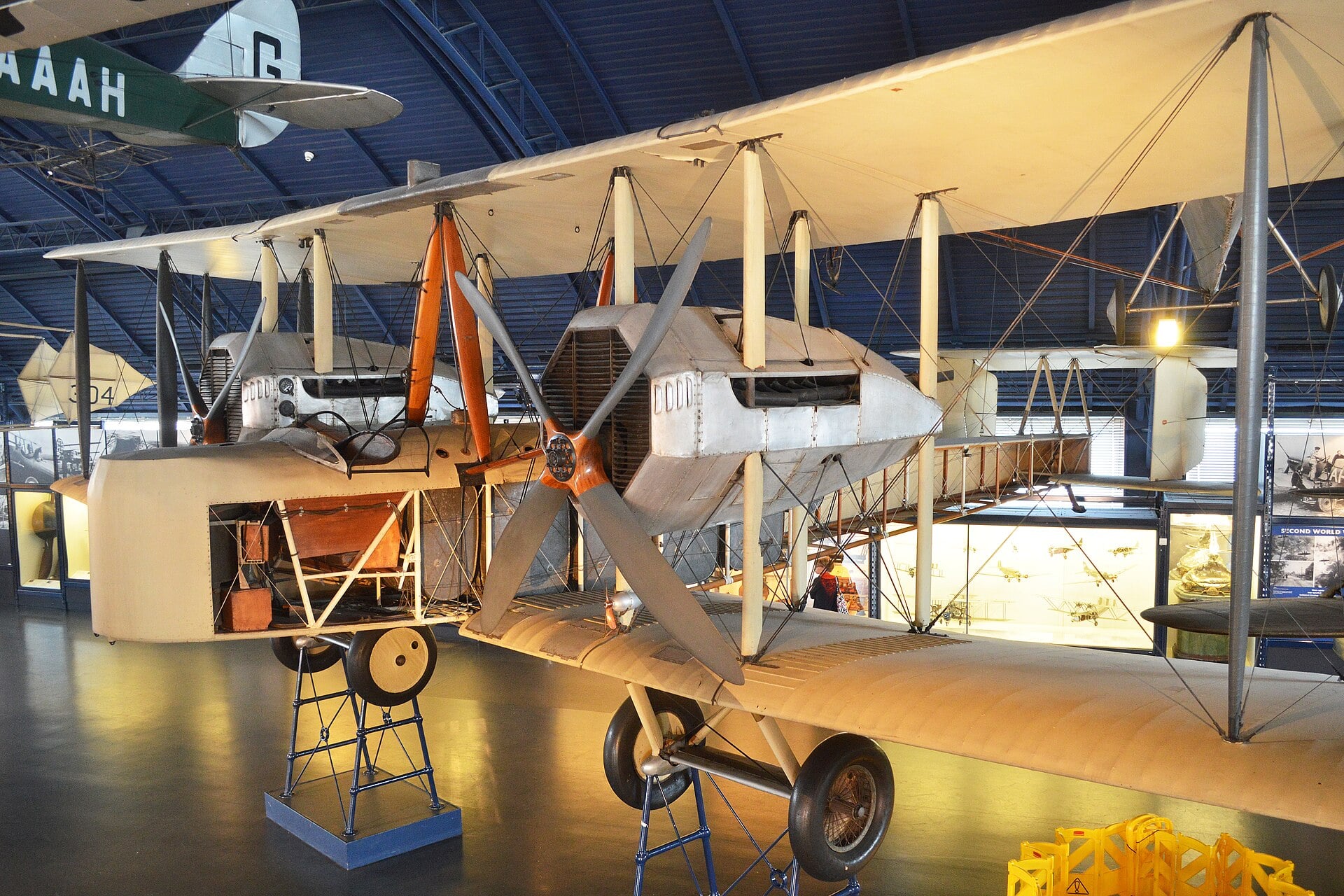
Vickers Vimy — the bomber that missed its war and conquered the world's oceans instead
The Vickers Vimy: the war-machine that made peace-time history
The Vickers Vimy was designed for a job it never really did. In 1917, with German cities beyond the reach of most Allied aircraft, the British Air Board issued a specification for a heavy bomber able to carry a worthwhile load of bombs from bases in France, or even England, deep into Germany. Vickers' chief designer, Rex Pierson, answered with a large, clean twin-engined biplane. The prototype first flew on 30 November 1917 — and there its wartime story very nearly ends.
The Vimy was simply too late. Development, engine troubles and the sheer novelty of the design meant that only a handful of aircraft had reached France by the time the guns fell silent on 11 November 1918, and the type never saw combat in the First World War. Had the war run into 1919 as many expected, the Vimy would have been the RAF's standard strategic bomber for the long-planned raids on Germany. Instead, the Armistice left Britain with a fine new heavy bomber and nothing to bomb.
What happened next is why the world remembers the name. In June 1919 a modified Vimy, stripped of its military equipment and filled with fuel, carried Captain John Alcock and Lieutenant Arthur Whitten Brown non-stop across the Atlantic — the first aeroplane ever to do so — from Newfoundland to a bog in the west of Ireland. Five months later another Vimy, flown by the Australian brothers Ross and Keith Smith, became the first aircraft to fly from England to Australia, an eleven-thousand-mile journey that had seemed barely credible. A third Vimy set out to be first from England to South Africa in 1920. In the space of a year the Vimy turned the map of the world into something an aeroplane could cross.
Behind the record flights was a steady military career. The Vimy became a mainstay of the post-war Royal Air Force, equipping the home-based heavy-bomber squadrons through the early 1920s and serving in the Middle East, and it soldiered on as a training and parachuting aircraft into the end of the decade. Its roomy design also spawned a family: the enlarged Vimy Commercial airliner and, from that, the Vernon — the RAF's first purpose-built troop-transport, which flew the desert air-routes of Iraq.
None of this should be over-stated. As a bomber the Vimy was slow, lightly built by later standards, and eclipsed within a decade. But as the machine that first joined continents by air, it has a secure place in aviation history — and, unusually for an aircraft of its age, you can still stand in front of the real thing: Alcock and Brown's Atlantic Vimy survives in London, the Smiths' Vimy in Adelaide, and a modern airworthy replica has re-flown all three of its pioneering routes.
transatlantic flight, Clifden, 15 June 1919
The Vickers Vimy in detail: the bomber, the engines and why it missed the war
01The Vickers Vimy's origins: a 1917 bomber to strike Germany
The Vimy was born from the same idea as the German Gotha and the British Handley Page O/400: that the aeroplane could carry a war beyond the trenches and strike an enemy's cities and industry directly. By 1917 Britain wanted a bomber that could reach Germany itself. The Air Board issued a specification for a twin-engined heavy bomber, and Vickers — through its designer Reginald Kirshaw "Rex" Pierson — produced the machine originally given the company designation F.B.27 and named "Vimy" after the 1917 Battle of Vimy Ridge.
The prototype first flew on 30 November 1917, piloted by Captain Gordon Bell. Several prototypes followed, each testing different engines as Vickers searched for a reliable powerplant. Orders were placed for large numbers — the plan was to equip a strategic bombing force for a 1919 campaign against Germany — but building and perfecting so large an aircraft took time.
Why it mattered
The Vimy represented Britain's second generation of heavy bomber, cleaner and more capable than the pioneering Handley Page O-types it was meant to replace. It embodied the belief, held strongly in 1918, that long-range bombing would be decisive — a belief the aircraft itself would never get the chance to test in war.
02The Vickers Vimy's Rolls-Royce Eagle engines and biplane structure
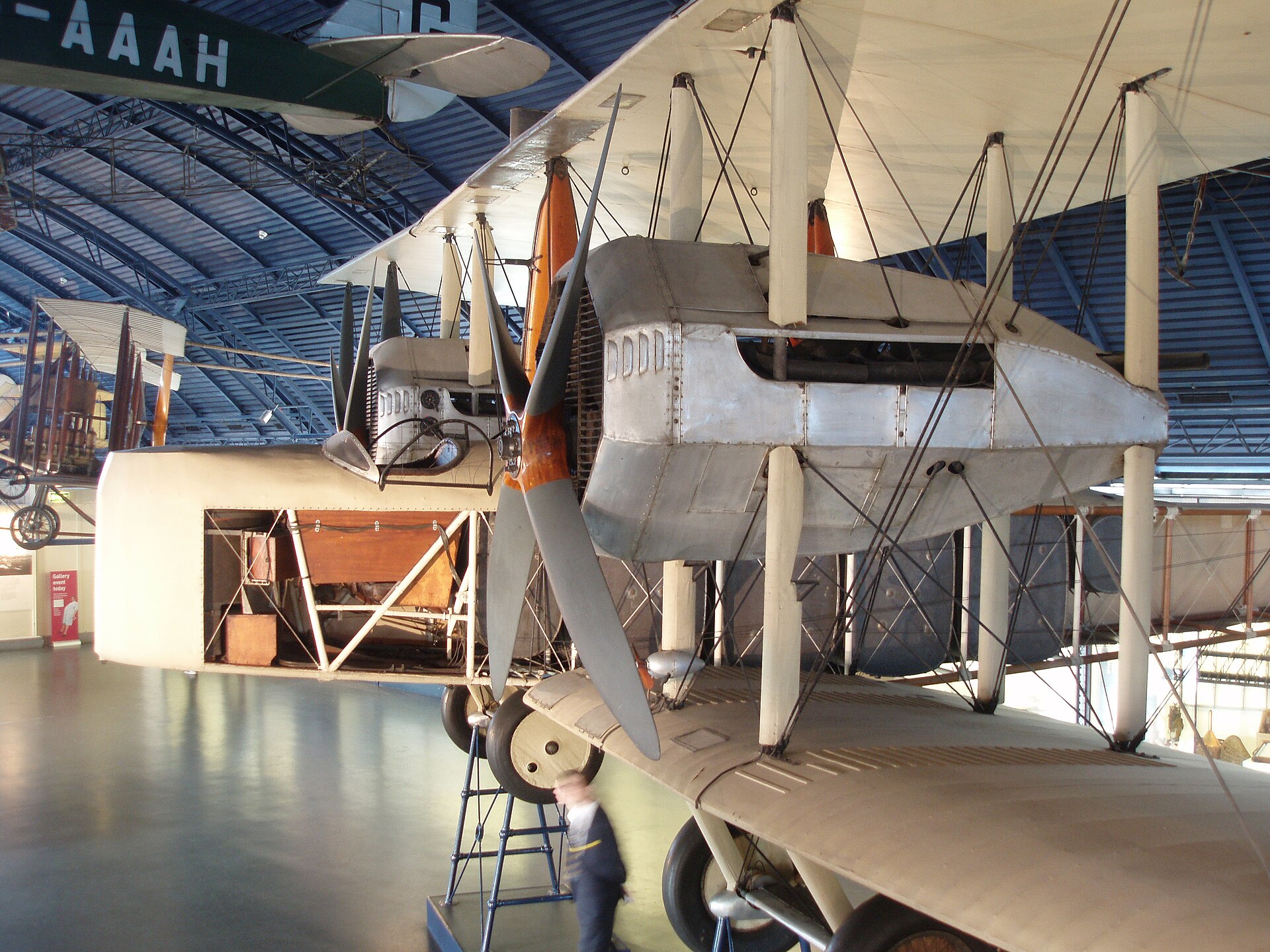
Production Vimys were powered by two Rolls-Royce Eagle VIII engines — water-cooled V-12s of about 360 horsepower each — mounted in nacelles between the biplane wings and driving tractor propellers. The Eagle was one of the outstanding aero-engines of the war, and it gave the Vimy the reliability that its record-breaking flights would depend on. Because the Eagle was in high demand, some prototypes and variants were fitted with alternative engines such as the Hispano-Suiza, Sunbeam Maori, Salmson, Fiat and the American Liberty; production standardised on the Eagle VIII.
Structurally the Vimy was a conventional two-bay biplane of wood and fabric, with a wingspan of about 20.75 m (68 ft) — large, but considerably smaller than the hundred-foot Handley Page O/400. A crew of three was typical: pilot, and two others acting as navigator, gunner and engineer. It was steady and pleasant to fly, if unspectacular; qualities that made it a poor dogfighter but an excellent platform for long, patient journeys.
Top speed was around 160 km/h (about 100 mph) and service ceiling roughly 2,100 m (about 7,000 ft) — figures that vary between sources and with load. These were the numbers of a load-carrier, not a racer.
03Why the Vickers Vimy missed the First World War
The Vimy's most striking feature is a negative one: despite being designed as a bomber, it never dropped a bomb in anger during the war it was built for. The timing was simply against it. The prototype flew in late 1917, but turning a promising prototype into squadron-ready aircraft — sorting engines, fixing teething troubles, tooling up production — took most of 1918.
By the Armistice of 11 November 1918, only a very small number of Vimys had reached the front; accounts commonly say just one or a handful had arrived in France, and none had flown a combat mission. The great strategic-bombing offensive against Germany that the Vimy was meant to spearhead was planned for 1919 and never took place.
This is why the Vimy is such an unusual aircraft historically. Its fame rests almost entirely on what it did after the war, in peacetime, as a long-distance pioneer — and only secondarily on the military career it went on to have in the 1920s. Few famous warplanes are famous for something other than fighting.
How the Vickers Vimy was built to go the distance
A clean twin-engined biplane
A conventional wood-and-fabric biplane of about 20.75 m span, roomy and stable — smaller and cleaner than the Handley Page O/400 it was meant to replace, and easy to fly on long trips.
Two dependable Rolls-Royce Eagles
A pair of Rolls-Royce Eagle VIII V-12s of about 360 hp each — the reliability that made non-stop ocean crossings and eleven-thousand-mile journeys survivable rather than suicidal.
Space for fuel, or for a story
Designed to carry bombs and a crew of three, the airframe had the volume to be stripped out and filled with extra fuel tanks — the change that turned a bomber into a record-breaker.
Vickers Vimy specifications, performance and cost
Figures are representative of a standard Rolls-Royce Eagle VIII-engined Vimy IV bomber; dimensions, weights, performance and production totals vary between contemporary sources, and estimated or contested values are flagged.
Baseline note: the figures describe the Vimy IV, the Rolls-Royce Eagle VIII version and the only mark delivered to the Royal Air Force in numbers. Mark numbers on this aeroplane followed the engine rather than the airframe — Vimy I Hispano-Suiza, II Sunbeam Maori, III Fiat, IV Eagle — and Vickers' own company history confuses matters further by calling the Eagle production aircraft the F.B.27A Mk II. Deltas for the five Napier Lion-engined Vimy Ambulances and the fat-bodied civil Vimy Commercial are in grey. Climb is given as time to a stated height and endurance in place of range, which is how figures of this period were quoted.
Dimensions & weights
- Crew
- 3 — a pilot, a gunner in the nose and a gunner behind the wings (Vimy Commercial 2 crew and 10 passengers; Vimy Ambulance 2 crew, four stretcher or eight sitting cases and two medical attendants)
- Length
- 13.27 m (43 ft 6.5 in); Vimy Commercial 13.00 m (42 ft 8 in)
- Wingspan
- 20.73 m (68 ft 0 in). Some tables give 68 ft 1 in; the Hispano-engined first prototype spanned 67 ft 2 in.
- Height
- 4.76 m (15 ft 7.5 in). At Joyce Green the hangar floor had to be recessed to roll the first prototype out.
- Wing area
- 123.6 m² (1,330 sq ft)
- Wing configuration
- Equal-span four-bay biplane with balanced ailerons on both upper and lower planes, and a biplane tail with twin rudders
- Empty weight
- 3,221 kg (7,101 lb); Vimy Commercial 3,533 kg (7,790 lb)
- Gross weight
- 5,670 kg (12,500 lb), the same for the Commercial
- Disposable load
- Nearly 2,270 kg (5,000 lb) including fuel, out of a 12,500 lb take-off weight. This is the figure that made the Vimy remarkable in 1918: at Martlesham the prototype lifted more than the far larger Handley Page O/400 on roughly half the effective power.
- Fuel
- 2,346 l (516 imp gal) standard; the transatlantic conversion carried 3,932 l (865 imp gal) in tanks fitted where the bombs had been
- Maximum bomb load
- 1,123 kg (2,476 lb)
- Wing loading at gross weight
- 45.9 kg/m² (9.4 lb/sq ft)
- Unit cost
- £4,500 — the price the South African government paid Vickers in 1920 for G-UABA, the Silver Queen
- Production
- Roughly 230 aircraft completed against an order book that reached 1,130. Vickers built 112 (seven at Crayford and six at Weybridge before the Armistice cuts, then 99 more for the peacetime RAF); Westland completed 25 of the 75 it was contracted for; Morgan & Co delivered most of its order; the Royal Aircraft Establishment's piecemeal assemblies cannot be counted at all, and Bruce says so plainly.
Performance
- Maximum speed
- 166 km/h (103 mph) at ground level. Quoted anywhere between 98 and 112 mph; Vickers' pilot Captain Broome recorded 112 mph on one test flight, which is the outlier that inflates several tables.
- Maximum speed, Vimy Commercial
- 158 km/h (98 mph) at ground level — slightly better than the bomber in still air, a bonus of carrying the load inside instead of hung underneath
- Climb to 1,525 m (5,000 ft)
- 22 minutes (Vimy Commercial 28 minutes; the Hispano-engined prototype 23.5 minutes)
- Climb to 1,830 m (6,000 ft)
- 18 minutes — Andrews and Morgan print this alongside the 22-minute figure above in the same volume. The two come from different trials and cannot both be right.
- Service ceiling
- 2,135 m (7,000 ft)
- Absolute ceiling
- 3,200 m (10,500 ft). Vickers' own account puts the fully loaded ceiling at no more than 3,660 m (12,000 ft), which is the number that matters: Alcock and Brown had to fly through their weather rather than climb over it.
- Endurance
- 11 hours with full crew and load
- Maximum range
- 3,025 km (1,880 miles) — enough to reach Berlin from France and return, which was the whole design case
- Range of the transatlantic conversion
- 3,927 km (2,440 miles) on 865 imp gal. Roughly 1,290 km (800 miles) worth of fuel was still aboard when the aircraft came to rest at Clifden.
- Transatlantic crossing, 14–15 June 1919
- 3,040 km (1,890 miles) at an average of about 185 km/h (115 mph). Alcock and Brown's own reckoning gives 15 h 57 min; Vickers' company history gives 16 h 27 min take-off to landing.
- England to Australia, 12 November to 10 December 1919
- 17,911 km (11,130 miles) in 135 h 55 min of flying, spread across 27 days and 20 hours — inside the Australian government's 30-day limit with two days to spare
Propulsion & systems
- Engines
- Two Rolls-Royce Eagle VIII water-cooled V-12s, 268 kW (360 hp) each. A number of tables, Wikipedia's among them, give 300 hp; that is the Eagle VI and VII rating, not the VIII.
- Prototype engines
- 200 hp geared Hispano-Suiza (later replaced by 260 hp Salmson 9Zm radials), 260 hp Sunbeam Maori, 300 hp Fiat A.12bis and finally the Eagle VIII, in that order. The four prototypes were loosely called Marks I to IV after them, though surviving Weybridge drawings do not confirm the numbering.
- Engines ordered but never fitted
- The 230 hp BHP Puma and the 400 hp Liberty L-12. There was considerable enthusiasm for the Liberty because American supply was plentiful, but every Liberty contract was cancelled in January 1919 without a single aircraft completed.
- Later re-engining
- Bristol Jupiter and Armstrong Siddeley Jaguar air-cooled radials on the training and parachute aircraft of the later 1920s, in place of the water-cooled Eagles; Napier Lions on the Vimy Ambulance and on some Commercials
- Nacelles
- Mounted mid-gap between the wings and containing the fuel tanks, which put the petrol well away from the crew and made both radiators and air intakes visible from the cockpit — a detail Vickers later argued had saved Alcock and Brown from the icing that may have stopped Hawker's single-engined Sopwith
- Structure
- Steel-tube forward fuselage, wooden rear fuselage with steel end fittings and swaged tie-rod bracing, and McGruer patent hollow spruce longerons wound from machined shims. When the inventor re-examined the Science Museum aircraft decades later, its longerons were in perfect condition.
- Undercarriage
- Two pairs of wheels on tubular steel V-struts, a tail skid, and a further skid under the nose to prevent nose-overs. The transatlantic aircraft flew without its nose wheel to save weight and drag, which is very likely why it tipped onto its nose in the bog.
- Aerodynamic development
- Vickers used its own wind tunnel at St Albans, the first commercially owned tunnel anywhere, and Rex Pierson deliberately made the Vimy smaller than the O/400 to save structure weight. Design to first flight took four months.
- Flight instruments
- No gyroscopic instruments of any kind. Over the Atlantic, Alcock twice lost control in cloud and pulled out of a spiral dive close to the sea.
- Electrical supply
- A wind-driven generator, which failed at 17:20 on 14 June 1919 and took the radio, the intercom and the cockpit heating with it for the rest of the crossing
- Bombing equipment
- High Altitude Drift Mk.Ia bombsight in the nose position and two Michelin-built Mk.I flare carriers as standard
- Navigation
- Sextant, drift sight and dead reckoning. Arthur Whitten Brown had worked out his methods as a prisoner of war, and crossed the Irish coast at Clifden only a few miles north of his flight plan after a night with almost no sights.
Armament & payload
The Vimy was armed to bomb Germany by night and never dropped a bomb in anger
Two Lewis guns on Scarff rings and a ton of bombs in and under the fuselage: the Vimy's armament was conventional for a 1918 heavy bomber and entirely adequate to the job it was drawn for, which was to fly from France to targets inside Germany, Berlin included, in the dark. One aircraft was flown to Nancy in October 1918 to stand by for exactly that. The Armistice came first, and no Vimy ever attacked anything. Everything the type is remembered for it did with the guns taken out and the bomb cells full of petrol. The rear Scarff mounting was commonly not fitted at all during the interwar years, and Vimys in RAF training, parachute and mail-carrying service flew unarmed for most of their working lives.
Defensive guns
- Two .303 in Lewis guns, one in the nose position and one behind the wings, each on a Scarff ring.
- The second prototype introduced a pair of guns for the rear gunner and that became the production standard, though single guns were normal in service.
- The rear gun could be shifted to a pivot mounting in the fuselage floor to fire aft and downward beneath the tail, with side windows to give light while drums were changed.
- No fixed forward-firing gun was ever fitted, so the Vimy required no synchronisation gear of any kind: no Constantinesco-Colley hydraulic gear and no Vickers-Challenger mechanical gear appears anywhere in the aircraft.
- Interwar aircraft frequently flew with the rear mounting deleted, and the radial-engined trainers of the late 1920s carried no armament whatever.
Ammunition, mountings and sights
- Provision for four spare Lewis drums in the nose position and up to six in the rear.
- The Scarff ring was a spring-balanced free mounting that let a gunner traverse and elevate a Lewis one-handed against a 100 mph slipstream — the standard British answer to the problem and a good one.
- Bombs were aimed with a High Altitude Drift Mk.Ia sight worked by the front gunner lying prone in the nose.
- Two Michelin Mk.I flare carriers were standard: night bombing meant finding the target and then finding the aerodrome again, and the flares served both.
Bomb load and stowage
- 1,123 kg (2,476 lb) maximum, the majority stowed vertically inside the fuselage between the spars of the lower centre section.
- The standard load was twelve 250 lb bombs in the internal cells. Some variants could take eighteen, with further bombs hung externally under the lower planes, where the engines fitted gave the power for it.
- An alternative light load of eighteen 112 lb bombs with two 230 lb bombs is quoted for the Hispano-engined aircraft.
- Release was simple mechanical linkage. There was no bomb bay in the modern sense and no doors — the bombs sat nose-down in open cells.
Anti-shipping and heavy-gun fits
- The Vimy could carry a pair of torpedoes, and production through 1918 was formally reserved for anti-submarine work before any aircraft went to the night-bombing squadrons.
- The policy behind that was enormous in scale: the RAF planned to grow its land-based anti-submarine force from 66 aeroplanes in November 1917 to a projected 726, with the long-ranged Vimy at the centre of it.
- Not one Vimy was ever used in the anti-submarine role. Fitting floats was studied in August 1918 and it is not known whether any were ever fitted.
- A Coventry Ordnance Works one-pounder was trialled on a Vimy, supplied as an adaptable kit — the heaviest gun the type ever carried and never a service fit.
What replaced the armament
- For the Atlantic every piece of military equipment came out and the fuel capacity went up from 516 to 865 imperial gallons in its place.
- The Smiths' Australian aircraft was close to a standard bomber, with tropical spares and stores where the military load would have been.
- The Vimy Commercial traded the whole armament for a plywood fuselage of much greater diameter seating ten, or 8.5 m³ (300 cu ft) and 1,134 kg (2,500 lb) of freight with the seats out.
- The Vimy Ambulance carried four stretcher cases loaded through a door in the nose — probably the first nose-loading aeroplane anywhere, and an idea Vickers kept all the way to the Valentia.
What the Vimy never did
- It never dropped a bomb on an enemy. Only three aircraft had reached the RAF by October 1918, one of them in France with the Independent Air Force, and the Armistice ended the plan to raid Berlin before any sortie was flown.
- It never sank a submarine, never carried a torpedo operationally, and never fired its guns at another aeroplane in British service.
- Vimys did see combat, but Chinese ones: twenty Vimy Commercials were secretly converted into bombers for the Zhili clique warlord Cao Kun and flew in the Second Zhili-Fengtian War of 1924. Low-level attacks worked until General Zhao Buli was brought down by ground fire near Jiumenkou on 17 September, after which the survivors bombed from heights that made them useless.
- Its last military duty was to be shot at by nobody in particular: Vimys served as targets for Royal Engineers searchlight crews training at Blackdown in Hampshire until 1938.
Three typical loadouts
- Night bombing sortie as planned, France to Germany, autumn 1918
- Twelve 250 lb bombs in the internal cells, two Lewis guns with ten spare drums between them, High Altitude Drift Mk.Ia sight, two Michelin flare carriers, a crew of three and eleven hours of endurance. One Vimy was flown to Nancy in October 1918 to fly precisely this profile. None ever did.
- Transatlantic, Lester's Field, Newfoundland, 14 June 1919
- Guns, bomb gear and racks stripped out; fuel raised from 516 to 865 imperial gallons for a still-air range of 3,927 km (2,440 miles); the nose wheel left off to save weight and drag. Two men, 196 letters and a parcel — the first transatlantic airmail — and two toy cat mascots, Lucky Jim and Twinkletoes.
- Cairo to Baghdad air mail, No. 216 Squadron, 1921–26
- No bombs, no gunners, mail and passengers instead, and a furrow ploughed across the desert to navigate by. The Vimy was the backbone of that route for five years, and the Biggin Hill Night Flying Flight put the same aircraft to comparable civil use during the General Strike of 1926, flying copies of the British Gazette around the country.
Sourcing caveat: Vimy production figures cannot be reconciled, and Bruce says so outright — serial number reallocations and the Royal Aircraft Establishment's piecemeal assembly method make a firm total impossible, while mark numbers followed engines that were themselves substituted according to what was in stock. The bomb loads quoted here are maxima from Vickers and Air Ministry figures rather than typical loads, and the Vimy's actual wartime operational load is unknown for the simple reason that there was never one.
Variants
The Vimy was a bomber that arrived too late and made its name entirely in peacetime
The design began as a conversation in the Hotel Cecil in July 1917 and an outline drawn on a sheet of foolscap. The Air Board had a surplus of Hispano-Suiza engines and a shortage of Rolls-Royce Eagles, and asked whether Vickers could build a bomber around the Hispano to the same specification as the Handley Page O/400. Rex Pierson designed it, three prototypes were contracted on 16 August 1917, and Gordon Bell flew the first from Joyce Green in Kent on 30 November: four months from conversation to first flight, which even Vickers regarded afterwards as one of the high points of the British industry's war.
It was a genuinely good aeroplane. At Martlesham in January 1918 the prototype lifted a greater load than the much larger and more powerful O/400 on roughly half the effective power, which is what a smaller airframe and careful detail design bought. Production orders eventually reached 1,130 aircraft. Thirteen had been completed when the Armistice was signed, three had reached the RAF, and one was standing by at Nancy for raids on Germany that never happened. The Vimy only reached full service status in July 1919, with No. 58 Squadron in Egypt.
So the reputation was made in peacetime, and in the space of nine months. Alcock and Brown crossed the Atlantic non-stop from Lester's Field, St John's, Newfoundland to the Derrygimla bog near Clifden, County Galway on 14 and 15 June 1919, took the Daily Mail £10,000 prize and were knighted a week later. Ross and Keith Smith with Sergeants Jim Bennett and Wally Shiers flew G-EAOU from Hounslow Heath to Darwin between 12 November and 10 December 1919 for the Australian government's £10,000. Van Ryneveld and Brand left Brooklands for the Cape on 4 February 1920 in Silver Queen, wrecked her near Korosko about 130 km (80 miles) short of Wadi Halfa on a leaking radiator, wrecked a borrowed RAF Vimy at Bulawayo on 6 March, and finished the journey to Cape Town in a DH.9 on 20 March. They were disqualified and given £5,000 each anyway.
Behind the record flights sat the ordinary work. Throughout the 1920s the Vimy was the core of the RAF's heavy bomber force, and for some years the only twin-engined bomber based in Britain at all.
- F.B.27 prototypes (1917–18, 4)
- Contracted 16 August 1917; first flight 30 November 1917 by Captain Gordon Bell. B9952 with Hispano-Suizas, later re-engined with Salmsons and given three degrees of dihedral; B9953 with Sunbeam Maoris, written off after an engine failure; the third with Fiat A.12s, destroyed at Martlesham on 11 September 1918 when a stalled landing detonated its armed bombs; the fourth with Eagle VIIIs, to Martlesham on 11 October 1918 after mass production had already started.
- Vimy I, II and III (1918, very few)
- Engine marks rather than airframe marks: Hispano-Suiza or Salmson, Sunbeam Maori, and Fiat A.12bis respectively. None reached the RAF in useful numbers, and the surviving Weybridge drawings do not confirm the mark numbering at all.
- Vimy IV, F.B.27A (1918–25, roughly 230)
- The production aeroplane and the only one that mattered. Two Rolls-Royce Eagle VIIIs of 268 kW (360 hp), 2,476 lb of bombs, eleven hours of endurance. The RAF's standard heavy bomber from 1919 until the Vickers Virginia displaced it in 1924 and 1925.
- Transatlantic Vimy (1919, 1 conversion)
- The 13th airframe off the post-war Weybridge line, stripped of military equipment and tanked to 865 imperial gallons, with a revised undercarriage. Rebuilt at Weybridge after the Clifden landing and preserved ever since.
- G-EAOU (1919, 1 conversion)
- The Australian aircraft, close to standard apart from tropical spares and stores. The registration was said by its crew to stand for "God 'elp all of us". Presented by Vickers to the Australian government on arrival.
- Vimy Commercial (1919–21, 43)
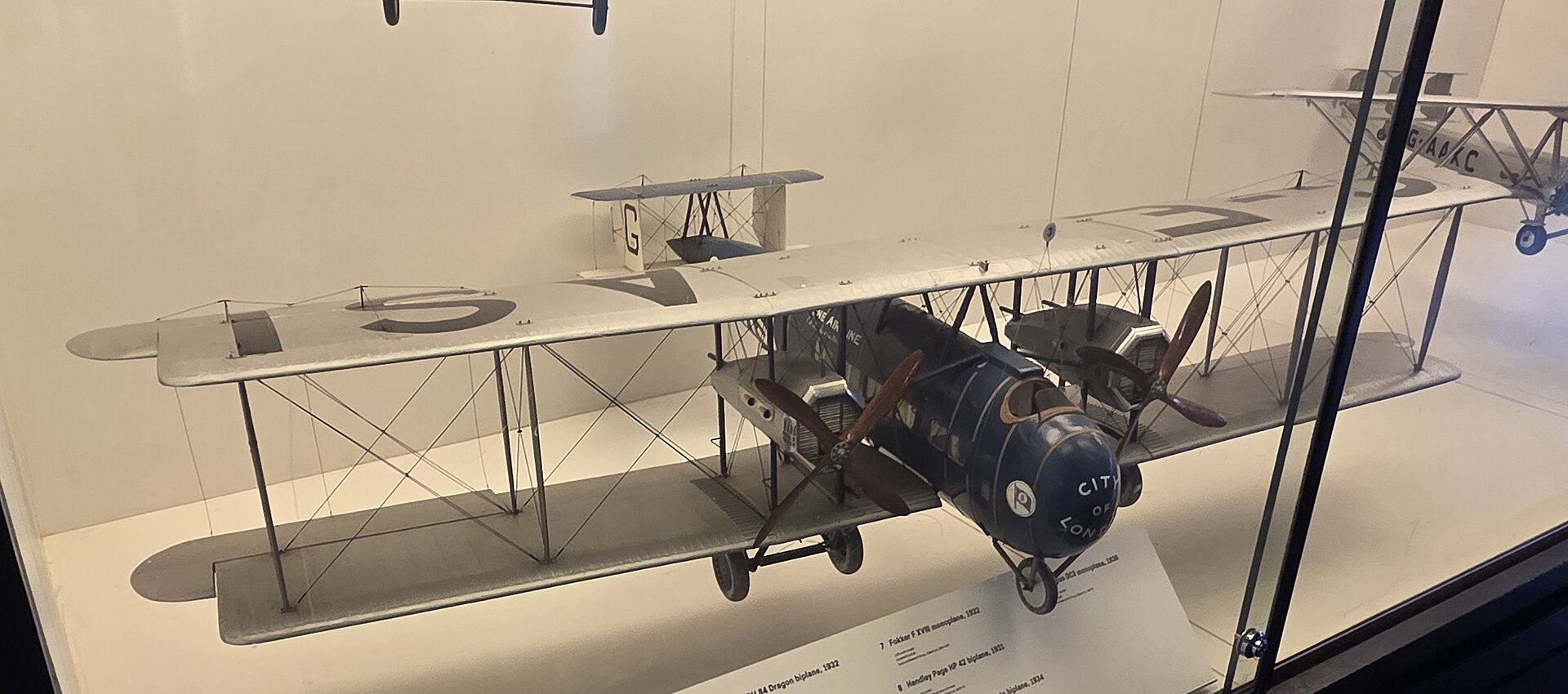
- A new plywood fuselage of much greater diameter, Consuta copper-sewn, on the bomber's wings, engines and tail, seating ten. Prototype K-107, later G-EAAV, first flown at Joyce Green by Stan Cockerell on 13 April 1919. China ordered 100, cut the contract to 40, and left most of them in their crates. G-EASI City of London flew 174,000 km (108,000 miles) for Instone and then Imperial Airways by April 1924.
- Vimy Ambulance (1921, 5)
- Napier Lion-engined Commercials for the RAF carrying four stretcher or eight sitting cases with two medical staff, loaded through a nose door. They did not perform impressively overseas; at least one was later brought up to Vernon Mk III standard with extra wing tanks.
- Vickers Vernon (1921–23, 55)
- A bomber-transport development of the Commercial and the RAF's first purpose-built troop transport, used on the Cairo to Baghdad route and in Iraq.
- Vimy trainers (1926–33, conversions)
- Re-engined with Bristol Jupiter or Armstrong Siddeley Jaguar radials for No. 4 Flying Training School at Abu Sueir in Egypt and for parachute training at Henlow. Between 1923 and 1931 at least 43 early aircraft were reconditioned to extend their lives; one was reconditioned four times.
- A.N.F. Express Les Mureaux (1920s, 1 conversion)
- Vimy Commercial no. 42, sold to the French operator Grands Express Aeriens as F-ADER with Napier Lions and later re-engined by ANF Les Mureaux with two 276 kW (370 hp) Lorraine 12Da V-12s.
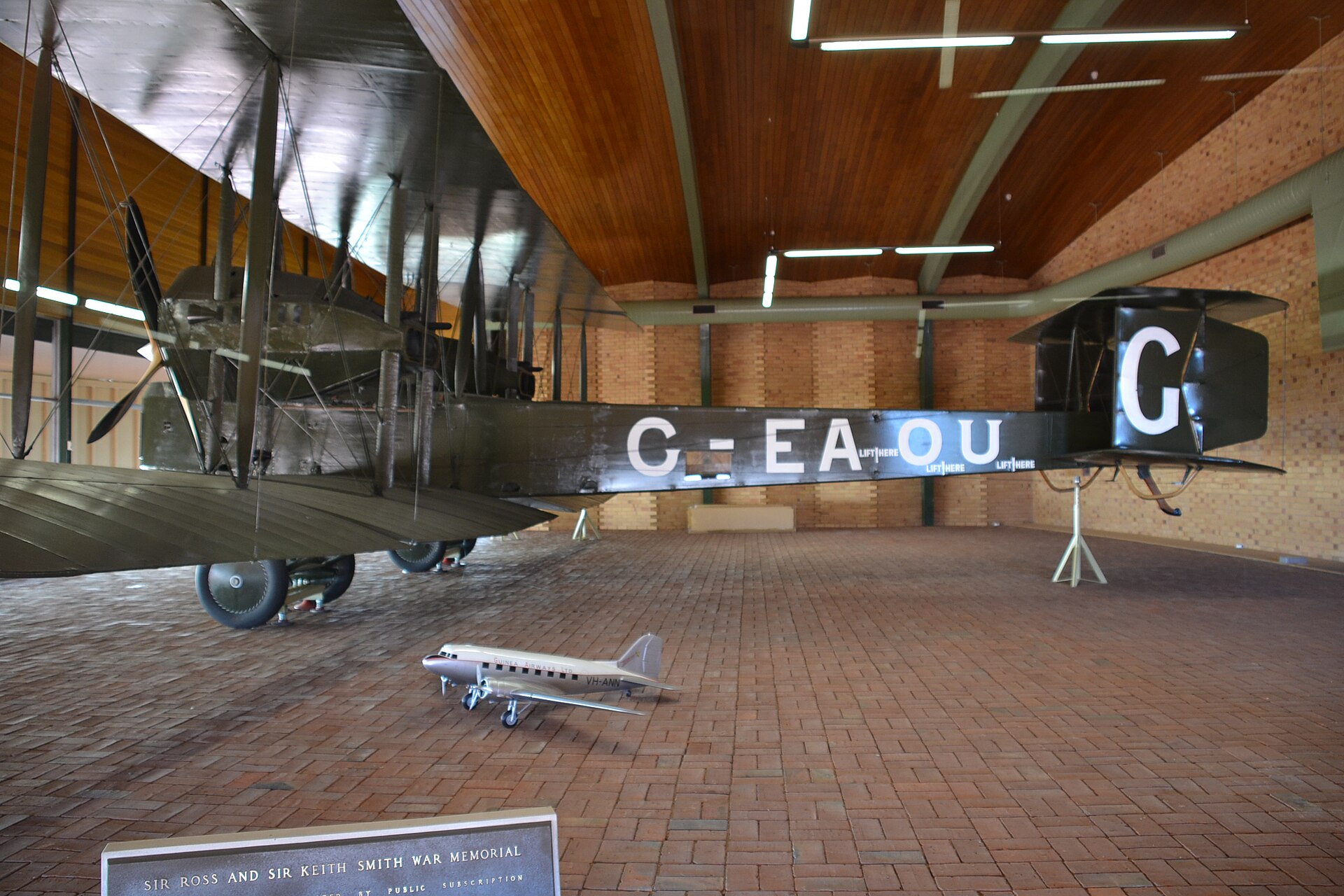
Withdrawal and survivors: the Vimy was an RAF front-line heavy bomber from July 1919, when No. 58 Squadron in Egypt replaced its Handley Page O/400s, until the Virginia displaced it in 1924 and 1925. No. 502 Squadron at Aldergrove in Northern Ireland kept Vimys until 1929; radial-engined conversions trained pilots and parachutists into the early 1930s; and the last of all served as searchlight targets at Blackdown in Hampshire until 1938, five years after the retirement date usually printed for the type. Two original Vimys survive, and neither has flown since 1920. Alcock and Brown's transatlantic machine, rebuilt by Vickers at Weybridge after it stood on its nose in the Derrygimla bog, is in the Science Museum in London, where Vickers also supplied a separate replica cockpit section in the early 1920s — a detail worth knowing, since photographs of that section are sometimes taken for the aircraft itself. G-EAOU, the Smith brothers' Australian aeroplane, sits in its own climate-controlled hall in the grounds of Adelaide Airport, paid for by public subscription. Everything else that looks like a Vimy is a reproduction, and there have been three full-size ones. A taxiable machine was built by Shawcraft Models of Iver Heath for British Lion Films in the 1950s for a film about Alcock and Brown that was never made; it appeared at Biggin Hill in 1955 and then vanished, its engine nacelles turning up as set dressing in Daleks' Invasion Earth 2150 A.D. The second, G-AWAU, was built by the Vintage Aircraft and Flying Association at Brooklands and first flew on 3 June 1969 in the hands of D. G. "Dizzy" Addicott and Peter Hoar; marked in turn H651 Triple First and F8614, damaged by fire, it was displayed at the Royal Air Force Museum in London until February 2014 and is now stored dismantled at Stafford. The third, NX71MY, was built in 1994 by an Australian-American team led by Peter McMillan and Lang Kidby, and is the only aeroplane ever to have recreated all three of the Vimy's record flights: England to Australia by Kidby and McMillan in 1994, England to South Africa by Mark Rebholz and John LaNoue in 1999, and the Atlantic by Steve Fossett and Rebholz on 2 and 3 July 2005 — landing on the Connemara golf course rather than risking the bog. It was donated to Brooklands Museum in 2006, made a 90th anniversary visit to Clifden in June 2009, flew last from Dunsfold to Brooklands on 15 November 2009, and is now the centrepiece of the museum's Vimy Pavilion, kept as a live aeroplane and still run up on the ground.
The Vickers Vimy's record flights, service and legacy
04The Vickers Vimy and the first non-stop transatlantic flight: Alcock and Brown, 1919
The London newspaper the Daily Mail had offered a £10,000 prize for the first non-stop flight across the Atlantic. In the spring of 1919 several teams gathered in Newfoundland to try. Vickers entered a modified Vimy, its bomb gear removed and extra fuel tanks fitted, flown by pilot Captain John Alcock and navigator Lieutenant Arthur Whitten Brown.
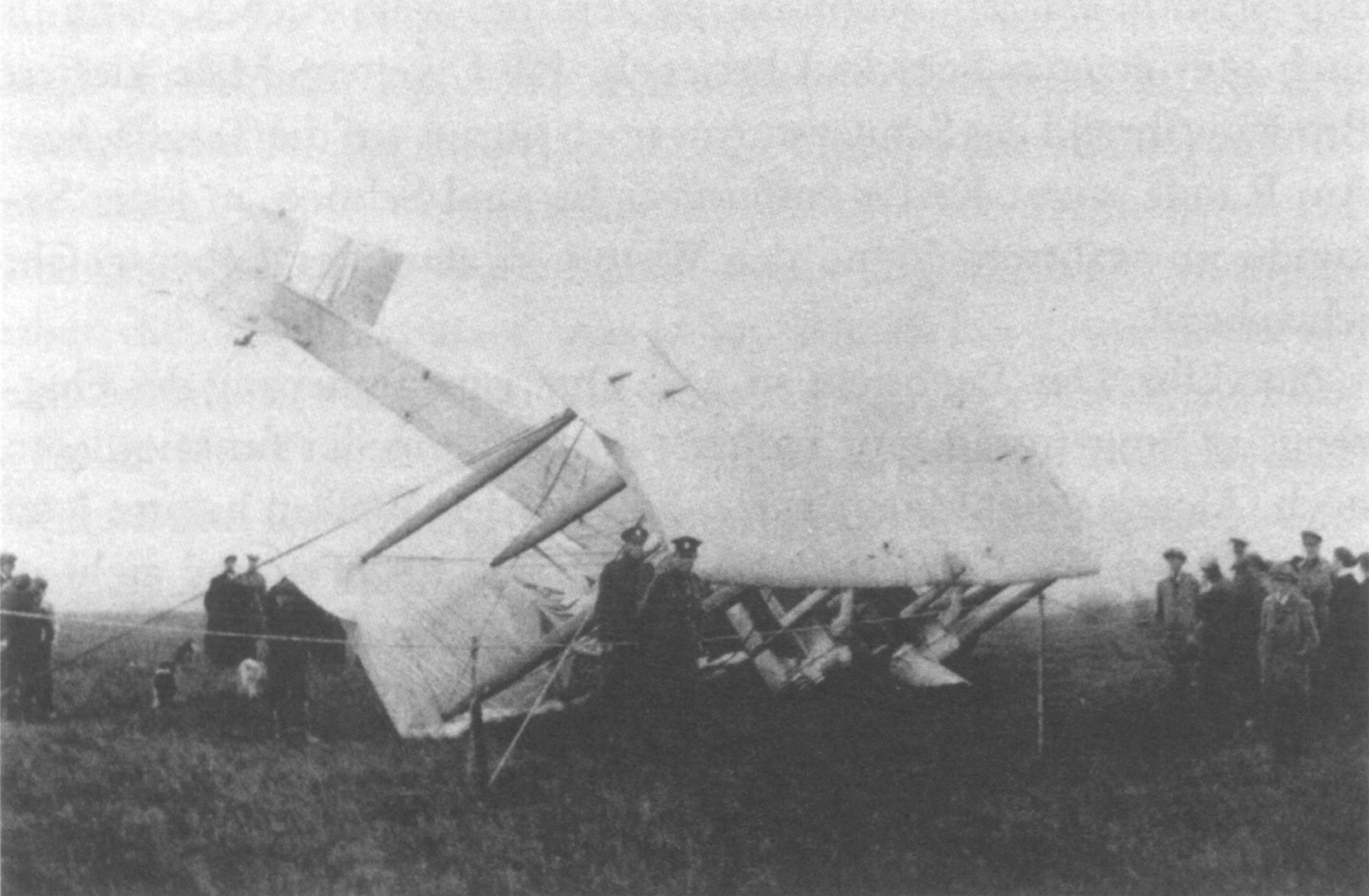
They took off from Lester's Field near St. John's on the afternoon of 14 June 1919. The crossing was brutal: fog that hid the horizon, a failed electrical generator, ice, and at one point a spin from which Alcock recovered only just above the waves. Brown reportedly had to climb out onto the wings to clear ice from the engine intakes. After roughly sixteen hours in the air they crossed the Irish coast and, spotting what looked like a green field near Clifden in County Galway, put down — only for the "field" to be Derrygimlagh bog. The Vimy tipped onto its nose in the soft ground, but both men climbed out unhurt.
The reward
It was the first non-stop aerial crossing of the Atlantic in history, covering about 1,890 miles in a little under sixteen hours of flying. Alcock and Brown collected the Daily Mail prize and were both knighted by King George V within days. (Exact timings and the flight distance vary slightly between sources.) Tragically, Sir John Alcock was killed in a flying accident in France only six months later.
05The Vickers Vimy's first England-to-Australia flight: the Smith brothers, 1919
The Australian government offered a £10,000 prize for the first flight from England to Australia by Australians in a British aircraft, to be completed within 30 days. Brothers Captain Ross Macpherson Smith and Lieutenant Keith Macpherson Smith, with mechanics Sergeants Jim (Wally) Bennett and Wally Shiers, entered a standard Vimy registered G-EAOU — a registration the crew joked stood for "God 'Elp All Of Us".
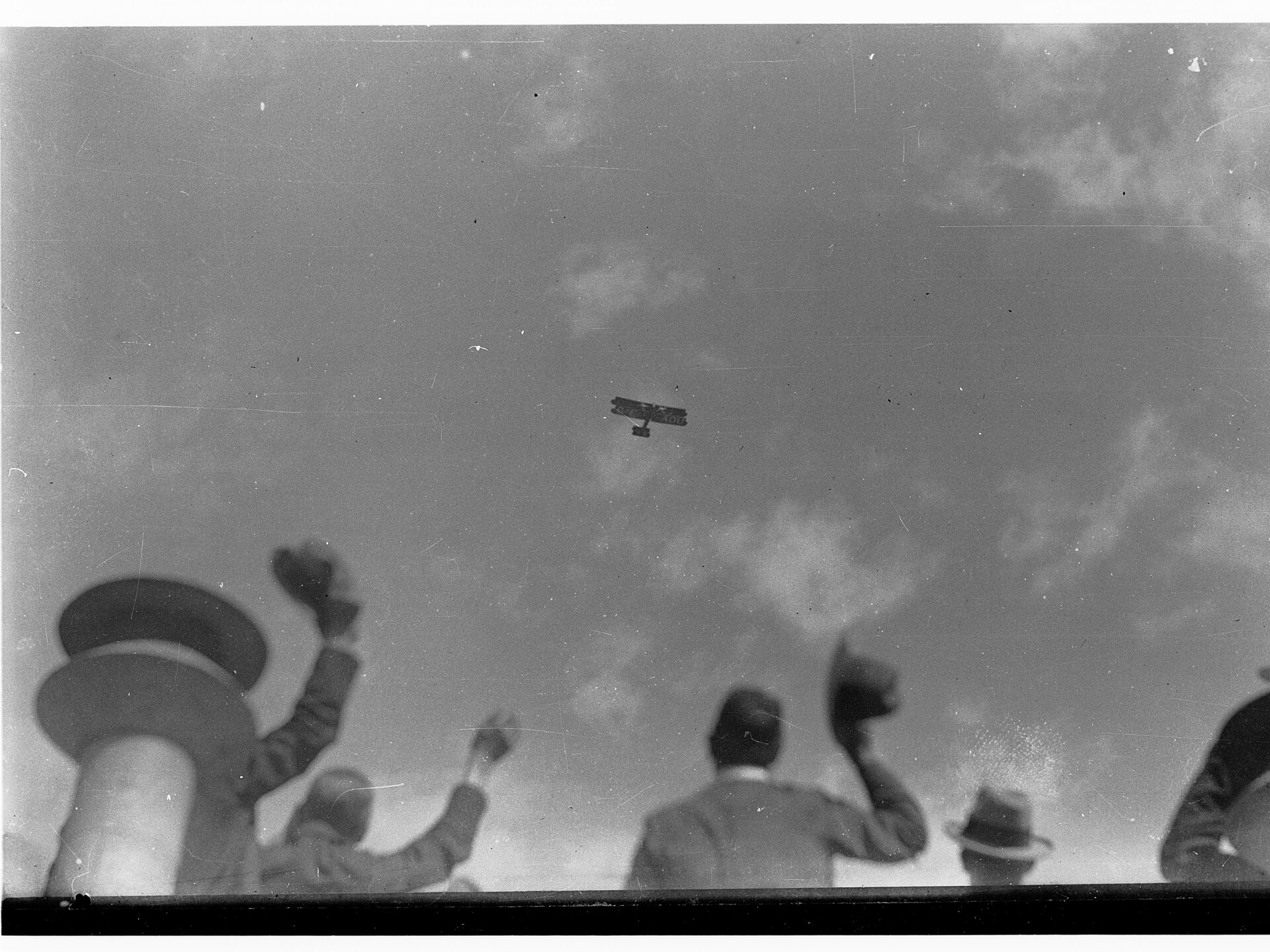
They left Hounslow Heath, west of London, on 12 November 1919 and flew east in stages: across France and Italy, over the Mediterranean to Crete and Cairo, on through Damascus, Baghdad and Persia to Karachi, across India to Calcutta, then Rangoon, Bangkok, Singapore and the Dutch East Indies, before the final island-hops to Timor and the crossing to Darwin. They landed at Darwin on 10 December 1919, inside the time limit, having flown roughly 11,000 miles (about 18,000 km) in some 28 days.
It was the first flight from England to Australia, and one of the epic journeys of early aviation — a route that would later become an arterial airline path. The Smith brothers were both knighted and the crew shared the prize. Their Vimy, G-EAOU, still exists.
06The Vickers Vimy and the England-to-South-Africa attempt: "Silver Queen", 1920
The third of the great 1919–20 route-proving flights was the attempt to fly from England to Cape Town. In February 1920 the South African airmen Lieutenant Colonel Pierre van Ryneveld and Squadron Leader Christopher Quintin Brand set off from Brooklands in a Vimy named "Silver Queen".
Unlike the Atlantic and Australia flights, this one did not end in a Vimy. "Silver Queen" was forced down and wrecked in Egypt, near Wadi Halfa, after an engine problem. The crew continued in a second borrowed Vimy, "Silver Queen II", which was in turn wrecked on take-off near Bulawayo in Southern Rhodesia (today Zimbabwe). Van Ryneveld and Brand finished the journey to Cape Town in a substitute aircraft — a de Havilland D.H.9 — arriving on 20 March 1920. They too were knighted for the achievement.
So while the Vimy's name is attached to the first England–South Africa flight, strictly speaking no Vimy completed it: the record was finished on a different aeroplane after both Vimys were lost. It is a detail often glossed over, and worth stating plainly.
07The Vickers Vimy in RAF service in the 1920s
Away from the headlines, the Vimy did become the standard RAF heavy bomber of the early post-war years — the role it had been designed for, arriving just too late to fight. It equipped home-based bomber squadrons in Britain from 1919 and served overseas, including in Egypt and the Middle East, where the RAF used air power to police its new mandates.
As newer bombers such as the Vickers Virginia arrived, the Vimy was steadily relegated to second-line duties. It found a long and useful afterlife as a training aircraft — particularly for night flying and, notably, as one of the RAF's early parachute-training aircraft, from which trainee parachutists jumped. In these roles some Vimys soldiered on until around 1929, a decade after the type first flew.
It was an unglamorous career, but a solid one, and it means the Vimy was a familiar sight in British skies throughout the 1920s — not merely a one-off record-breaker but a genuine service aircraft.
08From bomber to airliner: the Vimy Commercial and the Vernon
The Vimy's roomy design lent itself to conversion, and Vickers developed a dedicated civil version, the Vimy Commercial, with a much larger, deeper fuselage of monocoque construction able to carry around ten passengers. It first flew in 1919 and saw service with early airlines; a number were exported, including to China.
From the Vimy Commercial the RAF derived the Vernon, generally regarded as the service's first purpose-built troop-transport aircraft. Vernons flew the desert air-route across Iraq in the early 1920s, carrying troops and mail and even mounting one of the first strategic air-lifts of soldiers. The Vimy family therefore sits at the root of both military and civil air transport in Britain.
A wider family
Taken together — bomber, record-breaker, airliner and transport — the Vimy line shows how directly the heavy aircraft of 1918 fed into the civil aviation and air-transport networks of the 1920s.
09The Vickers Vimy's operating costs: what a 1919 record-breaker cost
No reliable unit price or hourly operating cost survives for the Vimy in a form worth quoting. It was a wartime and early-1920s military aircraft, procured under conditions and accounting utterly unlike those of a modern machine, and the surviving records do not translate into a meaningful "cost per flight hour".
What can be said is that the Vimy was expensive in the terms that mattered then: it needed two of the scarce, costly Rolls-Royce Eagle engines, a skilled crew and a great deal of fuel. The record flights were underwritten by newspaper and government prize money precisely because such long-distance flying was hugely expensive and risky. Because no Vimy is operated commercially today — the survivors are museum pieces and the airworthy machine is a replica — there is no genuine modern per-hour cost to quote, and any figure presented as one is not grounded in a real, flyable original.
10Surviving Vickers Vimys: the originals and the airworthy replica
Remarkably for an aircraft of its age, more than one genuine Vimy survives. Alcock and Brown's actual transatlantic Vimy was preserved and is displayed at the Science Museum in London. The Smith brothers' England-to-Australia Vimy, G-EAOU, is preserved in a purpose-built memorial hall at Adelaide Airport in South Australia. There is also a full-scale non-flying replica of a Vimy bomber in RAF markings on display in Britain.
On top of the originals, a modern airworthy replica was built in the 1990s by a team led by Peter McMillan and Lang Kidby. This flying Vimy re-created all three of the type's pioneering routes: England to Australia in 1994, England to South Africa in 1999, and the transatlantic crossing in 2005. After its flying career the replica was retired to Brooklands Museum, on the very site where Vickers built the original Vimys.
Between the two preserved originals and the record-repeating replica, the Vimy is far better represented today than most of its contemporaries — you really can go and stand in front of the aircraft that first crossed the Atlantic.
The Vickers Vimy from drawing board to record book
Specification and design
The British Air Board calls for a heavy bomber to strike Germany. Vickers' Rex Pierson designs the F.B.27, named "Vimy" after the Battle of Vimy Ridge.
First flight
The prototype Vimy flies for the first time, piloted by Captain Gordon Bell. Further prototypes test a range of engines.
Too late for the war
Only a handful of Vimys reach France by the Armistice of 11 November 1918; the type never flies a combat mission in the First World War.
First across the Atlantic
Alcock and Brown fly a modified Vimy non-stop from Newfoundland to Clifden, Ireland — the first non-stop transatlantic flight — winning the £10,000 Daily Mail prize and knighthoods.
First to Australia
Ross and Keith Smith, with Bennett and Shiers, fly the Vimy G-EAOU from England to Darwin in about 28 days — the first England-to-Australia flight.
The South Africa attempt
Van Ryneveld and Brand set out for Cape Town in the Vimy "Silver Queen"; after both Vimys are lost they finish in a substitute aircraft.
RAF heavy bomber
The Vimy equips post-war RAF bomber squadrons at home and in the Middle East, while the Vimy Commercial and Vernon derivatives pioneer air transport.
Trainer and parachute aircraft
Relegated to second-line duties, Vimys serve as night-flying trainers and early parachute-training aircraft into the late 1920s.
The replica re-flies the routes
A modern airworthy Vimy replica re-creates all three pioneering flights — Australia, South Africa and the Atlantic — before retiring to Brooklands Museum.
The Vickers Vimy in twelve stories: from Vimy Ridge to the Atlantic
Named for a battle
The new Vickers bomber takes its name from the 1917 Battle of Vimy Ridge.
Read the full account
Vickers gave its F.B.27 bomber the name "Vimy" in honour of the Battle of Vimy Ridge, the hard-fought Canadian-led victory of April 1917. It was a fashionable way of the time to link a new weapon to a recent feat of arms. The name would outlast the battle in public memory, because the aircraft that carried it went on to do things no battle honour could have predicted.
The prototype takes off
Captain Gordon Bell lifts the first Vimy off the ground.
Read the full account
The first Vimy flew on 30 November 1917 in the hands of test pilot Captain Gordon Bell. It was a clean, well-proportioned biplane, and it flew well. Over the following months several prototypes explored different engine fits as Vickers hunted for a reliable powerplant; the Rolls-Royce Eagle VIII eventually became the standard, and with it the Vimy became the aircraft history remembers.
The war ends first
The Armistice arrives before the Vimy can go to war.
Read the full account
The Vimy was meant to be the spearhead of a 1919 bombing campaign against Germany. But building and perfecting a large aircraft took time, and by the Armistice of 11 November 1918 only a very small number had reached France. None flew a combat mission. In an instant the Vimy went from being tomorrow's war-winner to a superb bomber with no war to fight — a fact that would shape its entire legend.
The Atlantic beckons
The Daily Mail's £10,000 prize draws teams to Newfoundland.
Read the full account
The London Daily Mail had offered £10,000 to the first aviators to cross the Atlantic non-stop by air. With the war over, several teams shipped their aircraft to Newfoundland, the closest jumping-off point, and set about clearing fields to fly from. Vickers entered a Vimy, stripped of military gear and packed with extra fuel, and sent it out with pilot John Alcock and navigator Arthur Whitten Brown.
Wheels up from Newfoundland
Alcock and Brown launch into the Atlantic weather.
Read the full account
On the afternoon of 14 June 1919, heavily loaded with fuel, the Vimy lifted off from Lester's Field near St. John's and turned east over the ocean. Ahead lay nearly two thousand miles of open water with no possibility of rescue if anything failed. Almost at once they flew into cloud and fog that would hide the horizon for most of the crossing.
Down in an Irish bog
After ~16 hours the Vimy reaches Ireland — nose-first.
Read the full account
Through fog, ice and a near-fatal spin, the two men flew on by dead reckoning. Brown reportedly climbed out to clear ice from the engines. At last, after roughly sixteen hours, they crossed the Irish coast near Clifden and put down on what looked like a green field — Derrygimlagh bog. The Vimy sank in and tipped onto its nose, but both crew stepped out unhurt, the first men to fly the Atlantic non-stop.
Heroes overnight
Alcock and Brown are knighted; the Vimy is world-famous.
Read the full account
The flight was a sensation. Alcock and Brown collected the Daily Mail prize and were knighted by King George V within days. The transatlantic Vimy was preserved for the nation and is displayed today at the Science Museum in London. Tragedy followed the triumph: Sir John Alcock was killed in a flying accident in France only six months later, at the age of 27.
The Smith brothers set off
A Vimy leaves London bound for Darwin, half a world away.
Read the full account
Barely five months after the Atlantic flight, another Vimy set out on an even longer journey. The Australian brothers Ross and Keith Smith, with mechanics Jim Bennett and Wally Shiers, took off from Hounslow Heath on 12 November 1919 to try for the Australian government's £10,000 prize for the first England-to-Australia flight, aiming to cover some eleven thousand miles within 30 days.
Across the world in stages
France, Egypt, India, Singapore, the East Indies — then Australia.
Read the full account
The Vimy G-EAOU — the crew joked the registration meant "God 'Elp All Of Us" — flew east in short, punishing hops: across Europe to Cairo, on through Baghdad and Persia to India, then Burma, Siam, Singapore and the Dutch East Indies, fighting monsoon weather, rough fields and constant mechanical work. It was as much a feat of the two mechanics as of the pilots.
First to Australia
G-EAOU lands at Darwin inside the time limit.
Read the full account
On 10 December 1919 the Vimy touched down at Darwin, completing the first flight from England to Australia within the 30-day limit. Ross and Keith Smith were both knighted and the crew shared the prize. Their aircraft, G-EAOU, survives to this day, preserved in a purpose-built hall at Adelaide Airport — a genuine original of one of aviation's epic journeys.
The South Africa try
Two Vimys are lost on the way to Cape Town.
Read the full account
The last of the great route-proving flights was the 1920 attempt to fly from England to South Africa. Van Ryneveld and Brand set out in the Vimy "Silver Queen", but it was wrecked in Egypt; a second Vimy was wrecked near Bulawayo. They finished the journey to Cape Town in a substitute aircraft — so the Vimy's name is attached to the flight even though no Vimy actually completed it.
History flown again
A modern Vimy replica re-flies all three routes.
Read the full account
In the 1990s a team led by Peter McMillan and Lang Kidby built an airworthy Vimy replica and set out to re-create the type's pioneering journeys. They flew England to Australia in 1994, England to South Africa in 1999, and crossed the Atlantic in 2005 — repeating, in a faithful reproduction, the very flights that made the Vimy famous. The replica now rests at Brooklands Museum, where the originals were built.
The Vickers Vimy in photographs
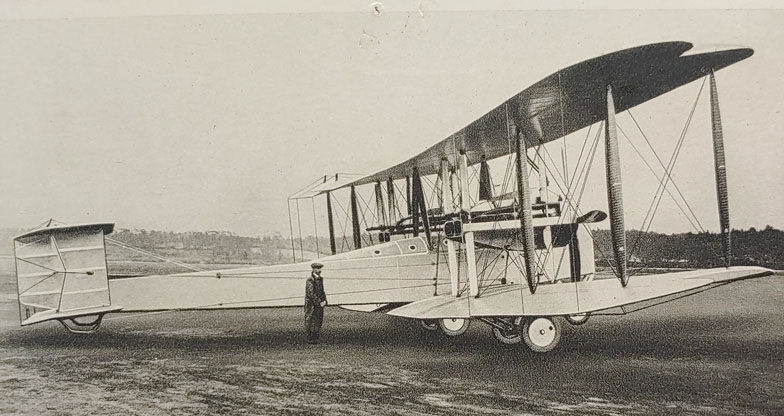
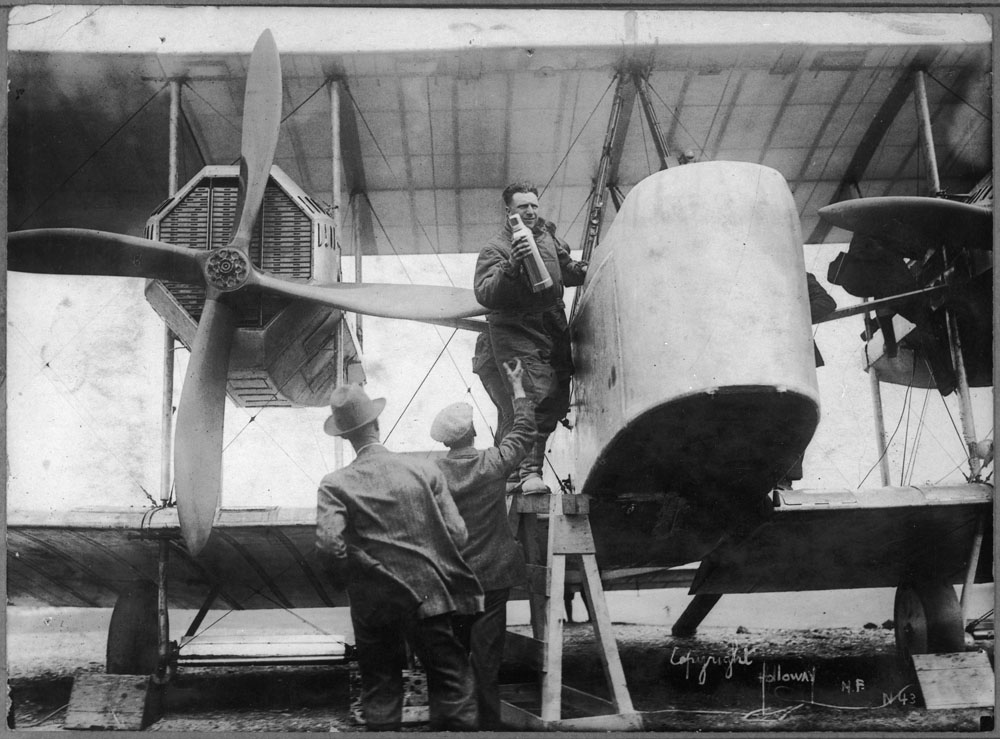
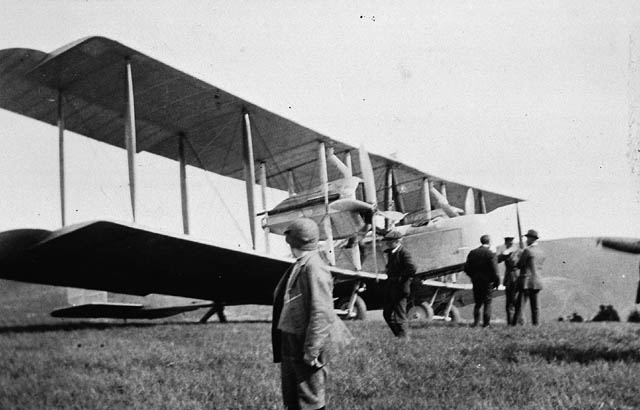
The Vickers Vimy on film: the bomber that conquered the Atlantic
"The Aircraft That Conquered The Atlantic — Vickers Vimy", Rex's Hangar (aviation-history documentary channel), roughly 121,000 views at the time of writing. Chosen as a dedicated, well-researched account of the type.
Where the Vickers Vimy was built, flew and survives
Britain designed and built it; then, stripped of its guns, it traced the first great long-distance air-routes of the world — across the Atlantic, out to Australia, and towards South Africa — before serving the RAF and, finally, coming to rest in museums. Toggle the categories to explore.
The Vickers Vimy by the numbers
Vickers Vimy: your questions answered
Can I fly in a Vickers Vimy?
No. There is no bookable Vickers Vimy flight anywhere. Two genuine Vimys survive as museum exhibits — Alcock and Brown's transatlantic aircraft in London and the Smith brothers' G-EAOU in Adelaide — and a modern airworthy replica flew for years before retiring to a museum. None of them is available for passenger flights, and MiGFlug does not operate Vimy flights.
What you can do is experience real military flight in aircraft that still fly. MiGFlug puts civilians in the cockpit of genuine jets — from the L-39 Albatros to supersonic fighters — for aerobatics, high-g manoeuvres and edge-of-space flights. If the Vimy's story sparked your interest in aviation, start here: migflug.com/flights-prices.
What was the Vickers Vimy?
It was a British twin-engined heavy bomber designed by Vickers late in the First World War. It is most famous not for bombing but for pioneering long-distance flights — in 1919 Vimys made the first non-stop transatlantic flight and the first flight from England to Australia.
Did the Vickers Vimy fight in World War I?
No. Although it was designed as a bomber to strike Germany, the Vimy entered service too late. Only a handful had reached France by the Armistice of November 1918, and the type never flew a combat mission in the war. Its fame rests almost entirely on its post-war record flights.
Who flew the first non-stop transatlantic flight in a Vickers Vimy?
Captain John Alcock (pilot) and Lieutenant Arthur Whitten Brown (navigator) flew a modified Vimy non-stop from St. John's, Newfoundland, to a bog near Clifden, Ireland, on 14–15 June 1919 — about sixteen hours in the air. They won the £10,000 Daily Mail prize and were both knighted.
Which Vickers Vimy flew from England to Australia?
A standard Vimy registered G-EAOU, flown by the Australian brothers Ross and Keith Smith with mechanics Jim Bennett and Wally Shiers. They left London on 12 November 1919 and reached Darwin on 10 December 1919, flying about 11,000 miles in roughly 28 days — the first England-to-Australia flight. That aircraft is preserved in Adelaide.
Did a Vickers Vimy fly from England to South Africa?
Not all the way. In 1920 Van Ryneveld and Brand set out for Cape Town in the Vimy "Silver Queen", but both it and a replacement Vimy were wrecked en route. They completed the journey in a substitute aircraft, so strictly speaking no Vimy finished the England-to-South-Africa flight, even though the attempt is part of the type's story.
What engines did the Vickers Vimy use?
Production Vimys used two Rolls-Royce Eagle VIII V-12 engines of about 360 hp each. Some prototypes and variants tested other engines — Hispano-Suiza, Sunbeam Maori, Salmson, Fiat and the American Liberty — but the reliable Eagle became standard, and its dependability was key to the record flights.
How many Vickers Vimys were built?
Figures vary between sources, but the total is commonly cited as somewhere around 200 to 240 aircraft across bomber and derivative versions. The Vimy also spawned the enlarged Vimy Commercial airliner and the Vernon military transport.
Do any Vickers Vimys survive?
Yes — unusually for an aircraft of its age. Alcock and Brown's transatlantic Vimy is at the Science Museum in London, and the Smith brothers' G-EAOU is preserved at Adelaide Airport in Australia. A full-scale replica bomber is also displayed in Britain, and a separate airworthy replica re-flew all three pioneering routes in the 1990s and 2000s before retiring to Brooklands Museum.
How fast was the Vickers Vimy, and how big?
It was a load-carrier, not a racer: top speed around 160 km/h (about 100 mph), a wingspan of roughly 20.75 m (68 ft) and a crew of about three. These figures vary with load and between sources, and are best treated as representative rather than exact.
The record-breaker lives in museums. A real jet flight does not.
No Vickers Vimy is bookable — but a genuine military jet flight is real, and available now. Take the controls, pull real g and see the curve of the Earth with MiGFlug.
 Fly the L-39 AlbatrosThe world’s most-flown jet trainer — aerobatics included
 Fly the F-104 Starfighter“The missile with a man in it”
 Fly the MiG-21The Cold War’s most-produced jet
 Fly the T-33 Shooting StarAmerica’s first jet trainer
 Fly the DH VampireA piece of early jet history
 Fly the S.211Agile Italian jet trainer
 Fly the MB-326The classic Aermacchi jet
 Fly the MiG-15The Soviet legend of the Korean War
Explore more of the Book of Beasts
Where these Vickers Vimy facts come from
- Science Museum, London — Alcock and Brown's Vickers Vimy.Holds and documents the actual first-transatlantic aircraft.
- Royal Air Force Museum — Vickers Vimy type history.National museum of the RAF; Vimy service and derivatives.
- Imperial War Museums (IWM) — Alcock and Brown, 1919.Photographs and records of the transatlantic flight.
- State Library of South Australia / History Trust of South Australia — Ross Smith's Vimy G-EAOU.The preserved England–Australia aircraft in Adelaide.
- Australian War Memorial — the 1919 England-to-Australia flight.Records of the Smith brothers' journey.
- Brooklands Museum — Vickers and the airworthy Vimy replica.On the site where the Vimy was built; home of the replica.
- National Museum of Flight (Scotland) — Vimy and early aviation.Reference on the type and its record flights.
- Smithsonian National Air and Space Museum — early long-distance flight.Context on the 1919–20 pioneering flights.
- Flight archive (contemporary reporting).Period coverage of the Vimy and its record flights.
- Rex's Hangar — "The Aircraft That Conquered The Atlantic: Vickers Vimy" (video).Dedicated documentary overview of the type.
Specifications, production totals, dates, crew figures and flight distances vary between sources; contested and estimated values are flagged in the text. In particular, the Vimy saw no First World War combat, and no Vimy completed the 1920 England–South Africa flight. Images are public domain or freely licensed via Wikimedia Commons, credited individually. MiGFlug does not operate Vickers Vimy flights — the surviving aircraft are museum exhibits and an airworthy replica.