
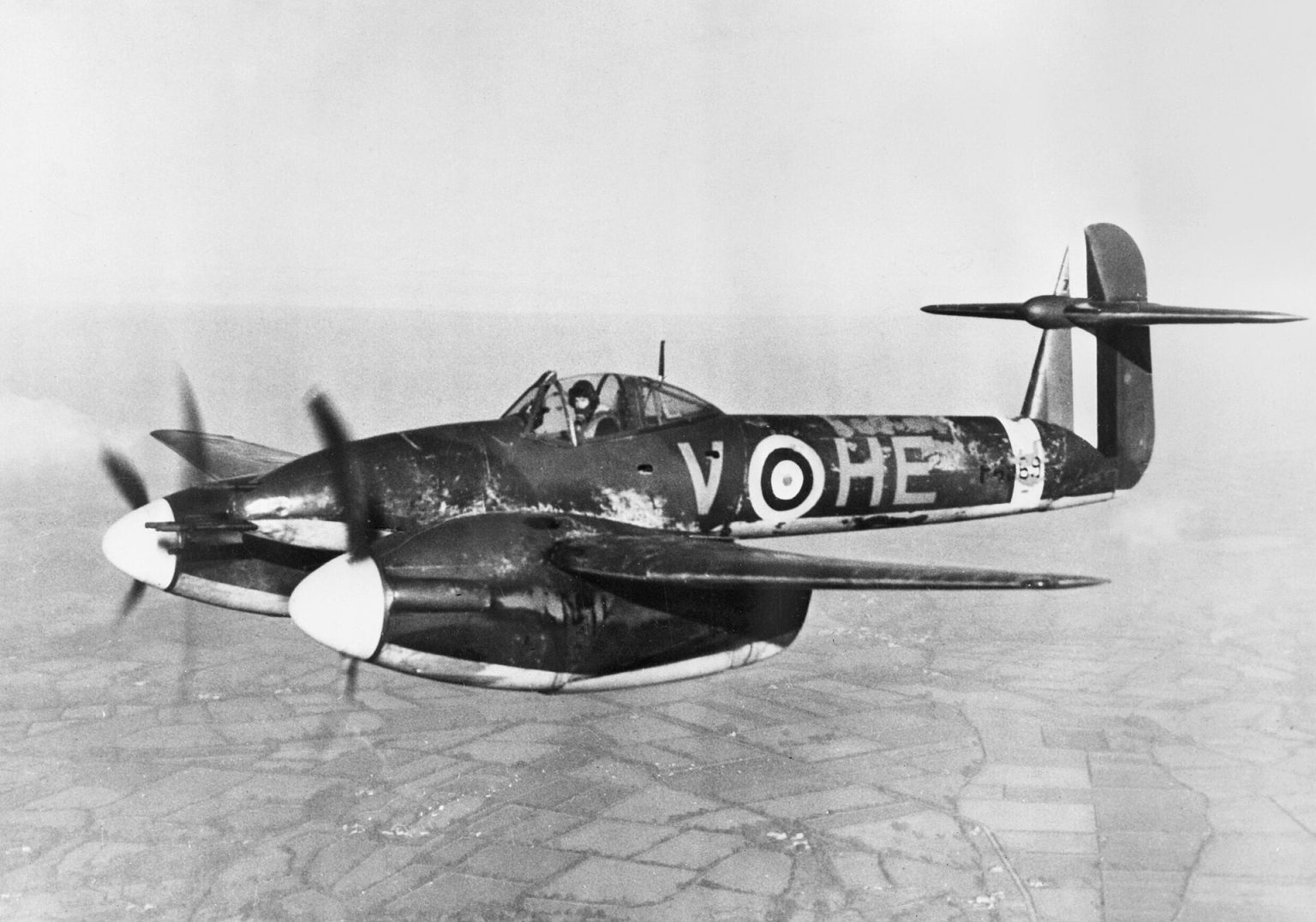
Westland Whirlwind
“Whirlibomber”
Britain’s first single-seat, twin-engine cannon fighter — four 20 mm guns grouped in the nose, deadly at low level in 1940, and doomed by an engine nobody would finish.
The Westland Whirlwind: Britain’s brilliant, tragic first cannon fighter
In the mid-1930s the Royal Air Force went looking for something new: a fighter that did not rely on rifle-calibre machine guns but carried cannon — guns heavy enough to smash a bomber in a single firing pass. The answer, to specification F.37/35, came from an unlikely place. Westland Aircraft of Yeovil was known for slow army co-operation machines, but its young technical director, W. E. W. “Teddy” Petter, produced one of the most advanced fighters in the world.
The Whirlwind was radical. It was the RAF’s first single-seat, twin-engine, cannon-armed fighter, and it concentrated four 20 mm Hispano cannon in the nose — no wing guns, no convergence problems, just a devastating cone of fire straight ahead. It was small, clean and, at low and medium altitude, genuinely fast: roughly 360 mph (about 580 km/h), comparable with the Spitfires of the day. It first flew on 11 October 1938 and reached the squadrons in 1940.
And then the story turns. The Whirlwind was built around two Rolls-Royce Peregrine engines — and the Peregrine was an orphan. Rolls-Royce poured everything into the Merlin, the engine that powered the Spitfire, Hurricane, Lancaster and Mosquito. The Peregrine was never fully developed, was troublesome in service, and was cancelled. With no engine, the airframe had no future.
Only about 114 Whirlwinds were built, and just two squadrons — No. 263 and No. 137 — ever flew it. Hampered at altitude and tricky to land on small wartime airfields, it found its niche low down: as a long-range fighter, escort, and, as the bomb-carrying “Whirlibomber”, on cross-Channel strikes against airfields, trains and shipping, where its speed and firepower told. It was withdrawn late in 1943 as the Hawker Typhoon took over the low-level role.
What lingers is the sense of waste. The Whirlwind was not a failure of design or of courage — it was a failure of priorities, an excellent aircraft starved of the one thing it could not do without. In the alternate history where the Peregrine gets another year of development, or where the airframe is redesigned around a pair of Merlins, the RAF might have had a superb long-range cannon fighter years before the Mosquito and Beaufighter matured. Instead the Whirlwind flew its brief war with two under-strength squadrons, did good work at low level, and vanished so completely that today not one intact example remains. It endures in photographs, in a few salvaged relics, and in the memory of everyone who has ever looked at that four-cannon nose and wondered what might have been.
01Why the Westland Whirlwind is remembered as a “what-if” aircraft
The tragedy of the Whirlwind is that almost everything about the airframe was right and almost everything about the engine was wrong. Petter’s design was aerodynamically clean, structurally advanced, and armed more heavily than any single-seat fighter of 1940. Test pilots liked its handling and its stability as a gun platform. Had it received a mature, high-altitude engine — a Merlin-class powerplant with a proper supercharger for height — it might have been a formidable all-round fighter.
Instead it was tied to the Peregrine, and when that engine was cancelled the Whirlwind was frozen: no development engine meant no development airframe. It is one of the clearest cases in aviation history of a promising design killed not by the enemy but by industrial priorities at home. Figures for its exact performance vary between sources, so treat the numbers here as commonly cited estimates rather than absolutes.
The “what-if” is not just idle nostalgia. The Whirlwind demonstrated ideas — concentrated nose cannon, a clean twin-engine single-seater, long range with heavy hitting power — that the RAF would spend the rest of the war chasing in other aircraft. The Bristol Beaufighter and the de Havilland Mosquito both eventually delivered heavy twin-engine firepower, but they were bigger, two-crew aircraft that arrived later. A matured Whirlwind might have filled the single-seat long-range cannon-fighter niche years earlier. That it did not is down to a decision made in a Rolls-Royce boardroom, not on any airfield or battlefield — which is exactly why the aircraft fascinates historians and enthusiasts to this day.
How the Westland Whirlwind was built — and what went wrong
The Westland Whirlwind’s four-cannon nose: firepower ahead of its time
The Whirlwind grouped four 20 mm Hispano cannon in the nose, firing straight ahead with no need to harmonise wing guns to a single convergence point. For 1940 this was crushing firepower — several times the throw-weight of the eight rifle-calibre guns in a Spitfire or Hurricane — concentrated exactly where the pilot aimed.
The Rolls-Royce Peregrine: the orphan engine that doomed the Whirlwind
Two Rolls-Royce Peregrine V-12s, each around 885 hp, powered the type. The Peregrine was a development of the older Kestrel, but Rolls-Royce concentrated on the Merlin and the big Griffon and Vulture. The Peregrine was never matured, suffered reliability problems, and was cancelled — leaving the Whirlwind with no engine to grow into.
Petter’s clean airframe: small, fast and low down
Designer “Teddy” Petter gave the Whirlwind a slim fuselage, a low-drag radiator layout buried in the wing centre-section, and a bubble-type canopy with excellent forward view. It was quick at low and medium altitude and stable enough to be an accurate gun platform — but it needed a long run to land and lost performance badly as it climbed.
02The Westland Whirlwind’s engines in detail: why the Peregrine was never enough
The Peregrine was a compact, 21-litre V-12 producing roughly 860–885 hp depending on the source and rating. On paper two of them gave the Whirlwind adequate power; in practice the engine was under-developed and its supercharging was optimised for low and medium altitude. Above about 15,000 ft the Whirlwind’s performance fell away, which mattered enormously in 1940–41 when much of the air war was fought high.
Rolls-Royce had finite engineering capacity, and the Merlin — needed for the Spitfire, Hurricane, Lancaster, Mosquito and more — came first, second and third. The Peregrine was quietly dropped, and with it any chance of a better-engined Whirlwind. A proposed re-engining with Merlins (which would have needed a substantially new aircraft, and became the very different Welkin high-altitude fighter) was not pursued for the Whirlwind itself. Exact power and altitude figures vary between references and should be read as estimates.
There was also the matter of the installation itself. Packaging two liquid-cooled V-12s, their radiators, coolant, oil and exhaust into a small fighter is a genuinely hard engineering problem, and Petter’s solution — burying the radiators in the thick wing centre-section between fuselage and engine — was elegant but demanding to build and maintain. Early aircraft suffered cooling and exhaust troubles that took time to resolve, and every hour spent nursing an immature engine was an hour the tiny fleet was not flying. None of these problems were unsolvable; they were the normal teething troubles of an advanced aircraft. What the Whirlwind never got was the time and the engineering investment to solve them — because the engine at the heart of it all had already been condemned.
03The Westland Whirlwind’s handling: a fast, heavy gun platform with a catch
Pilots generally praised the Whirlwind’s speed at low level, its concentrated firepower and its stability in the aim. The catch was the landing: the aircraft came in fast — its high wing loading and the demands of its Fowler flaps gave it a notably high landing speed — which made it a handful on the short, rough grass airfields of the day and drove up the accident rate. Combined with weak high-altitude performance and a tiny production run, this limited where and how the type could be used, and it settled into the low-level fighter and fighter-bomber roles where it was genuinely effective.
Visibility from the cockpit was good for the era — the pilot sat high under a framed bubble canopy with a clear view forward over the short nose, an advantage for both gunnery and low-level flying. The controls were generally liked, and the aircraft was a steady platform in the dive and the firing pass. Twin engines also brought a genuine safety margin over water: a Whirlwind could, in principle, limp home on one engine from a Channel sortie where a single-engine fighter would have gone into the sea. Against these virtues stood the demanding circuit, the altitude limitation, and the sheer scarcity of aircraft and spares. The overall verdict of most who studied or flew it is consistent: a very good aeroplane asked to fight with one hand tied behind its back by its powerplant.
It is worth being clear about how much of the “difficult” reputation is fair and how much is exaggerated. Much of it traces back to the landing characteristics and to the fact that pilots came to the Whirlwind straight from docile trainers or from single-engine fighters, with little twin time. Once converted, many pilots were enthusiastic about the aircraft and defended it robustly. The Whirlwind was not a widow-maker; it was a demanding thoroughbred that punished carelessness and rewarded skill. Given a mature engine, better altitude performance and enough airframes to build up experience across more squadrons, it is entirely plausible that its reputation would today be that of a formidable early-war heavy fighter rather than a fascinating failure — which is precisely why it remains one of the most debated aircraft of its generation.
Westland Whirlwind specifications: dimensions, engines, performance and cost
Baseline note: this is the Westland Whirlwind Mk I of 1940 — the single-seat twin-engined cannon fighter, not the Westland Whirlwind helicopter of the 1950s, which was a licence-built Sikorsky S-55 and shares nothing with it but a name and a manufacturer. The Mk I is effectively the only Whirlwind there was: 114 production aircraft and two prototypes, all built to one standard and, as Francis Mason noted, kept in combat "virtually unmodified" for three years. Figures follow the A&AEE-derived tabulation reproduced by Derek James. Where a Whirlwind delta exists it is not a mark but a modification — slats wired shut from June 1941, bomb racks from the summer of 1942 — and those are given in grey.
Dimensions & weights
- Crew
- 1 (under one of the world’s first true bubble canopies, with the wing set low and well forward; the view was excellent in every direction except straight over the nose)
- Length
- 9.83 m (32 ft 3 in); a number of references give 32 ft 9 in (9.98 m), and the discrepancy has never been resolved in print
- Wingspan
- 13.72 m (45 ft 0 in)
- Height
- 3.35 m (11 ft 0 in); 11 ft 7 in (3.53 m) in some tabulations, probably measured to a different datum on the T-tail
- Wing area
- 23.23 m² (250 sq ft) — a very small wing for a twin, and the root of both the aircraft’s speed and its landing problem
- Empty weight
- 3,769 kg (8,310 lb)
- Loaded weight
- 4,697 kg (10,356 lb)
- Maximum take-off weight
- 5,191 kg (11,445 lb), with two 500 lb bombs
- Wing loading
- 223 kg/m² (45.6 lb/sq ft) — against about 25 lb/sq ft for a Spitfire I. This one number explains the high approach speed and the short list of airfields the Whirlwind could use
- Power loading
- 2.65 kg/hp (5.85 lb/hp)
- Internal fuel
- ~609 litres (134 imp gal, 161 US gal) in wing tanks, with no provision for drop tanks — a decisive omission in an aircraft conceived as a long-range escort
- Ammunition
- 240 rounds total, 60 per gun in drum magazines: about six seconds of firing. Enough, given what four 20 mm shells do to an airframe, but no more than enough
- Material cost
- Building one Whirlwind consumed roughly three times as much light alloy as building a Spitfire — an argument that carried real weight in 1941 and helped seal the type’s fate
Performance
- Maximum speed
- 580 km/h at 4,570 m (360 mph at 15,000 ft) — the same as the best single-engined fighters of 1940
- Speed at low level
- Faster than a contemporary Spitfire down low, with lighter lateral control. Pilots described it as one of the nicest twins ever built, and it could hold its own against a Bf 109 below about 15,000 ft
- Performance above 20,000 ft
- Fell off sharply, and squadron reports said so plainly. Modern analysis blames the propeller rather than the engine: the production de Havilland blades were thick (9.6 per cent thickness-to-chord), tip Mach reached about 0.72 in the climb, and the resulting shock waves made the constant-speed unit hunt. This is a strong argument, not a settled verdict
- Stalling speed
- 153 km/h (95 mph) flaps down — high for 1940, and the reason the Whirlwind was restricted to a handful of long-runway airfields such as Exeter, Warmwell, Manston and Drem
- Time to 15,000 ft
- 5 minutes 54 seconds (4,570 m)
- Time to 30,000 ft
- 20 minutes 30 seconds (9,145 m) — and the last 10,000 ft of that took over fourteen minutes, which is the altitude problem stated as a number
- Service ceiling
- 9,235 m (30,300 ft)
- Range
- 1,287 km (800 miles)
- Combat radius
- ~240 km (150 miles) as a low-altitude fighter with normal reserves — no better than a Hurricane or a Spitfire, which destroyed the case for the Whirlwind as an escort. On 12 August 1941 the Whirlwinds escorting 54 Blenheims to power stations near Cologne had to turn back at Antwerp; ten Blenheims did not come home
- Weight of fire
- 272 kg per minute (600 lb/min) from the nose battery — ahead of any fighter in the world until the Beaufighter appeared, and ahead of any single-seater for longer than that
- Damage tolerance
- Notably good. Two engines meant a Whirlwind could come home on one; the wings and engines ahead of the cockpit absorbed impact in forced landings, and pilots repeatedly walked away from write-offs
Propulsion & systems
- Engines
- 2 × Rolls-Royce Peregrine I, supercharged liquid-cooled 60° V12 of 21.2 litres (1,296 cu in) — the final development of the Kestrel, and a dead end. Only 301 were ever built, for 116 airframes
- Power
- 660 kW (885 hp) each at 3,050 m (10,000 ft) on 100 octane fuel. The proposed Mk II Peregrine would have given 1,010 hp at +12 lb boost, rated to 20,000 ft; Rolls-Royce cancelled the work before it existed
- Engine dimensions
- Bore 127 mm × stroke 139.7 mm (5.0 × 5.5 in), 517 kg (1,140 lb) dry. Single-speed gear-driven centrifugal supercharger, +9 psi, downdraught carburettor
- Propellers
- de Havilland bracket-type three-blade variable-pitch, 3.05 m (10 ft). The first prototype L6844 had handed, counter-rotating engines; L6845 and every production aircraft did not
- Cooling
- Ducted radiators buried in the leading edge of the wing centre section rather than slung under the nacelles — beautifully clean, and a persistent source of overheating
- High-lift devices
- Large Fowler flaps, which is why the tail is where it is: the original twin fin arrangement sat in the wake of the deployed flaps, so W. E. W. Petter moved the tailplane to the top of the fin. The Whirlwind is one of the earliest T-tails on a combat aircraft
- Slats
- Handley Page slats on the outer wings and on the lips of the radiator intakes, interconnected by duralumin torque tubes. Wired shut from June 1941 after two aircraft were lost to slat failure in hard manoeuvring; the A&AEE found take-off and landing barely affected and handling actually improved
- Structure
- Stressed-skin duralumin monocoque with a magnesium-alloy skinned rear fuselage. The first prototype routed its exhausts through the wings and fuel tanks to exit at the trailing edge; a duct failed in flight, heat-fractured an aileron control rod and nearly killed Harald Penrose, and conventional external stacks were fitted at once
- First flight
- 11 October 1938, L6844, from Yeovil — delayed by the novelty of the design, and by late delivery of engines and undercarriage
- Service entry
- First production aircraft delivered to No. 263 Squadron on 6 July 1940; the squadron was declared operational on the type at Exeter on 7 December 1940. Withdrawn from operations 29 November 1943; declared obsolete 1 January 1944
- Number built
- 116 — 114 production aircraft and two prototypes — against 400 ordered and a 1939 plan, dropped, for 800 more at the Castle Bromwich shadow factory. Castle Bromwich built Spitfires instead
04The Westland Whirlwind’s costs: why there is no price-per-hour for this aircraft
Unlike modern warbirds, the Whirlwind has no meaningful operating-cost figure today for one simple reason: no complete example survives and none is airworthy. There is nothing to fuel, insure or maintain, so a cost-per-flight-hour cannot be quoted — we mark it “not applicable” rather than invent a number.
Its original wartime unit cost is likewise not reliably recorded in the sources we trust; production was tiny (about 114 aircraft) and spread over 1940–42, and wartime accounting figures for such a small run are inconsistent. Where you see money attached to the Whirlwind, treat it with caution. What can be said is that the type’s true cost was strategic: an advanced airframe wasted because its engine was never funded to maturity.
For comparison and context only — not as a Whirlwind figure — it is worth remembering how the economics of warbirds work today. A surviving, airworthy WWII fighter such as a Spitfire or Mustang typically costs many thousands of pounds per flight hour to operate, once fuel, specialist maintenance, insurance and the amortised cost of a multi-million-pound restoration are counted, which is why flights in original piston fighters are so rare and so expensive. The Whirlwind sits outside even that world: with no airframe to restore, there is simply no operating economy to describe. If you want the experience of flying a genuine fast military aircraft, the realistic modern route is a jet — which is exactly what MiGFlug arranges — rather than any Whirlwind, which exists today only in photographs, film and relics.
Armament & payload
Four Hispanos in the nose gave the Whirlwind the hardest punch of any fighter in the world, and six seconds to use it
Specification F.37/35 asked for a single-seat fighter with four 20 mm cannon, and the reasoning behind it was sound and unusually clear-headed for 1935: rising closing speeds meant shorter firing passes, and eight rifle-calibre Brownings put a lot of rounds into the air without putting enough energy into the target. When the designs were reviewed in May 1936 the conference concluded that the guns should go in the nose rather than the wings, because uneven recoil from wing-mounted cannon would spoil the aim — which meant two engines. Westland’s P.9 was the only one of the eight submissions that got built and flown. The result was a battery of four Hispanos clustered around the aircraft’s centreline, with no harmonisation convergence to worry about and a weight of fire of 600 lb a minute. The drum-fed Hispano Mk I was the weak part of the package, and the RAF’s wider loss of confidence in the cannon in 1940–41 attached itself to the aircraft that carried four of them.
Gun
- 4 × 20 mm Hispano-Suiza HS.404, British-built as the Hispano Mk I, in the nose. 60 rounds per gun in drum magazines, 600 rounds per minute per gun, about six seconds of continuous fire.
- Nose grouping was the real advantage and is often understated: no convergence point, so the pattern was equally dense at 100 yards and 400, and the pilot aimed the aeroplane rather than a compromise.
- The Mk I’s drum feed was the problem. Belt feed, developed by Martin-Baker, only arrived with the Hispano Mk II in 1941, by which time trial installations in Hurricanes and Spitfires had already shown a tendency to jam under manoeuvring load and prompted the Air Ministry to specify twelve-machine-gun fighters instead for a while.
- In fairness to the Whirlwind, its installation was one of the better ones: the guns sat in a short, stiff, rigid nose structure close to the centre of gravity, not in a flexing wing. The type’s reputation for gun trouble is partly inherited guilt.
- Experimental fits on the first prototype: twelve 0.303 in machine guns, and separately a single 37 mm cannon. Neither went anywhere, and both are evidence of how uncertain the Air Ministry still was about what a fighter should shoot with.
Air-to-air
- No guided weapon existed; the four-cannon battery was the air-to-air armament, and it was formidable.
- First confirmed kill: an Arado Ar 196 floatplane on 8 February 1941. The Whirlwind that shot it down went into the sea and the pilot was killed — an apt beginning.
- On 6 August 1941 four Whirlwinds of 263 Squadron on an anti-shipping strike were bounced by a large formation of Bf 109s and claimed three destroyed for no loss. Below about 15,000 ft the aircraft was genuinely competitive, and it went on fighting Ju 88s, Do 217s, Bf 109s and Fw 190s.
- Above 20,000 ft it was not competitive, which is why Dowding refused to send 263 Squadron south during the Battle of Britain, remarking in October 1940 that there was "no room for passengers" in that part of the world.
- The claim that the Whirlwind was the most heavily armed fighter in the world needs one qualification: the two-seat Beaufighter carried the same four Hispanos plus six .303s from late 1940. Among single-seaters the Whirlwind held the record considerably longer.
Air-to-surface guided
- None carried, and none existed in RAF service in the Whirlwind’s lifetime.
- What the aircraft had instead was a gun accurate enough to be used as a precision weapon. Whirlwind pilots destroyed locomotives by putting 20 mm shells through boilers, several in a single sortie, and this was a genuinely economical way to attack a railway.
- The same battery proved effective against E-boats in the Channel, a target class that ordinary fighters struggled with and bombers rarely hit.
- Both of these are precision attack missions flown with iron sights, and they are the best answer to the question of what the Whirlwind was actually for.
Bombs
- From the summer of 1942 both squadrons received underwing racks for 2 × 250 lb (113 kg) or 2 × 500 lb (227 kg) bombs — a maximum of 1,000 lb (454 kg).
- The aircraft was promptly nicknamed the "Whirlibomber", and at least 67 conversions were made.
- Bombing was done in a shallow dive from low level; there were no dive brakes and no bombsight worth the name, and accuracy came from getting very close.
- This was the Whirlwind’s last and most productive role: cross-Channel Rhubarbs against locomotives, bridges, shipping and airfields, flown by 263 and 137 Squadrons from mid-1942 until the summer of 1943.
Rockets
- None carried. The RAF’s 3-inch RP-3 rocket entered service in 1942 and went to Hurricanes, Beaufighters, Swordfish and then Typhoons.
- By the time it was available in quantity, Whirlwind production had been over for months and the type was on a short official leash: an Air Ministry letter forbade work on any Whirlwind needing repair that was not already close to flyable.
- This is worth stating plainly, because the ground-attack aircraft the Whirlwind is often compared to — the Typhoon, which replaced it in 263 Squadron in December 1943 — did most of its damage with rockets the Whirlwind never got.
- A Whirlwind with rockets, a belt-fed Hispano Mk II and a 1,010 hp Peregrine would have been a formidable 1943 aeroplane. None of those three things happened.
Pods & other stores
- No drop tanks were ever fitted. For an aircraft whose original justification was long-range escort, this is the single most consequential absence in the whole programme.
- Night-flying equipment was trialled with No. 25 Squadron in 1940 — exhaust shrouding and landing lights — before the squadron sensibly went to the radar-equipped two-seat Beaufighter instead. A single-seat night fighter with no radar and no second crewman was never a serious proposition.
- The radiator intakes in the wing leading edge were themselves a kind of installed store: they kept the aeroplane clean and they overheated, and no fix was ever attempted because there were too few aircraft to justify one.
- Re-engining studies rather than stores, but they belong here: Bristol or American radials were examined, and in 1941 a pair of 1,400 hp Merlin XX was proposed to Sholto Douglas. The proposal was rejected. Westland put the design work into the high-altitude Welkin instead.
- One aircraft, P6994, went to the United States in June 1942 for trials and was still there in late 1944.
Three typical loadouts
- Convoy patrol and anti-E-boat, 1941
- Guns only: 240 rounds of 20 mm, full internal fuel, working out of Exeter over the Channel and the Western Approaches. Unglamorous, and the job the Whirlwind was best suited to that anyone actually gave it — long endurance for a fighter, two engines over cold water, and a battery that could break an E-boat.
- Bomber escort, 12 August 1941
- Guns only, maximum fuel, escorting 54 Blenheims of the low-level Cologne power-station raid. The Whirlwinds turned back near Antwerp because they had nothing left; the Blenheims went on unescorted and ten were lost. This mission is the honest test of the escort-fighter claim, and the Whirlwind failed it — not through any fault of design so much as because 134 gallons and no drop tank is not an escort fighter.
- Rhubarb, Whirlibomber, 1942–43
- Two 250 lb or 500 lb bombs under the outer wings, four cannon loaded, crossing the Channel at nought feet to hit locomotives, marshalling yards, bridges and airfields in northern France. 137 Squadron specialised in railway targets. Its last Whirlwind sortie, on 21 June 1943, was a raid on the airfield at Poix; one aircraft could not find it, bombed a supply train instead, then lost an engine to a jammed throttle and was written off in a forced landing beside Manston. As so often with this aeroplane, the pilot walked away.
Sourcing caveat: the "Whirlwind Mk II" designation is used two different ways in the literature and both appear in otherwise reliable sources. Some accounts apply it to the bomb-carrying Whirlibomber conversions; others, following Westland’s own correspondence, apply it to W. E. W. Petter’s proposed 1,010 hp Peregrine version that was never built. The bombed aircraft were officially still Mk Is. Ammunition, rate of fire and weight-of-fire figures come from Moyes and from the Air Ministry pilot’s notes; performance figures are A&AEE test-house values and, as squadron reports above 20,000 ft make clear, the Whirlwind did not always reproduce them in service.
Variants
The Whirlwind was killed by an engine Rolls-Royce no longer wanted to build, and there was no second engine it could take
W. E. W. "Teddy" Petter’s first fighter was an unusually advanced aeroplane: stressed-skin duralumin with a magnesium-alloy rear fuselage, Fowler flaps, a T-tail forced by those flaps, leading-edge radiators, a full bubble canopy years before anyone else had one, and four cannon in the nose. It was so closely held that it stayed secret through most of its development, by which time the French press had already written about it. Petter went on to design the Canberra, the Lightning and the Gnat, which is a fair guide to how much original thinking went into the Whirlwind.
The failure had one primary cause and two aggravating ones. The primary cause is that the aircraft was designed tightly around the Rolls-Royce Peregrine, and the Peregrine was a development dead end. In August 1940 Ernest Hives of Rolls-Royce wrote to Air Chief Marshal Wilfrid Freeman asking to stop work on the Peregrine, the Vulture and the Exe and concentrate everything on the Merlin and the Griffon. Freeman said no and ordered production to continue — but the testing department had already been told to spend all its time on the Merlin, and an engine that nobody is developing does not mature. Production ended in 1942 at 301 units and the engine was formally cancelled in 1943. Westland knew the airframe could not take anything larger without a redesign it would never be allowed to do.
The aggravating causes were the wing and the calendar. A 45.6 lb/sq ft wing loading gave a fast, clean, lovely-handling aeroplane that came in far too quickly for wartime grass, restricting it to a handful of long runways; with production capped at the number of Peregrines available, no redesign of the wing was ever contemplated. And by late 1940 the Spitfire was being given cannon, Bomber Command was moving to night operations so escort mattered less, and what the RAF wanted from a twin was range and room for radar — both of which the Beaufighter offered and the Whirlwind did not.
- Westland P.9 (1936–1937, design)
- Westland’s answer to F.37/35, originally with two Rolls-Royce Kestrel K.26 engines and a twin tail. Eight designs from five firms were submitted; Boulton Paul’s P.88s and a Supermarine twin were ordered alongside it and both were cancelled in January 1938. Westland won partly on merit and partly because it had spare capacity and was further advanced than Supermarine, who needed over two years.
- Prototypes L6844 and L6845 (1938–1940, 2 built)
- L6844 flew on 11 October 1938 and had counter-rotating engines and the wing-routed exhaust system that nearly killed Harald Penrose; L6845 had same-rotation engines, as did all production aircraft. Both can be picked out by mudguards over the wheels and an "acorn" fairing at the fin-rudder joint. Over 250 modifications to the two prototypes held the first production order up until January 1939.
- Whirlwind Mk I (1940–January 1942, 114 built)
- The only production version. Four Hispano Mk I in the nose, two Peregrine Is, 400 ordered and 114 delivered. Deliveries were slow from the start — the first Peregrines did not reach Westland until January 1940, and on 17 August 1940 263 Squadron had five Whirlwinds on strength and not one serviceable.
- Whirlibomber conversions (summer 1942, at least 67)
- Underwing racks for two 250 lb or 500 lb bombs. Frequently listed as the "Whirlwind Mk II", which is at best an informal usage. This is the configuration in which most of the type’s operational work was done.
- Whirlwind Mk II (1941–1942, proposed, none built)
- Petter’s campaign to save the aircraft: an improved 1,010 hp Peregrine with a better high-altitude supercharger, 100 octane fuel and +12 lb boost, rated to 20,000 ft. It would have addressed the exact deficiency the squadrons complained about. Rolls-Royce cancelled Peregrine work and the proposal died with it.
- Merlin and radial proposals (1941, studies)
- Bristol or American radials were examined; two 1,400 hp Merlin XX were proposed in writing to Sholto Douglas and rejected. Westland fed the design work into the pressurised high-altitude Welkin, which was built in small numbers and never saw operational use either.
- Night fighter trials (1940, 3 aircraft)
- Prototype L6845 was flown to North Weald on 30 May 1940 for No. 25 Squadron, and the first two production aircraft followed in June for night-flying trials. The squadron was re-equipped with the Beaufighter instead; a radar night fighter needs a second crewman, and the Whirlwind had nowhere to put one.
- Squadron service (1940–1943, 3 units)
- No. 263 Squadron, rebuilding after being wrecked in Norway, was the first and last operator, from July 1940 to December 1943, code HE. No. 137 Squadron formed in September 1941 and specialised in railway interdiction, code SF, until June 1943. No. 25 Squadron had three aircraft on trial only. Two operational squadrons is the entire front-line history of the type.
- P6994 (1942, 1 aircraft)
- Sent to the United States in June 1942 for trials with the US Navy and still there in late 1944. Its eventual fate is not recorded.
- Butterworth Westland Whirlwind (late 1970s–early 1980s, homebuilt design)
- A two-thirds scale replica marketed as plans for amateur construction. Not a Whirlwind in any meaningful sense, but for thirty years it was the only way to see something Whirlwind-shaped in the air.
Closing caveat on survivors, and it is unambiguous: no Whirlwind survives, complete or otherwise. After the type was declared obsolete on 1 January 1944 every remaining airframe but one went to No. 18 Maintenance Unit at RAF Dumfries and was scrapped. The exception, P7048, was kept by Westland, granted a civil certificate of airworthiness on 10 October 1946 as G-AGOI, used briefly as a company hack, withdrawn in 1947 and scrapped as well. In October 1979 a dig group recovered the remains of P6966 — the first Whirlwind lost, which buried itself eight feet into a field near Grangemouth on 7 August 1940 after Pilot Officer McDermott took off on a blown tyre and baled out — and brought up both Peregrine engines. Those are the only two Rolls-Royce Peregrines in existence. Since 2011–12 the Whirlwind Fighter Project has been building a full-scale reconstruction as P7056, and the distinction matters: it is a reproduction, not a restoration, and it is explicitly not intended to fly. It is being made, in the project’s words, as close to an original Whirlwind as design and engineering allow, indistinguishable inside and out from a squadron aircraft. As of mid-2026 the fully equipped cockpit, the rear fuselage and the tail with a retracting tailwheel are complete and on public display at the Kent Battle of Britain Museum at Hawkinge, alongside the excavated remains of P6966 and its two engines; the wings are under construction. When it is finished it will be the only complete Whirlwind anywhere, and it will never have flown.
Westland Whirlwind timeline: from cannon-fighter spec to withdrawal
A cannon fighter is requested
Air Ministry specification F.37/35 calls for a single-seat fighter armed with four 20 mm cannon — a radical break from rifle-calibre guns. It reflected a growing worry that machine-gun fighters simply could not do enough damage in the split second they held a fast bomber in their sights.
Petter’s Westland design is chosen
Teddy Petter’s twin-engine proposal is selected and a prototype ordered from Westland at Yeovil. It was a bold choice: a firm known for slow army co-operation aircraft was being trusted with one of the most advanced fighter concepts in the world.
First flight
The prototype (L6844) makes its maiden flight on 11 October 1938 — one of the most advanced fighters in the world at that moment, with performance to match the best single-engine types and far heavier firepower.
Into RAF service
No. 263 Squadron becomes the first unit to receive the Whirlwind, working up on the new and unfamiliar type through the summer while production dribbled slowly out of Yeovil and spares were scarce.
Combat debut
The Whirlwind flies its first operational sorties late in the year — convoy patrols and interceptions from bases in the west of England — and begins to show both its low-level speed and its high-altitude limitations.
Second — and last — squadron; engine cancelled
No. 137 Squadron forms on the type. Meanwhile Rolls-Royce ends Peregrine production, capping the Whirlwind at about 114 aircraft and quietly guaranteeing there would be no third squadron and no improved variant.
The “Whirlibomber”
Bomb racks are fitted and the Whirlwind turns to low-level cross-Channel strikes on airfields, trains and shipping. In the fighter-bomber role the aircraft finds a genuine purpose that plays to its speed and firepower.
Withdrawn
By December 1943 both squadrons re-equip — largely with Hawker Typhoons — and the Whirlwind is retired from operations. Within a few years every airframe is scrapped, leaving no complete survivor.
Westland Whirlwind stories: the engine, the guns and the two squadrons
The orphan Peregrine
An advanced fighter tied to an engine Rolls-Royce would not finish.
Read the full account
Teddy Petter’s first fighter
The man behind the Whirlwind later shaped some of Britain’s greatest jets.
Read the full account
Four cannon in the nose
No wing guns, no convergence — just a wall of 20 mm straight ahead.
Read the full account
Specification F.37/35
The RAF asks for a cannon fighter — and Westland answers.
Read the full account
No. 263 Squadron
The first — and for a while only — Whirlwind unit.
Read the full account
No. 137 Squadron
The second and last Whirlwind squadron.
Read the full account
The “Whirlibomber”
Bombs turned the cannon fighter into a low-level striker.
Read the full account
Rhubarbs and Ramrods
Cross-Channel raids where speed and firepower paid off.
Read the full account
A fast, tricky landing
High landing speed made small airfields a challenge.
Read the full account
Out of breath up high
The Peregrine’s supercharging left it weak at altitude.
Read the full account
Train-busting and shipping strikes
Down on the deck, the Whirlwind was in its element.
Read the full account
No complete Whirlwind left
Only relics survive — and a reproduction is being built.
Read the full account
Westland Whirlwind photos: the fighter, its squadrons and its cockpit
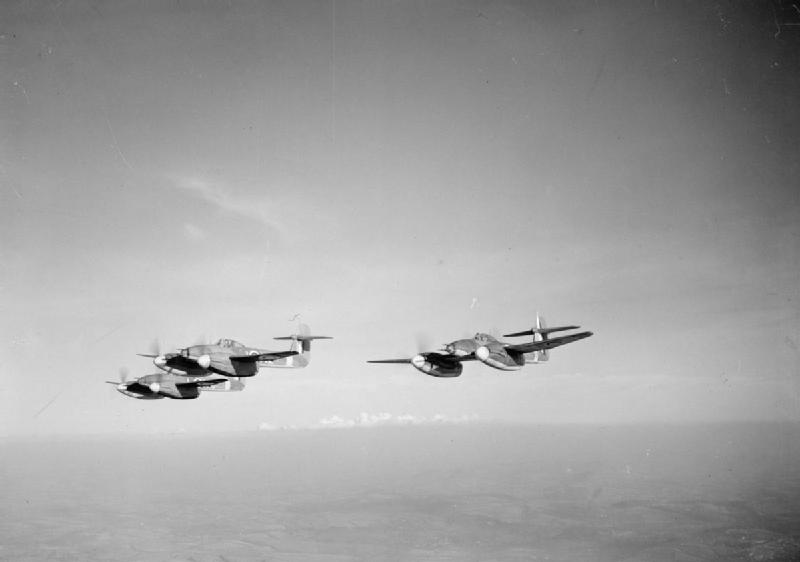
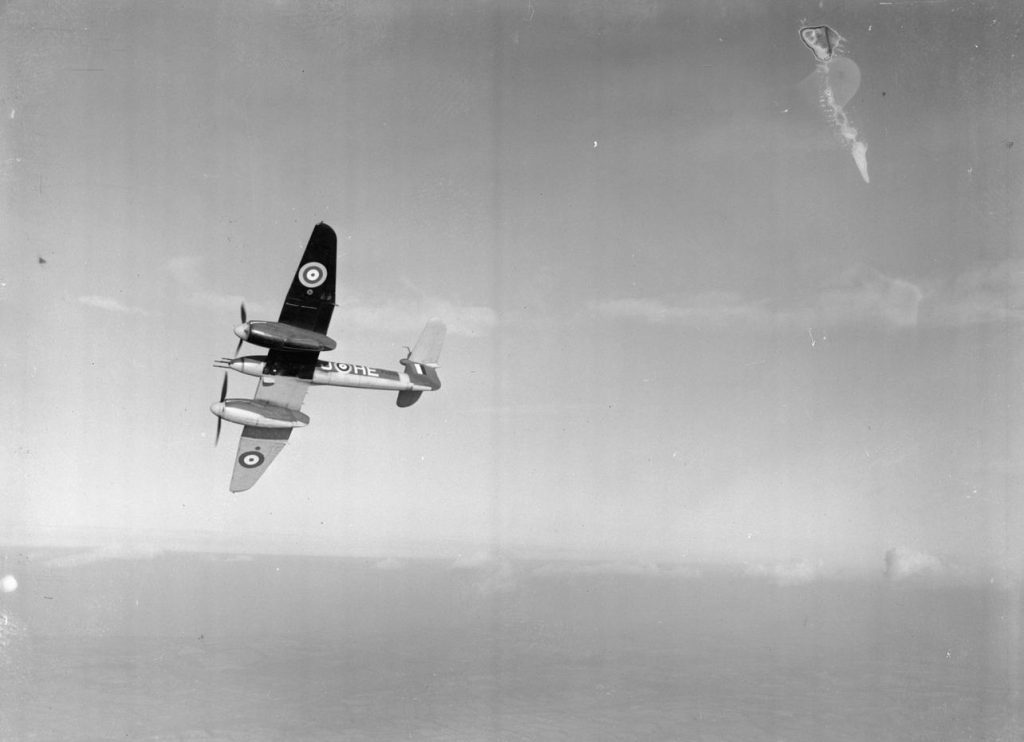
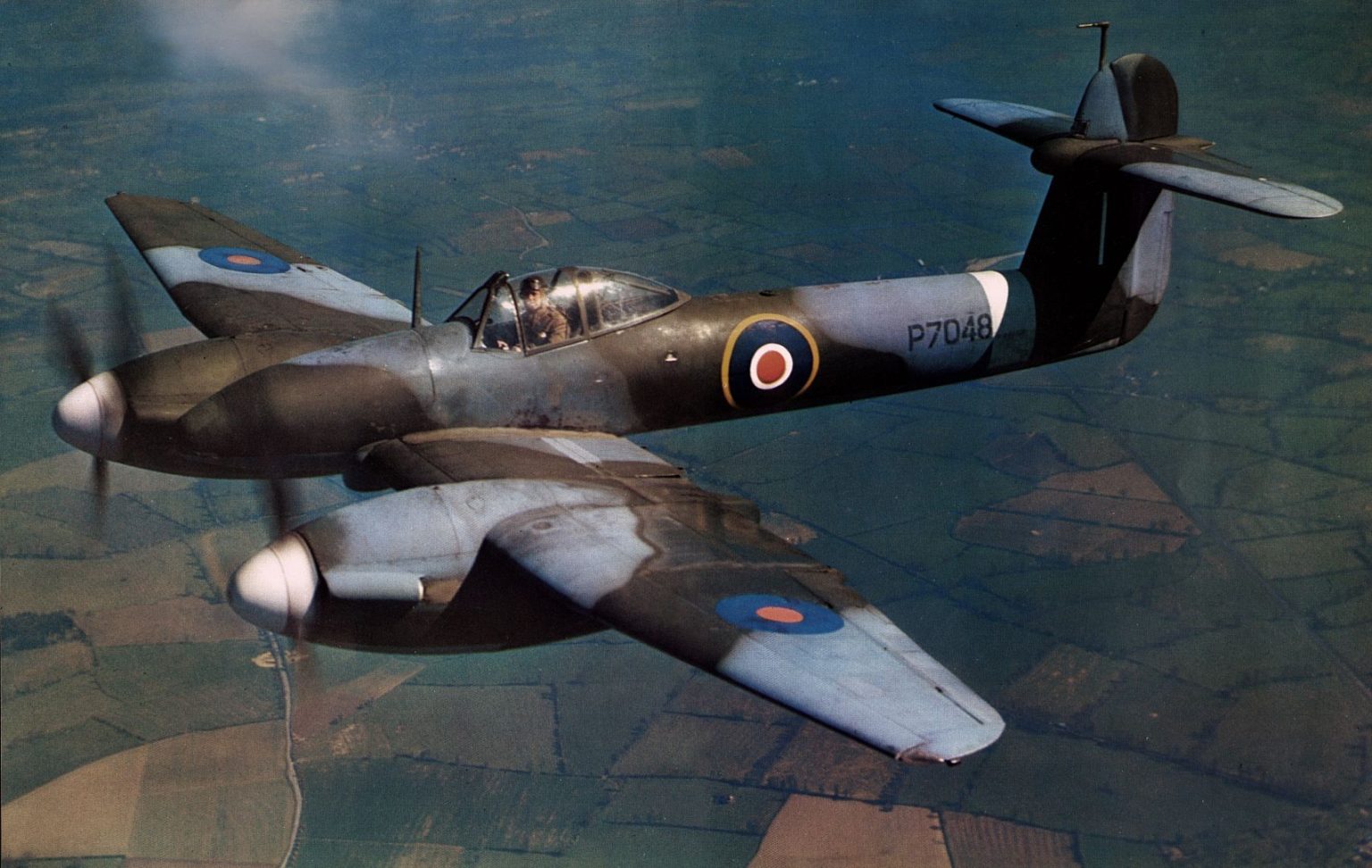
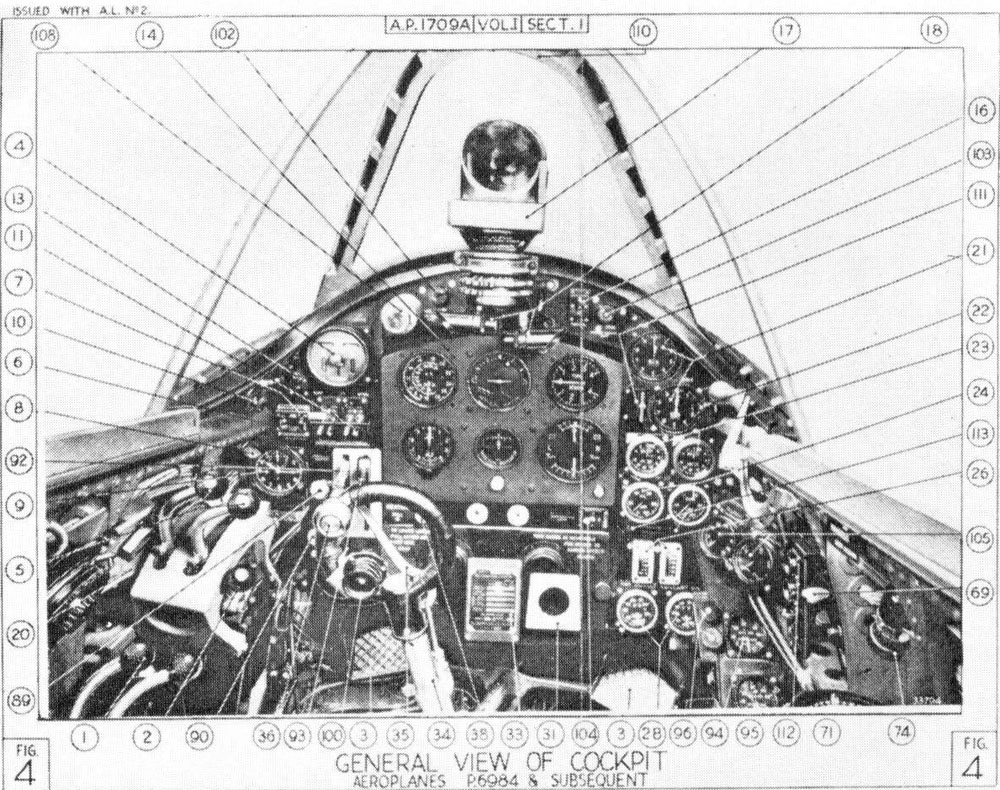
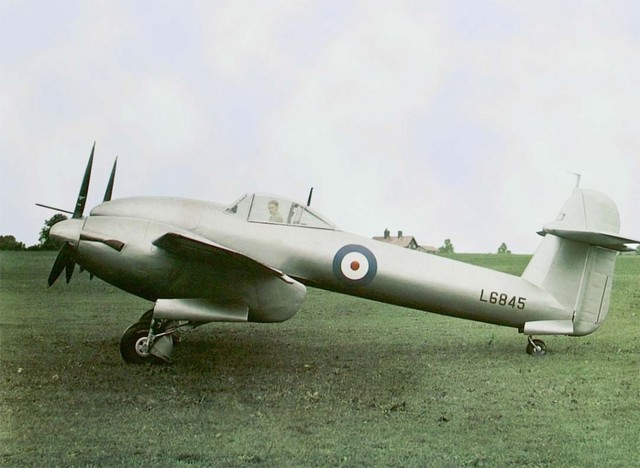
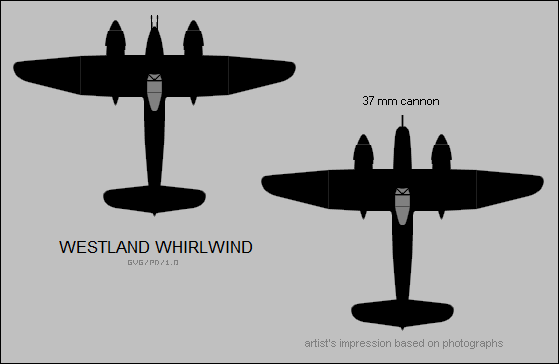
The Westland Whirlwind on film: genuine 1943 squadron footage
Rare wartime newsreel of an operational Whirlwind squadron, from the British Pathé archive — one of the few moving-image records of the type in RAF service, showing the aircraft being run up, taxied and flown as it was in 1943. Because no complete Whirlwind survives today, footage like this is as close as anyone will get to seeing the real aircraft in motion. British Pathé, “Whirlwind Fighter Squadron” (1943); approximately 209,000 views on YouTube.
Where the Westland Whirlwind served: origin, RAF combat and surviving relics
The Whirlwind never left British service — it was never exported, so the “Foreign Operators” layer is deliberately empty. Blue marks its British origin; the camouflage layer marks the theatres of RAF Whirlwind operations; grey marks where surviving relics remain.
The Westland Whirlwind’s record: small numbers, real impact
The Whirlwind’s combat career was limited by its tiny numbers, but its low-level fighter and fighter-bomber work over the Channel and occupied France was genuinely effective — and its concentrated cannon armament pointed the way that fighters would go. Judged on scale it barely registers: two squadrons, three years, roughly a hundred airframes. Judged on ideas, it is one of the most influential British fighters that almost nobody got to fly.
Its legacy runs in two directions. Technically, the Whirlwind helped prove the case for heavy cannon armament and for the fast, low-level twin — concepts the RAF would pursue with the Beaufighter, the Mosquito and, in the single-seat ground-attack role, the Typhoon that directly replaced it. Institutionally, it became a cautionary tale about the danger of building an aircraft around a single, un-prioritised engine: a lesson that shaped how Britain thought about engine-airframe planning for the rest of the war. Designers pointed to the Whirlwind for years afterwards as the example of what happens when the powerplant is allowed to become the weak link.
And then there is the human legacy. The pilots of 263 and 137 flew a demanding aircraft on some of the most dangerous sorties of the war — low, alone, deep over enemy territory — and made it work despite every handicap the supply chain and the Peregrine could throw at them. That the aircraft is remembered so fondly, decades after the last one was scrapped, is a tribute as much to them as to Petter’s design. The figures below are best read as commonly cited approximations; wartime records for so small a fleet are not always consistent.
See the Hawker Typhoon — the aircraft that took over the Whirlwind’s low-level role
Westland Whirlwind: frequently asked questions
Can I fly in a Westland Whirlwind?
Why was the Westland Whirlwind cancelled after so few were built?
How many Westland Whirlwinds were built, and which squadrons flew it?
What made the Westland Whirlwind’s firepower special?
What was a “Whirlibomber”?
Was the Westland Whirlwind actually a good fighter?
Are there any surviving Westland Whirlwinds?
Who designed the Westland Whirlwind?
You can’t fly the Westland Whirlwind
— but these, you can
No complete Whirlwind survives, so no one can put you in one. But MiGFlug can put you in the cockpit of a genuine military jet today. Pick your aircraft and fly.
 Fly the L-39 AlbatrosThe world’s most-flown jet trainer — aerobatics included
 Fly the F-104 Starfighter“The missile with a man in it”
 Fly the MiG-21The Cold War’s most-produced jet
 Fly the T-33 Shooting StarAmerica’s first jet trainer
 Fly the DH VampireA piece of early jet history
 Fly the S.211Agile Italian jet trainer
 Fly the MB-326The classic Aermacchi jet
 Fly the MiG-15The Soviet legend of the Korean War
Aircraft related to the Westland Whirlwind
Westland Whirlwind: sources & further reading
- Imperial War Museums — wartime photographs of Whirlwind squadrons (CH-series) and collections context.
- Royal Air Force Museum — RAF service history, squadrons and aircraft records.
- British Pathé — original 1943 newsreel footage of an operational Whirlwind squadron.
- Flight / FlightGlobal archive — contemporary technical reporting on the Whirlwind and the Peregrine engine.
- Key Aero / Aeroplane — aviation-history features on the type’s design and operations.
- Smithsonian National Air and Space Museum — wider context on the move to cannon-armed fighters.
- Rolls-Royce Heritage Trust — background on the Peregrine engine and Rolls-Royce production priorities.
- MiGFlug Afterburner — related features on WWII fighters and flying real military jets today.