
Yakovlev Yak-1
The root of the Yak fighter dynasty
The nimble wood-and-steel fighter that finally gave Soviet pilots a machine able to meet the Messerschmitt Bf 109 on something like equal terms — and the ancestor of the most-produced fighter family of the Second World War.
The Yak-1 and the fighter the Soviet Union badly needed
At the end of the 1930s the Soviet fighter arm was in trouble. Its front-line types — the Polikarpov I-15 biplane and I-16 monoplane — had been outclassed, a lesson driven home in Spain and later against Finland. In 1939 the Soviet leadership threw open a competition for a modern low-wing fighter, and among the designers who answered was Alexander Yakovlev, until then known mainly for light sports and training aircraft.
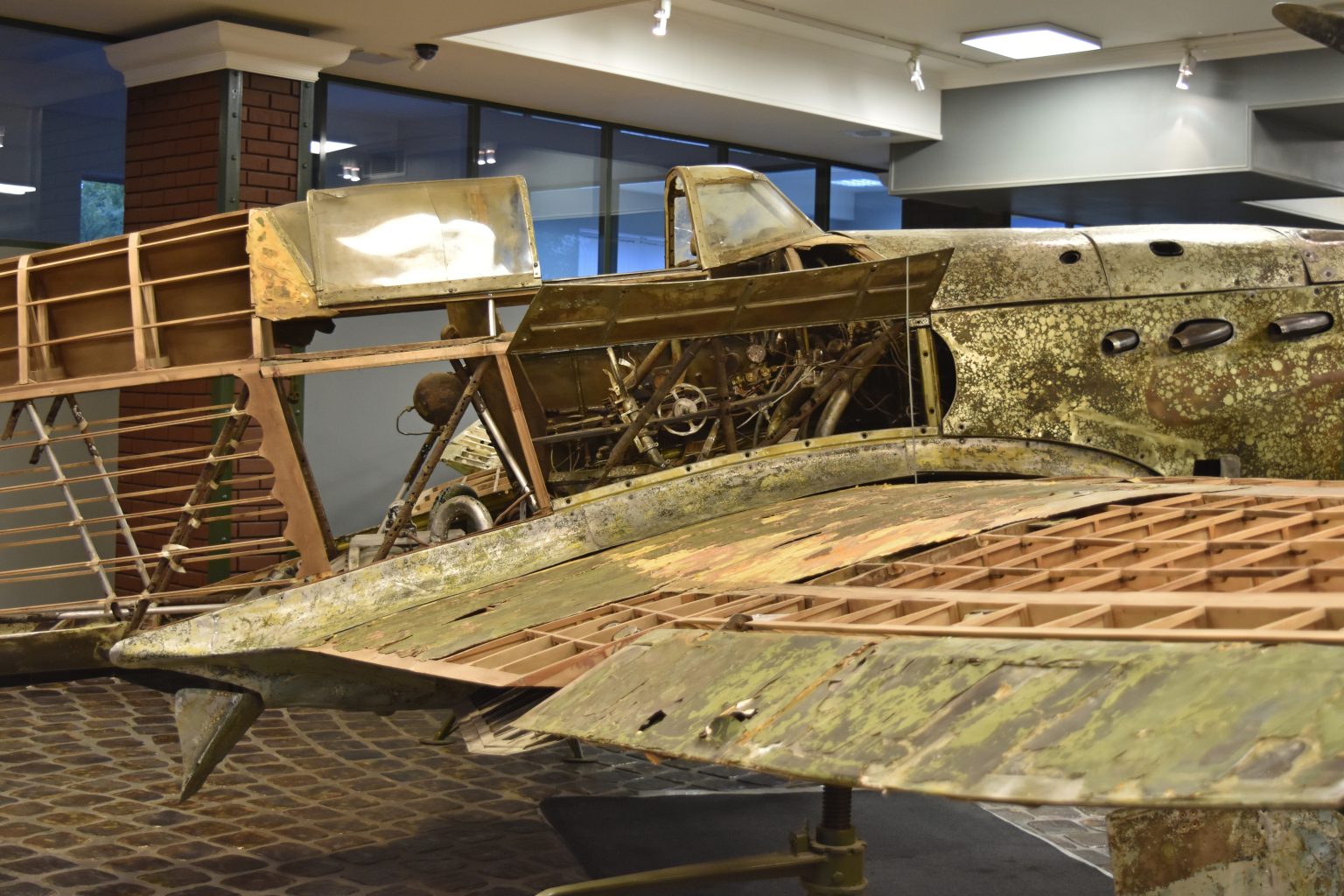
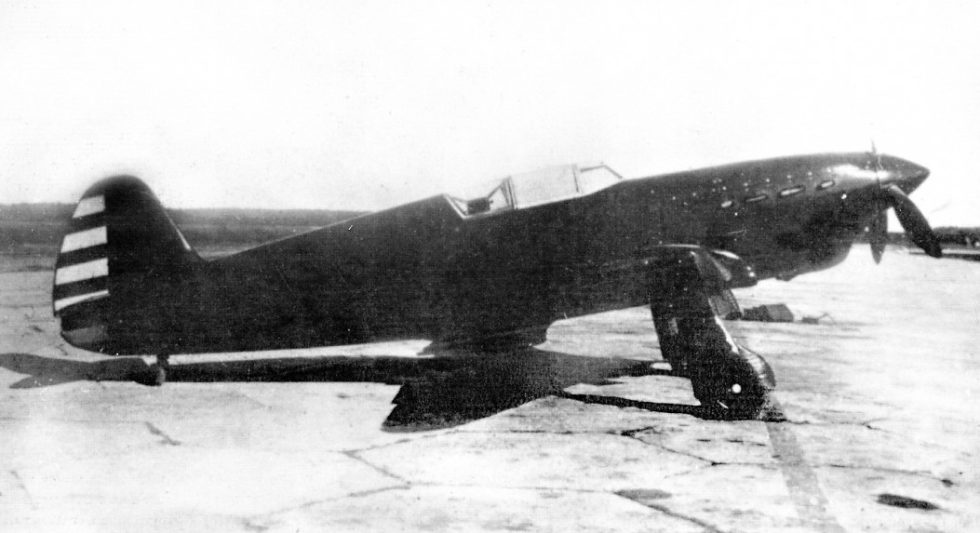
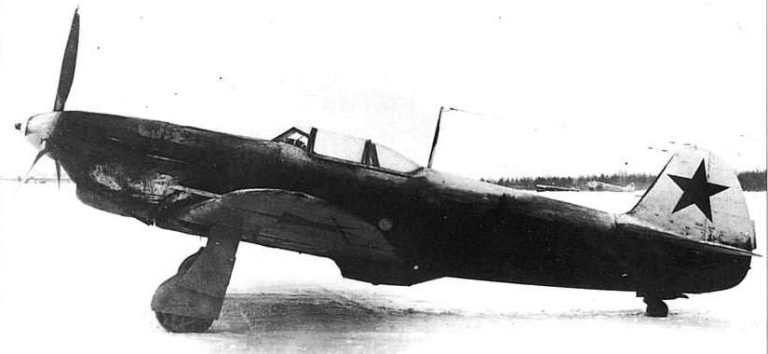
His answer, the prototype I-26, first flew in January 1940. Redesignated Yak-1, it was a clean, compact machine built around the Klimov M-105 liquid-cooled V12 — a licensed and developed descendant of the French Hispano-Suiza 12Y — with a cannon firing through the propeller hub. Crucially, it was made largely of wood and steel tube rather than scarce aluminium: a plywood-and-fabric wing over a welded steel-tube fuselage frame. That kept it cheap and let it be built in enormous numbers by a workforce and industry under extreme wartime strain.
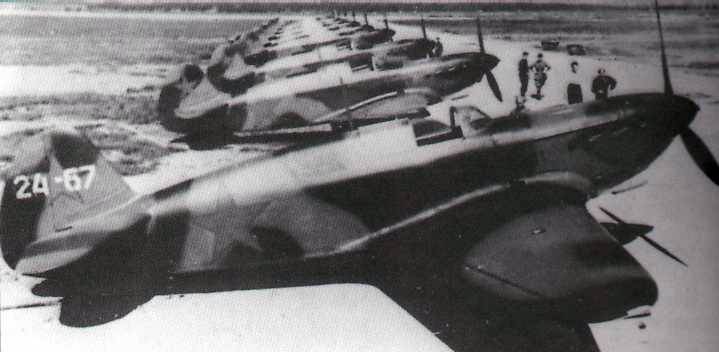
When Germany invaded in June 1941, the Yak-1 was still new and its units still learning it, and losses in those first months were catastrophic. But the aircraft itself was sound: light on the controls, pleasant to fly, agile at the low and medium altitudes where the Eastern Front air war was fought. Pilots liked it, and Yakovlev listened to them. A steady stream of refinements — a lighter airframe, a more powerful M-105PF, and finally the Yak-1B with a cut-down rear fuselage and an all-round-vision bubble canopy — turned a promising fighter into a genuinely competitive one.
The Yak-1 also became the seed of a family. Its structure and engine were the basis of the trainer-turned-fighter Yak-7, the long-range Yak-9, and the superb lightweight Yak-3 — together the most numerous fighter line of the war. And it carried some of the conflict’s most remarkable pilots: the 586th Fighter Aviation Regiment, one of the all-women units raised by Marina Raskova, flew Yak-1s, and it was in a Yak that Lydia Litvyak — later mythologised as the “White Lily of Stalingrad” — and her friend Katya Budanova made their names. The Free French volunteers of the Normandie-Niemen regiment began their Eastern Front war on Yak-1s too.
01The Yakovlev Yak-1’s origins: how a sport-plane designer built the USSR’s new fighter
Alexander Yakovlev’s bureau had no track record in fighters when it entered the 1939 competition, and the odds were against it beside established names such as Polikarpov, Lavochkin and Mikoyan. Yet the I-26 prototype flew first and, despite early engine and cooling troubles that cost the life of a test pilot, showed the cleanest handling of the contenders. The design’s deliberate simplicity — wood where metal was scarce, a proven engine, an airframe that ordinary factories could turn out fast — was exactly what a country about to be invaded needed. It is often noted that the Yak-1 was less about outright performance than about being good enough, in vast numbers, right now.
What makes the Yak-1 special
Built of wood and steel, not aluminium
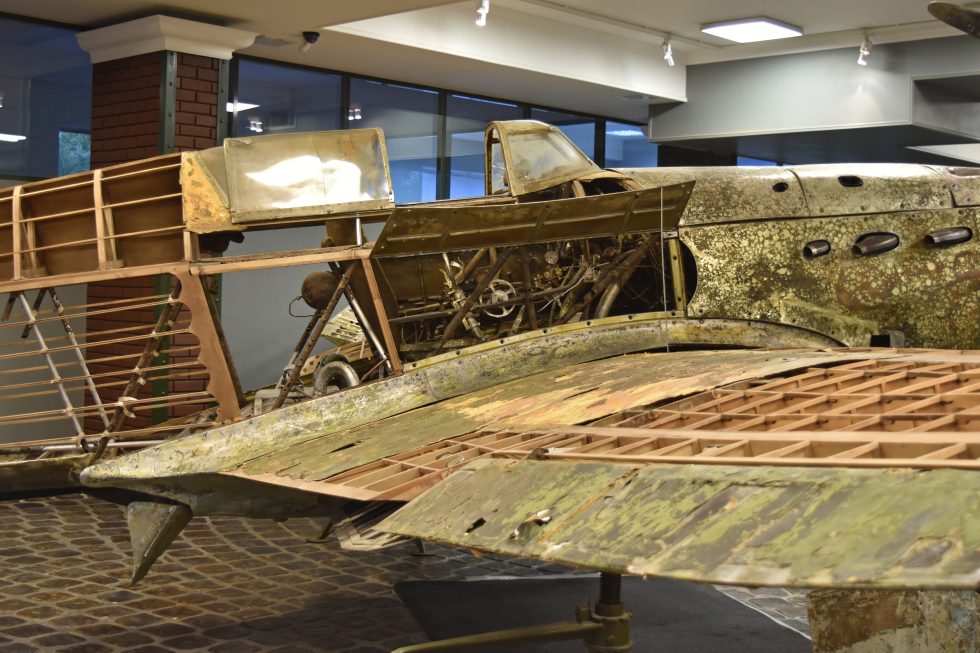
With light alloy in desperately short supply, the Yak-1 used a plywood-and-fabric wing over a welded steel-tube fuselage skinned in ply and fabric. It was heavier than an all-metal fighter in places and lighter in others, but above all it was cheap, quick to build and repairable by units in the field — qualities that mattered more than elegance when factories were being evacuated east ahead of the German advance.
The Klimov M-105 and its motor-cannon
Power came from the Klimov M-105, a liquid-cooled V12 developed from the licence-built Hispano-Suiza 12Y and giving roughly 1,050–1,180 hp in its later M-105PF form. Mounted in the vee of the engine and firing through the propeller hub was a 20 mm ShVAK cannon — a hard-hitting, accurately centred weapon — backed early on by a pair of 7.62 mm machine guns.
The Yak-1B: a fighter perfected
The definitive Yak-1B of 1942–43 cut down the rear fuselage and added a clear bubble canopy for all-round vision, swapped the rifle-calibre guns for a single heavy 12.7 mm UBS, and trimmed weight throughout. The result was lighter, faster-climbing and far better in a fight — the version most pilots remember fondly and the template for the Yaks that followed.
02The Yak-1’s wooden construction: why the Soviets built a fighter from plywood
Aluminium was a strategic bottleneck for the wartime USSR, needed for engines and bombers before fighters. Yakovlev’s answer was to lean on materials Soviet industry had in abundance: wood, plywood, steel tube and fabric, with light alloy reserved for the most critical fittings. Bakelite-bonded plywood (delta-wood) was used in some structural members. The trade-off was weight and, in damp conditions, durability — but it let unskilled and semi-skilled labour in dispersed factories produce fighters by the thousand. The Yak-1 and its descendants proved that, in the specific conditions of the Eastern Front, a “good enough” wooden fighter available in quantity beat a superior one available in a trickle.
03The Yak-1’s family tree: from one fighter to the war’s biggest dynasty
The Yak-1 was never a dead end — it was a starting point. Its layout and M-105 engine spawned the two-seat-turned-fighter Yak-7, the versatile long-range Yak-9 (the most-produced Soviet fighter of all), and the small, light, ferociously agile Yak-3 that many rate among the best dogfighters of the war at low altitude. Taken together, the Yak-1/-3/-7/-9 line ran to tens of thousands of aircraft and formed the backbone of Soviet fighter aviation from 1942 to 1945. Every one of them traces back to the compact wooden fighter that first flew in 1940.
Yakovlev Yak-1 full specifications
Baseline note: the figures below describe the Yak-1b as it left Factory No. 292 at Saratov from the autumn of 1942 — Klimov M-105PF, cut-down rear fuselage, all-round-vision canopy, and one 12.7 mm UBS in place of the pair of rifle-calibre ShKAS. Deltas for the 1941 aeroplane with the M-105P, and for the Messerschmitt Bf 109F-4 it was built to fight, are given in grey. Two warnings apply to every Yak-1 number ever printed. Published performance is prototype or acceptance performance: because of the manufacturing tolerances described in the propulsion column, an individual series aircraft could be 20 to 40 km/h slower than its own data sheet, and the Soviet test establishment said so at the time. And the production total, almost always rounded to 8,700, is 8,721 in the factory records, of which 8,550 came from Saratov alone.
Dimensions & weights
- Crew
- 1
- Length
- 8.48 m (27 ft 10 in)
- Wingspan
- 10.00 m (32 ft 10 in)
- Height
- 2.64 m (8 ft 8 in), tail down
- Wing area
- 17.15 m² (184.6 sq ft) — about a square metre more than the Bf 109F, and the root of the Yak’s turning advantage
- Aerofoil
- Clark YH, 14 per cent at the root, 10 per cent at the tip
- Structure
- Welded chrome-molybdenum steel-tube fuselage truss, duralumin panels forward and fabric aft; one-piece wooden wing with two pine box spars and a stressed plywood skin
- Empty weight
- 2,316 kg (5,106 lb); Russian tables more often give 2,394 kg (5,278 lb) for the same aircraft, and the gap is real — no two Yak-1s weighed quite the same
- Normal take-off weight
- 2,883 kg (6,356 lb)
- 1941 Yak-1, for comparison
- 2,858 kg (6,301 lb) loaded; the ski-equipped winter aeroplane went to 2,985 kg (6,581 lb) and flew like it
- Wing loading
- 168 kg/m² (34.4 lb/sq ft) at normal take-off weight; the Bf 109F-4 carried 180 kg/m² (36.9 lb/sq ft)
- Power loading
- 3.07 kg/kW (5.04 lb/hp) at normal take-off weight
- Internal fuel
- ~408 litres (~90 imp gal, ~108 US gal, about 305 kg) in four wing tanks — no external tank provision existed, and that single omission defined the type’s reach
Performance
- Maximum speed
- 592 km/h (368 mph) at 4,900 m (16,100 ft); Russian sources place the peak lower, between 3,650 and 4,300 m (12,000 and 14,100 ft), because the M-105PF was deliberately re-rated for low altitude
- Maximum speed, sea level
- 531 km/h (330 mph) — the figure that actually mattered, because the Eastern Front air war was fought below 4,000 m (13,000 ft)
- 1941 Yak-1 (M-105P), for comparison
- 577 km/h (359 mph) at 4,950 m (16,240 ft) and 480 km/h (298 mph) at sea level
- Time to 5,000 m
- 5.4 min (16,400 ft); Russian tables give 6.2 min for the M-105PF aeroplane and 9.2 min for the 1941 M-105P machine, the spread being partly engine rating and partly the equipment that kept being bolted on
- Rate of climb
- 15.4 m/s (3,030 ft/min) averaged to 5,000 m; the Bf 109F-4 climbed better at every height, and no amount of Soviet lightening ever closed that gap
- Service ceiling
- 10,050 m (32,970 ft); sources spread from 10,000 to 10,500 m (32,800 to 34,400 ft), and the aeroplane was effectively spent above 5,000 m (16,400 ft)
- Range, internal fuel
- 700 km (435 miles); some tables say 850 km (530 miles) at economical cruise, which no combat sortie ever flew
- Endurance
- About 1 hr 40 min — short, and the reason Yak regiments lived on airfields a few minutes from the line
- Time for a full 360° turn
- 19 s at 1,000 m (3,300 ft); the lightened Yak-1M managed 17 s, and the Bf 109F-4 needed 20 to 21 s — a genuine Soviet advantage, and a small one
- Take-off run
- 340 m (1,115 ft)
- Landing run
- 560 m (1,840 ft) — long for a light fighter, and the light tail made nose-overs and propeller strikes common on soft strips
- For comparison: Bf 109F-4
- 659 km/h (409 mph) at 6,200 m (20,300 ft) — some 67 km/h (42 mph) faster at height, better in the climb and the zoom, and with a far better engine above 5,000 m
Propulsion & systems
- Engine
- 1 × Klimov M-105PF (redesignated VK-105PF in 1944), 12-cylinder 60° vee, liquid-cooled, a licence-descended and much-modified Hispano-Suiza 12Y
- Take-off power
- 940 kW (1,260 hp)
- Rated power
- 902 kW (1,210 hp) at 700 m (2,300 ft) in first supercharger speed; 880 kW (1,180 hp) at 2,700 m (8,900 ft) in second
- Displacement
- 35.1 litres (2,142 cu in); bore 148 mm, stroke 170 mm, compression 7.0:1, 94 to 95 octane petrol
- Engine dry weight
- 575 kg (1,268 lb) — about a fifth of the whole loaded aeroplane
- Induction
- Two-speed single-stage centrifugal supercharger, drive ratios 7.78:1 and 11.0:1, carburettor fed — and therefore unable to tolerate negative g, which cost pilots their engines at the worst possible moment until they learned to roll rather than push
- Reduction gear and cannon drive
- 0.666:1 reduction with a hollow output shaft carrying the ShVAK barrel through the propeller boss — the whole reason the M-105P existed and the feature that shaped every Yakovlev fighter that followed
- Propeller
- VISH-105SV three-blade constant-speed metal airscrew, 3.00 m (9 ft 10 in)
- Cooling
- Ventral water radiator in a duct under the wing centre section, oil cooler in the chin intake; the M-105PF ran hot all its life and oil overheating was never wholly cured — the first prototype made fifteen forced landings from it during testing alone
- Manufacturing tolerances
- Roughly 7,000 blueprint changes went through in 1941 and another 5,000 in 1942; tolerances were so loose that final assembly meant mating whatever parts fitted, undercarriage legs could differ in length between the two sides of one aircraft, and components were often not interchangeable between airframes
- Protection
- 8 to 9 mm armoured seat back from the first production aircraft; the Yak-1b added a 64 mm laminated armour-glass windscreen and a rear armour panel, plus an inert-gas system bleeding cooled exhaust into the fuel tanks — a real advance over the leaking spot-welded tanks of 1941
- Radio
- None at all on the first 1,000 aircraft; RSI-3 and later RSI-4 sets became common by spring 1942 and obligatory that August, though the sets were noisy, short-ranged and frequently ripped out again by pilots who preferred the weight saving
- Cockpit
- Yak-1b introduced a lowered rear decking with a blown sliding hood, a Bf 109-derived control column with brake lever and pneumatic-electric gun triggers, and a retractable tailwheel; the early sliding hood jammed often enough that pilots removed it and flew open, losing about 20 km/h
04The Yak-1’s operating costs: why no reliable price exists
The Yak-1 was a product of the Soviet wartime command economy: built in state factories, issued to state air regiments, and never sold on an open market. As a result no reliable flyaway unit price, and no credible cost-per-flight-hour figure, exists in the public record — the concepts barely applied to Soviet military production of the period, where output was measured in airframes and engines rather than dollars. What is well documented is that the design was deliberately cheap: wood and steel in place of scarce alloys, and a structure simple enough for dispersed, semi-skilled factories to build at scale. Any specific monetary cost you see attached to a Yak-1 should be treated as an estimate or conversion, not a sourced fact.
Armament & payload
The Yak-1 fired one cannon down the centreline and asked the pilot to get close
Everything the Yak-1 shot with came out along the thrust axis or immediately beside it. The 20 mm ShVAK sat in the vee of the M-105P and fired through a hollow reduction-gear shaft and the propeller boss; the machine guns were synchronised over the engine. There was no convergence to set, no wing guns to harmonise and no dispersion pattern to learn, which mattered enormously in an air force that in 1942 was sending pilots to regiments with fewer than twenty hours on type. The price was volume of fire: one cannon and one heavy machine gun is a thin battery for 1943, well under the Bf 109F-4’s MG 151/20 and pair of MG 17s in weight of shell per second and nowhere near a Focke-Wulf Fw 190A. Soviet doctrine answered by closing to a hundred metres and firing short. Ammunition figures are genuinely unsettled: most Western accounts give 120 rounds for the ShVAK on early aircraft and 140 on the Yak-1b with 220 for the UBS, while some Russian tables print 220 for the cannon and 1,500 for the ShKAS pair, which are probably totals expressed differently. The lower set is used here.
Gun
- 1 × 20 mm ShVAK motornaya pushka in the engine vee, firing through the hollow propeller shaft; about 120 rounds on early Yak-1s and 140 on the Yak-1b
- 2 × 7.62 mm ShKAS synchronised above the engine, 750 rounds per gun — standard until mid-1942, and by then close to useless against armoured German aircraft
- 1 × 12.7 mm Berezin UBS synchronised on the port side of the upper cowling, 220 rounds — the Yak-1b standard from the autumn of 1942, and worth more than the two guns it replaced
- ShVAK ballistics: the 20 × 99R round, roughly 800 rounds per minute, 750 to 790 m/s at the muzzle, a projectile of about 96 g — giving something like nine seconds of cannon fire in total
- Yak-1b changed the firing gear from mechanical cables to a pneumatic and electric system with the trigger on a Bf 109-pattern stick grip, and fitted a proper reflector sight; both were straightforward improvements that should have arrived in 1941
Air-to-air
- No guided air-to-air weapon of any kind existed in Soviet service; guns were the whole story, as they were for every combatant’s single-seat fighters in 1941 to 1945
- RS-82 rockets were occasionally salvoed into bomber formations early in the war, a tactic borrowed from the Polikarpov I-16 and abandoned as soon as anyone measured the results
- Against a Bf 109F the Yak-1b fought by turning and by staying low: Nikolai Golodnikov’s judgement, that an experienced pilot in a Yak-1b could meet the F-4 and G-2 on equal terms, is honest precisely because of the qualifier
- Mikhail Baranov scored all 24 of his victories on Yak-1s, including four Bf 109s and a Ju 87 in one day on 6 August 1942 — proof that the airframe was sufficient in the right hands
- The Yak-1b’s greatest air-to-air improvement was not a weapon at all but the cut-down rear fuselage and blown hood, which for the first time let a Soviet fighter pilot see the aircraft that was about to kill him
Air-to-surface guided
- None. The Soviet Union fielded no guided air-to-surface weapon during the Second World War, and nothing of the sort was ever proposed for the Yak-1
- The card is kept because the absence is structural rather than accidental: the Yak-1 was a short-ranged front-line air-superiority fighter and the VVS wanted it doing exactly one job
- That job was escorting Ilyushin Il-2s and covering the ground troops below 4,000 m (13,000 ft), the band in which the M-105PF was rated and the type was competitive
- Everything the Yak-1 could do against the ground it did with unguided rockets, two small bombs, or its guns — and from the summer of 1942 it increasingly did none of it
Bombs
- 2 × FAB-100 bombs of 100 kg (220 lb) on underwing racks, or the lighter FAB-50 of 50 kg (110 lb)
- Racks were fitted to early production only and were among the first things deleted in the 1942 weight-reduction programme, along with the rocket rails
- The arithmetic was brutal: 200 kg of bombs on a 2,880 kg fighter with 940 kW cost climb rate a Yak-1 could not spare against a Bf 109F that already out-climbed it
- By 1943 a Yak-1b in a front-line regiment carried nothing under its wings at all, and that was the correct answer
Rockets
- 6 × RS-82 unguided rockets on underwing rails, fitted to roughly the first thousand aircraft
- RS-82: 82 mm calibre, about 6.8 kg (15 lb) all up with some 360 g of explosive, leaving the rail at roughly 350 m/s
- Accuracy was poor enough that the weapon was a formation or area weapon rather than a point one; against a moving vehicle it was close to useless
- The rails alone cost something like 15 to 20 km/h (9 to 12 mph) in level speed, and they were stripped from mid-1942 in the drive to make the Yak-1 lighter and faster
- Their removal is the clearest single illustration of Yakovlev’s design philosophy: subtract everything that is not needed to win the turning fight at low level
Pods & other stores
- No drop tanks. The Yak-1 had no provision for external fuel whatsoever, which capped combat radius at a fraction of the Bf 109F’s and is why the follow-on Yak-9D answered with extra internal tankage instead
- Radio: RSI-3 Orel and later RSI-4 Malyutka sets; the first 1,000 aircraft had none, many later machines had receivers only, and unreliable sets were often removed by pilots who valued the weight more than the voice
- Ski undercarriage for the winters of 1941 and 1942, worth roughly 30 km/h (19 mph) of speed and 127 kg (280 lb) of weight against the wheeled aeroplane
- Gun cameras were rare, which is one honest reason Soviet victory claims from 1942 to 1943 are so difficult to audit today
- No pressurisation, no oxygen refinement worth the name and no high-altitude equipment — the Yak-1 was designed for a war fought within sight of the ground
Three typical loadouts
- Il-2 escort, Kuban, spring 1943
- Clean Yak-1b: ShVAK with 140 rounds, UBS with 220, nothing under the wings, RSI-4 set fitted and working. Flown as a weaving pair a few hundred metres above and behind the Shturmovik formation — the single most common Yak-1 sortie of the war, and the one for which the type was optimised.
- Free hunt, 73rd Guards Fighter Aviation Regiment, summer 1943
- Clean Yak-1b, full ammunition, a pair operating independently between 1,000 and 3,000 m (3,300 and 9,800 ft) hunting German aircraft and the occasional observation balloon. This is the loadout Lydia Litvyak and Yekaterina Budanova flew, and the sortie on which Litvyak did not return on 1 August 1943.
- Front-line strike, winter 1941 to 1942
- Early Yak-1 on skis with 6 × RS-82 rockets or 2 × FAB-100 bombs, ShVAK with 120 rounds and two ShKAS with 750 rounds each, usually no radio. Slow, badly finished, flown by pilots with a few dozen hours — and still the best fighter the Soviet Union had available in quantity that winter.
Sourcing caveat: ammunition loads, rocket and bomb fits varied by production series and were frequently altered in the field, and the 1942 lightening programme was applied unevenly across factories and even across batches. Where Western reference works and Russian factory tables disagree, both readings have been given rather than averaged.
Variants
The Yak-1 has no clean variant list, because the aeroplane changed on the line every few weeks
The Yak-1 won its place in 1940 against two rivals that on paper each beat it at something. The Mikoyan and Gurevich I-200 was far faster at height, reaching 640 km/h (400 mph) at 7,800 m (25,600 ft) as the MiG-3, but it was a poor aeroplane below 5,000 m, heavy on the controls, vicious at the stall and armed with one 12.7 mm gun and two rifle-calibre ones. The Lavochkin, Gorbunov and Gudkov I-301 was the fastest M-105P aircraft flown, touching 604 km/h (375 mph) in prototype form, but as the LaGG-3 it gained weight relentlessly and lost as much as 100 km/h in service, earning its crews’ nickname of the varnished guaranteed coffin. Yakovlev’s I-26 beat neither on a single figure. It won because it was the lightest, the most pleasant to fly, the easiest to build, the most forgiving of a badly trained pilot, and because it could be repaired by a regiment with a welding torch and a sheet of plywood. That is the correct way to choose a wartime fighter, and the Soviet Air Force chose correctly.
It should be said plainly that the aircraft delivered in 1941 and 1942 were often disgraceful. Production had been ordered in February 1940, before state testing was complete; roughly 7,000 blueprint changes went through in 1941 and 5,000 more in 1942 while the line kept moving. Tolerances were so wide that no two airframes were the same, parts were not interchangeable, and assemblers mated whatever components would fit. Fuel tanks were spot-welded and leaked under vibration. Plywood skinning warped and rotted when aircraft were parked outdoors, as they always were. The first thousand fighters had no radio at all, so a Soviet regiment could not be directed onto a target while a Luftwaffe Gruppe could. Add pilots with twenty hours on type and the loss figures explain themselves: 3,336 Yak-1s were written off on operations, 1,301 of them in 1942 alone.
What rescued the design was not a new mark but a sustained campaign of subtraction and tidying that produced the Yak-1b from the autumn of 1942 — a designation, it is worth noting, that the Soviet Air Force never used officially, and which appears in unit paperwork and in later Western writing rather than in factory records. The rear fuselage was cut down and a blown sliding hood fitted, giving a Soviet fighter pilot proper rearward vision for the first time. The ShKAS pair became a single UBS. Armour glass, a retractable tailwheel, sealed joints, faired brackets, a better sight and pneumatic gun triggers all arrived together, and the M-105PF added low-altitude power. Speed rose by about 23 km/h at unchanged climb, which is a modest number for what was in truth a transformation in how the aeroplane could be fought. In troop trials from December 1942 to January 1943, 58 Yak-1bs flew 6,174 sorties for 25 claimed kills against six of their own lost.
- I-26-1, -2 and -3 (1940, 3 prototypes)
- First flight 13 January 1940. The first machine was destroyed on 27 April 1940 with Yulian Piontkovskiy killed; the third passed state acceptance on 9 December 1940, eleven months after production had already been ordered.
- Yak-1 with M-105P (1940 to 1941)
- Initial production: ShVAK and two ShKAS, provision for six RS-82 rockets or two FAB-100 bombs, no radio, mechanical gun firing. 425 existed on 22 June 1941 and fewer than a hundred were serviceable in the western districts.
- Yak-1 with M-105PA (1941 to 1942)
- Improved engine, gradual introduction of radio, and the beginning of the weight-reduction programme — rocket rails, bomb racks and any equipment not needed for air fighting deleted batch by batch.
- Yak-1 with M-105PF, lightened (1942)
- The low-altitude engine rating that made the type competitive again, combined with a stripped airframe. Klimov objected that the higher boost would shorten engine life; Yakovlev pushed it through anyway, and in a war where a fighter’s expected life was measured in weeks he was right.
- Yak-1b (August 1942 to July 1944, 4,188 built)
- Cut-down rear decking, all-round-vision hood, single 12.7 mm UBS, armour glass, retractable tailwheel, sealed and faired airframe, Bf 109-pattern stick. Roughly half of all Yak-1 production and the version that fought the Kuban and Kursk.
- Yak-1M (1943, 2 prototypes)
- Smaller wing of 14.85 m², relocated oil cooler intakes into the wing roots, further weight cut, VK-105PF2 engine; a 17-second turn at 1,000 m. Put into production as the Yak-3, of which 4,848 were built to 1946.
- UTI-26 (1940 to 1941)
- The tandem two-seat trainer derived from the third and fourth I-26 airframes. Produced as the Yak-7, then converted back into a single-seat fighter as the Yak-7B with two UBS guns; 6,399 built, and the structural bridge to the Yak-9.
- I-28 and I-30 (1940 to 1941, 1 and 2 built)
- Two dead ends worth naming. The I-28 was a high-altitude interceptor with M-105PD, metal fuselage and automatic slats; the I-30, confusingly the first aircraft called Yak-3, had an all-metal wing, slats and three ShVAK cannon. Neither was built, chiefly because duralumin did not exist to spare in 1941.
- Yak-1 na lyzhakh (winters of 1941 and 1942)
- Ski undercarriage conversion, non-retracting, costing roughly 30 km/h and 127 kg. Ugly, necessary, and abandoned once the VVS could rely on rolled snow strips.
- Allied and export service (1943 to about 1950)
- No Yak-1 was ever licence-built abroad. Free French Groupe de Chasse Normandie flew Yak-1s from January to December 1943 after training on Yak-7s at Ivanovo; the Polish 1st Fighter Regiment Warszawa formed on the type in 1943; and Yugoslavia operated Yak-1bs alongside Yak-3s and Yak-9s from late 1944, roughly a hundred Yak fighters of all marks passing through its air force to about 1950.
Two closing points, both about how the Yak-1 is remembered rather than how it flew. First, the units. Groupe de Chasse Normandie, later the Normandie-Niémen regiment, flew about 5,240 sorties from March 1943 to May 1945 and claimed 273 victories for 42 pilots killed and four Heroes of the Soviet Union; whether the French chose the Yak or were simply issued it is disputed between accounts, and Soviet sources are clear that equipment was allocated, not selected. The 586th Fighter Aviation Regiment, one of Marina Raskova’s three women’s regiments, took its first Yak-1s in 1942 and flew air defence over Saratov, Stalingrad, Voronezh and westward into Hungary; its own record of 2,073 sorties, 125 air combats and 19 aircraft shot down is modest against inflated retellings, and is the figure that should be quoted. Lydia Litvyak flew Yak-1s with the 586th, then the 437th, the 9th Guards and finally the 296th, which became the 73rd Guards; she was lost on her fourth sortie of 1 August 1943 at the age of 21. Her tally is variously given from five to twelve individual victories plus shared claims and a balloon, and the conservative reading of five solo and three shared is the one the archives support. The Hero of the Soviet Union followed only on 5 May 1990, delayed by nearly half a century by an official suspicion that she had been captured. Second, the survivors. The Yak-1 is very nearly extinct: three original airframes are known, and none flies. Serial 08110, the aircraft bought with his own savings by the Saratov farmer Ferapont Golovaty and flown by Boris Yeryomin, is complete and preserved at Saratov. Serial 12222, recovered from Lake Krivoye in the Murmansk region on 9 June 2012 after a crash on 28 August 1943, is displayed as a forced-landing diorama at the Vadim Zadorozhny Museum of Technology outside Moscow. Serial 1342, salvaged from the frozen Polonets Lake near Demyansk in 1990, has been under long restoration in Britain with the Historic Aircraft Collection and remains unflown. Be sceptical of anything else calling itself a Yak. The airworthy Yak-3s and Yak-9s at Western airshows are overwhelmingly new-build aircraft produced at Orenburg between 1991 and 2002 from original dies — about 21 to 23 airframes — and are powered by Allison V-1710 or Pratt & Whitney engines, not Klimov V-12s; the later Romanian Yak-3U/R-2000 has a radial. They are honest reproductions, not war veterans, and no genuine wartime Yak-1 has flown since 1945.
From 1939 competition to founding a dynasty
The fighter competition
The Soviet leadership calls for a new generation of monoplane fighters. Yakovlev’s bureau, known for sport and training aircraft, enters with the I-26.
First flight
The I-26 prototype flies in January 1940. Despite early engine and cooling problems — one costing a test pilot’s life — it is ordered into production as the Yak-1.
Barbarossa
The Yak-1 meets the German invasion still new in service. Early losses are heavy, but the type proves sound and well-liked by its pilots.
Women’s regiments & Stalingrad
The all-women 586th Fighter Aviation Regiment takes the Yak-1 into combat. Over Stalingrad, Lydia Litvyak and Katya Budanova begin scoring.
The Yak-1B
A cut-down rear fuselage, bubble canopy and heavier single gun produce the definitive Yak-1B — lighter, faster-climbing and much improved in a fight.
Normandie-Niemen & Litvyak
The Free French Normandie-Niemen regiment begins its Eastern Front war on Yak-1s. On 1 August 1943 Litvyak fails to return from her last sortie.
Production ends
Yak-1 output winds down as the improved Yak-3 and Yak-9 take over the lines — both direct descendants of the 1940 design.
The root of the family
The Yak-1/-3/-7/-9 line becomes the most numerous fighter family of the war, and the ancestor of Yakovlev’s postwar jets.
From the cockpit: twelve Yak-1 stories
The sport-plane bureau that built a fighter
Yakovlev was known for trainers and racers — then it won a fighter competition.
Read the full story
A fighter you could build in a shed
Wood, steel tube and fabric — the Yak-1 was designed around scarcity.
Read the full story
Meeting the Messerschmitt
The Yak-1 was the first Soviet fighter that could trade blows with the Bf 109.
Read the full story
The 586th takes the Yak to war
One of Marina Raskova’s all-women units flew the Yak-1 in combat.
Read the full story
The White Lily of Stalingrad
Litvyak flew a Yak marked with a flower and became a legend — and a myth.
Read the full story
Litvyak’s wingmate
Budanova flew Yaks alongside Litvyak and was among the war’s top women aces.
Read the full story
French pilots on Soviet Yaks
Free French volunteers chose the Yak — and began on the Yak-1.
Read the full story
Cutting down the spine
A lower rear fuselage and a bubble canopy transformed the fighter.
Read the full story
A gun in the vee of the engine
The Yak-1’s 20 mm ShVAK fired straight through the propeller hub.
Read the full story
Raised from a lake bed
Yak-1 wrecks are still being lifted from the lakes and bogs where they fell.
Read the full story
Cheap, and everywhere
About 8,700 Yak-1s were built — and that was only the beginning.
Read the full story
The fighter that founded a dynasty
From a wooden 1940 fighter came a line that reached into the jet age.
Read the full story
The Yak-1 in pictures


The Yak-1 in motion
Yarnhub: The Soviet Woman Who Fought Germans With a Yak-1 — the story of Lydia Litvyak and her Yak, from a leading animated military-history channel (over 1.5 million views).
Where the Yak-1 flew
What the Yak-1 achieved
The Yak-1 was a workhorse, not a record-setter — its achievement was to be available, in quantity, at the moment the Soviet air force was fighting for survival. It equipped some of the war’s most storied units and carried its most famous women pilots, and it seeded the fighter family that helped win air superiority in the east.
Compare the combat record of every military aircraft. Individual pilot tallies from this era are frequently contested; figures here are given as commonly cited.
Everything people ask about the Yak-1
Can I fly in a Yakovlev Yak-1?
What was the Yak-1?
Was the Yak-1 really made of wood?
How good was the Yak-1 against the Bf 109?
Who was Lydia Litvyak?
How many Yak-1s were built?
What is the difference between the Yak-1 and the Yak-1B?
You can’t fly the Yak-1.
These, you can.
Some legends only live in museums — others are fuelled and waiting. MiGFlug has put civilians in real military jet cockpits since 2004.
 Fly the L-39 AlbatrosThe world’s most-flown jet trainer — aerobatics included
 Fly the F-104 Starfighter“The missile with a man in it”
 Fly the MiG-21The Cold War’s most-produced jet
 Fly the T-33 Shooting StarAmerica’s first jet trainer
 Fly the DH VampireA piece of early jet history
 Fly the S.211Agile Italian jet trainer
 Fly the MB-326The classic Aermacchi jet
 Fly the MiG-15The Soviet legend of the Korean War
Continue the tour
Every fact, checked
- Smithsonian National Air and Space MuseumReference for Soviet WWII fighter design and the Yakovlev lineage.
- Imperial War MuseumsEastern Front air war context and Soviet aircraft history.
- Royal Air Force MuseumBackground on the Yakovlev fighter family and its combat use.
- The National WWII MuseumSoviet women pilots, the 586th Regiment and Lydia Litvyak.
- The Aviation Geek ClubYak-1 development, the Yak-1B and the wider Yak family.
- Key AeroTechnical and historical features on Soviet wartime fighters.
- HistoryNet / Aviation HistoryNormandie-Niemen and Eastern Front fighter operations.
- Wikimedia CommonsPublic-domain and Creative Commons photographs used in this gallery.