
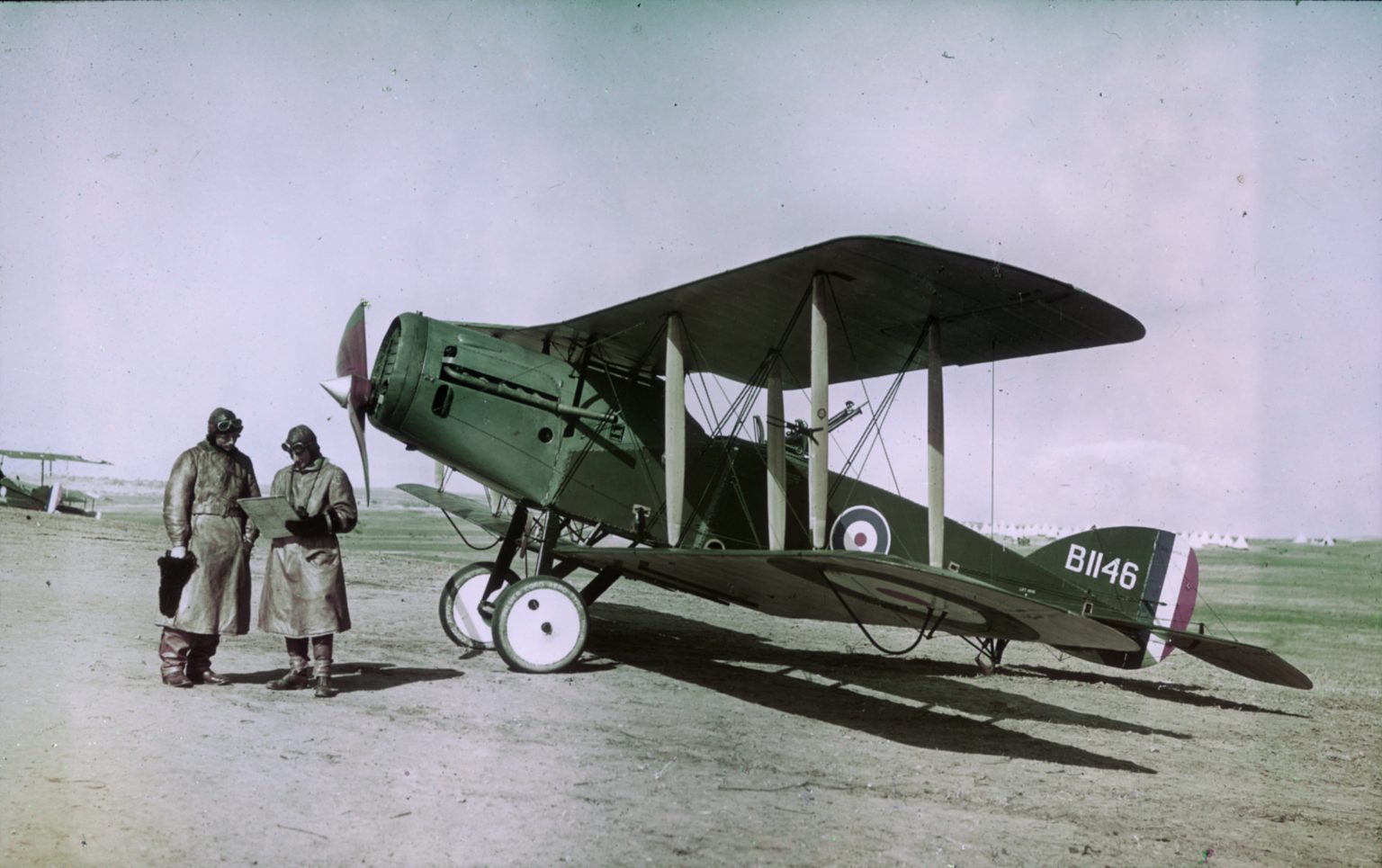
Bristol F.2 Fighter
“Brisfit” · “Biff”
The two-seater that Germany learned to fear — once its crews stopped flying it like one.
The Bristol F.2 Fighter: the two-seater that had to be flown like a single-seat scout
By the middle of the First World War the two-seat aeroplane had a reputation problem. Machines like the B.E.2 were steady camera platforms and gentle to fly, but in a dogfight they were slow, poorly armed and desperately vulnerable — the German scouts of 1916 treated them, in the bitter phrase of the day, as “cold meat”. When the Bristol Aeroplane Company’s young chief designer Frank Barnwell set out to design a replacement, he did something unusual: he built a two-seater with the performance and the punch of a fighter.
The result, the Bristol F.2 Fighter, first flew in September 1916. Its heart was the Rolls-Royce Falcon, a compact and beautifully made V12 that in its definitive Falcon III form gave about 275 horsepower — enough to push a strong, two-bay biplane along at roughly 198 km/h and up to some 5,500 metres. Barnwell hung the fuselage between the wings rather than resting it on the lower wing, giving both crew members a superb field of view. The armament told the story of his intent: a single fixed Vickers machine gun firing forward through the propeller for the pilot, and one or two Lewis guns on a Scarff ring for the observer to cover the tail. This was not a reconnaissance machine that could defend itself. It was a fighter with a second pair of eyes and a second gun.
Almost nobody understood that at first — and the misunderstanding was very nearly fatal. When No. 48 Squadron took the new “Bristols” into action over Arras in April 1917, at the height of the slaughter the Royal Flying Corps would remember as “Bloody April”, the crews flew them the way two-seaters had always been flown: defensively, formating tightly, trusting the observer’s gun to keep the enemy at bay. On 5 April a patrol led by William Leefe Robinson — already a national hero and Victoria Cross winner for shooting down an airship over England — ran into the Albatros scouts of Manfred von Richthofen’s Jasta 11. Four of the six Bristols were shot down; Leefe Robinson himself was forced down and captured. It looked like a humiliating failure.
It was, in fact, the wrong lesson learned the hard way. Pilots quickly discovered that the F.2B was strong, fast and manoeuvrable enough to be flown like a single-seat scout: point the nose and the fixed Vickers at the enemy, fight aggressively, throw the aeroplane around — and let the observer guard the blind spot behind. Flown that way, the Bristol Fighter turned from “cold meat” into one of the most feared fighting aircraft of the war, a machine German pilots learned to leave alone. It was so good that the RAF kept it in front-line service for well over a decade after the Armistice.
Tough, versatile and honest, the “Brisfit” went on to soldier through the 1920s as the RAF’s standard army-cooperation aircraft, policing the frontiers of an empire from Iraq to India, and it was exported around the world. More than five thousand were built. Few designs of the First World War aged so well, and only one still flies today.
01The Bristol Fighter’s design brief: why Frank Barnwell built a two-seater to fight
Frank Barnwell had already given Bristol the pretty little Scout, and when he began work on what became the F.2 he was thinking about a replacement for the vulnerable reconnaissance two-seaters then in service. His first sketches, the R.2A and R.2B, imagined an Army Co-operation machine around a smaller engine. The arrival of the Rolls-Royce Falcon changed everything: with roughly 275 hp available in the mature Falcon III, Barnwell could give a two-seater genuine fighter performance. He redesigned the aircraft around the big V12, mounted the fuselage on struts in the interplane gap for visibility, and gave it the fixed forward Vickers of a scout as well as the observer’s Lewis gun. The prototype flew on 9 September 1916. The initial production F.2A reached France in the spring of 1917; the refined F.2B, with a modified lower centre-section, better view and small aerodynamic tweaks, became the definitive version and the one built in the greatest numbers.
What made the Bristol F.2 Fighter work: strength, a great engine and a fixed front gun
A fighter’s engine in a two-seater
The water-cooled Rolls-Royce Falcon V12 — about 275 hp in the Falcon III — gave the F.2B the speed, climb and reserve of power a scout needed. It was the single most important reason the design succeeded, and the reason a shortage of Falcons became the programme’s biggest headache.
Two guns, two jobs
A fixed, synchronised Vickers gun let the pilot fight head-on like a single-seater, while one or two Lewis guns on the observer’s Scarff ring covered the tail. Handled aggressively, the combination gave the aeroplane a lethal “sting in the tail” that caught many attackers by surprise.
Built to take punishment
The wire-braced, fabric-covered wooden airframe with its fuselage slung in the wing gap was famously strong and forgiving. It could be thrown around in combat, absorb battle damage, operate from rough forward strips and, later, endure years of hard colonial service — the durability that kept it in RAF use into the 1930s.
02The Rolls-Royce Falcon: the engine that made the Bristol Fighter — and the shortage that limited it
The Falcon was a smaller sibling of the famous Rolls-Royce Eagle, a liquid-cooled V12 of about 867 cubic inches. In its Falcon III form it produced around 275 hp and it was, by the standards of 1917, superbly reliable and smooth. The problem was that Rolls-Royce built engines to jeweller’s standards and could not build them fast enough. Falcon production never kept pace with airframe production, and that single bottleneck shaped the whole programme: it forced the Air Board to fit alternative engines to many airframes, and those alternatives — described below — were consistently disappointing. Contemporary and later historians are consistent on the point: a Falcon-engined Bristol Fighter was a first-class combat aircraft, and the shortage of Falcons, not any flaw in the design, was what held the type back.
03The engine that nearly ruined it: the Sunbeam Arab and Hispano-Suiza alternatives
When Falcons ran short, airframes were completed with the Sunbeam Arab (nominally around 200 hp) or the Hispano-Suiza. Both were less powerful than the Falcon, and the Arab in particular was plagued by vibration and reliability troubles that were never fully cured. Aircraft so fitted were noticeably inferior — slower, less pleasant and less trusted — and they coloured some early opinions of the type unfairly. The lesson every source draws is the same, and it is worth stating plainly: judge the Bristol Fighter by its Falcon-engined form. That was the aeroplane the German scouts learned to respect; the under-powered, wrong-engined examples were a wartime expedient forced by industrial shortage, not the design as intended.
04How pilots learned to fly the Bristol Fighter: from defensive two-seater to aggressive scout
The tactical revelation of 1917 is the single most important thing to understand about the Bristol Fighter. The early crews, following two-seater doctrine, flew defensively and let the observer do the fighting — and were slaughtered. The survivors and the squadrons that followed learned to treat the F.2B as a single-seat fighter that happened to have a rear gun: attack with the fixed forward Vickers, manoeuvre hard, use the aircraft’s strength and speed, and rely on the observer only to protect the tail. Flown this way the Bristol Fighter was devastating. The change was not to the aeroplane but to the men flying it, and it turned a near-failure into one of the outstanding combat aircraft of the war — a reminder that a weapon is only as good as the doctrine behind it.
Bristol F.2B Fighter specifications: engine, performance and armament
Baseline note: the figures describe the Bristol F.2B with the 275 hp Rolls-Royce Falcon III — the engine on all but the first 150 or so F.2Bs and on every aircraft that made the type’s reputation. Deltas for the original F.2A (Falcon I, 52 built) and for the substitute engines — the 200 hp Sunbeam Arab (Type 15), the 200 and 300 hp Hispano-Suiza (Types 16 and 17) and the 230 hp Siddeley Puma — are in grey. Where an altitude was recorded for a speed or a climb time it is given below; where the sources disagree, the spread is quoted rather than averaged.
Dimensions & weights
- Crew
- 2 — pilot and observer-gunner, seated back to back and as close together as the structure allowed, so the two could talk and could see the same piece of sky
- Wingspan
- 11.96 m (39 ft 3 in), equal upper and lower
- Length
- 7.87 m (25 ft 10 in)
- Height
- 2.97 m (9 ft 9 in)
- Wing area
- 37.6 m² (405 sq ft) — two-bay biplane, equal span, no stagger to speak of
- Fuselage position
- Slung in the middle of the wing gap rather than resting on the lower wing, with a clear gap between the lower longerons and the lower wing. This is the defining feature of the design and it exists for one reason: fields of view. The pilot sees over and under the upper wing, and the observer has a clear arc down and back
- Structure
- Wire-braced wooden box-girder fuselage with steel fittings, wooden two-spar wings, fabric covering. It was built strong on purpose, and the strength turned out to be the single most valuable thing about it
- Structural margin
- Exceptional. Crews threw the aeroplane about in ways no other two-seater of the war would survive, and it was still being flown hard on the North-West Frontier fifteen years later. The strengthened marks built in 1926–27 were beefed up further again for load-carrying, not because the original was weak
- Empty weight
- 975 kg (2,145 lb). 877 kg (1,934 lb) is also widely published and probably describes an earlier or more lightly equipped aircraft; both appear in reputable sources
- Loaded weight
- 1,261 kg (2,779 lb) in the clean fighter-reconnaissance condition
- Maximum take-off weight
- 1,471 kg (3,243 lb) with the full bomb load
- Wing loading
- 33.5 kg/m² (6.86 lb/sq ft) at loaded weight — lower than an S.E.5a’s, on an aeroplane carrying two men and two guns. This is why a Bristol Fighter turns like a single-seater
Performance
- Maximum speed at 1,525 m
- 198 km/h (123 mph at 5,000 ft) — the best-attested performance figure for the type, and about 16 km/h (10 mph) better than the Falcon I F.2A
- Speed at height
- It held speed well as it climbed, which is unusual for 1917 and is the reason a Bristol Fighter could still fight at 4,500 m. Period trial figures around 174 km/h at 2,000 m (108 mph at 6,560 ft) and 150 km/h at 4,000 m (93 mph at 13,100 ft) appear in the surviving test data
- Climb to 2,000 m
- 6 min 24 sec (6,560 ft)
- Climb to 3,050 m
- About eleven minutes (10,000 ft) — three minutes better than the Falcon I F.2A on the same airframe, which is the clearest single measure of what the Falcon III was worth
- Climb to 4,000 m
- 16 min 50 sec (13,100 ft)
- Initial rate of climb
- 4.5 m/s (889 ft/min). 244 m/min (800 ft/min) is also commonly published; the difference is loading and individual engines
- Service ceiling
- Quoted between 5,500 m (18,000 ft) and 6,550 m (21,500 ft), with about 5,900 m (19,400 ft) sitting in the middle of the trial data. All three figures are defensible and describe different aircraft in different conditions
- Endurance
- 3 hours — long for a fighter of the period, and the reason the type could do reconnaissance and fighting on the same sortie
- Manoeuvrability
- Extraordinary for a two-seater and better than several single-seaters. It could be looped, rolled and spun deliberately, and the low wing loading meant it turned with an Albatros. Nothing else carrying two men in 1917 could say that
- Diving
- Unrestricted in practice. The aeroplane could be dived as hard as the pilot dared, which mattered because the tactic that made it work was a diving attack followed by a hard turning fight
- Handling
- Honest and forgiving. It did not have the Camel’s tendency to kill inexperienced pilots, and the long postwar career in training and army co-operation rests on that as much as on the structure
Propulsion & systems
- Engine
- One Rolls-Royce Falcon III water-cooled 60-degree V12, 205 kW (275 hp), 14.2 litres, 5.3:1 compression. Rolls-Royce rated it at 285 hp at 2,300 rpm; 275 hp is the figure the Royal Air Force and almost all the literature use, and both refer to the same engine
- Why the Falcon mattered
- It turned a reconnaissance aeroplane into a fighter. Frank Barnwell had drawn the design around a 120 hp Beardmore for the artillery-spotting role; when the Falcon became available he redrew it, and the power-to-weight ratio changed what the aircraft was for
- Alternative engines
- 230 hp Falcon I and 253 hp Falcon II on the F.2A and the first F.2Bs; 200 hp Sunbeam Arab, 200 hp and 300 hp Hispano-Suiza, 230 hp Siddeley Puma, 200 hp RAF 4d and 180 hp Wolseley Viper all tried. Radial and rotary installations were proposed as the Type 22 and never built
- The engine problem
- Rolls-Royce could not build Falcons fast enough. The plan was to give subcontractor-built Fighters the Sunbeam Arab and reserve Falcons for Bristol-built machines; the Arab suffered chronic vibration from weak cylinder and crank-chamber design and a cooling system that needed redesigning repeatedly, and never became viable. British corps squadrons soldiered on with R.E.8s and F.K.8s to the Armistice because of it
- Cooling
- Frontal circular radiator in the nose. The prototype’s side-mounted column radiators blocked the pilot’s view and were replaced before production — the same instinct that shaped the whole airframe. Tropical radiators were fitted for Middle East and Indian service
- Propeller
- Two-blade fixed-pitch wood
- Synchronisation gear
- Constantinesco-Colley C.C. hydraulic gear on the Vickers, made standard for British aircraft in November 1917 — the best synchroniser fielded by any combatant in the war, transmitting the firing impulse as a pressure wave down a column of oil instead of through a push rod
- Sights
- Aldis non-magnifying telescopic tube with a ring-and-bead backup for the pilot; a Norman vane or ring sight on the observer’s Lewis
- Radio
- Pioneering, and genuinely first. No. 11 Squadron was the first equipped: the flight commander carried a transmitter and the rest receivers, giving one-way voice or key orders in the air. Trailing aerials had to be wound in before a fight, which limited its usefulness
- Parachutes
- None in service. The Royal Aircraft Establishment used Bristol Fighters for static-line parachute trials, with several aircraft modified to stow a canopy under the fuselage, and the work continued after the Armistice — too late for the men who flew it in France
- First flight
- 9 September 1916 for the F.2A prototype; the first F.2B flew on 25 October 1916
- Service entry and withdrawal
- 48 Squadron received F.2As from just before Christmas 1916 and took them to France on 8 March 1917. The RAF finally withdrew the F.2B in 1932, the last unit being 20 Squadron in India — a front-line career of fifteen years
- Number built
- 5,329, in production from 1916 to 1927. 1,583 were on RAF squadron strength at the Armistice
*Figures marked with an asterisk are contested or approximate. Performance varied considerably with engine fit and altitude; the quoted speed and ceiling are for the Falcon III. Production totals are commonly given from about 5,300 upward and continued after the Armistice. There is no reliable First World War unit price; the cost-per-flight-hour figure is a rough modern estimate for operating a Falcon-engined vintage airframe (a single airworthy example exists) and is offered only for comparison.
05Bristol Fighter variants: F.2A, F.2B and the export machines
The first production version was the F.2A, of which only a relatively small number were built before it was superseded. The definitive wartime and post-war version was the F.2B, distinguished by a revised lower centre-section for a better downward view, a slightly larger tailplane and other refinements; the great majority of Bristol Fighters were F.2Bs. Airframes were completed with Falcon, Sunbeam Arab or Hispano-Suiza engines depending on supply. A separate and largely unsuccessful effort saw the Americans plan mass production of a Liberty-engined version in the United States, which was abandoned after severe development problems. In the 1920s the RAF introduced tropicalised and army-cooperation sub-variants for overseas service, and numerous countries flew exported examples.
06The Bristol Fighter’s operating costs: what it cost then, and what a survivor costs now
No reliable unit price survives from the First World War, and comparing 1917 procurement figures to modern money is fraught, so we flag any number as an estimate. What can be said is that the Bristol Fighter was, by the standards of a Rolls-Royce-powered fighter, an expensive machine to build — the Falcon engine alone was a precision product in short supply. In the present day the relevant “cost” is the cost of keeping a vintage airframe airworthy. Operating a genuine Falcon-engined biplane of this era — hand-built spares, a rare vintage aero-engine, specialist maintenance and insurance — is broadly comparable to running other flying First World War originals, on the order of a few thousand pounds or dollars per flight hour. That figure is a rough estimate only; there is no commercial rate because the type is not offered for rides.
07Guns and gunnery: the Vickers, the Lewis and the Scarff ring
The pilot’s weapon was a single belt-fed .303-inch Vickers machine gun mounted on the fuselage centreline and synchronised to fire through the propeller arc — the same class of gun and interrupter gear as a contemporary single-seat scout. The observer had one, and sometimes two, drum-fed .303-inch Lewis guns on a Scarff ring, a rotating mounting that let him swing the gun rapidly through a wide arc to cover the vulnerable tail. Some crews mounted a second Lewis for extra weight of fire. The combination was the key to the aeroplane: an attacker who dived on a Bristol Fighter expecting an easy two-seater kill could find himself flying straight into the observer’s guns while the pilot manoeuvred to bring the fixed Vickers to bear.
Armament & payload
One gun forward, one or two aft, and a doctrine that decided which of them mattered
On paper the Bristol Fighter’s armament is entirely conventional for a British two-seater of 1917: a single synchronised Vickers for the pilot, a Lewis on a Scarff ring for the observer, and racks for a modest load of light bombs. Every R.E.8 and F.K.8 in France carried the same thing. What made the Bristol different was not the guns but which gun the crew treated as the primary weapon.
Flown as the specification implied — formation held, speed kept down, the observer doing the shooting — it was slaughtered. Flown as a single-seat fighter that happened to have a gun in the back, with the pilot attacking on the Vickers and the observer covering the tail, it became one of the outstanding combat aircraft of the war. Same aeroplane, same guns, opposite results, six weeks apart.
The details reinforce the point. The Vickers sat buried under the cowling, where engine heat stopped it freezing at altitude but where the pilot could barely reach it — an installation that only makes sense if you expect to fire it a great deal. The observer’s twin-Lewis mounting was often reduced to one gun by choice, because at 4,500 m in an open cockpit the weight of two was more than a man could swing. Fits varied: single and twin Lewis mountings ran side by side throughout, over-wing Foster mountings were tried and abandoned, and postwar army co-operation aircraft carried message hooks, cameras and desert kit that no 1917 machine had.
Gun, forward
- One fixed 7.7 mm (0.303 in) Vickers, mounted centrally under the engine cowling and firing through the propeller arc.
- Buried in the cowling deliberately, so engine heat kept the water jacket and the lubricant from freezing in the cold at which the type routinely fought. The cost was that the breech was almost out of the pilot’s reach for clearing a stoppage.
- Synchronised by the Constantinesco-Colley C.C. hydraulic gear, which fired the gun by sending a pressure wave down a column of oil rather than through a mechanical rod — the most reliable synchroniser of the war and standard on British aircraft from November 1917.
- Aimed through an Aldis telescopic tube sight with a ring-and-bead as backup.
- This was the gun that mattered, and the whole revision of Bristol Fighter tactics consists of recognising that.
Gun, aft
- One or two 7.7 mm (0.303 in) Lewis guns on a Scarff ring over the observer’s cockpit, giving a wide arc up, back and to both sides.
- The Scarff ring was a rotating mounting with elastic-cord elevation compensation, so a gun that weighs 12 kg handles as though it weighs very little. It was the best flexible mounting of the war and stayed in RAF service into the 1930s.
- Twin guns were common but far from universal. Many observers deliberately reverted to one, because at the heights combat had moved to by 1918 the twin mounting was too heavy to swing quickly against a fighter.
- Eight drums of ammunition was a typical load. Changing a 97-round drum in the slipstream, standing up, wearing gloves, is exactly as difficult as it sounds.
- Used properly this gun covered the blind spot behind a single-seater’s tail — an advantage no Albatros, Camel or S.E.5a had, and one that made a formation of Bristols genuinely difficult to attack.
The over-wing Lewis that did not work
- Several attempts were made to add one or two Lewis guns on a Foster mounting above the upper wing, either alongside the Vickers or in place of it, to increase forward fire.
- They failed for an unglamorous reason: the guns interfered with the pilot’s compass, which sat on the trailing edge of the upper centre section.
- Offsetting the mounting to starboard reduced the interference but did not cure it, and the fittings were not adopted.
- Photographs of Bristol Fighters with over-wing Foster rails exist and are genuine; they show experiments, not a service standard.
Bombs
- Up to 110 kg (240 lb) under the lower wings, in practice twelve 20 lb Cooper bombs on light racks.
- Used against troops, transport and aerodromes, particularly during and after the German spring offensive of 1918, and heavily in the postwar colonial policing role.
- The full load took the aircraft to its 1,471 kg maximum weight and cost noticeably in climb, which on an aeroplane whose defence was performance was a real trade rather than a free option.
- Postwar army co-operation aircraft in the Middle East and India carried bombs as routine equipment rather than as an occasional fit, alongside message-pickup hooks and reconnaissance cameras.
Sensors and equipment
- Reconnaissance and artillery-observation cameras — the role the airframe was originally drawn for, and one it kept doing well throughout its career.
- Wireless. No. 11 Squadron was the first RFC unit equipped, with a transmitter in the flight commander’s aircraft and receivers in the rest, allowing one-way orders in the air. The trailing aerial had to be reeled in before combat.
- Message-pickup hooks and streamer-drop gear for army co-operation work in the 1920s.
- Tropical radiators and desert equipment on the Mk II and later marks for Middle East and Indian service.
- Static-line parachute installations were trialled by the Royal Aircraft Establishment on modified aircraft, with the canopy stowed under the fuselage. They were not issued in wartime.
What it did not carry
- No cannon and no rockets. Le Prieur rockets were a fighter-versus-balloon fitting and were not used on this type.
- No armour and no self-sealing tanks — the aircraft’s protection was its performance and the observer’s gun.
- No parachutes in service, for either crew member, throughout the war.
- No arrester gear or flotation equipment in service. An engineless airframe went through immersion trials in November 1918 and deck-landing trials were reportedly conducted aboard HMS Eagle, but the Bristol Fighter never became a naval aeroplane.
Three typical loadouts
- Offensive patrol, 5 April 1917 — how not to do it
- One Vickers, one Lewis, formation held, speed reduced to keep station, the observers relied on to beat off attacks with crossfire. Six F.2As of 48 Squadron under Captain William Leefe Robinson VC crossed the lines on the type’s first offensive sortie and met Manfred von Richthofen’s Jasta 11 in Albatros D.IIIs. Four of the six were shot down — two of them credited to Richthofen personally, and Leefe Robinson to Vizefeldwebel Sebastian Festner, who took him prisoner. The doctrine was standard for two-seaters, the aircraft was not, and the crews had been trained to fly it as though it were.
- Fighter-reconnaissance patrol, late 1917 into 1918 — how to do it
- Same aircraft, same guns, opposite method. The pilot flies it as a single-seater and fights on the Vickers, diving, turning and shooting exactly as an S.E.5a pilot would; the observer stops being the main armament and becomes the tail guard, covering the six o’clock that every single-seat fighter of the war had to leave open. Andrew McKeever of 11 Squadron took 30 victories this way and his usual observer Leslie Powell eight, and by the Armistice J. M. Bruce’s judgement was that the Bristol Fighter "ended the war supreme in its class".
- Army co-operation, Iraq and the North-West Frontier, 1920s
- Vickers and Lewis retained, twelve 20 lb Cooper bombs under the wings, camera, message hooks, tropical radiator and desert survival kit. Long sorties in extreme heat over country with no forced-landing options, flown by an aeroplane designed for the Western Front and still doing the job a decade after the war it was built for had ended.
Sourcing caveat: published Bristol Fighter figures vary more than they should for a well-documented British type, because they come from different marks, different engines and different loadings. Empty weight is quoted at both 1,934 lb and 2,145 lb and service ceiling at anything from 18,000 to 21,500 ft in equally reputable places; the speed of 123 mph at 5,000 ft is the one number essentially every source agrees on, and it is the anchor used here. The figures follow J. M. Bruce — his Aircraft Profile No. 21 and his later Air Enthusiast work on the type — cross-checked against the Royal Air Force Museum, the Imperial War Museum, the Shuttleworth Collection and the Canada Aviation and Space Museum. Rolls-Royce rated the Falcon III at 285 hp at 2,300 rpm while the RAF and the aviation literature almost always say 275 hp; both describe the same engine. Victory totals are the officially credited ones.
Variants
The Bristol Fighter is the clearest case in the war of an aircraft being defeated by its instructions rather than by the enemy
Frank Barnwell began the design in late 1915 as a replacement for the B.E.2c: a reconnaissance and artillery-spotting machine that could look after itself. The layout followed from the mission — fuselage slung in the wing gap for the best possible view for both men, crew seats close together so they could work as a team. Then the 190 hp Rolls-Royce Falcon became available, Barnwell redrew the whole design around it, and what came out was no longer a reconnaissance aeroplane. It had the power-to-weight ratio of a fighter, the wing loading of a fighter and the strength to be flown like one.
Nobody told the crews. On 5 April 1917 the first offensive patrol went out flying the doctrine the RFC had written for two-seaters — hold formation, hold speed, let the observers do the fighting from behind — and Jasta 11 destroyed four of the six aircraft. The type was written off in some quarters on the spot. What changed was not the aeroplane, which was already the definitive F.2B by May, but the instruction: fly it at the enemy, fight on the front gun, treat the rear gun as protection. Within months the same aircraft was beating Albatros scouts in turning fights, and by November 1918 the RAF had 1,583 of them in squadron service and no serious rival in its class on either side of the line.
Two things kept it in service long after 1918: strength and honesty. The wooden box-girder fuselage tolerated abuse that would have broken lighter contemporaries, and the aeroplane did not punish an average pilot. That combination made it the RAF’s standard army co-operation machine through the 1920s, over Iraq, Palestine, Egypt, India and the North-West Frontier, and it stayed in front-line British service until 1932 — fifteen years of front-line service, which no other fighter of its generation came close to.
- Bristol Type 12 F.2A (1916–17, 52 built)
- The original production version, Falcon I of 230 hp, two-bay equal-span biplane. Only 52 were completed before the F.2B superseded it, and one of them was Leefe Robinson’s A3337 on 5 April 1917. Almost the whole of the type’s bad reputation was earned by this small batch in about six weeks.
- Bristol Type 14 F.2B (1916–27, the bulk of 5,329 built)
- The definitive aircraft. First 150 or so with the Falcon I or II, the remainder with the 275 hp Falcon III, which gave 10 mph more in level flight and three minutes less to 10,000 ft. In service from May 1917 and in production for eleven years.
- Bristol Type 15 (1917–18, Sunbeam Arab)
- 200 hp Sunbeam Arab, intended for subcontractor production so that Falcons could be reserved for Bristol-built machines. A failure: chronic severe vibration from weak cylinder and crank-chamber design and a cooling system that needed repeated redesign. A few reached France late in the war and the combination was never made to work.
- Bristol Types 16 and 17 (1917–18, Hispano-Suiza)
- 200 hp and, proposed, 300 hp Hispano-Suiza. Better than the Arab, but Hispano-Suizas were already desperately short for the S.E.5a and the Sopwith Dolphin and the 300 hp version was not available in quantity before the Armistice.
- Engineering Division USB-1A and USB-1B (1918, one each)
- American versions built after Pershing personally recommended the type on 1 August 1917. A contract for 1,000 aircraft went to Fisher Body, was cancelled and reallocated to Curtiss. The engine question — Liberty 8 against Hispano-Suiza — was fought out politically as much as technically, and not one American-built Fighter reached the AEF in France.
- Dayton-Wright XB-1A and XB-1B (1918–20)
- A substantially redesigned American version with a 330 hp Wright-Hispano and a wood-veneer monocoque fuselage. Bruce’s verdict is worth recording: despite considerable effort, none of the American versions performed any better than the British original.
- F.2B Mk II (from December 1919, 435 built)
- The army co-operation aircraft: tropical cooling and desert equipment for the Middle East and India. This is the mark that gave the type its long second career.
- Type 96 Fighter Mk III and Type 96A (1926–27, 50 built)
- Structurally strengthened aircraft with revised tail units and stronger undercarriages, built new nine years after the Armistice for a role nobody had imagined in 1916.
- Bristol Tourer and civil conversions (1920s)
- Surplus airframes with Siddeley Puma engines and canopies over the cockpits, some with enclosed passenger cabins. The Tourer managed 206 km/h (128 mph) and was used for pioneering long-distance and colonial air services.
- Export and licence operators (1919–36)
- Poland bought 106 or 107 in 1920, almost all with 300 hp Hispano-Suizas, and flew them until 1932; Argentina bought 28 and built ten more under licence at FMA in 1930–31. Also Afghanistan, Australia, Belgium, Bolivia, Canada, Greece, Honduras — whose single 1921 aircraft was that country’s first military aeroplane, burned in a revolution in 1924 — Ireland, Mexico, New Zealand, Norway, Peru, Spain, Sweden, the Soviet Union and Yugoslavia.
Survivors, and what is actually original: the Bristol Fighter is one of the very few First World War combat types of which genuinely original airframes still fly. Three were airworthy as of the last full survey: F.2B D8096 with the Shuttleworth Collection at Old Warden, which still flies each British summer; D7889 at the Canada Aviation and Space Museum in Ottawa; and D8084, owned by Peter Jackson and flown from Hood Aerodrome at Masterton in New Zealand, where the Omaka Aviation Heritage Centre holds a second original fuselage. Substantially original aircraft are on static display at the Royal Air Force Museum London (E2466), the Imperial War Museum Duxford (E2581), the Museo del Aire in Madrid, the Musée Royal de l’Armée in Brussels (a Type 17) and the Polish Aviation Museum in Kraków (H1279). Aerospace Bristol at Filton is restoring an original airframe bought from a private American collection in 2016. Beyond those, what you will see is reproduction — including a full-scale replica serialled A7288 built in 2010 by engineers from Rolls-Royce, Airbus and GKN Aerospace to mark a century of aircraft manufacture at Filton, where the originals were designed and built. The distinction matters and is worth stating plainly: for most First World War types every flying example is new, and the Bristol Fighter is one of the rare exceptions where it is not.
The Bristol F.2 Fighter: from 1916 prototype to 1930s frontier patrols
Barnwell’s design and first flight
Frank Barnwell redesigns his two-seater around the Rolls-Royce Falcon; the prototype flies on 9 September 1916.
“Bloody April” disaster
No. 48 Squadron’s debut is a catastrophe; flown defensively, four of six are lost to Jasta 11 on 5 April and Leefe Robinson is captured.
The tactics change
Crews learn to fly the F.2B aggressively as a scout, attacking with the fixed gun; the type’s reputation is transformed.
One of the war’s best
The Bristol Fighter serves on the Western Front, in Italy, the Middle East and Home Defence; aces like McKeever run up big scores.
Imperial policeman
The RAF’s standard army-cooperation aircraft, patrolling Iraq, India’s North-West Frontier and beyond; widely exported.
Retired at last
Withdrawn from front-line RAF service after some fifteen years — an extraordinary career for a 1916 design.
The Bristol Fighter in action: twelve stories from disaster to mastery
The debut that nearly killed the design
On 5 April 1917 six Bristols of No. 48 Squadron met Richthofen’s Jasta 11 — and four went down.
Read the full story
No. 48 Squadron was the first unit to take the Bristol Fighter to France, and its introduction to combat came in the worst month the Royal Flying Corps ever endured. On 5 April 1917 a patrol of six aircraft led by Captain William Leefe Robinson — the airman who had won the Victoria Cross for destroying a German airship over England in 1916 — ran into the Albatros scouts of Jasta 11, led by Manfred von Richthofen. Flying in the tight defensive formation appropriate to older two-seaters, the Bristols were unable to use their real strengths. Four of the six were shot down, and Leefe Robinson was forced down and taken prisoner. To observers it looked as though the new “fighter” was no better than the machines it replaced. The truth was almost the opposite: the aircraft was superb, but the tactics were wrong, and the price of learning that was paid in the first days of April 1917.
Fly it like a single-seater
The fix was not a new aeroplane but a new idea: attack with the front gun and trust the observer behind.
Read the full story
Within weeks of the disaster, pilots began to work out what the Bristol Fighter really was. It was strong, it was fast, and with the Falcon it climbed and manoeuvred like a scout. The men who survived started to fly it as one: turning to bring the fixed Vickers to bear, diving and zooming aggressively, treating the observer’s gun as insurance against attack from behind rather than as the primary weapon. The change in results was dramatic. Squadrons that had dreaded the type began to rack up victories, and German pilots — who had briefly thought the Bristol easy prey — learned to be extremely wary of it. It is one of the clearest examples in air warfare of a weapon whose potential was unlocked not by engineering but by doctrine.
Andrew McKeever, the deadliest Brisfit crew
The Canadian pilot and his observers scored around 31 victories — proof of what the type could do.
Read the full story
The most successful Bristol Fighter pilot of the war was the Canadian Andrew Edward McKeever of No. 11 Squadron, credited with roughly 31 aerial victories — an extraordinary total for a two-seater and more than many single-seat aces achieved. McKeever fought his Bristol exactly as the type demanded: offensively, using the front gun as his main weapon and coordinating with his observers, among them Leslie Powell, to deal with anything that got behind. On one celebrated occasion the pair took on a much larger formation of German aircraft and fought their way clear. McKeever’s record was the emphatic answer to Bloody April: in the right hands, the Bristol Fighter was one of the deadliest aircraft in the sky.
The sting in the tail
The man behind the pilot, swinging his Lewis on the Scarff ring, was what made attacking the Bristol so dangerous.
Read the full story
Attacking German pilots developed a healthy respect for the Bristol Fighter’s rear cockpit. The observer sat behind the pilot with one or two Lewis guns mounted on a Scarff ring — a spring-balanced rotating mount that let him swing his fire quickly through a wide arc and elevate it to cover the whole rear hemisphere. A scout diving on what looked like a slow two-seater could find itself flying straight into a stream of .303 fire from an alert observer while the pilot hauled the nose round to add the fixed Vickers. Good crews worked as a team, the observer calling threats and clearing the tail while the pilot pressed the attack. It was this cooperation, more than any single feature, that gave the aeroplane its lethal reputation.
The Rolls-Royce Falcon
A jewel of a V12 — and in such short supply that it shaped the entire programme.
Read the full story
Everything good about the Bristol Fighter began with its engine. The Rolls-Royce Falcon was a compact liquid-cooled V12, a smaller relative of the Eagle, giving about 275 horsepower in its Falcon III form. It was smooth, reliable and powerful enough to make a two-seater fight like a scout. But Rolls-Royce built engines slowly and to exacting standards, and Falcon output never matched the number of airframes coming off the lines. That shortage forced the fitting of inferior substitute engines to many aircraft and was, by common agreement, the single greatest limitation on the type — a limitation of industry, not of design.
The Sunbeam Arab problem
When Falcons ran out, airframes got the troublesome Arab — and the aeroplane suffered for it.
Read the full story
To keep production moving in the face of the Falcon shortage, many Bristol Fighters were completed with the Sunbeam Arab, an engine of nominally around 200 horsepower, or with Hispano-Suiza units. The Arab was persistently troubled by vibration and reliability problems that were never really solved, and aircraft fitted with it were markedly inferior to the Falcon-engined machines: slower, less pleasant to fly and less trusted by their crews. These under-powered examples unfairly coloured some early judgements of the design. The consistent verdict of historians is to judge the Bristol Fighter by its Falcon form — the substitutes were a wartime compromise, not the aircraft Barnwell built.
Chasing raiders over Britain
Bristol Fighters stood guard against the Gotha bombers and Zeppelins attacking England.
Read the full story
The Bristol Fighter did not only serve over the trenches. Home Defence squadrons in Britain used it against the German bombing raids of 1917–18, when Gotha and Giant aircraft — and, earlier, airships — attacked London and the south-east. Its combination of a good climb, endurance and two guns made it a useful night and day interceptor at a time when catching a fast bomber over a blacked-out country was desperately hard. The type’s association with home defence was fitting: its most famous early pilot, Leefe Robinson, had won his Victoria Cross shooting down an airship over England before he ever flew a Bristol.
Palestine, Ross Smith and No. 1 Squadron AFC
Australian crews flew Bristol Fighters over the Sinai and Palestine in the campaign against the Ottomans.
Read the full story
Far from the mud of Flanders, Bristol Fighters served in the Middle East, where No. 1 Squadron of the Australian Flying Corps flew them in support of the advance through Sinai and Palestine in 1918. The dry, open theatre suited the aeroplane’s range and ruggedness. Among the pilots was Ross Smith, later to become famous for the first flight from England to Australia; photographs by the war photographer Frank Hurley captured him and his Bristol against the desert landscape. In this theatre the type ranged widely on reconnaissance, escort and ground-attack work, harrying retreating columns and helping to establish the air superiority that contributed to the collapse of the Ottoman armies.
Policing an empire from the air
Through the 1920s the “Brisfit” patrolled Iraq and the North-West Frontier as the RAF’s workhorse.
Read the full story
After the war the RAF adopted a policy of “air control” — using aircraft to police remote and rebellious territories cheaply. The Bristol Fighter, rugged and easy to maintain, became the standard army-cooperation aircraft for this work. It flew from dusty strips in Iraq, over the mountains of India’s North-West Frontier and across the Middle East, carrying out reconnaissance, message-dropping, light bombing and support of ground columns. The role was often grim and politically controversial, but it kept the type in demanding front-line service for well over a decade — a longevity almost unheard of for an aeroplane designed in 1916. It is a large part of why so many Bristol Fighters were built.
Building thousands of Brisfits
Bristol’s Filton works and a web of sub-contractors turned out more than five thousand airframes.
Read the full story
The Bristol Aeroplane Company’s works at Filton, near Bristol, were the heart of production, but demand far outstripped what one firm could supply and a network of sub-contractors built airframes as well. Estimates of the total vary — figures from about 5,300 upward are commonly quoted — and production continued after the Armistice to meet the needs of the peacetime RAF and export customers, which is one reason the totals are hard to pin down. Whatever the exact number, the Bristol Fighter was built in quantities that put it among the most numerous British aircraft of its generation, and enough survived in service and in store to keep the type flying for many years.
D8096: the one that still flies
The Shuttleworth Collection keeps an airworthy Falcon-engined F.2B flying at English airshows.
Read the full story
Of the thousands built, one genuine Bristol Fighter is kept in flying condition today: D8096, an F.2B operated by the Shuttleworth Collection at Old Warden in Bedfordshire. Restored to fly with a Rolls-Royce Falcon engine, it is one of the very few airworthy aircraft of its type and era anywhere in the world, and it appears at Shuttleworth’s flying displays where the public can watch and hear a real First World War Bristol Fighter in the air. It is important to be clear about what this is and is not: D8096 is a priceless historic aircraft flown by its custodians for display, not a machine you can book a ride in. Seeing it fly is the closest anyone can come to the real thing.
Why the Bristol Fighter lasted
Strength, a good engine and honest handling gave it a career that spanned fifteen years.
Read the full story
Very few aircraft designed in 1916 were still doing useful front-line work in 1932, but the Bristol Fighter was. Its secret was a combination of virtues: a strong, repairable airframe; the fine Rolls-Royce Falcon engine; genuine fighter performance; and honest, forgiving handling that suited both a raw wartime pilot and a peacetime frontier squadron. It could fight, reconnoitre, escort, bomb lightly and police a colonial territory, and it could be kept flying with the tools and skills of a modest field workshop. That versatility, more than any single record, is the measure of the design — and the reason the “Brisfit” is remembered as one of the great aeroplanes of the First World War.
The Bristol F.2 Fighter in photographs
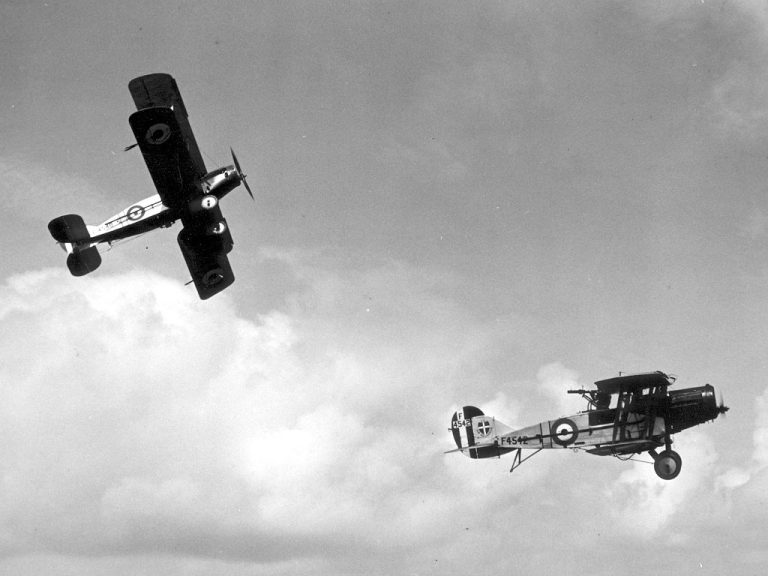
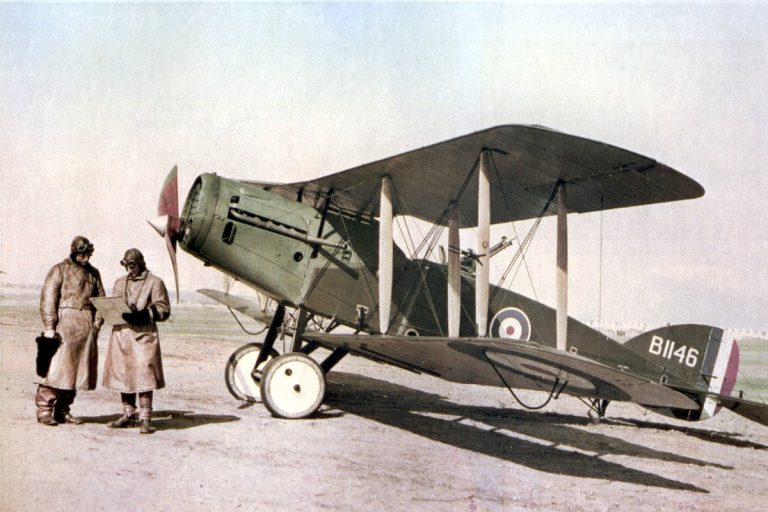
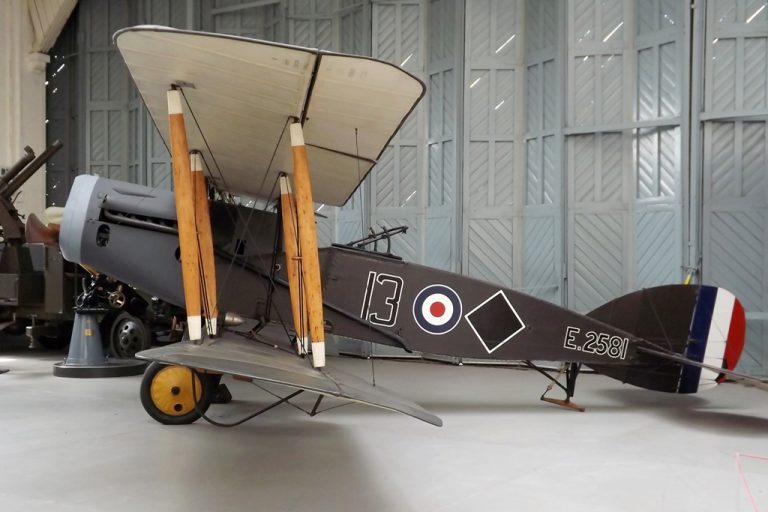
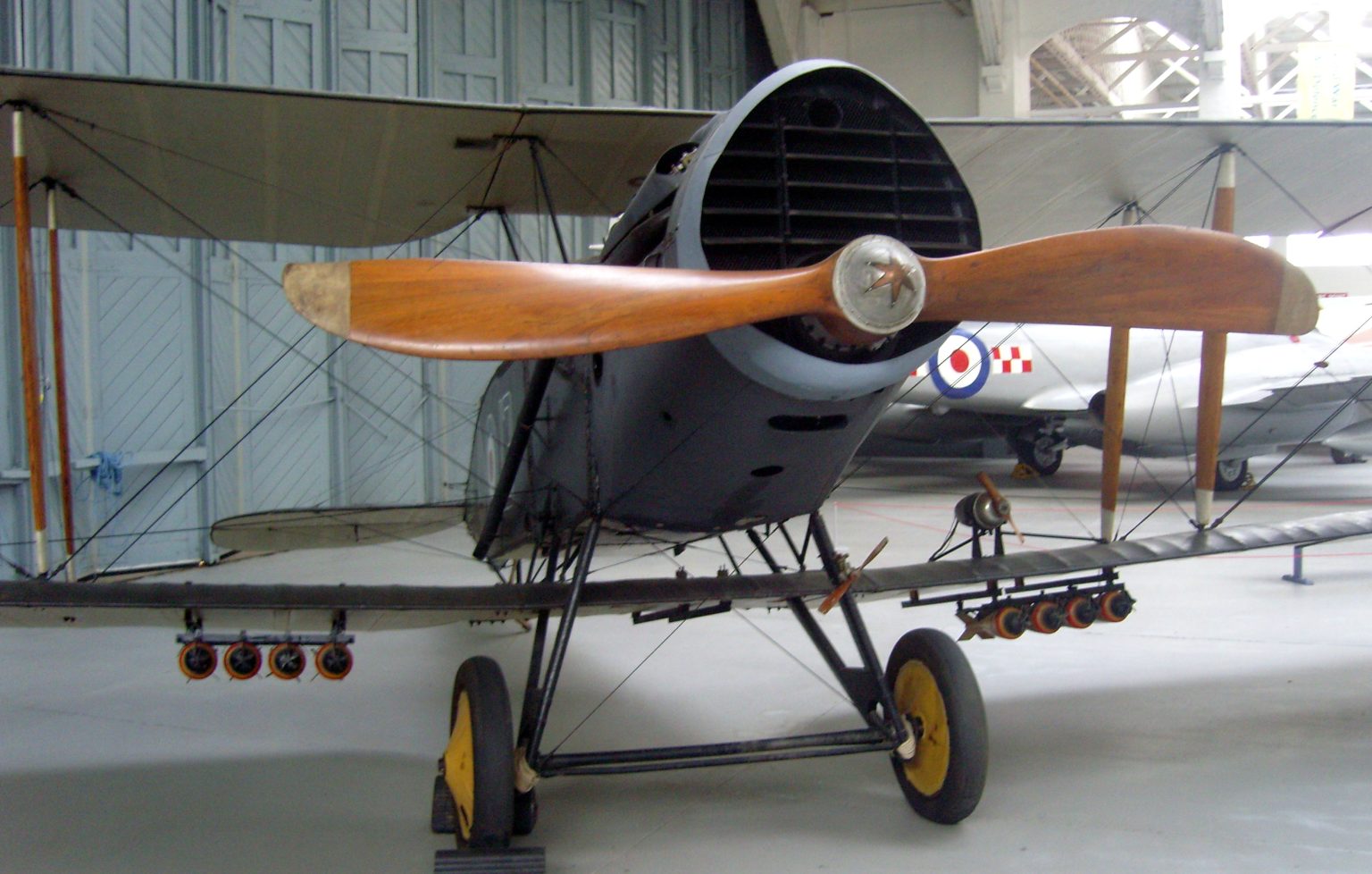
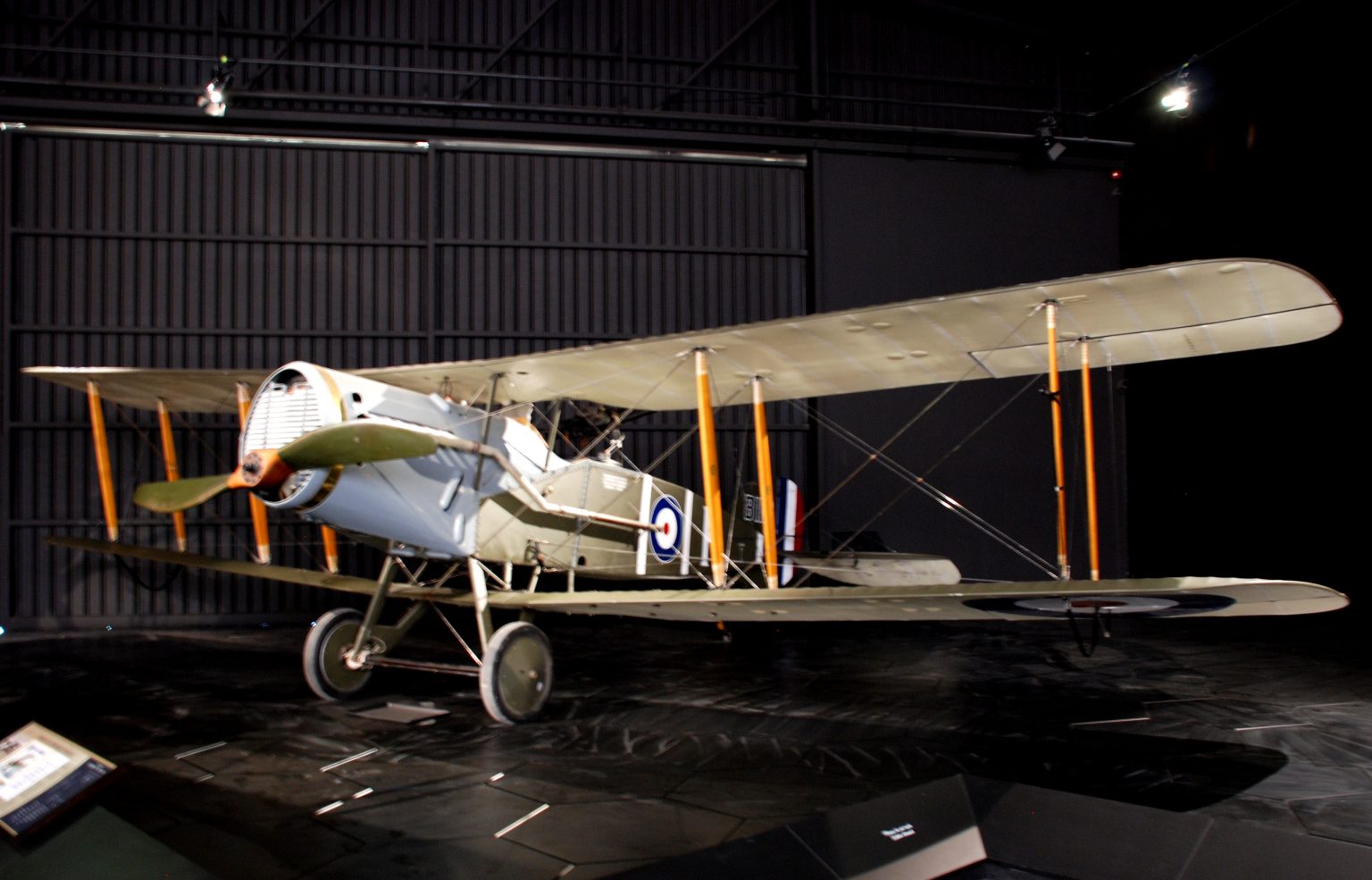
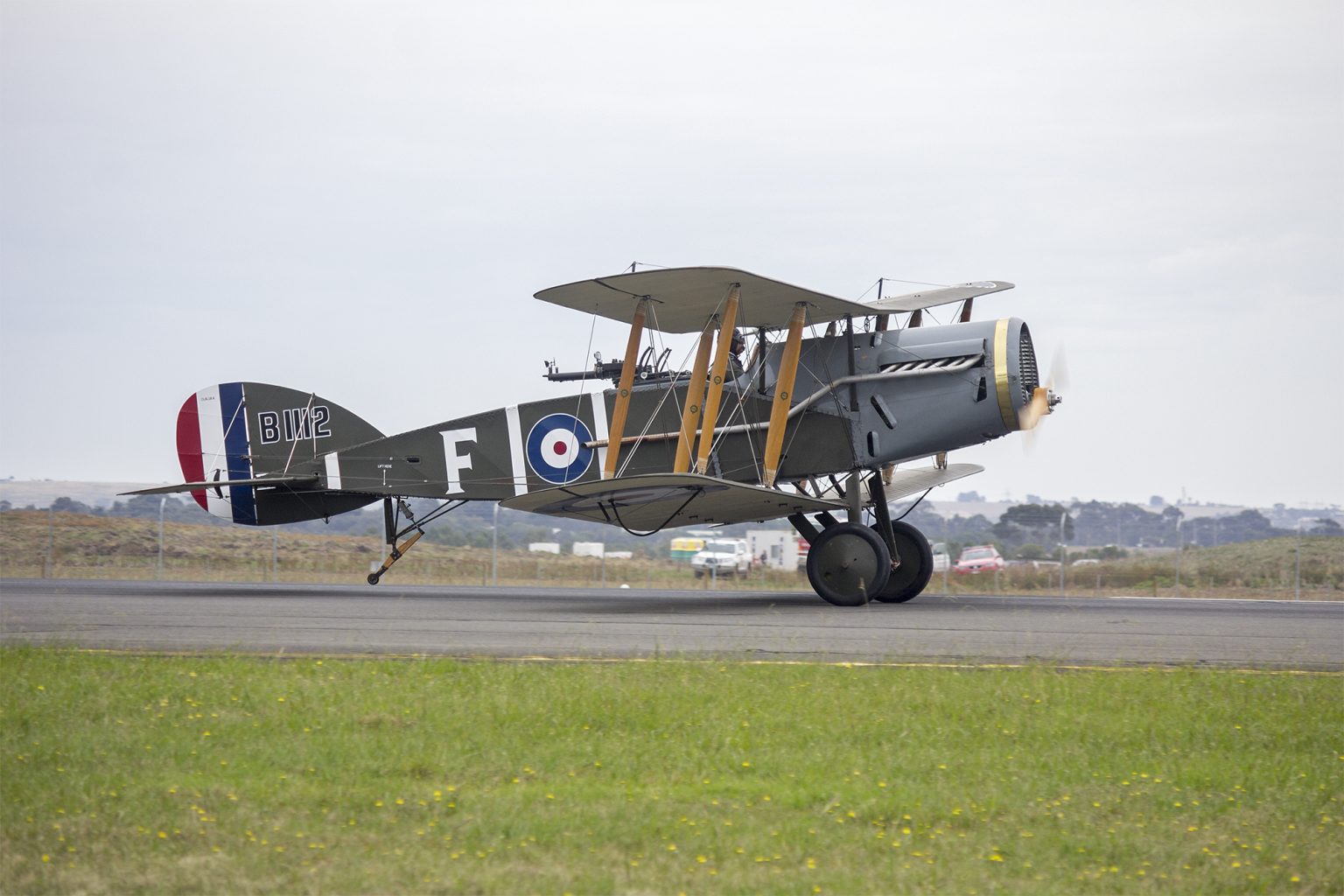
The Bristol Fighter on film: starting an airworthy F.2B
“How To Start A Bristol Fighter” — the Shuttleworth Trust, the custodians of the airworthy F.2B D8096, show how their Rolls-Royce Falcon-engined original is brought to life. Posted by the official operator’s channel (The Shuttleworth Trust), with several thousand views.
Where the Bristol Fighter served: origin, wartime fronts, exports and survivors
The Bristol Fighter was designed and built in Britain, fought in the hands of the RFC/RAF and Allied crews from 1917, went on to a long post-war career as an exported army-cooperation aircraft into the 1930s, and survives today in museums and, in one case, in the air. Toggle the categories to see each layer of its global story.
The Bristol Fighter’s combat record: from “easy meat” to one of the war’s most feared fighters
The Bristol Fighter’s reputation is a study in reversal. Its first weeks in action in April 1917 were a costly failure; within months, flown properly, it had become one of the outstanding fighting aircraft of the war and stayed in front-line service for fifteen years.
Precise victory-versus-loss figures for a type flown across so many fronts and roles are impossible to state with confidence, and any single number should be treated as an estimate. For how we handle contested air-combat figures, see our combat statistics methodology.
Everything people ask about the Bristol F.2 Fighter
Can I fly in a Bristol F.2 Fighter?
Why was the Bristol Fighter’s combat debut such a disaster?
What made the Bristol Fighter so effective once tactics changed?
Who designed the Bristol F.2 Fighter and what engine did it use?
How many Bristol Fighters were built and how long did it serve?
Are there any surviving Bristol Fighters?
What were the Bristol Fighter’s nicknames?
You can’t fly the Bristol Fighter.
These, you can.
No airline sells a seat in a 1917 Bristol Fighter, and its one airworthy survivor is a museum treasure, not a ride. But the feeling that made men climb into these machines — real flight in a real military aircraft — is something MiGFlug still makes possible today. From Cold War jet trainers to genuine fighters, here are aircraft you actually can fly in.
 Fly the L-39 AlbatrosThe world’s most-flown jet trainer — aerobatics included
 Fly the F-104 Starfighter“The missile with a man in it”
 Fly the MiG-21The Cold War’s most-produced jet
 Fly the T-33 Shooting StarAmerica’s first jet trainer
 Fly the DH VampireA piece of early jet history
 Fly the S.211Agile Italian jet trainer
 Fly the MB-326The classic Aermacchi jet
 Fly the MiG-15The Soviet legend of the Korean War
Continue through the Aircraft Museum
Every fact on this page, traceable
- Royal Air Force MuseumHoldings and reference material on the Bristol F.2B Fighter and its RAF service.
- Imperial War Museums (IWM)Bristol Fighter airframes and wartime photographs, including the aircraft at Duxford.
- The Shuttleworth CollectionCustodians of the airworthy Falcon-engined F.2B D8096 at Old Warden.
- The Vintage AviatorDetailed engineering and reproduction work on First World War types including the Bristol Fighter.
- Smithsonian National Air and Space MuseumReference material on First World War aircraft, engines and armament.
- Canada Aviation and Space MuseumPreserves an original Bristol F.2B in the national collection.
- Omaka Aviation Heritage CentreNew Zealand collection of Great War aircraft, including a Bristol Fighter.
- J. M. Bruce, The Aeroplanes of the Royal Flying Corps (Military Wing)The standard scholarly reference on RFC aircraft design and service.
- J. M. Bruce, Bristol Fighter (Windsock Datafile)Detailed monograph on the F.2A/F.2B, its engines and variants.
- MiGFlug — Afterburner MagazineMiGFlug’s own features on warbirds, fighter history and flying genuine military aircraft.
Contested or approximate figures — top speed, service ceiling, production totals and any cost estimate — are flagged as such in the text and specification tables. Performance figures are for the Rolls-Royce Falcon III-engined F.2B and vary with engine fit and altitude. Wikipedia is deliberately not used as a cited source.