
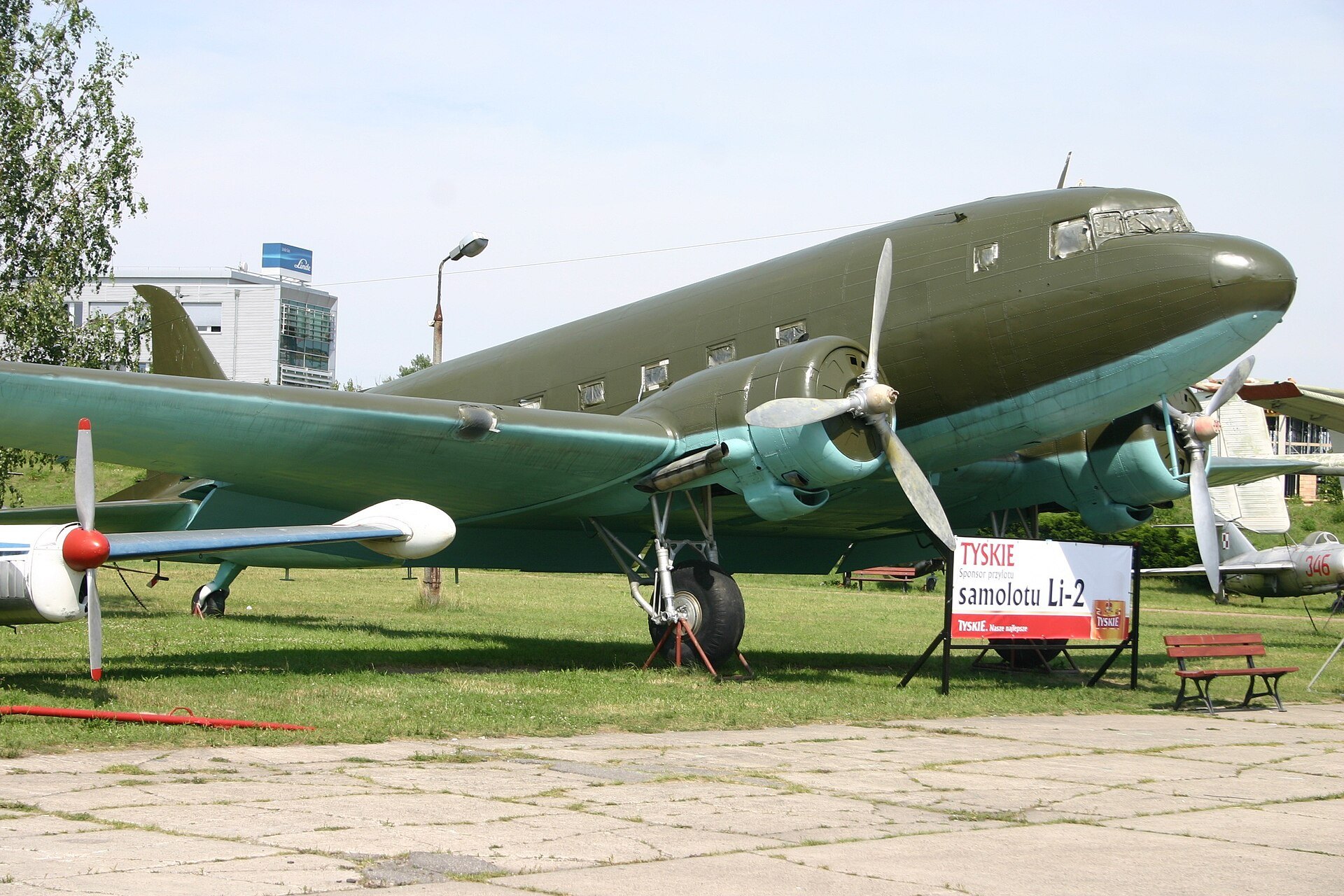
Lisunov Li-2
The Soviet DC-3
A licence-built DC-3 redrawn in metric for Soviet factories, the Li-2 became the Red Army’s transport, partisan supplier and night bomber, then the airliner of the Eastern bloc; one still flies in Hungary.
The Li-2: how the Soviet Union rebuilt the DC-3 in metric
In November 1936 a Soviet engineer named Boris Lisunov arrived at the Douglas Aircraft Company in Santa Monica. Moscow had bought a licence to build the DC-3 that July, and Lisunov’s job was to understand it well enough to build it at home. He spent nearly two and a half years there, with the young Vladimir Myasishchev, later a bomber designer in his own right, among his colleagues. The task was larger than copying. Every drawing had to be converted from inches to millimetres, American materials replaced with Soviet ones, and the design adapted to Soviet engines and Soviet weather. The result, about 1,300 engineering changes later, was first called the PS-84, and after the German invasion it became the Li-2.
Series production began in 1939 at Factory No. 84 at Khimki near Moscow. The Li-2 used Shvetsov ASh-62IR radials, developed from the Wright Cyclone, moved the passenger door to the right side, added a cargo door on the left and fitted engine shutters for extreme cold. When Germany invaded in June 1941, about 237 PS-84s had been built and the factory was evacuated to Tashkent, where production resumed in 1942. Kazan and, after the war, Komsomolsk-on-Amur also built the type, the Far Eastern plant turning out some 353 Li-2Ts between 1946 and 1950. Totals are disputed: the Smithsonian gives about 3,000, while later Russian research suggests nearly 4,900.
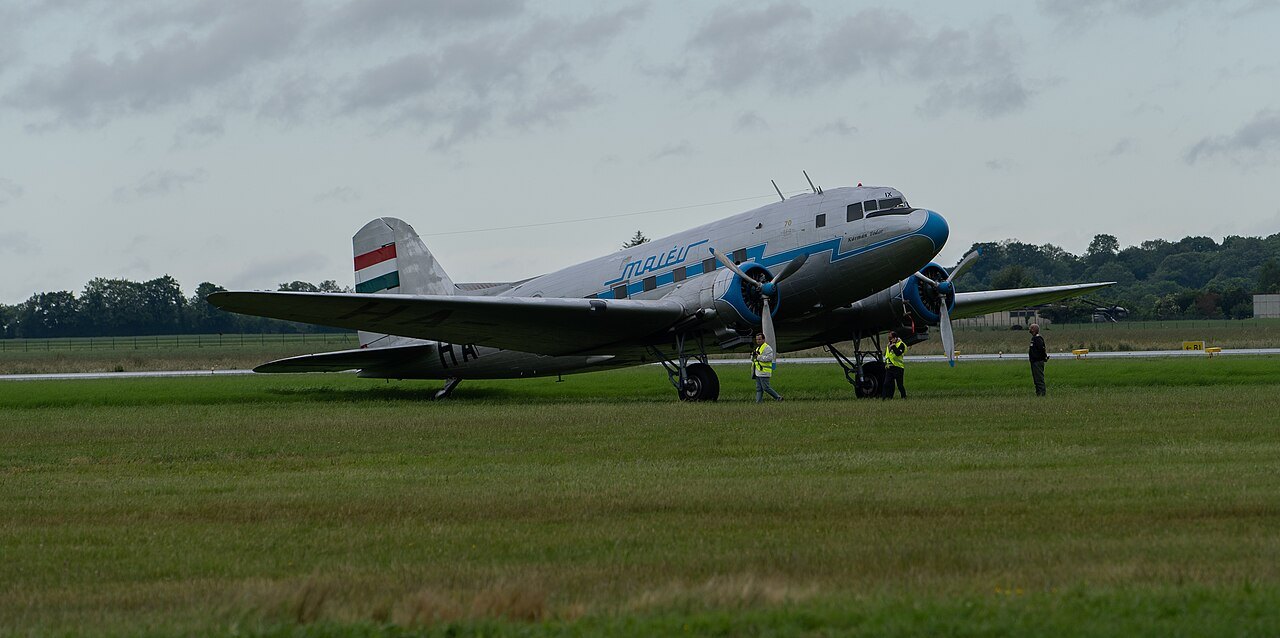
The war made it a military aircraft. Li-2s flew supplies into besieged cities, dropped paratroopers and supplies to partisans behind the lines, evacuated wounded and, fitted with a dorsal gun turret and bomb racks, flew night bombing missions with Long-Range Aviation. Polish paratroopers trained in the USSR jumped from them in 1943 and 1944. After 1945 the Li-2 was the airliner of Aeroflot, LOT, Malév, ČSA and other airlines, the transport of the new socialist air forces and a polar workhorse. China imported more than 200. A handful served into the 1980s, North Korea reportedly kept some even longer, and in Budapest the Goldtimer Foundation flies HA-LIX, the last airworthy Li-2.
01The Li-2’s war: partisans, paratroops and night bombers
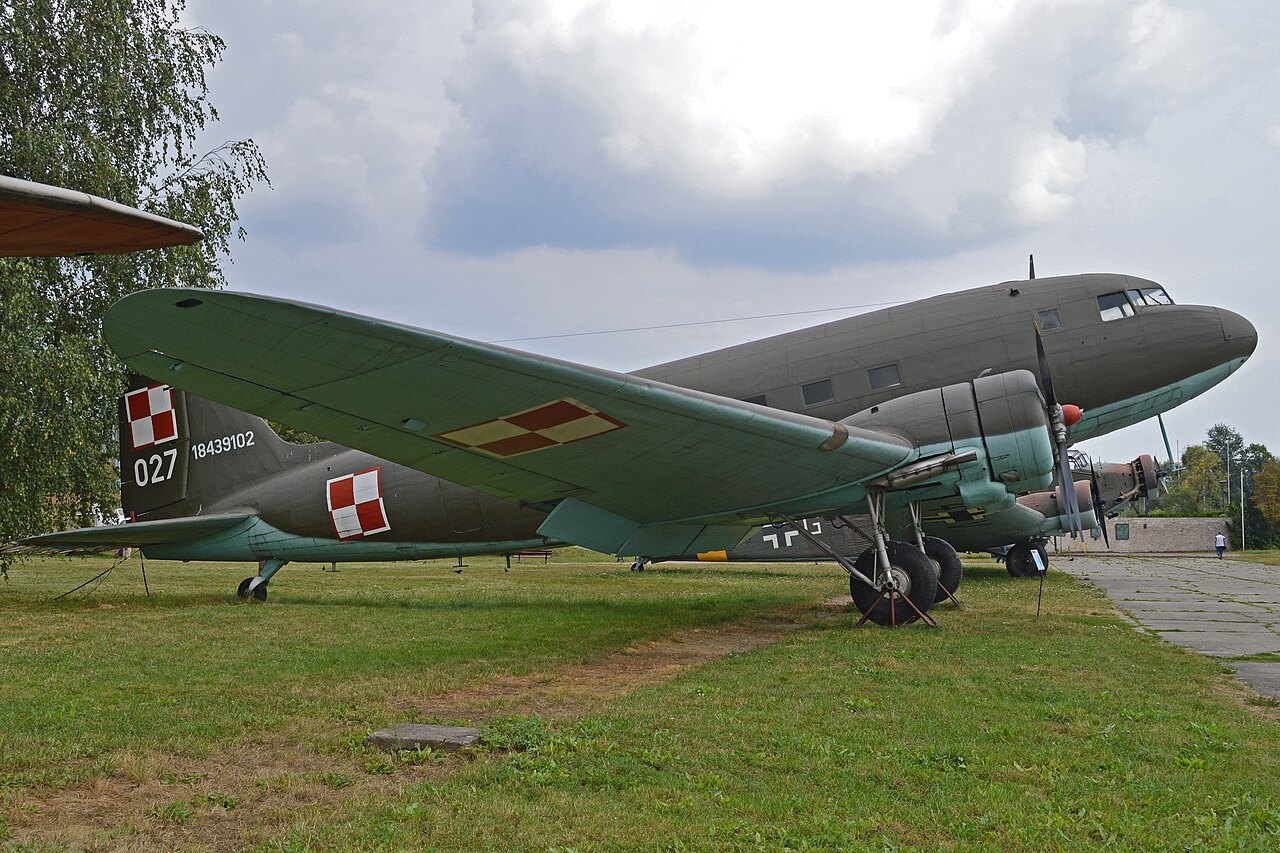
When the war began, most of the Soviet Union’s PS-84s were airliners with Aeroflot, and they were mobilised at once into transport units. They flew supplies into encircled and besieged cities, carried ammunition to the front and casualties back, and dropped paratroopers and supplies to partisan bands far behind German lines, often landing on improvised strips in forests at night. The Polish Aviation Museum notes that Polish paratroopers of the Independent Special Battalion jumped from Li-2s in 1943 and 1944, and that most Polish parachute drops from the east were made from the type.
The Li-2 was also armed. The military Li-2VV had a redesigned nose, a dorsal turret with a 7.62 mm ShKAS or 12.7 mm UBT machine gun and racks for bombs, and from 1944 the Li-2NB was built as a dedicated night bomber with a bombardier’s station and night bombsight. Long-Range Aviation used these aircraft for night attacks on targets behind the front, alongside its regular bombers. After the war, Long-Range Aviation kept a transport division of Li-2s; in January 1955 it still had 35.
02The Li-2 after 1945: airliner of the Eastern bloc
After 1945 the Li-2 was the standard airliner and transport of the Soviet Union and its allies until the Il-12 and Il-14 arrived, and it lingered long after. LOT Polish Airlines, Malév, ČSA, TABSO in Bulgaria, Tarom in Romania and the North Korean airline operated the type. Military transport units across the Warsaw Pact used it for parachute training and liaison. In Poland the last Li-2T flight, from Dęblin to Kraków, came on 13 May 1974.
In China the Li-2 served in large numbers with the air force and the national airline in the 1940s and 1950s, more than 200 being imported, and some of the last in service anywhere flew in China and Vietnam in the 1980s. Polar aviation used ski-equipped aircraft in the Arctic. By the time the type retired, it had served the Soviet bloc for more than four decades.
What makes the Li-2 special
A DC-3 redrawn in metric
The Soviet licence covered the DC-3, but Soviet factories worked in millimetres, used different alloys and gauges, and had different tooling. Lisunov’s team made about 1,300 changes to the Douglas drawings. The skins were often heavier, the hardware was all Soviet standard, and the result was a slightly heavier aircraft that looked almost identical to the American original from a distance.
Built for Russian winters
The Li-2 used Shvetsov ASh-62IR nine-cylinder radials, a Soviet development of the Wright R-1820 Cyclone, of about 900 to 1,000 hp. The engines had full cowling shutters to keep them warm in extreme cold, the aircraft could be fitted with skis, and the passenger door moved to the right side with a large cargo door on the left. Those details made it at home on frozen strips from Leningrad to Siberia.
Transport with a turret
Unlike most DC-3 derivatives, the Li-2 went to war armed. Military versions had a dorsal turret with a ShKAS or UBT machine gun, and some carried bombs on external racks for night raids. The Li-2NB of 1944 was a dedicated night bomber. Few other airliner designs ever served so directly as combat aircraft.
03The Li-2’s versions: from PS-84 to night bomber
- PS-84: pre-war airliner, built from 1939; about 237 by June 1941.
- Li-2: wartime and post-war designation for the type.
- Li-2VV: military transport and bomber with redesigned nose, dorsal turret and bomb racks.
- Li-2NB: dedicated night bomber of 1944 with bombardier station and night bombsight.
- Li-2D: paratroop transport with reinforced floor and cargo doors.
- Li-2T: post-war transport, built at Komsomolsk-on-Amur among others.
- Polar, photographic and other special-purpose versions, many on skis.
Lisunov Li-2 specifications
Specifications
- Crew
- 4
- Capacity
- about 19 to 24 passengers, or paratroops and cargo in military versions
- Length
- 19.65 m (64 ft 6 in)
- Wingspan
- 28.81 m (94 ft 6 in)
- Empty weight
- 7,700 kg (16,976 lb)
- Max take-off weight
- 11,280 kg (24,868 lb)
- Powerplant
- 2 × Shvetsov ASh-62IR radials, about 900–1,000 hp each
- Cruise speed
- about 240–260 km/h (150–160 mph)
- Range
- about 2,400–2,500 km (1,500–1,550 mi)
- Service ceiling
- about 5,600–6,000 m (18,400–19,700 ft)
- Armament
- military versions: dorsal turret with one 7.62 mm ShKAS or 12.7 mm UBT machine gun; bombs on external racks
Costs & production
- Cost per flight hour
- No published figure; a hedged estimate for the one airworthy Li-2 is in the low thousands of US dollars an hour, based on two large radials burning avgas, a 1949 airframe and the Goldtimer Foundation’s volunteer maintenance and sightseeing-flight funding
- Production
- About 3,000 (Smithsonian) to nearly 4,900 (later Russian research), 1939 to the early 1950s, at Khimki, Tashkent, Kazan and Komsomolsk-on-Amur
- Programme
- DC-3 licence 1936; PS-84 series production 1939; last service in China and Vietnam in the 1980s; HA-LIX flying again since 2001
04The Li-2’s operating costs: keeping HA-LIX in the air
The only airworthy Li-2 is HA-LIX, which the Goldtimer Foundation restored at Budaörs between 1997 and 2001. Its restoration took tens of thousands of hours: Hungarian press reported some 40,000, using original Russian components except for modern GPS and transponder equipment, and two years were needed just to strip the old paint with about 500 litres of stripper. It first flew again on 21 September 2001 and received its certificate of airworthiness on 15 April 2002. Today the foundation funds its operation partly with sightseeing flights over Budapest, held on the first Saturday of each month from June to October.
The Li-2 from Santa Monica to Budaörs
The licence
The Soviet Union buys a licence for the DC-3 on 15 July; Boris Lisunov goes to Douglas in November.
Series production
The PS-84 enters production at Factory No. 84, Khimki, after Lisunov returns in April.
Evacuation
About 237 PS-84s have been built when Germany invades; the factory moves to Tashkent.
Tashkent
Production restarts in Tashkent in January, and the type becomes the Li-2.
Polish paratroopers
Polish airborne troops in the USSR begin jumping from Li-2s.
Night bomber
The Li-2NB night bomber version appears.
HA-LIX built
The aircraft that will become the last airworthy Li-2 is built in Tashkent.
Poland’s last flight
The last Polish Li-2T flight, Dęblin to Kraków, on 13 May.
HA-LIX flies again
After a four-year restoration, the Goldtimer Foundation’s Li-2 flies on 21 September.
Over Normandy
HA-LIX joins the D-Day 75th anniversary flights, dropping paratroopers alongside C-47s.
Stories & eyewitnesses: the Li-2 at war and on the airlines
Lisunov in Santa Monica
A Soviet engineer spent nearly three years inside Douglas.
Read the full story
Behind the lines
Li-2s kept the partisan war supplied.
Read the full story
Polish paratroopers from the east
Most Polish drops from the USSR used the Li-2.
Read the full story
An airliner that bombed
Long-Range Aviation flew Li-2s at night against the front.
Read the full story
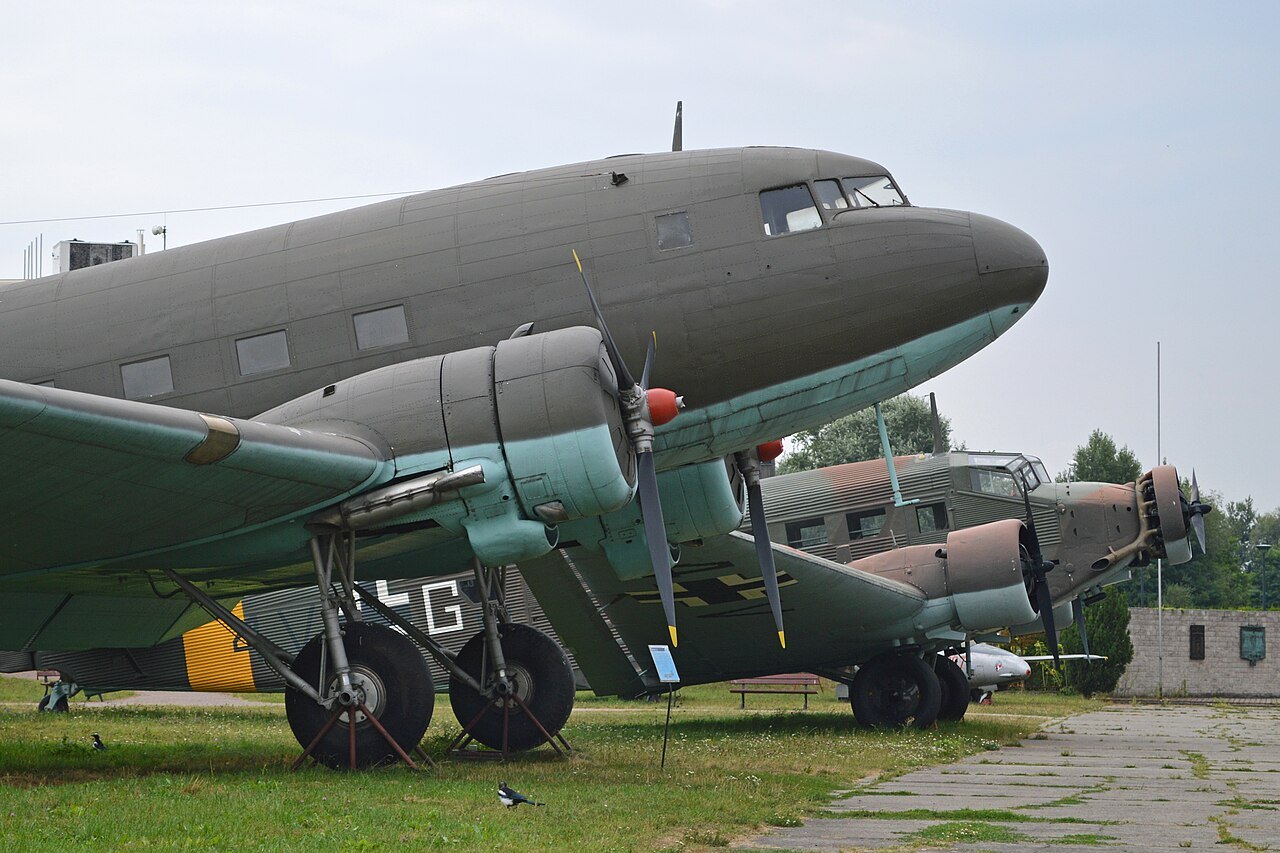
The Kraków Li-2
A 1943 veteran that served Poland until 1974.
Read the full story
HA-LIX reborn
A Hungarian foundation brought the last Li-2 back to life.
Read the full story
Over Omaha Beach
The Li-2 flew with the C-47s at D-Day 75.
Read the full story
LOT’s workhorse
Poland’s airline flew up to forty Li-2s.
Read the full story
The Li-2 in pictures
Where the Li-2 flies and flew
The Li-2’s record
The Li-2 was the Soviet Union’s most important transport of the Second World War, and unusually for a DC-3 derivative it also flew as an armed night bomber. It supplied partisans, besieged cities and the front, dropped paratroopers including Polish units, and after the war served the airlines and air forces of the Eastern bloc into the 1980s.
See how training and combat types compare in the military aircraft statistics database. Figures are approximate.
Everything people ask about the Li-2
Can I fly in a Lisunov Li-2?
Is the Li-2 the same as a DC-3?
Why is it called the Li-2?
How many Li-2s were built?
Did the Li-2 fly in combat?
Is any Li-2 still flying?
You can’t fly the Li-2.
These, you can.
Most of this museum you can only look at. These genuine military jets you can fly yourself with MiGFlug — with aerobatics and time on the controls.
 Fly the L-39 AlbatrosThe world’s most-flown jet trainer — aerobatics included
 Fly the F-104 Starfighter“The missile with a man in it”
 Fly the MiG-21The Cold War’s most-produced jet
 Fly the T-33 Shooting StarAmerica’s first jet trainer
 Fly the DH VampireA piece of early jet history
 Fly the S.211Agile Italian jet trainer
 Fly the MB-326The classic Aermacchi jet
 Fly the MiG-15The Soviet legend of the Korean War
Continue the tour
Every fact, checked
- Li-2 HA-LIXGoldtimer Foundation on the restoration and specifications of the last airworthy Li-2
- Goldtimer FoundationThe foundation, its Li-2 and its flights
- Lisunow Li-2 (lic. DC-3)Polish Aviation Museum on the type, Polish paratroopers and post-war service
- Douglas DC-3Smithsonian National Air and Space Museum: about 3,000 Li-2s built under licence
- Hungarian success in Normandy at the D-Day 75th anniversaryOrigo (Hungary) on HA-LIX at the 2019 Normandy commemorations
- Long-Range Aviation in 1955Dvigatel magazine: Long-Range Aviation order of battle including its Li-2 transport division
- LOT historyLOT Polish Airlines history with its Li-2 and Il-14